
Introduction
Tire Maintenance Guide | A car can start perfectly, have fresh engine oil, a healthy battery, and a full fuel tank, yet still have a serious problem if its tires are neglected. Tires are the only parts of the vehicle that remain in direct contact with the road, so their condition affects steering, braking, stability, comfort, fuel consumption, and overall driving safety.
Many tire problems also develop gradually. A tire may lose pressure without looking flat, develop uneven tread wear without making much noise, or suffer sidewall damage that isn’t obvious from the driver’s seat.
That’s why regular tire care should be part of every vehicle maintenance routine.
For drivers who want a complete approach to vehicle care, Fuel Delivery Dubai provides a useful starting point for understanding broader vehicle-related services and maintenance information.
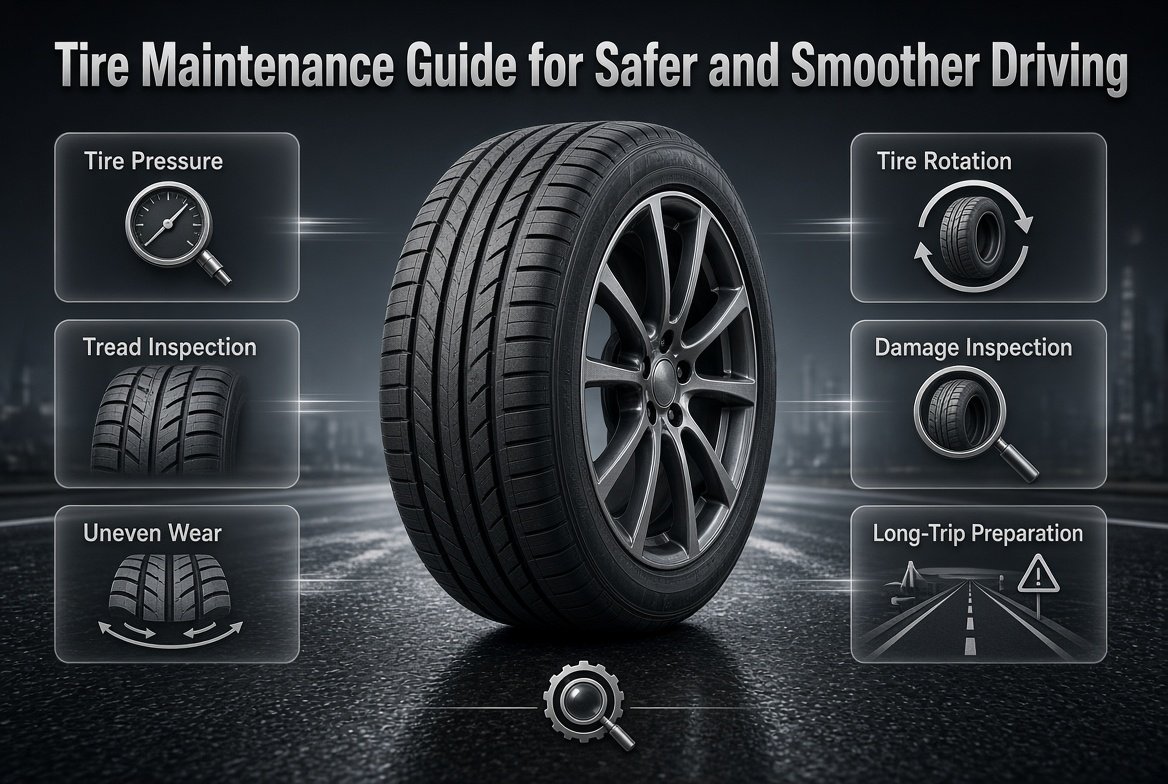
This tire maintenance guide explains how to check tire pressure, inspect tread, identify uneven wear, understand tire rotation, recognize damage, prepare tires for long journeys, and know when professional inspection or replacement is necessary.
What Is Tire Maintenance?
Tire maintenance is the regular process of checking tire pressure, tread depth, physical condition, wear patterns, wheel condition, and related components to keep tires operating properly. It also includes rotation, balancing, alignment checks, and replacement when a tire is worn, damaged, or aged beyond its safe service condition.
Tire maintenance isn’t one single job.
It is a combination of small checks that help you identify problems before they become more expensive or disruptive.
A proper tire maintenance routine normally includes:
- Checking tire pressure
- Inspecting tread condition
- Checking sidewalls
- Looking for punctures and embedded objects
- Monitoring uneven wear
- Checking tire age
- Rotating tires when recommended
- Checking wheel balance when necessary
- Checking alignment when symptoms appear
- Inspecting the spare tire
- Replacing damaged or excessively worn tires
The important point is consistency.
You don’t need to spend an hour inspecting your tires every day. A few minutes of regular attention can reveal problems that might otherwise remain unnoticed.
The National Highway Traffic Safety Administration recommends regular attention to tire inflation, tread, damage, rotation, balancing, and alignment. It also notes that proper inflation affects safety, durability, and fuel consumption.
Why Is Tire Maintenance So Important?
Proper tire maintenance helps the tires maintain their intended contact with the road and can support better handling, braking, durability, comfort, and fuel efficiency. Neglected tires can develop pressure, wear, or structural problems that may affect vehicle control.
Think about what happens during normal driving.
When you accelerate, tires transfer engine power to the road.
When you brake, the tires help convert braking force into deceleration.
When you turn, the tires provide the grip needed to follow the steering direction.
When you drive over water, the tread pattern helps channel water away from the contact area.
This means tire condition directly affects how your vehicle behaves.
Poor tire maintenance can contribute to:
- Uneven tire wear
- Reduced tire life
- Poor handling
- Increased rolling resistance
- Increased fuel consumption
- Reduced wet-road traction
- Steering vibration
- Vehicle pulling
- Greater risk of tire failure
A tire problem can also become more difficult to deal with when it happens during a long highway trip or in an unfamiliar area.
That’s why tire maintenance is preventive maintenance rather than simply cosmetic care.
How Often Should You Check Your Tires?
A practical tire maintenance routine should include regular pressure checks and visual inspections.
NHTSA recommends checking tire pressure at least monthly and before long trips, including the spare tire where applicable. It also recommends inspecting tread and tire damage regularly.
A simple routine can look like this:
| Tire Check | Suggested Routine |
|---|---|
| Tire pressure | At least monthly and before long trips |
| Visual inspection | Regularly |
| Tread condition | During pressure checks |
| Sidewall inspection | During routine inspections |
| Tire rotation | According to manufacturer guidance |
| Wheel alignment | When symptoms or inspection indicate |
| Wheel balancing | When vibration or installation requires it |
| Spare tire | During regular vehicle maintenance |
| Tire age | Periodically review |
These aren’t universal replacement rules.
Your vehicle manufacturer’s recommendations should always take priority because tire size, drivetrain, wheel configuration, load requirements, and tire design can vary.
Pro Tip: The best tire maintenance routine is the one you actually follow. A simple monthly inspection is far more useful than a complicated maintenance plan that gets forgotten.
How to Check Tire Pressure Correctly
Check tire pressure with an accurate gauge when the tires are cold and compare the reading with the pressure specified by the vehicle manufacturer. The recommended pressure is normally found on the driver’s door-area tire information label or in the owner’s manual—not by simply using the maximum pressure printed on the tire sidewall.
This is one of the most important points in tire maintenance.
The number printed on the tire itself can be misunderstood.
The tire sidewall may show a maximum inflation pressure, while your vehicle manufacturer specifies the pressure the tire should normally have on that particular vehicle.
Those numbers serve different purposes.
Where Can You Find the Correct Tire Pressure?
Check:
- Driver’s door jamb
- Driver’s door pillar
- Tire and loading information label
- Owner’s manual
- Manufacturer’s documentation
Some vehicles specify different pressures for the front and rear tires.
Some also provide different recommendations depending on vehicle load.
Always follow the manufacturer’s information for your specific vehicle.
Step-by-Step Tire Pressure Check
Step 1: Let the Tires Cool
For the most useful pressure reading, check the tires when they are cold.
A cold tire generally means the vehicle hasn’t been driven for several hours.
Driving heats the tires and increases the pressure temporarily, so comparing a warm reading directly with the cold specification can be misleading. NHTSA defines cold tires for this purpose as tires that haven’t been driven for at least about three hours.
Step 2: Find the Manufacturer’s Recommended Pressure
Don’t guess.
Locate the vehicle information label or owner’s manual and note the recommended pressure for the front and rear tires.
Step 3: Remove the Valve Cap
Remove the valve cap carefully.
Keep it clean and don’t leave it on the ground where dirt can enter the valve area.
Step 4: Measure the Pressure
Press the gauge firmly against the valve stem.
Record the reading.
Check all four tires rather than assuming they’re identical.
Step 5: Adjust the Pressure
If pressure is low, add air gradually.
If it’s too high, release air carefully and recheck.
Step 6: Recheck
After adjustment, measure again.
Then replace the valve cap.
Common Mistake: Many drivers check one tire and assume the others have the same pressure. Tires can lose air at different rates, so each tire should be checked individually.
What Happens When Tire Pressure Is Too Low?
Low tire pressure is one of the most common tire maintenance problems.
An underinflated tire can flex more than intended as it rolls. That additional flexing can contribute to heat buildup, increased rolling resistance, uneven wear, and potentially tire failure.
Low pressure can affect:
- Steering response
- Vehicle stability
- Braking behavior
- Fuel economy
- Tire wear
- Tire durability
- Driving comfort
One of the frustrating things about underinflation is that it may not be visually obvious.
A tire can be significantly underinflated without looking completely flat.
That’s why checking by hand or simply looking at the tire isn’t enough.
Use a pressure gauge.
NHTSA specifically notes that visual inspection isn’t a reliable substitute for measuring inflation pressure and recommends regular gauge checks.
What Happens When Tire Pressure Is Too High?
Overinflation isn’t a good tire maintenance strategy either.
Some drivers assume that adding extra air will improve fuel economy.
That’s not an appropriate reason to exceed the vehicle manufacturer’s specified pressure.
Excessive inflation can affect:
- Ride comfort
- Contact characteristics
- Tread wear
- Handling
- Impact sensitivity
The objective is not maximum pressure.
The objective is correct pressure.
Follow the vehicle manufacturer’s specification for the actual vehicle and load condition.
What Does the TPMS Warning Light Mean?
Modern vehicles may have a Tire Pressure Monitoring System, commonly called TPMS.
The system monitors tire pressure and can warn the driver when pressure becomes significantly low.
However, TPMS shouldn’t replace regular manual checks.
A warning light generally means the tire pressure has already dropped enough for the system to trigger a warning. It isn’t designed to tell you that your tires are perfectly maintained every day.
If the TPMS warning appears:
- Don’t ignore it.
- Check tire pressure as soon as practical.
- Inspect the tires for visible damage.
- Add air if required.
- Investigate repeated pressure loss.
- Have the vehicle inspected if the warning continues.
NHTSA specifically advises that TPMS is not a substitute for routine tire maintenance.
How to Check Tire Tread
Tire tread should be inspected for remaining depth, even wear, damage, and embedded objects. Don’t inspect only the center of the tire; check the inner shoulder, center, and outer shoulder because different wear patterns can reveal different problems.
Tread performs an important job.
It helps provide traction and helps manage water between the tire and road surface.
As tread wears, the tire’s ability to perform in wet conditions can be affected.
NHTSA identifies 2/32 inch as the minimum tread depth at which tires should be replaced and also points drivers toward the built-in treadwear indicators. Always consider applicable local requirements and manufacturer guidance as well.
Check the Entire Tread
Look at:
- Inner edge
- Center
- Outer edge
Then compare the wear from one tire to another.
You aren’t only asking:
“Is there enough tread?”
You’re also asking:
“Is the tire wearing normally?”
That second question is extremely important.
What Does Uneven Tire Wear Mean?
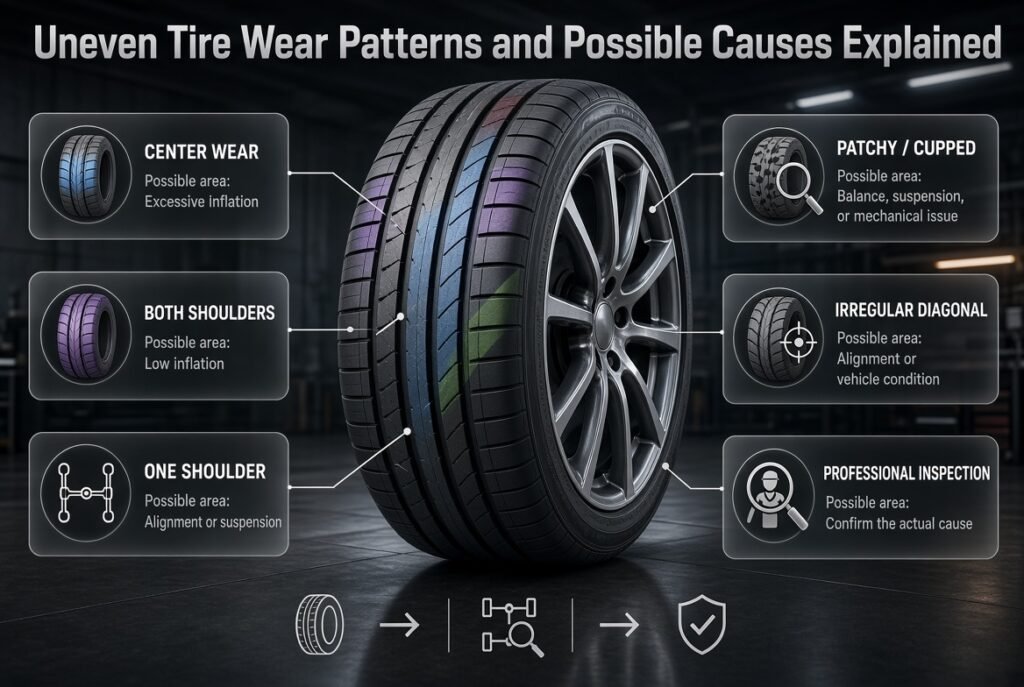
Uneven tire wear is a warning sign that shouldn’t automatically be dismissed.
Different patterns can suggest different causes.
| Wear Pattern | Possible Area to Investigate |
|---|---|
| Center worn more heavily | Excessive inflation |
| Both shoulders worn | Low inflation |
| One shoulder worn | Alignment or suspension |
| Patchy/cupped wear | Balance, suspension, or other mechanical issue |
| Irregular diagonal wear | Alignment or other vehicle condition |
These patterns are clues rather than guaranteed diagnoses.
For example, shoulder wear doesn’t automatically prove that tire pressure was low.
A professional inspection may be needed to determine the actual cause.
If the same unusual wear returns after fitting new tires, investigate the vehicle rather than repeatedly replacing tires.
Why Tire Rotation Matters
Tire rotation means moving tires between approved wheel positions according to the vehicle and tire manufacturer’s recommended pattern. When rotation is appropriate, it can help distribute wear more evenly and potentially extend usable tire life.
Front and rear tires don’t always experience identical forces.
Depending on the vehicle, the front tires may deal with:
- Steering
- Braking forces
- Drive forces
- Greater cornering loads
Regular rotation can help reduce differences in wear when the vehicle manufacturer recommends it.
However, not every vehicle can use the same rotation pattern.
Some vehicles have:
- Directional tires
- Staggered tire sizes
- Different front and rear tire sizes
- Asymmetric designs
- Specific rotation restrictions
NHTSA recommends following the vehicle owner’s manual for both rotation frequency and pattern and notes that some vehicles aren’t suitable for conventional rotation.
Expert Tip: Never assume “front to back” is automatically correct. Check the tire design and vehicle manufacturer’s instructions first.
Tire Balancing vs Wheel Alignment
These two services are often confused, but they solve different problems.
Tire Balancing
Balancing addresses weight distribution around the wheel-and-tire assembly.
An imbalance can contribute to:
- Steering-wheel vibration
- Vehicle vibration
- Uneven tire wear
- Reduced driving comfort
New tires are normally balanced during installation.
Wheel Alignment
Alignment concerns the angles and positioning of the wheels relative to the vehicle and road.
Alignment problems can contribute to:
- Vehicle pulling
- Off-center steering wheel
- Uneven tire wear
- Reduced tire life
NHTSA identifies both balancing and alignment as important parts of tire maintenance and notes that alignment can help prevent a vehicle from pulling to one side and help maximize tire life.
When Should You Check Wheel Alignment?
You don’t necessarily need an alignment adjustment every time you inspect your tires.
However, an alignment inspection is worth considering when:
- The vehicle pulls to one side
- Steering wheel isn’t centered
- One tire wears faster than another
- A tire develops unusual shoulder wear
- The vehicle has hit a significant pothole or curb
- Suspension components have been repaired
- Steering components have been replaced
- New abnormal handling appears
If you notice an unusual wear pattern, don’t simply rotate the tires and forget about it.
Rotation can redistribute the problem without correcting the underlying cause.
Brake Maintenance Basics for Safer Driving
A reliable braking system depends on more than simply replacing brake pads when they wear out. Brake pads, discs, calipers, brake fluid, hoses, warning lights, and pedal feel all deserve attention as part of regular vehicle care. If you want a practical overview of brake inspections, common warning signs, brake-fluid maintenance, driving-related wear, and situations that require prompt attention, follow our Brake Maintenance Basics guide. It provides a detailed approach to understanding your braking system and identifying potential problems before they become more serious. fueldeliverydubai.com
How Suspension Problems Can Affect Tires
Tires don’t work independently from the suspension system.
Suspension components help control wheel movement and tire contact with the road.
Problems involving components such as:
- Shock absorbers
- Struts
- Bushings
- Control arms
- Ball joints
- Wheel bearings
- Steering components
can potentially contribute to abnormal tire wear or handling symptoms.
This is why tire replacement alone isn’t always the solution.
If a tire keeps wearing abnormally, the vehicle should be inspected as a complete system.
How to Inspect Tire Sidewalls
Sidewalls deserve the same attention as tread.
When inspecting your tires, look for:
- Cuts
- Cracks
- Bulges
- Deep scrapes
- Punctures
- Exposed internal material
- Unusual deformation
- Impact damage
A sidewall bulge is particularly important.
It can indicate internal structural damage and should not be treated as a minor cosmetic issue.
If you notice a significant bulge, cut, or other serious damage, avoid unnecessary driving and have the tire assessed by a qualified tire professional.
NHTSA advises drivers to inspect both tread and sidewalls for cuts, punctures, bulges, scrapes, cracks, and other damage.
What Should You Do If a Tire Has a Nail or Screw?
Finding a nail or screw in the tread doesn’t always mean the tire must immediately be thrown away.
However, you should avoid making a quick assumption.
First:
- Check the tire pressure.
- Look at how quickly pressure is changing.
- Avoid pulling the object out unnecessarily.
- Have the tire professionally inspected.
- Determine whether a proper repair is possible.
Whether a puncture can be repaired depends on factors such as:
- Puncture location
- Puncture size
- Tire condition
- Previous repairs
- Whether the tire was driven while severely underinflated
Sidewall damage generally requires much more caution than a suitable tread-area puncture.
How Does Tire Age Affect Maintenance?
A tire doesn’t become safe or unsafe based on tread depth alone.
Rubber and tire materials change with age and exposure to environmental conditions.
Over time, a tire may develop:
- Cracking
- Hardening
- Reduced flexibility
- Surface deterioration
- Structural aging
This means a tire with reasonable tread can still deserve professional evaluation if it is old or shows signs of deterioration.
The age of a tire can be identified through its Tire Identification Number, commonly associated with the DOT marking. The last four digits indicate the week and year of manufacture.
NHTSA notes that some vehicle and tire manufacturers recommend replacement based on age, including recommendations in the six-to-ten-year range depending on manufacturer guidance.
The important lesson is simple:
Don’t judge tire condition by tread depth alone.
Does Hot Weather Affect Tire Maintenance?
Hot climates make consistent tire maintenance particularly important.
When the vehicle is driven, tires naturally become warmer. Pressure changes as temperature changes.
This is why cold-pressure measurement is useful for comparing your tire pressure with the vehicle manufacturer’s specification.
For drivers in Dubai and other hot climates, additional attention can be useful because vehicles may experience:
- High ambient temperatures
- Hot road surfaces
- Heavy traffic
- Long highway journeys
- Frequent acceleration and braking
- High air-conditioning use
- Dust and road debris
These conditions don’t mean tires automatically become unsafe.
They simply make routine inspection more important.
How Does Tire Pressure Affect Fuel Economy?
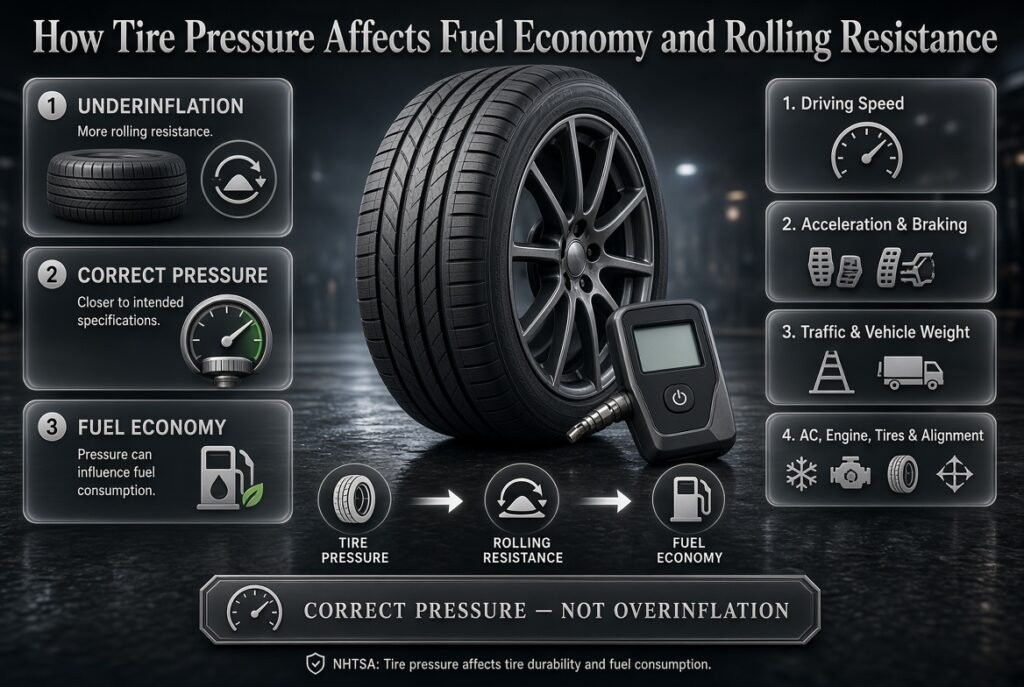
Tire pressure can affect rolling resistance and fuel consumption. Underinflated tires generally require more energy to roll, which can reduce fuel efficiency. Correct inflation helps the vehicle operate closer to its intended specifications.
However, tire pressure is only one part of fuel economy.
Fuel consumption can also be influenced by:
- Driving speed
- Acceleration
- Braking habits
- Traffic
- Vehicle weight
- Air conditioning
- Engine condition
- Tire type
- Wheel alignment
So the goal shouldn’t be to inflate tires beyond specification to save fuel.
The goal is correct pressure.
NHTSA identifies tire pressure as an important factor in both tire durability and fuel consumption.
Tire Maintenance Before a Long Road Trip
A long journey is one of the worst times to discover a preventable tire problem.
Before leaving, inspect the tires properly.
Long-trip tire checklist:
- Check cold tire pressure
- Check all four tires
- Inspect tread
- Inspect sidewalls
- Look for punctures
- Check for uneven wear
- Check the spare
- Check the jack and required equipment
- Confirm tire size and condition
- Check for warning lights
- Make sure the vehicle isn’t overloaded
NHTSA specifically recommends checking tires before long trips and inspecting pressure, tread, damage, and spare-tire condition.
If you’re preparing the whole vehicle rather than just the tires, your broader Vehicle Maintenance Guides can be used alongside this tire checklist.
How Vehicle Load Affects Tire Maintenance
A vehicle’s load matters because tires are designed to operate within specific load limits.
If you’re carrying:
- Multiple passengers
- Heavy luggage
- Tools
- Equipment
- Large quantities of goods
you should make sure the vehicle remains within its manufacturer’s specified load capacity.
Overloading can increase stress on tires and other vehicle components.
Don’t assume that adding more air automatically makes an overloaded vehicle safe.
Correct inflation and correct load are separate considerations.
Always follow the vehicle manufacturer’s load and tire-pressure information.
Don’t Forget the Spare Tire
One of the most commonly forgotten tire maintenance tasks is checking the spare.
A spare tire can sit unused for years.
That doesn’t mean it remains ready indefinitely.
Check:
- Air pressure
- Physical condition
- Age
- Cracks
- Storage condition
- Correct size/type
- Jack
- Wheel wrench
- Required tools
NHTSA specifically recommends checking the spare as part of regular tire maintenance.
Quick Tip: A spare tire is emergency equipment. You don’t want to discover that it is flat at the exact moment you need it.
Common Tire Maintenance Mistakes
Mistake 1: Checking Pressure Only When the Tire Looks Flat
A tire can be significantly underinflated without looking obviously flat.
Better approach:
Use a gauge regularly.
Mistake 2: Using the Sidewall Pressure as the Normal Pressure
The number printed on the tire may be misunderstood as the vehicle’s required pressure.
Better approach:
Use the vehicle manufacturer’s recommended pressure.
Mistake 3: Checking Only One Tire
Different tires can lose pressure at different rates.
Better approach:
Check all four tires and the spare where applicable.
Mistake 4: Ignoring Uneven Wear
Uneven wear isn’t always cosmetic.
It may indicate a problem involving:
- Inflation
- Alignment
- Balance
- Suspension
- Steering
- Wheel condition
Better approach:
Investigate the cause.
Mistake 5: Driving on a Damaged Sidewall
A tire may still hold air after suffering impact damage.
That doesn’t automatically mean it’s safe.
Better approach:
Have serious sidewall damage professionally assessed.
Mistake 6: Assuming New Tires Solve Everything
If the vehicle has an alignment or suspension problem, new tires may eventually develop the same abnormal wear.
Better approach:
Find and correct the underlying problem.
Mistake 7: Forgetting Tire Age
Tread depth is only one part of tire condition.
Better approach:
Check tire age and physical condition as well.
Mistake 8: Ignoring the Spare
A spare can become old, underinflated, or damaged while sitting unused.
Better approach:
Inspect it during regular maintenance.
A Practical Monthly Tire Maintenance Routine
You don’t need a complicated process.
Choose one regular day each month.
Step 1: Check all tire pressures
Use a reliable gauge and compare readings with the vehicle manufacturer’s specifications.
Step 2: Walk around the vehicle
Look for obvious damage.
Step 3: Inspect the tread
Check for:
- Low tread
- Uneven wear
- Embedded objects
- Cracking
- Irregular patterns
Step 4: Inspect sidewalls
Look for cuts, bulges, cracks, and impact damage.
Step 5: Look for differences
Compare the four tires.
One tire that looks significantly different from the others deserves attention.
Step 6: Check the spare
Don’t leave it out of the routine.
Step 7: Record unusual findings
If one tire keeps losing pressure or wearing differently, make a note.
This makes it easier to explain the problem during a professional inspection.
How Tire Maintenance Fits Into Complete Vehicle Maintenance
Tires are one part of a much larger maintenance system.
A well-maintained vehicle should be inspected across multiple areas.
These may include:
- Tires
- Brakes
- Suspension
- Steering
- Engine oil
- Coolant
- Brake fluid
- Battery
- Lights
- Wipers
- Belts
- Filters
- Fuel system
If you’re building a complete maintenance routine, don’t treat tires as an isolated task.
For example, your Essential Car Fluids guide can help you understand the fluids that support different vehicle systems.
If you’re checking fluid condition during the same maintenance session, the Vehicle Fluid Inspection guide provides additional guidance.
This approach makes vehicle maintenance more organized rather than waiting for individual problems to appear.
Engine Oil, Coolant and Tire Maintenance: Why They Belong Together
Tire maintenance obviously isn’t the same as engine maintenance.
However, both belong to the same preventive approach.
Engine oil supports lubrication and engine operation, while coolant supports temperature management.
You can review Engine Oil Maintenance in Dubai when checking the engine side of your maintenance routine.
For cooling-system care, see Coolant Fluid Maintenance in Dubai.
The benefit of combining these checks is simple.
Instead of thinking:
“I’ll fix things when something breaks.”
you’re creating a routine where you regularly look for early warning signs.
Tire Maintenance and Brake Maintenance
Tires and brakes work closely together during braking.
Even a well-maintained braking system depends on the tires maintaining appropriate road contact.
At the same time, tire wear can sometimes make braking behavior feel different.
During a broader inspection, consider:
- Tire condition
- Tire pressure
- Brake pads
- Brake discs
- Brake fluid
- Brake warning lights
- Brake pedal feel
For the fluid side of brake maintenance, you can review the Brake Fluid Maintenance guide.
This doesn’t mean every tire inspection requires a full brake service.
It means that tire maintenance works best when viewed as part of the vehicle’s complete safety system.
What Are the Signs That Tires Need Immediate Attention?
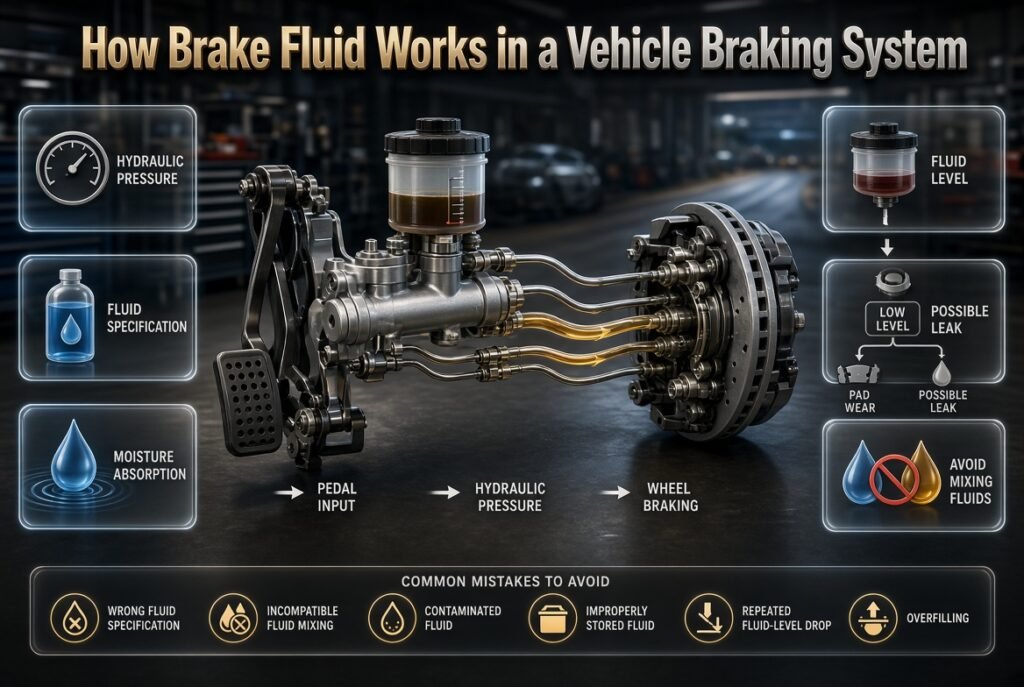
Some symptoms deserve faster action than routine maintenance.
Pay particular attention to:
- Sudden pressure loss
- Visible sidewall bulge
- Severe sidewall cut
- Exposed internal material
- Severe tread damage
- Strong vibration
- Repeated TPMS warnings
- Tire rapidly losing air
- Severe uneven wear
- Tire separation or deformation
- Vehicle suddenly pulling to one side
If a tire is seriously damaged, don’t continue driving simply because the car can still move.
A tire professional can determine whether the tire can be repaired, needs replacement, or is affected by another vehicle problem.
When Should You Replace a Tire?
A tire should be considered for replacement when it reaches its applicable wear limit, has serious physical damage, develops unacceptable irregular wear, repeatedly loses pressure, or reaches an age where the tire or vehicle manufacturer recommends replacement.
Replacement decisions shouldn’t be based on mileage alone.
Consider:
Tread
Is the tread sufficiently deep?
Damage
Are there cuts, cracks, bulges, punctures, or structural concerns?
Wear
Is the tread wearing evenly?
Age
How old is the tire?
Performance
Has handling, vibration, noise, or pressure retention changed?
Vehicle requirements
Is the tire still the correct type, size, and specification for the vehicle?
NHTSA advises replacing tires at its stated minimum tread level and also highlights physical damage, irregular wear, inflation problems, and age as factors that can indicate the need for replacement.
Should You Replace One Tire or All Four?
There isn’t one universal answer.
The correct decision depends on:
- Vehicle drivetrain
- Tire configuration
- Remaining tread on other tires
- Tire age
- Manufacturer requirements
- Tire size
- Tire type
- Overall condition
Some vehicles require closer matching of tire circumference or tread characteristics, particularly certain all-wheel-drive systems.
If one tire is damaged, don’t automatically order one replacement without checking the vehicle manufacturer’s requirements and the condition of the remaining tires.
A tire professional can assess the complete set and explain the available options.
What Tire Size Should You Buy?
When replacing tires, use the size and specification recommended by the vehicle manufacturer.
Check:
- Tire information label
- Owner’s manual
- Existing tire markings
- Manufacturer specifications
Don’t choose a tire only because it looks similar.
Other specifications can matter, including:
- Load rating
- Speed rating
- Construction
- Tire type
- Size
- Intended application
NHTSA recommends using the original tire size or another size specifically recommended by the vehicle manufacturer.
Expert Tire Maintenance Advice
Good tire maintenance is mostly about noticing small changes early.
Don’t wait for a flat
Regular pressure checks can identify slow leaks before they become roadside emergencies.
Don’t judge by appearance alone
Use a pressure gauge and inspect tread and sidewalls properly.
Don’t ignore one unusual tire
If one tire behaves differently from the others, find out why.
Don’t treat rotation as a universal rule
Follow the manufacturer’s rotation instructions.
Don’t assume new tires fix vehicle problems
Alignment, suspension, wheels, and inflation can affect tire wear.
Don’t ignore age
Older tires deserve attention even when tread remains.
Don’t forget the spare
Emergency equipment is only useful when it’s actually ready.
Keep a basic maintenance record
Recording tire installation dates, rotation dates, pressure issues, and inspections can make future maintenance easier.
Simple Tire Inspection Checklist
Use this checklist during your regular vehicle inspection.
Tire Pressure
- Front-left pressure checked
- Front-right pressure checked
- Rear-left pressure checked
- Rear-right pressure checked
- Spare checked
- Pressure compared with manufacturer specification
Tread
- Tread inspected
- Wear appears reasonably even
- No serious tread damage
- No embedded objects
- Treadwear indicators checked where applicable
Sidewalls
- No bulges
- No major cuts
- No serious cracks
- No major scrapes
- No exposed internal material
Vehicle Behavior
- No unusual vibration
- No persistent pulling
- Steering feels normal
- No repeated TPMS warning
General
- Tire age reviewed
- Rotation schedule reviewed
- Alignment symptoms considered
- Spare tire ready
- Jack and wheel tools available
Tire Maintenance for Dubai Drivers
Dubai driving can involve a combination of city traffic, high temperatures, highways, frequent braking, long journeys, and extended air-conditioning use.
That makes regular vehicle checks particularly useful.
A driver may spend a significant amount of time in:
- Stop-and-go traffic
- High-speed highway conditions
- Hot parking areas
- Busy urban roads
- Long-distance routes
Tire maintenance should therefore become part of the normal ownership routine rather than something done only before a road trip.
A practical Dubai-focused routine is:
Monthly:
Check tire pressure, tread, sidewalls, and spare.
Before long journeys:
Perform a complete visual inspection and confirm correct cold pressure.
After a significant pothole or curb impact:
Watch for vibration, pulling, pressure loss, or visible damage.
When abnormal wear appears:
Investigate alignment, balance, suspension, inflation, and other possible causes.
When tires become old or damaged:
Arrange a professional condition assessment.
What Should You Do After Hitting a Pothole?
A pothole impact can affect more than the tire.
Possible consequences include:
- Tire sidewall damage
- Wheel damage
- Alignment changes
- Suspension damage
- Slow pressure loss
After a significant impact, don’t only ask:
“Does the tire still have air?”
Also consider:
- Does the steering feel different?
- Is the vehicle pulling?
- Is there vibration?
- Is pressure dropping?
- Is there visible damage?
- Does the wheel appear damaged?
If something feels different after an impact, have the vehicle inspected.
How Can You Extend Tire Life?
There is no trick that makes tires last indefinitely.
However, consistent maintenance can help prevent avoidable wear.
Focus on:
- Correct tire pressure
- Appropriate vehicle loading
- Regular inspection
- Proper rotation where recommended
- Correct wheel alignment
- Proper wheel balancing
- Good driving habits
- Prompt attention to damage
- Appropriate tire selection
- Regular vehicle maintenance
Avoid aggressive driving habits that place unnecessary stress on tires.
Hard acceleration, heavy braking, sharp cornering, and repeated impacts with potholes can contribute to faster wear.
How Often Should I Check My Car Tire Pressure?
Tire pressure should be checked regularly rather than only when a tire looks low or when the TPMS warning light appears. For most drivers, checking the pressure at least once a month and before a long road trip is a practical routine. Pressure should ideally be measured when the tires are cold because driving heats the tires and temporarily changes the reading.
The correct pressure isn’t necessarily the number printed on the tire sidewall. Always use the tire pressure recommended by your vehicle manufacturer, which is usually listed on the driver’s door-area label or in the owner’s manual. Front and rear tire pressures may also be different.
Important points to remember:
Check all four tires individually rather than checking only one.
Check the spare tire if your vehicle has one.
Use a reliable tire-pressure gauge.
Check pressure before long highway journeys.
Investigate a tire that repeatedly loses pressure instead of continually adding air.
Don’t increase pressure beyond the manufacturer’s recommendation simply to improve fuel economy.
How Do I Know If My Tires Need to Be Replaced?
Tire replacement shouldn’t be based on mileage alone. A tire may need replacement because of worn tread, serious physical damage, abnormal wear, repeated pressure loss, age-related deterioration, or structural problems—even if the vehicle hasn’t covered particularly high mileage.
Start by inspecting the tread across the entire tire rather than looking only at the center. Then inspect the sidewalls for cuts, cracks, bulges, or other visible damage. Uneven wear can also indicate an underlying problem with tire pressure, wheel alignment, balancing, suspension, or steering components.
A tire with good-looking tread isn’t automatically safe if it has serious sidewall damage or other structural deterioration.
Signs that deserve professional attention include:
Tread reaching the applicable replacement limit
Visible sidewall bulges
Deep cuts or serious cracks
Exposed internal material
Repeated or unexplained pressure loss
Severe uneven tread wear
Strong vibration or unusual handling
Significant age-related deterioration
Damage following a pothole or curb impact
A professional inspection is particularly important when you’re unsure whether the problem is with the tire itself or another part of the vehicle.
What Causes Uneven Tire Wear?
Uneven tire wear usually means that different parts of the tire are wearing at different rates. It can be caused by incorrect tire pressure, wheel alignment problems, wheel imbalance, worn suspension components, steering issues, tire rotation problems, or certain driving conditions.
The wear pattern can provide useful clues. Excessive center wear may be associated with overinflation, while wear on both shoulders can be associated with underinflation. Wear concentrated on one shoulder may point toward an alignment or suspension-related issue. Cupping or patchy wear may require investigation of balancing, suspension, or other mechanical factors.
However, a wear pattern shouldn’t be treated as a guaranteed diagnosis. Several problems can produce similar symptoms.
If you notice uneven wear:
Check tire pressure first.
Inspect all four tires.
Look for differences between the inner, center, and outer tread.
Consider when the tires were last rotated.
Pay attention to steering vibration or vehicle pulling.
Have alignment checked if the vehicle doesn’t track normally.
Inspect suspension components if abnormal wear continues.
Don’t simply replace the tire without investigating the cause.
This is especially important because fitting a new tire without correcting the underlying problem can allow the replacement tire to develop the same abnormal wear.
Does Tire Pressure Affect Fuel Economy and Tire Life?
Tire pressure can affect both fuel economy and tire durability. When a tire is underinflated, it can create greater rolling resistance, meaning the engine may need to use more energy to move the vehicle. Low pressure can also increase tire flexing and heat buildup, potentially contributing to faster or irregular wear.
However, inflating tires above the manufacturer’s recommended pressure isn’t the correct way to improve fuel economy. The goal is to maintain the manufacturer’s specified pressure for the vehicle and its applicable load condition.
Fuel economy is influenced by many factors, so tire pressure is only one part of the picture.
For better tire and vehicle efficiency:
Maintain the manufacturer’s recommended pressure.
Check pressure when tires are cold.
Check pressure regularly rather than waiting for a warning.
Avoid unnecessary vehicle overloading.
Monitor uneven tread wear.
Keep wheels properly aligned when required.
Address suspension or steering problems.
Check pressure before long-distance driving.
Correct tire pressure gives the tire a better chance of operating as intended while also supporting predictable handling and efficient rolling.
What Should I Check on My Tires Before a Long Road Trip?
Before a long road trip, don’t limit your preparation to checking the fuel level. Tires should receive a complete inspection because a small problem that is manageable near home can become a major inconvenience on a highway or remote stretch of road.
Start by checking the cold pressure of all four tires and compare each reading with the vehicle manufacturer’s specification. Then inspect the tread for excessive or uneven wear and look closely at the sidewalls for cuts, cracks, bulges, or impact damage.
The spare tire should also be checked. A spare that has been sitting unused for years may have low pressure or age-related deterioration.
Use this pre-trip tire checklist:
Check cold tire pressure.
Inspect all four tires.
Check the spare tire.
Look for tread damage.
Check for uneven wear.
Inspect sidewalls for cuts and bulges.
Look for nails, screws, or other embedded objects.
Check for recent pressure-loss problems.
Make sure the vehicle isn’t overloaded.
Check for unusual vibration or steering behavior.
Confirm the jack and wheel-changing equipment are available.
Consider an inspection if you’ve recently hit a major pothole or curb.
A few minutes spent checking the tires before departure can help identify problems while you still have time to deal with them properly.
Conclusion
Proper tire maintenance is an important part of safe, reliable, and efficient driving. Tires are the only part of your vehicle that remains in direct contact with the road, so their condition can affect braking, steering, handling, ride comfort, fuel efficiency, and overall driving safety.
A good tire maintenance routine does not have to be complicated. Regularly check tire pressure, inspect tread depth and wear patterns, examine the sidewalls, monitor for repeated pressure loss, and pay attention to changes in steering, vibration, or vehicle handling. Tire rotation, wheel alignment, balancing, and suspension inspections should also be addressed when required.
Dubai’s hot weather, heavy traffic, frequent highway driving, road debris, and occasional pothole impacts make consistent tire inspections even more valuable. Don’t wait for a flat tire or visible damage before checking your tires. Small warning signs can sometimes indicate a problem that needs attention before it becomes more serious.
Before a long journey, give your tires a complete inspection and confirm that the spare tire and emergency equipment are ready. If you notice severe tread wear, sidewall damage, unusual vibration, repeated pressure loss, or abnormal wear, have the vehicle inspected by a qualified professional.
Most importantly, tire maintenance should be part of your wider vehicle maintenance routine. Regular checks of essential components such as engine oil, coolant, brake fluid, and other vehicle systems can help you identify developing problems earlier and keep your vehicle prepared for everyday driving and longer journeys.
Consistent tire care is ultimately about more than extending tire life. It helps maintain predictable vehicle behavior, supports better road contact, and gives you greater confidence every time you drive.
Leave a Reply