
Introduction
Preparing Your Car for a Long Journey | A long journey can start with excitement and end with unnecessary stress when a small vehicle problem appears at the wrong time. A weak battery, low tyre pressure, an overlooked warning light, poor fuel planning, or a forgotten spare tyre can turn a simple road trip into a roadside emergency.
That’s why preparing your car for a long journey should begin before you load the luggage and start the engine.
For drivers planning longer journeys in and around Dubai, Fuel Delivery Dubai is also a useful resource for understanding fuel planning, roadside fuel situations, and emergency preparation. The goal isn’t to expect something to go wrong. It’s to make sure you’re ready if something unexpected happens.
A good pre-trip check doesn’t need to be complicated. You need to look at the vehicle’s essential safety systems, confirm that the car is properly maintained, plan your fuel stops, organize emergency equipment, and make sure you understand what to do if the vehicle develops a problem.
This guide explains exactly what to check before a long journey, how to prepare your tyres, battery, fluids, brakes, lights and fuel system, what emergency items to carry, how to avoid common mistakes, and what to do if something goes wrong during the trip.
Why Is Preparing Your Car for a Long Journey Important?
Preparing your car for a long journey is important because problems that seem minor during short local trips can become much more inconvenient when you’re travelling hundreds of kilometres from home.
A vehicle may start normally every morning but still have a weak battery. Tyres may look acceptable but have incorrect pressure or uneven wear. A dashboard warning may appear occasionally and then become more serious during extended driving.
Long journeys also introduce factors that aren’t always present during short trips:
- Longer continuous engine operation
- Higher average speeds
- Greater fuel consumption
- More luggage and passengers
- Extended air-conditioning use
- Greater tyre and brake demands
- Fewer convenient opportunities to stop
- Unfamiliar roads
- Longer distances between suitable fuel stations
The objective isn’t to eliminate every possible mechanical failure. No inspection can guarantee that.
Instead, preparation helps you identify known and preventable problems before departure.
A useful principle is:
Inspect → Correct → Plan → Pack → Recheck
This simple process can make a major difference to the overall journey.
What Should You Check Before a Long Car Journey?
Before a long journey, check the tyres, brakes, battery, engine oil, coolant, lights, wipers, warning lights, fuel level, spare tyre and general vehicle condition. You should also review the route, identify fuel stops, charge your phone and prepare basic emergency equipment.
A practical inspection can be divided into five areas:
| Area | What to Check | Main Purpose |
|---|---|---|
| Tyres | Pressure, tread, damage | Road contact and handling |
| Mechanical | Oil, coolant, battery, brakes | Vehicle reliability |
| Visibility | Lights, wipers, windshield | Safe visibility |
| Fuel | Tank level, range, fuel stops | Prevent fuel emergencies |
| Emergency | Spare tyre, phone, equipment | Preparedness if something goes wrong |
Don’t try to inspect everything at the last possible minute.
Ideally, begin several days before the journey so that you have time to deal with anything unusual.
How Do You Prepare Your Car for a Long Road Trip?
The best way to prepare your car for a long road trip is to start with a complete basic inspection rather than focusing only on fuel. Check the tyres, fluids, brakes, battery, lights, warning indicators and emergency equipment, then plan your route and fuel stops.
Here’s a practical preparation sequence.
Step 1: Check the Tyres
Tyres are one of the first things to inspect before a long journey.
They are responsible for maintaining contact between the vehicle and the road, so their condition affects handling, braking and overall driving behaviour.
Check:
- Tyre pressure
- Tread condition
- Sidewalls
- Visible cuts
- Cracks
- Bulges
- Uneven wear
- Objects stuck in the tyre
- Spare tyre condition
Use the tyre-pressure recommendation provided by your vehicle manufacturer.
Don’t guess the correct pressure based on how the tyre looks.
A tyre can appear normal while being underinflated.
Why Does Tyre Pressure Matter on a Long Journey?
Incorrect tyre pressure can affect handling, tyre wear and fuel consumption.
Underinflated tyres can also increase rolling resistance, which means the engine may need to work harder to move the vehicle.
However, don’t deliberately overinflate tyres as a fuel-saving trick.
Safety and the vehicle manufacturer’s specifications should always come first.
For longer trips, check the pressure when the tyres are cold whenever possible.
What About the Spare Tyre?
A spare tyre is only useful if it is actually ready to use.
Check:
- Spare tyre pressure
- Visible damage
- Jack
- Wheel wrench
- Locking-wheel-nut key where applicable
- Storage condition
Some modern vehicles don’t have a conventional spare tyre. They may use a repair kit or another system.
Know what your vehicle has before you leave.
⚠ Common Mistake: Assuming the spare tyre is ready simply because you’ve never used it.
Step 2: Inspect the Brakes Before a Long Journey
Brakes deserve special attention because long-distance driving can involve high-speed roads, heavy traffic, hills and repeated braking.
Pay attention to changes such as:
- Squealing
- Grinding noises
- Vibration during braking
- Unusual pedal feel
- Longer stopping distance
- Vehicle pulling to one side
- Brake warning lights
If braking behaviour has changed, don’t assume it will fix itself during the journey.
A professional inspection can identify worn components or other problems that may not be obvious during a quick driveway check.
Should You Replace Brake Components Before Every Road Trip?
No.
A long journey doesn’t automatically mean that brake components need replacement.
The sensible approach is to inspect the braking system and replace components when their condition or maintenance requirements indicate that replacement is needed.
The goal is condition-based preparation, not unnecessary replacement.
Step 3: Check Engine Oil
Engine oil helps lubricate and protect internal engine components.
Before a long journey, check the oil level according to the manufacturer’s instructions.
If the level is low, use the correct oil specification for your vehicle.
Don’t simply choose an oil because the bottle looks similar or because another vehicle uses it.
Your owner’s manual or manufacturer guidance should determine the appropriate specification.
What If the Oil Level Keeps Dropping?
If you’ve noticed repeated oil loss, don’t simply top it up and forget about it.
Frequent oil loss may indicate:
- A leak
- Consumption
- A maintenance issue
- Another mechanical problem
A long journey isn’t the best time to discover that the vehicle has a developing oil problem.
Step 4: Check Coolant and the Cooling System
The cooling system deserves attention before extended driving.
Check the coolant level according to the manufacturer’s procedure.
Also look for signs of:
- Coolant leakage
- Overheating
- Unusual temperature readings
- Damaged hoses where visible
- Unusual smells
Never open a hot cooling system simply to inspect or add coolant.
Follow the manufacturer’s safety instructions and allow the vehicle to cool appropriately.
Why Is Cooling System Preparation Important?
An engine operating for a long period needs a functioning cooling system.
A problem that doesn’t appear during a short local trip may become more obvious during extended driving, especially in demanding conditions.
If the temperature gauge behaves unusually or a temperature warning appears, don’t treat it as something to ignore.
Step 5: Test the Battery Before Leaving
A battery problem can be especially frustrating during a long trip.
You may have no difficulty driving once the engine starts, but then encounter a problem after stopping at a fuel station or rest area.
Look for warning signs such as:
- Slow engine cranking
- Difficulty starting
- Battery warning light
- Electrical accessories behaving strangely
- Previous jump-starts
- Battery nearing the end of its expected service period
A visual inspection doesn’t tell you everything about battery health.
If there are warning signs, consider having the battery and charging system properly tested.
⭐ Expert Tip: Don’t replace a battery simply because you’re going on a long journey. Test it first when appropriate, then make the replacement decision based on its actual condition and the vehicle’s requirements.
Step 6: Check the Alternator and Charging System

The battery isn’t the only part of the vehicle’s electrical system that matters.
The alternator and charging system are responsible for maintaining electrical power while the engine is running.
If you’ve noticed:
- Battery warning lights
- Repeated starting problems
- Flickering lights
- Electrical irregularities
- A battery repeatedly becoming discharged
then the charging system may need professional assessment.
Replacing the battery without understanding an underlying charging problem may not solve the real issue.
Step 7: Check All Exterior Lights
Before a long journey, check:
- Headlights
- Brake lights
- Indicators
- Hazard lights
- Reverse lights
- Other required exterior lights
Lighting is particularly important if you’re travelling at night or through areas where visibility can change.
Ask another person to confirm that the lights are functioning while you operate the controls when possible.
Don’t discover a failed brake light after you’ve already started the journey.
Step 8: Check Wipers and Windshield Condition
Good visibility is essential for long-distance driving.
Inspect:
- Wiper blades
- Washer fluid
- Windshield condition
- Washer spray
- Dirt or residue on the glass
A windshield that looks fine during bright daylight can become much harder to see through when exposed to glare, dust, rain or nighttime lighting.
Replace badly worn wipers before the journey.
📌 Quick Tip: Clean the inside and outside of the windshield before leaving. Interior glass residue can become especially noticeable when sunlight or headlights create glare.
Step 9: Test the Air Conditioning
For long journeys in hot weather, air conditioning is more than a comfort feature.
Test the system before departure.
Check:
- Cooling performance
- Airflow
- Fan operation
- Unusual smells
- Unusual noises
If the system has suddenly become weak or behaves differently, investigate it before a major trip.
You don’t want to discover an air-conditioning problem after several hours of driving in hot conditions.
What Fluids Should You Check Before a Long Journey?
Depending on your vehicle, relevant fluids may include:
- Engine oil
- Coolant
- Brake fluid
- Windshield washer fluid
- Transmission fluid where applicable
- Power-steering fluid where applicable
Always follow the manufacturer’s instructions for checking and topping up fluids.
Different vehicles use different systems, so don’t assume every car should be checked in exactly the same way.
Fluid Inspection Checklist
Oil: Correct level and no obvious issue.
Coolant: Appropriate level according to the manufacturer’s procedure.
Brake fluid: Correct level and no obvious signs of leakage.
Washer fluid: Enough for the expected journey.
Other fluids: Check according to the vehicle design and maintenance instructions.
⚠ Common Mistake: Checking only engine oil because it’s the fluid drivers most commonly think about.
A long-trip inspection should consider the entire vehicle.
For a practical checklist of what to keep in your vehicle before a journey, read this essential roadside emergency items guide to learn which emergency supplies can help you stay prepared for unexpected roadside situations.
How Should You Check for Fluid Leaks?
Look for unusual fluid underneath the vehicle or around accessible components.
A fresh leak shouldn’t automatically be dismissed as harmless.
Different fluids can indicate different problems.
If you notice:
- Fresh fluid spots
- Repeated fluid loss
- A strong unusual smell
- Wet areas where they shouldn’t be
- A fluid level that keeps falling
have the issue investigated before a long trip.
A small leak can become a much bigger inconvenience when you’re far from home.
How Important Is Fuel Planning for a Long Journey?
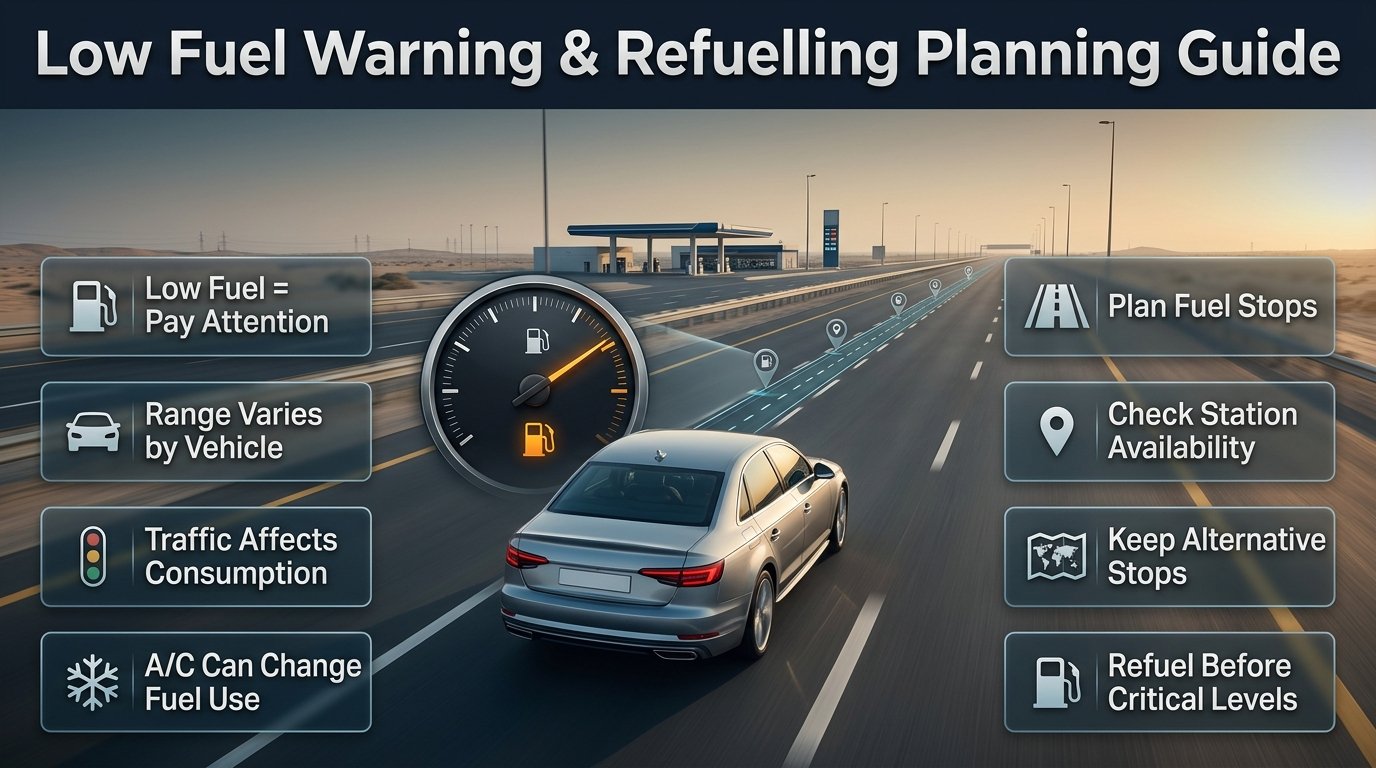
Fuel planning is one of the most important parts of preparing your car for a long journey because your vehicle’s displayed remaining range is an estimate, not a guaranteed distance.
Actual fuel consumption can change because of:
- Traffic
- Driving speed
- Air conditioning
- Vehicle load
- Tyre pressure
- Road conditions
- Acceleration
- Idling
- Detours
This means a vehicle that normally has enough fuel for a particular distance may have less practical range during a difficult journey.
For detailed guidance, see Fuel Planning for Long Distance Driving.
How Should You Plan Fuel Stops?
Before leaving:
- Check your current fuel level.
- Estimate the journey distance.
- Identify suitable fuel stations.
- Consider traffic.
- Consider possible detours.
- Avoid depending on the final part of the fuel gauge.
- Keep enough practical reserve for unexpected delays.
Don’t calculate the trip down to the final kilometre.
If the journey is longer than expected, your fuel consumption can change.
Why Should You Not Rely Completely on the Fuel Gauge?
A fuel gauge doesn’t give you a perfect prediction of how far the vehicle will travel.
The displayed range can change depending on recent driving conditions.
For more information, see How Accurate Is a Car Fuel Gauge?.
You can also learn about Understanding Vehicle Fuel Range and How to Estimate Remaining Fuel Range in Dubai.
How Can You Avoid Running Out of Fuel During a Long Trip?
The simplest way to avoid a fuel emergency is to treat refuelling as part of journey planning rather than waiting for the fuel warning to become urgent.
Before a long drive:
- Refuel when practical.
- Know where the next suitable stations are.
- Consider traffic and delays.
- Don’t depend completely on estimated range.
- Monitor the fuel level throughout the journey.
- Keep your phone charged.
If you want to understand the warning itself, see Low Fuel Warning Light Meaning in Dubai.
You can also review How Far Can a Car Drive on Low Fuel in Dubai?.
The important lesson is not to treat low fuel as a challenge.
A fuel warning should encourage planning.
What If Your Car Runs Out of Fuel During the Journey?
Running out of fuel can happen because of poor planning, unexpected traffic, a missed exit, an inaccurate range assumption, or an unexpected detour.
If it happens, personal safety comes first.
If you can safely move the vehicle away from active traffic, do so. Use hazard lights appropriately and request suitable assistance.
For detailed guidance, see What to Do When Your Car Runs Out of Fuel in Dubai.
You can also review Safely Dealing With an Empty Fuel Tank for additional safety considerations.
If the situation occurs on an active road, see Running Out of Fuel on the Road.
What If the Vehicle Runs Out of Fuel on a Highway?
Highway situations require extra caution because surrounding traffic may be moving quickly.
The priority is to move to the safest available position when it can be done safely, make the vehicle visible, and seek appropriate assistance.
Read Running Out of Fuel on a Highway for a more detailed highway-focused guide.
Highway Fuel Emergency Safety in Dubai also covers prevention, safe stopping and emergency preparation.
What Should You Pack for a Long Car Journey?
Your emergency equipment should be practical rather than excessive.
Consider carrying:
- Fully charged phone
- Charging cable
- Power bank
- Drinking water
- Basic first-aid supplies
- Flashlight
- Appropriate warning equipment
- Spare tyre equipment where applicable
- Vehicle documents as appropriate
- Emergency contact information
- Basic tools where appropriate
The exact equipment depends on the vehicle, route and local requirements.
The important point is accessibility.
Don’t place your emergency equipment underneath every piece of luggage.
What Is the Best Way to Organize Emergency Equipment?
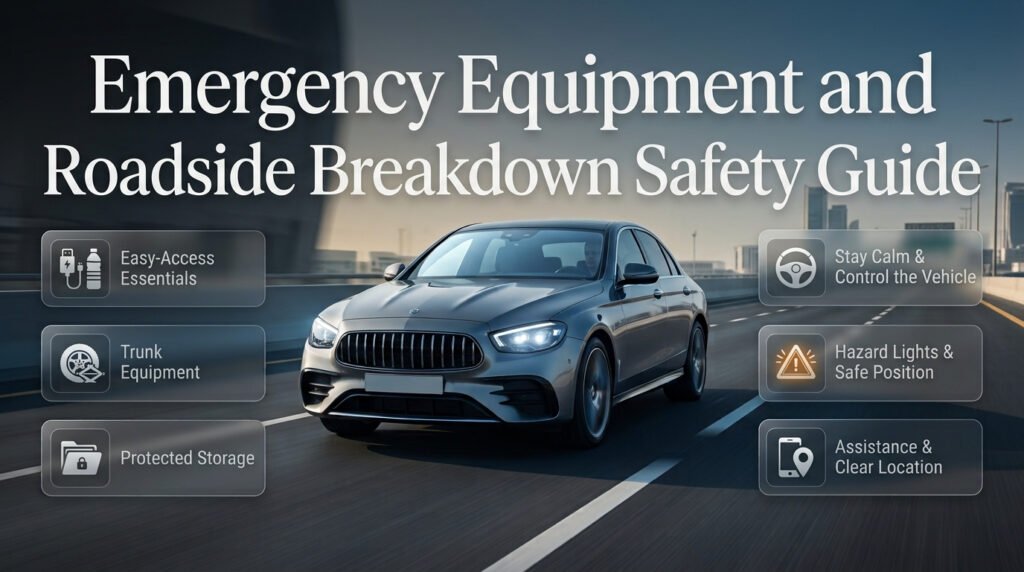
Keep frequently needed items where they can be reached without unpacking the entire vehicle.
For example:
Easy access: phone charger, water, basic emergency information.
Trunk access: spare tyre, jack, wheel equipment.
Protected storage: documents and other items that should remain secure.
Good organization reduces stress when something unexpected happens.
How Should You Prepare for a Roadside Breakdown?
A breakdown isn’t always dangerous because of the mechanical failure itself.
The surrounding environment can create additional risk.
You may be dealing with:
- Fast-moving traffic
- Poor visibility
- Extreme heat
- An unfamiliar road
- Limited safe stopping space
- A vehicle that cannot move
Before leaving, save relevant assistance information and make sure your phone is charged.
For broader preparation, see Road Trip Emergency Preparation.
You can also review Vehicle Emergency Checklist for Long Trips for a more structured emergency checklist.
What Should You Do During a Roadside Breakdown?
If the vehicle develops a serious problem during the journey:
- Stay calm.
- Maintain control of the vehicle.
- Move to a safer location if it is possible and safe.
- Use hazard lights appropriately.
- Keep away from moving traffic.
- Contact appropriate roadside assistance or emergency services.
- Explain your location clearly.
- Follow professional instructions.
For a detailed breakdown response, see What to Do During a Roadside Breakdown.
Additional guidance is available in Staying Safe During a Car Breakdown.
For a more structured approach, see Vehicle Breakdown Safety Procedures.
What Are the Most Important Roadside Safety Precautions?
The most important principle is to prioritize people before the vehicle.
If the vehicle stops in an unsafe location, don’t become so focused on fixing the mechanical problem that you forget about surrounding traffic.
Relevant preparation includes:
- Keeping your phone charged
- Knowing your location
- Having emergency contacts available
- Using appropriate warning equipment
- Avoiding unnecessary exposure to traffic
- Seeking professional assistance when needed
For more information, see Roadside Vehicle Emergency Precautions.
How Should You Prepare a Loaded Car for a Long Journey?
Extra passengers and luggage change how the vehicle operates.
Before leaving, remove unnecessary items.
Then organize the remaining luggage securely.
Pay attention to:
- Vehicle payload limits
- Weight distribution
- Luggage security
- Visibility
- Tyre pressure recommendations for the load
- Roof-mounted equipment
Don’t assume that more luggage is harmless simply because there is space available.
A heavier vehicle can require more fuel and may behave differently during braking and handling.
The load should remain within the vehicle manufacturer’s limits.
Should You Remove Unnecessary Weight Before a Long Trip?
Yes, removing unnecessary items is a simple preparation step.
You don’t need to empty the vehicle completely.
Instead, ask:
Do I really need this item for the journey?
Remove unnecessary tools, old luggage, unused equipment and other heavy items that serve no purpose.
This can make the vehicle easier to organize and may reduce unnecessary fuel consumption.
How Should You Plan Your Route?
Route planning is about more than knowing the destination.
Before leaving, identify:
- Main route
- Alternative route
- Fuel stations
- Rest stops
- Major landmarks
- Expected traffic areas
- Places where you could safely stop if necessary
Keep navigation updated before departure.
Don’t depend entirely on your phone’s battery throughout the trip.
A charging cable or power bank is useful backup equipment.
Why Should You Plan Alternative Fuel Stops?
Your preferred station may be unavailable because of:
- Traffic
- Road closures
- Detours
- Long queues
- Route changes
- Navigation errors
Having another option reduces pressure.
This is particularly useful on unfamiliar routes.
How Can You Improve Fuel Efficiency During a Long Journey?
Preparing the vehicle properly can support fuel efficiency, but driving habits matter too.
Avoid:
- Unnecessary aggressive acceleration
- Repeated hard braking
- Excessive speed
- Extended unnecessary idling
- Carrying unnecessary weight
- Driving with incorrect tyre pressure
Instead:
- Maintain a sensible legal speed.
- Look ahead.
- Accelerate smoothly.
- Keep tyres correctly inflated.
- Remove unnecessary load.
- Plan fuel stops.
- Avoid unnecessary engine idling.
Fuel efficiency should never come at the expense of safe driving.
The purpose of fuel planning is to make the journey more predictable, not to encourage unsafe driving behaviour.
What Dashboard Warning Signs Should You Never Ignore?
Before leaving, make sure you understand any warning light that remains illuminated.
Potentially important warning signs can include:
- Engine-related warnings
- Oil-pressure warnings
- Brake warnings
- Temperature warnings
- Battery or charging warnings
- Other manufacturer-specific alerts
Not every warning has the same level of urgency.
Your vehicle’s owner’s manual should be the first reference for understanding dashboard symbols.
If a warning relates to a serious system or the vehicle behaves abnormally at the same time, professional assessment may be appropriate.
⚠ Common Mistake: Assuming that because the vehicle is still moving, the warning can safely be ignored.
What Other Warning Signs Should You Look For?
Dashboard lights aren’t the only clues.
Pay attention to:
- New vibrations
- Strange noises
- Burning smells
- Steering changes
- Brake changes
- Unusual temperature behaviour
- Fluid leaks
- Reduced performance
- Slow starting
- Unexpected fuel consumption
These symptoms don’t always mean a major failure.
But they deserve attention before a long trip.
A professional inspection is often easier before departure than after the vehicle has stopped somewhere inconvenient.
How Many Days Before a Long Trip Should You Prepare Your Car?

Ideally, start several days before departure.
This gives you time to identify issues and arrange repairs if necessary.
Three to Seven Days Before
Consider:
- Maintenance status
- Tyres
- Battery
- Brakes
- Fluids
- Warning lights
- Any unusual vehicle behaviour
One to Two Days Before
Focus on:
- Fuel planning
- Route
- Emergency equipment
- Phone charging
- Spare tyre
- Luggage
On the Day
Perform a final check:
- Fuel
- Tyres
- Dashboard
- Lights
- Luggage
- Phone
- Emergency equipment
This staged approach is much easier than trying to solve everything immediately before departure.
Common Mistakes Drivers Make Before Long Journeys
Mistake 1: Checking Only the Fuel
A full tank doesn’t mean the vehicle is ready.
The battery, tyres, brakes, fluids, lights and warning systems still matter.
Better Approach
Use a complete pre-trip checklist.
Mistake 2: Ignoring a Slow-Starting Engine
Some drivers assume a vehicle that eventually starts is fine.
Repeated slow starting can be a reason to investigate the battery or charging system.
Better Approach
If starting behaviour has changed, have it assessed before the journey.
Mistake 3: Forgetting the Spare Tyre
A spare tyre can remain unused for years.
That doesn’t mean it’s ready.
Better Approach
Check its pressure and condition before travelling.
Mistake 4: Relying Completely on Estimated Range
The dashboard range is useful, but real-world conditions can change fuel consumption.
Better Approach
Plan fuel stops with a sensible reserve.
Mistake 5: Overloading the Vehicle
Drivers sometimes pack everything because there is room.
Better Approach
Take only what you need and stay within the manufacturer’s load limits.
Mistake 6: Leaving Preparation Until the Morning
This creates unnecessary pressure.
Better Approach
Start several days earlier.
Mistake 7: Ignoring Small Leaks
A small leak may indicate a developing problem.
Better Approach
Investigate unexplained fluid loss before departure.
Mistake 8: Forgetting the Phone Charger
A phone may be essential for navigation and communication.
Better Approach
Start with a charged phone and carry suitable charging equipment.
Mistake 9: Treating Fuel Efficiency as More Important Than Safety
Trying to save fuel should never lead to unsafe driving.
Better Approach
Follow legal speed limits, maintain safe control and prioritize road safety.
What Do Professionals Recommend Before a Long Journey?
A professional approach focuses on condition, evidence and preparation, rather than replacing parts unnecessarily.
The process is simple:
Inspect
Look at the vehicle as a whole.
Test
Where appropriate, test components such as the battery or charging system rather than relying only on appearance.
Correct
Address known problems before departure.
Plan
Know your route and fuel stops.
Pack
Carry practical emergency equipment.
Recheck
Complete a final inspection before leaving.
This approach helps prevent two common mistakes:
Under-preparation: Ignoring genuine problems.
Over-preparation: Replacing perfectly good components without evidence that they need replacement.
The goal is neither.
The goal is a vehicle that is properly maintained and appropriately prepared for the journey.
A Complete Long-Journey Vehicle Checklist
Vehicle Condition
- Tyre pressure checked
- Tyres inspected
- Spare tyre checked
- Jack and wheel equipment available
- Brake performance normal
- Engine oil checked
- Coolant checked
- Other relevant fluids checked
- Battery condition considered
- Charging system checked if necessary
- Lights tested
- Wipers tested
- Windshield checked
- Air conditioning tested
- No unexplained leaks
- No significant warning lights
Fuel Preparation
- Fuel level checked
- Route distance considered
- Fuel stops identified
- Alternative fuel stops considered
- Estimated range treated as an estimate
- Reasonable fuel reserve maintained
Emergency Preparation
- Phone charged
- Charging cable available
- Power bank available if appropriate
- Water available
- Basic first-aid supplies
- Flashlight
- Appropriate warning equipment
- Vehicle documents
- Emergency contacts
- Roadside assistance information
Luggage
- Unnecessary weight removed
- Luggage secured
- Driver visibility maintained
- Important emergency items accessible
- Vehicle load kept within manufacturer’s limits
What should I check on my car before a long journey?
A proper pre-trip inspection should cover the parts that directly affect safety, reliability, and your ability to continue driving if something changes on the road. Don’t focus only on fuel or engine oil. Tyres, brakes, battery, fluids, lights, wipers, warning lights, and the spare tyre all deserve attention. If the vehicle has recently developed an unusual noise, vibration, starting problem, fluid leak, or warning light, it’s better to investigate it before departure rather than hoping it won’t become a problem during the journey.
Before leaving, check:
Tyre pressure, tread, sidewalls, and visible damage
Brake performance and any unusual brake noise
Engine oil and other relevant fluid levels
Battery condition and starting performance
Coolant level according to the manufacturer’s instructions
Headlights, indicators, brake lights, and hazard lights
Windshield, wipers, and washer fluid
Spare tyre, jack, and wheel-changing equipment where applicable
Dashboard warning lights
Fuel level and planned refuelling points
A few minutes of preparation can also give you enough time to arrange professional assistance if you find something that needs attention.
How should I prepare my tyres before a long road trip?
Tyres should be one of the first things you inspect because they have continuous contact with the road and can affect handling, braking, comfort, and fuel consumption. Check the pressure when the tyres are cold and use the vehicle manufacturer’s recommended specification rather than guessing from the appearance of the tyre. Also inspect the tread and sidewalls for cuts, cracks, bulges, uneven wear, or objects that may have become embedded.
If you’re travelling with several passengers or carrying a heavier load, check the manufacturer’s recommended tyre pressure for the relevant loading condition. Don’t deliberately overinflate or underinflate the tyres as a shortcut for improving fuel economy.
A professional tyre check should include:
Correct cold tyre pressure
Adequate tread condition
Even tread wear
No visible cuts or bulges
No obvious sidewall damage
No embedded objects
Spare tyre or approved repair system checked
Jack and wheel equipment available where applicable
Also remember that tyre pressure can change with temperature. A tyre that was correctly inflated under one set of conditions may show a different pressure later. Checking before a long journey gives you an opportunity to correct the pressure and identify visible problems before you’re far from home.
What fluids should I check before driving a long distance?
Before a long journey, check the fluids that your vehicle manufacturer specifies for regular inspection. Engine oil and coolant are particularly important, but depending on the vehicle, you may also need to consider brake fluid, windshield washer fluid, transmission fluid, and power-steering fluid where applicable. Always use the correct fluid specification and follow the manufacturer’s instructions rather than adding an unsuitable product.
The important point is to look for both level and condition-related warning signs. If a fluid level repeatedly drops, don’t simply keep topping it up without investigating why. Repeated fluid loss can indicate a leak or another mechanical issue that should be addressed before a long trip.
Before departure, consider checking:
Engine oil level
Coolant level using the manufacturer’s recommended procedure
Brake fluid level
Windshield washer fluid
Transmission fluid where the vehicle provides a checking procedure
Power-steering fluid where applicable
Visible signs of fluid leakage
Unusual smells or signs of overheating
Never open a hot cooling system simply to check or add coolant. If you notice a significant leak, repeated fluid loss, or unusual temperature behaviour, professional inspection is more appropriate than simply preparing for the trip and hoping the issue remains unchanged.
Should I check my car battery before a long journey?
Battery condition is worth considering before a long journey, particularly if the vehicle has recently been slow to start, has needed a jump-start, shows electrical irregularities, or has a battery that is approaching the end of its expected service period. A battery can sometimes start the vehicle normally while still having reduced reserve capacity, so a visual inspection alone doesn’t provide a complete picture of its condition.
The charging system should also be considered. If the alternator or charging system isn’t working correctly, replacing the battery alone may not resolve the underlying problem. Where there are symptoms, a proper battery and charging-system test can provide more useful information before departure.
Look for signs such as:
Slow or unusual engine cranking
Previous jump-start requirements
Battery or charging warning lights
Flickering or unusual electrical behaviour
Repeated battery discharge
Corrosion or visible battery damage
A battery nearing the end of its expected service life
There’s no need to replace a perfectly healthy battery simply because you’re going on a long journey. The professional approach is to assess its condition, consider the vehicle’s requirements, and address genuine signs of weakness before travelling.
How should I plan fuel for a long journey?
Fuel planning should be based on the actual journey rather than relying entirely on the vehicle’s estimated remaining range. Your fuel consumption can change because of traffic, speed, air-conditioning use, vehicle load, road conditions, driving style, and unexpected detours. This means the range displayed on the dashboard should be treated as an estimate rather than a guaranteed distance.
Before leaving, identify suitable fuel stations along the route and consider where you could refuel if traffic or a route change increases the distance. It’s generally more practical to plan a refuelling stop while you still have a reasonable reserve than to wait until the low-fuel warning becomes urgent.
A practical fuel plan should include:
Starting with an appropriate fuel level
Estimated journey distance
Reliable fuel stations along the route
Alternative refuelling options
Expected traffic or delays
Possible detours
Your vehicle’s normal fuel consumption
Additional fuel demand from heavy loads or extensive air-conditioning use
A sensible reserve rather than relying on the final part of the tank
If the low-fuel warning appears earlier than expected, don’t automatically assume the vehicle will travel the same distance you normally achieve. Treat the warning as a signal to make a fuel decision and avoid deliberately pushing the vehicle until the tank is empty.
For longer journeys, good fuel planning is part of overall vehicle preparation—not something to think about only when the fuel gauge is nearly empty.
Conclusion
Preparing your car for a long journey is about more than filling the fuel tank and starting the drive. A proper pre-trip check gives you the opportunity to identify small problems before they become expensive or inconvenient breakdowns on the road.
Before leaving, take time to check the tyres, brakes, engine oil, coolant, battery, lights, wipers, and other essential systems. Make sure your fuel plan matches the distance, route, traffic conditions, and availability of fuel along the way. It is also worth carrying essential emergency equipment and keeping important vehicle information easily accessible.
For longer trips, preparation should include more than the vehicle itself. Review your route, allow enough time for breaks, avoid driving when excessively tired, and know what steps to take if your car develops a problem. Understanding your vehicle’s fuel range and responding promptly to a low-fuel warning can also reduce the risk of being stranded.
A few minutes of preparation before departure can make a significant difference to your confidence and safety throughout the journey. Whether you are travelling across Dubai or planning a longer road trip, a well-prepared vehicle is better equipped to handle the demands of long-distance driving.
The goal is simple: check the car, plan the journey, manage your fuel carefully, and be prepared for unexpected situations before you set off.
Leave a Reply