
Introduction
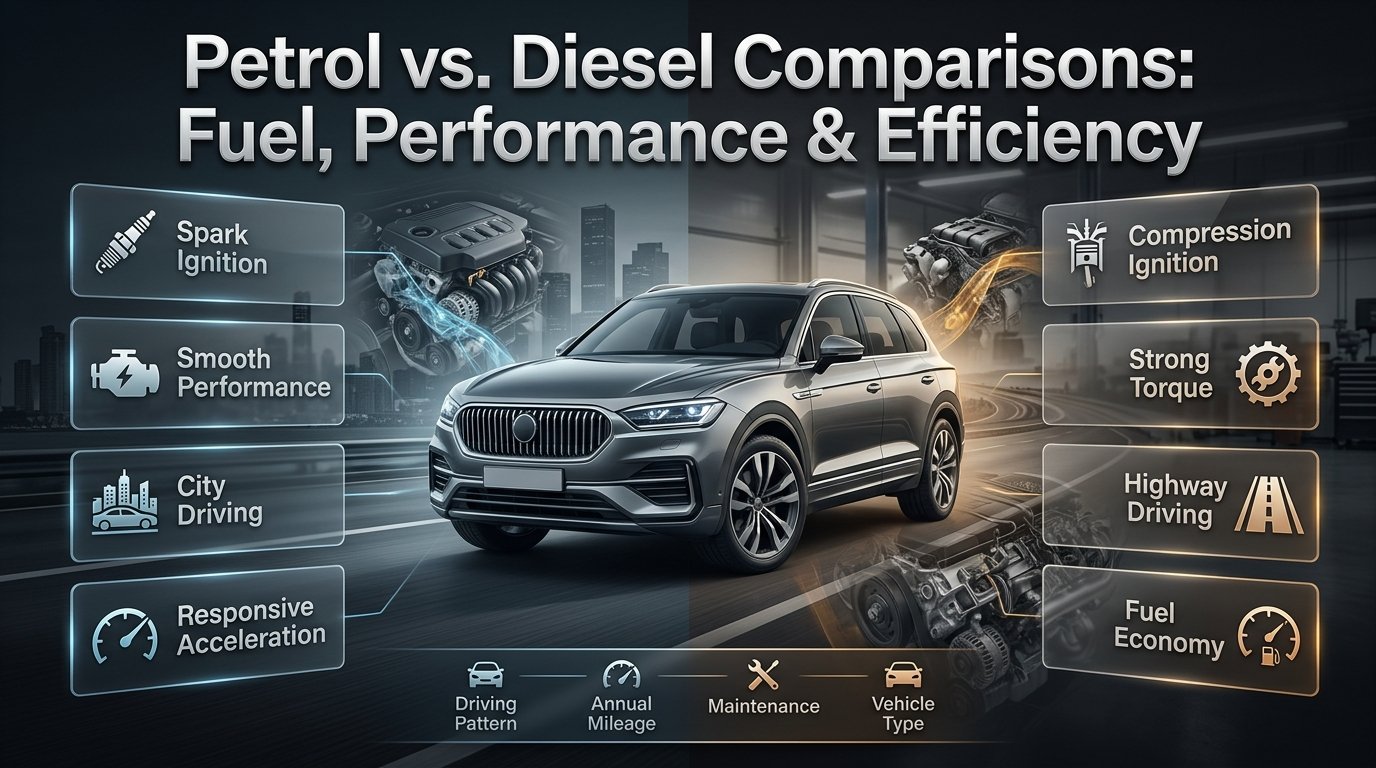
Petrol vs. diesel comparisons | can look simple at first. One fuel is commonly associated with smooth performance and city driving, while the other is known for fuel economy, torque, and long-distance use. But choosing between them isn’t really about which fuel is “better” in every situation.
The better choice depends on how you drive, how many kilometres you cover, what type of vehicle you own, how much you want to spend on maintenance, and what you expect from the engine.
Need reliable fuel-related information and services? 👉 Fuel Delivery Dubai.
A driver who makes short trips around a busy city may have completely different requirements from someone who drives hundreds of kilometres every week. A family SUV, delivery van, commercial truck, and small passenger car also have different priorities.
This guide gives you a practical petrol vs. diesel comparison covering engine operation, fuel economy, performance, maintenance, emissions, city driving, highway driving, fuel quality, long-term ownership, common mistakes, and buying decisions.
The goal isn’t to convince you that one fuel is always superior. It’s to help you understand which option makes more sense for your actual driving conditions.
What Is the Difference Between Petrol and Diesel?
Petrol and diesel are both petroleum-derived fuels, but they are designed to work with different types of internal-combustion engines. The biggest technical difference is how combustion begins.
A petrol engine normally uses a spark plug to ignite an air-fuel mixture. A diesel engine compresses air to a much higher pressure and temperature before injecting diesel fuel, allowing the fuel to ignite from the heat created by compression.
In simple terms:
Petrol engine: Air + petrol → compression → spark → combustion → power
Diesel engine: Air → high compression → fuel injection → self-ignition → combustion → power
This difference affects engine design, torque characteristics, fuel economy, noise, emissions systems, and maintenance requirements.
For readers who want a broader explanation of vehicle fuels, the guide to automotive fuel types provides useful background.
Petrol vs. Diesel at a Glance
| Feature | Petrol | Diesel |
|---|---|---|
| Ignition system | Spark ignition | Compression ignition |
| Typical engine character | Smooth and responsive | Strong low-speed pulling power |
| Fuel economy | Often lower than comparable diesel | Often higher in comparable applications |
| Low-speed torque | Generally lower | Generally higher |
| Engine sound | Usually quieter | Often more noticeable |
| Short trips | Often well suited | Can be less suitable for some modern diesels |
| Long-distance driving | Very capable | Often highly suitable |
| Heavy loads | Capable | Particularly suitable |
| Purchase price | Often lower | Often higher |
| Engine complexity | Varies | Can be higher in modern applications |
| Maintenance | Varies by vehicle | Can be more expensive for certain components |
| Best use case | City and mixed driving | High mileage, highway and heavy-duty use |
These are general tendencies, not universal rules. Engine technology has changed significantly, so the specific vehicle matters just as much as the fuel type.
How Does a Petrol Engine Work?
A petrol engine uses controlled ignition to burn a mixture of fuel and air inside the combustion chamber.
The basic four-stroke process involves:
- Intake – the engine draws in air and fuel.
- Compression – the piston compresses the mixture.
- Power – a spark ignites the mixture.
- Exhaust – combustion gases leave the cylinder.
The pressure generated by combustion pushes the piston downward. The piston is connected to the crankshaft, which converts this movement into rotational power.
You can learn more about this process in the detailed guide to the petrol engine combustion process.
Why Do Petrol Engines Feel Smooth?
Petrol engines are often appreciated for smooth power delivery and responsive acceleration.
They can operate effectively across a broad range of engine speeds, and modern petrol engines can use technologies such as:
- Turbocharging
- Direct fuel injection
- Variable valve timing
- Electronic throttle control
- Variable valve lift
- Advanced engine-management systems
These technologies allow relatively small engines to produce useful power while maintaining good drivability.
A petrol engine can therefore be a practical choice for someone who spends most of their time in urban traffic and wants predictable throttle response.
When Is Petrol a Good Choice?
Petrol may be particularly suitable when:
- You drive relatively few kilometres each year.
- Most journeys are short or medium distance.
- Your driving is mainly urban.
- You prefer quiet operation.
- You want smooth acceleration.
- The initial vehicle price matters.
- You don’t regularly tow heavy loads.
- Your vehicle isn’t expected to spend most of its life on highways.
This doesn’t mean petrol is unsuitable for long-distance driving. Modern petrol vehicles can be extremely capable on highways.
The point is that the driving pattern should determine the choice.
Pro Tip: Before choosing an engine, write down your typical weekly driving pattern. Knowing whether you regularly make 5-kilometre trips or 100-kilometre trips is more useful than simply asking whether petrol or diesel is “better.”
How Does a Diesel Engine Work?
A diesel engine follows a different combustion process.
Instead of first creating a spark-ignited air-fuel mixture, the engine draws in air and compresses it strongly. This compression increases the air temperature. Diesel fuel is then injected into the hot compressed air, where it ignites.
The basic process is:
- Air enters the cylinder.
- The piston compresses the air.
- Compression raises air temperature.
- Diesel fuel is injected.
- The fuel ignites.
- Combustion creates pressure.
- The piston moves and produces mechanical power.
For a more detailed explanation, see the guide to the diesel engine combustion process.
Why Does Diesel Produce Strong Torque?
One of the biggest reasons drivers choose diesel is torque.
Torque is the twisting force produced by an engine. Diesel engines are designed to produce substantial torque at relatively low engine speeds.
That characteristic is useful when a vehicle needs to:
- Move a heavy load.
- Climb an incline.
- Tow a trailer.
- Accelerate without constantly increasing engine speed.
- Maintain momentum under load.
This is one reason diesel engines have traditionally been popular in commercial vehicles, pickups, SUVs, buses, and heavy-duty applications.
However, torque should not be confused with horsepower. A vehicle’s actual performance depends on several factors, including engine power, torque, transmission, weight, gearing, aerodynamics, and traction.
Petrol vs. Diesel Fuel Economy
Fuel economy is one of the most common reasons people compare petrol and diesel.
Diesel engines often achieve better fuel economy than comparable petrol engines. This is partly related to diesel engine efficiency and the energy characteristics of diesel fuel.
But the word “comparable” is important.
Comparing a small diesel hatchback with a large petrol SUV doesn’t tell you much. Vehicle size, weight, engine design, transmission, aerodynamics, and driving conditions all affect fuel consumption.
What Affects Real-World Fuel Consumption?
Your actual fuel economy can be influenced by:
- Driving speed
- Traffic congestion
- Acceleration habits
- Vehicle weight
- Tyre pressure
- Engine condition
- Air-conditioning use
- Road gradient
- Wind resistance
- Vehicle aerodynamics
- Cargo
- Engine oil condition
- Route planning
A driver who accelerates aggressively and brakes heavily may consume considerably more fuel than a smooth driver using the same vehicle.
A Simple Fuel Economy Example
Suppose a petrol vehicle uses 8 litres per 100 km and a diesel vehicle uses 6 litres per 100 km.
If both vehicles travel 20,000 km per year:
Petrol:
20,000 ÷ 100 × 8 = 1,600 litres
Diesel:
20,000 ÷ 100 × 6 = 1,200 litres
The theoretical difference is therefore 400 litres per year.
Whether that saving justifies choosing the diesel depends on the purchase-price difference, fuel prices, maintenance costs, insurance, depreciation, and how long you plan to keep the vehicle.
Quick Tip: Never calculate fuel savings using fuel economy alone. Calculate annual fuel consumption and then compare the total ownership cost.
Petrol vs. Diesel Performance
Performance means different things to different drivers.
Someone interested in quick acceleration may care about horsepower and throttle response. A person towing equipment may care more about torque. A highway driver may care about smooth cruising and fuel economy.
Petrol Performance Characteristics
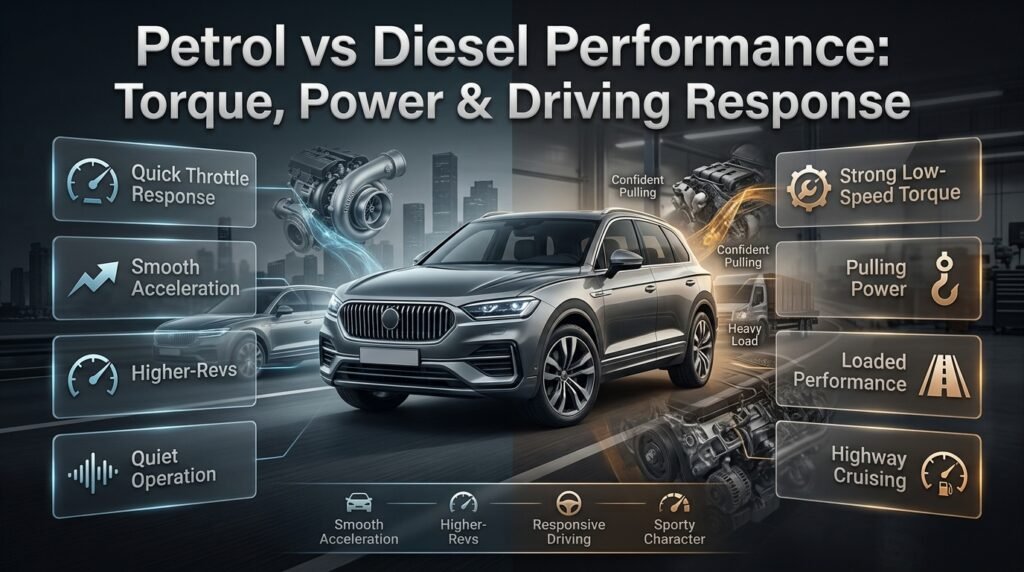
Petrol engines are often associated with:
- Quick throttle response
- Smooth acceleration
- Higher-revving operation
- Quiet operation
- Responsive driving
- Sporty engine characteristics
Turbocharged petrol engines can also produce substantial torque, so the old assumption that petrol engines are always weak at low speeds isn’t accurate.
Diesel Performance Characteristics
Diesel engines are often associated with:
- Strong low-speed torque
- Confident pulling power
- Good loaded performance
- Strong highway cruising ability
- Efficient operation over long distances
For a commercial vehicle carrying significant weight, these characteristics can be extremely useful.
Which One Accelerates Faster?
There isn’t a universal answer.
A petrol vehicle may accelerate faster than a diesel vehicle if it has more horsepower, less weight, better gearing, or a more performance-focused transmission.
Similarly, a diesel vehicle may feel stronger when moving away from low speeds because of its torque delivery.
The best comparison is between the actual vehicles, not simply between fuel types.
Which Is Better for City Driving?
For many drivers, petrol is a practical choice for urban use.
City driving often involves:
- Short journeys
- Frequent stopping
- Heavy traffic
- Repeated acceleration
- Long periods at low speeds
- Frequent engine starts
A petrol vehicle can handle these conditions effectively.
Modern diesel vehicles can also operate in cities, but some diesel engines use sophisticated emissions-control systems that are designed to work properly under appropriate operating conditions.
Repeated short journeys may not always be ideal for these systems.
That doesn’t mean every diesel vehicle will experience problems in city use. It means buyers should understand the manufacturer’s recommendations for the specific vehicle.
City Driver Example
Imagine someone drives:
- 6 km to work
- 6 km home
- Several short shopping trips
- Occasional weekend driving
Their annual mileage may be relatively low.
For this driver, the potential fuel savings of diesel may not be enough to justify a higher purchase price or potentially more complex maintenance.
Petrol may therefore be a sensible option.
Which Is Better for Highway Driving?
Diesel has traditionally been strong in long-distance driving.
A driver covering large distances can benefit from:
- Good fuel economy
- Strong torque
- Long cruising range
- Efficient operation under steady loads
However, modern petrol engines can also perform extremely well on highways.
A turbocharged petrol engine paired with an efficient transmission can provide good fuel economy and smooth cruising.
The correct question is therefore:
Which specific vehicle gives the best combination of economy, comfort, reliability and ownership cost for my highway use?
That question is more useful than simply asking whether diesel is better.
Petrol vs. Diesel for Heavy Loads
Diesel has traditionally had an advantage in applications where substantial torque is required.
Heavy loads increase the work an engine has to perform.
Examples include:
- Commercial vans
- Pickup trucks
- Large SUVs
- Towing vehicles
- Delivery vehicles
- Construction-related transport
- Fleet vehicles
A diesel engine’s torque characteristics can make these applications easier to manage.
But vehicle design matters. A petrol engine with modern turbocharging can also handle substantial loads if the vehicle is properly designed and rated for the task.
Always follow the manufacturer’s towing and payload limits.
Petrol vs. Diesel Maintenance Costs
Maintenance is one of the areas where simplistic comparisons can be misleading.
A petrol engine isn’t automatically cheap to maintain, and a diesel engine isn’t automatically expensive.
Modern engines contain sophisticated systems regardless of fuel type.
Petrol Maintenance
Depending on the vehicle, maintenance may include:
- Engine oil changes
- Oil filters
- Air filters
- Spark plugs
- Fuel filters
- Cooling-system checks
- Ignition-system checks
- Sensors
- Turbocharger servicing where applicable
Diesel Maintenance
Diesel maintenance can include:
- Engine oil and filter changes
- Fuel-filter replacement
- Air-filter replacement
- Injector inspection
- High-pressure fuel-system maintenance
- Turbocharger inspection
- Emissions-system maintenance
- Diesel particulate filter monitoring
- Other manufacturer-specific service items
Some diesel components can be expensive if they fail.
This is particularly relevant when purchasing a used diesel vehicle.
Used Diesel Example
A used diesel car with excellent service records may be a better purchase than a poorly maintained petrol car.
On the other hand, a diesel vehicle with neglected emissions equipment, fuel-system problems, or poor service history could become expensive.
The condition of the specific vehicle matters more than the badge on the fuel cap.
Why Fuel Quality Matters for Both Engines
The quality of fuel affects both petrol and diesel engines.
Fuel isn’t simply a liquid that provides energy. It has properties that influence combustion, fuel-system operation, storage stability, and engine performance.
For a broader understanding, see petrol and diesel fuel types.
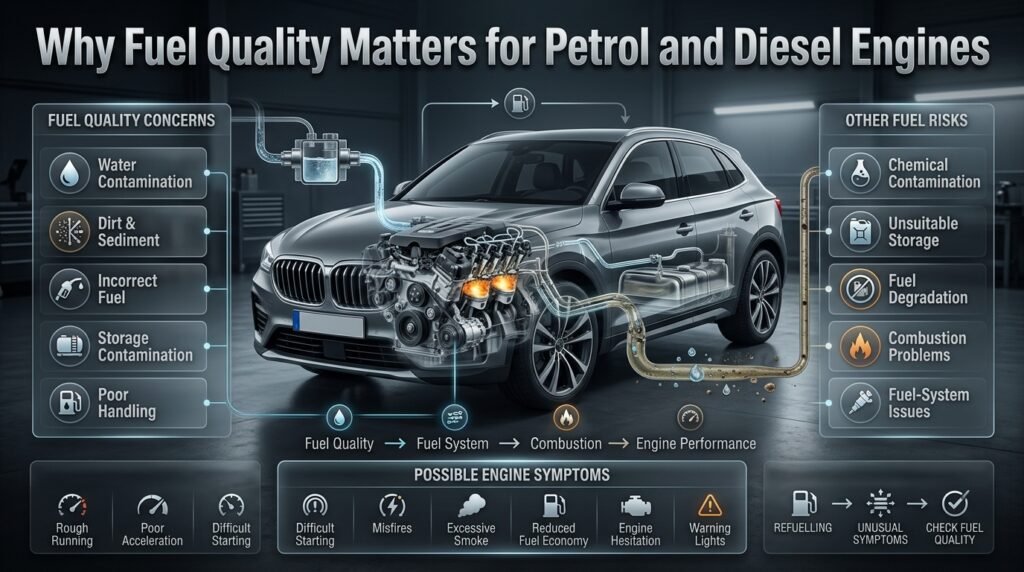
Fuel quality concerns can include:
- Water contamination
- Dirt
- Sediment
- Incorrect fuel
- Storage contamination
- Poor handling
- Chemical contamination
- Degradation caused by unsuitable storage
Drivers who notice unusual engine behavior after refuelling shouldn’t automatically assume the engine itself has failed.
Possible symptoms can include:
- Rough running
- Poor acceleration
- Difficult starting
- Misfires
- Excessive smoke
- Reduced fuel economy
- Engine hesitation
- Warning lights
Petrol Octane vs. Diesel Cetane
Petrol and diesel use different fuel-quality concepts.
Petrol is commonly discussed in terms of octane rating. Octane relates to a fuel’s resistance to premature or uncontrolled combustion under compression.
Diesel is commonly associated with cetane rating, which relates more closely to ignition quality and how readily diesel fuel begins combustion under compression.
This distinction is important because petrol and diesel engines need different combustion characteristics.
Why Octane Matters in Petrol Engines
If a petrol engine requires a certain octane level, using the manufacturer’s recommended grade helps the engine operate as intended.
Higher octane doesn’t automatically mean more power in every engine.
A vehicle designed for regular petrol may not gain a meaningful performance benefit simply because a higher-octane fuel is used.
For more information, see regular vs. premium petrol octane.
What Happens If You Put Petrol in a Diesel Vehicle?
Incorrect fuelling can create serious problems.
Petrol and diesel have different lubrication and combustion properties. Modern diesel fuel systems operate at very high pressures and rely on fuel properties that petrol doesn’t provide in the same way.
If petrol is accidentally added to a diesel vehicle, don’t assume that driving until the tank is empty will solve the problem.
If you notice the mistake before starting the engine, avoid starting it and seek professional assistance.
If the vehicle has already been driven, stop as soon as it is safe and contact a qualified professional.
The sooner the wrong fuel is identified, the better the opportunity to reduce potential damage.
Emergency Roadside Fuel Advice
A fuel-related problem can quickly turn an ordinary journey into a roadside emergency, especially when the vehicle runs out of fuel, receives the wrong fuel, or develops symptoms such as difficult starting, rough running, hesitation, or sudden loss of power. The safest approach is to avoid continuing to drive when a serious fuel problem is suspected. Move the vehicle to a safe location where possible, switch on the hazard lights, and assess the situation before attempting further travel. If the issue involves incorrect fuelling, contaminated fuel, or a vehicle that will not restart, professional fuel-system assistance can help prevent unnecessary damage and reduce the risk of turning a manageable problem into a more expensive repair. Drivers should also avoid guessing at the cause and should provide accurate information about what happened, including what fuel was added, whether the engine was started, and what symptoms appeared.
When a fuel-related problem leaves you stranded, Emergency Roadside Fuel Advice can help you understand the safest steps to take, what mistakes to avoid, and when professional roadside fuel assistance is the better option.
What Happens If You Put Diesel in a Petrol Vehicle?
Diesel in a petrol vehicle can also cause problems.
Because diesel has different physical and combustion properties from petrol, the engine may:
- Struggle to start
- Misfire
- Run unevenly
- Lose power
- Produce smoke
If the mistake is discovered before starting the engine, don’t start the vehicle.
Professional fuel-system assistance is the safest approach.
Petrol vs. Diesel in Hot Weather
Hot climates can place additional demands on vehicles regardless of fuel type.
High temperatures can increase the importance of:
- Cooling-system condition
- Engine oil quality
- Battery condition
- Tyre pressure
- Air-conditioning performance
- Correct coolant levels
- Proper maintenance
- Fuel-system condition
The assumption that one fuel is automatically better in hot weather isn’t reliable.
A vehicle designed for the local climate and maintained according to manufacturer recommendations is more important than simply choosing petrol or diesel.
Seasonal Car Care Tips in Dubai
Seasonal car care becomes especially important in Dubai, where high temperatures, intense sunlight, occasional heavy rain, and changing road conditions can place additional demands on a vehicle throughout the year. Drivers should pay attention to essential components such as the battery, tyres, cooling system, engine oil, coolant, brakes, wipers, lights, and air-conditioning system rather than waiting for a warning sign or breakdown. Before periods of extreme heat or changing weather, a quick inspection can help identify low tyre pressure, weak battery performance, worn wiper blades, fluid-level issues, or cooling-system concerns before they become more serious. Following the vehicle manufacturer’s maintenance schedule and adapting routine checks to Dubai’s demanding climate can improve reliability, driving comfort, and overall road readiness.
Seasonal checks are only one part of keeping your vehicle reliable, so for a complete breakdown of weather-related maintenance, warning signs, and practical year-round advice, read our Seasonal Car Care Tips in Dubai guide.
How Does Fuel Quality Affect Engine Performance?
Fuel quality can influence combustion and engine operation.
Poor fuel may contribute to:
- Reduced performance
- Difficult starting
- Rough idle
- Fuel-system contamination
- Increased deposits
- Poor fuel economy
- Injector problems
- Engine hesitation
The relationship between fuel quality and performance is explained in more detail in fuel quality and engine performance.
For drivers interested in understanding testing methods, fuel quality testing basics is also useful.
What Does Good-Quality Petrol Look Like?
Good-quality petrol should meet the required specifications for the market and vehicle application.
Important considerations can include:
- Correct fuel grade
- Appropriate octane
- Clean handling
- Proper storage
- Freedom from significant contamination
- Compliance with applicable fuel standards
The guide to good quality petrol characteristics covers these points in more detail.
Common Causes of Fuel Contamination
Fuel contamination doesn’t always happen because of deliberately poor fuel.
It can result from:
- Water entering storage tanks
- Dirt entering fuel containers
- Poorly maintained storage systems
- Condensation
- Incorrect handling
- Damaged equipment
- Cross-contamination
- Old or unsuitable storage conditions
Drivers can learn more from the guide to causes of fuel contamination.
For petrol-specific symptoms, see contaminated petrol symptoms.
For diesel-related issues, the provided resource on contaminated diesel causes can also be useful.
Petrol vs. Diesel Emissions
Emissions are another important part of the comparison.
Petrol and diesel engines produce different emissions profiles. Modern vehicles use emissions-control technology to reduce harmful pollutants.
Depending on the vehicle, systems can include:
- Catalytic converters
- Oxygen sensors
- Exhaust gas recirculation
- Diesel particulate filters
- Selective catalytic reduction
- Engine-management systems
- Other exhaust after-treatment technologies
It isn’t accurate to say that every petrol vehicle has lower emissions than every diesel vehicle or vice versa.
The vehicle’s age, engine technology, maintenance condition, fuel quality, and certification all matter.
Why Modern Diesel Engines Are More Complex
Modern diesel engines must meet increasingly strict emissions requirements.
That has resulted in additional systems designed to reduce pollutants.
These technologies can improve emissions performance, but they can also increase system complexity.
For owners, that means understanding the vehicle’s maintenance requirements becomes increasingly important.
Petrol vs. Diesel Purchase Price
Diesel vehicles often cost more to purchase than comparable petrol vehicles, although this varies by market and vehicle.
The higher initial price can sometimes be justified by:
- Better fuel economy
- High annual mileage
- Stronger resale demand in certain markets
- Heavy-duty capability
- Long-distance suitability
But if you drive relatively few kilometres each year, recovering the additional purchase cost through fuel savings may take a long time.
Break-Even Thinking
Suppose a diesel vehicle costs significantly more than a petrol equivalent.
If it saves only a small amount of fuel each year, you need to calculate how many years it would take for the savings to cover the initial price difference.
That calculation becomes even more important if the diesel has higher maintenance costs.
Total Cost of Ownership
A professional comparison should include more than fuel.
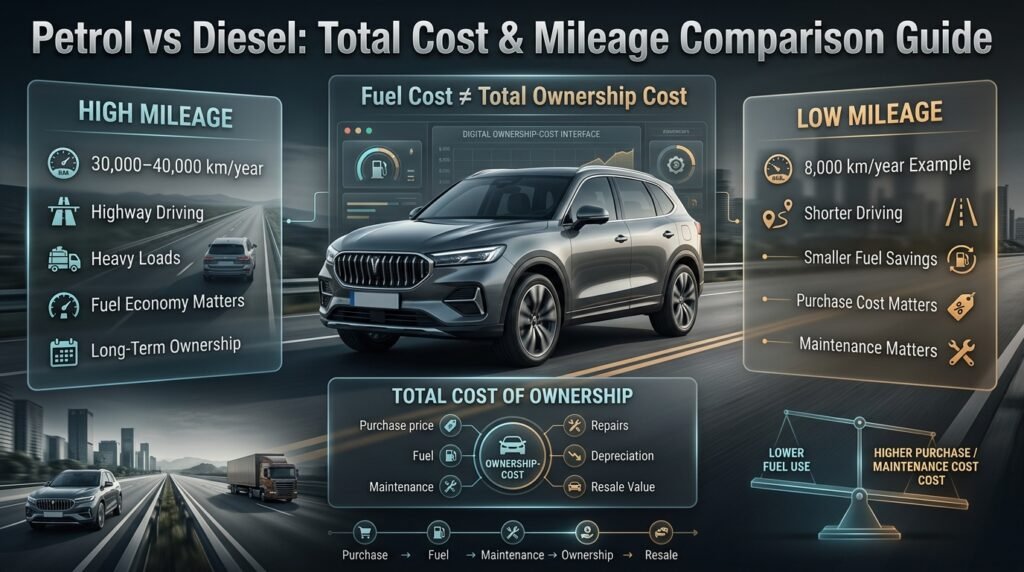
Consider:
Purchase price + fuel + maintenance + insurance + repairs + depreciation + financing + resale value
This is called the broader cost of ownership.
For example, a vehicle that consumes less fuel but costs substantially more to purchase and maintain may not be cheaper overall.
Similarly, a petrol vehicle with slightly higher fuel consumption may be more economical over several years if it costs less to buy and maintain.
Petrol vs. Diesel for High-Mileage Drivers
High-mileage drivers should pay particularly close attention to fuel economy.
If you travel 30,000 or 40,000 kilometres per year, even a modest difference in fuel consumption can become financially significant.
Diesel may therefore be attractive when:
- Annual mileage is high.
- Most driving is on highways.
- The vehicle regularly carries loads.
- The diesel’s fuel economy advantage is substantial.
- Maintenance costs are predictable.
- The vehicle is expected to be kept for several years.
But the calculation should still be based on actual figures.
Petrol vs. Diesel for Low-Mileage Drivers
Low-mileage drivers may not benefit as much from diesel’s fuel economy.
Suppose you drive only 8,000 kilometres per year.
Even if a diesel saves fuel, the absolute annual saving may be relatively small.
If the diesel vehicle costs more to purchase or maintain, those savings may not compensate for the additional costs.
This is why low-mileage drivers often find petrol vehicles attractive.
Which Is Better for SUVs?
SUVs are available with both petrol and diesel engines.
Diesel can be particularly attractive for:
- Towing
- Long highway journeys
- Heavy loads
- High annual mileage
- Off-road applications where low-speed torque matters
Petrol can be attractive for:
- Urban driving
- Family use
- Shorter journeys
- Quieter operation
- Lower annual mileage
- Drivers who prioritize responsive acceleration
The best choice depends on how the SUV will actually be used.
Buying a diesel SUV solely because “SUVs should have diesel engines” is not a good decision-making strategy.
Which Is Better for Commercial Vehicles?
Commercial vehicles need to be evaluated differently.
A business should look at:
- Daily mileage
- Payload
- Route length
- Idle time
- Fuel consumption
- Maintenance
- Driver behavior
- Downtime
- Vehicle utilization
- Service availability
For long-distance commercial operation, diesel may provide a strong combination of economy and torque.
For short urban delivery routes, however, another powertrain may sometimes be more suitable.
The best fleet choice is based on operational data, not assumptions.
How Driving Style Changes Fuel Economy
The driver has a major influence on fuel consumption.
Aggressive driving can increase fuel use regardless of fuel type.
Useful habits include:
- Accelerate smoothly.
- Avoid unnecessary hard braking.
- Maintain a sensible cruising speed.
- Anticipate traffic.
- Avoid unnecessary idling.
- Maintain tyre pressure.
- Remove unnecessary cargo.
- Service the vehicle regularly.
- Plan routes efficiently.
A vehicle with excellent laboratory fuel economy can still consume significantly more fuel if driven aggressively in heavy traffic.
Smooth driving is only the beginning, so for more practical advice on reducing fuel consumption, improving driving efficiency, and avoiding habits that waste fuel, read our Smooth driving is only the beginning, so for more practical advice on reducing fuel consumption, improving driving efficiency, and avoiding habits that waste fuel, read our Fuel-Saving Driving Tips guide.guide.
Vehicle Maintenance Guides
Effective vehicle maintenance is one of the most important factors in protecting fuel efficiency, engine performance, reliability, and long-term ownership value. A vehicle can have an efficient petrol or diesel engine, but neglected maintenance can gradually increase fuel consumption and create avoidable performance problems. Regular checks should cover engine oil and filters, tyre pressure, battery condition, cooling-system performance, brakes, belts, fluids, air-conditioning, and warning lights. For petrol engines, spark plugs, ignition components, and air-intake systems can also influence combustion quality, while diesel vehicles may require closer attention to fuel filters, injectors, turbochargers, and emissions-related components. Drivers should also pay attention to changes such as rough idling, difficult starting, unusual smoke, reduced acceleration, strange engine noises, or a sudden drop in fuel economy. Following the manufacturer’s service schedule and addressing small issues before they become major faults can help maintain consistent performance and reduce unexpected repair costs. For Dubai drivers in particular, routine maintenance is especially valuable because high temperatures, heavy traffic, frequent air-conditioning use, and long highway journeys can place additional demands on the vehicle.
For a complete guide to routine servicing, preventive maintenance, common vehicle problems, and practical ways to keep your car reliable throughout the year, explore our Vehicle Maintenance Guides for expert, easy-to-follow advice.
Dubai Driving and Fuel Insights
Dubai’s unique driving environment makes fuel efficiency more than simply choosing the right petrol. Dubai driving and fuel insights highlight how stop-and-go traffic, prolonged idling, frequent short journeys, highway speeds, and heavy air-conditioning use can influence real-world fuel consumption. Drivers can improve efficiency by accelerating smoothly, maintaining consistent speeds, avoiding unnecessary idling, and keeping tyres at the recommended pressure. Regular vehicle maintenance is equally important because issues such as clogged filters, worn spark plugs, poor wheel alignment, or under-inflated tyres can gradually increase fuel consumption. Understanding these local driving factors allows Dubai motorists to make smarter fuel decisions, reduce avoidable running costs, and maintain more dependable vehicle performance in everyday driving conditions.
For a more complete understanding of fuel efficiency, smart driving habits, vehicle maintenance, and practical refueling guidance, explore our detailed Dubai Fuel & Driving Guide to make better decisions on the road.
Does Air Conditioning Affect Fuel Consumption?
Yes.
Air conditioning requires energy, and that energy ultimately affects fuel consumption in vehicles powered by internal-combustion engines.
The impact varies depending on:
- Outside temperature
- Vehicle design
- Air-conditioning system
- Driving speed
- Cabin temperature
- Vehicle efficiency
- Operating conditions
In hot climates, air conditioning can be an important part of real-world fuel consumption.
That means fuel economy comparisons should be based on realistic local driving conditions rather than laboratory numbers alone.
Does Tyre Pressure Affect Petrol and Diesel Economy?
Yes.
Under-inflated tyres increase rolling resistance.
The engine then needs to provide more energy to move the vehicle, potentially increasing fuel consumption.
Correct tyre pressure also supports:
- Handling
- Braking
- Tyre life
- Ride quality
- Fuel economy
Check the manufacturer’s recommended tyre pressure rather than using a random number from another vehicle.
Does Vehicle Weight Matter?
Absolutely.
The heavier a vehicle is, the more energy is generally required to accelerate it.
Unnecessary cargo can therefore reduce fuel efficiency.
This matters particularly in:
- City driving
- Stop-start traffic
- Frequent acceleration
- Hilly areas
If you carry equipment or tools for work, regularly review whether everything in the vehicle is genuinely necessary.
Common Petrol vs. Diesel Mistakes
Mistake 1: Choosing Based Only on Fuel Price
A cheaper litre doesn’t necessarily mean a cheaper vehicle to operate.
Why it happens: People naturally focus on the price displayed at the fuel station.
Why it can be harmful: It ignores fuel consumption, maintenance, purchase price, and depreciation.
Better approach: Calculate annual ownership cost.
Mistake 2: Assuming Diesel Always Gives Better Mileage
Diesel often provides good fuel economy, but not every diesel vehicle beats every petrol vehicle.
Better approach: Compare actual vehicles under similar conditions.
Mistake 3: Buying Diesel for Very Short Trips
Some modern diesel systems may not be well suited to constant short-distance use.
Better approach: Check the manufacturer’s recommendations and consider whether your typical journeys allow the vehicle to operate as intended.
Mistake 4: Ignoring Maintenance History
A poorly maintained diesel can become expensive.
Better approach: Inspect service records and major components before buying.
Mistake 5: Thinking More Torque Means More Horsepower
Torque and horsepower are related but not identical.
Better approach: Look at the complete performance specification.
Mistake 6: Ignoring Fuel Quality
Even a high-quality engine can suffer if contaminated or unsuitable fuel enters the system.
Better approach: Use reputable fuel sources and respond quickly to unusual symptoms.
Mistake 7: Choosing Based on Internet Opinions
One driver’s experience doesn’t automatically apply to another driver.
Better approach: Base your decision on your mileage, route, vehicle requirements, budget, and ownership plans.
Expert Advice for Choosing Petrol or Diesel
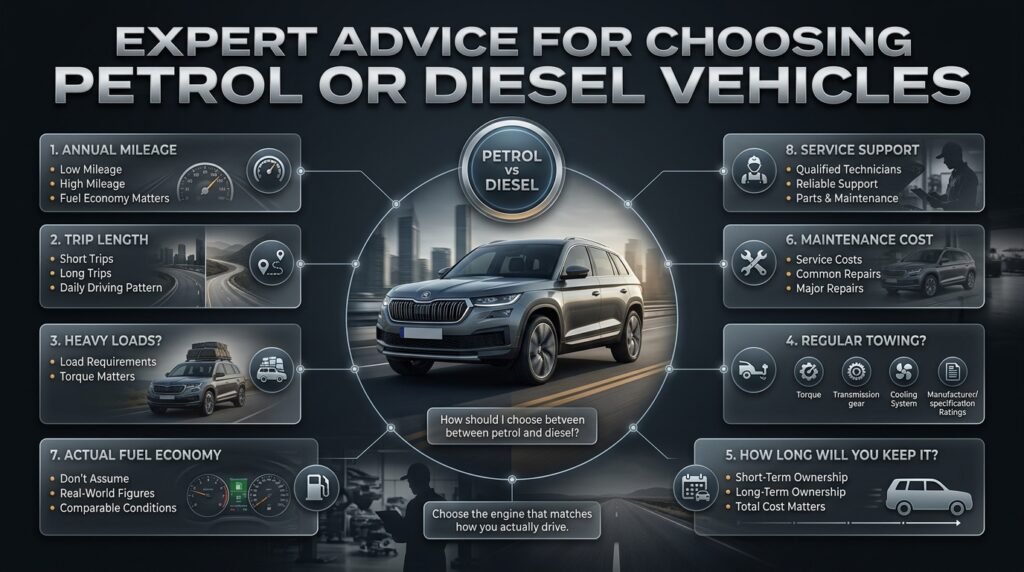
A sensible decision can be made using a few practical questions.
1. How Many Kilometres Do You Drive?
Estimate your annual mileage.
Low mileage generally reduces the financial advantage of fuel economy.
High mileage increases the value of every improvement in consumption.
2. How Long Are Your Normal Trips?
If most trips are only a few kilometres, your requirements are different from someone driving 100 kilometres each day.
3. Do You Carry Heavy Loads?
If yes, torque becomes more important.
4. Do You Tow?
If you tow regularly, compare torque, towing capacity, transmission, cooling system, and manufacturer ratings.
5. How Long Will You Keep the Vehicle?
A vehicle you plan to keep for eight years should be evaluated differently from one you plan to replace after two years.
6. What Does Maintenance Cost?
Research common service items and potential major repairs.
7. What’s the Vehicle’s Actual Fuel Economy?
Don’t assume.
Look for realistic figures from comparable driving conditions.
8. Is There Reliable Service Support?
A technically excellent vehicle isn’t ideal if qualified service support is difficult to access.
A Practical Petrol vs. Diesel Decision Guide
Use the following general framework:
Mostly short city trips + low mileage → Petrol may make more sense
Mixed driving + moderate mileage → Compare both carefully
Frequent highway trips + high mileage → Diesel may be advantageous
Heavy loads + regular towing → Diesel is often worth considering
Quiet operation + urban family use → Petrol may be attractive
Commercial high-mileage operation → Analyze diesel carefully
These aren’t absolute rules. They’re starting points for a more informed comparison.
What About Hybrid Vehicles?
The automotive market has changed considerably, so petrol and diesel aren’t the only options.
Hybrid vehicles combine an internal-combustion engine with electric assistance. Many hybrids use petrol engines, while fully electric vehicles remove conventional petrol and diesel combustion entirely.
For buyers choosing a newer vehicle, the comparison may therefore be:
Petrol vs. diesel vs. hybrid vs. electric
A hybrid may be particularly attractive for drivers who spend a lot of time in urban traffic.
An electric vehicle may suit someone who has convenient charging access and a driving pattern compatible with its range.
The best powertrain depends on the individual’s circumstances.
Petrol vs. Diesel for Fleet Management
Businesses should avoid choosing fleet fuel types based on personal preferences.
Instead, track:
- Kilometres per vehicle
- Fuel consumed
- Fuel cost
- Maintenance cost
- Downtime
- Load
- Route
- Driver behavior
- Average trip length
- Vehicle age
A company may discover that different vehicles require different powertrains.
For example, long-distance delivery vehicles may benefit from diesel, while short-distance urban service vehicles could use petrol or another suitable technology.
The goal should be lowest practical total operating cost while maintaining reliability and productivity.
How Fuel Quality Standards Protect Engines
Fuel-quality standards help ensure that fuels meet specified properties.
Consistent fuel quality is particularly important for modern engines because their fuel systems are highly engineered.
Learn more about fuel quality standards to understand why specifications matter.
Using the correct fuel grade and following the vehicle manufacturer’s recommendations is one of the simplest ways to avoid unnecessary fuel-related problems.
What Should You Check Before Buying a Used Diesel?
A used diesel deserves a careful inspection.
Pay attention to:
- Cold starting
- Engine noise
- Exhaust smoke
- Idle quality
- Turbocharger behavior
- Fuel-system performance
- Service history
- Warning lights
- Emissions equipment
- Oil condition
- Coolant condition
- Transmission operation
A professional inspection is especially valuable if the vehicle has high mileage.
What Should You Check Before Buying a Used Petrol?
Check:
- Cold starting
- Idle stability
- Acceleration
- Engine noises
- Oil leaks
- Cooling system
- Spark plugs and ignition system
- Turbocharger if equipped
- Service history
- Warning lights
- Transmission behavior
Don’t assume a petrol vehicle is automatically low-risk because petrol engines are sometimes considered simpler.
The specific vehicle condition is what matters.
How Fuel Contamination Can Affect Ownership Costs
Fuel contamination can turn a routine refuelling stop into a repair problem.
If contaminants reach sensitive fuel-system components, repairs can become expensive.
That is why proper fuel handling, suitable storage, clean equipment, and reliable fuel supply are important.
The general principles discussed in factors affecting fuel quality can help drivers and fleet operators understand why fuel quality can change over time.
Petrol vs. Diesel: Which One Is More Reliable?
Reliability isn’t determined by fuel type alone.
A well-maintained diesel can run reliably for a very long time.
A properly maintained petrol engine can also provide many years of dependable service.
Reliability depends on:
- Engine design
- Maintenance
- Driving conditions
- Fuel quality
- Service intervals
- Vehicle age
- Operating temperature
- Driving style
- Quality of repairs
A vehicle with excellent maintenance history should generally receive more attention than a vehicle that simply has a preferred fuel type.
Is Diesel Still a Good Choice?
Yes, diesel can still be a sensible choice for certain drivers.
It can make particular sense when:
- Annual mileage is high.
- Long-distance driving is common.
- Heavy loads are involved.
- Towing is frequent.
- Fuel economy is a major priority.
- The vehicle’s maintenance requirements are understood.
But diesel shouldn’t be chosen automatically.
Modern petrol engines have become more efficient, while alternative powertrains have also become more competitive.
The right decision depends on your actual circumstances.
Is Petrol Still a Good Choice?
Absolutely.
Petrol remains a practical option for many passenger vehicles.
It can be particularly attractive for:
- City drivers
- Short-trip users
- Low-mileage drivers
- Families
- Drivers who prioritize smooth operation
- Buyers seeking a lower initial purchase price
Modern petrol engines can also provide strong performance and respectable fuel economy.
Is petrol or diesel better for everyday driving?
There isn’t one universal winner. The better option depends mainly on how far you drive, where you drive, and how you use the vehicle. Petrol is generally a practical choice for drivers who spend most of their time in cities, make shorter journeys, and don’t accumulate very high annual mileage. Diesel becomes more attractive when the vehicle regularly covers longer distances, especially on highways, or carries heavy loads. Current buying guidance continues to emphasize driving pattern and annual mileage rather than fuel type alone.
For a driver doing frequent short urban trips, petrol can make more sense because the fuel-economy advantage of diesel may not be large enough to offset its higher purchase or maintenance costs. For someone driving long highway distances every week, diesel’s efficiency and strong low-speed torque can become much more valuable.
Points to consider:
Mostly city driving → petrol is often the more practical choice.
Frequent highway driving → diesel is worth serious consideration.
Heavy loads or towing → diesel’s torque can be an advantage.
Low annual mileage → calculate the savings before paying extra for diesel.
High annual mileage → diesel may offer better long-term running costs.
Always compare the actual vehicles, not just the fuel types.
Does diesel really give better fuel economy than petrol?
In many comparable vehicles, diesel engines are more fuel-efficient than petrol engines, but better mileage doesn’t automatically mean lower overall ownership cost. Diesel engines can extract more useful energy from each litre and commonly achieve better fuel economy, particularly during sustained highway driving. The difference can become much smaller in heavy stop-start traffic.
The important mistake is to compare only kilometres per litre. A proper comparison should include the price of each fuel, the vehicle’s purchase price, maintenance, insurance, depreciation, and how many kilometres you drive each year.
For example, if a diesel saves you fuel but costs substantially more to purchase, you need enough annual mileage for those fuel savings to recover the extra investment. A low-mileage driver may therefore gain little financially from diesel, while a high-mileage driver can benefit considerably.
Points to consider:
Compare real-world fuel consumption, not just brochure figures.
Calculate your annual kilometres.
Check the current fuel price in your market.
Include servicing and repair costs.
Consider the vehicle’s purchase-price difference.
Calculate the total cost over the period you expect to own it.
Is petrol better than diesel for short city trips?
For drivers who regularly make short, stop-start journeys, petrol is often the safer and more practical choice. Modern diesel vehicles can use diesel particulate filters (DPFs) and other emissions-control equipment that need appropriate operating conditions to function correctly. Repeated short journeys can make DPF regeneration more difficult and may increase the risk of related problems.
The important point isn’t simply the number of kilometres you drive each year. Trip pattern matters. Someone who drives only 8,000 km a year but regularly takes long highway journeys has a very different usage pattern from someone who drives the same 8,000 km through repeated 3–5 km city trips.
If your normal routine is school runs, shopping, short office journeys, traffic signals, and frequent engine starts, a petrol vehicle may fit that lifestyle better.
Points to consider:
Frequent short trips generally favour petrol.
Repeated cold starts can be hard on any engine.
Modern diesel vehicles need their emissions systems to operate correctly.
Regular longer journeys can make diesel more suitable.
Don’t buy a diesel simply because someone says it gives better mileage.
Check the manufacturer’s recommendations for the specific diesel model.
Which is cheaper to maintain: petrol or diesel?
Petrol is often perceived as cheaper and simpler to maintain, but there is no fixed rule that applies to every vehicle. Modern petrol engines can have turbochargers, direct injection, complex sensors and sophisticated emissions equipment. Modern diesels can have high-pressure fuel systems, turbochargers, particulate filters and other emissions-control components.
The real difference becomes especially important when you’re buying a used vehicle. A well-maintained diesel with complete service records may be a better long-term purchase than a neglected petrol car. Likewise, an older diesel with problems in its fuel or emissions systems can become expensive very quickly.
Before buying, don’t just ask, “Is diesel maintenance expensive?” Ask what this particular engine commonly needs, how much its major components cost, and whether it has been maintained according to the manufacturer’s schedule.
Points to consider:
Check the complete service history.
Ask about common faults for the exact engine.
Inspect the turbocharger where applicable.
Check fuel-system condition.
On diesel models, pay attention to emissions-system components.
Get a professional inspection before buying a used vehicle.
Budget for major repairs rather than looking only at routine servicing.
Should I choose petrol or diesel for high-mileage and long-distance driving?
If you regularly cover high annual mileage and a large portion of that driving is on highways, diesel can be an excellent option. Its combination of fuel efficiency, low-speed torque and strong long-distance performance makes it particularly useful for drivers who spend many hours on the road. Current 2026 buying guidance continues to identify high-mileage, long-distance drivers as the group most likely to benefit from diesel.
However, high mileage alone isn’t enough to make the decision. A driver covering 20,000 km mostly through congested city traffic has a different situation from someone covering the same distance on open highways. The type of journey, load, driving speed, fuel costs and maintenance requirements all affect the final calculation.
For commercial drivers and fleet operators, the calculation should go even further. Fuel consumption, downtime, maintenance, payload, route length and vehicle utilization should all be measured before choosing the powertrain.
Points to consider:
High annual mileage can make diesel more financially attractive.
Highway driving is where diesel efficiency can be especially useful.
Heavy loads increase the value of strong low-speed torque.
Calculate fuel cost per kilometre rather than comparing pump prices alone.
Include maintenance and repair costs.
Consider how many years you plan to keep the vehicle.
For business vehicles, calculate the complete operating cost before deciding.
Conclusion
Choosing between petrol and diesel isn’t simply a matter of deciding which fuel is cheaper or which engine has better mileage. The right choice depends on your driving habits, annual mileage, journey length, vehicle type, maintenance budget, and long-term ownership plans.
Petrol is often a practical option for city driving, shorter journeys, lower annual mileage, and drivers who prefer smooth and responsive everyday performance. Diesel can make more sense for high-mileage drivers, frequent highway travel, heavy loads, towing, and situations where strong fuel economy and low-speed torque are important.
Before making a decision, look beyond the fuel price. Compare the vehicle’s real-world fuel consumption, purchase price, servicing requirements, potential repair costs, reliability, and expected resale value. This gives you a much clearer picture of the actual cost of ownership.
Most importantly, don’t choose petrol or diesel simply because one is generally considered “better.” Choose the powertrain that matches the way you actually use your vehicle. A well-maintained vehicle with the right engine for your driving conditions will usually deliver a better ownership experience than a vehicle chosen purely because of its fuel type.
Leave a Reply