Introduction
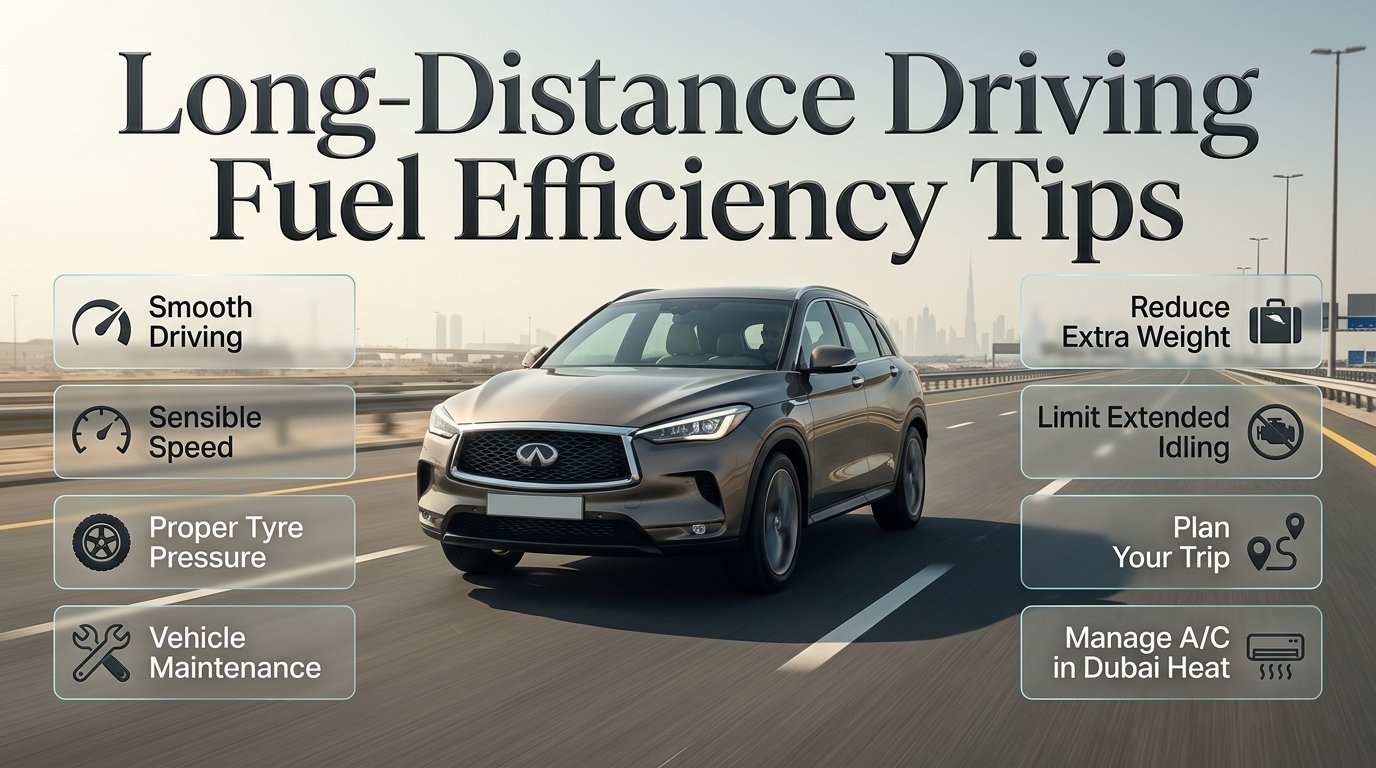
Long-Distance Driving Fuel Efficiency Tips | Long-distance driving can be comfortable, relaxing, and convenient when your vehicle is properly prepared and your driving habits are efficient. However, travelling hundreds of kilometres can also expose fuel-wasting habits that may not seem important during short daily journeys. Excessive speed, frequent acceleration, unnecessary braking, low tyre pressure, extra vehicle weight, poor maintenance, and extended idling can all contribute to higher fuel consumption.
For drivers in Dubai, fuel efficiency can be even more important because long journeys may involve high-speed roads, heavy traffic, extreme temperatures, and frequent use of air conditioning. The good news is that improving fuel economy doesn’t require complicated modifications or expensive equipment. A combination of sensible preparation, smooth driving, proper maintenance, and better trip planning can make a meaningful difference over time.
If you need additional information about fuel-related services and roadside fuel assistance in Dubai, you can also visit Fuel Delivery Dubai.
This guide explains practical long-distance driving fuel efficiency tips that drivers can use before, during, and after a long journey. The focus is not on unrealistic fuel-saving promises, but on simple habits that can help reduce unnecessary fuel consumption while keeping the journey safe and comfortable.
Why Fuel Efficiency Matters on Long Trips
Fuel economy becomes more noticeable when you travel long distances.
Imagine a vehicle that averages 8 litres of fuel per 100 kilometres. On a 500-kilometre journey, it would use approximately 40 litres under those conditions. If the same vehicle consumes 9 litres per 100 kilometres because of higher speeds, heavy traffic, aggressive acceleration, or additional load, the journey would require approximately 45 litres.
That difference may appear small on one trip, but drivers who regularly travel long distances can see the effect over weeks and months.
Fuel efficiency also isn’t only about the price of fuel. Efficient driving can encourage smoother vehicle operation, reduce unnecessary stress on some components, and make long journeys more predictable.
The most effective approach is to look at the entire journey rather than focusing on one trick.
A fuel-efficient long trip usually involves:
- Preparing the vehicle before departure
- Checking tyre pressure
- Removing unnecessary weight
- Planning the route
- Maintaining a sensible speed
- Accelerating smoothly
- Avoiding unnecessary braking
- Reducing unnecessary idling
- Managing air conditioning sensibly
- Monitoring traffic conditions
- Keeping the vehicle properly maintained
- Planning fuel stops in advance
None of these steps needs to be extreme. Their value comes from using them consistently.
What Is the Most Fuel-Efficient Way to Drive Long Distances?
The most practical approach is to drive smoothly and predictably while maintaining a reasonable speed suitable for the road and traffic conditions.
Fuel efficiency isn’t simply about driving as slowly as possible. A vehicle operates under different loads and conditions, and fuel consumption can change depending on speed, acceleration, road surface, wind, traffic, vehicle weight, tyre condition, and many other factors.
For highway driving, one of the most important principles is to avoid unnecessary changes in speed.
Repeatedly accelerating and braking requires the vehicle to continually convert fuel energy into motion and then lose some of that energy through braking. When traffic and road conditions allow, maintaining a steady pace can reduce this unnecessary cycle.
For a more focused guide, see Fuel-Efficient Highway Driving.
Car Load and Fuel Consumption
The amount of weight carried by a vehicle can influence fuel consumption, particularly during frequent acceleration, hill climbing, and stop-and-go driving. Extra luggage, heavy equipment, or unnecessary items in the trunk increase the vehicle’s overall weight, requiring more energy to move. While a small amount of additional weight may have a limited effect on a single trip, carrying unnecessary loads regularly can gradually reduce fuel efficiency. For better economy, remove items you do not need, distribute essential luggage safely, and avoid treating your vehicle as permanent storage. In Dubai, combining a sensible vehicle load with smooth driving and proper tire pressure can help support more efficient everyday driving.
For practical tips on how luggage, heavy equipment, passenger load, and unnecessary items can affect your vehicle’s fuel consumption, explore our detailed Car Load and Fuel Consumption guide and learn how to manage vehicle weight more efficiently.
1. Maintain a Steady Speed
One of the simplest ways to improve fuel economy during a long trip is to avoid unnecessary speed fluctuations.
Suppose you’re driving on an open highway and repeatedly change your speed. You accelerate to a higher speed, lift off the accelerator, brake, accelerate again, and repeat the process. Even if the average speed appears reasonable, this pattern can be less efficient than maintaining a relatively consistent pace.
A steady speed allows the engine and transmission to operate more consistently.
This doesn’t mean you should maintain exactly the same speed regardless of circumstances. Traffic, road conditions, speed limits, weather, and safety always come first.
Instead, the objective is to avoid unnecessary fluctuations when conditions are stable.
Good habits include:
- Looking ahead instead of focusing only on the vehicle directly in front of you
- Leaving an appropriate following distance
- Avoiding unnecessary acceleration
- Avoiding unnecessary braking
- Maintaining a reasonable cruising speed
- Adjusting speed smoothly when conditions change
Over a long journey, these small decisions can add up.
2. Avoid Excessive Highway Speed
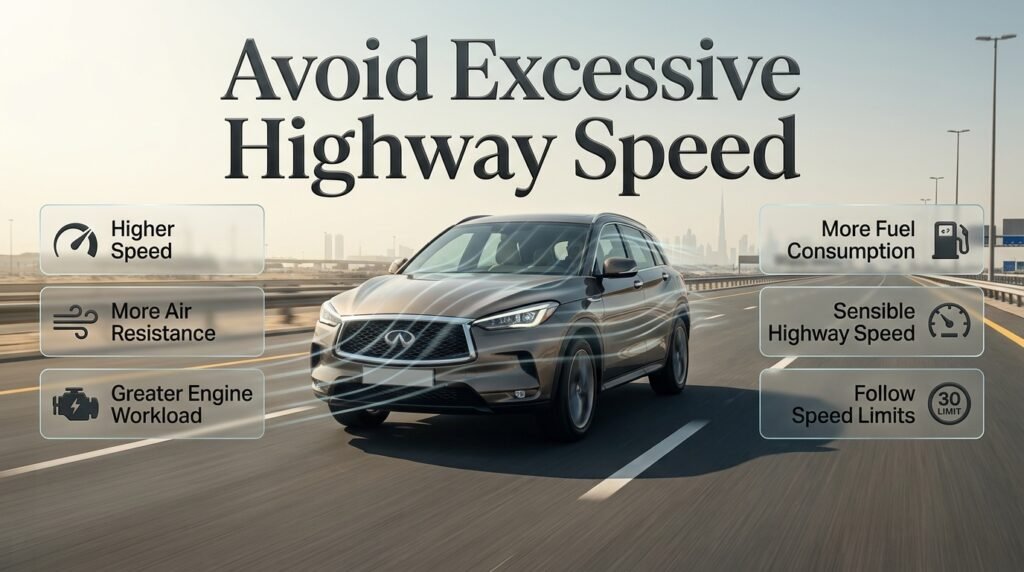
Speed is one of the factors that can have a major effect on highway fuel consumption.
As vehicle speed increases, aerodynamic resistance becomes increasingly important. Your engine has to produce more power to overcome air resistance, so travelling significantly faster can increase fuel consumption.
This is one reason why a driver may notice a difference in fuel economy when moving from moderate highway speeds to much higher speeds.
The temptation to drive faster during a long trip is understandable. You may feel that increasing speed will save time. However, the time gained may be relatively small compared with the additional fuel consumed.
For example, increasing your speed may reduce the duration of a journey by a limited amount, while increasing the engine’s workload for a large part of the trip.
Always follow the applicable speed limits and road rules. Fuel economy should never be used as a reason to drive below a safe speed or create a hazard for other road users.
For additional information about speed and fuel use, see How Highway Speed Affects Fuel Consumption.
3. Accelerate Smoothly
Aggressive acceleration is another common source of unnecessary fuel consumption.
When you press the accelerator hard, the engine is asked to produce more power quickly. If this happens repeatedly throughout a journey, fuel consumption can rise.
Smooth acceleration doesn’t mean crawling away from every traffic light or taking an unnecessarily long time to reach highway speed. It means applying the accelerator progressively and avoiding aggressive inputs when they aren’t necessary.
Try to accelerate smoothly when:
- Joining a highway
- Leaving a junction
- Moving away from a traffic light
- Returning to cruising speed after traffic slows
- Climbing a gradual incline
Of course, there are situations where stronger acceleration is necessary for safety, such as merging appropriately into moving traffic. Safety should always take priority.
The goal is to remove unnecessary aggressive acceleration from normal driving rather than preventing appropriate acceleration when the situation requires it.
You can learn more about the subject at How Acceleration Affects Fuel Consumption.
4. Reduce Unnecessary Braking
Efficient driving is not simply about what you do with the accelerator. Your braking habits also matter.
If you accelerate hard and then brake heavily a short time later, some of the energy used to accelerate the vehicle is lost during braking.
This doesn’t mean you should avoid braking. Braking is essential whenever safety requires it.
Instead, develop the habit of looking further ahead.
If traffic is slowing several hundred metres ahead, you may be able to gradually reduce speed rather than maintaining your current speed until the last moment and then braking hard.
This can make driving smoother and may reduce unnecessary cycles of acceleration and braking.
A useful principle is:
Look ahead → anticipate → adjust smoothly → accelerate only when needed.
For more information, read How Braking Habits Affect Fuel Economy in Dubai.
5. Keep a Safe Following Distance
Following too closely can indirectly contribute to poor fuel economy.
When you’re close to the vehicle ahead, you have less time to react to changes in traffic. This can lead to repeated braking and acceleration.
A reasonable following distance gives you more time to respond gradually.
For example, if traffic ahead begins to slow, you may be able to ease off the accelerator rather than immediately applying the brakes.
This approach has benefits beyond fuel economy. It can also make driving less stressful and give you more reaction time.
However, following distance should always be appropriate for traffic, speed, weather, and road conditions.
6. Check Tyre Pressure Before a Long Journey
Tyre pressure is an easy item to overlook before a road trip.
Underinflated tyres can increase rolling resistance. When rolling resistance increases, the vehicle may require more energy to move.
Before starting a long journey, check the tyre pressure according to the vehicle manufacturer’s recommended specification.
Don’t rely on how the tyre looks. A tyre can be underinflated without appearing obviously flat.
Also inspect the tyres for:
- Uneven tread wear
- Cuts
- Cracks
- Bulges
- Embedded objects
- Excessive tread wear
- Signs of damage
If you are travelling a long distance, tyre condition is important for both efficiency and safety.
Remember that the recommended tyre pressure may vary depending on the vehicle and load. Check the information provided by the manufacturer rather than using a random pressure value.
7. Remove Unnecessary Weight
Extra weight can affect fuel consumption because a heavier vehicle generally requires more energy to accelerate.
Before a long trip, take a few minutes to inspect the trunk, rear seats, and storage compartments.
You may find items that have been sitting in the vehicle for weeks even though you don’t need them.
Examples include:
- Old equipment
- Heavy tools
- Unused sports equipment
- Boxes
- Extra luggage
- Unnecessary accessories
- Items left behind from previous trips
You don’t need to remove every useful item from the vehicle. Emergency equipment, spare tyres, tools, and other important items should remain available.
The idea is simply to avoid carrying unnecessary heavy objects over hundreds of kilometres.
8. Remove Unused Roof Accessories
Roof racks, roof boxes, and other external accessories can affect aerodynamics.
This is particularly relevant during highway travel because aerodynamic resistance becomes more significant as speed increases.
If you have a roof rack installed but aren’t using it, consider removing it before a long journey if the manufacturer’s instructions and your vehicle setup allow it.
The same principle applies to other unnecessary external equipment.
Ask yourself:
Do I actually need this accessory for this journey?
If the answer is no, removing it may be worthwhile.
9. Use Air Conditioning Sensibly in Dubai
Air conditioning is an important part of driving in Dubai. During hot weather, maintaining a comfortable cabin isn’t a luxury; it can be important for driver concentration and comfort.
However, the AC system requires energy, and the amount of energy required can vary depending on outside temperature, cabin temperature, vehicle design, AC settings, and driving conditions.
You can use the system sensibly without sacrificing comfort.
Before starting:
- Park in shade when possible.
- Use available ventilation appropriately.
- Keep the vehicle’s cooling system maintained.
- Avoid leaving the engine running unnecessarily for long periods.
- Keep doors and windows closed when appropriate.
At highway speeds, driving with windows open can increase aerodynamic drag. The best approach depends on the circumstances, but drivers shouldn’t sacrifice safe cabin temperatures simply to chase a small fuel saving.
In Dubai’s climate, driver safety and comfort should always remain the priority.
Air Conditioning and Fuel Consumption
Air conditioning can have a noticeable effect on fuel consumption, especially during hot weather and heavy traffic. When the AC system is running, the engine needs additional power to operate the compressor, which can increase fuel use. In Dubai’s hot climate, however, avoiding AC completely is not practical or comfortable. A better approach is to use the system efficiently by parking in shade when possible, ventilating the cabin briefly before cooling it, maintaining the AC system properly, and avoiding unnecessary idling with the AC running. These simple habits can help reduce unnecessary fuel consumption while keeping the cabin comfortable.
For practical tips on reducing unnecessary fuel consumption while keeping your car comfortable in Dubai’s hot climate, explore our detailed Air Conditioning and Fuel Consumption guide, which explains how AC use, traffic, idling, driving speed, and vehicle maintenance can affect overall fuel economy.
Tire Pressure and Fuel Efficiency
Tire pressure plays an important role in fuel efficiency because underinflated tires create greater rolling resistance, forcing the engine to work harder and potentially increasing fuel consumption. Maintaining the recommended tire pressure can help your vehicle roll more efficiently while also supporting better handling, braking, and tire wear. In Dubai’s hot climate, checking tire pressure regularly is especially useful because temperature changes can affect pressure readings. Always follow the vehicle manufacturer’s recommended pressure rather than relying on the maximum pressure printed on the tire sidewall.
For practical guidance on maintaining the correct tire pressure, reducing unnecessary rolling resistance, and supporting better fuel economy in Dubai’s driving conditions, read our detailed Tire Pressure and Fuel Efficiency guide.
10. Avoid Unnecessary Idling
A vehicle can consume fuel while sitting still with the engine running.
This is particularly noticeable when drivers leave the engine running for extended periods during waiting situations.
Examples include:
- Waiting outside a location
- Picking someone up
- Sitting in a parking area
- Waiting during a long roadside stop
- Sitting in a queue that isn’t moving
If you expect to remain stopped for an extended period and it is safe and appropriate to switch the engine off, unnecessary idling can be avoided.
However, you shouldn’t repeatedly turn the engine off and on during very short stops if doing so creates a safety, traffic, or vehicle-system concern.
The practical objective is to avoid prolonged engine running when the vehicle isn’t being used.
For more information, see Fuel Consumption While Idling.
11. Understand How Traffic Affects Fuel Economy
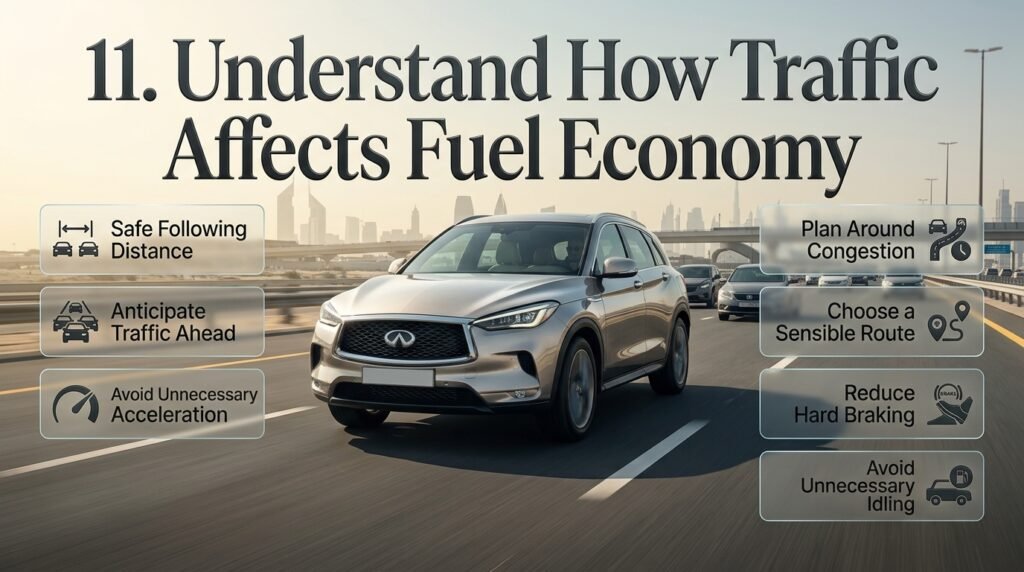
Long-distance travel doesn’t always mean continuous highway cruising.
You may encounter:
- Congestion
- Roadworks
- Accidents
- Toll areas
- Busy interchanges
- Construction zones
- City traffic
- Stop-and-go conditions
Repeated stopping and accelerating can make a journey less efficient than smooth cruising.
Traffic planning can therefore be an important part of fuel efficiency.
Before leaving, consider checking the expected traffic conditions. If your schedule is flexible, travelling outside the busiest period may reduce both journey time and unnecessary speed changes.
You can read more about this topic at How Traffic Affects Fuel Economy in Dubai.
12. Reduce Stop-and-Go Driving When Possible
Stop-and-go traffic creates a cycle of:
Stop → accelerate → slow down → brake → stop again.
This can be particularly inefficient compared with maintaining a steady speed.
You cannot always avoid congestion, especially in a busy city. However, better route planning can sometimes help.
If two routes are available, don’t automatically choose the shortest distance. Consider:
- Expected traffic
- Number of intersections
- Road conditions
- Average speed
- Construction
- Known congestion points
- Time of day
A slightly longer route that allows smoother movement may sometimes be preferable to a shorter route involving heavy stop-and-go traffic.
However, route choice should be based on the overall journey, not fuel economy alone.
For additional guidance, see Stop and Go Driving Fuel Efficiency.
13. Plan Your Route Before Leaving
Route planning is one of the simplest ways to make a long journey more predictable.
Before departure, know:
- Where you’re going
- Approximate journey distance
- Expected travel time
- Fuel stations along the route
- Potential traffic areas
- Suitable rest locations
- Alternative routes
- Weather or road conditions where relevant
Good planning can reduce the temptation to drive aggressively because you’re worried about being late.
It can also help you avoid unnecessary detours.
A driver who knows where the next fuel stop is doesn’t need to worry about searching for a station at the last moment.
14. Plan Fuel Stops in Advance
Don’t wait until the fuel tank is nearly empty before thinking about where to refuel.
For a long trip, identify suitable fuel stops based on your vehicle’s expected range and the route.
Your plan should consider:
- Fuel tank size
- Average fuel consumption
- Total journey distance
- Traffic
- Available stations
- Possible detours
- Your comfort level with the remaining range
You don’t necessarily need to stop at every station you see. But you should avoid relying on an extremely small remaining fuel range when travelling through unfamiliar areas.
If you experience an unexpected fuel shortage during a journey in Dubai, Fuel Delivery Dubai can provide a convenient point of reference for roadside fuel assistance.
15. Maintain the Vehicle Properly
Fuel-efficient driving starts with a vehicle that is operating properly.
Driving habits matter, but maintenance matters too.
Before a major journey, pay attention to:
Engine oil
Make sure the oil level is appropriate and follow the manufacturer’s recommended maintenance schedule.
Tyres
Check pressure, tread condition, and visible damage.
Brakes
If you notice unusual noises, vibration, pulling, or other warning signs, have the vehicle inspected.
Battery
A weak battery may not directly cause every fuel-economy problem, but battery condition is still important for reliable starting and overall vehicle operation.
Cooling system
Dubai’s hot climate makes proper cooling-system maintenance especially important.
Air filter
A severely restricted air filter can affect engine operation. Follow the manufacturer’s maintenance recommendations.
Warning lights
Never ignore important dashboard warning lights simply because the car continues to move.
A long trip is not the ideal time to discover that a small maintenance problem has become a major breakdown.
16. Don’t Ignore Small Vehicle Problems
Drivers sometimes postpone maintenance because a problem appears minor.
A strange noise, vibration, warning light, unusual smell, or change in vehicle behaviour can be an early indication that something needs attention.
Before travelling hundreds of kilometres, ask yourself:
Would I be comfortable driving this vehicle for several hours if the problem gets worse?
If the answer is no, have the vehicle checked before leaving.
Fuel efficiency is important, but reliability and safety are more important.
Vehicle Drag and Fuel Consumption in Dubai
Vehicle drag can have a significant effect on fuel consumption, particularly as driving speed increases. Aerodynamic resistance becomes more noticeable on highways, meaning vehicles may need more engine power to maintain higher speeds. Roof racks, cargo boxes, open windows at high speeds, and bulky external accessories can increase drag and reduce efficiency further. In Dubai, where drivers often use high-speed roads for longer journeys, keeping the vehicle streamlined and removing unnecessary external equipment can help reduce aerodynamic resistance. Combining good aerodynamics with moderate speeds and smooth driving can support better overall fuel economy.
For a deeper understanding of how aerodynamic resistance, driving speed, roof equipment, external cargo, wind, and vehicle design can influence fuel consumption, explore our detailed Vehicle Drag and Fuel Consumption in Dubai guide.
17. Avoid Aggressive Driving
Aggressive driving can combine several inefficient behaviours at once.
For example:
- Hard acceleration
- High speeds
- Sudden braking
- Frequent overtaking
- Rapid lane changes
- Unnecessary speed changes
These behaviours can increase fuel consumption and may also increase stress and vehicle wear.
A smoother driving style is usually more comfortable during a long journey.
Try to drive proactively rather than reactively.
Look farther ahead.
Anticipate traffic.
Allow enough space.
Make smooth inputs.
Maintain an appropriate speed.
This approach can make the entire trip feel easier.
For broader fuel-saving guidance, see Fuel-Saving Driving Tips.
How Aerodynamics Affects Fuel Efficiency
Aerodynamics plays an important role in fuel efficiency, especially when a vehicle is traveling at higher speeds. As speed increases, air resistance creates more drag, requiring the engine to use additional energy to keep the vehicle moving. Features such as roof racks, cargo boxes, open windows, and bulky external accessories can increase aerodynamic drag and contribute to higher fuel consumption. Keeping the vehicle streamlined, removing unnecessary external equipment, and maintaining a sensible highway speed can help reduce resistance and support more efficient driving.
For a clearer understanding of how air resistance, vehicle design, speed, roof accessories, and external load can influence your car’s fuel consumption, explore our detailed How Aerodynamics Affects Fuel Efficiency guide.
How Vehicle Weight Affects Fuel Economy
Vehicle weight has a direct influence on fuel economy because a heavier car requires more energy to accelerate and maintain movement, particularly in stop-and-go traffic. Carrying unnecessary luggage, tools, equipment, or other heavy items can gradually increase fuel consumption, especially when the vehicle is used frequently. The effect may be more noticeable during repeated acceleration, hill climbs, and city driving than during steady cruising. Keeping the vehicle load reasonable, removing items that are no longer needed, and distributing essential cargo safely can help reduce unnecessary energy demand and support better overall fuel efficiency.
For a deeper look at how passenger load, luggage, heavy equipment, and overall vehicle weight can influence fuel consumption, explore our detailed How Vehicle Weight Affects Fuel Economy guide for practical ways to manage unnecessary weight and improve driving efficiency.
18. Use Smooth Driving Techniques
Smooth driving is not about being unnecessarily slow.
It is about reducing sudden and unnecessary changes.
A smooth driver:
- Accelerates progressively
- Maintains a reasonable cruising speed
- Looks ahead
- Anticipates traffic
- Brakes when necessary
- Avoids unnecessary lane changes
- Maintains an appropriate following distance
- Adjusts speed gradually where conditions allow
These habits are especially useful on long journeys because you repeat them for hours.
A small inefficient action performed once doesn’t matter much.
The same action performed hundreds of times can matter considerably.
For more information, see Smooth Driving Techniques for Better Fuel Economy.
19. Don’t Carry More Fuel Than You Need
Some drivers believe that filling a vehicle completely is always the most efficient option.
However, fuel itself has weight.
That doesn’t mean you should avoid filling the tank when appropriate. It means there is little reason to carry excessive fuel beyond what your journey requires simply because you want the maximum possible range.
For normal driving, follow your vehicle’s recommended refuelling practices.
For long-distance travel, balance:
- Fuel availability
- Journey distance
- Vehicle range
- Planned stops
- Traffic
- Personal comfort
The objective is reliable travel, not trying to operate with either an unnecessarily heavy tank or an uncomfortably low fuel level.
20. Don’t Make Unnecessary Detours
A small detour may seem insignificant.
But if you’re already travelling hundreds of kilometres, repeated unnecessary kilometres can increase total fuel use.
Before leaving, enter your destination correctly and review the route.
If you need to stop for food, shopping, fuel, or other reasons, try to combine stops when practical rather than making several separate trips.
For example:
Instead of:
Fuel stop → return to route → shopping → return again
you may be able to plan the stops more efficiently.
Good planning doesn’t have to be complicated.
Roof Racks and Fuel Economy in Dubai
Roof racks can affect fuel economy by increasing a vehicle’s aerodynamic drag, particularly when driving at higher speeds on Dubai’s highways. Even when the rack is not carrying cargo, its added exposure to airflow can create additional resistance, which may require more engine power to maintain speed. The effect can become greater when carrying bulky items such as bicycles, luggage, or roof boxes. If a roof rack is not needed for a particular journey, removing it can help keep the vehicle more aerodynamic. For regular users, choosing a streamlined design, securing cargo properly, and avoiding unnecessary weight can support better fuel efficiency.
If you regularly use a roof rack for luggage, bicycles, or other equipment, our detailed Roof Racks and Fuel Economy in Dubai guide explains how roof-mounted accessories can increase aerodynamic drag and influence fuel consumption, especially during highway driving.
21. Take Breaks Instead of Rushing
Fuel efficiency shouldn’t encourage drivers to push through fatigue.
Long-distance driving requires concentration.
If you’re tired, take an appropriate break. A rested driver is better positioned to maintain smooth, attentive driving.
Fatigue can also contribute to:
- Late braking
- Poor speed control
- Sudden acceleration
- Missed turns
- Unnecessary route changes
- Reduced awareness of traffic
A fuel-efficient trip is not successful if the driver reaches the destination exhausted or unsafe.
Plan realistic travel times and include appropriate breaks.
22. Use Cruise Control When Conditions Are Suitable
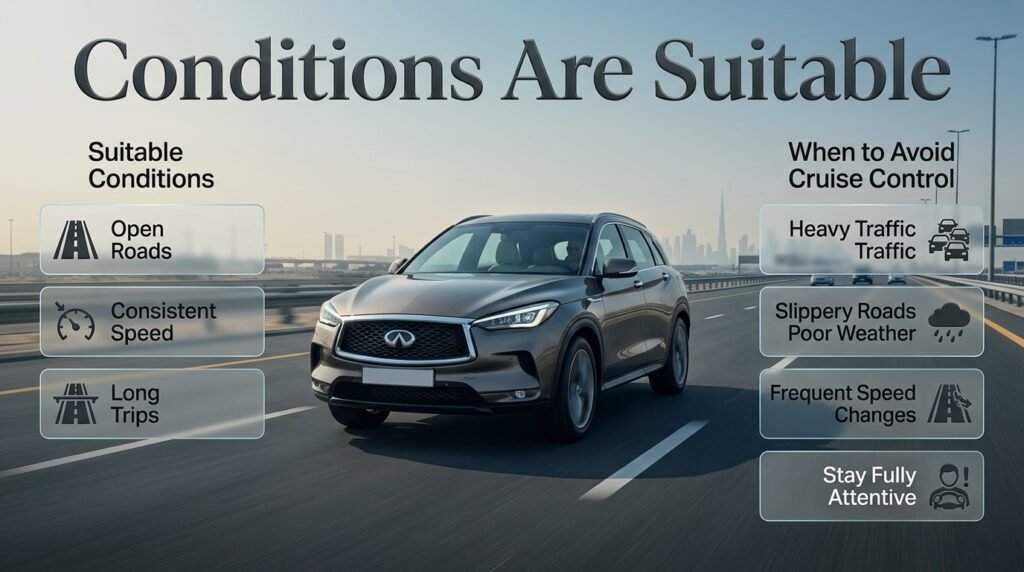
Cruise control can be useful on long, relatively open roads.
It can help maintain a consistent speed and reduce the tendency to gradually speed up and slow down without noticing.
However, cruise control isn’t appropriate for every situation.
Avoid relying on it when:
- Traffic is heavy
- Roads are slippery
- Weather conditions are poor
- Frequent speed changes are necessary
- You need close control of the vehicle
The driver should remain fully attentive even when cruise control is active.
23. Pay Attention to Road Conditions
Road surface and terrain can influence fuel consumption.
Driving uphill requires additional engine power. Strong headwinds can also increase aerodynamic resistance.
You cannot control these factors, but you can control how you respond to them.
For example, avoid unnecessarily aggressive acceleration simply because the vehicle’s speed drops slightly on an incline.
Similarly, don’t accelerate excessively downhill simply to maintain a target speed if road conditions and traffic don’t require it.
The safest approach is to respond naturally to the road while maintaining appropriate control.
24. Avoid Unnecessary Lane Changes
Frequent lane changes often involve acceleration, deceleration, and speed adjustments.
On a clear road, repeatedly changing lanes without a meaningful reason doesn’t improve fuel economy.
Choose the appropriate lane for the road and traffic conditions and maintain your position when practical.
Of course, lane changes are necessary when:
- Preparing for an exit
- Passing safely and legally
- Following road directions
- Responding to traffic
- Avoiding hazards
The point is to avoid unnecessary movement, not to avoid legitimate lane changes.
25. Prepare for Dubai’s Hot Climate
Long-distance driving in Dubai can put additional demands on the vehicle because of high temperatures.
Before a long trip, pay attention to the vehicle’s cooling system and fluid levels.
It’s also sensible to check:
- Coolant
- Engine oil
- Tyres
- Battery
- AC performance
- Belts and hoses where applicable
- Dashboard warning lights
Extreme heat can expose weaknesses that may not be obvious during normal short trips.
Good preparation can reduce the chance of turning a fuel-efficient journey into an unexpected roadside stop.
Common Mistakes That Increase Fuel Consumption
Mistake 1: Driving Too Fast
The driver wants to arrive sooner and gradually increases speed.
The problem is that higher highway speeds can increase aerodynamic resistance and fuel consumption.
Better approach: Follow speed limits and maintain a sensible, steady pace.
Mistake 2: Hard Acceleration
The driver aggressively accelerates every time traffic clears.
This can increase fuel use.
Better approach: Accelerate smoothly when conditions allow.
Mistake 3: Braking Too Late
The driver waits until traffic is very close before braking.
This can result in repeated hard acceleration and braking.
Better approach: Look farther ahead and anticipate traffic changes.
Mistake 4: Ignoring Tyre Pressure
The vehicle appears normal, so tyre pressure isn’t checked.
Better approach: Check tyre pressure before long trips.
Mistake 5: Carrying Unnecessary Weight
Heavy items remain in the vehicle for months.
Better approach: Remove items you don’t need.
Mistake 6: Leaving Roof Accessories Installed
A roof rack or box remains installed even when it isn’t being used.
Better approach: Remove unnecessary external equipment when practical.
Mistake 7: Excessive Idling
The engine runs while the vehicle remains stationary for extended periods.
Better approach: Avoid unnecessary prolonged idling when safe and appropriate.
Mistake 8: Ignoring Maintenance
The driver assumes fuel economy is only controlled by driving technique.
Better approach: Keep the vehicle maintained according to the manufacturer’s recommendations.
Mistake 9: Rushing Because of Poor Planning
The driver leaves late and tries to make up time by driving faster.
Better approach: Plan the journey realistically and allow enough time.
Mistake 10: Focusing Too Much on One Fuel-Saving Trick
Some drivers look for one technique that will dramatically reduce fuel consumption.
Better approach: Combine several sensible habits consistently.
How to Prepare Your Car One Day Before a Long Trip
The day before your journey is a good time to inspect the vehicle.
Start with the tyres.
Check their pressure and inspect their condition.
Then check the vehicle’s fluids according to the manufacturer’s recommendations.
Make sure your lights work correctly and your windscreen is clean enough for good visibility.
Check your spare tyre or tyre-repair equipment.
If the vehicle has recently shown unusual behaviour, arrange an inspection rather than hoping the problem disappears.
Also remove unnecessary items from the trunk.
If you use a roof rack or other external equipment, decide whether you actually need it for the journey.
Finally, review your route.
Know where you’re likely to stop and where fuel is available.
Long-Distance Trip Checklist
Before leaving, use this simple checklist:
Vehicle
- Tyre pressure checked
- Tyres inspected
- Engine oil checked
- Coolant checked
- Battery condition considered
- Brake condition checked
- Lights working
- Wipers working
- Washer fluid available
- Spare tyre or repair equipment available
- No important warning lights
Load
- Unnecessary heavy items removed
- Excess luggage removed
- Unused roof accessories removed
Journey
- Route planned
- Fuel stops identified
- Traffic considered
- Rest stops considered
- Weather checked where appropriate
- Emergency contact information available
Driving
- Smooth acceleration
- Reasonable speed
- Safe following distance
- Minimal unnecessary braking
- No unnecessary idling
- Appropriate AC use
Gear Shifting and Fuel Economy in Dubai
Gear shifting has a direct impact on how efficiently a vehicle uses fuel, particularly in Dubai’s busy traffic and changing road conditions. Driving in the appropriate gear helps keep the engine operating within an efficient range, while unnecessarily high engine speeds or using the wrong gear can increase fuel consumption. Manual drivers can improve efficiency by shifting smoothly and selecting the appropriate gear for their speed and road conditions. Automatic transmissions generally manage gear changes themselves, but smooth acceleration and avoiding unnecessary aggressive driving can still support better fuel economy.
For a practical understanding of how to choose the right gear, avoid unnecessary engine strain, and improve fuel efficiency in Dubai’s city traffic and highway conditions, read our detailed Gear Shifting and Fuel Economy in Dubai guide.
How to Monitor Your Fuel Economy
If you want to improve your fuel efficiency, it helps to measure it.
You don’t have to use sophisticated equipment.
You can record:
- Distance travelled
- Fuel added
- Approximate fuel consumption
- Driving conditions
- Highway or city driving
- Heavy traffic
- Air conditioning use
- Vehicle load
Over several trips, you may notice patterns.
For example, perhaps your fuel economy is noticeably worse when:
- Driving at higher speeds
- Carrying heavy luggage
- Travelling during congestion
- Using the vehicle heavily in extreme heat
- Making frequent short stops
Once you identify your own patterns, you can focus on the habits that matter most for your vehicle.
Why There Is No Single Best Fuel-Saving Trick
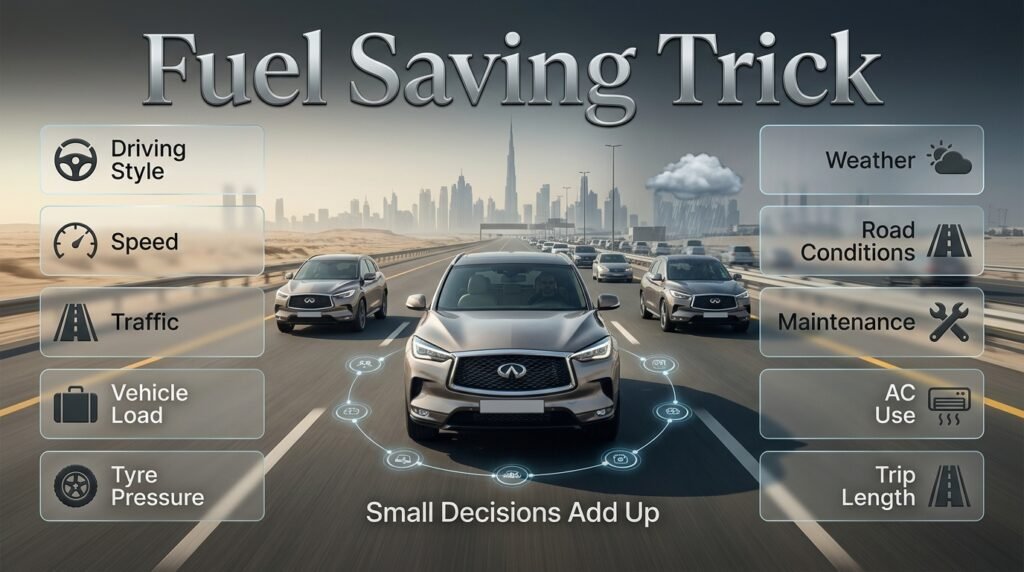
Fuel consumption is influenced by many variables.
Two drivers can operate the same model of car and achieve different fuel economy because of differences in:
- Driving style
- Speed
- Traffic
- Vehicle load
- Tyre pressure
- Weather
- Road conditions
- Maintenance
- AC use
- Trip length
This is why claims that one simple trick will always produce a specific fuel saving should be treated carefully.
A better strategy is to improve the entire driving process.
Think of fuel efficiency as a collection of small decisions rather than one magic solution.
Improving Fuel Economy on Long Trips: A Practical Strategy
If you want a simple routine to follow, use this approach.
Before the journey
Check the vehicle.
Remove unnecessary weight.
Check tyres.
Plan the route.
Identify fuel stops.
At the beginning
Accelerate smoothly.
Reach an appropriate cruising speed.
Avoid unnecessary high-speed driving.
During the journey
Look ahead.
Maintain a safe following distance.
Avoid unnecessary braking.
Keep your speed consistent where appropriate.
Use AC sensibly.
Avoid unnecessary idling.
During breaks
Check your fuel level.
Take an appropriate rest.
Look around the vehicle if you notice anything unusual.
At the end
Record your fuel consumption if you’re monitoring efficiency.
Think about what affected the journey.
This helps you improve future trips.
Fuel-Efficient Use of Automatic Transmission
Using an automatic transmission efficiently can help reduce unnecessary fuel consumption, especially during Dubai’s busy traffic and frequent stop-and-go driving. Avoid aggressive acceleration, sudden braking, and repeatedly switching between Drive and other gears when it is not necessary. When waiting for longer periods, follow the vehicle manufacturer’s guidance rather than keeping the engine unnecessarily engaged. Regular transmission maintenance and using the correct manufacturer-recommended fluid can also support smooth gear changes and efficient vehicle operation. The key is to let the transmission work naturally while maintaining a smooth, predictable driving style.
For practical guidance on using an automatic transmission more efficiently, including smooth acceleration, proper gear modes, traffic management, and highway driving habits, explore our detailed Fuel-Efficient Use of Automatic Transmission guide.
How to Reduce Fuel Use in Heavy Traffic
Sometimes traffic cannot be avoided.
When you find yourself in congestion, focus on smoothness rather than constantly trying to regain every kilometre per hour.
Leave enough space to avoid unnecessary braking.
If traffic moves slowly, allow the vehicle to move smoothly rather than repeatedly accelerating hard and immediately stopping.
Don’t accelerate simply because a small gap appears if traffic ahead is already stopping.
And don’t use the accelerator aggressively to close a gap that will disappear seconds later.
This style of driving can make traffic less stressful while avoiding some unnecessary fuel waste.
For more information, see How to Reduce Fuel Use in Traffic.
Fuel Efficiency and Vehicle Comfort Can Work Together
Some drivers believe fuel-efficient driving means making the journey uncomfortable.
It doesn’t have to.
You don’t need to drive dangerously slowly.
You don’t need to turn off essential climate control in extreme heat.
You don’t need to avoid every acceleration.
You don’t need to drive with an almost empty fuel tank.
The objective is simply to remove unnecessary fuel waste.
A comfortable, well-maintained vehicle driven smoothly at a reasonable speed can provide a good balance between efficiency and practicality.
Vehicle Accessories and Fuel Economy
Vehicle accessories and fuel economy are closely connected because certain add-ons can increase aerodynamic drag, vehicle weight, or electrical load. Roof racks, cargo boxes, oversized accessories, and other external equipment may make the engine work harder, especially during highway driving. Even small changes can affect fuel consumption when they are used regularly. For better efficiency, remove unnecessary accessories when they are not needed, keep external equipment streamlined, and avoid carrying extra weight without a purpose. In Dubai, where long highway journeys and high-speed driving are common, choosing practical accessories and maintaining the vehicle properly can help support better overall fuel economy.
For a practical guide on how roof racks, cargo boxes, extra weight, larger wheels, and other accessories can influence fuel consumption, read our detailed Vehicle Accessories and Fuel Economy in Dubai guide before choosing or removing accessories from your vehicle.
What Should You Do If You Run Out of Fuel?
Even careful planning cannot eliminate every unexpected situation.
A longer-than-expected traffic jam, wrong route, fuel-station closure, vehicle problem, or simple miscalculation can leave a driver with insufficient fuel.
If your vehicle runs out of fuel, move to a safe location if possible and follow applicable roadside-safety procedures.
Avoid standing in a dangerous location near moving traffic.
If you need emergency fuel assistance in Dubai, you can use Fuel Delivery Dubai as a resource for roadside fuel support.
The best approach, however, is to prevent the situation through sensible fuel planning whenever possible.
Expert Tips for Better Long-Distance Fuel Economy
Experienced drivers often focus less on individual tricks and more on consistency.
The following habits are worth making part of your normal routine:
1. Think ahead
Don’t wait until traffic forces you to brake.
2. Maintain your vehicle
Efficiency starts with proper mechanical condition.
3. Keep tyres correctly inflated
Don’t rely on appearance.
4. Reduce unnecessary weight
Carry what you actually need.
5. Avoid excessive speed
Higher speeds can significantly increase aerodynamic resistance.
6. Smooth out your driving
Avoid unnecessary acceleration and braking.
7. Plan fuel stops
Don’t depend on the last possible kilometre of fuel range.
8. Don’t ignore the climate
Dubai’s heat makes cooling-system and AC maintenance important.
9. Give yourself enough time
Rushing encourages inefficient and potentially unsafe driving.
10. Measure your results
Track fuel economy over multiple trips instead of judging one journey.
What is the most fuel-efficient speed for highway driving?
There is no single speed that works perfectly for every vehicle because fuel economy depends on the engine, transmission, vehicle weight, aerodynamics, road conditions, and driving style. However, fuel consumption generally increases as highway speed rises, especially once you move beyond moderate cruising speeds. The EPA specifically notes that speeding reduces fuel economy, while its fuel-economy testing includes separate high-speed conditions because higher speeds and harder acceleration can significantly change fuel consumption.
For everyday highway driving, the practical approach is to stay within the posted speed limit and avoid unnecessarily high speeds. Driving at a steady, moderate speed is usually more efficient than repeatedly accelerating, overtaking, and braking. The goal is not to drive unusually slowly; it is to avoid using more engine power than the journey actually requires.
Key points:
Follow the posted speed limit rather than chasing maximum speed.
Keep your speed as consistent as traffic and road conditions allow.
Avoid unnecessary rapid acceleration after every slowdown.
Use cruise control when appropriate on a relatively open highway.
Remember that your vehicle’s ideal economy speed can differ from another vehicle’s.
For a long trip, even small changes in speed and driving behaviour can accumulate over hundreds of kilometres. That is why steady, controlled highway driving is generally a better fuel-saving strategy than simply trying to reach your destination as quickly as possible.
Does driving faster really use more fuel?
Yes, and the reason is more than simply “the engine is working harder.” As speed increases, aerodynamic drag becomes increasingly important, so the vehicle needs more power to keep moving through the air. EPA guidance identifies speeding as a factor that decreases fuel economy, and its testing methodology specifically accounts for high-speed driving.
This is particularly noticeable on highways because there are fewer stops and starts. At a steady moderate speed, the engine can maintain forward motion efficiently. At a significantly higher speed, however, the vehicle has to overcome greater air resistance continuously.
Think about a long highway journey. If you drive slightly faster for a few minutes, the difference may not seem important. But if you maintain that higher speed for an entire trip, the additional fuel demand can become much more noticeable.
What to keep in mind:
Higher speed increases aerodynamic resistance.
Rapid acceleration consumes more fuel than gradual acceleration.
Frequent overtaking can create unnecessary speed changes.
Maintaining a steady cruising speed is generally easier on fuel.
Fuel economy should never be prioritised over safe and legal driving.
The best approach is therefore efficient rather than excessively slow driving. Maintain a sensible speed, anticipate traffic, and avoid aggressive changes in speed whenever the road allows. The U.S. Department of Energy also reports that aggressive driving can substantially reduce fuel mileage, particularly in stop-and-go conditions.
How can I improve fuel economy on a long highway trip?
The biggest gains usually come from combining several sensible habits rather than relying on one “fuel-saving trick.” A properly maintained vehicle, correct tyre pressure, smooth acceleration, controlled speed, reduced unnecessary weight, and less idling can all contribute to better real-world fuel economy.
Before starting a long journey, check the basics. Tyres should be inflated according to the vehicle manufacturer’s recommended pressure, and the vehicle should not be carrying unnecessary heavy items. If your car has a roof rack or other external accessories that you do not need, removing them can also reduce aerodynamic drag. EPA guidance specifically identifies under-inflated tyres, excess cargo, and roof accessories as factors that can reduce fuel economy.
During the trip, concentrate on how you use the accelerator and brakes. Instead of accelerating aggressively and then braking a few seconds later, look farther ahead and adjust your speed progressively.
Before the trip:
Check tyre pressure.
Remove unnecessary heavy cargo.
Check that the vehicle is properly maintained.
Remove unnecessary roof-mounted equipment.
Plan the route where practical.
While driving:
Accelerate smoothly.
Maintain a steady speed.
Avoid unnecessary overtaking.
Anticipate traffic and upcoming slowdowns.
Minimise unnecessary idling during stops.
Use cruise control when conditions make it appropriate.
In hot climates, air conditioning can also affect fuel consumption because it places an additional load on the vehicle. The Department of Energy recommends practical measures such as allowing hot cabin air to escape before heavily relying on the A/C.
The important point is that fuel-efficient highway driving is a combination of preparation, vehicle condition, and driver behaviour. You do not need to make one dramatic change; several small improvements can work together over a long journey.
Does tyre pressure affect fuel consumption on highway trips?
Absolutely. Tyre pressure is one of the simplest things a driver can check before a long journey, and under-inflated tyres can increase rolling resistance, making the vehicle work harder to move down the road. EPA guidance recommends keeping tyres properly inflated and notes that under-inflation can reduce fuel economy.
However, there is an important distinction between correct tyre pressure and maximum tyre pressure. You should not simply inflate your tyres to the highest number printed on the tyre. Instead, use the vehicle manufacturer’s recommended pressure, which is normally provided on the driver’s-side door-jamb label, owner’s manual, or another manufacturer-specified location.
For a highway journey, check the tyres before you leave, preferably when they are cold. Also inspect them for obvious damage, unusual wear, or other problems. Correct pressure helps the tyre operate as designed and can support both fuel economy and safe handling.
Before a long trip, check:
Recommended cold tyre pressure.
All four tyres.
The spare tyre, if your vehicle has one.
Visible cuts, bulges, or abnormal wear.
Whether the vehicle is carrying a heavy load that requires a different manufacturer-recommended pressure.
Do not overinflate tyres simply to try to save fuel. The Department of Energy notes that fuel economy benefits from proper inflation, but safety and the manufacturer’s recommendations should remain the priority.
A few minutes spent checking tyre pressure before a long trip can therefore be much more useful than searching for complicated fuel-saving tricks.
Does idling waste fuel even when the car is not moving?
Yes. When the engine is running and the vehicle is stationary, the car is consuming fuel without travelling any distance. In fuel-economy terms, extended idling is particularly inefficient because you are using fuel while adding zero miles or kilometres to the journey. EPA guidance recommends avoiding unnecessary idling, and the Department of Energy notes that idling can consume a significant amount of fuel over time.
This matters during long trips when drivers stop at parking areas, roadside locations, pickup points, or other places and leave the engine running simply out of habit. One short idle period may not make a dramatic difference, but repeated unnecessary idling over days and weeks can add up.
At the same time, this does not mean you should switch the engine off every few seconds in normal traffic. Safety, traffic conditions, vehicle design, and manufacturer recommendations matter. Modern vehicles may also have automatic start-stop systems specifically designed to reduce fuel consumption during stationary periods.
Better idling habits include:
Avoid leaving the engine running while parked unnecessarily.
Don’t use extended idling as a routine waiting habit.
Use the vehicle’s automatic start-stop system if equipped and appropriate.
Plan stops so you are not sitting with the engine running for long periods.
Never sacrifice safety simply to save fuel.
For drivers trying to improve fuel consumption while idling, the easiest rule is simple: if the vehicle is safely parked and there is no reason for the engine to remain running, unnecessary idling should be avoided. This is especially relevant when you’re trying to maximise fuel efficiency over a long-distance journey.
Conclusion
Fuel-efficient highway driving is not about driving as slowly as possible or making extreme changes to your normal routine. It is about driving smoothly, maintaining a sensible and legal speed, keeping your vehicle properly maintained, and avoiding habits that unnecessarily increase fuel consumption. Over a long journey, small improvements can make a meaningful difference to how often you need to refuel and how much you spend on fuel.
Before setting off, check your tyre pressure, remove unnecessary weight, and make sure your vehicle is in good condition. During the journey, maintain a steady pace, accelerate progressively, anticipate traffic, and avoid unnecessary braking and idling. In Dubai’s hot climate, sensible use of air conditioning and proper trip preparation can also help you manage fuel consumption more effectively.
For drivers who want more practical guidance on saving fuel and managing unexpected fuel situations in Dubai, Fuel Delivery Dubai 👉 Fuel Delivery Dubai can also be a useful resource.
Ultimately, the most effective approach is consistency. Smooth driving, sensible speed, proper vehicle care, and good planning work together to improve highway fuel economy without making your journey inconvenient or uncomfortable.
Leave a Reply