Introduction
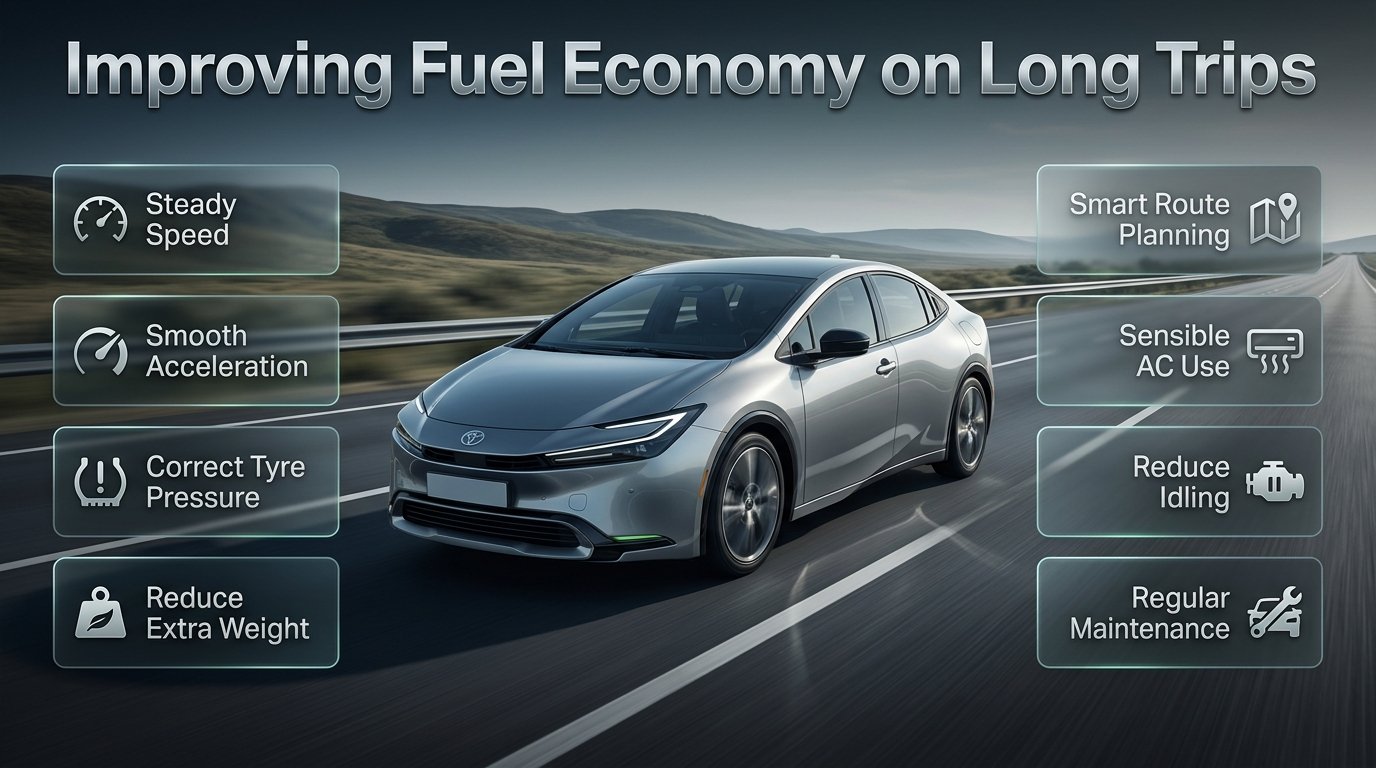
Improving Fuel Economy on Long Trips | A long road trip can be easy on your body but surprisingly hard on your fuel budget. You may start with a full tank, settle into a comfortable highway speed, and expect excellent mileage. Then, after a few hours, you notice the fuel gauge has dropped faster than expected. Improving fuel economy on long trips isn’t about driving painfully slowly or turning off every comfort feature. It’s about understanding where fuel is being used and making smarter decisions throughout the journey.
Long-distance driving gives you an advantage because traffic is often lighter, stops are less frequent, and the engine can operate more consistently. But high speeds, unnecessary acceleration, heavy luggage, low tyre pressure, roof accessories, aggressive braking, idling, and poor vehicle maintenance can quickly reduce those benefits.
If you’re preparing for a long journey, this guide explains how to reduce fuel consumption before and during the trip. You’ll learn how speed, acceleration, tyres, air conditioning, vehicle weight, route planning, traffic, and driving habits affect fuel economy. You’ll also find practical examples, common mistakes, expert tips, checklists, and answers to frequently asked questions.
For broader fuel-related information and services in Dubai, you can also visit 👉 Fuel Delivery Dubai.
What Does Improving Fuel Economy on Long Trips Actually Mean?
Improving fuel economy means travelling the same distance while using less fuel. On a long trip, even a small improvement in fuel efficiency can make a noticeable difference because the distance travelled is much greater.
For example, if a vehicle normally travels 12 km per litre and you improve its efficiency to 13 km per litre, the difference may seem small on a short journey. Over hundreds of kilometres, however, those savings can add up.
Fuel economy is affected by several interacting factors:
- Driving speed
- Acceleration and braking
- Traffic conditions
- Tyre pressure
- Vehicle weight
- Aerodynamic drag
- Engine condition
- Air-conditioning use
- Route selection
- Road conditions
- Weather
- Driving style
- Vehicle load
The goal isn’t to change everything at once. The biggest improvements usually come from controlling the factors you can influence most easily.
Why Can Long Trips Still Use More Fuel Than Expected?
A highway trip is often more efficient than stop-and-go city driving, but that doesn’t mean every highway journey is economical.
One of the biggest reasons is speed.
As speed increases, aerodynamic resistance rises significantly. The engine has to produce more power to overcome that resistance. This means a vehicle travelling at a very high highway speed can consume considerably more fuel than the same vehicle travelling at a moderate, steady speed.
Other problems can also appear during long journeys.
You might:
- Carry unnecessary luggage
- Accelerate hard to overtake
- Brake heavily after accelerating
- Keep roof racks installed unnecessarily
- Drive with underinflated tyres
- Leave the engine running during long stops
- Use aggressive driving habits
- Ignore warning signs or maintenance issues
The key lesson is simple: long-distance fuel economy comes from consistency, preparation, and avoiding unnecessary energy loss.
12 Most Effective Ways to Improve Fuel Economy on Long Trips
1. Maintain a Steady Highway Speed
One of the easiest ways to improve fuel economy is to avoid unnecessary speed fluctuations.
Constantly accelerating, releasing the accelerator, accelerating again, and then braking wastes energy. A steady driving pattern allows the engine and transmission to work more consistently.
This doesn’t mean driving below the legal limit. Instead, choose an appropriate speed within the posted limit and maintain it when traffic and road conditions allow.
Optimal Driving Speed for Fuel Efficiency in Dubai
Why steady speed helps
Imagine two drivers travelling the same 200-kilometre route.
Driver A:
- Maintains a consistent speed
- Anticipates traffic
- Avoids unnecessary overtaking
- Accelerates smoothly
Driver B:
- Frequently speeds up
- Overtakes aggressively
- Brakes hard
- Accelerates again
Driver B may cover the journey at roughly the same average speed, but the repeated changes in speed can increase fuel consumption.
Pro Tip: Don’t focus only on your average speed. Pay attention to how often you’re forcing the engine to accelerate and decelerate.
2. Avoid Driving Faster Than Necessary
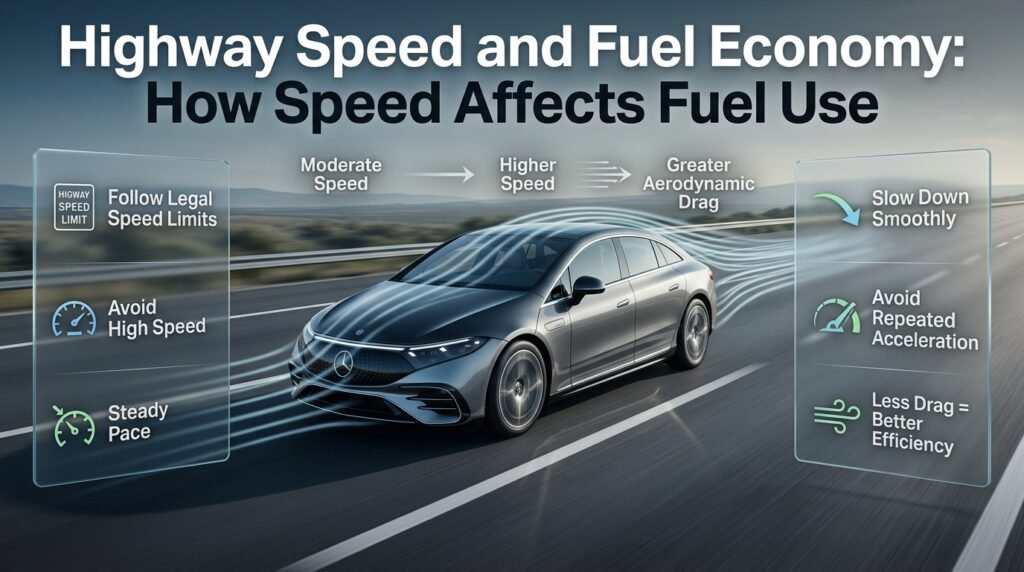
Speed is one of the most important factors affecting highway fuel economy.
At moderate speeds, aerodynamic resistance is manageable. As speed rises, aerodynamic drag becomes increasingly important.
For example, increasing speed from a moderate highway pace to a significantly higher speed can require substantially more engine power. The exact fuel penalty varies by vehicle, tyres, road, wind, and drivetrain, so there isn’t one universal speed at which every car gets its best mileage.
The practical approach is:
- Follow the legal speed limit.
- Avoid unnecessary high-speed driving.
- Maintain a steady pace.
- Slow down smoothly when conditions require it.
- Avoid repeatedly accelerating just to gain a few seconds.
For a deeper explanation, see How Highway Speed Affects Fuel Consumption.
3. Accelerate Smoothly
Hard acceleration demands more power from the engine. On a long trip, repeated aggressive acceleration can significantly increase fuel use.
Smooth acceleration doesn’t mean crawling onto the highway. You still need to accelerate safely and appropriately when joining traffic.
The difference is what happens afterward.
Instead of:
Hard acceleration → high speed → hard braking → repeat
Aim for:
Smooth acceleration → steady speed → anticipation → gentle adjustment
This driving pattern reduces unnecessary energy losses.
You can learn more about the relationship between acceleration and fuel use in How Acceleration Affects Fuel Consumption in Dubai.
Practical example
Suppose traffic ahead is slowing down.
An aggressive driver may continue accelerating and then brake sharply.
An attentive driver sees the slowdown early, eases off the accelerator, and allows the vehicle to reduce speed gradually.
The second driver isn’t necessarily travelling much slower. They’re simply avoiding unnecessary energy expenditure.
4. Use Brakes Strategically
Braking is essential for safety, but unnecessary braking often means you’ve already used energy that could have been preserved.
Every time you accelerate to gain speed and then immediately brake, some of the energy used to accelerate the vehicle is lost as heat through the braking system.
Good fuel-efficient driving therefore involves looking farther ahead.
Watch:
- Traffic lights
- Vehicles several cars ahead
- Merging traffic
- Exit ramps
- Toll areas
- Congestion
- Roadwork
- Speed changes
If you recognize a slowdown early, you can often reduce the accelerator input sooner rather than making a late, hard braking manoeuvre.
For more detail, read How Braking Habits Affect Fuel Economy in Dubai.
Expert Tip: Fuel economy should never come before safety. Brake normally whenever necessary. Never coast or delay braking simply to save fuel.
5. Check Tyre Pressure Before Leaving
Tyre pressure is easy to overlook before a road trip, yet it can influence rolling resistance, handling, tyre wear, and fuel consumption.
Underinflated tyres generally create more rolling resistance. The engine may then need to work harder to move the vehicle.
Before a long trip:
- Check all four tyres.
- Check the spare tyre if applicable.
- Use the vehicle manufacturer’s recommended pressure.
- Check pressure when tyres are cold.
- Inspect for visible damage.
- Don’t rely on appearance alone.
Don’t automatically inflate tyres beyond the recommended pressure to save fuel. Excessive pressure can affect handling, ride comfort, and tyre wear.
Quick Tip
The correct pressure is normally found on the vehicle’s tyre-pressure label, owner’s manual, or manufacturer information—not necessarily on the tyre’s maximum-pressure marking.
6. Reduce Unnecessary Vehicle Weight
Every additional kilogram doesn’t automatically create a huge fuel penalty, but unnecessary weight does increase the energy required to move the vehicle, particularly during acceleration and in stop-start conditions.
Long trips often encourage people to pack everything “just in case.”
Before leaving, ask:
Do I really need this for the journey?
Remove:
- Unused tools
- Heavy boxes
- Old equipment
- Unnecessary sports gear
- Excess luggage
- Items left in the boot permanently
A lighter vehicle is generally easier to accelerate.
This becomes particularly useful when combined with smooth driving.
7. Remove Roof Racks and Accessories When They’re Not Needed
Roof-mounted equipment can increase aerodynamic drag.
A roof box, rack, carrier, or other accessory changes the shape of the vehicle and can disturb airflow. At highway speeds, aerodynamic effects become increasingly important.
If you don’t need a roof accessory for the journey, consider removing it before travelling.
Common Mistake
Many drivers think:
“It’s already installed, so I’ll leave it there.”
That convenience can come with an efficiency cost.
If you regularly take long trips, make removing unnecessary roof equipment part of your pre-trip routine.
8. Use Air Conditioning Sensibly
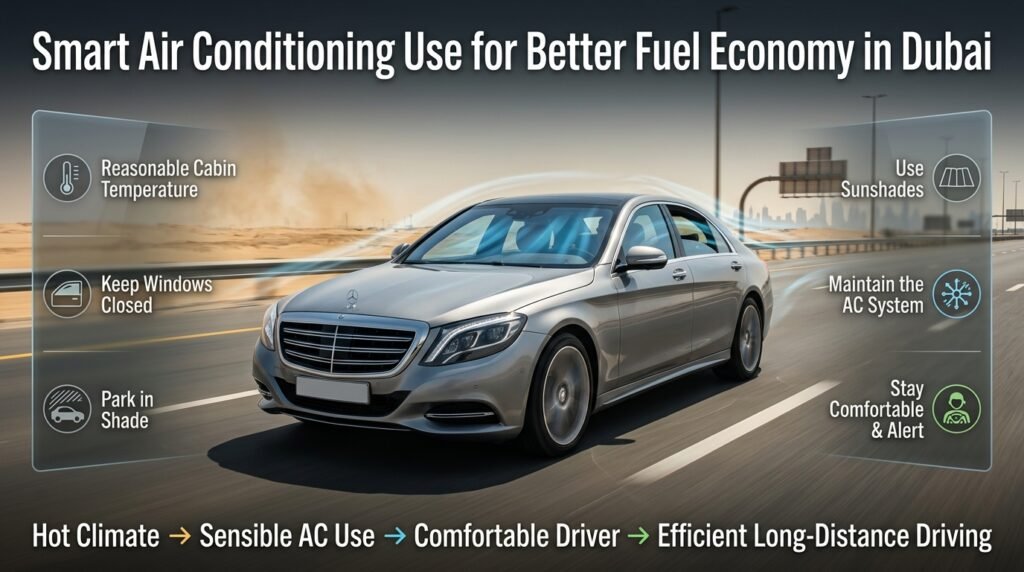
In hot climates such as Dubai, air conditioning isn’t a luxury that drivers can simply avoid. Staying cool and alert is important for safe driving.
However, air conditioning requires energy.
The best approach isn’t necessarily to turn the system off completely. Instead, use it sensibly.
Practical habits
- Avoid setting the temperature unnecessarily low.
- Use a reasonable cabin temperature.
- Keep doors and windows closed while the AC is operating.
- Park in shade when possible.
- Use sunshades when the vehicle is parked.
- Make sure the AC system is functioning properly.
At higher road speeds, opening windows can also increase aerodynamic drag. The best choice depends on speed, outside temperature, humidity, and vehicle design.
Expert Tip: Don’t sacrifice comfort or concentration just to chase a small fuel saving. A comfortable, alert driver is more important.
Air Conditioning and Fuel Consumption
Air conditioning can have a noticeable effect on fuel consumption, especially during hot weather and heavy traffic. When the AC system is running, the engine needs additional power to operate the compressor, which can increase fuel use. In Dubai’s hot climate, however, avoiding AC completely is not practical or comfortable. A better approach is to use the system efficiently by parking in shade when possible, ventilating the cabin briefly before cooling it, maintaining the AC system properly, and avoiding unnecessary idling with the AC running. These simple habits can help reduce unnecessary fuel consumption while keeping the cabin comfortable.
For practical tips on reducing unnecessary fuel consumption while keeping your car comfortable in Dubai’s hot climate, explore our detailed Air Conditioning and Fuel Consumption guide, which explains how AC use, traffic, idling, driving speed, and vehicle maintenance can affect overall fuel economy.
Vehicle Drag and Fuel Consumption in Dubai
Vehicle drag can have a significant effect on fuel consumption, particularly as driving speed increases. Aerodynamic resistance becomes more noticeable on highways, meaning vehicles may need more engine power to maintain higher speeds. Roof racks, cargo boxes, open windows at high speeds, and bulky external accessories can increase drag and reduce efficiency further. In Dubai, where drivers often use high-speed roads for longer journeys, keeping the vehicle streamlined and removing unnecessary external equipment can help reduce aerodynamic resistance. Combining good aerodynamics with moderate speeds and smooth driving can support better overall fuel economy.
For a deeper understanding of how aerodynamic resistance, driving speed, roof equipment, external cargo, wind, and vehicle design can influence fuel consumption, explore our detailed Vehicle Drag and Fuel Consumption in Dubai guide.
How Vehicle Weight Affects Fuel Economy
Vehicle weight has a direct influence on fuel economy because a heavier car requires more energy to accelerate and maintain movement, particularly in stop-and-go traffic. Carrying unnecessary luggage, tools, equipment, or other heavy items can gradually increase fuel consumption, especially when the vehicle is used frequently. The effect may be more noticeable during repeated acceleration, hill climbs, and city driving than during steady cruising. Keeping the vehicle load reasonable, removing items that are no longer needed, and distributing essential cargo safely can help reduce unnecessary energy demand and support better overall fuel efficiency.
For a deeper look at how passenger load, luggage, heavy equipment, and overall vehicle weight can influence fuel consumption, explore our detailed How Vehicle Weight Affects Fuel Economy guide for practical ways to manage unnecessary weight and improve driving efficiency.
9. Plan Your Route Before Starting
Route planning is one of the simplest ways to improve long-trip efficiency.
A shorter route isn’t always the most economical route.
Consider:
- Distance
- Traffic
- Road quality
- Frequent stops
- Construction
- Toll roads
- Hills
- Congestion
- Expected delays
- Fuel availability
A route that is 10 kilometres shorter but consistently congested may consume more fuel than a slightly longer route with steady-flow traffic.
This is especially relevant when travelling through busy urban areas before reaching the highway.
10. Avoid Long Periods of Unnecessary Idling
Idling means the engine is running while the vehicle isn’t moving.
You’re consuming fuel without covering any distance.
Long trips can include unexpected waiting:
- Meeting someone
- Waiting at a pickup point
- Taking a break
- Waiting outside a business
- Sitting in traffic
- Stopping at a roadside location
If you’re safely parked and don’t need the engine running, shutting it off may prevent unnecessary fuel consumption. Follow local rules and your vehicle manufacturer’s recommendations, particularly in extreme temperatures.
For more information, see Fuel Consumption While Idling and Car Idling Fuel Consumption in Dubai.
11. Keep Your Engine and Vehicle Properly Maintained
Fuel economy isn’t only about your right foot.
A poorly maintained vehicle may not operate as efficiently as it should.
Before a long journey, pay attention to:
- Engine oil condition
- Air filter condition
- Tyre pressure
- Wheel alignment
- Brake condition
- Spark plugs where applicable
- Fuel system condition
- Cooling system
- Battery and electrical system
- Warning lights
Modern vehicles have sophisticated engine-management systems, so don’t ignore an illuminated warning light.
A fuel-economy problem can sometimes be an early sign of a mechanical issue.
Important distinction
Routine maintenance doesn’t magically turn an ordinary car into a high-mileage vehicle. Its main purpose is to keep the vehicle operating as designed.
That’s an important difference.
Vehicle Accessories and Fuel Economy
Vehicle accessories and fuel economy are closely connected because certain add-ons can increase aerodynamic drag, vehicle weight, or electrical load. Roof racks, cargo boxes, oversized accessories, and other external equipment may make the engine work harder, especially during highway driving. Even small changes can affect fuel consumption when they are used regularly. For better efficiency, remove unnecessary accessories when they are not needed, keep external equipment streamlined, and avoid carrying extra weight without a purpose. In Dubai, where long highway journeys and high-speed driving are common, choosing practical accessories and maintaining the vehicle properly can help support better overall fuel economy.
For a practical guide on how roof racks, cargo boxes, extra weight, larger wheels, and other accessories can influence fuel consumption, read our detailed Vehicle Accessories and Fuel Economy in Dubai guide before choosing or removing accessories from your vehicle.
12. Use Cruise Control When Conditions Are Suitable
Cruise control can be useful on long, relatively flat roads with light traffic because it helps maintain a consistent speed.
It can reduce the tendency to unintentionally increase speed.
However, cruise control isn’t appropriate everywhere.
Avoid relying on it when:
- Traffic is heavy
- Roads are slippery
- Visibility is poor
- You need frequent speed changes
- The road is winding
- Conditions are unpredictable
Always remain attentive.
Common Mistake: Treating cruise control as an automatic-driving system. It isn’t. You’re still responsible for monitoring the road and controlling the vehicle.
How Aerodynamics Affects Fuel Efficiency
Aerodynamics plays an important role in fuel efficiency, especially when a vehicle is traveling at higher speeds. As speed increases, air resistance creates more drag, requiring the engine to use additional energy to keep the vehicle moving. Features such as roof racks, cargo boxes, open windows, and bulky external accessories can increase aerodynamic drag and contribute to higher fuel consumption. Keeping the vehicle streamlined, removing unnecessary external equipment, and maintaining a sensible highway speed can help reduce resistance and support more efficient driving.
For a clearer understanding of how air resistance, vehicle design, speed, roof accessories, and external load can influence your car’s fuel consumption, explore our detailed How Aerodynamics Affects Fuel Efficiency guide.
Fuel-Efficient Highway Driving: What Actually Works?
Highway driving can be fuel-efficient because it often involves fewer stops and less repeated acceleration.
However, the benefits are strongest when you combine several good habits.
Highway Driving Fuel Efficiency
A strong highway fuel-efficiency routine looks like this:
Before departure
↓
Check tyre pressure
↓
Remove unnecessary weight
↓
Inspect the vehicle
↓
Plan the route
↓
Fill enough fuel for the journey
↓
Drive at an appropriate steady speed
↓
Accelerate smoothly
↓
Anticipate traffic
↓
Avoid unnecessary braking
↓
Monitor fuel consumption
This approach is more effective than relying on a single “fuel-saving trick.”
How Traffic Changes Long-Trip Fuel Economy
Traffic can destroy the efficiency advantage of highway travel.
Stop-and-go driving requires frequent acceleration and braking. Each acceleration requires energy, while braking removes kinetic energy through the braking system.
This is why a journey with a high average speed isn’t necessarily the same thing as a journey with efficient driving.
How Traffic Affects Fuel Economy in Dubai
In heavy traffic:
- Increase following distance where safe.
- Look ahead.
- Avoid unnecessary lane changes.
- Avoid racing to every small gap.
- Accelerate smoothly.
- Don’t accelerate toward traffic that is already slowing.
- Avoid unnecessary idling when safely parked.
For more practical traffic advice, see How to Reduce Fuel Use in Traffic.
Roof Racks and Fuel Economy in Dubai
Roof racks can affect fuel economy by increasing a vehicle’s aerodynamic drag, particularly when driving at higher speeds on Dubai’s highways. Even when the rack is not carrying cargo, its added exposure to airflow can create additional resistance, which may require more engine power to maintain speed. The effect can become greater when carrying bulky items such as bicycles, luggage, or roof boxes. If a roof rack is not needed for a particular journey, removing it can help keep the vehicle more aerodynamic. For regular users, choosing a streamlined design, securing cargo properly, and avoiding unnecessary weight can support better fuel efficiency.
If you regularly use a roof rack for luggage, bicycles, or other equipment, our detailed Roof Racks and Fuel Economy in Dubai guide explains how roof-mounted accessories can increase aerodynamic drag and influence fuel consumption, especially during highway driving.
Stop-and-Go Driving vs Steady Highway Driving
| Driving condition | Typical fuel impact | Why |
|---|---|---|
| Steady highway speed | Generally efficient | Fewer stops and consistent operation |
| Moderate traffic | Moderate | Some speed variation |
| Heavy stop-and-go traffic | Generally inefficient | Frequent acceleration and braking |
| Aggressive overtaking | Higher consumption | Increased acceleration |
| Long idling | Wastes fuel | Fuel used without movement |
| High-speed highway driving | Higher consumption | Increased aerodynamic resistance |
The exact result depends on the vehicle, road, traffic, weather, load, and driving behaviour.
For more detail on stop-and-go conditions, visit Stop and Go Driving Fuel Efficiency.
Car Load and Fuel Consumption
The amount of weight carried by a vehicle can influence fuel consumption, particularly during frequent acceleration, hill climbing, and stop-and-go driving. Extra luggage, heavy equipment, or unnecessary items in the trunk increase the vehicle’s overall weight, requiring more energy to move. While a small amount of additional weight may have a limited effect on a single trip, carrying unnecessary loads regularly can gradually reduce fuel efficiency. For better economy, remove items you do not need, distribute essential luggage safely, and avoid treating your vehicle as permanent storage. In Dubai, combining a sensible vehicle load with smooth driving and proper tire pressure can help support more efficient everyday driving.
For practical tips on how luggage, heavy equipment, passenger load, and unnecessary items can affect your vehicle’s fuel consumption, explore our detailed Car Load and Fuel Consumption guide and learn how to manage vehicle weight more efficiently.
Long-Distance Driving Fuel Efficiency Tips in Dubai
Long-distance driving in Dubai can be more fuel-efficient when you maintain a steady speed, avoid unnecessary acceleration and braking, and keep the vehicle properly maintained. Before a long journey, check tire pressure, remove unnecessary weight, and make sure the engine and fluids are in good condition. Using cruise control where appropriate can help maintain a consistent speed on suitable highways, while avoiding excessive speeds can reduce aerodynamic drag and fuel consumption. Planning your route in advance can also help you avoid heavy traffic, unnecessary detours, and prolonged idling.
Planning a long journey in Dubai? Explore our detailed Long-Distance Driving Fuel Efficiency Tips in Dubai guide for practical advice on maintaining steady speeds, reducing unnecessary stops, preparing your vehicle, and improving fuel efficiency throughout your trip.
Should You Drive Slowly to Save Fuel?
Not necessarily.
Driving slower can reduce aerodynamic resistance, but the goal isn’t to drive unnecessarily slowly or create a safety problem.
The better strategy is to drive at an appropriate speed that:
- Follows the speed limit
- Matches road conditions
- Fits traffic flow
- Avoids unnecessary high speeds
- Keeps the journey comfortable and safe
Fuel economy should never be considered separately from safe driving.
Does Overtaking Waste Fuel?
Overtaking itself isn’t automatically inefficient.
Sometimes overtaking is necessary for safety or traffic flow. The issue is aggressive and unnecessary acceleration.
For example, accelerating hard to pass a vehicle and then immediately returning to your previous speed can use more fuel than maintaining a steady pace.
A good driver considers:
- Whether overtaking is necessary
- Whether there’s enough safe space
- Whether the speed increase is reasonable
- Whether traffic ahead will require braking immediately afterward
Don’t compromise safety to save fuel.
Does Using Premium Fuel Improve Fuel Economy?
Not automatically.
Higher-octane fuel is designed to resist engine knock better than lower-octane fuel. It doesn’t automatically mean your vehicle will consume less fuel.
Use the fuel grade recommended by your vehicle manufacturer.
If your vehicle requires or recommends a specific octane rating, follow that guidance.
Using a more expensive fuel simply because you believe it must provide better mileage isn’t always cost-effective.
How to Measure Your Fuel Economy Properly
Your dashboard’s fuel-economy display can be useful, but the most reliable way to understand your real-world fuel consumption is to track fuel purchased and distance travelled over multiple trips.
Simple method
- Fill the tank.
- Reset the trip meter.
- Drive normally.
- Fill the tank again.
- Record the litres added.
- Record kilometres travelled.
- Calculate:
Fuel economy = kilometres travelled ÷ litres used
Example
If you drive 600 km and use 50 litres:
600 ÷ 50 = 12 km/L
You can compare this number across different trips.
Don’t judge your vehicle’s fuel economy from one short journey. Weather, traffic, fuel level, road conditions, and driving style can cause temporary differences.
How to Prepare Your Car for a Long Fuel-Efficient Journey
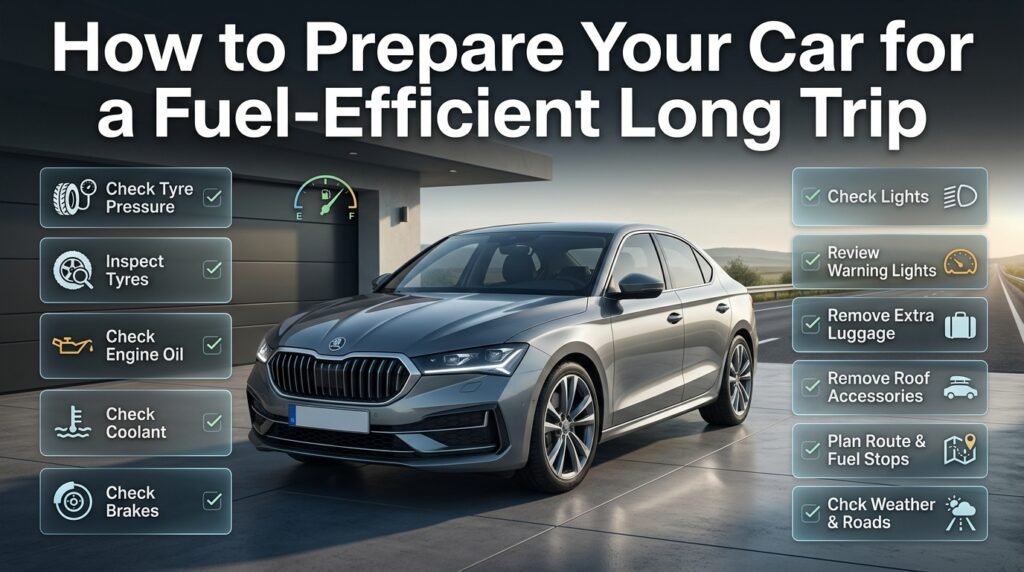
One Day Before the Trip
Vehicle checklist
- Check tyre pressure
- Inspect tyres for damage
- Check engine oil
- Check coolant
- Check brake condition
- Check lights
- Check windshield washer fluid
- Check battery condition if needed
- Check warning lights
- Remove unnecessary luggage
- Remove unnecessary roof accessories
- Plan the route
- Identify suitable fuel stops
- Check weather and road conditions
Preparation can prevent small problems from becoming expensive roadside emergencies.
Tire Pressure and Fuel Efficiency
Tire pressure plays an important role in fuel efficiency because underinflated tires create greater rolling resistance, forcing the engine to work harder and potentially increasing fuel consumption. Maintaining the recommended tire pressure can help your vehicle roll more efficiently while also supporting better handling, braking, and tire wear. In Dubai’s hot climate, checking tire pressure regularly is especially useful because temperature changes can affect pressure readings. Always follow the vehicle manufacturer’s recommended pressure rather than relying on the maximum pressure printed on the tire sidewall.
For practical guidance on maintaining the correct tire pressure, reducing unnecessary rolling resistance, and supporting better fuel economy in Dubai’s driving conditions, read our detailed Tire Pressure and Fuel Efficiency guide.
What to Do During the Journey
A fuel-efficient journey isn’t about watching the fuel gauge every five minutes.
Instead, establish good habits and maintain them.
While driving:
Look ahead.
Don’t focus only on the vehicle directly in front of you.
Maintain appropriate following distance.
This gives you more time to respond smoothly.
Keep speed consistent.
Avoid unnecessary speed changes.
Accelerate smoothly.
Use only the power you need.
Brake progressively.
When conditions permit, avoid last-second braking.
Monitor your surroundings.
Fuel economy should never interfere with safe driving.
Common Mistakes That Waste Fuel on Long Trips
Mistake 1: Driving Too Fast
Why it happens
The driver wants to reach the destination sooner.
Why it’s harmful
Higher speeds can substantially increase aerodynamic drag and fuel demand.
Better approach
Follow the speed limit and maintain an appropriate, steady pace.
Mistake 2: Accelerating Into Every Open Gap
Why it happens
The driver feels that every available gap is an opportunity to make progress.
Why it’s harmful
Repeated acceleration uses additional energy and often leads to more braking.
Better approach
Maintain a smooth flow whenever traffic conditions allow.
Mistake 3: Carrying Too Much Luggage
Why it happens
People pack items they may never use.
Why it’s harmful
Extra weight increases the energy required to move the vehicle.
Better approach
Pack according to the actual requirements of the trip.
Mistake 4: Ignoring Tyre Pressure
Why it happens
The car appears to drive normally.
Why it’s harmful
Underinflated tyres can increase rolling resistance and may also affect handling and tyre wear.
Better approach
Check pressure before leaving.
Mistake 5: Keeping Roof Accessories Installed
Why it happens
Removing them seems inconvenient.
Why it’s harmful
Roof accessories can increase aerodynamic drag.
Better approach
Remove unnecessary equipment before long highway trips.
Mistake 6: Excessive Air Conditioning
Why it happens
Drivers want the cabin extremely cold.
Why it’s harmful
Air conditioning requires energy.
Better approach
Use a comfortable temperature rather than an unnecessarily low setting.
Mistake 7: Unnecessary Idling
Why it happens
Drivers don’t want to restart the engine or expect to wait only a few minutes.
Why it’s harmful
Fuel is consumed while the vehicle isn’t travelling.
Better approach
When safely parked and appropriate, switch the engine off during longer waits.
Mistake 8: Braking Too Late
Why it happens
The driver isn’t looking far enough ahead.
Why it’s harmful
Late braking often follows unnecessary acceleration.
Better approach
Scan the road ahead and anticipate changes.
Mistake 9: Chasing Fuel-Economy Numbers at the Expense of Safety
Why it happens
The driver becomes too focused on saving fuel.
Why it’s harmful
Unsafe techniques can increase accident risk.
Better approach
Safety always comes first.
Expert Tips for Maximum Fuel Economy on Long Trips
Tip 1: Think Several Vehicles Ahead
Professional defensive driving involves looking beyond the car directly in front of you.
If you can see traffic slowing several vehicles ahead, you may have enough time to reduce acceleration smoothly.
That saves energy while also creating a safer driving environment.
Tip 2: Avoid Unnecessary Speed Changes
A common misconception is that fuel-efficient driving means constantly adjusting the accelerator.
In reality, unnecessary adjustments can create inefficiency.
When conditions are stable, consistency is your friend.
Tip 3: Don’t Obsess Over Instant Fuel Economy
Dashboard displays can jump significantly when you accelerate, climb a hill, use AC, or encounter traffic.
Instead of reacting to every fluctuation, look at longer-term averages.
The goal is sustainable improvement.
Tip 4: Combine Several Small Improvements
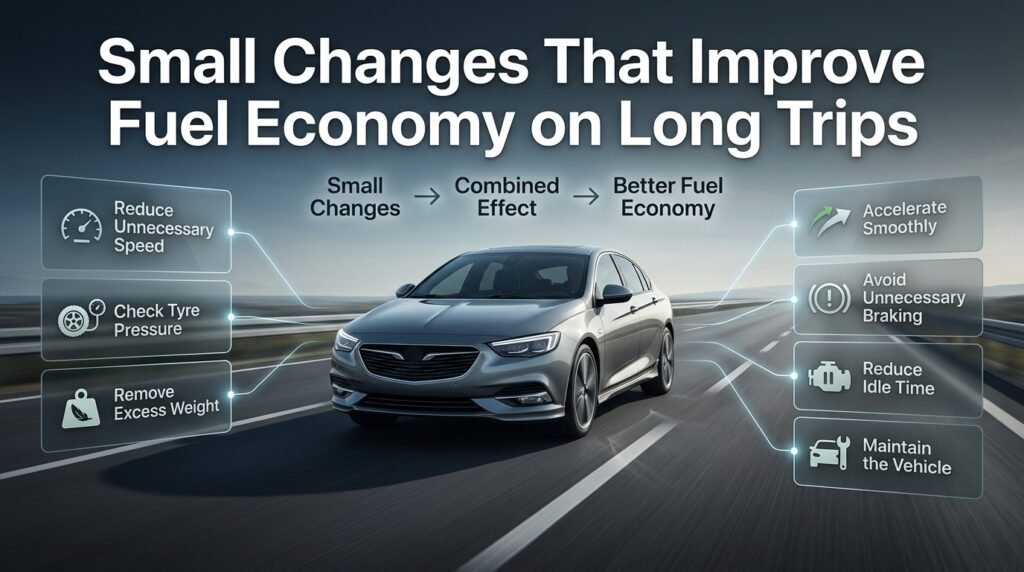
You don’t need one dramatic change.
Imagine you:
- Reduce unnecessary speed
- Check tyre pressure
- Remove excess weight
- Accelerate smoothly
- Avoid unnecessary braking
- Reduce idle time
- Maintain the vehicle properly
Each change may provide a modest benefit, but together they can make a meaningful difference.
A Practical Long-Trip Fuel-Economy Strategy
Here’s a simple strategy you can use for your next journey.
Before starting
Check your vehicle.
Once on the highway
Choose a legal and appropriate cruising speed.
During traffic changes
Look ahead and avoid unnecessary acceleration.
When approaching congestion
Ease off early when safe.
During breaks
Avoid unnecessary engine idling.
At fuel stops
Record your fuel usage if you’re tracking economy.
After the trip
Compare your results with previous journeys.
This turns fuel efficiency into a measurable driving habit rather than a guessing game.
Fuel-Efficient Driving Techniques You Can Use Every Day
Fuel-efficient driving doesn’t have to be limited to road trips.
The same principles can improve everyday driving.
Fuel-Efficient Driving Techniques
Useful habits include:
- Smooth acceleration
- Predictive braking
- Appropriate speed
- Proper tyre inflation
- Reduced unnecessary weight
- Reduced idling
- Sensible AC use
- Regular vehicle maintenance
- Better route planning
These habits become more effective when they’re consistent.
When Fuel Economy Suddenly Gets Worse
If your fuel consumption suddenly changes without a clear reason, don’t automatically blame your driving.
Possible causes can include:
- Low tyre pressure
- Wheel alignment problems
- Brake drag
- Engine problems
- Faulty sensors
- Poor maintenance
- Increased traffic
- Strong headwinds
- Extreme weather
- Heavier vehicle load
- Roof accessories
- Different driving patterns
A sudden and persistent change should be investigated, especially if accompanied by warning lights, unusual noises, poor performance, or changes in engine behaviour.
Gear Shifting and Fuel Economy in Dubai
Gear shifting has a direct impact on how efficiently a vehicle uses fuel, particularly in Dubai’s busy traffic and changing road conditions. Driving in the appropriate gear helps keep the engine operating within an efficient range, while unnecessarily high engine speeds or using the wrong gear can increase fuel consumption. Manual drivers can improve efficiency by shifting smoothly and selecting the appropriate gear for their speed and road conditions. Automatic transmissions generally manage gear changes themselves, but smooth acceleration and avoiding unnecessary aggressive driving can still support better fuel economy.
For a practical understanding of how to choose the right gear, avoid unnecessary engine strain, and improve fuel efficiency in Dubai’s city traffic and highway conditions, read our detailed Gear Shifting and Fuel Economy in Dubai guide.
Does Weather Affect Long-Trip Fuel Economy?
Yes.
Weather can influence fuel economy through temperature, wind, road conditions, air density, and the use of climate-control systems.
A strong headwind can increase aerodynamic resistance even when you’re driving at the same speed.
Hot weather can also increase air-conditioning use.
In Dubai, extreme heat makes climate control particularly relevant. That doesn’t mean you should avoid AC. It means you should keep the system properly maintained and use it sensibly.
Fuel-Efficient Use of Automatic Transmission
Using an automatic transmission efficiently can help reduce unnecessary fuel consumption, especially during Dubai’s busy traffic and frequent stop-and-go driving. Avoid aggressive acceleration, sudden braking, and repeatedly switching between Drive and other gears when it is not necessary. When waiting for longer periods, follow the vehicle manufacturer’s guidance rather than keeping the engine unnecessarily engaged. Regular transmission maintenance and using the correct manufacturer-recommended fluid can also support smooth gear changes and efficient vehicle operation. The key is to let the transmission work naturally while maintaining a smooth, predictable driving style.
For practical guidance on using an automatic transmission more efficiently, including smooth acceleration, proper gear modes, traffic management, and highway driving habits, explore our detailed Fuel-Efficient Use of Automatic Transmission guide.
What About Hills and Mountains?
Climbing requires additional energy because the vehicle is working against gravity.
You may notice fuel economy decrease on uphill sections.
Don’t try to maintain an unnecessarily high speed while climbing if road conditions don’t require it.
Use the vehicle’s normal operating range and allow speed to vary appropriately when safe and legal.
On descents, don’t shift into neutral simply to chase fuel savings. Maintain proper control and follow the vehicle manufacturer’s guidance for downhill driving.
Does Car Size Affect Long-Trip Fuel Economy?
Absolutely.
A small, lightweight vehicle generally has different energy requirements from a large SUV, pickup, or heavily loaded vehicle.
Vehicle design affects:
- Weight
- Aerodynamics
- Engine size
- Transmission
- Tyres
- Drivetrain
- Rolling resistance
That’s why fuel-economy comparisons should ideally be made between similar vehicles and similar driving conditions.
A large vehicle shouldn’t be expected to consume fuel like a compact car simply because both are travelling on the same highway.
Should You Fill the Tank Completely Before a Long Trip?
It depends on the journey and fuel availability.
A full tank gives you convenience and reduces the chance of running low in an unfamiliar area. However, carrying additional fuel weight can have a small efficiency effect.
In practice, the convenience and safety of having adequate fuel generally matter much more than the small weight difference.
The most important point is to avoid allowing the tank to reach an unnecessarily low level when fuel stations are far apart.
If you do run out of fuel unexpectedly in Dubai, a fuel-delivery service can be useful in an emergency. Fuel Delivery Dubai
Key Takeaways
- Maintain an appropriate, steady highway speed.
- Avoid unnecessary high-speed driving.
- Accelerate smoothly.
- Look ahead and anticipate traffic.
- Avoid unnecessary braking.
- Check tyre pressure before long journeys.
- Remove unnecessary luggage.
- Remove unused roof accessories.
- Use air conditioning sensibly.
- Avoid unnecessary idling.
- Keep the vehicle properly maintained.
- Plan your route before leaving.
- Track fuel economy over several trips.
- Never sacrifice safety to save fuel.
What is the best way to improve fuel economy on a long trip?
The most effective approach isn’t one secret trick. It’s a combination of steady speed, smooth acceleration, controlled braking, correct tyre pressure, sensible vehicle loading, and proper maintenance. On a long highway journey, these habits matter because even small inefficiencies are repeated for hundreds of kilometres. The EPA specifically identifies speeding, hard acceleration and braking, extra weight, roof racks, excessive A/C use, under-maintained vehicles, and incorrect tyre pressure as factors that can reduce fuel economy.
Before leaving, give your vehicle a quick inspection and remove anything you don’t actually need. Once you’re on the road, concentrate on maintaining an appropriate, legal speed instead of constantly speeding up and slowing down. Look farther ahead so you can react gradually to traffic rather than accelerating hard and then braking suddenly.
Key points:
Maintain a consistent and appropriate highway speed.
Accelerate progressively instead of using sudden bursts of power.
Anticipate traffic and avoid unnecessary braking.
Check tyre pressure before the journey.
Remove unnecessary luggage and roof-mounted equipment.
Keep the engine and other vehicle systems properly maintained.
Use air conditioning sensibly, especially in hot weather.
Avoid unnecessary idling during stops.
The important point is consistency. One small change may not transform your fuel consumption, but several sensible habits working together can make a meaningful difference over a long journey.
What speed gives the best fuel economy on a long highway trip?
There isn’t one universal “best speed” for every car. The most fuel-efficient cruising speed depends on the vehicle’s engine, transmission, tyres, aerodynamics, road conditions, wind, load, and gearing. What is consistent is that fuel consumption generally increases as highway speed rises, because aerodynamic resistance becomes increasingly important.
This is why driving at the absolute maximum permitted speed isn’t necessarily the most economical choice. For example, if you’re travelling at a very high highway speed and repeatedly making small speed corrections, you’re asking the engine to overcome greater aerodynamic resistance while also changing its workload.
A better strategy is to choose a legal, safe, and comfortable cruising speed and keep it reasonably steady. On a relatively flat highway with light traffic, cruise control can help maintain consistency, provided road and weather conditions are suitable.
For better long-trip economy:
Follow the posted speed limit.
Avoid unnecessarily high speeds.
Keep your speed reasonably consistent.
Don’t accelerate just to overtake when there’s no real benefit.
Avoid repeated speed changes.
Use cruise control where appropriate.
Reduce speed smoothly when conditions allow.
The goal isn’t to drive painfully slowly. It’s to avoid paying a fuel penalty simply because you’re travelling faster than necessary.
How much does tyre pressure affect fuel economy on a long trip?
Tyre pressure is one of the easiest things to check before a long journey, and it’s often overlooked. When tyres are underinflated, they deform more as they roll, increasing rolling resistance. That means the engine has to work harder to keep the vehicle moving. Proper inflation also supports better handling and tyre wear.
This becomes particularly relevant on a long trip because you’re not driving a few kilometres—you may be covering several hundred kilometres. A tyre-pressure problem that seems minor around town can continue affecting the vehicle throughout the entire journey.
Check the pressure when the tyres are cold and use the pressure recommended by your vehicle manufacturer. That figure is normally found on the driver’s-door label, fuel-filler-area label, or in the owner’s manual. Don’t simply use the maximum pressure printed on the tyre sidewall as your vehicle’s recommended setting.
Before a long trip, check:
All four tyres.
The spare tyre, if your vehicle has one.
Visible cuts, bulges, or other damage.
Uneven tread wear.
Any tyre that repeatedly loses pressure.
Recommended pressure according to the vehicle manufacturer.
Also remember that overinflating tyres isn’t a smart fuel-saving shortcut. Tyre pressure should be correct for the vehicle and load rather than artificially high.
For long-distance driving, two minutes spent checking your tyres can be far more valuable than trying complicated fuel-saving tricks after you’ve already started the journey.
Does air conditioning reduce fuel economy during long trips?
Air conditioning can increase fuel consumption because the compressor and associated systems require energy. However, the answer isn’t simply “turn the AC off.” In a hot climate, maintaining a comfortable cabin can help the driver remain alert and focused, which is much more important than chasing a small fuel saving.
The practical solution is to use the AC efficiently rather than excessively. Keep the cabin at a reasonable temperature instead of setting it dramatically colder than necessary. When the vehicle is travelling at highway speeds, opening the windows can also increase aerodynamic drag, so the choice between windows and AC isn’t as simple as it may seem.
If you’re travelling in Dubai or another very hot environment, preparation also helps. Parking in shade, using a sunshade while the car is parked, and allowing the AC system to operate normally can make the cabin easier to cool.
Smart AC habits include:
Use a comfortable temperature.
Keep windows closed when using AC at highway speeds.
Use cabin recirculation once the cabin has cooled, when appropriate.
Avoid leaving the engine idling for long periods just to keep the cabin cool.
Keep the AC system properly maintained.
Don’t sacrifice driver comfort and concentration simply to save fuel.
A fuel-efficient road trip should be efficient and comfortable, not a test of how long you can tolerate an overheated cabin.
How can I save the most fuel when driving hundreds of kilometres?
For a genuinely long journey, think beyond driving technique. Preparation before the trip can be just as important as what you do behind the wheel. A vehicle with correct tyre pressure, unnecessary weight removed, properly maintained systems, and a sensible route has a better starting point than one that leaves home overloaded and poorly prepared.
During the journey, focus on smoothness. Avoid the cycle of hard acceleration → high speed → hard braking → acceleration again. Instead, look ahead, maintain a safe following distance, anticipate changes in traffic, and make gradual speed adjustments whenever conditions permit. Efficient-driving guidance from EECA and Michelin similarly emphasizes steady speed, smooth acceleration and braking, proper tyre pressure, reduced unnecessary weight, and appropriate use of cruise control.
Use this long-trip formula:
Before departure: Check tyres and vehicle condition.
Pack smart: Remove unnecessary heavy items.
Reduce drag: Remove unused roof racks or carriers.
Plan ahead: Choose a sensible route and fuel stops.
On the highway: Maintain a legal, steady speed.
In traffic: Look ahead and avoid unnecessary acceleration.
When slowing: Lift off gradually when safe rather than making repeated hard stops.
During breaks: Avoid unnecessary engine idling.
After the trip: Compare your fuel consumption with previous journeys.
One of the biggest mistakes is trying to save fuel through only one action—for example, driving slower while ignoring tyre pressure or carrying a heavily loaded roof box.
The better approach is to stack several small improvements together.
That’s what makes a long-trip fuel strategy practical: you’re not relying on a gimmick. You’re reducing unnecessary fuel use at every stage of the journey, from the moment you prepare the car until you reach your destination.
Conclusion
Improving fuel economy on long trips doesn’t require complicated techniques or major changes to the way you drive. The biggest gains usually come from simple habits repeated consistently throughout the journey. Maintaining an appropriate speed, accelerating smoothly, anticipating traffic, checking tyre pressure, reducing unnecessary weight, using air conditioning sensibly, and keeping your vehicle properly maintained can all help you get more distance from the fuel you already have.
Before starting a long journey, take a few minutes to prepare your vehicle and plan your route. Once you’re on the road, focus on smooth, predictable, and safe driving rather than constantly trying to chase the highest possible mileage figure. Avoid unnecessary acceleration and braking, and remember that driving faster doesn’t always mean reaching your destination much sooner—it can simply mean using more fuel.
For drivers travelling in Dubai, understanding local traffic, highway conditions, idling, and hot-weather driving can make your fuel-saving strategy even more effective. You can also explore 👉 Fuel Delivery Dubai for additional fuel-related information and emergency fuel support.
Ultimately, better fuel economy comes down to preparation, consistency, and smart driving decisions. Make these habits part of every long journey, and you’ll be in a much better position to reduce unnecessary fuel consumption while enjoying a safer and more comfortable drive.
Leave a Reply