
Introduction
Car Battery Maintenance | A car battery usually gets attention only when the engine refuses to start. You turn the key or press the start button, the engine cranks slowly, you hear clicking, or nothing happens at all. What looked like a normal drive suddenly becomes a roadside problem.
The good news is that many battery-related problems can be identified before complete failure.
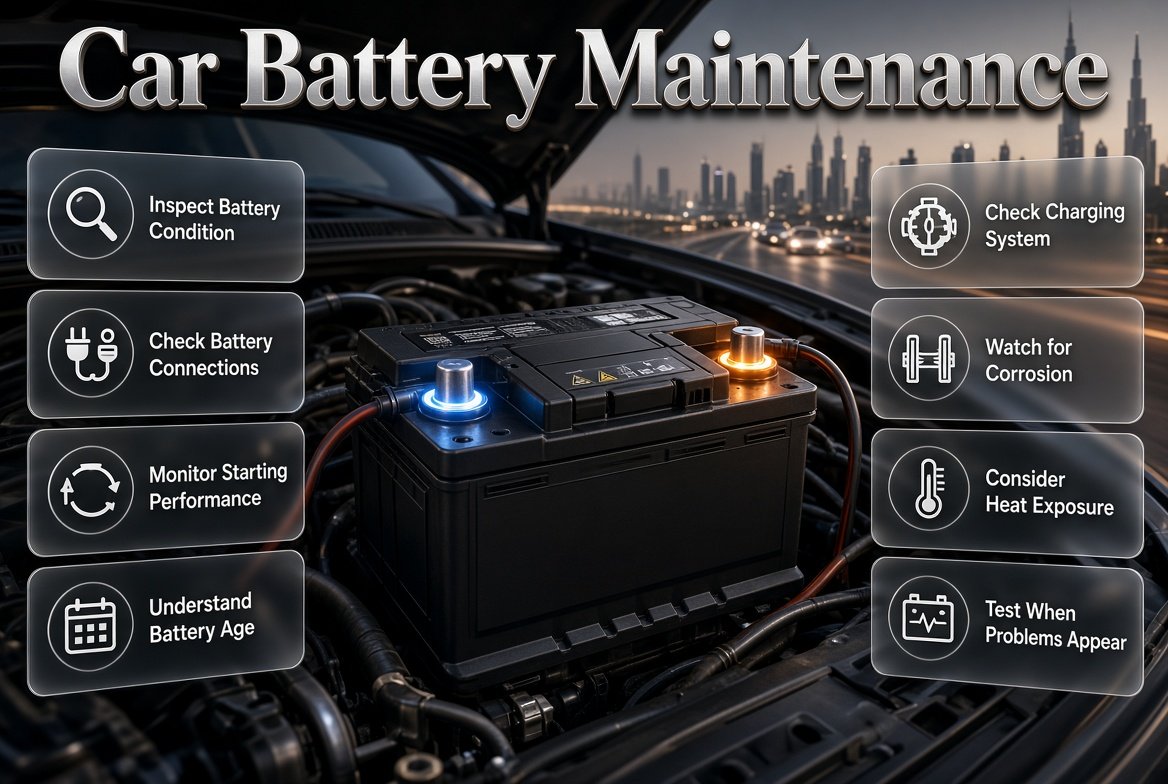
Car battery maintenance is not about constantly working on the battery or replacing it before necessary. It is about inspecting the battery, keeping connections in good condition, monitoring starting performance, understanding battery age, and checking the charging system when something doesn’t seem right.
For Dubai drivers, this matters even more because vehicles can operate in high temperatures, heavy traffic, frequent stop-and-go conditions, and long periods of air-conditioning use. A practical maintenance routine can help identify developing problems before they become inconvenient breakdowns.
For broader vehicle and roadside information, you can also explore Fuel Delivery Dubai, where battery care is one part of a larger approach to vehicle reliability and roadside preparedness.
This guide explains how to maintain a car battery, how often to inspect it, how to recognize early warning signs, what battery corrosion means, how heat affects battery life, when testing is useful, what mistakes to avoid, and when maintenance should give way to replacement.
What Is Car Battery Maintenance?
Car battery maintenance is the regular inspection and care of the battery, terminals, cables, mounting, electrical connections, and charging system to help maintain reliable vehicle starting and electrical operation.
It isn’t limited to cleaning the terminals.
A battery can look perfectly clean and still be weak internally. Likewise, a battery can be healthy while a loose terminal, damaged cable, or charging-system problem causes starting difficulties.
A sensible battery-maintenance routine includes:
- Inspecting the battery case
- Checking for corrosion
- Inspecting terminal connections
- Checking cable condition
- Making sure the battery is properly secured
- Monitoring engine-starting performance
- Checking battery condition as it ages
- Investigating repeated discharge
- Checking the charging system when necessary
- Replacing the battery when testing and condition indicate that it is no longer reliable
The goal is simple:
Inspect → Clean → Test → Diagnose → Maintain → Monitor
That approach is more useful than automatically replacing a battery because it has reached a certain age.
Why Is Car Battery Maintenance Important?
A battery provides the electrical energy needed to start the engine and supports many electrical functions of the vehicle.
When you start the car, the starter motor needs substantial electrical power. Once the engine is running, the vehicle’s charging system helps maintain the electrical system and replenish the battery.
If the battery, connections, or charging system develops a problem, you may notice:
- Slow engine cranking
- Clicking when starting
- Dim or flickering lights
- Electrical accessories behaving strangely
- Warning lights
- Repeated need for jump-starts
- Loss of battery charge
- Difficulty starting after the car has been parked
Regular inspection doesn’t guarantee that a battery will never fail. Batteries are wear components and can eventually lose their ability to store and deliver sufficient energy.
However, maintenance gives you an opportunity to notice changes earlier.
For example, if your engine normally starts immediately but gradually begins taking longer to crank, that’s useful information. You don’t necessarily need to replace the battery immediately, but it is a good reason to inspect and test it.
The bigger benefit is predictability
A battery problem discovered at home is usually easier to deal with than the same problem discovered:
- In heavy traffic
- At night
- On a highway
- During extreme heat
- At an unfamiliar location
- Before an important journey
Good maintenance is therefore less about making the battery last forever and more about reducing avoidable surprises.
Understanding Automotive Charging System Maintenance
A vehicle’s charging system is responsible for maintaining the electrical supply needed while the engine is running and keeping the battery properly charged. Problems with the alternator, battery, wiring, grounds, drive belt, connections, or vehicle charging controls can affect overall electrical performance, and the symptoms may not always identify the actual cause. Instead of replacing the battery or alternator based on one symptom, a proper charging-system inspection should consider the complete system and how it performs under different operating conditions. For a practical guide to checking charging performance, identifying common warning signs, inspecting key components, and understanding when further diagnosis may be required, read our Automotive Charging System Maintenance Guide. This guide can help you understand the charging system more clearly and take a condition-based approach to vehicle electrical maintenance.
How Often Should You Check Your Car Battery?
There isn’t one universal battery-maintenance interval that applies to every vehicle.
Battery life and maintenance needs depend on:
- Vehicle type
- Battery technology
- Battery age
- Climate
- Driving pattern
- Electrical demand
- Charging-system condition
- Parking habits
- Vehicle usage
A quick visual inspection every few months is a practical habit. As the battery gets older, testing becomes increasingly useful.
AAA recommends paying closer attention to battery condition after around three years and having batteries tested annually from that point.
A practical battery schedule
| Check | Practical timing |
|---|---|
| Visual inspection | Every few months |
| Terminal inspection | Every few months |
| Cable and mounting check | During routine servicing |
| Battery test | Periodically, especially as battery ages |
| Charging-system test | When symptoms appear |
| Replacement assessment | Based on age, condition and test results |
Your vehicle manufacturer’s maintenance instructions should take priority because modern vehicles can use different battery technologies and electrical-management systems.
What Should You Check During a Car Battery Inspection?
A basic battery inspection doesn’t have to take long.
The important thing is knowing what you’re looking for.
1. Inspect the Battery Case
Start with the battery housing.
Look for:
- Cracks
- Bulging
- Deformation
- Leakage
- Severe damage
- Signs of overheating
A battery with physical damage should not simply be cleaned and returned to service.
A swollen or cracked battery can indicate internal deterioration and should be assessed appropriately.
Professional advice
Don’t press, puncture, open, or attempt to repair a damaged battery.
If the case is visibly damaged, professional assessment is the safer approach.
2. Inspect the Battery Terminals
The terminals should be securely connected and relatively clean.
Look for powdery or crusty deposits around the connections.
Corrosion can interfere with electrical contact and increase resistance in the connection.
It may appear:
- White
- Blue
- Greenish
- Powdery
- Crusty
Small amounts of surface contamination aren’t automatically evidence of battery failure.
The important question is whether the connection remains clean, secure and electrically sound.
3. Check the Battery Cables
Don’t look only at the battery itself.
Inspect the visible portions of the cables for:
- Loose connections
- Corrosion
- Damaged insulation
- Fraying
- Signs of overheating
- Physical damage
A vehicle that won’t start doesn’t automatically have a dead battery.
The problem may be a cable or connection.
This is one reason replacing a battery without diagnosis can sometimes waste money.
4. Check the Battery Hold-Down
The battery should be properly secured.
Excessive movement can expose the battery and its connections to unnecessary vibration.
Check whether:
- The hold-down is present
- The battery sits correctly
- The mounting arrangement looks secure
- The battery moves excessively
Don’t overtighten mounting hardware simply to make it extremely tight. Follow the manufacturer’s installation requirements.
How Do You Clean Car Battery Terminals?

If battery terminals have corrosion, they can often be cleaned using an appropriate procedure and proper safety precautions.
Before working around the battery:
- Switch off the vehicle.
- Turn off electrical accessories.
- Remove metal jewelry.
- Use suitable eye and hand protection.
- Follow the vehicle manufacturer’s battery-disconnection procedure.
- Avoid creating a short circuit between terminals.
For conventional battery connections, AAA guidance describes disconnecting the negative connection first and reconnecting the positive connection first.
A suitable battery-terminal cleaning method can remove corrosion and surface contamination.
AAA also describes a baking-soda-and-water approach for cleaning corrosion from conventional battery terminals.
However, cleaning should not become a substitute for diagnosis.
What if corrosion keeps returning?
Recurring corrosion can have an underlying cause.
Possible contributors include:
- Battery condition
- Charging-system issues
- Poor terminal connection
- Leakage
- Environmental exposure
If the same corrosion keeps returning, have the battery and charging system inspected rather than repeatedly cleaning the surface without finding the reason.
Expert Tip: Cleaning a symptom is useful. Finding the reason the symptom keeps returning is better.
Practical Guide to Alternator Maintenance
The alternator is a key part of the vehicle’s charging system, helping supply electrical power while the engine is running and supporting the battery’s state of charge. When charging performance becomes inconsistent, drivers may notice slow starting, dim or flickering lights, electrical accessories behaving unusually, or repeated battery discharge. However, these symptoms do not automatically mean the alternator itself needs replacement. A proper inspection should consider charging output, battery condition, electrical load, wiring and ground connections, belt condition, and the vehicle’s specific charging strategy. For a clearer understanding of what alternator maintenance involves, how its condition can be assessed, and which signs may indicate the need for further diagnosis, read our Alternator Maintenance Basics Guide. This guide helps vehicle owners approach alternator problems through proper inspection and diagnosis rather than unnecessary parts replacement.
What Causes Battery Terminal Corrosion?
Battery corrosion can develop for several reasons, and the appearance alone doesn’t tell you exactly which cause is responsible.
Potential contributors include:
Battery age
As batteries age, their condition can change and the likelihood of corrosion or other problems may increase.
Charging-system problems
Incorrect charging conditions can affect battery performance and may contribute to battery-related problems.
Poor connections
A connection that isn’t secure can create electrical resistance and heat.
Leakage
Physical battery damage or other issues can result in electrolyte-related contamination.
Heat
High temperatures can accelerate battery deterioration and make existing weaknesses more noticeable.
The correct response depends on the cause.
If corrosion is minor and isolated, cleaning may be sufficient.
If corrosion is severe or repeatedly returns, testing is more appropriate.
How Does Dubai Heat Affect Car Battery Maintenance?
Hot climates deserve special consideration when it comes to battery care.
High temperatures can accelerate battery deterioration, and AAA notes that climate and extreme heat can influence battery life.
Dubai driving can involve several conditions that place additional demands on a vehicle:
- High ambient temperatures
- Hot engine compartments
- Heavy traffic
- Long periods of idling
- Extensive air-conditioning use
- Outdoor parking
- Frequent short journeys
- High electrical demand
This doesn’t mean every battery in Dubai will fail early.
It means battery condition deserves attention.
What should Dubai drivers do?
Instead of replacing the battery automatically because of the climate, use a more practical approach:
Inspect → Test → Diagnose → Replace only when justified
Pay attention to:
- Battery age
- Starting speed
- Terminal condition
- Physical battery condition
- Charging-system performance
- Repeated loss of charge
The broader principle of seasonal vehicle care is similar: inspect components affected by environmental conditions rather than automatically replacing parts simply because the weather changes.
Can Short Trips Affect Battery Condition?
Short trips can create a different charging pattern from longer journeys.
Starting the engine requires electrical energy. The charging system then replenishes the battery while the vehicle operates.
If a car is repeatedly driven for very short distances, the charging period may be limited.
This becomes more relevant when the vehicle also uses:
- Air conditioning
- Lights
- Infotainment
- Heated or ventilated seats
- Phone charging
- Other electrical accessories
A short drive doesn’t automatically mean the battery isn’t charging.
The point is simply that frequent short trips can create more demanding battery-use patterns, especially when combined with an aging battery.
Common mistake
Some drivers believe that starting the car and letting it run for a few minutes is always enough to maintain the battery.
That’s not necessarily true.
If a vehicle has a recurring low-charge problem, the proper response is to determine why the battery isn’t maintaining adequate charge rather than relying on occasional idling.
What Are the Signs of a Weak Car Battery?
A battery may show warning signs before complete failure.
The most common symptoms include:
- Slow engine cranking
- Clicking when starting
- Repeated starting difficulty
- Dim or flickering lights
- Electrical irregularities
- Battery or charging warning light
- Repeated jump-start requirements
- Corrosion
- Swelling
- Battery leakage
- Difficulty starting after parking
AAA lists slow cranking, dim lights, warning indicators, corrosion, physical battery damage and repeated jump-starting among signs that can point toward battery trouble.
But there’s an important point:
A symptom doesn’t identify a component by itself.
For example, slow cranking can result from:
- Weak battery
- Poor terminal connection
- Damaged cable
- Starter problem
- Charging-system issue
- Other electrical faults
This is why testing is valuable.
Why Is My Car Slow to Start?
A slow engine crank is one of the most useful symptoms to notice.
If the starter sounds noticeably slower than normal, don’t simply wait until the vehicle stops starting completely.
Start by considering:
- Battery age
- Terminal condition
- Cable condition
- Recent driving pattern
- Whether the battery has recently gone flat
- Whether the charging system has been checked
If the battery is old and starting performance has deteriorated, testing can help determine its condition.
If the battery tests healthy, attention should shift toward other possible causes.
Quick example
Imagine your vehicle has always started within one or two seconds.
Over several weeks, it changes to a slower, heavier crank.
Then one morning it clicks.
That pattern is more useful than simply saying, “The car doesn’t start.”
It gives a technician a sequence of symptoms that can help with diagnosis.
What Does the Battery Warning Light Mean?
One of the most common battery-related misunderstandings is assuming that the dashboard battery symbol always means the battery itself is bad.
It doesn’t necessarily.
The warning light can indicate a charging-system problem involving components such as:
- Alternator
- Voltage regulation
- Wiring
- Battery
- Related charging components
AAA explains that a battery or charging-system warning light can indicate a problem with the charging system rather than simply meaning that the battery needs replacement.
What should you do?
If the warning remains illuminated while driving, don’t treat it as an ordinary maintenance reminder.
Have the vehicle checked promptly.
Continuing to drive with a charging-system problem can eventually leave the vehicle without enough electrical power to continue operating normally.
How Do You Test a Car Battery?
Battery testing is more useful than judging battery health only from appearance.
A professional battery test can assess whether the battery can provide adequate starting performance.
A charging-system test can help determine whether the vehicle is properly maintaining the battery.
Is voltage enough?
Not always.
A conventional 12-volt battery may show a healthy resting voltage and still have reduced starting capacity.
AAA uses approximately 12.6 volts as a reference for a fully charged conventional battery, but voltage alone doesn’t provide a complete assessment of battery health.
This distinction matters.
Voltage tells you something.
A proper battery test tells you more.
That’s why a battery that appears normal on a basic voltage check can still fail under starting load.
What Is the Difference Between Battery Maintenance and Battery Replacement?
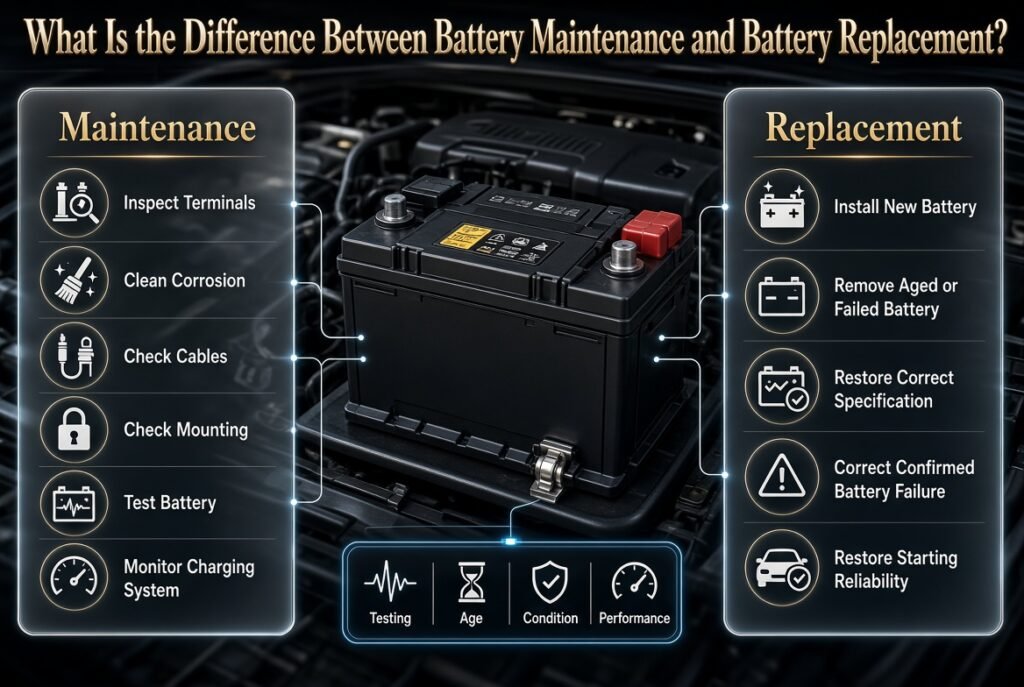
Maintenance and replacement solve different problems.
| Battery Maintenance | Battery Replacement |
|---|---|
| Inspect terminals | Install a new battery |
| Clean corrosion | Remove an aged or failed battery |
| Check cables | Restore correct battery specification |
| Check mounting | Correct confirmed battery failure |
| Test battery | Restore starting reliability |
| Monitor charging system | Replace a battery that cannot perform adequately |
Maintenance is intended to keep a serviceable battery in good condition.
Replacement is appropriate when testing, age, physical condition, or performance indicates that the battery is no longer reliable.
The distinction is important because replacing a healthy battery doesn’t solve every electrical problem.
How Long Does a Car Battery Last?
Many conventional automotive batteries last approximately three to five years, although actual life varies significantly depending on climate, vehicle use, battery type and maintenance.
Some batteries may last longer.
Others may require replacement sooner.
Factors that can influence service life include:
- Extreme temperatures
- Frequent short trips
- Electrical load
- Long periods of inactivity
- Charging-system condition
- Battery quality
- Vehicle design
- Maintenance
Age is therefore a risk indicator, not a replacement command.
A three-year-old battery that tests healthy doesn’t automatically need replacement.
A four-year-old battery showing poor test results and slow starting deserves much more attention.
When Should You Replace a Car Battery?
Consider replacement when there is clear evidence that the battery is no longer reliable.
Possible reasons include:
- Failed battery test
- Inability to hold charge
- Repeated jump-start requirement
- Severe physical damage
- Swelling
- Leakage
- Persistent starting problems
- Battery reaching the end of its expected service life
Before replacing it, ask an important question:
Why did the battery fail?
If a battery has failed normally because of age, replacement may solve the issue.
But if a relatively new battery repeatedly becomes discharged, another problem may be responsible.
Possible causes include:
- Alternator problem
- Electrical drain
- Poor connection
- Faulty electrical component
- Insufficient charging
- Vehicle being left unused for long periods
Replacing batteries repeatedly without diagnosis can become expensive.
Why Does a New Car Battery Sometimes Die Again?
A new battery should not be assumed to be the complete solution to every battery-related problem.
If a recently installed battery repeatedly loses charge, investigate:
Charging system
The alternator and related components may not be charging correctly.
Parasitic electrical drain
An electrical component may continue consuming power when the vehicle is parked.
Poor connection
A loose or contaminated connection can interfere with electrical operation.
Driving pattern
Very short trips may provide limited charging time.
Vehicle electrical fault
Modern vehicles contain many electronic systems, and an abnormal electrical load can contribute to battery discharge.
The broader vehicle-maintenance principle is the same: diagnose before replacing parts. The Fuel Delivery Dubai vehicle-maintenance guide also recommends investigating repeated battery failure instead of simply continuing to replace batteries.
How Does Battery Maintenance Fit Into Overall Car Maintenance?
The battery is one part of the vehicle, not the entire maintenance system.
A reliable vehicle also needs attention to:
- Tires
- Brakes
- Suspension
- Engine fluids
- Cooling system
- Lights
- Wipers
- Electrical systems
- Fuel system
- Steering
- Scheduled servicing
For a wider maintenance routine, our Vehicle Maintenance Guides cover different vehicle systems and explain how routine, preventive and corrective maintenance fit together.
This broader approach is useful because vehicle symptoms can overlap.
For example, an electrical problem may affect starting.
A tire problem may affect driving safety.
A cooling-system issue may create an overheating emergency.
A battery problem may simply be one part of a larger electrical-system fault.
Car Battery Maintenance Before a Long Journey
A long trip is a good reason to check the battery even if the vehicle appears normal.
Before travelling, review:
- Battery age
- Starting performance
- Terminal condition
- Battery mounting
- Visible damage
- Warning lights
- Charging-system symptoms
Don’t inspect the battery in isolation.
A complete pre-trip inspection should also include:
- Tire pressure
- Tire condition
- Brakes
- Engine oil
- Coolant
- Washer fluid
- Lights
- Wipers
- Spare tire or repair kit
- Fuel level
For tire preparation, see our detailed Tire Maintenance Guide in Dubai.
For a wider maintenance routine, the Vehicle Maintenance Guides resource can help you organize checks before longer journeys.
Professional approach
Don’t try to predict every possible breakdown.
Instead, inspect the components that:
- Affect safety
- Affect reliability
- Show known symptoms
- Are approaching scheduled maintenance
- Have a history of problems
That makes pre-trip maintenance practical instead of excessive.
How Tire Pressure and Battery Maintenance Fit Together
At first, tire pressure and battery health may seem unrelated.
They aren’t mechanically connected, but both are examples of simple maintenance tasks that can prevent larger problems.
A driver may spend considerable time worrying about engine performance while overlooking basic tire pressure.
Likewise, a driver may keep the tires in perfect condition while ignoring an aging battery that has started cranking slowly.
That’s why a complete maintenance routine should cover multiple systems.
Our Tire Pressure Maintenance in Dubai guide provides more detail on checking and maintaining correct tire pressure.
The principle is the same:
Don’t wait for failure before checking a component that can be monitored easily.
Why Brake and Battery Maintenance Should Both Be Routine
Battery problems usually affect starting and electrical operation.
Brake problems directly affect vehicle stopping.
They are different systems, but both benefit from early detection.
If your vehicle has a change in braking behavior, don’t wait for the next battery or oil service.
Our Brake Maintenance Basics in Dubai guide explains the role of routine brake inspection and maintenance.
You can also use the Brake Inspection Checklist in Dubai when reviewing common brake warning signs.
Signs that deserve attention include:
- Soft or unusual pedal feel
- Grinding
- Persistent squealing
- Vibration during braking
- Pulling
- Longer stopping distance
- Warning lights
Battery maintenance and brake maintenance don’t need to be performed together every time.
The important point is that both should be part of a broader vehicle-care routine.
Battery, Suspension and Overall Vehicle Reliability
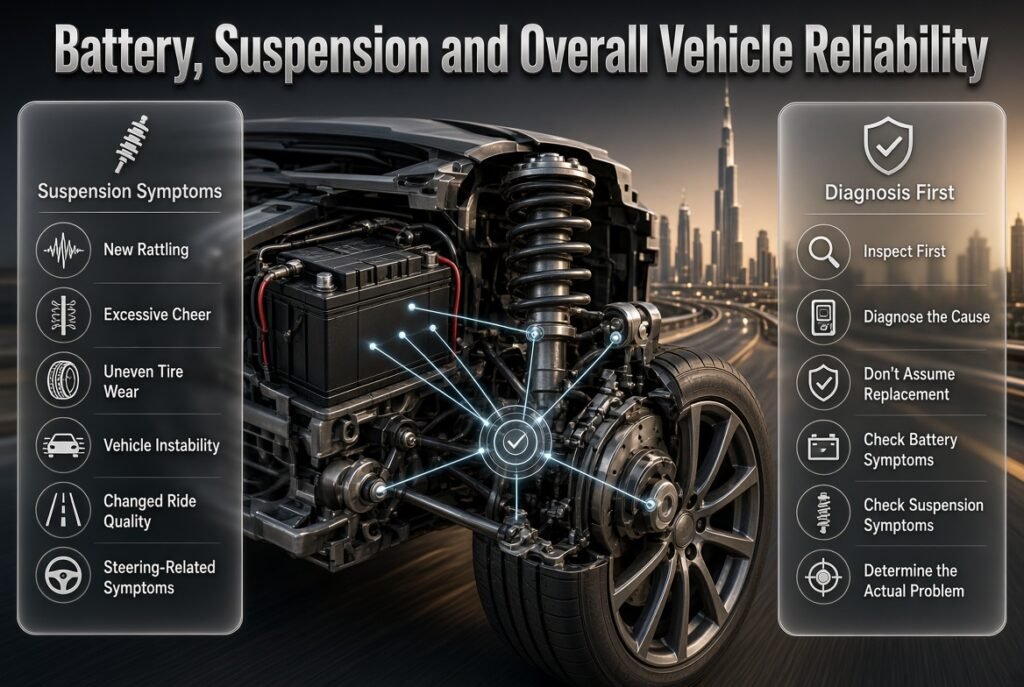
Suspension problems can also develop gradually.
Drivers may notice:
- New rattling
- Excessive bouncing
- Uneven tire wear
- Vehicle instability
- Changes in ride quality
- Steering-related symptoms
These issues don’t automatically mean that suspension components need replacement.
Inspection and diagnosis should come first.
For more information, see our Suspension Maintenance Guide in Dubai.
This same maintenance philosophy applies to batteries:
Don’t replace a component simply because a symptom exists. Determine what is actually causing the symptom.
What Are the Most Common Car Battery Maintenance Mistakes?
Mistake 1: Waiting Until the Battery Is Completely Dead
This is probably the most common mistake.
Drivers often assume that a battery is fine because the vehicle started yesterday.
Battery condition can deteriorate gradually.
Better approach
Notice changes in starting speed and investigate them before complete failure.
Mistake 2: Assuming a Dead Battery Is Always the Battery’s Fault
A vehicle that won’t start may have:
- Battery problem
- Starter problem
- Fuel problem
- Ignition problem
- Electrical fault
- Cable issue
- Charging-system problem
Diagnosis matters.
Mistake 3: Replacing the Battery Without Testing
A new battery isn’t useful if the real problem is an alternator or electrical drain.
Better approach
Test the battery and charging system when repeated discharge occurs.
Mistake 4: Ignoring Corrosion
Heavy corrosion can affect the electrical connection.
Better approach
Inspect the terminals regularly and investigate recurring corrosion.
Mistake 5: Treating Age as the Only Factor
Battery age matters, but it isn’t the complete story.
A battery’s:
- Test result
- Physical condition
- Starting performance
- Charging environment
- Usage pattern
also matter.
Mistake 6: Ignoring Warning Lights
A charging warning light should not be treated as a cosmetic dashboard message.
If it remains illuminated, investigate it.
Mistake 7: Using the Wrong Replacement Battery
A replacement battery must be appropriate for the vehicle.
Important factors can include:
- Battery size
- Terminal arrangement
- Capacity
- Starting performance
- Battery technology
- Vehicle-specific requirements
Modern vehicles may require specific battery types or registration/programming procedures.
Always follow manufacturer specifications.
A Practical Approach to Vehicle Electrical System Inspection
Electrical problems can affect much more than the vehicle’s ability to start. Battery terminals, wiring, ground connections, fuses, lighting circuits, sensors, charging components, and electronic systems can all contribute to unusual electrical symptoms. When a car develops slow cranking, dim lights, repeated battery discharge, warning indicators, or intermittent electrical faults, it is important to inspect the complete system rather than immediately blaming the battery or alternator. A systematic inspection can help identify loose connections, voltage-drop issues, charging problems, damaged wiring, or other underlying causes. For a detailed guide on what to inspect, how different electrical components work together, and how to approach common electrical symptoms, read our Vehicle Electrical System Inspection Guide. This guide is useful for understanding the vehicle’s electrical system and making more informed maintenance and diagnostic decisions.
How Does Seasonal Maintenance Help Protect Your Battery?
Battery maintenance becomes especially useful when environmental conditions change.
Before a demanding season or period of heavy vehicle use, check:
- Battery age
- Battery condition
- Terminal condition
- Starting performance
- Charging-system behavior
The same principle applies to other systems.
Hot conditions can place additional demands on:
- Battery
- Cooling system
- Tires
- Air conditioning
- Fluids
Wet conditions can increase the importance of:
- Tires
- Brakes
- Wipers
- Visibility
- Exterior lights
A seasonal maintenance routine should therefore focus on inspection rather than automatic replacement. This is also consistent with the broader approach outlined in our seasonal car-care guidance.
What Should You Do If Your Battery Dies on the Road?
If your battery fails while driving or the vehicle won’t restart after stopping, safety comes first.
If possible:
- Move the vehicle away from active traffic.
- Switch on hazard lights.
- Turn off unnecessary electrical equipment.
- Avoid repeatedly attempting to start the engine.
- Keep passengers away from moving traffic.
- Contact appropriate roadside assistance.
- Have the battery and charging system checked afterward.
A dead battery is a mechanical problem.
A vehicle stopped in an unsafe traffic position is a safety problem.
The safety issue comes first.
Our Vehicle Maintenance Guides provide broader guidance on handling different vehicle problems, while our roadside information explains how to prioritize personal safety during unexpected breakdowns.
What If the Battery Dies Because the Car Runs Out of Fuel?
A fuel emergency and a battery failure are different problems, but they can become connected.
For example, a driver may repeatedly try to restart a vehicle after it runs out of fuel.
Those repeated attempts can consume additional battery power.
If you’ve actually run out of fuel, don’t keep cranking the engine repeatedly.
Instead:
- Move somewhere safe if possible
- Turn on hazard lights
- Avoid unnecessary electrical use
- Arrange appropriate roadside assistance or fuel delivery
Our guide on What to Do When Your Car Runs Out of Fuel explains the practical safety steps to follow during an empty-fuel situation.
For situations involving an empty tank on the road, safety and vehicle positioning should come before trying repeatedly to restart the engine.
Battery Maintenance and Fuel-Related Starting Problems
Not every starting problem is a battery problem.
This distinction is important.
If nothing happens when you turn the key:
Possible causes can include:
- Weak battery
- Poor battery connection
- Starter circuit problem
- Electrical fault
If the engine cranks normally but doesn’t start:
Possible causes can involve:
- Fuel delivery
- Ignition
- Sensors
- Engine management
- Mechanical problems
If the engine starts and immediately stops:
Possible causes can include:
- Fuel problems
- Ignition problems
- Immobilizer
- Sensors
- Engine-management issues
If the problem started immediately after refueling, mention that when requesting assistance.
Fuel quality can also affect engine performance, but symptoms such as hesitation or difficult starting don’t prove that fuel is the cause. Other mechanical and electrical faults can produce similar symptoms.
Why You Shouldn’t Guess the Cause of a Starting Problem

Imagine two cars that won’t start.
Car A
The starter barely turns.
The lights become dim.
The battery is four years old.
Car B
The starter turns the engine at normal speed.
The engine doesn’t actually fire.
The fuel gauge is near empty.
Both vehicles “won’t start,” but they require completely different diagnostic approaches.
That’s why a useful maintenance habit is to describe what the vehicle is doing, rather than simply saying:
“The battery is dead.”
Better information includes:
- Does the starter crank?
- Is it slow?
- Is there clicking?
- Are the lights working?
- Is a warning light present?
- Did the problem happen after refueling?
- Did the vehicle previously show symptoms?
- Has the battery recently been replaced?
Good observations make diagnosis easier.
How Can You Extend Car Battery Life?
There is no maintenance trick that can guarantee a specific battery lifespan.
However, you can reduce avoidable stress by:
Keeping connections clean
Good electrical connections help the system operate properly.
Monitoring battery age
Knowing the installation date helps you recognize when testing becomes increasingly useful.
Avoiding unnecessary electrical drain
Don’t leave electrical accessories running when the engine is off unless the vehicle is designed for that use.
Addressing repeated discharge
A battery that repeatedly goes flat needs investigation.
Maintaining the charging system
A battery depends on the vehicle’s charging system to replenish energy.
Checking before long trips
An older battery deserves more attention before demanding journeys.
Following vehicle-specific requirements
Modern vehicles can have different battery-management systems and replacement procedures.
Car Battery Maintenance Checklist
Use this simple checklist as part of routine vehicle care.
Battery condition
- Battery case has no cracks
- No swelling
- No visible leakage
- No severe physical damage
Terminals
- Connections are secure
- No heavy corrosion
- No unusual buildup
Cables
- No visible damage
- No fraying
- Connections are secure
- No obvious overheating
Mounting
- Battery is properly secured
- Battery doesn’t move excessively
Performance
- Engine starts normally
- No repeated clicking
- No unusually slow cranking
- Lights operate normally
- No unexplained electrical behavior
Warning signs
- No battery/charging warning light
- No repeated jump-start requirement
- No recurring battery discharge
Preventive care
- Battery age is known
- Older battery has been tested
- Charging system checked when appropriate
- Correct replacement specification confirmed if replacement is required
Car Battery Maintenance Before a Dubai Road Trip
Before a long Dubai journey, don’t focus on the battery alone.
A practical road-trip inspection should cover:
Battery
Check age, terminals, physical condition and starting performance.
Tires
Check pressure and inspect the tread and sidewalls.
Brakes
Pay attention to noise, vibration, pedal feel and stopping behavior.
Fluids
Check the appropriate engine fluids according to manufacturer procedures.
Cooling system
Look for coolant loss, leaks and temperature warnings.
Lights
Check headlights, brake lights, indicators and hazard lights.
Wipers
Make sure visibility equipment is working properly.
Fuel
Plan enough fuel for the route and don’t rely blindly on the dashboard range estimate.
If you want a broader preparation routine, our Vehicle Maintenance Guides resource is useful for reviewing different systems before a longer trip.
A Practical Guide to Maintaining Your Car Battery
Regular car battery care can help reduce unexpected starting problems and identify potential issues before they become more serious. Battery condition can be influenced by factors such as high temperatures, frequent short journeys, long periods of inactivity, electrical loads, terminal condition, and the performance of the vehicle’s charging system. Instead of waiting for a complete failure, it is better to periodically inspect the battery, terminals, connections, and starting performance and investigate unusual symptoms early. For detailed guidance on battery inspection, maintenance, testing, common warning signs, and situations where professional diagnosis may be more appropriate, read our Car Battery Care Guide. This guide provides practical information to help vehicle owners understand battery condition and make better maintenance decisions without replacing a battery unnecessarily.
How Can You Keep Battery Maintenance Simple?
The biggest mistake is making maintenance so complicated that you stop doing it.
A simple routine works better.
Every few weeks
Pay attention to:
- Starting behavior
- Warning lights
- Electrical abnormalities
- Unusual sounds
Every few months
Inspect:
- Battery case
- Terminals
- Cables
- Mounting
As the battery gets older
Consider:
- Battery testing
- Charging-system testing
- More frequent monitoring
Before a long trip
Review:
- Battery
- Tires
- Brakes
- Fluids
- Cooling system
- Lights
- Wipers
- Fuel
This gives you a manageable maintenance routine without turning every drive into a mechanical inspection.
Expert Advice: What Professionals Look For
A professional doesn’t normally start by replacing the first component associated with a symptom.
The better approach is diagnosis.
For a battery-related complaint, a useful sequence is:
1. Listen to the complaint
What changed?
2. Inspect the battery
Is there physical damage?
3. Check the connections
Are terminals and cables secure?
4. Test the battery
Can it provide sufficient starting performance?
5. Test the charging system
Is the vehicle replenishing the battery properly?
6. Consider electrical drain
Does something continue consuming power when the vehicle is parked?
7. Check vehicle history
Is the battery new, old, or recently replaced?
8. Decide on the repair
Only after identifying the likely cause should replacement or repair be selected.
This approach saves money because it reduces unnecessary parts replacement.
What Are the Biggest Battery Maintenance Mistakes in Dubai?
Dubai’s environment makes a few mistakes particularly worth avoiding.
Ignoring an aging battery because the car still starts
A battery can deteriorate without immediately failing.
Waiting for extreme weather to expose a weakness
A marginal battery may become unreliable when conditions become more demanding.
Assuming every flat battery needs replacement
A discharged battery isn’t automatically a failed battery.
Replacing the battery without checking the charging system
A charging problem can affect a replacement battery too.
Leaving electrical systems active while parked
Unnecessary electrical consumption can discharge the battery.
Repeatedly jump-starting without diagnosis
A jump-start gets you moving but doesn’t explain the cause.
How Often Should You Check and Maintain Your Car Battery?
A car battery doesn’t need daily maintenance, but it shouldn’t be completely ignored between major services. For most vehicles, a quick visual inspection every few months is a practical routine. Check the battery case, terminals, cables, mounting, and any visible signs of corrosion or leakage. As the battery gets older, regular testing becomes more valuable because a battery can lose starting capacity even when the vehicle still starts normally.
For vehicles operating in Dubai’s hot climate, paying attention to battery condition is particularly important. High temperatures can accelerate battery deterioration, while frequent short trips, traffic, air-conditioning use, and extended periods of parking can add to the demands placed on the electrical system.
Important checks include:
Inspect the battery case for cracks, swelling, or leakage.
Check terminals for heavy corrosion or loose connections.
Make sure the battery is securely mounted.
Pay attention to slower-than-normal engine cranking.
Have an older battery tested rather than judging it only by appearance.
Check the charging system if the battery repeatedly loses charge.
A consistent inspection routine helps you identify developing problems before they become an unexpected starting failure.
What Are the Signs That a Car Battery Is Getting Weak?
A weak battery often gives some indication before it completely fails, although the symptoms can overlap with other electrical or mechanical problems. One of the most noticeable signs is slower engine cranking. If the starter sounds weaker or takes noticeably longer to turn the engine than it normally does, the battery deserves attention.
Other symptoms can include clicking during startup, dim or flickering lights, repeated need for jump-starts, electrical irregularities, corrosion around the terminals, or a battery/charging warning light. However, these symptoms don’t automatically prove that the battery itself is defective. A poor connection, starter problem, alternator fault, or another electrical issue can produce similar behavior.
Watch for these warning signs:
Slow or sluggish engine cranking.
Repeated clicking when attempting to start.
Headlights or interior lights becoming unusually dim.
Electrical accessories behaving inconsistently.
Battery or charging-system warning light.
The vehicle needing frequent jump-starts.
Visible swelling, leakage, or severe corrosion.
If several symptoms appear together, testing the battery and charging system is more useful than replacing the battery based on symptoms alone.
How Does Dubai’s Hot Weather Affect Car Battery Life?
High temperatures can accelerate battery deterioration, which makes battery monitoring particularly important in Dubai. Heat affects the chemical processes inside conventional automotive batteries and can contribute to faster degradation over time. The effect isn’t identical for every vehicle because battery technology, quality, driving habits, electrical demand, and charging-system condition also influence service life.
Dubai vehicles may regularly operate in demanding conditions such as extreme outdoor temperatures, heavy traffic, frequent idling, extensive air-conditioning use, and short urban journeys. These conditions don’t mean that every battery will fail early, but they make it sensible to monitor an aging battery rather than assuming it will remain reliable indefinitely.
For better battery care in hot conditions:
Keep battery terminals clean and properly connected.
Check the battery for physical damage or swelling.
Monitor changes in starting performance.
Know when the battery was installed.
Test an older battery periodically.
Investigate repeated loss of charge.
Check the charging system when battery problems continue.
The professional approach is not to replace a battery simply because Dubai is hot. Instead, use the climate as a reason to pay closer attention to the battery’s actual condition.
Why Does My Car Battery Keep Dying Even After I Replace It?
When a newly replaced battery repeatedly goes flat, the battery itself may not be the underlying problem. A vehicle’s charging system, electrical connections, or another electrical component could be responsible. Replacing the battery again without diagnosing the cause can result in the same problem returning.
One possibility is a charging-system fault. If the alternator or related components aren’t maintaining the battery correctly, even a new battery can become discharged. Another possibility is parasitic electrical drain, where a vehicle component continues consuming power while the car is parked. Poor terminal connections, long periods of inactivity, and frequent short journeys can also contribute to battery-discharge problems.
If a replacement battery keeps going flat, check:
Battery installation and terminal connections.
Alternator and charging-system performance.
Possible parasitic electrical drain.
Vehicle usage and parking pattern.
Electrical accessories that may remain active.
Correct battery specification for the vehicle.
A repeated battery failure should therefore be treated as a diagnostic problem, not simply a battery-replacement problem. Finding the reason for the discharge is more important than repeatedly installing another battery.
Should You Replace a Car Battery After Three Years?
Three years is an important point at which to start paying closer attention to battery condition, but it isn’t an automatic replacement deadline. Battery life varies according to climate, driving pattern, battery technology, vehicle electrical demand, maintenance, and charging-system condition. A battery that is three years old may still perform reliably, while another battery of the same age may already show significant deterioration.
Instead of using age alone, consider the battery’s actual performance. If the vehicle starts normally and the battery passes an appropriate test, immediate replacement may not be necessary. On the other hand, an older battery with slow cranking, repeated discharge, poor test results, or physical damage deserves more serious attention.
Consider these factors before replacement:
Battery age and installation date.
Battery test results.
Starting performance.
Physical condition of the battery.
Frequency of jump-starts.
Charging-system condition.
Vehicle manufacturer’s battery requirements.
The most reliable decision comes from combining age + condition + test results + vehicle symptoms
Conclusion
Car battery maintenance is not just about preventing a no-start situation. It is about keeping your vehicle’s electrical system reliable, identifying problems before they become roadside emergencies, and understanding when maintenance is enough and when professional testing or replacement is necessary.
A practical battery-care routine starts with regular inspection. Check the battery terminals for corrosion, look for physical damage or swelling, make sure the connections are secure, and pay attention to changes in starting performance. If the engine takes longer than usual to start, electrical accessories behave unusually, or the battery repeatedly loses charge, do not simply assume that the battery needs replacing. The charging system, electrical connections, parasitic drain, and driving pattern may also need to be checked.
Dubai’s heat, frequent traffic, extended air-conditioning use, and repeated short trips can place additional demands on a vehicle’s electrical system. That makes consistent inspection and testing particularly useful. However, the goal should not be to replace a battery based only on its age. Its actual condition, test results, vehicle requirements, and symptoms should all be considered together.
Good vehicle maintenance also works as a complete system. Battery condition should be considered alongside tires, brakes, suspension, fluids, and other essential components rather than treated as an isolated task. Following a structured Vehicle Maintenance Guide can help you keep these checks organized.
The most effective approach is simple:
- Inspect the battery and terminals regularly.
- Keep electrical connections clean and secure.
- Test battery and charging-system performance when symptoms appear.
- Pay attention to slow starting or repeated discharge.
- Avoid relying only on battery age to decide on replacement.
- Follow the vehicle manufacturer’s battery specifications.
- Have persistent electrical problems properly diagnosed.
- Include battery checks in your wider vehicle maintenance routine.
A healthy battery gives you more confidence that your car will start when you need it. With regular inspection, proper testing, and timely attention to warning signs, car battery maintenance can help reduce avoidable breakdowns and keep your vehicle dependable on Dubai roads.
Leave a Reply