
Introduction
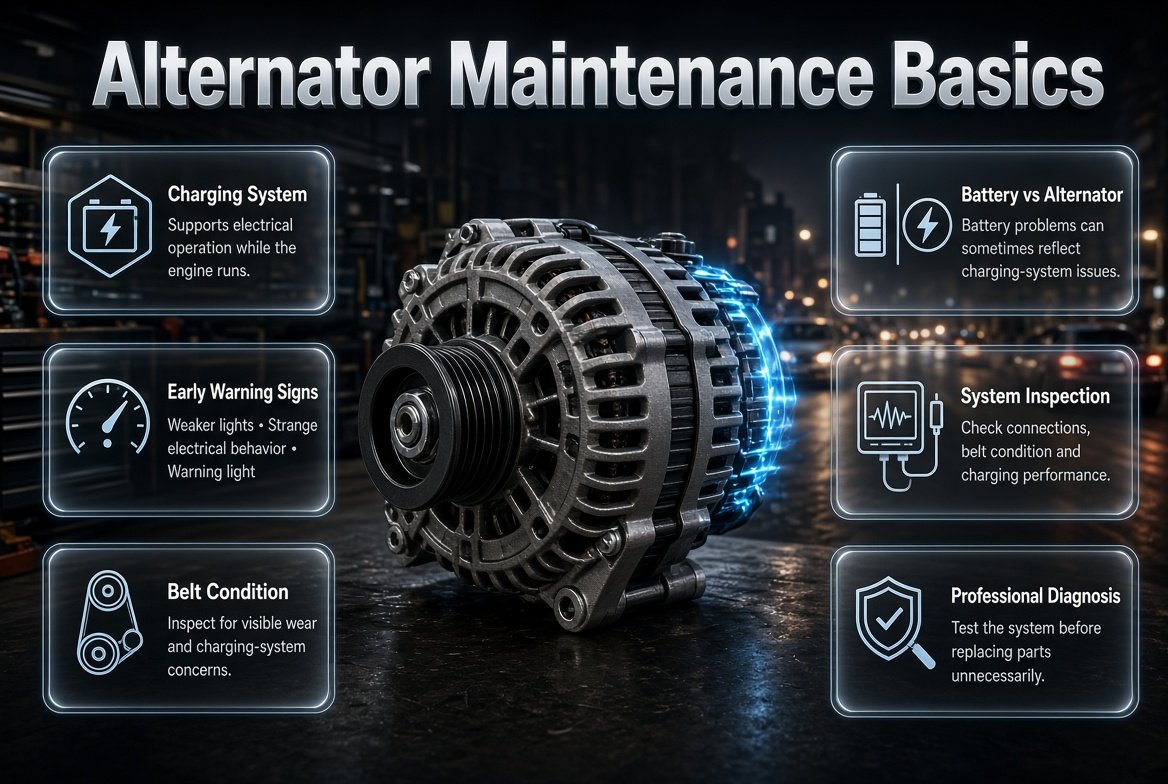
Alternator Maintenance Basics | A car can start normally in the morning and still develop a charging-system problem before the end of the day. The headlights may become weaker, electrical accessories may behave strangely, a warning light may appear, or the vehicle may eventually stop because the electrical system no longer has enough power.
Many drivers immediately blame the battery. Sometimes the battery is the problem, but sometimes the battery is only showing the consequences of another issue.
The alternator is one of the most important components involved in keeping a vehicle’s electrical system operating while the engine is running. Understanding alternator maintenance basics can help you recognize early warning signs, avoid unnecessary parts replacement, and reduce the chance of an unexpected roadside breakdown.
For drivers in Dubai, proper vehicle care is particularly important because high temperatures, heavy traffic, frequent air-conditioning use, stop-and-go driving, and long journeys can place demanding conditions on vehicles.
If you’re looking for the broader vehicle-care resources available on our site, you can also explore Fuel Delivery Dubai for additional practical automotive and roadside guidance.
This guide explains what an alternator does, what maintenance it actually needs, how to recognize problems, how the alternator differs from the battery, how to inspect the charging system, what mistakes to avoid, and when professional diagnosis is the smarter choice.
What Is an Alternator?
An alternator is an engine-driven component that produces electrical energy while the engine is running. It supplies power to the vehicle’s electrical systems and helps maintain the battery’s charge.
In simple terms, the alternator converts some of the engine’s mechanical energy into electrical energy.
A simplified system looks like this:
Engine → Drive Belt → Alternator → Electrical System + Battery
This relationship is important because the alternator isn’t working independently.
The drive belt must turn it correctly. Electrical connections must allow current to move properly. The charging-control system must regulate output appropriately. The battery must also be in reasonable condition.
If one part of this system develops a problem, the symptoms can sometimes look like an alternator failure even when the alternator itself isn’t the root cause.
Why Is Alternator Maintenance Important?
Alternator maintenance is important because charging problems can develop gradually.
A vehicle may continue starting normally even when the alternator isn’t producing the correct amount of electrical power. The battery may temporarily compensate by using its stored energy.
Eventually, however, that reserve can become depleted.
That can lead to:
- Difficulty starting
- Electrical warning lights
- Dim or flickering lights
- Weak electrical accessories
- Repeated battery discharge
- Engine stalling in severe cases
- A vehicle that won’t restart
Featured answer:
Alternator maintenance involves inspecting the alternator’s drive belt, electrical connections, battery connections, charging performance, wiring, and warning signs. Most alternators don’t need routine internal servicing on a fixed schedule. Instead, they should be checked as part of normal vehicle maintenance and whenever charging-system symptoms appear.
How Does an Alternator Work?
The alternator uses engine rotation to generate electricity.
When the engine runs, the crankshaft turns the drive belt. The belt then turns the alternator pulley. Inside the alternator, electromagnetic principles are used to generate electrical power.
The resulting electrical output is regulated before being supplied to the vehicle’s electrical system.
The basic sequence is:
- The engine starts.
- The drive belt begins turning.
- The alternator rotates.
- Electrical energy is generated.
- The charging system regulates the output.
- Electrical systems receive power.
- The battery receives charging support as required.
The exact control strategy differs between vehicles.
Older systems may operate differently from modern vehicles that use electronically controlled or variable charging strategies.
This matters when testing an alternator.
A technician shouldn’t automatically declare an alternator defective simply because a generic voltage number doesn’t appear constantly.
Vehicle-specific specifications and operating conditions matter.
What Happens If the Alternator Stops Working?
If the alternator stops producing adequate electrical power, the vehicle begins relying increasingly on the battery’s stored energy.
The battery can provide power for a limited period, but it isn’t designed to replace the alternator indefinitely while the engine is running.
As the battery’s available energy decreases, electrical functions may become unreliable.
Eventually, the engine may stop or the vehicle may fail to restart.
This is why a charging-system warning should be treated as a maintenance issue rather than something to ignore until the car refuses to move.
What Is the Difference Between an Alternator and a Battery?
The battery and alternator work together, but their jobs are different.
The battery stores electrical energy and provides substantial power during engine starting.
The alternator generates electrical energy while the engine is running and helps maintain the vehicle’s electrical supply and battery charge.
A simple comparison is:
| Component | Primary Role | Main Operating Situation |
|---|---|---|
| Battery | Stores electrical energy | Starting and electrical support |
| Alternator | Generates electrical energy | Engine running |
| Drive belt | Transfers engine rotation | Alternator operation |
| Charging controls | Regulate charging | During vehicle operation |
| Wiring and grounds | Carry electrical current | Throughout the system |
This distinction is useful because the symptoms can overlap.
For example, a weak battery can cause difficult starting.
A weak alternator can also eventually cause difficult starting because it isn’t adequately replenishing the battery.
That means replacing the battery doesn’t automatically solve a charging problem.
Likewise, replacing an alternator won’t necessarily solve a battery that has already deteriorated internally.
Why Should Both Be Tested?
Suppose a driver installs a new battery because the old one keeps going flat.
The car starts normally for a few days.
Then the new battery becomes weak too.
At this point, repeatedly replacing batteries isn’t a logical maintenance strategy.
The charging system should be tested.
The opposite situation is also possible.
An alternator may be operating correctly while an old battery can no longer hold an adequate charge.
The correct approach is therefore:
Test → Identify the cause → Repair the cause → Recheck the system
For battery-specific maintenance information, see the Car Battery Maintenance in Dubai guide.
What Maintenance Does an Alternator Actually Need?

One of the biggest misunderstandings about alternators is that they need frequent internal servicing like an engine.
Usually, they don’t.
A modern alternator is generally designed to operate for a long period without routine internal maintenance.
The more useful maintenance strategy is condition-based inspection.
That means checking the surrounding system and looking for evidence of deterioration.
Important checks include:
- Drive-belt condition
- Belt tension where applicable
- Alternator mounting
- Electrical connections
- Battery terminals
- Ground connections
- Wiring condition
- Charging performance
- Warning lights
- Unusual noise
- Signs of overheating
- Signs of contamination
The purpose isn’t to dismantle a healthy alternator unnecessarily.
The purpose is to identify problems before they develop into a complete charging failure.
Inspect the Alternator Drive Belt
The alternator depends on the drive belt to rotate.
If the belt is damaged, loose, excessively worn, contaminated, or slipping, the alternator may not operate correctly even if its internal components are healthy.
Depending on the vehicle, the same belt may also drive other components.
This makes belt inspection an important part of alternator maintenance.
What Should You Look For?
Look for:
- Cracks
- Fraying
- Glazing
- Missing material
- Oil contamination
- Abnormal wear
- Incorrect tension
- Squealing
- Visible belt damage
Don’t rely only on noise.
A belt can have visible deterioration without producing an obvious sound.
Likewise, a squealing noise doesn’t automatically prove that the alternator is defective.
The noise could originate from the belt, tensioner, pulley, or another accessory.
Common Mistake: Blaming the Alternator for Belt Noise
A driver hears a squeal and assumes:
“The alternator is failing.”
That conclusion may be premature.
The correct approach is to inspect the entire belt-drive system.
A professional diagnosis considers the sound, belt condition, pulley operation, charging performance, and other relevant evidence.
Expert Tip:
Never replace an alternator solely because of a belt noise. Confirm whether the noise comes from the alternator itself, its pulley, the belt, or another component.
A Complete Guide to Vehicle Electrical System Inspection
Your car’s electrical system involves much more than the battery alone. Starting problems, dim lights, repeated battery discharge, warning lights, slow electrical accessories, or intermittent faults can sometimes be caused by the charging system, starter circuit, wiring, grounds, fuses, connectors, or other electrical components. A proper inspection helps identify the actual source of the problem instead of replacing parts based on one symptom or voltage reading. For a step-by-step explanation of what to inspect, which electrical tests are useful, how to distinguish battery problems from charging-system issues, and when professional diagnosis may be necessary, read our Vehicle Electrical System Inspection Guide. This guide is particularly useful when you want to understand the complete electrical system before deciding whether a battery, alternator, wiring connection, or another component actually needs attention.
Check Alternator Electrical Connections
Electrical connections are an essential part of charging-system maintenance.
The alternator may be generating power correctly, but that power still has to reach the appropriate parts of the vehicle.
Problems can develop because of:
- Loose connections
- Corrosion
- Damaged wiring
- Poor grounding
- Heat-related deterioration
- Connector damage
- Excessive resistance
A connection can sometimes look acceptable while still performing poorly under load.
That’s why visual inspection and electrical testing serve different purposes.
Visual inspection identifies obvious physical problems.
Testing determines whether the system is actually behaving correctly.
Why Does Corrosion Matter?
Corrosion can increase electrical resistance.
In a charging system, excessive resistance can interfere with current flow and create symptoms that may be mistaken for alternator failure.
A vehicle operating in a hot, dusty environment may benefit from sensible inspection of accessible connections as part of broader maintenance.
But this doesn’t mean every connection should be cleaned or disturbed unnecessarily.
If a connection is secure, clean, and functioning correctly, unnecessary handling can create its own problems.
Pro Tip:
Maintenance should be evidence-based. Don’t disconnect healthy electrical components simply because you’re performing a routine inspection.
Inspect Battery Terminals and Ground Connections
The alternator and battery rely on good electrical paths.
Poor battery-terminal connections or weak grounds can affect the performance of the entire charging system.
During inspection, check for:
- Loose terminals
- Corrosion
- Damaged terminal hardware
- Poor ground connections
- Heat damage
- Damaged cables
A weak ground can sometimes create confusing electrical symptoms.
The driver may notice charging problems, starting issues, or unusual electrical behavior without realizing that the underlying issue is a connection rather than a major component failure.
This is another reason why diagnosis should begin with the complete system.
How to Keep Your Car Battery in Good Condition
Regular battery care can help you identify potential starting and electrical problems before they leave you stranded. Instead of waiting until the engine struggles to crank, it is useful to periodically check the battery terminals, visible connections, battery condition, starting performance, and signs of corrosion or physical damage. Factors such as extreme heat, frequent short trips, long periods of inactivity, and heavy electrical use can also affect battery performance over time. If you want a practical guide covering battery inspection, maintenance, testing, common warning signs, and when replacement may actually be necessary, read our Car Battery Care Guide. It provides a straightforward approach to understanding battery condition and making better maintenance decisions before a minor issue becomes a roadside problem.
What Are the Signs of a Failing Alternator?
Alternator problems can develop gradually or appear suddenly.
Some symptoms are obvious.
Others are easy to dismiss.
The most important warning signs include the following.
Battery or Charging Warning Light
A battery-shaped warning light doesn’t necessarily mean the battery itself is bad.
It can indicate a problem within the charging system.
Possible causes can include:
- Alternator output problems
- Drive-belt problems
- Wiring issues
- Charging-control faults
- Electrical connection problems
If the warning remains illuminated while the engine is running, it deserves attention.
Dimming Headlights
Headlights that become unusually dim can indicate an electrical supply problem.
However, lighting issues can have other causes, so don’t use dim headlights alone as proof of alternator failure.
Flickering Lights
Flickering may indicate unstable electrical supply, connection problems, or another electrical fault.
The pattern matters.
For example, flickering that appears only under certain loads may provide useful diagnostic information.
Repeated Battery Discharge
This is one of the most important symptoms.
If a battery repeatedly becomes discharged despite normal use, don’t simply install another battery.
Investigate:
- Battery condition
- Alternator output
- Electrical connections
- Parasitic drain
- Belt operation
- Charging controls
Unusual Noise
Grinding, whining, rattling, or squealing sounds from the alternator area deserve inspection.
Possible causes can include:
- Bearing wear
- Pulley problems
- Belt problems
- Internal alternator damage
- Nearby accessory problems
Noise is a symptom, not a diagnosis.
Burning Smell
A burning rubber or electrical smell can indicate overheating, belt slipping, wiring problems, or another fault.
If there is smoke, visible fire, or a strong burning smell, prioritize safety rather than attempting roadside diagnosis.
How Often Should an Alternator Be Inspected?
There isn’t one universal alternator inspection interval that works for every vehicle.
The appropriate schedule depends on:
- Vehicle manufacturer
- Vehicle age
- Mileage
- Operating environment
- Electrical demand
- Belt condition
- Battery condition
- Previous repairs
- Driving pattern
A sensible strategy is to include charging-system inspection in routine vehicle maintenance.
Additional inspection is appropriate when symptoms appear.
For example, don’t wait for the next scheduled service if you suddenly notice:
- A charging warning light
- Repeated battery discharge
- Dimming lights
- Unusual belt noise
- Starting changes
- Electrical glitches
- Burning smells
Should an Alternator Be Replaced at a Certain Mileage?
Not necessarily.
There is no universal mileage at which every alternator should automatically be replaced.
Preventive replacement may make sense in certain vehicle-specific circumstances, but replacing a healthy alternator simply because it has reached an arbitrary mileage can create unnecessary expense.
Condition matters more than an isolated number.
How Do You Test an Alternator?

Testing should go beyond simply looking at the alternator.
A basic electrical test can provide useful information, but modern vehicles may require more comprehensive diagnostic procedures.
A technician may consider:
- Battery state
- Charging voltage
- Charging current
- Electrical load
- Engine operating conditions
- Vehicle-specific charging strategy
- Wiring resistance
- Ground condition
- Warning-system data
Can You Test an Alternator With a Multimeter?
A multimeter can be useful for basic voltage measurements if you know how to use it safely.
However, a single reading isn’t always enough.
Modern charging systems can change their behavior depending on:
- Battery condition
- Temperature
- Engine speed
- Electrical demand
- Vehicle control strategy
- Operating conditions
Therefore, a multimeter reading should be interpreted in context.
A Basic Inspection Sequence
Step 1 — Inspect
Look for visible belt, wiring, terminal, or physical problems.
Step 2 — Check the Battery
A battery with an existing fault can complicate charging-system diagnosis.
Step 3 — Test Charging Performance
Measure the system according to the vehicle’s recommended diagnostic procedure.
Step 4 — Add Appropriate Electrical Load
Where applicable, observe how the charging system behaves under realistic electrical demand.
Step 5 — Compare With Vehicle Specifications
Don’t rely on a generic number when manufacturer-specific data is available.
Step 6 — Diagnose
Determine whether the issue is the alternator, battery, belt, wiring, control system, or another component.
Step 7 — Recheck
After repair, confirm that the original symptom has actually been corrected.
Why Modern Alternators Can Be Harder to Diagnose
Older charging systems were often easier to understand because their operating behavior was relatively straightforward.
Modern vehicles can use intelligent charging systems that adjust alternator output according to vehicle conditions.
The system may consider information such as:
- Battery state
- Engine conditions
- Temperature
- Electrical demand
- Driving conditions
- Vehicle control-system commands
As a result, seeing the charging voltage change doesn’t automatically mean something is broken.
This is particularly important for DIY diagnosis.
A driver may search for one “correct alternator voltage” and conclude that anything different indicates failure.
That isn’t always accurate.
Common Mistake:
Treating a modern vehicle like an older vehicle with a fixed charging strategy.
The correct specification should come from the vehicle’s service information and diagnostic requirements.
Does Dubai’s Climate Affect Alternator Maintenance?
Dubai presents demanding operating conditions for vehicles.
High ambient temperatures, extended air-conditioning use, traffic congestion, dust, and frequent stop-and-go driving can all contribute to overall vehicle stress.
The important point is to avoid exaggerated maintenance claims.
Hot weather doesn’t automatically mean:
“Replace your alternator early.”
Instead, it means that sensible inspection and awareness of warning signs are valuable.
Pay attention to:
- Battery condition
- Belt condition
- Electrical connections
- Charging performance
- Warning lights
- Heat-related symptoms
- Unusual smells
- Electrical instability
The goal is not to replace components because the climate is hot.
The goal is to detect genuine deterioration before failure.
How Does Air Conditioning Affect the Charging System?
Air conditioning is particularly important in Dubai because it may be used extensively throughout much of the year.
The climate-control system involves electrical and mechanical loads.
The alternator supplies electrical power to the vehicle’s electrical systems while the engine is operating.
When electrical demand increases, the charging system may have to respond accordingly.
A healthy system is designed to handle normal vehicle loads.
Therefore, air-conditioning use alone shouldn’t be treated as evidence that an alternator is being damaged.
However, if electrical symptoms appear when the vehicle is under higher load, it can be useful diagnostic information.
For example:
- Lights dim when electrical demand increases.
- The idle changes abnormally.
- Warning lights appear.
- Accessories behave inconsistently.
- The battery repeatedly becomes discharged.
These symptoms deserve investigation.
Does Idling Affect the Alternator?
The engine continues running during idle, so the alternator continues operating.
This is why electrical systems can still function while the vehicle is stationary.
The alternator takes mechanical energy from the running engine and converts it into electrical energy.
However, the exact charging behavior at idle depends on the vehicle.
Electrical demand can also affect engine load.
For example, when multiple systems operate simultaneously, the engine and charging system may have to manage a greater demand.
This doesn’t mean normal traffic idling automatically damages the alternator.
It simply demonstrates why the charging system must be healthy and correctly controlled.
Alternator Maintenance Checklist
A practical alternator maintenance checklist doesn’t need to be complicated.
Visual Checks
- Inspect the drive belt.
- Look for visible belt damage.
- Check accessible wiring.
- Look for corrosion.
- Inspect battery terminals.
- Look for signs of overheating.
- Look for fluid contamination.
Operational Checks
- Watch the dashboard warning lights.
- Listen for unusual sounds.
- Monitor starting behavior.
- Notice unusual lighting changes.
- Pay attention to electrical accessory performance.
Diagnostic Checks
- Test the battery when necessary.
- Test charging performance.
- Check electrical connections.
- Evaluate belt operation.
- Compare results with vehicle specifications.
After Repair
- Confirm the original symptom has disappeared.
- Recheck charging performance.
- Confirm warning lights are behaving normally.
- Verify that battery discharge isn’t continuing.
The basic philosophy should be:
Inspect → Test → Diagnose → Repair → Recheck → Monitor
Common Alternator Maintenance Mistakes
Mistake 1: Replacing the Battery Repeatedly
A driver notices that the car doesn’t start.
A new battery is installed.
The car works again.
A few weeks later, the same problem returns.
Another battery is installed.
This cycle can continue if the actual charging problem is never diagnosed.
Better approach: Test the battery and charging system together when repeated discharge occurs.
Mistake 2: Replacing the Alternator Without Testing
A battery keeps going flat, so the driver assumes the alternator must be bad.
That’s not enough evidence.
A battery can be defective.
There can be an electrical drain.
A cable may have excessive resistance.
A belt may be slipping.
A charging-control system may have a fault.
Better approach: Diagnose the entire system before purchasing an expensive component.
Mistake 3: Ignoring the Drive Belt
Drivers often think about the alternator itself and forget the belt that turns it.
A damaged or slipping belt can directly affect alternator operation.
Better approach: Include belt inspection in every charging-system assessment.
Mistake 4: Ignoring the Battery Warning Light
Some drivers continue driving because the vehicle still feels normal.
That’s risky.
A charging warning can mean the vehicle is running on stored battery energy rather than receiving adequate charging support.
Better approach: Treat the warning as a prompt for timely diagnosis.
Mistake 5: Using One Generic Voltage Number
A single number is often presented online as the universal test for alternator health.
Modern vehicles don’t always work that simply.
Better approach: Use vehicle-specific specifications and test the system under appropriate conditions.
Mistake 6: Assuming Every Electrical Problem Is an Alternator Problem
Electrical symptoms have many possible causes.
A malfunctioning accessory, poor ground, wiring fault, battery issue, or control-system problem can create symptoms similar to charging-system trouble.
Better approach: Start with evidence rather than assumptions.
Mistake 7: Continuing to Drive After Serious Symptoms
A charging problem can eventually become a vehicle-stopping problem.
If the warning light appears together with dimming lights, burning smells, abnormal noises, or multiple electrical failures, continuing a long drive isn’t a sensible gamble.
Better approach: Move to a safe location when possible and arrange appropriate assistance.
Alternator Repair or Replacement: Which Is Better?
Whether an alternator should be repaired or replaced depends on the actual fault.
Some alternators can be professionally rebuilt or repaired.
Others may be more appropriately replaced as a complete unit.
The decision depends on:
- Internal component condition
- Vehicle requirements
- Parts availability
- Repair quality
- Labour cost
- Component reliability
- Manufacturer recommendations
- Overall economics
A professional shouldn’t recommend replacement merely because the vehicle has high mileage.
At the same time, repairing a severely damaged alternator isn’t always the most practical solution.
The right question is:
Which solution provides reliable operation for this particular vehicle and fault?
Alternator Maintenance vs Charging-System Maintenance
These terms are related but shouldn’t be treated as identical.
Alternator maintenance focuses specifically on the alternator and the factors directly affecting its operation.
Charging-system maintenance takes a wider view.
It can include:
- Alternator
- Battery
- Belt system
- Wiring
- Ground connections
- Charging controls
- Electrical loads
- Related warning systems
This distinction matters for SEO as well as user understanding.
Someone searching specifically for alternator maintenance usually wants to understand the alternator, its inspection, symptoms, and care.
Someone looking for complete charging-system maintenance has a broader diagnostic need.
For the wider subject, you can read the Automotive Charging System Maintenance in Dubai guide.
This article should remain focused on the alternator itself and the practical checks that affect its operation.
How Can Regular Maintenance Reduce Alternator Problems?
No maintenance routine can guarantee that an alternator will never fail.
Electrical components can fail unexpectedly.
However, regular inspections can identify surrounding conditions that may contribute to charging problems.
Useful habits include:
Follow the Vehicle Maintenance Schedule
Manufacturer recommendations provide the starting point for maintenance.
Don’t replace components simply because an internet article gives a generic interval.
Monitor Warning Lights
Dashboard warnings can provide early information.
Don’t normalize a warning because the car still drives.
Maintain the Battery
A healthy battery is an important part of the electrical system.
Inspect Belts
A belt problem can affect alternator operation.
Address Electrical Symptoms Early
Small symptoms can provide useful clues before a complete failure occurs.
Keep Records
If the battery, alternator, belt, or charging system has previously been repaired, keeping a simple maintenance record can help with future diagnosis.
What Should You Check Before a Long Journey?
A long trip is not the best time to discover a charging-system problem.
Before an extended journey, inspect the vehicle’s important maintenance areas.
For the alternator and electrical system, pay attention to:
- Battery starting performance
- Warning lights
- Drive-belt condition
- Headlight behavior
- Electrical accessories
- Unusual noises
- Burning smells
- Recent charging problems
A broader pre-trip inspection should also consider:
- Engine oil
- Coolant
- Tyres
- Tyre pressure
- Brakes
- Lights
- Fuel level
- Fluid leaks
- Emergency equipment
For broader maintenance planning, the Vehicle Maintenance Guides resource can help you look beyond the alternator without turning every maintenance issue into a charging-system problem.
What Happens If an Alternator Fails While Driving?
If the alternator stops producing adequate power while the engine is running, the vehicle may initially continue operating using energy stored in the battery.
The problem is that the battery’s reserve is limited.
As that reserve decreases, electrical systems can become unreliable.
Eventually, the engine may stop.
The exact timing cannot be predicted safely because it depends on the battery, electrical demand, vehicle design, and nature of the failure.
For that reason, drivers shouldn’t use:
“The battery still has power.”
as a reason to continue a long journey.
What Should You Do?
If a charging warning appears while driving:
- Stay calm.
- Pay attention to traffic.
- Reduce unnecessary electrical loads where practical.
- Look for a safe location.
- Avoid unnecessary detours.
- If the vehicle becomes unsafe, stop safely.
- Arrange appropriate assistance.
If there is smoke, fire, a strong burning smell, or another immediate hazard, prioritize personal safety.
Don’t stand beside a vehicle in an unsafe traffic environment simply to inspect the alternator.
Can a Car Run With a Bad Alternator?
A vehicle can sometimes continue running for a limited period after an alternator problem because the battery still contains stored electrical energy.
But this doesn’t mean the vehicle should be driven normally.
The available battery energy is finite.
Electrical demand can also vary significantly depending on vehicle conditions.
Lights, climate-control systems, electronic modules, fans, infotainment, and other systems can consume energy.
As the battery becomes depleted, the vehicle may eventually lose the ability to operate reliably.
Quick Tip:
If the charging warning light comes on and other electrical symptoms appear, don’t calculate how many kilometres you think the battery will last. Get the vehicle assessed as soon as safely possible.
When Should You Seek Professional Alternator Diagnosis?
Professional diagnosis is particularly appropriate when:
- The charging warning light remains on.
- The battery repeatedly becomes discharged.
- The vehicle has unusual starting behavior.
- Headlights become unusually dim.
- Electrical accessories behave unpredictably.
- The alternator area makes unusual noises.
- There is a burning smell.
- The belt appears damaged.
- Charging tests produce abnormal results.
- The vehicle stops unexpectedly.
Professional diagnosis is valuable because it separates the symptom from the cause.
For example:
Symptom: Battery keeps going flat.
Possible causes:
- Weak battery
- Alternator problem
- Belt problem
- Wiring issue
- Ground issue
- Parasitic electrical drain
- Charging-control fault
Replacing one component without determining which cause is actually present can waste time and money.
Alternator Maintenance for Different Driving Conditions
Not every vehicle experiences the same operating conditions.
Mostly Short Trips
Frequent short trips can place different demands on the battery and charging system because the vehicle may not operate long enough under some conditions to restore energy used during starting.
If starting performance gradually changes, investigate rather than assuming the battery simply needs another replacement.
Heavy Traffic
Stop-and-go traffic means the engine may spend significant time at low speeds or idle.
The alternator continues operating, but charging behavior can vary according to the vehicle’s charging strategy and electrical demand.
Highway Driving
Long highway trips can place sustained demands on the vehicle’s electrical and mechanical systems.
Before a long highway journey, warning signs should be addressed rather than ignored.
High-Temperature Driving
High ambient temperatures can affect many vehicle components.
This makes routine inspection valuable, but again, heat alone isn’t proof that an alternator should be replaced.
Does Electrical Load Affect Alternator Operation?
Yes, electrical demand is relevant to alternator operation.
Modern vehicles contain many electrical systems, including:
- Headlights
- Climate-control electronics
- Cooling fans
- Infotainment
- Sensors
- Control modules
- Power accessories
- Charging ports
- Safety systems
The alternator must provide electrical energy while the engine is operating.
When demand increases, the charging system may adjust accordingly.
However, an individual small accessory doesn’t normally mean the alternator is suddenly overloaded.
The more useful concern is whether the vehicle’s charging system can maintain appropriate operation under normal and expected electrical loads.
If multiple electrical symptoms appear together, testing is more useful than guessing.
Can Poor Alternator Maintenance Affect Fuel Economy?
The alternator is driven by the engine, so generating electrical power involves mechanical load.
Increased electrical demand can therefore influence engine load.
However, drivers should avoid exaggerated claims such as:
“A slightly old alternator will automatically cause huge fuel consumption.”
That’s not a useful maintenance conclusion.
Fuel economy depends on many factors.
A charging-system fault can create abnormal operating conditions, but it shouldn’t be treated as the explanation for every change in fuel consumption.
If fuel consumption changes significantly, consider the complete vehicle rather than focusing on the alternator alone.
How Does Alternator Maintenance Fit Into Overall Vehicle Maintenance?
Alternator maintenance is one part of a larger maintenance strategy.
A healthy vehicle requires attention to multiple systems.
These may include:
- Engine
- Cooling system
- Brakes
- Tyres
- Suspension
- Battery
- Charging system
- Fluids
- Belts
- Lights
- Electrical systems
The key is to keep the maintenance categories separate while understanding how they interact.
For example, the alternator belongs to the charging system.
The battery belongs to the electrical starting and energy-storage side.
The drive belt belongs to the mechanical drive system but directly affects alternator operation.
This system-based understanding makes diagnosis more accurate.
Expert Advice for Better Alternator Maintenance
The most useful alternator maintenance habit is simple:
Don’t wait for total failure before paying attention to warning signs.
A good inspection process doesn’t begin with the question:
“Which expensive part should I replace?”
It begins with:
“What evidence do I have, and what could cause these symptoms?”
A professional-style process is:
1. Observe
Notice warning lights, starting behavior, sounds, smells, and electrical changes.
2. Inspect
Check the belt, terminals, wiring, and visible components.
3. Test
Evaluate battery and charging performance using suitable equipment.
4. Diagnose
Determine the actual source of the problem.
5. Repair
Correct the confirmed fault.
6. Recheck
Make sure the original problem has been resolved.
7. Monitor
Watch for recurrence.
This approach is more reliable than replacing components based on assumptions.
For drivers in Dubai, this condition-based approach is particularly useful because it avoids both extremes:
Ignoring vehicle stress
and
Replacing healthy parts unnecessarily.
How Often Should an Alternator Be Checked or Serviced?
An alternator usually doesn’t have a fixed service interval in the same way engine oil or other scheduled maintenance items do. Instead, it should be inspected as part of the vehicle’s regular maintenance routine and tested whenever symptoms suggest a charging-system problem. The exact inspection frequency depends on the vehicle, mileage, driving conditions, battery condition, belt condition, and manufacturer recommendations.
For Dubai drivers, periodic inspection is particularly useful because vehicles can experience high temperatures, heavy traffic, extensive air-conditioning use, and long periods of operation. These conditions don’t automatically mean an alternator needs early replacement, but they make it sensible to monitor the charging system and address unusual symptoms promptly.
Important checks include:
Inspecting the alternator drive belt for wear or damage
Checking battery terminals and electrical connections
Looking for corrosion or damaged wiring
Monitoring charging-system warning lights
Listening for unusual alternator or belt noises
Testing charging performance when symptoms appear
Checking the battery if repeated discharge occurs
The key principle is condition-based maintenance rather than automatic replacement. A properly functioning alternator doesn’t need to be replaced simply because it has reached a particular age or mileage.
What Are the Signs That an Alternator Needs Maintenance or Repair?
Alternator problems often provide warning signs before complete failure, although some faults can occur suddenly. Common symptoms include a battery or charging warning light, dimming or flickering headlights, repeated battery discharge, unusual noises, electrical accessories behaving inconsistently, and starting problems after the vehicle has been driven.
One important point is that these symptoms don’t automatically prove that the alternator itself has failed. A weak battery, damaged belt, poor electrical connection, wiring fault, grounding problem, or charging-control issue can produce similar symptoms.
Watch for these warning signs:
Battery warning light remains illuminated
Headlights become unusually dim or fluctuate
Battery repeatedly becomes discharged
Electrical accessories behave abnormally
Grinding, whining, or squealing sounds appear
Burning rubber or electrical smells develop
Vehicle develops unexplained starting problems
Charging-system performance tests outside vehicle specifications
If several symptoms occur together, don’t wait until the vehicle stops completely. Early diagnosis can help identify whether the problem is the alternator or another part of the charging system.
Can a Bad Alternator Drain or Damage a Car Battery?
A charging-system problem can leave the battery inadequately charged, which may eventually result in repeated discharge and reduced battery reliability. The alternator’s job is to provide electrical power while the engine is running and help maintain the battery’s charge. If it isn’t functioning correctly, the battery may have to supply more of the vehicle’s electrical demand than it was designed to handle continuously.
However, a repeatedly discharged battery doesn’t automatically mean the alternator is defective. Electrical drains, poor connections, wiring faults, battery deterioration, or other charging-system problems can also be responsible.
When a battery keeps going flat, check:
Battery condition and age
Alternator charging performance
Drive-belt condition
Battery terminals
Ground connections
Alternator wiring
Possible parasitic electrical drain
Vehicle charging-control system
Replacing the battery repeatedly without identifying the underlying cause can become an expensive cycle. A proper battery and charging-system test is normally a better first step.
Does Dubai’s Hot Weather Affect Alternator Performance?
Dubai’s high temperatures can create demanding operating conditions for many vehicle components, including the electrical and charging systems. Heavy air-conditioning use, traffic congestion, frequent stop-and-go driving, dust, and extended vehicle operation can increase the overall demands placed on a vehicle.
However, hot weather shouldn’t be used as a reason to replace an alternator prematurely. A healthy alternator is designed to operate within the vehicle’s specified conditions. The more practical approach is to monitor its condition and investigate genuine warning signs.
For vehicles operating in demanding conditions, pay attention to:
Battery performance
Drive-belt condition
Electrical connections
Charging-system warning lights
Unusual alternator noise
Signs of overheating
Repeated battery discharge
Changes in electrical accessory performance
The professional approach is inspect, test, diagnose, and then repair. Don’t assume that every electrical problem is caused by Dubai’s climate or that every older alternator needs preventive replacement.
Should I Repair or Replace a Faulty Alternator?
The decision to repair or replace an alternator should be based on the confirmed fault, vehicle requirements, repair quality, cost, and expected reliability. Some alternators can be professionally rebuilt by replacing worn internal components, while others may be more practical to replace as a complete unit.
A technician should first determine exactly what has failed. The problem could involve internal electrical components, bearings, the pulley, regulator, wiring, or another part of the charging system. Replacing the complete alternator isn’t always necessary if a reliable repair is available and appropriate for the vehicle.
Consider these factors before making the decision:
Type and severity of the alternator failure
Availability of quality replacement parts
Repair and labour costs
Quality of the replacement unit
Vehicle age and condition
Warranty coverage
Long-term reliability
Manufacturer or vehicle-specific requirements
The biggest mistake is making the repair-or-replace decision before diagnosis. A professional charging-system test should establish whether the alternator is actually defective and whether the surrounding battery, belt, wiring, and connections are contributing to the problem.
Bottom line: repair a component when a reliable repair makes sense; replace it when replacement provides the more dependable and practical solution.
Conclusion
Alternator maintenance is an important part of keeping a vehicle’s electrical and charging system reliable. The alternator works continuously while the engine is running, supplying electrical power to the vehicle and helping maintain the battery’s charge. When its condition is overlooked, a relatively small issue involving the belt, wiring, connections, or alternator itself can eventually develop into a starting or roadside breakdown problem.
The best approach is not to replace an alternator simply because of its age or mileage. Instead, focus on regular inspection, condition monitoring, accurate testing, and timely diagnosis. Pay attention to warning lights, unusual noises, repeated battery discharge, dimming lights, electrical irregularities, and other changes in normal vehicle operation.
For drivers in Dubai, maintaining the charging system is especially practical because high temperatures, traffic congestion, frequent air-conditioning use, and extended driving can place additional demands on vehicle components. These conditions do not automatically mean an alternator will fail, but they make routine inspection and early attention to warning signs more valuable.
A reliable alternator maintenance routine can be summarized simply:
- Inspect the alternator and drive belt regularly.
- Keep electrical connections clean and secure.
- Monitor battery and charging performance.
- Investigate warning lights and unusual electrical symptoms.
- Test the charging system before replacing major components.
- Repair or replace faulty parts based on proper diagnosis.
- Follow the vehicle manufacturer’s maintenance recommendations.
Most importantly, don’t treat the alternator as an isolated component. Battery condition, wiring, grounding, belt condition, and the wider charging system all influence electrical reliability. Looking at these components together provides a more accurate diagnosis and helps prevent unnecessary parts replacement.
Good alternator maintenance is ultimately about prevention rather than guesswork: inspect, test, diagnose, maintain, and monitor. With that approach, vehicle owners can reduce avoidable charging problems, improve electrical-system reliability, and have greater confidence that the vehicle will start and operate properly when it is needed most.
Leave a Reply