

Introduction
Automotive Charging System Maintenance | A car can have a relatively new battery and still leave you stranded.
You turn the key or press the start button, the engine struggles, the dashboard lights behave strangely, and suddenly the vehicle won’t start. Many drivers immediately assume the battery has failed. Sometimes that’s true. But in many cases, the battery is only the part showing the symptom while the real problem is somewhere in the charging system.
That is why automotive charging system maintenance deserves more attention than simply replacing a battery when the vehicle refuses to start.
The charging system keeps the battery supplied with electrical energy while the engine is running and supports the vehicle’s electrical demands. It involves the alternator, battery, voltage regulation, drive belt, wiring, terminals, grounds, sensors, and—in many modern vehicles—electronic charging controls. A fault in any one of these areas can affect the performance of the entire system.
For general roadside and vehicle-care information, you can also visit Fuel Delivery Dubai, where vehicle maintenance and roadside guidance are organized around practical driving situations.
This guide explains how the automotive charging system works, which components need attention, how to recognize early warning signs, how charging-system testing is performed, what maintenance you can realistically do yourself, when professional diagnosis is needed, and which mistakes can turn a small electrical issue into an expensive repair.
What Is an Automotive Charging System?
An automotive charging system is the group of components that produces, controls, and distributes electrical power while the engine is running. Its main purpose is to operate the vehicle’s electrical systems and maintain the battery’s available charge after the energy used during starting and other electrical demands.
The main parts normally include:
- Battery
- Alternator
- Voltage regulator or electronic charging control
- Drive belt
- Battery cables
- Ground connections
- Charging wires
- Fuses and fusible links where applicable
- Sensors and control modules on modern vehicles
- Charging warning indicator
The system is not simply an alternator connected to a battery.
The components have to work together.
The alternator generates electrical power from engine rotation. The battery stores electrical energy and provides the high current required to start the engine. The voltage-control system manages charging output, while cables and connections carry electrical current between the components.
A useful way to visualize the system is:
Engine → Drive Belt → Alternator → Charging Circuit → Battery + Electrical Loads
This relationship explains why a problem with a belt or cable can create symptoms that appear to be a battery problem.
Why Is Charging System Maintenance Important?
A healthy charging system helps maintain starting reliability and supports the electrical equipment that the vehicle depends on.
The charging system supplies or supports power for systems such as:
- Engine control electronics
- Fuel and ignition systems
- Exterior lights
- Interior lights
- Dashboard electronics
- Infotainment
- Air-conditioning controls
- Electric fans
- Power windows
- Safety systems
- Sensors and control modules
A charging-system fault can therefore become more than a simple “battery issue.”
A weak charging system may leave the battery chronically undercharged. An overcharging condition can create its own problems. Poor connections can create voltage loss. A slipping belt can reduce alternator output. An electronic control fault can cause unusual charging behavior.
The correct approach is to diagnose the system as a complete electrical network rather than replacing whichever component looks suspicious first.
How Does a Car Charging System Work?
The charging process begins before the engine is even running.
When you start the vehicle, the battery provides electrical energy to the starter motor. The starter uses a large amount of current to rotate the engine until combustion takes over.
Once the engine is running, the alternator begins producing electrical energy.
The basic process is:
- The engine rotates the accessory drive system.
- The drive belt turns the alternator.
- The alternator converts mechanical energy into electrical energy.
- The alternator’s electrical output is controlled and regulated.
- Electrical power supplies vehicle loads.
- Available charging capacity replenishes energy used from the battery.
The alternator doesn’t simply “fill the battery.”
In normal operation, the alternator and battery work together with the vehicle’s electrical loads. The alternator supplies much of the electrical demand while the battery acts as an energy reserve and electrical stabilizer.
Modern charging systems can be more complicated because the vehicle may actively adjust alternator output according to battery state, electrical demand, temperature, engine operating conditions, and control-system commands.
This is one reason why a simple rule such as “the alternator must always show exactly the same voltage” isn’t appropriate for every modern vehicle.
What Are the Main Components of a Charging System?
Understanding each component makes charging-system maintenance much easier.
Battery
The battery stores electrical energy and provides the high current required to crank the engine.
It also helps stabilize electrical voltage when electrical demand changes.
A battery can be fully charged and still be defective. Similarly, a healthy battery can become discharged because the charging system isn’t restoring the energy used during operation.
This distinction is extremely important.
Battery condition and charging-system condition are related, but they are not the same thing.
Alternator
The alternator is the primary electrical generator in a conventional vehicle once the engine is running.
It converts mechanical rotation into electrical power.
A failing alternator may:
- Produce insufficient output
- Produce unstable output
- Make abnormal noises
- Fail intermittently
- Stop charging completely
- Develop internal diode or regulator faults
An alternator should be tested before replacement whenever practical.
Voltage Regulator
The regulator controls alternator output to maintain appropriate electrical-system voltage.
In older systems, the regulator may be a separate component.
In many modern vehicles, regulation is integrated into the alternator or controlled electronically through the vehicle’s control system.
Its job isn’t simply to produce “maximum voltage.”
It must provide the appropriate charging behavior for the vehicle and battery.
Incorrect regulation can contribute to:
- Undercharging
- Overcharging
- Battery damage
- Electrical instability
- Warning lights
- Control-module faults
Drive Belt
The alternator needs mechanical power from the engine.
That power is commonly transferred through a serpentine or accessory drive belt.
If the belt is damaged, loose, contaminated, worn, or slipping, the alternator may not rotate correctly.
A belt problem can therefore produce an apparent charging-system failure even when the alternator itself is functional.
Battery Cables and Terminals
The alternator can produce correct output and the battery can still receive inadequate charging if the electrical connections have excessive resistance.
Common problems include:
- Corrosion
- Loose terminals
- Damaged cable ends
- Internal cable damage
- Poor grounding
- Loose alternator connections
HELLA’s charging-system diagnostic guidance specifically recommends inspecting the belt drive, battery condition, alternator connections, positive cable, and ground lines before moving deeper into electrical diagnosis.
Ground Connections
Electrical current needs a complete circuit.
The negative side of the charging system relies on ground connections through the vehicle’s electrical architecture.
A damaged or corroded ground connection can create:
- Voltage loss
- Starting problems
- Charging problems
- Intermittent electrical symptoms
- Unusual dashboard behavior
Ground faults are often overlooked because the alternator may appear to be the obvious suspect.
Understanding Alternator Maintenance and Charging Performance
The alternator plays an important role in keeping the vehicle’s electrical system supplied with power while the engine is running and helping maintain the battery’s charge. However, alternator problems can sometimes be confused with a weak battery, especially when symptoms such as slow starting, dim lights, electrical issues, or repeated battery discharge appear. Proper maintenance therefore involves more than simply checking whether the alternator is producing voltage. If you want to understand how alternator condition should be inspected, what charging-system symptoms can indicate, and why testing should consider the battery, electrical load, wiring, belt condition, and vehicle-specific charging strategy, read our Alternator Maintenance Basics Guide. This guide can help you take a more informed approach before replacing an alternator or another electrical component.
What Should Be Checked During Automotive Charging System Maintenance?
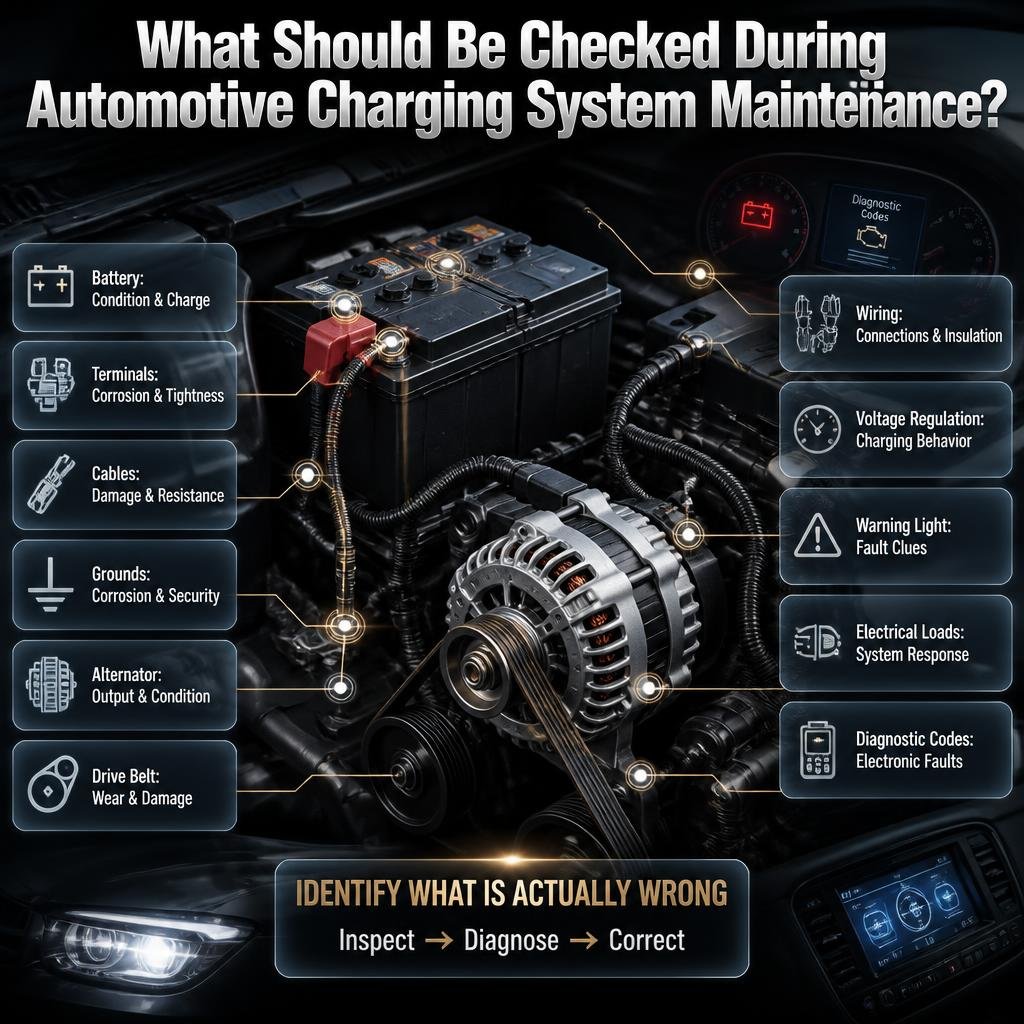
A proper charging-system inspection should cover the complete system rather than one component.
Charging System Maintenance Checklist
| Area | What to Inspect | Why It Matters |
|---|---|---|
| Battery | Condition, charge and physical condition | Supports reliable starting |
| Battery terminals | Corrosion and tightness | Maintains good electrical contact |
| Battery cables | Damage and resistance | Prevents voltage loss |
| Ground connections | Corrosion and security | Completes the electrical circuit |
| Alternator | Output and physical condition | Supplies electrical power |
| Drive belt | Wear, cracks, damage and slipping | Drives the alternator |
| Alternator wiring | Connections and insulation | Carries charging current |
| Voltage regulation | Charging behavior | Prevents under/overcharging |
| Warning light | Illumination or intermittent behavior | Provides an important fault clue |
| Electrical loads | System response under demand | Helps identify weak charging |
| Diagnostic codes | Stored electronic faults | Supports modern-system diagnosis |
The objective is not to replace everything that looks old.
The objective is to identify what is actually wrong.
How Often Should the Charging System Be Inspected?
There isn’t one universal inspection interval for every vehicle.
The vehicle manufacturer’s maintenance schedule should be the primary reference because battery types, alternators, charging controls, and electrical architectures vary.
However, a charging-system inspection makes particular sense during:
- Routine servicing
- Battery replacement
- Starting-problem diagnosis
- Repeated jump-starts
- Electrical-accessory installation
- Major engine-bay work
- Long-distance travel preparation
- Investigation of warning lights
You should also consider an earlier inspection if the vehicle has started showing electrical symptoms.
For example, if the battery has gone flat twice within a short period, simply charging it again isn’t a maintenance strategy.
You need to determine why it became discharged.
What Are the Warning Signs of a Charging System Problem?
Charging-system problems don’t always appear as a complete failure.
Many vehicles provide clues first.
Common warning signs include:
- Battery-shaped warning light
- Dim headlights
- Flickering lights
- Slow electrical accessories
- Repeated battery discharge
- Difficult starting
- Unusual alternator noise
- Belt squealing
- Electrical warning messages
- Unstable dashboard behavior
- Burning smell near electrical components
- Battery becoming unusually hot
- Vehicle stalling after electrical symptoms appear
One symptom alone doesn’t prove that the alternator has failed.
For example, dim headlights may result from:
- Low system voltage
- Poor electrical connections
- Battery problems
- Alternator problems
- Wiring resistance
- Electronic charging-control issues
This is why a proper charging-system test is more useful than guessing from symptoms.
What Does the Battery Warning Light Actually Mean?
The battery-shaped dashboard warning light is often misunderstood.
It does not necessarily mean:
“Your battery is old.”
It can indicate that the vehicle has detected a charging-system problem.
Possible causes include:
- Alternator output problem
- Drive-belt problem
- Charging-circuit fault
- Poor electrical connection
- Voltage-regulation issue
- Electronic charging-control fault
If the light appears while driving and stays illuminated, the battery may be supplying electrical energy without receiving sufficient replacement energy from the charging system.
Eventually, the battery can become too discharged to keep the vehicle operating.
What Should You Do?
If the warning light comes on:
- Treat it seriously.
- Reduce unnecessary electrical loads when safe.
- Avoid unnecessary long-distance driving.
- Move to a safe location if the vehicle develops additional symptoms.
- Arrange charging-system diagnosis.
- Don’t assume a battery replacement alone will solve the problem.
Common Mistake: Driving for another hour because “the car is still running.”
The vehicle may be running only because the battery still has enough stored energy.
Why Regular Vehicle Electrical System Inspection Matters
A vehicle’s electrical system supports essential functions such as engine starting, battery charging, lighting, sensors, safety systems, and many electronic accessories. When an electrical problem develops, the symptoms may not always point directly to the faulty component. A weak battery, poor ground connection, damaged wiring, charging-system issue, loose terminal, or excessive electrical load can produce similar warning signs. A systematic inspection helps narrow down the actual cause instead of replacing parts unnecessarily. For a practical explanation of what to inspect, which warning signs to watch for, and how battery, alternator, wiring, and other electrical components work together, follow our Vehicle Electrical System Inspection Guide. This guide can help vehicle owners understand electrical problems more clearly and take the right maintenance steps before a minor fault develops into a starting or roadside issue.
How Is a Charging System Professionally Tested?
Professional charging-system diagnosis should follow a logical sequence.
The goal is to determine whether the problem is actually the alternator or somewhere else.
Step 1: Inspect the Battery
The battery’s physical and electrical condition should be considered first.
A severely discharged or defective battery can complicate charging-system testing.
Check for:
- Physical damage
- Corrosion
- Loose terminals
- Low state of charge
- Poor starting performance
- Battery-test results
A battery can have adequate voltage but poor capacity, so voltage alone isn’t always enough to determine battery health.
Step 2: Inspect the Drive Belt
Look for:
- Cracking
- Fraying
- Glazing
- Contamination
- Damage
- Abnormal movement
- Belt noise
- Pulley or tensioner problems
HELLA recommends visual inspection of the complete belt drive and attention to cracks, damaged ribs, unusual pulley movement, and grinding or squeaking noises.
Step 3: Check Electrical Connections
Inspect:
- Battery terminals
- Positive cable
- Alternator connections
- Ground cables
- Relevant connectors
A loose or corroded connection can create enough resistance to cause charging problems.
Step 4: Measure Charging Behavior
A technician may measure voltage at the battery and alternator under different operating conditions.
The exact expected value depends on the vehicle.
Conventional systems often operate in a familiar charging-voltage range, but modern smart-charging systems can intentionally vary output.
Step 5: Perform Load Testing
The system can be tested while electrical loads are operating.
Examples include:
- Headlights
- Blower motor
- Rear defogger
- Other electrical accessories
The purpose is to determine whether the charging system can maintain appropriate performance when demand increases.
Step 6: Perform Voltage-Drop Testing
Voltage-drop testing is one of the most useful ways to identify excessive resistance.
For example, the alternator may produce healthy voltage at its output terminal, but the battery may receive less because of resistance in a cable or connection.
That means:
Good alternator output ≠ guaranteed good charging at the battery.
Voltage-drop testing helps locate that difference.
Step 7: Scan the Vehicle
Modern vehicles can communicate charging information through electronic control modules.
A diagnostic scan may reveal:
- Charging-related fault codes
- Battery-state information
- Alternator load information
- Sensor data
- Communication faults
- Charging-control problems
Modern alternators can also communicate with control systems through networks such as LIN, depending on vehicle design.
Can You Test a Car Charging System at Home?

Basic checks are possible, but complete diagnosis depends on the vehicle.
A digital multimeter can provide useful information, but the reading needs to be interpreted correctly.
The old approach of:
“Engine off = one number, engine running = another number, therefore alternator good or bad.”
isn’t reliable for every modern vehicle.
Some vehicles intentionally vary alternator output.
A safer home inspection includes:
- Look at the battery terminals.
- Check for visible corrosion.
- Inspect accessible cables.
- Look at the drive belt with the engine off.
- Check for dashboard warning lights.
- Observe unusual electrical behavior.
- Use a suitable battery/charging tester if you understand the procedure.
- Compare readings with vehicle-specific specifications.
If you aren’t comfortable working around electrical systems and moving engine components, professional testing is the better option.
Expert Tip: Never touch moving belts, pulleys, or fans while the engine is running. A charging-system inspection isn’t worth a hand injury.
Why Voltage-Drop Testing Matters
Voltage-drop testing is often overlooked by inexperienced technicians and vehicle owners.
Imagine the alternator is producing appropriate electrical output.
You might assume the system is healthy.
But if there is excessive resistance in the cable between the alternator and battery, some of that electrical potential is lost before it reaches the battery.
The same principle applies to the ground side.
A charging problem can therefore exist even when the alternator itself is capable of producing power.
This is why good diagnostic practice checks:
Alternator → Cable → Connection → Battery
rather than checking only:
Alternator
A professional diagnostic sequence may compare alternator output with voltage measured at the battery and then perform voltage-drop testing if the readings don’t match.
How Do You Maintain Battery Terminals?
Battery terminals should be kept clean, secure, and in good condition.
During an inspection, look for:
- White or green corrosion deposits
- Loose clamps
- Damaged terminal posts
- Cracked cable ends
- Signs of overheating
- Damaged insulation
If corrosion is present, follow the battery and vehicle manufacturer’s recommended cleaning procedure.
Don’t simply scrape corrosion away and assume the charging system is fixed.
The underlying cause should still be considered.
For example, repeated corrosion or overheating may indicate a connection problem that needs further investigation.
What About Battery Cables?
Cables can deteriorate internally.
A cable may look normal from the outside while having excessive resistance.
This is one reason voltage-drop testing is useful when charging performance doesn’t match alternator output.
How Should the Alternator Be Maintained?
Most alternators aren’t components that require routine internal maintenance by the vehicle owner.
Their condition is generally monitored through inspection and testing.
During maintenance, check for:
- Abnormal noise
- Physical damage
- Loose connectors
- Belt-related problems
- Charging warning lights
- Unstable charging behavior
- Signs of overheating
Don’t spray water, cleaners, oils, or other chemicals directly into the alternator unless the vehicle or component manufacturer specifically approves the procedure.
If the alternator fails a proper test, repair or replacement should be based on the specific fault and vehicle requirements.
Practical Steps for Better Car Battery Care
Good battery maintenance is not only about replacing the battery when the vehicle fails to start. Regularly checking the battery terminals, connections, visible condition, starting performance, and signs of corrosion can help identify developing problems earlier. Driving patterns also matter, as frequent short trips, long periods of inactivity, heavy electrical use, and high temperatures can place additional demands on the battery. For a practical, step-by-step approach to checking battery condition, understanding common warning signs, improving battery maintenance, and knowing when professional testing or replacement may be appropriate, read our Car Battery Care Guide. It provides useful guidance for maintaining battery reliability and making informed decisions instead of assuming that every starting or electrical problem is caused by the battery itself.
Why Is Drive Belt Maintenance Part of Charging System Maintenance?
The alternator can’t work correctly if it isn’t being driven properly.
A worn or slipping belt may produce intermittent symptoms.
For example:
- The vehicle may charge normally at one time.
- Electrical loads increase.
- The belt slips.
- Alternator speed falls.
- Charging output drops.
- The warning light appears.
- The belt stops slipping.
- The warning disappears.
That type of intermittent problem can be difficult to diagnose if the belt is ignored.
Inspect the belt and related pulleys whenever charging-system symptoms appear.
Don’t replace a belt solely because it looks slightly old, but don’t ignore visible damage or abnormal operation either.
How Does Heat Affect Charging System Maintenance?
Heat is an important consideration in vehicle maintenance, particularly in hot climates.
High ambient temperatures can increase stress on batteries and other electrical components.
However, good maintenance doesn’t mean assuming:
“It’s hot, so replace the battery or alternator early.”
That’s too simplistic.
A better strategy is:
Inspect → Test → Diagnose → Maintain → Monitor
Pay particular attention to:
- Battery condition
- Terminal condition
- Cable connections
- Charging behavior
- Belt condition
- Electrical warning lights
- Repeated battery discharge
Heat can make an existing weakness more noticeable, but proper diagnosis should identify the actual fault.
Does Air Conditioning Affect the Charging System?
Air conditioning can increase electrical demand through components such as the blower motor and control systems.
A healthy charging system is designed to support normal vehicle electrical loads.
However, if the system is already weak, heavy electrical demand may make a marginal condition easier to notice.
For example, you might see:
- Headlights dimming when loads increase
- Unusual electrical fluctuations
- Battery warning light appearing under demand
- Slow electrical accessories
Don’t blame the air conditioner automatically.
The better question is:
Can the charging system maintain appropriate operation under the vehicle’s normal electrical load?
If not, the system needs diagnosis.
Can Short Trips Affect Battery Charging?
Yes, frequent short trips can contribute to battery discharge.
Starting the engine uses battery energy.
The alternator then has to restore that energy.
If the vehicle is repeatedly driven for very short periods, especially with significant electrical demand, the battery may not receive enough opportunity to recover fully.
This doesn’t mean short trips automatically damage the charging system.
The issue is the combination of:
- Frequent starting
- Short operating periods
- Heavy electrical demand
- Battery age
- Low state of charge
- Possible charging-system weakness
A vehicle that is mostly used for short trips may benefit from closer monitoring of battery condition.
Does Idling Charge the Battery?
The alternator can produce electrical power while the engine is idling, but that doesn’t mean idling is always an effective way to recharge a significantly discharged battery.
Alternator output depends on engine speed and vehicle design.
At idle, available output may be lower than at higher engine speeds, while the vehicle may simultaneously be using electrical energy for:
- Air conditioning
- Cooling fans
- Lights
- Electronics
- Blower motors
If a battery has become significantly discharged, proper battery charging with an appropriate charger or professional service may be more effective than simply leaving the engine idling.
What Is Smart Charging?
Many modern vehicles use electronically managed charging systems.
Instead of maintaining one fixed charging condition at all times, the vehicle may adjust charging behavior according to factors such as:
- Battery state
- Temperature
- Electrical demand
- Engine operating conditions
- Fuel-economy strategy
- Energy-management requirements
- Regenerative or deceleration strategies on certain vehicles
This means a changing voltage reading isn’t automatically proof of alternator failure.
The correct specification depends on the vehicle.
Some systems also require battery registration or adaptation after battery replacement. HELLA notes that intelligent charging systems can use different battery types and charging strategies, and that certain vehicles require battery replacement to be registered using diagnostic equipment.
Why Does Battery Registration Matter?
On vehicles that require it, the battery-management system needs to know that a new battery has been installed.
Without the appropriate procedure, charging strategy may not match the new battery correctly.
Not every vehicle requires registration.
Always follow the manufacturer’s procedure.
Battery Maintenance vs Charging System Maintenance

These two areas are connected but should not be treated as identical.
| Battery Maintenance | Charging System Maintenance |
|---|---|
| Battery condition | Alternator performance |
| State of charge | Charging output |
| Battery capacity | Voltage regulation |
| Terminal condition | Belt operation |
| Battery case | Charging cables |
| Starting performance | Ground connections |
| Battery testing | Voltage-drop testing |
| Battery replacement | Charging-control diagnosis |
A weak battery doesn’t automatically mean the alternator is bad.
A failing alternator doesn’t automatically mean the battery was the original problem.
A good diagnostic process identifies the relationship between them.
What Are the Most Common Automotive Charging System Maintenance Mistakes?
Mistake 1: Replacing the Battery First
This is probably one of the most common mistakes.
The car won’t start.
The owner buys a battery.
The car starts.
A few days or weeks later, the battery is flat again.
The original charging-system fault was never addressed.
Better approach: Test the battery and charging system together when repeated discharge occurs.
Mistake 2: Assuming the Alternator Is Always the Problem
The alternator is important, but it isn’t the only possible cause.
A charging problem may result from:
- Belt problems
- Cable resistance
- Ground faults
- Loose terminals
- Battery failure
- Regulator problems
- Electronic control faults
A complete diagnostic process avoids unnecessary replacement.
Mistake 3: Using a Universal Charging Voltage Rule
Older vehicles often make people comfortable with simple voltage rules.
Modern vehicles aren’t always that simple.
Smart charging systems can intentionally change output.
Therefore, measurements should be interpreted according to vehicle-specific specifications.
Mistake 4: Ignoring Ground Connections
A poor ground can create electrical resistance.
If the ground path is weak, the charging system may not behave as expected.
Ground testing should therefore be part of serious charging diagnosis.
Mistake 5: Ignoring the Drive Belt
A slipping belt can reduce alternator speed.
Replacing the alternator without checking the belt can leave the original problem unresolved.
Mistake 6: Continuing to Drive With a Charging Warning
A vehicle may continue running after charging-system failure.
That doesn’t mean it’s safe to continue driving indefinitely.
Once the battery’s stored energy is depleted, the vehicle can lose electrical functionality and stop.
Mistake 7: Installing the Wrong Battery
Battery type and specifications matter.
Some modern vehicles are designed around particular battery technologies and charging strategies.
Installing a battery with the wrong specifications can create compatibility and charging-management problems.
Mistake 8: Adding Electrical Accessories Without Considering System Capacity
Additional electrical equipment can increase demand.
Examples include:
- Auxiliary lighting
- Audio upgrades
- Refrigeration equipment
- Inverters
- Dash-camera systems
- Additional electronics
Before installing significant electrical accessories, consider the vehicle’s charging capacity and wiring requirements.
What Should You Do After Installing a New Battery?
A new battery should not automatically end the diagnosis.
After installation:
- Confirm the battery is the correct type and specification.
- Make sure the battery is securely mounted.
- Confirm terminals are clean and properly connected.
- Check the charging system.
- Confirm warning lights behave normally.
- Check whether the vehicle requires battery registration.
- Monitor for repeated discharge.
If the new battery repeatedly becomes weak, don’t keep replacing it.
Find the reason.
How Can You Prepare the Charging System Before a Long Trip?
Long journeys put greater importance on reliability because a charging fault can leave you far from assistance.
Before a major trip, consider checking:
Battery
- Starting performance
- Age and condition
- State of charge
- Terminal condition
Charging system
- Alternator operation
- Warning lights
- Charging behavior
- Electrical connections
Drive system
- Belt condition
- Pulley or tensioner noise
Electrical equipment
- Headlights
- Indicators
- Brake lights
- Interior electronics
- Essential warning systems
A broader inspection is also worthwhile before long-distance driving.
For a general overview of maintenance planning and inspection topics, see the Vehicle Maintenance Guides.
How Does Charging System Maintenance Fit Into Overall Car Maintenance?
The charging system is one part of a much larger vehicle-maintenance routine.
A reliable car also depends on:
- Braking system condition
- Tire condition
- Tire pressure
- Suspension components
- Fluids
- Cooling system
- Steering
- Engine maintenance
- Electrical systems
That means charging-system maintenance should be included in a wider preventive-maintenance strategy rather than treated as an isolated task.
For example, if you are already checking the battery and alternator before a long journey, it makes sense to inspect tire condition and pressure at the same time.
How Should You Combine Charging Checks With Brake Maintenance?
Electrical reliability and braking safety are different subjects, so one should never be substituted for the other.
However, both can be included in a routine vehicle inspection.
If you’re reviewing braking-system condition, the Brake Maintenance Basics in Dubai guide can help you understand routine brake-care principles.
For a more structured inspection approach, use the Brake Inspection Checklist in Dubai.
The useful lesson is simple:
Don’t wait for one system to fail before inspecting the others.
Preventive maintenance works best when important vehicle systems are checked according to their own service requirements.
How Should Charging Maintenance Be Combined With Tire Care?
Tires don’t affect alternator operation directly, but they are another critical part of vehicle reliability.
When preparing a vehicle for a long journey, check:
- Tire pressure
- Tread condition
- Visible damage
- Uneven wear
- Spare tire condition
The Tire Maintenance Guide in Dubai provides a dedicated resource for broader tire maintenance.
Correct tire pressure deserves its own attention because pressure changes affect tire performance, handling, wear, and efficiency.
For that specific area, see Tire Pressure Maintenance in Dubai.
This separation is useful because it prevents unrelated maintenance topics from becoming mixed together while still giving drivers a practical overall inspection routine.
Why Should Suspension Maintenance Be Considered Separately?

Suspension maintenance is another important area, but it has a different purpose from charging-system maintenance.
The charging system deals primarily with electrical energy management.
The suspension system affects:
- Ride control
- Vehicle stability
- Wheel movement
- Tire contact
- Handling
- Comfort
If you’re carrying out a broader vehicle inspection, the Suspension Maintenance Guide in Dubai can help you evaluate suspension-related concerns separately.
This matters because good maintenance isn’t about treating every vehicle system as if it has the same inspection method.
Each system needs the correct diagnostic approach.
What Is the Best Professional Approach to Charging System Maintenance?
A good technician shouldn’t begin by guessing the replacement part.
The better sequence is:
1. Listen to the complaint
What happened?
Was the battery dead after sitting overnight?
Did the battery light appear while driving?
Did the lights flicker?
Did the car require repeated jump-starts?
The symptom pattern matters.
2. Reproduce the condition
If possible, identify when the fault occurs.
Does it happen:
- At idle?
- Under load?
- During starting?
- After a long drive?
- Only when the engine is hot?
- Intermittently?
3. Inspect
Check the physical components before replacing anything.
4. Test
Use appropriate battery and charging-system tests.
5. Compare results
Don’t interpret one reading in isolation.
6. Diagnose
Determine whether the problem is:
- Battery
- Alternator
- Belt
- Cable
- Ground
- Regulator
- Sensor
- Control module
- Another electrical issue
7. Repair
Fix the confirmed problem.
8. Verify
Test the system again after repair.
This final step matters.
A repair isn’t truly complete until the original symptom has been addressed and the charging system operates as intended.
What Are the Benefits of Preventive Charging System Maintenance?
Preventive maintenance can’t guarantee that an alternator or battery will never fail.
What it can do is identify developing problems earlier.
Benefits include:
- Better starting reliability
- Reduced risk of unexpected electrical failure
- Earlier detection of weak batteries
- Identification of poor connections
- Reduced chance of unnecessary parts replacement
- Better preparation for long trips
- Improved understanding of vehicle electrical health
The biggest benefit is often diagnostic.
Finding a weak connection before it becomes a no-start problem is much easier than troubleshooting a vehicle after it has stopped on the roadside.
What Are the Drawbacks of Ignoring Charging System Maintenance?
Ignoring charging problems can create a chain reaction.
A weak alternator may leave the battery undercharged.
Repeated undercharging can reduce battery performance.
A poor connection can create heat and resistance.
A slipping belt can affect alternator operation.
An overcharging problem can place stress on electrical components.
The longer the original problem continues, the more difficult the final diagnosis may become.
That doesn’t mean every unusual voltage reading requires immediate expensive repairs.
It means symptoms should be investigated before they become failures.
When Should You Stop Driving and Seek Help?
Some charging-system symptoms are more urgent than others.
Consider stopping and seeking assistance when:
- The battery warning light stays on.
- Electrical systems begin failing.
- Headlights become severely dim.
- Multiple warning lights appear.
- The engine begins running abnormally.
- You smell burning electrical insulation.
- The drive belt appears broken.
- The vehicle begins losing power.
- The engine temperature rises because a belt failure may affect other systems.
Safety comes first.
Don’t attempt to inspect a moving belt or alternator while the engine is running.
If you’re stranded, move to a safe location when possible and use appropriate roadside assistance.
For general roadside support and vehicle-related information, you can also return to Fuel Delivery Dubai, especially when dealing with unexpected roadside situations.
Can Charging System Maintenance Prevent a Breakdown?
It can reduce the risk, but no maintenance routine can guarantee that a component won’t fail.
A well-maintained system gives you a better chance of identifying warning signs before complete failure.
For example:
A battery test may reveal declining capacity.
A belt inspection may identify deterioration.
A voltage-drop test may reveal resistance.
A scan may identify a charging-control fault.
A warning light may provide an early indication of trouble.
The goal isn’t to predict every failure.
The goal is to avoid ignoring information that the vehicle is already giving you.
Expert Advice for Automotive Charging System Maintenance
If you want a practical maintenance strategy rather than a complicated checklist, remember these principles.
Don’t diagnose by part name
A “dead battery” is a symptom, not always the root cause.
Test before replacing expensive components
Alternators are not cheap enough to replace based on a guess.
Check the connections
A poor connection can create symptoms that look much more serious.
Don’t ignore the belt
The alternator depends on mechanical drive.
Understand modern charging systems
Variable charging is not automatically a fault.
Consider the battery and alternator together
One affects the other.
Pay attention to intermittent symptoms
A problem that disappears doesn’t necessarily mean the problem is gone.
Follow vehicle-specific specifications
The manufacturer’s service information should take priority over generic internet rules.
Verify repairs
After a repair, confirm that the charging system performs correctly.
Keep maintenance proportional
Inspect when appropriate, test when necessary, and replace components when their condition justifies replacement.
A Practical Charging System Inspection Routine
For everyday vehicle ownership, you don’t need to become an automotive electrician.
A simple routine can help.
Monthly visual awareness
Look for:
- Warning lights
- Battery corrosion
- Obvious cable damage
- Belt damage
- Unusual noises
During routine servicing
Ask for:
- Battery condition check
- Charging-system test when appropriate
- Terminal inspection
- Belt inspection
- Charging-related fault-code check if symptoms exist
Before a long trip
Check:
- Battery condition
- Charging warning light
- Drive belt
- Electrical connections
- Lights
- Tire condition
- Tire pressure
- Brakes
- Essential fluids
This creates a balanced inspection rather than focusing on only the component that failed last time.
Automotive Charging System Maintenance: Quick Decision Guide
| What You Notice | What It May Indicate | Best Next Step |
|---|---|---|
| Battery repeatedly goes flat | Charging problem, drain or weak battery | Test battery and charging system |
| Battery light stays on | Charging-system fault | Diagnose promptly |
| Belt squeals | Belt, pulley or tension problem | Inspect belt drive |
| Lights flicker | Voltage instability or connection issue | Test charging system |
| New battery goes dead | Undercharging or electrical drain | Diagnose root cause |
| Alternator makes noise | Bearing, belt or pulley issue | Inspect and test |
| Voltage varies | Could be normal smart charging or fault | Compare with vehicle specification |
| Car stalls after battery light | Charging failure possible | Seek assistance |
| Corroded terminals | High resistance possible | Clean/inspect and test connections |
| Electrical warning messages | Low/unstable voltage possible | Perform complete diagnosis |
How often should an automotive charging system be checked?
An automotive charging system should generally be inspected during routine vehicle servicing, but the exact interval depends on the vehicle manufacturer’s maintenance recommendations, battery type, vehicle age, driving pattern, and operating conditions. A charging-system check is particularly important if the vehicle has repeated starting problems, a battery that keeps going flat, dimming lights, unusual electrical behavior, or a battery warning light. Regular inspection can identify a weak connection, belt problem, battery deterioration, or charging fault before it becomes a roadside breakdown.
Useful checks include:
Inspecting battery terminals for corrosion or looseness
Checking battery condition and state of charge
Inspecting the alternator and its electrical connections
Checking the drive belt for visible deterioration
Testing charging performance when required
Checking cables and ground connections
Investigating repeated battery discharge rather than simply recharging it
A professional inspection is especially worthwhile when a new battery is installed but the vehicle previously had unexplained starting or charging problems.
What are the warning signs of a failing car charging system?
A failing charging system can produce several warning signs before complete failure. The most recognizable is the battery-shaped warning light appearing while the engine is running, but drivers may also notice dim or flickering headlights, slow electrical accessories, repeated battery discharge, difficult starting, unusual belt or alternator noises, or multiple electrical warning messages. These symptoms don’t automatically prove that the alternator has failed because battery, wiring, belt, ground, and voltage-control problems can produce similar behavior.
Pay attention to:
Battery or charging warning light
Headlights that become unusually dim or flicker
Battery repeatedly losing charge
Slow power windows or other electrical accessories
Difficulty starting after normal driving
Squealing or unusual noises from the belt area
Burning electrical smell
Multiple electrical warning messages
Electrical problems that become worse under heavy load
Don’t ignore symptoms simply because the vehicle still starts. A charging problem can gradually reduce the battery’s available energy until the vehicle eventually becomes unable to operate.
How can you tell if the problem is the battery or the alternator?
The battery and alternator perform different jobs, but their symptoms can overlap, which makes diagnosis based only on starting behavior unreliable. The battery stores electrical energy and supplies the high current needed to start the engine, while the alternator generates electrical power once the engine is running and helps restore the energy used during starting. A weak battery may cause slow cranking, while a charging-system fault may cause repeated battery discharge, warning lights, or electrical instability. However, a proper battery and charging-system test is the most reliable way to separate the two.
A professional diagnosis may include:
Battery condition and capacity testing
Charging-system output testing
Electrical load testing
Voltage-drop testing
Battery terminal inspection
Positive cable inspection
Ground connection testing
Drive-belt inspection
Electronic diagnostic scanning on modern vehicles
A useful rule is test before replacing. Installing a new battery won’t repair a defective alternator, and installing an alternator won’t fix a damaged battery cable or poor ground connection.
Can a bad alternator damage a car battery?
A faulty alternator can contribute to battery problems because the charging system may fail to restore the energy the battery uses during starting and normal vehicle operation. An undercharging condition can leave the battery repeatedly operating below its proper state of charge, while an overcharging condition can also create excessive electrical stress. However, not every battery failure is caused by the alternator. Battery age, high temperatures, prolonged inactivity, frequent short trips, electrical drains, and other vehicle conditions can also reduce battery performance.
If a battery keeps becoming weak, check the complete charging system rather than repeatedly replacing the battery.
Important areas to evaluate include:
Alternator output
Voltage regulation
Battery condition
Battery state of charge
Battery terminals
Positive and negative cables
Ground connections
Drive belt
Electrical drains
Vehicle-specific charging controls
If a new battery becomes discharged again soon after installation, that’s a strong reason to investigate the underlying cause instead of assuming the replacement battery is defective.
Is it safe to drive with the battery warning light on?
Driving with a battery or charging warning light illuminated should not be treated as a normal condition. The warning can indicate that the charging system isn’t supplying sufficient electrical power, meaning the vehicle may be relying increasingly on the energy stored in the battery. The car may continue running for some time, but once the battery becomes sufficiently discharged, electrical systems can stop functioning properly and the engine may eventually shut down. There is no reliable distance or time that can be guaranteed because battery condition, electrical load, vehicle design, and fault severity all vary.
If the warning light appears while driving:
Stay calm and prioritize a safe location.
Reduce unnecessary electrical loads when appropriate.
Avoid unnecessary long-distance driving.
Watch for additional warning lights or changes in vehicle behavior.
Don’t inspect moving belts or engine components while the engine is running.
Arrange professional charging-system diagnosis as soon as practical.
If the vehicle begins losing power or develops other serious symptoms, seek roadside assistance rather than continuing to drive.
The key point is that the warning light shouldn’t be interpreted as simply “the battery needs replacing.” It can be an indication of an alternator, belt, wiring, connection, regulation, or broader charging-system problem. Proper testing identifies the actual cause before an unnecessary component is replaced.
Conclusion
Automotive charging system maintenance is an important part of keeping a vehicle reliable, especially in demanding driving conditions. The charging system does much more than keep the battery charged. The alternator, battery, voltage regulation system, drive belt, cables, terminals, grounds, and electronic controls must work together to provide stable electrical power while the engine is running.
A battery warning light, dim headlights, repeated battery discharge, slow electrical accessories, unusual belt noise, or difficult starting should not automatically be treated as a simple battery problem. These symptoms can come from several different causes, which is why proper inspection and testing are more useful than replacing parts based on assumptions.
For Dubai drivers, regular attention is particularly valuable because high temperatures, heavy traffic, frequent air-conditioning use, short trips, long periods of idling, and demanding electrical loads can place additional stress on vehicle electrical systems. That does not mean every vehicle needs premature component replacement. A better approach is to inspect, measure, diagnose, maintain, and monitor the system according to the vehicle’s actual condition and manufacturer recommendations.
A practical charging-system maintenance routine should include checking the battery, inspecting terminals and cables, examining the drive belt, evaluating alternator performance, checking voltage regulation, and investigating any repeated loss of battery charge. When an electrical fault is suspected, professional testing can help distinguish between a weak battery, alternator problem, poor connection, voltage-drop issue, belt problem, or another charging-system fault.
Good maintenance is ultimately about preventing uncertainty from becoming a roadside problem. By recognizing warning signs early and addressing confirmed faults properly, drivers can reduce the risk of unexpected starting problems and maintain dependable electrical performance.
For broader vehicle-care planning, the Vehicle Maintenance Guides can also help you organize charging-system checks alongside other essential maintenance areas without treating every vehicle problem as the same issue.
The goal is simple: don’t wait for the vehicle to stop before checking why its electrical system is struggling. Regular inspection, accurate diagnosis, and timely maintenance provide a much more reliable approach to long-term vehicle ownership.
Leave a Reply