
Introduction
Car Battery Care Guide | A car battery usually gets attention at the worst possible time. You turn the key or press the start button, expecting the engine to fire immediately, but instead you hear a slow crank, a few clicks, or nothing at all. What looked like an ordinary drive can suddenly become a roadside problem.
The good news is that battery failure often doesn’t happen without warning. Changes in starting performance, corrosion around the terminals, repeated discharge, unusual electrical behavior, or an aging battery can all provide useful clues.
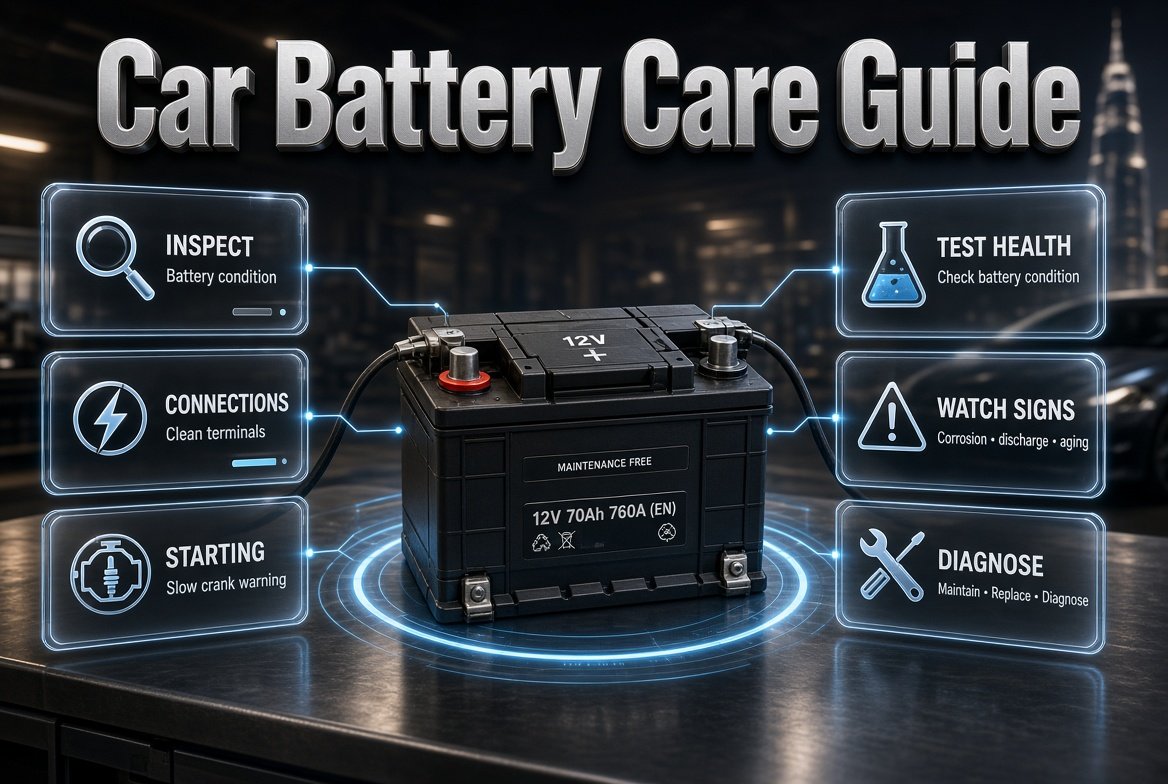
This car battery care guide explains how to inspect your battery, keep its connections in good condition, understand battery health, recognize warning signs, test the battery correctly, and decide when maintenance is enough and when replacement or professional diagnosis is necessary.
For broader vehicle reliability and roadside information, you can also visit Fuel Delivery Dubai.
The goal isn’t to make an old battery last forever. The goal is much more practical: keep a healthy battery in good condition, identify problems early, and avoid replacing parts without knowing what actually failed.
What Is Car Battery Care?
Car battery care is the regular inspection, testing, and maintenance of the battery and its related connections so the vehicle can start reliably and support its electrical systems.
It involves more than simply cleaning the terminals.
A battery can look clean and still have poor internal performance. At the same time, a healthy battery can appear to be faulty if a terminal is loose, a cable is damaged, or the charging system isn’t replenishing the battery properly.
A sensible battery-care routine includes:
- Inspecting the battery case
- Checking for corrosion
- Inspecting terminal connections
- Checking visible battery cables
- Making sure the battery is securely mounted
- Monitoring starting performance
- Considering battery age
- Checking for repeated loss of charge
- Testing battery condition when appropriate
- Checking the charging system when symptoms suggest a problem
- Replacing the battery when its condition or test results justify replacement
The basic principle is:
Inspect → Measure → Diagnose → Maintain → Monitor
That approach is more useful than automatically replacing a battery simply because it has reached a particular age.
Why does this approach matter?
Because battery-related symptoms don’t always identify the failed component.
A slow crank might be caused by a weak battery, but it could also result from poor connections, damaged cables, a starter problem, or charging-system issues.
Similarly, a battery that keeps going flat may not actually be defective. Something else may be draining it.
Good battery care therefore focuses on condition and evidence, not assumptions.
Why Is Car Battery Care Important?
The battery plays an important role in starting the engine and supporting the vehicle’s electrical system.
When you start the vehicle, the starter motor requires substantial electrical power. Once the engine is running, the charging system normally supplies electrical power to the vehicle and replenishes energy used from the battery.
If something goes wrong with the battery, connections, or charging system, you may notice:
- Slow engine cranking
- Clicking during starting
- Dim or flickering lights
- Electrical accessories behaving strangely
- Battery or charging warnings
- Repeated jump-start requirements
- Difficulty starting after parking
- Loss of stored battery charge
- Unusual electrical behavior
The important point is that maintenance doesn’t guarantee that a battery will never fail.
Automotive batteries are wear components. Their ability to store and deliver energy gradually changes with age and operating conditions.
The real benefit of maintenance is early information.
For example, if your vehicle normally starts immediately but gradually begins cranking more slowly over several weeks, that’s useful information. You may not need a new battery immediately, but the change deserves attention.
The real value of battery maintenance is predictability
A battery problem discovered while the vehicle is parked at home is generally easier to deal with than the same problem appearing:
- In heavy traffic
- At night
- On a highway
- During very hot weather
- In an unfamiliar location
- Before an important journey
Battery care is therefore less about preventing every possible failure and more about reducing avoidable surprises.
How Often Should You Check Your Car Battery?
There isn’t one universal inspection schedule for every vehicle.
Battery-care requirements vary according to:
- Battery type
- Vehicle design
- Battery age
- Climate
- Driving pattern
- Electrical demand
- Charging-system condition
- Parking habits
- Vehicle usage
For many drivers, a quick visual inspection every few months is a practical starting point.
As the battery becomes older, more attention should be given to its actual condition and starting performance rather than relying only on appearance.
A practical battery-care schedule
| Check | Practical approach |
|---|---|
| Battery case | Inspect every few months |
| Terminals | Check for corrosion and looseness |
| Cables | Inspect during routine servicing |
| Battery mounting | Check for movement or damage |
| Starting performance | Monitor continuously |
| Battery testing | Consider periodically, especially as battery ages |
| Charging system | Test when symptoms appear |
| Replacement | Base decision on condition and test results |
Your vehicle manufacturer’s recommendations should take priority, especially if the vehicle uses an AGM, EFB, start-stop battery, or another specialized battery technology.
Should you inspect an older battery more often?
Generally, yes.
Age doesn’t automatically mean failure, but an older battery has less remaining service-life margin than a newer one.
If an aging battery also shows slower starting, repeated discharge, corrosion, or poor test results, the reason for concern becomes much stronger.
What Should You Check During a Car Battery Inspection?
A basic inspection doesn’t need to be complicated.
The purpose is to identify visible problems and changes that justify further testing.
1. Inspect the battery case
Start with the physical battery housing.
Look for:
- Cracks
- Bulging
- Swelling
- Deformation
- Leakage
- Severe contamination
- Signs of overheating
- Other physical damage
A damaged battery shouldn’t simply be cleaned and returned to service.
If the case is cracked, swollen, leaking, or visibly distorted, professional assessment is the safer approach.
Common Mistake: Never puncture, open, press, or attempt to repair a damaged automotive battery yourself.
2. Inspect the terminals
The terminals should be secure and reasonably clean.
Look for powdery or crusty deposits around the connections. Corrosion can interfere with electrical contact and increase resistance.
Corrosion may appear:
- White
- Bluish
- Greenish
- Powdery
- Crusty
A small amount of surface contamination doesn’t automatically prove that the battery has failed.
The important questions are:
Is the connection clean?
Is it secure?
Is the electrical connection performing correctly?
Those questions are more useful than judging the battery only by appearance.
3. Check the battery cables
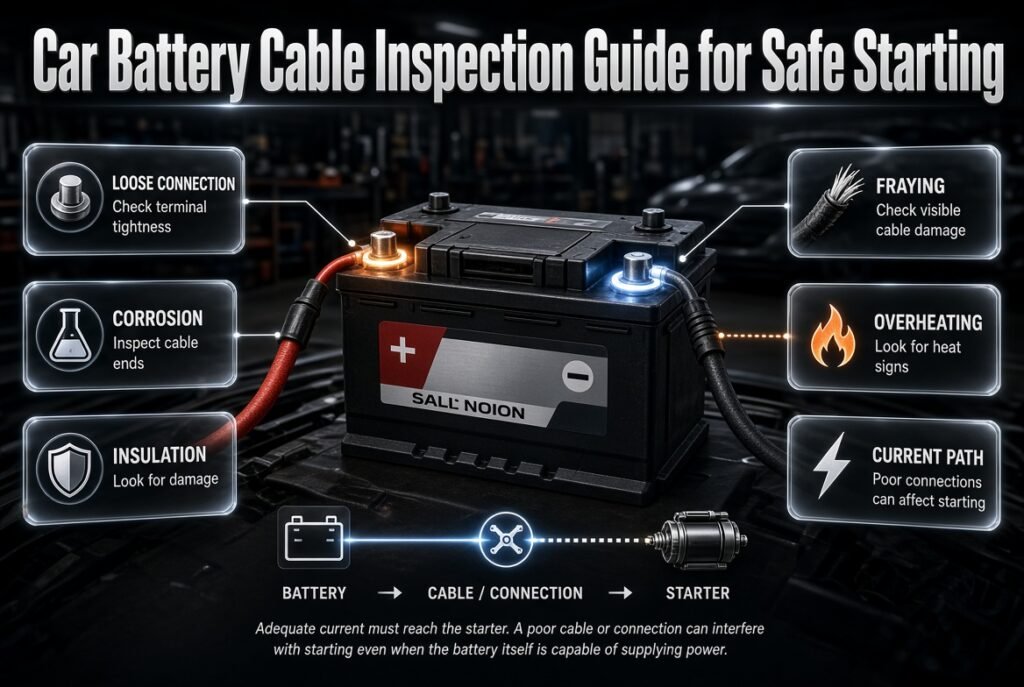
Don’t inspect only the battery itself.
Visible portions of the cables should also be checked for:
- Loose connections
- Corrosion
- Damaged insulation
- Fraying
- Signs of overheating
- Physical damage
A vehicle that won’t start doesn’t automatically have a dead battery.
A poor cable or connection can prevent adequate current from reaching the starter even when the battery itself is capable of supplying power.
4. Check the battery hold-down
The battery should be securely mounted.
Excessive movement can expose the battery and its connections to unnecessary vibration.
Check whether:
- The hold-down is present
- The battery sits correctly
- The mounting hardware appears secure
- The battery moves excessively
Don’t simply tighten everything as much as possible. Follow the vehicle manufacturer’s requirements.
When Should You Inspect Your Vehicle’s Electrical System?
Electrical problems are not always easy to identify because several different components can produce similar symptoms. A vehicle that is slow to start, has dim or flickering lights, repeatedly loses battery charge, shows electrical warning lights, or experiences intermittent power issues may have a problem with the battery, alternator, starter circuit, wiring, connections, grounds, fuses, or another part of the electrical system. Replacing the battery immediately may therefore solve the problem only temporarily if the underlying cause has not been identified.
A proper inspection helps you look at the electrical system as a complete system rather than focusing on one symptom. It can include checking the battery condition, terminal connections, charging performance, visible wiring, electrical loads, warning indicators, and other relevant components. This is particularly useful before a long trip or when the same electrical problem keeps returning. For a practical step-by-step approach to identifying potential electrical issues, see our Vehicle Electrical System Inspection Guide. The guide explains what to inspect, which warning signs deserve attention, how battery and charging-system problems can be differentiated, and when further professional diagnosis may be necessary.
How Do You Clean Car Battery Terminals?
Terminal cleaning can be useful when corrosion or contamination is affecting the connection.
However, battery cleaning should be treated as a maintenance procedure, not as a complete diagnosis.
Before working around a battery:
- Switch the vehicle off.
- Turn off electrical accessories.
- Remove metal jewelry.
- Use appropriate eye and hand protection.
- Follow the vehicle manufacturer’s battery-disconnection procedure.
- Avoid creating a short circuit between battery terminals.
For conventional battery connections, proper disconnection and reconnection order matters. Some modern vehicles may also have specific procedures for preserving electronic settings or battery-management functions.
Once the battery is safely isolated according to the manufacturer’s procedure, appropriate terminal-cleaning equipment can be used to remove corrosion.
What if corrosion keeps coming back?
This is where many people stop too early.
They clean the terminals, see that the surface looks better, and consider the problem solved.
But recurring corrosion can have an underlying cause.
Possible contributors include:
- Battery condition
- Charging-system problems
- Poor terminal connection
- Leakage
- Environmental exposure
- Excessive heat
If corrosion repeatedly returns, inspect and test the system rather than continuously cleaning the same symptom.
Expert Tip: Cleaning corrosion can restore a poor connection, but recurring corrosion should make you ask why it keeps happening.
What Causes Car Battery Corrosion?
Battery corrosion doesn’t have one universal cause.
The appearance of the corrosion may provide clues, but diagnosis should consider the battery, connection, charging conditions, and environment together.
Battery age
As a battery ages, its condition changes. Older batteries may become more prone to performance problems and connection-related issues.
Charging conditions
An abnormal charging system can contribute to battery-related problems.
This is one reason repeated corrosion shouldn’t automatically be blamed on the battery itself.
Poor terminal connection
A connection that isn’t secure can increase electrical resistance.
That resistance can contribute to heat and electrical-performance problems.
Leakage or physical damage
A damaged battery may produce contamination around its casing or connections.
Heat and environmental conditions
High temperatures can accelerate battery deterioration and make existing weaknesses more noticeable.
What should you do?
If corrosion is minor and isolated, cleaning and inspection may be sufficient.
If corrosion is heavy, recurring, or accompanied by starting problems, battery and charging-system testing is more appropriate.
How Does Heat Affect Car Battery Life?
Temperature is an important part of battery care, particularly in hot climates.
High temperatures can accelerate chemical deterioration inside automotive batteries. Heat can also increase the importance of keeping an aging battery under observation.
For vehicles operating in Dubai, battery care can be especially relevant because normal driving may involve:
- High ambient temperatures
- Hot engine compartments
- Heavy traffic
- Long periods of idling
- Extensive air-conditioning use
- Outdoor parking
- Frequent short journeys
- High electrical demand
This doesn’t mean that every battery in Dubai will fail early.
It means the battery shouldn’t be treated as a component that can be ignored until it stops working.
What should drivers monitor in hot conditions?
Pay attention to:
- Battery age
- Starting speed
- Terminal condition
- Physical battery condition
- Charging-system behavior
- Repeated loss of charge
The better approach is:
Inspect → Test → Diagnose → Maintain → Replace when justified
Not:
Hot climate → Assume battery is bad → Replace immediately
Pro Tip: Climate is a reason to pay closer attention to battery condition, not a reason to replace every battery prematurely.
Can Short Trips Affect Car Battery Condition?
Yes, frequent short trips can create a more demanding charging pattern.
Starting the engine consumes electrical energy. The vehicle’s charging system then replenishes energy while the engine is running.
If the vehicle is driven only a very short distance, the available operating time for replenishment may be limited.
This becomes more relevant when the vehicle also uses:
- Air conditioning
- Headlights
- Infotainment
- Phone charging
- Heated or ventilated seats
- Other electrical accessories
A short trip doesn’t automatically mean that the battery isn’t charging.
The concern is repeated use of a pattern where the energy consumed during starting and operation isn’t being adequately replaced.
Is idling the car for a few minutes enough?
Not necessarily.
Many drivers believe that starting the engine and allowing it to idle for a few minutes is a guaranteed way to restore the battery.
That’s an oversimplification.
If the vehicle has a recurring low-charge problem, the better solution is to determine why the battery isn’t maintaining sufficient charge.
Occasional idling isn’t a substitute for proper diagnosis.
What Are the Signs of a Weak Car Battery?
A battery may provide warning signs before complete failure.
Common symptoms include:
- Slower-than-normal engine cranking
- Clicking when attempting to start
- Repeated starting difficulty
- Dim or flickering lights
- Electrical irregularities
- Battery or charging warning lights
- Repeated jump-start requirements
- Difficulty starting after parking
- Visible swelling
- Battery leakage
- Heavy terminal corrosion
However, a symptom doesn’t identify a component by itself.
For example, slow cranking can be associated with:
- Weak battery
- Poor terminal connection
- Damaged cable
- Starter problem
- Charging-system issue
- Other electrical faults
That’s why testing matters.
A useful real-world example
Imagine your vehicle normally starts within one or two seconds.
Over several weeks, the engine begins cranking more slowly.
Eventually, one morning, you hear a click instead of the normal crank.
The most useful information isn’t simply:
“The car doesn’t start.”
The useful information is the sequence:
Normal starting → slower cranking → increasing difficulty → no-start
That history helps guide diagnosis.
Why Is My Car Slow to Start?

Slow cranking is one of the most useful battery-related symptoms to notice.
If the starter sounds noticeably slower than normal, don’t simply wait for the vehicle to stop starting completely.
Consider:
- Battery age
- Terminal condition
- Cable condition
- Recent driving pattern
- Whether the battery recently went flat
- Whether the charging system has been checked
If the battery is older and starting performance has deteriorated, a battery test can help determine whether it remains reliable.
If the battery tests healthy, attention should shift toward other possible causes.
This is a good example of why professional diagnosis is better than replacing parts based only on symptoms.
What Does the Battery Warning Light Mean?
One of the most common battery misunderstandings is assuming that the battery symbol on the dashboard always means the battery itself is defective.
It doesn’t necessarily.
The warning can indicate a problem with the charging system, which may involve:
- Alternator
- Voltage regulation
- Wiring
- Battery
- Charging connections
- Related electrical components
If the warning remains illuminated while driving, it shouldn’t be treated as a routine service reminder.
Have the vehicle checked promptly.
A charging-system problem can eventually leave the vehicle without enough electrical power to continue operating normally.
Common Mistake: Replacing the battery immediately after seeing a battery warning light without checking the charging system.
How Do You Test a Car Battery?
Battery testing is more useful than judging condition from appearance alone.
A proper diagnostic approach may include several different checks.
Resting voltage test
A voltmeter can provide information about the battery’s state of charge when the vehicle has been sitting.
It’s useful, but it has limitations.
A reasonable voltage reading doesn’t automatically prove that the battery can deliver adequate starting current.
Load testing
A load test evaluates how the battery performs under a controlled electrical demand.
This provides information that a simple resting-voltage measurement cannot provide by itself.
Conductance testing
Many professional battery testers use conductance measurements to assess battery condition and starting capability.
Again, the result should be interpreted according to the battery type and testing equipment.
Charging-system testing
If the battery repeatedly loses charge, the charging system also needs attention.
The diagnostic process may include:
- Charging voltage
- Charging current
- Electrical load
- Alternator behavior
- Wiring
- Ground connections
- Vehicle operating conditions
- Battery state
The key lesson is simple:
Voltage tells you something. A complete battery diagnosis tells you much more.
Why Battery Testing Is Better Than Guessing
Consider two vehicles.
Vehicle A
The battery is four years old and the engine is cranking slowly.
Testing shows poor battery performance.
In this situation, replacement may be reasonable.
Vehicle B
The battery is only one year old but repeatedly goes flat.
Replacing it immediately may not solve the problem.
The technician should investigate:
- Charging system
- Electrical drain
- Battery connections
- Vehicle usage
- Electrical accessories
- Other faults
The two vehicles have similar symptoms but potentially very different solutions.
That’s why professional maintenance focuses on evidence rather than assumptions.
What Is the Difference Between Battery Maintenance and Battery Replacement?
Battery maintenance and battery replacement solve different problems.
| Battery Maintenance | Battery Replacement |
|---|---|
| Inspect terminals | Install appropriate new battery |
| Clean corrosion | Remove failed battery |
| Check cables | Correct confirmed battery failure |
| Check mounting | Restore starting reliability |
| Monitor performance | Replace battery that can’t perform |
| Test condition | Match correct battery specification |
| Check charging system when needed | Address end-of-service-life condition |
Maintenance is intended to keep a serviceable battery reliable.
Replacement is appropriate when testing, physical condition, performance, or service history indicates that the battery is no longer dependable.
This distinction prevents unnecessary spending.
A new battery cannot repair a faulty alternator.
A new battery cannot automatically fix a parasitic electrical drain.
A new battery cannot correct a damaged cable.
How Long Does a Car Battery Last?

Many conventional automotive batteries commonly last around three to five years, but there is no universal expiration date.
Actual battery life can vary according to:
- Climate
- Vehicle use
- Battery type
- Electrical demand
- Driving pattern
- Long periods of inactivity
- Charging-system condition
- Battery quality
- Vehicle design
- Maintenance
This is why age should be treated as a risk indicator, not an automatic replacement command.
A three-year-old battery that tests healthy and starts the vehicle normally doesn’t necessarily need immediate replacement.
On the other hand, an older battery showing poor test results, slow cranking, repeated discharge, or physical deterioration deserves much closer attention.
When Should You Replace a Car Battery?
Replacement becomes appropriate when there is clear evidence that the battery can no longer provide reliable service.
Possible reasons include:
- Failed battery test
- Inability to hold charge
- Repeated jump-start requirements
- Severe physical damage
- Swelling
- Leakage
- Persistent starting problems
- Advanced age combined with poor performance
- Battery no longer meeting vehicle requirements
Before installing a new battery, ask one important question:
Why did the old battery fail?
If it failed naturally after a reasonable service life, replacement may be straightforward.
But if a relatively new battery repeatedly loses charge, another problem may be responsible.
Possible causes include:
- Alternator fault
- Electrical drain
- Poor connection
- Faulty electrical component
- Insufficient charging
- Extended vehicle inactivity
Replacing batteries repeatedly without diagnosing the cause can become expensive.
Why Does a New Car Battery Sometimes Die Again?
A new battery should not automatically be considered the final answer to every battery problem.
If a recently installed battery repeatedly loses charge, investigate the system around it.
Charging system
The alternator and related charging components may not be maintaining the battery correctly.
Parasitic drain
A component may continue consuming electrical power after the vehicle is parked.
Poor connection
A loose or contaminated connection can interfere with normal electrical operation.
Driving pattern
Frequent short trips may provide limited opportunity for the battery to recover the energy used during starting.
Vehicle electrical fault
Modern vehicles contain numerous electronic systems. An abnormal electrical load can contribute to battery discharge.
The professional principle is:
Don’t replace the same component repeatedly without identifying why it keeps failing.
What Is Parasitic Battery Drain?
Parasitic drain is electrical consumption that continues after the vehicle has been switched off.
Some electrical consumption is normal because modern vehicles need to maintain certain functions.
The concern is excessive or abnormal current draw.
Possible causes include:
- Interior light remaining on
- Aftermarket accessories
- Faulty electronics
- Incorrectly installed equipment
- A control module failing to enter its normal sleep state
- Other electrical faults
If a battery is healthy but repeatedly becomes discharged while parked, parasitic drain should be considered.
This type of problem usually requires more than a simple battery replacement.
How Should You Care for a Car Battery Before a Long Trip?
A long journey is a good reason to check the battery even if the vehicle appears to be working normally.
Before a trip, review:
- Battery age
- Starting performance
- Terminal condition
- Cable condition
- Battery mounting
- Visible physical damage
- Warning lights
- Recent battery discharge
- Charging-system symptoms
Don’t stop at the battery.
A practical pre-trip inspection should also cover other important systems.
For example, your broader maintenance plan can include tires, brakes, fluids, lights, wipers, and other components covered in the Vehicle Maintenance Guides.
The purpose isn’t to predict every possible breakdown.
Instead, inspect components that:
- Affect safety
- Affect reliability
- Show warning signs
- Are approaching scheduled maintenance
- Have a history of problems
That makes pre-trip maintenance practical rather than excessive.
How Does Battery Care Fit Into Overall Vehicle Maintenance?
The battery is one part of a much larger vehicle system.
A reliable car also requires attention to:
- Tires
- Brakes
- Suspension
- Engine oil
- Coolant
- Other fluids
- Lights
- Wipers
- Steering
- Fuel system
- Electrical system
- Scheduled maintenance
Battery maintenance should therefore be connected to the overall maintenance strategy without being mixed up with unrelated component checks.
For example, a battery problem affects starting and electrical operation.
A brake problem affects stopping.
A tire problem affects road contact and handling.
A cooling-system problem can contribute to overheating.
Each system has a different function and should be diagnosed according to its own symptoms.
The broader principle is the same:
Inspect the actual condition before deciding what needs to be replaced.
What Are the Most Common Car Battery Care Mistakes?
Mistake 1: Waiting until the battery is completely dead
A vehicle may start normally one day and struggle the next.
Why it happens: Drivers often assume that a working vehicle has a healthy battery.
Why it’s a problem: Battery deterioration can happen gradually.
Better approach: Pay attention to changes in starting speed and investigate them early.
Mistake 2: Assuming every no-start problem is the battery
A no-start condition can have several causes.
Possible causes include:
- Battery
- Starter
- Fuel system
- Ignition system
- Electrical fault
- Cable problem
- Charging system
Better approach: Diagnose before replacing.
Mistake 3: Replacing a battery without testing
A new battery may temporarily appear to solve the problem even when the real issue is elsewhere.
Better approach: If the battery repeatedly discharges, test the battery and charging system together.
Mistake 4: Ignoring corrosion
Corrosion can interfere with electrical contact.
Better approach: Inspect terminals periodically and investigate recurring corrosion.
Mistake 5: Treating battery age as the only factor
Age matters, but so do:
- Test results
- Physical condition
- Starting performance
- Driving pattern
- Charging conditions
- Electrical demand
Better approach: Use age as one part of the decision.
Mistake 6: Ignoring warning lights
A charging warning shouldn’t be treated as a cosmetic dashboard message.
Better approach: Have the charging system checked promptly.
Mistake 7: Installing the wrong replacement battery
Not every battery fits every vehicle.
Important factors may include:
- Physical size
- Terminal arrangement
- Capacity
- Starting performance
- Battery technology
- Vehicle-specific requirements
Modern vehicles may also require battery registration or programming after replacement.
Expert Tip: Match the replacement battery to the vehicle manufacturer’s specifications rather than choosing solely by physical appearance or price.
Expert Car Battery Care Advice

A professional approach to battery care can be summarized into several practical habits.
Don’t diagnose by one symptom
A slow crank doesn’t automatically mean the battery is bad.
Don’t diagnose by one voltage reading
Voltage is useful, but it isn’t the whole story.
Don’t replace before understanding the cause
Especially when a relatively new battery repeatedly fails.
Don’t ignore environmental conditions
Heat, inactivity, short trips, and heavy electrical use can change the way the battery behaves.
Don’t confuse maintenance with repair
Cleaning a terminal can improve a connection, but it can’t repair a failed battery cell.
Don’t confuse battery problems with charging-system problems
The battery stores electrical energy.
The charging system replenishes it.
Both need to work correctly.
Use condition-based maintenance
The best maintenance decision is usually based on:
Observed symptom + inspection + measurement + diagnosis + appropriate action
That is more reliable than following arbitrary replacement rules.
A Simple Car Battery Care Checklist
Use this checklist as a quick reference.
Visual inspection
- Battery case looks normal
- No swelling or cracks
- No visible leakage
- Terminals are reasonably clean
- Connections appear secure
- Cables show no obvious damage
- Battery is properly mounted
Performance check
- Engine starts normally
- No unusual cranking
- No repeated clicking
- No unexplained electrical behavior
- No repeated jump-starts
- No persistent battery/charging warning
History check
- Battery age is known
- Vehicle hasn’t repeatedly gone flat
- Charging system hasn’t shown warning signs
- No recent unexplained electrical drain
- Battery hasn’t been repeatedly deeply discharged
If several items raise concerns, testing is more useful than guessing.
How Can I Make My Car Battery Last Longer?
The best way to extend car battery life is to prevent avoidable stress rather than trying to “repair” normal battery aging. Keep the terminals clean and secure, make sure the battery is properly mounted, avoid repeated deep discharges, and pay attention to changes in starting performance. Your driving pattern also matters because frequent short trips may give the charging system limited time to replenish the energy used during starting.
A battery should also be checked when it begins to show warning signs rather than waiting until it completely fails. If the battery repeatedly loses charge, don’t simply keep jump-starting it. The battery, charging system, electrical connections, and possible parasitic drain should be assessed to identify the actual cause.
Important battery-life practices:
Keep battery terminals clean and properly connected.
Avoid repeatedly allowing the battery to become completely discharged.
Investigate slow or unusual engine cranking.
Check the charging system when the battery repeatedly loses charge.
Avoid leaving unnecessary electrical accessories operating when the engine is off.
Consider battery testing as the battery gets older.
Follow the vehicle manufacturer’s battery and maintenance recommendations.
Professional advice: Battery care can help maximize useful service life, but it cannot stop normal internal aging. The objective is to prevent premature failure and identify deterioration early.
How Do I Know If My Car Battery Is Weak or Needs Replacing?
A weak battery often gives warning signs before complete failure. The most noticeable is usually slower engine cranking, especially when the vehicle previously started quickly and consistently. Other signs can include repeated jump-starts, unusual electrical behavior, difficulty starting after the vehicle has been parked, or a battery that repeatedly loses its charge.
However, these symptoms don’t automatically prove that the battery itself has failed. Poor terminal connections, damaged cables, starter problems, charging-system faults, and excessive electrical drain can produce similar symptoms. That’s why battery replacement should ideally follow proper testing rather than being based on one symptom.
Warning signs worth investigating include:
Engine cranks slower than normal.
The vehicle needs repeated jump-starts.
Electrical accessories behave unusually.
Battery or charging warning lights appear.
The battery repeatedly becomes discharged.
There is visible swelling, cracking, or leakage.
Battery terminals show severe or recurring corrosion.
The battery is older and its starting performance is deteriorating.
A professional battery test can provide more useful information about starting capability than a simple visual inspection. Charging-system testing may also be necessary if the battery isn’t maintaining its charge.
Professional advice: Don’t use battery age as the only replacement rule. A three-year-old battery isn’t automatically bad, and a younger battery isn’t automatically healthy. Age + symptoms + inspection + testing provide a much stronger basis for the decision.
Why Does My Car Battery Keep Dying Even After I Replace It?
When a relatively new battery repeatedly goes flat, the battery itself may not be the real problem. Replacing the battery can temporarily restore starting ability, but if the underlying fault remains, the replacement battery may eventually become discharged as well.
One possibility is a charging-system problem. If the alternator isn’t replenishing the battery correctly, the vehicle can gradually consume more energy than it replaces. Another possibility is parasitic electrical drain, where a component continues consuming excessive power after the vehicle has been switched off.
Driving habits can also contribute. Frequent short trips, extended periods of inactivity, or repeated starting without enough operating time can make it difficult for the battery to maintain an adequate state of charge.
Common causes of repeated battery discharge include:
Faulty or underperforming charging system.
Excessive parasitic electrical drain.
Loose or corroded battery connections.
Damaged battery cables.
Frequent short-distance driving.
Long periods of vehicle inactivity.
Aftermarket electrical accessories.
Incorrect battery specification or installation.
A battery that was already defective.
The correct solution is to diagnose the battery and vehicle electrical system together. Simply installing another battery without investigating the cause can result in repeated expense.
Professional advice: If a new battery repeatedly dies, treat the situation as a diagnostic problem—not simply a battery replacement problem.
How Often Should I Check or Maintain My Car Battery?
A practical battery-care routine starts with regular visual inspection and monitoring rather than frequent unnecessary maintenance. For many vehicles, checking the battery every few months and including it in routine servicing is a sensible approach. Older batteries or vehicles experiencing starting problems deserve closer attention.
During an inspection, look at the battery case, terminals, cables, mounting, and any visible signs of leakage or physical damage. You should also consider how the vehicle has been behaving. A battery that looks clean may still have poor internal performance, so testing becomes more valuable when the battery is aging or symptoms appear.
A useful inspection checklist includes:
Check the battery case for cracks or swelling.
Look for corrosion around terminals.
Confirm that connections are secure.
Inspect visible battery cables.
Check that the battery is properly mounted.
Monitor engine cranking speed.
Watch for battery or charging warning lights.
Note any repeated loss of charge.
Consider professional testing as the battery ages.
There’s no benefit in constantly cleaning a battery that is already clean, and cleaning cannot correct internal battery failure. Maintenance should be condition-based.
Professional advice: The best battery-care schedule isn’t about touching the battery every few weeks. It’s about noticing changes early and testing the system when there is a reason to investigate it.
Does Hot Weather Affect Car Battery Life?
Hot weather can contribute to faster battery deterioration because elevated temperatures can accelerate chemical and physical aging inside many automotive batteries. This becomes particularly relevant in climates where vehicles regularly experience high ambient temperatures and hot under-hood conditions.
However, it would be incorrect to assume that every battery exposed to hot weather needs early replacement. Battery age, condition, charging-system performance, driving habits, and previous discharge events all influence how long it remains reliable.
In hot climates such as Dubai, drivers should pay particular attention to an aging battery because heat can expose weaknesses that might otherwise remain unnoticed until starting performance deteriorates.
Hot-weather battery care should include:
Inspecting terminals for corrosion.
Checking for swelling or physical damage.
Monitoring slow engine cranking.
Testing an aging battery when appropriate.
Checking charging-system performance if problems occur.
Avoiding unnecessary repeated deep discharge.
Investigating repeated battery failures rather than repeatedly replacing batteries.
A healthy charging system and properly maintained battery can continue operating normally despite high temperatures. The important point is to monitor condition rather than assume failure.
Professional advice: Heat is a reason to be more proactive about battery inspection—not a reason to replace a battery simply because the vehicle operates in a hot climate.
Conclusion
A reliable car battery isn’t simply about installing a new battery and waiting until it fails. Proper car battery care is about understanding its condition, noticing early warning signs, maintaining clean and secure connections, and checking the charging system when something doesn’t seem right.
Regular inspection can help identify corrosion, loose connections, physical damage, or other problems before they become a complete starting failure. At the same time, battery age, driving habits, climate, repeated discharge, and charging-system performance should all be considered when evaluating battery health.
The most important approach is to inspect, measure, diagnose, maintain, and monitor rather than replacing parts based on assumptions. A slow start doesn’t always mean the battery is bad, and a battery that repeatedly goes flat doesn’t necessarily need another replacement. Proper testing can help determine whether the actual problem is the battery, charging system, electrical connection, or another component.
For drivers in demanding conditions, especially those dealing with high temperatures, traffic, frequent short trips, or long periods of vehicle inactivity, proactive battery checks can make a significant difference. A few minutes of inspection and timely testing can be far easier than dealing with an unexpected no-start situation.
Ultimately, good battery maintenance isn’t about trying to make a battery last forever. It’s about maximizing reliable service life, identifying problems early, and making informed maintenance decisions. When battery care becomes part of your wider vehicle maintenance routine, you can reduce avoidable electrical problems and have greater confidence every time you start the vehicle.
Leave a Reply