

Introduction
Vehicle Electrical System Inspection | A car can look completely normal in the morning and still develop an electrical problem before the end of the day. The engine may crank slowly, the headlights may become unusually dim, a warning light may appear, or the vehicle may suddenly refuse to start. Sometimes the cause is a weak battery. In other cases, the battery is perfectly usable and the real problem is somewhere in the charging system, starter circuit, wiring, grounding, fuse system, or electronic controls.
That is why a proper vehicle electrical system inspection should never be reduced to checking battery voltage alone.
A modern vehicle depends on a network of electrical components that must work together. The battery supplies stored energy, the starter uses high current to crank the engine, the alternator supplies electrical power while the engine is running, and wiring, grounds, fuses, relays, sensors, and control modules distribute and manage that power.
For drivers who want a broader approach to vehicle reliability, Fuel Delivery Dubai also provides practical vehicle and roadside information alongside emergency fuel assistance.
This guide explains how a vehicle electrical system should be inspected, what components matter most, which tests actually tell you something useful, how to distinguish battery problems from charging problems, what common mistakes can waste money, and when professional electrical diagnosis is the safer option.
What Is a Vehicle Electrical System Inspection?
A vehicle electrical system inspection is a systematic evaluation of the battery, starting system, charging system, wiring, grounds, fuses, connectors, electrical loads, and relevant electronic systems to identify faults or developing problems.
The purpose isn’t simply to find a component that has failed.
The real objective is to answer three questions:
- What is the symptom?
- Where is the electrical fault occurring?
- Why did the fault occur?
A proper inspection may include:
- Battery condition testing
- Battery terminal inspection
- Cable and connector inspection
- Ground testing
- Starter-circuit testing
- Alternator and charging-system testing
- Voltage-drop testing
- Fuse and relay inspection
- Wiring inspection
- Electrical-load testing
- Parasitic-draw testing
- Diagnostic scanning
- Inspection of warning lights and stored faults
The exact combination depends on the vehicle and the symptoms.
A car with slow cranking doesn’t necessarily need the same tests as a car that repeatedly loses battery charge overnight.
Why Does a Complete Inspection Matter?
Electrical problems are often misdiagnosed because several components can create similar symptoms.
For example, a slow-starting vehicle could have:
- A weak battery
- Corroded battery terminals
- A poor engine ground
- High resistance in a cable
- A failing starter
- Low charging performance
- A mechanical problem that makes the engine difficult to crank
Replacing the battery without testing the rest of the circuit might temporarily change the symptom without fixing the actual cause.
Featured answer: A vehicle electrical system inspection checks the complete electrical network rather than one component. It normally considers battery condition, starting performance, charging output, wiring, grounds, fuses, connections, and diagnostic information so the actual cause can be identified before parts are replaced.
Why Is Vehicle Electrical System Inspection Important?
Electrical systems are involved in far more vehicle functions than starting the engine.
Depending on the vehicle, electrical power and electronic control may support:
- Engine management
- Fuel injection
- Ignition
- Exterior lighting
- Interior lighting
- Air-conditioning controls
- Electric cooling fans
- Power windows
- Central locking
- Instrument clusters
- Infotainment
- Safety systems
- Sensors
- Control modules
- Driver-assistance features
A problem in one area can therefore produce symptoms somewhere else.
For example, low system voltage may cause several electronic modules to behave abnormally. A poor ground may create intermittent electrical symptoms that seem unrelated. A weak charging system may gradually discharge a healthy battery.
The important point is that electrical diagnosis should follow the evidence.
A technician shouldn’t automatically assume that the oldest component is the failed component.
Early Inspection Can Prevent Bigger Problems
An electrical inspection doesn’t guarantee that a vehicle won’t break down.
Electrical components can fail unexpectedly.
However, inspection can identify conditions such as:
- Corroded terminals
- Weak battery performance
- Damaged wiring
- Poor grounds
- Abnormal charging behavior
- Loose connections
- Repeated fuse failures
- Unusual electrical drain
Finding these issues earlier can make repairs more predictable.
This is also where a broader maintenance strategy helps. The Vehicle Maintenance Guides resource can be useful when electrical inspection is being considered as part of a wider vehicle-maintenance routine.
What Components Are Checked During a Vehicle Electrical System Inspection?
A complete electrical inspection should follow the path of electrical energy through the vehicle.
A simplified system looks like this:
                 ENGINE RUNNING
                       │
                       ▼
                ┌─────────────┐
                │  ALTERNATOR │
                └──────┬──────┘
                       │
                       ▼
             ┌──────────────────┐
             │ Charging Circuit │
             └────────┬─────────┘
                      │
                      ▼
                ┌───────────┐
                │  BATTERY  │
                └─────┬─────┘
                      │
        ┌─────────────┼──────────────┐
        ▼             ▼              ▼
     STARTER       LIGHTS       ELECTRONICS
Each part can create a different type of electrical problem.
1. Battery Inspection
The battery is one of the first components people think about when discussing electrical problems.
It stores electrical energy and provides the high current required to start the engine.
A proper battery inspection should consider more than voltage.
A technician may check:
- Battery age
- Battery type
- Physical condition
- State of charge
- Starting capability
- Terminal condition
- Cable condition
- Battery mounting
- Evidence of leakage
- Signs of swelling or overheating
A battery can show reasonable voltage and still have reduced ability to deliver starting current.
Likewise, a healthy battery can repeatedly become discharged because another part of the electrical system isn’t functioning correctly.
What Should You Look for on the Battery?

Start with a visual inspection.
Look for:
- Cracked casing
- Bulging
- Leakage
- Severe corrosion
- Loose terminals
- Damaged cables
- Poor mounting
- Heat damage
A physically damaged battery should not simply be cleaned and returned to normal service.
For a detailed battery-specific maintenance routine, see Car Battery Maintenance in Dubai.
That topic has a different purpose from this article: battery maintenance focuses specifically on battery condition, care, aging, connections, and replacement decisions, while this guide looks at the entire electrical system.
2. Battery Terminal and Cable Inspection
A battery cannot deliver its available power effectively if the connections are poor.
Terminal corrosion, loose clamps, damaged cables, or contamination can introduce electrical resistance.
This may result in:
- Slow cranking
- Clicking during starting
- Intermittent electrical operation
- Voltage loss
- Heat at the connection
- Charging problems
A connection may look acceptable and still have excessive resistance when current is flowing.
That’s why visual inspection and electrical testing complement each other.
Common Terminal Problems
A technician may look for:
- Corrosion around the terminal
- Loose terminal clamps
- Damaged cable ends
- Frayed cables
- Heat discoloration
- Signs of arcing
- Poor contact surfaces
Pro Tip: Don’t confuse a clean-looking terminal with a proven-good electrical connection. If the vehicle has a starting or charging symptom, the connection should be tested when appropriate.
3. Ground Connection Inspection
Grounding is one of the most commonly overlooked areas of vehicle electrical diagnosis.
The electrical circuit needs a reliable return path. Depending on the vehicle design, the chassis and engine may form important parts of this path.
Poor grounding can cause:
- Slow starting
- Flickering lights
- Unstable electrical behavior
- Sensor-related problems
- Intermittent faults
- Communication issues
- Unusual dashboard warnings
Ground problems can be particularly frustrating because the vehicle may operate normally most of the time.
Then, under certain conditions, the fault appears.
Where Are Important Grounds Located?
Depending on the vehicle, relevant grounding points may include:
- Battery-to-body connection
- Battery-to-engine connection
- Engine-to-chassis strap
- Module grounds
- Component-specific grounds
A technician may use voltage-drop testing to determine whether a ground path has excessive resistance.
4. Alternator and Charging-System Inspection
The alternator normally supplies electrical power while the engine is running and helps restore energy used from the battery during starting.
However, modern charging systems are not always simple fixed-output systems.
Charging behavior can vary according to:
- Battery state
- Electrical demand
- Engine operating conditions
- Temperature
- Vehicle control strategy
- Charging-system design
This means a single voltage reading should not always be interpreted without considering the vehicle’s design and operating conditions.
The charging system can include:
- Alternator
- Voltage regulator
- Drive belt
- Battery
- Charging cables
- Grounds
- Fuses or fusible links
- Sensors
- Control modules
- Charging warning system
For a deeper explanation of maintenance, inspection, and diagnosis specifically focused on the charging side, see Automotive Charging System Maintenance in Dubai.
The distinction is important: this article examines the charging system as one part of a complete electrical inspection, while the charging-system guide focuses specifically on alternator operation, charging behavior, maintenance, and diagnosis.
5. Starter Motor and Starting Circuit
The starter motor uses a large amount of electrical current to rotate the engine during starting.
If the engine doesn’t crank, or cranks slowly, several different causes should be considered.
Possible causes include:
- Weak battery
- Poor battery connection
- Bad ground
- High cable resistance
- Starter fault
- Starter solenoid problem
- Relay problem
- Control-circuit fault
- Mechanical engine resistance
A single clicking sound doesn’t automatically prove that the starter has failed.
Similarly, no sound doesn’t automatically prove that the battery is dead.
The complete starting circuit should be evaluated.
6. Fuses and Relays
Fuses protect electrical circuits from excessive current.
If a fuse fails, it is important to understand why.
A blown fuse can sometimes be an isolated event, but repeated fuse failure deserves investigation.
Possible causes include:
- Short circuit
- Damaged wiring
- Failed electrical component
- Incorrect accessory installation
- Excessive electrical load
What About Relays?
Relays allow one circuit to control another circuit that may carry higher current.
A relay problem can affect systems such as:
- Starter circuits
- Cooling fans
- Fuel pumps
- Lighting
- Horns
- Accessories
Testing depends on the specific circuit.
Common Mistake: Never install a higher-rated fuse simply because the correct fuse keeps blowing. The fuse is there to protect the circuit. A larger fuse can allow wiring or components to overheat.
7. Wiring and Connector Inspection
Wiring carries electrical power and signals between components.
A wire can fail because of:
- Physical damage
- Heat
- Corrosion
- Vibration
- Water intrusion
- Poor previous repairs
- Rodent damage
- Incorrect accessory installation
Connectors can also develop problems.
A connector may become loose, contaminated, corroded, or damaged internally.
Intermittent electrical problems often require careful inspection because the fault may not be visible when the vehicle is stationary.
What Is the Correct Process for a Vehicle Electrical System Inspection?
A professional inspection should follow a logical sequence.
Random testing often creates confusion.
Step 1: Understand the Symptom
Before touching a component, determine exactly what happened.
Ask:
- Does the engine crank?
- Does it crank slowly?
- Is there a click?
- Are the lights dim?
- Did the vehicle start normally earlier?
- Does the problem happen only when hot?
- Does it happen after sitting overnight?
- Is the problem intermittent?
- Did an accessory recently get installed?
- Has the battery been replaced recently?
The symptom helps determine where to begin.
Practical Example
Suppose a driver says:
“The car starts normally in the morning, but after driving for 30 minutes and stopping, it sometimes won’t restart.”
That symptom is different from:
“The car sits overnight and the battery is dead every morning.”
The first situation may require investigation of heat-related starting or charging behavior.
The second may point toward battery condition, charging performance, or parasitic draw.
Step 2: Perform a Visual Inspection
Before advanced testing, inspect the system.
Check:
- Battery
- Terminals
- Cables
- Grounds
- Wiring
- Fuses
- Connectors
- Alternator area
- Drive belt where applicable
- Aftermarket accessories
Look for signs of:
- Corrosion
- Heat
- Melting
- Damage
- Loose connections
- Poor repairs
- Water contamination
Visual inspection is simple, but it should never be skipped.
Step 3: Check Battery State and Condition
Battery testing should determine more than whether voltage exists.
Useful information may include:
- State of charge
- Battery condition
- Starting capability
- Battery age
- Temperature
- Battery specification
If the battery is significantly discharged, further testing may need to account for that condition.
A discharged battery isn’t automatically a failed battery.
Step 4: Test the Starting Circuit
If starting performance is poor, evaluate the circuit under actual starting conditions.
This can involve:
- Battery performance during cranking
- Starter operation
- Positive-side voltage drop
- Ground-side voltage drop
- Cable condition
- Starter control circuit
The objective is to determine whether sufficient electrical power reaches the starter.
Step 5: Test the Charging System
When the engine is running, evaluate charging behavior.
Depending on the vehicle, testing can involve:
- System voltage
- Charging current
- Electrical load
- Alternator output
- Wiring
- Ground condition
- Charging control
- Warning indicators
Modern vehicles may change charging behavior under different conditions, so diagnosis should follow vehicle-specific information where available.
Step 6: Perform Voltage-Drop Testing
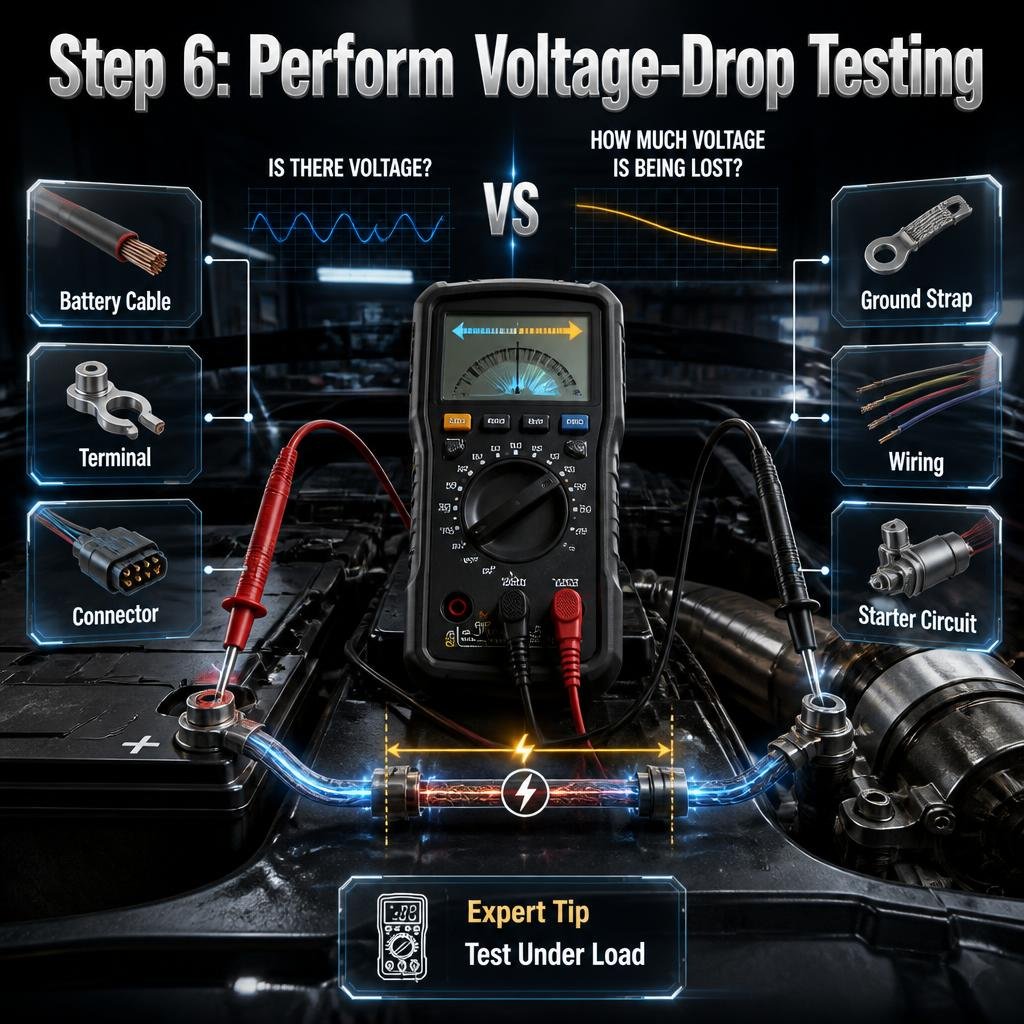
Voltage-drop testing is one of the most useful methods for finding unwanted resistance.
The basic idea is simple.
Instead of asking:
“Is there voltage?”
you ask:
“How much voltage is being lost across this part of the circuit while current is flowing?”
A high voltage drop can indicate resistance in:
- Battery cable
- Terminal
- Connector
- Ground strap
- Wiring
- Starter circuit
Why Is Voltage-Drop Testing Better Than Visual Inspection Alone?
Because resistance can be hidden.
A cable may look perfect from the outside but have an internal problem.
A terminal may appear tight but still have poor electrical contact.
Testing under load reveals how the circuit behaves when it actually needs to carry current.
Expert Tip: Voltage-drop testing is particularly valuable when a component appears to be receiving power but isn’t performing correctly.
Step 7: Scan the Vehicle for Diagnostic Information
Modern vehicles can store information about electrical and electronic faults.
A diagnostic scan may reveal:
- Low-voltage events
- Communication faults
- Sensor faults
- Module problems
- Charging-related codes
- Starting-related information
But a diagnostic trouble code should not automatically be treated as a failed part.
For example, a low-voltage event may trigger multiple codes across different modules.
Replacing every component associated with those codes would be an expensive mistake.
The codes need to be interpreted in context.
Step 8: Check for Parasitic Electrical Drain
If the battery repeatedly becomes discharged while the vehicle is parked, parasitic-draw testing may be necessary.
Some electrical consumption after shutdown is normal.
Modern vehicles often take time to enter their sleep state.
After the vehicle has properly shut down, excessive current consumption can point toward:
- Interior lighting
- Trunk or glovebox lighting
- Aftermarket accessories
- Alarm systems
- Dash cameras
- Tracking equipment
- Audio systems
- Faulty control modules
- Wiring faults
The exact acceptable current level varies by vehicle.
Therefore, don’t label a draw “bad” without considering manufacturer information and the vehicle’s normal sleep behavior.
How Do You Know Whether the Battery or Alternator Is the Problem?
This is one of the most common electrical questions.
The answer is that battery condition and charging-system condition must be tested separately.
A battery can be weak.
An alternator can be weak.
Both can have problems.
Or both can be healthy while the real issue is wiring, grounding, starter operation, or excessive electrical drain.
| Symptom | Possible Areas to Investigate |
|---|---|
| Slow cranking | Battery, cables, grounds, starter |
| Battery repeatedly discharged | Battery, charging system, parasitic drain |
| Battery warning light | Charging system, wiring, alternator |
| Clicking during start | Battery, connection, starter circuit |
| Dim lights | Charging system, battery, connections |
| Overnight battery drain | Battery, parasitic draw, accessories |
| Intermittent electrical faults | Grounds, connectors, wiring, modules |
| Repeated blown fuse | Short circuit, component, wiring |
This table is a diagnostic starting point—not a replacement for testing.
How Can Regular Battery Care Prevent Starting Problems?
A car battery does more than simply start the engine. It also supports the vehicle’s electrical system and helps provide stable power when the engine is off or when electrical demand changes. Over time, heat, repeated short trips, long periods of inactivity, loose or dirty terminals, and charging-system problems can affect battery performance. This means that a battery that appears to be working normally today may still show signs of reduced condition later.
Regular battery care can help you identify potential problems before they develop into an unexpected starting failure. Checking the battery terminals, looking for corrosion or physical damage, monitoring starting performance, and paying attention to repeated battery discharge are all useful parts of basic battery maintenance. However, battery care should not be limited to the battery itself. If a battery repeatedly loses charge, the underlying cause should also be investigated because the charging system, electrical connections, or parasitic electrical load may be contributing to the problem.
For a practical approach to maintaining battery condition and recognizing common warning signs, read our Car Battery Care Guide. It covers important battery-care practices, common problems to watch for, and practical ways to reduce avoidable battery-related starting issues while keeping the vehicle’s wider electrical system in consideration.
What Are the Signs That Your Car Needs an Electrical Inspection?
You don’t have to wait for complete failure.
An inspection is worthwhile when you notice:
- Slow engine cranking
- Repeated jump-starting
- Battery repeatedly going flat
- Dim headlights
- Flickering interior lights
- Battery warning light
- Multiple dashboard warnings
- Electrical accessories behaving strangely
- Power windows operating unusually slowly
- Electronics resetting
- Intermittent starting
- Repeated blown fuses
- Unexplained electrical drain
- Burning smell near electrical components
- Visible wiring damage
One important warning sign is a change from the vehicle’s normal behavior.
If the car has always started immediately and suddenly takes longer to crank, that change deserves attention even if the vehicle still starts.
How Does Dubai’s Climate Affect Vehicle Electrical Systems?
Climate doesn’t mean every component will fail early, but environmental conditions can influence electrical component stress.
Dubai vehicles may experience:
- High ambient temperatures
- Heavy traffic
- Frequent stop-and-go driving
- Long periods of air-conditioning use
- Extended idling
- Dust
- Frequent short journeys
- Long periods of vehicle parking
High temperatures can accelerate battery aging and place additional stress on certain components and connections.
However, the correct approach is not:
“The climate is hot, so replace everything early.”
A better approach is:
Inspect → Measure → Diagnose → Maintain → Monitor
That means checking the actual condition of the system rather than replacing components purely because of climate.
How Does Air Conditioning Affect the Electrical System?
Air conditioning creates additional electrical and mechanical demand.
Electrical systems may need to support:
- Climate-control electronics
- Blower motors
- Cooling fans
- Sensors
- Control modules
- Compressor-related controls
During periods of high electrical demand, the charging system must respond appropriately.
If the vehicle experiences unusual dimming, warning lights, or unstable electrical behavior when multiple systems are operating, further diagnosis may be appropriate.
This doesn’t automatically mean the alternator is failing.
The system needs to be tested under the conditions where the symptom appears.
A Practical Guide to Car Battery Care
A reliable battery is essential for consistent starting performance, especially when your vehicle is regularly used in hot weather, heavy traffic, short trips, or long journeys. However, battery care involves more than simply replacing the battery when the car struggles to start. Regularly checking the battery condition, terminals, cables, mounting, starting performance, and charging system can help identify potential problems before they become a roadside inconvenience. If you want a more detailed, step-by-step approach to battery inspection, testing, maintenance, warning signs, and replacement decisions, read our Car Battery Care Guide. It explains how to assess battery health properly and why diagnosing the actual cause is often more useful than replacing the battery based on a single symptom.
What Are the Most Common Vehicle Electrical Inspection Mistakes?
Mistake 1: Replacing the Battery Immediately
Because batteries are common failure points, many people replace them first.
Sometimes that solves the problem.
Sometimes it doesn’t.
If the real issue is a charging fault or excessive electrical drain, the replacement battery may eventually become discharged too.
Better approach: Test the battery and investigate the wider system when symptoms indicate it.
Mistake 2: Assuming a Voltage Reading Proves Battery Health
A voltage reading is useful information, but it doesn’t tell you everything about battery condition.
A battery can show acceptable voltage and still have reduced starting performance.
Better approach: Use appropriate battery testing rather than relying on one number.
Mistake 3: Ignoring Ground Connections
Ground problems can produce symptoms that look like component failures.
Better approach: Include ground connections in electrical diagnosis, especially when faults are intermittent.
Mistake 4: Replacing the Alternator Without Testing It
A charging warning doesn’t automatically mean the alternator itself has failed.
The problem may involve:
- Belt
- Wiring
- Ground
- Regulation
- Battery
- Charging control
- Connections
Better approach: Test the complete charging circuit.
Mistake 5: Replacing Every Part Mentioned by a Scan Tool
Diagnostic codes provide clues.
They don’t always provide the final answer.
Better approach: Confirm the fault through testing before replacing the component.
Mistake 6: Using a Higher-Rated Fuse
This is particularly dangerous.
The fuse protects the circuit.
Increasing its rating can allow excessive current to continue flowing through wiring that wasn’t designed for it.
Better approach: Install the specified fuse and investigate the reason for repeated failure.
Mistake 7: Ignoring Aftermarket Accessories
An electrical problem that starts after installing a dash camera, alarm, tracker, stereo, lighting system, or other accessory should make that installation part of the investigation.
It doesn’t prove the accessory caused the problem, but it deserves consideration.
What Can You Safely Check Yourself?
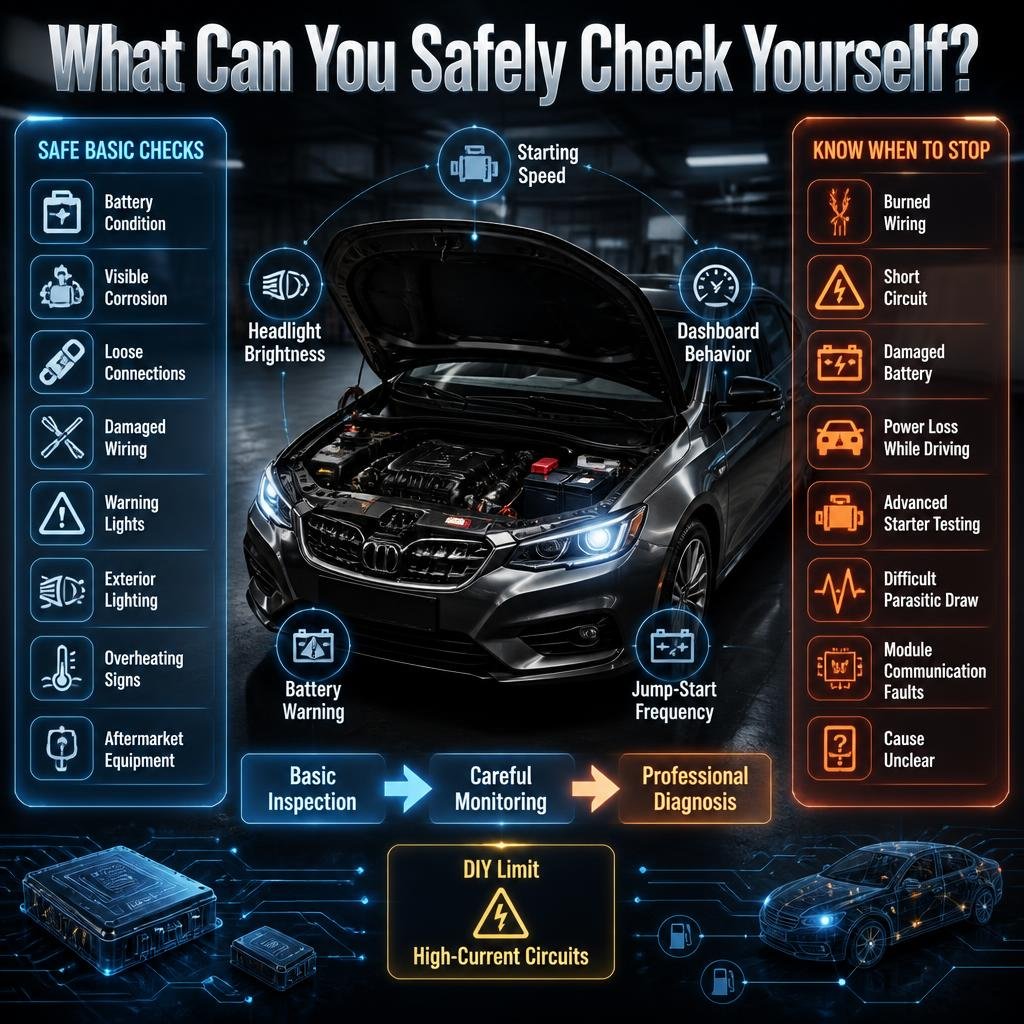
Some basic inspections are reasonable for vehicle owners.
You can visually check:
- Battery condition
- Visible corrosion
- Loose-looking connections
- Damaged wiring
- Warning lights
- Exterior lighting
- Signs of overheating
- Aftermarket electrical equipment
You can also monitor changes in:
- Starting speed
- Headlight brightness
- Dashboard behavior
- Battery warning indicators
- Frequency of jump-starts
However, advanced electrical diagnosis should be approached carefully.
High-current circuits can be dangerous.
Modern vehicles may also have sensitive electronic systems that require specific procedures.
When Should You Stop DIY Testing?
Professional help is appropriate when:
- Wiring is burned
- There is a short circuit
- The battery is physically damaged
- The vehicle loses power while driving
- The starter circuit requires advanced testing
- A parasitic draw is difficult to isolate
- Multiple modules show communication faults
- The cause of an electrical problem is unclear
The goal isn’t to avoid DIY maintenance.
The goal is to avoid turning a diagnostic problem into a larger electrical problem.
Vehicle Electrical System Inspection Checklist
Use the following checklist during routine inspection or before a long journey.
Battery
- Check battery age
- Inspect battery case
- Look for swelling or leakage
- Check terminal condition
- Inspect cable connections
- Confirm battery mounting
- Test battery condition when appropriate
Starting System
- Observe cranking speed
- Listen for unusual clicking
- Check starter operation
- Inspect starter connections
- Perform voltage-drop testing if necessary
Charging System
- Check charging behavior
- Inspect alternator
- Inspect drive belt where applicable
- Check charging cables
- Check grounds
- Investigate warning lights
Wiring
- Inspect visible cables
- Check connectors
- Look for corrosion
- Look for heat damage
- Look for damaged insulation
- Review aftermarket wiring
Protection and Diagnostics
- Check relevant fuses
- Check relays when appropriate
- Scan for diagnostic information
- Investigate repeated fuse failures
- Test for parasitic drain when symptoms indicate it
When Should You Schedule a Professional Electrical Inspection?
There isn’t one universal inspection interval that applies to every vehicle.
Electrical inspection should be based on:
- Vehicle age
- Battery age
- Vehicle usage
- Climate
- Starting behavior
- Warning lights
- Electrical symptoms
- Recent repairs
- Accessory installation
- Long-trip plans
An inspection becomes particularly valuable when a vehicle has started showing symptoms.
It is also sensible before a long journey if the battery is aging or the vehicle has recently experienced electrical issues.
A Useful Rule
Don’t wait for a complete electrical failure if the vehicle is already giving you warning signs.
For example:
Normal start → slightly slower start → occasional slow start → repeated starting difficulty
The earlier stages provide an opportunity to investigate before the vehicle becomes completely unreliable.
What Should You Do If Your Vehicle Suddenly Loses Electrical Power?
If the electrical system fails while driving, safety should come first.
Do not immediately start investigating wiring on an active road.
Prioritize:
- Vehicle control
- Safe positioning
- Passenger safety
- Visibility
- Communication
- Diagnosis or roadside assistance
If possible, move to a safer location away from moving traffic.
Use hazard warning lights if they remain operational.
Avoid standing in a dangerous traffic lane while attempting electrical repairs.
Once you are in a safe location, contact appropriate roadside assistance or a qualified technician.
If the vehicle has stopped because of an empty fuel tank rather than an electrical fault, fuel assistance is a different solution from electrical diagnosis. In that situation, the Fuel Delivery Dubai service can be relevant for drivers who need roadside fuel assistance in Dubai.
This distinction matters because a vehicle that won’t start isn’t automatically experiencing an electrical failure.
How Can You Prepare Your Vehicle’s Electrical System Before a Long Trip?
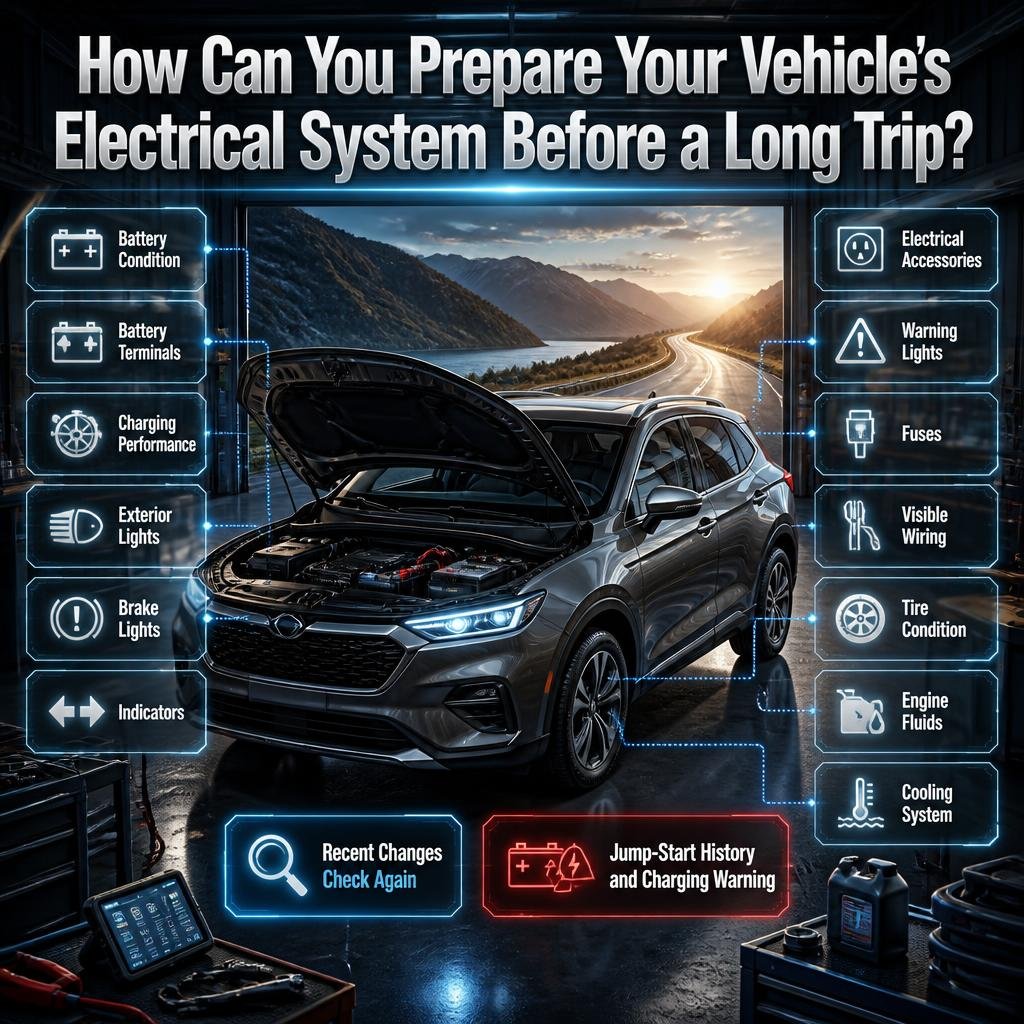
Long journeys place greater importance on reliability because a small fault can become inconvenient when you’re far from home.
Before a long trip, consider checking:
- Battery condition
- Battery terminals
- Charging performance
- Exterior lights
- Brake lights
- Indicators
- Electrical accessories
- Warning lights
- Fuses
- Visible wiring
- Tire condition
- Engine fluids
- Cooling system
Pay particular attention to anything that has changed recently.
If the vehicle has needed jump-starting or has shown charging warnings, don’t assume the problem has disappeared simply because the vehicle currently starts.
What Is the Difference Between Electrical Inspection and Electrical Repair?
Inspection and repair are two different stages.
Electrical Inspection
The objective is to identify:
- What is wrong
- Where the problem is located
- How severe it is
- Whether a component is actually defective
Electrical Repair
The objective is to correct the confirmed fault.
That could involve:
- Cleaning or repairing a connection
- Replacing a damaged cable
- Repairing wiring
- Replacing a fuse
- Replacing a starter
- Replacing an alternator
- Replacing a battery
- Repairing a control circuit
The advantage of separating these stages is simple:
You diagnose first and repair second.
This reduces unnecessary parts replacement.
How Does Preventive Electrical Maintenance Save Money?
Preventive inspection doesn’t mean replacing parts early.
It means identifying developing conditions before they become expensive or inconvenient failures.
For example:
A loose connection may be inexpensive to correct.
If ignored, it can create repeated starting problems.
A weak battery can be tested before a long trip.
An abnormal charging condition can be investigated before repeated battery discharge damages reliability.
A damaged cable can be repaired before excessive resistance causes more serious symptoms.
This is why condition-based maintenance is usually more useful than blindly replacing components according to age alone.
Expert Advice: How Professionals Approach Electrical Diagnosis
Experienced technicians generally avoid jumping straight to the most obvious component.
A sensible diagnostic process looks more like this:
1. Verify the complaint
Don’t diagnose a problem that hasn’t been reproduced or confirmed when possible.
2. Gather information
Ask when the problem occurs and under what conditions.
3. Inspect visually
Look for obvious damage before complicated testing.
4. Test the power source
Evaluate battery condition and available electrical energy.
5. Test the relevant circuit
Follow the symptom toward the component or circuit involved.
6. Measure voltage under load
Don’t rely exclusively on static readings.
7. Check grounds and connections
Electrical resistance can hide in cables and terminals.
8. Use diagnostic information intelligently
Codes and scan data should support the diagnosis, not replace it.
9. Confirm the cause
Before replacing a costly component, make sure the evidence points to that component.
10. Verify the repair
After repair, confirm that the original symptom has actually been resolved.
This approach is slower than guessing but usually much more reliable.
What Is Included in a Vehicle Electrical System Inspection?
A professional vehicle electrical system inspection is a complete check of the electrical components that help the vehicle start, charge, operate, and communicate properly. It goes beyond checking whether the battery has voltage. The inspection should be based on the vehicle’s symptoms and may include the battery, starter circuit, alternator, charging system, wiring, grounds, fuses, relays, connectors, and relevant diagnostic information.
The technician normally starts by identifying the driver’s complaint and then checks the most relevant parts of the system. For example, a slow-cranking vehicle requires a different diagnostic approach from a vehicle whose battery repeatedly becomes discharged overnight.
A useful electrical inspection may include:
Battery condition and starting capability
Battery terminals and cable connections
Engine and chassis ground connections
Starter operation and starting-circuit voltage drop
Alternator and charging-system performance
Fuses, relays, and electrical protection
Visible wiring and connector condition
Diagnostic trouble codes where relevant
Parasitic electrical draw when battery discharge is suspected
The important point is that inspection should identify the cause of the electrical problem, not simply identify the oldest component. This helps prevent unnecessary battery, starter, or alternator replacement.
How Do You Know If the Problem Is the Battery, Alternator, or Starter?
Battery, alternator, and starter problems can produce similar symptoms, so identifying the faulty component requires testing rather than relying on one symptom. A slow or failed start can result from insufficient battery power, poor cable connections, a weak ground, starter resistance, or another fault in the starting circuit. A repeatedly discharged battery may instead point toward the charging system or excessive electrical drain.
A professional diagnosis separates these systems and tests them individually. Battery condition is evaluated first when appropriate, followed by starting-circuit and charging-system checks based on the vehicle’s symptoms.
Some useful clues include:
Slow cranking: battery, cables, grounds, or starter may need testing.
Repeated battery discharge: battery condition, charging system, or parasitic draw should be investigated.
Battery warning light: charging-system diagnosis may be required.
Clicking without normal cranking: battery connections, starter circuit, or starter may be involved.
Electrical problems while driving: charging system, wiring, grounds, or electronic control systems may need attention.
The key is not to replace all three components simply because they are related. Testing should determine which part is actually causing the problem.
Why Does My Car Battery Keep Dying Even After I Replace It?
When a replacement battery repeatedly goes flat, the battery itself may not be the underlying problem. A new battery can become discharged if the alternator isn’t replenishing the energy used during driving, if an electrical accessory continues consuming power while the vehicle is parked, or if a poor connection is preventing proper charging.
Short journeys can also contribute because starting the engine consumes energy and a short drive may not provide enough operating time for the charging system to restore it. However, repeated overnight discharge or unusually rapid battery loss deserves proper electrical testing.
Common areas to investigate include:
Charging-system performance
Alternator operation
Battery terminals and cables
Engine and chassis grounds
Aftermarket accessories
Interior or trunk lights
Parasitic electrical draw
Battery condition and correct specification
Professional advice: Don’t keep replacing batteries when the same symptom returns. If a new battery repeatedly becomes discharged, diagnose the vehicle’s complete electrical system before buying another replacement.
What Are the Signs That a Car Needs an Electrical System Inspection?
A vehicle doesn’t have to stop completely before it needs an electrical inspection. Changes in starting performance, lighting, dashboard behavior, or electronic operation can provide early clues that something isn’t working as it should.
One of the most useful warning signs is a change from the vehicle’s normal behavior. If the engine used to start immediately but now cranks more slowly, or if electrical accessories have started behaving inconsistently, the change should be investigated rather than ignored.
Important signs include:
Slow or inconsistent engine cranking
Repeated jump-start requirements
Battery repeatedly becoming discharged
Battery or charging warning light
Flickering or unusually dim lights
Multiple unexpected dashboard warnings
Power windows or electrical accessories operating slowly
Electronics resetting or switching off
Repeatedly blown fuses
Burning smell around electrical components
Visible corrosion or damaged wiring
Electrical problems that appear and disappear randomly
Intermittent problems deserve particular attention because they can become more difficult to reproduce later. An inspection while the symptoms are occurring can provide valuable diagnostic information.
How Often Should a Vehicle Electrical System Be Inspected?
There isn’t a single inspection interval that is appropriate for every vehicle. Electrical inspection should be based on vehicle age, battery condition, operating environment, driving habits, previous electrical problems, and the symptoms the vehicle is showing.
A basic electrical check can be included during routine vehicle servicing, while a more detailed inspection becomes important when the vehicle develops starting, charging, lighting, or battery-drain problems. It is also sensible to check the system before a long road trip if the battery is aging or the vehicle has recently shown electrical symptoms.
An inspection becomes especially worthwhile when:
The battery is getting older
The vehicle has required recent jump-starts
Starting performance has changed
The battery has been replaced more than once because of repeated discharge
A charging warning has appeared
Electrical accessories have recently been installed
The vehicle operates frequently in demanding conditions
You are preparing for a long journey
For vehicles operating in hot climates such as Dubai, regular condition-based inspection can be particularly useful. High temperatures can accelerate battery aging and place additional stress on some electrical components, but this doesn’t mean parts should automatically be replaced early.
The professional approach is simple: inspect the condition, measure performance, diagnose abnormalities, and replace components only when testing shows they are actually needed.
Conclusion
A vehicle electrical system inspection is not simply about checking whether the battery starts the car. It is a complete assessment of the electrical components that work together to provide reliable starting, charging, lighting, power distribution, and electronic operation.
A proper inspection should consider the battery, terminals, ground connections, alternator, starter, fuses, relays, wiring, connectors, voltage drops, and electrical loads. When an electrical problem appears, replacing parts without proper testing can solve the wrong problem and lead to unnecessary expense.
This is especially important in Dubai, where high temperatures, heavy traffic, frequent air-conditioning use, short trips, dust, and long periods of vehicle operation can place additional demands on the electrical system. However, these conditions do not mean every electrical component should be replaced early. The better approach is to inspect, measure, diagnose, maintain, and monitor the system based on its actual condition.
Regular electrical inspections can help identify weak battery performance, charging problems, poor connections, excessive electrical resistance, and developing faults before they become a roadside breakdown. If you are reviewing your vehicle more broadly, explore our Vehicle Maintenance Guides for related maintenance topics.
For battery-specific care, a dedicated Car Battery Maintenance in Dubai guide can help you understand inspection, terminal condition, battery health, and service considerations. For charging-system concerns, including the alternator and related components, see our Automotive Charging System Maintenance in Dubai.
The key is not to wait until the vehicle refuses to start. Warning lights, slow cranking, repeated battery discharge, flickering lights, unusual electrical behavior, or intermittent starting problems are all reasons to investigate the system properly.
A well-maintained electrical system gives you more than a reliable start—it supports the dependable operation of the entire vehicle. Regular inspection and evidence-based diagnosis can help you identify problems earlier, avoid unnecessary part replacement, and keep your vehicle ready for everyday Dubai driving.
Leave a Reply