Introduction
Low Fuel Warning Light Meaning | You’re driving normally when a small fuel-pump symbol suddenly appears on the dashboard. Maybe you’re still several kilometres from home, you’re stuck in Dubai traffic, or you’re travelling on a highway where the next petrol station isn’t immediately obvious.
So, what does the low fuel warning light mean?
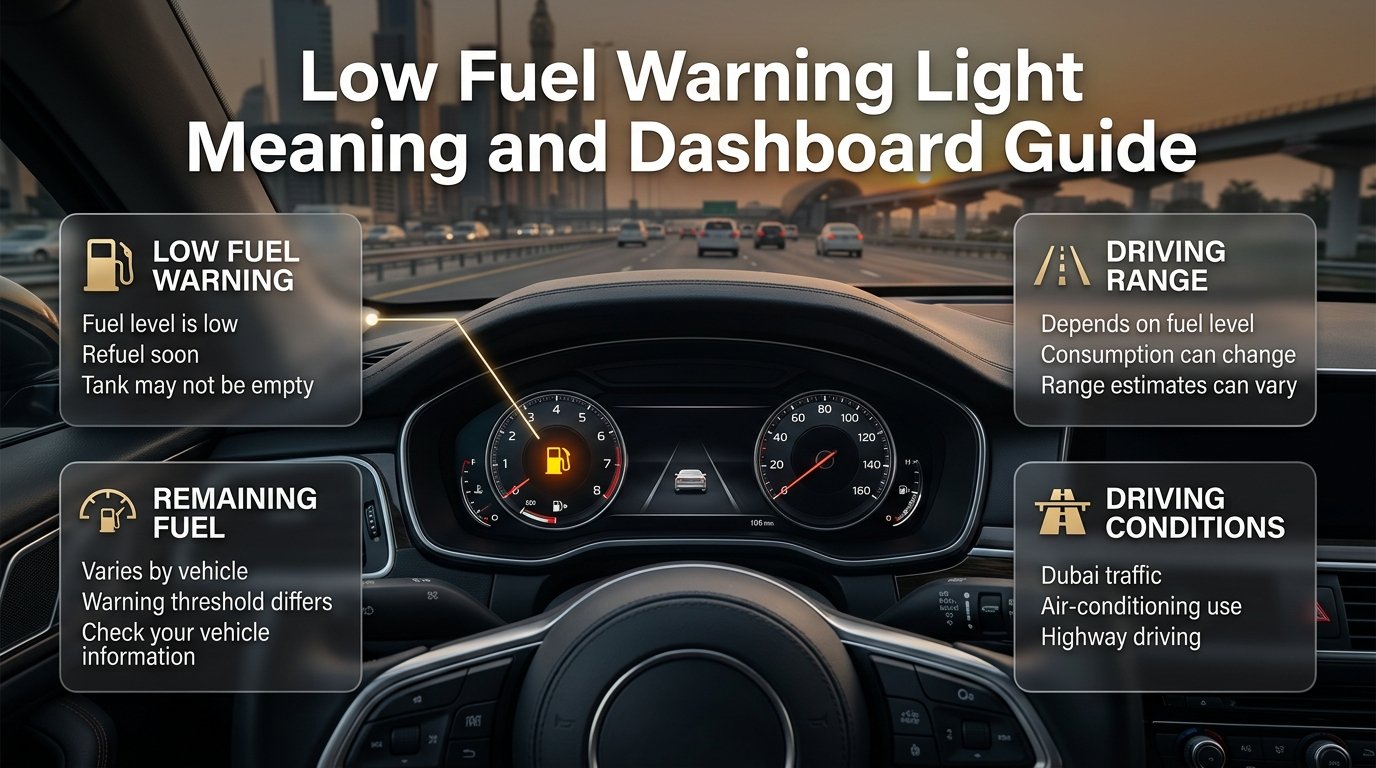
The low fuel warning light means your vehicle has detected that the fuel level has fallen to a low threshold and you should refuel soon. It usually doesn’t mean the tank is completely empty, but the exact amount of fuel remaining varies by vehicle, fuel-tank design, warning calibration, and driving conditions. Toyota, for example, describes its low-fuel warning as indicating that the tank is nearly empty and recommends filling it as soon as possible.
For Dubai drivers, the warning deserves extra attention because traffic congestion, air-conditioning use, long road distances, and highway driving can change fuel consumption considerably.
If you need roadside fuel assistance, you can also use Fuel Delivery Dubai when reaching a petrol station is no longer practical.
In this guide, you’ll learn exactly what the low fuel warning means, how much fuel may remain, how far you might be able to drive, why the range estimate can change, what happens when the tank becomes completely empty, and what you should do if the warning appears while you’re on a busy road or highway.
What Does the Low Fuel Warning Light Mean?
The low fuel warning light means the fuel level has reached a predetermined low-fuel threshold set by the vehicle manufacturer. It is a reminder to refuel before the vehicle runs out of usable fuel.
It is important to understand that the warning light isn’t a precise measurement of remaining fuel.
It doesn’t necessarily mean:
- The tank is completely empty
- You have exactly a certain number of litres left
- You have a guaranteed number of kilometres remaining
- The engine will stop immediately
Instead, it means your available fuel margin has become limited enough that you should start thinking about refuelling.
In simple terms
Low fuel light = fuel is getting low, so refuel soon.
The exact point at which the light comes on varies between vehicles. Some manufacturers may trigger the warning when a particular amount of fuel remains, while others use a different calibration.
That’s why you shouldn’t assume that the low-fuel reserve in your car is identical to the reserve in another car.
Why does the car warn you before the tank is empty?
The purpose of the warning is to give you an opportunity to find fuel before the engine stops.
If the warning only appeared when the tank was completely empty, it wouldn’t be very useful.
The reserve therefore provides a margin for normal situations such as:
- Being away from a petrol station
- Driving through traffic
- Taking an unexpected detour
- Searching for a suitable fuel station
- Experiencing slower-than-normal traffic
However, that reserve should be treated as a safety margin, not as extra fuel you should routinely use.
What Does the Low Fuel Warning Symbol Look Like?
The low fuel warning is commonly shown as a small fuel-pump icon on the dashboard.
Depending on the vehicle, you may see:
- A yellow or amber fuel-pump symbol
- A fuel-pump icon with a warning message
- A “Low Fuel” message
- A “Refuel” message
- A low-fuel symbol combined with the fuel gauge
- A flashing low-fuel indicator
The exact design depends on the manufacturer and model.
Some vehicles also show an arrow beside the fuel-pump icon. That arrow normally indicates which side of the vehicle has the fuel filler door.
This is particularly helpful when driving an unfamiliar vehicle.
Low fuel light vs other warning lights
Don’t confuse the low-fuel warning with other dashboard warnings.
| Dashboard indication | General meaning |
|---|---|
| Fuel-pump symbol | Fuel level is low |
| Engine warning light | Possible engine/emissions system issue |
| Oil-pressure warning | Possible low oil pressure |
| Battery warning | Charging-system issue |
| Temperature warning | Engine temperature problem |
| Tyre-pressure warning | Tyre pressure issue |
A low-fuel warning normally means you need fuel. It isn’t automatically an indication of an engine malfunction.
Toyota’s current dashboard guidance similarly identifies the low-fuel warning as an indication of low fuel and recommends refuelling.
How Much Fuel Is Left When the Low Fuel Light Comes On?
This is one of the most common questions, but there isn’t one universal answer.
The amount of fuel remaining when the warning activates depends on the vehicle.
Factors include:
- Fuel tank capacity
- Manufacturer calibration
- Fuel-level sensor design
- Tank shape
- Vehicle model
- Fuel-system design
- Vehicle angle
- Sensor interpretation
A small hatchback and a large SUV may both show a low-fuel warning, but the actual number of litres remaining can be very different.
Why there’s no universal reserve amount
Fuel tanks aren’t all the same size.
For example, imagine two vehicles:
Vehicle A
- Tank capacity: 45 litres
- Low-fuel threshold: relatively low
Vehicle B
- Tank capacity: 70 litres
- Low-fuel threshold: different manufacturer calibration
Both vehicles can display the same warning symbol while having very different amounts of fuel remaining.
This is why online claims such as “the low fuel light always means you have exactly 5 litres left” shouldn’t be treated as universal rules.
Check your owner’s manual
Your vehicle’s owner’s manual is the best source for model-specific information.
Manufacturer documentation may explain:
- When the warning appears
- What the fuel gauge means
- How the range estimate works
- What happens when the tank is nearly empty
Toyota owner’s manuals, for example, explicitly note that the low-fuel warning can appear when the tank becomes nearly empty and advise filling the tank as soon as possible. They also note that fuel movement on inclines or curves can cause the warning to appear earlier.
Does the Low Fuel Light Mean the Tank Is Empty?
No, not normally.
The low fuel warning is generally intended to appear before the tank is completely empty.
That gives the driver some remaining operating margin.
But there is an important difference between:
“Some fuel remains”
and
“I can safely drive for another long distance.”
Those aren’t the same thing.
Your remaining fuel may be enough to reach a nearby petrol station, but it may not be enough to handle another 30–50 kilometres of heavy traffic.
This is particularly important in Dubai, where a short distance on the map can sometimes take much longer during congestion.
How Far Can You Drive After the Low Fuel Light Comes On?
There is no guaranteed distance.
The actual distance depends on:
- How much fuel remains
- Your vehicle’s fuel economy
- Traffic conditions
- Driving speed
- Air-conditioning use
- Vehicle load
- Road conditions
- Acceleration and braking habits
- Tyre condition
- Engine and vehicle condition
Your car might travel significantly farther on an open highway than it would in dense stop-and-go traffic.
A simple example
Suppose your vehicle normally achieves:
10 km per litre
And suppose, purely as an example, that approximately:
5 litres remain
A simple theoretical calculation would be:
5 × 10 = 50 km
But that doesn’t mean you can safely assume you’ll get 50 km.
If you enter heavy traffic, your fuel consumption may increase.
If you drive aggressively, it may increase.
If you have a heavy load, it may increase.
If you’re using significant air conditioning in hot conditions, fuel consumption can also change.
Therefore:
Estimated range is not guaranteed range.
For a deeper explanation of range calculations, see How to Estimate Remaining Fuel Range in Dubai.
What Is Distance to Empty?
Many modern vehicles display Distance to Empty, often abbreviated as DTE.
This is the vehicle’s estimate of how far you can travel using the fuel currently available.
It can be extremely useful, but you shouldn’t treat it as a promise.
The system may calculate the estimate using factors such as:
- Recent fuel consumption
- Current fuel level
- Historical driving patterns
- Vehicle operating conditions
If your driving conditions suddenly change, the estimate may change too.
Example
Imagine your dashboard shows:
Distance to Empty: 60 km
You then leave an open road and enter severe city congestion.
The vehicle may start using fuel at a higher rate than it was previously.
The estimated range could then fall faster than the kilometres you’re actually travelling.
That doesn’t necessarily mean the fuel gauge is broken.
It may simply mean the computer is updating its prediction.
Why Does My Remaining Fuel Range Drop So Quickly?
A common situation is seeing something like this:
60 km remaining
Then after a relatively short period of driving:
45 km remaining
Drivers sometimes assume the car has suddenly lost 15 km worth of fuel.
That’s not necessarily what happened.
The vehicle may have recalculated the estimate because your recent driving became less fuel-efficient.
Common causes include:
- Heavy traffic
- Repeated acceleration
- Frequent braking
- Long idling
- High speeds
- Air-conditioning use
- Steep roads
- Heavy vehicle load
- Stop-and-go driving
This is why DTE should be treated as a dynamic estimate.
For more information about fuel-gauge reliability, see How Accurate Is a Car Fuel Gauge?.
Why Does the Low Fuel Light Sometimes Come On Early?
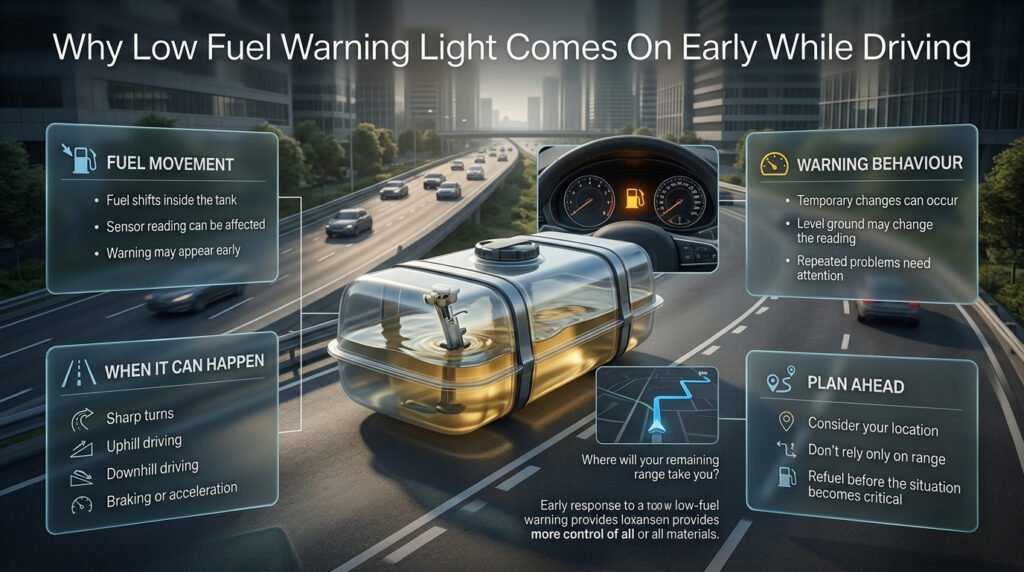
You may notice the low fuel warning appearing earlier than expected, particularly when:
- Turning sharply
- Driving uphill
- Driving downhill
- Parking on an incline
- Taking a roundabout
- Braking heavily
- Accelerating suddenly
That’s because fuel moves inside the tank.
The fuel-level sensor isn’t measuring fuel in a perfectly static environment.
Manufacturer documentation can specifically acknowledge this behaviour. Toyota manuals, for example, state that on inclines or curves, fuel movement inside the tank can cause the low-fuel warning to come on earlier than usual.
Should you panic?
No.
If the warning appears temporarily while the vehicle is on a steep incline and then disappears after returning to level ground, the movement of fuel may be contributing.
However, if the warning repeatedly behaves incorrectly under normal driving conditions, the fuel-level system may need inspection.
Why You Shouldn’t Ignore the Low Fuel Warning
The biggest risk of ignoring the warning isn’t necessarily immediate mechanical damage.
It’s running out of fuel in the wrong place.
A vehicle that stops in:
- A parking area
- A residential driveway
- A safe roadside location
is much easier to deal with than one that stops:
- In an active traffic lane
- On a busy highway
- Near an interchange
- In heavy congestion
- In an unsafe roadside position
That’s why the warning should be treated as an opportunity to act early.
Think about the location, not just the distance
If your dashboard says you have 25 km of estimated range, ask:
“Where will I be after 25 km?”
Not simply:
“Can my car technically drive 25 km?”
That difference can prevent a fuel emergency.
What Should You Do When the Low Fuel Light Comes On?
When the warning appears, don’t panic.
Use a simple process.
Step 1: Check the fuel gauge
Look at the fuel gauge and confirm that the low-fuel warning corresponds with a low reading.
If available, also check the estimated remaining range.
Step 2: Consider your route
Ask yourself:
- Where is the nearest suitable petrol station?
- Is traffic heavy?
- Am I travelling on a highway?
- Do I need to make a long detour?
- Is my estimated range comfortable?
Step 3: Drive smoothly
Avoid unnecessary acceleration.
Avoid aggressive driving.
Maintain a sensible speed suitable for the road.
The goal isn’t to drive dangerously slowly. It’s to avoid wasting fuel through unnecessary driving behaviour.
Step 4: Refuel at the first practical opportunity
If a suitable petrol station is nearby, use it.
Don’t continue driving simply because you believe there’s “still plenty left.”
Step 5: Arrange assistance early if necessary
If you’re uncertain about reaching a petrol station, don’t wait until the engine stops.
Early assistance is generally easier to manage than an immobile vehicle.
For additional guidance, see Emergency Roadside Fuel Advice.
Should You Refuel Immediately When the Low Fuel Light Comes On?
You don’t necessarily need to stop the vehicle immediately in an unsafe location simply because the light has appeared.
However, you should plan to refuel soon.
If you are:
- Near a petrol station
- Driving normally
- In a safe area
- Not experiencing unusual vehicle behaviour
you can generally continue safely to the refuelling point.
The important part is not to treat the warning as something that can be ignored for the rest of the journey.
A good rule
Low fuel light appears → start planning.
Range becomes uncertain → refuel or arrange assistance.
Engine begins losing power → prioritize safety immediately.
How Dubai Traffic Changes the Situation
Dubai driving conditions can make a low-fuel situation more complicated than it initially appears.
A driver may look at a map and think:
“The petrol station is only 10 km away.”
But the journey may involve:
- Heavy congestion
- Long traffic lights
- Stop-and-go movement
- Slow-moving roads
- Highway merging
- Detours
- Parking-area navigation
The vehicle still consumes fuel while moving slowly or idling.
That means distance alone isn’t enough to determine whether you can safely reach a petrol station.
For more detail, see How Traffic Affects Fuel Economy in Dubai.
Does Idling Consume Fuel When the Tank Is Low?
Yes.
If the engine is running, it generally continues consuming fuel even when the vehicle isn’t moving.
This becomes especially relevant when you’re sitting in traffic or waiting in a parking area with the engine running.
If your fuel is already critically low, unnecessary idling reduces the amount of fuel available for actual movement.
You can learn more about this topic through Fuel Consumption While Idling and Car Idling Fuel Consumption in Dubai.
But don’t make safety compromises
Fuel conservation shouldn’t override safety.
For example, don’t turn off essential systems in unsafe conditions simply to save a small amount of fuel.
Your objective is to reach a safe refuelling point, not to achieve a perfect fuel-economy number.
Does Air Conditioning Affect Remaining Fuel?
Air conditioning can affect fuel consumption because the system requires energy to operate.
In Dubai, air conditioning is often essential because of high temperatures.
Therefore, don’t interpret “save fuel” as “drive without necessary cooling.”
Instead:
- Drive smoothly
- Avoid unnecessary acceleration
- Avoid unnecessary detours
- Don’t leave the engine idling without reason
- Head toward a suitable refuelling point
The effect of air conditioning varies by vehicle and conditions, so there isn’t one universal percentage that applies to every car.
Does Speed Affect How Long Low Fuel Will Last?
Yes.
Driving at higher speeds can increase fuel consumption because aerodynamic resistance increases as speed rises.
If your fuel is low, maintaining a sensible, legal, steady speed is generally better than aggressive high-speed driving.
But there’s an important safety point:
Do not drive unusually slowly on a high-speed road simply to save fuel.
Follow the road’s speed requirements and traffic conditions.
Fuel economy matters, but safe road behaviour matters more.
What Happens If You Keep Driving With the Low Fuel Light On?
If enough fuel remains, the vehicle may continue driving normally.
But as the fuel supply becomes critically low, the engine may eventually:
- Hesitate
- Lose power
- Run unevenly
- Stop
The exact symptoms depend on the vehicle and fuel system.
At that point, the problem changes from a warning to an actual roadside emergency.
This is why deliberately testing the vehicle’s maximum reserve isn’t a sensible experiment.
Is It Bad to Drive Until the Tank Is Completely Empty?
Repeatedly running the vehicle completely out of fuel is not a good driving habit.
Ford’s owner guidance, for example, notes that the fuel pump is installed inside the tank and recommends keeping fuel in the tank to help prevent fuel-pump damage.
There can also be practical problems after completely running dry, particularly depending on the vehicle’s fuel-system design.
More importantly, running empty can leave you stranded in an unsafe location.
The better approach
Don’t wait for:
Fuel light → very low range → engine stops
Instead aim for:
Fuel light → identify fuel → refuel
That small change in habit can eliminate many unnecessary fuel emergencies.
What Happens When a Car Runs Completely Out of Fuel?
When the engine no longer receives an adequate fuel supply, it can stop running.
Depending on where this happens, you may experience:
- Sudden loss of engine power
- Difficulty restarting
- Vehicle immobilization
- Increased roadside risk
- Delayed journey
- Need for fuel assistance
The most important issue is where the vehicle stops.
A car running out of fuel on a quiet private parking area is inconvenient.
A car running out of fuel in a live traffic lane is a safety problem.
For a complete guide, see What to Do When Your Car Runs Out of Fuel.
What Should You Do If Your Car Runs Out of Fuel?
If the engine stops because the vehicle has run out of fuel, your priority should be safety.
1. Stay calm
Don’t panic or make sudden roadside movements.
2. Move the vehicle if safely possible
If the vehicle can still be moved safely and you can reach a safer location, do so.
Don’t take unnecessary risks attempting to push or move a vehicle in active traffic.
3. Use hazard lights
Make the vehicle more visible to approaching traffic where appropriate.
4. Stay away from moving traffic
Don’t stand unnecessarily in the roadway or walk along a highway looking for fuel.
5. Arrange fuel assistance
Provide accurate information about:
- Location
- Road name
- Direction
- Exit
- Landmark
- Vehicle
- Fuel type
For additional guidance, see Steps After Running Out of Petrol.
What Information Should You Give for Roadside Fuel Delivery?
Good location information can make roadside assistance considerably easier.
When requesting fuel, provide:
Your location
Use a live location when possible.
Road direction
For example:
- Toward Abu Dhabi
- Toward Dubai
- Northbound
- Southbound
Nearest exit
An exit number or interchange can help identify your position.
Landmark
Mention a recognizable nearby location.
Vehicle information
Provide the:
- Make
- Model
- Approximate year if relevant
Fuel type
Confirm whether the vehicle needs:
- Petrol
- Diesel
Never guess the fuel type.
If the vehicle has already stopped, Running Out of Fuel on the Road provides additional practical guidance.
What If the Low Fuel Light Comes On on a Highway?
A highway situation requires more planning because stopping options may be limited.
If the warning appears:
- Remain calm.
- Check your estimated range.
- Look for an appropriate nearby refuelling option.
- Avoid unnecessary detours.
- Drive smoothly.
- Don’t wait until the vehicle loses power.
- Arrange assistance early if reaching fuel is uncertain.
The most important principle is:
Don’t turn a manageable low-fuel warning into a highway breakdown.
For a detailed safety guide, read Highway Breakdown Safety Procedures in Dubai.
You can also review Highway Fuel Emergency Safety in Dubai for broader guidance.
Should You Walk to a Petrol Station?
If you’re stranded on a highway or busy road, walking along the roadway to find fuel is generally not a good solution.
The risk from moving traffic can be much greater than the inconvenience of waiting for appropriate assistance.
If you’re in a safe location, arrange roadside assistance instead.
This is particularly important when:
- The road has fast-moving traffic
- There is no safe pedestrian route
- Visibility is poor
- You’re unfamiliar with the area
- You’re travelling at night
- You’re carrying passengers
For wider roadside precautions, see Roadside Vehicle Emergency Precautions.
Low Fuel Warning Light and Fuel Gauge Accuracy
The low-fuel warning and fuel gauge are connected, but neither should be treated as a laboratory-accurate measurement.
The gauge generally provides an approximate quantity of fuel remaining.
Toyota documentation, for example, describes the fuel gauge as indicating the approximate quantity of fuel remaining and notes that refuelling on a slope can affect the displayed level.
Why fuel gauges aren’t perfectly linear
A fuel tank isn’t necessarily shaped like a simple box.
The tank may have:
- Irregular sections
- Internal components
- Different depths
- Fuel movement during driving
As a result, the gauge may not move proportionally with every litre consumed.
You might therefore notice that:
- The first half appears to last longer
- The final quarter seems to fall faster
- The warning appears while the gauge still appears to show some fuel
This doesn’t automatically mean something is wrong.
What If the Fuel Gauge Seems Wrong?
If the fuel gauge behaves unusually, pay attention.
Potential signs of a problem include:
- Gauge remains full for an unusually long time
- Gauge suddenly drops dramatically
- Gauge stays near empty after refuelling
- Low-fuel warning remains on after adding fuel
- Fuel level changes dramatically without explanation
Possible causes can include:
- Fuel-level sensor issues
- Sending-unit problems
- Wiring faults
- Dashboard problems
- Electrical issues
If the behaviour repeats, have the vehicle inspected.
Don’t simply compensate by assuming the tank always contains more fuel than the gauge says.
What If the Low Fuel Light Stays On After Refuelling?
If you’ve refuelled but the warning remains illuminated, don’t immediately assume the vehicle is still empty.
Give the system an opportunity to update.
If the warning continues after adding a meaningful amount of fuel, there may be an issue with the fuel-level measurement system.
Check your owner’s manual for the correct procedure.
If the problem repeatedly occurs, have the vehicle inspected.
A faulty fuel-level system can become a practical problem because it prevents you from accurately knowing how much fuel you have.
Can the Low Fuel Light Come On During Turns?
Yes.
Fuel moves inside the tank during:
- Sharp turns
- Hard braking
- Acceleration
- Hills
- Slopes
If the tank is already close to the warning threshold, this movement can affect the sensor reading.
Manufacturer manuals explicitly acknowledge that fuel movement during inclines and curves can cause a low-fuel warning to appear earlier than usual.
If the light appears briefly and then disappears, the vehicle may simply be responding to fuel movement.
If it remains on, assume the fuel level is genuinely low and plan to refuel.
How Driving Habits Affect Low-Fuel Range
Once the warning appears, your driving style can influence how quickly the remaining fuel is consumed.
Smooth acceleration
Aggressive acceleration demands more fuel.
Predictable braking
Constant acceleration followed by heavy braking wastes energy.
Steady driving
Maintaining a consistent speed where traffic and road conditions allow can improve efficiency.
Avoid unnecessary idling
An idling engine still consumes fuel.
Avoid unnecessary detours
When fuel is low, every extra kilometre matters.
Don’t drive aggressively
Low fuel isn’t a reason to rush.
For a broader guide to efficient driving, see Fuel Saving Driving Tips.
Does Vehicle Weight Affect Remaining Fuel Range?
Yes.
A heavily loaded vehicle generally requires more energy to move than the same vehicle with a lighter load.
This means extra passengers, luggage, equipment, or unnecessary items can affect fuel consumption.
The effect varies by vehicle and driving conditions, but when your fuel is already low, it’s another reason not to assume that your usual range will remain exactly the same.
The same principle applies to long journeys.
A vehicle loaded for a family trip may not deliver the same fuel economy it achieves when driven lightly around the city.
Why Highway Driving Can Be Different
Highway driving can sometimes be more fuel-efficient than stop-and-go city driving because there may be fewer interruptions and less repeated acceleration.
But high speeds can also increase fuel consumption due to aerodynamic resistance.
This creates an important balance.
The goal isn’t simply:
Drive as slowly as possible.
It’s:
Drive at a safe, legal, steady speed appropriate for the road.
For more information, see Highway Driving Fuel Efficiency and Fuel-Efficient Highway Driving.
Common Mistakes Drivers Make When the Low Fuel Light Appears
Mistake 1: Assuming a fixed number of kilometres remains
A driver may hear that a particular car can travel a certain distance after the light comes on.
That number shouldn’t be transferred to another vehicle.
Why it’s risky: Every vehicle and driving situation is different.
Better approach: Use your own vehicle’s information and leave a safety margin.
Mistake 2: Treating DTE as guaranteed
A display showing 40 km doesn’t mean you’re guaranteed 40 km.
Why it’s risky: Fuel consumption can change.
Better approach: Treat the number as an estimate.
Mistake 3: Waiting until the engine stops
This turns a warning into an emergency.
Better approach: Refuel when practical.
Mistake 4: Ignoring traffic
A petrol station 15 km away may take much longer to reach during congestion.
Better approach: Consider time, traffic and fuel consumption—not distance alone.
Mistake 5: Driving aggressively to “get there faster”
Hard acceleration can increase fuel consumption.
Better approach: Drive smoothly and safely.
Mistake 6: Walking along a highway for fuel
This can expose you to moving traffic.
Better approach: Stay in a safe position and arrange assistance.
Mistake 7: Guessing the fuel type
This is particularly dangerous if assistance is being arranged.
Better approach: Confirm whether the vehicle needs petrol or diesel.
Mistake 8: Assuming a faulty gauge is normal
If the gauge repeatedly behaves strangely, don’t ignore it.
Better approach: Have the fuel-level system inspected.
Expert Advice: How to Manage Low Fuel More Professionally
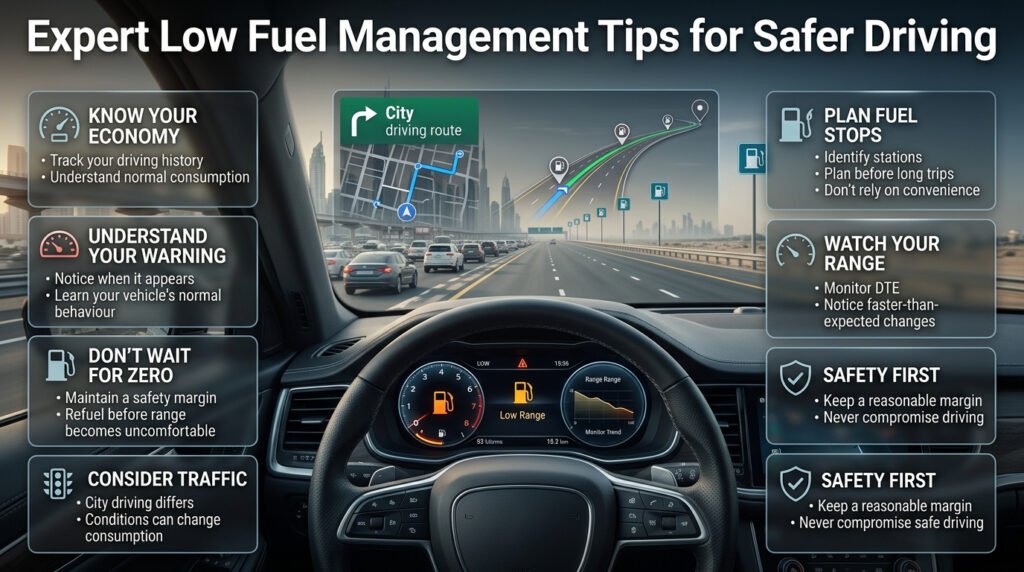
A professional approach to fuel management isn’t about squeezing every last kilometre from the tank.
It’s about maintaining a reasonable safety margin.
1. Know your vehicle’s normal fuel economy
Your own driving history can be more useful than a generic online number.
2. Understand your warning behaviour
Notice approximately when the low-fuel light normally appears.
3. Don’t wait for zero
Refuel before your available range becomes uncomfortable.
4. Consider traffic before long trips
Your open-road range may not represent your city-traffic range.
5. Plan highway fuel stops
Don’t assume a fuel station will always be conveniently available exactly when you need it.
6. Watch your vehicle’s changing range
If DTE starts dropping faster than expected, take the warning seriously.
7. Keep safety above fuel economy
Never compromise safe driving simply to save fuel.
How to Prevent the Low Fuel Warning From Becoming a Breakdown
The easiest fuel emergency to solve is the one you prevent.
A few habits can make a major difference.
Refuel before the reserve becomes critical
You don’t need to wait until the light appears every time.
Know your normal driving pattern
A car used mainly for city traffic will have different consumption from one used mainly on highways.
Check the vehicle before long trips
Pay attention to:
- Tyres
- Fuel level
- Engine condition
- Warning lights
- Planned route
Think about traffic
A normal journey can become much longer during congestion.
Don’t overload unnecessarily
Extra weight can increase fuel consumption.
Plan your stops
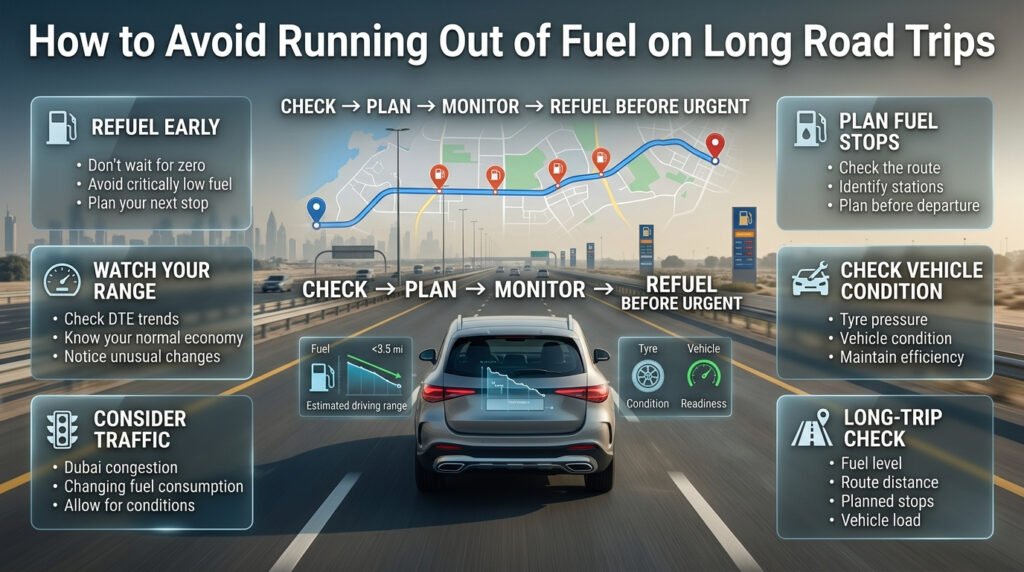
For long-distance journeys, identify sensible refuelling points before leaving.
For more detailed long-trip planning, see Improving Fuel Economy on Long Trips and Long-Distance Driving Fuel Efficiency Tips.
Low Fuel Warning Light: Quick Decision Guide
| Situation | Best response |
|---|---|
| Warning just appeared near a petrol station | Refuel soon |
| Warning appears with comfortable range | Plan your refuelling stop |
| Heavy traffic ahead | Consider refuelling earlier |
| Range estimate falling rapidly | Take action sooner |
| Highway with no obvious fuel stop | Plan carefully and consider assistance |
| Engine starts losing power | Prioritize safety |
| Vehicle stops completely | Move to safety if possible and arrange assistance |
| Gauge behaves incorrectly after refuelling | Consider inspection |
How Much Fuel Is Left When the Low Fuel Warning Light Comes On?
When the low fuel warning light comes on, your vehicle normally still has some fuel remaining, but there is no standard amount that applies to every car. The warning is activated at a manufacturer-defined fuel level, and that threshold can vary according to the vehicle’s tank capacity, fuel-level sensor, and calibration. This means one car may have considerably more usable reserve than another when both display the same warning.
It’s also important not to confuse the fuel reserve with guaranteed driving range. Even if your vehicle has several litres remaining, the distance you can travel depends on your current fuel consumption. Heavy Dubai traffic, frequent acceleration, high speeds, air-conditioning use, and additional vehicle load can reduce your remaining range faster than normal.
Important points to remember:
The low fuel light normally appears before the tank is completely empty.
The exact remaining litres depend on your vehicle and manufacturer.
Your owner’s manual is the best source for the model-specific reserve level.
Fuel movement on slopes and during sharp turns can sometimes affect the warning.
Don’t use a generic “X litres remain” figure from another vehicle as a guarantee for yours.
Treat the warning as a signal to refuel soon rather than as a measurement of how much fuel you can safely use.
The safest approach is to combine the warning light with your fuel gauge, distance-to-empty display, current traffic conditions, and knowledge of your vehicle’s normal fuel economy. If you’re already uncertain about reaching a petrol station, it’s better to arrange fuel assistance before the vehicle becomes stranded.
How Far Can You Drive After the Low Fuel Light Comes On?
There is no guaranteed number of kilometres you can drive after the low fuel warning appears. Your remaining range depends on how much fuel is actually left and how efficiently the vehicle is using it at that moment. A car travelling smoothly on an open road may cover considerably more distance than the same car travelling through heavy stop-and-go traffic.
For example, if your vehicle normally achieves 10 km per litre, its theoretical range with 5 litres remaining would be around 50 km. But that calculation assumes the vehicle continues achieving the same fuel economy. Real-world conditions can change that figure significantly, so it shouldn’t be treated as a safe guaranteed distance.
Your remaining range can be affected by:
Heavy traffic and repeated stopping
High-speed driving
Aggressive acceleration
Frequent braking and acceleration
Air-conditioning use
Heavy luggage or additional vehicle weight
Hills and inclines
Tyre pressure and vehicle condition
Your recent driving pattern
This is particularly important in Dubai. A petrol station that appears to be only a short distance away may take much longer to reach during congestion, giving the engine more time to consume fuel while covering relatively little distance.
Professional advice: Don’t test your vehicle’s maximum reserve range in real traffic. When the low fuel light appears, use your dashboard range as an estimate, identify a realistic refuelling point, and leave yourself enough margin for unexpected traffic or route changes.
If the estimated range is already very low and you’re unsure whether you’ll reach fuel, arranging roadside fuel delivery early is safer than waiting for the engine to stop.
Is It Safe to Keep Driving When the Low Fuel Warning Light Is On?
A vehicle will normally continue operating after the low fuel warning appears because the warning is designed to activate before the tank is completely empty. However, that doesn’t mean it’s a good idea to continue driving for a long distance while relying on the remaining reserve.
The real issue is not simply whether the engine can keep running. It’s whether you can reach a safe refuelling point before the available fuel becomes critically low. Conditions can change quickly, particularly during Dubai traffic or highway travel.
For example, a driver may see 30 km on the distance-to-empty display and assume there is plenty of fuel. If traffic suddenly becomes congested, fuel consumption may increase and the estimated range can fall faster than expected.
If the warning appears, a sensible approach is to:
Check your fuel gauge and remaining-range estimate.
Look for a suitable petrol station on your route.
Avoid unnecessary detours.
Drive smoothly rather than aggressively.
Consider traffic before deciding how far you can continue.
Refuel at the first practical opportunity.
Arrange assistance early if reaching fuel becomes uncertain.
⚠️ Common mistake: Many drivers wait until the warning has been on for a long time because they believe the reserve is designed to take them a certain distance. It isn’t. The reserve is there to provide a margin, not to give you a guaranteed driving target.
If your vehicle is already experiencing hesitation, loss of power, or unusual engine behaviour while the fuel warning is illuminated, don’t assume you have plenty of time left. Find a safe solution before the vehicle stops.
What Should You Do If Your Car Runs Out of Fuel After the Low Fuel Light Comes On?
If the vehicle eventually stops because it has run out of fuel, your first priority should be roadside safety, not trying to find fuel on foot. Where it is safe and possible, move the vehicle away from active traffic and use the hazard warning lights to make the vehicle more visible. Avoid standing in the roadway or walking along a busy highway looking for a petrol station.
Once you’re in a safer position, arrange appropriate roadside fuel assistance. Give the provider clear information so they can locate the vehicle without unnecessary delays. A live location is useful, but you should also provide the road name, direction of travel, nearest exit, landmark, and correct fuel type.
When requesting fuel assistance, provide:
Your current location or live pin
Road or highway name
Direction of travel
Nearest exit or interchange
Nearby landmark
Vehicle make and model
Petrol or diesel requirement
Whether the vehicle is safely positioned
The fuel type is especially important. Don’t guess whether the vehicle requires petrol or diesel, particularly if someone else is arranging assistance for you.
For highway situations, the location of the stopped vehicle matters just as much as the fuel itself. If you’re on a high-speed road, don’t put yourself at additional risk by walking along the shoulder unnecessarily.
The best strategy is actually to act before this stage. If your range is becoming uncertain, arrange assistance while the vehicle is still in a manageable location. Getting fuel before the engine stops is generally much easier than dealing with a complete roadside breakdown.
Can the Low Fuel Warning Light Be Wrong or Come On Earlier Than Expected?
Yes, the warning can sometimes appear earlier than a driver expects because fuel-level systems are not perfectly precise. Fuel moves around inside the tank when the vehicle accelerates, brakes, turns, or travels on an incline. This movement can temporarily influence the fuel-level sensor, particularly when the tank is already close to the warning threshold.
The shape of the fuel tank also matters. A fuel gauge isn’t simply measuring a perfectly uniform container where every movement of the gauge represents exactly the same number of litres. The relationship between fuel volume and the displayed level can vary throughout the tank.
However, there’s an important distinction between normal variation and a genuinely faulty fuel-level system.
A temporary change can happen when:
Driving up or down a slope
Taking a sharp turn
Braking or accelerating
Parking on an incline
Fuel is moving inside a nearly empty tank
A possible fault deserves attention when:
The warning stays on after substantial refuelling.
The gauge repeatedly shows an obviously incorrect level.
The fuel reading suddenly jumps without a clear reason.
The gauge remains full for an unusually long period.
The low-fuel warning appears much earlier than normal every time.
The reading behaves inconsistently during ordinary level-road driving.
If the warning system consistently behaves strangely, don’t simply assume that you have more fuel than the dashboard indicates. A problem with the fuel-level sensor, sending unit, wiring, or related components can make fuel-level information unreliable.
Professional approach: If you notice an unusual reading once, monitor it. If the same problem repeatedly occurs, have the fuel-level system checked. Accurate fuel information is particularly important because a faulty gauge can turn a routine journey into an unexpected fuel emergency.
Conclusion
Understanding the low fuel warning light is an important part of responsible driving. When the light comes on, it is a clear reminder that your remaining fuel is limited and your available driving range may change depending on traffic, driving speed, road conditions, vehicle load, and fuel consumption.
Instead of relying only on the estimated range or waiting until the tank is completely empty, treat the warning light as a signal to plan your next refuelling stop. This is especially important in Dubai, where heavy traffic, long highway journeys, high temperatures, and extended idling can affect how quickly your remaining fuel is used.
If you do run out of fuel, focus on safety first. Move the vehicle to a safe position where possible, avoid walking along active roads, and arrange reliable roadside fuel assistance rather than putting yourself at unnecessary risk.
The best approach is simple: take the low fuel warning seriously, understand your vehicle’s typical fuel range, and refuel before the tank reaches an emergency level. A small amount of planning can prevent an inconvenient fuel shortage from becoming a stressful roadside situation.
Leave a Reply