Introduction
Highway Breakdown Safety Procedures | A highway breakdown can turn an ordinary journey into a stressful situation in a matter of seconds. One moment you’re driving normally, and the next your engine loses power, a tyre goes flat, the temperature warning appears, or the fuel gauge reaches empty. When traffic is moving quickly around you, knowing what to do matters far more than trying to fix the problem immediately.
This is why understanding highway breakdown safety procedures is so important for Dubai drivers. A vehicle problem is usually manageable, but being exposed to fast-moving traffic, extreme heat, poor visibility, or an unsafe stopping position can make the situation much more serious.
If you’re looking for dependable roadside fuel support in Dubai, Fuel Delivery Dubai can also be a useful resource when an empty fuel tank is the reason your vehicle has stopped.
This guide explains what to do before, during, and after a highway breakdown. You’ll learn how to react when your car starts losing power, how to make your vehicle more visible, when to remain inside, when moving away from the vehicle may be safer, what to do if you run out of fuel, how to deal with a flat tyre or overheating, and which mistakes you should avoid.
The goal isn’t simply to get your car moving again.
The first goal is to keep people safe.
What Are Highway Breakdown Safety Procedures?
Highway breakdown safety procedures are the practical steps a driver should follow when a vehicle becomes disabled or unsafe to continue on a high-speed road. They focus first on controlling the vehicle, warning approaching traffic, reaching the safest available stopping position, protecting passengers, and contacting appropriate assistance.
The exact response depends on where the vehicle stops and what caused the breakdown. A car safely parked in a designated emergency area presents a different situation from a vehicle that has stopped in an active traffic lane.
The basic sequence is:
Stay in control → warn traffic → move to safety → communicate your location → get assistance → avoid unnecessary roadside exposure.
This order is important because drivers often make the mistake of thinking about the mechanical problem first.
If the car has a flat tyre, they immediately think about changing it.
If the fuel tank is empty, they immediately think about finding fuel.
If the engine overheats, they immediately think about opening the bonnet.
But on a highway, the location of the vehicle can be more dangerous than the mechanical fault itself.
Why Are Highway Breakdowns More Dangerous Than Normal Roadside Breakdowns?
A highway breakdown carries additional risks because vehicles may be travelling at high speeds and drivers have limited time to react to an unexpected obstacle.
Even if your vehicle is stopped on the side of the road, traffic may pass relatively close to it. A distracted driver, sudden lane change, poor visibility, or another unexpected event can create additional danger.
Dubai also presents its own environmental challenges. High temperatures can make waiting outside uncomfortable or unsafe, while heavy traffic can make roadside activity more difficult.
A breakdown therefore requires two separate decisions:
- How do I deal with the vehicle problem?
- How do I keep myself and my passengers away from unnecessary danger?
The second question should always come first.
What Should You Do Immediately When Your Car Breaks Down on a Highway?
If you notice that your vehicle is losing power, behaving unusually, overheating, or developing another serious problem, remain calm and focus on controlling it.
Avoid sudden steering or braking. If the vehicle can still move safely, gradually reduce speed and look for an appropriate stopping location away from active traffic.
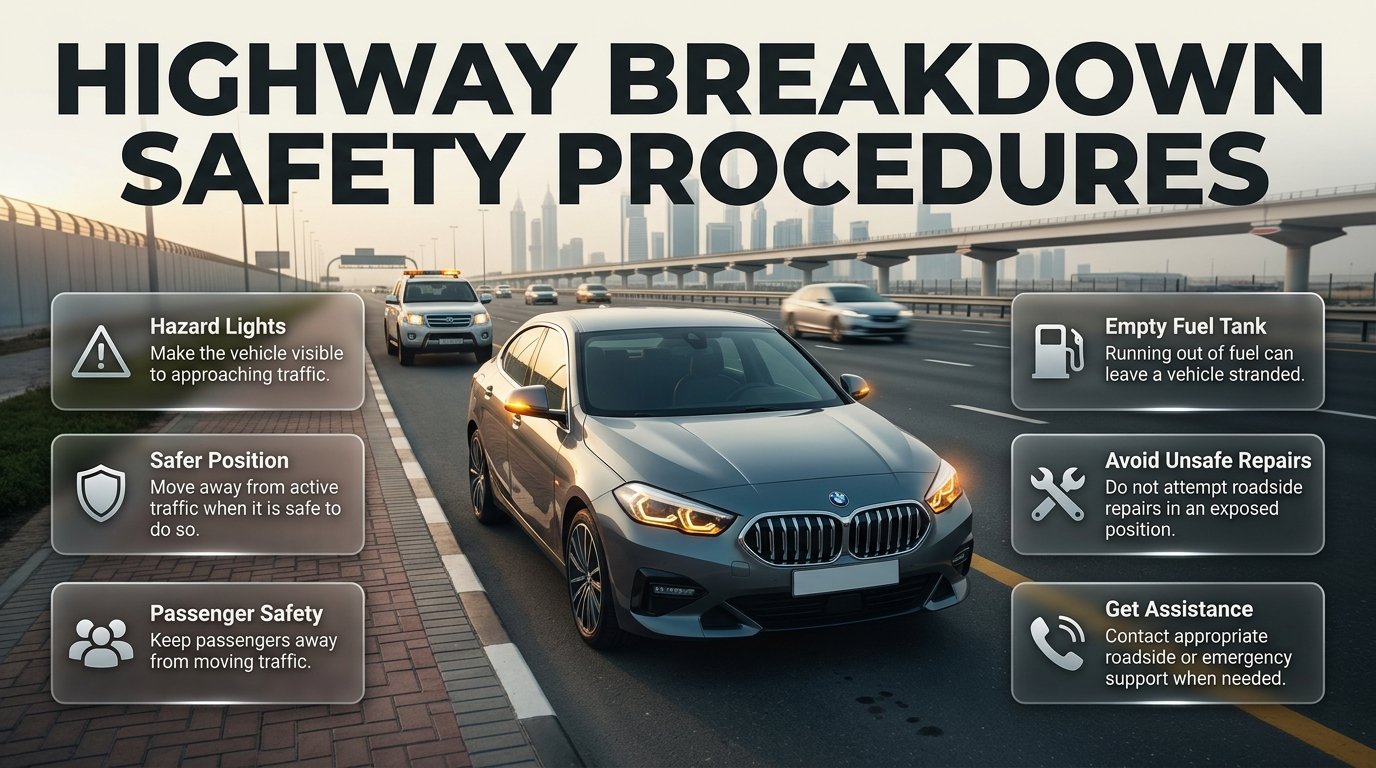
Turn on the hazard warning lights as soon as practical.
Once the vehicle is stopped, don’t immediately jump out and start inspecting it. First look at your surroundings and assess the traffic situation.
Your immediate priorities should be:
- Maintain control of the vehicle.
- Turn on hazard warning lights.
- Move away from traffic if it can be done safely.
- Stop in the safest available location.
- Protect passengers.
- Contact appropriate assistance.
- Avoid unnecessary exposure to moving vehicles.
💡 Pro Tip: If you notice early signs of a problem, don’t wait for the vehicle to stop completely. If the engine temperature is rising, power is disappearing, or a serious warning appears, begin looking for a safe stopping location immediately.
Step 1: Stay Calm and Keep Control
The first few seconds after a breakdown are often the most important.
A sudden engine problem can surprise you, especially if the steering feels different or the vehicle begins slowing unexpectedly.
Don’t panic.
Keep your attention on the road and maintain a controlled path.
If the vehicle is still moving, avoid making a sudden lane change. Signal where appropriate and gradually move toward the safest available area.
If the vehicle loses power completely, use whatever momentum remains to reach a safer position if possible.
Why does staying calm matter?
Panic can lead to:
- Sudden braking
- Sharp steering
- Unsafe lane changes
- Stopping in an active lane
- Getting out of the vehicle too quickly
- Forgetting to activate warning lights
A calm response gives you more time to make better decisions.
Step 2: Turn On Your Hazard Lights
Hazard lights are an important part of highway breakdown safety.
They help alert approaching drivers that your vehicle is experiencing a problem or may be stationary.
Use them as soon as practical while maintaining control of the vehicle.
The purpose isn’t to guarantee that every driver will see you. It’s to make your situation more obvious.
This is particularly important when:
- Traffic is heavy.
- Visibility is reduced.
- Your vehicle is stopped unexpectedly.
- Your car is moving unusually slowly.
- Your vehicle is positioned near a traffic lane.
⚠ Common Mistake: Some drivers become so focused on the mechanical problem that they forget to warn other road users. Don’t start inspecting the engine before you’ve made the vehicle as noticeable as reasonably possible.
Step 3: Move Your Vehicle Away From Active Traffic
If your vehicle can still move safely, try to reach a suitable stopping area away from active traffic.
Depending on the road, this may be a designated emergency stopping area or a safe shoulder.
Don’t take unnecessary risks simply to move a few extra metres.
If steering or braking has become unreliable, forcing the vehicle toward the shoulder may create another hazard.
The decision should always be based on whether the vehicle can be moved safely, not whether it can be moved at all.
The rule to remember
Safe movement is better than forced movement.
If the car cannot be moved safely, focus on warning traffic and contacting assistance.
Step 4: Make Your Location Easy to Identify
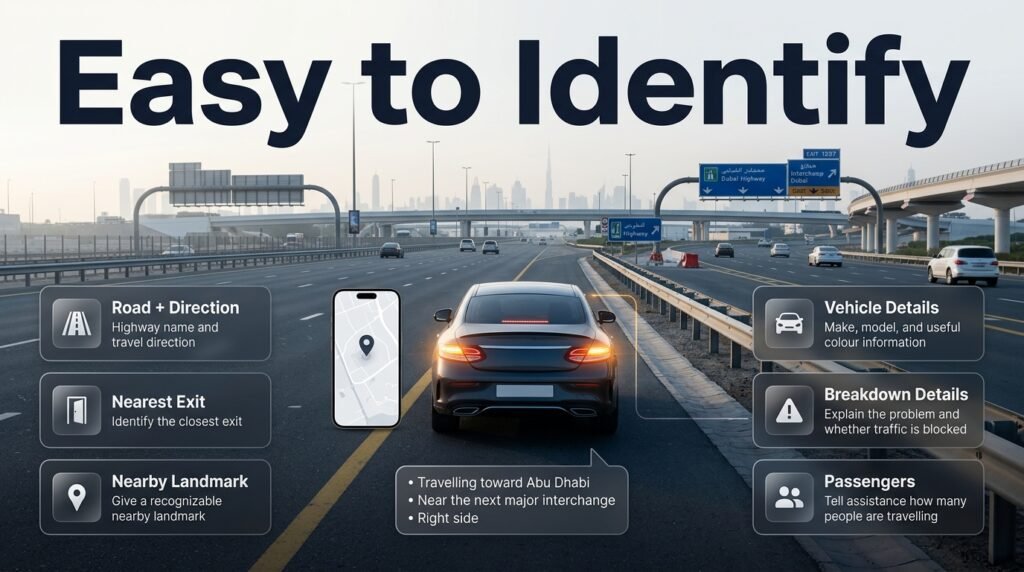
Once you’ve reached a safe position, one of the most useful things you can do is communicate your exact location.
Simply telling someone, “My car broke down on the highway,” isn’t enough.
Dubai has a large road network, multiple lanes, interchanges, exits, service roads, and parallel routes.
When contacting roadside assistance, provide:
- Road or highway name
- Direction of travel
- Nearest exit
- Nearby landmark
- Approximate location
- Vehicle make and model
- Vehicle colour if useful
- Type of problem
- Whether the vehicle is blocking traffic
- Number of passengers
If your phone supports location sharing, use the appropriate location information available to you.
Example
Instead of:
“I’m somewhere on Sheikh Zayed Road.”
Give information such as:
“I’m travelling toward Abu Dhabi, near the next major interchange, and my vehicle is stopped on the right side.”
Specific information makes it easier for assistance personnel to locate you.
Should You Stay Inside Your Car During a Highway Breakdown?
There isn’t one universal answer.
Your safest option depends on where the vehicle has stopped, how close traffic is, whether the vehicle is stable, and whether there are hazards such as fire or smoke.
If your vehicle is safely away from moving traffic and leaving it would expose you to greater danger, remaining inside with your seatbelt fastened may be appropriate.
If the vehicle is in a dangerous location and there is a safe, protected area that can be reached without entering active traffic, moving away from the vehicle may be preferable.
The important point is to avoid making a rushed decision.
Consider the surrounding conditions
| Situation | Main consideration |
|---|---|
| Vehicle safely away from traffic | Remaining protected may be appropriate |
| Vehicle very close to moving traffic | Treat the situation as higher risk |
| Vehicle blocking an active lane | Contact assistance urgently |
| Smoke or fire present | Distance from the vehicle becomes more important |
| Safe protected area available | Consider whether it can be reached safely |
| Extreme heat | Minimize unnecessary exposure |
⭐ Expert Tip: Don’t assume that “getting out of the car” is automatically safer. On a busy highway, the wrong exit from the vehicle can put you directly into the path of traffic.
What Should You Do If Your Car Stops in an Active Traffic Lane?
A vehicle that stops in a live traffic lane should be treated as a high-risk situation.
Turn on your hazard lights immediately.
If the vehicle can be moved safely, try to reach a safer position.
If it cannot move, don’t attempt to push it yourself.
Don’t stand behind the vehicle and wave at traffic.
Don’t walk into the lane to signal drivers.
Don’t try to cross the highway.
Instead, contact the appropriate roadside or emergency service and explain that the vehicle is unable to move and where it is located.
Why is pushing dangerous?
A person pushing a vehicle has little protection from approaching traffic. The vehicle may also begin rolling unexpectedly.
A disabled vehicle should be handled by people and equipment designed for roadside recovery whenever the location is unsafe.
How Should You Handle a Highway Breakdown in Dubai’s Heat?
Dubai’s climate adds another consideration to roadside emergencies: heat exposure.
A breakdown during a hot period can become uncomfortable quickly, especially if you are outside the vehicle for an extended time.
This is one reason preparation matters.
Keep these items available:
- Drinking water
- Charged mobile phone
- Phone charging cable
- Power bank if available
- Basic first-aid supplies
- Flashlight
- Emergency contact details
- Vehicle documents
- Appropriate emergency equipment
If your vehicle is safely positioned and there is no immediate hazard, minimizing unnecessary exposure to the heat may be sensible.
If there is smoke, fire, fuel leakage, or another dangerous condition, don’t stay near the vehicle simply because the weather is hot.
Safety takes priority over comfort.
What If Your Car Runs Out of Fuel on a Highway?
Running out of fuel is one of the most preventable causes of roadside breakdowns, but it still happens.
A driver may underestimate fuel consumption because of traffic, air-conditioning use, detours, congestion, or simply because the next fuel station is farther away than expected.
If your vehicle begins losing power because the fuel tank is empty, avoid repeated attempts to restart the engine.
If the car still has enough momentum to reach a safe stopping area, do so carefully.
Once stopped, treat the situation as a roadside safety problem.
Don’t walk along the highway searching for fuel.
Don’t cross traffic lanes to reach a petrol station.
Don’t stand near the traffic side of the vehicle unnecessarily.
Instead, arrange appropriate fuel or roadside assistance.
For more detailed guidance, see What to Do When You Run Out of Fuel in Dubai.
You can also read Car Ran Out of Fuel Safety in Dubai for additional practical safety advice.
What Should You Do When Running Out of Fuel on the Road?
Running out of fuel doesn’t mean you should immediately start walking.
Your first job is to make sure the vehicle is in the safest possible position.
If you are dealing with an empty fuel tank, avoid turning the situation into a pedestrian emergency.
A highway isn’t the same as a normal city street.
Vehicles may approach quickly, and walking along the roadside can expose you to traffic.
For a more detailed explanation, see Running Out of Fuel on the Road.
The safest solution is usually to remain in a protected location and arrange appropriate assistance.
What Should You Do If Your Car Stops Because the Fuel Tank Is Empty?
If the engine has stopped because there is no fuel left, don’t assume that the problem is minor simply because the repair itself is straightforward.
The location matters.
An empty tank in a parking area is inconvenient.
An empty tank beside a busy highway can become a safety issue.
You can learn more through Car Stops Due to Empty Fuel Tank.
For additional guidance on handling an empty tank safely, see Safely Dealing With an Empty Fuel Tank in Dubai.
If you’re unsure what to do immediately after the vehicle stops, Steps After Running Out of Petrol provides a useful step-by-step resource.
Is Professional Fuel Delivery Safer Than Walking to a Petrol Station?
When a vehicle has run out of fuel on a highway, walking to a petrol station may seem like the fastest solution.
It often isn’t.
You may have to walk beside fast-moving traffic, cross roads, carry fuel, or travel a considerable distance in hot weather.
Professional fuel delivery can remove much of that unnecessary exposure by bringing fuel to the vehicle, where safe access is possible.
The practical decision is simple:
If getting fuel requires you to put yourself in danger, don’t walk for it. Arrange assistance instead.
This is especially relevant when the vehicle is stopped on a busy Dubai highway.
What If Your Car Overheats on the Highway?
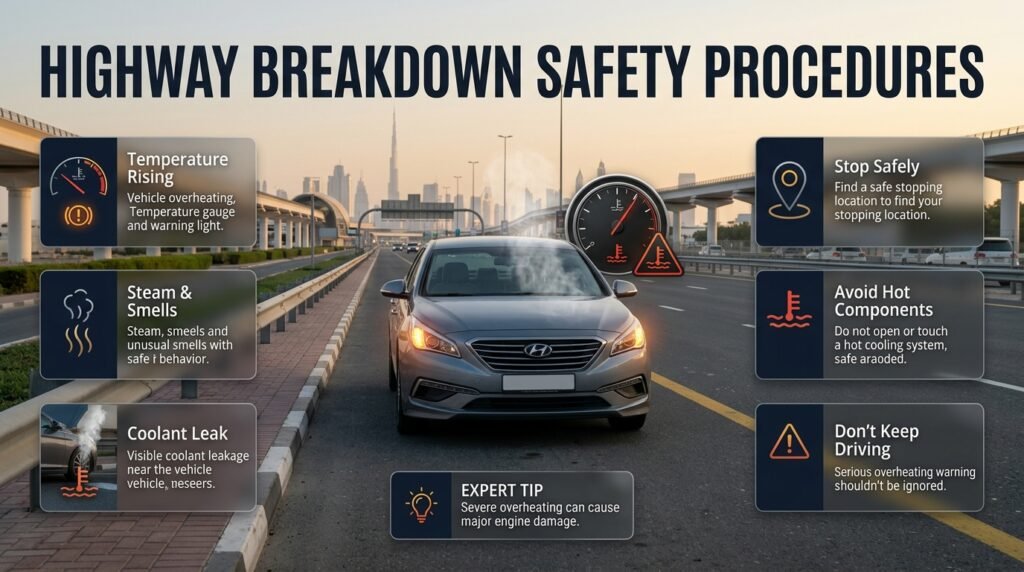
Overheating is another common reason for a highway stop.
You may notice:
- Temperature gauge rising
- Temperature warning light
- Steam
- Unusual smells
- Loss of engine performance
- Coolant leaking
If the temperature warning becomes serious, don’t continue driving simply because the destination is close.
Look for a safe stopping location.
Once stopped, don’t immediately open a hot radiator or cooling-system cap.
A hot cooling system can contain pressurized coolant and may cause serious burns.
Avoid:
- Opening a hot radiator cap
- Touching hot engine components
- Continuing to drive with a serious overheating warning
- Standing near escaping steam
- Attempting a repair while the engine is dangerously hot
⭐ Expert Tip: A few extra kilometres of driving with a severely overheating engine can turn a manageable cooling problem into major engine damage.
What If You Get a Flat Tyre on a Highway?
A flat tyre requires the same basic principle: safety before repair.
If you feel a sudden vibration, pulling, thumping, or loss of tyre pressure, reduce speed gradually and maintain control.
Avoid sudden steering.
If possible, move to a safe stopping location.
Once stopped, assess the environment before deciding whether to change the tyre yourself.
A tyre change may be relatively simple mechanically, but the roadside location can make it dangerous.
If traffic is passing close to the vehicle, professional roadside assistance may be a better choice.
For broader guidance, see Roadside Breakdown Safety Tips in Dubai.
What If Your Battery Dies on the Highway?
A weak battery can cause starting problems, but it may also create a breakdown after the vehicle has already been driven.
If your engine stops because of an electrical problem, follow the same basic highway safety process.
Don’t immediately start troubleshooting wires or electrical components beside moving traffic.
Get the vehicle into the safest available location if possible.
Then arrange appropriate roadside assistance.
If you suspect the battery is weak before a long journey, address it before leaving. Preventive maintenance is far easier than dealing with a dead vehicle beside a busy road.
What Should You Do While Waiting for Roadside Assistance?
Once help has been requested, avoid unnecessary activity.
Many drivers become impatient and repeatedly inspect the vehicle, walk around it, or attempt multiple repairs.
This can increase exposure to traffic.
Instead, keep the situation controlled.
While waiting:
- Keep your phone available.
- Monitor changing conditions.
- Keep passengers away from traffic.
- Avoid standing on the roadway.
- Follow instructions from the assistance provider.
- Keep your location information ready.
- Avoid unnecessary repairs.
- Remain alert to approaching traffic.
For a broader guide, read What to Do During a Roadside Breakdown.
What Are the Most Important Roadside Vehicle Emergency Precautions?
Roadside emergencies require a different mindset from normal vehicle maintenance.
You aren’t working in a garage.
You’re operating in an environment where other vehicles are moving around you.
Important precautions include:
Keep yourself visible
Your vehicle should be obvious to approaching traffic.
Stay away from traffic
Don’t stand closer to the roadway than necessary.
Don’t attempt unsafe repairs
A repair can wait if the location is dangerous.
Communicate clearly
Tell assistance personnel exactly where you are.
Protect passengers
Children and other passengers shouldn’t be allowed to wander around the vehicle.
More practical advice is available in Roadside Vehicle Emergency Precautions.
Highway Breakdown Safety vs. Normal Roadside Breakdown Safety
Not every breakdown requires the same response.
| Factor | Highway | Normal Roadside |
|---|---|---|
| Traffic speed | Often high | Usually lower |
| Reaction time | Limited | Often greater |
| Pedestrian exposure | Higher risk | Depends on location |
| DIY repairs | Often less suitable | May be practical |
| Walking for help | Generally unsafe | Sometimes possible |
| Vehicle visibility | Extremely important | Still important |
| Professional assistance | Often preferable | Situation-dependent |
The biggest difference is exposure to moving traffic.
A tyre change in a quiet parking area may be straightforward.
The same tyre change on a narrow highway shoulder can be significantly more dangerous.
What Should You Keep in Your Car for a Highway Emergency?
Preparation doesn’t guarantee that a breakdown won’t happen, but it can make the situation easier to manage.
Consider keeping:
- Drinking water
- Charged mobile phone
- Car charger
- Power bank
- Flashlight
- Basic first-aid supplies
- Vehicle documents
- Tyre information
- Spare tyre where applicable
- Suitable emergency equipment
- Important roadside assistance numbers
You should also know basic information about your vehicle before a breakdown occurs.
For example:
Where are the hazard-light controls?
Where is the spare tyre?
Does the car have a tyre repair kit?
What dashboard warnings indicate overheating?
Knowing these things in advance can save valuable time.
How Can You Prevent a Highway Breakdown?
The best breakdown is the one you prevent.
Before a long highway journey, spend a few minutes checking the vehicle.
Check the Fuel Level
Don’t begin a long journey with the fuel gauge already close to empty.
Traffic congestion can increase travel time and fuel consumption.
Unexpected detours can also change your fuel requirements.
Check the Tyres
Look for:
- Low pressure
- Uneven wear
- Cracks
- Visible damage
- Excessive tread wear
Check Dashboard Warning Lights
Don’t ignore warning lights simply because the vehicle still drives normally.
A warning today can become a breakdown tomorrow.
Check the Battery
If your vehicle is slow to start, don’t assume it will suddenly fix itself.
Check Important Fluids
Check the appropriate fluid levels according to your vehicle manufacturer’s recommendations.
Plan Your Journey
Know the major roads, exits, and destinations.
Don’t rely entirely on the estimated driving range shown by the dashboard.
How Can Fuel Planning Reduce Highway Breakdown Risk?
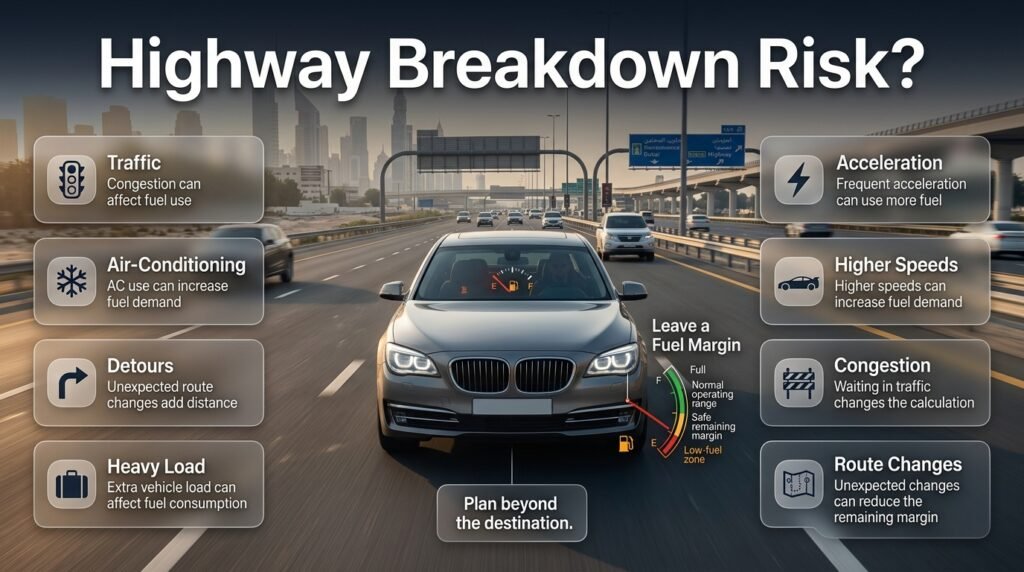
Fuel planning is particularly important on long trips.
A driver may think:
“I have enough fuel to reach the destination.”
But the calculation can change because of:
- Traffic
- Air-conditioning
- Detours
- Heavy vehicle load
- Frequent acceleration
- Higher speeds
- Waiting in congestion
- Unexpected route changes
A sensible driver doesn’t treat the last portion of the fuel gauge as a guaranteed reserve.
Leave yourself a reasonable margin.
That simple habit can prevent an empty-tank emergency.
Common Highway Breakdown Mistakes
Mistake 1: Panicking
A sudden breakdown can be frightening.
But panic can cause sudden steering, braking, or unsafe decisions.
Better approach: Focus on vehicle control first.
Mistake 2: Trying to Walk for Fuel
Drivers sometimes believe a petrol station must be nearby.
They may underestimate the distance or forget how dangerous highway walking can be.
Better approach: Arrange fuel or roadside assistance.
Mistake 3: Standing Beside the Vehicle
Getting out of the car doesn’t automatically make you safer.
Better approach: Choose the safest available protected position.
Mistake 4: Repairing the Vehicle in an Unsafe Location
Even a simple tyre change can become dangerous when traffic is moving close by.
Better approach: Move to a genuinely safe location or call professionals.
Mistake 5: Giving an Incomplete Location
“Highway breakdown” isn’t enough information for an assistance provider.
Better approach: Give road name, direction, exit, landmark, and precise location information available to you.
Mistake 6: Repeatedly Restarting the Engine
Repeated starting attempts won’t create fuel where there is none and may worsen certain mechanical issues.
Better approach: Stop unnecessary attempts and arrange assistance.
Mistake 7: Ignoring Early Warning Signs
A temperature warning, strange vibration, or repeated dashboard alert shouldn’t be ignored.
Better approach: Investigate the problem before a long journey.
Mistake 8: Forgetting About Passengers
Drivers sometimes focus entirely on the car.
Passengers also need protection.
Better approach: Keep everyone away from unnecessary traffic exposure.
Expert Advice: Think About Safety Before the Mechanical Problem
Professional roadside workers don’t approach every breakdown by asking:
“How quickly can we repair the car?”
They first ask:
“Is the location safe?”
That difference matters.
A vehicle can be repaired later.
A dangerous roadside situation needs to be controlled first.
A practical professional mindset is:
1. Assess location
Where is the vehicle relative to traffic?
2. Assess visibility
Can approaching drivers clearly recognize the problem?
3. Assess passengers
Are people exposed to traffic or environmental hazards?
4. Assess the vehicle
Can it be moved safely?
5. Arrange assistance
What type of help is required?
6. Repair or recover
Only once the situation is controlled.
⭐ Expert Tip: Don’t measure a successful breakdown response by how quickly you repair the vehicle. Measure it by whether everyone remains safe until the problem is resolved.
What Should You Do During a Long Highway Breakdown?
A short breakdown may be resolved quickly.
A complicated breakdown can take longer.
During a prolonged roadside wait, conditions can change.
Traffic may become heavier.
Weather may change.
The vehicle’s position may become more difficult to access.
Your phone battery may become low.
For this reason, conserve your phone battery where practical and keep communication available.
If you initially provided an approximate location, update the assistance provider if you discover more accurate information.
Don’t become so comfortable waiting that you stop monitoring your surroundings.
How Should You Handle a Breakdown at Night?
Night-time breakdowns require additional caution because visibility is reduced.
Make the vehicle as visible as practical using appropriate warning equipment and lights.
Avoid standing in dark areas beside moving traffic.
Keep passengers together and away from the roadway.
When contacting assistance, provide landmarks and location information clearly.
If you’re unsure whether a particular area is safe, avoid unnecessary movement until professional help arrives.
The basic principle remains the same:
Visibility and protection come before repair.
What If Another Driver Stops to Help?
It’s common for another motorist to offer assistance after seeing a broken-down vehicle.
You can be polite without putting yourself in an unsafe situation.
You don’t need to accept every offer of help.
If professional assistance is already on the way, explain that help has been arranged.
Don’t allow someone to persuade you to walk into traffic, cross the highway, or perform an unsafe repair.
Your priority remains your safety.
What If You See Someone Else’s Car Broken Down?
If you see a broken-down vehicle while driving, reduce speed and give it plenty of space.
Don’t stop in a way that creates another obstruction.
If someone clearly requires emergency assistance, use the appropriate emergency or roadside channels rather than creating an additional roadside hazard.
Remember that approaching traffic may not notice the disabled vehicle immediately.
Giving it space is one of the simplest ways to reduce risk.
A Simple Highway Breakdown Decision Tree
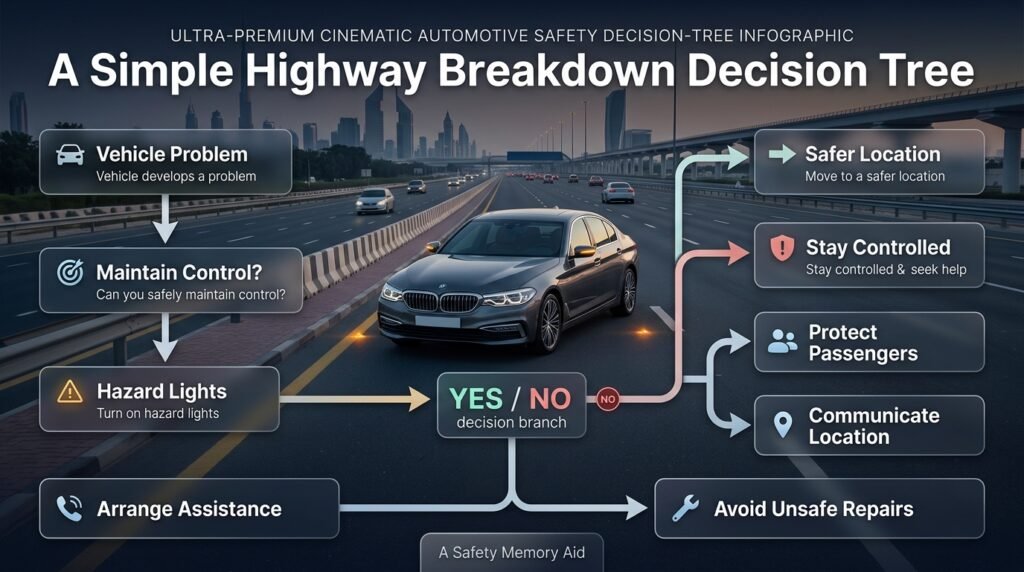
You can remember the process using this simple structure:
Vehicle develops a problem
          ↓
Can you safely maintain control?
          ↓
        YES
          ↓
Turn on hazard lights
          ↓
Can the vehicle move safely?
      ↙           ↘
    YES             NO
     ↓               ↓
Move to safer     Stay controlled
location          and seek help
     ↓               ↓
Protect passengers and communicate location
              ↓
       Arrange assistance
              ↓
       Avoid unsafe repairs
The decision tree isn’t designed to replace professional or emergency instructions. It’s simply a memory aid for keeping your priorities in the right order.
Highway Fuel Emergency Safety
Fuel-related breakdowns deserve special attention because they’re preventable but common.
The mistake is usually not the lack of fuel itself.
It’s what drivers do after the tank becomes empty.
A driver may:
- Walk toward a station.
- Stand beside the car.
- Ask strangers for fuel.
- Cross traffic.
- Continue trying to start the engine.
- Leave passengers unattended.
These actions can create additional risks.
For a dedicated guide, see Highway Fuel Emergency Safety in Dubai.
The safer approach is to make the vehicle visible, remain protected, and arrange suitable assistance.
When Should You Call for Professional Assistance?
You should consider professional assistance when:
- The vehicle cannot move.
- The vehicle is positioned dangerously.
- You have a flat tyre in an unsafe location.
- The engine is overheating.
- You have run out of fuel.
- The battery is dead.
- You don’t know what caused the breakdown.
- The repair requires specialist equipment.
- You feel unsafe attempting the repair yourself.
There’s no advantage in taking unnecessary risks simply to prove you can repair the problem yourself.
A roadside professional has the appropriate equipment and experience to deal with vehicle recovery more safely.
How Can You Prepare for a Highway Breakdown Before Leaving?
Preparation takes only a few minutes.
Before a long journey, ask yourself:
Fuel
Do I have enough fuel with a reasonable reserve?
Tyres
Are my tyres properly inflated and free from obvious damage?
Battery
Has the vehicle shown any signs of weak starting?
Cooling system
Is the temperature behaving normally?
Phone
Is my phone charged?
Water
Do I have enough drinking water?
Route
Do I know my road, direction, and major exits?
Assistance
Do I know how to request help if something goes wrong?
These simple checks can make a major difference.
Highway Breakdown Safety Checklist
Before the Journey
- Check fuel level
- Check tyre pressure
- Inspect tyres
- Check dashboard warnings
- Check battery condition
- Check important fluid levels
- Charge your phone
- Carry water
- Carry basic emergency supplies
- Know your route
- Keep assistance information available
During a Breakdown
- Stay calm
- Maintain vehicle control
- Activate hazard lights
- Move away from traffic if safe
- Stop in the safest available location
- Protect passengers
- Assess the surrounding danger
- Contact assistance
- Share your exact location
- Avoid unnecessary repairs
- Avoid walking on the highway
What should you do first when your car breaks down on a highway?
The first priority is not fixing the vehicle—it is getting yourself and your passengers out of immediate danger. If the car is still moving, stay calm, maintain control, switch on the hazard lights, and try to reach the safest available location away from moving traffic. If the vehicle cannot be moved safely, don’t make a sudden manoeuvre just to reach the shoulder. Once stopped, assess your surroundings before deciding what to do next.
Important steps:
Keep control of the steering and avoid sudden braking.
Turn on hazard warning lights.
Move away from the live traffic lane if this can be done safely.
Stop as far from moving traffic as reasonably possible.
Assess whether passengers are exposed to traffic.
Contact roadside assistance and provide your exact location.
Avoid attempting repairs until the situation is genuinely safe.
The biggest mistake is treating a highway breakdown like a normal parking-lot problem. A flat tyre, empty fuel tank, or dead battery may be mechanically simple, but standing beside the vehicle with high-speed traffic passing nearby can create a much more serious danger.
Should you stay inside your car or get out during a highway breakdown?
There isn’t one answer that applies to every breakdown. The decision depends on where your vehicle has stopped, how close traffic is, whether a protected area is available, and whether there is an immediate hazard such as fire or smoke. Official guidance generally emphasizes moving to a place of relative safety and staying well away from moving traffic when it can be done safely.
If the vehicle is safely away from traffic and leaving it would expose you to greater danger, remaining inside with your seat belt fastened may be the safer option. If you can safely exit away from traffic and reach a protected area, that may provide better protection from a vehicle collision.
Before getting out, consider:
Is traffic passing very close to the vehicle?
Is there a barrier or protected area nearby?
Can you exit without stepping into traffic?
Is there smoke, fire, fuel leakage, or another immediate hazard?
Are children or vulnerable passengers with you?
Can everyone reach safety without crossing the roadway?
⚠️ Professional rule: Never get out simply because you assume being outside is safer. On a high-speed road, the wrong position outside the vehicle can be more dangerous than remaining securely inside.
What should you do if your car breaks down in a live highway traffic lane?
A breakdown in a live lane should be treated as a high-risk emergency, because approaching drivers may have very little time to react. Turn on your hazard lights immediately and, if the vehicle can be moved safely, try to reach a safer location. If it cannot move, don’t attempt to push the car yourself or walk into the traffic lane to warn drivers. Contact appropriate emergency or roadside assistance and clearly explain that the vehicle is stopped in an active lane.
Your location information becomes particularly important in this situation.
Tell the assistance provider:
Highway or road name
Direction of travel
Nearest exit or interchange
Lane or shoulder position
Nearby landmark
Vehicle make, model, and colour
Whether the vehicle is blocking traffic
Whether passengers are inside
If the vehicle cannot move, don’t risk your life trying to solve a mechanical problem while surrounded by moving traffic. The priority is to get professional help and reduce the chance of a secondary collision.
📌 Key point: A vehicle stopped in a live lane isn’t the right place for DIY repairs. The repair can wait; getting the traffic hazard managed cannot.
What should you do if you run out of fuel on a highway?
Running out of fuel on a highway should be handled as a roadside safety problem first and a fuel problem second. If possible, use the remaining vehicle momentum to reach a safer stopping location, switch on the hazard lights, and arrange fuel or roadside assistance. Do not walk along the highway looking for a petrol station or attempt to cross traffic lanes to obtain fuel.
This is particularly important in Dubai, where a driver may face heavy traffic, long road sections, and high temperatures while waiting for assistance.
If you run out of fuel:
Move the vehicle away from active traffic if it is safe to do so.
Turn on hazard lights.
Don’t repeatedly attempt to restart an empty tank.
Don’t walk along the highway.
Don’t cross traffic lanes.
Keep passengers away from moving traffic.
Arrange professional fuel delivery or roadside assistance.
Give the provider your precise location.
For your article, this FAQ is especially valuable because it connects highway breakdown safety with a common fuel-related emergency without making the content feel promotional.
The key lesson is simple: don’t turn an empty fuel tank into a pedestrian emergency.
Is it safe to repair or change a tyre on the highway shoulder?
A highway shoulder should never automatically be treated as a safe place for repairs. Even if changing a tyre is mechanically straightforward, you may have to stand outside the vehicle close to fast-moving traffic. Road-safety guidance from multiple authorities recommends avoiding roadside repairs on high-speed roads when doing so exposes you to traffic.
If you experience a flat tyre, focus first on controlling the vehicle and reaching a safer stopping position if possible. Once stopped, assess the surroundings before deciding whether a repair is appropriate.
Consider these factors:
Width of the shoulder
Speed and volume of passing traffic
Distance between your vehicle and traffic
Visibility
Weather and lighting conditions
Availability of a safer stopping area
Whether professional roadside assistance is available
If the location is narrow, exposed, or uncomfortable enough that you’re worried about passing vehicles, that’s a strong indication that you shouldn’t be standing there trying to change the tyre.
⭐ Professional advice: Being able to change a tyre doesn’t mean you should change it in every location. The roadside environment determines whether the repair is safe—not the simplicity of the repair itself.
Conclusion
A highway breakdown can happen without warning, but the way you respond can make a major difference to your safety. The most important thing is not to panic or rush into repairs. Focus first on getting yourself and your passengers away from moving traffic, making the vehicle visible to other drivers, and contacting the right roadside assistance when needed.
Whether the problem is an empty fuel tank, flat tyre, overheated engine, or dead battery, treat a highway breakdown as a safety situation rather than simply a vehicle problem. Avoid standing close to traffic, walking along the highway to find fuel, or attempting repairs in an exposed location. If your vehicle can be moved safely, get it to a safer position; if it cannot, stay alert and follow appropriate local emergency and roadside assistance guidance.
A few simple habits can also prevent many stressful situations. Check your fuel level before long journeys, keep your vehicle properly maintained, carry essential emergency equipment, and know how to communicate your exact location if something goes wrong.
Most importantly, remember that getting home safely is more important than saving a few minutes or trying to fix everything yourself. Staying calm, making your vehicle visible, keeping away from traffic, and getting professional help when necessary are the foundations of effective highway breakdown safety procedures.
Leave a Reply