Introduction
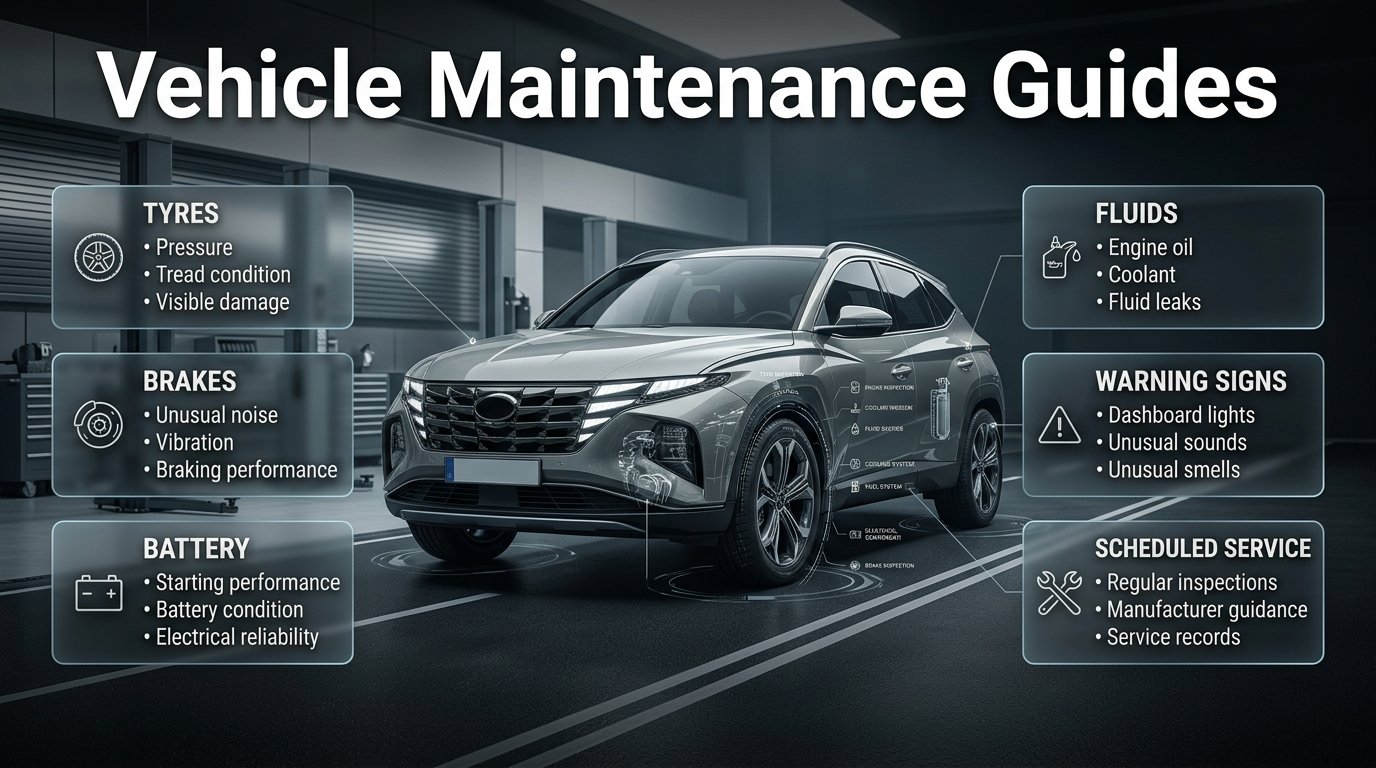
Vehicle Maintenance Guides | A vehicle can appear perfectly healthy one day and develop a serious problem the next. But in many cases, the warning signs were already there: a tyre slowly losing pressure, a battery taking longer to start the engine, a brake making an unusual noise, a warning light appearing on the dashboard, or the engine beginning to use more oil than usual.
The challenge isn’t always knowing that a vehicle needs maintenance. The real challenge is knowing what to check, how often to check it, which problems are urgent, and which tasks require a professional.
That’s why practical vehicle maintenance guides are useful. Good maintenance isn’t simply about changing engine oil. It includes tyres, brakes, fluids, battery health, cooling systems, filters, fuel, electrical components, suspension, steering, warning lights, and scheduled servicing.
For drivers who also want to understand the connection between vehicle operation, fuel, and roadside support, Petrol Delivery to My Location 👉 Fuel Delivery Dubai provides additional information.
This guide explains vehicle maintenance in simple, practical language. You’ll learn how to create a maintenance routine, what you can inspect yourself, when professional help is needed, how fuel quality can affect vehicle operation, what mistakes commonly cost drivers money, and how to prepare a vehicle before a long journey.
The objective isn’t to turn every driver into a mechanic. It’s to help you recognize problems earlier, understand what your vehicle needs, and make better maintenance decisions.
What Does Vehicle Maintenance Include?
Vehicle maintenance is the process of inspecting, servicing, cleaning, adjusting, replacing, and repairing components so that a vehicle remains safe and reliable.
Some maintenance tasks are simple enough for many owners to perform themselves. Others require specialist tools, diagnostic equipment, technical knowledge, or safety procedures.
Typical maintenance areas include:
- Engine oil and filters
- Tyres and wheels
- Brakes
- Battery and charging system
- Cooling system
- Transmission
- Steering and suspension
- Lights and visibility
- Air conditioning
- Fuel system
- Exhaust and emissions components
- Belts and hoses
- Electrical and electronic systems
Maintenance can generally be divided into three categories.
Routine Maintenance
Routine maintenance consists of regular checks and simple servicing.
Examples include:
- Checking tyre pressure
- Checking fluid levels
- Inspecting lights
- Looking for visible leaks
- Checking wipers
- Monitoring warning lights
Preventive Maintenance
Preventive maintenance means dealing with wear or service requirements before they become failures.
Examples include:
- Replacing engine oil according to the service schedule
- Replacing a scheduled filter
- Inspecting brake components
- Replacing worn tyres
- Testing an aging battery
For practical guidance on keeping your vehicle reliable, identifying maintenance needs early, and reducing the risk of unexpected problems, explore our complete Preventive Vehicle Maintenance Guide.
Corrective Maintenance
Corrective maintenance takes place after a problem has been identified.
Examples include:
- Replacing a failed alternator
- Repairing a coolant leak
- Replacing damaged suspension components
- Repairing a fuel-system fault
The best vehicle maintenance strategy combines all three.
Why Is Regular Vehicle Maintenance Important?
Regular maintenance helps reduce avoidable problems and gives you an opportunity to identify developing faults before they become larger failures.
It can help with:
- Road safety
- Reliability
- Predictable repair costs
- Component lifespan
- Fuel efficiency
- Vehicle performance
- Resale condition
- Reduced breakdown risk
However, maintenance isn’t a guarantee that a vehicle will never break down. Electrical components, tyres, mechanical parts, and other systems can fail unexpectedly.
The goal is to reduce preventable problems and identify developing issues as early as possible.
For example, a tyre that is losing pressure slowly may seem like a minor inconvenience. But if the driver continues without checking it, incorrect pressure can affect handling, tread wear, and fuel consumption.
Pro Tip: Don’t wait until a vehicle feels seriously different before checking it. Small changes can provide useful early warnings.
How Often Should a Vehicle Be Maintained?
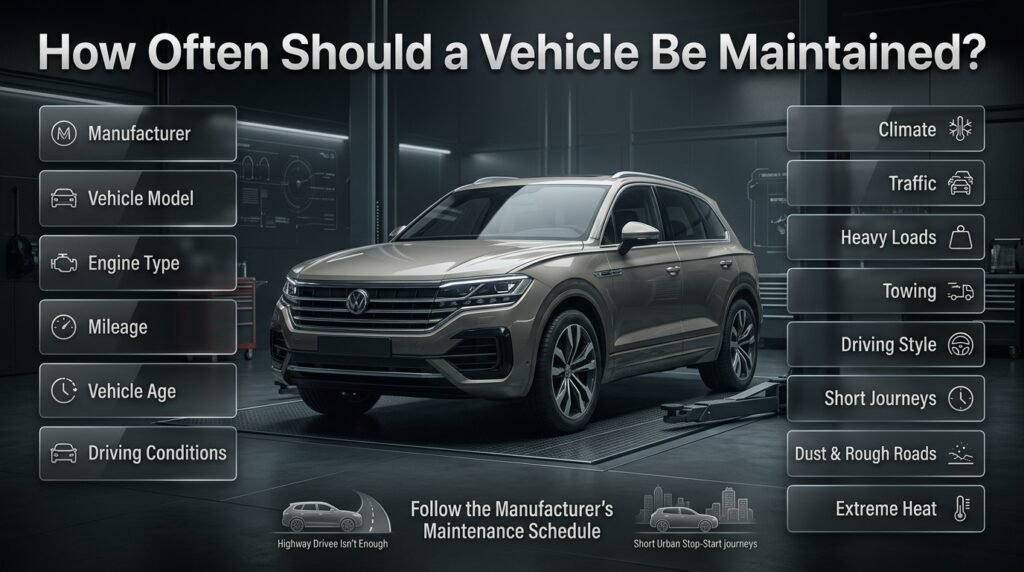
There isn’t one maintenance schedule that works for every vehicle.
The correct schedule depends on:
- Vehicle manufacturer
- Model
- Engine type
- Mileage
- Age
- Driving conditions
- Climate
- Traffic conditions
- Load
- Towing
- Driving style
The owner’s manual should be your primary source for vehicle-specific maintenance intervals.
Some vehicles use mileage-based schedules. Others use time-based intervals, service-monitor systems, or a combination.
Why Mileage Alone Isn’t Enough
Two cars may have exactly the same mileage but completely different operating histories.
Imagine one car that has spent most of its life travelling on highways. Another has been used for short urban trips with frequent stops and starts.
The second vehicle may experience different levels of stress even though the mileage is identical.
Factors that can affect maintenance requirements include:
- Heavy traffic
- Frequent short journeys
- Extreme heat
- Dust
- Rough roads
- Heavy loads
- Towing
- Long periods of inactivity
- Frequent cold starts
- Aggressive driving
This is why a generic “service every X kilometres” rule shouldn’t replace the manufacturer’s instructions.
What Should You Check Before Driving?
You don’t need to perform a full mechanical inspection every time you enter your vehicle.
A quick visual and functional check is often enough for everyday use.
Look around the vehicle for:
- Flat tyres
- Damaged tyres
- Fluid underneath the vehicle
- Broken lights
- Damaged mirrors
- Windscreen damage
- Loose exterior components
- Unusual smoke
Once you start the vehicle, pay attention to:
- Warning lights
- Engine starting behavior
- Brake-pedal feel
- Steering feel
- Unusual vibrations
- Unusual noises
- Unusual smells
A vehicle owner who knows how the car normally behaves is often better positioned to notice when something changes.
How Do You Check Engine Oil?
Engine oil lubricates internal engine components and helps reduce friction and heat.
Maintaining the correct oil level is important, but the checking procedure differs between vehicles.
If your vehicle uses a traditional dipstick:
- Park on a suitable level surface.
- Follow the manufacturer’s instructions about engine temperature.
- Switch the engine off.
- Wait for the recommended period if required.
- Remove the dipstick.
- Wipe it clean.
- Reinsert it completely.
- Remove it again.
- Compare the oil level with the marked range.
Some modern vehicles don’t use a dipstick and instead provide an electronic oil-level reading.
Always follow the procedure specified for your vehicle.
What If the Oil Level Is Low?
Low oil doesn’t necessarily mean that the engine simply needs an oil change.
The vehicle could have:
- An oil leak
- Increased oil consumption
- A seal problem
- Internal engine wear
- Another mechanical issue
If the level repeatedly falls between services, the cause should be investigated.
Common Mistake: Continuously adding oil without investigating abnormal oil loss can hide an underlying mechanical problem.
Is Dark Oil Always Bad?
Not necessarily.
Oil can change appearance as it circulates through an engine and performs its job. Color alone isn’t a reliable way to determine whether oil needs replacement.
Service intervals should be based on the manufacturer’s specifications and operating conditions.
Why Are Tyres So Important?
Tyres are the only components directly connecting the vehicle to the road.
Their condition affects:
- Braking
- Steering
- Stability
- Grip
- Ride quality
- Road noise
- Fuel economy
A tyre can look acceptable from a distance while having a problem that needs attention.
Regularly inspect for:
- Cuts
- Cracks
- Bulges
- Punctures
- Uneven wear
- Damaged sidewalls
- Embedded objects
- Excessive tread wear
What Tyre Pressure Should You Use?
Use the pressure recommended by the vehicle manufacturer.
This information is normally available in the owner’s manual or on a vehicle information label.
Don’t automatically use the maximum pressure printed on the tyre sidewall. That number isn’t necessarily the recommended pressure for your specific vehicle.
Check tyre pressure regularly and, where possible, when the tyres are appropriately cool.
What Causes Uneven Tyre Wear?
Uneven wear can have several causes.
These include:
- Incorrect tyre pressure
- Wheel alignment problems
- Suspension wear
- Wheel balancing issues
- Incorrect installation
- Driving conditions
If a replacement tyre begins wearing unevenly soon after installation, replacing it again without checking the underlying cause may simply repeat the problem.
Quick Tip: Tyre pressure deserves extra attention before long-distance journeys.
When Should You Check the Brakes?
Brake problems should never be treated as something to ignore until the next convenient service.
Potential warning signs include:
- Grinding
- Persistent squealing
- Brake vibration
- Steering-wheel vibration during braking
- Soft brake pedal
- Increased stopping distance
- Pulling to one side
- Brake warning lights
- Burning smells
Some brake sounds may have simple explanations, but persistent or worsening symptoms should be inspected.
Why Brake Maintenance Matters
Brake components naturally wear over time.
Wear can vary depending on:
- Traffic
- Driving style
- Vehicle weight
- Road conditions
- Climate
- Mileage
A vehicle used heavily in stop-and-go traffic may place different demands on its brakes than one used mainly on highways.
If braking performance changes noticeably, safety should take priority over convenience.
How Should You Maintain the Battery?
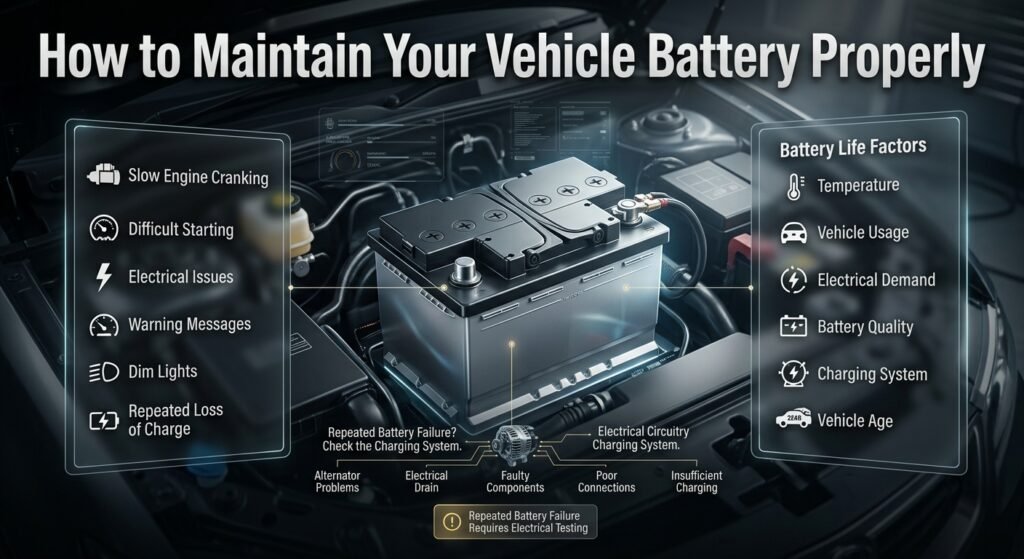
The battery is essential for starting the engine and supporting electrical systems.
A weak battery can cause:
- Slow engine cranking
- Difficult starting
- Intermittent electrical issues
- Warning messages
- Dim lights
- Repeated loss of charge
Battery life varies depending on:
- Temperature
- Vehicle usage
- Electrical demand
- Battery quality
- Charging-system condition
- Vehicle age
Why Does a New Battery Sometimes Fail Again?
If a replacement battery becomes weak unusually quickly, the battery may not be the only problem.
Possible causes include:
- Alternator problems
- Excessive electrical drain
- Faulty electrical components
- Poor connections
- Insufficient charging
Replacing the battery repeatedly without testing the charging and electrical systems can waste money.
Expert Tip: Repeated battery failure is a reason to investigate the vehicle’s electrical and charging systems, not simply keep buying batteries.
Why Is the Cooling System Important?
An engine produces substantial heat during operation.
The cooling system helps keep engine temperature within its intended operating range.
Depending on the vehicle, the system can include:
- Coolant
- Radiator
- Water pump
- Thermostat
- Cooling fans
- Hoses
- Expansion tank
- Sensors
Signs of a Cooling-System Problem
Watch for:
- Temperature warning lights
- Rising temperature gauge
- Coolant loss
- Visible leaks
- Steam
- Unusual smells
- Cooling fans behaving abnormally
- Repeated overheating
Overheating should never be treated as a normal maintenance issue.
If the engine overheats, stop safely and allow it to cool according to appropriate safety procedures.
Never open a hot pressurized cooling system casually. Hot coolant can cause serious burns.
What Happens If Coolant Keeps Disappearing?
Repeated coolant loss should be investigated.
Possible causes include:
- External leaks
- Hose problems
- Radiator problems
- Water-pump problems
- Thermostat housing leaks
- Other cooling-system faults
Simply adding more coolant solves the immediate low-level condition but doesn’t identify why the level dropped.
A vehicle that repeatedly needs coolant deserves professional inspection.
What Vehicle Fluids Need Attention?
Modern vehicles use several different fluids.
Depending on the vehicle, these may include:
- Engine oil
- Coolant
- Brake fluid
- Transmission fluid
- Differential fluid
- Transfer-case fluid
- Power-steering fluid
- Windscreen washer fluid
These fluids perform different jobs and aren’t interchangeable.
Why Does Fluid Specification Matter?
Modern vehicles can have very specific fluid requirements.
Using an incorrect product can contribute to:
- Poor lubrication
- Seal problems
- Transmission issues
- Hydraulic problems
- Reduced component life
- System malfunction
Always check the manufacturer’s required specification rather than choosing a product simply because its packaging says it is suitable for vehicles.
What Role Does Fuel Play in Vehicle Maintenance?
Fuel is an important part of vehicle operation, but it is sometimes misunderstood.
Petrol and diesel engines use different combustion methods, and their fuel systems have different characteristics.
Drivers who want to understand the basics can explore Fuel Fundamentals.
For a broader explanation of fuel categories, see automotive fuel types and petrol and diesel fuel types.
Good fuel-related maintenance includes:
- Using the correct fuel
- Following the vehicle’s fuel specification
- Avoiding suspected contaminated fuel
- Responding correctly to wrong-fuel incidents
- Investigating symptoms after refueling
It doesn’t mean buying unnecessary additives or automatically choosing the most expensive fuel.
How Can Fuel Quality Affect Engine Performance?
Fuel quality can affect combustion and fuel-system operation.
Poor-quality or contaminated fuel may contribute to:
- Difficult starting
- Hesitation
- Misfires
- Rough running
- Poor acceleration
- Reduced power
- Stalling
However, these symptoms aren’t proof that fuel is responsible.
Similar symptoms can be caused by:
- Ignition faults
- Sensors
- Fuel pumps
- Injectors
- Air-intake problems
- Electrical faults
- Mechanical problems
This is why proper diagnosis matters.
For more information, see fuel quality standards and fuel quality and engine performance.
What Is Fuel Quality Testing?
Fuel quality testing can help determine whether a fuel-related problem actually exists.
This becomes particularly useful when a vehicle develops unusual symptoms after refueling.
You can learn more through fuel quality testing basics.
A sensible investigation considers:
- When the symptoms started.
- Whether the symptoms appeared after refueling.
- What fuel was added.
- Whether the vehicle had experienced similar problems previously.
- Whether fuel pressure is normal.
- Whether the fuel sample shows contamination.
- Whether other vehicle systems are functioning correctly.
Timing can be a useful clue, but timing alone doesn’t prove cause and effect.
What Are the Symptoms of Contaminated Petrol?
Contaminated petrol may contribute to:
- Difficult starting
- Rough running
- Hesitation
- Misfires
- Reduced acceleration
- Engine stalling
More detailed information is available in contaminated petrol symptoms.
If symptoms began immediately after refueling, document what happened and avoid unnecessary driving until the situation has been assessed.
What Can Cause Diesel Fuel Contamination?
Diesel fuel can experience contamination from several sources, including water, dirt, storage issues, handling problems, or unsuitable material entering the fuel system.
Possible consequences can include poor engine performance and fuel-system problems.
For more information, see contaminated diesel causes.
It’s important not to assume that every diesel engine problem is contamination. Professional diagnosis should consider the entire fuel and engine system.
What Causes Fuel Contamination?
Fuel contamination can occur at different stages, including storage, transportation, handling, or introduction of foreign material.
Potential contaminants can include:
- Water
- Dirt
- Sediment
- Incorrect fuel
- Other unwanted material
See causes of fuel contamination for additional information.
Good fuel handling practices reduce the risk, but no vehicle owner should assume that contamination is impossible.
What Are the Characteristics of Good Quality Petrol?
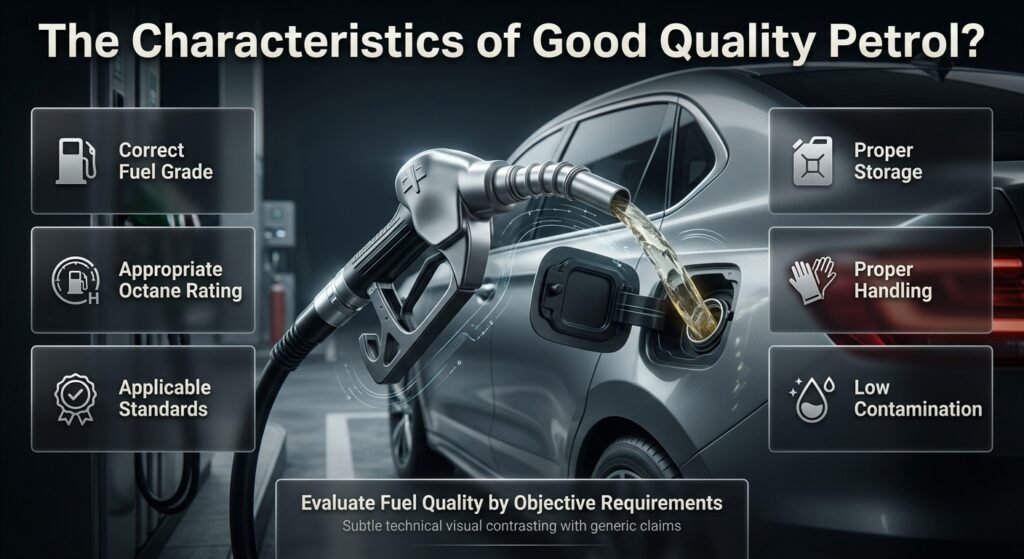
Fuel should meet the relevant specification and be appropriate for the vehicle.
Useful characteristics can involve:
- Correct fuel grade
- Appropriate octane rating
- Compliance with applicable standards
- Proper storage and handling
- Absence of significant contamination
For more information, see good quality petrol characteristics.
The important point is that fuel quality should be evaluated according to objective requirements rather than appearance or marketing claims alone.
Does Premium Petrol Improve Vehicle Performance?
Higher-octane petrol isn’t automatically better for every vehicle.
Octane rating is primarily related to resistance to engine knock.
If an engine is designed to operate on a lower octane rating, moving to a higher grade doesn’t automatically create additional power or improve fuel economy.
The vehicle manufacturer’s recommendation should guide fuel selection.
For a more detailed comparison, see regular vs premium petrol octane.
How Do Petrol and Diesel Engines Differ?
Petrol and diesel engines use different combustion approaches.
Petrol engines generally use spark ignition, while diesel engines use compression ignition.
These differences affect components, combustion behavior, fuel systems, and maintenance requirements.
For additional information, read about the petrol engine combustion process and the diesel engine combustion process.
The maintenance schedule still depends on the specific vehicle, so engine type alone shouldn’t be used to determine service intervals.
What Is Preventive Vehicle Maintenance?
Preventive maintenance means dealing with maintenance requirements before a component reaches complete failure.
For example, if the manufacturer specifies a particular service interval for an oil and filter change, waiting until the engine develops a problem isn’t a sensible maintenance strategy.
Likewise, a tyre with significant wear should be addressed before it becomes unsafe.
Preventive maintenance can provide:
- Better reliability
- Fewer avoidable breakdowns
- More predictable expenses
- Improved safety
- Better vehicle condition
- Easier planning
However, preventive maintenance doesn’t mean replacing every component as early as possible.
The goal is to follow manufacturer recommendations and respond to actual component condition.
Which Maintenance Tasks Can You Do Yourself?
Many vehicle owners can safely perform basic checks.
Depending on the vehicle, these may include:
- Checking tyre pressure
- Inspecting tyres
- Checking washer fluid
- Inspecting lights
- Checking certain fluid levels
- Looking for visible leaks
- Replacing some wiper blades
- Monitoring warning lights
- Keeping service records
Before performing any maintenance task, check the owner’s manual.
Some vehicles have specific procedures that differ from older or simpler vehicles.
Which Maintenance Jobs Should a Professional Handle?
Professional assistance is recommended for complex or safety-critical work.
This includes:
- Brake repairs
- Steering repairs
- Suspension work
- Wheel alignment
- Transmission repairs
- Major engine repairs
- Advanced electrical diagnosis
- Fuel-system diagnosis
- Cooling-system faults
- Air-conditioning repairs
- Advanced electronic diagnostics
Modern vehicles can contain complicated electronic systems, sensors, control modules, and safety systems.
Trying to repair these systems without appropriate knowledge can create additional problems.
What Are the Most Common Vehicle Maintenance Mistakes?
Ignoring Dashboard Warning Lights
A warning light is information.
Some warnings may be less urgent than others, but drivers shouldn’t assume that every warning can safely be ignored.
Check the owner’s manual and obtain appropriate diagnosis when necessary.
Guessing the Correct Fluid
A fluid being marketed for “cars” doesn’t mean it is correct for every vehicle.
Always verify the required specification.
Overfilling Fluids
More fluid isn’t automatically better.
Oil, coolant, transmission fluid, and other systems have specified operating levels.
Ignoring Tyre Pressure
Tyre pressure changes over time and with temperature.
Regular checks are simple and can prevent unnecessary problems.
Replacing Parts Without Diagnosis
A symptom doesn’t identify a component by itself.
For example, a car that won’t start might have a battery issue, starter problem, fuel problem, ignition fault, sensor issue, or another cause.
Replacing parts randomly can become expensive.
Ignoring Small Leaks
A small leak may indicate a developing problem.
Don’t assume that a small amount of fluid on the ground is harmless without identifying what it is.
Assuming Fuel Is Always the Problem
If an engine runs poorly after refueling, fuel contamination is one possibility.
But other systems can create identical symptoms.
Good diagnosis considers:
- Fuel
- Ignition
- Air intake
- Electrical systems
- Sensors
- Engine mechanics
How Can Vehicle Maintenance Improve Fuel Economy?
Maintenance alone doesn’t guarantee dramatically better fuel economy, but vehicle condition can influence efficiency.
Useful practices include:
- Maintain correct tyre pressure.
- Follow the manufacturer’s service schedule.
- Replace service items when required.
- Fix engine faults promptly.
- Avoid unnecessary weight.
- Use the correct fuel.
- Avoid excessive idling.
- Drive smoothly.
- Maintain sensible speeds.
Tyre pressure is particularly important because incorrect pressure can increase rolling resistance.
However, overinflating tyres isn’t a proper fuel-saving strategy. Safety and manufacturer recommendations should come first.
For more information about conditions that influence fuel quality, see factors affecting fuel quality.
How Should You Prepare a Vehicle for a Long Journey?
A long trip is a good reason to perform a more thorough inspection.
Before travelling, check:
- Tyre pressure
- Tyre condition
- Spare tyre or repair equipment
- Engine oil
- Coolant
- Washer fluid
- Brakes
- Battery
- Lights
- Wipers
- Fuel level
- Warning lights
Also check whether the next scheduled service is due during your trip.
Long-Distance Vehicle Maintenance Checklist
- Check tyre pressure.
- Inspect tread and sidewalls.
- Check engine oil.
- Check coolant according to the manufacturer’s procedure.
- Check washer fluid.
- Test lights.
- Inspect wipers.
- Check battery condition.
- Check brakes.
- Confirm the spare tyre or repair kit is usable.
- Make sure no warning lights are being ignored.
- Confirm the vehicle has enough fuel for the planned route.
A few minutes of preparation can be much easier than dealing with a preventable problem far from home.
What Should You Do If Your Vehicle Overheats?
Overheating requires immediate attention.
If the temperature warning appears or the engine is overheating:
- Move to a safe location if possible.
- Stop the engine when appropriate.
- Keep away from hot pressurized components.
- Allow the vehicle to cool.
- Do not casually open a hot coolant-system cap.
- Seek appropriate assistance.
- Have the cause identified before normal driving resumes.
Continuing to drive an overheating engine can turn a cooling-system problem into major engine damage.
What Should You Do If Your Vehicle Won’t Start?
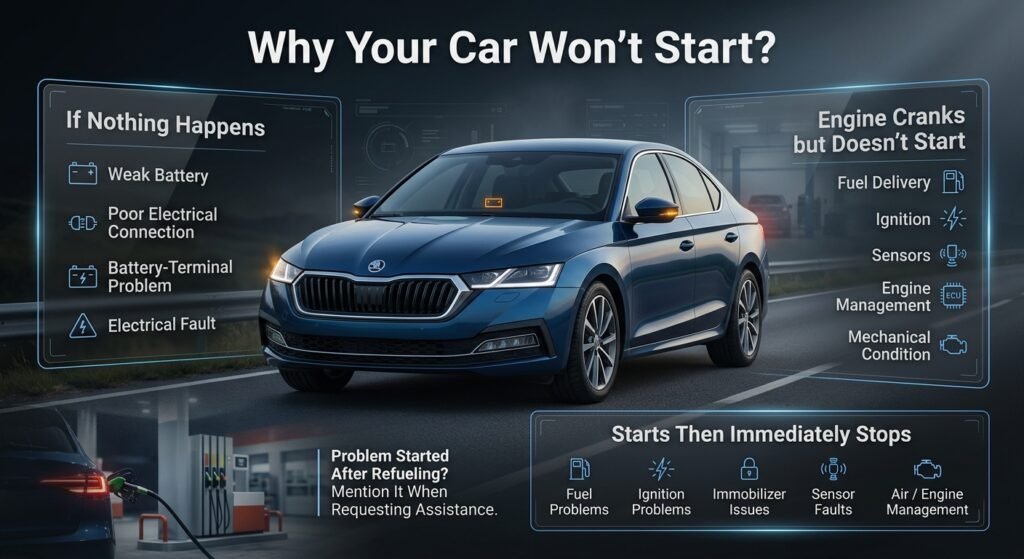
A no-start problem can have many causes.
If Nothing Happens
Possible causes include:
- Weak battery
- Poor electrical connection
- Battery-terminal problem
- Electrical fault
If the Engine Cranks but Doesn’t Start
Possible causes may involve:
- Fuel delivery
- Ignition
- Sensors
- Engine management
- Mechanical condition
If the Engine Starts and Immediately Stops
Potential causes can include:
- Fuel problems
- Ignition problems
- Immobilizer issues
- Sensor faults
- Air or engine-management problems
If the problem began immediately after refueling, mention this clearly when requesting assistance.
How Should You Maintain a Vehicle That Is Rarely Used?
A vehicle doesn’t stop aging simply because it isn’t driven frequently.
Long periods of inactivity can affect:
- Battery charge
- Tyres
- Brakes
- Fluids
- Fuel
- Rubber components
- Electrical systems
If a vehicle is going to remain parked for an extended period, follow the manufacturer’s storage recommendations.
Don’t assume that starting the engine for a few minutes is always sufficient.
Why Should You Keep Vehicle Maintenance Records?
A maintenance record creates a useful history.
Record:
- Service dates
- Mileage
- Oil changes
- Filter replacements
- Brake work
- Tyre replacements
- Battery replacement
- Fluid services
- Major repairs
- Diagnostic work
Records help you know what has already been completed and what may be due next.
They can also help a technician understand previous problems.
If you sell the vehicle, documented maintenance can demonstrate responsible ownership.
How Can You Create a Simple Vehicle Maintenance Routine?
A practical routine doesn’t need to be complicated.
Every Few Weeks
Check:
- Tyre pressure
- Tyre condition
- Oil level where applicable
- Washer fluid
- Visible leaks
- Lights
Monthly
Review:
- Tyre wear
- Battery condition
- Wipers
- Coolant level where applicable
- Warning lights
- Unusual sounds
During Scheduled Service
Follow the manufacturer’s requirements for:
- Oil
- Filters
- Brakes
- Fluids
- Belts
- Spark plugs where applicable
- Transmission service where specified
Before Long Trips
Perform a broader inspection of:
- Tyres
- Brakes
- Fluids
- Battery
- Lights
- Wipers
- Spare tyre
- Warning lights
This system is simple enough to maintain consistently.
Vehicle Maintenance Decision Guide
| Problem | Recommended Response |
|---|---|
| Low tyre pressure | Correct it to the manufacturer’s specification |
| Tyre bulge or serious damage | Seek professional tyre assistance |
| Persistent warning light | Identify and diagnose it |
| Brake vibration | Have the braking system inspected |
| Repeated coolant loss | Investigate the cooling system |
| Repeated battery failure | Test battery and charging system |
| Unexplained fluid leak | Identify and investigate |
| Severe engine noise | Stop unnecessary driving and seek assessment |
| Fuel-related symptoms after refueling | Consider fuel and other possible causes |
| Scheduled service due | Arrange service according to manufacturer guidance |
What Maintenance Issues Should Never Be Ignored?
Some symptoms deserve more urgent attention than ordinary maintenance reminders.
These include:
- Brake failure or major brake changes
- Steering problems
- Severe overheating
- Major fluid leaks
- Smoke
- Strong fuel smell
- Serious loss of power
- Severe vibration
- Critical dashboard warnings
- Repeated engine stalling
When safety may be compromised, don’t continue driving simply because the vehicle is technically still moving.
How often should I service my vehicle?
The right service interval depends on your vehicle’s make, model, engine, mileage, age, and driving conditions. There isn’t one universal rule that applies to every car. The manufacturer’s maintenance schedule should always be your starting point because it tells you when important items such as engine oil, filters, spark plugs, fluids, belts, and other components need inspection or replacement.
Your driving pattern also matters. A vehicle used mainly for short trips, heavy traffic, dusty roads, extreme temperatures, or frequent stop-and-go driving may experience more demanding conditions than a vehicle used mostly for longer highway journeys. If you notice unusual noises, warning lights, fluid loss, poor performance, or changes in braking or steering, don’t wait for the next scheduled service.
Important points:
Follow the manufacturer’s recommended service intervals.
Track both time and mileage, not mileage alone.
Consider your actual driving conditions.
Don’t ignore unusual symptoms between services.
Keep a record of every service and repair.
Have overdue maintenance checked before taking a long journey.
What are the most important vehicle maintenance checks I should do regularly?
The most important checks are the ones connected to safety, reliability, and early detection of problems. Tyres, brakes, fluids, battery condition, lights, warning indicators, and visible leaks deserve regular attention. You don’t need to perform a full mechanical inspection every day, but you should become familiar with how your vehicle normally looks, sounds, and feels.
For example, if a tyre that normally holds pressure begins losing air repeatedly, that’s a useful warning. Likewise, a new vibration during braking, a change in engine sound, or a dashboard warning light shouldn’t simply be ignored because the vehicle is still running.
Regular checks should include:
Tyre pressure and visible tyre damage
Engine oil level where applicable
Coolant level according to the manufacturer’s procedure
Brake performance
Battery and starting behavior
Headlights, brake lights, and indicators
Windscreen washer fluid and wipers
Visible fluid leaks
Dashboard warning lights
Unusual sounds, smells, or vibrations
Professional tip: Early diagnosis is usually easier than trying to diagnose a vehicle after a small problem has developed into several related faults.
What are the warning signs that my vehicle needs immediate maintenance?
A vehicle doesn’t always fail without warning. Changes in braking, steering, engine behavior, temperature, or electrical performance can indicate that something needs attention. Some problems can wait for a scheduled inspection, while others should be dealt with immediately because continuing to drive may create a safety risk or cause additional damage.
Pay particular attention to symptoms that appear suddenly or become progressively worse. For example, a major change in brake-pedal feel is more concerning than a routine maintenance reminder. Similarly, severe overheating, significant fluid leakage, smoke, or a serious loss of power shouldn’t be treated as ordinary maintenance issues.
Warning signs to take seriously include:
Brake pedal becoming unusually soft or hard
Increased stopping distance
Steering becoming difficult or unpredictable
Severe or sudden vibration
Engine overheating
Smoke or strong burning smells
Significant oil or coolant leakage
Repeated engine stalling
Serious loss of engine power
Critical dashboard warning lights
Strong fuel smell or suspected fuel-system problems
Common mistake: Continuing to drive because “the car is still moving.” A vehicle can remain driveable while a serious problem is developing.
Can poor-quality or contaminated fuel cause vehicle performance problems?
Poor-quality or contaminated fuel can affect engine operation, particularly when water, dirt, sediment, incorrect fuel, or other unwanted material enters the fuel system. Depending on the vehicle and the type of contamination, symptoms may include difficult starting, hesitation, rough running, misfires, reduced acceleration, or stalling.
However, one important point is often overlooked: these symptoms don’t automatically prove that the fuel is contaminated. Similar behavior can come from ignition faults, fuel-pump problems, injectors, sensors, air-intake issues, electrical faults, or mechanical problems. That’s why professional diagnosis should look at the timing of the symptoms and actual evidence rather than blaming the fuel immediately.
For example, if a vehicle begins running badly immediately after refueling, the timing is worth mentioning to a technician. It is a useful clue, but it isn’t conclusive proof.
What you should do:
Note when the symptoms started.
Remember when and where the vehicle was refueled.
Avoid unnecessary driving if the engine is running severely.
Don’t replace expensive fuel-system components without diagnosis.
Have suspected contamination properly investigated.
Keep any relevant fuel or service information available for the technician.
How can regular vehicle maintenance help prevent expensive repairs?
Regular maintenance doesn’t make a vehicle immune to breakdowns, but it can reduce the number of avoidable failures and help identify developing problems earlier. A worn component, low fluid level, damaged tyre, weak battery, or cooling-system issue is generally easier to deal with when discovered during a routine inspection than after it causes a roadside breakdown.
The biggest advantage of preventive maintenance is predictability. Instead of waiting for a component to fail at an inconvenient time, you can identify maintenance requirements, plan the repair, and keep the vehicle available for normal use.
For example, replacing a worn consumable according to the manufacturer’s schedule is very different from waiting until a related component fails and creates a larger repair.
Best practices for controlling maintenance costs:
Follow the manufacturer’s maintenance schedule.
Don’t ignore small leaks or unusual noises.
Check tyres regularly.
Respond to warning lights appropriately.
Keep fluids at the correct levels and specifications.
Diagnose problems before replacing parts.
Maintain accurate service records.
Inspect the vehicle before long-distance trips.
Use qualified professionals for complex or safety-critical repairs.
Expert takeaway: The goal of vehicle maintenance isn’t to spend more money on the car. It’s to spend the right amount at the righ
Conclusion
Proper vehicle maintenance isn’t just about following a service schedule—it’s about paying attention to how your vehicle performs every day. Regular checks of tyres, brakes, fluids, battery, cooling system, lights, and warning indicators can help identify developing problems before they turn into expensive repairs or unexpected roadside breakdowns.
The most effective approach is simple: follow the manufacturer’s recommendations, investigate unusual changes early, use the correct fluids and fuel, and don’t replace parts without understanding the actual cause of a problem. Small maintenance habits can make a significant difference to vehicle safety, reliability, performance, and long-term running costs.
A well-maintained vehicle is also better prepared for everyday driving and long-distance journeys. Taking a few minutes to check important components before a trip can help you avoid problems when you’re far from home.
Remember: good maintenance isn’t about waiting for something to fail. It’s about recognizing what your vehicle needs before a minor issue becomes a major one.
Leave a Reply