
Introduction
Contaminated petrol can cause a range of unexpected vehicle problems, especially when symptoms appear shortly after refuelling. A car may suddenly hesitate, shake, lose power, struggle to start, run roughly, or even stall. While these symptoms can point to an engine or ignition problem, contaminated petrol symptoms should also be considered when the timing closely follows a refuelling stop.
Petrol contamination is not always visible. Water, dirt, sediment, rust particles, incorrect fuel, or other unwanted substances can enter the fuel system and interfere with combustion, fuel delivery, and engine performance. In some cases, the fuel may look completely normal while still causing drivability problems.
This guide explains the most common contaminated petrol symptoms, what causes petrol contamination, how fuel-related problems can be distinguished from other vehicle faults, what to do when contaminated fuel is suspected, and which common mistakes should be avoided.
If you need practical fuel-related assistance in Dubai, you can also visit Need Petrol Emergency Dubai 👉 Fuel Delivery Dubai for information about available fuel delivery services.
What Are the Most Common Contaminated Petrol Symptoms?
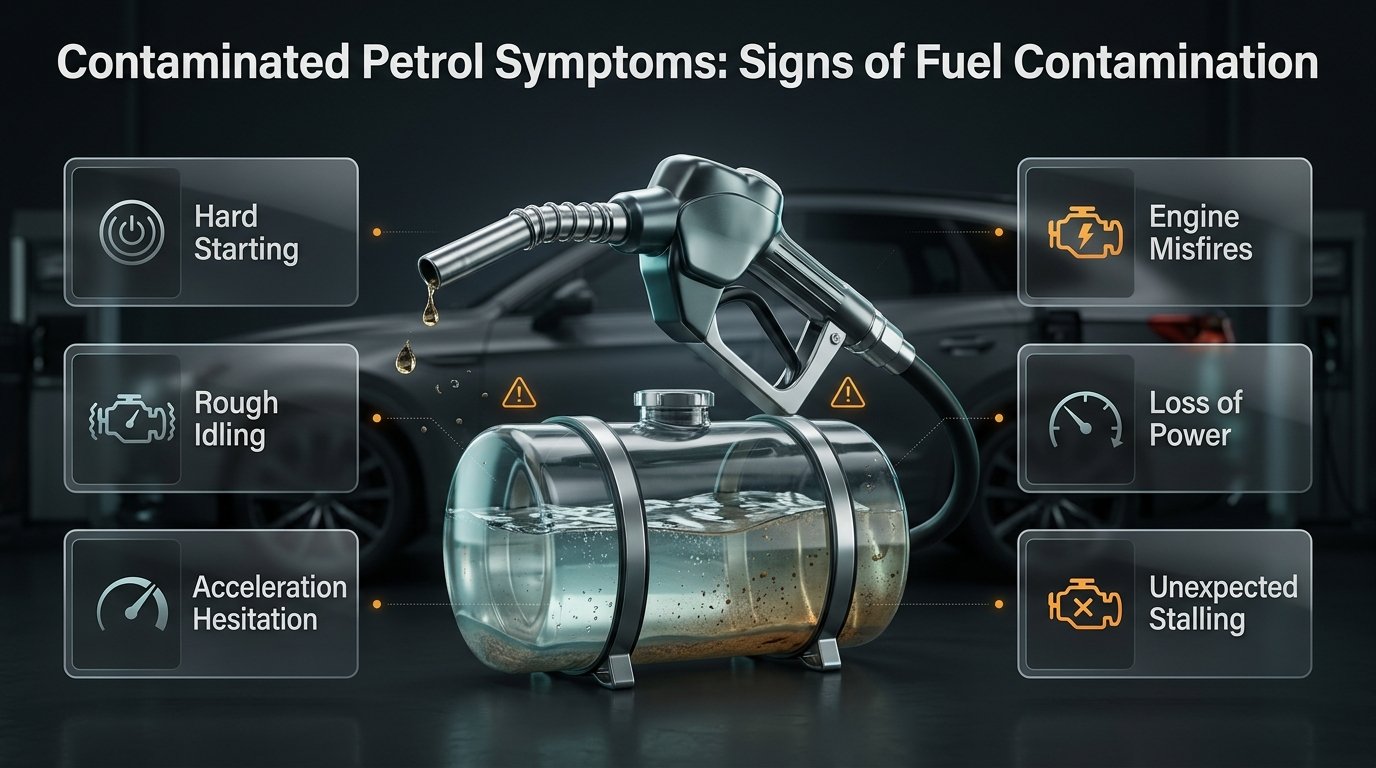
Contaminated petrol can cause problems with starting, combustion and fuel delivery. The most common signs include hard starting, rough idling, hesitation, sputtering, misfires, reduced acceleration, loss of power, poor fuel economy and engine stalling. A combination of symptoms appearing shortly after refuelling is more suspicious than one symptom by itself.
Common contaminated petrol symptoms include:
- Difficulty starting
- Longer engine cranking
- Rough or unstable idling
- Engine hesitation
- Sputtering or jerking
- Poor throttle response
- Loss of power
- Engine misfires
- Unexpected stalling
- Reduced fuel economy
- Unusual exhaust or fuel smell
- Check-engine warning
- Restricted fuel delivery
It’s important to remember that these symptoms don’t automatically prove that petrol is contaminated. Spark plugs, ignition coils, fuel pumps, injectors, sensors, air-intake problems and mechanical faults can create very similar symptoms.
The strongest clue is often the relationship between refuelling and the beginning of the problem.
1. Difficulty Starting the Engine
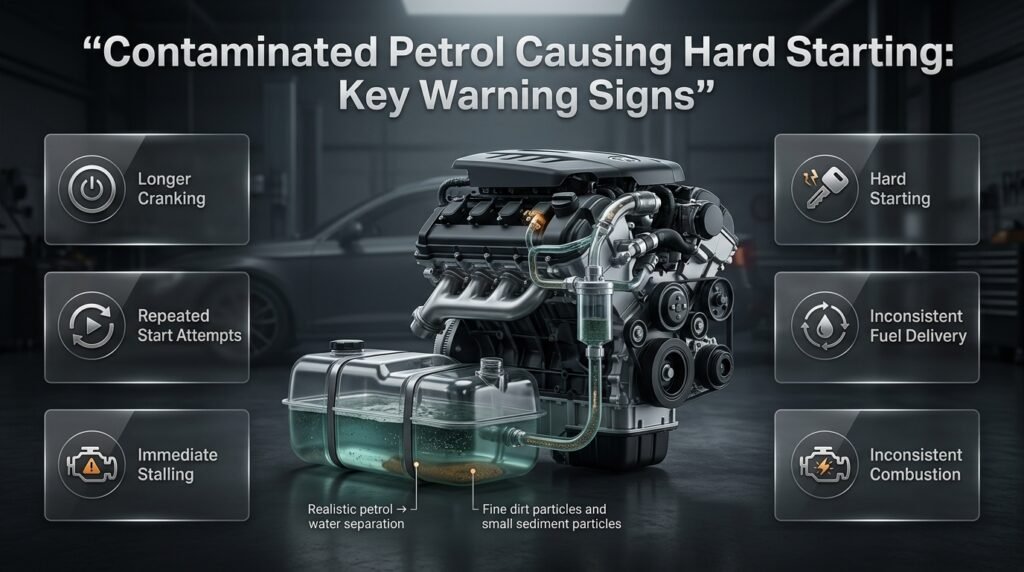
Hard starting is one of the first problems a driver may notice after contaminated petrol enters the fuel system.
A petrol engine needs an appropriate mixture of fuel and air and a reliable ignition source. When water, dirt, sediment or another unwanted substance interferes with that process, combustion can become inconsistent.
You may notice that:
- The engine takes longer to start.
- The starter cranks for longer than normal.
- The vehicle needs several attempts to start.
- The engine starts but immediately stalls.
- Starting becomes increasingly difficult.
Why does contaminated petrol cause hard starting?
Petrol is formulated to vaporise and burn under specific conditions. Water doesn’t burn like petrol, while solid particles can interfere with fuel delivery.
If significant contamination reaches the fuel system, the engine may not receive a consistent supply of usable fuel. This can make starting difficult, particularly when contamination is severe.
Pro Tip: If the vehicle started normally before refuelling and developed starting problems shortly afterward, record that timing. It can be valuable information during diagnosis.
2. Rough or Unstable Idling
A healthy petrol engine should generally maintain a reasonably stable idle. If the engine begins shaking, sputtering or repeatedly changing RPM, something is interfering with normal operation.
Possible signs include:
- Engine vibration
- Fluctuating RPM
- Rough idle
- Sputtering
- Uneven engine sound
- Feeling that the engine may stall
Contaminated petrol can cause rough running when it interferes with consistent combustion.
However, rough idle can also be caused by vacuum leaks, dirty injectors, worn spark plugs, ignition coils, throttle-body problems and sensor faults.
That’s why rough idling should be considered alongside the timing and other symptoms rather than treated as proof of fuel contamination.
3. Hesitation During Acceleration
Another common contaminated petrol symptom is hesitation when you press the accelerator.
Instead of responding smoothly, the vehicle may briefly pause, jerk, sputter or feel as if power has disappeared.
Drivers may describe this as:
- Stuttering
- Jerking
- Surging
- Coughing
- Flat spots
- Delayed acceleration
- Poor throttle response
The combustion process depends on fuel and air reaching the engine in the correct conditions. When fuel quality or fuel delivery is compromised, combustion may become inconsistent.
For a closer explanation of how petrol is converted into engine power, see the petrol engine combustion process guide.
4. Loss of Engine Power
A vehicle affected by contaminated petrol may still run, but it can feel noticeably weaker.
You might notice that the car:
- Accelerates more slowly
- Struggles on hills
- Feels weak when carrying passengers
- Doesn’t respond normally to the accelerator
- Loses power under load
Fuel contamination can interfere with consistent fuel delivery or combustion, reducing engine performance.
But power loss isn’t exclusive to fuel contamination. A blocked air filter, restricted exhaust, failing fuel pump, ignition problem, sensor fault or other mechanical issue can cause similar behaviour.
This is why replacing expensive components without confirming the cause can be a costly mistake.
5. Engine Misfires
A misfire occurs when combustion in a cylinder doesn’t happen correctly.
It may feel like:
- A sudden jerk
- Engine shaking
- Uneven acceleration
- Loss of power
- Rough running
- Irregular engine sound
Contaminated petrol can contribute to misfires if the fuel isn’t burning consistently or fuel delivery becomes disrupted.
However, misfires also have many other possible causes, including spark plugs, ignition coils, injectors and compression problems.
Expert Tip: If the check-engine light is flashing while the engine is severely misfiring, avoid unnecessary driving. Persistent severe misfires can potentially damage the catalytic converter.
6. Engine Stalling
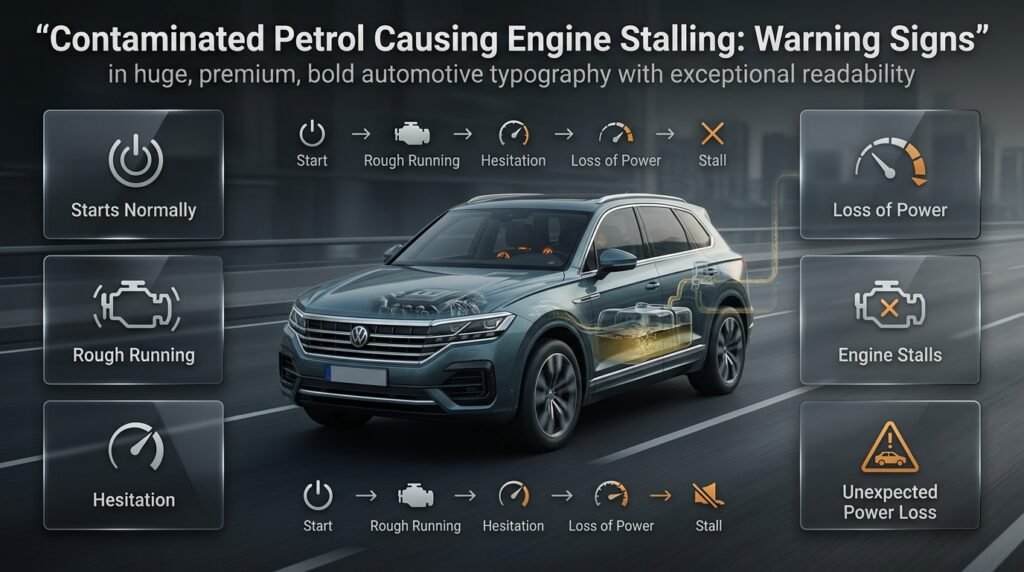
Severe fuel contamination may cause the engine to stall.
A vehicle might start normally and then follow a pattern such as:
Start → rough running → hesitation → loss of power → stall
Sometimes the engine will restart, only for the same problem to return.
Repeated stalling is particularly concerning if it occurs while driving. Unexpected loss of engine power can create a safety risk in traffic.
If the vehicle repeatedly stalls after refuelling, don’t keep restarting it simply to see whether the problem disappears.
7. Poor Fuel Economy
Not every contaminated-fuel problem causes immediate breakdown.
In some cases, the first noticeable change is increased fuel consumption.
You may find that your normal driving range has decreased even though:
- Your route is similar.
- Your driving style hasn’t changed.
- Traffic conditions are comparable.
- The vehicle isn’t carrying an unusual load.
Fuel-related combustion problems can affect efficiency, but poor fuel economy by itself doesn’t prove contaminated petrol.
Low tyre pressure, heavy traffic, air-conditioning use, driving style and engine problems can all increase fuel consumption.
The clue becomes stronger when poor fuel economy appears together with hesitation, rough running or other symptoms after refuelling.
8. Unusual Exhaust or Fuel Smell
A fuel-related problem can sometimes change the smell coming from the vehicle.
You might notice:
- A stronger petrol smell
- An unusual exhaust odour
- A noticeable smell during acceleration
- Sputtering from the exhaust
However, smell isn’t a reliable fuel-quality test.
A strong petrol smell can also be caused by fuel leaks, an excessively rich mixture, injector faults or exhaust-system problems.
Common Mistake: Assuming that an unusual smell automatically means contaminated petrol. Treat it as a clue, not a diagnosis.
9. Check-Engine Light
Contaminated petrol can sometimes contribute to conditions that trigger the check-engine light.
For example, unstable combustion may cause the engine-management system to detect misfires or abnormal fuel-trim conditions.
But a diagnostic code doesn’t automatically identify contaminated petrol as the cause.
The vehicle tells you that it has detected a problem. Additional testing is needed to determine why that problem occurred.
This distinction can prevent unnecessary parts replacement.
What Can Contaminate Petrol?
Petrol can become contaminated during storage, transportation, handling or dispensing.
Common contaminants include:
- Water
- Dirt
- Dust
- Rust
- Sediment
- Other particles
- Incorrect fuel
- Degraded fuel
- Contaminated storage equipment
Different contaminants can produce different symptoms.
For example, water can interfere with combustion, while solid particles can restrict filters or affect sensitive fuel-system components.
For a broader understanding of vehicle fuels, the guide to types of automotive fuel provides useful background on different fuel categories and their applications.
Water Contamination
Water is one of the more important contaminants to consider.
It can enter fuel through:
- Water intrusion
- Poor storage
- Damaged tanks
- Condensation
- Poorly sealed containers
- Contaminated handling equipment
Water doesn’t burn like petrol. If a significant amount reaches the engine, normal combustion can be disrupted.
Possible symptoms include:
- Hard starting
- Misfires
- Rough running
- Hesitation
- Stalling
- Poor acceleration
Significant water exposure can also contribute to corrosion in affected fuel-system components.
Dirt, Rust and Sediment
Solid particles can enter petrol from storage tanks, containers, transportation equipment or other parts of the fuel-handling process.
A vehicle’s fuel filter is designed to capture particles before they reach sensitive components. But heavy contamination can restrict the filter and reduce fuel flow.
This can lead to:
- Poor acceleration
- Hesitation
- Power loss
- Hard starting
- Stalling under load
A heavily contaminated system may therefore require more attention than simply replacing the filter.
Incorrect Fuel
Incorrect fuelling isn’t exactly the same as contamination, but it can create serious fuel-related symptoms.
For example, diesel accidentally added to a petrol vehicle can interfere with normal combustion.
If you realise that you’ve put the wrong fuel in your car, avoid starting the engine if possible. Starting the vehicle can circulate the incorrect fuel through more of the system.
Understanding the basic differences between petrol and diesel can help explain why the two aren’t interchangeable. The petrol and diesel fuel types guide covers these differences in more detail.
How Can You Tell If Petrol Is Contaminated?
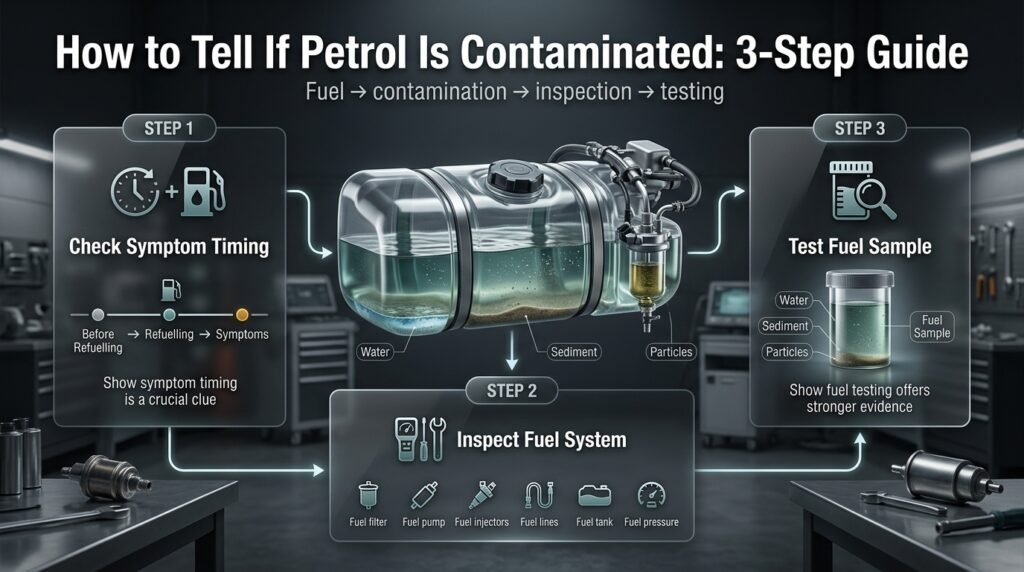
Symptoms alone cannot definitively confirm contaminated petrol.
A stronger diagnosis combines the timing of the problem with fuel-system inspection and, when appropriate, fuel testing.
Step 1: Check When the Symptoms Started
Ask yourself:
- Was the vehicle running normally before refuelling?
- Did the problem begin soon afterward?
- Did several symptoms appear together?
- Did the vehicle behave differently after leaving the fuel station?
- Did another vehicle using the same fuel source experience a similar problem?
A strong connection between refuelling and symptom onset is an important clue.
Step 2: Inspect the Fuel System
Depending on the symptoms, a technician may inspect:
- Fuel filter
- Fuel pressure
- Fuel pump
- Injectors
- Fuel lines
- Fuel tank
- Fuel sample
The inspection should be based on the vehicle’s symptoms and history.
Step 3: Test a Fuel Sample
If contamination is strongly suspected, a fuel sample can be examined for evidence of water, sediment, particles, incorrect fuel or other abnormalities.
Visual inspection can reveal some obvious contamination, but it can’t confirm every aspect of fuel quality.
The fuel quality testing basics guide explains why testing is more useful than relying on appearance alone.
What Does Contaminated Petrol Look Like?
Many drivers expect contaminated petrol to look obviously dirty.
Sometimes it does.
A fuel sample may show:
- Water separation
- Cloudiness
- Sediment
- Rust particles
- Visible debris
But not every fuel problem can be seen with the naked eye.
Clear-looking petrol isn’t automatically proof that it is suitable for the vehicle.
Some important fuel characteristics require appropriate testing rather than simple visual inspection.
Contaminated Petrol Symptoms vs Other Engine Problems
Fuel contamination can look remarkably similar to ordinary vehicle faults.
| Symptom | Could fuel contamination cause it? | Other possible causes |
|---|---|---|
| Hard starting | Yes | Battery, ignition, fuel pump |
| Rough idle | Yes | Vacuum leak, plugs, injectors |
| Hesitation | Yes | Sensors, ignition, throttle |
| Power loss | Yes | Air filter, exhaust, fuel pump |
| Misfire | Yes | Coils, plugs, injectors |
| Stalling | Yes | Sensors, pump, electrical faults |
| Poor fuel economy | Possible | Tyres, traffic, engine condition |
| Check-engine light | Possible | Many different faults |
The table isn’t a diagnostic test. It simply demonstrates why a driver shouldn’t conclude that contaminated petrol is responsible based on one symptom.
What Should You Do If You Suspect Contaminated Petrol?
1. Stop Driving if the Symptoms Are Severe
If the engine is badly misfiring, repeatedly stalling or losing substantial power, continuing to drive isn’t a good way to determine whether the fuel will eventually improve.
Severe running problems can create safety risks and may contribute to additional damage.
2. Avoid Repeatedly Restarting the Engine
If contaminated fuel is present, repeated starting can continue circulating it through the fuel system.
3. Keep Your Refuelling Information
Keep:
- Your fuel receipt
- Fuel station details
- Date and approximate time
- Fuel type
- Amount purchased
- Vehicle mileage
- Time when symptoms appeared
This information can help establish the relationship between refuelling and the vehicle problem.
4. Have the Vehicle Properly Diagnosed
A professional inspection can help determine whether contaminated petrol is actually responsible.
5. Don’t Replace Random Components
Replacing injectors, coils, spark plugs, sensors or fuel pumps without establishing the cause can become unnecessarily expensive.
How Does Fuel Quality Affect Engine Performance?
Fuel quality can affect how consistently an engine receives and burns fuel.
Problems involving fuel cleanliness or unsuitable fuel characteristics can influence:
- Combustion
- Fuel delivery
- Injector operation
- Throttle response
- Fuel economy
- Engine performance
This is why a fuel problem can sometimes feel like an engine problem.
The relationship between fuel condition and vehicle performance is explained further in fuel quality and engine performance.
What Fuel Quality Standards Have to Do With Contamination
Fuel isn’t considered suitable simply because it looks clear.
Fuel quality involves characteristics and requirements that help ensure fuel performs appropriately in engines and fuel systems.
Understanding these requirements can help explain why fuel contamination and general fuel quality are related but aren’t exactly the same thing.
Fuel quality standards provides additional information about the broader concept of fuel quality.
Can Contaminated Petrol Damage an Engine?
Contaminated petrol doesn’t automatically mean permanent engine damage.
The potential consequences depend on:
- Type of contamination
- Amount of contamination
- How long the vehicle operates with it
- Vehicle design
- Severity of symptoms
- How quickly the problem is addressed
Possible consequences can include:
- Fuel-filter restriction
- Injector contamination
- Poor combustion
- Fuel-pump stress
- Persistent misfires
- Catalytic-converter damage from severe misfires
The earlier a serious fuel problem is identified, the better the opportunity to prevent secondary problems.
How Long Does It Take for Contaminated Petrol Symptoms to Appear?
There is no universal timeframe.
Severe contamination can produce symptoms almost immediately, while less severe problems may become noticeable gradually.
For example:
- Significant water contamination may cause immediate running problems.
- Heavy sediment may progressively restrict fuel flow.
- Moderate contamination may first appear as hesitation.
- Continued driving may make symptoms more noticeable.
Instead of focusing only on the number of kilometres driven, pay attention to when the vehicle changed behaviour.
A car that ran normally before refuelling and became problematic shortly afterward deserves a closer look at its fuel supply.
Common Mistakes Drivers Make
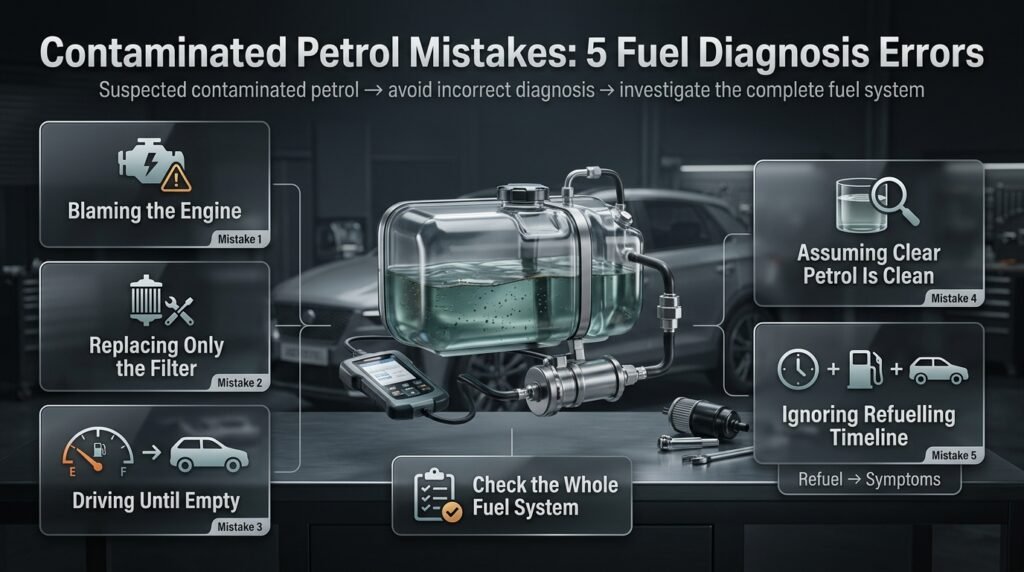
Mistake 1: Blaming the Engine Immediately
A vehicle that runs poorly doesn’t automatically have an internal engine problem.
Why it happens: Serious symptoms can make drivers assume the engine has failed.
Why it’s harmful: Fuel-related causes may be overlooked.
Better approach: Consider fuel quality alongside ignition, fuel pressure, air intake, sensors and mechanical causes.
Mistake 2: Replacing Only the Fuel Filter
A new filter may not solve the problem if contaminated fuel remains inside the tank or other parts of the fuel system.
Why it happens: The filter is an obvious component associated with fuel cleanliness.
Why it’s harmful: Contamination can continue affecting the system.
Better approach: Determine the extent of contamination before deciding which components require attention.
Mistake 3: Driving Until the Tank Is Empty
Some drivers assume that using the remaining fuel will make the problem disappear.
That’s not necessarily true.
If the fuel contains water, sediment or incorrect fuel, continued driving can circulate the problem through the fuel system.
Mistake 4: Assuming Clear Petrol Is Clean
Fuel can appear normal while still having a problem that requires testing.
Visual inspection is useful for obvious contamination, but it isn’t a complete fuel-quality assessment.
Mistake 5: Ignoring the Refuelling Timeline
If the vehicle was running normally before refuelling and developed several symptoms afterward, that information is valuable.
Always tell the technician exactly when the fuel was purchased and when the symptoms appeared.
Expert Advice: How Professionals Approach Fuel Contamination
A good diagnosis separates symptoms from causes.
For example:
Misfire = symptom
Contaminated petrol = possible cause
Hard starting = symptom
Fuel-pressure problem = possible cause
Power loss = symptom
Restricted fuel delivery = possible cause
This distinction prevents a common diagnostic mistake: replacing parts simply because they are associated with the symptom.
A professional approach asks three questions.
What changed?
Did the problem begin after refuelling?
What evidence supports contamination?
Is there evidence of water, particles, sediment, abnormal fuel, fuel-filter restriction or fuel-pressure problems?
What else could explain the symptoms?
Could ignition, sensors, injectors, fuel pump, air intake, electrical components or mechanical faults cause the same problem?
The goal isn’t to find the first possible explanation.
The goal is to identify the most likely cause using evidence.
Regular Petrol vs Premium Petrol: Is Octane the Problem?
Drivers sometimes confuse contaminated petrol with petrol that simply has the wrong octane rating.
These are different issues.
Octane relates primarily to a petrol’s resistance to knock under specified test conditions. Contamination refers to unwanted substances or unsuitable material entering the fuel.
Using a fuel grade that doesn’t match the manufacturer’s recommendation can affect performance in some vehicles, but it shouldn’t automatically be described as contamination.
If you’re unsure about the difference, the guide to regular vs premium petrol octane explains why octane selection and fuel contamination shouldn’t be treated as the same issue.
Why Good-Quality Petrol Matters
Good fuel should be suitable for the engine, properly handled and free from problematic contamination.
Drivers sometimes judge fuel only by its appearance or price, but fuel quality involves more than that.
A useful understanding of fuel characteristics can help you recognise why two fuels that look similar may not necessarily have identical properties.
The guide to good quality petrol characteristics covers the main characteristics drivers should understand.
What Are the Most Common Symptoms of Contaminated Petrol?
The most common signs include difficulty starting, rough idling, hesitation during acceleration, sputtering, engine misfires, loss of power, poor acceleration and unexpected stalling. A check-engine light may also appear when contaminated fuel contributes to misfires or other abnormal engine conditions. These symptoms become more suspicious when several appear together shortly after refuelling rather than developing randomly over a long period.
A useful way to judge the situation is to look at the pattern, not just one symptom. For example, a single difficult start could be caused by a weak battery or another unrelated fault. But if the car was running normally, you refuelled, and then it began hesitating, running roughly and losing power, the fuel supply deserves proper investigation.
Key signs to watch for:
Hard or delayed starting
Rough or unstable idle
Sputtering or jerking
Hesitation when accelerating
Reduced engine power
Repeated misfires
Unexpected stalling
Check-engine warning
Professional tip: Don’t diagnose contaminated petrol from one symptom alone. The combination of symptoms and the time they appeared after refuelling provide much stronger evidence.
Can Water in Petrol Cause Hard Starting, Misfires and Stalling?
Yes, water contamination can interfere with normal petrol-engine operation and produce symptoms such as hard starting, rough running, hesitation, misfires, reduced power and stalling. Water doesn’t behave like petrol during combustion, so when enough contaminated fuel reaches the engine, normal combustion can become inconsistent. Water contamination is one recognised form of a bad or contaminated fuel supply.
The important point is that you don’t need to see a large amount of water sitting visibly in the tank before taking the possibility seriously. A driver may first notice the problem through changes in how the engine behaves.
Water contamination can be associated with:
Water entering through compromised storage or fuel-handling conditions
Contaminated fuel supplies
Moisture or condensation under certain conditions
Fuel-system sealing problems
If water contamination is suspected, repeatedly driving the vehicle isn’t a good diagnostic strategy. Continued operation can keep moving the contaminated fuel through the fuel system and may turn a simple fuel-quality issue into a broader fuel-system problem.
What makes water contamination more suspicious?
Symptoms appeared soon after refuelling.
The engine suddenly became rough.
Acceleration became jerky.
The vehicle began stalling.
Several symptoms appeared at the same time.
The important distinction is that these signs suggest contamination; they don’t independently prove it.
How Do I Know If My Car Has Contaminated Petrol or an Engine Problem?
This is one of the most important questions because contaminated petrol and ordinary engine faults can produce remarkably similar symptoms. Hard starting, hesitation, misfires, rough idling and poor acceleration are not exclusive to fuel contamination. A proper diagnosis should compare the timing of the symptoms with the vehicle’s mechanical and fuel-system condition.
Start with the timeline.
If the car was performing normally for days or weeks and the symptoms appeared immediately after a refuelling event, that is useful evidence. It doesn’t prove the fuel caused the problem, but it gives the technician a reason to inspect the fuel supply.
If the same symptom had been gradually developing for several weeks before refuelling, an unrelated mechanical problem may be more likely.
Look at the whole picture
Situation
What it may suggest
Problem starts immediately after refuelling
Fuel deserves investigation
Rough idle develops gradually
Mechanical or fuel-system fault possible
Misfire with warning light
Requires proper diagnosis
Hard starting plus stalling
Fuel contamination is one possibility
Poor acceleration only
Many possible causes
Symptoms existed before refuelling
Fuel may not be the main cause
Professional approach: Don’t replace spark plugs, injectors, fuel pumps or sensors simply because the engine is running badly. First establish whether the problem is actually related to fuel.
How Can I Confirm Whether Petrol Is Contaminated?
The most reliable approach is to combine symptom history, vehicle diagnosis and fuel inspection or testing where appropriate. Looking at petrol can sometimes reveal obvious water, sediment, rust or particles, but visual inspection alone can’t establish every aspect of fuel quality.
A proper investigation normally begins with the vehicle’s history.
Start with these questions:
When was the vehicle last refuelled?
Where was it refuelled?
How much fuel was added?
Was the vehicle running normally beforehand?
How soon did the symptoms appear?
Did the symptoms get worse after driving?
Has the vehicle experienced similar problems before?
A technician may then investigate relevant fuel-system components and, when appropriate, examine a fuel sample for contamination.
Fuel contamination can involve water, debris, sediment, another fuel or degraded fuel, so the exact contaminant matters. Different problems can require different corrective actions.
Evidence worth keeping:
Fuel receipt
Refuelling date and time
Fuel station details
Type of fuel purchased
Vehicle mileage
Description of when symptoms started
Diagnostic results
Fuel-sample findings, if testing is performed
This information becomes particularly valuable if you believe the problem started immediately after a specific refuelling event.
What Should I Do If I Suspect I Have Contaminated Petrol?
If the vehicle is severely misfiring, repeatedly stalling, refusing to start or losing substantial power, don’t keep driving simply to use up the fuel. The safer and more sensible approach is to stop unnecessary operation and arrange an appropriate inspection. Professional automotive guidance also recommends getting a vehicle properly diagnosed rather than assuming that bad fuel is responsible.
The next step depends on how severe the symptoms are.
If the vehicle is running normally
Keep monitoring it and document any unusual behaviour, particularly if symptoms began after refuelling.
If the vehicle is running poorly
Avoid unnecessary trips and have the fuel and vehicle inspected.
If the engine is repeatedly stalling or severely misfiring
Don’t continue driving just to empty the tank. Arrange appropriate assistance and diagnosis.
If you believe the fuel itself is contaminated
Keep the receipt and refuelling details. If possible, don’t discard potentially useful evidence before the fuel issue has been assessed.
Avoid these common mistakes:
Don’t keep restarting a vehicle that repeatedly stalls.
Don’t assume adding more petrol will automatically solve contamination.
Don’t replace expensive components without diagnosis.
Don’t rely solely on fuel colour or smell.
Don’t assume every misfire means the engine itself is damaged.
The goal is simple: identify the actual cause before spending money on repairs.
Bottom Line
The strongest sign of contaminated petrol isn’t one isolated symptom. It’s a pattern: the vehicle was operating normally, refuelling occurred, and soon afterward several fuel-related symptoms appeared together. Hard starting, rough idle, hesitation, misfires, power loss and stalling should prompt investigation, but they still need to be distinguished from ordinary mechanical or electrical faults.
Conclusion
Contaminated petrol can cause a range of problems, from hard starting and rough idling to hesitation, misfires, poor acceleration, loss of power and unexpected stalling. The challenge is that these symptoms can also come from ignition, fuel-system, electrical or mechanical faults, so it’s important not to blame the fuel without checking the evidence.
The timing of the symptoms is one of the most useful clues. If your vehicle was running normally before refuelling and began behaving differently shortly afterward, the fuel supply deserves closer attention. Keep your fuel receipt and note when the symptoms started, as this information can make diagnosis much easier.
If contamination is suspected, avoid unnecessary driving when the vehicle is running badly and don’t start replacing expensive components based only on symptoms. A proper inspection and, where appropriate, fuel testing can help identify whether the problem is genuinely contaminated petrol or something else.
Most importantly, don’t ignore sudden changes in engine behaviour after refuelling. Identifying the cause early can help prevent unnecessary repairs, protect the fuel system and get your vehicle back to reliable operation sooner.
Leave a Reply