Introduction
Water Contamination in Fuel | When a vehicle suddenly starts losing power, hesitating, misfiring, or refusing to start, most drivers immediately suspect a mechanical problem. They may think about the fuel pump, injectors, spark plugs, battery, turbocharger, or engine itself.
But sometimes the problem begins before the fuel even reaches the engine.
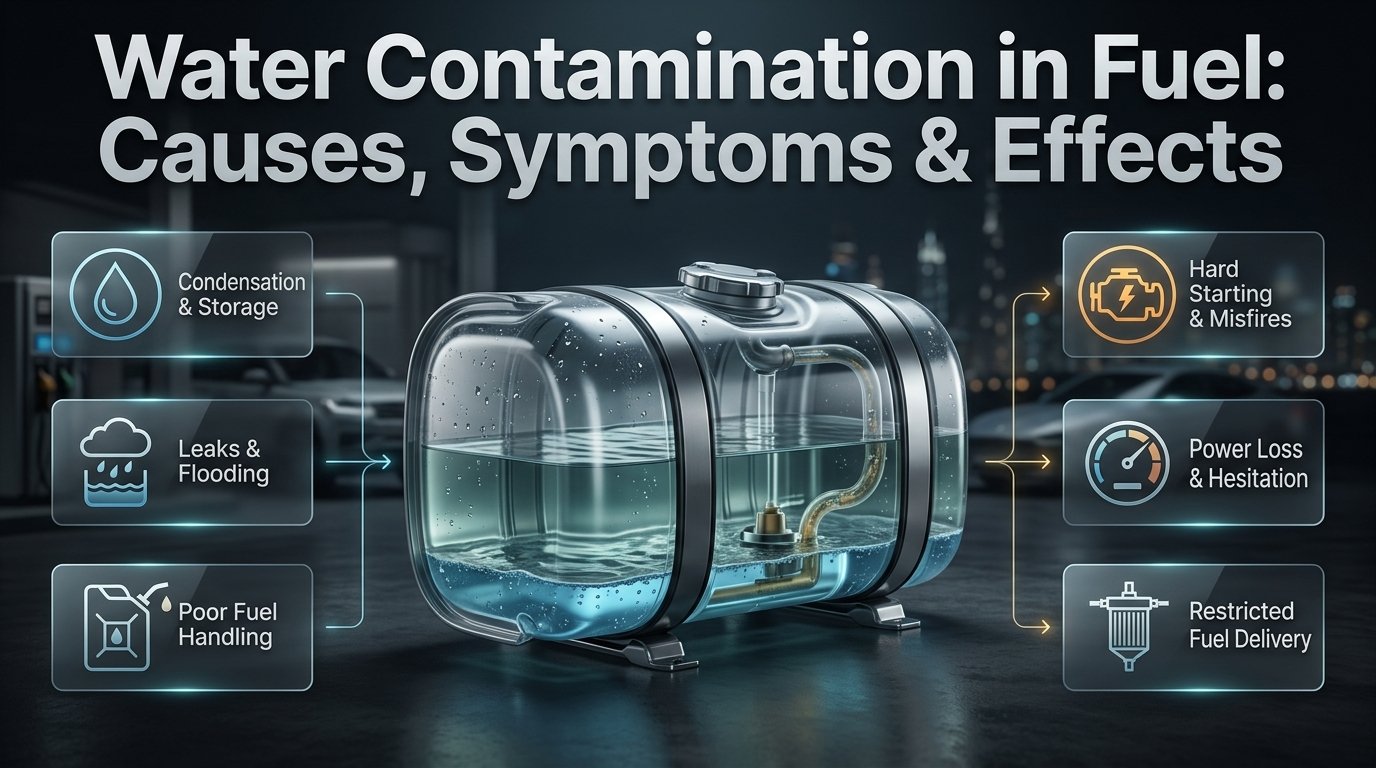
Water contamination in fuel can cause many of the same symptoms as a mechanical fault. Water can enter a vehicle’s fuel tank through condensation, contaminated storage tanks, leaks, flooding, poor fuel handling, or other sources. Once it reaches the fuel system, it can interfere with combustion, restrict fuel delivery, contribute to corrosion, and create serious problems in sensitive components.
For drivers who need reliable fuel-related services in Dubai, Need Fuel Delivery Dubai 👉 Fuel Delivery Dubai can also be useful when dealing with fuel supply and emergency refueling needs.
The important thing is not to panic or immediately replace expensive parts. The better approach is to understand how water gets into fuel, what symptoms it causes, how to test for it, what damage it can create, and what should be done when contamination is suspected.
This guide covers all of those points in practical detail.
What Is Water Contamination in Fuel?
Water contamination in fuel means that unwanted water has entered petrol, diesel, or another fuel supply and is present in a quantity that can affect fuel quality, storage, fuel delivery, or engine operation.
Water may exist in different forms. Some moisture can be dissolved in fuel, while larger amounts can exist as tiny droplets or separate into free water. Because water is denser than petrol and diesel, free water generally settles toward the bottom of a fuel tank or storage container.
The problem becomes more serious when that water reaches the fuel pickup system.
A vehicle’s engine is designed to receive fuel with predictable physical and chemical properties. Water doesn’t provide the same combustion characteristics as petrol or diesel, so significant contamination can disrupt the normal fuel-delivery and combustion process.
Water can also create problems outside the combustion chamber. It may contribute to corrosion, affect filters, interfere with fuel-system operation, and create conditions that encourage additional contamination.
This is why fuel quality involves much more than simply choosing the correct fuel type. It also includes cleanliness, storage, water control, handling, and fuel-system condition.
For a broader introduction to the subject, see Fuel Fundamentals.
Why Is Water Contamination in Fuel a Serious Problem?
Water contamination matters because modern engines depend on a consistent and controlled fuel supply.
Petrol engines use a carefully controlled mixture of air and fuel that is ignited by a spark. Diesel engines rely on compression ignition and precise fuel injection. In both cases, introducing water into the fuel supply can disturb normal operation.
The effects can include:
- Hard starting
- Rough idling
- Hesitation
- Misfiring
- Poor acceleration
- Loss of engine power
- Stalling
- Restricted fuel flow
- Fuel-filter problems
- Corrosion
- Fuel-system wear
- Potential damage to sensitive components
The severity depends on the amount of water, fuel type, vehicle design, contamination location, and how long the contaminated fuel remains in the system.
A small amount of moisture doesn’t automatically mean an engine will suffer catastrophic damage. However, significant or repeated contamination should never be ignored.
Pro Tip: A vehicle that develops symptoms shortly after refueling deserves a fuel-quality investigation alongside normal mechanical diagnosis. The timing doesn’t prove contamination, but it’s an important clue.
How Does Water Get Into Fuel?
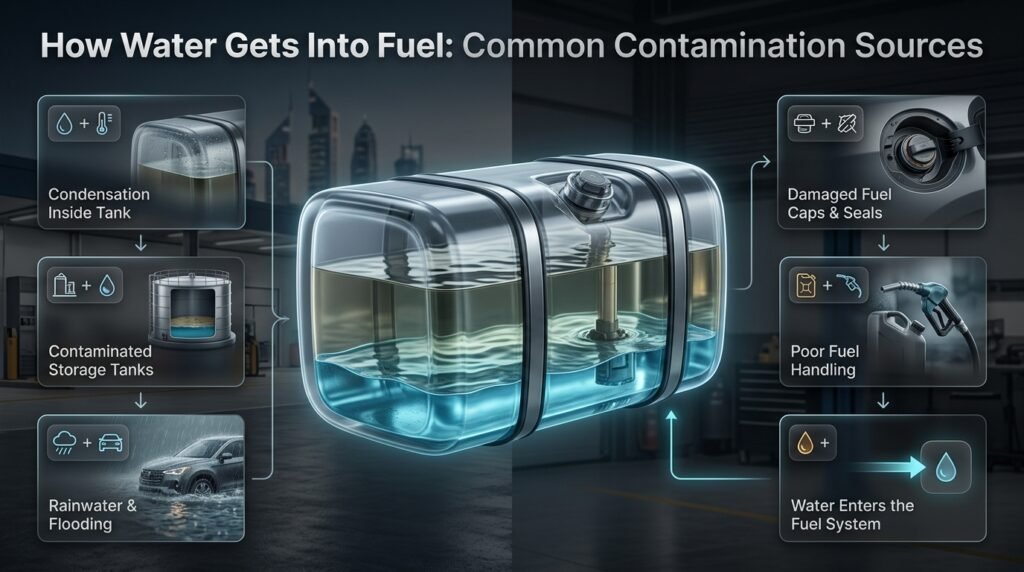
Water can enter fuel at several points between storage and combustion. Sometimes the vehicle itself is responsible. In other cases, the contamination begins during storage, transportation, or dispensing.
Understanding the source is important because removing contaminated fuel without correcting the source can allow the problem to happen again.
Condensation Inside the Fuel Tank
Condensation is one possible source of water.
A partially filled tank contains air above the fuel. When temperature changes occur, moisture in that air can condense on internal surfaces. Over time, repeated temperature cycles may contribute to moisture accumulation.
The risk depends on storage conditions, temperature changes, tank design, humidity, and how long the fuel remains stored.
This is particularly relevant to vehicles, machinery, generators, and fuel containers that aren’t used frequently.
Contaminated Fuel Storage Tanks
Water may already be present in a storage tank before fuel reaches the vehicle.
Storage tanks can accumulate water because of condensation, leaks, poor maintenance, or environmental exposure. If water isn’t detected and removed, it can eventually become part of the fuel being dispensed.
This is why fuel storage management is an important part of overall fuel quality.
Rainwater and Flooding
Water can enter fuel systems through exposure to heavy rain or flooding.
A vehicle exposed to flooding requires particular caution because floodwater isn’t necessarily clean water. It can contain dirt, sediment, chemicals, and other contaminants.
Simply getting the engine started again doesn’t prove that the fuel system is unaffected.
Damaged Fuel Caps or Seals
A damaged fuel cap, filler neck, seal, or related component can potentially allow moisture into the tank.
A vehicle that repeatedly experiences water contamination should therefore be inspected for physical entry points rather than only having the fuel replaced.
Poor Fuel Handling
Water can also enter through improperly maintained containers, transfer equipment, hoses, storage drums, or dispensing systems.
This is one reason professional fuel handling requires attention to equipment cleanliness and storage conditions.
For a broader overview of contamination sources, read causes of fuel contamination.
What Happens When Water Settles in a Fuel Tank?
Water and fuel don’t behave exactly the same way inside a tank.
Because free water is denser than petrol and diesel, it generally moves toward the lowest part of the tank. This can create a layer of water beneath the fuel.
A simplified process looks like this:
Water enters tank → Water separates from fuel → Water settles → Vehicle movement disturbs contents → Fuel pickup draws contaminated material → Filter receives contamination → Engine performance may suffer
This explains why a vehicle may appear normal at first.
If the contaminated material hasn’t reached the fuel pickup yet, the engine may continue running normally. Later, vehicle movement, fuel consumption, or other changes can cause the water to enter the fuel-delivery system.
That’s one reason contamination symptoms aren’t always immediate.
What Are the Symptoms of Water Contamination in Fuel?
The symptoms depend on how much water has entered the system and how far the contamination has travelled.
Common symptoms include:
- Hard starting
- Engine hesitation
- Rough idle
- Misfiring
- Loss of power
- Poor acceleration
- Surging
- Stalling
- Unstable engine operation
- Reduced throttle response
The most important diagnostic point is that these symptoms aren’t unique to water contamination.
A weak fuel pump, clogged filter, injector fault, ignition problem, sensor failure, restricted air intake, turbocharger issue, or mechanical fault can create similar symptoms.
Therefore, symptoms should be treated as clues rather than proof.
What Are the Symptoms of Water in Petrol?
Water contamination in petrol can interfere with normal combustion.
Petrol engines depend on the correct fuel-air mixture and reliable ignition. When significant water enters the fuel stream, the engine may struggle to maintain normal combustion.
Possible symptoms include:
Hard Starting
The engine may crank normally but fail to start or require repeated attempts.
Rough Idle
The engine may start but run unevenly, shake, or fluctuate at idle.
Hesitation
The vehicle may hesitate when the accelerator is pressed, particularly when more fuel is required.
Poor Acceleration
The engine may feel weak under load or during overtaking.
Misfiring
Combustion may become unstable, producing hesitation or uneven engine operation.
Stalling
If contamination is significant enough, the engine may stall and become difficult to restart.
For more detail on the wider symptom pattern, see contaminated petrol symptoms.
What Are the Symptoms of Water in Diesel Fuel?
Diesel engines can be particularly sensitive to water contamination.
Modern diesel systems use high-pressure fuel injection and extremely precise components. Clean fuel is essential for proper operation and component protection.
Potential symptoms include:
- Hard starting
- Rough idle
- Reduced power
- Hesitation
- Poor acceleration
- Surging
- Engine stalling
- Fuel-filter restriction
- Unusual fuel-system behavior
- In severe cases, fuel-system damage
Water contamination can be especially concerning because diesel fuel also plays an important role in lubricating certain fuel-system components.
For a broader explanation of diesel contamination problems, see contaminated diesel causes.
Petrol vs Diesel: Which Fuel Is More Sensitive to Water?
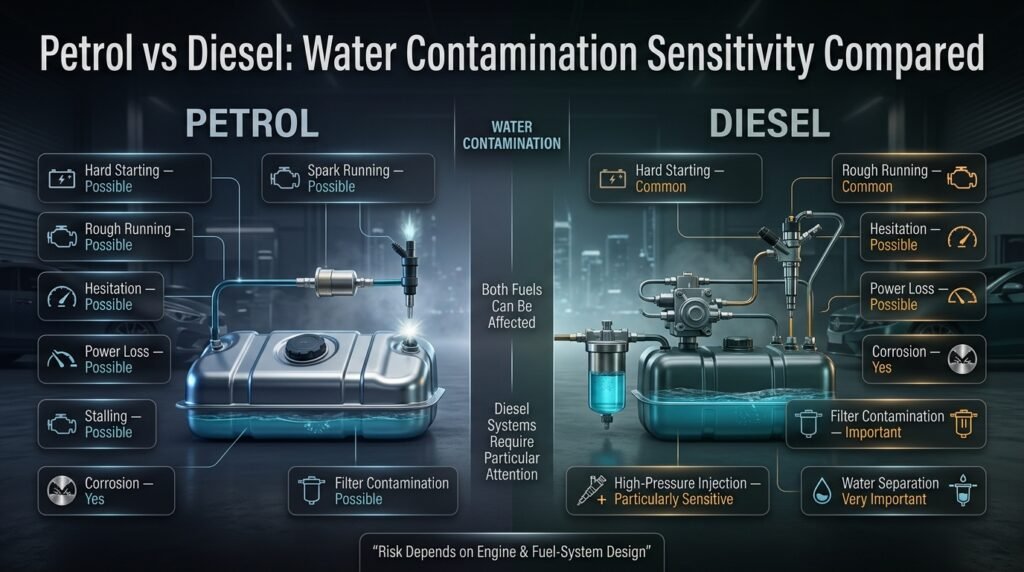
Both fuels can be affected by water, but the consequences can differ.
| Factor | Petrol | Diesel |
|---|---|---|
| Hard starting | Possible | Common |
| Rough running | Possible | Common |
| Hesitation | Possible | Possible |
| Power loss | Possible | Common |
| Stalling | Possible | Possible |
| Corrosion concerns | Yes | Yes |
| Filter contamination | Possible | Important |
| High-pressure injection sensitivity | Depends on system | Particularly important |
| Water separation | Important | Very important |
The exact risk depends on the engine and fuel-system design.
Older and newer vehicles can respond differently, so symptoms should always be interpreted in context.
For readers comparing fuel characteristics, petrol and diesel fuel types provides useful background.
Can Water Contamination Damage Fuel Injectors?
It can contribute to injector problems, especially when contamination is significant or persistent.
Fuel injectors are precision components. Their job is to deliver fuel in a controlled pattern and quantity. Contaminated fuel can interfere with that process.
Water can also contribute to corrosion and may travel through the system along with other contaminants such as dirt or sediment.
This doesn’t mean every vehicle containing water will immediately need new injectors.
The correct approach is to determine:
- Whether water is actually present.
- How much contamination exists.
- Whether the contaminated fuel reached the injection system.
- Whether injector performance has actually been affected.
Replacing injectors without confirming the cause can be an expensive mistake.
Can Water Contamination Damage a Fuel Pump?
Significant water contamination can potentially contribute to fuel-pump problems.
Fuel pumps depend on the fuel system operating within its intended conditions. In diesel applications, fuel can also contribute to lubrication and cooling.
Water doesn’t provide the same lubricating properties as the intended fuel.
If contaminated fuel continues circulating, sensitive components may experience increased wear or corrosion.
However, a failing fuel pump shouldn’t automatically be blamed on water. A proper diagnosis should consider electrical supply, fuel pressure, filter restriction, pump condition, wiring, and other possible causes.
Can Water Contamination Clog the Fuel Filter?
Water itself isn’t identical to dirt or sediment, but contamination can affect fuel filters and water-separation systems.
If the fuel also contains rust, sediment, microbial material, or other debris, the filter can become restricted.
A restricted filter can produce:
- Reduced fuel flow
- Loss of power
- Hard starting
- Hesitation
- Stalling
Replacing a contaminated filter may be necessary, but it doesn’t automatically solve contamination throughout the tank.
Common Mistake: Replacing the filter and assuming the problem is finished while leaving contaminated fuel inside the tank.
If contaminated fuel continues entering the filter, the replacement component can become affected again.
How Can You Tell If Fuel Contains Water?
The first step is often visual inspection of a representative fuel sample.
Possible warning signs include:
- Visible separation
- Water collecting at the bottom
- Cloudiness
- Sediment
- Unusual appearance
- Layers within the sample
- Particles or debris
However, visual inspection has limitations.
Small amounts of water may not be obvious, and fuel appearance alone can’t establish every aspect of fuel quality.
For more reliable evaluation, appropriate sampling and fuel testing should be used.
See fuel quality testing basics for more information about fuel inspection and testing.
How Is Water Contamination in Fuel Tested?
A proper testing process starts with a representative sample.
Step 1: Collect the Sample
The sample should represent the fuel that is actually being supplied to the engine.
Sampling only from a clean-looking upper layer can give misleading results if water has settled elsewhere.
Step 2: Inspect the Sample
Check for visible:
- Water
- Sediment
- Separation
- Cloudiness
- Unusual color
- Particles
Step 3: Compare With Known Good Fuel
Where appropriate, comparing a suspected sample against a known clean sample can help identify unusual characteristics.
Step 4: Perform Appropriate Testing
When contamination is uncertain or the potential repair cost is high, professional testing provides greater confidence.
Step 5: Investigate the Source
Finding water is only part of the diagnosis.
You also need to determine where it came from.
Was there:
- A storage problem?
- Condensation?
- A leak?
- Flood exposure?
- A damaged seal?
- Contaminated dispensing equipment?
Without addressing the source, contamination can return.
Can You See Water in Petrol or Diesel?
Sometimes, yes.
Free water can form a separate layer because of its greater density. Depending on the amount and fuel condition, it may be visible in a sample.
But not all water contamination will be obvious to the naked eye.
That’s why statements such as “the fuel looks clean” shouldn’t be treated as proof that the fuel is completely free from water or other contaminants.
Visual inspection is useful, but testing provides stronger evidence.
What Should You Do If You Suspect Water in Fuel?

The right response depends on the severity of the problem.
If the vehicle is still operating normally but you have strong evidence that water entered the tank, avoid unnecessary driving until the fuel can be assessed.
If the engine is already hesitating, stalling, or losing significant power, stop when it is safe to do so.
Repeatedly restarting the engine may continue moving contaminated fuel through the system.
A general response may include:
- Stop unnecessary operation.
- Confirm whether contamination is present.
- Determine how much fuel is affected.
- Inspect the fuel tank.
- Check the fuel filter.
- Inspect relevant fuel-system components.
- Remove contaminated fuel when appropriate.
- Correct the source of contamination.
- Refill with suitable clean fuel.
- Verify proper engine operation.
The exact procedure should follow the vehicle manufacturer’s requirements and the condition of the fuel system.
Should You Keep Driving With Water-Contaminated Fuel?
If significant contamination is suspected, continuing to drive isn’t a sensible strategy.
The vehicle might continue operating temporarily, but that doesn’t mean the problem is harmless.
Driving can move contaminated fuel deeper into the system, potentially affecting filters, pumps, injectors, and other components.
The risk is particularly important with modern diesel systems.
If contamination is confirmed, dealing with the fuel problem early is generally preferable to waiting until the vehicle stops completely.
Can You Add More Fuel to Dilute Water Contamination?
Adding clean fuel isn’t a reliable solution for significant water contamination.
The idea sounds simple: add more fuel and reduce the concentration of water.
But water may remain at the bottom of the tank, and the contaminated fuel may already have entered the fuel lines and filter.
Dilution also doesn’t correct the source of the contamination.
If only a very small amount of moisture is suspected, the appropriate response may differ from a situation involving visible free water or a large quantity of contaminated fuel.
The important point is to avoid treating dilution as a universal repair.
Do Fuel Additives Remove Water?
Some products are marketed specifically for fuel-system water management.
However, their usefulness depends on:
- Fuel type
- Vehicle design
- Product formulation
- Amount of contamination
- Location of the water
- Manufacturer recommendations
An additive isn’t automatically appropriate for every contaminated fuel system.
If substantial free water is present, physical removal of contaminated fuel may be more appropriate than relying on an additive.
Expert Tip: Never use a fuel additive simply because the engine is running badly. First determine whether the product is appropriate for the vehicle and whether water contamination is actually the cause.
Water Contamination vs Dirty Fuel: What’s the Difference?
Water is only one possible contaminant.
Fuel can also contain:
- Dirt
- Dust
- Rust
- Sediment
- Microbial material
- Other unwanted substances
These contaminants can sometimes occur together.
| Contaminant | Possible Source | Common Concern |
|---|---|---|
| Water | Condensation, leaks, flooding | Corrosion and combustion problems |
| Dirt | Poor handling | Filter and injector contamination |
| Rust | Corroded tanks | Fuel-system restriction |
| Sediment | Storage tanks | Filter blockage |
| Microbial material | Water/fuel interface | Sludge and filter plugging |
This is why identifying the contaminant matters.
A filter that removes particles doesn’t necessarily solve the water problem.
For a wider understanding of fuel contamination, see causes of fuel contamination.
How Does Water Affect Fuel Quality During Storage?
Water can become particularly problematic when fuel is stored for long periods.
Storage tanks experience temperature changes, humidity, condensation, and environmental exposure.
If water enters the system and remains there, it can contribute to additional fuel-quality problems.
Good fuel storage therefore involves more than simply keeping fuel in a container.
It may require:
- Tank inspection
- Water monitoring
- Proper sealing
- Clean dispensing equipment
- Filtration
- Appropriate storage procedures
- Regular maintenance
- Contamination control
For more information about fuel-quality requirements, see fuel quality standards.
How Does Water Affect Engine Performance?
An engine requires fuel to arrive in a consistent condition and quantity.
When water enters the fuel supply, the engine may receive less usable fuel and may experience unstable combustion.
This can lead to:
- Hesitation
- Reduced acceleration
- Rough operation
- Misfires
- Stalling
- Poor throttle response
But remember that the same symptoms can be produced by mechanical or electrical faults.
That’s why a professional diagnosis shouldn’t focus on fuel contamination alone.
Fuel quality should be considered together with:
- Fuel pressure
- Filter condition
- Injector operation
- Ignition system
- Air intake
- Sensors
- Electrical systems
- Engine mechanical condition
For more detail, read fuel quality and engine performance.
How Does Water Affect Petrol Engine Combustion?
Petrol engines rely on spark ignition.
Air and fuel are mixed in the engine and then ignited by a spark under controlled conditions.
For readers who want to understand this process in greater detail, see petrol engine combustion process.
Water contamination can interfere with this process when sufficient water reaches the engine.
Instead of contributing useful fuel energy, water can disrupt the expected fuel-air mixture and combustion conditions.
The result can be rough running, hesitation, misfires, or stalling.
The exact symptom depends on contamination severity and engine design.
How Does Water Affect Diesel Engine Combustion?
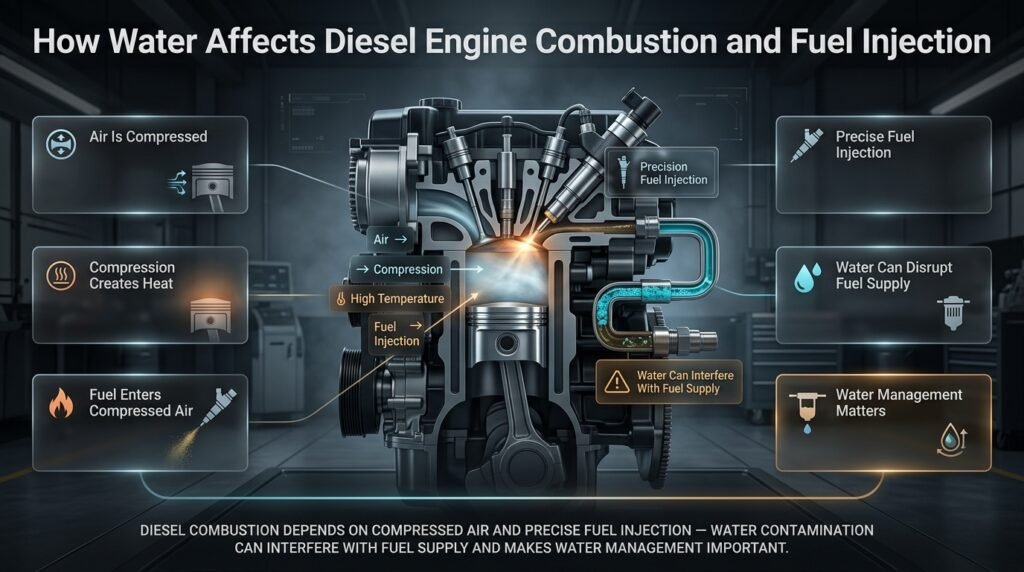
Diesel engines operate differently.
Air is compressed to create high temperatures, and diesel fuel is injected into the compressed air at the appropriate point in the combustion cycle.
The fuel injection system therefore has a major role in engine performance.
You can learn more through the diesel engine combustion process.
Water contamination can interfere with the fuel supply and create additional concerns for precision injection equipment.
That’s why water management is particularly important for modern diesel engines.
Is Water Contamination Worse in Modern Diesel Vehicles?
Modern diesel engines can be highly sensitive to fuel contamination because their injection systems operate at very high pressures and use precision components.
This doesn’t mean every water-contaminated diesel vehicle will suffer expensive damage.
It means that ignoring contamination is a poor risk-management strategy.
If a modern diesel vehicle suddenly loses power, stalls, or becomes difficult to start after suspected contaminated fueling, the fuel system deserves prompt attention.
What Are the Common Mistakes When Dealing With Water in Fuel?
Mistake 1: Blaming the Engine Immediately
A vehicle that runs poorly doesn’t automatically have an internal engine problem.
Why it happens: Severe symptoms make drivers think the engine itself has failed.
Why it’s harmful: Fuel contamination can be overlooked.
Better approach: Consider fuel quality alongside mechanical and electronic causes.
Mistake 2: Replacing Only the Fuel Filter
A filter can become contaminated, but the tank may still contain water.
Why it’s harmful: The new filter can become contaminated again.
Better approach: Investigate the entire fuel supply.
Mistake 3: Continuing to Drive
The engine may still run, so the driver assumes everything is fine.
Why it’s harmful: Contaminated fuel may continue circulating.
Better approach: If significant contamination is suspected, minimize unnecessary operation.
Mistake 4: Assuming Every Problem After Refueling Is Contaminated Fuel
Timing is important, but it isn’t proof.
A coincidental mechanical or electrical fault can occur after refueling.
Better approach: Test and diagnose instead of guessing.
Mistake 5: Ignoring the Fuel Source
Some people focus entirely on the vehicle.
But contamination can originate from:
- Storage tanks
- Containers
- Transport equipment
- Dispensing equipment
- Fuel handling
- Environmental exposure
Finding the source prevents recurrence.
Mistake 6: Relying Only on Fuel Appearance
Clean-looking fuel isn’t automatically contamination-free.
Some problems aren’t obvious visually.
Better approach: Use appropriate testing when the consequences of incorrect diagnosis are significant.
How Can You Prevent Water Contamination in Fuel?
Prevention is usually easier and cheaper than dealing with contaminated fuel after the vehicle develops symptoms.
For Vehicle Owners
Drivers can reduce risk by:
- Keeping the fuel cap properly secured
- Replacing damaged seals
- Avoiding damaged fuel containers
- Buying fuel from reputable sources
- Paying attention to sudden symptoms after refueling
- Avoiding unnecessary long-term storage of fuel
- Inspecting the vehicle after flood exposure
For Fuel Storage Operators
Fuel storage requires greater control.
Important practices include:
- Keeping tanks properly sealed
- Monitoring water accumulation
- Inspecting tanks regularly
- Maintaining dispensing equipment
- Preventing rainwater entry
- Keeping storage areas clean
- Monitoring filters
- Following appropriate fuel-quality procedures
For Fleet Operators
Fleet operators should treat fuel quality as part of routine maintenance.
A basic fuel-management system can include:
- Fuel supplier records
- Delivery records
- Tank inspections
- Water checks
- Filter monitoring
- Fuel sampling
- Consumption monitoring
- Contamination incident records
This can help identify problems before they affect a large number of vehicles.
How Can Businesses Detect Fuel Contamination Early?
Early detection depends on having a routine rather than waiting for an engine failure.
Useful practices include:
Monitor Fuel Storage
Regularly inspect tanks and storage systems.
Track Filter Condition
A sudden increase in filter restriction can indicate contamination.
Sample Fuel When Necessary
Sampling can help identify water, sediment, and other abnormalities.
Record Fuel Problems
If multiple vehicles develop similar symptoms after using fuel from the same supply, the pattern becomes important evidence.
Investigate the Source
Don’t simply treat the vehicle. Look at the whole fuel chain.
This approach is especially useful for fleets, generators, construction equipment, and businesses that depend heavily on stored fuel.
How Can You Tell Whether the Problem Is Water or a Mechanical Fault?
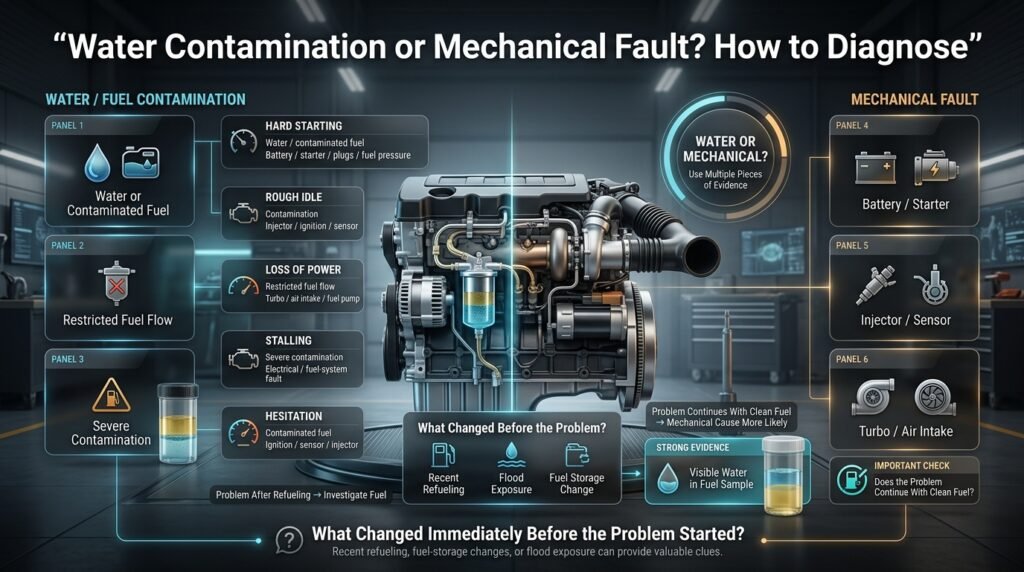
This is one of the most important diagnostic questions.
Both problems can produce similar symptoms.
| Symptom | Possible Water/Fuel Cause | Possible Mechanical Cause |
|---|---|---|
| Hard starting | Water or contaminated fuel | Battery, starter, plugs, fuel pressure |
| Rough idle | Contamination | Injector, ignition, sensor |
| Loss of power | Restricted fuel flow | Turbo, air intake, fuel pump |
| Stalling | Severe contamination | Electrical or fuel-system fault |
| Hesitation | Contaminated fuel | Ignition, sensor, injector |
| Problem after refueling | Strong clue | Coincidental fault possible |
| Visible water in sample | Strong evidence | Not relevant |
| Problem continues with clean fuel | Less likely | More likely |
The best diagnosis uses multiple pieces of evidence.
Quick Tip: Ask yourself, “What changed immediately before the problem started?” Recent refueling, fuel storage changes, or flood exposure can be valuable diagnostic clues.
When Should You Seek Professional Fuel-System Help?
Professional assistance is advisable when:
- The vehicle won’t start after suspected contamination.
- The engine repeatedly stalls.
- Significant water is visible in fuel.
- A diesel engine suddenly loses power.
- The vehicle has been exposed to flooding.
- The fuel filter repeatedly becomes restricted.
- You suspect water has entered a high-pressure fuel system.
- You don’t know how much contaminated fuel is present.
- Expensive fuel-system components may be at risk.
Attempting random repairs can become expensive.
A better strategy is to identify the contamination, locate its source, assess how far it has travelled, and then determine the appropriate cleanup or repair procedure.
What Are the Most Important Fuel-Quality Factors?
Water is only one part of fuel quality.
Other important factors include:
- Correct fuel type
- Octane for petrol applications
- Cetane characteristics for diesel
- Water content
- Particulate cleanliness
- Storage stability
- Oxidation stability
- Proper handling
- Appropriate storage
- Fuel-system compatibility
For a deeper explanation, see factors affecting fuel quality.
The important lesson is that fuel quality should be treated as a complete system rather than one single measurement.
What Does Good-Quality Petrol Look Like?
Good-quality petrol should meet the appropriate specification and be suitable for the vehicle.
It should not contain unacceptable levels of water, sediment, or other contamination.
However, appearance alone doesn’t tell the whole story.
Fuel can look normal while still having quality problems that require testing.
You can learn more about the characteristics of suitable petrol through good quality petrol characteristics.
Can Water Contamination Happen at a Fuel Station?
It is possible for contamination to occur within a fuel-storage or dispensing system, but it shouldn’t automatically be assumed that a fuel station is responsible whenever a vehicle develops symptoms.
There are multiple possible contamination points.
The correct approach is to investigate evidence such as:
- Timing of symptoms
- Fuel source
- Sample condition
- Storage conditions
- Vehicle history
- Filter condition
- Other diagnostic evidence
If multiple vehicles experience similar symptoms after receiving fuel from the same source, that pattern can be particularly important.
What Should You Do After Flooding?
Flood exposure requires extra caution.
Floodwater can contain:
- Dirt
- Mud
- Sediment
- Chemicals
- Corrosive substances
- Other contaminants
If water has potentially entered the fuel tank or fuel system, simply starting the vehicle isn’t enough to establish that everything is safe.
The vehicle should be assessed according to its design and the extent of water exposure.
This is especially important for modern vehicles with complex electrical and fuel systems.
Can Water Contamination Be Completely Prevented?
No system can eliminate every possible contamination risk, but good practices can significantly reduce the likelihood.
The most effective prevention measures are:
- Keep fuel systems sealed.
- Maintain storage tanks.
- Monitor for water.
- Keep dispensing equipment clean.
- Prevent environmental water entry.
- Inspect damaged components.
- Use appropriate fuel-handling procedures.
- Investigate contamination quickly.
Prevention becomes especially important for businesses that store large quantities of fuel.
Expert Advice: Diagnose the Fuel Before Replacing Expensive Parts
One of the most practical lessons in fuel-system troubleshooting is simple:
Don’t replace expensive components based only on symptoms.
If an engine suddenly loses power after refueling, there may be several possible explanations.
A professional diagnostic process should consider:
- Recent refueling
- Fuel type
- Fuel source
- Fuel sample condition
- Water presence
- Filter condition
- Fuel pressure
- Injector performance
- Ignition
- Sensors
- Air intake
- Electrical systems
- Mechanical condition
If water contamination is confirmed, the next question is not simply “Which part should I replace?”
It is:
“How did the water get into the system, how far has it travelled, and what components have been exposed?”
That question leads to a much better repair decision.
What Are the Signs of Water Contamination in Fuel?
The most common signs of water contamination in fuel are hard starting, rough idling, hesitation, loss of power, poor acceleration, misfiring, surging, and unexpected stalling. The symptoms can appear gradually or become noticeable soon after contaminated fuel reaches the engine. Diesel vehicles may also show fuel-filter problems or a water-in-fuel warning, depending on the vehicle’s equipment.
The important thing is that these symptoms don’t automatically prove water is present. A blocked filter, weak fuel pump, injector problem, ignition fault, sensor issue, or air-intake problem can create a very similar driving experience. That’s why the timing of the problem matters. If the vehicle was running normally and suddenly developed symptoms after refueling, fuel quality should move higher on the diagnostic checklist.
Look for these warning signs:
Hard starting or repeated cranking
Rough or unstable idle
Hesitation when accelerating
Noticeable loss of power under load
Engine surging or stumbling
Unexpected stalling
Unusual exhaust smoke in some diesel situations
A Water in Fuel warning, where the vehicle is equipped with one
Repeated fuel-filter restriction
Symptoms that began shortly after refueling
A particularly useful clue is a change in performance under load. An engine may appear reasonably normal at idle but struggle when climbing a hill, accelerating, or carrying a heavy load because the fuel system has greater demand.
Professional takeaway: Don’t diagnose water contamination from one symptom. Look for a pattern—especially the combination of recent refueling, unusual engine behavior, fuel-filter evidence, and visible contamination.
How Does Water Get Into Petrol or Diesel Fuel?
Water usually enters fuel through condensation, leaks, contaminated storage tanks, flooding, damaged seals, poor fuel handling, or contaminated fuel supplied from an earlier point in the distribution chain. In diesel systems, water contamination is particularly important because diesel fuel systems rely heavily on clean fuel and many vehicles use water-separation equipment.
One of the most overlooked causes is condensation. A fuel tank isn’t always completely full. The space above the fuel contains air, and changes in temperature can cause moisture to condense inside the tank. Over time, that moisture can accumulate as free water.
Storage conditions also matter. A fuel tank that isn’t properly sealed, maintained, or monitored can gradually collect water. The same principle applies to commercial fuel storage, generators, agricultural equipment, construction machinery, and vehicles that sit unused for long periods.
Water can also enter through physical damage. A faulty filler cap, damaged seal, leaking vent, or flood exposure can introduce water directly into the fuel system.
Common sources include:
Condensation from temperature changes
Poorly sealed storage tanks
Damaged fuel caps or filler components
Heavy rain or flooding
Contaminated fuel-storage equipment
Poorly maintained dispensing equipment
Improperly stored fuel containers
Contamination before the fuel reaches the vehicle
There’s another reason this question matters: finding water isn’t enough.
If you remove contaminated fuel but don’t identify how the water entered, the same problem can return. For example, draining a tank won’t permanently solve the issue if a damaged seal is still allowing moisture into the system.
Professional takeaway: Always investigate both the contamination and its source. Good fuel management means preventing the second contamination event, not simply cleaning up the first one.
How Can You Tell If There Is Water in the Fuel?
The most reliable way to confirm water contamination is to inspect an appropriate fuel sample or the vehicle’s fuel-water separator/filter system, rather than relying only on engine symptoms. Free water is generally denser than petrol or diesel, so it tends to separate and settle at the bottom. Heavily contaminated diesel may also appear cloudy or hazy.
A visual inspection can sometimes provide a very useful clue. If free water has separated from the fuel, a sample may show distinct layers. In a transparent separator bowl, water may be visible beneath the fuel.
Diesel vehicles equipped with a fuel-water separator often provide an additional diagnostic advantage. Water can collect in the separator, and some vehicles have a sensor that activates a Water in Fuel warning.
However, don’t make the mistake of assuming that clear-looking fuel is automatically clean. Small quantities of contamination aren’t necessarily obvious, and visual inspection doesn’t tell you everything about overall fuel quality.
A proper investigation should consider:
A representative fuel sample
The condition of the fuel filter
The water separator, if fitted
Visible water or sediment
Recent refueling history
Fuel-storage conditions
Any warning lights
Whether other vehicles using the same fuel developed problems
For commercial or high-value equipment, professional fuel testing is a better choice when the result will determine whether expensive components need replacement.
Quick diagnostic point: If water is visible in a transparent fuel-water separator, don’t treat that as simply a “dirty filter” problem. The tank and fuel supply may also need investigation.
Professional takeaway: Symptoms suggest the possibility; physical evidence confirms the problem. This distinction can prevent unnecessary replacement of pumps, injectors, sensors, and other expensive components.
What Happens If Water Gets Into Diesel Fuel?
When water enters diesel fuel, it can interfere with normal fuel-system operation, reduce the fuel’s protective lubricating properties, encourage corrosion, and create conditions that support microbial contamination. In modern high-pressure diesel systems, prolonged or significant water exposure can become particularly expensive because pumps and injectors operate with very tight tolerances.
The first stage may be relatively simple: the engine becomes difficult to start, idles roughly, hesitates, or loses power. At this point, the problem may still be manageable if contamination is identified and dealt with promptly.
The greater concern comes when contaminated fuel continues circulating.
Water can reach the fuel filter, high-pressure pump, injectors, and other fuel-system components. It can also contribute to corrosion inside the system. In diesel storage, the presence of water can encourage microbial growth at the fuel-water interface. That contamination can produce sludge and contribute to filter plugging.
This is why diesel operators shouldn’t ignore a water-in-fuel warning or repeated filter contamination.
Potential consequences include:
Hard starting
Rough engine operation
Loss of power
Fuel-filter restriction
Corrosion
Reduced fuel-system protection
Injector problems
High-pressure pump wear
Microbial contamination in stored diesel
Increased repair costs if the issue continues
A useful way to think about it is:
Water enters tank → separates and settles → reaches fuel system → affects filtration → reaches precision components → performance deteriorates → prolonged exposure increases repair risk
The exact outcome depends on the amount of water, vehicle design, fuel-system condition, and how quickly the contamination is addressed.
Expert point: A diesel engine that still runs isn’t necessarily a diesel engine that’s safe to keep driving. If a water-in-fuel warning appears or significant contamination has been confirmed, the priority should be identifying and removing the contamination according to the vehicle manufacturer’s service procedure. Ford, for example, specifically warns that water in diesel fuel can compromise lubricity and cause corrosion, and recommends servicing the water separator when the warning indicator illuminates.
What Should You Do If You Suspect Water Contamination in Fuel?
If you strongly suspect water contamination, the first priority is to avoid unnecessarily circulating the contaminated fuel and establish whether water is actually present. If the engine is already running badly, repeatedly restarting it just to see whether the problem disappears isn’t a good diagnostic strategy. The appropriate next step is fuel-system inspection and, where necessary, removal of contaminated fuel.
The response should depend on the situation.
If you have only noticed a possible fuel-quality problem but the vehicle is running normally, arrange an inspection rather than immediately replacing expensive parts.
If the engine is already:
Stalling
Losing substantial power
Running very roughly
Refusing to start
Showing a water-in-fuel warning
Experiencing repeated filter problems
then the issue deserves more urgent attention.
A sensible professional approach is:
Stop unnecessary operation if it is safe to do so.
Check the vehicle’s fuel-water separator or filter if equipped.
Inspect an appropriate fuel sample for water and sediment.
Determine whether the contamination is limited or widespread.
Investigate the source of the water.
Remove contaminated fuel when required.
Replace or service contaminated filters according to the vehicle’s procedure.
Inspect relevant fuel-system components if significant contamination occurred.
Refill with suitable clean fuel.
Verify that the original performance problem has actually been resolved.
One important mistake is trying to solve significant contamination simply by adding more fuel. Dilution doesn’t necessarily remove water that has settled at the bottom of the tank, and it doesn’t address contaminated fuel that may already have entered the fuel system.
Another mistake is immediately blaming the injectors or fuel pump. The correct repair depends on evidence.
Professional takeaway: The goal isn’t just to get the engine running again. The goal is to remove the contamination, find its source, protect the fuel system, and prevent the same problem from returning.
Conclusion
Water contamination in fuel is a problem that shouldn’t be ignored, especially when a vehicle suddenly develops hard starting, rough running, hesitation, loss of power, or stalling. Although these symptoms can also come from mechanical or electrical faults, a change that occurs soon after refueling is a strong reason to investigate fuel quality.
The right approach is to diagnose the fuel before replacing expensive components. Check for evidence of water, inspect the fuel filter or water separator where applicable, and determine how the contamination entered the system. If significant water is confirmed, contaminated fuel should be dealt with properly rather than simply diluted with more fuel.
Good fuel management also starts with prevention. Proper storage, sealed fuel systems, clean handling, regular inspections, and timely testing can greatly reduce the risk of water entering petrol or diesel.
For drivers and businesses in Dubai, reliable fuel supply is equally important. If you need fuel delivery or emergency refueling assistance, Fuel Delivery Dubai can help you access fuel when and where you need it.
Ultimately, understanding water contamination in fuel isn’t just about fixing one engine problem. It’s about protecting the entire fuel system, avoiding unnecessary repair costs, and keeping your vehicle reliable when you need it most.
Leave a Reply