
Introduction
Dubai Traffic Patterns | Driving across Dubai can be a very different experience depending on when and where you travel. A journey that takes 20 minutes during a quieter period may take considerably longer when office commuters, school traffic and commercial vehicles fill the roads. Even familiar routes can become unpredictable when an accident, road closure or major event changes normal traffic movement.
Understanding Dubai traffic patterns helps motorists make better decisions about departure times, route selection and daily travel arrangements. Traffic congestion is not limited to traditional morning and evening rush hours. Shopping activities, school schedules, tourism, business operations, weather conditions and journeys between neighbouring emirates also influence how vehicles move throughout the city.
Dubai has a diverse road network connecting residential communities, commercial districts, industrial areas, airports and popular tourist destinations. Each area experiences different traffic demands. Sheikh Zayed Road may become busy because of cross-city commuting, while Downtown Dubai and Dubai Marina can experience additional pressure from visitors, parking movements and local activities.
For residents, visitors, delivery drivers and daily commuters, understanding these changes can make everyday journeys more manageable. Fuel Delivery Dubai provides additional information for motorists who want to understand fuel-related driving challenges and practical vehicle assistance in Dubai.
This guide explains how traffic develops throughout the day and week, which roads and districts experience recurring congestion, what causes unexpected delays and how motorists can plan more efficient journeys. It also explores the relationship between traffic flow, fuel consumption, road safety and vehicle maintenance.
1. What Are Dubai Traffic Patterns?
Dubai traffic patterns describe the regular changes in vehicle movement, congestion levels and journey times across different roads and locations. These changes depend on the time of day, working schedules, school activities, commercial demand, tourism and road conditions.
Traffic patterns help explain why the same road may remain relatively clear during one period but become heavily congested a few hours later.
For example, a residential road near a school may experience increased traffic during morning drop-off and afternoon pickup periods. Meanwhile, a major highway connecting Dubai with Sharjah may become busier when employees travel towards their workplaces.
These movements are not random. Many follow recurring daily and weekly routines.
What factors influence traffic patterns?
Several factors contribute to the way traffic moves around Dubai:
- Office opening and closing schedules.
- School drop-off and pickup timings.
- Residential population and new developments.
- Commuting between Dubai and other emirates.
- Shopping, tourism and entertainment activities.
- Commercial deliveries and freight transportation.
- Road construction and maintenance.
- Accidents, vehicle breakdowns and temporary closures.
- Rain, fog, dust and other weather conditions.
The effect of each factor depends on its location and timing. A shopping event may create congestion around a mall without significantly affecting the entire city, whereas an incident on a major highway can influence several connecting roads.
Why should drivers understand these patterns?
Knowing how traffic normally develops helps motorists plan journeys before congestion becomes a problem.
It can help drivers:
- Select more suitable departure times.
- Estimate journey durations realistically.
- Avoid unnecessary route changes.
- Reduce time spent in stop-and-go traffic.
- Manage fuel consumption.
- Reach appointments with fewer delays.
- Make safer decisions during unexpected congestion.
Traffic patterns should be treated as planning guidance, not guaranteed predictions. Live road conditions can change at any moment.
2. What Are the Main Traffic Rush Hours in Dubai?
Dubai generally experiences its strongest weekday commuting activity during morning and evening periods. These peaks develop because large numbers of employees, students and other road users travel within similar time windows.
However, the exact timing differs between locations and routes.
Morning rush hour in Dubai
Morning traffic commonly increases between approximately 6:30 AM and 9:30 AM.
During this period, vehicles move towards business districts, schools, industrial areas and commercial centres.
Some of the main traffic generators include:
- Business Bay.
- Downtown Dubai.
- DIFC and Trade Centre.
- Dubai Internet City.
- Dubai Media City.
- Dubai Marina.
- Dubai International Airport.
- Industrial and warehouse districts.
Commuters entering Dubai from Sharjah and other northern emirates also contribute to increased traffic on connecting highways.
The direction of congestion depends on where people are travelling from and where they work. A road heading towards a commercial district may become crowded while the opposite direction experiences relatively lighter movement.
Practical advice: If your working hours are flexible, consider travelling before the strongest commuting period or after the main morning demand has eased. Check live conditions before leaving rather than depending entirely on yesterday’s journey time.
Evening rush hour in Dubai
Evening congestion commonly increases from around 4:00 PM and can continue until 8:00 PM or later on busy routes.
This period often brings several types of journeys together.
Employees return to residential communities, parents collect children, residents visit shopping destinations and commercial vehicles continue their operations.
The combined demand can create longer queues around highways, intersections and residential access roads.
Some routes become particularly difficult when traffic leaving business districts meets vehicles travelling towards shopping and entertainment areas.
Midday traffic conditions
Midday traffic is often less concentrated around traditional office commuting routes, but this does not mean that every road becomes quiet.
Between approximately 10:00 AM and 3:00 PM, vehicles continue moving for business appointments, deliveries, shopping, healthcare visits and other daily activities.
Roads near commercial centres, government facilities, hospitals and shopping destinations can remain busy.
Drivers should also consider that construction work, road maintenance and temporary lane restrictions may affect midday journeys.
Late-night traffic patterns
Late-night traffic generally decreases after the main evening activity period.
However, some districts remain active because of restaurants, hotels, entertainment venues, airport movements and other late operating businesses.
Drivers travelling at night should not assume that every road is empty.
Reduced visibility, tired motorists and vehicles travelling at higher speeds can create different driving challenges even when congestion is limited.
3. How Do Dubai Traffic Patterns Change During the Week?
Traffic demand changes throughout the week because working schedules, school activities and recreational journeys are not identical every day.
Understanding these differences helps motorists plan regular commuting and occasional travel more effectively.
Monday traffic
Monday generally brings a return to regular working and school routines.
Morning traffic can increase as employees travel towards business districts and students return to educational institutions.
Drivers should expect familiar commuting pressure around residential exits, major highways and office access roads.
Tuesday to Thursday traffic
Tuesday, Wednesday and Thursday commonly follow established weekday commuting patterns.
Traffic demand is influenced by:
- Office working hours.
- School schedules.
- Business appointments.
- Commercial deliveries.
- Inter-emirate commuting.
- Residential and shopping activities.
These days can be useful for understanding regular route behaviour because many journeys follow recurring schedules.
However, incidents and special events can still produce unexpected delays.
Friday traffic patterns
Friday traffic may differ because working hours, school arrangements and personal schedules can change.
Some business districts experience different activity levels, while mosques, shopping destinations and residential areas attract additional local traffic at particular times.
Drivers should also consider prayer-related movements and changing commercial schedules when travelling near busy local destinations.
Saturday traffic patterns
Saturday often brings more recreational and shopping-related journeys.
Some traditional office commuting routes may experience reduced demand during certain hours, but shopping centres, beaches, restaurants and tourist destinations can become crowded.
Family journeys and social activities can also create additional traffic around residential communities.
Sunday traffic patterns
Sunday traffic depends on working schedules and the return of residents to their normal routines.
Some areas may experience business-related commuting, while other locations become busier because residents prepare for the coming week.
Shopping, appointments and family activities can influence local traffic.
Expert tip: Do not assume that a weekend journey will always be faster. Compare the same route at similar times across several weeks to understand its recurring behaviour.
4. Which Major Roads Experience Heavy Traffic in Dubai?
Dubai’s main highways connect residential communities, commercial districts, industrial zones and neighbouring emirates. Their traffic levels depend on commuting demand, interchange movements and the number of vehicles entering or leaving surrounding areas.
Sheikh Zayed Road (E11)
Sheikh Zayed Road is one of Dubai’s most important transport corridors.
It connects several major locations, including Jebel Ali, Dubai Marina, Al Barsha, Business Bay, DIFC, Trade Centre and Downtown Dubai.
Because it serves both local and longer-distance journeys, traffic conditions can change considerably throughout the day.
Morning and evening commuting periods often increase vehicle demand, particularly around interchanges and access points.
Drivers should remember that traffic on the main highway is only one part of the journey. Entering a business district or reaching a building entrance may take additional time.
Sheikh Mohammed bin Zayed Road (E311)
Sheikh Mohammed bin Zayed Road is an important route for motorists travelling between Dubai, Sharjah and other northern emirates.
It also connects residential developments, commercial districts and industrial areas.
Commuting traffic can become particularly noticeable when employees travel towards Dubai in the morning and return towards surrounding emirates later in the day.
Heavy vehicles, merging movements and interchange activity can influence traffic flow.
Emirates Road (E611)
Emirates Road provides another important connection for longer-distance travel and cross-emirate journeys.
It serves motorists travelling between different parts of Dubai and neighbouring emirates.
Although it may offer an alternative to other highways, it should not automatically be considered the faster option.
The correct choice depends on the destination, road conditions, journey distance and current traffic information.
Al Khail Road (E44)
Al Khail Road connects several residential and commercial areas, including Business Bay, Al Quoz, Meydan and surrounding developments.
It supports commuters travelling between different parts of the city.
Traffic can increase near interchanges, connecting roads and developing residential communities.
Drivers should pay particular attention to lane selection and merging movements.
Airport Road and Al Rebat Street
Roads around Dubai International Airport experience traffic from passengers, taxis, commercial vehicles, airport employees and visitors.
Traffic may increase around terminal entrances, passenger pickup points and nearby intersections.
Drivers collecting passengers should follow designated pickup arrangements rather than stopping in unsuitable locations.
Allow additional time when travelling to the airport, especially when flight schedules, road incidents or busy travel periods may affect access.
5. How Do Traffic Conditions Differ Between Dubai Areas?

Traffic congestion does not develop for the same reasons across the entire city.
Some districts are dominated by office commuting, while others experience more tourism, shopping, industrial or residential traffic.
Downtown Dubai
Downtown Dubai combines commercial buildings, hotels, residential towers and popular tourist destinations.
Burj Khalifa, Dubai Mall, Dubai Opera and surrounding developments attract regular visitor movements.
Traffic can increase around:
- Shopping centre parking entrances.
- Hotel drop-off areas.
- Residential building access roads.
- Tourist pickup points.
- Major intersections.
- Events and special attractions.
The main highway may be moving normally while local roads remain crowded.
Drivers visiting Downtown should therefore consider parking access and the final approach to their destination.
Business Bay
Business Bay experiences considerable weekday traffic because of its offices, residential buildings, hotels and commercial facilities.
Morning and evening commuting movements can create congestion around connecting roads and building entrances.
Traffic can also increase when vehicles enter or leave parking facilities at similar times.
For regular commuters, understanding the difference between highway travel and local access time is particularly important.
Dubai Marina and Jumeirah Lake Towers
Dubai Marina and JLT combine residential, commercial, hospitality and leisure activities.
Office commuting contributes to weekday traffic, while restaurants, waterfront attractions and social activities increase vehicle movements during evenings and weekends.
Parking access, taxi pickup locations and local road connections can become additional sources of delay.
Drivers should avoid making sudden lane changes when approaching busy building entrances.
Deira and Bur Dubai
Deira and Bur Dubai have established commercial and residential areas with different traffic characteristics from newer developments.
Retail businesses, wholesale markets, commercial deliveries and local transport movements influence traffic throughout the day.
Some roads have closely spaced intersections and limited space for stopping or loading.
Motorists should remain alert to pedestrians, delivery vehicles and vehicles entering or leaving side streets.
Al Quoz
Al Quoz contains industrial, warehouse, commercial and residential areas.
Its traffic patterns are influenced by employee journeys, freight transportation, delivery vehicles and business operating hours.
Heavy vehicles can create additional pressure around warehouse entrances and connecting roads.
Drivers should maintain sufficient space when travelling near large commercial vehicles.
Dubai Silicon Oasis and International City
These communities generate regular residential and commercial journeys.
Traffic can increase around community entrances, schools, shopping facilities and connections to major highways.
Residents travelling towards central Dubai should consider both the highway journey and the final approach to their destination.
6. What Causes Traffic Congestion in Dubai?
Traffic congestion develops when vehicle demand becomes greater than the available road capacity.
However, the number of vehicles is only one part of the problem. Road design, driver behaviour, merging movements and unexpected incidents can also influence traffic flow.
Population growth and urban development
Dubai continues to develop residential communities, business districts and commercial facilities.
As new areas become occupied, more people travel between homes, workplaces, schools and shopping destinations.
This creates additional demand on connecting roads.
Even when road infrastructure improves, congestion can remain a challenge if the number of daily journeys increases at the same time.
School and office schedules
School drop-offs, pickups and office commuting create concentrated vehicle movements.
When several schools and workplaces operate within similar time windows, nearby roads may experience increased pressure.
Vehicles stopping near school entrances can also reduce available road space.
Road construction and maintenance
Road improvement projects help maintain and develop transport infrastructure.
However, temporary lane closures, diversions, construction access points and restricted turning movements can reduce available road capacity.
Drivers should follow temporary road signs and avoid making last-minute manoeuvres near work zones.
Accidents and vehicle breakdowns
An accident can affect traffic even when only part of a road is blocked.
Other motorists may slow down, change lanes or approach the incident cautiously, creating additional delays.
Vehicle breakdowns can also interrupt traffic movement, especially on highways and busy connecting roads.
Keeping a vehicle properly maintained reduces the risk of avoidable mechanical problems during daily journeys.
Poor merging and lane-changing behaviour
Sudden lane changes, late merging and aggressive braking can disturb traffic flow.
When several motorists make these movements simultaneously, the effect can spread backwards through a queue.
Predictable driving and appropriate following distances help reduce unnecessary interruptions.
Weather conditions
Rain, fog, dust and reduced visibility can affect normal driving behaviour.
Motorists may reduce their speed, increase following distances and brake more carefully.
These actions are necessary for safety, although they can also change normal traffic movement.
7. How Do Traffic Patterns Affect Journey Times?
The distance between two locations does not always determine how long a journey will take.
A short trip through a congested commercial district may take longer than a longer journey on a clear highway.
Intersections, parking entrances, traffic signals, merging movements and road incidents all influence the final arrival time.
Distance versus actual travel time
Consider two hypothetical journeys:
| Journey | Distance | Estimated travel time |
|---|---|---|
| Route A during light traffic | 10 km | 12–15 minutes |
| Route A during heavy traffic | 10 km | 25–35 minutes |
| Route B during light traffic | 15 km | 17–20 minutes |
| Route B during heavy traffic | 15 km | 25–30 minutes |
These examples are illustrative, not guaranteed Dubai journey estimates.
They demonstrate why choosing the shortest route does not always produce the earliest arrival.
Understanding average traffic data
Traffic reports can help motorists understand broader travel trends.
For example, TomTom’s 2025 Traffic Index reported an average congestion level of 42.7% for Dubai and an average journey time of approximately 19 minutes and 10 seconds for a 10 km drive.
The reported average journey times also differed between morning and evening rush hours.
These figures provide useful context, but they should not be treated as live estimates for every individual road.
Actual travel time depends on the route, direction, date, road conditions and unexpected incidents.
How much extra time should you allow?
A suitable time allowance depends on the importance and nature of the journey.
Consider these situations:
- Local residential journeys may need a modest buffer.
- Cross-city journeys require more flexibility.
- Airport trips should include additional time for unexpected delays.
- School journeys should account for pickup and drop-off activity.
- Business appointments should include a realistic arrival allowance.
Planning with a buffer is more effective than trying to recover lost time through speeding or aggressive driving.
8. How Does Salik Influence Dubai Traffic Patterns?
Salik is Dubai’s electronic road toll system. It automatically charges registered vehicles when they pass through designated toll gates.
Its pricing structure varies according to crossing times and applicable arrangements.
However, Salik charges and traffic congestion are two different considerations. A toll road can still experience heavy traffic, while an alternative road may be relatively clear.
Understanding variable toll charges
Dubai introduced variable Salik pricing based on the time of crossing.
The general published structure includes higher charges during designated peak periods, lower charges during off-peak periods and a free overnight period.
Sunday and Ramadan arrangements can differ from the normal weekday schedule.
Drivers should check the current applicable tariff before planning a journey around toll costs.
Should you avoid toll roads during busy periods?
Avoiding a toll gate may reduce direct toll expenses, but it does not automatically make the journey cheaper or faster.
An alternative route may increase driving distance, fuel use and travel time.
Before choosing a different road, compare:
- Total distance.
- Estimated travel time.
- Number of toll crossings.
- Current congestion.
- Additional fuel consumption.
- Road access and restrictions.
A slightly more expensive route may be more practical if it saves considerable time and avoids unnecessary driving.
9. How Do Traffic Patterns Affect Fuel Consumption?
Traffic conditions have a direct influence on how efficiently a vehicle uses fuel.
When traffic moves smoothly, vehicles can maintain a more consistent speed. In heavy stop-and-go conditions, repeated acceleration, braking and idling can increase fuel consumption.
This is especially relevant for motorists who regularly travel through busy commercial districts and major commuting corridors.
Repeated acceleration and braking
Accelerating requires energy from the vehicle’s engine or electric power system.
When a driver accelerates and immediately brakes because of congestion, much of the energy used to increase speed is lost.
Repeated acceleration and braking can therefore increase fuel consumption without producing meaningful progress.
Maintaining a suitable following distance helps drivers anticipate traffic movement and avoid unnecessary braking.
Excessive engine idling
A vehicle with its engine running consumes fuel even when it is stationary.
Long waiting periods at intersections, crowded parking exits and pickup locations can contribute to unnecessary fuel consumption.
Drivers should avoid leaving engines running unnecessarily when safe and appropriate to switch them off.
However, always follow vehicle manufacturer recommendations and consider traffic safety before stopping or restarting the engine.
Air-conditioning demand
Air-conditioning is essential for comfortable driving in Dubai’s hot climate.
Depending on the vehicle, cooling demand can place an additional load on the engine or electrical system.
When heavy congestion, prolonged idling and intensive air-conditioning use occur together, overall energy consumption may increase.
Maintaining the cooling system properly helps ensure that it operates as intended.
Practical ways to reduce fuel waste
Drivers can improve fuel efficiency through simple habits:
- Maintain a consistent and appropriate speed.
- Avoid unnecessary acceleration.
- Keep a safe following distance.
- Anticipate traffic signals.
- Avoid sudden braking.
- Maintain correct tyre pressure.
- Follow the recommended servicing schedule.
- Plan journeys to reduce avoidable congestion.
For more practical information about driving behaviour and fuel efficiency, explore Dubai Driving and Fuel Insights.
10. How Do School Timings and Office Schedules Affect Traffic?
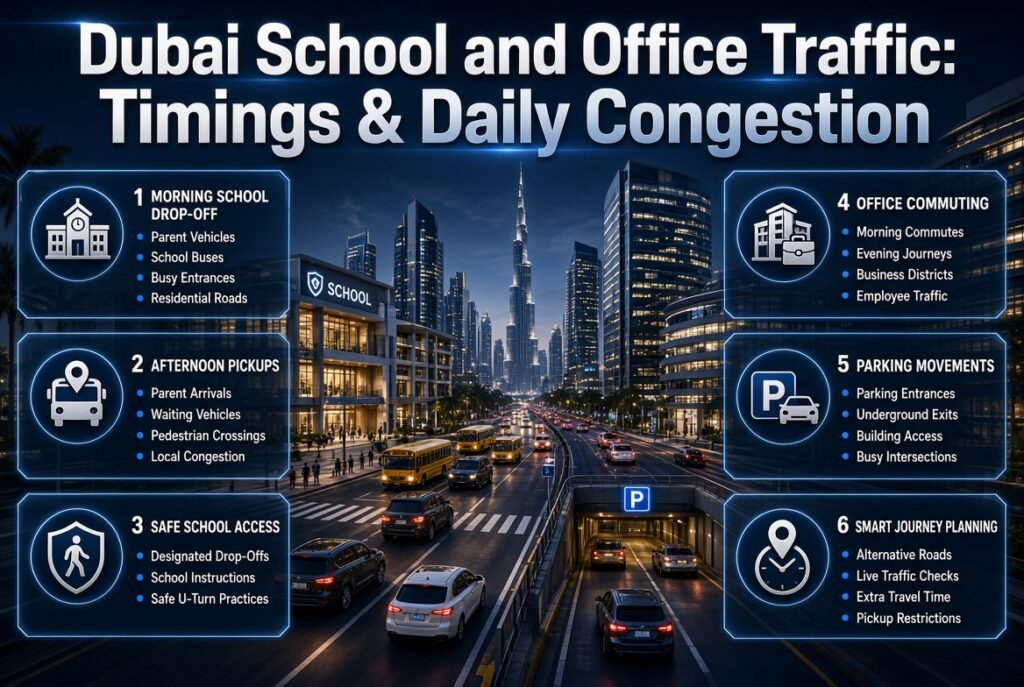
School and office schedules are major contributors to recurring traffic demand.
Unlike occasional events, these activities happen regularly and create predictable movements around residential communities, educational institutions and business districts.
School drop-off traffic
Morning school traffic often develops around entrances, nearby intersections and residential access roads.
Parents, school transport vehicles and other motorists may arrive within similar time windows.
The situation becomes more difficult when drivers stop in unsuitable locations or make sudden U-turns.
Parents should use designated drop-off facilities and follow school traffic instructions.
Afternoon school pickups
School pickup periods create another concentration of vehicles.
Parents arriving early, buses waiting near entrances and vehicles leaving surrounding residential areas can increase local congestion.
Drivers should avoid blocking junctions and pedestrian crossings while waiting.
Office commuting movements
Business districts generate significant traffic during the beginning and end of working periods.
Office parking entrances, underground exits and nearby intersections can become temporary congestion points.
Some buildings experience additional pressure when large numbers of employees finish work at similar times.
How should regular commuters prepare?
Drivers who regularly travel near schools or business districts should:
- Identify alternative access roads.
- Check live conditions before leaving.
- Avoid unnecessary stops near entrances.
- Follow parking and pickup restrictions.
- Allow extra time during school opening and closing periods.
Understanding local activity is often more useful than relying only on general citywide rush-hour information.
11. How Do Shopping and Tourist Activities Change Weekend Traffic?
Weekend traffic is influenced by recreational and commercial activities rather than traditional office commuting alone.
Dubai attracts residents and visitors to shopping centres, beaches, hotels, waterfront destinations and entertainment facilities.
These locations can generate substantial traffic, particularly during afternoon and evening periods.
Shopping centre traffic
Large shopping centres attract vehicles throughout the week.
Demand can increase during weekends, promotional campaigns, holidays and special shopping events.
Congestion may develop around:
- Parking entrances.
- Exit ramps.
- Taxi pickup areas.
- Nearby intersections.
- Pedestrian crossings.
- Road connections leading towards major highways.
Sometimes the surrounding road remains clear while the parking entrance creates a long queue.
Drivers should consider parking access as part of their total journey time.
Beach and waterfront traffic
Popular waterfront locations attract visitors during suitable weather conditions.
Dubai Marina, Jumeirah and Palm Jumeirah can experience additional vehicle movements because of hotels, restaurants, beaches and recreational activities.
Drivers should check access and parking arrangements before travelling to busy destinations.
Tourist attractions
Tourist destinations often attract visitors from several parts of the city.
Hotels, tour vehicles, taxis and private cars may use the same access roads.
This can create temporary pressure around entrances and passenger drop-off points.
Special events and exhibitions
Concerts, exhibitions, sporting competitions and public celebrations can change traffic conditions considerably.
The effect may extend beyond the event location because visitors use surrounding roads and parking facilities.
Before travelling through a busy event area, check relevant traffic advisories and consider another suitable route.
12. How Do Weather and Seasonal Changes Affect Dubai Traffic?
Weather and seasonal activity can change both traffic demand and driving conditions.
The number of vehicles using a road is important, but the way motorists respond to the environment also influences traffic flow.
Summer traffic patterns
During summer, high temperatures influence travel comfort and vehicle operation.
Some residents adjust their daily schedules, while tourist activity and indoor shopping destinations can influence traffic around commercial areas.
Vehicles also depend heavily on air-conditioning during slow-moving journeys.
Drivers should pay attention to:
- Cooling system performance.
- Tyre condition.
- Battery health.
- Engine temperature.
- Air-conditioning performance.
- Fuel level before longer trips.
High temperatures make proper vehicle maintenance particularly important.
Winter traffic patterns
The cooler months encourage outdoor activities, tourism and weekend travel.
Beaches, parks, waterfront destinations and outdoor restaurants may attract additional visitors.
This can increase local traffic during afternoons, evenings and weekends.
Rain and fog
Rain and fog can reduce visibility and affect road grip.
Drivers should adjust their speed to the conditions and increase their following distance.
Important precautions include:
- Use appropriate vehicle lighting.
- Avoid sudden braking.
- Keep a safe distance from other vehicles.
- Follow official road warnings.
- Avoid flooded roads.
- Never enter water-covered areas when their depth and safety are uncertain.
Ramadan traffic patterns
Ramadan can change normal commuting behaviour because working hours, school schedules and daily activities may shift.
Traffic may increase around certain periods before iftar as people travel towards homes, shops and restaurants.
Evening activity can continue later than usual, affecting roads around commercial and recreational destinations.
Drivers should consider updated working schedules and local traffic information rather than assuming that normal weekday patterns will remain unchanged.
For more information about changing road conditions, weather-related driving challenges and temporary disruptions, read our Dubai Road Conditions guide.
13. How Can Drivers Check Live Dubai Traffic Conditions?
Historical traffic information helps motorists understand recurring patterns, but live information is essential when planning an actual journey.
An accident, temporary closure, road diversion or construction activity can change travel time unexpectedly.
Check Google Maps
Google Maps helps drivers compare route options and review traffic conditions.
It can provide estimated journey durations and highlight certain congestion areas.
Drivers should compare the complete journey rather than selecting an alternative simply because it appears shorter.
Use Waze
Waze provides navigation and community-based traffic information.
Depending on available reports, motorists may receive information about accidents, road hazards and certain temporary disruptions.
This can help drivers understand changing conditions before and during a journey.
Follow RTA updates
Dubai’s Roads and Transport Authority provides information about transport services, road developments and relevant traffic arrangements.
Its official announcements can help motorists understand temporary changes affecting the road network.
Follow Dubai Police announcements
Dubai Police shares traffic-related information, road safety guidance and public advisories.
These updates are particularly useful during significant incidents, unusual traffic situations and exceptional road conditions.
What should you check before leaving?
A practical pre-journey checklist includes:
- Current traffic on the complete route.
- Expected arrival time.
- Accident and incident reports.
- Temporary road closures.
- Construction diversions.
- Weather conditions.
- Parking access.
- Applicable Salik crossings.
Checking these details shortly before departure can prevent avoidable delays.
14. What Common Mistakes Should Drivers Avoid During Heavy Traffic?
Many drivers lose time and increase their risk because they rely on assumptions rather than current road conditions.
Understanding these mistakes can help motorists make better decisions.
Assuming every alternative road is faster
A navigation application may suggest another road, but a shorter route does not always provide a quicker journey.
Secondary roads may include traffic signals, residential entrances and frequent turning movements.
Why it happens: Drivers focus on distance rather than the complete journey time.
How to avoid it: Compare estimated arrival times, road conditions and total distance before changing routes.
Leaving without checking current traffic
Some motorists follow the same departure schedule every day.
However, an accident or road closure can make a familiar route significantly slower.
Why it happens: Drivers assume that yesterday’s conditions will repeat.
How to avoid it: Review live traffic information shortly before travelling.
Making frequent lane changes
Repeated lane changes can interrupt traffic movement and increase collision risk.
Why it happens: Drivers believe another lane will always move faster.
How to avoid it: Select a suitable lane early and change only when necessary and safe.
Following other vehicles too closely
Short following distances leave drivers with less time to react when traffic slows suddenly.
Why it happens: Motorists try to prevent other vehicles from entering the available space.
How to avoid it: Maintain a safe distance and adjust it according to speed, visibility and road conditions.
Ignoring local access roads
Drivers sometimes estimate their entire journey using highway conditions.
However, the final approach to an office building, residential tower or shopping destination may create additional delays.
How to avoid it: Check the complete route, including entrances, parking areas and destination access roads.
Delaying vehicle maintenance
A poorly maintained vehicle may develop problems during a congested journey.
Battery failure, overheating, tyre damage and insufficient fuel can turn an ordinary commute into a roadside emergency.
How to avoid it: Follow the manufacturer’s maintenance schedule and inspect essential vehicle components regularly.
15. What Professional Driving Strategies Help During Busy Traffic Periods?
Good traffic planning combines route selection, departure timing, vehicle condition and safe driving behaviour.
Professional drivers do not depend entirely on one fixed route. They assess conditions and make practical decisions when circumstances change.
Keep a primary and alternative route
Identify a normal route and at least one suitable alternative.
Compare both options using current travel estimates, road restrictions and destination access.
An alternative route should be practical and safe, not simply different.
Adjust flexible journeys
If an appointment or personal journey does not require an exact departure time, consider travelling outside the strongest commuting periods.
Even a modest adjustment may reduce the time spent in congestion on certain routes.
Maintain smooth driving behaviour
Avoid rapid acceleration, unnecessary braking and aggressive lane changes.
A consistent driving style improves passenger comfort and helps reduce avoidable fuel consumption.
Maintain your vehicle for Dubai conditions
Vehicles operating in Dubai regularly experience high temperatures, air-conditioning demand and periods of slow-moving traffic.
Important maintenance areas include:
- Engine oil and filter condition.
- Coolant level and cooling system.
- Tyre pressure and tread condition.
- Battery performance.
- Brake condition.
- Air-conditioning performance.
- Fuel system condition.
A properly maintained vehicle is less likely to experience avoidable problems during daily commuting.
Monitor fuel before long journeys
Traffic delays can increase journey duration, particularly when travelling across different parts of Dubai or between neighbouring emirates.
Avoid starting a long journey with an unnecessarily low fuel level.
If your vehicle runs out of fuel, prioritise safety and seek appropriate roadside assistance rather than attempting an unsafe journey to a nearby petrol station.
For wider guidance about road movement, traffic behaviour and driving challenges, explore our Dubai Road and Traffic guide.
16. How Can Better Traffic Management Improve Dubai’s Road Network?
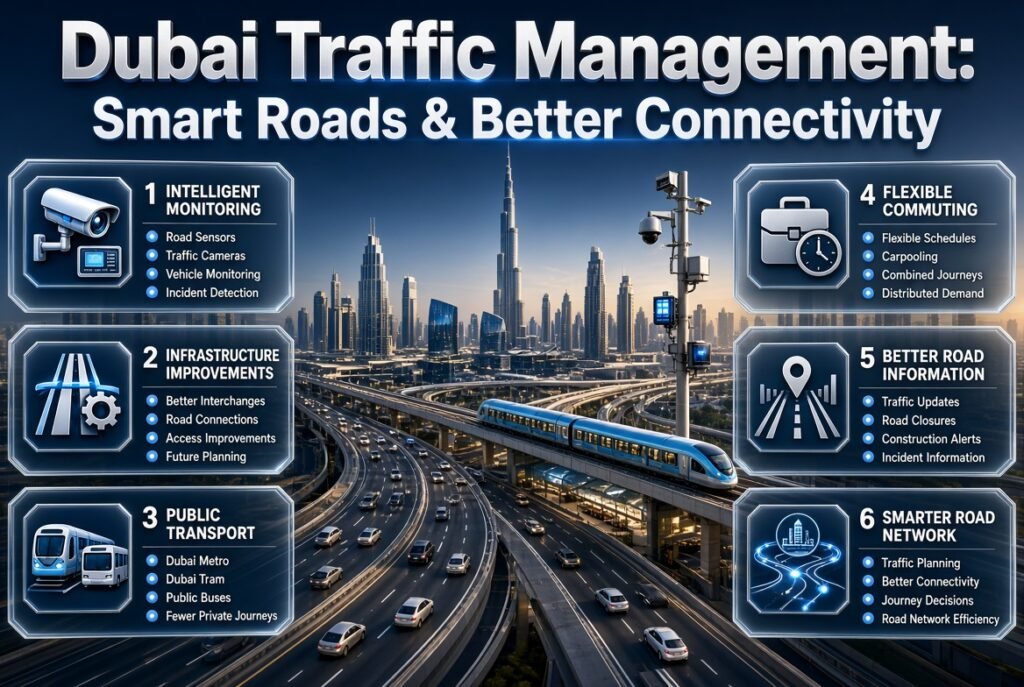
Managing congestion requires more than increasing the number of road lanes.
Authorities must consider future population growth, travel demand, public transport, road design, incident response and the way motorists use available infrastructure.
Intelligent traffic monitoring
Modern traffic management systems use road sensors, cameras and digital information to monitor vehicle movements.
These systems can help identify recurring congestion points and changing traffic conditions.
Better information can support more effective traffic signal management, road planning and incident response.
Infrastructure improvements
Improving interchanges, road connections and access points can help manage traffic demand.
However, infrastructure projects must consider how residential and commercial development will influence future vehicle movements.
The objective should be to improve the overall journey rather than simply increase traffic capacity on one road.
Public transportation
Dubai Metro, Dubai Tram, buses and other public transport services provide alternatives to private vehicle journeys.
Using public transportation where practical can reduce the number of individual vehicles travelling through congested districts.
Public transport can be particularly useful for journeys involving established commercial and residential centres.
Flexible working and commuting arrangements
Flexible working schedules can help distribute commuting demand across different periods.
Carpooling and combining necessary journeys can also reduce unnecessary individual vehicle movements.
Better road information
Accurate traffic updates help motorists make informed decisions.
Clear information about road closures, construction and incidents can reduce confusion and discourage unsafe last-minute route changes.
17. How Should You Plan Your Daily Journey Around Dubai Traffic Patterns?
The best journey plan depends on the starting location, destination, departure time and purpose of travel.
A practical approach combines advance preparation with live traffic information.
Step 1: Identify your travel period
Determine whether the journey falls during morning commuting, midday activity, evening rush hour or weekend traffic.
This gives you an initial understanding of possible road demand.
Step 2: Check the complete route
Review the journey from your starting point to your final destination.
Include connecting roads, highway exits, local access roads and parking arrangements.
Step 3: Compare suitable alternatives
Consider journey time, distance, toll charges and current road conditions.
Select the route that offers the most practical balance rather than automatically choosing the shortest distance.
Step 4: Prepare your vehicle
Check fuel level, tyre condition and essential vehicle systems before longer journeys.
A basic inspection can help prevent avoidable roadside problems.
Step 5: Allow additional time
Include a reasonable buffer for unexpected delays.
This is particularly important when travelling to airports, business appointments, schools and scheduled events.
Step 6: Adjust your driving behaviour
Remain patient, maintain safe distances and follow road signs.
Do not make risky decisions simply because congestion has increased your journey time.
Step 7: Review your regular travel routine
If you use the same route frequently, compare journey times across different days and departure periods.
This helps identify which travel arrangements work best for your routine.
18. What Should Drivers Do When Traffic Becomes Unexpectedly Heavy?
Even well-planned journeys can encounter unexpected congestion.
An accident, broken-down vehicle, temporary closure or sudden weather change can affect roads without warning.
The most important response is to remain calm and avoid creating additional risks.
Avoid sudden manoeuvres
Do not make abrupt lane changes or reverse simply because traffic has stopped.
Follow road signs and instructions from authorised personnel.
Keep emergency access clear
Do not block emergency vehicles or stop in restricted areas.
If an emergency vehicle approaches, respond safely and follow applicable road rules.
Check for official information
Use reliable traffic updates to understand whether the delay is temporary or related to a larger incident.
Do not rely on unverified messages or rumours.
Protect yourself during a breakdown
If your vehicle develops a mechanical problem, move to a safe location if possible.
Use hazard lights when appropriate and follow safe roadside procedures.
Avoid standing in moving traffic or attempting repairs in dangerous locations.
For more detailed advice about safe driving decisions, incident awareness and accident prevention, explore our Dubai Road Safety guide.
What Are the Busiest Traffic Hours in Dubai, and How Can Drivers Avoid Them?
Dubai generally experiences its busiest weekday traffic during the morning and evening commuting periods. Morning congestion develops as employees and students travel towards business districts and schools, while evening traffic increases when residents return home or visit shopping and entertainment destinations. However, congestion can begin earlier or continue later depending on the road, location and daily activities.
Drivers who regularly travel through Sheikh Zayed Road, Al Khail Road or routes connecting Dubai with Sharjah should plan their journeys around these recurring patterns. Leaving slightly earlier, adjusting flexible appointments and checking current traffic conditions can help reduce unnecessary delays.
Practical ways to manage rush-hour journeys:
Check live traffic conditions before starting your journey.
Allow additional time for morning and evening appointments.
Avoid unnecessary trips during the busiest commuting periods.
Compare alternative routes instead of automatically choosing the shortest distance.
Keep sufficient distance from other vehicles in slow-moving traffic.
Which Roads and Areas in Dubai Experience the Most Traffic Congestion?
Traffic congestion in Dubai is concentrated around major highways, busy interchanges, commercial districts and popular residential destinations. Sheikh Zayed Road, Sheikh Mohammed bin Zayed Road, Emirates Road and Al Khail Road can experience significant traffic demand during commuting periods. Areas such as Downtown Dubai, Business Bay, Dubai Marina, JLT and Deira also experience congestion because of their combination of residential, business, shopping and recreational activities.
The reason for congestion differs between locations. For example, Business Bay experiences considerable office-related traffic, while Dubai Marina can become busy because of residential movements, restaurants, hotels and visitors. Similarly, roads connecting Sharjah with Dubai experience additional commuting demand from people travelling between the two emirates.
Important considerations when travelling through busy areas:
Check traffic around highway exits, not just the main road.
Consider parking entrances and local access roads when visiting commercial districts.
Allow additional time when travelling between Dubai and Sharjah.
Avoid unnecessary lane changes near busy interchanges.
Review road conditions before travelling through areas affected by construction or events.
How Can Drivers Predict Dubai Traffic Conditions Before Starting a Journey?
Drivers can understand likely traffic conditions by combining regular travel patterns with live road information. Historical traffic trends help identify recurring busy periods, while navigation applications provide updated journey estimates and alternative routes. This approach is more reliable than depending on a fixed departure schedule or assuming that a familiar road will always remain clear.
For example, someone travelling from Dubai Silicon Oasis to Business Bay should consider the departure time, current conditions on connecting highways and traffic near the final destination. Even if the main highway is moving smoothly, congestion near an interchange or building entrance can affect the total journey.
A practical traffic-planning routine includes:
Check the expected journey duration before departure.
Review congestion on the complete route.
Look for reported accidents and temporary road restrictions.
Compare alternative routes using estimated arrival times.
Check parking and destination access arrangements.
Allow a reasonable time buffer for unexpected delays.
Regular commuters can also compare their journey times across different weekdays to identify the most suitable departure period for their routine.
How Do Dubai Traffic Patterns Affect Fuel Consumption and Vehicle Performance?
Heavy traffic can increase fuel consumption because vehicles repeatedly accelerate, brake and remain stationary with their engines running. These conditions make driving less efficient, particularly when congestion continues for long periods. Frequent stop-and-go movement can also increase the demands placed on braking systems and other vehicle components.
In Dubai, high temperatures and regular air-conditioning use can add another consideration. A vehicle operating in slow-moving traffic may experience prolonged cooling-system demand, while an already poorly maintained vehicle may be more vulnerable to overheating or mechanical problems.
Drivers can reduce unnecessary fuel consumption by:
Maintaining smooth acceleration and braking.
Avoiding unnecessary engine idling.
Keeping tyres inflated to the manufacturer’s recommended pressure.
Maintaining the cooling system and engine oil.
Checking battery and brake condition regularly.
Planning journeys to reduce avoidable congestion.
Monitoring fuel levels before longer trips.
Vehicle maintenance is particularly important for motorists who regularly commute through congested areas. A properly maintained vehicle is better prepared for the demands of daily driving.
Why Do Dubai Traffic Patterns Change During Weekends, Winter and Ramadan?
Dubai traffic changes throughout the year because residents and visitors adjust their travel routines according to working schedules, weather, school activities and social events. Weekday congestion is often influenced by office and school commuting, whereas weekend traffic is more closely connected with shopping, tourism, restaurants and recreational destinations.
Winter can bring increased outdoor activity because the weather is more comfortable for visiting beaches, parks and waterfront locations. Ramadan can also change normal commuting patterns as working hours and daily activities shift. Traffic may increase around certain periods before iftar and later in the evening as residents travel for shopping, dining and family gatherings.
What drivers should consider during changing traffic periods:
Check local traffic conditions before weekend shopping trips.
Allow additional time when visiting popular tourist destinations.
Expect different commuting patterns during Ramadan.
Monitor weather-related road conditions during periods of rain or fog.
Check for temporary traffic arrangements during public events.
Avoid relying entirely on normal weekday journey estimates during holidays.
Understanding these seasonal and weekly changes helps motorists plan more realistically instead of assuming that traffic will follow the same pattern throughout the year.
Conclusion
Understanding Dubai traffic patterns helps drivers plan their journeys more efficiently, avoid unnecessary delays, and make better decisions on the road. Traffic conditions can change throughout the day because of rush hours, roadworks, accidents, weather, school schedules, major events, and seasonal travel demand. A route that is clear in the morning may become heavily congested later, so following the same travel routine every day is not always practical.
Drivers can reduce the impact of congestion by checking traffic conditions before departure, allowing extra travel time during peak periods, choosing suitable alternative routes, and maintaining a safe distance from other vehicles. Smooth acceleration, controlled braking, and avoiding unnecessary idling can also help reduce fuel consumption during slow-moving traffic.
Dubai’s road network continues to develop, but responsible driving and effective journey planning remain essential. Whether travelling through Downtown Dubai, Business Bay, Deira, Dubai Marina, or along Sheikh Zayed Road, staying informed about changing road conditions can make everyday journeys safer and more predictable.
For additional guidance on Dubai roads, vehicle use, and fuel-related situations, explore our Dubai driving and fuel insights. Drivers who need convenient fuel assistance can also visit our fuel delivery services in Dubai for further information.
By understanding local traffic trends, preparing for busy periods, and adopting safer driving habits, motorists can make better use of Dubai’s road network and enjoy more organised, comfortable, and efficient journeys.
Leave a Reply