
Introduction
Dubai Road Conditions | Driving in Dubai can be a comfortable experience when roads are clear, visibility is good and traffic is moving smoothly. However, conditions can change unexpectedly. A route that normally takes 20 minutes may take much longer because of an accident, road construction, heavy traffic, fog or sudden rainfall. For residents, tourists and new drivers, understanding these changes is essential for planning safe and convenient journeys.
Dubai road conditions depend on several factors, including road quality, traffic volume, weather, construction activity, vehicle condition and driving behaviour. Although Dubai has a modern road infrastructure with extensive highways, well-connected residential streets and advanced traffic management systems, motorists still need to understand how different roads behave throughout the day.
For example, driving on Sheikh Zayed Road requires different attention from travelling through a residential community such as Al Barsha. Highway driving involves managing speed, maintaining lane discipline and anticipating traffic movements, while residential driving requires greater awareness of pedestrians, parking entrances and local intersections.
This guide explains the different types of roads in Dubai, daily traffic patterns, weather-related driving challenges, highway conditions, construction diversions and vehicle-related concerns. It also provides practical advice on checking road conditions, preparing your vehicle and handling unexpected situations.
Whether you are commuting to work, travelling between emirates, visiting popular destinations or driving through unfamiliar neighbourhoods, this information will help you understand Dubai’s road network and make better decisions before starting your journey.
For additional guidance about vehicle assistance, fuel availability and driving-related services, visit Fuel Delivery Dubai.
1. What Are the General Road Conditions in Dubai?
Dubai generally has a modern road network designed to support private vehicles, public transport, commercial traffic and long-distance travel. Major highways provide connections between important districts, while smaller roads serve residential communities, shopping destinations and industrial areas.
Most major routes have clearly marked lanes, directional signs, controlled intersections and designated entry and exit points. However, road quality alone does not determine whether a journey will be comfortable. Traffic congestion, road maintenance, visibility and driving behaviour also influence the overall experience.
Road quality and maintenance
Major roads in Dubai generally offer smooth driving surfaces suitable for everyday commuting and longer journeys. Maintenance activities help address surface damage, road markings and infrastructure requirements.
Nevertheless, drivers may encounter temporary problems such as:
- Uneven road surfaces near maintenance areas.
- Loose sand close to construction zones.
- Temporary lane restrictions.
- Changed road markings.
- Debris near road edges.
- Water accumulation after rainfall.
- Reduced visibility around roadwork areas.
These conditions may not affect an entire route. Sometimes, only a short section requires additional attention.
Professional advice: Avoid increasing speed simply because the road surface looks smooth. Always consider traffic density, visibility, road signs and the distance available for stopping.
Differences between major and local roads
Dubai’s road network includes several types of streets, and each requires a different driving approach.
Major highways are designed for higher-speed travel, subject to posted speed limits. Local roads generally have more intersections, parking access points and pedestrian activity.
Commercial areas may experience frequent vehicle movements, while industrial routes often accommodate heavy vehicles and delivery traffic.
Understanding these differences helps drivers prepare for the road ahead rather than reacting to every situation at the last moment.
2. What Types of Roads Can You Find in Dubai?
Dubai has an extensive network of highways, expressways, urban streets, residential roads, service roads and connecting routes. Each category serves a different purpose and has its own traffic characteristics.
Highways and expressways
Highways are essential for travelling between major districts and connecting Dubai with neighbouring emirates.
Some important routes include:
- Sheikh Zayed Road.
- Sheikh Mohammed Bin Zayed Road.
- Al Khail Road.
- Emirates Road.
- Dubai–Al Ain Road.
These roads generally provide multiple lanes and designated interchanges. However, traffic can become dense around exits, merging points and commercial districts.
Drivers should select the correct lane early, maintain an appropriate following distance and avoid unnecessary lane changes.
Urban roads
Urban roads connect commercial districts, residential areas, offices and shopping destinations.
Locations such as Downtown Dubai, Business Bay, Deira and Bur Dubai have busy urban road networks.
Drivers should expect:
- Frequent traffic signals.
- Pedestrian crossings.
- Parking entrances.
- Vehicles turning into side streets.
- Delivery vehicles.
- Congestion near commercial buildings.
The most important consideration is anticipating what other road users may do.
Residential streets
Residential roads usually have lower speed limits and more pedestrian activity than major highways.
Drivers may encounter children, pedestrians, parked vehicles, school traffic and vehicles entering or leaving residential buildings.
Slow down when approaching community entrances, crossings and narrow streets.
Service roads
Service roads provide access to petrol stations, commercial properties, residential buildings and other facilities.
They are particularly important near major highways because vehicles regularly enter and leave the main carriageway.
Before joining a service road or returning to a highway, check mirrors and blind spots carefully.
Industrial and commercial roads
Industrial areas may experience substantial movement of trucks, buses, delivery vehicles and commercial transport.
Heavy vehicles require additional space when turning and may have larger blind spots.
Avoid driving too closely beside trucks, particularly when approaching intersections and loading areas.
3. Which Major Roads Should Drivers Know in Dubai?
Knowing the purpose of Dubai’s major roads makes route planning easier, especially for people who travel regularly between residential and commercial locations.
Sheikh Zayed Road
Sheikh Zayed Road is one of Dubai’s most important highways. It connects several major commercial and residential districts and provides access to important destinations.
It is commonly used by commuters, business travellers and visitors.
During busy periods, motorists may experience:
- Slow-moving traffic.
- Heavy merging near interchanges.
- Congestion around business districts.
- Increased traffic near exits.
- Frequent lane changes.
Drivers should identify their exit early and avoid sudden movements when traffic becomes dense.
Al Khail Road
Al Khail Road connects several residential and commercial communities across Dubai.
It is useful for travelling between different districts, but traffic conditions can change around major intersections and connecting roads.
Before using this route, check the traffic situation and consider whether another road provides a more convenient journey.
Sheikh Mohammed Bin Zayed Road
Sheikh Mohammed Bin Zayed Road is an important route for travelling between different parts of Dubai and surrounding areas.
Drivers should pay attention to highway speed limits, heavy vehicles, interchange directions and traffic entering from connecting roads.
Emirates Road
Emirates Road supports longer-distance travel and provides connections between Dubai and other areas of the UAE.
Before using this route, check your fuel level, tyre condition and general vehicle condition.
Dubai–Al Ain Road
Dubai–Al Ain Road connects Dubai with Al Ain and supports regular commuting and longer journeys.
Motorists should prepare for highway driving by checking their vehicle, planning suitable stops and confirming their intended route.
Important: The most suitable road depends on your starting point, destination and current traffic conditions. A route that is convenient during quiet hours may not be the best option during peak periods.
4. How Does Traffic Congestion Affect Dubai Road Conditions?
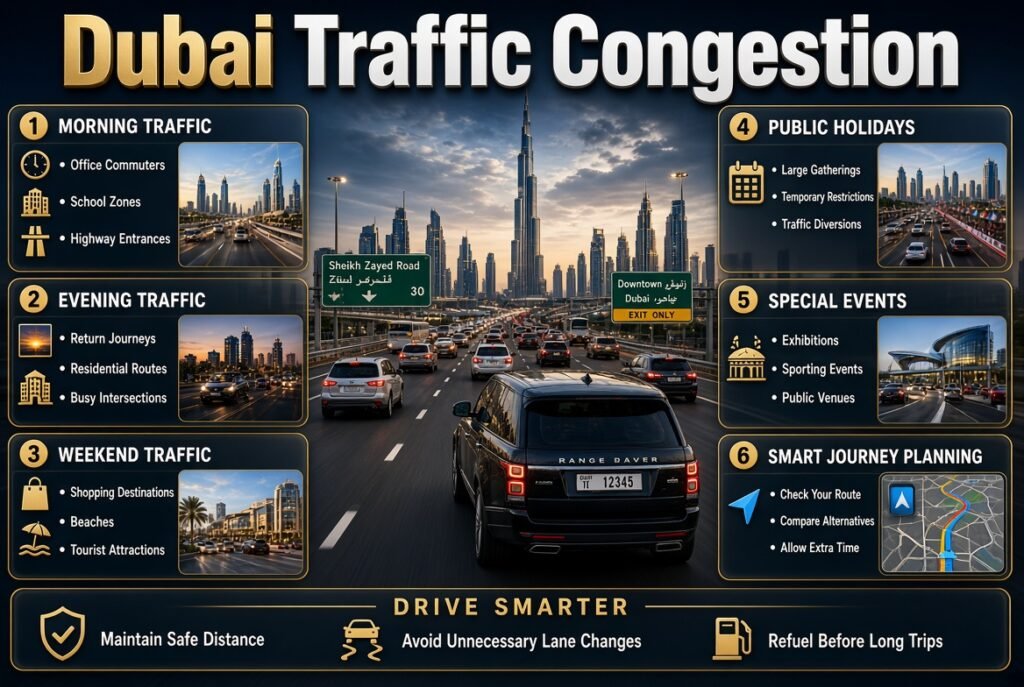
Traffic congestion is one of the most common challenges for Dubai motorists. Even when roads are properly maintained, a high number of vehicles can reduce average speeds and increase journey times.
Congestion is influenced by working hours, school schedules, commercial activity, public events, accidents and road maintenance.
Morning traffic
Morning congestion often develops when residents travel from residential communities towards offices, schools and business districts.
Drivers may experience queues near:
- Highway entrances.
- Major intersections.
- School zones.
- Business districts.
- Commercial parking entrances.
Allow additional time if your journey involves several busy intersections.
Evening traffic
Evening traffic increases when commuters return home from offices and commercial areas.
Vehicles travelling towards popular residential communities may experience longer queues, especially around major connecting roads.
Avoid unnecessary overtaking and maintain a consistent driving style.
Weekend traffic
Weekend traffic patterns can differ from normal working days.
Some commuter routes may be quieter, while shopping centres, beaches, entertainment destinations and tourist attractions may experience increased vehicle movement.
Before visiting a popular destination, consider parking access, local traffic and possible delays near entrances.
Public holidays and special events
Public holidays, exhibitions, sporting events and large public gatherings can influence traffic patterns.
Some roads may experience temporary restrictions or diversions.
Plan your journey in advance and follow authorised traffic instructions.
Practical ways to reduce traffic-related delays
You cannot always avoid congestion, but you can reduce its impact.
- Check your route before leaving.
- Compare alternative routes.
- Allow additional travel time.
- Avoid unnecessary lane changes.
- Keep sufficient distance from the vehicle ahead.
- Refuel before starting a longer journey.
- Avoid relying on normal journey times during special events.
Common mistake: Assuming that a familiar journey will always take the same amount of time. Traffic conditions are not fixed, so checking the route before departure is a better habit.
5. How Do Weather Conditions Change Dubai Road Conditions?
Weather plays an important role in road safety. Although Dubai experiences dry conditions for much of the year, motorists must also prepare for extreme heat, rain, fog and dusty weather.
The correct driving approach depends on the conditions at the time of travel.
Extreme summer temperatures
Dubai’s summer temperatures can place additional demands on vehicles.
The engine cooling system, battery, tyres and air conditioning may experience greater operating stress, particularly during long journeys and heavy traffic.
Drivers should regularly check:
- Engine coolant condition and level.
- Tyre pressure.
- Battery performance.
- Air-conditioning operation.
- Engine temperature.
- Engine oil condition.
Long periods of idling can also increase fuel consumption and place additional demands on the vehicle.
Expert advice: If the engine temperature rises above its normal operating range, find a safe stopping location. Do not continue driving while ignoring an overheating warning. Never open a hot pressurised cooling system.
Rainy road conditions
Rain can change the road surface considerably, particularly after a long dry period.
Water may mix with dust and other surface residues, reducing tyre grip. Standing water can also hide uneven surfaces or damaged sections.
When driving during rain:
- Reduce speed according to conditions.
- Increase following distance.
- Use appropriate headlights.
- Check windshield wipers.
- Avoid sudden braking.
- Avoid sharp steering movements.
- Stay away from flooded roads.
A vehicle travelling too quickly on a wet surface may take longer to stop.
Common mistake: Following another vehicle through a flooded section without knowing the water depth. Different vehicles have different ground clearances, and the water may become deeper further along the road.
Foggy conditions
Fog can reduce visibility significantly, particularly during early mornings when humidity and temperature conditions are suitable.
Drivers may struggle to identify vehicles, lane markings and upcoming intersections.
To drive more safely in fog:
- Reduce speed gradually.
- Use appropriate fog lights where fitted and permitted.
- Use low-beam headlights.
- Avoid high-beam headlights.
- Increase following distance.
- Avoid unnecessary overtaking.
- Follow road markings carefully.
If visibility becomes too poor, postpone your journey or move to a suitable safe stopping location away from moving traffic.
Dust storms and sandy conditions
Dusty weather can make driving difficult because visibility may decrease rapidly.
Sand can also accumulate near exposed road sections, construction areas and road edges.
During dusty conditions:
- Reduce speed.
- Keep windows closed.
- Maintain a safe distance.
- Avoid sudden steering movements.
- Use appropriate lighting.
- Follow official weather warnings.
If visibility becomes extremely poor, delaying the journey is often the safest decision.
6. How Do Roadworks and Construction Affect Driving in Dubai?
Dubai’s continued development means that maintenance and construction work may affect different roads and neighbourhoods.
Roadworks can temporarily change normal driving patterns through lane closures, diversions, barriers and reduced speed limits.
Common problems near construction areas
Motorists may encounter:
- Temporary lane closures.
- Narrower driving spaces.
- Changed entry and exit arrangements.
- Construction vehicles entering traffic.
- Uneven road surfaces.
- Temporary traffic signals.
- Reduced speed limits.
These changes can be particularly challenging for drivers unfamiliar with the area.
Safe driving near roadworks
Reduce speed when approaching construction areas and follow temporary signs.
Watch for workers, construction vehicles and temporary barriers. Avoid entering restricted lanes even if another driver appears to be doing so.
If your intended exit is closed, continue safely and choose an alternative route.
Professional tip: Navigation applications may not immediately reflect every temporary road restriction. Always follow the signs and instructions displayed on the actual road.
7. How Can Drivers Check Live Dubai Road Conditions?
Checking road information before travelling can help drivers avoid unnecessary delays and identify potential safety problems.
However, different information sources provide different types of assistance. Some focus on official traffic announcements, while others offer route guidance and estimated journey times.
Check RTA information
The Roads and Transport Authority (RTA) is an important source of Dubai transport information.
Its digital services and official communication channels can help motorists access relevant road and transport updates.
Follow Dubai Police announcements
Dubai Police provides road safety information and traffic-related announcements.
These updates can be especially useful during adverse weather, accidents and situations that require additional driving precautions.
Use navigation applications
Navigation applications can help identify:
- Congested roads.
- Estimated journey times.
- Alternative routes.
- Reported incidents.
- Route changes.
- Difficult intersections.
However, digital navigation should not replace official road signs or authorised instructions.
Check conditions before starting your journey
Develop a simple pre-journey routine:
- Review the route.
- Check reported congestion.
- Look for weather warnings.
- Identify possible diversions.
- Confirm your fuel level.
- Check important vehicle warning indicators.
- Allow extra time for unexpected delays.
For broader information about driving-related topics, explore Dubai Driving and Fuel Insights.
Important: General road information does not guarantee that a particular route is clear at the time you travel. Check current official information before departure.
8. What Are the Main Road Safety Challenges in Dubai?
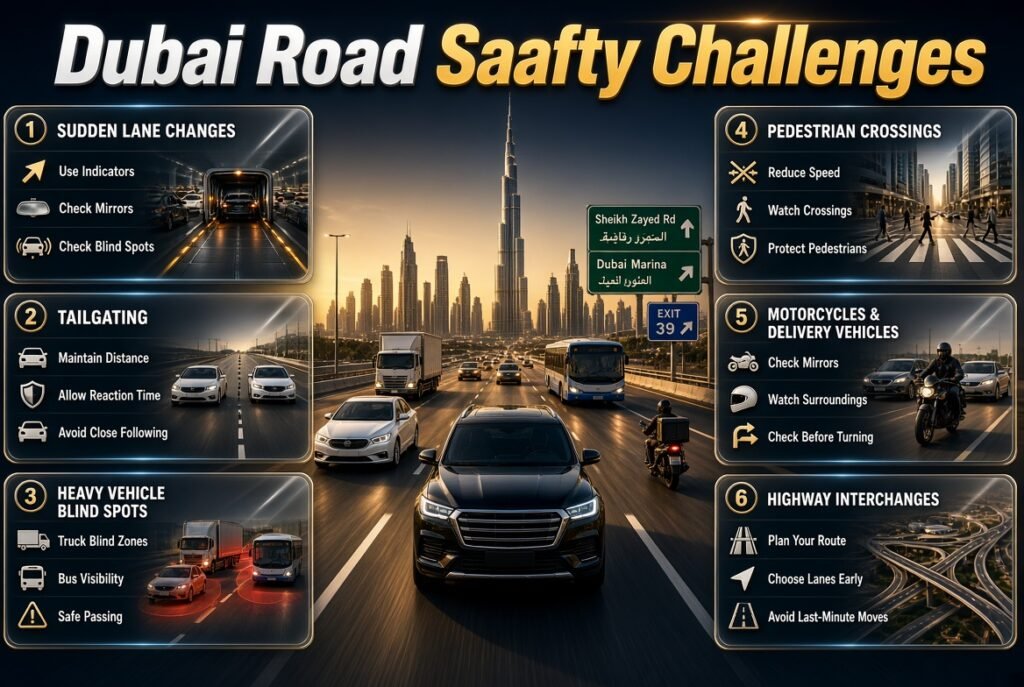
Dubai’s roads are shared by private vehicles, taxis, buses, motorcycles, trucks, cyclists and pedestrians. Their different movements create situations where drivers must remain alert.
Sudden lane changes
Sudden lane changes can interrupt traffic flow and increase collision risks.
Always signal, check mirrors and blind spots, and change lanes only when enough space is available.
Tailgating
Following another vehicle too closely reduces the time available to react if it brakes suddenly.
Maintain an appropriate following distance and increase it during rain, fog and poor visibility.
Heavy vehicle blind spots
Trucks and buses have larger blind spots than ordinary cars.
Avoid remaining beside heavy vehicles for extended periods, especially near turns and intersections.
Pedestrian crossings
Residential and commercial areas may have considerable pedestrian activity.
Reduce speed near crossings, schools, bus stops and shopping entrances.
Motorcycles and delivery vehicles
Motorcycles and delivery vehicles can approach from positions that may not be immediately visible in mirrors.
Check blind spots before turning, changing lanes or entering another road.
Complex highway interchanges
Some interchanges require drivers to make early lane decisions.
Study your route in advance and avoid last-minute movements when approaching an exit.
9. How Do Road Conditions Affect Vehicle Performance and Fuel Economy?
Road conditions influence how much energy a vehicle uses during a journey.
A vehicle travelling at a steady speed on a suitable road may use fuel differently from one repeatedly accelerating and braking in congested traffic.
Understanding this relationship helps motorists improve driving habits and identify potential vehicle problems.
Stop-and-go traffic
Frequent acceleration and braking increase the energy required to move a vehicle.
This can increase fuel consumption, particularly when traffic remains congested for extended periods.
To reduce unnecessary fuel use:
- Accelerate smoothly.
- Anticipate traffic changes.
- Avoid unnecessary braking.
- Maintain a suitable following distance.
- Avoid aggressive overtaking.
- Use efficient routes where practical.
Uneven road surfaces
Uneven surfaces can affect passenger comfort and may contribute to tyre and suspension damage.
Pay attention to repeated vibrations, steering changes and unusual noises.
If the vehicle begins pulling to one side or develops an unusual vibration, arrange a professional inspection.
Tyre pressure and road grip
Tyre pressure affects handling, braking and tyre wear.
Underinflated tyres can increase rolling resistance, while incorrect pressure may affect vehicle stability and comfort.
Check pressure when tyres are cold and use the manufacturer’s recommended figures.
Air conditioning and summer traffic
Air conditioning is important for comfortable driving in Dubai’s climate.
However, operating the system can increase engine load, particularly during slow-moving traffic.
Maintain the air-conditioning system and cooling system according to the vehicle manufacturer’s service recommendations.
Fuel planning during traffic delays
Low fuel can become a serious inconvenience when a journey takes longer than expected.
A vehicle may have enough fuel for a normal journey but become stranded when an accident, diversion or congestion increases travel time.
Do not wait until the fuel warning appears before planning your next refuelling stop.
If an unexpected fuel shortage occurs, Fuel Delivery Dubai can help motorists understand available mobile fuel assistance options.
10. How Should You Prepare Your Vehicle for Dubai Road Conditions?
Vehicle preparation is essential because even good roads cannot prevent mechanical problems caused by poor maintenance.
High temperatures, traffic congestion, frequent braking and longer journeys can make regular inspections particularly important.
Inspect tyres
Check tyre pressure, tread depth and visible damage.
Look for cuts, bulges, cracks and uneven wear.
A damaged tyre should be inspected before continuing a long journey.
Check the cooling system
The cooling system helps maintain the engine’s normal operating temperature.
Inspect coolant condition, hoses, radiator condition and visible leaks.
Use the coolant specification recommended by the vehicle manufacturer rather than choosing a product based only on its colour.
Monitor battery condition
High temperatures can place additional demands on automotive batteries.
Warning signs may include slow engine starting, dim lights and electrical irregularities.
Have the battery and charging system checked when these symptoms appear.
Maintain brakes
Brakes are essential for safe driving, particularly in congested areas where vehicles frequently slow down.
Pay attention to unusual noises, vibrations and changes in pedal feel.
Arrange an inspection if braking performance changes.
Check engine oil and essential fluids
Engine oil helps lubricate and protect moving engine components.
Follow the manufacturer’s recommended oil specification and service intervals.
Also check other essential fluids according to the vehicle’s maintenance requirements.
Inspect lights and visibility equipment
Headlights, indicators, brake lights and windshield wipers are important for visibility and communication with other road users.
Check that they work correctly before travelling, particularly during foggy or rainy weather.
11. What Should You Do If Your Vehicle Breaks Down on a Dubai Road?
A vehicle breakdown can happen because of battery failure, tyre damage, overheating, mechanical faults or an empty fuel tank.
The correct response depends on the location and surrounding traffic.
Step 1: Move away from moving traffic
If the vehicle is still controllable, move towards an appropriate safe stopping area when possible.
Avoid stopping in an active lane unless an emergency leaves no safer option.
Step 2: Activate hazard lights
Switch on your hazard warning lights to alert other motorists.
Do not put yourself at risk by attempting repairs beside moving traffic.
Step 3: Identify the problem safely
Look at dashboard warnings and consider what happened before the vehicle stopped.
Common issues include:
| Vehicle problem | Possible indication | Appropriate assistance |
|---|---|---|
| Battery failure | Engine does not start | Battery assistance |
| Empty fuel tank | Engine stops or fuel runs out | Fuel delivery |
| Tyre damage | Pressure loss or vibration | Tyre assistance |
| Engine overheating | Temperature warning | Mechanical assistance |
| Mechanical failure | Unusual noises or warning lights | Vehicle recovery or repair |
Step 4: Arrange suitable roadside assistance
Choose assistance according to the actual problem.
A flat battery requires a different solution from an empty fuel tank or serious mechanical failure.
Provide your location as accurately as possible and explain the vehicle’s condition.
Step 5: Wait somewhere safe
Avoid standing behind or beside a vehicle exposed to moving traffic.
Follow local safety instructions and wait for assistance in an appropriate safe location.
Important: Personal safety should always come before attempting to repair the vehicle yourself.
12. What Should Tourists and New Residents Know About Driving in Dubai?
People who are unfamiliar with Dubai’s road network may need time to understand its highways, interchanges and traffic patterns.
Even experienced drivers can find unfamiliar multi-lane intersections challenging.
Understand right-hand traffic
Vehicles in the UAE drive on the right-hand side of the road.
Drivers arriving from countries with left-hand traffic should take additional care when turning, entering roundabouts and joining highways.
Understand road signs
Dubai uses regulatory, warning and directional signs to guide motorists.
Pay attention to:
- Speed limits.
- Lane directions.
- Exit numbers.
- No-entry restrictions.
- Parking regulations.
- Overtaking restrictions.
- Pedestrian crossings.
Never assume that a road sign has exactly the same meaning as a similar sign in another country.
Learn highway navigation
Before entering a major highway, understand which exit you need.
Some interchanges involve several connecting roads, so last-minute decisions can create dangerous situations.
Understand local driving behaviour
Different roads have different traffic characteristics.
Highways may involve faster-moving traffic, while residential roads require more attention to pedestrians and parked vehicles.
Do not copy aggressive driving habits from other motorists. Follow traffic regulations and maintain a safe driving distance.
Check vehicle and driving requirements
Tourists and residents should confirm that their driving licence, vehicle registration and insurance meet the applicable UAE requirements.
Rental vehicle users should also understand the vehicle’s controls, emergency equipment and roadside assistance arrangements before starting their journey.
13. What Are the Most Common Mistakes Drivers Make on Dubai Roads?
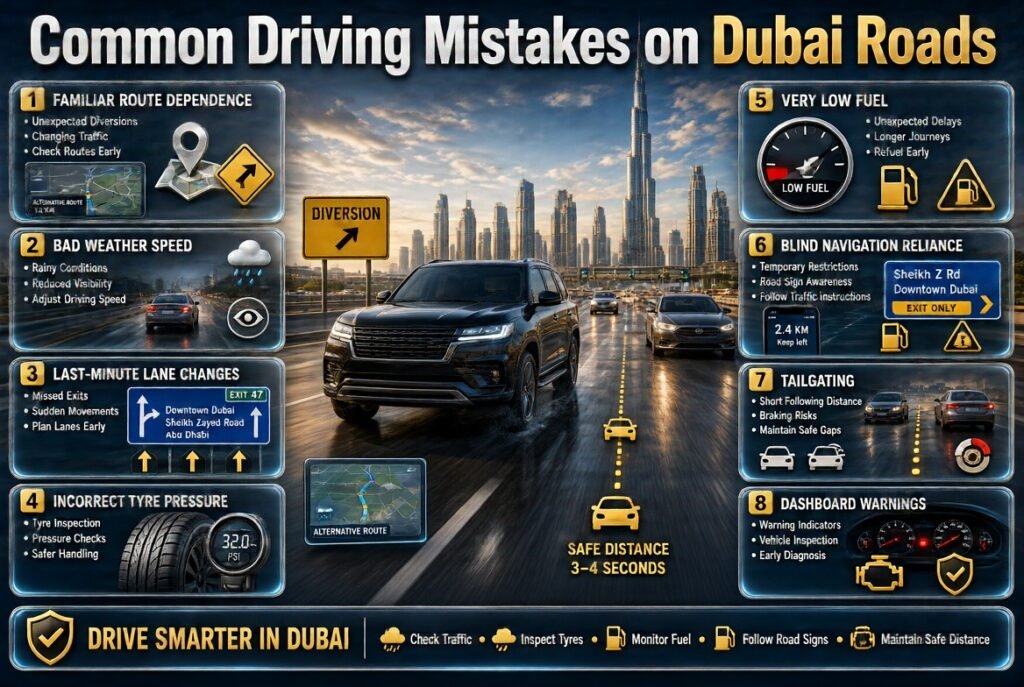
Many avoidable road problems happen because drivers underestimate changing conditions or make decisions too late.
Understanding these mistakes can help improve driving safety.
Mistake 1: Relying on familiar routes
Why it happens: Drivers assume their usual route will always be available and clear.
Why it is harmful: Accidents, construction and diversions can change journey times.
How to avoid it: Check current traffic information before departure.
Mistake 2: Driving too quickly during bad weather
Why it happens: Some drivers focus only on the posted speed limit.
Why it is harmful: Rain, fog and dust can reduce visibility and road grip.
How to avoid it: Adjust speed to actual conditions.
Mistake 3: Changing lanes at the last moment
Why it happens: Drivers miss an exit or misunderstand an interchange.
Why it is harmful: Sudden movements can cause collisions.
How to avoid it: Plan exits early and change lanes only when safe.
Mistake 4: Ignoring tyre pressure
Why it happens: Drivers concentrate on engine maintenance and forget tyre inspections.
Why it is harmful: Incorrect pressure can affect handling, braking and tyre wear.
How to avoid it: Check tyre pressure regularly when tyres are cold.
Mistake 5: Driving with very little fuel
Why it happens: Motorists assume they can reach a petrol station before running out.
Why it is harmful: Unexpected congestion and route changes can increase fuel requirements.
How to avoid it: Refuel before the tank becomes critically low.
Mistake 6: Following navigation instructions blindly
Why it happens: Drivers rely entirely on digital directions.
Why it is harmful: Temporary restrictions may not appear immediately.
How to avoid it: Follow official road signs and traffic instructions.
Mistake 7: Following vehicles too closely
Why it happens: Drivers want to maintain their position in traffic.
Why it is harmful: Insufficient braking distance increases collision risk.
How to avoid it: Maintain a suitable gap and increase it during poor weather.
Mistake 8: Ignoring dashboard warnings
Why it happens: Drivers assume a warning will disappear without intervention.
Why it is harmful: Minor mechanical problems can become more serious.
How to avoid it: Understand dashboard indicators and arrange inspections when necessary.
14. What Practical Driving Habits Make Dubai Journeys Safer?
Safe driving involves anticipating situations instead of reacting only after a problem develops.
A few consistent habits can make everyday travel more comfortable and predictable.
Plan the route before departure
Check your starting point, destination, estimated journey time and possible alternative routes.
If you are travelling through unfamiliar areas, study the important exits before starting.
Maintain a safe driving distance
Leave sufficient space between your vehicle and the one ahead.
This provides more time to react to sudden braking and unexpected traffic movements.
Avoid unnecessary lane changes
Changing lanes repeatedly rarely provides a meaningful advantage in heavy traffic.
Choose an appropriate lane and remain there unless a safe change is necessary.
Keep essential vehicle equipment working
Check headlights, indicators, brake lights, windshield wipers and mirrors.
These components help you see the road and communicate your intentions to other motorists.
Prepare for unexpected delays
Keep your fuel level suitable for the planned journey.
For longer trips, consider where you can safely stop if traffic, weather or vehicle problems interrupt your journey.
Stay calm in congested conditions
Aggressive driving does not solve traffic congestion.
Avoid unnecessary honking, sudden acceleration and unsafe overtaking.
A calm and predictable driving style helps reduce risk.
15. Professional Recommendations for Driving in Different Dubai Conditions
Different driving situations require different preparation. Experienced motorists generally benefit from adjusting their approach according to the route, vehicle and weather.
Before a highway journey
- Check fuel level.
- Inspect tyre pressure and visible damage.
- Confirm that brakes and lights work.
- Review the route and intended exit.
- Check current traffic conditions.
- Allow enough time for the journey.
Before driving in residential areas
- Reduce speed.
- Watch for pedestrians.
- Look for parked vehicles.
- Expect vehicles to enter from side roads.
- Pay attention to school and community entrances.
Before driving in rainy weather
- Check windshield wipers.
- Confirm that headlights work.
- Reduce speed.
- Increase following distance.
- Avoid flooded roads.
Before driving in extreme heat
- Monitor the cooling system.
- Check battery condition.
- Inspect tyres.
- Ensure the air conditioning operates correctly.
- Carry water for unexpected delays.
Before a longer inter-emirate journey
- Check the planned route.
- Confirm sufficient fuel.
- Inspect tyres and brakes.
- Check engine oil and coolant.
- Plan suitable breaks.
- Keep emergency assistance information available.
Professional recommendation: Vehicle maintenance should be preventive rather than reactive. Finding a weak battery, damaged tyre or cooling-system leak before a journey is considerably better than dealing with the same problem on a busy road.
How Can I Check Current Road Conditions and Traffic Updates in Dubai Before Travelling?
Checking road conditions before starting your journey helps you avoid unexpected delays, identify traffic congestion and prepare for possible road closures. Dubai’s traffic situation can change because of accidents, construction activities, weather conditions and peak-hour demand. A route that is normally convenient may become heavily congested within a short period.
Motorists should use reliable traffic information sources to understand the situation before departure. Navigation applications can help identify slower routes and suggest alternatives, while official RTA and Dubai Police channels provide relevant transport and road safety announcements.
Important things to check before travelling:
Current traffic congestion on your planned route.
Accidents or temporary road closures.
Construction work and lane restrictions.
Weather conditions, particularly fog and rainfall.
Estimated journey time and alternative routes.
Access restrictions around your destination.
Professional advice: Check traffic before leaving rather than waiting until you are already stuck in congestion. Always follow official road signs and police instructions, even if your navigation application recommends another direction.
Which Roads in Dubai Experience Heavy Traffic During Peak Hours?
Traffic congestion in Dubai is influenced by commuting patterns, commercial activity, school schedules and the movement of vehicles between residential and business districts. Major highways and connecting roads can become particularly busy during morning and evening commuting periods.
Sheikh Zayed Road, Al Khail Road, Sheikh Mohammed Bin Zayed Road and important connecting routes may experience slower traffic depending on the time, location and surrounding conditions.
Drivers should not assume that an entire highway will be congested. Sometimes, delays are concentrated around specific interchanges, entrances or exits.
Practical ways to manage peak-hour traffic:
Check traffic conditions before selecting your route.
Allow additional time for morning and evening journeys.
Avoid unnecessary lane changes.
Maintain a safe distance from vehicles ahead.
Consider alternative routes when traffic is heavily congested.
Plan parking and destination access in advance.
Expert tip: Compare the complete journey rather than choosing a route simply because it has fewer kilometres. A slightly longer route with smoother traffic may be more convenient than a shorter route with repeated stopping and starting.
How Do Rain, Fog and Extreme Heat Affect Driving Conditions in Dubai?
Weather conditions can significantly influence road safety and vehicle performance in Dubai. Although dry weather is common, rain, fog and dusty conditions can create unexpected driving challenges. Extreme summer temperatures can also affect vehicle components and increase the demands placed on cooling systems, batteries and tyres.
During rainfall, water and surface residues can reduce tyre grip. Fog makes it difficult to judge distances and identify vehicles ahead, while dust storms can reduce visibility. High temperatures can increase the likelihood of vehicle overheating when cooling systems are not properly maintained.
Driving precautions for different weather conditions:
Rain: Reduce speed, increase following distance and avoid flooded sections.
Fog: Use appropriate lighting, avoid unnecessary overtaking and maintain a greater distance.
Dust storms: Slow down, avoid sudden steering and postpone travel if visibility becomes extremely poor.
Extreme heat: Monitor engine temperature, check tyre pressure and maintain the cooling system.
Professional recommendation: Never assume that the normal highway speed is appropriate during adverse weather. Adjust your driving to actual visibility and road grip, and postpone non-essential journeys when conditions become unsafe.
What Should Drivers Check Before Travelling on Long Roads and Highways in Dubai?
Long-distance journeys require more preparation than ordinary city driving. Even when Dubai’s major highways provide comfortable driving surfaces, a vehicle with low fuel, damaged tyres or a weak battery can develop problems during travel.
Before starting a longer journey, motorists should inspect essential vehicle components and confirm that the planned route is suitable.
Essential vehicle checks:
Tyres: Inspect pressure, tread depth and visible damage.
Engine oil: Confirm the oil level and follow the recommended specification.
Coolant: Check the cooling system for leaks and ensure the coolant is suitable for the vehicle.
Battery: Look for signs of weak starting or electrical problems.
Brakes: Pay attention to unusual noises, vibrations and changes in braking performance.
Fuel: Ensure sufficient fuel is available for the planned journey.
Lights: Check headlights, indicators and brake lights.
Navigation: Review exits, alternative routes and possible delays.
Expert tip: Do not wait for a dashboard warning or roadside breakdown before inspecting your vehicle. Preventive maintenance is particularly important when travelling in extreme temperatures or through unfamiliar areas.
What Should I Do If My Car Runs Out of Fuel or Breaks Down on a Dubai Road?
Running out of fuel or experiencing a mechanical problem can become stressful, especially on a busy highway or an unfamiliar road. The first priority should always be personal safety, not attempting to repair the vehicle immediately.
If your vehicle develops a problem, move to a suitable safe stopping location if possible and activate your hazard warning lights. Avoid standing near moving traffic or attempting roadside repairs in a dangerous location.
The type of assistance required depends on the actual problem.
What to do in different situations:
Empty fuel tank: Arrange roadside fuel assistance and provide your exact location and required fuel type.
Flat battery: Request professional battery assistance.
Damaged tyre: Arrange tyre replacement or roadside tyre assistance.
Engine overheating: Stop safely, switch off the engine and seek mechanical assistance. Never open a hot cooling system.
Mechanical failure: Arrange professional inspection or vehicle recovery.
For unexpected fuel shortages, Fuel Delivery Dubai provides information about mobile fuel assistance options for motorists who cannot conveniently reach a petrol station.
Professional advice: Keep your fuel level under control before starting long journeys. If an emergency occurs, communicate your location clearly and choose assistance according to the vehicle’s actual problem.
Conclusion
Understanding Dubai road conditions is essential for safe, comfortable and well-planned driving. Although the city has a modern road network, traffic congestion, busy interchanges, changing speed limits, roadworks and weather conditions can affect journeys throughout the day. Drivers who understand these factors can make better travel decisions, avoid unnecessary delays and reduce the risks associated with unexpected road situations.
Before starting a journey, check traffic updates, choose suitable routes and allow extra time during peak hours. On highways, maintain a safe following distance, follow lane discipline and adjust your speed according to road conditions. During rain, fog or reduced visibility, drive carefully and avoid sudden braking or unnecessary lane changes. Regular vehicle inspections, correct tyre pressure, sufficient fuel and properly functioning brakes are equally important for reliable travel.
For residents, tourists and daily commuters, responsible driving means staying alert and preparing for changing conditions rather than relying only on familiar routes. A little planning can make a significant difference, whether you are travelling through central Dubai, using major highways or driving between different emirates.
Ultimately, safe driving in Dubai depends on three things: understanding road conditions, maintaining your vehicle and following traffic regulations. By making these habits part of every journey, drivers can travel more confidently, protect their vehicles and contribute to safer roads across Dubai.
Leave a Reply