
Introduction
Dubai Road and Traffic | Driving in Dubai can be a smooth experience, but only when you understand how its roads work. A journey that normally takes 15 minutes can take considerably longer during rush hour. A missed exit on Sheikh Zayed Road, an unexpected lane change, road construction or unfamiliar traffic signs can also create problems for drivers who do not know the city’s road system.
Understanding Dubai road and traffic conditions is therefore important for residents, tourists, daily commuters and anyone travelling between different parts of the emirate. Dubai has a modern road network, multiple-lane highways, major interchanges, controlled-speed zones and busy urban streets. However, driving confidently requires more than knowing how to operate a vehicle. You must also understand road signs, lane discipline, speed limits, traffic signals, parking regulations and safe driving practices.
Whether you regularly travel through Downtown Dubai, Dubai Marina, Business Bay, Deira, Bur Dubai or areas along Sheikh Zayed Road, having the right information can help you avoid unnecessary delays and reduce driving risks.
For additional practical guidance about driving and fuel-related challenges, visit Fuel Delivery Dubai. This guide explains how Dubai’s road network operates, what causes traffic congestion, how to prepare for different driving conditions and what motorists should know before travelling.
1. How Does the Dubai Road Network Work?
Dubai’s road network connects residential communities, commercial districts, industrial areas, tourist destinations and neighbouring emirates. It includes major highways, arterial roads, local streets, service roads, bridges, tunnels and complex interchanges.
The system is designed to handle different types of journeys, from short neighbourhood trips to long-distance travel between Dubai, Abu Dhabi, Sharjah and other emirates.
Major types of roads in Dubai
Understanding the different road categories makes navigation easier.
- Highways: Designed for faster travel over longer distances, with controlled access and multiple lanes.
- Main arterial roads: Connect major districts and distribute traffic between highways and communities.
- Collector roads: Carry vehicles between local streets and larger roads.
- Local streets: Provide access to residential buildings, shops, schools and other neighbourhood facilities.
- Service roads: Run alongside some major roads and provide access to businesses, buildings and local destinations.
Each category has a different traffic pattern. A highway requires careful lane discipline and anticipation, while residential streets demand lower speeds and greater attention to pedestrians.
Why Dubai’s road layout can be challenging
Some roads have multiple lanes, several exits and closely spaced interchanges. Drivers unfamiliar with the area may struggle to select the correct lane early enough.
For example, someone travelling towards Downtown Dubai might encounter several directional signs before reaching the intended exit. Waiting until the last moment to move across lanes can create dangerous situations.
Professional advice: Review your route before starting your journey. Pay attention to exit numbers, destination signs and lane markings instead of depending entirely on last-second navigation instructions.
2. What Are the Major Roads in Dubai?
Dubai has several major roads that carry daily commuter traffic, commercial vehicles, public transport connections and long-distance travellers. Knowing their locations and purposes helps drivers choose suitable routes and prepare for busy junctions.
Sheikh Zayed Road
E11 – One of Dubai’s most important highway corridors
Sheikh Zayed Road is a major route connecting different parts of Dubai and providing access towards Abu Dhabi. It passes important commercial and residential districts and carries substantial commuter traffic.
Drivers use this road for:
- Travelling between central Dubai and southern districts.
- Reaching business and commercial areas.
- Connecting with major interchanges and alternative routes.
- Continuing towards Abu Dhabi.
Because of its high traffic volume and multiple exits, drivers should select their lane early. Sudden braking or crossing several lanes near an exit can put other motorists at risk.
Al Khail Road
Al Khail Road is another important route connecting residential and commercial communities. It provides access to areas such as Business Bay, Al Quoz and other developing districts.
It is useful for drivers who want alternative connections between different parts of Dubai. However, traffic conditions can change considerably around major interchanges, especially during commuting periods.
Emirates Road
Emirates Road provides connections between Dubai and other emirates. It is particularly useful for longer journeys and motorists travelling between residential communities outside central Dubai.
Drivers should plan fuel stops, check their vehicle condition and understand the exits before beginning a longer trip.
Dubai–Al Ain Road
This road connects Dubai with Al Ain and serves commuters, commercial transport and intercity travellers. It is an important route for people travelling outside the main urban districts.
Other important roads
| Road | Main purpose |
|---|---|
| Al Wasl Road | Urban and residential connections |
| Jumeirah Road | Coastal neighbourhood access |
| Hessa Street | Connections between residential communities |
| Umm Suqeim Street | East-west movement across Dubai |
| Beirut Street | Access to eastern Dubai districts |
| Ras Al Khor Road | Industrial and commercial connections |
| Airport Road | Access to Dubai International Airport |
Expert tip: Do not assume that the shortest route is always the fastest. A slightly longer route with fewer congested junctions may save time, fuel and driving effort.
3. Why Does Traffic Congestion Happen in Dubai?
Traffic congestion occurs when the number of vehicles using a road exceeds the amount of traffic that the road can comfortably handle. In Dubai, congestion is influenced by commuting patterns, school schedules, commercial activity, roadworks, accidents and major events.
Understanding these causes helps drivers make better decisions instead of simply reacting to traffic after becoming stuck.
Morning and evening rush hours
Morning traffic develops when employees, students, delivery vehicles and commercial transport move towards busy districts.
Evening congestion often occurs when commuters return home at similar times.
Commonly busy periods include:
- Early morning commuting.
- School arrival and departure times.
- Late afternoon office departures.
- Weekend shopping and leisure periods.
- Major exhibitions, sporting events and public gatherings.
These are general patterns, not guarantees. Actual conditions depend on the location, day and surrounding activities.
School traffic
Schools create concentrated traffic around entrances, exits and nearby residential roads.
Parents stopping in unsuitable locations, vehicles waiting in travel lanes and pedestrians crossing unexpectedly can slow down an otherwise normal journey.
Drivers should reduce speed near schools, follow crossing instructions and avoid stopping where parking is prohibited.
Road construction and maintenance
Dubai continuously develops and maintains its transport infrastructure. Temporary lane closures, diversions and construction activity can affect familiar routes.
A road that normally offers a straightforward journey may become slower because traffic is redirected into fewer lanes.
Practical advice: Check your route before leaving, particularly when travelling through developing areas or near major junctions.
Accidents and vehicle breakdowns
Even a minor accident can create a significant traffic queue when it blocks a busy lane.
Vehicle breakdowns also affect traffic, particularly when a car stops on a highway shoulder or near an interchange.
Before longer journeys, check:
- Engine oil condition.
- Coolant level.
- Tyre pressure.
- Battery condition.
- Fuel level.
- Warning lights.
A vehicle that is properly maintained is less likely to cause an unexpected roadside interruption.
Weather-related congestion
Dubai’s weather can affect road conditions in different ways.
Rain may reduce visibility and tyre grip. Fog can make it difficult to judge distances, while blowing dust may reduce visibility on exposed roads.
During these conditions, drivers should reduce speed, increase following distance and avoid unnecessary lane changes.
4. What Are the Busiest Driving Areas in Dubai?
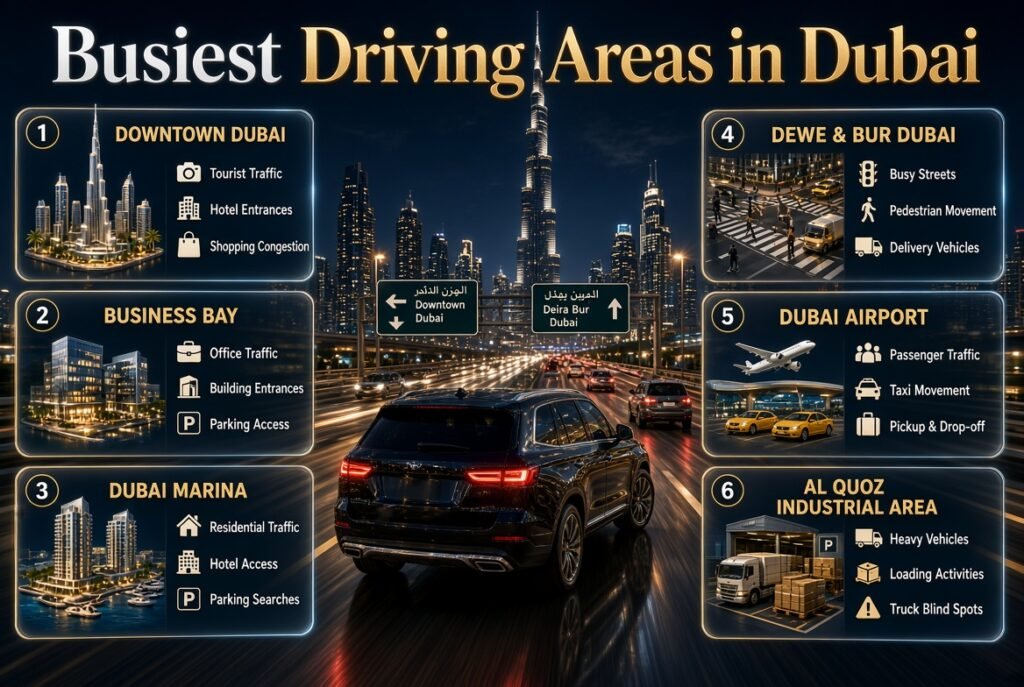
Traffic conditions differ from one district to another. Some locations experience congestion because they contain offices, shopping destinations, residential towers, schools or important highway connections.
Downtown Dubai
Downtown Dubai attracts residents, office workers and visitors throughout the week.
Traffic commonly increases around major attractions, hotel entrances, shopping destinations and connecting roads.
Drivers should allow additional time when travelling near busy commercial and tourist locations, particularly during events and holiday periods.
Business Bay
Business Bay combines offices, residential buildings, hotels and commercial facilities.
Traffic can build up around building entrances, parking access points and connections to major roads.
Drivers should identify the correct building entrance before arriving rather than stopping suddenly to search for an address.
Dubai Marina
Dubai Marina has a concentrated residential and leisure environment.
Traffic movement can become slower around apartment entrances, retail areas, hotels and popular destinations. Parking searches may also add time to short journeys.
Deira and Bur Dubai
These established commercial districts contain busy streets, shopping areas, public transport connections and traditional markets.
Drivers should be especially careful around pedestrians, delivery vehicles, buses and smaller intersections.
Dubai International Airport surroundings
Airport traffic is affected by passenger arrivals, departures, taxis, private vehicles and commercial transport.
Always follow airport-specific signs and use designated pickup and drop-off areas. Stopping in an unsuitable location can obstruct other vehicles and create safety problems.
Al Quoz and industrial districts
Commercial and industrial traffic is common around Al Quoz, particularly during working hours.
Heavy vehicles, loading activities and delivery operations can influence traffic movement. Drivers should maintain additional space around trucks and avoid remaining in their blind spots.
5. How Can You Check Dubai Traffic Conditions Before Travelling?
Checking traffic conditions before starting a journey is one of the simplest ways to avoid unnecessary delays.
A navigation route may show the distance between two locations, but the actual journey time depends on current traffic, road closures, accidents and other conditions.
Check the route before departure
Start by identifying your destination and the roads you intend to use.
Look for:
- Congested junctions.
- Road closures.
- Construction diversions.
- Accident-related delays.
- Alternative routes.
- Difficult parking locations.
Do not wait until you reach a busy interchange to decide which direction to take.
Use navigation responsibly
Navigation applications can help identify alternative routes, estimate travel times and provide turn-by-turn directions.
However, drivers should never operate a phone while driving. Enter the destination before starting the vehicle and use a suitable hands-free navigation setup.
Understand live traffic information
Traffic information is useful because it helps you distinguish between normal congestion and an unexpected disruption.
For example, if a highway is moving slowly because of an accident, taking an alternative road may be more sensible than remaining in a long queue.
However, alternative routes should be evaluated carefully. A smaller road may have more traffic signals, pedestrian crossings and restricted access.
Build extra time into important journeys
If you have an airport departure, medical appointment, business meeting or school pickup, avoid planning your journey around the minimum estimated travel time.
Allow additional time for:
- Traffic congestion.
- Parking.
- Walking from the parking area.
- Unexpected diversions.
- Building access and security procedures.
A realistic travel plan reduces pressure and helps you drive more safely.
6. What Traffic Rules Should Every Dubai Driver Understand?
Dubai follows UAE traffic legislation, alongside applicable local regulations. Drivers must understand and follow road signs, traffic signals, speed restrictions and vehicle safety requirements.
The current UAE road safety framework includes Federal Decree-Law No. 14 of 2024 on Traffic Regulation. U.AE
Follow posted speed limits
Speed limits vary according to road design, location and traffic conditions.
Drivers must follow the speed displayed on road signs rather than assuming that every highway or urban road has the same limit.
Some motorists mistakenly believe that a universal 20 km/h allowance applies everywhere. This is not a safe assumption. Follow the applicable posted limit and any official instructions.
Speed cameras and other enforcement systems monitor compliance.
Maintain proper lane discipline
Lane discipline is essential on Dubai’s multi-lane roads.
Drivers should:
- Stay within their selected lane.
- Signal before changing lanes.
- Check mirrors and blind spots.
- Avoid sudden movements.
- Use the correct lane for their intended exit.
- Avoid unnecessary weaving between vehicles.
Changing lanes without checking surrounding traffic can cause side-impact collisions.
Wear seat belts
The driver and passengers must use seat belts. Children must be secured using appropriate child restraints according to applicable requirements.
A seat belt helps reduce the risk of serious injury during sudden braking or a collision.
Avoid mobile phone distractions
Using a handheld phone while driving takes attention away from traffic.
Even a brief glance at a message can prevent a driver from noticing a braking vehicle, pedestrian or changing signal.
Set navigation, music and communication preferences before moving.
Respect traffic signals
Red lights, amber lights and green lights must be treated correctly.
Never accelerate to cross an intersection simply because the signal is about to change. Watch for pedestrians and vehicles that may still be clearing the junction.
Give way to emergency vehicles
When an emergency vehicle approaches with warning signals, drivers should provide a clear path safely and follow the applicable traffic instructions.
Do not panic, brake suddenly or make an unsafe movement to get out of the way.
Avoid dangerous overtaking
Overtaking should only take place when it is permitted and safe.
Avoid overtaking near blind bends, restricted areas, junctions or locations where visibility is inadequate.
Important: Traffic rules are not simply about avoiding fines. They help protect drivers, passengers, pedestrians and everyone else using the road.
7. How Do Road Signs and Lane Markings Work in Dubai?
Road signs and lane markings communicate important information about direction, restrictions, speed and road safety.
Drivers who understand these markings can make better decisions and avoid last-minute movements.
Direction signs
Direction signs identify destinations, road names, exits and important connections.
On major roads, they may appear well before an interchange. Reading them early helps drivers select the correct lane.
Speed limit signs
Speed limit signs indicate the maximum permitted speed for a particular section of road.
Limits may change when entering residential areas, approaching intersections or travelling through construction zones.
Lane arrows
Lane arrows show which directions are permitted from a particular lane.
For example, a lane may be designated for turning left, travelling straight or turning right.
Do not wait until the last moment to move into the correct lane.
Solid and broken lane markings
Road markings communicate whether a lane change is permitted or restricted.
A broken line generally indicates that crossing may be permitted when safe and lawful. A solid line indicates a restriction that drivers must respect according to the applicable road marking.
Pedestrian crossings
Pedestrian crossings identify locations where people may cross the road.
Drivers should slow down when approaching crossings and be prepared to stop when pedestrians have priority.
Common road signs drivers should recognise
| Sign type | Meaning |
|---|---|
| Stop | Come to a complete stop |
| Give Way | Yield to traffic with priority |
| No Entry | Do not enter |
| Speed Limit | Follow the displayed maximum speed |
| No Parking | Parking is prohibited |
| No U-Turn | U-turns are not permitted |
| Pedestrian Crossing | Watch for pedestrians |
| Roundabout | Follow roundabout instructions |
Quick tip: When you see an unfamiliar sign, do not make a sudden decision. Reduce speed where appropriate, observe surrounding traffic and follow the official road instructions.
8. How Do Salik and Parking Systems Affect Dubai Traffic?
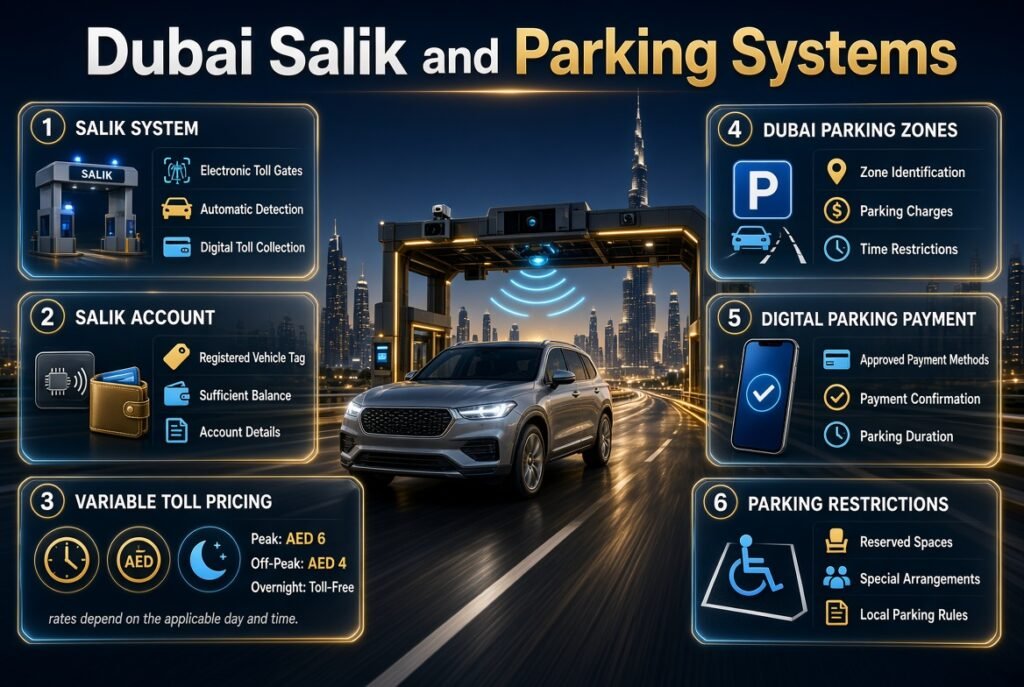
Dubai uses electronic tolling and regulated parking systems to manage road use and public parking.
Understanding these systems helps drivers plan journeys and avoid unexpected costs.
Understanding Salik
Salik is Dubai’s electronic road toll system. Vehicles passing through designated toll gates are charged automatically through an associated Salik account.
Drivers should ensure that:
- The vehicle has the required Salik tag.
- The tag is installed correctly.
- The account has sufficient balance.
- Vehicle and account details are accurate.
- Toll transactions are monitored.
Salik charges vary according to the day and time.
According to the published variable pricing structure, standard weekday rates are AED 6 during peak periods and AED 4 during off-peak periods. The period from 1:00 am to 6:00 am is toll-free. Sunday rates are generally AED 4, with the same overnight toll-free period, subject to applicable exceptions. Salik Annual Report 2025+1
How to plan around Salik
Before choosing a route, consider whether it passes through toll gates.
A route with fewer kilometres may involve toll charges, while an alternative route may take longer but avoid a toll crossing.
The best choice depends on your travel time, destination and overall journey cost.
Understanding Dubai parking zones
Public parking is divided into designated zones with different rules and charges.
Drivers should check the parking information displayed on nearby signs before leaving their vehicles.
Pay attention to:
- Parking zone identification.
- Applicable charges.
- Permitted parking duration.
- Payment confirmation.
- Reserved parking restrictions.
- Special event arrangements.
Parking rules and tariffs can differ by location and time. Do not rely on information from another neighbourhood when parking somewhere unfamiliar.
Avoid common parking problems
Some drivers assume that a parking space is free because there is no payment machine nearby.
This is not necessarily correct. Payment may be available through approved digital methods.
Always confirm the parking zone and payment requirements before walking away.
9. How Do Different Weather Conditions Affect Dubai Road Traffic?
Weather has a direct effect on driving conditions. Although Dubai experiences sunshine for much of the year, motorists must also prepare for extreme heat, rain, fog, dust and reduced visibility.
Each condition creates different risks.
Driving during extreme summer heat
High temperatures place additional pressure on vehicles, tyres, batteries and cooling systems.
A vehicle that performs normally during cooler weather may develop problems when exposed to prolonged heat and heavy traffic.
Common concerns include:
- Battery performance deterioration.
- Increased cooling system demand.
- Tyre pressure changes.
- Engine overheating caused by mechanical faults.
- Air-conditioning performance problems.
- Greater fuel consumption during prolonged idling.
Before driving in summer, check tyre condition, coolant level, battery health and engine oil.
If the temperature warning appears, do not continue driving as though nothing is wrong. Find a safe place to stop and follow the vehicle manufacturer’s instructions.
Driving during rain
Rain creates slippery road surfaces and can reduce tyre grip.
Water may collect in low-lying areas, while oil and dirt on the road can make the first period of rainfall particularly challenging.
Drivers should:
- Reduce speed.
- Increase following distance.
- Avoid sudden braking.
- Use headlights appropriately.
- Avoid unnecessary lane changes.
- Never drive through deep or unknown standing water.
Expert tip: Do not use cruise control when road conditions are slippery. Maintain direct control of your vehicle and adjust your speed to the available visibility and traction.
Driving in fog
Fog reduces visibility and makes it difficult to judge the distance between vehicles.
When visibility becomes poor:
- Reduce speed gradually.
- Increase the distance from the vehicle ahead.
- Use appropriate fog lights when necessary.
- Avoid high-beam headlights when they reflect off fog.
- Follow lane markings carefully.
- Avoid stopping in active traffic lanes.
If visibility becomes dangerously low, consider delaying the journey or stopping at a safe location.
Driving during dusty conditions
Dust and blowing sand can reduce visibility, particularly on open roads and exposed highway sections.
Avoid sudden braking and maintain enough distance to react if the vehicle ahead slows down.
Do not assume that a clear road surface means the conditions are safe. Visibility can change quickly.
10. How Can You Drive Safely on Dubai Highways?
Highway driving requires a different approach from driving through residential streets.
Vehicles travel at higher speeds, traffic can change quickly and mistakes may have more serious consequences.
Maintain a safe following distance
Following too closely reduces the time available to react when the vehicle ahead brakes.
Maintain sufficient distance according to your speed, visibility, road surface and traffic conditions.
Increase that distance during rain, fog or heavy traffic.
Choose the correct lane
Select a lane that matches your intended direction and driving speed.
Avoid repeatedly changing lanes to gain a small advantage. Frequent lane changes can increase collision risks and disturb traffic flow.
Understand blind spots
Large vehicles have significant blind spots.
Avoid driving directly beside a truck for extended periods. If you cannot see the truck driver in the vehicle’s mirrors, the driver may not be able to see you clearly either.
Avoid tailgating
Tailgating is dangerous because the driver behind has less time to respond to unexpected braking.
If another vehicle is following too closely, avoid aggressive braking or confrontation. Maintain a predictable speed and move to another lane when it is safe and appropriate.
Prepare for highway exits
Many drivers create unnecessary risks because they miss an exit and attempt to cross several lanes at the last moment.
A better approach is to:
- Check the exit direction early.
- Read road signs before approaching the interchange.
- Move into the correct lane gradually.
- Signal clearly.
- Accept a longer alternative route if you miss the exit.
Missing an exit is inconvenient. Making an unsafe manoeuvre is much worse.
11. What Should You Know About Dubai Roundabouts and Intersections?
Roundabouts and intersections are important parts of Dubai’s urban road network.
They control traffic movement but can become confusing when drivers do not understand lane positioning or right-of-way requirements.
How to approach a roundabout
Before entering a roundabout, reduce speed and observe the road signs and lane markings.
Drivers should:
- Identify their intended exit.
- Select the appropriate entry lane.
- Give way according to roundabout rules and signs.
- Watch for vehicles already circulating.
- Signal when required.
- Exit carefully without cutting across other vehicles.
Never assume that another driver will follow the same route you expect.
Understanding traffic intersections
At signal-controlled intersections, follow the traffic lights and road markings.
Pay attention to turning lanes, pedestrian crossings and vehicles approaching from other directions.
A green signal does not mean you can ignore pedestrians or enter an intersection that is blocked by traffic.
Avoid blocking junctions
Entering a junction without enough space to clear it can prevent other vehicles from moving.
Even when the signal is green, wait until there is sufficient space beyond the intersection.
This simple habit helps maintain smoother traffic movement.
12. How Does Dubai Traffic Affect Fuel Consumption?
Traffic congestion does not only increase travel time. It can also increase the amount of fuel a vehicle uses.
Repeated acceleration, braking, idling and low-speed movement can make urban journeys less fuel-efficient than steady driving.
Stop-and-go traffic increases fuel use
When a vehicle repeatedly accelerates from a complete stop, the engine must provide additional energy to increase its speed.
If this happens frequently, fuel consumption can rise.
For example, a driver travelling through a congested commercial district may experience several cycles of stopping and accelerating during a relatively short journey.
The same distance travelled on a relatively clear road may require less fuel.
Long idling periods waste fuel
An engine consumes fuel even when the vehicle is stationary.
Waiting in a long queue, leaving the engine running while parked or waiting outside a building can increase unnecessary fuel consumption.
Drivers should avoid unnecessary idling while following vehicle manufacturer recommendations and applicable safety requirements.
Air conditioning affects fuel economy
Dubai’s hot weather makes air conditioning an important part of everyday driving.
In conventional petrol and diesel vehicles, the air-conditioning system can increase engine workload and fuel consumption.
The impact depends on vehicle design, outside temperature, cabin conditions and driving pattern.
Maintain the vehicle properly
Poor vehicle maintenance can make traffic-related fuel consumption worse.
Pay attention to:
- Correct tyre pressure.
- Clean air filters.
- Suitable engine oil.
- Proper wheel alignment.
- Healthy ignition components.
- Cooling system performance.
- Correct fuel system operation.
For more detailed information about everyday driving conditions, fuel consumption and vehicle efficiency, see Dubai Driving and Fuel Insights.
Practical fuel-saving habits in traffic
- Accelerate smoothly.
- Avoid unnecessary hard braking.
- Maintain a steady speed where possible.
- Leave enough space to avoid repeated braking.
- Plan routes before departure.
- Avoid unnecessary journeys during heavily congested periods.
- Keep tyres properly inflated.
You can also learn more about Fuel Delivery Dubai if you need information about fuel assistance and unexpected fuel shortages during road journeys.
13. What Should You Do If Your Vehicle Breaks Down on a Dubai Road?
A vehicle breakdown can happen even when the driver follows a regular maintenance schedule.
Battery failure, overheating, tyre damage, mechanical faults and running out of fuel are common reasons why motorists may need roadside assistance.
The correct response depends on where the vehicle stops and whether it creates a danger to other road users.
Step 1: Stay calm and assess the situation
If you notice an unusual noise, warning light, loss of power or mechanical problem, avoid sudden steering or braking.
Look for a safe place to move away from active traffic.
Step 2: Move to a safe location if possible
If the vehicle remains controllable, move towards a suitable safe area, such as an authorised parking space or safe roadside location.
Never stop in a live highway lane unless the vehicle cannot be moved safely.
Step 3: Make your vehicle visible
Activate the hazard warning lights when appropriate.
Use warning equipment only when it can be placed safely and in accordance with road safety requirements.
Stay away from moving traffic. Do not stand behind or beside a disabled vehicle in a dangerous position.
Step 4: Identify the problem
Check whether the issue involves:
- A flat or damaged tyre.
- A weak or failed battery.
- Engine overheating.
- A fuel shortage.
- An electrical problem.
- A mechanical warning.
Do not attempt repairs in an unsafe location.
Step 5: Arrange appropriate assistance
Depending on the problem, you may need roadside support, a tyre service, battery assistance, fuel delivery or vehicle recovery.
Choose assistance that matches the actual problem rather than repeatedly attempting to restart a vehicle with an unresolved fault.
Common breakdown situations
| Problem | Recommended response |
|---|---|
| Flat battery | Arrange suitable battery assistance |
| Engine overheating | Stop safely and seek mechanical support |
| Flat tyre | Arrange safe tyre replacement or recovery |
| Empty fuel tank | Arrange appropriate fuel assistance |
| Mechanical failure | Contact a qualified recovery or repair service |
Why fuel planning matters
Running out of fuel on a busy road can create unnecessary stress and potentially dangerous situations.
Before longer journeys, check your fuel gauge and consider the distance to your next suitable refuelling point.
If the fuel warning light appears, avoid delaying the decision to refuel simply because the vehicle is still moving normally.
14. How Can Tourists and New Residents Drive Confidently in Dubai?
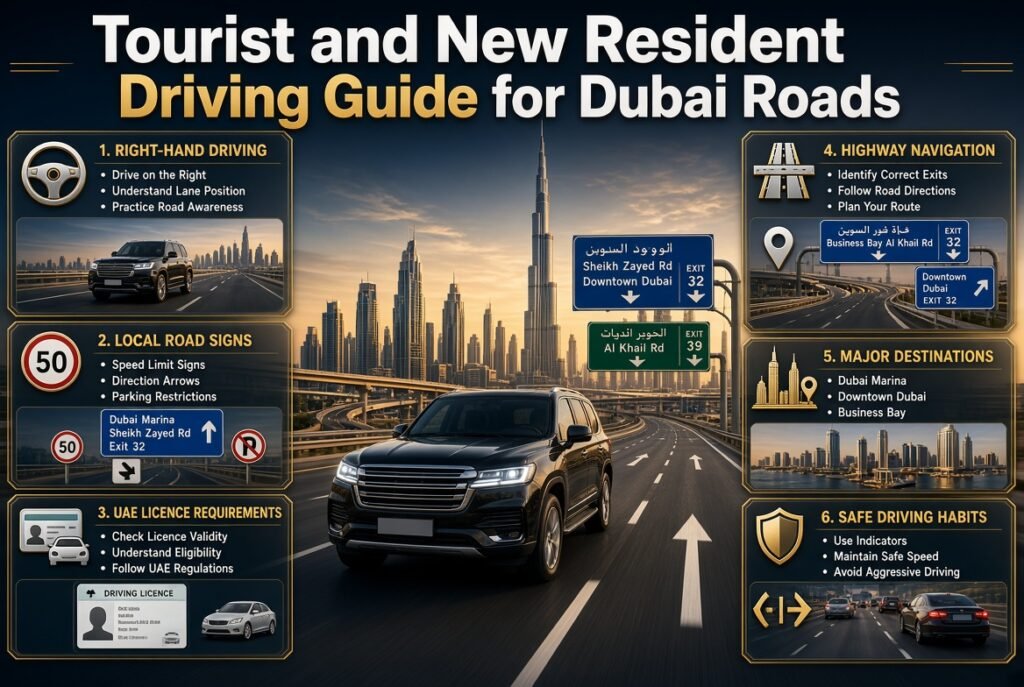
People who are unfamiliar with Dubai’s road network often need time to understand its traffic patterns.
A driver who is comfortable on familiar roads may feel less confident when dealing with large interchanges, multiple exits and busy commercial areas.
Understand the driving direction
Vehicles in the UAE drive on the right-hand side of the road.
Drivers coming from countries where traffic keeps to the left should spend time becoming familiar with this arrangement before entering busy roads.
Learn local road signs
Do not depend entirely on memory or assumptions from another country.
Understand local speed signs, lane arrows, parking restrictions and warning signs.
Check licence requirements
Tourists and residents must ensure that they are legally permitted to drive in the UAE.
The applicable requirements depend on nationality, residency status, licence type and relevant UAE regulations.
Do not assume that every foreign driving licence is automatically accepted in every situation.
Become familiar with major destinations
Before travelling, identify the nearest major road, correct exit and parking facility.
For example, reaching a building in Dubai Marina may require navigating through a local access road after leaving a major highway.
Knowing the final approach is just as important as selecting the highway route.
Avoid unnecessary pressure
New drivers should not feel forced to match aggressive driving behaviour around them.
Maintain a safe speed, use indicators correctly and allow other vehicles to pass when appropriate.
Confident driving comes from preparation and predictable decisions, not from driving aggressively.
15. What Are the Most Common Dubai Road and Traffic Mistakes?
Many traffic problems develop because drivers repeat small mistakes that could easily be avoided.
These mistakes can increase journey time, create safety risks and sometimes result in traffic violations.
1. Changing lanes at the last moment
Why it happens: Drivers notice an exit too late or ignore direction signs.
Why it is dangerous: Sudden movements can cause other vehicles to brake or swerve.
How to avoid it: Review the route and move into the correct lane early.
2. Assuming every road has the same speed limit
Why it happens: Drivers become familiar with one particular route and apply the same assumptions elsewhere.
Why it is dangerous: Speed limits can change between highways, urban roads and restricted sections.
How to avoid it: Follow the signs on the road you are currently using.
3. Following other vehicles too closely
Why it happens: Drivers become impatient in congested traffic.
Why it is dangerous: It reduces reaction time and increases the risk of rear-end collisions.
How to avoid it: Maintain a suitable safety gap.
4. Using a mobile phone while driving
Why it happens: Drivers try to check messages, navigation instructions or incoming calls.
Why it is dangerous: Attention is diverted from traffic conditions.
How to avoid it: Set up navigation before starting the journey and use permitted hands-free options.
5. Ignoring vehicle maintenance
Why it happens: Drivers delay inspections when the vehicle appears to be working normally.
Why it is dangerous: Hidden mechanical problems can develop into breakdowns.
How to avoid it: Follow a regular maintenance schedule and investigate warning lights promptly.
6. Not checking parking restrictions
Why it happens: Drivers assume parking rules are the same in every district.
Why it is dangerous: Different zones may have different charges, timings and restrictions.
How to avoid it: Read the local parking signs before leaving the vehicle.
7. Driving with insufficient fuel
Why it happens: Drivers underestimate journey distance or postpone refuelling.
Why it is dangerous: The vehicle may stop in an unsuitable location.
How to avoid it: Monitor the fuel gauge and refuel before reaching a critically low level.
8. Driving too fast in poor weather
Why it happens: Drivers continue using their normal speed despite reduced visibility or slippery surfaces.
Why it is dangerous: Tyre grip and reaction time become more important when conditions deteriorate.
How to avoid it: Adjust speed according to visibility, road surface and traffic conditions.
16. Professional Tips for Better Driving on Dubai Roads
Safe and efficient driving is not about reaching your destination as quickly as possible. It is about making decisions that reduce risk, save time and protect your vehicle.
The following recommendations can help both experienced motorists and new drivers.
Plan your journey around traffic patterns
If your schedule allows flexibility, avoid travelling through heavily congested areas during busy commuting periods.
For important appointments, leave earlier rather than depending on an optimistic navigation estimate.
Keep your vehicle ready for Dubai conditions
A vehicle operating in Dubai needs regular attention because high temperatures, traffic congestion and long journeys can place additional demands on its components.
Pay particular attention to:
- Battery condition and charging performance.
- Engine cooling system.
- Tyre pressure and tread depth.
- Brake performance.
- Engine oil condition.
- Air-conditioning performance.
- Fuel system condition.
Develop defensive driving habits
Defensive driving means anticipating potential hazards instead of reacting only when something happens.
For example, if you see a vehicle approaching from a side road, prepare for the possibility that it may enter your lane.
Similarly, if traffic ahead begins slowing down, reduce speed gradually rather than braking sharply at the last moment.
Keep enough fuel for unexpected delays
Do not calculate fuel requirements based only on the distance shown by navigation.
Traffic congestion, detours, air-conditioning use and unexpected stops can affect fuel consumption.
Maintain a sensible fuel reserve, particularly before travelling outside central Dubai.
Stay informed about road changes
Drivers should remain aware of new diversions, road closures and changes to traffic arrangements.
A route that worked perfectly last month may not be the most convenient option today.
Avoid unnecessary driving stress
Aggressive acceleration, constant lane changes and arguments with other drivers do not improve road conditions.
Maintain a calm driving style and concentrate on predictable movements.
17. Daily Dubai Road Safety Checklist
A short vehicle and journey check can prevent many avoidable problems.
Use this checklist before starting your daily commute or a longer journey.
- Check the fuel level.
- Check tyre condition and visible damage.
- Make sure the tyres have appropriate pressure.
- Check for dashboard warning lights.
- Confirm that headlights and indicators work.
- Adjust mirrors and seat position.
- Fasten your seat belt.
- Ensure passengers are properly secured.
- Set your navigation destination before driving.
- Check traffic conditions and possible diversions.
- Carry the necessary vehicle documents.
- Make sure your phone is not a driving distraction.
For longer journeys, also consider checking coolant condition, engine oil and the vehicle’s general mechanical condition.
A few minutes of preparation can prevent a much longer interruption on the road.
What Are the Busiest Roads in Dubai, and How Can Drivers Avoid Traffic Congestion?
Dubai has several major roads that experience heavy traffic, particularly during morning and evening commuting hours. Sheikh Zayed Road, Al Khail Road, Hessa Street and Emirates Road are important routes connecting residential communities, business districts and neighbouring emirates. Traffic can also become heavy around Downtown Dubai, Business Bay, Dubai Marina and Deira.
The best way to avoid unnecessary delays is to understand your route before leaving. Check current traffic conditions, identify alternative roads and allow additional travel time during busy periods.
Practical tips:
Check live traffic conditions before starting your journey.
Avoid unnecessary travel during peak commuting periods.
Plan alternative routes around major interchanges.
Allow extra time when travelling near schools and commercial districts.
Avoid sudden lane changes when approaching busy exits.
What Are the Important Traffic Rules Every Driver Must Follow in Dubai?
Drivers in Dubai must follow UAE traffic regulations, including speed restrictions, lane discipline, traffic signals, seat belt requirements and rules against distracted driving. These regulations help maintain predictable traffic movement and protect everyone using the road.
One of the most important responsibilities is following the posted speed limit. Speed restrictions can change between highways, urban roads, residential areas and roadwork sections. Drivers should also use indicators correctly, maintain safe distances and check blind spots before changing lanes.
Important driving rules:
Follow the speed limit displayed on road signs.
Wear seat belts and ensure passengers are properly secured.
Never use a handheld mobile phone while driving.
Respect traffic signals and pedestrian crossings.
Avoid tailgating and dangerous overtaking.
Follow road markings and directional signs.
Give emergency vehicles a safe and clear path.
How Can Drivers Check Live Dubai Traffic Conditions Before Travelling?
Checking traffic conditions before departure helps drivers avoid unexpected delays and select more suitable routes. Dubai’s traffic situation can change because of accidents, road construction, lane closures, public events and weather conditions.
Drivers should use reliable navigation and official traffic information services to review their journeys. It is also important to check the final destination and parking arrangements rather than focusing only on the estimated driving time.
Recommended preparation:
Review the route before starting the vehicle.
Check for accidents and temporary road closures.
Compare alternative routes when congestion is reported.
Check weather conditions before longer journeys.
Allow additional time for airport trips and important appointments.
Keep navigation instructions ready without handling your phone while driving.
Professional advice: Do not automatically choose the route with the shortest distance. A slightly longer route with fewer congested intersections may provide a smoother and more predictable journey.
How Do Dubai Traffic Conditions Affect Vehicle Fuel Consumption and Performance?
Heavy traffic can increase fuel consumption because vehicles repeatedly accelerate, brake and remain stationary with their engines running. These conditions place additional demands on the engine and can make short urban journeys less fuel-efficient than steady highway driving.
Dubai’s hot climate can add another challenge. Frequent air-conditioning use, prolonged idling and high ambient temperatures may increase vehicle workload. Poor tyre pressure, dirty air filters and neglected maintenance can further affect fuel efficiency and driving performance.
Ways to improve fuel efficiency:
Accelerate gradually instead of using unnecessary hard acceleration.
Maintain appropriate tyre pressure.
Avoid unnecessary engine idling.
Keep the air-conditioning system properly maintained.
Follow the recommended engine oil and servicing schedule.
Plan journeys to reduce repeated stop-and-go driving.
Monitor fuel levels before entering long or congested routes.
Drivers who understand these factors can manage fuel expenses more effectively while reducing unnecessary vehicle stress.
What Should You Do If Your Car Breaks Down or Runs Out of Fuel on a Dubai Road?
A vehicle breakdown or unexpected fuel shortage can become stressful, especially on a busy highway or unfamiliar road. The first priority should always be personal safety rather than attempting an immediate repair or walking towards a nearby petrol station.
If your vehicle develops a problem, move to a safe location if possible, activate hazard warning lights when appropriate and stay away from moving traffic. Do not attempt to inspect or repair the vehicle in an active traffic lane.
Steps to follow:
Move your vehicle to a safe location if it is controllable.
Activate hazard warning lights when appropriate.
Keep yourself and passengers away from moving traffic.
Identify whether the problem involves fuel, battery, tyres or engine performance.
Contact suitable roadside assistance or vehicle recovery.
Follow the instructions provided by the assistance team.
Professional recommendation: Check your fuel level, battery condition, tyre pressure and cooling system before longer journeys. If you regularly drive through unfamiliar areas, plan suitable refuelling stops and keep emergency assistance arrangements available.
Conclusion
Understanding Dubai road and traffic conditions is essential for anyone who drives regularly, commutes to work or travels between different areas of the emirate. From major highways such as Sheikh Zayed Road and Al Khail Road to busy residential streets and commercial districts, every route requires awareness, preparation and responsible driving.
Traffic congestion, changing weather conditions, road diversions and unexpected vehicle problems can affect even short journeys. However, drivers can avoid many unnecessary difficulties by checking traffic updates, following speed limits, maintaining safe distances and choosing suitable routes before departure.
Vehicle maintenance is equally important. Regularly checking tyres, brakes, battery, engine oil, coolant and fuel levels helps reduce the risk of unexpected breakdowns, particularly during Dubai’s extreme summer temperatures and heavy traffic periods.
Ultimately, safe driving is not simply about reaching your destination quickly. It is about making informed decisions, protecting your vehicle and keeping other road users safe. With proper preparation, good driving habits and an understanding of Dubai’s road network, you can enjoy smoother, safer and more reliable journeys throughout the city.
Leave a Reply