
Introduction
Dubai Road Safety | A normal journey in Dubai can quickly become stressful when traffic suddenly slows down, a vehicle changes lanes without warning, or poor visibility makes it difficult to see the road ahead. Even experienced drivers can face unexpected situations, particularly on busy highways, at major intersections, and during extreme weather.
Dubai has a well-developed road network, modern traffic management systems, and strict road regulations. However, having good infrastructure does not automatically make every journey safe. Drivers must understand local traffic rules, recognise potential hazards, maintain their vehicles, and make responsible decisions behind the wheel.
Dubai road safety is not just about avoiding traffic fines or following speed limits. It involves protecting passengers, pedestrians, cyclists, delivery riders, and everyone who shares the road. A small mistake, such as following another vehicle too closely or checking a mobile phone while driving, can have serious consequences.
Whether you are a new resident, an experienced driver, a tourist renting a vehicle, or someone who travels daily between different parts of the city, understanding road safety can make a significant difference.
This comprehensive guide explains how to drive safely in Dubai, understand traffic regulations, handle busy highways, prepare for changing weather, prevent accidents, maintain your vehicle, and respond correctly to unexpected roadside situations.
For additional information about driving, vehicle performance, and fuel-related situations, explore our Fuel Delivery Dubai resource.
1. Understanding Road Safety in Dubai
Road safety refers to the rules, behaviours, precautions, and vehicle conditions that help prevent traffic accidents and protect everyone using public roads.
In Dubai, road safety involves more than individual driving skills. It also depends on traffic management, road design, vehicle inspections, pedestrian facilities, enforcement systems, and cooperation between different road users.
Why is road safety particularly important in Dubai?
Dubai has a diverse transport environment. Private cars, taxis, buses, heavy vehicles, motorcycles, bicycles, and delivery riders regularly share the city’s road network.
Drivers may experience several different conditions during one journey:
- High-speed traffic on major highways.
- Congestion around commercial districts.
- Frequent vehicle movements near shopping centres.
- Pedestrians crossing near residential communities.
- Construction activity and temporary road diversions.
- Reduced visibility during fog or dust.
- Wet surfaces during unexpected rainfall.
These conditions require drivers to remain attentive rather than relying entirely on familiar routes.
For example, someone travelling from Dubai Marina towards Downtown Dubai may experience relatively smooth highway movement before encountering slower traffic near an exit. Maintaining a suitable following distance and anticipating the change in traffic speed helps prevent sudden braking.
Who is responsible for road safety?
Road safety is a shared responsibility.
Drivers must control their vehicles, follow regulations, and avoid dangerous behaviour.
Passengers should wear seat belts, avoid distracting the driver, and use suitable child restraints.
Pedestrians should use designated crossing points and follow pedestrian signals.
Cyclists and delivery riders should use appropriate protective equipment and comply with applicable road restrictions.
Vehicle owners should maintain their vehicles and ensure they remain safe for road use.
When each group understands its responsibilities, the possibility of avoidable accidents can be reduced.
2. What Are the Main Traffic Rules Drivers Must Follow in Dubai?
Drivers in Dubai must follow UAE traffic legislation, road signs, speed restrictions, vehicle safety requirements, and instructions issued by the relevant authorities.
The UAE’s Federal Decree-Law No. 14 of 2024 on Traffic Regulation came into effect on 29 March 2025. It establishes the current federal framework for regulating drivers, vehicles, pedestrians, and road use.
Understanding the practical requirements is essential for residents and visitors.
Follow the posted speed limits
Speed limits depend on the road and its designated conditions. A highway, service road, residential street, and school area may have different restrictions.
Drivers should never assume that the speed limit remains unchanged throughout an entire journey.
Pay attention to:
- Speed limit signs.
- Electronic traffic displays.
- Temporary roadwork restrictions.
- Variable speed information.
- Warning signs near intersections.
- Conditions requiring a lower speed.
A posted maximum speed does not mean you should always travel at that speed. Rain, fog, traffic congestion, poor visibility, and road damage may require you to slow down.
Wear seat belts correctly
Seat belts are essential safety equipment for every vehicle occupant.
Drivers should make sure that all passengers are properly secured before starting the journey.
Important practices include:
- Position the shoulder belt across the chest.
- Keep the lap belt low across the hips.
- Never place the shoulder belt behind your back.
- Replace damaged or malfunctioning seat belts.
- Check that rear passengers are also secured.
A common mistake is allowing a passenger to travel without a seat belt because the journey is short. The risk of an accident does not depend on how far you intend to travel.
Follow child passenger safety requirements
Children need appropriate protection because adult seat belts may not fit their bodies correctly.
UAE regulations require suitable child seats for children under four years old. Children under 10 years old or shorter than 145 cm must not sit in the front passenger seat.
Parents should select a restraint according to the child’s size and the manufacturer’s instructions.
Before travelling, check that:
- The child seat is appropriate for the child’s height and weight.
- The restraint is installed correctly.
- The seat belt or installation system is properly secured.
- The child is positioned according to the manufacturer’s instructions.
Avoid mobile phone distractions
Using a handheld mobile phone while driving is dangerous because it takes your attention away from the traffic environment.
Even when a road appears empty, a pedestrian, vehicle, or unexpected obstacle may suddenly enter your path.
Before driving:
- Set your navigation destination.
- Check important messages.
- Adjust your music and vehicle settings.
- Put your phone somewhere secure.
- Use an appropriate hands-free arrangement if necessary.
Never type messages, browse social media, or record videos while operating a vehicle.
Respect traffic signals and road markings
Traffic signals and road markings help organise vehicle movement and prevent conflicts at intersections.
Drivers must understand the meaning of:
- Red, amber, and green signals.
- Stop lines.
- Give-way markings.
- Directional arrows.
- Lane separation lines.
- Pedestrian crossing markings.
- Restricted access signs.
Do not enter an intersection simply because the vehicle ahead has moved. Make sure there is enough space to proceed without blocking other traffic.
3. How Can You Drive Safely on Dubai’s Major Roads and Highways?
Safe highway driving requires good speed management, lane discipline, early observation, and sufficient stopping distance. Drivers should anticipate merging traffic, avoid unnecessary overtaking, and never make sudden manoeuvres.
Dubai’s major roads connect residential, commercial, industrial, and business areas. Traffic speeds and road layouts can change significantly between different sections.
Maintain a suitable following distance
Following distance is the space between your vehicle and the vehicle travelling ahead.
Maintaining an appropriate gap gives you more time to recognise hazards and respond safely.
The three-second rule is a useful starting point under suitable conditions.
To use it:
- Identify a fixed roadside object.
- Watch when the vehicle ahead passes it.
- Count three seconds.
- Check whether your vehicle reaches the same point after the count.
If you arrive too early, increase the distance.
Allow a larger gap during rain, fog, heavy traffic, and poor visibility.
Understand lane discipline
Every lane change should have a clear purpose.
Drivers who frequently move between lanes may create unpredictable situations for surrounding motorists.
Use the following approach:
- Identify your destination and required exit early.
- Check your mirrors.
- Activate the indicator.
- Check your blind spot.
- Confirm that sufficient space is available.
- Move smoothly into the selected lane.
Do not cross several lanes at the last moment to reach an exit.
Expert Tip: Look further ahead than the vehicle directly in front of you. Observing traffic several vehicles ahead can help you recognise slowing traffic before you need to brake.
Overtake only when safe and permitted
Overtaking requires careful judgement.
Before changing lanes to pass another vehicle, check whether the manoeuvre is permitted and whether the road ahead provides sufficient visibility and space.
Avoid overtaking:
- Near blind bends.
- At restricted locations.
- When visibility is poor.
- When another vehicle is already overtaking.
- When the available gap is insufficient.
- Near intersections where the manoeuvre could create danger.
Never force another motorist to brake or change direction because you want to overtake.
Understand highway entrances and exits
Merging areas require particular attention because vehicles entering the highway may be travelling at different speeds.
Drivers entering the road should assess traffic and merge only when a safe gap is available.
Drivers already on the highway should remain aware of vehicles approaching from joining lanes.
Avoid sudden braking or unnecessary lane changes near exits.
Give emergency vehicles priority
Police vehicles, ambulances, and other authorised emergency vehicles need sufficient space to respond to incidents.
Remain calm, observe surrounding traffic, and follow official instructions.
Never deliberately block an emergency vehicle or make a sudden movement that creates another hazard.
4. How Can Drivers Manage Heavy Traffic in Dubai?
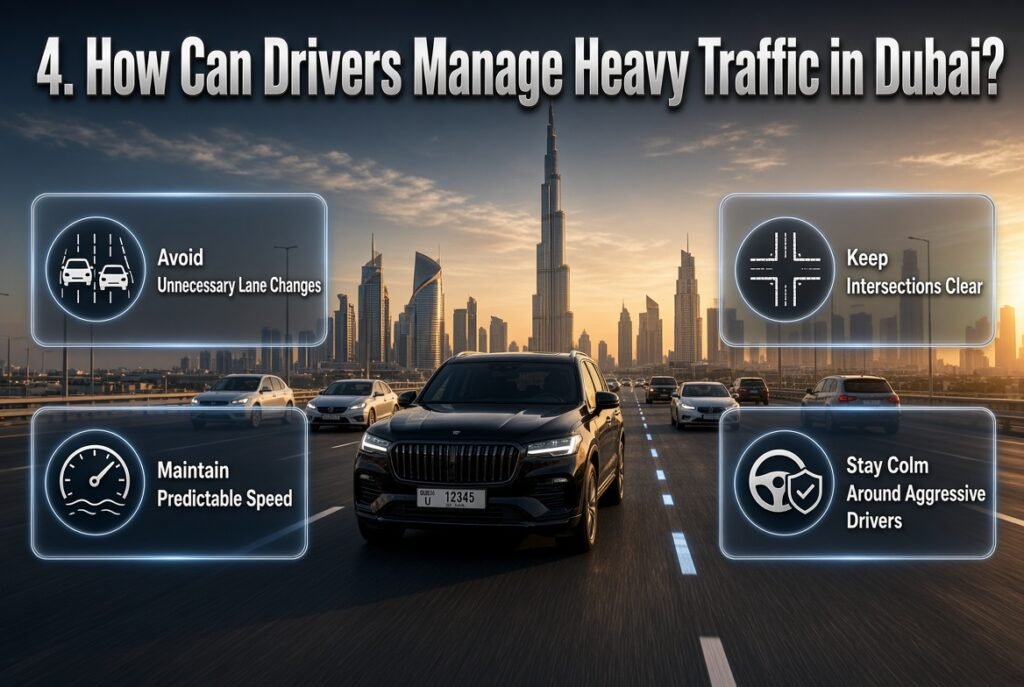
Heavy traffic requires patience, consistent vehicle control, and awareness of surrounding vehicles. The safest approach is to anticipate congestion rather than react aggressively when traffic slows.
Congestion can develop around business districts, shopping centres, school areas, major interchanges, and popular destinations.
Avoid unnecessary lane switching
Changing lanes repeatedly can create side-collision risks and disrupt traffic movement.
Instead, choose a suitable lane according to your destination and remain in it unless a safe change is necessary.
A driver who constantly searches for a faster lane may gain very little time while increasing the possibility of an accident.
Maintain a predictable speed
Sudden acceleration followed by unnecessary braking creates unstable traffic movement.
Try to maintain a smooth and consistent speed while observing the vehicles around you.
If traffic begins slowing:
- Release the accelerator early.
- Increase your awareness of the vehicle ahead.
- Brake progressively.
- Avoid sudden steering movements.
- Keep enough space for emergency manoeuvres.
Do not block intersections
One of the most frustrating traffic situations occurs when vehicles enter an intersection without enough room to clear it.
This can block crossing traffic and prevent other vehicles from moving.
Wait behind the stop line until sufficient space becomes available.
Manage aggressive driving behaviour
Impatience can lead to tailgating, unnecessary horn use, aggressive acceleration, and unsafe overtaking.
These behaviours increase stress and create unpredictable situations.
If another driver behaves aggressively:
- Avoid responding with similar behaviour.
- Do not engage in arguments.
- Maintain a safe distance.
- Allow the other vehicle to move away when possible.
- Report dangerous behaviour through appropriate official channels when necessary.
A safe journey is more important than winning an argument on the road.
5. How Does Dubai’s Weather Influence Road Safety?
Dubai’s weather can affect road visibility, tyre grip, vehicle condition, and driver concentration. Extreme heat, rainfall, fog, dust storms, and strong winds each require different precautions.
Drivers should adjust their behaviour according to actual conditions.
Driving during extreme summer heat
High temperatures can place additional pressure on vehicle cooling systems, batteries, tyres, and air-conditioning equipment.
Before a long journey, check:
- Tyre pressure and visible condition.
- Engine coolant level.
- Radiator and cooling system condition.
- Battery performance.
- Engine warning lights.
- Air-conditioning operation.
Do not ignore signs of overheating.
If the temperature warning appears, find a safe place to stop. Follow the vehicle manufacturer’s instructions and allow the engine to cool.
Never open a hot cooling system because pressurised coolant can cause serious burns.
Driving during rainfall
Rain can reduce road grip and increase stopping distances.
Water may also collect in low-lying areas, making it difficult to judge road depth.
When rain begins:
- Reduce your speed.
- Increase following distance.
- Use suitable headlights.
- Avoid sudden braking.
- Keep steering movements smooth.
- Avoid driving through flooded areas.
If water covers the road and its depth is uncertain, do not attempt to cross it.
Driving in fog
Fog makes it difficult to identify vehicles, road markings, and hazards.
Drivers should reduce speed and avoid unnecessary overtaking.
Use suitable fog lighting when required and permitted. High-beam headlights can create glare and reduce visibility in foggy conditions.
If visibility becomes too poor to continue safely, find an appropriate safe stopping location away from moving traffic.
Driving during dust storms
Dust storms can reduce visibility and create difficult driving conditions.
Loose dust may also affect the windscreen and reduce the driver’s ability to recognise road markings.
If a dust storm becomes severe:
- Reduce speed gradually.
- Increase following distance.
- Avoid sudden manoeuvres.
- Use appropriate lighting.
- Avoid stopping in an active lane.
- Find a safe location if conditions become unsuitable for driving.
For a deeper understanding of changing weather, visibility, and surface conditions, read our Dubai Road Conditions guide.
6. What Are the Most Important Pedestrian Safety Rules in Dubai?
Pedestrian safety depends on using designated crossing facilities, following signals, staying visible, and remaining alert near moving vehicles.
Pedestrians are especially vulnerable because they do not have the physical protection provided by a vehicle.
Use approved pedestrian crossings
Always choose marked pedestrian crossings, footbridges, or other designated facilities.
Before crossing:
- Stop at the appropriate location.
- Check traffic in both directions.
- Follow pedestrian signals.
- Confirm that approaching vehicles have stopped.
- Cross without unnecessary delay.
Never assume that a driver has noticed you.
Understand restrictions on crossing high-speed roads
Under UAE traffic legislation, pedestrians are prohibited from crossing roads where the speed limit exceeds 80 km/h.
Use approved bridges and designated crossing facilities on these roads.
Crossing at an unsuitable location can expose pedestrians to fast-moving traffic and create serious accident risks.
Keep children away from moving traffic
Children may not accurately judge vehicle speed or distance.
Parents and guardians should supervise young children near roads and teach them to stop before approaching a crossing.
Hold younger children’s hands where necessary and explain why they must never run between parked vehicles.
Improve visibility at night
Dark clothing can make pedestrians difficult to recognise, especially in poorly lit areas.
Wear visible clothing and use reflective accessories when walking near roads at night.
Avoid walking along road edges where a safe pavement or pedestrian path is available.
7. How Can Cyclists and Delivery Riders Stay Safe?
Cyclists and delivery riders should use appropriate routes, maintain their equipment, wear suitable protective gear, and follow applicable traffic regulations.
They face different risks from private motorists because they have less physical protection.
Protective equipment and visibility
Important precautions include:
- Wear an appropriate helmet.
- Use suitable front and rear lights.
- Wear visible clothing.
- Check brakes before riding.
- Maintain correct tyre pressure.
- Secure carried equipment.
- Follow designated cycling routes where applicable.
Safe interaction with motor vehicles
Drivers should check blind spots before turning or changing lanes.
Cyclists and delivery riders should also avoid sudden movements and communicate their intentions clearly.
Both groups must remain alert at intersections, junctions, and vehicle entrances.
Avoid rushing during deliveries
Delivery schedules should never encourage unsafe riding.
A few minutes saved through speeding or dangerous manoeuvres are not worth the risk of a collision.
Professional riders should prioritise visibility, safe stopping, and proper equipment maintenance.
8. Why Is Vehicle Maintenance Essential for Road Safety?

Vehicle maintenance helps ensure that important systems work correctly when drivers need them most. Tyres, brakes, steering, suspension, lights, batteries, and cooling systems all contribute to safe vehicle operation.
A vehicle can develop problems gradually without obvious symptoms during normal driving.
Regular inspections help identify these issues before they become serious.
Inspect tyres and tyre pressure
Tyres affect braking, steering, grip, and vehicle stability.
Drivers should inspect:
- Tyre inflation pressure.
- Tread condition.
- Uneven wear.
- Sidewall cracks.
- Cuts and bulges.
- Visible foreign objects.
- Spare tyre condition.
Follow the manufacturer’s recommended pressure rather than relying on a general figure.
Incorrect pressure can affect handling and tyre wear. Damaged tyres should be professionally assessed.
Check the braking system
The braking system must respond consistently.
Warning signs include:
- Grinding sounds.
- Squealing noises.
- Pedal vibration.
- A soft or unusually hard brake pedal.
- Vehicle pulling to one side.
- Increased stopping distance.
- Brake warning lights.
Do not delay inspection if these symptoms appear.
Maintain steering and suspension
Steering and suspension systems help the vehicle remain stable and respond correctly to driver inputs.
Watch for:
- Excessive body movement.
- Uneven tyre wear.
- Steering vibration.
- Knocking sounds.
- Poor cornering stability.
- Difficulty keeping the vehicle straight.
These symptoms may indicate problems that require professional diagnosis.
Inspect headlights and indicators
Lighting equipment helps drivers communicate their movements and recognise hazards.
Check that headlights, indicators, brake lights, reversing lights, and hazard lights operate correctly.
A faulty brake light can prevent a following driver from recognising that you are slowing down.
Monitor the engine and cooling system
Dubai’s climate makes cooling system maintenance particularly important.
Check coolant levels according to manufacturer recommendations and inspect for leaks, damaged hoses, and unusual temperature changes.
Never continue driving with a serious overheating warning.
Maintain the battery and electrical system
A weak battery can leave a vehicle unable to start.
Inspect battery terminals, charging performance, and dashboard warnings.
If electrical problems occur repeatedly, have the charging system and battery tested instead of repeatedly attempting to restart the vehicle.
9. What Should You Do When Your Car Breaks Down on a Dubai Road?
A vehicle breakdown can become dangerous when it happens on a busy road or highway. Drivers should prioritise personal safety, alert approaching traffic, and arrange suitable assistance instead of attempting risky roadside repairs.
The correct response depends on the vehicle’s location and the nature of the problem.
Step 1: Move away from moving traffic if possible
If the vehicle remains controllable, move towards a suitable shoulder or designated stopping area.
Avoid abrupt steering or braking.
If the vehicle cannot move, remain aware of nearby traffic and follow appropriate emergency procedures.
Step 2: Activate hazard lights
Hazard lights warn approaching drivers that your vehicle has stopped or is experiencing difficulty.
Use warning equipment where safe and appropriate.
Step 3: Protect passengers
Keep passengers away from active traffic lanes.
Children should remain under adult supervision, and nobody should stand directly behind the vehicle where passing traffic creates danger.
Step 4: Identify the likely problem
Common reasons for roadside breakdowns include:
- Empty fuel tank.
- Flat or damaged tyre.
- Weak battery.
- Engine overheating.
- Electrical malfunction.
- Mechanical failure.
Do not attempt to inspect or repair the vehicle if doing so would expose you to moving traffic.
Step 5: Arrange the correct assistance
The required service depends on the problem.
For example:
| Vehicle problem | Suitable assistance |
|---|---|
| Empty fuel tank | Emergency fuel delivery |
| Flat tyre | Tyre assistance |
| Weak battery | Battery inspection or jump-start assistance |
| Engine failure | Vehicle recovery or mechanical support |
| Overheating | Safe roadside inspection and repair assistance |
If your vehicle runs out of fuel, you can explore Fuel Delivery Dubai for information about arranging fuel assistance.
How can you reduce the risk of a fuel-related breakdown?
Fuel management is an important part of everyday vehicle preparation.
Before travelling:
- Check the fuel gauge.
- Understand your vehicle’s approximate remaining range.
- Identify suitable refuelling opportunities.
- Avoid unnecessary idling.
- Do not depend entirely on the low-fuel warning.
- Allow additional fuel margin for unexpected delays.
A vehicle’s remaining range is only an estimate. Traffic, air-conditioning use, vehicle condition, and driving behaviour can change actual fuel consumption.
10. How Can Drivers Prevent Common Road Accidents?
Accident prevention starts with recognising dangerous situations before they develop. Drivers should remain alert, anticipate other road users’ movements, maintain vehicle control, and avoid unnecessary risks.
Many collisions happen because two or more small mistakes occur at the same time.
For example, a driver may be following too closely while checking a mobile phone. If the vehicle ahead brakes suddenly, the available reaction time may be insufficient.
Prevent rear-end collisions
Rear-end collisions often occur when drivers follow too closely or fail to notice changing traffic conditions.
To reduce this risk:
- Maintain sufficient distance.
- Look beyond the vehicle immediately ahead.
- Avoid unnecessary distractions.
- Brake progressively.
- Adjust speed before reaching congestion.
Prevent side collisions
Side collisions can happen when drivers change lanes without properly checking surrounding traffic.
Always use mirrors, indicators, and blind-spot checks.
Never assume that another vehicle will automatically make space.
Prevent intersection accidents
Intersections bring together vehicles travelling in different directions.
Approach them carefully and:
- Follow signal instructions.
- Observe stop lines.
- Check for pedestrians.
- Avoid entering blocked junctions.
- Look for vehicles making permitted turns.
- Never accelerate through an amber light simply to avoid waiting.
Prevent parking and reversing accidents
Low-speed accidents are common in parking areas because of limited visibility and nearby pedestrians.
Before reversing:
- Check mirrors.
- Look around the vehicle.
- Check for children and pedestrians.
- Move slowly.
- Stop if visibility becomes uncertain.
Do not rely entirely on reversing cameras or parking sensors.
11. What Are the Most Common Road Safety Mistakes Drivers Make?
Many driving mistakes happen because motorists become overconfident, underestimate road hazards, or develop habits that seem convenient but create unnecessary risks.
Understanding these mistakes helps drivers correct their behaviour before an accident occurs.
Driving too fast for the conditions
A driver may remain within the posted limit but still travel too quickly for heavy rain, poor visibility, or congestion.
Why it happens: Drivers focus only on the speed limit.
Why it is dangerous: The available stopping distance may be insufficient.
How to avoid it: Adjust speed according to visibility, grip, traffic, and road conditions.
Ignoring blind spots
Some motorists rely exclusively on mirrors before changing lanes.
Why it happens: Drivers assume mirrors show everything around their vehicles.
Why it is dangerous: Motorcycles and other vehicles may remain outside the visible mirror area.
How to avoid it: Check mirrors, signal, and perform an appropriate blind-spot check.
Ignoring vehicle warning signs
A dashboard warning light, unusual noise, or vibration may indicate a developing problem.
Why it happens: Drivers assume the issue will disappear.
Why it is dangerous: A minor fault may affect braking, steering, cooling, or vehicle reliability.
How to avoid it: Consult the vehicle manual and arrange professional inspection.
Driving while tired
Fatigue can reduce concentration and slow reactions.
Why it happens: Drivers underestimate how much rest they need.
Why it is dangerous: They may fail to recognise hazards or maintain consistent vehicle control.
How to avoid it: Rest before driving, take breaks, and avoid continuing when sleepy.
Following another vehicle too closely
Tailgating reduces the time available to respond.
Why it happens: Drivers become impatient or want to prevent other vehicles from merging.
Why it is dangerous: Sudden braking can lead to a collision.
How to avoid it: Maintain a suitable following distance and allow safe merging.
Stopping in dangerous locations
A vehicle may stop on a road shoulder or near a junction when the driver wants to check a problem.
Why it happens: The driver underestimates the danger of the location.
Why it is dangerous: Passing vehicles may have little time or space to react.
How to avoid it: Use a suitable stopping area and arrange assistance when required.
12. What Should You Do After a Road Accident in Dubai?
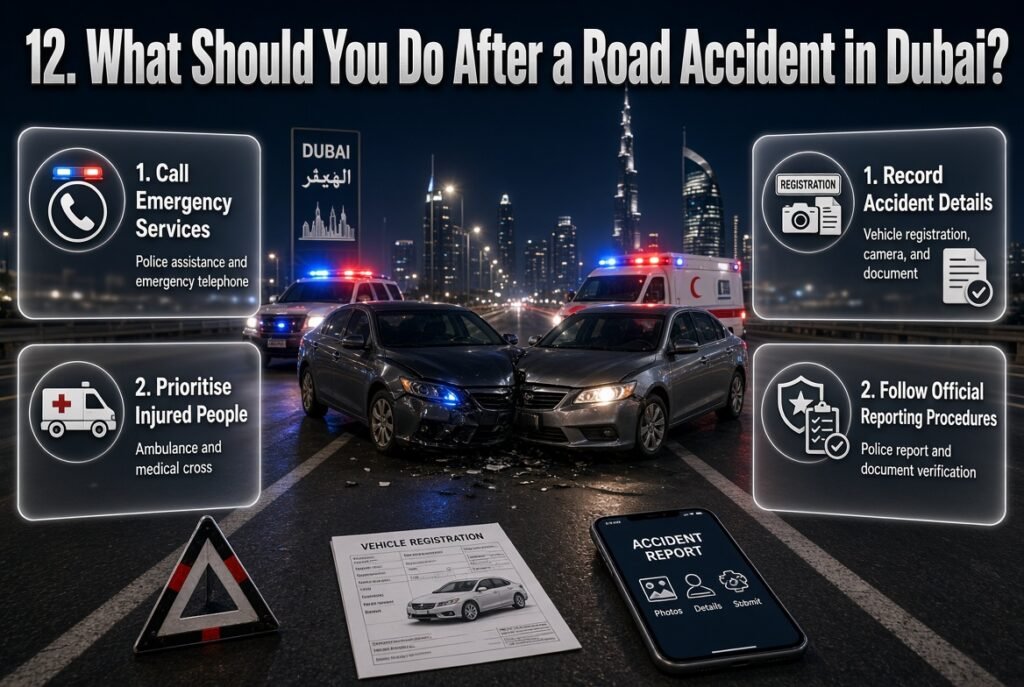
After a road accident, protect everyone involved, contact the appropriate emergency services, follow official instructions, and complete the required reporting procedure.
The response depends on whether the accident involves injuries or only vehicle damage.
If someone is injured
Call 999 for police assistance and 998 for an ambulance when medical assistance is needed.
You should:
- Stop safely.
- Activate hazard lights where appropriate.
- Provide your location clearly.
- Follow emergency operator instructions.
- Avoid moving seriously injured people unless there is immediate danger.
- Keep unnecessary bystanders away.
- Do not obstruct emergency responders.
Do not attempt medical procedures beyond your training.
If the accident is minor
If nobody is injured and the vehicles can be moved safely, follow the official instructions for clearing the road and reporting the incident.
The UAE provides digital channels for reporting minor accidents, including the Dubai Police App and other approved applications.
Record relevant information
Where it is safe and appropriate, keep a record of:
- Vehicle registration details.
- Contact information of involved parties.
- Time and location.
- Visible vehicle damage.
- Relevant photographs.
- Insurance information.
Avoid arguing about responsibility at the accident scene.
Do not leave the scene unlawfully
Drivers involved in accidents must follow applicable legal reporting and cooperation requirements.
Leaving without completing the required procedures can create additional legal problems.
13. How Can New Drivers Develop Better Road Safety Habits?
New drivers need more than basic vehicle-control skills. They must develop awareness, judgement, route knowledge, and the ability to respond calmly when traffic conditions change.
Experience improves driving confidence, but good habits must be practised consistently.
Start with familiar routes
New motorists should initially practise on routes they understand.
This helps them concentrate on vehicle control, traffic signs, and lane positioning rather than worrying about unfamiliar directions.
Learn common road layouts
Become comfortable with:
- Roundabouts.
- Multi-lane intersections.
- Highway entrances.
- Exit ramps.
- Service roads.
- Parking areas.
- Pedestrian crossings.
Understanding these layouts helps reduce last-minute decisions.
Practise smooth driving
Avoid harsh acceleration, sudden braking, and unnecessary steering movements.
Smooth driving makes your actions more predictable for surrounding motorists.
Build observation skills
Develop a regular habit of checking mirrors and looking ahead.
Do not focus exclusively on the vehicle directly in front of you.
Observe traffic signals, pedestrians, motorcycles, and vehicles approaching from joining lanes.
Do not allow other drivers to pressure you
New drivers sometimes make unsafe decisions because another motorist is following closely or repeatedly using the horn.
Remain calm, follow the rules, and complete manoeuvres only when they are safe.
14. Professional Road Safety Practices for Everyday Drivers
Professional defensive driving focuses on prevention, anticipation, and consistent decision-making. Instead of waiting for a dangerous situation, drivers identify possible hazards early and create enough space to respond.
These practices can be applied to ordinary daily journeys.
Follow an observation routine
Regularly observe:
- The road ahead.
- Rear-view mirrors.
- Side mirrors.
- Blind spots before manoeuvres.
- Roadside hazards.
- Pedestrians and cyclists.
- Traffic signals.
This routine helps you maintain a better understanding of the traffic environment.
Perform a pre-drive inspection
Before a long journey, inspect important vehicle components.
A practical routine is:
Inspect: Check tyres, lights, mirrors, visible leaks, and warning indicators.
Measure: Check tyre pressure and relevant fluid levels according to manufacturer guidance.
Diagnose: Investigate unusual sounds, vibrations, warning lights, and changes in vehicle behaviour.
Maintain: Arrange servicing or repairs when required.
Monitor: Recheck the vehicle after maintenance and observe whether the original issue has been resolved.
Maintain a useful emergency kit
Keep essential equipment securely stored inside the vehicle.
Useful items may include:
- First-aid supplies.
- Drinking water.
- Torch.
- Phone charging cable.
- Reflective warning equipment.
- Basic emergency contact information.
Check the condition of stored supplies periodically.
Avoid driving when conditions are unsafe
Not every journey needs to happen immediately.
If severe rain, flooding, or poor visibility makes travel dangerous, delay non-essential journeys where possible.
This is a practical safety decision, not an inconvenience.
Keep your vehicle’s documents in order
Before travelling, make sure your driving licence, vehicle registration, and required insurance arrangements are valid.
A vehicle should also meet applicable safety and roadworthiness requirements.
15. Dubai Road Safety Checklist Before Starting Your Journey
A pre-drive checklist helps you identify common problems before entering traffic. It is particularly useful before long journeys, highway travel, and trips during extreme weather.
Driver readiness
- Carry a valid driving licence.
- Make sure you are alert and fit to drive.
- Avoid driving under the influence.
- Set navigation before moving.
- Check your route and expected travel conditions.
Passenger protection
- Fasten the driver’s seat belt.
- Confirm that every passenger is secured.
- Use appropriate child restraints.
- Secure loose objects inside the vehicle.
Vehicle condition
- Check tyre pressure and visible damage.
- Inspect headlights and indicators.
- Confirm that brake lights work.
- Check dashboard warning lights.
- Look for visible fluid leaks.
- Confirm that mirrors and windscreen are clear.
Road preparation
- Check the weather.
- Allow sufficient journey time.
- Understand the route and exits.
- Avoid unnecessary distractions.
- Prepare for possible traffic delays.
This routine does not replace professional servicing, but it helps drivers recognise basic problems before starting a journey.
What Are the Most Important Road Safety Rules Every Driver Must Follow in Dubai?
Driving safely in Dubai requires understanding local traffic regulations and following responsible driving practices. Drivers must observe posted speed limits, wear seat belts, maintain safe distances, respect traffic signals, and avoid mobile phone distractions. These rules are particularly important on busy highways, at major intersections, and in residential areas where traffic conditions can change quickly.
Dubai’s road network includes high-speed highways, service roads, multi-lane junctions, and busy pedestrian areas. Drivers should therefore remain alert and adjust their driving according to the road environment rather than relying only on their usual driving habits.
Important road safety rules include:
Follow posted speed limits and road signs.
Wear seat belts and ensure all passengers are secured.
Use appropriate child safety seats.
Never use a handheld mobile phone while driving.
Maintain a safe distance from the vehicle ahead.
Check mirrors and blind spots before changing lanes.
Give pedestrians and authorised emergency vehicles appropriate priority.
Never drive under the influence of alcohol or impairing substances.
Following these practices helps drivers reduce avoidable risks and protect everyone sharing Dubai’s roads.
How Can Drivers Prevent Road Accidents on Dubai Highways?
Preventing highway accidents requires careful speed management, proper lane discipline, early hazard recognition, and sufficient stopping distance. Major roads such as Sheikh Zayed Road and Al Khail Road can experience heavy traffic, sudden braking, merging vehicles, and changing speed conditions. Even a small driving mistake can become dangerous when vehicles are travelling at higher speeds.
Drivers should avoid aggressive overtaking and unnecessary lane switching. Planning exits in advance also helps prevent sudden movements across multiple lanes.
Practical highway accident prevention tips:
Maintain at least a three-second following distance in suitable conditions.
Increase the gap during rain, fog, and poor visibility.
Check mirrors and blind spots before changing lanes.
Use indicators before making manoeuvres.
Avoid tailgating and sudden braking.
Never make last-minute exit movements.
Keep your attention on traffic instead of mobile devices.
Slow down when approaching congestion or roadwork.
One particularly important habit is looking beyond the vehicle immediately ahead. This helps you recognise slowing traffic earlier and respond without unnecessary emergency braking.
What Should You Do If Your Car Breaks Down or Runs Out of Fuel on a Dubai Road?
A vehicle breakdown on a busy Dubai road can create a serious safety concern, especially when it happens on a highway or in an area with limited stopping space. The first priority should always be protecting yourself and your passengers rather than attempting an immediate repair.
If your vehicle develops a mechanical problem, move towards a suitable safe stopping area if possible. Switch on your hazard lights and avoid standing in an active traffic lane. Once everyone is safe, identify whether you need roadside recovery, battery assistance, tyre support, or emergency fuel delivery.
Follow these important steps:
Move the vehicle away from moving traffic if it is safe to do so.
Activate hazard lights to alert approaching motorists.
Keep passengers away from dangerous traffic areas.
Avoid attempting roadside repairs in an unsafe location.
Contact suitable roadside assistance.
Explain your exact location and the nature of the problem.
If the vehicle has run out of fuel, arranging fuel assistance can be more practical than walking along a busy road looking for a petrol station. You can explore Fuel Delivery Dubai to understand available fuel delivery assistance.
How Do Dubai’s Weather Conditions Affect Road Safety?
Dubai’s weather can significantly influence driving conditions, particularly during extreme summer heat, rainfall, fog, and dust storms. These conditions affect visibility, tyre grip, vehicle performance, and stopping distances. Drivers who continue using their normal driving habits without adjusting to the weather may face unnecessary risks.
During summer, high temperatures can place additional pressure on tyres, batteries, and engine cooling systems. Rain can reduce road grip, while fog and dust can make it difficult to recognise vehicles and road markings.
Weather-related safety precautions:
Check tyre pressure and condition regularly during hot weather.
Monitor engine temperature and cooling system warnings.
Reduce speed when roads become wet.
Increase following distance during rain and fog.
Use appropriate vehicle lighting in reduced visibility.
Avoid driving through flooded roads.
Delay non-essential journeys during severe weather.
Stop at a suitable safe location if visibility becomes dangerously poor.
Drivers should also inspect their vehicles before long journeys, especially during the hottest months. Proper preparation can help prevent mechanical problems and make unexpected weather changes easier to manage.
What Vehicle Maintenance Checks Are Essential for Safe Driving in Dubai?
Regular vehicle maintenance is an important part of road safety because even a small mechanical fault can affect steering, braking, visibility, or vehicle stability. Dubai’s hot climate and frequent stop-and-go traffic make it particularly important to monitor the condition of tyres, batteries, brakes, and cooling systems.
Drivers should not wait for a breakdown or dashboard warning before inspecting their vehicles. Following the manufacturer’s maintenance schedule and investigating unusual vehicle behaviour can help identify problems early.
Essential vehicle safety checks include:
Tyres: Inspect pressure, tread depth, cracks, cuts, and uneven wear.
Brakes: Check for unusual noises, vibration, and changes in stopping performance.
Battery: Monitor starting performance, terminals, and charging condition.
Cooling system: Check coolant levels, hoses, and temperature warnings.
Lights: Ensure headlights, brake lights, and indicators work correctly.
Steering and suspension: Investigate vibration, unusual sounds, and handling problems.
Windscreen and wipers: Maintain clear visibility and replace worn wiper blades.
A well-maintained vehicle is easier to control and more dependable during unexpected situations. Regular inspections also help drivers identify developing faults before they become serious roadside problems.
Conclusion
Dubai road safety depends on responsible driving, awareness of traffic conditions, and proper vehicle maintenance. Whether travelling on busy city streets, major highways, residential roads, or unfamiliar routes, drivers should remain alert, follow traffic regulations, maintain safe distances, and avoid risky decisions such as speeding, sudden lane changes, and distracted driving.
Preparing your vehicle before every journey is equally important. Regularly checking tyres, brakes, lights, engine condition, coolant, and fuel levels can help prevent avoidable breakdowns and roadside emergencies. Drivers should also understand how to respond safely to accidents, vehicle faults, heavy rain, reduced visibility, and unexpected traffic conditions.
Safe driving is not only about protecting yourself; it also means respecting passengers, pedestrians, cyclists, motorcyclists, and other road users. By developing consistent safety habits and making informed decisions, motorists can reduce risks and contribute to safer roads throughout Dubai.
Ultimately, road safety is a daily responsibility, not an occasional precaution. A few careful decisions before and during every journey can make a meaningful difference to everyone’s safety.
Leave a Reply