Introduction
Fuel-Saving Driving Tips | Fuel can become one of the biggest recurring expenses for anyone who drives regularly. The difference between an efficient driving style and an inefficient one may seem small on a single journey, but repeated every day, those differences can add up significantly over weeks, months, and years.
Many drivers assume that saving fuel means driving extremely slowly, avoiding air conditioning, buying premium fuel, or using special additives. In reality, the biggest improvements usually come from much simpler habits: how you accelerate, how you respond to traffic, how often you brake, how fast you drive, how well you maintain your tyres, and whether your vehicle is operating properly.
For drivers who want to understand the wider role of fuel in vehicle performance, Petrol Delivery to My Location 👉 Fuel Delivery Dubai provides additional fuel-related resources.
This guide focuses on practical fuel-saving driving tips that can be applied to normal everyday driving. It explains why certain driving habits affect fuel consumption, which common “fuel-saving tricks” may not be worth following, how vehicle maintenance influences efficiency, and what to investigate when your vehicle’s fuel consumption suddenly becomes worse.
Fuel-Saving Driving Tips
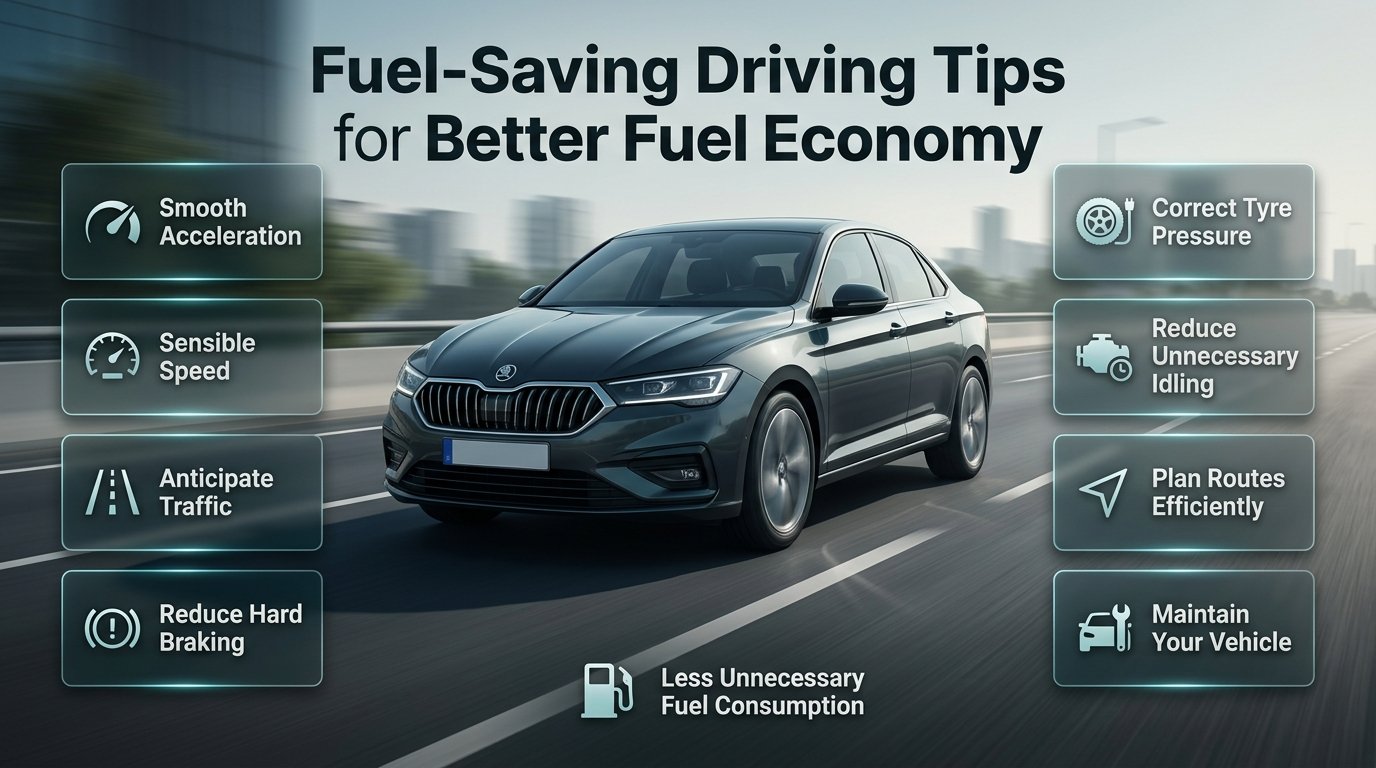
Improving fuel economy doesn’t require complicated techniques or expensive products. The biggest gains usually come from consistent everyday habits such as accelerating smoothly, anticipating traffic, maintaining a sensible speed, avoiding unnecessary idling, keeping tyres at the recommended pressure, reducing excess vehicle weight, and planning journeys efficiently. Vehicle condition matters too, because issues such as poor tyre pressure, brake drag, incorrect alignment, or overdue maintenance can increase fuel consumption. The key is to focus on practical changes that fit your normal driving routine rather than chasing unrealistic fuel-saving claims. When these habits are combined with proper vehicle maintenance and the correct fuel specification, drivers can reduce avoidable fuel use while keeping their journeys safe, comfortable, and efficient.
For a complete practical guide covering everyday driving habits, fuel-saving techniques, vehicle efficiency, and common mistakes, explore our Fuel-Saving Driving Tips Guide for more detailed advice.
What Are the Most Effective Fuel-Saving Driving Tips?
The most effective ways to reduce fuel consumption are to accelerate smoothly, anticipate traffic, avoid unnecessary braking, maintain a sensible speed, reduce prolonged idling, keep tyres at the recommended pressure, avoid carrying unnecessary weight, plan journeys efficiently, and maintain the vehicle according to the manufacturer’s recommendations.
No single technique works in every situation. Fuel consumption is affected by driving style, vehicle design, traffic, road conditions, weather, vehicle load, tyres, air conditioning, maintenance, and fuel quality.
The aim isn’t to make every journey perfectly economical. It’s to eliminate unnecessary fuel use while keeping driving safe, comfortable, and practical.
Why Does Driving Style Affect Fuel Consumption?
A vehicle needs energy to move. The engine produces that energy by converting chemical energy in fuel into mechanical power.
Whenever you accelerate, climb a hill, overcome resistance, or maintain a higher speed, the engine needs to produce more work.
Several types of resistance affect a moving vehicle:
- Air resistance
- Tyre rolling resistance
- Road gradients
- Vehicle weight
- Mechanical resistance
- Acceleration demands
The driver has considerable control over some of these factors.
You can’t change the shape of your car every morning, but you can decide whether to accelerate gently or aggressively. You can anticipate a red light instead of rushing toward it. You can remove unnecessary heavy equipment from the trunk. You can maintain the correct tyre pressure.
These small decisions are what make efficient driving practical.
1. Accelerate Smoothly
Aggressive acceleration is one of the easiest habits to identify when looking for opportunities to improve fuel economy.
When a driver presses the accelerator aggressively, the engine has to produce a large amount of power in a short period. The exact fuel consumption depends on the engine, transmission, vehicle, road, and operating conditions, but repeated hard acceleration generally isn’t an efficient way to drive.
The solution isn’t to accelerate painfully slowly.
Instead, use smooth and progressive acceleration.
For example, when a traffic light turns green, accelerate normally and reach the desired speed without unnecessarily forcing the engine to produce maximum power.
Why smooth acceleration helps
Consider two drivers leaving the same traffic light.
The first driver accelerates aggressively, reaches high speed quickly, then brakes hard because traffic ahead has slowed.
The second driver accelerates smoothly, watches traffic farther ahead, and adjusts speed before reaching the congestion.
The second driver is not necessarily driving dramatically slower. They’re simply avoiding unnecessary energy use.
A useful habit
When accelerating, ask yourself:
“Do I actually need all this speed right now?”
If the road ahead is already congested, aggressive acceleration may only result in stronger braking a few seconds later.
Pro Tip: Smooth driving should never mean unsafe driving. Keep up with normal traffic and follow the road’s speed limit.
2. Anticipate Traffic Instead of Reacting Late
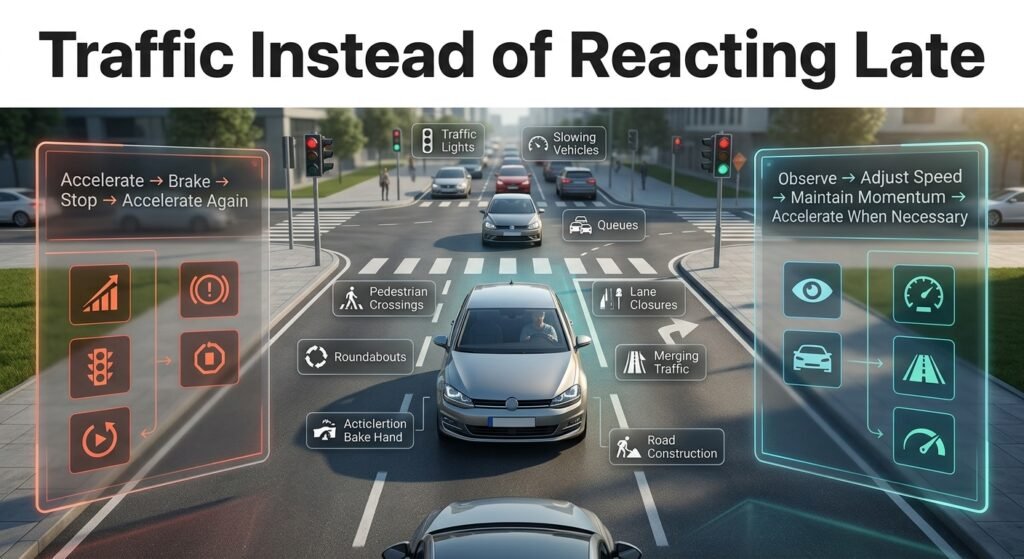
Traffic anticipation is one of the most useful skills for economical driving.
A driver who watches only the vehicle directly ahead may repeatedly accelerate and brake. A driver who looks farther down the road has more time to respond.
Watch for:
- Traffic lights
- Vehicles slowing down
- Queues
- Pedestrian crossings
- Roundabouts
- Lane closures
- Merging traffic
- Road construction
- Vehicles entering from side roads
Suppose you are approaching a red traffic light and can already see that several vehicles are stopped.
Continuing to accelerate until you reach the queue means you’ll probably need to brake harder.
Instead, if traffic conditions allow, you can gradually release the accelerator and let the vehicle slow naturally.
This doesn’t mean coasting in an unsafe manner. It means avoiding unnecessary acceleration when you already know that you’ll need to slow down.
The inefficient cycle
Accelerate → Brake → Stop → Accelerate again
The more efficient approach
Observe → Adjust speed → Maintain momentum where possible → Accelerate when necessary
This principle is particularly useful in urban driving.
3. Avoid Unnecessary Hard Braking
Braking is essential for safety, so you should never avoid braking simply to save fuel.
The issue is unnecessary braking caused by poor anticipation.
When you accelerate a vehicle, the engine uses energy to increase its speed. If you immediately brake heavily, much of that kinetic energy is converted into heat through the braking system.
That doesn’t mean every braking event is wasteful. Braking is often necessary.
The practical goal is to avoid creating situations where you:
- Accelerate unnecessarily.
- Reach a traffic problem.
- Brake aggressively.
- Accelerate again.
A safe following distance gives you more time to respond.
It also makes driving less stressful because you’re not constantly reacting to sudden changes.
4. Maintain a Sensible and Consistent Speed
Speed has an important effect on fuel consumption.
At higher speeds, aerodynamic resistance becomes increasingly significant. The engine therefore has to produce more power simply to maintain the vehicle’s speed.
This is why fuel consumption can rise considerably when a driver regularly travels at very high speeds.
However, the answer isn’t to drive unusually slowly.
A sensible approach is to:
- Follow posted speed limits.
- Maintain a speed appropriate for road conditions.
- Avoid unnecessary high-speed driving.
- Avoid repeated speed fluctuations.
- Adapt to traffic rather than constantly chasing higher speeds.
The most economical speed differs between vehicles. A small hatchback, large SUV, hybrid, diesel vehicle, and performance car won’t necessarily have the same ideal operating point.
Therefore, general claims such as “every car gets its best economy at exactly one speed” should be treated cautiously.
5. Use Cruise Control When Conditions Are Appropriate
Cruise control can help maintain a consistent speed on roads where traffic conditions are stable.
If you repeatedly speed up and slow down without a reason, cruise control may help reduce those unnecessary fluctuations.
It can be particularly useful on:
- Open highways
- Long-distance roads
- Roads with relatively consistent traffic
However, cruise control isn’t suitable for every situation.
Be cautious when:
- Traffic is heavy.
- Roads are wet or slippery.
- Visibility is poor.
- Traffic speeds change frequently.
- You need to respond constantly to road conditions.
Modern adaptive cruise-control systems work differently from traditional cruise control, but neither replaces the driver’s responsibility.
Fuel savings should never come before safe vehicle control.
6. Reduce Unnecessary Idling
An engine that is running while the vehicle is stationary is consuming fuel without moving you toward your destination.
Long periods of unnecessary idling can therefore waste fuel.
Common examples include:
- Waiting outside a store
- Sitting in a parking area
- Waiting for someone for a long time
- Leaving the engine running during extended stationary periods
However, don’t turn engine shutdown into an obsession.
A brief stop isn’t the same as a long period of unnecessary idling. Modern vehicles may also have automatic stop-start systems designed to manage this situation.
In extreme weather, safety and comfort also matter. In very hot conditions, air conditioning may be important for maintaining a reasonable cabin environment.
The practical goal is simple:
Avoid prolonged idling when it isn’t necessary or beneficial.
7. Keep Tyres at the Correct Pressure
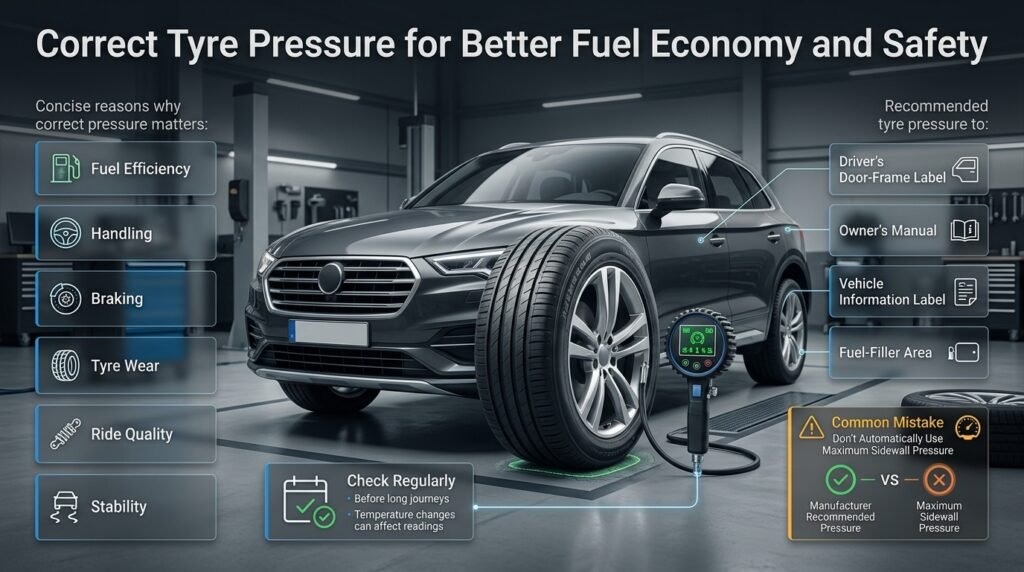
Tyre pressure is easy to overlook because it doesn’t seem directly connected to the engine.
But tyres are the point where the vehicle interacts with the road.
Underinflated tyres can increase rolling resistance. When rolling resistance increases, the vehicle may require more energy to move.
Correct pressure also matters for:
- Handling
- Braking
- Tyre wear
- Ride quality
- Stability
- Overall safety
The correct tyre pressure should come from the vehicle manufacturer.
You can usually find it on:
- The driver’s door-frame label
- The owner’s manual
- A vehicle information label
- Sometimes near the fuel-filler area
Don’t automatically use the maximum pressure printed on the tyre sidewall. That figure isn’t necessarily the recommended operating pressure for your vehicle.
How often should you check?
Regularly.
Tyres naturally lose some pressure over time, and temperature changes can affect pressure readings.
Before a long journey is also a sensible time to check them.
Common Mistake: Overinflating tyres in an attempt to save fuel can create other problems. Fuel economy isn’t worth compromising handling and tyre safety.
8. Remove Unnecessary Weight
A heavier vehicle requires more energy to accelerate.
If your vehicle regularly carries heavy items that you don’t actually need, removing them can help reduce unnecessary load.
Examples might include:
- Old equipment
- Heavy tools
- Unused luggage
- Sports equipment
- Large containers
- Unnecessary cargo
You don’t need to remove every small object from your vehicle.
The practical principle is:
Don’t carry significant weight around permanently if you don’t need it.
The effect becomes more relevant for vehicles that regularly carry substantial loads.
9. Remove Unused Roof Equipment
External equipment can affect fuel consumption differently from items inside the vehicle.
A roof rack or roof box changes the airflow around the vehicle and can increase aerodynamic drag.
The effect can become more noticeable at higher road speeds.
If you use a roof-mounted accessory occasionally, consider removing it when it isn’t required.
This isn’t about chasing tiny improvements. It’s about eliminating an avoidable source of resistance when practical.
10. Plan Your Routes Before You Drive
Fuel-efficient driving doesn’t begin when you press the accelerator.
It begins with planning.
A poor route can increase:
- Distance
- Traffic exposure
- Waiting time
- Number of stops
- Acceleration and braking
- Fuel consumption
If you have several errands to complete, consider combining them.
For example:
Less efficient pattern:
Home → Shop → Home
Home → Bank → Home
Home → Pharmacy → Home
Potentially better pattern:
Home → Bank → Pharmacy → Shop → Home
The actual best route depends on distance and traffic, but combining journeys can eliminate unnecessary repeated travel.
Navigation apps can also help identify congestion, road closures, and alternative routes.
However, don’t automatically choose the shortest distance. A slightly longer route with significantly less stop-and-go traffic may sometimes be more efficient.
11. Avoid Unnecessary Short Trips
Very short journeys can sometimes be less efficient than longer continuous journeys because the vehicle may spend more time operating before reaching normal operating conditions.
This doesn’t mean short trips are bad or that you should avoid them when necessary.
Instead, consider combining nearby errands where practical.
For example, if you need to visit three places in the same area, doing them during one planned trip may be more sensible than returning home between each stop.
The benefit isn’t just fuel.
It can also save:
- Time
- Tyre wear
- Vehicle wear
- Traffic exposure
12. Use Air Conditioning Sensibly
Air conditioning can affect fuel consumption because the system requires energy to operate.
For drivers in hot climates, however, avoiding air conditioning entirely isn’t necessarily a sensible fuel-saving strategy.
Excessive heat can make driving uncomfortable and may affect concentration.
The better approach is to use climate control efficiently.
Practical habits
- Don’t set the temperature unnecessarily low.
- Keep doors and windows closed when appropriate.
- Use shade when parking.
- Use sunshades where practical.
- Keep the AC system maintained.
- Make sure the cabin air filter is maintained according to the vehicle’s schedule.
At higher speeds, driving with windows wide open can also increase aerodynamic drag. The exact trade-off between open windows and air conditioning depends on speed and vehicle design.
The important point is to avoid extreme strategies.
13. Maintain the Vehicle Properly
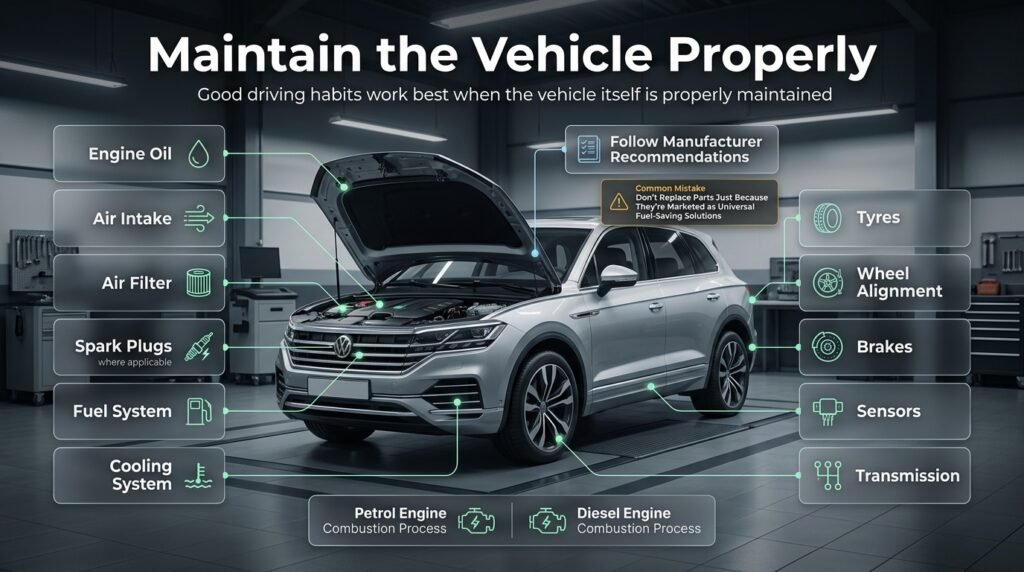
Good driving habits can’t compensate for every mechanical problem.
If a vehicle isn’t operating correctly, fuel consumption can increase even when the driver is doing everything right.
Maintenance areas that deserve attention include:
- Engine oil
- Air intake system
- Air filter
- Spark plugs where applicable
- Fuel system
- Tyres
- Wheel alignment
- Brakes
- Sensors
- Cooling system
- Transmission
The correct maintenance schedule depends on the vehicle.
Don’t replace parts simply because someone says a particular replacement is a universal fuel-saving trick.
Instead, follow the manufacturer’s maintenance requirements and investigate symptoms when they appear.
For readers who want to understand how fuel is actually converted into engine power, the petrol engine combustion process provides useful background. For diesel vehicles, the diesel engine combustion process explains the different combustion method.
Vehicle Maintenance Guides
Regular vehicle maintenance is one of the most practical ways to support consistent fuel economy, dependable performance, and safer everyday driving. Components such as tyres, brakes, engine oil, air filters, spark plugs, wheel alignment, sensors, and the fuel system can all influence how efficiently a vehicle operates. Instead of waiting until fuel consumption increases or a warning light appears, follow the manufacturer’s recommended maintenance schedule and pay attention to early signs such as rough running, reduced acceleration, unusual noises, uneven tyre wear, or changes in engine performance. A well-maintained vehicle allows the engine and supporting systems to operate closer to their intended condition, helping prevent avoidable fuel waste while reducing the risk of more expensive repairs later.
For a complete practical guide to keeping your vehicle efficient, reliable, and road-ready throughout the year, explore our Vehicle Maintenance Guides for expert maintenance tips and helpful checks.
14. Use the Fuel Recommended for Your Vehicle
Fuel economy can also be affected by using inappropriate fuel.
Petrol and diesel engines are designed around different combustion systems. They shouldn’t be treated as interchangeable fuels.
Understanding the basic differences between fuels can help prevent expensive mistakes. The automotive fuel types resource provides additional information about common vehicle fuels.
You can also learn more about petrol and diesel fuel types and their applications.
What about octane?
Petrol octane rating is related to a fuel’s resistance to knock.
A higher octane number doesn’t simply mean “more powerful fuel.”
Some engines are designed to benefit from or require higher-octane fuel because of their compression ratio, calibration, or operating conditions.
If you’re unsure what your vehicle needs, follow the manufacturer’s specification.
15. Does Premium Petrol Always Save Fuel?
No.
This is a common misconception.
Premium petrol can be appropriate for an engine designed to operate with higher-octane fuel. But putting premium petrol into every vehicle doesn’t automatically result in enough extra efficiency to justify its higher cost.
The correct question isn’t:
“Is premium fuel better?”
The better question is:
“What fuel does my vehicle manufacturer recommend?”
If you want to understand the difference more clearly, see the guide to regular vs premium petrol octane.
Using the correct fuel specification is more important than choosing fuel simply because it has a premium label.
16. Understand the Relationship Between Fuel Quality and Fuel Economy
Fuel quality and fuel economy are related, but they’re not identical.
A vehicle needs fuel that meets the appropriate specifications for its engine and fuel system.
Problems with fuel quality can sometimes cause:
- Poor acceleration
- Rough running
- Hesitation
- Misfiring
- Difficult starting
- Reduced performance
However, don’t blame every fuel-economy problem on fuel quality.
If your vehicle suddenly consumes more fuel, the cause could also be:
- Traffic
- Tyre pressure
- Vehicle load
- Air conditioning
- Wheel alignment
- Brake problems
- Engine problems
- Sensors
- Driving style
For a broader understanding, you can explore fuel quality standards and fuel quality and engine performance.
17. Learn to Recognize a Sudden Change in Fuel Consumption
Gradual changes are sometimes difficult to notice.
A sudden change is more useful diagnostically.
Suppose your vehicle normally delivers similar fuel economy for several months, and then you notice a significant increase immediately after a refueling.
Don’t immediately assume the fuel caused it.
Ask:
- Has traffic changed?
- Have you started using the AC more?
- Are your tyres properly inflated?
- Are you carrying more weight?
- Has your route changed?
- Is the engine running differently?
- Are there warning lights?
- Is the vehicle accelerating normally?
- Did the change happen immediately or gradually?
If the vehicle also develops drivability symptoms, fuel quality becomes one possibility among several.
Information about fuel quality testing basics can help explain why fuel problems need to be evaluated rather than assumed.
18. Don’t Ignore Signs of Fuel Contamination
Fuel contamination can affect engine performance, although symptoms vary depending on the contaminant and vehicle.
Possible symptoms can include:
- Hard starting
- Rough idle
- Hesitation
- Reduced acceleration
- Misfiring
- Poor engine performance
If you notice problems after refueling, don’t automatically continue driving while hoping they’ll disappear.
The correct response depends on the severity of the symptoms and the vehicle.
For more background, see contaminated petrol symptoms and information about contaminated diesel causes.
You can also learn about common causes of fuel contamination.
19. Consider Wheel Alignment
Fuel-saving discussions often focus on the engine and ignore the wheels.
That’s a mistake.
If wheel alignment is incorrect, tyres may not roll as efficiently as intended. The vehicle may also show uneven tyre wear or pulling to one side.
Possible signs include:
- Steering wheel not centered
- Vehicle pulling left or right
- Uneven tyre wear
- Unusual handling
If you notice these symptoms, have the vehicle inspected.
Correct alignment isn’t just about fuel economy. It also supports proper tyre wear and vehicle handling.
20. Don’t Ignore Brake Drag
A brake that doesn’t release correctly can create resistance.
That means the engine has to work harder to move the vehicle.
Possible warning signs include:
- Vehicle feels unusually heavy
- One wheel becomes much hotter than others
- Burning smell
- Vehicle pulling to one side
- Reduced ability to roll freely
This isn’t a fuel-saving problem you should try to solve through driving technique.
A suspected brake problem needs proper inspection because braking is a safety-critical system.
What Driving Habits Waste the Most Fuel?
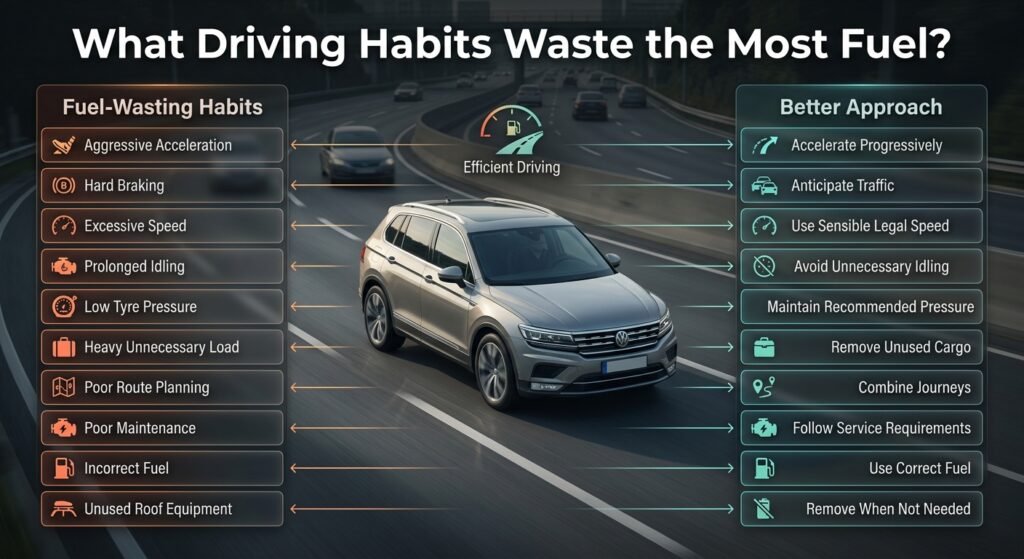
| Driving habit | Why it can increase consumption | Better approach |
|---|---|---|
| Aggressive acceleration | Creates high power demand | Accelerate progressively |
| Repeated hard braking | Wastes vehicle momentum | Anticipate traffic |
| Excessive speed | Increases aerodynamic resistance | Use a sensible legal speed |
| Prolonged idling | Uses fuel while stationary | Avoid unnecessary long idle periods |
| Low tyre pressure | Can increase rolling resistance | Maintain recommended pressure |
| Heavy unnecessary load | Requires more energy to accelerate | Remove unused cargo |
| Poor route planning | Adds distance and congestion | Combine journeys |
| Poor maintenance | May reduce normal engine efficiency | Follow service requirements |
| Incorrect fuel | May cause unsuitable operation | Follow manufacturer specification |
| Unused roof equipment | Can increase aerodynamic drag | Remove when not needed |
How Can You Make City Driving More Fuel Efficient?
City driving can be challenging because it involves frequent stops, traffic lights, queues, pedestrians, lane changes, and unpredictable traffic.
You can’t control the traffic, but you can control your response.
Keep a reasonable following distance
This gives you more time to react.
Look beyond the vehicle immediately ahead
If you see traffic slowing 100 metres ahead, you can begin adjusting earlier.
Avoid racing between traffic lights
Accelerating aggressively to the next light often provides little practical benefit.
Don’t accelerate into obvious congestion
If traffic is already stopped, extra speed usually just creates more braking.
Combine errands
Fewer separate journeys can reduce total distance and repeated stops.
Keep your vehicle maintained
City driving can place significant demands on brakes, tyres, cooling systems, and the drivetrain.
Dubai Driving and Fuel Insights
Dubai’s driving environment creates some unique considerations for fuel efficiency. High temperatures, frequent air-conditioning use, busy urban traffic, short trips, highway driving, and periods of stop-and-go congestion can all influence how much fuel a vehicle consumes. Drivers can improve efficiency by maintaining the manufacturer’s recommended tyre pressure, avoiding unnecessary idling, planning routes around heavy congestion where practical, and using smooth acceleration instead of repeatedly speeding up and braking. During Dubai’s hotter months, proper cooling-system and air-conditioning maintenance is also important for reliable vehicle operation. The most effective approach is not to avoid essential systems such as air conditioning, but to combine sensible driving habits with proper vehicle maintenance and realistic expectations about fuel consumption in local conditions.
For a complete Dubai-focused guide covering local driving conditions, fuel efficiency, vehicle care, and practical fuel-related advice, explore our Dubai Driving and Fuel Insights Guide for more helpful information.
How Is Highway Driving Different?
Highway driving often provides an opportunity for steady speeds, but higher speeds can also increase aerodynamic resistance.
A fuel-efficient highway approach is generally based on consistency.
Try to:
- Maintain a sensible speed.
- Avoid unnecessary acceleration.
- Use cruise control where appropriate.
- Keep tyres properly inflated.
- Remove unnecessary roof equipment.
- Avoid carrying unnecessary heavy cargo.
- Watch traffic far ahead.
Wind can also have a significant effect.
Driving into a strong headwind can increase energy demand, while a tailwind may reduce it.
This is one reason why comparing fuel consumption from only one trip can be misleading.
How Should You Drive on Hills?
Hills naturally affect fuel consumption.
Going uphill requires additional energy because the vehicle is gaining elevation.
The goal isn’t to eliminate the extra fuel requirement. That’s impossible. Instead, avoid unnecessary aggressive driving.
On an uphill section:
- Maintain a safe speed.
- Avoid excessive acceleration.
- Allow the vehicle’s transmission to select an appropriate gear.
- Don’t chase the exact same speed at all costs if road conditions make that unnecessary.
On downhill sections, modern vehicles may use different fuel-management strategies depending on the drivetrain and operating conditions.
Don’t shift into neutral simply to try to save fuel. Maintain proper vehicle control and follow safe driving practices.
How Does Vehicle Weight Affect Fuel Economy?
Weight matters most when the vehicle repeatedly needs to accelerate.
This is why unnecessary heavy cargo can be more relevant in urban driving than during constant-speed cruising.
For example, a vehicle carrying several heavy items while repeatedly stopping and starting may use more fuel than the same vehicle with the unnecessary load removed.
But don’t remove safety equipment, emergency equipment, or items that you genuinely need just to chase a small fuel saving.
The sensible rule is:
Remove unnecessary weight, not useful equipment.
How Can You Track Your Fuel Economy Properly?
Your dashboard’s fuel-economy display can be useful, but don’t rely on a single reading.
A more reliable method is to monitor several refueling cycles.
Step 1: Record the odometer
Note the mileage when you refuel.
Step 2: Record the fuel added
Write down how many litres were added.
Step 3: Drive normally
Don’t deliberately change your driving style just for the first measurement.
Step 4: Refuel again
Record the distance and fuel added.
Step 5: Calculate consumption
For example:
Distance: 600 km
Fuel used: 60 litres
60 ÷ 600 × 100 = 10 L/100 km
Step 6: Compare several periods
One tank isn’t enough to establish a trend.
Traffic, temperature, road conditions, tyre pressure, passengers, and AC usage can all influence the result.
Why One Bad Fuel-Economy Reading Doesn’t Always Mean There’s a Problem
Imagine your car normally gets 8 L/100 km.
One week, you get 10 L/100 km.
That doesn’t necessarily mean the engine has developed a fault.
Perhaps:
- You spent more time in traffic.
- The weather was hotter.
- You used air conditioning more.
- You carried additional passengers.
- You drove more short journeys.
- Your route changed.
- You drove at higher speeds.
Now imagine the vehicle continues getting 10 L/100 km for several weeks under similar conditions.
That is more meaningful.
A persistent change deserves investigation.
Common Fuel-Saving Mistakes
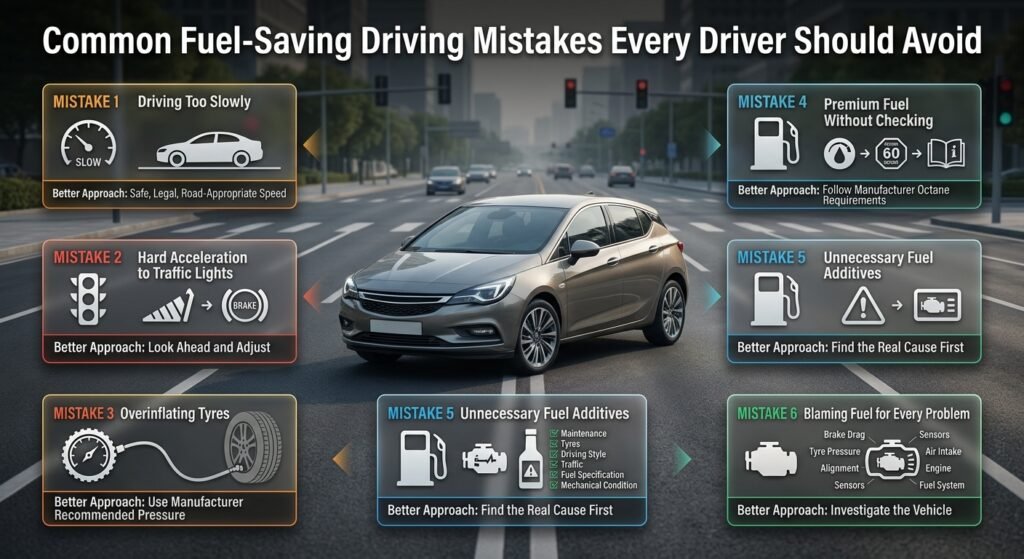
Mistake 1: Driving Too Slowly
Some drivers believe the slower they drive, the more fuel they save.
That’s too simplistic.
Driving at an inappropriate speed can create safety problems and interfere with normal traffic.
Better approach: Drive at a safe, legal, road-appropriate speed and avoid unnecessary high-speed driving.
Mistake 2: Accelerating Hard to Reach the Next Traffic Light
This is common in urban driving.
A driver sees a green light and accelerates aggressively, only to brake moments later because the next light is red.
Why it’s inefficient: Fuel is used to create speed that immediately has to be removed.
Better approach: Look ahead and adjust your acceleration according to what is actually happening on the road.
Mistake 3: Overinflating Tyres
Some drivers think harder tyres automatically mean better fuel economy.
Why it’s a problem: Excessive pressure can affect handling, braking, comfort, and tyre wear.
Better approach: Use the manufacturer’s recommended pressure.
Mistake 4: Buying Premium Fuel Without Checking the Requirement
Premium fuel isn’t automatically better for every engine.
Better approach: Follow the manufacturer’s recommended octane rating.
Mistake 5: Using Fuel Additives Without a Reason
Fuel additives are often marketed as easy solutions for fuel economy.
But no additive should be treated as a universal solution.
If a vehicle has poor fuel economy, first consider:
- Maintenance
- Tyres
- Driving style
- Traffic
- Fuel specification
- Mechanical condition
Mistake 6: Blaming Fuel for Every Performance Problem
A vehicle that suddenly consumes more fuel might have a mechanical problem.
Possible causes can include:
- Brake drag
- Tyre pressure
- Alignment
- Sensors
- Air intake problems
- Engine issues
- Fuel-system issues
Fuel quality is one possibility, not the automatic answer.
Expert Advice for Better Fuel Economy
A practical approach is to concentrate on things you can control.
Control your acceleration
Avoid unnecessary bursts of power.
Control your observation
Look farther ahead.
Control your speed
Don’t drive faster than necessary.
Control your vehicle condition
Maintain tyres, brakes, engine, and other components.
Control unnecessary weight
Don’t permanently carry heavy items you don’t need.
Control your journey planning
Combine errands and avoid unnecessary detours.
Control your expectations
No driving technique can overcome every physical factor affecting fuel economy.
A large SUV carrying heavy cargo in hot weather and heavy traffic will not achieve the same consumption as a lightweight car on an open road.
The goal is to make your vehicle as efficient as reasonably possible under your actual conditions.
Fuel Quality and Driving Efficiency: Why Both Matter
Fuel economy isn’t determined entirely by fuel quality.
A vehicle can have good-quality fuel and still consume too much because of aggressive driving, low tyre pressure, heavy traffic, or mechanical problems.
Likewise, efficient driving cannot completely compensate for contaminated or unsuitable fuel.
This is why it helps to consider the entire system:
Fuel + Engine + Tyres + Driver + Road + Traffic + Weather + Load
Each part contributes to the final result.
For readers researching the wider topic, factors affecting fuel quality provides additional information about what can influence fuel condition.
What Should You Do If Fuel Economy Suddenly Gets Worse?
Start with simple checks.
Check tyre pressure
Incorrect pressure is easy to overlook.
Think about recent driving conditions
Has traffic become worse?
Have your journeys become shorter?
Are you using AC more?
Check vehicle load
Are you carrying significantly more weight?
Check for warning signs
Look for:
- Dashboard warning lights
- Rough running
- Loss of power
- Strange smells
- Unusual noises
- Difficult starting
Consider maintenance
If the change persists, have the vehicle inspected.
Consider fuel quality
If the change occurred immediately after refueling and drivability problems appeared at the same time, fuel quality may deserve investigation.
The important point is not to jump to one conclusion without evidence.
Emergency Roadside Fuel Advice
Running low on fuel or discovering a fuel-related problem while driving can quickly turn a normal journey into a roadside emergency. If your fuel level becomes critically low, don’t wait until the engine stops in an unsafe location. Reduce unnecessary acceleration, avoid high speeds, switch off non-essential electrical loads where appropriate, and look for a safe place to pull over. If the vehicle has already stopped because of an empty tank, do not continue attempting to restart it repeatedly, as this may create additional mechanical strain depending on the vehicle. Instead, move to a safe location if possible, activate your hazard lights, and arrange reliable roadside fuel assistance. If you suspect contaminated or incorrect fuel, avoid driving further until the situation has been assessed. For drivers in Dubai, having access to dependable emergency fuel delivery can provide a practical solution when reaching a petrol station is not possible.
For a complete step-by-step guide on what to do when your vehicle runs out of fuel or needs urgent roadside assistance, read our Emergency Fuel Delivery Guide to understand the safest and most practical options available to Dubai drivers.
Fuel-Saving Driving Tips for Long-Distance Trips
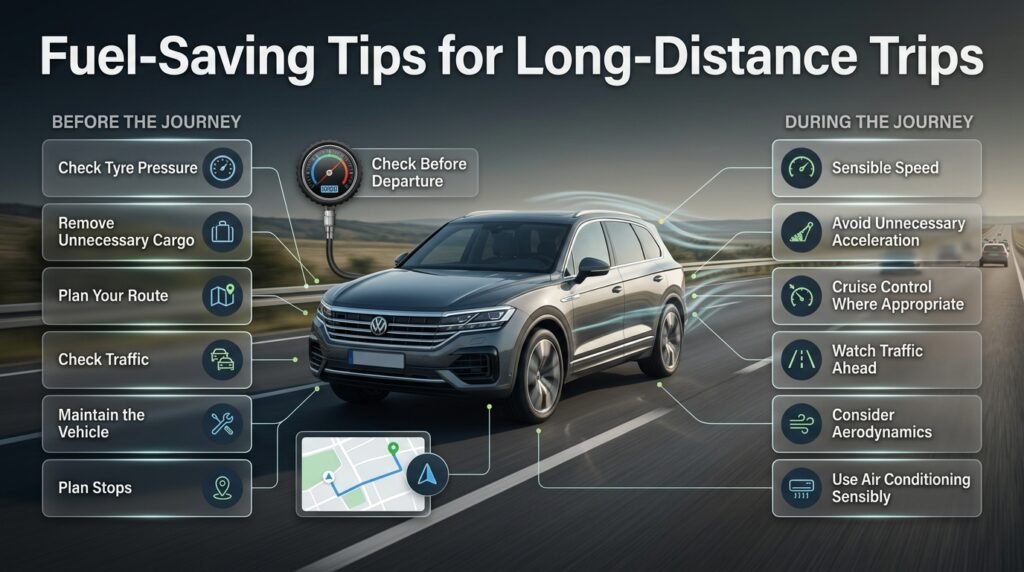
Long journeys provide different opportunities to improve efficiency.
Before leaving:
- Check tyre pressure.
- Remove unnecessary cargo.
- Plan your route.
- Check traffic conditions.
- Make sure the vehicle is properly maintained.
- Consider where you will stop.
During the journey:
- Maintain a sensible speed.
- Avoid unnecessary acceleration.
- Use cruise control where appropriate.
- Watch traffic ahead.
- Keep windows and external equipment in mind from an aerodynamic perspective.
- Use air conditioning sensibly.
A little preparation before a long journey can prevent avoidable inefficiency.
Seasonal Car Care Tips
Seasonal conditions can have a noticeable effect on vehicle performance, fuel consumption, and driving comfort, especially in environments where temperatures change significantly throughout the year. Before periods of extreme heat or demanding driving conditions, drivers should pay attention to tyre pressure, engine fluids, cooling-system condition, battery performance, air conditioning, and overall vehicle maintenance. In hot climates such as Dubai, a properly functioning cooling and AC system is particularly important for comfortable and reliable driving. Regular inspections can also help identify worn tyres, weak batteries, fluid leaks, or other issues before they develop into larger problems. Following a seasonal maintenance routine doesn’t just support fuel efficiency; it helps keep the vehicle dependable, safe, and ready for everyday and long-distance journeys.
For a complete guide to preparing your vehicle for changing weather conditions, preventing seasonal problems, and maintaining reliable performance, explore our Seasonal Car Care Tips Guide for practical maintenance advice.
Fuel-Saving Driving Tips for Fleet Operators
For businesses operating multiple vehicles, fuel efficiency becomes even more important.
A small difference in fuel consumption may seem insignificant for one vehicle.
Multiply it across:
- 10 vehicles
- 20 vehicles
- 50 vehicles
- 100 vehicles
and the financial impact can become substantial.
Fleet operators can benefit from:
- Monitoring fuel consumption by vehicle
- Training drivers in smooth driving
- Tracking tyre pressure
- Maintaining service schedules
- Monitoring excessive idling
- Planning routes
- Investigating unusual consumption
- Reviewing vehicle loads
- Comparing similar vehicles under similar conditions
The objective isn’t to punish drivers for every difference.
Different routes and workloads naturally produce different consumption.
Instead, look for consistent patterns and unexplained changes.
A Simple Daily Fuel-Efficient Driving Routine
You don’t need to remember dozens of techniques every time you drive.
Use this simple routine.
Before starting
Check:
- Tyres
- Vehicle warning lights
- Route
- Cargo
- General vehicle condition
During the first few minutes
Drive smoothly rather than aggressively.
Observe the traffic pattern.
During normal driving
Ask yourself:
Can I avoid this unnecessary acceleration?
Can I see a traffic problem ahead?
Am I maintaining an appropriate speed?
Am I braking because I need to, or because I reacted too late?
These questions naturally encourage more efficient driving.
At the end of the journey
If the journey was unusually inefficient, think about why.
Was there heavy traffic?
Did you make several stops?
Did you carry a heavy load?
Was the route different?
Understanding the cause is more useful than simply looking at the final fuel figure.
Is Fuel-Efficient Driving Safe?
Yes, when it is based on sensible driving rather than extreme behavior.
Fuel efficiency should never involve:
- Driving below a safe traffic speed
- Ignoring road conditions
- Coasting in unsafe ways
- Avoiding necessary braking
- Turning off systems needed for safety
- Ignoring mechanical problems
- Overinflating tyres
- Driving while distracted by fuel-economy calculations
Safety remains the first priority.
Good fuel-efficient driving is actually closely connected to good defensive driving because both encourage anticipation, smooth control, and awareness of traffic.
10 Habits That Can Make a Real Difference
If you don’t want to change everything at once, start with these ten habits:
- Accelerate smoothly.
- Look farther ahead.
- Avoid unnecessary hard braking.
- Maintain a sensible speed.
- Avoid prolonged unnecessary idling.
- Keep tyres at the recommended pressure.
- Remove unnecessary heavy cargo.
- Plan journeys efficiently.
- Maintain the vehicle properly.
- Monitor fuel consumption over time.
These habits are simple enough to maintain without turning every journey into a technical exercise.
What is the most effective way to save fuel while driving?
The most effective approach isn’t one special trick. It’s a combination of smooth acceleration, sensible speed, early traffic awareness, fewer unnecessary stops and starts, and proper vehicle maintenance. Aggressive acceleration, speeding, and hard braking can significantly reduce fuel economy, particularly in stop-and-go traffic. The U.S. Department of Energy notes that aggressive driving can reduce fuel economy substantially, with the effect being especially noticeable in congested conditions.
The practical difference comes from how consistently you apply these habits. For example, there’s little benefit in driving carefully for one journey and then accelerating aggressively for the next ten. Fuel efficiency improves when economical driving becomes your normal driving style.
A good driver learns to read the road rather than reacting to every situation at the last moment. If a traffic light ahead is red, there’s usually little reason to accelerate aggressively toward it. If traffic several vehicles ahead is slowing, reducing acceleration early can help you avoid unnecessary braking and another acceleration cycle.
What to focus on:
Accelerate progressively instead of flooring the accelerator.
Look several vehicles ahead when traffic conditions allow.
Maintain a safe following distance.
Avoid unnecessary hard braking.
Keep your cruising speed reasonable and within the legal limit.
Reduce prolonged unnecessary idling.
Keep tyres correctly inflated.
Maintain the vehicle according to the manufacturer’s schedule.
Professional advice: Don’t try to save fuel by driving unnaturally slowly or by avoiding necessary braking. The goal is efficient control, not simply using the least possible fuel at any cost.
Does driving slower really save fuel?
Driving slower can reduce fuel consumption in some situations, but the idea that “the slower you drive, the more fuel you save” is too simplistic. Fuel economy depends on the vehicle, road conditions, engine, transmission, traffic, acceleration, load, weather, and speed.
One important reason higher speeds can reduce fuel economy is aerodynamic drag. As speed increases, the vehicle has to work harder to push through the air. The Department of Energy specifically advises avoiding excessive speeds because fuel economy generally declines as speed rises, particularly at higher highway speeds.
But that doesn’t mean driving far below the normal traffic flow is a good fuel-saving technique. It can create a safety problem, disrupt traffic, and may not provide the benefit a driver expects.
The smarter approach is to find a sensible cruising speed for the road, vehicle, and traffic conditions.
For example, on an open highway, maintaining a steady legal speed is generally more sensible than repeatedly accelerating to a high speed and then slowing down. In city traffic, the bigger opportunity may be reducing unnecessary acceleration and braking rather than simply reducing your average speed.
A better strategy is:
Follow the posted speed limit.
Avoid unnecessary high-speed driving.
Keep your speed reasonably consistent.
Don’t race between traffic lights.
Adjust speed early when traffic begins slowing.
Avoid rapid acceleration followed by hard braking.
Professional advice: Don’t think of fuel-efficient driving as “driving slowly.” Think of it as using only the amount of energy the situation actually requires.
Does keeping the tyres properly inflated improve fuel economy?
Yes, tyre pressure can influence fuel economy because tyres create rolling resistance as they move across the road. When tyres are significantly underinflated, the vehicle may require more energy to move, which can reduce efficiency. Correct tyre pressure also supports handling, braking, tyre life, and overall safety. The Department of Energy reports that properly inflated tyres can improve fuel economy, although the exact benefit varies by vehicle and conditions.
This is one of the most practical fuel-efficiency checks because it doesn’t require changing your driving style or purchasing a new component. A tyre-pressure check takes only a few minutes but can also identify a slow leak before it becomes a bigger problem.
The important point is to use the manufacturer’s recommended pressure. You shouldn’t deliberately overinflate tyres because you believe higher pressure automatically means better mileage.
Overinflation can affect the way the vehicle contacts the road and may influence handling, braking, ride comfort, and tyre wear.
Make tyre pressure part of your routine:
Check pressure regularly.
Check before longer journeys.
Follow the vehicle manufacturer’s recommended specification.
Inspect tyres for visible damage or unusual wear.
Don’t rely only on appearance; a tyre can be underinflated without looking obviously flat.
Pay attention to tyre-pressure warnings if your vehicle has a monitoring system.
Professional advice: If you’re trying to improve fuel economy, check the tyres before spending money on fuel additives or other products. It’s a simple maintenance step that supports both efficiency and safety.
How much fuel can you save by avoiding unnecessary idling?
The amount depends on the vehicle, engine size, air-conditioning use, weather, and other conditions, but prolonged unnecessary idling can consume a meaningful amount of fuel because the engine is running while the vehicle isn’t travelling.
The Department of Energy states that idling can consume roughly 0.25 to 0.5 gallons of fuel per hour in many passenger-vehicle situations, although actual consumption varies. Its current resources also emphasize idle reduction as a straightforward way to improve fuel efficiency.
Think about a driver who regularly waits in the vehicle for 15 or 20 minutes with the engine running. One individual incident may not seem important, but repeating that habit every day can turn unnecessary idling into a regular fuel expense.
However, the advice needs to be applied sensibly. You shouldn’t switch the engine off in situations where doing so creates a safety issue or where the vehicle needs to remain running for an essential function.
For normal parked situations, however, there is little benefit in leaving the engine running simply because you’re waiting.
Good ways to reduce unnecessary idling include:
Turn the engine off when parked for an extended period where appropriate.
Avoid sitting with the engine running while waiting for someone.
Don’t use the engine simply to remain comfortable when you can safely stop and leave the vehicle.
Use your vehicle’s automatic stop-start system if equipped and appropriate.
Avoid unnecessary warming-up idling; follow the vehicle manufacturer’s guidance.
Professional advice: Don’t focus on switching the engine off for every few seconds in traffic. Focus on long, unnecessary periods of idling. The objective is to remove waste without creating inconvenience or safety problems.
Why is my car suddenly using more fuel than usual?
A sudden increase in fuel consumption shouldn’t automatically be blamed on your driving or the fuel itself. Fuel economy can change because of traffic, driving style, tyre pressure, vehicle load, weather, air-conditioning use, route changes, maintenance problems, or mechanical faults.
The Department of Energy emphasizes that real-world fuel economy can vary significantly depending on how a vehicle is driven, its mechanical condition, and the environment in which it operates.
Start by looking for a pattern.
If you’ve recently started driving in heavier traffic, taking shorter trips, carrying more passengers, using the air conditioner more frequently, or driving at higher speeds, the change may have a straightforward explanation.
But if your driving conditions haven’t changed and fuel consumption has suddenly increased, the vehicle deserves closer attention.
Possible areas to investigate include:
Tyre pressure
Wheel alignment
Brake drag
Engine maintenance
Air-intake problems
Sensors
Fuel-system issues
Increased vehicle load
Changes in driving conditions
Fuel quality
A sudden change accompanied by rough running, hesitation, poor acceleration, difficult starting, unusual smells, warning lights, or misfiring deserves more attention than a small variation in fuel economy alone.
A professional troubleshooting approach is:
Compare several refueling cycles rather than one tank.
Check tyre pressure.
Think about recent changes in driving conditions.
Check whether the vehicle is carrying additional weight.
Review recent maintenance.
Pay attention to new performance symptoms.
Have the vehicle inspected if the problem continues.
Professional advice: Don’t immediately buy fuel additives or replace random parts because your fuel economy has dropped. First determine what changed. Good diagnosis is usually more valuable than guessing.
Final Expert Takeaway
The biggest mistake people make with fuel economy is searching for one magical solution.
There usually isn’t one.
A driver who combines smooth acceleration, sensible speed, traffic anticipation, correct tyre pressure, reduced unnecessary idling, good maintenance, and sensible route planning is much more likely to achieve consistent fuel savings than someone constantly trying different fuel-saving products.
The Department of Energy’s guidance similarly emphasizes driving behavior, tyre maintenance, reduced idling, appropriate speed, and vehicle maintenance as practical ways to improve fuel economy.
The best fuel-saving strategy is therefore not complicated:
Drive smoothly → anticipate traffic → maintain the vehicle → monitor fuel consumption → investigate unusual changes.
That approach is practical, safe, and sustainable for everyday drivers.
Conclusion
Saving fuel isn’t about using one quick trick or changing the way you drive completely. The biggest results usually come from small habits that you repeat consistently. Smooth acceleration, sensible speed, early traffic awareness, correct tyre pressure, reduced unnecessary idling, proper vehicle maintenance, and efficient route planning can all contribute to better fuel economy.
It’s also important to remember that higher fuel consumption isn’t always caused by driving habits. If your vehicle suddenly starts using noticeably more fuel, check for changes in tyre pressure, traffic conditions, vehicle load, air-conditioning use, maintenance issues, or possible fuel and mechanical problems.
The best approach is simple: drive smoothly, maintain your vehicle properly, use the correct fuel, and pay attention to changes in performance. Over time, these practical habits can reduce unnecessary fuel consumption while also making everyday driving smoother, safer, and more economical.
Leave a Reply