Introduction
Causes of Fuel Contamination | Fuel contamination is a common but often overlooked problem that can affect petrol and diesel vehicles, storage tanks, generators, fleets, and commercial fuel systems. A vehicle may start normally one day and then develop rough running, poor acceleration, difficult starting, reduced fuel economy, or even fuel-system damage.
The important point is that contamination doesn’t always come from the fuel itself. Water can enter through condensation, dirt can get into an open tank, incorrect fuel can be added accidentally, and microbial growth can develop in poorly maintained diesel storage systems.
Understanding the causes of fuel contamination helps drivers and fuel-system operators identify problems earlier and prevent unnecessary repairs. This guide explains the main types of contamination, how they enter fuel systems, warning signs, testing methods, prevention steps, and what to do when contaminated fuel is suspected.
For broader information about fuel fundamentals and how different fuel properties affect vehicles, see Fuel Delivery Dubai.
What Is Fuel Contamination?
Fuel contamination occurs when unwanted substances enter petrol or diesel and change its quality, composition, cleanliness, or performance characteristics. Common contaminants include water, dirt, dust, rust, sediment, incorrect fuels, chemicals, and microorganisms.
Even a small amount of contamination can become important when fuel passes through sensitive components such as injectors, fuel pumps, filters, and high-pressure diesel systems.
The severity depends on the contaminant, its concentration, the type of engine, how long the fuel remains contaminated, and whether the problem is detected early.
Why Does Fuel Become Contaminated?
Fuel becomes contaminated mainly because of poor storage, water intrusion, dirty equipment, damaged tanks, improper handling, condensation, accidental mixing, and inadequate maintenance.
The most common contaminants are:
- Water
- Dirt and dust
- Rust and corrosion particles
- Sediment
- Microbial growth
- Incorrect fuel
- Lubricants or other petroleum products
- Degraded fuel residues
- Chemical contamination
A useful way to understand the problem is to separate contamination into three broad categories:
Fuel contamination → Water + Particles + Chemical/Biological contamination
Each category creates different risks and requires a different response.
What Are the Main Causes of Fuel Contamination?
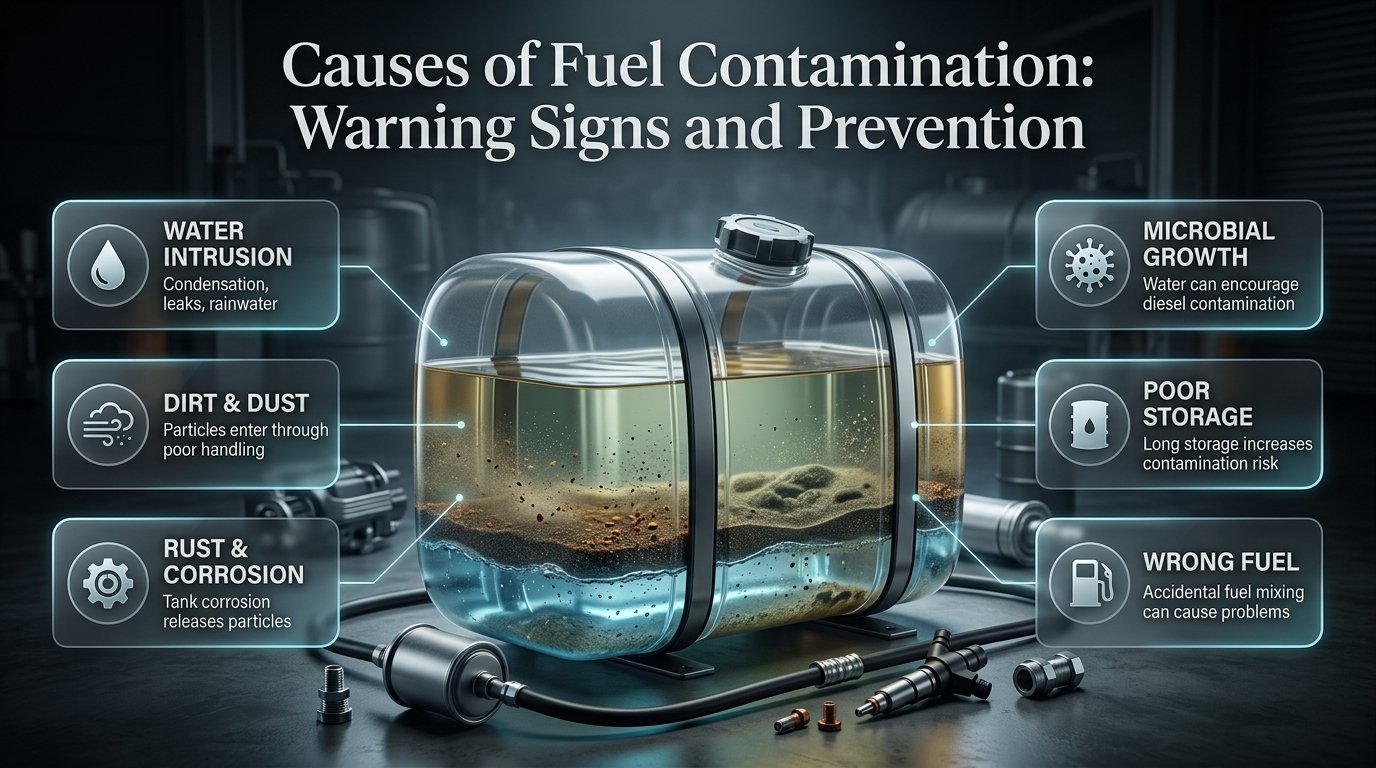
The major causes of fuel contamination include water entering storage tanks, dirty containers and equipment, condensation, corrosion, poor storage practices, microbial growth, accidental fuel mixing, and contaminated delivery equipment.
Some problems happen suddenly, while others develop gradually over months.
1. Water Entering the Fuel System
Water is one of the most important fuel contaminants, particularly in diesel systems.
Water can enter through:
- Rainwater entering damaged tank openings
- Poorly sealed fuel caps
- Condensation inside storage tanks
- Flooding
- Leaking underground or above-ground tanks
- Contaminated fuel deliveries
- Improperly stored fuel containers
Water is especially problematic because it doesn’t behave like fuel. It can settle at the bottom of a tank, where it may eventually reach the fuel system.
In diesel systems, free water can contribute to corrosion, filter problems, injector issues, and microbial growth.
Pro Tip: Don’t assume a sealed tank is automatically protected from water. Temperature changes can create condensation inside a tank even when rainwater cannot enter.
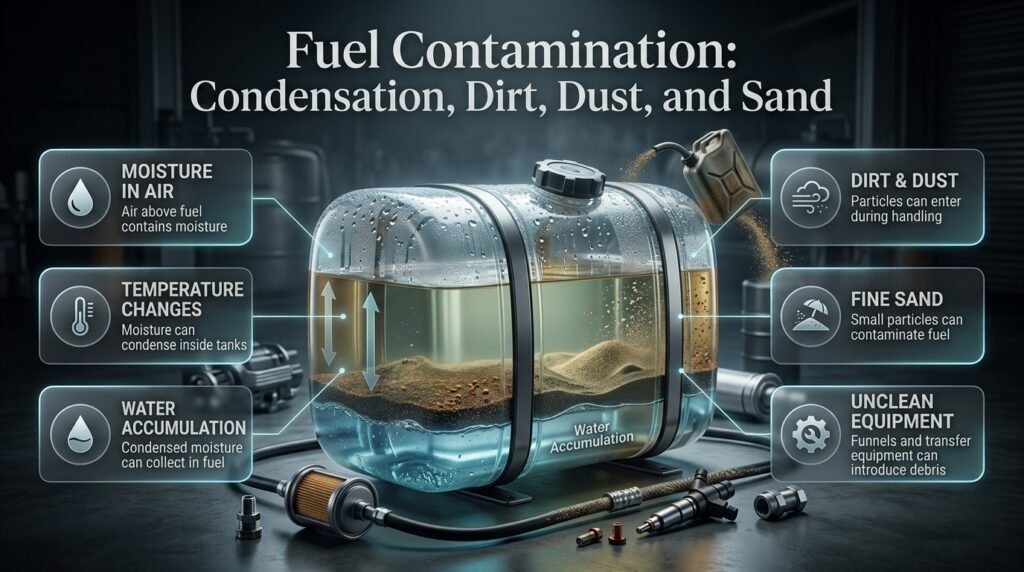
2. Condensation Inside Fuel Tanks
Condensation is an easy cause of contamination to overlook.
A tank containing air above the fuel also contains moisture in that air. When temperatures change, moisture can condense on internal tank surfaces and eventually collect in the fuel.
This is particularly relevant when a tank is frequently exposed to large temperature changes or remains partially filled for long periods.
Keeping storage tanks properly maintained and minimizing unnecessary exposure to moisture can reduce the risk.
3. Dirt, Dust, and Sand
Particles can enter fuel during transportation, storage, refueling, or maintenance.
Sources include:
- Dirty fuel containers
- Open storage tanks
- Dusty filling areas
- Contaminated funnels
- Unclean transfer equipment
- Poorly maintained dispensing systems
- Damaged tank seals
Particles can clog filters and restrict fuel flow. Fine particles may also contribute to wear in fuel-system components.
Modern diesel injection systems are particularly sensitive to cleanliness because they operate with extremely precise components.
For a broader explanation of how fuel types behave in vehicles, see types of automotive fuel.
4. Rust and Corrosion
Metal fuel tanks, pipes, fittings, and other components can corrode over time.
Corrosion becomes more likely when water is present. Once corrosion develops, small rust particles can break away and enter the fuel.
The result can be a cycle:
Water enters → corrosion develops → rust particles form → particles enter fuel → filters become restricted
Rust contamination can be particularly troublesome because simply removing visible water doesn’t necessarily remove all solid contaminants.
5. Microbial Growth in Diesel Fuel
Diesel fuel can develop microbial contamination when water and suitable conditions are present.
Microorganisms can grow at the fuel-water interface, particularly in storage tanks containing accumulated water.
Microbial activity may produce:
- Sludge
- Sediment
- Dark deposits
- Filter blockage
- Corrosion
- Unpleasant fuel-system deposits
A common mistake is treating microbial contamination as simply “dirty fuel.” If the underlying water remains in the tank, the problem can return.
6. Poor Fuel Storage
Fuel quality can deteriorate when fuel is stored under unsuitable conditions.
Poor storage practices include:
- Leaving tanks partially filled for long periods
- Allowing water to accumulate
- Using damaged containers
- Keeping containers exposed to contamination
- Failing to inspect storage tanks
- Ignoring tank corrosion
- Using dirty transfer equipment
Storage conditions matter because fuel quality isn’t determined only when fuel is purchased. Handling and storage can change its condition afterward.
7. Contaminated Fuel Containers
A container that previously held another liquid can contaminate fuel.
For example, using a container that previously contained:
- Water
- Cleaning chemicals
- Lubricants
- Other fuels
- Solvents
- Industrial liquids
can introduce unwanted substances into petrol or diesel.
Fuel should always be stored and transferred using suitable, clean containers designed for petroleum products.
8. Accidental Mixing of Different Fuels
Incorrect fuel can enter a vehicle through human error.
Examples include:
- Petrol added to a diesel vehicle
- Diesel added to a petrol vehicle
- Different fuel grades mixed unintentionally
- Fuel mixed with non-fuel petroleum products
This isn’t necessarily “contamination” in the same way as dirt or water, but from the engine’s perspective, the result can be equally serious.
If the wrong fuel has been added, starting the engine can circulate the mixture through the fuel system. The safest response is usually to stop and seek appropriate professional assistance rather than continuing to drive.
For more information about petrol and diesel differences, see petrol and diesel fuel types.
What Are the Most Common Types of Fuel Contamination?
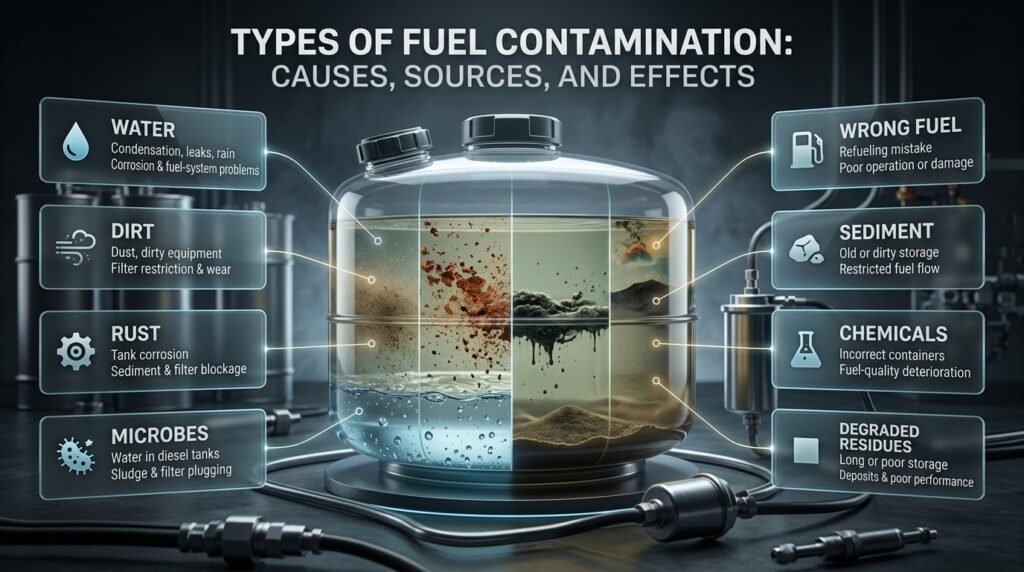
| Contaminant | Common Source | Possible Effect |
|---|---|---|
| Water | Condensation, leaks, rain | Corrosion, poor combustion, fuel-system problems |
| Dirt | Dust, dirty equipment | Filter restriction, component wear |
| Rust | Tank corrosion | Sediment and filter blockage |
| Microbes | Water in diesel tanks | Sludge, corrosion, filter plugging |
| Wrong fuel | Refueling mistake | Poor operation or engine damage |
| Sediment | Old or dirty storage | Restricted fuel flow |
| Chemicals | Incorrect containers | Fuel-quality deterioration |
| Degraded residues | Long or poor storage | Deposits and poor performance |
The contaminant matters because different problems require different corrective actions. Water contamination, for example, should not be treated in exactly the same way as microbial contamination.
How Does Water Contamination Affect Petrol and Diesel?
Water can interfere with combustion, encourage corrosion, reduce fuel-system reliability, and create conditions for microbial growth in diesel storage.
In petrol systems, water can contribute to poor engine operation, especially when significant quantities reach the fuel system.
In diesel systems, water is particularly concerning because modern diesel injection equipment requires clean, properly conditioned fuel.
Water can also reduce lubrication characteristics in parts of the fuel system where fuel contributes to lubrication.
Water Contamination Warning Signs
Possible signs include:
- Engine hesitation
- Difficult starting
- Rough running
- Unexpected power loss
- Fuel-filter restriction
- Corrosion
- Unusual sediment
- Repeated fuel-system problems
These symptoms aren’t proof of water contamination by themselves. Similar symptoms can have electrical, mechanical, ignition, or fuel-delivery causes.
How Does Fuel Contamination Affect Engine Performance?
Contaminated fuel can affect combustion quality, fuel delivery, filters, injectors, pumps, and overall engine reliability.
The effects depend on the contaminant.
Poor-quality or contaminated fuel may contribute to:
- Hard starting
- Rough idle
- Hesitation
- Reduced acceleration
- Poor fuel economy
- Loss of power
- Injector problems
- Filter blockage
- Fuel-pump wear
- Increased deposits
- Increased emissions
For a deeper look at the relationship between fuel condition and vehicle operation, see fuel quality and engine performance.
Petrol engines and diesel engines don’t respond identically to fuel contamination. Their combustion systems, fuel-delivery systems, and operating principles are different.
For example, petrol engines use spark ignition, while diesel engines rely on compression ignition. Understanding these differences makes it easier to understand why a particular contaminant can affect one system differently from another.
Learn more about the petrol engine combustion process and diesel engine combustion process.
Can Old Fuel Become Contaminated?
Yes. Fuel that has been stored for an extended period can experience changes in quality, particularly when storage conditions are poor.
Long storage can increase the opportunity for:
- Oxidation
- Sediment formation
- Water accumulation
- Microbial growth in diesel systems
- Deposit formation
- Contamination from storage equipment
The exact storage life depends on the fuel, storage conditions, container, temperature, contamination exposure, and fuel-management practices.
Expert Tip: Don’t judge stored fuel only by how clear it looks. Some fuel-quality problems aren’t obvious through visual inspection.
How Can You Tell If Fuel Is Contaminated?
There isn’t one symptom that proves fuel contamination. Diagnosis should combine observations, vehicle symptoms, inspection, and appropriate testing.
Potential warning signs include:
Visual Changes
Fuel may show:
- Cloudiness
- Visible water
- Sediment
- Rust particles
- Dark deposits
- Sludge
However, visual inspection has limitations.
Fuel can look acceptable while still having chemical or microbial problems.
Vehicle Performance Changes
A sudden change after refueling can be an important clue, especially if several vehicles using the same fuel source develop similar symptoms.
Possible signs include:
- Sudden rough running
- Difficulty starting
- Loss of power
- Poor acceleration
- Reduced fuel economy
- Fuel-filter blockage
Fuel-Filter Problems
Repeated filter restriction can sometimes indicate contamination upstream.
If a filter becomes blocked unusually quickly, simply replacing the filter may not solve the underlying problem.
The fuel tank, storage system, delivery equipment, and fuel source may also need inspection.
How Is Fuel Contamination Tested?
Fuel contamination can be investigated through visual inspection, water detection, sampling, filtration checks, and laboratory fuel-quality testing when necessary.
Testing can help identify:
- Free water
- Sediment
- Particulate contamination
- Fuel-quality changes
- Microbial contamination
- Certain chemical abnormalities
A basic inspection can be useful for an initial assessment, but laboratory testing may be appropriate when the problem is disputed, severe, recurring, or associated with valuable equipment.
For a practical introduction to testing methods, see fuel quality testing basics.
Step-by-Step: What Should You Do If You Suspect Contaminated Fuel?
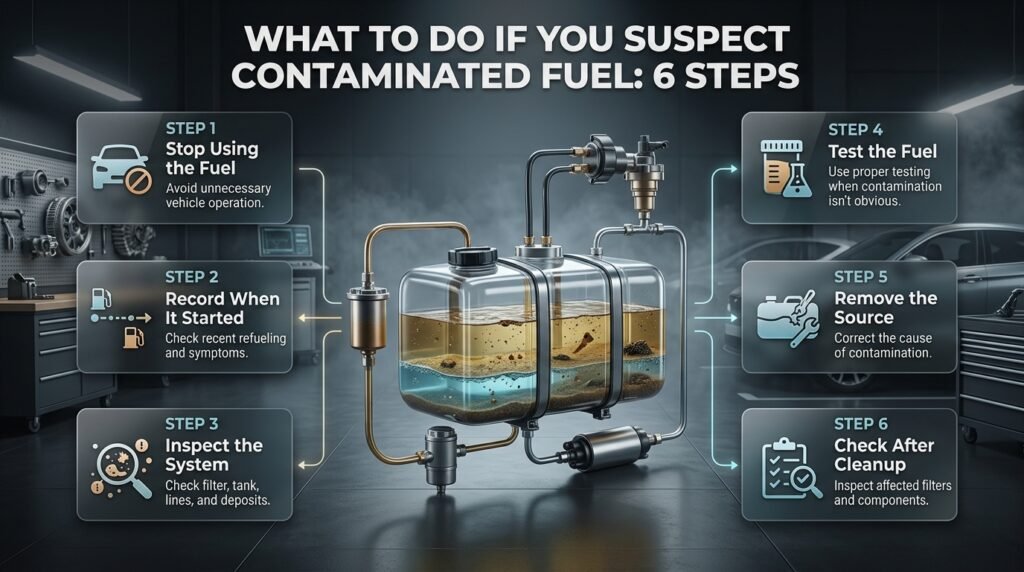
Step 1: Stop Using the Suspected Fuel
If contamination is strongly suspected, avoid unnecessarily operating the vehicle or equipment.
Why it matters: Continuing to circulate contaminated fuel can move the problem deeper into the fuel system.
Common mistake: Continuing to drive because the engine still starts.
Step 2: Record When the Problem Started
Think about what happened immediately before the symptoms appeared.
Ask:
- Was the vehicle recently refueled?
- Did the symptoms begin immediately afterward?
- Was fuel taken from a new source?
- Has the vehicle been stored for a long period?
- Were multiple vehicles affected?
This information can help identify whether fuel is a likely cause.
Step 3: Inspect the Fuel System
Depending on the vehicle and circumstances, the fuel filter, tank, lines, and other components may require inspection by a qualified technician.
Look for evidence of:
- Water
- Sediment
- Rust
- Sludge
- Unusual deposits
Step 4: Test the Fuel When Necessary
If the contamination isn’t obvious, proper testing can provide stronger evidence.
Step 5: Remove the Source of Contamination
Replacing contaminated fuel without correcting the source can result in recurrence.
For example, draining a tank won’t permanently solve a problem if water continues entering through a damaged seal.
Step 6: Check the Fuel System After Cleanup
After contaminated fuel is removed, affected filters and components may need inspection or replacement.
The correct procedure depends on the vehicle and contamination type.
How Can Fuel Contamination Be Prevented?
The best approach is prevention rather than waiting for symptoms.
Use Clean Storage Equipment
Fuel containers, transfer pumps, funnels, and dispensing equipment should be clean and suitable for petroleum products.
Never assume an ordinary container is appropriate simply because it can hold liquid.
Keep Water Out
Inspect:
- Fuel caps
- Tank openings
- Seals
- Breathers
- Storage tank covers
- Drain points
Water management is particularly important for stored diesel.
Maintain Storage Tanks
Regular inspections can identify corrosion, sediment, leaks, and water accumulation before they become major problems.
Avoid Unnecessary Long-Term Storage
Fuel-management practices should consider how quickly fuel is consumed.
For businesses and fleets, rotating stored fuel can reduce problems associated with prolonged storage.
Buy Fuel From Reliable Sources
Fuel quality begins with the supply chain.
A reliable supplier, clean dispensing equipment, appropriate storage, and good handling practices all contribute to maintaining fuel quality.
For general information about fuel-quality requirements, see fuel quality standards.
What Are the Most Common Fuel Contamination Mistakes?
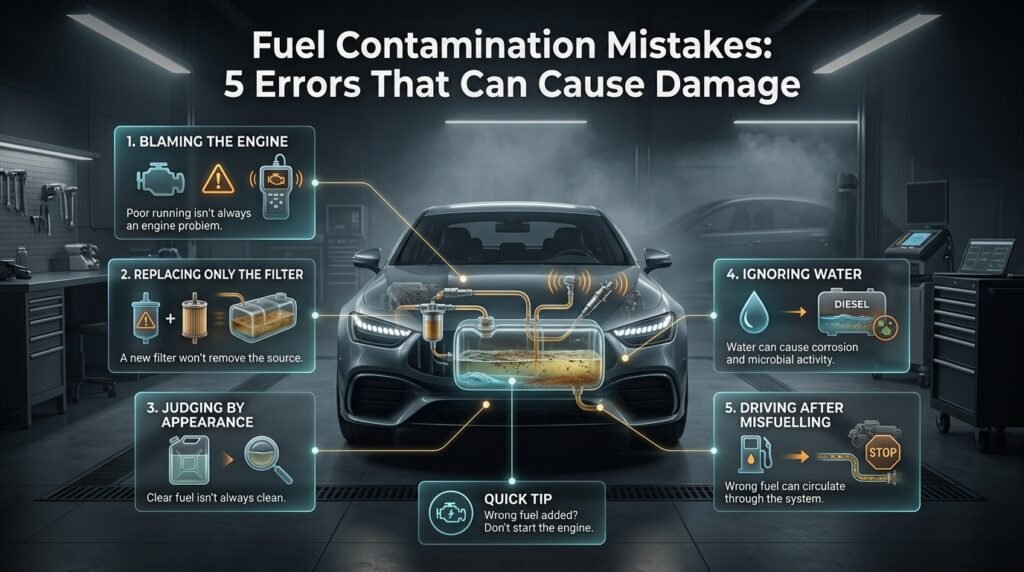
Mistake 1: Blaming the Engine Immediately
A vehicle that runs poorly doesn’t automatically have an engine problem.
Why it happens: Drivers often focus on mechanical components first.
Why it’s harmful: A contaminated fuel supply can be overlooked.
Better approach: Consider recent refueling, fuel storage, filter condition, and contamination evidence alongside mechanical diagnosis.
Mistake 2: Replacing Only the Fuel Filter
A new filter can temporarily improve symptoms while the contaminated fuel remains in the tank.
Better approach: Find and correct the source of contamination.
Mistake 3: Judging Fuel Only by Appearance
Clear fuel isn’t automatically clean fuel.
Some contamination requires testing to identify.
Mistake 4: Ignoring Water in a Diesel Tank
Small amounts of water shouldn’t automatically be considered harmless.
Water can contribute to corrosion and microbial activity.
Mistake 5: Continuing to Drive After Suspected Misfuelling
If the wrong fuel has been added, continuing to operate the vehicle can circulate the mixture through the fuel system.
Quick Tip: If you realize the wrong fuel has been added before starting the engine, don’t start it. Get appropriate assistance first.
Does Fuel Grade Prevent Contamination?
No. A higher-octane or premium petrol isn’t automatically protected from water, dirt, or other contaminants.
Octane describes resistance to knock; it doesn’t mean that fuel is immune to contamination.
If you’re comparing petrol grades, understanding regular vs premium petrol octane can help prevent confusion between octane performance and overall fuel cleanliness.
Similarly, fuel quality involves several properties rather than one number.
For petrol, characteristics such as volatility, octane, cleanliness, and stability can matter. For diesel, cetane quality, lubricity, cleanliness, water content, and oxidation stability can all be important.
How Do You Prevent Fuel Contamination in a Fleet?
Fleet operators should treat fuel quality as part of routine maintenance rather than an emergency issue.
A practical fleet fuel-management program can include:
- Buying fuel from consistent, reliable sources
- Inspecting storage tanks
- Checking for water
- Monitoring fuel-filter replacement intervals
- Keeping dispensing equipment clean
- Recording unusual fuel-related breakdowns
- Rotating stored fuel
- Investigating repeated contamination
- Training drivers to report refueling abnormalities
If several vehicles experience similar problems after using fuel from the same storage system, the shared fuel source deserves immediate attention.
What Are the Most Common Causes of Fuel Contamination?
The most common causes of fuel contamination are water intrusion, dirt and sediment, tank corrosion, microbial growth, poor storage practices, and accidental mixing with another fuel or substance. Contamination can happen at almost any stage, including transportation, storage, refueling, and fuel-system maintenance. Water is particularly important because it can settle at the bottom of a tank and create conditions that encourage corrosion and microbial activity. Industry guidance identifies water, particulates, microbial activity, corrosion, and fuel degradation among the major contamination concerns.
In many cases, contamination isn’t caused by one dramatic event. A poorly sealed tank, repeated condensation, accumulated sediment, or an unclean dispensing system can gradually reduce fuel quality until symptoms finally appear.
Key causes include:
Water intrusion: Rain, leaking seals, condensation, or contaminated deliveries can introduce water.
Dirt and dust: Open or poorly maintained tanks and transfer equipment can allow particles into fuel.
Rust and corrosion: Corroding tanks and pipes can release metallic particles into stored fuel.
Microbial growth: Water at the bottom of diesel tanks can create an environment where bacteria, fungi, and yeast multiply.
Poor storage: Long storage periods, inadequate tank maintenance, and water accumulation increase contamination risk.
Incorrect fuel or chemical mixing: Adding the wrong fuel or unsuitable substance can change the fuel’s characteristics and create serious operating problems.
Professional insight: When contamination keeps returning, don’t simply replace the fuel filter or drain the tank and assume the problem is solved. The source of contamination needs to be identified as well. Otherwise, the same water, particles, or biological contamination can enter the replacement fuel again.
How Does Water Get Into Fuel?
Water can enter fuel through condensation, leaking tank covers and seals, rainwater, damaged vents or fittings, poor filling procedures, contaminated fuel deliveries, and inadequate storage practices. Temperature changes are especially important because humid air can enter a tank through its ventilation system and moisture can later condense on internal tank surfaces.
Once water enters a fuel tank, it commonly settles toward the bottom because free water is denser than petrol or diesel. That makes the bottom of a storage tank an important area to monitor. Water isn’t just an unwanted liquid sitting in the tank; it can contribute to corrosion and, particularly in diesel storage, provide the conditions needed for microbial contamination.
Common ways water enters fuel systems:
Condensation caused by temperature changes
Rain entering through damaged or poorly sealed openings
Faulty tank covers, gaskets, or fill points
Water entering through vents or breathers
Contaminated fuel deliveries
Poor drainage around storage equipment
Improperly stored fuel containers
Why it matters:
Water can settle at the tank bottom.
It can accelerate corrosion.
It can contribute to microbial growth in diesel storage.
It can increase sediment and sludge problems.
It can eventually reach filters, pumps, and injectors.
Expert tip: A tank doesn’t need to have an obvious leak for water contamination to occur. Condensation alone can introduce moisture over time, which is why fuel-storage maintenance should include routine water checks rather than relying only on visual inspection of the outside of the tank.
What Causes Microbial Contamination in Diesel Fuel?
Microbial contamination in diesel fuel usually develops when water and fuel are present together for a sufficient period of time. Bacteria, fungi, and yeast can grow around the fuel-water interface, particularly in tanks where water has accumulated and the fuel remains relatively undisturbed. The resulting biological material can form sludge, films, or sediment that eventually contributes to filter blockage and corrosion.
This problem is often called “diesel bug,” but the name can make the issue sound simpler than it really is. The microorganisms aren’t simply appearing because diesel is old. The presence of water is a major factor that creates the conditions for biological growth.
The problem can become more serious in tanks that are used infrequently, such as standby generators, seasonal equipment, and fuel-storage systems with low turnover.
Conditions that encourage microbial growth include:
Water accumulated at the bottom of the tank
Long-term fuel storage
Warm or changing temperatures
Poor tank housekeeping
Contaminated storage equipment
Fuel systems that aren’t inspected regularly
Possible consequences include:
Sludge formation
Filter plugging
Fuel-line restriction
Corrosion
Sediment accumulation
Injector and fuel-system problems
Important point: Simply adding a treatment product without addressing the water problem may not provide a lasting solution. Good fuel management starts with controlling water and removing the conditions that allow microbial contamination to develop. Industry guidance specifically emphasizes water removal and tank housekeeping as key measures for controlling biological contamination.
What Are the Signs That Fuel Is Contaminated?
The signs of contaminated fuel can include rough engine operation, difficult starting, hesitation, reduced power, poor fuel economy, repeated fuel-filter blockage, visible water or sediment, sludge, or unusual deposits in the fuel system. However, these symptoms aren’t exclusive to fuel contamination, so they should be treated as warning signs rather than automatic proof of contaminated fuel.
One of the strongest clues is a sudden change after refueling. If a vehicle was operating normally and develops problems shortly after receiving fuel from a particular source, the fuel should be considered as part of the diagnosis.
Storage systems can also provide physical evidence. A bottom-of-tank sample may reveal water, sediment, rust, or biological material that isn’t obvious from the fuel’s general appearance.
Watch for these warning signs:
Engine starts harder than usual
Rough idle or unstable operation
Hesitation during acceleration
Unexpected loss of power
Fuel filters becoming blocked unusually quickly
Visible water or sediment in a fuel sample
Sludge or biological deposits
Rust or corrosion around fuel-system components
Several vehicles developing similar fuel-related symptoms
Don’t make this mistake: Clear-looking fuel isn’t automatically clean fuel. Some contamination can be difficult to identify by appearance alone, so persistent or serious problems may require proper fuel sampling and testing.
Professional approach: Look at the timing, symptoms, fuel history, filter condition, and storage conditions together. If several vehicles using the same storage tank develop similar problems, investigating the shared fuel source can be more productive than diagnosing every vehicle independently.
How Can Fuel Contamination Be Prevented?
Fuel contamination can be prevented by controlling water, keeping storage and transfer equipment clean, maintaining tank seals and fittings, monitoring for sediment and corrosion, avoiding unsuitable containers, and regularly checking stored fuel. Good housekeeping is especially important for diesel because water accumulation can create conditions for microbial growth and corrosion.
Prevention doesn’t require complicated procedures in every situation. The basic principle is to stop contaminants from entering the fuel and detect small problems before they become major fuel-system failures.
Practical prevention checklist:
Keep fuel tanks properly sealed.
Inspect tank covers, gaskets, fill points, and vents.
Check for water accumulation.
Keep dispensing equipment clean.
Use suitable fuel containers.
Prevent dirt and dust from entering open fuel systems.
Monitor tanks for rust and corrosion.
Avoid unnecessary long-term fuel storage.
Investigate repeated filter blockage.
Test stored fuel when contamination is suspected.
Remove water and sediment before they become a larger problem.
Keep different fuel types properly separated.
For commercial storage and fleet operations, prevention should be part of a routine fuel-management program rather than something done only after a vehicle breaks down. Industry guidance recommends practices such as water management, tank inspection, suitable filtration, clean handling, and monitoring of storage conditions to reduce contamination risks.
Expert recommendation: Don’t wait for an engine to show symptoms before checking the fuel. A small amount of water or sediment may be manageable when detected early, while the same contamination can become much more expensive after it reaches filters, pumps, injectors, or other sensitive components.
Best 5 to Use in Your Article
If your goal is SEO + real user value, I’d use these exact five:
What Are the Most Common Causes of Fuel Contamination?
How Does Water Get Into Fuel?
What Causes Microbial Contamination in Diesel Fuel?
What Are the Signs That Fuel Is Contaminated?
How Can Fuel Contamination Be Prevented?
These five cover the natural search journey: cause → water → diesel contamination → symptoms → prevention, without making the FAQ section repetitive.
Conclusion
Fuel contamination can start with something as simple as water entering a tank, dirt getting into a fuel container, or corrosion releasing particles into stored fuel. In diesel systems, accumulated water can create another problem by encouraging microbial growth, while poor storage and handling can allow contamination to develop gradually without obvious warning signs.
The important thing is not to wait until contaminated fuel causes serious engine or fuel-system problems. Unusual filter blockage, difficult starting, rough running, hesitation, reduced power, or visible water and sediment should be treated as warning signs that deserve investigation.
Good fuel management focuses on prevention. Keep tanks properly sealed, control water accumulation, use clean transfer equipment, inspect storage systems regularly, and investigate recurring fuel-quality problems instead of repeatedly replacing filters or components.
When fuel quality is uncertain, proper inspection and testing can help identify the contaminant and determine the right corrective action. For drivers and businesses in Dubai, reliable fuel handling and timely assistance can also help reduce the risk of unnecessary vehicle downtime.
For professional fuel-related assistance, visit Fuel Delivery Dubai.
Leave a Reply