
Introduction
Factors Affecting Fuel Quality | Fuel quality is easy to ignore until a vehicle starts behaving differently. A car may suddenly hesitate, lose power, consume more fuel, or become difficult to start. Many drivers immediately suspect a mechanical problem, but fuel quality can also be part of the picture.
For drivers who need reliable fuel support in Dubai, Fuel Delivery Dubai is a relevant resource when fuel needs to reach a vehicle quickly. But whether you’re dealing with petrol or diesel, understanding the factors affecting fuel quality can help you make better decisions before a small fuel problem becomes a larger maintenance issue.
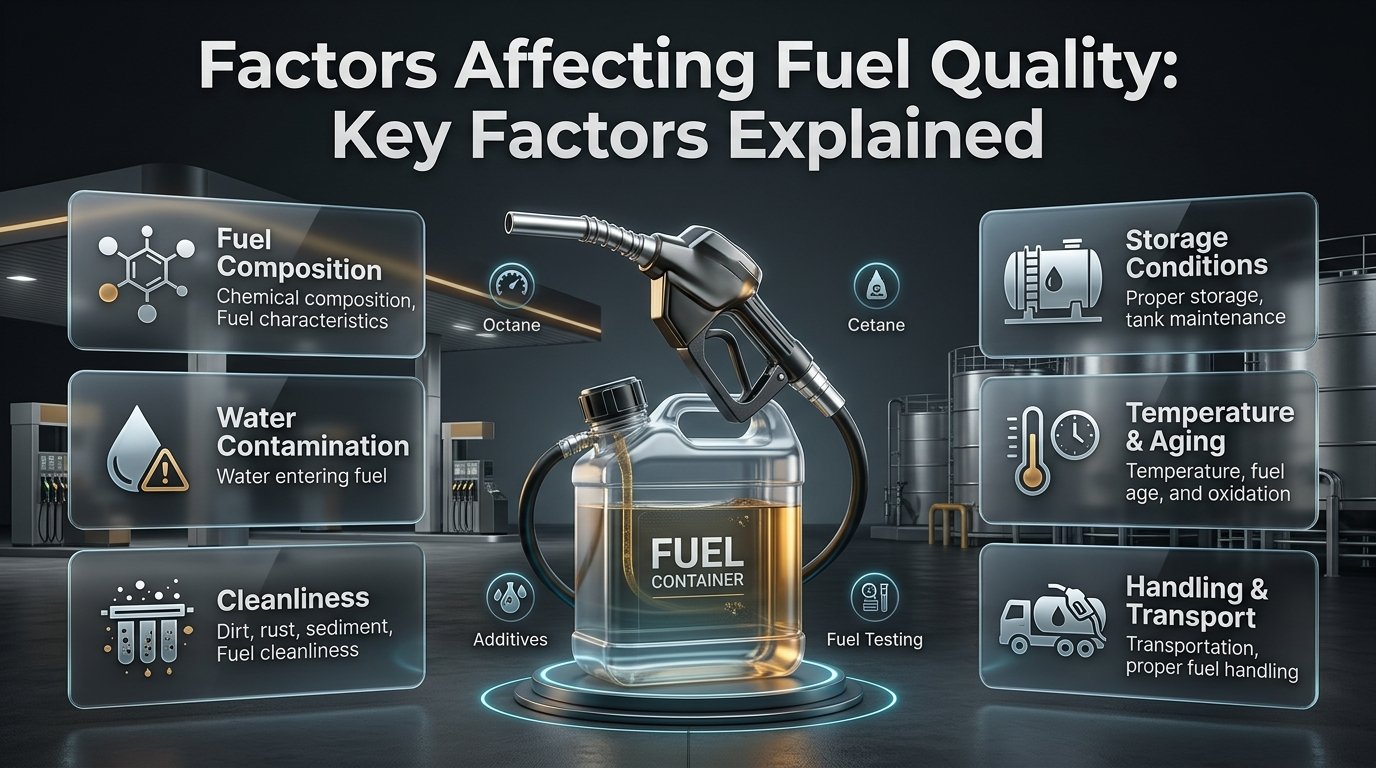
Fuel quality isn’t determined by appearance or price alone. Its chemical composition, octane or cetane characteristics, water content, cleanliness, storage conditions, temperature, age, oxidation, additives, transportation, and handling can all influence its condition.
This guide explains the major factors that affect fuel quality, how those factors influence petrol and diesel differently, what poor-quality fuel can do to an engine, how fuel should be stored and handled, and when fuel testing becomes worthwhile.
What Are the Main Factors Affecting Fuel Quality?
The main factors affecting fuel quality include fuel composition, octane or cetane quality, contamination, water, storage conditions, temperature, oxidation, fuel age, microbial activity, additives, transportation, handling, and compliance with the required fuel specification.
Fuel quality isn’t fixed forever. Fuel can meet its required specification when produced but later become contaminated or degraded during transportation and storage. Water, particulate contamination, poor tank maintenance, and long storage periods are recognized concerns, particularly for diesel fuel.
The major factors are:
- Chemical composition
- Octane rating in petrol
- Cetane quality in diesel
- Water contamination
- Dirt and sediment
- Storage conditions
- Temperature
- Oxidation and aging
- Microbial contamination
- Additives
- Transportation
- Handling practices
- Tank condition
- Fuel-quality standards
The important point is that fuel quality depends on both the properties of the fuel and what happens to it after production.
1. Fuel Composition Has a Major Effect on Quality
Fuel composition is one of the basic factors that determines how fuel behaves during storage and combustion.
Petrol and diesel are not single substances. They are carefully formulated mixtures containing different hydrocarbon components and, depending on the product, controlled additive packages.
The composition affects characteristics such as volatility, ignition behavior, stability, energy content, emissions, and compatibility with the engine.
A fuel can therefore look completely normal while having properties that differ significantly from another fuel intended for the same general application.
Why does fuel composition matter?
Fuel composition can influence:
- Combustion behavior
- Ignition characteristics
- Energy content
- Volatility
- Deposit formation
- Emissions
- Storage stability
- Fuel-system compatibility
Understanding the broader range of automotive fuel types can help explain why different fuels aren’t interchangeable simply because they look similar.
Expert Tip: Don’t use price, color, or brand reputation as the only measurement of fuel quality. The most important question is whether the fuel meets the specification required for the application.
2. Octane Rating Affects Petrol Quality
For petrol engines, octane rating is an important quality characteristic because it indicates resistance to knock.
Knock occurs when combustion happens in an undesirable way instead of following the intended combustion process. Engines with higher compression ratios or certain turbocharged designs may require fuel with greater knock resistance.
However, higher octane doesn’t automatically mean that petrol is better in every respect.
A vehicle should normally use the fuel grade recommended by its manufacturer. Putting a much higher-octane fuel into an engine that doesn’t require it isn’t the same thing as improving every aspect of fuel quality.
What influences an engine’s octane requirement?
Important factors include:
- Compression ratio
- Turbocharging
- Engine design
- Ignition timing
- Engine-management strategy
- Manufacturer recommendation
- Operating conditions
The difference between regular vs premium petrol octane is therefore more useful to understand than simply assuming that the highest octane is always the best choice.
3. Cetane Quality Is Important for Diesel
Diesel fuel has a different job inside an engine.
A diesel engine compresses air to a high temperature before injecting fuel into the combustion chamber. The injected fuel then ignites under those conditions.
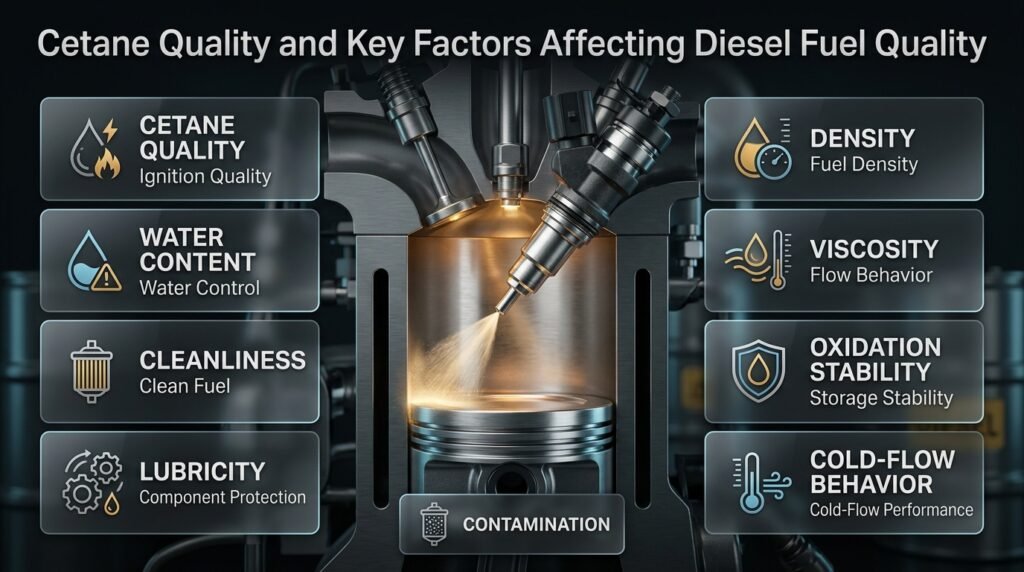
Because of this, cetane quality is an important measure of diesel’s ignition behavior.
Poor ignition quality can contribute to longer ignition delay and less desirable combustion. Suitable cetane characteristics can support easier starting and smoother engine operation. The International Energy Agency’s Advanced Motor Fuels information also identifies cetane number as an important descriptor of diesel ignition quality.
But cetane isn’t the only diesel-quality consideration.
Diesel quality also involves:
- Water content
- Cleanliness
- Lubricity
- Density
- Viscosity
- Oxidation stability
- Cold-flow behavior
- Contamination
The diesel engine combustion process provides useful background on why diesel properties need to match compression-ignition engine operation.
4. Water Contamination Can Seriously Reduce Fuel Quality
Water is one of the most important contaminants in fuel storage and handling.
It can enter a tank through condensation, rainwater intrusion, damaged seals, poor maintenance, or other storage problems. In diesel systems, water can be particularly troublesome because it can contribute to corrosion, microbial growth, and fuel-system problems.
Why is water harmful?
Water contamination can contribute to:
- Corrosion
- Fuel-pump wear
- Injector problems
- Filter restriction
- Microbial growth
- Poor fuel-system performance
- Sludge formation
- Reduced fuel quality
Water can be present without making the entire fuel supply obviously dirty.
That’s why professional fuel-quality control doesn’t depend entirely on appearance.
Common Mistake: Assuming clear fuel is automatically clean fuel. Visual inspection can identify obvious contamination, but it can’t confirm every important fuel property.
5. Dirt, Rust, and Sediment Affect Fuel Cleanliness
Fuel systems don’t tolerate unnecessary particulate contamination well.
Dirt, rust, dust, tank scale, and other particles can enter fuel during transportation, storage, dispensing, or maintenance.
Modern diesel injectors are especially sensitive to contamination because their internal components operate with very small clearances. Cummins notes that particles and other contaminants can contribute to injector wear, sticking, and malfunction.
Common sources of particulate contamination include:
- Corroded storage tanks
- Tank sediment
- Dirty transfer equipment
- Poorly maintained dispensing systems
- Contaminated containers
- Rust particles
- Dust and debris
Fuel filtration provides important protection, but filtration should not be considered a substitute for clean fuel handling.
6. Storage Conditions Can Change Fuel Quality
Fuel quality doesn’t end when the fuel leaves the refinery.
Storage conditions can have a major influence on the condition of fuel before it reaches the vehicle.
Poorly maintained tanks can introduce water, rust, sediment, and microorganisms. Storage time also creates more opportunity for contamination and degradation. Cummins specifically identifies time, weather, humidity, tank openings, and contamination entry as factors that can affect stored diesel.
Good storage practices include:
- Keep tanks properly maintained.
- Protect storage systems from water entry.
- Monitor for sediment and corrosion.
- Keep dispensing equipment clean.
- Use appropriate filtration.
- Avoid unnecessary long-term storage.
- Inspect stored fuel when quality concerns arise.
For a broader explanation of specifications and acceptable fuel characteristics, see fuel quality standards.
7. Temperature Can Influence Fuel Behavior
Temperature affects the physical behavior of fuel.
For petrol, temperature can influence volatility and evaporation. For diesel, temperature can affect viscosity and cold-flow behavior.
Cold conditions can cause wax components in diesel to precipitate and potentially contribute to filter restriction. The Diesel Fuel Storage and Handling Guide identifies wax precipitation, cold-temperature operation, and fuel viscosity as important considerations for diesel fuel management.
Temperature can influence:
- Fuel density
- Volatility
- Evaporation
- Viscosity
- Diesel flow
- Wax behavior
- Storage stability
This doesn’t mean normal temperature changes automatically make fuel poor quality. It means fuel needs to be suitable for the conditions in which it will be stored and used.
8. Oxidation and Fuel Aging Can Reduce Quality
Fuel can deteriorate during extended storage, particularly under unfavorable conditions.
Oxygen, heat, metals, and time can contribute to chemical degradation. In diesel, degradation products can form troublesome contamination, while high temperatures can accelerate deterioration.
Possible consequences include:
- Sediment formation
- Deposits
- Filter plugging
- Reduced storage stability
- Fuel degradation
- Increased maintenance requirements
The longer fuel remains stored, the more important storage conditions become.
Quick Tip: Don’t think of fuel storage as simply putting fuel into a tank and forgetting about it. Storage itself is part of fuel-quality management.
9. Microbial Contamination Can Affect Stored Diesel
Microbial contamination is an important concern when water is present in stored diesel.
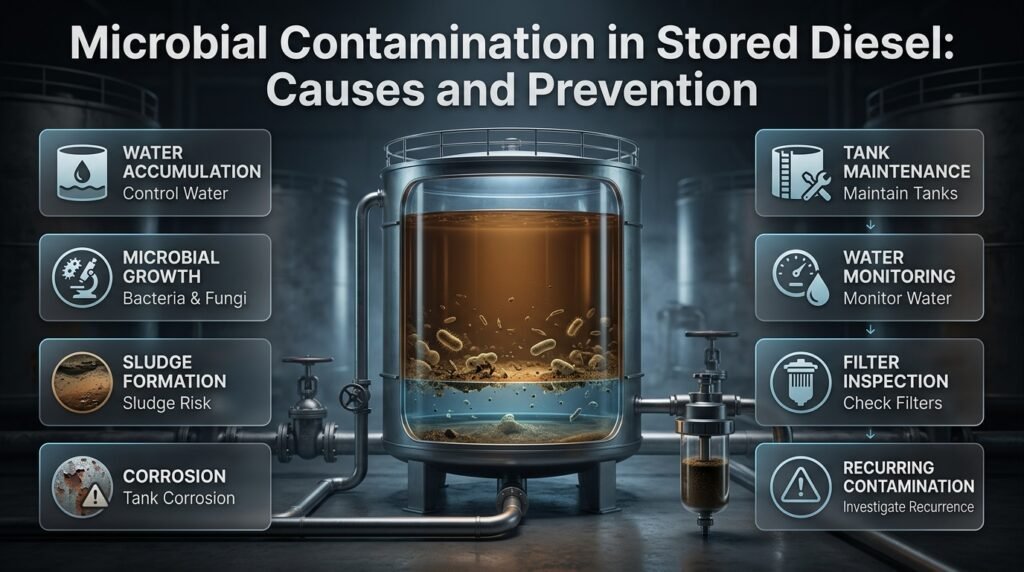
Bacteria and fungi can develop around the fuel-water interface under suitable conditions. Their growth can produce biomass and other by-products that contribute to sludge, filter blockage, and corrosion.
Research on stored hydrocarbon fuels identifies diesel as particularly susceptible to microbiological problems, which can lead to sludge and deterioration of storage equipment.
What helps prevent microbial problems?
The first step is controlling water.
Good practices include:
- Preventing water from entering tanks
- Monitoring stored diesel
- Maintaining tanks
- Checking for water accumulation
- Inspecting filters
- Investigating recurring contamination
Calling the problem “diesel algae” is common, but the contamination can involve different types of microorganisms rather than actual algae.
10. Additives Can Influence Fuel Quality
Fuel additives are used for specific technical purposes.
Depending on the formulation, additives can support characteristics such as:
- Ignition quality
- Oxidation stability
- Corrosion protection
- Lubricity
- Detergency
- Cold-flow performance
- Water handling
For example, recognized diesel additive categories include cetane improvers, oxidation inhibitors, detergents, corrosion inhibitors, flow improvers, and lubricity additives.
But this doesn’t mean that adding more additives automatically creates better fuel.
Fuel is formulated as a controlled product. An unsuitable additive or incorrect dosage can introduce another variable into the system.
Pro Tip: Use additives for a clearly identified purpose and only when they’re appropriate for the fuel and application.
11. Fuel Handling Practices Matter
Fuel can be contaminated even when the original product was good.
Every transfer point creates an opportunity for water, dirt, rust, or another unwanted substance to enter the fuel.
Poor handling can involve:
- Dirty containers
- Unclean transfer equipment
- Damaged tank caps
- Poorly maintained pumps
- Incorrect fuel identification
- Improper transfer procedures
- Cross-contamination
This is why fuel quality is partly a handling issue, not just a manufacturing issue.
A simple principle works well:
Keep fuel protected from water, dirt, heat, and cross-contamination throughout its journey.
12. Transportation Can Influence Fuel Quality
Fuel may pass through several stages before reaching the vehicle:
Refinery → Terminal → Transport → Storage → Dispensing → Vehicle
Each stage needs suitable quality control.
Fuel can encounter different tanks, pipes, hoses, filters, pumps, and storage environments along the way.
Particulate contamination can come from rust or debris within storage and distribution systems, while water can enter tanks through weather exposure, openings, or condensation.
This means fuel quality should be considered across the complete supply chain.
13. Cross-Contamination Can Create Serious Problems
Petrol and diesel are designed for different engine systems.
Accidentally introducing the wrong fuel can create operating problems and potentially require draining and system inspection.
Cross-contamination can also occur during storage or dispensing if equipment isn’t clearly identified or properly maintained.
For drivers who want to understand how the two fuels differ, petrol and diesel fuel types provides useful background.
The basic rule is straightforward:
Correct fuel + correct storage + correct handling = lower risk of fuel-related problems.
14. Fuel Quality Influences Engine Performance
Modern engines rely on highly controlled fuel delivery.
Injectors, pumps, filters, sensors, and electronic controls all need fuel that is suitable for the system.
Contaminated or unsuitable fuel can contribute to:
- Hard starting
- Rough running
- Hesitation
- Reduced power
- Poor fuel economy
- Filter restriction
- Injector problems
- Increased deposits
- Higher emissions
Research on diesel fuel quality identifies properties such as density, viscosity, calorific value, cetane number, water and sediment content, lubricity, oxidation stability, and particulate contamination as relevant to overall fuel assessment.
For a deeper look at the relationship between fuel condition and vehicle behavior, see fuel quality and engine performance.
How Does Fuel Quality Affect Combustion?
Fuel quality affects how fuel is delivered, atomized or mixed, ignited, and burned. Petrol engines normally use spark-initiated combustion, while diesel engines rely on compression ignition.
A simplified chain is:
Fuel quality → Fuel delivery → Fuel-air preparation → Ignition → Combustion → Power → Emissions
If fuel properties or cleanliness are outside the required range, one or more stages can be affected.
For petrol engines, understanding the petrol engine combustion process makes it easier to see why suitable fuel properties matter.
However, fuel quality isn’t the only factor affecting combustion. Air supply, ignition, injection timing, sensors, compression, engine condition, and maintenance also play important roles.
Petrol vs Diesel: Which Fuel-Quality Factors Matter Most?
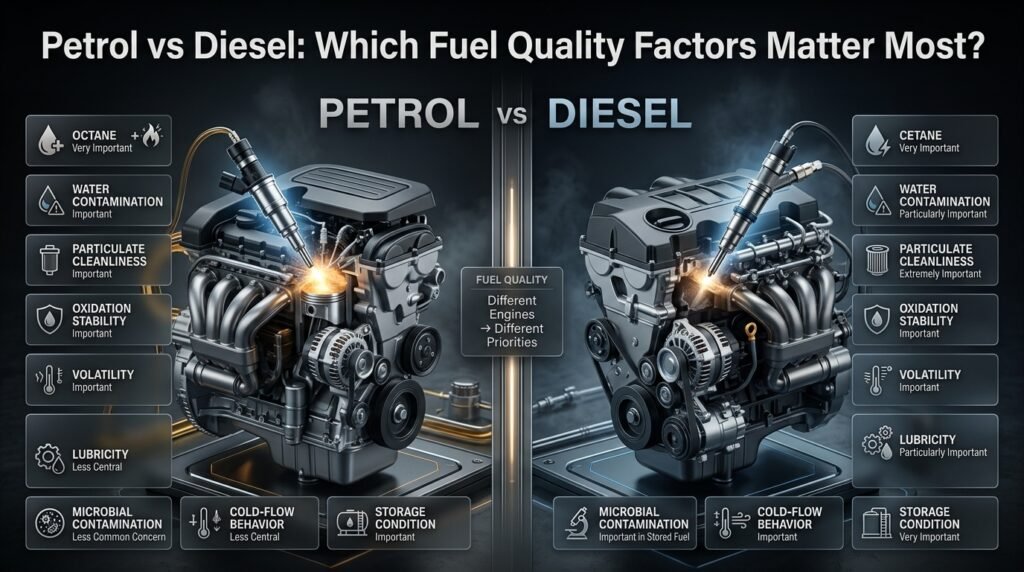
| Fuel-quality factor | Petrol | Diesel |
|---|---|---|
| Octane | Very important | Not the primary measure |
| Cetane | Not the primary measure | Very important |
| Water contamination | Important | Particularly important |
| Particulate cleanliness | Important | Extremely important |
| Oxidation stability | Important | Important |
| Volatility | Important | Important |
| Lubricity | Less central | Particularly important |
| Microbial contamination | Less common concern | Important in stored fuel |
| Cold-flow behavior | Less central | Important |
| Storage condition | Important | Very important |
Both fuels need proper quality control, but their most important characteristics differ because the engines use different combustion systems.
What Are the Signs of Poor-Quality Fuel?
No single symptom proves that fuel is the cause of an engine problem.
However, fuel quality becomes worth investigating when unusual symptoms appear soon after refueling or when several vehicles develop similar problems after using the same fuel source.
Possible warning signs include:
- Sudden loss of power
- Difficult starting
- Rough engine operation
- Hesitation
- Unusual fuel consumption
- Repeated filter blockage
- Injector-related symptoms
- Visible water
- Visible sediment
- Unusual fuel appearance
Timing matters.
If a vehicle operated normally before refueling and developed problems shortly afterward, the fuel becomes one possible common factor.
But it’s important not to jump to conclusions. Mechanical, electrical, ignition, air-intake, and sensor problems can create similar symptoms.
How Can Fuel Quality Be Tested?
Fuel testing should be based on the specific problem being investigated.
A visual inspection can identify obvious contamination such as visible water or sediment, but it cannot measure every important fuel property.
Depending on the fuel and concern, testing may evaluate:
- Density
- Water content
- Sediment
- Distillation characteristics
- Octane-related properties
- Cetane-related properties
- Sulfur content
- Oxidation stability
- Lubricity
- Particulate contamination
The best approach is:
Identify the concern → Collect a suitable sample → Select relevant tests → Compare results with the required specification → Take corrective action
For a practical overview, fuel quality testing basics explains why different fuel-quality concerns require different testing methods.
Expert Tip: Don’t test fuel simply to collect numbers. First identify what you’re trying to determine, then choose the tests that can answer that question.
How Can Drivers Protect Fuel Quality?
Most drivers don’t need laboratory equipment to reduce fuel-quality risks.
A few practical habits make a meaningful difference.
Use the correct fuel
Follow the vehicle manufacturer’s recommendation for fuel type and octane requirement.
Choose reliable fuel sources
A consistent, reputable source reduces the likelihood of questionable handling or contamination.
Pay attention after refueling
If unusual symptoms appear soon after refueling, record when they started and consider whether fuel quality could be one of the contributing factors.
Avoid unnecessary fuel storage
If fuel is being stored for equipment, don’t leave it unmanaged for unnecessarily long periods.
Don’t rely on additives as a shortcut
Additives aren’t a replacement for clean, correctly specified fuel.
Common Mistakes People Make When Judging Fuel Quality
Mistake 1: Judging fuel only by appearance
Clear fuel isn’t automatically high-quality fuel.
Why it happens: Visual inspection is quick.
Why it’s a problem: Some fuel properties and contaminants can’t be confirmed by appearance.
Better approach: Use visual inspection as a basic screening step and perform appropriate testing when necessary.
Mistake 2: Assuming expensive fuel is always better
A higher price doesn’t automatically mean that fuel is technically better for a particular vehicle.
Better approach: Follow the manufacturer’s recommendation and focus on suitability and specification.
Mistake 3: Thinking higher octane means better fuel
Octane is specifically related to knock resistance in petrol.
Better approach: Use the octane grade appropriate for the engine.
Mistake 4: Ignoring storage conditions
Fuel can deteriorate or become contaminated after production.
Better approach: Maintain storage tanks and control water and sediment.
Mistake 5: Assuming filters solve everything
Filters are important protective components, but they’re not designed to make heavily contaminated fuel acceptable.
Better approach: Prevent contamination at the source.
Mistake 6: Blaming fuel for every engine problem
Poor performance can have many causes.
Better approach: Diagnose the complete vehicle before deciding that fuel quality is responsible.
Expert Advice: How Professionals Manage Fuel Quality
Professional fuel management is mainly about prevention.
1. Start with the correct specification
Know what fuel the vehicle or equipment actually requires.
2. Control water
Water is one of the most common storage concerns, especially for diesel.
3. Control particulate contamination
Keep tanks, transfer equipment, and filtration systems properly maintained.
4. Monitor stored fuel
Look for water, sediment, unusual appearance, filter problems, or other changes.
5. Investigate patterns
If several vehicles develop similar symptoms after using the same fuel source, investigate the shared factor.
6. Test when evidence justifies it
Appropriate testing can help distinguish a fuel-quality issue from an unrelated mechanical fault.
Why Fuel Quality Matters for Fleet Operators
For an individual driver, a fuel-quality issue may affect one vehicle.
For a fleet operator, the same issue can potentially affect many vehicles at once.
The consequences can include:
- Increased maintenance
- Filter replacement
- Injector problems
- Vehicle downtime
- Reduced fuel economy
- Operational delays
- Unexpected repair costs
Fleet operators should therefore treat fuel quality as part of preventive maintenance.
A basic fuel-quality program can include:
- Approved fuel sources
- Proper storage procedures
- Tank inspections
- Water monitoring
- Contamination control
- Fuel documentation
- Appropriate testing
- Procedures for investigating fuel-related incidents
What are the main factors affecting fuel quality?
Fuel quality is influenced by several factors rather than one single property. The most important include fuel composition, octane or cetane quality, water contamination, dirt and sediment, storage conditions, temperature, oxidation, fuel age, microbial contamination, additives, transportation, and handling. A fuel can be correctly formulated when produced but still lose quality if it’s exposed to water, contamination, poor storage, or prolonged degradation.
Key points to remember:
Fuel quality depends on both its original formulation and how it’s handled afterward.
Water and particulate contamination are especially important concerns for diesel.
Long-term storage can increase the risk of oxidation, sediment, and microbial growth.
Modern engines generally require cleaner, better-controlled fuel than older systems.
How does water contamination affect fuel quality?
Water is one of the most serious threats to stored fuel, particularly diesel. It can enter through condensation, damaged seals, tank openings, poor storage practices, or contaminated deliveries. Once present, water can contribute to corrosion, microbial growth, filter blockage, injector problems, and fuel-system wear. Water can also accelerate fuel degradation, making an existing storage problem worse rather than simply remaining an isolated contaminant.
What to watch for:
Cloudy or hazy fuel
Visible water or separation
Repeated filter blockage
Sludge or sediment
Corrosion around fuel-system components
Unusual engine hesitation or power loss
The important professional approach is prevention. Keeping storage tanks clean, dry, and properly maintained is much better than waiting for contaminated fuel to cause an expensive engine problem.
Does fuel storage and age affect fuel quality?
Yes, and this is one of the factors that is often underestimated. Fuel can change during extended storage because of oxidation, condensation, temperature changes, water exposure, microbial activity, and sediment formation. Over time, these processes can create deposits or sludge that restrict filters and interfere with fuel-system performance. Long-term stored fuel may therefore need monitoring rather than being treated as permanently unchanged.
Good storage practice includes:
Keep storage tanks properly maintained.
Prevent water from entering the tank.
Monitor stored fuel for sediment and contamination.
Avoid unnecessary long-term storage.
Inspect tanks and filters when fuel problems appear.
Test stored fuel when its condition is uncertain.
For businesses, generators, and fleets that keep significant quantities of fuel, storage management should be treated as part of the overall fuel-quality program.
Does higher octane mean better fuel quality?
Not necessarily. Octane measures petrol’s resistance to knock; it doesn’t measure overall fuel quality. A higher-octane fuel can be the correct choice for an engine designed to require it, but simply choosing the highest octane doesn’t automatically mean the fuel has better cleanliness, stability, contamination control, or every other desirable characteristic.
A useful way to think about it is that octane answers one specific question: how well the petrol resists knock under standardized conditions.
When choosing petrol, consider:
The octane requirement specified by the vehicle manufacturer
Fuel cleanliness
Proper storage and handling
Fuel quality standards
The reliability of the fuel source
The vehicle’s actual requirements
So, don’t confuse higher octane with higher overall fuel quality. They’re related to fuel performance, but they aren’t the same measurement.
How can you tell if fuel quality is poor?
There isn’t one visual sign that can confirm poor fuel quality. However, cloudiness, visible water, sediment, unusual separation, sludge, repeated filter restriction, or sudden engine problems after refueling can all be reasons to investigate. Visual inspection is useful as an initial check, but important fuel characteristics often require proper sampling and testing. Fuel analysis can examine issues such as water, particles, microbial contamination, fuel degradation, and specification-related properties.
If you suspect a fuel-quality problem:
Note when the symptoms started.
Consider whether they appeared soon after refueling.
Inspect the fuel system and filters for obvious contamination.
Take an appropriate fuel sample if testing is justified.
Compare test results with the required fuel specification.
Don’t assume every engine problem is caused by fuel.
This last point is important. Hard starting, poor acceleration, rough running, and reduced power can also come from mechanical, electrical, ignition, air-intake, or sensor problems. Good diagnosis means investigating fuel quality alongside other possible causes rather than blaming the fuel immediately.
Conclusion
Understanding the factors affecting fuel quality is important for protecting engine performance, fuel-system reliability, and long-term maintenance costs. Fuel quality isn’t determined by price, appearance, or octane number alone. Its condition depends on several factors, including fuel composition, octane or cetane characteristics, water contamination, dirt and sediment, storage conditions, temperature, oxidation, fuel age, additives, transportation, and handling.
For drivers, the best approach is practical: use the fuel grade recommended for your vehicle, choose reliable fuel sources, and pay attention to unusual symptoms after refueling. If fuel is stored for longer periods, proper tank maintenance and contamination control become even more important.
When fuel quality is genuinely in doubt, don’t rely only on appearance. Appropriate fuel testing can help identify contamination or changes that cannot be seen with the naked eye. This is especially valuable for diesel systems and fleet operations where a fuel-quality problem can affect multiple vehicles.
Ultimately, maintaining good fuel quality is about prevention, proper handling, suitable storage, and informed fuel selection. By controlling the factors that can degrade or contaminate fuel, drivers and businesses can reduce avoidable fuel-system problems and support more consistent engine performance.
Leave a Reply