Introduction
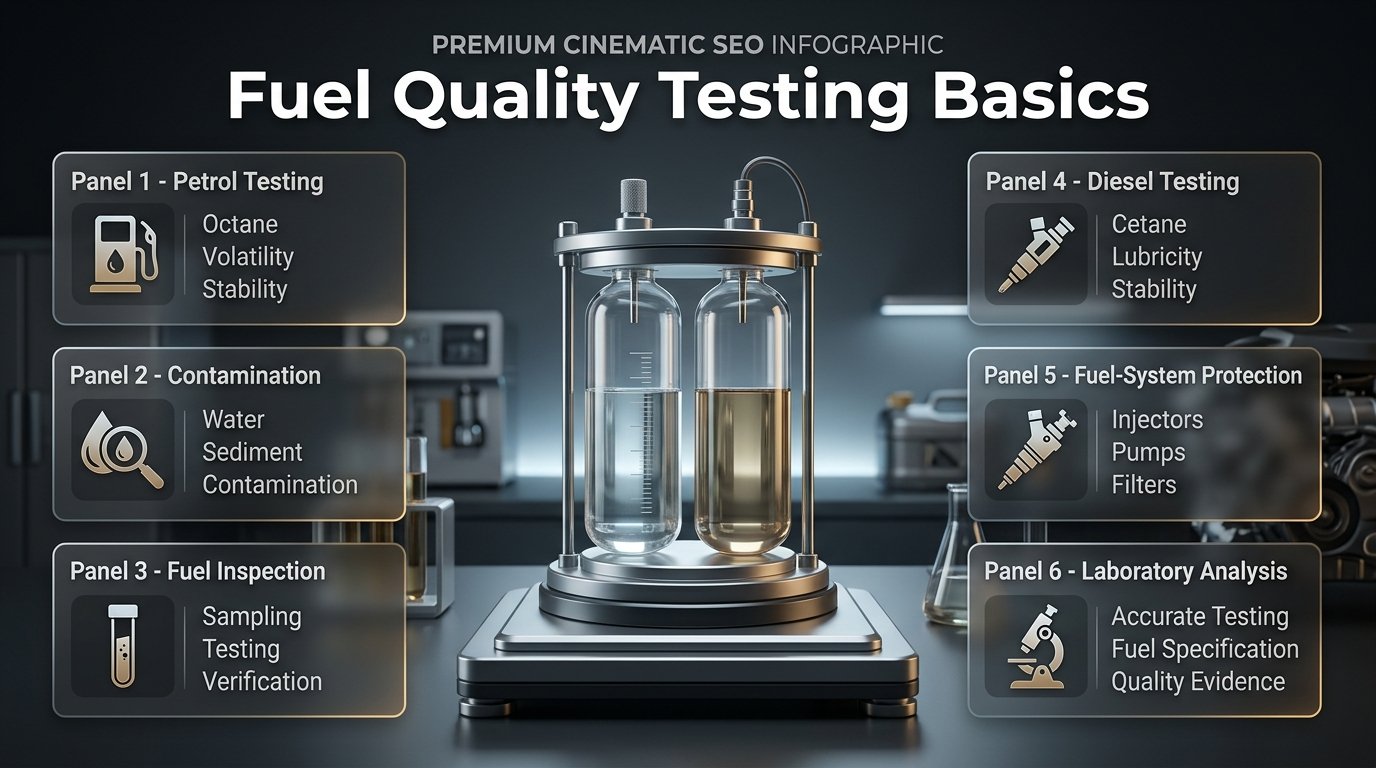
Fuel Quality Testing Basics | A petrol sample may appear clear but have unsuitable volatility, poor stability, contamination, or an octane level that doesn’t match the required specification. Diesel can look normal while containing water, sediment, or other contaminants that may affect injectors, pumps, filters, and engine performance.
That’s why understanding fuel quality testing basics matters for vehicle owners, workshops, fleet operators, fuel suppliers, and businesses that store or use fuel. Proper testing provides evidence about what’s actually in the fuel instead of relying only on appearance, price, brand, or smell.
If you’re looking for reliable fuel information and delivery support, you can also visit Out of Fuel Dubai 👉 Fuel Delivery Dubai to understand the wider fuel supply and delivery context.
In this guide, you’ll learn what fuel quality testing is, which properties are commonly tested, how petrol and diesel testing differ, how to collect a reliable sample, what test results mean, when laboratory testing is worthwhile, and which common mistakes can lead to incorrect conclusions.
What Is Fuel Quality Testing?
Fuel quality testing is the process of examining petrol, diesel, or another fuel to determine whether its physical and chemical properties meet the required specification. Depending on the fuel and purpose, testing may measure properties such as octane, cetane, density, water, sulfur, distillation characteristics, flash point, lubricity, stability, and contamination.
The important thing to understand is that fuel quality isn’t determined by one measurement.
A fuel can have an acceptable octane rating and still contain contamination. Similarly, diesel can have suitable cetane performance while having excessive water, sediment, or poor lubricity.
Professional fuel testing therefore focuses on the properties that actually matter for the specific fuel, engine, application, and specification.
Why Does Fuel Quality Testing Matter?
Fuel is directly involved in combustion and also comes into contact with sensitive components throughout the fuel system.
Poor-quality or contaminated fuel can contribute to:
- Difficult starting
- Rough engine operation
- Hesitation
- Reduced power
- Poor fuel economy
- Injector problems
- Fuel-filter restriction
- Deposits
- Corrosion
- Fuel-system wear
- Increased emissions
However, fuel shouldn’t automatically be blamed whenever an engine develops a problem.
A faulty sensor, ignition problem, clogged air filter, injector fault, mechanical issue, incorrect tire pressure, poor maintenance, or driving conditions can create similar symptoms.
That’s where fuel quality testing becomes useful. It can help confirm or eliminate fuel as a possible cause.
Pro Tip: Don’t order every possible fuel test just because an engine is running badly. Start with the symptoms, fuel type, storage conditions, and suspected problem. Then choose tests that can actually answer the question.
What Are the Main Fuel Properties Tested?
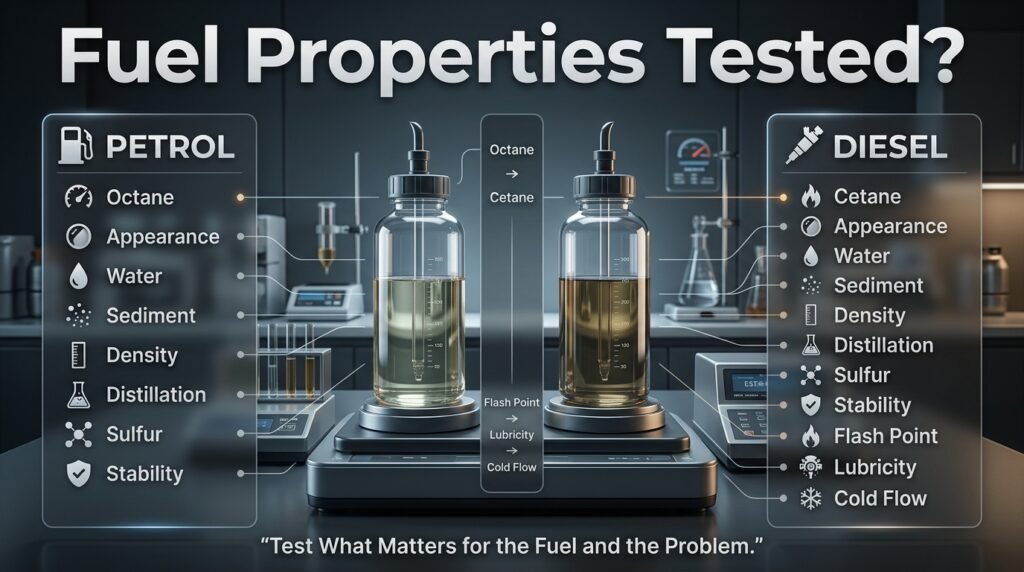
The exact testing package depends on whether you’re testing petrol or diesel.
Some properties are relevant to both fuels, while others are closely associated with their different combustion and operating requirements.
| Fuel Property | Petrol | Diesel | Why It Matters |
|---|---|---|---|
| Appearance | ✓ | ✓ | Identifies obvious contamination |
| Water | ✓ | ✓ | Can cause fuel-system problems |
| Sediment | ✓ | ✓ | Indicates particulate contamination |
| Density | ✓ | ✓ | Helps characterize fuel |
| Octane | ✓ | — | Indicates resistance to knock |
| Cetane | — | ✓ | Indicates diesel ignition quality |
| Distillation | ✓ | ✓ | Shows boiling and vaporization behavior |
| Sulfur | ✓ | ✓ | Important for fuel specifications and emissions |
| Oxidation stability | ✓ | ✓ | Indicates resistance to degradation |
| Flash point | — | ✓ | Important for diesel handling and safety |
| Lubricity | — | ✓ | Important for fuel-system wear |
| Cold-flow properties | — | ✓ | Important for low-temperature operation |
Not every situation requires every test.
A sensible testing program matches the analysis to the actual problem.
What Is Fuel Fundamentals and Why Does It Matter?
Before testing fuel, it helps to understand what fuel actually needs to do inside an engine.
Fuel isn’t simply a liquid that burns.
Its properties influence how it is stored, delivered, injected, vaporized, ignited, and burned.
For a broader introduction to these principles, you can explore Fuel Fundamentals.
Understanding these basics makes fuel test results easier to interpret.
For example, knowing that petrol engines depend on controlled spark ignition helps explain why octane matters. Understanding compression ignition explains why cetane, injection quality, and cleanliness are important in diesel engines.
How Is Petrol Quality Tested?
Petrol, also called gasoline, is primarily used in spark-ignition engines.
Its quality depends on several characteristics that affect vaporization, combustion, engine performance, emissions, and storage stability.
A professional petrol analysis may include several different measurements.
What Does Octane Testing Measure?
Octane is one of the best-known petrol quality measurements.
It describes a fuel’s resistance to knock, an abnormal combustion event that can occur when the fuel-air mixture burns in an uncontrolled manner.
A higher octane rating means greater resistance to knock.
But higher octane doesn’t automatically mean better fuel for every vehicle.
An engine designed to operate on regular petrol may not receive a meaningful benefit from using a much higher octane fuel unless the manufacturer recommends or requires it.
For a more detailed explanation, see regular vs premium petrol octane.
Why Does Octane Matter in Fuel Testing?
Modern petrol engines can use high compression ratios, turbocharging, advanced ignition control, and sophisticated engine management systems.
These technologies make appropriate knock resistance important.
If fuel doesn’t provide the required resistance to abnormal combustion, the engine may experience knock under certain operating conditions.
However, octane testing only answers one question.
It doesn’t tell you whether the fuel is free from water, has the correct sulfur level, has appropriate volatility, or has good storage stability.
What Is Petrol Distillation Testing?
Distillation testing examines how petrol behaves as temperature increases and different components evaporate.
This matters because petrol needs appropriate volatility for different stages of vehicle operation.
Its characteristics can affect:
- Cold starting
- Warm-up
- Acceleration
- Driveability
- Vaporization
- Combustion
Fuel that’s too volatile can create unwanted vapor-related behavior under certain conditions.
Fuel that isn’t volatile enough may make starting and operation more difficult.
This is one reason fuel quality testing looks beyond octane.
Why Is Sulfur Tested in Petrol?
Sulfur testing determines how much sulfur is present in petrol.
Sulfur limits are important because modern vehicles use sophisticated emissions-control systems.
Excessive sulfur can interfere with certain emissions-control technologies and contribute to unwanted emissions-related effects.
The acceptable sulfur level depends on the applicable fuel specification and market.
When interpreting a laboratory report, don’t compare the number with a random value found online.
Always compare it with the correct specification for the fuel being tested.
How Is Petrol Stability Tested?
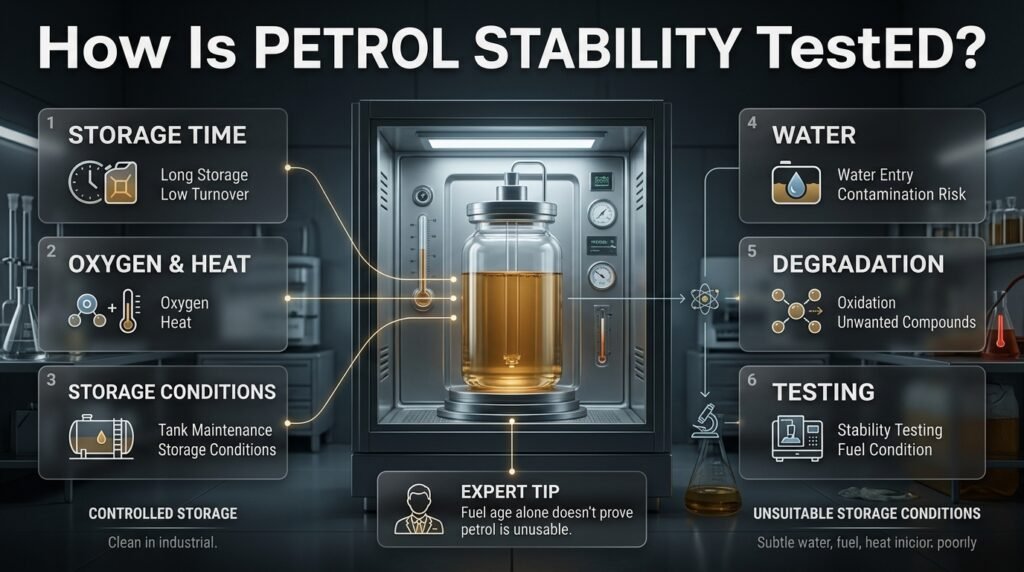
Petrol can deteriorate during storage.
Exposure to oxygen, heat, and unsuitable storage conditions can contribute to oxidation and the formation of unwanted compounds.
Stability testing helps assess how resistant the fuel is to degradation under defined test conditions.
This can become particularly important when:
- Fuel is stored for long periods
- Storage tanks aren’t maintained properly
- Fuel turnover is low
- Water enters the tank
- Fuel has been exposed to unsuitable conditions
Expert Tip: Fuel age alone doesn’t automatically prove that petrol is unusable. Its actual condition and storage history matter.
How Is Diesel Fuel Quality Tested?
Diesel fuel has different requirements because diesel engines use compression ignition rather than the spark-ignition process used by petrol engines.
Fuel is injected into highly compressed air, so diesel needs appropriate ignition characteristics, cleanliness, lubricity, and physical properties.
You can understand this process in more detail through the diesel engine combustion process.
Modern diesel systems can operate at extremely high pressures and very tight tolerances.
That makes diesel fuel cleanliness particularly important.
What Does Cetane Testing Measure?
Cetane number is one of the most important diesel fuel measurements.
It relates to the ignition quality of diesel under standardized testing conditions.
Appropriate cetane performance can contribute to:
- Easier starting
- More predictable ignition
- Smoother combustion
- Better engine operation
But cetane isn’t a complete measure of diesel quality.
A diesel fuel can have acceptable cetane characteristics while still containing water, sediment, or other contaminants.
Why Is Water Testing Important for Diesel?
Water is one of the major contaminants that fuel quality testing looks for in diesel.
Water can enter a storage tank through:
- Condensation
- Damaged seals
- Poor tank maintenance
- Rainwater intrusion
- Contaminated deliveries
- Poor storage practices
Water can contribute to:
- Corrosion
- Injector problems
- Fuel-pump wear
- Filter restriction
- Microbial growth
- Poor combustion
- Fuel-system damage
This becomes especially important in modern diesel systems because precision components operate under demanding conditions.
Can Water Always Be Seen in Diesel?
No.
Free water may separate and become visible under suitable conditions, but not every type or concentration of water contamination will be obvious during a simple visual inspection.
That’s why appropriate water testing can be useful when contamination is suspected.
Common Mistake: Assuming that clear diesel is automatically clean diesel.
What Is Diesel Flash Point Testing?
Flash point describes the temperature at which vapors from a fuel can ignite under specified test conditions.
It’s an important property for diesel handling and safety and can also provide information about whether a fuel is consistent with its expected product characteristics.
Like other laboratory results, flash point needs to be interpreted using the correct test method and specification.
Why Is Diesel Lubricity Tested?
Diesel fuel needs appropriate lubricating characteristics to help protect fuel-system components.
High-pressure pumps and injectors contain precision components that depend on suitable fuel properties.
Lubricity testing evaluates the fuel’s ability to limit wear under defined conditions.
This is particularly relevant when fuel-system durability is a concern.
What Are Diesel Cold-Flow Tests?
Diesel behavior can change when temperatures fall.
Depending on the application, testing may include:
- Cloud point
- Pour point
- Cold filter plugging point
These measurements help indicate how diesel behaves under low-temperature conditions.
For vehicles and equipment operating in colder environments, cold-flow characteristics can be particularly important.
What Does a Basic Fuel Quality Test Include?
A basic fuel quality assessment doesn’t necessarily require a complete laboratory analysis.
A practical screening process can begin with:
- Visual inspection
- Water and contamination assessment
- Basic physical-property measurements
- Relevant laboratory testsi
- Comparison with the applicable specification
The important distinction is between screening and laboratory analysis.
A visual check may reveal obvious water, sediment, or particles.
It cannot confirm detailed characteristics such as octane, cetane, sulfur, stability, lubricity, or distillation behavior.
How Should You Collect a Fuel Sample for Testing?
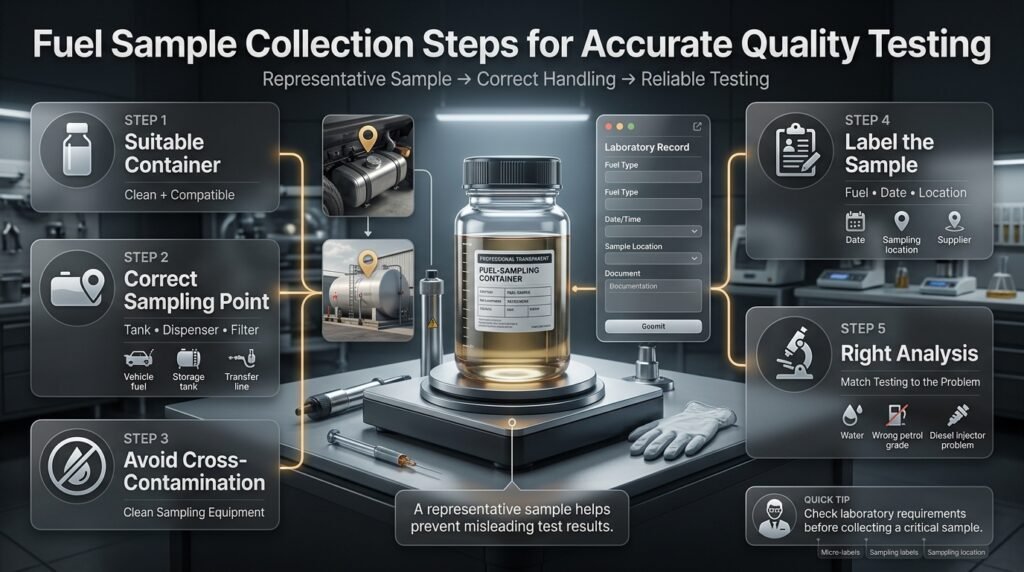
Sample collection is one of the most important parts of fuel quality testing.
A laboratory can perform an accurate analysis, but if the sample doesn’t represent the fuel being investigated, the result may still lead to the wrong conclusion.
Step 1: Use a Suitable Container
The container must be clean and compatible with the fuel and the planned analysis.
It shouldn’t introduce contaminants into the sample.
For certain tests, the laboratory may specify particular containers or handling procedures.
Why Does This Matter?
A contaminated container can create a false indication of contamination.
Step 2: Choose the Correct Sampling Point
Record exactly where the sample was collected.
Possible sampling points include:
- Vehicle fuel tank
- Storage tank
- Fuel dispenser
- Delivery compartment
- Tank bottom
- Fuel filter
- Transfer line
Different locations may contain different concentrations of water or sediment.
Step 3: Avoid Cross-Contamination
Sampling equipment should not introduce another fuel or contaminant into the sample.
This is particularly important when petrol and diesel are handled in the same facility.
Step 4: Label the Sample
Record useful details such as:
- Fuel type
- Date
- Time
- Sampling location
- Tank identification
- Vehicle identification
- Supplier
- Delivery reference
- Reason for testing
Good documentation becomes extremely valuable if the results later need to be compared.
Step 5: Send It for the Right Analysis
Tell the laboratory why you’re testing the fuel.
For example:
Suspected water contamination: Focus on water and contamination-related testing.
Suspected wrong petrol grade: Consider octane and relevant specification properties.
Repeated diesel injector problems: Consider water, particulate contamination, lubricity, and other appropriate diesel properties.
Long-term storage: Consider stability and contamination-related analysis.
Quick Tip: Before collecting a critical sample, ask the testing laboratory about its container, quantity, preservation, storage, and transportation requirements.
What Is the Difference Between Field and Laboratory Fuel Testing?
Field testing is useful for quick screening, while laboratory testing provides more detailed information.
| Feature | Field Testing | Laboratory Testing |
|---|---|---|
| Speed | Very fast | Slower |
| Cost | Usually lower | Usually higher |
| Convenience | High | Lower |
| Screening | Good | Excellent |
| Detailed analysis | Limited | Strong |
| Specification verification | Limited | Better |
| Commercial disputes | Usually insufficient alone | More appropriate |
| Complex contamination | Limited | Better suited |
Field testing is useful when an immediate indication is needed.
Laboratory testing becomes more valuable when you need detailed measurements, specification verification, or stronger evidence for a technical or commercial investigation.
When Should Fuel Be Sent to a Laboratory?
Laboratory testing is particularly useful when:
- A fuel delivery is disputed
- Multiple vehicles develop similar problems
- Serious contamination is suspected
- Fuel has been stored for a long period
- Fuel specification needs verification
- Expensive equipment is involved
- The cause of a recurring fuel-system problem is unclear
For a normal vehicle owner, a complete laboratory analysis isn’t necessary every time a car runs poorly.
The testing should be proportional to the problem.
What Fuel Quality Standards Should You Use?
A fuel test result doesn’t mean much without the correct comparison standard.
Fuel specifications define acceptable requirements for particular fuel products.
Depending on the situation, the appropriate benchmark may involve:
- Vehicle manufacturer requirements
- Local regulations
- Fuel specifications
- Industry standards
- Supplier specifications
- Contract requirements
- Market-specific requirements
For a deeper explanation, see fuel quality standards.
Why Is the Correct Specification Important?
Suppose a laboratory gives you a density value.
Is that value acceptable?
You can’t answer without knowing:
- Which fuel was tested?
- Which grade was tested?
- Which specification applies?
- Which test method was used?
- What limits does that specification define?
The same principle applies to sulfur, flash point, octane, cetane, distillation, and other properties.
Expert Tip: Never label a fuel result “good” or “bad” without first identifying the applicable specification.
How Does Fuel Quality Affect Engine Performance?
Fuel affects an engine through combustion, injection, vaporization, lubrication, deposits, and contamination.
In petrol engines, fuel properties influence how the fuel vaporizes and burns.
For more detail, see the petrol engine combustion process.
In diesel engines, fuel quality can be particularly important because high-pressure injection systems depend on clean fuel with suitable physical and chemical properties.
Potential symptoms associated with fuel-related problems can include:
- Hard starting
- Rough idle
- Hesitation
- Reduced acceleration
- Poor fuel economy
- Increased smoke
- Injector problems
- Filter restriction
- Fuel-system wear
But symptoms alone don’t prove that fuel is the cause.
A proper diagnosis should consider the vehicle’s mechanical condition as well.
What Are the Signs That Fuel Should Be Tested?
Fuel testing becomes more reasonable when a problem appears shortly after refueling or when several vehicles experience similar problems.
Warning signs can include:
- Sudden loss of power
- Difficult starting
- Rough engine operation
- Repeated injector failures
- Unexpected fuel-filter blockage
- Water found in the fuel system
- Unusual fuel appearance
- Suspected cross-contamination
- Long-term fuel storage
- Sudden unexplained fuel-consumption changes
- Multiple vehicles affected after the same delivery
One vehicle experiencing a problem doesn’t automatically mean the fuel is bad.
Several vehicles showing similar symptoms after receiving fuel from the same source provide a stronger reason for investigation.
How Do Different Automotive Fuels Require Different Testing?
Not every automotive fuel has the same characteristics or testing requirements.
Petrol, diesel, and other automotive fuels are designed for different engine technologies and operating principles.
That’s why understanding broader automotive fuel types is useful before interpreting fuel-quality results.
Similarly, understanding the differences between petrol and diesel fuel types helps explain why the same test isn’t necessarily appropriate for every fuel.
The testing strategy should always follow the fuel.
Common Fuel Quality Testing Mistakes
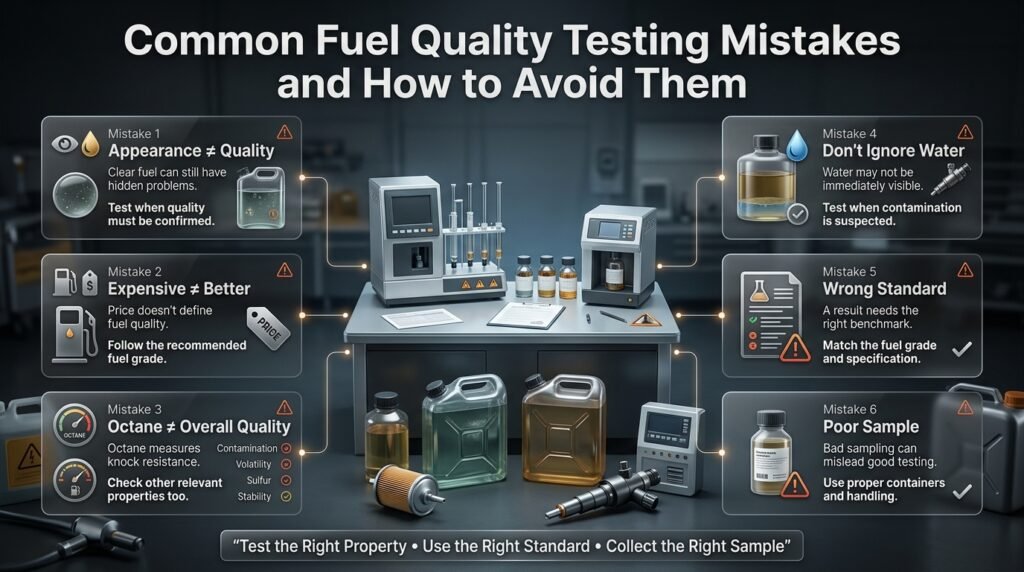
Mistake 1: Judging Fuel Only by Appearance
Fuel that looks clear isn’t automatically high-quality fuel.
Why It Happens
Visual inspection is simple and convenient.
Why It’s Harmful
Many important properties cannot be seen.
Better Approach
Use visual inspection as a screening step and perform appropriate testing when quality needs to be confirmed.
Mistake 2: Assuming Expensive Fuel Is Automatically Better
Higher price doesn’t automatically mean better fuel for every vehicle.
Why It Happens
Consumers often associate price with quality.
Better Approach
Follow the manufacturer’s recommended fuel grade and use fuel that meets the applicable specification.
Mistake 3: Confusing Octane With Overall Fuel Quality
Octane measures resistance to knock.
It doesn’t measure every property of petrol.
Better Approach
Consider octane together with contamination, volatility, sulfur, stability, and other relevant characteristics.
Mistake 4: Ignoring Water in Diesel
Water can create serious fuel-system problems.
Why It Happens
It isn’t always immediately visible.
Better Approach
Maintain storage tanks properly and use appropriate testing when water contamination is suspected.
Mistake 5: Comparing Results With the Wrong Standard
A laboratory result can be misunderstood if it’s compared with an unrelated specification.
Better Approach
Identify the exact fuel grade and applicable standard before interpreting the result.
Mistake 6: Taking a Poor Sample
Even good laboratory equipment can’t correct a bad sample.
Better Approach
Use appropriate containers, correct sampling procedures, proper labeling, and suitable handling.
How Can You Maintain Fuel Quality During Storage?
Testing is only one part of fuel quality management.
Storage practices have a major effect on whether fuel remains in acceptable condition.
Keep Storage Tanks Clean
Rust, sediment, sludge, and other materials can accumulate inside tanks.
If these contaminants enter the fuel system, they may cause problems even when the original fuel was acceptable.
Control Water
Prevent water from entering the tank and remove it appropriately when detected.
Water management should be part of routine storage maintenance.
Avoid Unnecessary Long-Term Storage
Fuel turnover matters.
Long storage periods can increase opportunities for:
- Oxidation
- Condensation
- Contamination
- Water accumulation
- Product degradation
Monitor Filters
Fuel filters can provide useful clues.
Repeated or unusually fast filter restriction may indicate contamination somewhere upstream.
Keep Accurate Records
Record:
- Delivery date
- Supplier
- Fuel grade
- Quantity
- Storage tank
- Delivery reference
- Test results
- Maintenance activities
- Fuel-related incidents
Good records make recurring fuel problems easier to trace.
What Should a Professional Fuel Quality Control Program Include?
For fleets, businesses, and bulk fuel users, a structured quality-control system is more useful than random testing.
A practical program can include:
1. Supplier Control
Know where fuel comes from and what specification it is supposed to meet.
2. Delivery Inspection
Review delivery documentation and inspect the fuel system where appropriate.
3. Storage Management
Keep tanks clean, dry, and properly maintained.
4. Sampling
Use representative samples when testing is necessary.
5. Testing
Choose field or laboratory tests according to the risk.
6. Documentation
Keep fuel deliveries, test results, and maintenance records.
7. Corrective Action
If fuel fails a requirement, isolate the issue and investigate before deciding how it should be handled.
This approach is particularly useful for organizations operating multiple vehicles or fuel-dependent equipment.
Petrol vs Diesel Fuel Quality Testing
| Quality Area | Petrol | Diesel |
|---|---|---|
| Engine type | Spark ignition | Compression ignition |
| Main ignition property | Octane | Cetane |
| Water concern | Important | Especially important |
| Sediment | Important | Important |
| Volatility | Important | Important, assessed differently |
| Flash point | Less central | Important |
| Lubricity | Not normally the primary focus | Very important |
| Cold-flow testing | Usually less important | Often important |
| Storage stability | Important | Important |
| Injection cleanliness | Important | Particularly critical |
The biggest mistake is assuming that petrol and diesel can be evaluated using exactly the same quality criteria.
Their combustion systems are different, so their quality-control priorities are different.
When Is Full Fuel Quality Analysis Worthwhile?
A complete analysis isn’t necessary every time a vehicle experiences a problem.
It becomes more worthwhile when the consequences of using questionable fuel are significant.
Commercial Fuel Disputes
When a buyer believes a delivered fuel batch doesn’t meet the agreed specification, laboratory testing can provide objective evidence.
Fleet-Wide Problems
If multiple vehicles experience similar fuel-system problems after the same delivery, a broader investigation is justified.
Long-Term Storage
Stored fuel can be tested before being used in expensive or critical equipment.
Unknown Contamination
When contamination is suspected but its type isn’t known, several tests may be necessary.
Serious Engine Investigation
If mechanical troubleshooting doesn’t explain repeated fuel-system failures, fuel analysis can help determine whether fuel is contributing.
What Are the Most Important Fuel Quality Tests for Petrol and Diesel?
The most important fuel tests depend on the type of fuel and the problem you’re investigating. For petrol, octane, distillation characteristics, sulfur, water and sediment, and stability can be important. For diesel, cetane, water, sediment, flash point, lubricity, sulfur, stability, and cold-flow properties may be relevant. Water and contamination deserve particular attention because they can cause performance and fuel-system problems even when the fuel looks normal.
The right approach isn’t to test every possible property. Instead, match the test to the suspected problem and the fuel specification.
Important tests may include:
Octane testing: Checks petrol’s resistance to knock.
Cetane testing: Evaluates diesel ignition quality.
Water testing: Identifies water contamination that may affect fuel systems.
Sediment or particulate testing: Detects solid contamination.
Distillation testing: Examines the fuel’s boiling and volatility characteristics.
Sulfur testing: Checks compliance with applicable sulfur limits.
Flash point testing: Particularly relevant for diesel safety and quality.
Lubricity testing: Important for protecting diesel injection components.
Stability testing: Helps assess resistance to fuel degradation.
The key takeaway is that fuel quality is a combination of properties, not one number. A petrol sample can have acceptable octane and still have a contamination problem, while diesel can have suitable cetane but unacceptable water or cleanliness.
How Can You Tell If Petrol or Diesel Fuel Is Bad?
You can sometimes identify obvious fuel problems through appearance, water separation, sediment, or unusual characteristics, but visual inspection alone cannot prove that fuel is good quality. Some important problems are invisible. Fuel may look clean while having unsuitable octane, cetane, sulfur, stability, volatility, or contamination levels. That’s why laboratory or appropriate field testing becomes important when fuel quality is genuinely in doubt.
A practical warning sign is when a fuel-related problem appears suddenly after refueling or after a new fuel delivery.
You should pay closer attention when you notice:
Difficult starting
Rough running
Sudden loss of power
Hesitation during acceleration
Unexpected fuel-filter restriction
Repeated injector problems
Water found in the fuel system
Visible sediment or particles
Unusual fuel appearance
Several vehicles developing similar symptoms after the same delivery
However, don’t immediately conclude that the fuel is responsible.
A faulty injector, sensor, ignition component, air filter, fuel pump, or other mechanical problem can produce similar symptoms. Fuel testing is most useful when it’s combined with proper vehicle diagnosis.
Professional tip: If several vehicles experience similar problems shortly after receiving fuel from the same source, preserve the delivery information and a representative sample before making major repairs. That evidence can be much more useful than guessing after the fuel has already been consumed.
How Is Diesel Fuel Tested for Water and Contamination?
Diesel fuel is commonly checked for water, sediment, particulate contamination, microbial growth, and other quality problems, because modern diesel fuel systems can be highly sensitive to contaminants. Water can contribute to corrosion and microbial growth, while solid particles can restrict filters and contribute to wear in precision fuel-system components.
A professional diesel investigation may look at several areas rather than relying on one test.
Water contamination
Water can enter diesel storage through condensation, poor tank maintenance, damaged seals, or contaminated deliveries.
Sediment and particles
Rust, dirt, sludge, and other particles can restrict filters and affect fuel delivery.
Microbial contamination
Microorganisms can grow where water and fuel meet, particularly in poorly maintained storage systems. Their growth can produce sludge and contribute to filter blockage and corrosion.
Fuel ignition quality
Cetane testing can help evaluate diesel’s ignition characteristics. Low cetane can be associated with longer ignition delay and undesirable combustion behavior.
Other important properties
Depending on the investigation, testing may also cover:
Density
Viscosity
Sulfur
Flash point
Lubricity
Oxidation stability
Distillation
Cold-flow properties
This is why professional diesel testing should be based on the actual problem rather than simply requesting a generic “bad fuel test.”
Does Higher Octane Mean Better Fuel Quality?
Higher octane means greater resistance to engine knock, but it doesn’t automatically mean that every other aspect of the fuel is better. Octane is specifically related to resistance to autoignition under standardized conditions; it isn’t a complete measurement of fuel cleanliness, sulfur content, stability, water contamination, or every other fuel property.
This distinction is important because many drivers assume:
Higher octane = higher overall fuel quality
That’s not necessarily correct.
For example, a vehicle designed around a particular octane requirement doesn’t automatically become more powerful simply because a higher-octane fuel is added. A fuel-quality assessment has to consider the complete specification rather than focusing on one number.
Think of it this way:
Octane → Knock resistance
Fuel quality → Octane + volatility + cleanliness + stability + composition + other required properties
So, if you’re testing petrol because of suspected poor quality, checking octane may be important, but it shouldn’t necessarily be the only test.
Expert tip: Always follow the vehicle manufacturer’s recommended fuel grade. Paying more for a higher-octane fuel isn’t automatically the solution to a fuel-quality problem.
When Should You Get Fuel Professionally Tested?
Professional fuel testing becomes worthwhile when there is a specific quality concern that cannot be reliably answered through visual inspection or basic checks. This is especially true after suspected contamination, repeated fuel-system failures, a disputed fuel delivery, long-term storage, or problems affecting multiple vehicles. Testing can also be valuable when you need documented evidence that a fuel does or does not meet its specification.
You should seriously consider professional testing when:
A fuel delivery is suspected to be contaminated.
Multiple vehicles develop similar problems.
Diesel contains suspected water or sediment.
Fuel has been stored for an extended period.
A supplier and customer disagree about fuel quality.
A high-value engine or equipment system is involved.
Repeated injector or fuel-filter problems cannot be explained.
You need to verify compliance with a fuel specification.
You suspect fuel adulteration or cross-contamination.
For adulteration investigations, ordinary visual inspection may not be enough. More advanced analytical techniques such as chromatography and spectroscopy can be used to identify compositional differences that physical-property checks alone may not conclusively establish.
Before sending a sample to a laboratory
Make sure you document:
Fuel type
Sampling location
Date and time
Supplier
Delivery details
Vehicle or tank identification
Reason for testing
Visible contamination
Symptoms observed
This information gives the laboratory and the person interpreting the results useful context.
Bottom line: Don’t wait until a major engine failure occurs if there is already strong evidence of a fuel-quality problem. Early testing can help determine whether fuel is actually responsible and prevent unnecessary component replacement.
Conclusion
Understanding fuel quality testing basics is important because fuel quality cannot be judged reliably by appearance, price, brand, or octane number alone. Proper testing looks at the properties that actually affect fuel performance, storage, combustion, emissions, and fuel-system reliability.
For petrol, tests such as octane, distillation characteristics, sulfur, stability, density, and contamination can provide a clearer picture of fuel condition. For diesel, cetane, water, sediment, lubricity, flash point, sulfur, stability, and cold-flow properties may be important depending on the application and suspected problem.
The most practical approach is to test according to the problem. If water contamination is suspected, focus on water and contamination testing. If a fuel delivery is disputed, compare laboratory results with the correct specification. If several vehicles develop similar problems after the same delivery, preserve a representative sample and investigate the fuel before replacing expensive components unnecessarily.
Good fuel quality also depends on what happens before testing. Reliable sourcing, clean storage tanks, proper handling, water control, correct sampling, and regular documentation all help reduce fuel-related problems.
In the end, effective fuel quality testing isn’t about running every possible test. It’s about knowing what to test, why it matters, how to collect a representative sample, and how to interpret the results against the correct fuel standard. When these steps are followed properly, fuel testing becomes a practical tool for protecting engines, reducing unnecessary repairs, and making better fuel-management decisions.
Leave a Reply