Introduction
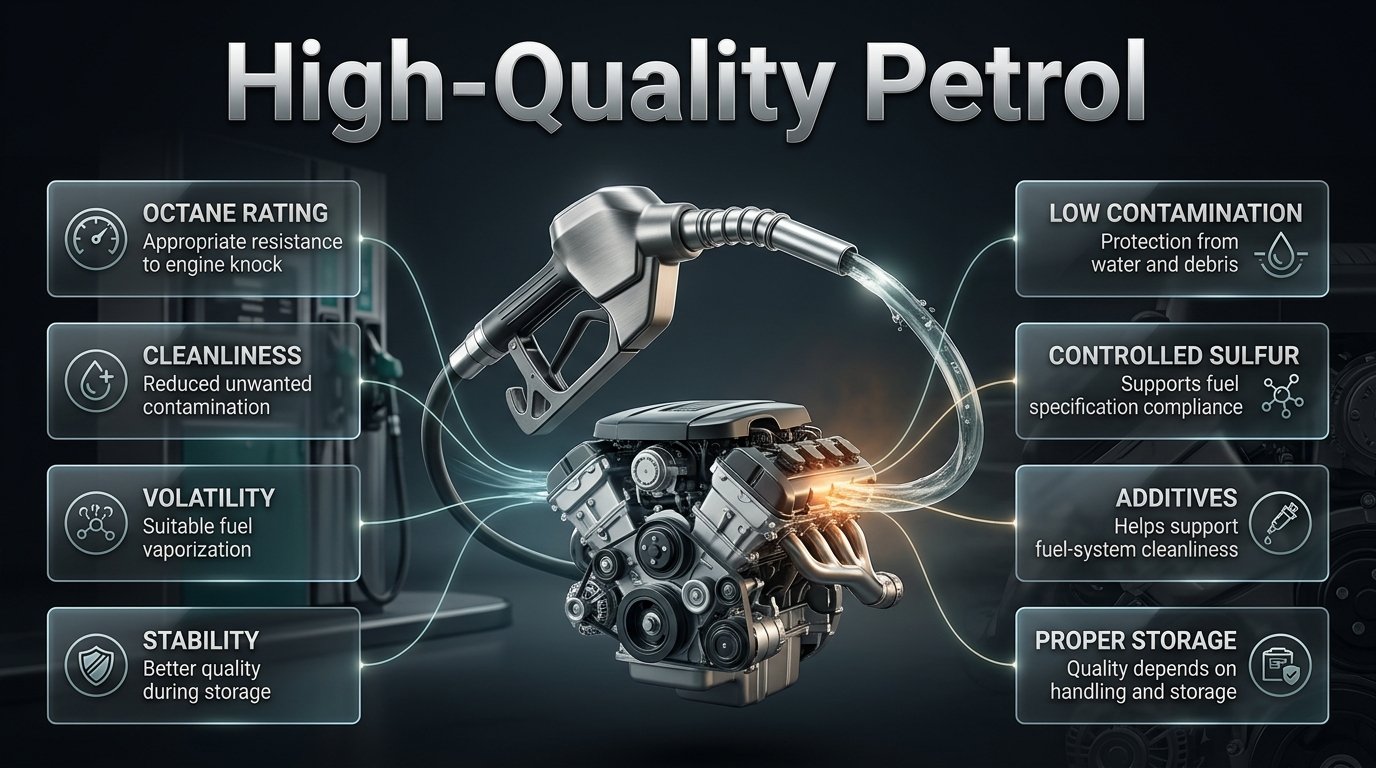
High-Quality Petrol | When your car suddenly starts giving poor mileage, feels slower than usual, develops rough acceleration, or begins making unusual engine sounds, fuel quality may be one of the things worth considering. However, petrol quality is more complicated than simply choosing the most expensive fuel or the highest octane available.
High-quality petrol is fuel that meets the required specification for the engine and has suitable characteristics for clean, consistent, and reliable combustion. Its quality depends on several factors, including octane rating, volatility, cleanliness, sulfur content, stability, contamination control, additives, storage, transportation, and handling.
For drivers who want a broader understanding of automotive fuel and related services, Fuel Delivery Dubai can also be useful as a starting point.
This guide explains what makes petrol high quality, how fuel quality affects engine performance and fuel economy, whether premium petrol is always better, how to identify potential fuel-quality problems, and what drivers and fleet operators should do to maintain reliable fuel quality.
What Is High-Quality Petrol?
High-quality petrol is fuel that consistently meets the technical and performance requirements established for its intended application. It should have an appropriate octane rating, suitable volatility, controlled sulfur and contaminant levels, good storage stability, and characteristics that allow an engine to operate as designed.
In simple terms, good petrol should behave predictably inside the fuel system and combustion chamber.
It needs to:
- Flow properly through the fuel system
- Vaporize appropriately
- Mix effectively with air
- Resist unwanted knock
- Burn consistently
- Support the engine’s intended performance
- Work correctly with emission-control systems
- Remain reasonably stable during storage
- Be free from significant water and physical contamination
One important point is often missed: high-quality petrol does not necessarily mean premium petrol.
Premium petrol normally refers to a higher-octane grade. High-quality petrol is a broader concept covering the overall condition and suitability of the fuel.
A properly specified regular-grade petrol can be high quality, while a premium fuel can still become problematic if it has been contaminated or poorly stored.
Why Does Petrol Quality Matter?
Petrol is not simply a liquid that provides energy. It is part of a carefully controlled combustion process.
In a petrol engine, fuel must be delivered, mixed with air, compressed, and ignited at the appropriate point. Modern engines use electronic control systems and sensors to adjust fuel delivery and ignition timing based on operating conditions.
When fuel meets the required specification, the engine can operate within the conditions its engineers intended.
When fuel quality is poor or unsuitable, problems may appear in different ways.
Possible symptoms include:
- Difficult starting
- Rough idling
- Hesitation during acceleration
- Reduced throttle response
- Poor fuel economy
- Engine knocking
- Misfiring
- Fuel-system contamination
- Increased deposits
- Increased emissions
That doesn’t mean fuel is responsible for every one of these problems.
A weak battery, dirty air filter, worn spark plugs, faulty injectors, incorrect tire pressure, failing sensors, or mechanical problems can create similar symptoms.
The key is to consider fuel quality as one possible factor rather than automatically blaming the petrol.
What Makes Petrol High Quality?
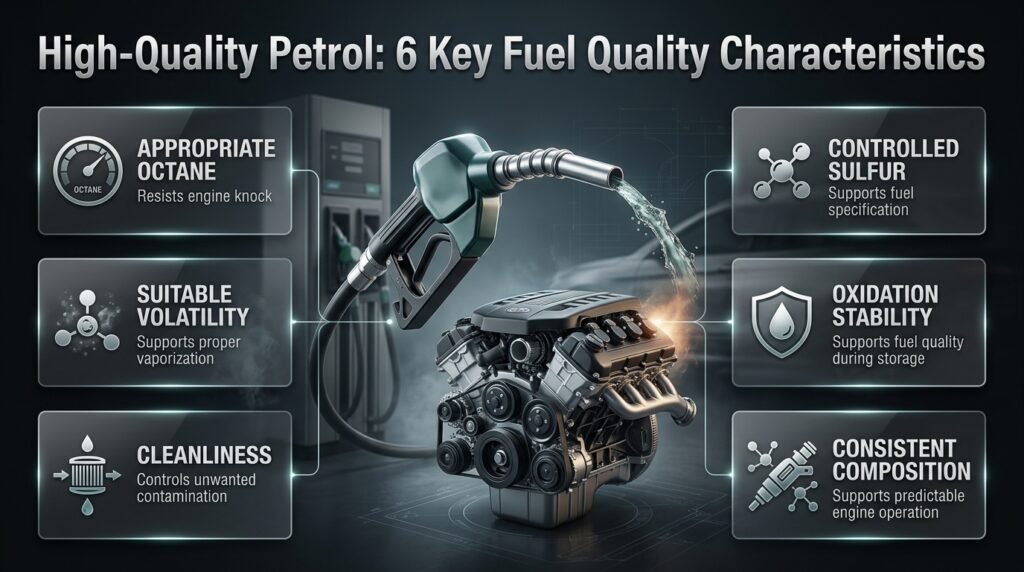
There isn’t a single measurement that determines whether petrol is “good.”
Fuel quality is better understood as a combination of several properties.
1. Appropriate Octane Rating
Octane rating is one of the most important characteristics of petrol because it relates to resistance to knock.
Engine knock can occur when part of the air-fuel mixture auto-ignites in an uncontrolled way instead of burning as intended from the spark-initiated flame front.
Higher-octane petrol has greater resistance to this type of unwanted combustion.
This becomes especially important in engines with:
- Higher compression ratios
- Turbocharging
- Supercharging
- Aggressive ignition timing
- Specific performance-oriented calibrations
However, higher octane does not automatically mean more energy or better fuel quality in every situation.
If a vehicle manufacturer specifies a particular minimum octane rating, that recommendation should normally be followed.
For a more detailed comparison, see regular vs premium petrol octane.
2. Suitable Volatility
Petrol must vaporize appropriately for the engine and operating environment.
Volatility describes how readily a fuel changes from liquid into vapor.
This matters because petrol engines need a combustible mixture of fuel vapor and air.
If the fuel does not vaporize appropriately, the engine can experience problems with mixture formation and drivability.
On the other hand, excessive volatility can also create undesirable vapor-related behavior.
For this reason, fuel specifications control volatility rather than simply trying to make petrol as volatile as possible.
Volatility requirements can vary depending on climate, season, regulations, and fuel formulation.
3. Cleanliness
Good petrol should be free from significant unwanted contamination.
Potential contaminants include:
- Water
- Dirt
- Sediment
- Rust particles
- Tank debris
- Other unwanted materials
Even a relatively small amount of contamination can become more significant when fuel is repeatedly circulated through injectors and other components.
Modern fuel-injection systems operate with relatively precise components. Contaminated fuel can interfere with that precision.
4. Controlled Sulfur Content
Sulfur is naturally associated with crude oil, but modern refining processes can reduce sulfur to controlled levels.
Why does this matter?
Because sulfur compounds can contribute to emissions and may interfere with certain emission-control technologies.
Modern fuel standards therefore place limits on sulfur content.
The specific limits depend on the applicable market and regulation, so it is more useful to discuss compliance with the relevant specification than to make generic claims about one fuel being “clean.”
For more information about the technical requirements associated with fuel quality, see fuel quality standards.
5. Good Oxidation Stability
Petrol can change during storage.
Exposure to oxygen, heat, and unfavorable storage conditions can contribute to oxidation and the formation of undesirable compounds.
This is particularly relevant when fuel remains stored for extended periods.
Fuel stability therefore matters for:
- Backup equipment
- Seasonal vehicles
- Rarely used cars
- Boats and recreational equipment
- Commercial storage tanks
- Fleet fuel systems
Good fuel quality and good storage practices need to work together.
6. Consistent Composition
Modern engines are designed around predictable fuel characteristics.
Fuel injection systems, oxygen sensors, engine control units, catalytic converters, and other components work together to control combustion.
Consistent fuel helps these systems operate within their intended range.
This is particularly important for commercial fleets because inconsistent fuel quality across multiple vehicles can make troubleshooting much more difficult.
Is High-Octane Petrol the Same as High-Quality Petrol?
No.
This is probably one of the most important distinctions drivers should understand.
Octane rating describes resistance to knock, while overall fuel quality includes many additional characteristics.
| Characteristic | What It Tells You |
|---|---|
| Octane rating | Resistance to knock |
| Volatility | How readily petrol vaporizes |
| Sulfur level | Amount of sulfur compounds |
| Cleanliness | Presence of unwanted contamination |
| Stability | How well fuel withstands storage |
| Additives | Additional performance or deposit-control properties |
| Specification compliance | Whether fuel meets required technical limits |
A higher octane number answers one question.
It doesn’t answer every question about fuel quality.
For example, a premium petrol may have a higher octane rating but still require proper storage and handling to maintain its quality.
How Does High-Quality Petrol Affect Engine Combustion?
A petrol engine depends on controlled combustion.
The basic process can be simplified as:
Fuel → Air-Fuel Mixture → Compression → Spark → Combustion → Expansion → Mechanical Power
Each stage depends on the fuel behaving appropriately.
Petrol must be delivered in a controlled quantity, mixed with air, vaporized appropriately, and ignited at the correct point.
The combustion process creates expanding gases that push the piston downward.
This movement is converted through the connecting rod and crankshaft into rotational motion that eventually reaches the wheels.
Fuel characteristics influence how predictably this process occurs.
For readers who want a deeper explanation of the combustion process, petrol engine combustion process explains how petrol is introduced, ignited, and converted into useful engine power.
Can High-Quality Petrol Improve Fuel Economy?
High-quality petrol can support normal and efficient engine operation when it matches the vehicle’s requirements.
But it would be inaccurate to promise that simply switching to a more expensive fuel will automatically improve mileage.
Fuel economy is influenced by many factors.
Major Factors Affecting Fuel Economy
- Driving speed
- Acceleration habits
- Traffic conditions
- Vehicle weight
- Tire pressure
- Engine condition
- Air-conditioning use
- Vehicle aerodynamics
- Road surface
- Fuel quality
- Fuel specification
- Transmission behavior
- Maintenance condition
For example, a driver may switch from regular to premium petrol expecting better mileage while continuing to drive aggressively in heavy traffic.
The additional fuel cost may then produce little or no meaningful financial benefit.
A better approach is to use the fuel grade recommended by the manufacturer and focus on the entire vehicle.
Can Poor Petrol Cause Poor Fuel Economy?
It can.
If fuel is contaminated, unsuitable, or significantly outside the required specification, combustion and fuel delivery may be affected.
However, poor mileage should not automatically be blamed on petrol.
Suppose a car’s fuel economy suddenly drops by 20%.
Before concluding that the fuel is responsible, check:
- Tire pressure
- Engine warning lights
- Air filter
- Spark plugs
- Fuel filter
- Driving conditions
- Traffic
- Air-conditioning use
- Vehicle load
- Recent maintenance
If the drop occurred immediately after refueling and is accompanied by rough running or hesitation, fuel quality becomes more relevant.
High-Quality Petrol vs Premium Petrol

The difference is simple but important.
High-quality petrol refers to overall fuel quality. Premium petrol generally refers to a higher-octane grade.
| Factor | High-Quality Petrol | Premium Petrol |
|---|---|---|
| Main concept | Overall quality | Higher octane grade |
| Octane | Appropriate for engine | Usually higher |
| Cleanliness | Should meet specification | Should meet specification |
| Stability | Important | Important |
| Contamination control | Important | Important |
| Suitable for every vehicle? | Depends on specification | No |
| Automatically better? | No universal answer | No |
A vehicle designed for regular petrol may not gain a useful advantage from premium petrol.
Meanwhile, a high-performance engine may specifically require higher octane to operate correctly.
The correct decision depends on the engine manufacturer’s requirements.
When Should You Use Premium Petrol?
Premium petrol is most relevant when the manufacturer:
- Requires it
- Recommends it
- Specifies a higher minimum octane
- Has designed the engine to benefit from higher octane
High-compression and turbocharged engines are examples where octane requirements can become particularly important.
If the owner’s manual says that premium fuel is required, ignoring that instruction can be a poor decision.
If the manual says regular petrol is acceptable, paying more for premium may not provide a meaningful benefit under normal conditions.
Does Premium Petrol Give More Power?
Not necessarily.
Higher octane doesn’t automatically create more horsepower.
However, some engines are designed to use higher-octane fuel more effectively.
Modern engine control systems can adjust ignition timing and other parameters based on knock detection and operating conditions.
An engine capable of taking advantage of higher octane may perform differently when using the recommended premium grade.
But the result depends entirely on the engine design.
A basic naturally aspirated engine designed for regular petrol shouldn’t be expected to become a performance engine simply because premium fuel was added.
Does High-Quality Petrol Clean the Engine?
This claim needs careful explanation.
Some petrol formulations include detergent additives designed to help control deposits in fuel-system components.
These additives can be useful.
But petrol shouldn’t be treated as a guaranteed engine-cleaning treatment.
If an engine has:
- Heavy carbon deposits
- Dirty injectors
- Damaged spark plugs
- Mechanical wear
- Faulty sensors
changing fuel alone may not solve the problem.
Fuel quality supports proper operation; it isn’t a replacement for maintenance.
How Can Petrol Become Contaminated?
Fuel contamination can occur at several stages.
During Transportation
Fuel can be affected by poorly maintained transport equipment or improper handling.
During Storage
Storage tanks can accumulate:
- Water
- Sediment
- Rust
- Dirt
If these contaminants enter the fuel stream, they can reach vehicles.
During Dispensing
Poorly maintained dispensing equipment can also introduce contamination.
Through Water Entry
Water can enter tanks through damaged seals, condensation, leaks, or unsuitable storage conditions.
This is one reason fuel storage management matters.
Can Water Get Into Petrol?
Yes.
Water contamination is one of the more serious fuel-quality concerns because petrol and water don’t behave as one uniform mixture.
Water can collect separately within a fuel-storage system.
If enough water reaches the vehicle’s fuel system, it can interfere with combustion and fuel delivery.
Possible symptoms include:
- Rough running
- Misfiring
- Difficult starting
- Poor acceleration
- Stalling
If serious contamination is suspected, professional inspection is preferable to repeatedly adding more fuel and hoping the problem disappears.
How Do You Know If Petrol Quality Is Poor?
Drivers often ask whether they can simply look at petrol and determine its quality.
Usually, they can’t.
Visual inspection may reveal obvious contamination in some situations, but many important fuel characteristics cannot be assessed with the naked eye.
You can’t reliably determine from appearance alone:
- Octane rating
- Sulfur content
- Volatility
- Oxidation stability
- Exact additive composition
- Compliance with technical standards
This is why supplier reliability and specification compliance are more useful indicators than appearance alone.
What Should You Look for in a Reliable Fuel Supplier?
A reliable supplier should have appropriate procedures for:
- Fuel sourcing
- Storage
- Transportation
- Handling
- Dispensing
- Quality control
- Tank maintenance
For everyday consumers, purchasing from an established and reputable fuel station is generally more sensible than choosing fuel based only on a lower price.
For businesses purchasing fuel in bulk, supplier selection becomes even more important.
Why Fuel Storage Matters
Fuel quality doesn’t stop at the refinery.
Imagine a simple chain:
Refining → Transportation → Storage → Dispensing → Vehicle
Every stage can affect the final result.
If fuel is produced correctly but stored in a dirty tank, the fuel quality reaching the vehicle can be compromised.
This is why storage tanks need appropriate maintenance and monitoring.
Important Fuel Storage Considerations
- Tank cleanliness
- Water control
- Sediment accumulation
- Tank integrity
- Temperature exposure
- Fuel turnover
- Proper sealing
- Safe handling procedures
Expert Tip: For bulk fuel users, treat the storage tank as part of the fuel system. A good-quality fuel product can still become problematic if the storage environment is poorly maintained.
How Does Fuel Quality Affect Modern Engines?

Modern petrol engines are increasingly precise.
Direct injection, turbocharging, variable valve timing, electronic throttle control, knock sensors, oxygen sensors, and advanced engine management systems all depend on controlled operating conditions.
This doesn’t mean modern engines are automatically fragile.
It means their performance depends on the fuel meeting the specification for which they were designed.
A vehicle manufacturer spends considerable engineering effort calibrating the engine for particular fuel characteristics.
Following the specified fuel recommendation is therefore a simple way to work with the engine rather than against it.
High-Quality Petrol and Emissions
Fuel quality can also affect vehicle emissions.
Modern vehicles use systems such as:
- Catalytic converters
- Oxygen sensors
- Evaporative-emission controls
- Exhaust sensors
- Electronic fuel management
Fuel specifications help these systems function correctly.
Sulfur and other fuel characteristics are controlled partly because they can affect emissions performance and after-treatment systems.
However, emissions depend on more than fuel.
Vehicle age, engine condition, maintenance, driving behavior, and emission-control technology all matter.
Does Fuel Quality Matter More in Older or Newer Cars?
It matters in both, but the consequences can differ.
Older vehicles may have simpler fuel systems and less sophisticated engine management.
Newer vehicles often have more precise injection and emission-control systems.
This means newer engines can be highly dependent on specification-compliant fuel, while older vehicles can still suffer from contamination, deposits, and fuel-system problems.
The right fuel specification should therefore be followed regardless of vehicle age.
Common Mistakes Drivers Make When Choosing Petrol
Mistake 1: Choosing the Highest Octane Automatically
Many drivers believe the highest octane fuel must be the best fuel.
That’s not necessarily true.
Why it happens: Premium fuel is often perceived as a superior version of regular fuel in every respect.
Why it can be wasteful: If the engine doesn’t require or benefit from the higher octane, the driver may simply spend more money.
Better approach: Follow the manufacturer’s fuel recommendation.
Mistake 2: Assuming Cheap Petrol Is Always Poor Quality
Price alone doesn’t tell you everything about fuel quality.
Pricing can be influenced by competition, location, operating costs, taxes, promotions, and many other factors.
Better approach: Evaluate supplier reliability and specification compliance instead of using price as your only quality indicator.
Mistake 3: Blaming Fuel for Every Engine Problem
A rough engine can have dozens of possible causes.
For example:
- Worn spark plugs
- Faulty ignition coils
- Dirty injectors
- Vacuum leaks
- Sensor problems
- Air-filter restriction
- Fuel-pressure problems
Fuel may be involved, but diagnosis should come before assumptions.
Mistake 4: Ignoring Storage Conditions
Bulk fuel users sometimes focus heavily on the fuel product and forget about the storage tank.
That’s a mistake.
The tank can introduce water, sediment, or other contamination into otherwise suitable fuel.
Mistake 5: Ignoring the Manufacturer’s Octane Recommendation
Using an unsuitable octane grade can create unnecessary problems.
The manufacturer’s recommendation exists for a reason.
Mistake 6: Believing Color Proves Quality
Fuel color is not a complete quality test.
Technical fuel properties cannot be judged reliably through appearance alone.
Mistake 7: Storing Petrol for Too Long Without a Plan
Long-term storage can create fuel-quality challenges.
The longer fuel sits under unsuitable conditions, the more attention should be paid to stability and storage practices.
How to Choose the Right Petrol for Your Car
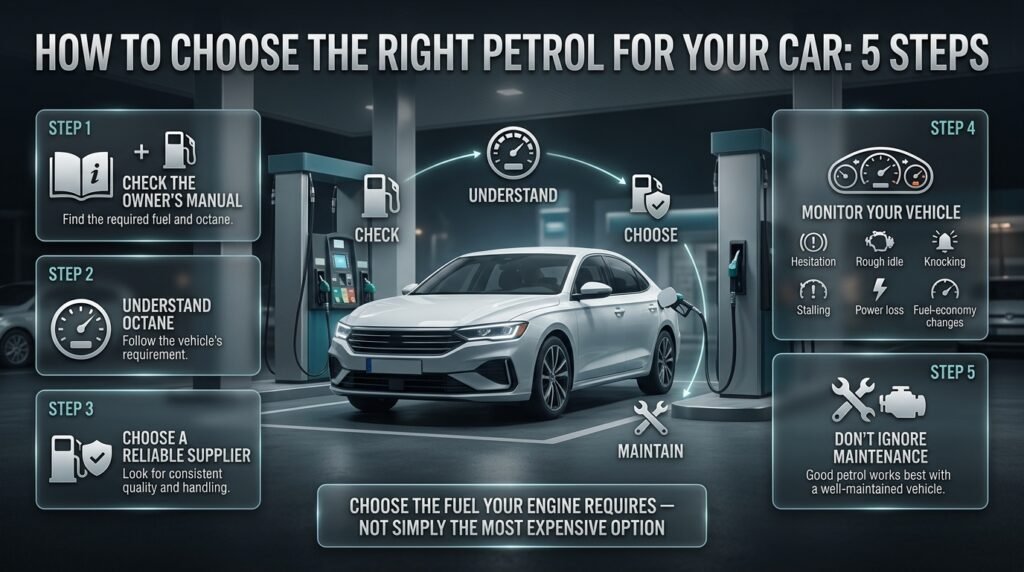
Choosing the right petrol can be handled with a straightforward process.
Step 1: Check the Owner’s Manual
Start with the manufacturer’s fuel requirement.
Look for:
- Minimum octane
- Recommended octane
- Fuel type
- Special fuel requirements
Don’t rely on assumptions.
Step 2: Understand the Octane Requirement
If your vehicle requires a higher-octane grade, use it.
If it accepts regular fuel, premium may not be necessary unless the manufacturer recommends it for a specific reason.
Step 3: Choose a Reliable Supplier
Look for consistent quality and proper fuel handling.
Step 4: Monitor Your Vehicle
Pay attention to changes after refueling.
Important signs include:
- New hesitation
- Rough idle
- Unusual knocking
- Stalling
- Sudden loss of power
- Unexpected fuel-economy changes
Step 5: Don’t Ignore Maintenance
Good petrol works best when the rest of the vehicle is maintained correctly.
A Simple Decision Guide for Drivers
| Situation | Sensible Approach |
|---|---|
| Manufacturer specifies regular petrol | Use the recommended regular grade |
| Manufacturer requires premium | Use the required premium grade |
| Vehicle knocks on recommended fuel | Have the vehicle inspected |
| Fuel economy suddenly drops | Check fuel and vehicle condition |
| Suspected contamination | Stop assuming and seek diagnosis |
| Long-term fuel storage | Follow appropriate storage practices |
| Fleet fuel purchasing | Monitor supplier and storage quality |
What Should You Do If Your Car Runs Badly After Refueling?
If a car develops problems immediately after refueling, don’t panic.
Start by considering the timing.
If the vehicle was operating normally before refueling and suddenly develops:
- Severe hesitation
- Misfiring
- Stalling
- Difficulty starting
fuel contamination becomes one possible explanation.
However, timing alone doesn’t prove that the fuel caused the problem.
Practical Steps
- Record when the problem started.
- Keep the fuel receipt if available.
- Note where the fuel was purchased.
- Avoid repeatedly adding unknown products or fuel grades.
- Check for warning lights.
- Have the vehicle diagnosed if symptoms continue.
- If contamination is suspected, have the fuel system professionally inspected.
This approach is much more reliable than simply switching brands repeatedly.
Does Petrol Quality Matter for Fleet Vehicles?
Absolutely.
For a private driver, a fuel-quality problem may affect one vehicle.
For a fleet operator, the same issue can affect dozens or hundreds of vehicles.
That can create:
- Increased fuel consumption
- Vehicle downtime
- Maintenance costs
- Driver complaints
- Unexpected repairs
- Operational delays
Fleet managers should therefore pay attention to fuel quality as part of overall fleet management.
Fleet Fuel Quality Checklist
- Monitor fuel consumption
- Maintain storage tanks
- Track suppliers
- Record fuel deliveries
- Inspect unusual consumption patterns
- Investigate repeated vehicle complaints
- Follow fuel specifications
- Prevent water and sediment accumulation
Consistent records make it easier to identify patterns.
For example, if multiple vehicles begin showing similar symptoms shortly after a particular fuel delivery, that information can help technicians investigate the issue more efficiently.
Petrol vs Diesel: Why Fuel Quality Requirements Differ
Petrol and diesel are both automotive fuels, but their engines operate differently.
Petrol engines typically use spark ignition.
Diesel engines use compression ignition.
Because their combustion processes differ, the fuel characteristics that matter most also differ.
If you’re researching the wider subject, petrol and diesel fuel types provides useful background on how these fuels are categorized and used.
Diesel fuel quality has its own important considerations, including cetane characteristics, lubricity, cold-flow behavior, water contamination, and cleanliness.
For readers interested in the diesel combustion process specifically, diesel engine combustion process provides a useful comparison.
Understanding Automotive Fuel More Broadly
Petrol is only one category of automotive fuel.
Depending on the vehicle and market, transportation can involve petrol, diesel, compressed natural gas, liquefied petroleum gas, ethanol blends, biodiesel blends, and other energy sources.
Understanding these categories makes it easier to understand why fuel specifications differ between engines.
For a broader overview, automotive fuel types explains the main categories and their applications.
This is especially useful for businesses that operate different types of vehicles or equipment because selecting fuel should always begin with the engine and application rather than with price alone.
Why Fuel Additives Matter
Some petrol formulations include additives designed to support specific fuel properties.
Depending on the formulation, additives may help with:
- Deposit control
- Corrosion protection
- Fuel stability
- Fuel-system cleanliness
- Other performance requirements
However, more additives do not automatically mean better fuel.
The important question is whether the fuel as a whole meets the appropriate specification and performs as intended.
Drivers should also be careful with aftermarket fuel additives.
Adding products without understanding their purpose or compatibility can create unnecessary risks.
Should You Add Fuel Additives to Petrol?
Not automatically.
Modern fuels are already formulated with additive packages appropriate to their specification.
Before adding an aftermarket product, consider:
- Why you want to use it
- Whether the manufacturer recommends it
- Whether the product is compatible with the engine
- Whether there is an actual problem to solve
If the vehicle is running normally, routine additive use may not be necessary.
High-Quality Petrol for High-Performance Engines
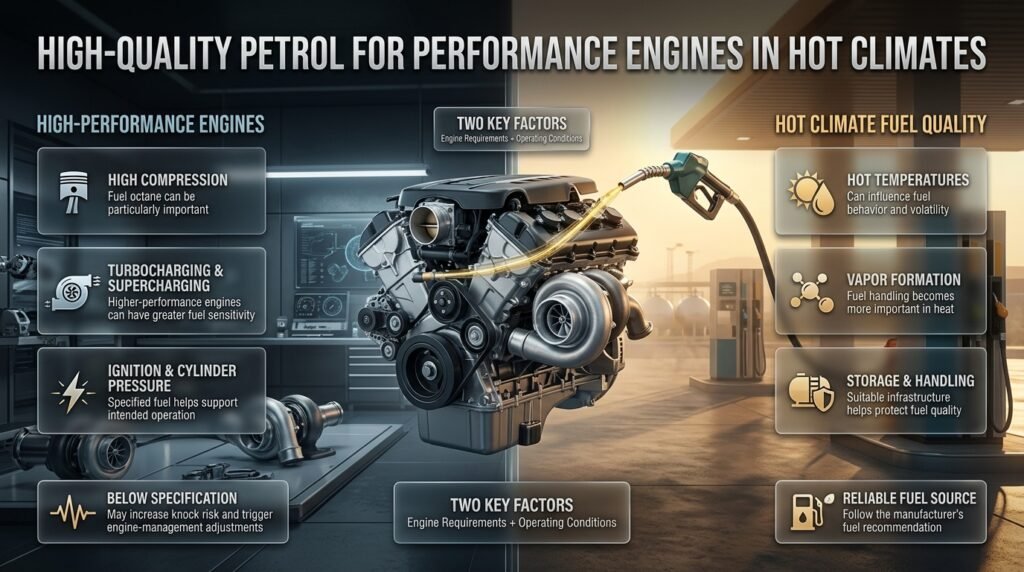
High-performance engines can have greater sensitivity to fuel requirements because of factors such as:
- High compression
- Turbocharging
- Supercharging
- Higher cylinder pressures
- Aggressive ignition timing
- Higher thermal loads
For these engines, the specified octane rating can be particularly important.
Using a fuel below the recommended specification can increase the risk of knock and cause the engine management system to adjust operation.
This can affect performance.
The correct fuel should therefore be treated as part of the engine’s design requirements rather than an optional upgrade.
High-Quality Petrol in Hot Climates
Operating conditions can affect fuel behavior.
Hot temperatures can influence fuel volatility, vapor formation, storage conditions, and vehicle operating behavior.
In hot climates, proper storage and fuel-handling practices become particularly important.
Fuel stations and bulk users need suitable infrastructure to protect fuel quality.
For drivers, choosing fuel from a reliable source and following the manufacturer’s recommendations remains the practical approach.
Does Petrol Quality Affect Starting?
It can.
Starting requires the engine to establish the correct conditions for combustion.
Fuel vaporization and mixture formation are particularly important during startup.
If petrol characteristics are unsuitable or the fuel is contaminated, starting and initial engine operation can be affected.
However, difficult starting can also result from:
- Weak battery
- Faulty starter
- Ignition problems
- Fuel-pressure issues
- Sensor faults
- Engine-temperature sensor problems
Diagnosis is therefore important.
Can Bad Petrol Cause Engine Knocking?
Unsuitable octane can contribute to knock.
If the fuel’s knock resistance is lower than what the engine requires under particular operating conditions, uncontrolled combustion can become more likely.
Modern engines often use knock sensors and electronic control strategies to respond.
But drivers should not treat persistent knocking as something to ignore.
If unusual knocking occurs, especially under acceleration or heavy load, the vehicle should be checked.
Is More Expensive Petrol Always Better?
No.
Price isn’t a technical definition of fuel quality.
A more expensive fuel may have:
- Higher octane
- Different additive formulation
- Different market positioning
- Higher operating or distribution costs
But those differences don’t automatically make it the best choice for every vehicle.
The best fuel is the one that satisfies the vehicle’s technical requirements and is supplied through a reliable quality-controlled system.
Expert Advice for Maintaining Petrol Quality
Professionals generally focus on prevention.
Know the Required Specification
Start with the vehicle or equipment manufacturer’s fuel requirement.
This eliminates much of the guesswork.
Buy From Reliable Sources
Choose suppliers that have appropriate fuel-quality and storage procedures.
Keep Storage Equipment Clean
For bulk users, inspect tanks regularly and address water or sediment issues.
Monitor Fuel Turnover
Avoid unnecessary long-term storage.
Track Vehicle Performance
Fuel consumption records can help identify unusual changes.
Investigate Patterns
One isolated vehicle complaint may have many causes.
Multiple vehicles showing the same symptoms after the same fuel delivery deserve closer attention.
Don’t Confuse Octane With Overall Quality
Octane is important, but it is only one measurement.
Maintain the Vehicle
Fuel quality and vehicle maintenance work together.
A perfectly specified fuel cannot compensate for a failing fuel pump or worn ignition components.
How Professionals Think About Fuel Quality
A useful way to understand fuel quality is to think in terms of the entire supply chain.
Fuel Production
↓
Quality Control
↓
Transportation
↓
Storage
↓
Dispensing
↓
Vehicle Fuel System
↓
Combustion
A problem can occur at any stage.
This is why simply asking, “Is this petrol good?” may be too broad.
A better question is:
Does this fuel meet the required specification, and has it been stored and handled correctly?
That question provides a much more useful framework for evaluating fuel quality
What Makes Petrol High Quality?
High-quality petrol isn’t simply petrol with a high octane number. Good fuel should meet the correct specification for the vehicle and have suitable characteristics for reliable combustion. Important factors include appropriate octane rating, controlled volatility, cleanliness, low contamination, suitable sulfur content, storage stability, and proper handling.
A fuel can have a high octane rating and still have quality problems if it has been contaminated or poorly stored. That’s why choosing petrol should involve more than looking at the number displayed on the pump.
Important points to consider:
Check the octane requirement recommended by the vehicle manufacturer.
Choose fuel from a reliable and properly maintained source.
Avoid assuming that expensive petrol is automatically better.
Fuel cleanliness and contamination control matter alongside octane.
Proper transportation, storage, and dispensing also affect final fuel quality.
For example, modern fuel systems use precise injectors, sensors, and electronic controls. Contaminated or unsuitable fuel can interfere with the consistent fuel delivery these systems depend on. Fuel-quality programs such as TOP TIER focus specifically on detergent performance and deposit control, showing why overall fuel formulation matters beyond octane alone.
Is Premium or High-Octane Petrol Better for Every Car?
No. Premium or high-octane petrol isn’t automatically better for every vehicle. Its main advantage is greater resistance to knock, which can be important for engines designed around higher octane fuel.
If your vehicle manufacturer recommends or requires premium fuel, using the appropriate higher-octane grade is important. But if your car is designed to run properly on regular petrol, paying extra for high-octane fuel may not produce a noticeable improvement in power or fuel economy.
The important distinction is between fuel quality and octane rating. A higher octane number doesn’t mean the fuel is automatically cleaner, more powerful, or more energy-dense.
Before choosing premium petrol:
Check your owner’s manual.
Look at the fuel-filler recommendation.
Follow the manufacturer’s minimum octane requirement.
Consider premium fuel if the manufacturer specifically recommends it.
Don’t choose high-octane petrol simply because it sounds like a “better” fuel.
Independent testing has also found that vehicles that don’t require premium fuel may receive little or no meaningful performance or fuel-economy benefit from paying extra for it.
Does High-Quality Petrol Improve Fuel Economy and Engine Performance?
It can help the engine operate as intended, but high-quality petrol doesn’t guarantee better mileage or more horsepower by itself.
Fuel economy depends on the entire vehicle and driving environment. Tire pressure, traffic, acceleration habits, engine condition, air-conditioning use, vehicle load, road conditions, and maintenance can have a much larger effect than simply changing fuel brands or moving to a higher-octane grade.
The situation is different when an engine is designed to benefit from higher octane. In such engines, using the appropriate higher-octane fuel can help the engine maintain the combustion conditions it was designed for. Octane is fundamentally about resistance to auto-ignition and knock.
For better real-world fuel economy:
Use the manufacturer’s recommended fuel grade.
Maintain correct tire pressure.
Keep the engine properly serviced.
Avoid unnecessary aggressive acceleration.
Don’t carry unnecessary vehicle weight.
Monitor sudden changes in fuel consumption.
Investigate mechanical problems instead of immediately blaming fuel.
A useful professional rule is simple: use the right fuel before trying to use more expensive fuel. If the vehicle is already receiving the correct specification, maintenance and driving conditions should be investigated before expecting a premium grade to transform fuel economy.
How Can You Tell If Petrol Is Poor Quality or Contaminated?
You can’t reliably judge the complete quality of petrol just by looking at it. Some contamination may be visible, but important characteristics such as octane, volatility, sulfur content, stability, additive performance, and specification compliance require proper testing or reliable quality-control procedures.
Water and particulate contamination are particularly important because they can interfere with fuel delivery and combustion. Fuel-quality standards and testing programs therefore consider more than appearance alone.
If your vehicle suddenly develops problems immediately after refueling, pay attention to the timing rather than automatically assuming the fuel is responsible.
Potential warning signs include:
Sudden rough running
Difficult starting
Hesitation during acceleration
Misfiring
Unexpected stalling
Unusual engine behavior
Sudden changes in fuel consumption
Keep the refueling receipt if possible and note where the fuel was purchased. If several vehicles experience similar problems after fuel from the same source or delivery, that pattern can be useful when investigating a possible fuel-quality issue.
At the same time, remember that spark plugs, ignition coils, injectors, sensors, fuel pumps, filters, and other mechanical or electrical components can create very similar symptoms.
Does Water or Poor Storage Affect Petrol Quality?
Yes. Fuel storage is an important part of overall petrol quality. Even properly formulated petrol can become problematic if it is exposed to contamination or unsuitable storage conditions.
Water can enter storage systems through condensation, leaks, damaged seals, or other handling problems. Sediment and rust can also accumulate in poorly maintained tanks. These contaminants may eventually enter the fuel system and affect vehicle operation.
Long storage periods can also matter because petrol can undergo chemical changes over time, particularly when exposed to oxygen, heat, and unfavorable conditions.
For better petrol storage:
Keep storage tanks properly maintained.
Control water contamination.
Prevent dirt and sediment from entering the fuel.
Inspect tanks and dispensing equipment.
Avoid unnecessary long-term storage.
Use appropriate storage procedures for the fuel and application.
Monitor fuel quality when storing large quantities.
This is especially important for businesses and fleet operators. A storage tank should effectively be treated as part of the fuel system. Good petrol entering a poorly maintained tank doesn’t guarantee good petrol reaching the vehicle.
A current example of why storage and contamination deserve attention is the recent debate around ethanol-blended petrol in the region. Recent reporting has highlighted conflicting industry findings concerning moisture and chloride contamination, while fuel retailers have stated that tested samples met applicable standards. The broader lesson is that fuel quality needs proper testing, handling, and storage controls rather than assumptions based only on the fuel label or blend name.
Conclusion
Choosing high-quality petrol isn’t simply about selecting the highest octane number or the most expensive fuel at the pump. True fuel quality depends on several factors working together, including the correct octane rating, suitable volatility, cleanliness, controlled sulfur content, good stability, proper additive performance, and protection against water and other contamination.
For everyday drivers, the smartest approach is to follow the vehicle manufacturer’s recommended fuel specification and buy from a reliable source. Premium petrol can be valuable for engines designed to require or benefit from higher octane, but it isn’t automatically a better choice for every car.
Fuel storage and handling also deserve attention. Even properly formulated petrol can develop problems if it becomes contaminated or is stored under unsuitable conditions. This is particularly important for businesses and fleet operators managing larger quantities of fuel.
Ultimately, the best petrol is the fuel that matches your engine’s requirements, meets the applicable quality standards, and has been properly stored and handled. By understanding these factors instead of judging petrol only by price or octane number, drivers can make more informed decisions, support reliable engine performance, and avoid unnecessary fuel-related expenses.
Leave a Reply