
Introduction
Dubai Petrol Grades | Standing in front of a petrol pump in Dubai, drivers usually have three main options: E-Plus 91, Special 95 and Super 98. Although all three are unleaded petrol, they are designed to meet different engine requirements. Choosing between them can become confusing, particularly when one grade costs more than another and motorists are unsure whether paying extra will actually benefit their vehicles.
Understanding Dubai petrol grades is important because the wrong fuel selection can affect engine operation, while purchasing unnecessarily expensive petrol can increase your monthly driving expenses without providing any meaningful advantage.
Dubai motorists drive different types of vehicles, including compact cars, family SUVs, luxury sedans, sports cars and commercial vehicles. Their engines do not all have identical fuel requirements. A vehicle designed for regular unleaded petrol may operate perfectly well on E-Plus 91, while another engine may require Special 95 or Super 98.
At Fuel Delivery Dubai, understanding local refuelling requirements is an important part of helping motorists make informed fuel decisions. Whether you drive every day through busy city roads or regularly travel longer distances, knowing which petrol grade your vehicle needs can help you manage fuel expenses and maintain suitable engine performance.
This comprehensive guide explains the differences between Dubai’s petrol grades, how octane ratings work, which vehicles need particular grades, how driving conditions influence consumption, and what to consider before refuelling.
1. What Are the Different Petrol Grades Available in Dubai?
Dubai’s main unleaded petrol options are E-Plus 91, Special 95 and Super 98. The numbers represent their Research Octane Number (RON), which measures a petrol’s resistance to engine knocking.
Although these grades serve different engine requirements, none is automatically the best choice for every vehicle. The correct selection depends on the engine design and the manufacturer’s recommended fuel specification.
E-Plus 91 Petrol
E-Plus 91 is the lower-octane option among Dubai’s three commonly available unleaded petrol grades.
It is designed for vehicles whose manufacturers permit 91 RON fuel. Many ordinary passenger vehicles with compatible engines can use this grade without requiring more expensive petrol.
Drivers may consider E-Plus 91 when:
- Their owner’s manual permits a minimum of 91 RON.
- Their fuel-filler label specifies 91 RON or an approved compatible range.
- Their engine is calibrated for regular unleaded petrol.
- They want to manage refuelling costs without compromising fuel compatibility.
However, choosing E-Plus 91 simply because it is cheaper is not a sensible decision if the vehicle requires a higher minimum octane rating.
Special 95 Petrol
Special 95 is a commonly used petrol grade in Dubai. It provides greater resistance to engine knocking than E-Plus 91 and is appropriate for vehicles designed for 95 RON.
Many everyday petrol cars and SUVs have fuel specifications that require or recommend this grade.
Special 95 may be appropriate when:
- The manufacturer’s minimum requirement is 95 RON.
- The vehicle’s fuel-filler label specifies 95 RON.
- The engine is calibrated for this octane level.
- The manufacturer allows 95 RON for normal operation.
It offers a practical balance for vehicles that need more octane resistance than 91 RON provides.
Super 98 Petrol
Super 98 is the highest-octane option among these three common petrol grades.
It provides greater resistance to knocking and is intended for engines that require or benefit from higher-octane fuel.
Certain high-compression, turbocharged and performance-oriented engines may specify 98 RON.
However, owning a luxury vehicle does not automatically mean you need Super 98. The exact engine specification is what matters.
Comparison of Dubai Petrol Grades
| Petrol grade | Octane rating | General application |
|---|---|---|
| E-Plus 91 | 91 RON | Compatible regular petrol engines |
| Special 95 | 95 RON | Vehicles requiring or recommending 95 RON |
| Super 98 | 98 RON | Engines requiring or benefiting from 98 RON |
Always check the manufacturer’s instructions before choosing a grade.
Understand Fuel Standards for Safer and More Informed Refuelling
Fuel standards play an important role in maintaining consistency across the fuel supply chain and helping motorists understand the specifications of the petrol and diesel they use. These standards cover important fuel characteristics, including composition, quality requirements and performance-related properties that influence suitability for different vehicle engines. For Dubai motorists, understanding these requirements can make fuel selection more straightforward and help prevent confusion when comparing different fuel types and grades. Drivers should also remember that meeting fuel standards and choosing the correct fuel for a particular vehicle are two separate considerations; the manufacturer’s recommended specifications should always guide the final choice. To learn more about fuel specifications, quality requirements and the standards relevant to motorists, explore this detailed resource on Dubai fuel standards.
2. What Does RON Mean and Why Is It Important?
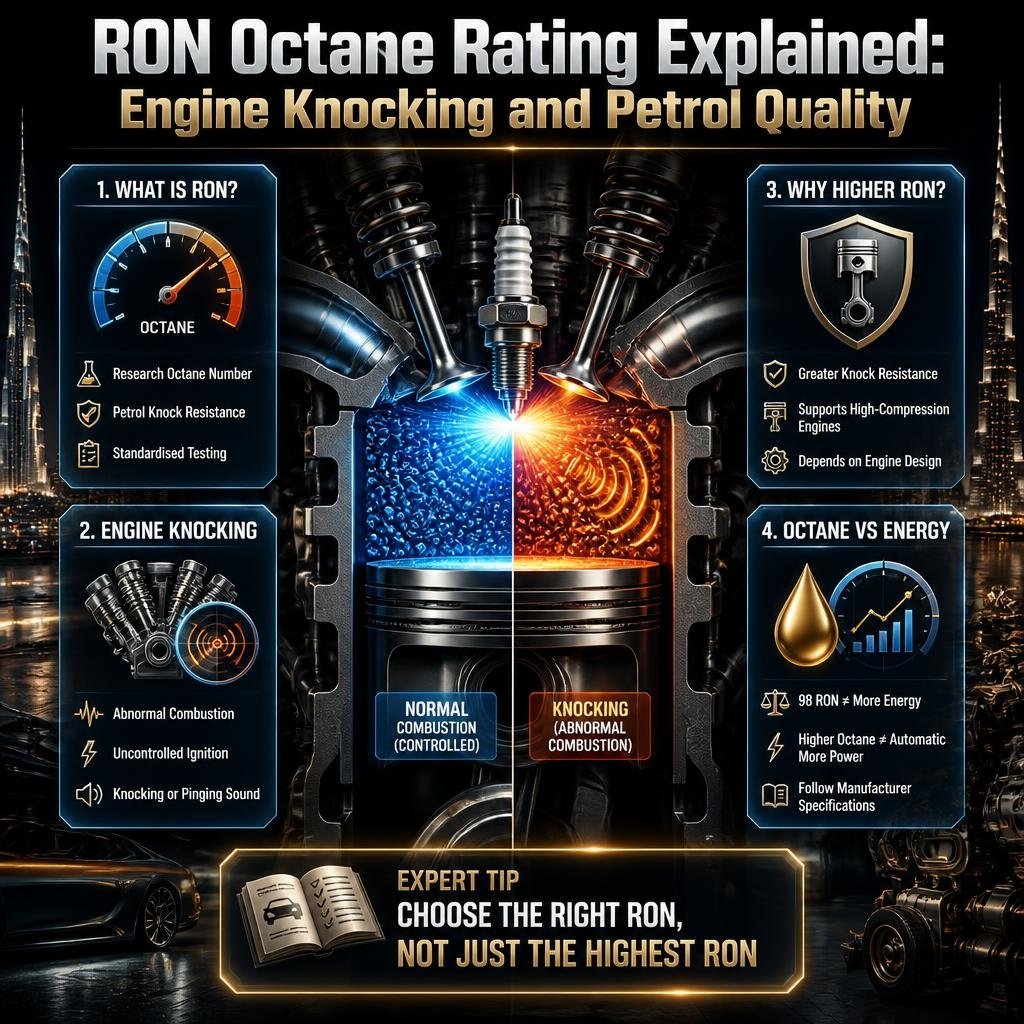
RON stands for Research Octane Number. It measures how resistant petrol is to uncontrolled combustion under a standardised testing method.
In simple terms, a higher RON indicates that petrol can withstand greater compression before becoming more prone to knocking.
Understanding this measurement helps drivers distinguish between the three main petrol grades available in Dubai.
What Is Engine Knocking?
A petrol engine compresses an air-fuel mixture inside its cylinders. A spark plug then ignites the mixture at the appropriate moment.
Combustion should occur in a controlled manner. If part of the mixture ignites prematurely or uncontrollably, abnormal combustion can produce a knocking or pinging sound.
This condition can affect engine performance and, under severe circumstances, contribute to mechanical damage.
Higher-octane petrol offers greater resistance to this type of combustion.
Does 98 RON Mean More Energy?
No. Octane rating is not a measurement of the percentage of energy contained in petrol.
A 98 RON grade is not automatically more powerful or more energy-dense than 95 RON petrol.
Its main advantage is greater resistance to knocking. Whether this provides a performance benefit depends on whether the engine is designed to use that additional resistance.
Expert Tip: Never judge petrol solely by its octane number. Fuel compatibility and the manufacturer’s specifications are more important than choosing the highest number displayed on a pump.
3. What Is the Difference Between E-Plus 91, Special 95 and Super 98?
The main difference is their resistance to knocking, not a simple ranking of how good or bad the petrol is.
Each grade serves engines with different requirements. Selecting an unsuitable grade can either create unnecessary expenses or compromise the engine’s intended operating conditions.
Differences in Engine Compatibility
E-Plus 91 is appropriate for engines approved for 91 RON.
Special 95 is appropriate for engines requiring or recommending 95 RON.
Super 98 is intended for engines whose specifications require or benefit from 98 RON.
A vehicle manufacturer may provide both a minimum octane requirement and a preferred grade for optimum performance. These instructions should be understood separately.
Differences in Refuelling Expenses
Higher-octane petrol generally costs more per litre than lower-octane alternatives.
However, a lower pump price does not automatically mean a better financial decision.
For example, if your vehicle requires 95 RON, using E-Plus 91 to reduce expenses may be inappropriate. Conversely, buying Super 98 for a vehicle designed for 91 RON may increase spending without a meaningful benefit.
The best financial decision is to use the least expensive grade that fully meets the manufacturer’s requirements.
4. How Do You Choose the Correct Petrol Grade for Your Car?
The correct petrol grade should always be determined by your vehicle’s official fuel specification.
Drivers should not rely entirely on general recommendations, engine size, vehicle price or advice from other motorists.
Step 1: Read the Owner’s Manual
The owner’s manual is one of the most reliable sources of information about your vehicle’s fuel requirements.
Find the fuel specification section and identify:
- Minimum RON requirement.
- Recommended petrol grade.
- Approved alternative grades.
- Any special instructions for high-load operation.
Some manufacturers specify a minimum octane rating, while others provide a preferred grade for optimum performance.
Step 2: Check the Fuel-Filler Door
Many vehicles display fuel information near the petrol filling opening.
Look for instructions such as:
- Minimum 91 RON.
- Minimum 95 RON.
- Recommended 98 RON.
- Premium unleaded petrol.
This is particularly useful when you are travelling or cannot immediately access the owner’s manual.
Step 3: Understand Minimum and Recommended Requirements
A minimum specification indicates the lowest octane rating permitted under the manufacturer’s instructions.
A recommended specification may identify the grade that supports the intended performance characteristics.
For example, a vehicle may permit 95 RON for normal operation but recommend 98 RON for optimum performance.
Do not assume these two instructions mean the same thing.
Step 4: Consider the Engine Technology
Different engine designs have different combustion requirements.
Turbocharged engines, high-compression engines and naturally aspirated engines may use different petrol specifications.
Even two vehicles with identical engine capacities can have different octane requirements because their engineering and engine management systems are not necessarily identical.
Step 5: Ask a Qualified Professional if the Specification Is Unclear
If the owner’s manual and fuel-filler label do not provide clear instructions, contact an authorised dealership or qualified automotive technician.
This is particularly important for imported vehicles, modified engines and performance cars.
Make Informed Refuelling Decisions for Everyday Dubai Driving
A consistent refuelling routine helps motorists manage their fuel requirements more effectively, particularly when travelling through Dubai’s busy roads and changing traffic conditions. Rather than relying only on the low-fuel warning light, drivers should monitor their fuel levels, estimate upcoming journey requirements and identify convenient refuelling opportunities before starting longer trips. It is equally important to select the correct petrol or diesel according to the vehicle manufacturer’s recommendations and avoid unnecessary refuelling mistakes. These practical habits can improve journey preparation, reduce unexpected fuel-related interruptions and make everyday vehicle management more convenient. For additional guidance on fuel selection, refuelling practices and managing everyday fuel requirements, explore this comprehensive Dubai Refuelling Guide.
5. Does Dubai’s Hot Climate Affect Petrol Grade Selection?

Dubai’s hot climate creates additional operating demands for vehicles, but it does not automatically mean that every motorist should upgrade to Super 98.
The correct octane requirement remains determined by the manufacturer’s specifications.
How High Temperatures Affect Vehicle Operation
During summer, vehicles can experience demanding operating conditions.
These may include:
- Increased cooling-system workload.
- Higher cabin air-conditioning demand.
- Reduced airflow during slow traffic.
- Extended engine operation.
- Greater thermal demand during heavy acceleration.
These conditions can influence vehicle performance and fuel consumption.
However, changing petrol grades without understanding the engine’s requirements is not an effective solution to every heat-related problem.
Does Higher-Octane Petrol Solve Overheating?
No. Petrol with a higher octane rating is not a replacement for a properly functioning cooling system.
If your vehicle experiences overheating, check the radiator, coolant level, cooling fans, thermostat and other relevant components through a qualified workshop.
What Should Dubai Drivers Do During Summer?
Focus on practical vehicle care:
- Maintain the cooling system according to the manufacturer’s schedule.
- Check tyre pressure regularly.
- Monitor engine oil condition.
- Avoid unnecessary heavy acceleration.
- Investigate unusual temperature readings.
- Use the petrol grade specified for your vehicle.
For a wider understanding of local driving conditions, explore Dubai Driving and Fuel Insights.
6. Does Super 98 Improve Engine Performance?
Super 98 can support better engine performance when the engine is designed to benefit from higher-octane petrol.
However, it does not automatically increase horsepower in every vehicle.
Some modern engines use electronic control systems and knock sensors to adjust ignition timing according to operating conditions and fuel characteristics.
When an engine is designed for higher-octane fuel, the additional resistance to knocking can allow it to operate closer to its intended performance settings.
When Can Super 98 Make a Difference?
It may provide a meaningful benefit in:
- Certain high-compression petrol engines.
- Performance-oriented sports cars.
- Turbocharged engines requiring higher octane.
- Vehicles whose manufacturers recommend 98 RON for optimum performance.
When Is Super 98 Unnecessary?
If your vehicle is designed for 91 RON and does not benefit from higher octane, purchasing 98 RON may simply increase your refuelling expenses.
The same principle applies to vehicles designed specifically for 95 RON.
Quick Tip: Don’t upgrade petrol grades just because you want faster acceleration. Engine condition, transmission operation, maintenance and vehicle design all influence acceleration.
7. Does Petrol Grade Affect Fuel Economy?
Petrol grade and fuel economy are related through engine operation, but a higher RON does not automatically mean more kilometres per litre.
An engine designed for 98 RON may benefit from using that grade. An ordinary vehicle designed for 95 RON may show little or no improvement when switched to Super 98.
Factors That Influence Fuel Consumption
Your actual fuel economy depends on several conditions:
Driving behaviour: Aggressive acceleration and repeated hard braking increase fuel consumption.
Traffic conditions: Stop-and-go driving can reduce efficiency compared with steady-speed journeys.
Tyre pressure: Incorrect tyre pressure increases rolling resistance and may increase fuel consumption.
Vehicle maintenance: Worn spark plugs, restricted air filters and other maintenance problems can affect engine operation.
Air-conditioning: Cabin cooling adds workload, particularly during hot weather and slow traffic.
How Can You Measure Actual Fuel Economy?
Rather than assuming one petrol grade is more economical, monitor your vehicle’s consumption.
Use this calculation:
Fuel economy in kilometres per litre = Distance travelled ÷ Litres consumed.
For example, if your vehicle travels 500 kilometres using 50 litres, its average consumption is 10 kilometres per litre.
Compare results under similar driving conditions before deciding whether a change has made a meaningful difference.
For additional practical guidance, explore Dubai City Driving.
8. How Do Dubai Petrol Prices Affect Monthly Fuel Expenses?

Petrol prices directly influence how much motorists spend on everyday driving.
The UAE announces monthly retail fuel prices, and the prices of E-Plus 91, Special 95 and Super 98 can change from one month to another.
For this reason, motorists should avoid relying on old price figures when calculating their current fuel budget.
How to Calculate Your Refuelling Cost
Use this simple formula:
Refuelling cost = Litres purchased × Current price per litre
For example, if you purchase 45 litres, multiply 45 by the announced price of your selected grade.
Repeat the calculation for each grade to understand the potential difference in spending.
Why Does Monthly Consumption Matter?
A small price difference per litre becomes more noticeable when a vehicle consumes large quantities of fuel.
Consider two motorists:
- One drives short distances and purchases 60 litres each month.
- Another travels regularly between different parts of Dubai and purchases 200 litres monthly.
The second driver will experience a larger total cost difference when comparing petrol grades.
However, fuel compatibility should always come before price.
How Can You Control Your Fuel Budget?
Start by identifying your monthly driving distance and average fuel consumption.
Then consider:
- How often you refuel.
- Which petrol grade your vehicle requires.
- Your typical daily journey.
- Traffic-related fuel consumption.
- Maintenance-related changes in efficiency.
Our detailed guides on Dubai Fuel Planning and Dubai Fuel Budget provide additional guidance on managing these expenses.
9. Can You Mix Different Petrol Grades?
Mixing compatible unleaded petrol grades is generally possible, provided the resulting fuel meets the vehicle’s requirements.
For example, adding 98 RON to a tank containing 95 RON petrol is not normally a problem for a vehicle approved for both grades.
However, mixing should not be used as a method of deliberately reducing fuel costs when the resulting octane level is uncertain.
Does Mixing 91 and 95 RON Produce 93 RON?
Not necessarily.
A simple mathematical average does not always predict the exact octane rating of a blended fuel. Actual blending characteristics can differ.
Therefore, motorists should not rely on an assumed calculation to meet a manufacturer’s minimum requirement.
What Should You Do?
- Follow the vehicle’s approved fuel specifications.
- Avoid deliberately lowering octane below the required minimum.
- Use compatible unleaded petrol only.
- Ask a qualified technician if you have concerns about an incorrect mixture.
Never confuse mixing petrol grades with mixing petrol and diesel. These are completely different situations.
Evaluate Fuel Station Locations Before Planning Your Journey
Knowing where suitable fuel stations are located can help motorists plan their journeys more efficiently and avoid unnecessary interruptions during daily travel. In Dubai, drivers may need to consider road accessibility, traffic conditions, journey distance and the availability of their vehicle’s recommended fuel grade when choosing a refuelling stop. Instead of waiting until the tank is nearly empty, it is sensible to identify convenient fuel stations along frequently used routes and consider alternative locations for longer journeys. This approach makes fuel planning more practical and reduces the pressure of finding a refuelling point at the last moment. To explore refuelling locations and learn more about available options across the city, consult this comprehensive guide to Dubai fuel stations.
10. What Happens If You Use the Wrong Petrol Grade?
Using petrol with a lower octane rating than the manufacturer’s minimum requirement can increase the possibility of abnormal combustion.
Modern engines may use knock sensors and electronic control systems to protect themselves, but this does not make repeated use of unsuitable fuel advisable.
Possible Effects of Using Insufficient Octane
Depending on engine design and operating conditions, motorists may experience:
- Reduced engine performance.
- Ignition timing adjustments.
- Increased knocking risk.
- Changes in fuel consumption.
- Unusual combustion noise.
- Increased mechanical stress under demanding conditions.
The severity depends on the vehicle and the difference between the required and supplied fuel grade.
What If You Accidentally Use E-Plus 91 Instead of Special 95?
First, establish whether your vehicle permits 91 RON.
If it requires 95 RON, avoid demanding acceleration and heavy engine loads. Follow the manufacturer’s instructions and seek professional advice if necessary.
What If You Use Super 98 Instead of Special 95?
For a vehicle approved for 95 RON, using compatible 98 RON petrol is generally acceptable.
However, the higher grade may not provide an observable advantage.
What If You Put Diesel in a Petrol Car?
Stop immediately.
Do not start the engine or attempt to drive the vehicle.
Contact a qualified recovery or automotive service and arrange an appropriate fuel-system inspection and draining procedure.
The same caution applies when petrol is mistakenly added to a diesel vehicle.
11. How Do Dubai Traffic Conditions Influence Petrol Consumption?
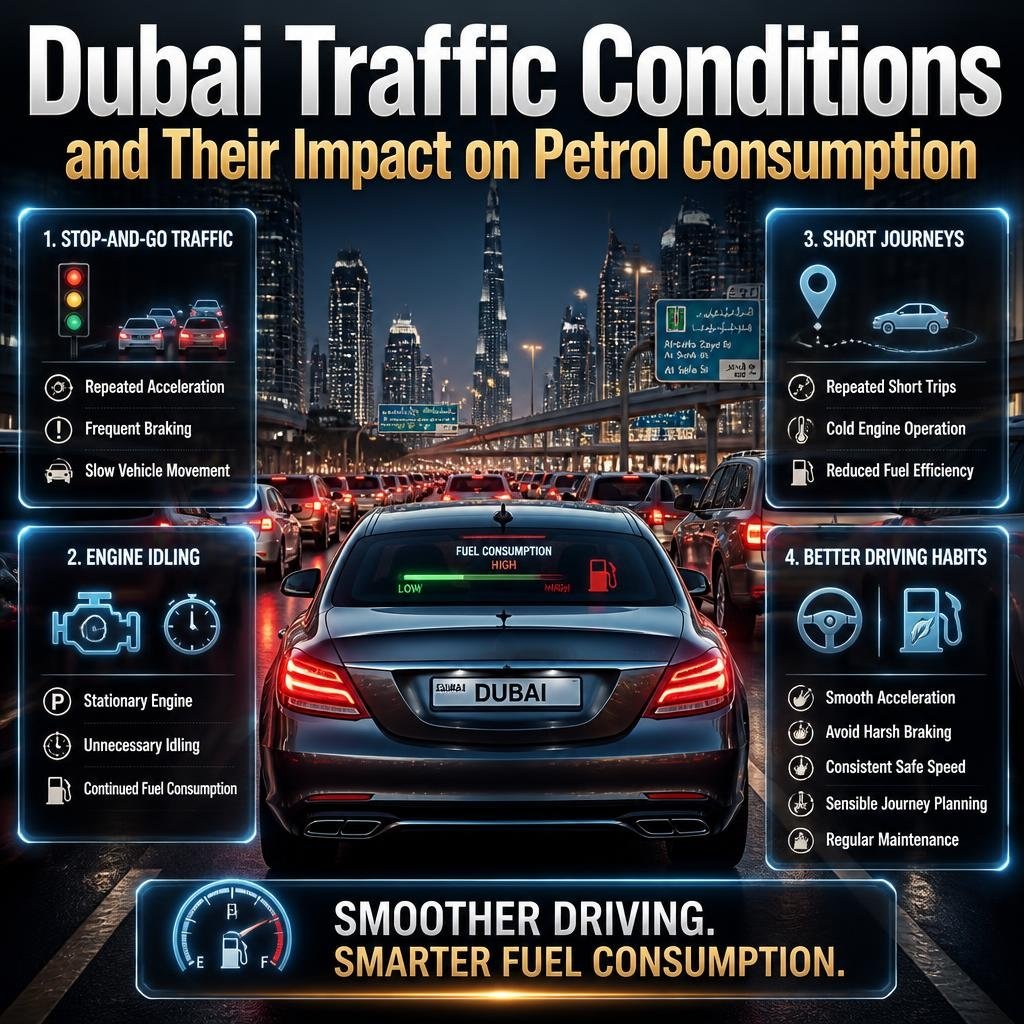
Dubai motorists regularly experience different traffic patterns depending on their journey, travel time and destination.
Heavy traffic can increase fuel consumption even when the correct petrol grade is being used.
Stop-and-Go Traffic
Repeated acceleration and braking require additional energy.
When vehicles move slowly through congested roads, engines may consume more fuel per kilometre than during consistent driving.
Extended Idling
An engine that remains running while a vehicle is stationary continues consuming petrol.
Unnecessary idling is particularly relevant when waiting for passengers or remaining stationary for extended periods.
Short-Distance Journeys
Repeated short journeys may prevent some engines from reaching their normal operating temperature.
This can affect fuel efficiency and may contribute to increased wear under certain conditions.
Better Driving Habits
To manage fuel consumption:
- Accelerate progressively.
- Avoid unnecessary braking.
- Maintain a safe and consistent speed.
- Switch off the engine during appropriate extended stops.
- Plan journeys sensibly.
- Keep your vehicle maintained.
Understanding Dubai Fuel Costs alongside driving conditions can help motorists identify where their money is going.
12. What Is the Difference Between Petrol Grade and Petrol Quality?
Petrol grade refers primarily to octane rating, whereas petrol quality includes several additional characteristics relating to fuel specifications, composition, cleanliness and handling.
A higher-octane grade is not automatically cleaner or fresher than a lower-octane grade.
Important Fuel Quality Considerations
Drivers should understand that fuel quality involves:
Specification compliance: Petrol should meet the applicable technical requirements.
Contamination control: Water, dirt and other unwanted substances can affect fuel-system operation.
Proper storage: Fuel should be handled and stored using appropriate procedures.
Fuel formulation: Different technical characteristics and approved additives can influence fuel behaviour.
Vehicle compatibility: The supplied fuel must meet the engine’s requirements.
Why Should Motorists Understand Both?
A vehicle needs the correct petrol grade, but octane rating alone does not describe every characteristic of the fuel.
A suitable refuelling decision therefore involves both compatibility and confidence in the fuel source.
For more detailed information, read Dubai Fuel Quality and Refuelling and Dubai Fuel Quality.
13. Petrol Grades and Diesel: Important Differences for Dubai Drivers
Petrol and diesel are separate fuels designed for different combustion systems.
E-Plus 91, Special 95 and Super 98 are petrol grades. They are not diesel alternatives.
How Petrol Engines Work
Petrol engines generally use spark plugs to ignite an air-fuel mixture inside their cylinders.
The petrol’s octane rating helps determine its resistance to knocking during combustion.
How Diesel Engines Work
Diesel engines compress air until it becomes sufficiently hot for injected diesel fuel to ignite.
Diesel fuel has different specifications and combustion characteristics from petrol.
Why Should Drivers Never Confuse Them?
Putting the wrong fuel into a vehicle can create serious problems.
Petrol can affect the lubrication requirements of a diesel fuel system, while diesel in a petrol vehicle can interfere with normal combustion.
Before refuelling, always confirm the fuel type rather than relying only on the vehicle’s appearance or model name.
For broader information about the fuel needs of different vehicles, visit Dubai Fuel Requirements.
14. Common Mistakes Drivers Make When Choosing Petrol Grades
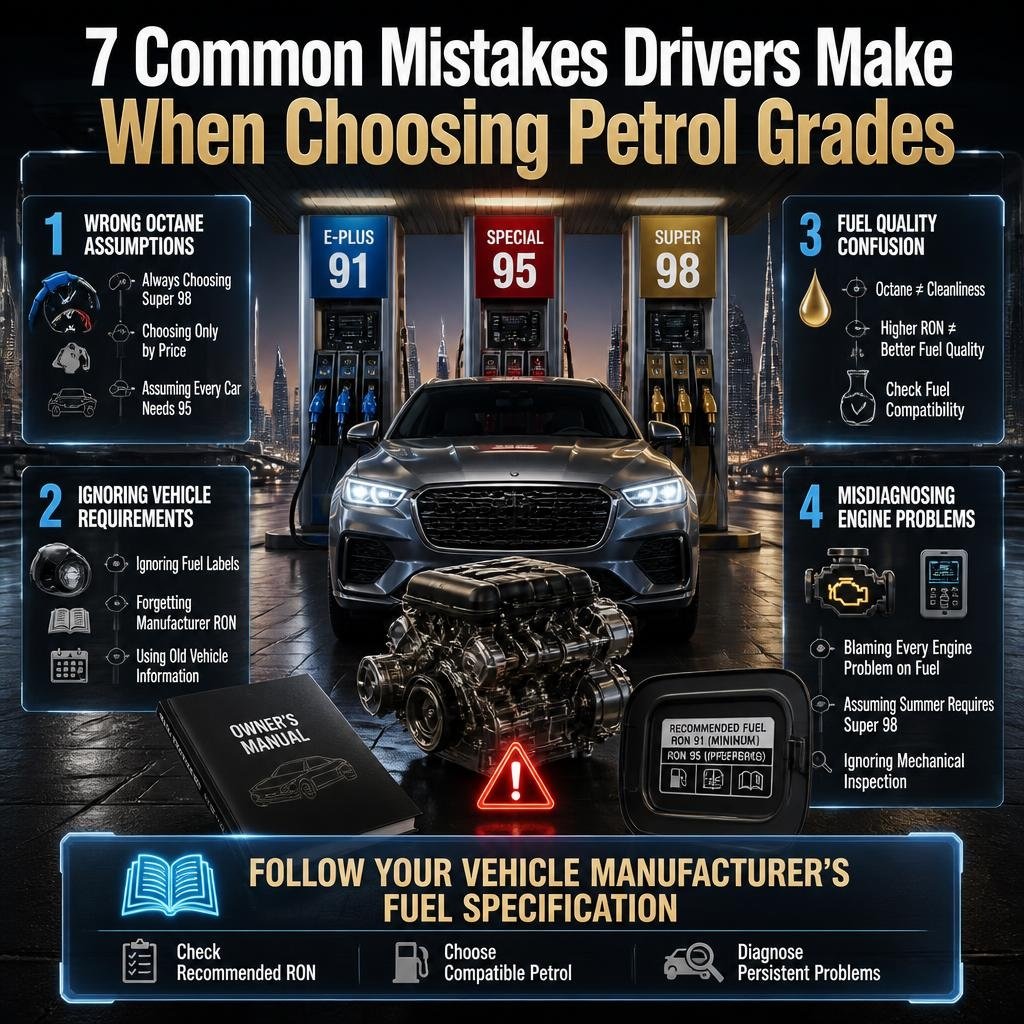
Even experienced motorists can make unnecessary fuel-selection mistakes.
Most problems happen because drivers choose petrol based on assumptions instead of checking their vehicle’s actual requirements.
Mistake 1: Always Buying Super 98
Some drivers assume the highest-octane option must be the best.
However, if their vehicle is designed for 91 or 95 RON, a more expensive grade may provide little additional value.
Better approach: Follow the manufacturer’s recommendation.
Mistake 2: Choosing Petrol Only by Price
Selecting the cheapest petrol can become a problem when the vehicle requires a higher minimum octane rating.
Better approach: Compare prices only among grades approved for your vehicle.
Mistake 3: Assuming All Cars Need Special 95
Special 95 is common, but it is not a universal requirement.
Some vehicles operate on 91 RON, while others require 98 RON.
Better approach: Check the fuel specification for your exact vehicle.
Mistake 4: Ignoring the Recommended Fuel Label
A driver may remember the fuel requirement of an older car and accidentally apply the same information to a different vehicle.
Better approach: Check the current vehicle’s owner’s manual and fuel-filler label.
Mistake 5: Confusing Octane with Petrol Cleanliness
Higher octane does not automatically indicate better cleaning properties or freedom from contamination.
Better approach: Understand the difference between fuel grade and fuel quality.
Mistake 6: Blaming Petrol Grade for Every Engine Problem
Poor acceleration, overheating and unusual noises can have many causes.
Changing to a higher-octane grade without diagnosing the problem may waste money.
Better approach: Arrange a proper mechanical inspection when symptoms persist.
Mistake 7: Assuming Summer Requires Premium Fuel
Dubai’s hot weather increases the importance of vehicle maintenance, but does not automatically change the manufacturer’s minimum RON requirement.
Better approach: Maintain the cooling system and use the specified petrol.
15. Professional Recommendations for Better Petrol Selection
A sensible refuelling routine should be based on vehicle compatibility, accurate information and regular monitoring.
The following practices can help Dubai motorists make better decisions.
Keep Your Fuel Specification Accessible
Record your vehicle’s minimum RON and recommended grade.
This is especially useful when another family member or employee refuels the vehicle.
Avoid Unnecessary Grade Changes
Using the correct grade consistently makes fuel selection easier and reduces confusion.
There is no reason to experiment with different grades unless the manufacturer permits them and there is a clear reason to do so.
Monitor Fuel Consumption
Keep track of litres purchased and distance travelled.
A sudden increase in consumption may indicate changes in traffic, tyre pressure, driving behaviour or vehicle condition.
Maintain the Engine Properly
Regular servicing helps the engine operate according to its intended design.
Pay attention to:
- Engine oil.
- Spark plugs.
- Air filters.
- Cooling system.
- Fuel-system condition.
- Manufacturer-recommended servicing intervals.
Use Suitable Fuel Sources
Choose recognised refuelling providers and avoid questionable fuel sources.
The correct octane rating is important, but proper fuel handling and specification compliance also matter.
Consider Your Overall Driving Expenses
Fuel expenditure should be considered alongside servicing, maintenance and vehicle usage.
Explore Dubai Fuel Expenses to understand the wider costs associated with everyday vehicle operation.
16. How Does Correct Petrol Selection Help During Emergency Refuelling?
Running out of petrol can happen unexpectedly, even to motorists who normally plan their journeys carefully.
Unexpected congestion, longer-than-expected journeys, inaccurate range estimates or delayed refuelling can leave a driver without enough fuel to reach a service station.
Emergency refuelling can provide practical assistance when reaching a petrol station is inconvenient or impossible.
What Should You Confirm Before Arranging Fuel Delivery?
Provide accurate vehicle information, including:
- Vehicle make and model.
- Petrol or diesel requirement.
- Required petrol grade.
- Current location.
- Approximate fuel quantity required.
These details help avoid confusion during an emergency.
Why Does Petrol Grade Still Matter?
Imagine a motorist driving a vehicle that requires Special 95.
The vehicle runs out of petrol while travelling through Dubai. Although receiving fuel quickly is important, the supplied grade must still meet the vehicle’s requirements.
Emergency assistance should not mean compromising fuel compatibility.
Drivers who need roadside refuelling information can visit Fuel Delivery Dubai to learn about available assistance and fuel delivery services.
Which Petrol Grade Is Best for Cars in Dubai: E-Plus 91, Special 95 or Super 98?
The best petrol grade for your car in Dubai depends on its engine design and the manufacturer’s recommended octane rating. E-Plus 91, Special 95 and Super 98 serve different engine requirements, so selecting the highest-priced option does not automatically provide better performance or fuel economy.
For everyday motorists, the most sensible approach is to check the minimum RON requirement before choosing a petrol grade. A vehicle designed for 91 RON may operate perfectly well on E-Plus 91, whereas an engine requiring 95 or 98 RON needs the appropriate fuel.
Important points to consider:
E-Plus 91: Suitable for vehicles approved for 91 RON.
Special 95: Appropriate for vehicles requiring or recommending 95 RON.
Super 98: Designed for engines requiring or benefiting from higher octane resistance.
Always check your owner’s manual before changing fuel grades.
Consider engine compatibility before comparing petrol prices.
Can Using E-Plus 91 Instead of Special 95 Damage Your Car Engine?
Using E-Plus 91 instead of Special 95 can create problems if your vehicle requires a minimum of 95 RON. Although modern engines may use knock sensors and electronic ignition adjustments to protect themselves, these systems should not be treated as permission to use petrol below the manufacturer’s specified requirement.
When an engine receives petrol with insufficient knock resistance, its management system may adjust ignition timing to reduce knocking. Depending on the engine and operating conditions, this can affect performance and increase mechanical stress.
What should drivers do?
Check whether your vehicle permits 91 RON.
Never ignore a minimum 95 RON fuel requirement.
Avoid heavy acceleration if you suspect unsuitable fuel has been used.
Follow the manufacturer’s instructions after accidental refuelling.
Consult a qualified mechanic if knocking or unusual engine behaviour continues.
The important distinction is that E-Plus 91 is not inherently harmful. It becomes an unsuitable choice when the vehicle is not designed to use it.
Does Using Super 98 Petrol Improve Mileage and Engine Performance?
Super 98 provides greater resistance to engine knocking than Special 95 and E-Plus 91, but its higher octane rating does not guarantee better mileage or additional horsepower in every vehicle. Engines designed for higher-octane petrol may benefit from its combustion characteristics because their electronic management systems can adjust ignition timing and other operating parameters accordingly. However, a vehicle designed to operate on 91 or 95 RON may show little or no measurable improvement after switching to Super 98. For everyday motorists in Dubai, the financial benefit of upgrading should therefore be evaluated against the vehicle’s actual requirements and performance.
Consider these factors before upgrading:
Engine design: High-compression and certain turbocharged engines may benefit from higher octane.
Fuel economy: Better mileage is not guaranteed simply by using 98 RON.
Acceleration: Additional octane does not automatically increase engine power.
Driving conditions: Traffic, air-conditioning and acceleration habits also influence consumption.
Cost effectiveness: Paying more for Super 98 is worthwhile when the engine’s specifications justify it.
How Do I Know Whether My Imported Car Needs 91, 95 or 98 Petrol in Dubai?
Imported vehicles can create confusion because different countries use different systems to display petrol octane ratings. For example, many vehicles manufactured for the United States use the Anti-Knock Index (AKI), whereas Dubai petrol grades are identified using Research Octane Number (RON). These measurements are not directly interchangeable, so drivers should not compare the numbers without understanding the rating system. A vehicle displaying 91 AKI, for example, should not automatically be refuelled with E-Plus 91. The correct UAE petrol grade must be determined using the manufacturer’s fuel specification and the appropriate conversion or equivalent recommendation.
When checking an imported vehicle’s requirements:
Identify whether the manual specifies RON, AKI or another octane measurement.
Check the original fuel-filler label.
Look for the manufacturer’s recommended fuel specification for your exact engine.
Consider whether the vehicle has been imported from the United States, Europe, Japan or another market.
Contact an authorised dealership if the recommended UAE equivalent is unclear.
Professional advice: Never select petrol based solely on a numerical comparison between two different octane-rating systems.
Does Dubai’s Extreme Summer Heat Mean Drivers Should Switch to Higher-Octane Petrol?
Dubai’s summer temperatures can increase the demands placed on a vehicle’s engine and cooling system, but hot weather alone does not mean every car needs a higher petrol grade. Octane requirements are determined primarily by engine design and manufacturer specifications. Certain high-performance engines may require premium petrol to maintain their intended performance under demanding operating conditions, while ordinary vehicles can continue using their approved petrol grade during summer. Drivers should pay particular attention to cooling-system maintenance, engine condition and driving habits rather than assuming that upgrading from Special 95 to Super 98 will resolve heat-related problems.
To prepare your vehicle for Dubai’s summer driving conditions:
Maintain the recommended coolant level and cooling-system condition.
Check the radiator and cooling fans for proper operation.
Keep tyres inflated according to the manufacturer’s recommendations.
Avoid unnecessary engine idling during extended stops.
Monitor unusual temperature readings and engine warning lights.
Continue using the petrol grade specified by your vehicle manufacturer.
Conclusion
Choosing the right petrol grade in Dubai is not simply about selecting the highest octane number. It is about understanding your vehicle’s engine requirements, following the manufacturer’s recommendations and using a fuel grade that supports reliable performance. E-Plus 91, Special 95 and Super 98 each serve different vehicle requirements, and paying more for a higher grade does not automatically mean better mileage, improved performance or longer engine life.
Dubai’s driving conditions also make responsible refuelling important. High temperatures, busy roads, frequent stop-and-go traffic and long journeys can influence how efficiently a vehicle uses fuel. However, these conditions do not mean every driver needs to switch to a higher-octane petrol grade. The correct approach is to follow the recommended RON rating and maintain good driving and vehicle-care habits.
Before refuelling, check your owner’s manual or the fuel recommendation displayed inside the fuel-filler flap. Use the correct grade consistently, avoid unnecessary engine strain and monitor your vehicle’s performance. Understanding your fuel requirements can help you manage running costs and make more informed decisions about everyday driving.
Whether you are planning your monthly fuel expenses or arranging refuelling assistance, reliable information makes a difference. For convenient petrol and diesel assistance across Dubai, visit Fuel Delivery Dubai and choose a practical refuelling solution when you need it.
Leave a Reply