Introduction
Vehicle Breakdown Safety Procedures | A vehicle breakdown can happen when you least expect it. You may be driving through a busy Dubai road, heading home after work, travelling on a highway, or simply making a short trip when the engine suddenly loses power. A flat tyre, dead battery, overheating engine, electrical fault, or empty fuel tank can leave you stranded within seconds.
The first reaction is often to think about fixing the car. But that’s not always the right priority.
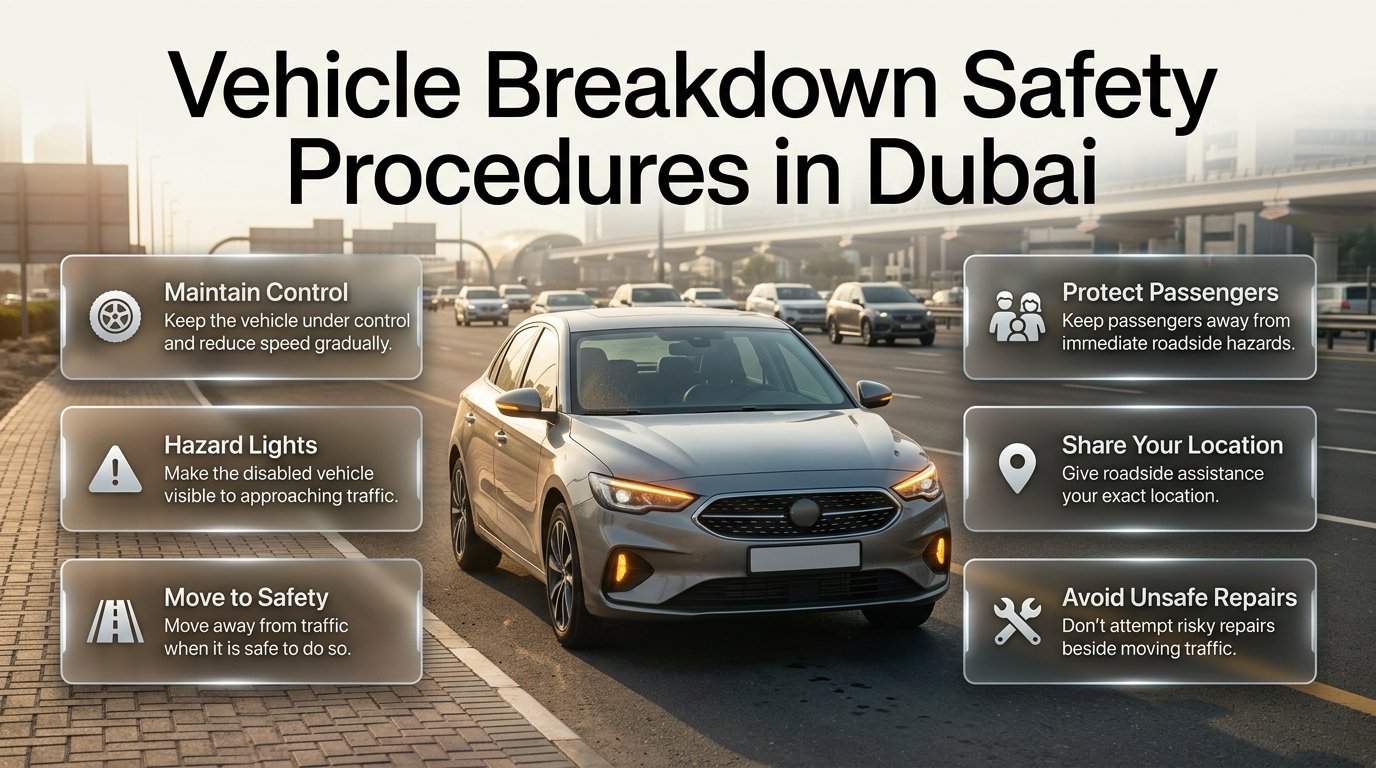
When your vehicle stops unexpectedly, personal safety comes before vehicle repair. Knowing the correct vehicle breakdown safety procedures can help you avoid moving traffic, prevent unnecessary risks, protect passengers, and get the right assistance more quickly.
For drivers in Dubai, this is especially important because busy roads, high-speed highways, heavy traffic, extreme heat, and long distances between some locations can make a roadside breakdown more challenging.
If your vehicle has run out of petrol, Fuel Delivery Dubai can also be a useful resource when you need emergency fuel assistance at your location.
This guide explains what to do before, during, and after a breakdown, how to stay safe on highways, what to do if your vehicle overheats or runs out of fuel, which mistakes to avoid, and when you should stop trying to fix the vehicle yourself.
What Are Vehicle Breakdown Safety Procedures?
Vehicle breakdown safety procedures are the practical steps a driver should follow when a vehicle becomes disabled or unsafe to continue driving. They include controlling the vehicle, moving away from traffic when possible, switching on hazard lights, choosing a safe position, protecting passengers, identifying the location, and contacting suitable assistance.
The basic priority is:
Control the vehicle → Move to safety → Make yourself visible → Protect passengers → Call for help → Deal with the vehicle problem.
This order matters.
A driver who immediately opens the bonnet or starts changing a tyre without considering traffic may solve a mechanical problem while creating a much greater safety risk.
A breakdown isn’t necessarily dangerous because the car has stopped. It becomes dangerous when people are exposed to moving traffic, fire, extreme heat, leaking fuel, unstable vehicles, or other hazards.
What Should You Do Immediately When Your Vehicle Breaks Down?
The first few moments after a breakdown are important. Try not to panic or make sudden steering or braking movements.
If the vehicle is still moving, concentrate on maintaining control and getting somewhere safer.
Step 1: Stay Calm and Maintain Control
Don’t immediately switch your attention to warning lights, engine sounds, or passengers.
Keep both hands on the steering wheel where practical and assess whether the vehicle is still responding normally.
If you’ve experienced a sudden loss of power, strange steering, brake problems, or a tyre failure, reduce your speed gradually rather than making an aggressive manoeuvre.
Step 2: Switch on Your Hazard Lights
Hazard warning lights tell approaching drivers that something is wrong.
Activate them as soon as you recognize that the vehicle is experiencing a problem and may need to stop.
This is particularly important when traffic is heavy or visibility is poor.
Step 3: Look for a Safe Place to Stop
If the vehicle remains controllable, move toward the safest available area.
Depending on where you are, this could be:
- A road shoulder
- An emergency stopping area
- A parking area
- A designated breakdown area
- A service area
- A safe location away from moving traffic
Don’t stop in a traffic lane simply because it’s convenient.
Step 4: Stop Without Creating Another Hazard
Once you’re in a safer position, apply the parking brake and secure the vehicle.
If the vehicle is experiencing overheating, smoke, fire, or another serious mechanical issue, switch the engine off when appropriate.
Step 5: Assess the Surroundings
Before opening a door or getting out, look around.
Ask yourself:
- How close is moving traffic?
- Is the vehicle completely off the road?
- Is there smoke?
- Is there a fuel leak?
- Is the area exposed to extreme heat?
- Is there a safe place for passengers?
- Is the vehicle likely to be hit by another car?
Only then decide whether leaving the vehicle is appropriate.
Why Is Getting Away From Traffic So Important?
A broken-down vehicle can become a secondary collision hazard.
Other drivers may be distracted, travelling too quickly, changing lanes, or unable to see your vehicle until the last moment.
This risk becomes greater on:
- Highways
- Busy intersections
- Curved roads
- Narrow shoulders
- Poorly lit roads
- Roads with heavy traffic
- Locations with limited visibility
For this reason, one of the most important roadside rules is simple:
Never treat the side of the road as a normal working area.
It may look spacious, but passing traffic can make even a small shoulder dangerous.
If the vehicle can safely reach a more protected location, do that first.
If it can’t move, don’t risk driving it simply to reach a more convenient place.
What Should You Do During a Roadside Breakdown?
Once you’ve stopped, your next priority is to make the situation stable.
Turn on your hazard lights and keep them operating while the vehicle remains a hazard to other road users.
If the vehicle is safely positioned, assess the problem from a safe location.
You may notice that the problem is relatively simple, such as an empty fuel tank or flat tyre. However, you shouldn’t assume every breakdown can be safely handled yourself.
For a detailed guide on the immediate response, read what to do during a roadside breakdown.
The most important rule is:
Don’t allow frustration to push you into an unsafe repair.
What Should You Do If Your Car Breaks Down on a Highway?
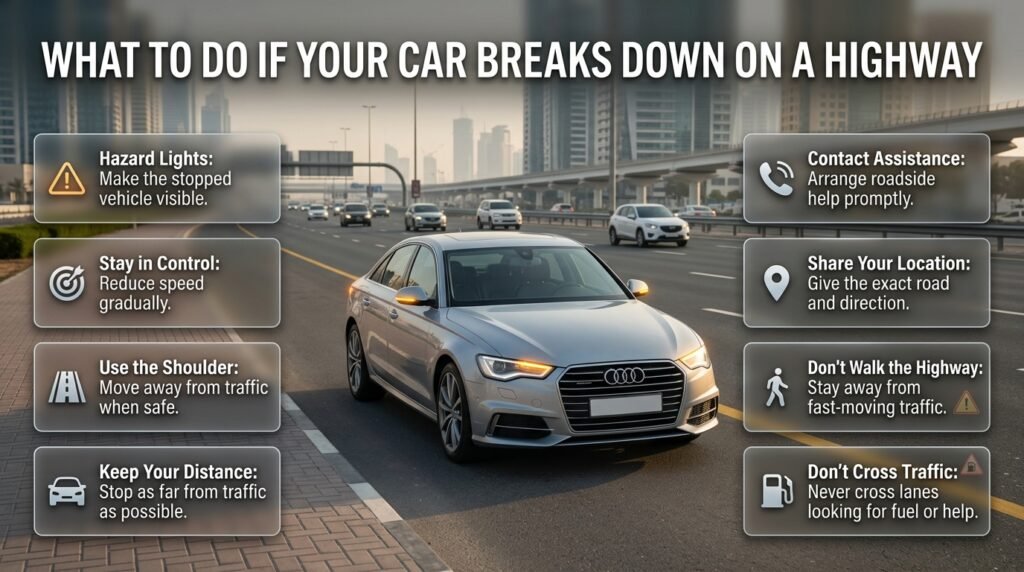
Highway breakdowns require additional caution because vehicles are travelling at higher speeds.
A driver approaching your stopped vehicle may have very little time to react.
If you notice a problem while driving on a highway:
- Switch on your hazard lights.
- Keep the vehicle under control.
- Reduce speed gradually.
- Move toward the shoulder if it is safe.
- Stop as far away from moving traffic as reasonably possible.
- Keep the hazard lights operating.
- Contact roadside assistance.
- Give your exact location and direction of travel.
- Avoid walking along the highway.
- Don’t cross traffic lanes looking for help.
If your vehicle has stopped in an extremely dangerous position and cannot move, don’t put yourself in greater danger by attempting a complicated repair.
Contact the appropriate emergency or roadside assistance service and follow their instructions.
Don’t Walk Along the Highway
This is one of the most important safety rules.
A petrol station may appear to be only a short distance away, but walking beside fast-moving traffic is extremely risky.
The same applies to walking to find a mechanic, asking another driver for help, or crossing the highway.
If your vehicle is out of fuel, professional fuel delivery is usually a much safer option than walking beside a high-speed road.
What Should You Do If Your Car Runs Out of Fuel?
Running out of petrol is one of the most common reasons a vehicle becomes stranded.
The situation can be especially stressful when the fuel warning light has been ignored for too long and the vehicle finally stops in traffic.
If you’ve run out of fuel:
- Turn on hazard lights.
- Keep calm.
- Move the vehicle away from traffic if it can still be moved safely.
- Don’t attempt to push the vehicle in a dangerous traffic area.
- Don’t walk along the road searching for petrol.
- Don’t cross highways to find a fuel station.
- Arrange fuel delivery or roadside assistance.
- Give the provider your exact location.
You can read the detailed guide on what to do when you run out of fuel in Dubai.
If the vehicle has already stopped, focus on safety rather than repeatedly trying to restart the engine.
What If the Fuel Gauge Was Already Near Empty?
A common mistake is assuming the remaining range shown on the dashboard is guaranteed.
The estimated range can change depending on:
- Traffic
- Air-conditioning use
- Driving speed
- Vehicle load
- Driving style
- Road conditions
- Fuel consumption
So don’t treat the displayed range as an exact promise.
If you’re already close to empty, refuelling before the tank reaches its final reserve is a much safer habit.
For additional safety guidance, see car ran out of fuel safety in Dubai.
You can also read:
- Safely Dealing With an Empty Fuel Tank in Dubai
- Steps After Running Out of Petrol
- Running Out of Fuel on the Road
These resources are particularly useful when an empty fuel tank is the direct cause of the breakdown.
What Should You Do If Your Engine Overheats?
An overheating engine shouldn’t be treated like a minor dashboard warning.
If the temperature gauge rises significantly, a temperature warning appears, or you see steam coming from the engine compartment, reduce your speed and look for a safe place to stop.
Once stopped:
- Turn off the engine when appropriate.
- Stay away from escaping steam.
- Don’t immediately open the radiator cap.
- Don’t touch hot engine components.
- Allow the vehicle to cool.
- Arrange professional assistance if necessary.
Why Shouldn’t You Open a Hot Radiator?
The cooling system can be extremely hot and pressurized.
Opening the radiator cap while the engine is hot can release hot coolant or steam and cause serious burns.
⚠️ Common Mistake: Drivers sometimes think adding coolant immediately is the fastest solution. If the engine is still extremely hot, opening the cooling system can be dangerous. Let it cool and get professional help when necessary.
Should You Continue Driving an Overheating Car?
Usually, continuing to drive an overheating vehicle isn’t worth the risk.
You may think you’re only a few kilometres from home or a workshop, but continued driving can turn a cooling problem into severe engine damage.
The safer decision is to stop and assess the situation.
What Should You Do If You Get a Flat Tyre?
A flat tyre can happen suddenly or develop gradually.
You might notice:
- Steering becoming heavier
- The vehicle pulling to one side
- Vibration
- Repeated thumping
- Tyre-pressure warning
- Unusual road noise
If you notice these symptoms, reduce speed smoothly and avoid aggressive steering.
Try to reach a safe stopping area.
Should You Change the Tyre Yourself?
Only if the vehicle is in a genuinely safe location.
Changing a tyre beside fast-moving traffic can be dangerous even if you have all the necessary tools.
Before starting:
- Make sure the vehicle is stable.
- Make sure you’re well away from moving traffic.
- Use the parking brake.
- Follow the vehicle manufacturer’s instructions.
- Keep passengers away from the work area.
If the location is unsafe, call roadside assistance instead.
What Should You Do If Your Battery Dies?
A dead battery can happen after leaving lights on, using accessories while the engine is off, or because the battery has reached the end of its service life.
Signs can include:
- Slow engine cranking
- Clicking when starting
- Dim interior lights
- Weak headlights
- Electrical systems not working
- Complete lack of response
If you’re stranded, don’t keep attempting to start the engine repeatedly.
Repeated attempts can drain the remaining battery power.
If you know how to safely perform a jump-start and have suitable equipment, follow the manufacturer’s instructions.
Otherwise, professional assistance is the safer option.
Modern vehicles can contain sensitive electronic systems, so incorrect jump-start connections can cause expensive damage.
What Should You Do If Your Car Stops at Night?
A night-time breakdown presents a visibility problem.
You may be able to see your own vehicle clearly, but other drivers may not.
Keep hazard lights on and avoid standing close to moving traffic.
If you’re safely able to use additional warning equipment, make the vehicle more visible.
However, don’t walk into traffic just to place a warning device.
Your own safety comes first.
Night Breakdown Checklist
- Hazard lights on
- Vehicle safely positioned
- Passengers away from traffic
- Phone charged
- Exact location identified
- Roadside assistance contacted
- No unnecessary walking
- No unsafe roadside repairs
If you’re waiting for assistance, remain alert to your surroundings.
How Should You Handle a Breakdown in Dubai’s Extreme Heat?
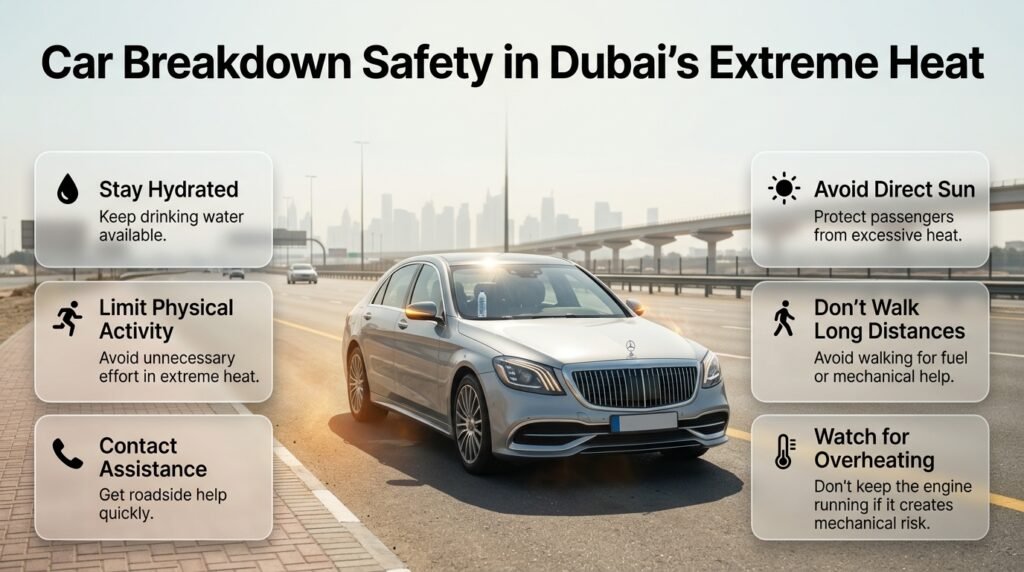
Dubai’s climate creates an additional challenge during roadside emergencies.
Extreme temperatures can quickly make an outdoor breakdown uncomfortable and potentially dangerous.
This is particularly important when:
- You have children in the vehicle.
- You’re stranded far from a building.
- Your air conditioning isn’t working.
- The vehicle has overheated.
- You have no drinking water.
- You’re waiting in direct sunlight.
What Should You Do?
Contact assistance quickly.
Avoid unnecessary physical activity.
Stay hydrated.
Don’t walk long distances looking for a petrol station or mechanic.
If it is safe to remain inside the vehicle temporarily, use the vehicle’s available protection from the sun, but don’t keep the engine running if doing so creates an overheating or mechanical risk.
If smoke, fire, or another serious hazard develops, leave the vehicle and move to a safe location.
How Do You Make a Broken-Down Vehicle Visible?
Visibility is a major part of roadside safety.
Other drivers need to understand that your vehicle isn’t moving normally.
Basic visibility measures include:
- Hazard warning lights
- Safe vehicle positioning
- Appropriate warning equipment when safe to use
- Staying out of traffic lanes
- Avoiding sudden movements around the vehicle
Don’t rely entirely on hazard lights.
A vehicle positioned around a blind corner can still be difficult for approaching drivers to see.
That’s why getting as far away from moving traffic as reasonably possible is so important.
Should You Stay Inside the Vehicle During a Breakdown?
There isn’t a single answer for every breakdown.
The safest option depends on the exact circumstances.
If your vehicle is completely away from traffic and there is no immediate danger, staying inside with your seat belt fastened may be reasonable while waiting for assistance.
However, if the vehicle is on fire, filling with dangerous smoke, leaking fuel, or presenting another immediate hazard, staying inside may not be safe.
If you can safely move to a protected area away from traffic, that may be preferable.
The key is to avoid two extremes:
Don’t automatically stay inside.
Don’t automatically get out.
Assess the actual danger around you.
What Information Should You Give Roadside Assistance?
When you’re stressed, it’s easy to give incomplete information.
Instead of saying:
“My car broke down in Dubai.”
Provide useful location information.
Tell the assistance provider:
- Road name
- Direction of travel
- Nearest exit
- Nearby landmark
- Building or hotel name
- Parking area
- Vehicle make
- Vehicle model
- Vehicle colour
- Nature of the breakdown
- Whether the vehicle is blocking traffic
- Whether passengers are present
If your phone allows you to share your location, use that feature where appropriate.
Example
A weak location description would be:
“I’m on Sheikh Zayed Road.”
A better description would include your direction, nearby exit or landmark, and exact stopping location.
This can save valuable time.
What Should You Do If Your Vehicle Breaks Down in a Parking Area?
Not every breakdown happens on a highway.
Your vehicle might refuse to start in:
- Shopping mall parking
- Residential parking
- Hotel parking
- Office parking
- Underground parking
- Petrol station
- Public parking area
These situations are usually safer than a highway breakdown, but you still need to consider surrounding vehicles and pedestrians.
Turn on hazard lights and move the vehicle only if it can be done safely.
If the vehicle won’t start, don’t keep turning the ignition repeatedly.
Contact the appropriate service and tell them exactly where the vehicle is parked.
For underground car parks, mention the parking level and section number if available.
What Should You Keep in Your Vehicle for an Emergency?
Preparation can make breakdown situations much easier.
A practical emergency kit can include:
- Drinking water
- Phone charging cable
- Power bank
- Flashlight
- Basic first-aid supplies
- Reflective safety equipment
- Gloves
- Tyre-pressure gauge
- Portable tyre inflator
- Vehicle documentation
- Emergency contact information
In Dubai, water is particularly important.
You don’t need to carry a huge toolbox.
The objective is to have items that improve safety and communication.
A breakdown kit shouldn’t encourage you to perform complex mechanical work beside a busy road.
Vehicle Breakdown Safety Procedures for Different Problems
Different failures require slightly different responses.
| Breakdown problem | Immediate priority | What to avoid |
|---|---|---|
| Empty fuel tank | Move away from traffic and arrange fuel | Walking beside highway |
| Flat tyre | Reach a safe stopping area | Changing tyre beside traffic |
| Dead battery | Secure vehicle and arrange assistance | Repeated starting attempts |
| Overheating | Stop and allow vehicle to cool | Continuing to drive |
| Brake problem | Stop as safely as possible | Driving to a workshop |
| Engine failure | Hazard lights and safe positioning | Repeated restart attempts |
| Electrical fault | Secure vehicle | Unqualified electrical repairs |
| Smoke/fire | Leave danger area and seek emergency help | Continuing to drive |
The exact response depends on the severity of the problem.
When you’re uncertain, choose the safer option.
What Are the Most Common Vehicle Breakdown Safety Mistakes?
Understanding what not to do is just as important as knowing what to do.
1. Standing Behind the Vehicle
Some drivers stand directly behind the car while waiting for assistance.
This creates unnecessary exposure to vehicles approaching from behind.
Stay in the safest available position.
2. Trying to Repair the Vehicle Immediately
The driver may open the bonnet, remove tools, or start investigating before checking traffic.
That’s the wrong order.
First establish safety.
Then consider the mechanical problem.
3. Walking to Find Petrol
This is particularly dangerous on major roads.
Even if a fuel station appears close, walking beside traffic can expose you to serious risks.
Arrange assistance instead.
4. Ignoring an Overheating Warning
Drivers sometimes continue driving because the destination is close.
This can cause expensive engine damage.
Stop when it’s safe.
5. Repeatedly Restarting the Vehicle
If the car isn’t starting, repeatedly turning the ignition isn’t necessarily going to solve the problem.
It can drain the battery and may complicate diagnosis.
6. Forgetting the Exact Location
Stress can make drivers give vague information.
Before calling, look for:
- Road signs
- Exit numbers
- Building names
- Landmarks
- Parking levels
- Direction of travel
7. Standing in the Traffic Lane
This is perhaps the most serious mistake.
Never assume approaching drivers will notice you.
What Should You Do If There Is Smoke or Fire?
Smoke should never be ignored.
If you see smoke coming from the engine compartment or underneath the vehicle, stop as safely as possible.
If there is an actual fire:
- Leave the vehicle.
- Move away from the vehicle.
- Keep passengers with you.
- Stay away from traffic where possible.
- Contact emergency services.
- Don’t put yourself at risk attempting to extinguish a serious vehicle fire.
Never continue driving a vehicle that appears to be on fire.
Don’t open the bonnet unnecessarily if doing so could expose you to flames or increase the danger.
When Should You Call Emergency Services?
Not every breakdown is an emergency.
A flat tyre or empty fuel tank without immediate danger may normally require roadside assistance.
Emergency services should be contacted when there is an immediate threat to people, such as:
- Serious collision
- Fire
- Injury
- Dangerous fuel or fluid leak
- Vehicle stopped in a highly dangerous position
- Immediate risk from traffic
- Another serious safety emergency
When there is a genuine emergency, don’t delay while trying to arrange a normal mechanical repair.
What Do Professional Roadside Technicians Recommend?
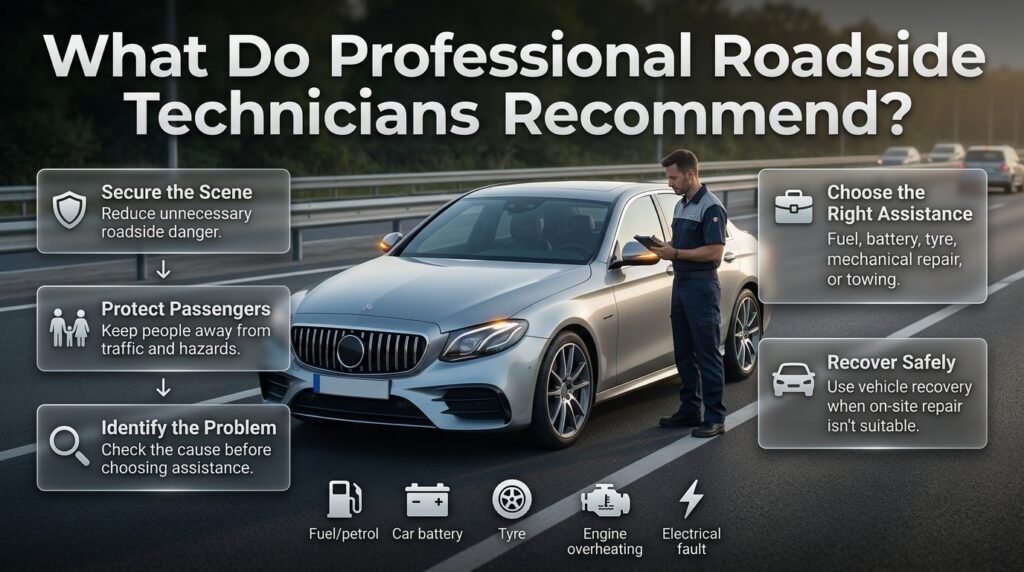
Professional technicians usually focus on separating the safety problem from the mechanical problem.
First, they want the vehicle and people in a safer position.
Then they determine why the vehicle stopped.
Then they decide whether the car can be repaired on-site or requires recovery.
This approach prevents a common mistake: becoming so focused on the vehicle that the driver forgets about surrounding traffic.
A practical professional sequence is:
1. Secure the scene
Make sure the vehicle isn’t creating unnecessary danger.
2. Protect passengers
Keep people away from traffic and mechanical hazards.
3. Identify the problem
Determine whether it’s fuel, battery, tyre, overheating, electrical, or another issue.
4. Choose the correct assistance
Fuel delivery, battery service, tyre assistance, mechanical repair, or towing may be appropriate.
5. Recover the vehicle safely
If the vehicle cannot be repaired safely at the location, professional recovery may be necessary.
⭐ Expert Tip: Don’t try to prove that you can repair the vehicle yourself. A roadside environment isn’t a workshop. If the location is dangerous, professional assistance is usually the smarter decision.
How Can You Reduce the Chance of a Breakdown?
The best breakdown is the one you prevent.
Regular vehicle maintenance can identify problems before they leave you stranded.
Check these areas regularly:
- Engine oil
- Coolant
- Battery
- Tyres
- Tyre pressure
- Brakes
- Lights
- Belts
- Hoses
- Fuel level
- Warning lights
- Air-conditioning system
Don’t ignore small symptoms.
For example, if your vehicle takes longer than normal to start, investigate the battery before it eventually fails in a car park or on the road.
If the temperature gauge behaves differently than usual, investigate the cooling system.
If a tyre repeatedly loses pressure, find the cause instead of repeatedly inflating it.
Prevention is usually easier than roadside recovery.
How Can Drivers Prepare Before a Long Dubai Journey?
Long journeys require additional preparation.
Before leaving:
Check the vehicle
Look at tyre condition and pressure, fluid levels, battery condition, and warning lights.
Check the fuel
Don’t start a long trip with an unnecessarily low fuel level.
Charge your phone
You need reliable communication if something goes wrong.
Carry water
This is particularly important in hot weather.
Know your route
Understand major roads, exits, and likely stopping points.
Share your travel plans
If appropriate, let someone know where you’re going and your expected arrival time.
Keep emergency contacts accessible
Don’t wait until you’re stranded to search for help.
What Should Passengers Do During a Breakdown?
Passengers also need clear instructions.
The driver should explain the situation calmly.
Children shouldn’t be allowed to move around near traffic.
Passengers shouldn’t stand on the road side of the vehicle unnecessarily.
If everyone must leave the vehicle, choose the safest available direction away from moving traffic when circumstances permit.
Avoid separating the group.
One person can communicate with the assistance provider while another stays with passengers.
The goal is to keep everyone calm and accounted for.
What Should You Do After Roadside Assistance Arrives?
When assistance arrives, don’t immediately assume everything is safe.
Wait for the technician and follow their instructions.
Explain:
- What happened
- When it started
- What warning lights appeared
- Whether you heard unusual sounds
- Whether the vehicle overheated
- Whether it lost power
- Whether you attempted a restart
- Whether you noticed smoke or leaking fluid
This information can help the technician diagnose the problem more efficiently.
If the vehicle is repaired temporarily, ask whether it is safe to continue driving.
A vehicle starting again doesn’t necessarily mean the original problem has disappeared.
How Can You Stay Safe While Waiting for Assistance?
Waiting can be frustrating, especially when you’re in a hurry.
But don’t allow impatience to create another problem.
While waiting:
- Keep monitoring traffic.
- Keep hazard lights operating when appropriate.
- Stay away from the traffic lane.
- Keep your phone available.
- Stay hydrated.
- Don’t attempt unnecessary repairs.
- Keep passengers together.
- Watch for changes in vehicle condition.
- Follow instructions from the assistance provider.
If the situation changes—for example, smoke develops or the vehicle becomes more exposed to traffic—update the assistance provider or emergency services.
Vehicle Breakdown Safety Procedures: Quick Checklist
Save this checklist mentally:
Before stopping
- Stay calm.
- Maintain steering control.
- Reduce speed gradually.
- Turn on hazard lights.
- Look for a safe stopping position.
After stopping
- Secure the vehicle.
- Keep away from moving traffic.
- Assess smoke, fire, leaks, and overheating.
- Protect passengers.
- Avoid unnecessary repairs.
When calling for assistance
- Give your exact location.
- Mention your direction of travel.
- Provide a nearby landmark.
- Explain the vehicle problem.
- Mention whether the vehicle blocks traffic.
- Tell them about any immediate hazard.
While waiting
- Stay visible.
- Stay hydrated.
- Keep passengers safe.
- Don’t walk along highways.
- Don’t attempt dangerous repairs.
What should you do first when your vehicle breaks down on the road?
The first priority is not repairing the vehicle—it is getting yourself and your passengers out of immediate danger. Stay calm, maintain control of the vehicle, switch on the hazard lights, and reduce speed gradually. If the vehicle is still controllable, move toward a shoulder, emergency stopping area, parking area, or another safe position away from moving traffic.
Once stopped, assess the surroundings before opening the doors or getting out. Look for passing traffic, smoke, fire, leaking fluids, overheating, or any other immediate hazard. If the location is unsafe, don’t start inspecting the engine or changing a tyre simply because you want to find the problem quickly.
A useful order to remember is:
Maintain control of the vehicle
Move away from traffic if it is safe
Switch on hazard lights
Secure the vehicle
Protect passengers
Assess immediate hazards
Contact appropriate roadside assistance
The UAE’s official traffic information specifically includes failure to take the necessary road-safety measures during a vehicle breakdown as a traffic violation, which shows why proper breakdown procedures shouldn’t be treated as optional.
The biggest mistake is becoming so focused on the mechanical problem that you forget about the traffic around you. A flat tyre, dead battery, or empty fuel tank can normally be dealt with; being exposed to moving traffic is a much more serious risk.
What should you do if your car breaks down on a highway?
A highway breakdown needs extra caution because vehicles around you may be travelling at high speed and have limited time to react. If your vehicle begins losing power, turn on the hazard lights, maintain steering control, reduce speed smoothly, and move toward the shoulder or another designated safe stopping area if you can do so safely.
Once stopped, keep as much distance as reasonably possible between your vehicle and moving traffic. Don’t walk along the highway, cross traffic lanes, or stand directly beside the vehicle while vehicles are passing close by.
Your priority should be:
Move to a safer position if the vehicle can still be driven safely.
Keep hazard lights operating.
Avoid standing in an active traffic lane.
Don’t attempt a complicated roadside repair.
Don’t walk to find fuel or a mechanic.
Give roadside assistance your exact location.
Follow the instructions of emergency or roadside personnel.
If the vehicle cannot be moved safely, don’t take an unnecessary risk just to get it farther away. A car with a serious steering, braking, collision, or mechanical problem may be more dangerous to drive.
It’s also important to remember that other motorists may not immediately recognize a disabled vehicle. NHTSA’s roadside guidance emphasizes preparing for breakdowns with an emergency kit and planning ahead because even a well-maintained vehicle can fail unexpectedly.
Professional advice: On a high-speed road, don’t measure your decision by how quickly you can fix the car. Measure it by how effectively you can keep people away from moving traffic.
Should you stay inside your car when it breaks down?
There isn’t one universal answer because the safest option depends on where the vehicle has stopped and what hazards are present. If the vehicle is safely away from traffic and there is no immediate danger such as fire or smoke, remaining inside with your seat belt fastened may be appropriate while waiting for assistance.
However, if the vehicle is in an extremely dangerous position, has caught fire, is producing significant smoke, or presents another immediate hazard, staying inside may not be the safest choice. In that situation, the priority is moving yourself and your passengers away from the immediate danger, provided you can do so safely.
Before getting out, consider:
How close is moving traffic?
Is the vehicle completely off the road?
Is there smoke or fire?
Is fuel leaking?
Is there a safe area away from traffic?
Can you leave without stepping into moving vehicles?
Are children or other passengers with you?
Don’t automatically assume that getting out is always safer, and don’t automatically assume that staying inside is always safer.
The circumstances matter.
If you’re on a busy Dubai road with vehicles passing close to your car, standing outside to inspect the engine can expose you to unnecessary danger. On the other hand, remaining inside a vehicle with a serious fire or other immediate hazard is obviously not a sensible option.
The professional approach is to assess the surrounding danger first, then decide where people are safest—not where the vehicle is easiest to inspect.
What should you do if your car runs out of fuel while driving?
Running out of fuel can leave you stranded unexpectedly, but the situation is usually manageable if you respond correctly. Switch on your hazard lights and, if the vehicle can still be moved safely, get it as far away from moving traffic as possible.
Once the vehicle is stopped, don’t start walking along the road looking for a petrol station. This is particularly important on highways, major roads, and unfamiliar routes where pedestrians may be exposed to fast-moving traffic.
Instead:
Keep the vehicle visible.
Stay away from active traffic lanes.
Identify your exact location.
Check the direction of travel.
Note nearby landmarks, exits, or buildings.
Contact a fuel delivery or roadside assistance service.
Tell the provider exactly what fuel the vehicle requires.
Wait in the safest available location.
For Dubai drivers, emergency fuel delivery can be a practical solution when an empty tank is the reason for the breakdown. Fuel Delivery Dubai can be used as a resource for motorists who need fuel brought to their location.
You can also link this FAQ naturally to your detailed fuel-safety content:
What to Do When Your Car Runs Out of Fuel in Dubai
Car Ran Out of Fuel Safety in Dubai
Safely Dealing With an Empty Fuel Tank in Dubai
Steps After Running Out of Petrol
Running Out of Fuel on the Road
Expert advice: Don’t judge the safety of walking for fuel by distance alone. A petrol station that’s only a few minutes away by car may be an unsafe walk because of traffic, road design, heat, and the lack of pedestrian access.
What should you do if your vehicle breaks down in extreme heat?
In Dubai, a roadside breakdown can become more difficult because extreme heat adds another problem to an already stressful situation. The priority is to reduce unnecessary exposure to heat while keeping yourself and passengers safe.
If the vehicle breaks down during very hot weather, move it to a safe location away from traffic if it remains controllable. Turn on hazard lights, contact assistance promptly, and avoid unnecessary physical work beside the vehicle.
If the engine has overheated, don’t keep driving simply because you think the destination or workshop is nearby. Continuing to operate an overheating engine can turn a manageable cooling-system problem into major engine damage.
While waiting for assistance:
Keep drinking water available.
Avoid unnecessary physical activity.
Protect children and passengers from direct heat.
Don’t walk long distances looking for help.
Don’t attempt a complicated roadside repair.
Monitor the vehicle for smoke, fire, or worsening conditions.
Give the assistance provider your precise location.
NHTSA also recommends carrying water, a charged phone, first-aid supplies, a flashlight, and other emergency-roadside equipment because even properly maintained vehicles can experience unexpected failures.
If you see smoke or fire, the situation changes completely. Don’t continue trying to diagnose the mechanical problem. Move away from the immediate hazard and contact the appropriate emergency service.
For UAE emergencies, the official government platform lists 999 for police, 998 for ambulance, and 997 for Civil Defence/fire.
Professional advice: In extreme heat, don’t turn a simple breakdown into a physical endurance test. Arrange assistance early, minimize time outside the vehicle, and treat overheating or fire as a mechanical safety issue rather than something to “push through.”
Conclusion
A vehicle breakdown can be stressful, but the right response can keep a difficult situation from becoming a dangerous one. The most important part of vehicle breakdown safety procedures is to put people before the vehicle. Stay calm, maintain control, switch on your hazard lights, and move away from moving traffic when it is safe to do so.
Whether you’re dealing with an empty fuel tank, flat tyre, dead battery, overheating engine, or another mechanical problem, don’t take unnecessary risks trying to fix the vehicle on the roadside. Give roadside assistance your exact location, keep passengers protected, and follow professional instructions while waiting for help.
For Dubai drivers, extreme heat and busy roads make preparation even more important. Keeping water, a charged phone, basic emergency equipment, and reliable assistance contacts in your vehicle can make a roadside emergency much easier to handle.
Remember the most important rule: get yourself and your passengers safe first, make the vehicle visible, and then deal with the breakdown. A vehicle can be repaired or recovered; your safety should never be compromised to save a few minutes.
Leave a Reply