Introduction
Roadside Breakdown Safety Tips | A car breakdown can happen at the worst possible time. You may be travelling to work, driving on a busy highway, heading home after a long day, or simply running an errand when the engine suddenly loses power. In that moment, the most important thing isn’t figuring out what’s wrong with the car. It’s making sure you, your passengers, and other road users remain safe.
Knowing practical roadside breakdown safety tips helps you respond calmly instead of making a rushed decision. Whether the problem is an empty fuel tank, flat tyre, dead battery, overheating engine, warning light, or complete mechanical failure, the first few minutes matter.
For drivers who need practical help with fuel-related emergencies in Dubai,Emergency Petrol Near Me 👉 Fuel Delivery Dubai
provides information and emergency fuel-related guidance. However, getting fuel is only one part of a roadside emergency. You also need to know how to position your vehicle, when to stay inside, when to leave the vehicle, how to deal with traffic, and when professional assistance is safer than attempting a repair yourself.
This guide explains what to do before, during, and after a roadside breakdown, with practical advice for Dubai driving conditions and everyday situations.
What Should You Do First When Your Car Breaks Down?
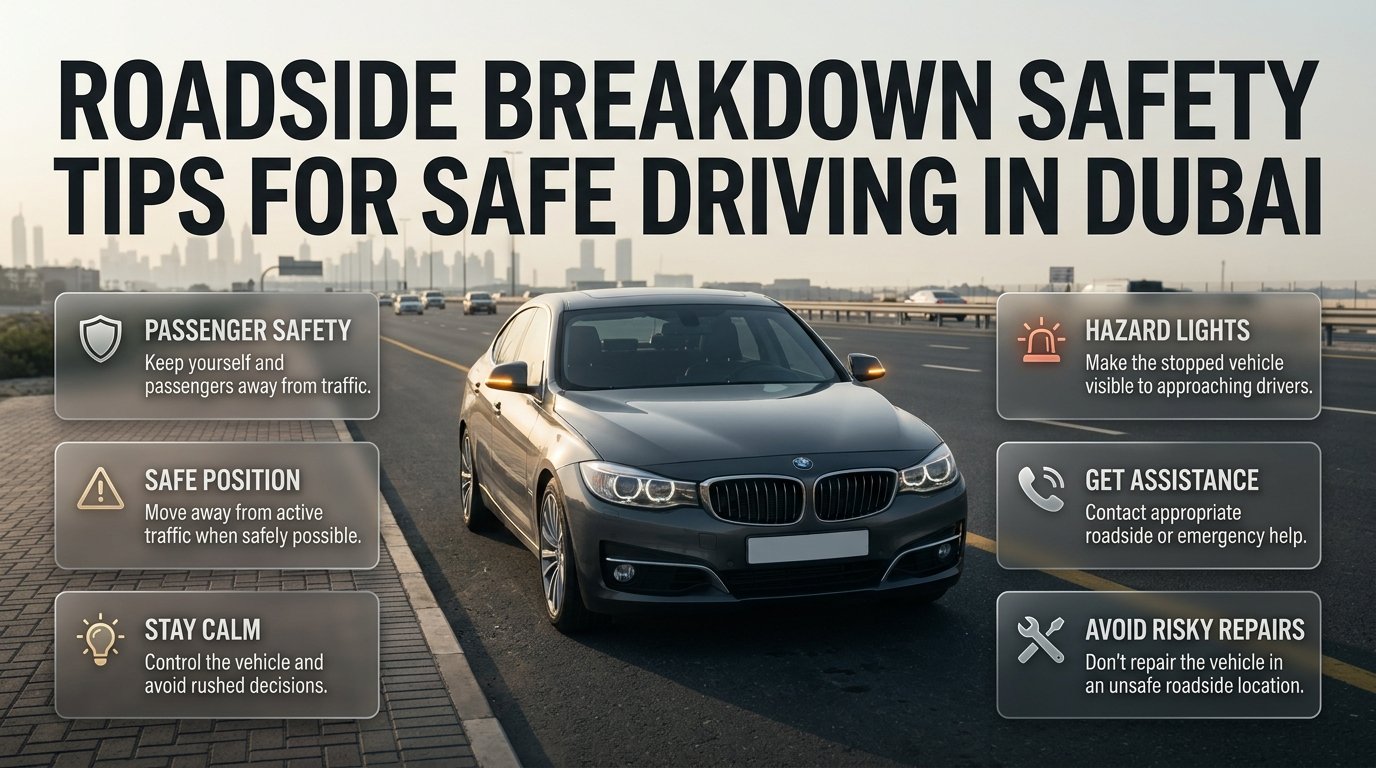
When a car breaks down, the first priority is to reduce the danger around you. If the vehicle is still controllable, move it toward the safest available location, activate your hazard lights, and avoid unnecessary roadside repairs until you have assessed the traffic and surroundings.
A breakdown can create a dangerous situation because a stationary vehicle isn’t always expected by approaching drivers.
Your first response should be:
Stay calm → Control the vehicle → Move away from traffic → Make the vehicle visible → Assess the situation → Get help
Don’t immediately jump out of the car.
Don’t start checking the engine while vehicles are passing close to you.
Don’t try to diagnose the problem before thinking about your location.
The mechanical fault can usually wait for a few minutes. Your safety can’t.
Stay Calm and Keep Control
If the engine begins to lose power, steering becomes difficult, or the vehicle behaves strangely, avoid sudden movements.
Keep control of the steering wheel and gradually reduce speed where possible.
Look for a safe area where you can stop without creating an additional hazard.
If you’re already stopped, don’t attempt to move the vehicle if doing so would put you or other drivers at greater risk.
Turn on Your Hazard Lights
Hazard warning lights alert approaching drivers that your vehicle is stationary or experiencing a problem.
Use them when appropriate, especially when your vehicle has stopped unexpectedly.
However, remember that hazard lights aren’t a protective barrier.
A driver travelling too quickly or failing to notice your vehicle can still create a collision risk.
Move Away From Traffic If It Is Safe
If your vehicle can still be driven safely, try to move toward an area away from active traffic.
Depending on the road, this could be:
- A designated emergency stopping area
- A safe shoulder
- A parking area
- A service area
- A side road
- Another suitable location away from moving vehicles
Don’t make a risky lane change just to reach a particular stopping point.
Your goal isn’t to find the perfect parking space.
Your goal is to reach the safest practical position.
💡 Pro Tip: If you notice a problem before the vehicle completely stops, start thinking about where you can safely pull over immediately. Waiting until the car loses all power may leave you with fewer options.
Why Is Roadside Breakdown Safety More Important Than Repairing the Car?
A mechanical problem is inconvenient, but traffic can turn it into a serious safety issue.
Drivers often focus on the vehicle because that’s what has gone wrong. They open the bonnet, inspect the tyre, check the engine, or start searching for tools.
But on a busy road, the greatest immediate danger may have nothing to do with the engine.
It may be:
- Fast-moving traffic
- Poor visibility
- A narrow shoulder
- A blind corner
- Another driver changing lanes
- Extreme heat
- A vehicle approaching from behind
- Pedestrians standing too close to the road
This is why professional roadside safety starts with the location, not the mechanical fault.
A dead battery in a safe parking area is one problem.
A dead battery on the shoulder of a busy highway is a completely different safety situation.
The battery may be identical.
The risk isn’t.
Where Should You Stop if Your Car Starts Failing?
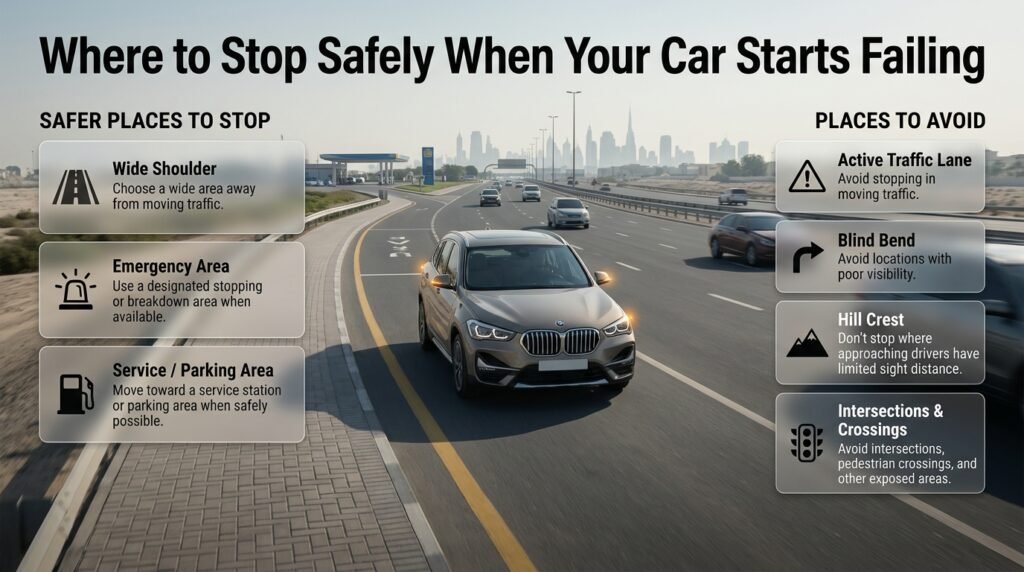
The best stopping location is one that creates the greatest practical separation between your vehicle and moving traffic.
If you recognize that your car is developing a problem while driving, look ahead rather than waiting until the vehicle becomes completely disabled.
Safer Places to Stop
Depending on the road layout, safer options may include:
- Emergency stopping areas
- Wide shoulders
- Designated breakdown areas
- Service stations
- Parking areas
- Safe side roads
- Other areas clearly separated from moving traffic
Places to Avoid
Try not to stop in:
- Active traffic lanes
- Blind bends
- The crest of a hill
- Narrow road shoulders
- Intersections
- Pedestrian crossings
- Areas with poor visibility
- Locations where passing vehicles come extremely close
Sometimes you won’t have a choice.
If the vehicle stops in a dangerous location, don’t blame yourself or waste time trying to find a better spot.
Focus on making the situation as safe as possible from where you are.
Should You Stay Inside Your Car During a Breakdown?
There isn’t one answer that applies to every breakdown.
Whether you should stay inside or leave depends on the location of the vehicle, traffic conditions, road design, and immediate hazards.
If getting outside would place you directly beside fast-moving traffic, leaving the vehicle may create more danger.
On the other hand, if the vehicle is exposed to fire, serious smoke, fuel leakage, or another immediate hazard, leaving may become necessary.
When Staying Inside May Be Safer
Remaining inside may be appropriate when:
- Traffic is moving very close to the vehicle
- There is no safe pedestrian area
- Leaving would require entering a live traffic lane
- The vehicle is in a relatively protected position
- There is no immediate fire or similar hazard
Keep your seat belt fastened when appropriate and contact roadside assistance.
When Leaving May Be Necessary
If there is:
- Fire
- Significant smoke
- A serious fuel leak
- Immediate risk of collision
- Another dangerous condition
you may need to move away from the vehicle.
If you can exit safely, use the side away from moving traffic where possible and move to a safer location.
⭐ Expert Tip: Don’t follow a rigid rule such as “always stay in the car” or “always get out.” Roadside safety depends on the actual conditions around you.
What Should You Do if Your Car Breaks Down on a Highway?
Highway breakdowns require extra caution because approaching vehicles may be travelling at high speeds.
If your car begins losing power on a highway, keep control and reduce speed gradually.
If the vehicle remains controllable, move toward the safest available stopping area.
Once stopped, activate your hazard lights and assess your surroundings.
Don’t stand beside the vehicle simply because you’re waiting for help.
Don’t walk along the highway looking for a petrol station.
Don’t attempt a complicated repair on a narrow shoulder.
Highway Breakdown Safety Sequence
Use this simple sequence:
1. Control the vehicle
Avoid sudden steering or braking.
2. Move away from traffic
If possible and safe, reach a suitable stopping location.
3. Make the vehicle visible
Use hazard warning lights.
4. Protect passengers
Keep everyone away from traffic where possible.
5. Call for assistance
Give your exact location and explain the problem.
6. Wait safely
Stay alert and follow professional or emergency instructions.
The highway environment is not the place to experiment with mechanical repairs.
What If Your Car Stops in the Middle of Traffic?
A vehicle that stops in an active lane presents a more urgent problem because approaching drivers may have little time to react.
Turn on hazard lights immediately.
If the vehicle can be moved safely, follow the road conditions and move it away from the active traffic flow.
If it cannot move, don’t put yourself in danger by attempting to push it through moving traffic.
Contact appropriate assistance.
Provide your location clearly.
If there is an immediate danger of collision or another emergency, contact the relevant emergency service.
The important thing is to avoid turning one breakdown into a second accident.
What Should You Do in Heavy Traffic?
Heavy traffic can create a false sense of safety because vehicles may be moving slowly.
But stop-and-go traffic still creates risks.
Drivers constantly change lanes, move around stopped vehicles, look at navigation screens, and react to gaps in traffic.
If your vehicle breaks down in congestion:
- Turn on hazard lights.
- Move toward the edge of the road if safely possible.
- Avoid standing between vehicles.
- Keep passengers away from moving traffic.
- Don’t attempt repairs in an active lane.
- Contact appropriate assistance.
- Remain aware of changing traffic conditions.
If you’re unable to move the vehicle, make it visible and get help rather than trying to solve the mechanical problem yourself.
What Should You Do If You Run Out of Fuel?
Running out of fuel is a common reason for becoming stranded.
The response should be similar to any other roadside breakdown.
First, try to move the vehicle to a safer location if it can still be controlled.
Then activate the hazard lights and arrange fuel assistance or roadside support.
If you want a dedicated guide to the immediate response, see Emergency Roadside Fuel Advice.
Running out of petrol isn’t just an inconvenience when it happens on a busy road.
The vehicle may lose power at an unexpected location, leaving you exposed to traffic.
Don’t Keep Restarting the Engine
If you believe the tank is empty, repeatedly attempting to start the engine isn’t a useful solution.
It may not get you anywhere and can distract you from the more important task of arranging assistance.
Don’t Walk Along a Highway
A common reaction is to leave the car and walk toward the nearest petrol station.
That can be dangerous, particularly on high-speed roads.
If you need fuel, arrange appropriate assistance instead of creating a separate pedestrian safety problem.
For a complete guide, read What to Do When Your Car Runs Out of Fuel in Dubai.
What If Your Car Runs Out of Fuel on the Road?
The exact response depends on where the vehicle stops.
If you’re safely off the main traffic flow, remain in a secure position while arranging assistance.
If the vehicle is exposed to moving traffic, your priority is to reduce that exposure.
A fuel emergency doesn’t justify standing beside a dangerous road.
You can learn more about this situation in Running Out of Fuel on the Road.
What If the Fuel Gauge Wasn’t Accurate?
Fuel gauges aren’t always perfectly precise, especially when the vehicle is parked on an incline or when the remaining fuel level is very low.
That’s another reason not to treat the fuel warning as a target.
If you regularly wait until the tank is nearly empty before refuelling, you’re increasing the chance of being stranded in an inconvenient location.
How Should You Deal With an Empty Fuel Tank Safely?
Once the vehicle has stopped because of an empty tank, don’t treat the situation like an ordinary refuelling stop.
Think about:
Vehicle position → Traffic → Passenger safety → Communication → Fuel assistance
If the vehicle is in a safe location, wait there for assistance.
If it’s in a dangerous location, follow appropriate roadside or emergency guidance.
The key lesson is simple: getting petrol isn’t more important than getting yourself out of danger.
For additional practical guidance, see Safely Dealing With an Empty Fuel Tank in Dubai.
What Should You Do After Running Out of Petrol?
Once you’ve safely stopped, avoid unnecessary movement around the vehicle.
Activate hazard lights where appropriate and arrange assistance.
Tell the provider:
- Your exact location
- Road name
- Direction of travel
- Nearby landmark or exit
- Vehicle make and model
- That the vehicle has run out of fuel
- Whether passengers are present
- Whether you’re blocking traffic
For a step-by-step breakdown of the situation, see Steps After Running Out of Petrol.
This information is especially useful because the safest response can change depending on whether you’re in a parking area, on an urban road, or beside a high-speed highway.
What Should You Do if Your Car Is Smoking?
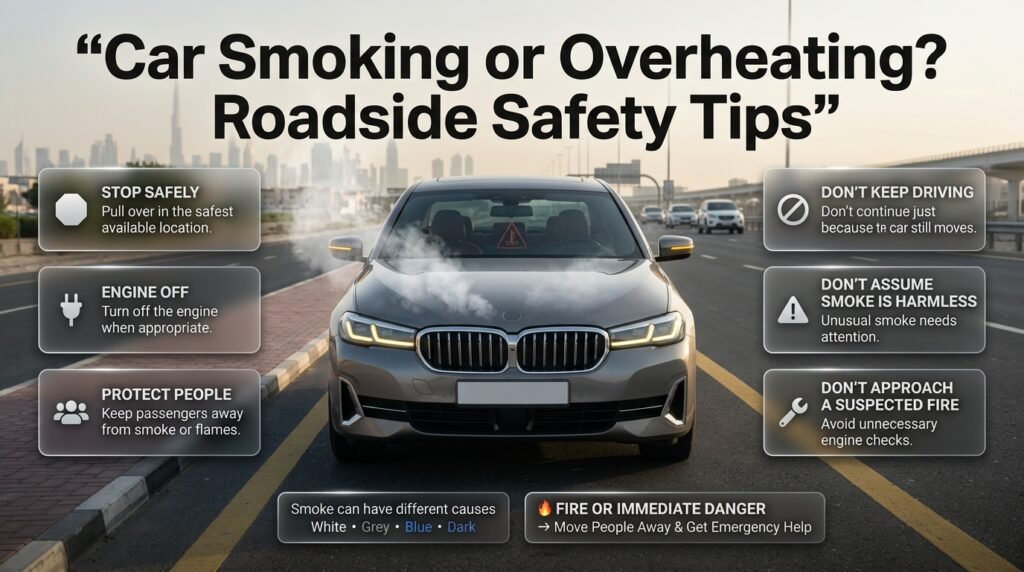
Smoke coming from a vehicle should never be ignored.
It can result from overheating, fluid leaks, electrical problems, or other mechanical faults.
If you notice smoke:
- Stop in the safest available location.
- Turn off the engine when appropriate.
- Keep people away from obvious smoke or flames.
- Don’t continue driving simply because the car still moves.
- Contact appropriate assistance.
- If there is fire or immediate danger, prioritize getting people away from the vehicle and contact emergency services.
Don’t Assume Smoke Is Harmless
White, grey, blue, or dark smoke can have different causes.
You don’t need to identify the exact cause beside a busy road.
The safest decision is to treat significant or unusual smoke as a reason to stop and assess the situation.
Should You Open the Bonnet?
Not automatically.
If you suspect a fire, don’t approach the engine unnecessarily.
The priority is getting people away from danger and contacting appropriate emergency assistance.
⚠ Common Mistake: A driver may think opening the bonnet will help the engine cool down immediately. In a suspected fire situation, approaching the engine compartment can increase personal risk.
What If the Engine Overheats?
An overheating engine can become a serious mechanical problem if you continue driving.
Warning signs may include:
- Temperature warning
- Steam
- Unusual smells
- Loss of power
- Warning messages
- Unusual engine behaviour
If safe to do so, pull over and stop.
Don’t keep driving simply because the destination is only a few kilometres away.
Also avoid opening a hot cooling system immediately. Pressurized coolant can cause serious burns.
Allow the vehicle to cool appropriately and seek professional advice or assistance.
Is It Safe to Change a Flat Tyre on the Roadside?
A flat tyre doesn’t automatically mean you should change it yourself.
The first question should be:
Is this location safe enough to perform the repair?
If the answer is no, call roadside assistance.
Changing a tyre beside high-speed traffic can expose you to passing vehicles for several minutes.
A Flat Tyre in a Safe Parking Area
You may have enough space to use the vehicle’s jack and spare tyre safely if you know how to do so.
A Flat Tyre on a Narrow Highway Shoulder
This is a completely different situation.
The safest choice may be to remain in a protected position and wait for professional assistance.
The fact that you know how to change a tyre doesn’t mean the location is safe for doing it.
What If Your Battery Dies?
A dead battery can leave you stranded without warning.
It may happen after:
- Leaving lights on
- Leaving accessories running
- Battery deterioration
- Electrical faults
- Long periods of inactivity
- Extreme operating conditions
If the vehicle is safely parked, you may be able to use a jump-start service.
If it’s on a busy roadside, don’t focus on the battery before considering traffic safety.
Don’t Stand in the Road While Jump-Starting
If professional help is available, it can be safer than attempting a jump-start in an exposed location.
Also avoid improvising electrical connections if you’re uncertain about your vehicle’s requirements.
What Emergency Equipment Should You Keep in Your Car?
A basic emergency kit can make a breakdown easier to manage.
Useful items include:
- Charged mobile phone
- Phone charging cable
- Power bank
- Drinking water
- Torch
- Basic first-aid supplies
- Vehicle documents
- Emergency contact information
- Appropriate reflective safety equipment
- Basic gloves
These items are useful because they support communication and personal safety.
They shouldn’t encourage you to perform repairs that are unsafe for the location.
Why a Charged Phone Matters
Your phone may be your most valuable emergency tool.
You may need it to:
- Call roadside assistance
- Contact emergency services
- Share your location
- Speak with family
- Access navigation
- Receive updates from the assistance provider
Before a long trip, check that your phone has enough battery.
📌 Quick Tip: Keep a charging cable in the vehicle permanently rather than relying on remembering to bring one.
What Information Should You Give Roadside Assistance?
Clear information helps assistance providers understand the situation.
Instead of saying:
“My car broke down.”
Provide useful details.
Tell them:
- Your road or highway
- Direction of travel
- Exact or approximate location
- Nearest exit
- Nearby landmark
- Vehicle make
- Vehicle model
- Vehicle colour
- Type of problem
- Whether the vehicle is blocking traffic
- Whether passengers are present
- Whether there is smoke, fire, or fuel leakage
Example of a Useful Breakdown Message
“My vehicle has lost power and is stopped on the right side of the road. I’m travelling toward the city and I’m near the next exit. The car isn’t moving.”
This is much more useful than simply saying:
“My car stopped.”
How Can You Share Your Location?
If your phone supports location sharing, use the available tools to communicate your position accurately.
You can also describe:
- Highway name
- Exit number
- Direction
- Landmark
- Nearby building
- Service station
- Junction
Location information can be especially important when you’re unfamiliar with the area.
Don’t guess if you can safely check.
What Should You Do While Waiting for Help?
Once assistance has been arranged, your job isn’t to keep working on the car.
Your job is to stay safe.
While waiting:
- Keep your phone available.
- Monitor surrounding traffic.
- Keep passengers away from moving vehicles.
- Avoid standing behind or directly beside the car.
- Don’t attempt complicated repairs.
- Follow instructions from roadside professionals.
- Be cautious about accepting help from unknown people.
If the environment becomes more dangerous, contact your assistance provider again and explain the change.
Roadside Breakdown Safety in Dubai’s Heat
Dubai driving conditions can create additional challenges during a breakdown.
A vehicle may become disabled while you’re dealing with:
- High temperatures
- Strong sunlight
- Heavy traffic
- Long distances
- Multi-lane roads
- Extensive air-conditioning use
This means waiting outside the vehicle can become uncomfortable very quickly.
Protect Yourself From Heat
If your location is safe and remaining inside the vehicle is appropriate, staying in a cooler environment may be preferable to standing outside in direct sunlight.
Keep drinking water available.
Avoid unnecessary physical activity.
If the vehicle is in an unsafe location, however, don’t remain inside simply because it’s cooler if there is an immediate danger such as fire.
Safety decisions should always account for the actual hazard.
What Should You Do at Night?
A breakdown at night creates a visibility problem.
Approaching drivers may have difficulty recognizing a stationary vehicle, particularly in poorly lit areas.
Use hazard lights where appropriate.
Keep yourself away from moving traffic.
Don’t assume that wearing dark clothing is acceptable simply because the vehicle has its lights on.
If you have suitable visibility equipment, use it according to local road-safety guidance.
But don’t place yourself in danger simply to position warning equipment.
What If You’re Carrying Children?
Children should remain under close supervision during a roadside emergency.
Don’t allow them to:
- Walk beside the road
- Stand behind the vehicle
- Play near traffic
- Wander away while you’re contacting assistance
If staying inside the vehicle is safer, keep them secured appropriately.
If evacuation becomes necessary because of an immediate hazard, move everyone to the safest available area away from the vehicle and traffic.
The important thing is to manage the entire group, not just the driver.
What If Someone Offers to Help?
Many people genuinely want to help a stranded driver.
However, you aren’t required to accept assistance from a stranger.
If professional roadside assistance has already been contacted, you can explain that help is on the way.
Don’t hand over keys, documents, or personal information unnecessarily.
If someone claims to represent a roadside company, verify their identity before allowing them to handle the vehicle.
Your safety and privacy matter as much as the vehicle.
What Are the Most Common Roadside Breakdown Mistakes?
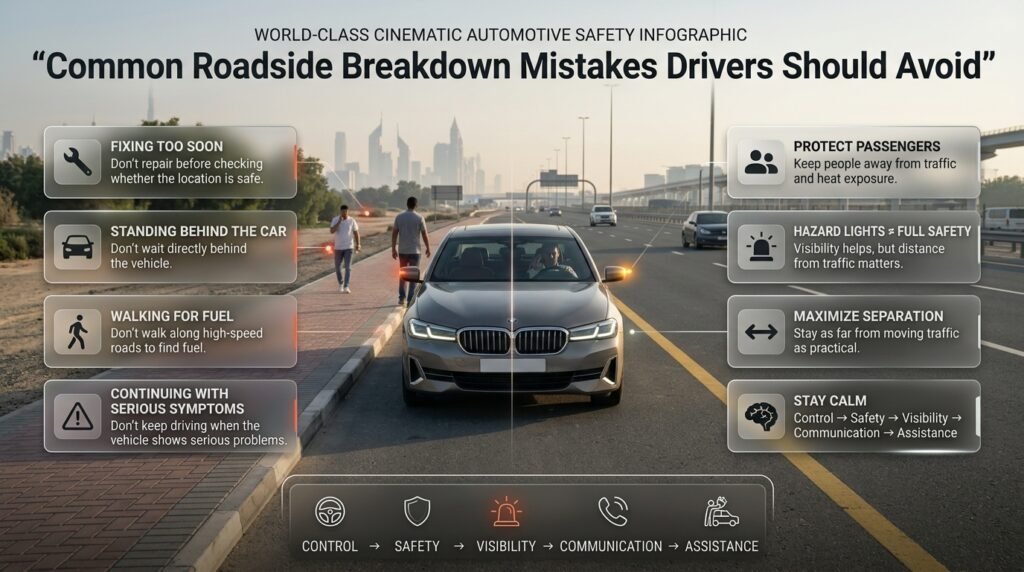
Understanding common mistakes can help you avoid them when you’re under pressure.
Mistake 1: Trying to Fix the Car Immediately
Drivers often think:
“The quicker I fix it, the quicker I can leave.”
But the location may be unsafe.
Better approach: Secure the situation first and repair only if the environment is genuinely safe.
Mistake 2: Standing Behind the Vehicle
Drivers sometimes stand behind their car while waiting for assistance.
This can be dangerous because another vehicle may approach unexpectedly.
Better approach: Keep yourself in a safer position away from traffic.
Mistake 3: Walking to Find Fuel
This commonly happens after running out of petrol.
Why it’s risky: High-speed roads aren’t designed for pedestrians.
Better approach: Arrange fuel or roadside assistance.
Mistake 4: Continuing to Drive With Serious Symptoms
A vehicle may still move even when something is seriously wrong.
Continuing to drive can make the fault worse or cause a sudden loss of control.
Better approach: Stop safely and seek assistance when the symptoms indicate a serious problem.
Mistake 5: Ignoring Passengers
A driver may become so focused on the vehicle that passenger safety is forgotten.
Better approach: Assess children, older passengers, and anyone vulnerable to heat or traffic exposure.
Mistake 6: Assuming Hazard Lights Make Everything Safe
Hazard lights improve visibility.
They don’t prevent collisions.
Better approach: Use them as one safety measure, not as a substitute for a safe position.
Mistake 7: Standing Too Close to Passing Traffic
Even a wide shoulder can leave you close to fast-moving vehicles.
Better approach: Maximize your separation from traffic whenever possible.
Mistake 8: Panicking
Panic can lead to sudden lane changes, unsafe exits, unnecessary repairs, or poor decisions.
Better approach: Follow a simple sequence:
Control → Safety → Visibility → Communication → Assistance
How Can You Prevent a Roadside Breakdown?
The best roadside safety strategy is prevention.
You can’t prevent every mechanical failure, but regular checks can reduce the chance of becoming stranded.
Before a longer journey, check:
- Fuel level
- Tyre pressure
- Tyre condition
- Battery condition
- Engine warning lights
- Oil level where appropriate
- Coolant level where appropriate
- Lights
- Wipers
- General vehicle condition
Don’t ignore a warning simply because the car still drives.
A small problem can become a breakdown at a much worse location.
Check Your Fuel Before Long Trips
Fuel planning is particularly important when travelling long distances or through heavy traffic.
Before leaving, consider:
Fuel level → Journey distance → Traffic → Route → Refuelling opportunities
Don’t deliberately start a long trip with a critically low fuel level.
This is especially important when you expect:
- Heavy congestion
- Long highway stretches
- Unfamiliar routes
- Limited fuel stations
- Delays
- Extreme heat
A few extra minutes spent refuelling can prevent a much more complicated roadside situation.
Why Tyre Checks Matter
Tyres are one of the most important points of contact between your vehicle and the road.
Before longer journeys, check:
- Tyre pressure
- Visible damage
- Tread condition
- Spare tyre condition where applicable
Don’t wait for a puncture to discover that your spare tyre is also unusable.
Why Battery Condition Matters
A battery may fail without giving you much warning.
If your vehicle has shown signs such as slow starting or electrical issues, don’t ignore them.
A battery inspection before a long journey can be easier than dealing with a dead vehicle in an inconvenient location.
What Should You Do Before a Long Journey?
A simple pre-trip routine can reduce your breakdown risk.
Before Leaving
Step 1: Check fuel.
Step 2: Check tyres.
Step 3: Check warning lights.
Step 4: Make sure your phone is charged.
Step 5: Take water.
Step 6: Confirm that important vehicle documents are available.
Step 7: Know your route.
Step 8: Consider traffic and weather conditions.
This doesn’t guarantee that the vehicle won’t fail.
It simply gives you better preparation if something goes wrong.
Roadside Breakdown Decision Guide
| Situation | First Priority | What to Avoid |
|---|---|---|
| Empty fuel tank | Move safely and arrange fuel | Walking along highway |
| Flat tyre | Find safe location | Changing tyre beside fast traffic |
| Dead battery | Get safe assistance | Unsafe roadside jump-start |
| Engine overheating | Stop safely | Continuing to drive |
| Smoke | Protect people | Approaching a possible fire |
| Highway breakdown | Separate from traffic | Standing beside the vehicle |
| Traffic-lane breakdown | Make situation visible and seek help | Pushing vehicle through traffic |
| Night breakdown | Visibility and distance from traffic | Standing in dark roadside areas |
The table isn’t a replacement for judgment.
Road conditions can change quickly, so always assess the actual situation.
What Is the Safest Way to Think About a Breakdown?
A useful mental shift is to stop thinking:
“How do I repair my car?”
and start thinking:
“How do I make this situation safe?”
Once the people are safe, you can deal with the vehicle.
This approach prevents many common roadside mistakes.
A flat tyre doesn’t require you to immediately change the tyre.
An empty fuel tank doesn’t require you to walk to a petrol station.
A dead battery doesn’t require you to start working beside highway traffic.
A warning light doesn’t automatically mean you should keep driving.
Every situation begins with the same question:
Is my current location safe?
Expert Advice for Safer Roadside Breakdowns
One practical rule is worth remembering:
The same mechanical fault can have completely different safety risks depending on where it happens.
Consider two examples.
Example One: Flat Tyre in a Parking Area
You have plenty of space.
There is no fast-moving traffic nearby.
You can safely inspect the tyre.
You may be able to change it yourself.
Example Two: Flat Tyre on a Busy Highway
Traffic is moving quickly.
The shoulder is narrow.
Vehicles are passing close to you.
Even though you know how to change a tyre, the repair itself may expose you to unnecessary danger.
The better choice may be professional assistance.
That’s the difference between knowing how to repair something and knowing when it’s safe to repair it.
A Simple Roadside Breakdown Checklist
Save this sequence mentally:
If the Car Stops
☐ Stay calm
☐ Keep control if the vehicle is moving
☐ Move away from traffic if safely possible
☐ Turn on hazard lights
☐ Assess the location
☐ Protect passengers
☐ Avoid unnecessary roadside repairs
☐ Contact appropriate assistance
☐ Share your exact location
☐ Stay alert while waiting
Emergency Items to Keep in the Vehicle
☐ Charged phone
☐ Charging cable
☐ Power bank
☐ Water
☐ Torch
☐ First-aid supplies
☐ Vehicle documents
☐ Emergency contacts
☐ Appropriate reflective equipment
What should you do first when your car breaks down on the road?
When your car breaks down, your first priority should be getting yourself and your passengers out of immediate danger, not trying to identify or repair the mechanical problem. If the vehicle is still controllable, reduce speed gradually and move toward the safest available location away from moving traffic. Once stopped, use your hazard warning lights so approaching drivers can recognize that your vehicle is stationary or causing an obstruction.
Before opening the bonnet, checking the tyre, or getting out of the vehicle, look at the road around you. A breakdown on a quiet street is very different from one on a busy highway or narrow shoulder.
Important points to remember:
Keep control of the vehicle and avoid sudden steering.
Move as far away from active traffic as you can without creating another hazard.
Switch on your hazard lights when appropriate.
Don’t stand directly between your vehicle and approaching traffic.
Contact roadside assistance or emergency services when the situation requires it.
Give the responder your exact location, road direction, nearby exit, or landmark.
The key mindset is simple: secure the situation first, diagnose the car second. A mechanical problem can usually be dealt with after you’re in a safer position.
Should you stay inside your car after a roadside breakdown?
Whether you should stay inside or leave the vehicle depends on where the vehicle has stopped and what hazards are present. There isn’t a universal rule that is safe for every breakdown. If you cannot safely exit because doing so would put you directly into moving traffic, staying inside with your seat belt fastened and hazard lights operating may be the safer option.
However, if you can safely leave the vehicle and reach a location well away from moving traffic, that may reduce the risk of being struck if another vehicle collides with your broken-down car. Official motorway guidance specifically emphasizes getting away from the carriageway when this can be done safely.
Before deciding, consider:
Is the vehicle completely away from the traffic flow?
Is there a safe area on the side away from traffic?
Would opening the door put you directly into moving vehicles?
Is there smoke, fire, fuel leakage, or another immediate danger?
Are children or vulnerable passengers with you?
Can you reach a barrier or other protected area safely?
If there’s an immediate threat such as fire, don’t remain inside simply because you were told that staying in the car is normally safer. The actual hazard should determine your response.
Professional rule of thumb: don’t make the decision based on the breakdown itself. Make it based on the road environment around the breakdown.
Is it safe to change a flat tyre or repair your car on the roadside?
A roadside repair is only worth attempting when the location itself is safe enough to work in. Knowing how to change a tyre doesn’t mean it’s safe to do so beside fast-moving traffic. On a busy highway, a few minutes spent kneeling beside the vehicle can expose you to a much greater risk than the original mechanical problem.
If your car is in a safe parking area or another well-separated location, changing a tyre may be reasonable if you have the correct equipment and know how to use it. But if you’re on a narrow shoulder, near a blind bend, or close to high-speed traffic, professional roadside assistance is generally the better choice. Official guidance advises against attempting repairs in dangerous motorway breakdown situations.
Before attempting a roadside repair, ask yourself:
Is my vehicle completely away from moving traffic?
Do passing vehicles have plenty of space?
Is the road straight and clearly visible?
Can I work without standing in a traffic lane?
Do I have the correct tools?
Is there any risk of the vehicle moving?
Would professional assistance be safer?
If the answer to any of these raises concern, don’t turn a simple tyre or battery problem into a personal safety emergency.
Remember: the ability to repair something and the ability to repair it safely in that location are two different things.
What should you do if your car runs out of fuel on a busy road or highway?
If your vehicle runs out of fuel, treat it as a roadside safety problem first and a fuel problem second. If the car still has enough momentum to reach a safer location, move it away from the main traffic flow if you can do so safely. Once stopped, activate the hazard lights and arrange appropriate fuel or roadside assistance.
The biggest mistake is getting out and walking along a busy road to find a petrol station. A driver may think that walking a short distance is harmless, but highways and busy roads aren’t designed for pedestrians. Your priority should be reducing your exposure to traffic while arranging help.
If you’ve run out of fuel:
Move the vehicle to a safer position if possible.
Turn on hazard lights.
Keep passengers away from moving traffic.
Avoid walking along a highway.
Don’t repeatedly attempt to restart an empty tank.
Contact a suitable roadside or fuel-delivery service.
Give your exact location and direction of travel.
Stay in a safe location while waiting for assistance.
Before long journeys, checking fuel level is one of the simplest ways to reduce the chance of becoming stranded. Road-safety guidance also recommends checking fuel, tyres, oil and other basic vehicle conditions before travelling.
For drivers dealing specifically with this situation, your existing guides on running out of fuel on the road and steps after running out of petrol can provide the next level of practical information.
How can you stay safe while waiting for roadside assistance?
Once you’ve contacted roadside assistance, don’t assume the dangerous part is over. A stationary vehicle can remain vulnerable to passing traffic, particularly at night, during poor visibility, or on a high-speed road. Your job while waiting is to maintain a safe position, keep passengers under control, and remain aware of what’s happening around you.
Give the assistance provider enough information to locate you without confusion. Mention the road name, direction of travel, nearby exit, landmark, vehicle details, and whether the car is blocking traffic. If your situation changes—for example, traffic becomes heavier or the vehicle begins smoking—update the responder.
While waiting for help:
Keep your phone charged and accessible.
Stay away from active traffic.
Don’t stand behind or directly in front of the vehicle.
Keep children and passengers away from the carriageway.
Avoid unnecessary mechanical repairs.
Don’t wander away from the vehicle without a safe reason.
Be cautious when accepting help from strangers.
Follow instructions from emergency or roadside professionals.
If the situation becomes immediately dangerous, contact emergency services.
It’s also worth keeping a small emergency kit in your vehicle. A charged phone, power bank, water, torch, first-aid supplies, and appropriate visibility equipment can be useful during an unexpected delay.
The most important thing to remember is that waiting safely is part of breakdown management. You don’t need to keep doing something to prove you’re handling the situation. Sometimes the safest action is simply to stay in a protected position and wait for qualified help.
Conclusion
A roadside breakdown can be stressful, but the situation becomes much easier to manage when you know what to do before panic takes over. The most important thing to remember is that your safety comes before the vehicle. Whether you’ve run out of fuel, suffered a flat tyre, lost battery power, or experienced a more serious mechanical problem, don’t rush into a repair without first considering the traffic and road conditions around you.
If possible, move your vehicle to a safer position, use your hazard lights to improve visibility, keep passengers away from moving traffic, and contact the right roadside assistance when needed. Avoid walking along busy roads or attempting repairs on a narrow highway shoulder simply because you want to get back on the road quickly.
Good preparation also makes a major difference. Keep your phone charged, carry basic emergency supplies, check your vehicle before longer journeys, and make sure you have enough fuel for the route you’re taking. These simple habits can reduce both the likelihood of a breakdown and the stress of dealing with one.
Ultimately, the safest response to a breakdown is not about how quickly you can fix the car. It’s about how safely you can manage the situation. Secure yourself and your passengers first, make the vehicle visible, get professional help when necessary, and deal with the mechanical problem only when it’s safe to do so.
Leave a Reply