Introduction
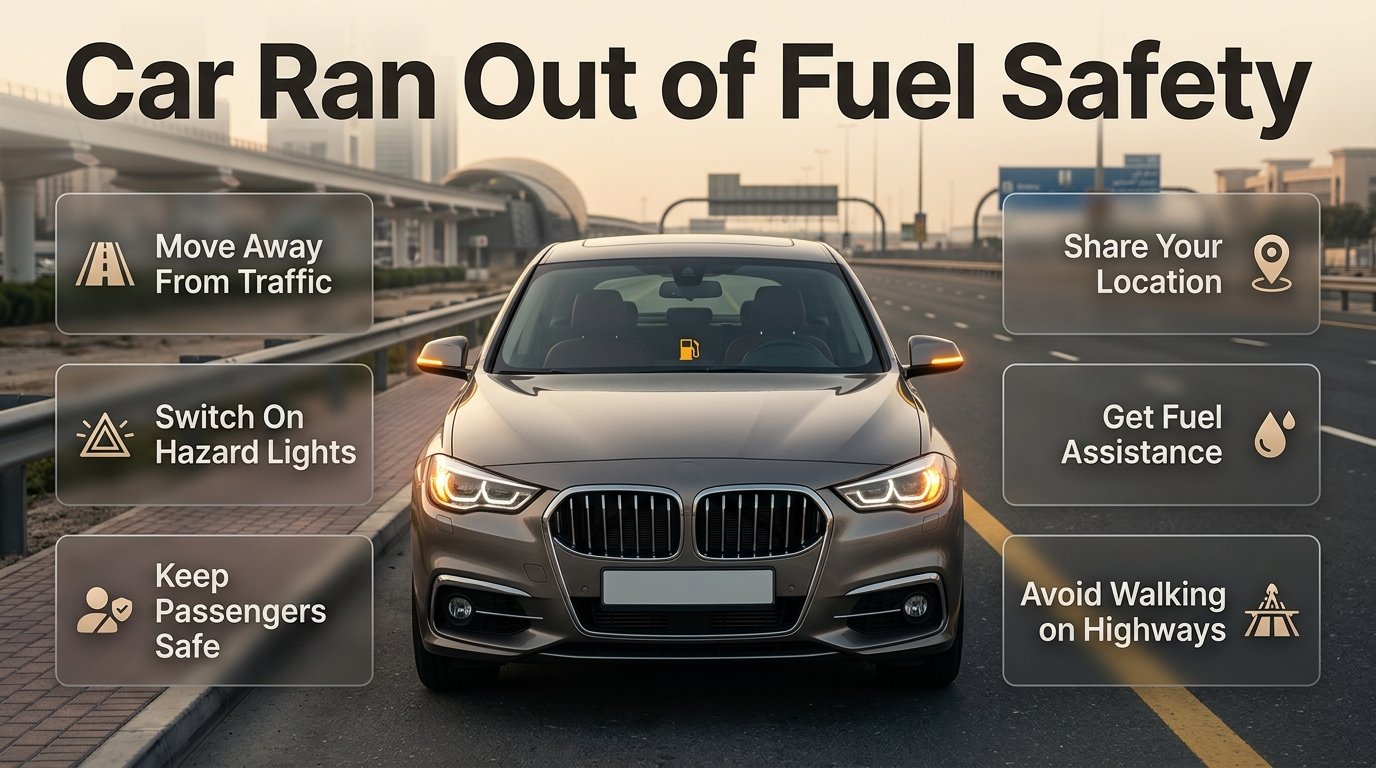
Car Ran Out of Fuel Safety | Running out of fuel can happen to anyone. You may think you have enough petrol to reach the next station, get caught in heavy traffic, take a wrong turn, or simply forget to check the fuel gauge. In Dubai, long roads, high temperatures, traffic congestion, and busy highways can make the situation even more stressful.
If your car ran out of fuel safety is your main concern, don’t panic. The most important thing is to get yourself and your passengers into a safe position before worrying about the fuel.
This guide explains exactly what to do when your car runs out of fuel, how to stay safe on a busy road, what mistakes to avoid, whether you should restart the engine, and how to arrange emergency fuel assistance. For additional practical guidance, you can also visit Fuel Delivery Dubai.
What Should You Do If Your Car Runs Out of Fuel?
If your car runs out of fuel, safely move it away from traffic if possible, switch on the hazard lights, stop in a visible and protected location, and contact roadside assistance or an emergency fuel delivery service. Don’t stand in traffic lanes or attempt risky repairs.
The first priority isn’t getting petrol. It’s protecting yourself from moving traffic.
Once the engine begins losing power, stay calm and maintain control of the vehicle. If you have enough momentum, steer toward the shoulder, emergency lane, parking area, or another safe location away from moving vehicles.
After stopping:
- Turn on your hazard warning lights.
- Apply the parking brake.
- Keep the vehicle in a safe position.
- Turn off unnecessary electrical equipment.
- Assess your surroundings before opening the doors.
- Contact roadside assistance or emergency fuel delivery.
- Stay inside the vehicle if leaving it would expose you to traffic.
📌 Quick Tip: If you’re on a highway, don’t assume the nearest visible shoulder is automatically safe. Look for a position that gives your vehicle as much distance as possible from moving traffic.
👉 If your vehicle runs out of fuel in Dubai, follow this step-by-step guide on what to do when your car runs out of fuel to learn how to stay safe, secure your vehicle, and arrange the right roadside assistance.
Why Is Running Out of Fuel Dangerous?
Running out of fuel is dangerous mainly because a disabled vehicle can become a hazard to other road users. The risk increases on highways, at night, during poor visibility, and in heavy traffic.
A vehicle that suddenly loses power may stop in an inconvenient or dangerous location. Other drivers may not immediately realize that you’re stationary.
There are also secondary risks. A driver might try to walk along a highway to find a fuel station, cross several lanes of traffic, or stand outside the car while waiting for help.
These actions can be much more dangerous than simply remaining in a secure location and requesting assistance.
In Dubai’s hot climate, another consideration is heat exposure. Waiting beside a vehicle in direct sunlight can become uncomfortable and potentially unsafe, particularly for children, elderly passengers, or anyone who is vulnerable to heat.
The basic rule is simple:
Vehicle safety first. Fuel recovery second.
What Are the First Things to Do When You Run Out of Fuel?
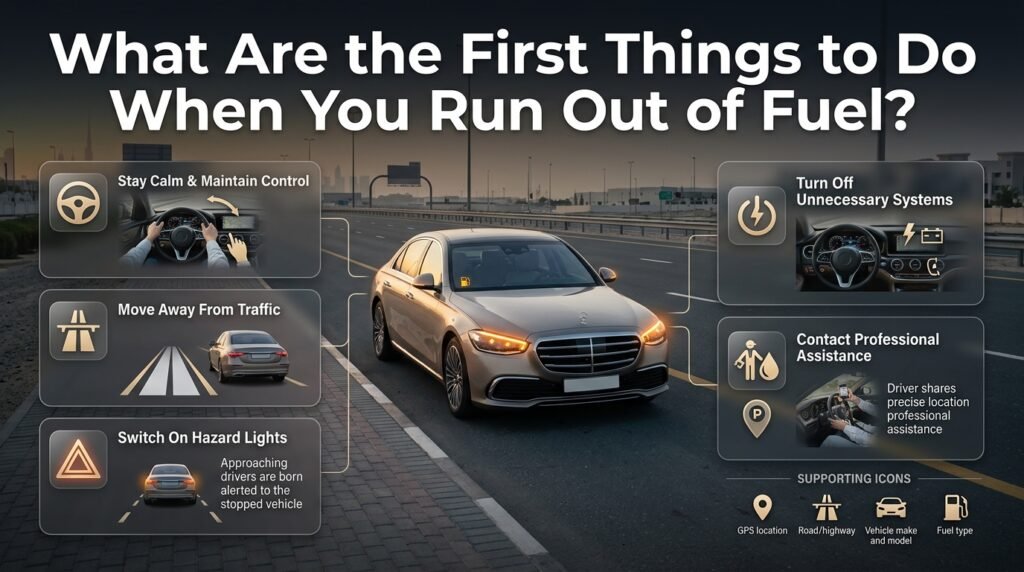
When the engine stops because the fuel tank is empty, focus on controlling the vehicle and making your location visible to other drivers.
1. Stay Calm and Maintain Control
Don’t suddenly brake or make an aggressive steering movement.
If the engine starts losing power, keep both hands on the steering wheel and guide the vehicle toward the safest available area.
Some vehicles may become harder to steer or may feel different when engine power is lost, depending on the vehicle’s systems. That’s another reason to avoid sudden movements.
2. Move Away From Traffic
If the vehicle can still roll safely, use its remaining momentum to reach:
- The road shoulder
- A designated emergency stopping area
- A parking area
- A service lane
- A safe roadside location
Don’t stop in a live traffic lane unless there is absolutely no alternative.
3. Switch on Hazard Lights
Hazard lights alert approaching drivers that your vehicle has a problem.
Use them as soon as you recognize that you’re experiencing a breakdown or fuel-related stop.
If visibility is poor, making the vehicle noticeable becomes even more important.
4. Turn Off the Engine and Unnecessary Systems
Once you’re safely stopped, don’t repeatedly attempt to restart the engine.
Turn off unnecessary electrical loads where practical.
If the vehicle is in a safe location and you need to conserve battery power while waiting for assistance, avoid leaving accessories running unnecessarily.
5. Contact Professional Assistance
Call a suitable roadside assistance provider or emergency fuel delivery service.
Give them:
- Your exact location
- Road or highway name
- Direction of travel
- Nearest exit or landmark
- Vehicle make and model
- Fuel type
- Whether passengers are inside
- Whether the vehicle is blocking traffic
The more accurately you describe your location, the easier it is for assistance to find you.
Should You Stay Inside the Car After Running Out of Fuel?
In many roadside situations, remaining inside the vehicle is safer than standing next to it, particularly when you’re stopped near fast-moving traffic. However, the safest action depends on the road layout, traffic, vehicle position, and immediate hazards.
If your car is safely away from traffic, staying inside with the doors secured can reduce exposure to passing vehicles and extreme weather.
If the vehicle is in a dangerous position, follow local emergency guidance and move to a genuinely safer location when it is safe to do so.
Don’t stand directly behind or in front of the vehicle.
Don’t sit on the road shoulder close to moving traffic.
Don’t walk along a highway simply because a petrol station appears nearby.
⭐ Expert Tip: A fuel station that looks “only a few minutes away” can still be unsafe to reach on foot if the road has fast traffic, barriers, interchanges, or restricted pedestrian access.
Running Out of Fuel on the Road
Running out of fuel on the road can quickly become a safety concern, particularly on busy roads or highways. If your vehicle loses power because the fuel tank is empty, switch on the hazard lights and, if it is safe to do so, move the car away from moving traffic. Avoid trying to walk along the road or attempting unsafe roadside repairs. Instead, stay in a secure location and contact professional roadside assistance or an emergency fuel delivery service. Providing your exact location and vehicle details can help ensure that assistance reaches you as quickly and safely as possible.
👉 If you are running out of fuel on the road in Dubai, follow this practical Running Out of Fuel on the Road Guide to learn how to secure your vehicle, stay safe around traffic, and arrange professional fuel assistance.
What Should You Do on a Dubai Highway?
Running out of fuel on a Dubai highway requires extra caution because vehicles may be traveling at high speeds and traffic conditions can change quickly.
If possible, guide your vehicle completely away from active lanes.
Once stopped, activate your hazard lights and make your location clear when contacting assistance.
Don’t attempt to walk along the highway to find fuel.
Don’t cross multiple lanes.
Don’t try to flag down random vehicles while standing close to moving traffic.
Instead, provide your location to professional roadside assistance.
If you’re unsure where you are, use your phone’s location services to identify the road, exit, or nearby landmark.
Highway Safety Checklist
- Move as far away from traffic as safely possible
- Switch on hazard lights
- Apply the parking brake
- Turn off unnecessary systems
- Share your exact location
- Contact roadside assistance
- Keep passengers away from traffic
- Don’t walk along the highway
- Don’t attempt unsafe repairs
Safely Dealing With an Empty Fuel Tank in Dubai
Dealing with an empty fuel tank in Dubai requires calm decision-making and a strong focus on roadside safety. If your vehicle runs out of petrol, switch on the hazard lights and, if possible, move the car to a safe location away from active traffic. Avoid stopping in dangerous lanes, walking along busy highways, or attempting unnecessary roadside repairs. Dubai’s high temperatures can also make prolonged exposure outside the vehicle uncomfortable and potentially dangerous, so stay in a safe, shaded or air-conditioned place whenever practical. Once you have secured yourself and the vehicle, contact a reliable roadside assistance or emergency fuel delivery service and provide your exact location, vehicle type, and required fuel. The priority is simple: stay visible, stay safe, and get professional help rather than taking unnecessary risks.
👉 If you find yourself with an empty fuel tank in Dubai, follow this practical Safely Dealing With an Empty Fuel Tank Guide for clear steps on staying safe, securing your vehicle, and arranging reliable roadside fuel assistance.
What If Your Car Stops in Heavy Traffic?
Running out of fuel in stop-and-go traffic can be particularly stressful.
Your vehicle may lose power while surrounded by other cars, leaving little room to move.
If this happens, activate the hazard lights immediately and try to steer toward the safest available position.
Don’t focus only on the fuel problem. Your immediate goal is to make other drivers aware that your vehicle is disabled.
If you’re unable to move the vehicle, stay calm and contact assistance.
Heavy traffic makes it even more important to avoid standing outside the car unless there is a clear safety reason to do so.
For drivers interested in understanding why frequent traffic situations increase fuel consumption, see How Traffic Affects Fuel Economy in Dubai.
Can You Restart a Car After It Runs Out of Fuel?
You may be able to restart a vehicle after adding the correct fuel, but repeatedly attempting to start an empty tank isn’t a useful solution.
When the fuel tank is empty, the fuel system may not have enough fuel pressure for normal operation.
Repeated cranking can also place unnecessary demand on the battery and starter.
The correct approach is to arrange an appropriate fuel supply first.
After adding fuel, the vehicle may require a normal starting procedure depending on its design.
Some modern vehicles have specific procedures after fuel starvation, while diesel vehicles can have additional considerations because air may enter the fuel system.
Don’t assume petrol and diesel vehicles behave exactly the same after running empty.
If the vehicle doesn’t start after adding the correct fuel, professional assistance may be needed.
What Happens to the Car When the Fuel Tank Becomes Empty?
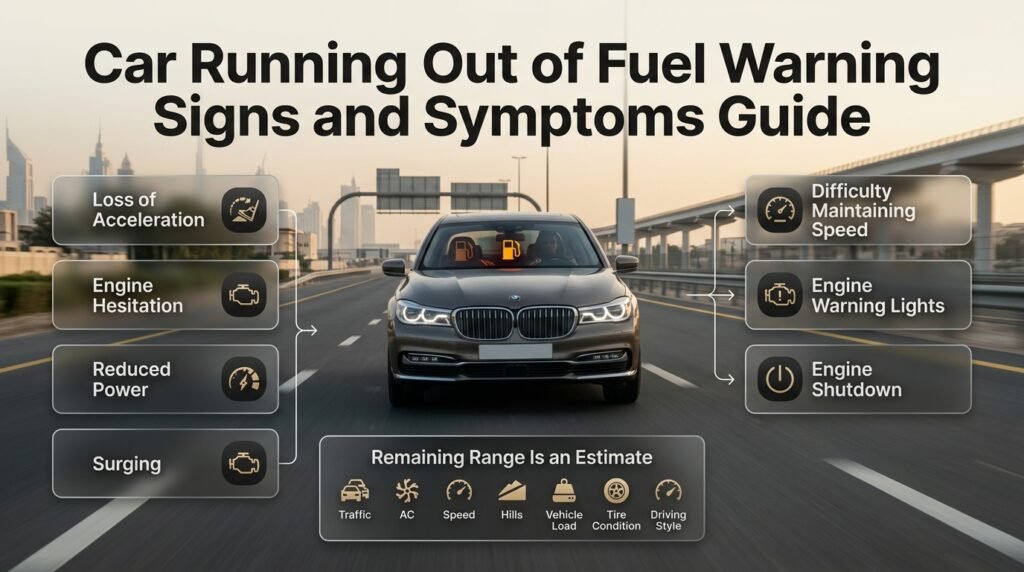
When the tank runs out, the engine eventually stops receiving enough fuel to maintain combustion.
Before the engine stops completely, you may notice:
- Loss of acceleration
- Engine hesitation
- Reduced power
- Surging
- Difficulty maintaining speed
- Engine warning lights
- Eventually, engine shutdown
The symptoms can vary between vehicles.
Sometimes drivers mistakenly interpret these symptoms as an engine or transmission failure.
However, if the fuel gauge was already near empty, fuel starvation is one possibility.
Don’t Ignore Earlier Warning Signs
A low-fuel warning is there for a reason.
The remaining range shown by a vehicle is also an estimate, not a guaranteed distance.
Traffic, air conditioning, driving speed, hills, vehicle load, tire condition, and driving style can all influence actual fuel consumption.
That’s why treating the estimated range as an exact promise can lead to trouble.
What Is the Safest Way to Get Fuel After Running Out?
The safest option is usually to arrange professional fuel assistance rather than leaving your vehicle and walking to a station.
A roadside fuel delivery service can bring an appropriate amount of fuel directly to the vehicle, allowing you to continue your journey after the situation is resolved.
Before requesting assistance, confirm:
- Your vehicle’s fuel type
- Your exact location
- The amount of fuel required
- Whether your vehicle is safely accessible
- Whether the vehicle is blocking traffic
For practical information about handling fuel-related roadside emergencies, see Emergency Roadside Fuel Advice.
Steps After Running Out of Petrol
If your car runs out of petrol in Dubai, follow a few simple steps to stay safe and get back on the road without taking unnecessary risks. Turn on your hazard lights, move the vehicle to a safe location if you can do so without danger, and avoid standing in or near moving traffic. Check your surroundings and keep your phone available so you can contact roadside assistance or emergency fuel delivery. Provide your exact location, vehicle details, and the type of petrol required so help can reach you efficiently. For a complete step-by-step process, focus first on safety, visibility, location sharing, and professional assistance rather than attempting to walk to a petrol station or handle unsafe roadside work yourself.
👉 If your car runs out of petrol in Dubai, follow these Steps After Running Out of Petrol to safely secure your vehicle, assess the situation, and arrange professional fuel assistance without unnecessary roadside risks.
Petrol vs Diesel: Does Running Out of Fuel Affect Them Differently?
Petrol and diesel vehicles can both stop when they run out of fuel, but diesel systems may require additional attention after fuel starvation.
| Issue | Petrol Vehicle | Diesel Vehicle |
|---|---|---|
| Engine stops when fuel is empty | Yes | Yes |
| Repeated starting attempts recommended | No | No |
| Correct fuel is essential | Yes | Yes |
| Fuel system may need attention | Sometimes | More likely |
| Professional assistance may be needed | Sometimes | More likely after prolonged starvation |
One of the biggest mistakes is adding the wrong fuel.
Never guess the fuel type.
If you’re uncertain, check the vehicle’s fuel label, owner’s manual, fuel cap markings, or contact a qualified professional.
Adding the wrong fuel can create a much bigger problem than simply running out.
What Should You Tell the Fuel Delivery Provider?
When requesting emergency fuel delivery, clear information saves time.
Tell the provider:
Your Location
Give the road name, direction, exit number, landmark, or GPS location.
For example:
“I’m on the highway near Exit 12, traveling toward Downtown, and my vehicle is stopped on the shoulder.”
That’s much more useful than simply saying:
“I’m on the highway.”
Your Vehicle
Provide the:
- Make
- Model
- Approximate year if known
- Petrol or diesel type
Your Situation
Explain whether:
- The engine has completely stopped
- The vehicle is safely parked
- You’re blocking a traffic lane
- Passengers are inside
- You’re on a highway or local road
This allows the provider to understand the urgency.
Common Mistakes People Make After Running Out of Fuel
Mistake 1: Walking to the Petrol Station
A station may look close, but reaching it safely can be difficult.
Highways, barriers, ramps, and fast-moving traffic can make walking extremely dangerous.
Better approach: arrange professional assistance.
Mistake 2: Standing Behind the Vehicle
Some drivers stand behind their car to warn approaching traffic.
This can expose them to serious danger if another vehicle loses control or fails to notice the stopped car.
Better approach: remain in the safest available position and use the vehicle’s warning systems.
Mistake 3: Repeatedly Trying to Start the Engine
Turning the key or pressing the start button again and again won’t create fuel in an empty tank.
It can also drain the battery.
Better approach: stop unnecessary attempts and arrange fuel assistance.
Mistake 4: Adding the Wrong Fuel
This can create expensive mechanical problems.
Better approach: confirm the fuel type before adding anything.
Mistake 5: Ignoring the Fuel Warning
Some drivers continue driving because the car still shows a few kilometers of estimated range.
That number can change quickly under heavy traffic or other conditions.
Better approach: treat the low-fuel warning as a reminder to refuel rather than a challenge to see how far the vehicle can go.
Mistake 6: Leaving Passengers Exposed to Traffic
Children and other passengers shouldn’t be standing near a busy road simply because the vehicle has stopped.
Better approach: prioritize a secure location away from moving traffic.
How Can You Prevent Running Out of Fuel?
The easiest fuel emergency to manage is the one you prevent.
You don’t need to refill the tank every time the gauge moves slightly downward, but you should develop a consistent refueling habit.
Keep a Personal Fuel Threshold
For example, you might decide to refuel before the gauge becomes critically low.
The exact threshold depends on your driving routine.
If you regularly travel long distances, use highways, or drive through areas where stations aren’t immediately convenient, maintaining a larger reserve can provide additional flexibility.
Check Fuel Before Long Trips
Before leaving for a long journey, check:
- Fuel level
- Tire pressure
- Engine condition
- Warning lights
- Expected route
- Available fuel stations
Don’t rely entirely on memory.
Watch Your Driving Conditions
Fuel consumption can increase in:
- Heavy traffic
- Frequent stop-and-go driving
- High-speed driving
- Very hot weather
- Long periods of idling
- Vehicles carrying heavy loads
For more practical ways to reduce unnecessary fuel consumption, see Fuel-Saving Driving Tips.
How Does Air Conditioning Affect Fuel Use in Dubai?
Air conditioning can increase the vehicle’s energy demand, although the actual effect varies by vehicle, weather, driving conditions, and HVAC system.
In Dubai, using air conditioning is often necessary for comfort and safety.
The goal shouldn’t be to avoid AC simply to save a small amount of fuel.
Instead, focus on the bigger picture.
Helpful habits include:
- Avoiding unnecessary idling with AC running
- Parking in shade when practical
- Keeping the cooling system maintained
- Avoiding aggressive acceleration
- Checking tire pressure regularly
- Planning longer trips efficiently
If you want to understand this topic in more detail, see Air Conditioning and Fuel Consumption.
What Should You Keep in Your Car for a Fuel Emergency?
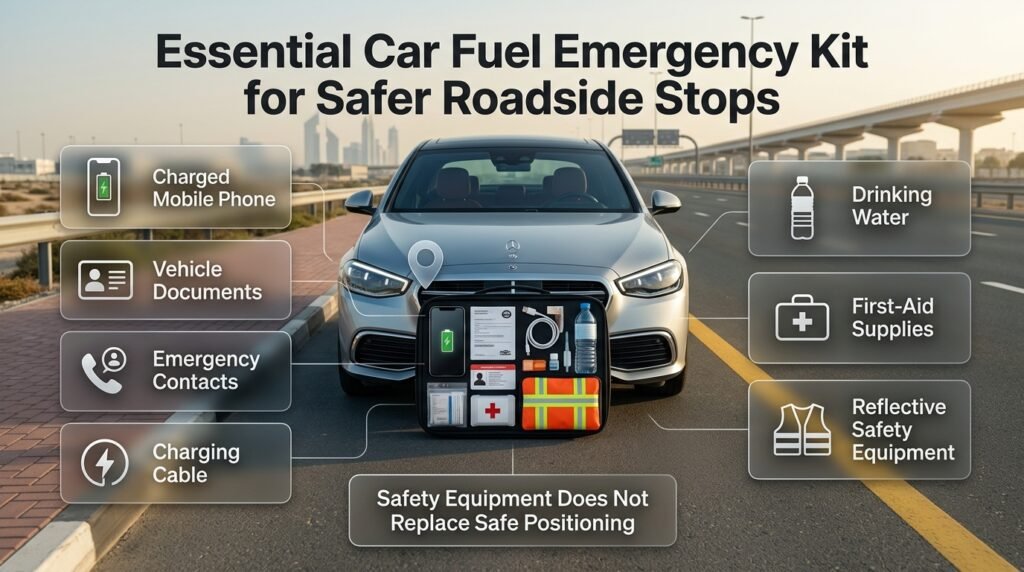
A few basic items can make an unexpected stop easier to manage.
Consider keeping:
- A charged mobile phone
- Vehicle documents
- Emergency contact information
- A phone charging cable
- Drinking water
- Basic first-aid supplies
- Reflective safety equipment where appropriate
However, emergency equipment shouldn’t encourage you to perform dangerous roadside work.
A reflective item doesn’t make it safe to stand beside a vehicle on a high-speed highway.
Your best resource is often a charged phone and accurate location information.
How Does Driving Style Help Prevent Fuel Emergencies?
Fuel economy isn’t only about the vehicle.
Driving behavior also matters.
Aggressive acceleration, unnecessary high speeds, harsh braking, and poor anticipation can increase fuel use.
Smooth driving can help you use fuel more efficiently and make your available range more predictable.
Useful habits include:
- Accelerating smoothly
- Maintaining a sensible speed
- Looking ahead in traffic
- Avoiding unnecessary braking
- Reducing unnecessary idling
- Keeping the vehicle properly maintained
For a deeper look at smoother driving, visit Smooth Driving Techniques for Better Fuel Economy.
A Simple Fuel Emergency Decision Guide
| Situation | Best Action |
|---|---|
| Vehicle still moving | Safely steer away from traffic |
| Vehicle stopped on highway shoulder | Hazard lights + professional assistance |
| Vehicle blocking traffic | Prioritize immediate safety and emergency assistance |
| Fuel station appears nearby | Don’t walk through unsafe traffic |
| Unsure about fuel type | Don’t add fuel until confirmed |
| Engine won’t restart after refueling | Contact a qualified professional |
| Extreme heat | Minimize unnecessary exposure outside |
| Passengers include children | Keep them away from traffic and heat |
⭐ Expert Advice for Preventing Fuel Emergencies
Professionals generally recommend thinking about fuel as part of trip planning rather than waiting until the gauge reaches empty.
Before a long journey, know roughly where you can refuel.
Don’t assume that your vehicle’s estimated remaining range will always remain accurate.
Traffic can dramatically change your fuel consumption.
If you’re driving through an unfamiliar area, maintaining a reasonable fuel reserve gives you more flexibility when plans change.
Most importantly, don’t turn a simple fuel shortage into a roadside safety incident by taking unnecessary risks.
What should I do if my car runs out of fuel on a highway?
If your car runs out of fuel on a highway, your first priority should be safety, not finding fuel immediately. As soon as you notice the engine losing power, stay calm, switch on your hazard lights, and carefully guide the vehicle toward the safest available shoulder or stopping area. Once the car is safely positioned away from moving traffic, contact roadside assistance or an emergency fuel delivery service.
Avoid getting out and walking along the highway, especially where vehicles are traveling at high speed. A nearby fuel station may look close, but reaching it on foot can expose you to unnecessary danger.
Important steps:
Turn on your hazard warning lights.
Move away from active traffic lanes if it is safe to do so.
Apply the parking brake after stopping.
Use your phone’s GPS to identify your exact location.
Contact professional roadside or fuel assistance.
Keep passengers away from moving traffic.
Don’t stand directly behind or in front of the vehicle.
Professional advice: On busy Dubai highways, staying in a secure location and giving the assistance provider an accurate GPS position is usually much safer than trying to walk to a petrol station.
Is it safe to keep driving after the low-fuel warning comes on?
A low-fuel warning means you should start planning to refuel rather than assuming you can continue for a fixed number of kilometers. The remaining driving range shown on the dashboard is only an estimate. Your actual fuel consumption can change because of traffic, driving speed, air conditioning, vehicle load, road conditions, and driving style.
For example, a vehicle showing a certain remaining range during normal highway driving may consume fuel much faster when it enters heavy stop-and-go traffic. In Dubai, long delays and extensive AC use can also affect overall fuel consumption.
A safer approach is to:
Refuel before the tank becomes critically low.
Treat the estimated range as an approximation.
Allow extra fuel for unexpected traffic delays.
Check your fuel level before long-distance journeys.
Avoid deliberately testing how far you can drive on an almost empty tank.
Expert tip: If you’re planning a long Dubai journey, don’t calculate your trip around the exact remaining range displayed on the dashboard. Keeping a reasonable fuel reserve gives you more flexibility if traffic suddenly becomes heavier or your route changes.
Should I keep trying to start my car after it runs out of fuel?
Once the vehicle has run out of fuel, repeatedly trying to start the engine isn’t a useful solution. Without an adequate fuel supply, the engine cannot continue normal combustion. Repeated starting attempts can also use valuable battery power, which may leave you with a second problem after the fuel issue has been solved.
The better approach is to stop unnecessary starting attempts, arrange the correct fuel, and then follow the vehicle manufacturer’s normal starting procedure after refueling.
After fuel is added:
Confirm that the correct fuel type was supplied.
Follow the normal starting procedure for your vehicle.
Avoid repeatedly cranking the engine.
Give the vehicle a reasonable opportunity to restart normally.
Contact a professional if it still doesn’t start.
Important: Diesel vehicles can require additional attention after completely running out of fuel because air may enter parts of the fuel system. The exact procedure varies by vehicle, so don’t assume that the process is identical to a petrol car.
What is the safest way to get fuel when your car runs out of petrol?
When a vehicle runs out of petrol on a busy road, the safest option is generally to arrange professional roadside assistance or emergency fuel delivery instead of walking to a petrol station. This is particularly important on highways, major roads, and locations where there isn’t a safe pedestrian route.
When requesting assistance, provide enough information for the provider to find you without unnecessary delays. Your GPS location is especially useful if you’re unfamiliar with the road or don’t know the exact exit number.
Give the assistance provider:
Your exact GPS location.
Road or highway name.
Direction you’re traveling.
Nearest exit or landmark.
Vehicle make and model.
Petrol or diesel requirement.
Information about whether the vehicle is blocking traffic.
For more practical guidance, you can also refer to Emergency Roadside Fuel Advice.
Professional recommendation: Don’t turn a simple empty-fuel situation into a pedestrian safety problem. If the vehicle is in a potentially dangerous location, focus on making the vehicle visible and getting qualified assistance to you.
Can running out of fuel damage your car?
Running completely out of fuel doesn’t automatically mean that your engine has suffered serious damage, but it can create additional problems depending on the vehicle and its fuel system. Once the fuel supply is exhausted, the engine stops because it no longer has the fuel required for combustion.
One common problem is that drivers repeatedly attempt to restart the vehicle, which can drain the battery. Some diesel vehicles can also require additional fuel-system procedures after running completely dry.
Possible problems include:
Battery becoming weak from repeated starting attempts.
Difficulty restarting after fuel has been added.
Fuel-system complications on some diesel vehicles.
Additional roadside problems if the car stops in an active traffic lane.
Increased risk to passengers if the vehicle becomes stranded in an unsafe location.
Best practice: Don’t make driving until empty a normal habit. Refuel before the tank reaches a critically low level, particularly before long highway journeys or when driving through unfamiliar areas.
Expert tip: If you’ve added the correct fuel but the vehicle still won’t start normally, don’t keep cranking the engine again and again. The car may have another issue that needs professional diagnosis.
Conclusion
Running out of fuel can quickly turn a normal journey into a stressful roadside emergency, but knowing what to do can keep the situation under control. The most important rule is simple: protect yourself and your passengers first, then deal with the fuel problem.
If your car runs out of fuel, move away from moving traffic when it is safe, switch on your hazard lights, avoid walking along busy roads, and contact professional roadside or emergency fuel assistance. Don’t repeatedly try to start an empty tank or take unnecessary risks to reach a petrol station.
A little planning can prevent most fuel emergencies. Check your fuel level before long journeys, allow extra fuel for heavy traffic and unexpected delays, and don’t rely completely on the estimated range shown on your dashboard.
For Dubai drivers, these habits are especially useful because heavy traffic, long routes, high temperatures, and extensive AC use can affect fuel consumption. Staying prepared means you can handle an unexpected low-fuel situation safely and confidently.
Leave a Reply