
Introduction
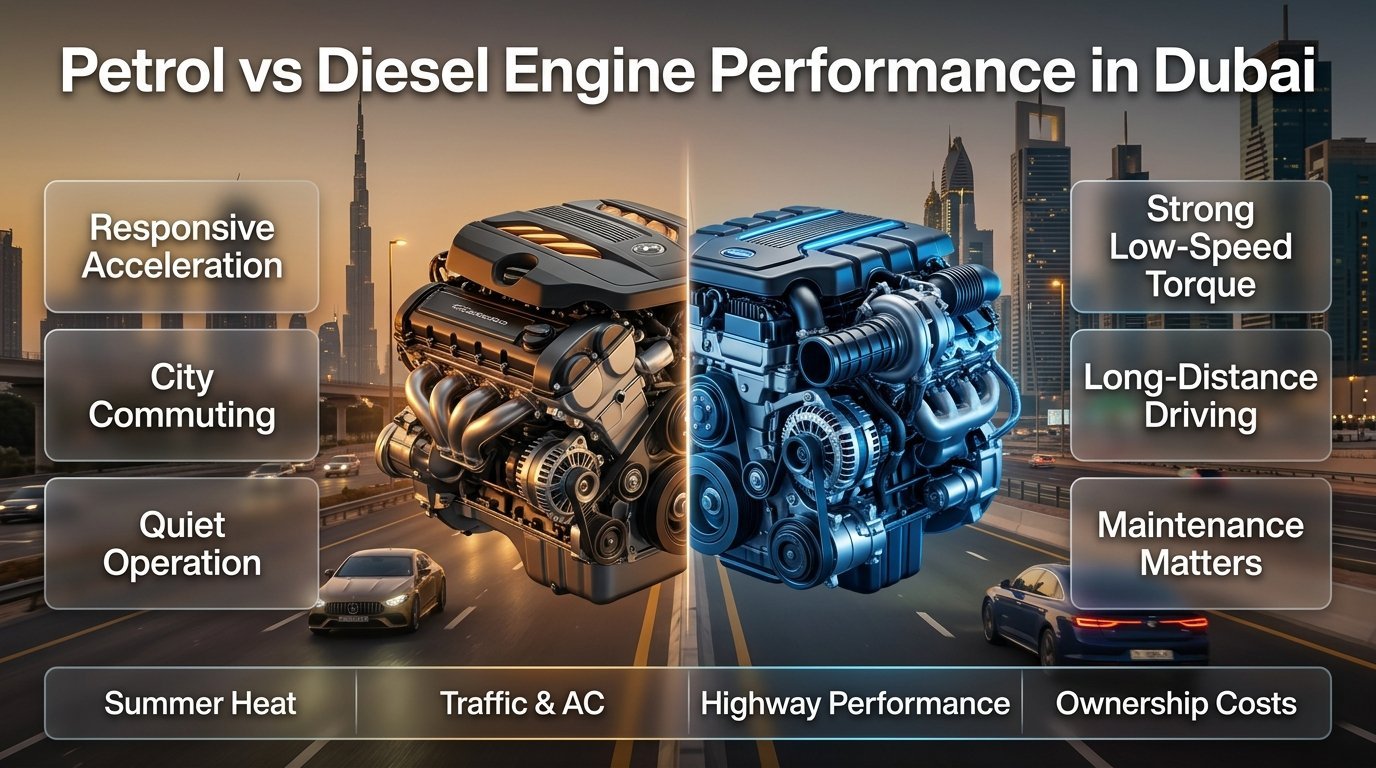
Petrol vs Diesel Engine Performance in Dubai | Choosing between a petrol and diesel engine can be confusing when you’re buying a car in Dubai. One vehicle may offer quick acceleration and smooth driving, while another may provide stronger pulling power and better fuel economy. Both can perform well, but the right choice depends on your daily routine, driving distance, vehicle type, and maintenance budget.
The petrol vs diesel engine performance in Dubai comparison is especially important because local driving conditions can include extreme summer temperatures, heavy traffic, frequent air-conditioning use, long highway journeys, and repeated acceleration. These factors influence engine performance, fuel consumption, and long-term ownership costs.
Petrol engines are often a practical choice for daily commuting, short journeys, and drivers who value quiet operation. Diesel engines can be attractive for motorists who regularly cover long distances, carry heavy loads, or need strong torque at low engine speeds. However, these are general tendencies, not fixed rules. Engine design, turbocharging, transmission, vehicle weight, and maintenance condition can change the result considerably.
This guide explains how petrol and diesel engines compare in Dubai, including acceleration, torque, fuel efficiency, summer performance, city traffic, highway driving, maintenance, reliability, and total ownership costs. It also covers common buying mistakes and practical ways to decide which engine suits your needs.
If you’re researching fuel-related driving decisions or need information about available fuel delivery services, you can also visit the Fuel Delivery Dubai homepage.
1. What Is the Difference Between Petrol and Diesel Engine Performance?
Petrol and diesel engines convert fuel energy into mechanical power, but they use different combustion processes. Petrol engines generally use spark plugs to ignite the air-fuel mixture, while diesel engines ignite injected fuel through the heat created by compressing air. These differences influence torque delivery, engine noise, efficiency, and the way each vehicle responds to the accelerator.
How does a petrol engine work?
A petrol engine draws air into its cylinders and mixes it with petrol, either before the air enters the cylinder or through direct fuel injection. The piston compresses the mixture, and a spark plug ignites it. The resulting combustion pushes the piston down and produces power.
Modern petrol engines may include turbochargers, direct injection, variable valve timing, and electronic engine management. These technologies help manufacturers balance performance, emissions, and fuel consumption.
In everyday driving, petrol engines are often appreciated for their smooth operation and relatively quiet sound. Many respond well to changes in accelerator input, which can be useful when moving away from traffic lights, merging onto a highway, or navigating busy urban roads.
Petrol engines are common in sedans, hatchbacks, family SUVs, crossovers, and performance cars. Their performance varies widely, so a small naturally aspirated petrol engine should not be expected to behave like a powerful turbocharged model.
How does a diesel engine work?
A diesel engine compresses air inside the cylinder until the air becomes hot enough for injected diesel fuel to ignite. This combustion process creates the force that moves the pistons and produces engine power.
Diesel engines commonly deliver substantial torque at relatively low engine speeds. This makes them suitable for vehicles that carry heavy loads, tow equipment within their rated limits, or travel long distances regularly.
Many diesel vehicles are turbocharged. A turbocharger helps supply more air to the engine, supporting stronger performance and improved efficiency when the system is designed and maintained correctly.
Diesel engines are frequently used in commercial vehicles, pickups, selected SUVs, and long-distance fleet applications. However, they may have more noticeable engine noise and vibration than comparable petrol vehicles, depending on their design and insulation.
Which engine produces better performance?
Neither petrol nor diesel automatically wins every performance comparison. Petrol engines may provide stronger acceleration at higher engine speeds, while diesel engines often deliver more low-speed torque.
The exact result depends on:
- Engine displacement and design.
- Maximum horsepower and the RPM at which it is produced.
- Torque output and the engine speed at which peak torque is available.
- Turbocharger response and transmission gearing.
- Vehicle weight, tyres, and traction.
- The condition of the engine and its supporting systems.
For example, a turbocharged petrol sedan may accelerate faster than an older diesel SUV. However, the diesel SUV may feel more capable when carrying passengers and luggage uphill. These differences come from the complete vehicle, not simply the fuel it uses.
2. Petrol vs Diesel Engine Performance in Dubai: Main Differences
For many private drivers, petrol offers a convenient combination of smooth operation and everyday performance. Diesel can be a strong choice for high-mileage driving, heavy-duty work, and vehicles that benefit from low-RPM pulling power. The most useful comparison considers how each engine performs under the same conditions.
| Performance factor | Petrol engine | Diesel engine |
|---|---|---|
| Acceleration | Often smooth and responsive | Strong pulling response in many models |
| Low-RPM torque | Varies; often lower in comparable applications | Often higher |
| Engine noise | Generally quieter | May produce more noise and vibration |
| Fuel economy | Often higher consumption in comparable vehicles | Often lower consumption |
| Short urban trips | Usually suitable | Depends on engine and emissions system |
| Long highway journeys | Comfortable in suitable vehicles | Often efficient for frequent long trips |
| Heavy loads | Depends on engine and vehicle rating | Often well suited to demanding loads |
| Summer performance | Depends on cooling and calibration | Depends on cooling and calibration |
| Servicing | Petrol-specific maintenance | May require diesel injection and emissions servicing |
| Repair costs | Vary by model | Can be higher for some specialist components |
| Common applications | Private cars and many SUVs | Commercial vehicles and selected SUVs |
These comparisons describe common patterns rather than guarantees. A lightweight petrol car may consume less fuel than a heavy diesel SUV. Similarly, a modern petrol engine may produce more horsepower than a diesel engine of comparable displacement.
Why engine specifications matter
Horsepower is relevant when comparing acceleration and the ability to sustain power at higher speeds. Torque helps explain how much rotational force the engine produces, but the vehicle’s transmission determines how that force reaches the wheels.
A diesel engine with high torque may not be faster than a petrol vehicle with greater power and a more responsive transmission. Conversely, a vehicle with modest peak horsepower may feel strong during ordinary driving if its torque delivery and gearing suit its weight.
Always compare vehicles in a similar class. Look at their manufacturer specifications, acceleration figures where available, and real-world driving behaviour before making a decision.
3. Which Engine Accelerates Faster in Dubai?
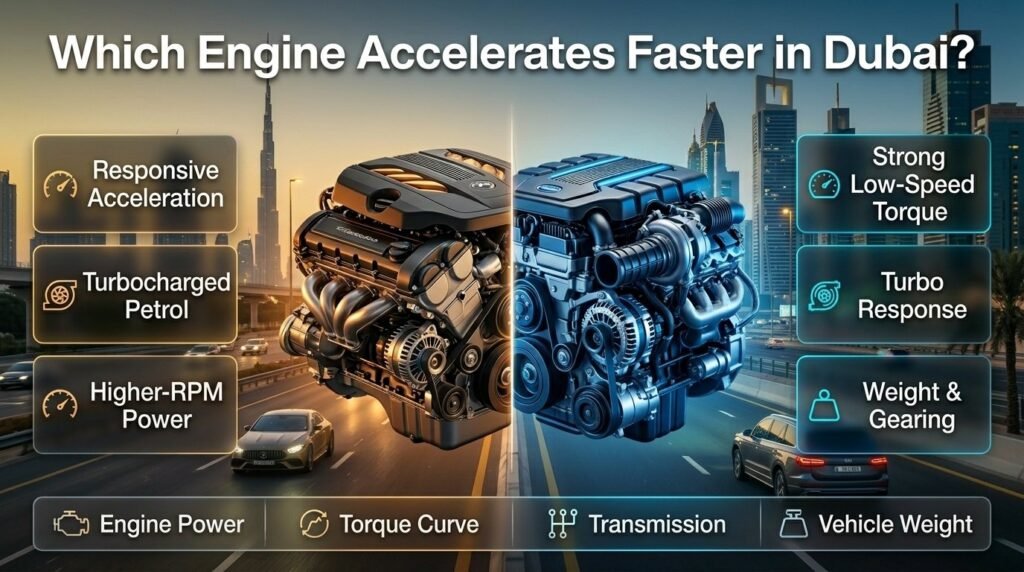
Petrol engines often provide lively acceleration, particularly when designed to produce power at higher RPMs. Diesel engines may feel stronger at low speeds because their torque delivery can help move a vehicle forward without requiring as much engine revving. Actual acceleration depends on power, gearing, traction, and vehicle weight.
Petrol acceleration in everyday traffic
A petrol vehicle can feel responsive when accelerating from a traffic signal or changing speed in urban traffic. Many petrol engines rev smoothly, and their transmission systems are designed to provide comfortable power delivery during ordinary commuting.
Turbocharged petrol engines can offer substantial torque as well as strong acceleration. Their response depends on turbocharger design, engine calibration, and transmission programming.
For a driver travelling through Dubai’s busy streets, smooth throttle response may be more useful than the highest possible horsepower figure. The vehicle should accelerate predictably without excessive hesitation or harsh gear changes.
Diesel acceleration and pulling power
Diesel vehicles often provide strong low-RPM torque, which can help when accelerating with passengers or luggage. Drivers may find that a suitable diesel engine moves a heavier vehicle without needing to rev as high as some petrol engines.
However, diesel acceleration varies by model. Some engines respond quickly, while others may have noticeable turbo lag before delivering their strongest output. Transmission calibration also affects how quickly the vehicle responds when the driver presses the accelerator.
What should you compare before buying?
Check the manufacturer’s acceleration figures, maximum power, torque curve, and transmission type. If possible, test-drive both vehicles on comparable routes and pay attention to how they respond during normal acceleration.
Do not test performance by speeding, racing, or making unsafe overtaking manoeuvres. Evaluate responsiveness within legal speed limits and normal road conditions.
Expert tip: For everyday driving, predictable acceleration and smooth transmission behaviour are often more useful than choosing a vehicle based on one impressive specification.
4. Does Dubai’s Hot Climate Affect Petrol and Diesel Engines Differently?
Dubai’s high summer temperatures place additional demands on the cooling system, engine lubrication, air intake, and air-conditioning system. Both petrol and diesel engines can operate reliably in hot weather when properly engineered and maintained. Neither fuel type automatically provides better protection against overheating.
Petrol engine performance in hot weather
High ambient temperatures increase the amount of heat the cooling system must remove. Air-conditioning also adds load, particularly when the vehicle is stationary or moving slowly through traffic.
Under certain conditions, a petrol engine may reduce power to protect itself from excessive heat or combustion knock. Engine management systems can adjust ignition timing, boost pressure, and other operating parameters to maintain safe conditions.
A driver may notice a difference between an early-morning journey and an afternoon trip during extreme heat. However, the size of that difference depends on the engine, vehicle design, cooling capacity, and driving conditions.
To support reliable petrol engine performance:
- Maintain the correct coolant level and specification.
- Inspect the radiator, cooling fans, hoses, and water pump when required.
- Use engine oil that meets the manufacturer’s requirements.
- Keep the air filter in suitable condition.
- Investigate abnormal temperature readings or sudden power loss.
- Follow the vehicle’s maintenance schedule.
Diesel engine performance in hot weather
Diesel engines also require effective cooling and lubrication. Turbocharged diesel engines can generate considerable heat when operating under sustained load, especially when carrying cargo or travelling at highway speeds.
A diesel vehicle that performs well on long journeys still needs a healthy radiator, cooling fan, thermostat, intercooler where fitted, and appropriate engine oil. Fuel-system condition is important too, because diesel injection systems operate at high pressures and require clean fuel.
High temperatures do not automatically make diesel engines more reliable than petrol engines. A poorly maintained diesel can overheat, lose power, or develop expensive faults just as a petrol vehicle can.
How can you recognise a cooling problem?
Watch for a temperature gauge that rises above its normal range, a coolant warning, unusual smells, visible leaks, steam, or repeated coolant loss. These symptoms should not be ignored.
If the engine overheats, stop in a safe location as soon as conditions permit and follow the manufacturer’s instructions. Never open a hot radiator or coolant reservoir cap, because pressurised coolant can cause serious burns.
Repeated overheating needs proper diagnosis. Replacing coolant alone will not solve a failed fan, leaking hose, faulty thermostat, damaged water pump, or other underlying fault.
For related maintenance guidance, see the Cooling System Maintenance guide.
5. Which Engine Is Better for Dubai’s Stop-and-Go Traffic?
Petrol engines are often a practical option for frequent urban driving because many provide smooth low-speed operation and are well suited to short journeys. Diesel engines can also perform well in city traffic, but their suitability depends on the model, driving pattern, and emissions-control equipment.
Petrol engines in city traffic
Urban driving involves repeated acceleration, braking, waiting at signals, and changes in vehicle speed. These conditions can increase fuel consumption because the engine repeatedly uses energy to accelerate the vehicle.
Many petrol vehicles are designed to handle this type of mixed driving comfortably. Their engines and transmissions can offer smooth response at low speeds, making them suitable for daily commuting and errands.
However, petrol consumption can rise significantly during severe congestion, especially when a vehicle is repeatedly accelerating and the air-conditioning system is working hard.
Diesel engines in city traffic
Diesel engines may provide strong low-speed pulling power, but this does not mean they always consume less fuel in congested conditions. Frequent stopping, idling, short trips, and low engine loads can reduce the expected efficiency advantage.
Some modern diesel vehicles use diesel particulate filters, commonly called DPFs, to capture soot from the exhaust. Depending on the design, the filter requires periodic regeneration to burn off accumulated particles.
Repeated short trips may prevent some vehicles from reaching the operating conditions needed for effective regeneration. This can lead to warning messages or additional maintenance requirements.
Not every diesel vehicle experiences the same issue, and some are specifically designed for urban use. Check the owner’s manual and understand the vehicle’s operating requirements before buying.
Which engine suits a daily Dubai commuter?
Consider a driver who travels a short distance to work, makes several errands during the day, and rarely leaves the city. A suitable petrol car may provide a straightforward ownership experience.
Now consider a driver who travels long distances every day, spends substantial time on highways, and uses a vehicle designed for diesel operation. Diesel may offer useful fuel savings and strong cruising performance.
These are examples, not universal rules. The actual vehicle, service history, fuel consumption, and ownership costs should guide the final decision.
6. Petrol vs Diesel Fuel Consumption in Dubai
Diesel vehicles often use fewer litres of fuel per 100 kilometres than comparable petrol vehicles. However, actual savings depend on the engine, vehicle weight, driving style, traffic, air-conditioning use, fuel prices, and maintenance condition.
Why can diesel engines be more fuel-efficient?
Diesel engines typically use higher compression ratios and can convert a greater proportion of fuel energy into useful work under many operating conditions. Diesel fuel also contains more energy per litre than petrol.
These characteristics help explain why many diesel vehicles achieve lower litres-per-100-kilometre consumption figures.
However, a fuel-efficient engine does not guarantee that the entire vehicle will be economical. Weight, aerodynamics, tyres, transmission gearing, and engine output all influence fuel use.
For example, a heavy diesel SUV may consume more fuel than a small petrol sedan. That does not necessarily mean the diesel engine is less efficient; the vehicles are doing different amounts of work under different conditions.
How to calculate your fuel costs
Use your vehicle’s actual average consumption and the applicable price per litre.
Fuel cost = distance driven ÷ 100 × consumption in litres per 100 km × price per litre
Suppose you drive 2,000 km each month and are comparing two vehicles with these assumed figures:
| Item | Petrol vehicle | Diesel vehicle |
|---|---|---|
| Average consumption | 9 L/100 km | 7 L/100 km |
| Monthly distance | 2,000 km | 2,000 km |
| Monthly fuel use | 180 litres | 140 litres |
| Illustrative price per litre | AED 2.70 | AED 2.80 |
| Monthly fuel cost | AED 486 | AED 392 |
| Annual fuel cost | AED 5,832 | AED 4,704 |
These figures are illustrative, not current UAE pump prices or guaranteed consumption figures. Replace them with the actual consumption of the vehicles you are comparing and the applicable prices.
In this example, the diesel vehicle saves AED 94 per month in fuel, equivalent to AED 1,128 annually. But that is not necessarily the total financial saving. Purchase price, servicing, insurance, depreciation, and potential repairs also affect the final result.
Does diesel always save money?
No. A diesel vehicle may cost more to buy or maintain. If its annual fuel saving is small, the additional ownership costs may cancel out the benefit.
Calculate the estimated annual fuel costs for both vehicles, then add routine servicing and a reasonable allowance for expected repairs. If the diesel vehicle costs more initially, consider how long you plan to keep it.
The higher the annual mileage, the more opportunity there may be for fuel savings to accumulate. But the exact break-even point depends on the figures for the specific vehicles.
For a dedicated comparison, read Petrol vs. Diesel Fuel Economy in Dubai.
7. Which Engine Is Better for Highway Driving in Dubai?
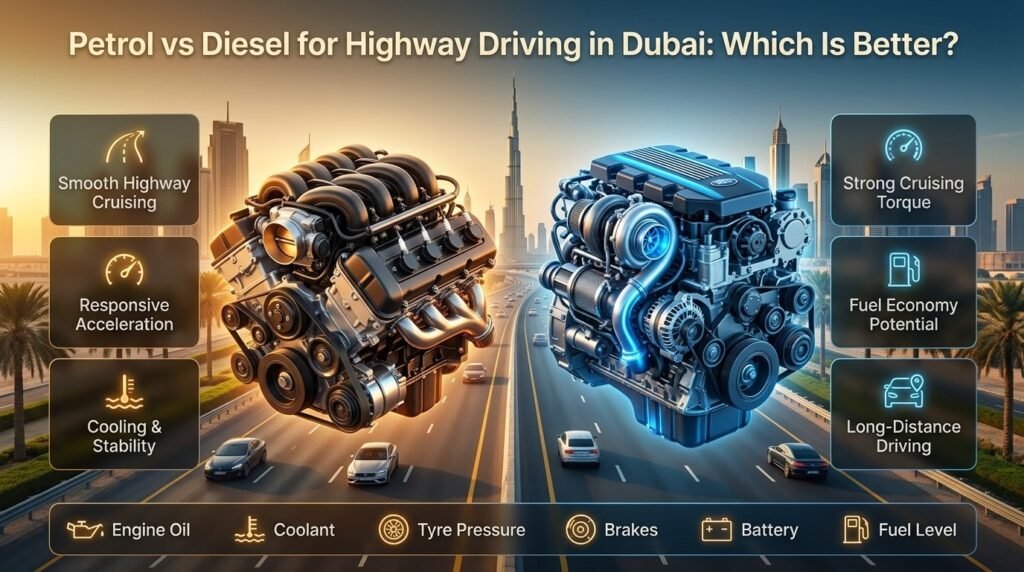
Diesel engines can be attractive for frequent highway driving because they often combine strong cruising torque with favourable fuel economy. Petrol engines can also deliver excellent highway performance, particularly when they have sufficient power and suitable transmission gearing.
Petrol engines on long journeys
Petrol vehicles can provide smooth acceleration, quiet cruising, and strong overtaking performance when the engine has sufficient power. Modern turbocharged petrol engines can produce useful torque across a broad range of engine speeds.
A suitable petrol car can handle journeys between Dubai and other UAE destinations comfortably. The main considerations include engine output, transmission behaviour, cooling capacity, stability, tyre condition, and fuel consumption at your normal cruising speed.
Smaller petrol engines may need to rev higher when accelerating or climbing a gradient, but that depends on the vehicle’s gearing and load. A well-designed petrol engine can be perfectly suitable for frequent highway use.
Diesel engines on long journeys
Diesel engines often provide strong torque at moderate engine speeds. This can help a vehicle maintain momentum when carrying passengers and luggage or travelling over gradients.
Diesel fuel economy may also make a meaningful difference for motorists who cover high annual mileage. Fleet operators and drivers who travel long distances regularly may find these savings particularly valuable.
Still, actual highway consumption depends on speed, wind resistance, vehicle weight, tyres, transmission, and engine condition. Driving faster generally increases aerodynamic resistance and can raise fuel consumption in either type of vehicle.
Prepare your vehicle before a long drive
Before travelling, check the engine oil and coolant levels, tyre pressure, tyre condition, brake performance, battery condition, and fuel level. Pay attention to existing warning lights, unusual vibrations, or temperature changes.
Do not assume a vehicle is ready for a long journey simply because it starts normally. Small problems can become more serious under sustained load.
Choose a vehicle that can maintain highway speed safely and comfortably without requiring excessive effort from the engine. The right combination of power, gearing, stability, and maintenance matters more than fuel type alone.
8. Petrol vs Diesel Maintenance Costs in Dubai
Maintenance costs vary by vehicle age, design, service history, parts availability, and the complexity of its systems. Petrol vehicles can be less expensive to maintain in some categories, while diesel vehicles may justify higher servicing costs through fuel savings or stronger capability.
What maintenance does a petrol engine need?
Typical petrol-engine maintenance includes engine oil and filter changes, air-filter inspection, spark plug replacement at the specified interval, cooling-system checks, and diagnosis of ignition or fuel-injection problems when symptoms occur.
Modern petrol engines can also have turbochargers, direct-injection systems, variable valve timing, and advanced emissions equipment. Repairs to these components can be expensive, particularly in premium vehicles.
A petrol engine is not automatically cheap to repair. The vehicle’s design and maintenance history are important factors.
What maintenance does a diesel engine need?
Diesel vehicles require regular engine oil and filter changes, air-filter maintenance, cooling-system checks, and attention to fuel filtration. Depending on the model, additional components may include high-pressure fuel pumps, injectors, turbochargers, DPFs, exhaust gas recirculation systems, and selective catalytic reduction equipment.
Not every diesel vehicle uses identical emissions technology. Requirements depend on the engine, model year, and market specification.
Because diesel injection systems operate under high pressure, fuel contamination or poor maintenance can contribute to expensive faults. Warning lights and unusual running symptoms should be investigated rather than ignored.
How can you avoid unnecessary repair costs?
Follow the manufacturer’s maintenance schedule and use the specified oil, filters, and fluids. Keep records of servicing and address new symptoms promptly.
If a vehicle loses power, consumes more fuel than usual, produces unusual smoke, or runs roughly, avoid replacing parts based on assumptions. A proper diagnosis may involve fault codes, live engine data, air intake, fuel delivery, cooling performance, and the vehicle’s service history.
The cheapest repair is not always the one with the lowest initial quote. A correct diagnosis helps prevent repeated part replacement and unnecessary labour.
For a broader overview, use the Petrol vs. Diesel Comparisons Dubai guide.
9. How Reliable Are Petrol and Diesel Engines in Dubai?
Reliability depends on design, maintenance, operating conditions, and the way the vehicle is used. Both petrol and diesel engines can provide long service lives, but neither is immune to wear, overheating, fuel-system faults, or poor maintenance.
Petrol engine reliability
A well-maintained petrol engine can provide dependable performance for daily commuting and long journeys. Reliability depends on factors such as lubrication, cooling, ignition components, fuel quality, and the condition of supporting systems.
Ignoring warning lights, delaying oil changes, or continuing to drive while the engine overheats can shorten component life. Modern petrol engines with turbocharging and direct injection may also require careful maintenance.
Diesel engine reliability
Diesel engines are often associated with durability, especially in applications designed for sustained loads and high mileage. However, durability is not the same as low maintenance cost.
Fuel injectors, high-pressure pumps, turbochargers, and emissions-control systems can require expensive attention. The risk and cost depend on the specific engine and its operating history.
A used diesel with a poor service record may be a worse purchase than a properly maintained petrol car. Equally, a neglected petrol engine can develop serious mechanical problems.
What should you check in a used vehicle?
Before purchasing either type, review the service records and arrange an independent inspection. Check for fluid leaks, cooling-system problems, abnormal noises, warning lights, and signs of previous overheating.
A diagnostic scan and road test can reveal issues that are not obvious when the engine is stationary. For diesel vehicles, the inspection should include relevant injection and emissions systems where fitted.
Do not rely on mileage alone. A higher-mileage vehicle with documented maintenance may be in better condition than a lower-mileage vehicle that has been neglected.
10. How Does Air Conditioning Affect Engine Performance?
Air conditioning is important in Dubai, where drivers may rely on it for much of the year. Running the system adds load to the vehicle, but the effect on performance and fuel consumption depends on the engine, compressor, cooling system, and driving conditions.
Petrol vehicles and air-conditioning load
In a petrol vehicle, the air-conditioning compressor requires power from the engine or an electrically driven system, depending on the design. The additional load may be more noticeable in a small engine when accelerating from a stop or climbing a gradient.
Modern engine management systems adjust operation to handle changing loads. A properly maintained vehicle should generally manage normal air-conditioning use without unusual performance problems.
If the engine struggles significantly, idles erratically, or overheats whenever the air conditioning is switched on, have the vehicle inspected. Possible causes include an excessive compressor load, cooling fan fault, cooling-system problem, or another underlying issue.
Diesel vehicles and air-conditioning load
Diesel engines often provide strong low-speed torque, which may help them manage additional load comfortably. However, diesel vehicles are not unaffected by air-conditioning use.
Fuel consumption can rise in both petrol and diesel vehicles when the air conditioning operates in extreme heat, especially during stationary idling and slow traffic.
Keep the system maintained and ensure the engine cooling system is working correctly. Do not interpret normal changes in fuel consumption as proof of an engine fault, but investigate sudden or unusually large changes.
11. Common Mistakes When Choosing Between Petrol and Diesel
A poor engine choice often results from focusing on one benefit while overlooking the driver’s actual needs. Avoid these common mistakes before buying a new or used vehicle.
Mistake 1: Choosing diesel only because it uses less fuel
Diesel engines often deliver favourable fuel economy, but lower fuel consumption does not automatically mean lower total ownership costs.
A higher purchase price, more expensive servicing, or an unexpected repair can reduce the savings. Calculate the expected costs over the period you intend to own the vehicle.
Mistake 2: Assuming petrol is always faster
Petrol engines often offer smooth acceleration, but some diesel vehicles produce more power or stronger low-speed performance than petrol alternatives.
Compare the exact specifications, vehicle weight, transmission, and acceleration figures rather than making a decision based on fuel type.
Mistake 3: Ignoring short-trip driving requirements
Drivers who use a diesel vehicle for repeated short journeys may encounter additional emissions-system requirements, depending on the model.
Check whether your normal routes allow the vehicle to operate as intended. A vehicle that suits long highway journeys may not be the most convenient option for frequent short urban trips.
Mistake 4: Treating summer heat as the only cause of poor performance
High temperatures can increase cooling demands, but reduced power or overheating may also result from a faulty fan, blocked radiator, low coolant, poor airflow, or another mechanical problem.
Diagnose the actual cause before replacing parts. Guesswork can increase costs without solving the issue.
Mistake 5: Comparing vehicles from different categories
A large diesel SUV and a small petrol sedan differ in weight, aerodynamics, engine output, and intended use. Comparing their fuel consumption without accounting for these factors can produce misleading conclusions.
Whenever possible, compare vehicles in the same category with similar performance requirements.
Mistake 6: Buying a used vehicle without checking its history
A low purchase price may be attractive, but an incomplete service history can hide neglected maintenance or expensive faults.
Arrange a professional inspection and review the service records before committing to the purchase. This is particularly important when evaluating turbocharged engines and complex emissions systems.
12. Expert Advice for Better Engine Performance in Dubai
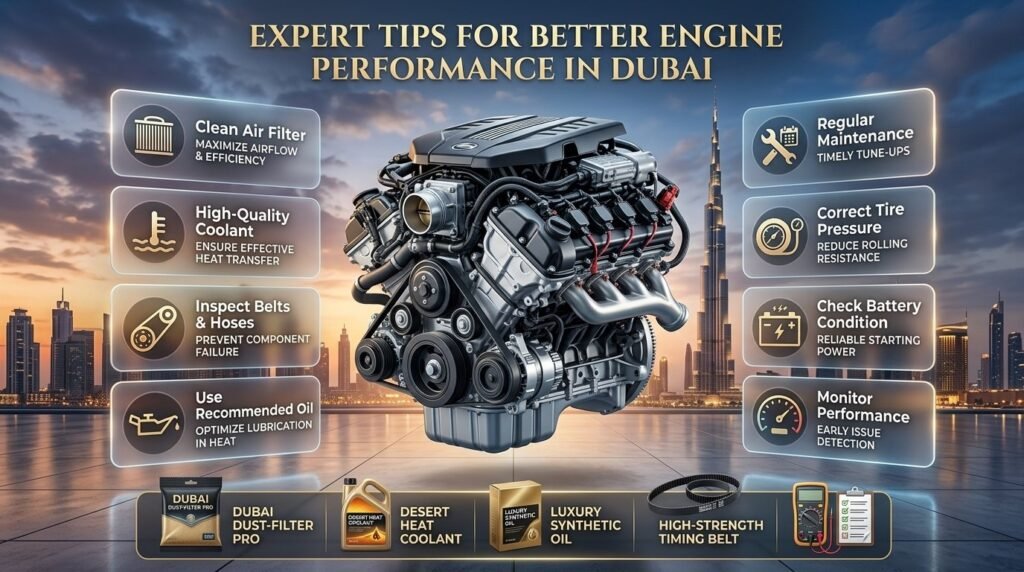
The best way to maintain engine performance is to follow a consistent maintenance process and investigate changes early. Replacing parts unnecessarily is rarely as effective as identifying the cause of a problem.
Follow a practical maintenance routine
Use the manufacturer’s recommended service intervals, adjusted where the manufacturer specifies special requirements for severe operating conditions. Check fluid levels and inspect the vehicle for visible leaks.
Pay attention to changes in starting, idling, acceleration, temperature, fuel consumption, and exhaust behaviour. These observations can help a technician identify the problem more efficiently.
Use the correct engine oil and coolant
Oil viscosity and specification should match the manufacturer’s requirements. Choosing oil solely because it is advertised for hot weather may be inappropriate if it does not meet the required specification.
Likewise, coolant should meet the manufacturer’s chemistry and performance requirements. Colour alone does not establish compatibility, and mixing incompatible coolant types can cause problems.
Maintain tyres and avoid unnecessary load
Tyre pressure affects rolling resistance, handling, and fuel consumption. Check the recommended pressures for your vehicle and load rather than inflating tyres beyond the specified level.
Remove unnecessary items from the vehicle when practical. Extra weight can increase fuel use, particularly in repeated urban acceleration.
Diagnose performance changes systematically
If the vehicle loses power, begins consuming more fuel, or develops unusual noises, record when the symptoms occur. Note whether the engine is cold or warm, whether the air conditioning is running, and whether the issue appears in traffic or at highway speed.
A technician can use this information alongside diagnostic data and physical inspections. Avoid assuming that one symptom proves a particular component has failed.
Choose the engine for your actual driving pattern
A driver who covers a few short journeys daily has different needs from a commercial driver who travels hundreds of kilometres regularly. The most suitable engine is the one that fits the work it will perform.
Think about annual mileage, typical trip length, passenger and cargo loads, servicing access, and the vehicle’s expected resale value. These factors provide a more reliable basis for choosing than general claims about petrol or diesel.
13. Which Engine Should You Choose for Your Driving Needs?
The following guide can help narrow your options. Treat it as a starting point because the exact vehicle specifications and your budget can change the recommendation.
| Driving situation | Option worth considering | Main reason |
|---|---|---|
| Daily city commuting | Petrol | Often practical for mixed urban use |
| Frequent short journeys | Petrol | May suit the driving pattern better |
| Regular long-distance travel | Petrol or diesel | Compare real-world economy and comfort |
| Heavy loads or towing | Diesel in many applications | Often offers strong low-RPM torque |
| High annual mileage | Diesel may be worthwhile | Fuel savings may accumulate |
| Quiet family driving | Petrol in many models | Often quieter engine operation |
| Commercial fleet use | Depends on the duty cycle | Load, mileage, uptime, and maintenance matter |
| Performance-focused driving | Compare exact models | Power, gearing, weight, and tuning determine results |
Ask these questions before making your final decision
- How many kilometres do I drive each month?
- Are my journeys mainly short urban trips or long highway drives?
- Do I regularly carry heavy loads or tow equipment?
- What are the real-world fuel-consumption figures for the vehicles I’m comparing?
- What servicing and emissions-system requirements apply?
- Does the vehicle have a complete service history?
- How much will the vehicle cost to buy, maintain, insure, and repair?
- Does the engine provide the acceleration, comfort, and pulling power I need?
Answering these questions with actual figures can help you avoid choosing an engine that looks economical on paper but costs more to own.
Which Engine Performs Better in Dubai: Petrol or Diesel?
Petrol and diesel engines can both perform reliably in Dubai, but the better option depends on your driving habits, vehicle type, and performance expectations. Petrol engines are often preferred for daily commuting because they generally offer smooth acceleration, quieter operation, and convenient performance in urban traffic. Diesel engines typically deliver stronger low-RPM torque, making them suitable for larger SUVs, commercial vehicles, and drivers who frequently travel long distances.
Dubai’s hot climate also makes cooling-system condition and regular maintenance important for both engine types. Rather than assuming one engine is always better, compare the specifications and real-world performance of the vehicles you’re considering.
Key points to consider:
Daily city driving: A suitable petrol vehicle may provide a practical balance of comfort and performance.
Long-distance travel: Diesel may offer better fuel economy in comparable vehicles.
Heavy loads: Diesel engines often provide stronger low-speed pulling power.
Summer reliability: Both engines require effective cooling, correct lubrication, and regular servicing.
Final decision: Choose according to your driving pattern, budget, and long-term ownership costs.
Is a Diesel Engine More Fuel-Efficient Than a Petrol Engine in Dubai?
Diesel engines often consume fewer litres of fuel per 100 kilometres than comparable petrol engines. Their higher compression ratios and efficient combustion characteristics help them convert fuel energy into useful work effectively. This can make diesel an attractive option for drivers who cover substantial distances on Dubai’s highways or travel regularly between emirates.
However, fuel efficiency depends on more than engine type. Vehicle weight, engine size, transmission, traffic conditions, driving speed, air-conditioning use, and maintenance can all influence consumption. Frequent short trips may also reduce the practical advantages of some diesel vehicles, particularly those equipped with diesel particulate filters.
Before deciding, calculate the fuel costs using your actual monthly mileage and the measured consumption of each vehicle.
Key points to consider:
Compare consumption in litres per 100 km rather than relying on general claims.
Use actual fuel prices and your expected annual mileage.
Include servicing and potential repair costs when calculating savings.
Consider whether your usual journeys are short urban trips or longer highway drives.
Review the detailed Petrol vs. Diesel Fuel Economy in Dubai comparison before making your decision.
How Does Dubai’s Extreme Summer Heat Affect Petrol and Diesel Engine Performance?
Dubai’s summer temperatures increase the demands placed on engine cooling, lubrication, and air-conditioning systems. Both petrol and diesel engines can experience reduced performance under certain conditions if heat management becomes inadequate. Modern engine management systems may adjust engine operation to protect components from excessive temperatures, while cooling-system faults can cause more serious problems.
Petrol engines may reduce power under conditions that increase combustion knock risk, while turbocharged diesel engines also require effective cooling when operating under sustained load. Neither engine type is automatically immune to overheating.
To maintain reliable performance, follow the manufacturer’s service schedule and address temperature warnings, coolant leaks, or unusual power loss promptly. Never open a hot radiator or pressurised coolant reservoir cap.
Key points to consider:
Maintain the correct coolant specification and level.
Inspect the radiator, cooling fans, hoses, and water pump when necessary.
Use the engine oil grade specified by the manufacturer.
Investigate repeated overheating rather than simply topping up coolant.
Arrange professional diagnosis if the engine loses power or temperature readings become abnormal.
Which Engine Is Better for Dubai Traffic and Frequent Short Trips?
For drivers who spend most of their time in city traffic, a suitable petrol engine is often a practical choice. Petrol vehicles commonly provide smooth low-speed operation and work well for daily commuting, shopping, and other short journeys. However, actual fuel consumption can increase significantly in congested traffic because of repeated acceleration, braking, and prolonged idling.
Diesel engines can also perform well in urban conditions, but the suitability of a particular model matters. Some modern diesel vehicles use diesel particulate filters that need specific operating conditions for regeneration. Repeated short trips may interfere with this process, depending on the vehicle’s design and driving pattern.
The right choice should reflect how you actually use your car, not simply which engine type has the better reputation for efficiency.
Key points to consider:
Petrol may be more convenient for frequent short journeys.
Diesel can suit urban driving if the vehicle is designed for that use.
Repeated short trips may create additional emissions-system concerns in some diesel models.
Smooth acceleration and sensible maintenance can help control fuel consumption.
Check the owner’s manual before choosing a diesel vehicle for predominantly short-distance driving.
How Can You Choose the Most Reliable and Cost-Effective Engine for Driving in Dubai?
Choosing a reliable engine requires looking beyond fuel economy or horsepower. The most suitable option is one that meets your performance needs, fits your budget, and can be maintained properly throughout your ownership period. A diesel vehicle may save money on fuel over long distances, but higher servicing or repair costs can reduce the overall benefit. Similarly, a petrol vehicle may offer convenient daily performance but consume more fuel in some comparable applications.
Before purchasing, review the vehicle’s service history, engine specifications, cooling-system condition, and expected maintenance requirements. If you’re buying a used car, a professional pre-purchase inspection can help identify problems that aren’t obvious during a short test drive.
Key points to consider:
Compare annual fuel costs using realistic consumption figures.
Include servicing, expected repairs, insurance, and purchase price in your calculations.
Inspect the cooling system carefully because both engine types need effective heat management in Dubai.
Check diesel injection and emissions systems where fitted.
Choose an engine that matches your annual mileage, typical journey length, passenger load, and long-term ownership plans.
Professional recommendation: Petrol is often a sensible starting point for everyday urban driving, while diesel deserves serious consideration for frequent long-distance travel and heavy-duty use. However, the exact vehicle, its maintenance history, and your real-world driving requirements should determine the final decision.
Conclusion: Petrol vs Diesel Engine Performance in Dubai
Choosing between petrol and diesel engine performance in Dubai depends on your driving habits, vehicle requirements, expected mileage, and long-term ownership costs. Both engine types can perform reliably in the UAE when properly maintained, but they offer different advantages under Dubai’s demanding driving conditions.
Petrol engines are often a practical choice for drivers who mainly travel within the city, make frequent short trips, and prefer smooth, quiet performance with responsive acceleration. Diesel engines can be more suitable for drivers who cover long distances regularly, spend considerable time on highways, or require strong low-speed pulling power. However, actual performance and fuel economy depend on the specific engine, vehicle weight, transmission, maintenance condition, and driving style.
Dubai’s extreme summer temperatures, heavy traffic, frequent air-conditioning use, and dusty environment make regular vehicle maintenance essential for both petrol and diesel vehicles. Checking the cooling system, engine oil, air filter, fuel system, and manufacturer-recommended service schedule helps maintain consistent performance and reduce the risk of unexpected repairs.
Before making a decision, compare the complete cost of ownership rather than focusing only on acceleration or fuel consumption. Consider the purchase price, fuel expenses, maintenance requirements, repair costs, annual mileage, and how long you intend to keep the vehicle. For a broader understanding of the differences, explore our Petrol vs. Diesel Comparisons Dubai guide and our detailed guide to Petrol vs. Diesel Fuel Economy in Dubai.
Ultimately, the best engine is the one that matches your everyday driving needs and budget. Petrol may offer the right balance for regular urban driving, while diesel may provide greater value for consistent long-distance use. By comparing real-world performance, fuel efficiency, and maintenance needs, you can make a more informed decision and enjoy dependable driving throughout Dubai.
Leave a Reply