
Introduction
Cooling System Maintenance | A car that starts overheating in traffic, loses coolant without an obvious leak, or shows a sudden temperature warning can quickly turn an ordinary journey into an expensive problem. In many cases, the cooling system gives early warning signs before serious engine damage occurs. The challenge is knowing what to check, which symptoms matter, and when professional diagnosis is necessary.
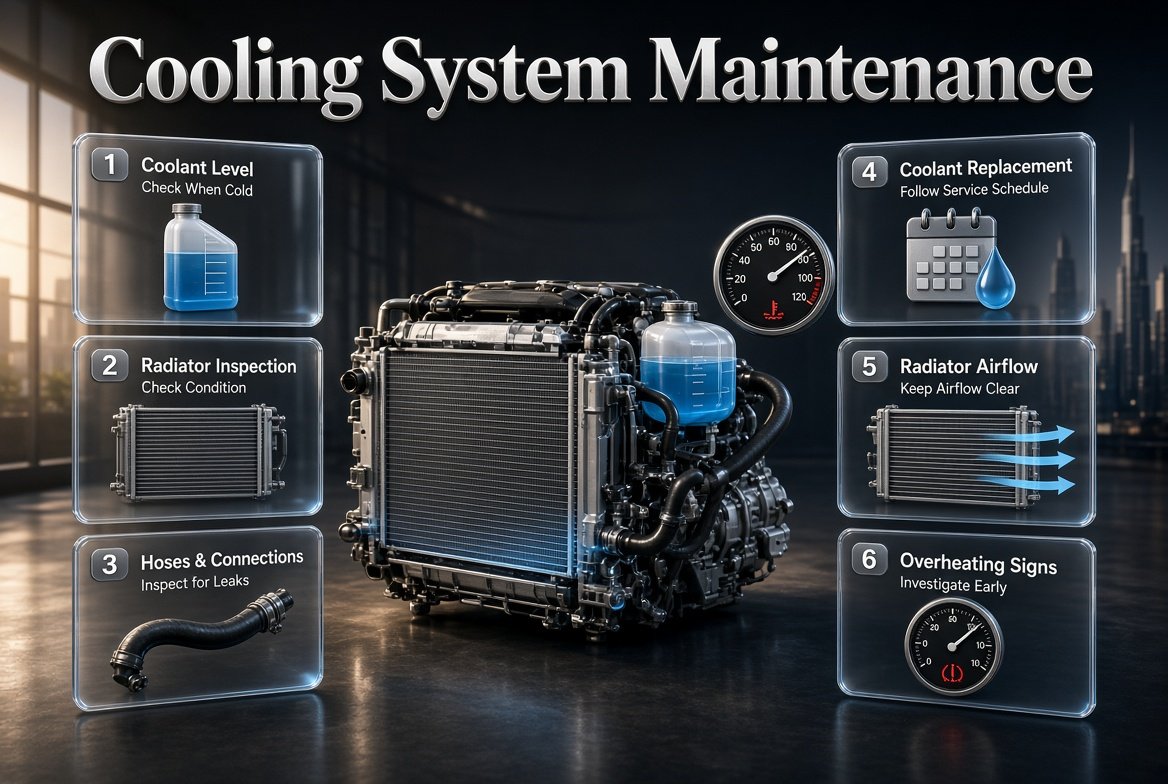
Cooling system maintenance helps keep your engine operating within its designed temperature range. It involves inspecting coolant levels, checking hoses and connections, maintaining radiator airflow, following coolant replacement intervals, and identifying problems before they become serious.
This guide explains how the engine cooling system works, how to maintain it correctly, how often to inspect its components, and how to recognize common faults. It also covers practical maintenance considerations for Dubai drivers, where high ambient temperatures, traffic congestion, and frequent air-conditioning use can place additional demands on a vehicle.
For broader vehicle-care advice, visit Fuel Delivery Dubai. This guide focuses specifically on cooling-system maintenance, helping you make informed decisions about inspections, servicing, and repairs.
What Is Cooling System Maintenance?
Cooling system maintenance is the process of inspecting, testing, and servicing the components that regulate engine temperature. Its purpose is to prevent overheating, support consistent engine performance, protect internal components, and maintain the operating conditions required for efficient combustion.
A typical liquid-cooled engine uses coolant to absorb heat from the engine and transfer it to the surrounding air through the radiator. The water pump circulates the coolant, the thermostat helps regulate its flow, and cooling fans assist airflow when necessary.
Routine maintenance helps identify problems such as:
- Low coolant levels or unexplained coolant loss.
- Leaking radiator hoses, connections, or seals.
- Damaged radiator fins or restricted airflow.
- Deteriorated coolant or contamination.
- A faulty thermostat or water pump.
- Cooling fans that do not operate correctly.
- Pressure-cap problems or air trapped in the system.
These checks matter because cooling-system faults can develop gradually. A loose connection may cause a small leak long before the temperature gauge rises. Similarly, a partially restricted radiator may perform adequately during light driving but struggle under heavy engine load.
The best maintenance strategy is to inspect the system, understand the symptoms, and repair the confirmed cause instead of replacing components based on assumptions.
How Does a Car Cooling System Work?
A car cooling system removes excess heat produced by the engine and helps maintain a stable operating temperature. It also supports consistent performance by preventing excessive heat from damaging engine components and by allowing the engine to warm up properly.
The basic cooling process follows these steps:
- Combustion generates heat inside the engine.
- Coolant absorbs heat as it circulates through engine passages.
- The water pump moves the coolant through the cooling circuit.
- Heated coolant passes through the radiator when the system directs it there.
- Air passing through the radiator carries heat away.
- The coolant returns to the engine, and the cycle continues.
The thermostat regulates coolant flow according to temperature and system design. A pressure cap helps maintain the specified system pressure, while the expansion tank accommodates coolant expansion in many modern vehicles.
What Are the Main Cooling System Components?
| Component | Main function | Maintenance focus |
|---|---|---|
| Radiator | Transfers heat from coolant to air | Leaks, damage, blockage |
| Engine coolant | Carries heat and protects against corrosion | Correct specification, level, condition |
| Water pump | Circulates coolant | Leakage, noise, circulation |
| Thermostat | Regulates coolant flow | Correct operating temperature |
| Pressure cap | Maintains specified system pressure | Seals and pressure rating |
| Hoses and clamps | Carry coolant between components | Cracks, swelling, loose connections |
| Cooling fan | Supports airflow through the radiator | Motor, controls, wiring |
| Expansion tank | Accommodates coolant expansion in many designs | Cracks, leaks, level |
| Temperature sensor | Reports temperature to vehicle systems | Accurate readings and fault diagnosis |
Every component has a different role, but the system works as a whole. A new radiator will not solve overheating caused by a defective water pump, and replacing the thermostat will not repair a leaking hose.
Understanding these relationships makes it easier to recognize why accurate diagnosis matters.
How Often Should You Perform Cooling System Maintenance?
The correct maintenance interval depends on the vehicle manufacturer’s recommendations, coolant specification, mileage, operating conditions, and service history. There is no single interval that applies to every vehicle.
As a practical starting point, inspect the coolant reservoir monthly when the engine is cold. Check visible hoses and connections during routine vehicle checks, and follow the manufacturer’s schedule for coolant testing, replacement, and more detailed inspections.
Recommended Cooling System Maintenance Schedule
| Maintenance task | Practical guideline |
|---|---|
| Check coolant level | Monthly and before long journeys |
| Inspect for visible leaks | During regular vehicle checks |
| Inspect hoses and clamps | During scheduled servicing and when symptoms appear |
| Check radiator airflow | Periodically and when cooling performance changes |
| Assess coolant condition | According to manufacturer guidance or when contamination is suspected |
| Replace coolant | At the specified time or mileage interval |
| Test the pressure cap | When symptoms or diagnostic findings justify it |
| Inspect the water pump and thermostat | According to the service schedule or when a fault is suspected |
| Check cooling-fan operation | During appropriate servicing or when overheating occurs |
These are general inspection guidelines, not universal replacement intervals. Some vehicles use long-life coolant, while others require different formulations and service schedules.
Does Hot Weather Mean You Should Replace Coolant More Frequently?
Not automatically. High temperatures can increase cooling demand, but they do not justify premature coolant replacement without considering the manufacturer’s instructions and the fluid’s condition.
In Dubai, extended idling, slow-moving traffic, heavy air-conditioning use, and high outdoor temperatures can reveal weaknesses in an existing cooling system. Regular inspection is therefore especially valuable.
Expert tip: Follow the specified coolant interval, but investigate warning signs as soon as they appear. A cooling system that repeatedly loses fluid needs diagnosis, not simply more frequent top-ups.
How to Check Engine Coolant Safely
Checking the coolant reservoir is one of the simplest maintenance tasks a vehicle owner can perform. However, safety comes first because hot coolant can be pressurized and may cause serious burns.
Step 1: Park and Allow the Engine to Cool
Park on level ground, switch off the engine, and allow it to cool completely. Never remove a radiator cap or pressurized expansion-tank cap while the system is hot.
Step 2: Locate the Correct Reservoir
Consult your owner’s manual if you’re unsure which reservoir contains engine coolant. Do not confuse it with the windscreen-washer reservoir or brake-fluid reservoir.
Step 3: Check the Level
Look for the MIN and MAX markings on the reservoir. When the engine is cold, the level should generally fall within the range specified by the manufacturer.
If it is below the minimum mark, investigate why it has dropped. A small top-up may be appropriate, but recurring coolant loss should not be ignored.
Step 4: Inspect the Coolant’s Appearance
Look for obvious contamination, floating debris, an oily film, or unusual discoloration. Coolant colour alone cannot reliably establish its quality or compatibility because different formulations have different colours.
Step 5: Inspect Visible Components
With the engine off and cool, check accessible hoses, the reservoir, and the area around the radiator. Look for wet patches, dried coolant residue, cracks, or damaged connections.
Step 6: Use the Correct Coolant
Use the specification approved for your vehicle. If the existing coolant type is unknown, contamination is visible, or the level continues to fall, seek professional advice before mixing fluids.
Common mistake: Never open a hot cooling system to check the level. Wait until it is completely cool and follow the manufacturer’s instructions.
How to Maintain Coolant and Prevent Cooling System Problems
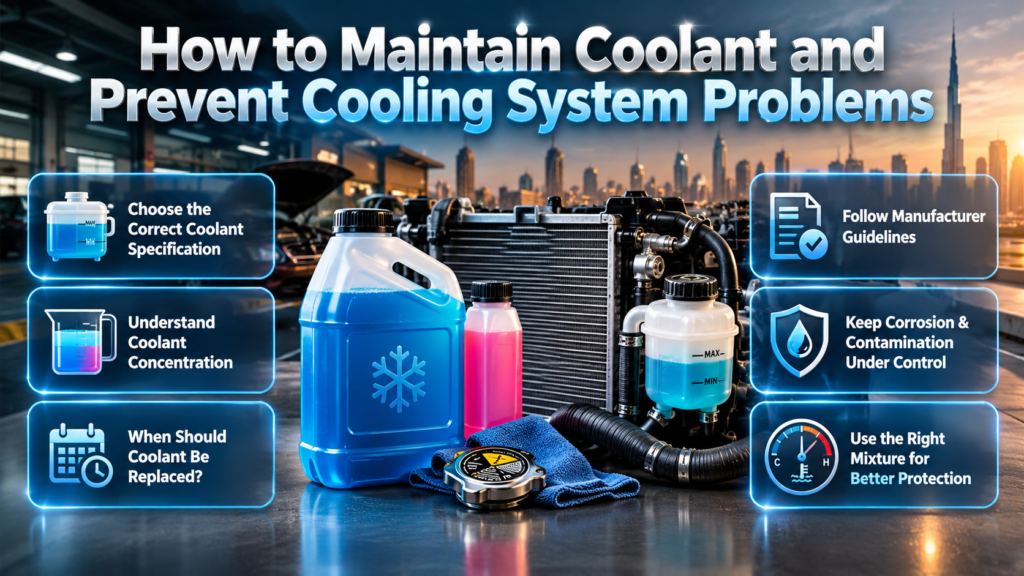
Engine coolant, often called antifreeze, carries heat away from the engine and helps protect cooling-system materials against corrosion. Depending on the formulation, it also provides freeze protection and supports the correct operation of seals and other components.
Over time, coolant additives can deteriorate. Incorrect mixtures, incompatible fluids, or contamination may also reduce the protection intended by the manufacturer.
Choose the Correct Coolant Specification
Different vehicles can require different coolant technologies. A product that works in one engine may not meet another manufacturer’s requirements.
Before buying coolant:
- Check the owner’s manual or manufacturer service information.
- Confirm the required coolant specification.
- Follow the specified concentration or premix instructions.
- Avoid mixing different formulations unless compatibility is confirmed.
- Use the recommended water quality if dilution is required.
Do not choose a product simply because its colour matches the coolant already in the reservoir.
Understand Coolant Concentration
Coolant may be sold as a ready-to-use premixed product or as a concentrate that must be diluted according to instructions. The correct mixture supports heat transfer, corrosion protection, and the temperature protection required by the vehicle.
More antifreeze is not necessarily better. Excessive concentration can reduce heat-transfer performance compared with the recommended mixture.
Use the manufacturer’s specified ratio instead of assuming every vehicle requires the same concentration.
When Should Coolant Be Replaced?
Replace coolant at the time or mileage interval specified by the manufacturer, or when an appropriate inspection establishes that contamination or deterioration requires attention.
Appearance alone is not a reliable measure of coolant condition. A clean-looking fluid may have depleted additives, while a different colour may be normal for a particular formulation.
After coolant replacement or cooling-system repairs, the system may need a specific filling and bleeding procedure. Air trapped inside can interfere with circulation and cause abnormal temperature behaviour.
For wider engine-care advice, read the Engine Maintenance Guide. It complements this article by helping you understand how cooling checks fit into your overall maintenance routine.
How to Maintain the Radiator for Better Cooling Performance
The radiator transfers heat from the coolant to the air passing through its core. Its performance depends on adequate coolant circulation, clean heat-transfer surfaces, and sufficient airflow.
A radiator can become less effective because of external debris, damaged fins, internal deposits, leakage, or restricted coolant flow.
Inspect the Radiator for Leaks
Check accessible radiator seams, hose connections, and surrounding areas for coolant residue, corrosion, or wet patches.
Some leaks occur only when the system is hot or pressurized, so the absence of a puddle beneath the car does not rule out a problem.
If coolant loss continues without an obvious source, a professional pressure test may help identify the leak.
Keep the Airflow Path Clear
Dust, insects, leaves, and other debris can collect around the radiator and air-conditioning condenser. Heavy buildup may restrict airflow and reduce heat transfer.
To maintain the radiator’s external condition:
- Inspect accessible cooling surfaces for debris.
- Remove loose material carefully.
- Avoid aggressive pressure washing that can bend delicate fins.
- Have difficult-to-access areas cleaned using an appropriate method.
- Investigate overheating that continues after cleaning.
Radiator fins are delicate. Damaging them while attempting to clean the cooling system can reduce airflow rather than improve it.
When Is a Radiator Flush Necessary?
A radiator flush may be appropriate when the coolant is contaminated, deposits are identified, or the manufacturer’s maintenance procedure requires it.
However, flushing is not a universal solution for overheating. It cannot repair a cracked radiator, faulty thermostat, damaged water pump, defective cooling fan, or leaking engine gasket.
A technician should determine whether the correct solution is flushing, targeted cleaning, repair, or replacement.
For additional maintenance planning, visit the Vehicle Maintenance Guides. This resource can help you organize cooling-system inspections alongside other routine vehicle-care tasks without duplicating the specific advice in this article.
How to Inspect Cooling System Hoses, Belts, and Connections
Cooling hoses carry fluid between the engine, radiator, heater, and other parts of the system. A deteriorated hose can leak, split, or fail under operating pressure, leading to coolant loss and overheating.
What Should You Look for During a Hose Inspection?
With the engine cold and switched off, inspect accessible hoses for:
- Cracks, splits, or damaged surfaces.
- Bulging or unusually soft sections.
- Coolant residue around hose ends.
- Loose or corroded clamps.
- Signs of rubbing against nearby components.
Do not squeeze hot hoses or tighten connections while the system is pressurized. If a hose appears severely swollen, damaged, or wet with coolant, arrange an appropriate inspection and replacement if necessary.
Why Do Hose Clamps Matter?
Clamps secure hoses to their fittings. A loose, corroded, incorrectly positioned, or damaged clamp can cause a leak, even when the hose itself appears healthy.
However, tightening a clamp excessively can damage the hose or fitting. Use the appropriate specification and repair procedure rather than applying force without assessment.
What About the Water Pump Drive Belt?
Some vehicles use a belt to drive the water pump, while others use electric pumps or different drive arrangements. If your vehicle has a relevant belt, inspect it according to the manufacturer’s instructions.
Cracking, fraying, contamination, or unusual noise may justify further inspection. Belt appearance alone cannot confirm that the water pump is operating correctly.
Expert tip: When replacing a failed hose, investigate why it failed. Heat exposure, incorrect routing, excessive pressure, or damage to nearby components may cause the replacement hose to develop the same problem.
Why Does the Thermostat Matter in Cooling System Maintenance?
The thermostat helps regulate coolant flow so the engine can warm up and operate within its intended temperature range.
When the engine is cold, the thermostat generally restricts flow through the radiator. As the engine warms, the thermostat opens according to its design, allowing more coolant to pass through the radiator.
A thermostat that sticks closed can restrict heat removal and contribute to overheating. One that remains open may cause slow warm-up or lower-than-expected operating temperatures.
Possible symptoms include:
- The temperature rising unusually quickly.
- Temperature fluctuations that require investigation.
- An engine taking too long to warm up.
- Cabin heating that performs differently than expected.
These symptoms do not prove thermostat failure. Low coolant, trapped air, sensor faults, and circulation problems can produce similar signs.
A technician can compare temperature readings and test system behaviour before recommending replacement. Changing the thermostat without confirming the fault may add expense while leaving the real problem unresolved.
How Can You Tell Whether the Water Pump Is Failing?
The water pump circulates coolant through the engine and cooling circuit. Depending on the design, it may be driven by an accessory belt, timing belt, timing chain, or electric motor.
A failing pump can reduce coolant circulation and contribute to overheating. Some pumps also develop seal leaks or bearing noise before complete failure.
Common warning signs include:
- Coolant residue or leakage near the pump.
- Unusual noise from the pump area.
- Repeated overheating without an obvious radiator problem.
- Diagnostic findings indicating inadequate coolant circulation.
Not every water pump failure produces a visible leak. Some faults develop internally or occur without clear external warning signs.
A qualified technician should assess the pump alongside the coolant level, thermostat, radiator, and other potential causes. Replacing a water pump based on overheating alone is not a reliable diagnostic method, particularly when the repair involves timing-system components or substantial labour.
What Does the Radiator Pressure Cap Do?
The pressure cap helps maintain the cooling system’s specified operating pressure. By controlling pressure and coolant transfer to the expansion tank, it supports the system’s ability to manage heat.
A damaged cap or deteriorated seal may allow coolant to escape, prevent the system from maintaining the intended pressure, or contribute to recurring coolant loss.
Possible warning signs include dried coolant residue around the cap, unexplained coolant loss, or other pressure-related symptoms.
These signs do not confirm that the cap is faulty. A technician can test it using the correct equipment and specification.
Never remove a pressurized cap while the engine is hot. Even a cap that appears easy to turn can release scalding coolant or steam.
How Do Cooling Fans Affect Engine Temperature?

Cooling fans help move air through the radiator when natural airflow is insufficient, especially when the vehicle is stationary or moving slowly.
Depending on the vehicle, the fan may be electric, mechanically driven, or controlled through a more complex electronic system.
A fan problem may become noticeable when the engine temperature rises in traffic but improves while driving at higher speeds.
Possible causes include:
- A failed fan motor.
- A faulty fuse or relay.
- Damaged wiring or electrical connections.
- A temperature sensor or control fault.
- Restricted airflow through the radiator and condenser.
Do not assume every traffic-related overheating problem is caused by the fan. Low coolant, radiator restriction, thermostat faults, and weak coolant circulation can produce similar symptoms.
Cooling fans can start unexpectedly, even after the engine has been switched off. Keep hands, clothing, and tools away from fan blades and moving components.
User Guide: A Practical Approach to Preventing Engine Overheating
Engine overheating can often be addressed more effectively when drivers recognise warning signs early and maintain the cooling system according to the vehicle manufacturer’s recommendations. In Dubai, high outdoor temperatures and heavy traffic make it important to monitor the temperature gauge, check coolant levels when the engine is completely cold, and inspect accessible hoses and connections for leaks. Make sure the radiator’s external airflow path remains clear of excessive dirt and debris, and use the correct coolant specification for your vehicle. If the temperature rises above its normal range, an overheating warning appears, or steam comes from under the bonnet, stop in a safe location and switch off the engine as soon as it is safe to do so. Allow the system to cool naturally, and never open a hot radiator cap or coolant reservoir. Repeated overheating should be professionally diagnosed because the cause may involve the thermostat, cooling fan, water pump, radiator, coolant leakage, or another engine problem. For step-by-step maintenance advice, common mistakes to avoid, and guidance on recognising overheating symptoms, read our Engine Overheating Prevention Guide. It helps drivers understand practical preventive checks and when further inspection is necessary.
What Are the Warning Signs of Cooling System Problems?
Cooling-system faults often produce changes in engine temperature, coolant level, smell, or visible component condition. Recognizing these signs early can help prevent more serious damage.
1. The Temperature Gauge Rises Above Normal
A rising gauge or temperature warning may indicate low coolant, restricted airflow, poor circulation, or another fault.
Reduce engine load and stop somewhere safe as soon as possible. If overheating is indicated, switch off the engine and follow the vehicle manufacturer’s instructions.
Do not continue driving in the hope that the temperature will return to normal.
2. Coolant Level Keeps Dropping
A falling coolant level may result from a leaking hose, radiator, pump seal, reservoir, or another component. Internal engine problems can also cause coolant loss.
Repeated top-ups without investigation may delay necessary repairs and allow the problem to worsen.
3. Sweet Smell or Visible Coolant Residue
Some coolant formulations have a sweet smell. Wet patches or crusty residue around cooling-system components may indicate leakage.
Avoid touching or tasting coolant. Keep it away from children and animals, and clean spills safely because many formulations are harmful if swallowed.
4. The Heater Behaves Unusually
Unexpectedly weak cabin heating can sometimes accompany low coolant or air trapped in the system. Heater-control faults and other problems can also cause similar symptoms.
If heater performance changes alongside coolant loss or abnormal engine temperature, arrange an inspection rather than assuming the heater itself is faulty.
5. Steam Appears From Under the Bonnet
Steam may indicate overheating or escaping coolant. Stop safely, switch off the engine when required, and keep away from the steam.
Do not open a hot pressurized cooling system or attempt an immediate repair at the roadside.
6. Coolant Appears Contaminated
An oily film, unusual deposits, or unexpected discoloration may indicate coolant deterioration or contamination. The cause could be relatively straightforward or could involve an internal engine problem.
Arrange an assessment before deciding whether the system needs flushing, repair, or further engine testing.
What Should You Do If Your Car Overheats?
Overheating requires a safety-first response. Continuing to drive with excessive engine temperature can cause severe damage, and opening a hot cooling system can cause serious burns.
Follow these general steps:
- Reduce engine load and move to a safe stopping place.
- Switch off the engine if overheating is indicated.
- Keep clear of steam or escaping coolant.
- Never remove the radiator or pressurized reservoir cap while hot.
- Allow the vehicle to cool completely before any permitted visual inspection.
- Arrange professional assistance if the cause is unknown, coolant is escaping, or overheating persists.
Do not restart the engine simply to see whether the warning has disappeared after severe overheating. If the vehicle has lost substantial coolant or shows signs of a serious fault, recovery or roadside assistance is safer than continuing the journey.
How Does Cooling System Maintenance Differ in Dubai?
Dubai’s climate makes cooling-system reliability particularly important. High outdoor temperatures, traffic congestion, extended idling, and frequent air-conditioning use can increase the demand placed on the vehicle’s heat-management systems.
The right response is not to replace every cooling component more frequently without evidence. It is to follow the manufacturer’s service schedule, monitor component condition, and investigate warning signs promptly.
Practical Checks for Dubai Drivers
Before long journeys:
- Check coolant level when the engine is cold.
- Inspect accessible hoses and connections.
- Look for coolant residue or leaks beneath the vehicle.
- Review any previous temperature warnings.
- Arrange an inspection if coolant loss or unusual temperature changes have occurred.
During routine ownership:
- Keep track of coolant top-ups.
- Note whether temperature changes occur in traffic or on highways.
- Inspect accessible radiator surfaces for blockage.
- Follow the specified coolant replacement schedule.
- Investigate warning lights and recurring symptoms.
Why Can a Car Overheat in Traffic but Not on the Highway?
At highway speeds, airflow through the radiator may be considerably greater than when the vehicle is stationary. If the temperature rises in traffic but improves at speed, cooling-fan operation or restricted airflow deserves attention.
Other causes remain possible, including low coolant, a partially restricted radiator, thermostat problems, or weak circulation.
Record when the overheating occurs and whether vehicle speed, air-conditioning use, or engine load changes the symptoms. This information can help a technician narrow down the cause.
For general vehicle-care information and roadside support, visit Fuel Delivery Dubai. If overheating makes your vehicle unsafe to drive, arrange appropriate assistance rather than continuing the journey.
Common Cooling System Maintenance Mistakes to Avoid
Many cooling-system problems become more expensive because an early warning is ignored or a repair is based on an incorrect assumption.
Mistake 1: Opening the Coolant Cap While the Engine Is Hot
Drivers sometimes want to check the coolant level immediately after seeing a temperature warning. However, pressurized hot coolant can escape suddenly and cause severe burns.
How to avoid it: Switch off the engine, stay clear of steam, and wait until the system is completely cool before checking the reservoir.
Mistake 2: Ignoring Small Coolant Losses
A car may continue running normally despite a small leak. This can make the problem appear unimportant.
However, the leak may worsen, and low coolant can reduce the system’s ability to remove heat.
How to avoid it: Monitor the level and arrange an inspection if it repeatedly falls.
Mistake 3: Mixing Coolants Without Checking Compatibility
A replacement coolant may look similar to the existing fluid without having the same formulation.
Using an incompatible product can compromise corrosion protection or cooling-system performance.
How to avoid it: Confirm the manufacturer’s required specification and approved coolant before adding fluid.
Mistake 4: Replacing Parts Without Diagnosing the Fault
Overheating does not automatically mean the thermostat, radiator, or water pump has failed.
Replacing parts without evidence can waste money while leaving the underlying problem unresolved.
How to avoid it: Use appropriate inspections, pressure testing, temperature checks, and other diagnostic procedures to establish the cause.
Mistake 5: Using Water as a Permanent Coolant Replacement
Water may provide temporary assistance in some emergencies, but it does not provide the same corrosion protection and other properties as the specified coolant mixture.
How to avoid it: Use the correct coolant formulation. If emergency guidance permits temporary water use, have the system checked and restored to the correct specification as soon as possible.
Mistake 6: Assuming a Normal Temperature Gauge Means Everything Is Fine
A developing leak or deteriorating hose may not immediately change the displayed temperature.
How to avoid it: Combine temperature monitoring with coolant-level checks, visual inspection, and attention to unusual smells or residue.
Mistake 7: Flushing the System Without Identifying the Problem
Flushing may be appropriate for contamination or deposits, but it cannot repair every mechanical fault.
How to avoid it: Ask for a diagnosis before approving a flush, especially when overheating is severe or recurring.
Mistake 8: Ignoring the Manufacturer’s Coolant Specification
Different vehicles may require different coolant chemistry, mixtures, and service intervals.
How to avoid it: Use the owner’s manual or manufacturer service information instead of relying only on general advice or coolant colour.
User Guide: Maintaining Your Car Radiator for Reliable Cooling
The radiator helps remove excess heat from the engine by transferring heat from the circulating coolant to the surrounding air. Keeping it in good condition involves more than checking coolant levels; drivers should also look for visible leaks, damaged hoses, corrosion, and dirt blocking the radiator’s external airflow. In Dubai, where hot weather and dusty conditions can place additional demands on a vehicle, these checks are a useful part of routine maintenance. Always check coolant levels with the engine completely cold, use the manufacturer-recommended coolant, and follow the vehicle’s specified servicing schedule. Avoid aggressive high-pressure cleaning, which can damage delicate radiator fins, and never open a hot radiator cap. If the engine overheats repeatedly, coolant disappears without an obvious explanation, or the radiator shows signs of damage, arrange a professional inspection to identify the actual cause before replacing parts. For practical instructions on radiator checks, coolant care, common maintenance mistakes, and signs of potential problems, read our Radiator Maintenance Guide. This resource helps drivers understand routine radiator care and make better-informed decisions about vehicle maintenance.
What Do Professionals Check During a Cooling System Inspection?
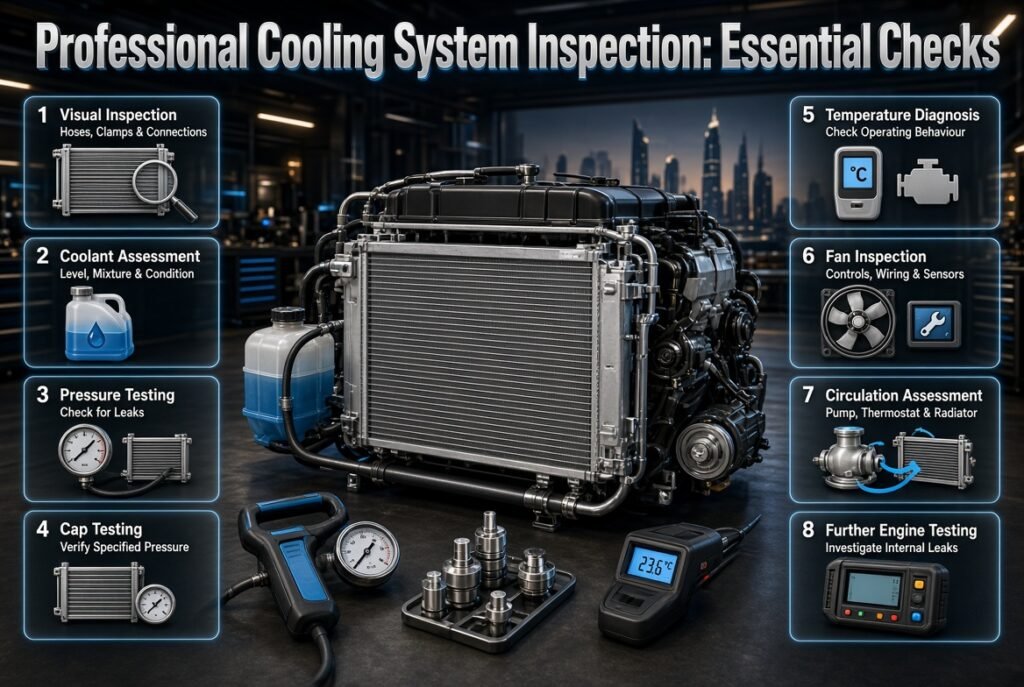
A professional inspection goes beyond looking at the coolant reservoir. It aims to determine whether the system can circulate coolant, transfer heat, maintain the specified pressure, and regulate engine temperature correctly.
Depending on the vehicle and symptoms, the inspection may include:
- Visual inspection: Check the radiator, reservoir, hoses, clamps, water pump area, and accessible connections.
- Coolant assessment: Verify the specified fluid, mixture, level, and condition.
- Pressure testing: Test the system for leaks using the correct pressure and procedure.
- Cap testing: Confirm that the pressure cap operates within its specified limits.
- Temperature diagnosis: Compare actual temperature readings with expected operating behaviour.
- Fan inspection: Check fan operation, controls, relevant fuses, relays, wiring, and sensors.
- Circulation assessment: Investigate possible thermostat, pump, or radiator restrictions.
- Further engine testing: If symptoms suggest internal coolant loss or combustion-gas leakage, perform appropriate additional tests.
Not every vehicle needs every test at every service. The inspection should be guided by the manufacturer’s maintenance schedule, observed condition, and reported symptoms.
For a structured approach to engine checks, use the Engine Inspection Checklist. It complements this cooling-system guide by helping you organize broader engine inspections without repeating the same detailed instructions.
A Practical Example: Coolant Keeps Disappearing
Imagine a driver notices that the coolant level drops twice in one month, but the temperature gauge remains normal.
Simply topping up the reservoir might seem reasonable because the engine has not overheated. However, a pressure test and visual inspection could reveal a small leak at a hose connection.
The appropriate response is to repair the leak, refill the system with the specified coolant, bleed air according to the manufacturer’s procedure, and verify that the level remains stable.
The important lesson is that a normal temperature reading does not eliminate the need to investigate repeated coolant loss.
How to Build a Better Cooling System Maintenance Routine
A useful maintenance routine should be simple enough to follow consistently. It should also distinguish between basic owner checks and technical procedures that require specialist equipment.
Monthly Checks
When the engine is cold, check the coolant reservoir level and inspect accessible areas for visible leaks or damaged hoses.
Pay attention to any changes since the previous check. A level that repeatedly falls deserves investigation even if the car continues to drive normally.
Before a Long Journey
Check the coolant level, inspect accessible connections, and review any recent temperature warnings. If the vehicle has overheated recently, resolve the underlying issue before beginning a long journey.
Do not assume that adding coolant makes a vehicle safe for a long drive when the cause of the loss remains unknown.
During Scheduled Servicing
Follow the manufacturer’s recommendations for coolant replacement and detailed inspections. Ask the technician to investigate recurring symptoms rather than simply clearing a warning or topping up the reservoir.
Keep records of coolant changes, repairs, and repeated coolant loss. This history helps identify patterns and can prevent unnecessary replacement of components that have already been tested.
Use a Simple Maintenance Record
| Date | Check or service | Findings | Action required |
|---|---|---|---|
| Monthly | Coolant level | Stable or falling | Monitor or investigate |
| Routine service | Hoses and connections | Normal or damaged | Repair if necessary |
| Scheduled interval | Coolant service | Due or not due | Follow manufacturer guidance |
| After a warning | Temperature behaviour | Normal or abnormal | Diagnose the cause |
The purpose of this record is not to create unnecessary work. It is to make changes easier to recognize and provide useful information when professional diagnosis is needed.
Expert Advice for Reliable Cooling System Maintenance
The most effective cooling-system maintenance combines regular observation with evidence-based repairs.
Inspect before replacing. Overheating can result from several different faults. Confirm the cause before buying parts.
Treat repeated coolant loss as a warning. A system that needs frequent top-ups should be investigated, even if the engine temperature appears normal.
Use the correct fluid. Coolant specifications, mixture requirements, and replacement intervals vary between vehicles.
Pay attention to operating conditions. Note whether the symptoms occur during traffic, high-speed driving, air-conditioning use, or heavy engine load.
Do not overlook small components. A damaged cap, deteriorated hose, or loose connection can affect the performance of the wider system.
Follow the correct repair procedure. Some vehicles require specific bleeding procedures, electronic controls, or specialist tools after cooling-system work.
Verify the repair. After a repair, the system should be checked according to the appropriate procedure to confirm correct coolant level, stable operating temperature, and absence of leakage.
A careful approach reduces unnecessary repairs and makes it easier to identify faults before they lead to more serious damage.
How Often Should You Perform Cooling System Maintenance?
Cooling system maintenance should follow your vehicle manufacturer’s recommended service schedule, coolant specifications, and driving conditions. As a practical starting point, check the coolant reservoir monthly when the engine is cold and inspect visible hoses, connections, and the radiator area during routine vehicle checks. Coolant replacement intervals vary between vehicles, so avoid relying on a universal mileage or time limit.
In hot climates such as Dubai, regular inspections are particularly useful because traffic congestion, prolonged idling, and high ambient temperatures can expose existing cooling-system weaknesses. However, hot weather alone does not automatically mean that coolant needs premature replacement.
Important maintenance checks include:
Check coolant levels before long journeys.
Inspect hoses and connections for cracks, swelling, or leakage.
Follow the manufacturer’s coolant replacement interval.
Investigate recurring coolant loss or unusual temperature changes.
Arrange professional testing if overheating occurs.
What Are the Warning Signs That Your Car’s Cooling System Needs Maintenance?
The most important warning signs include an unusually high engine temperature, repeated coolant loss, visible leaks, steam from under the bonnet, and unexpected changes in cabin heating. These symptoms can indicate problems with coolant circulation, radiator airflow, the thermostat, water pump, hoses, or other cooling-system components.
For example, if your car overheats mainly in traffic but returns to its normal temperature at higher speeds, a cooling-fan problem or restricted airflow may be responsible. However, other faults can produce similar symptoms, so accurate diagnosis is essential.
Watch for these warning signs:
Temperature gauge rising above its normal range.
Coolant level repeatedly dropping.
Sweet-smelling coolant or dried residue around connections.
Steam or visible coolant escaping.
Unusual temperature fluctuations or changes in heater performance.
If the engine overheats, stop somewhere safe, switch it off when appropriate, and allow it to cool. Never remove a hot radiator cap or pressurized coolant reservoir cap.
Which Coolant Is Best for Your Car, and When Should You Replace It?
The best coolant is the product that meets your vehicle manufacturer’s specified requirements. Different engines use different coolant formulations, and choosing a product based only on its colour can lead to compatibility problems. Always check the owner’s manual or manufacturer service information before purchasing coolant.
Coolant replacement intervals also vary. Some vehicles use long-life formulations, while others require more frequent servicing. Coolant additives gradually deteriorate, so following the specified interval helps maintain corrosion protection and proper cooling-system performance.
Before adding or replacing coolant:
Confirm the correct coolant specification.
Check whether the product is premixed or concentrated.
Follow the specified mixture ratio and water-quality requirements.
Avoid mixing different formulations unless compatibility is confirmed.
Investigate contamination or repeated coolant loss before simply topping up.
Fresh coolant cannot repair a leaking radiator, defective thermostat, or failing water pump. If the system has a mechanical fault, address the underlying problem as well as the coolant condition.
Why Does a Car Overheat in Traffic but Stay Cool on the Highway?
A car may overheat in traffic because airflow through the radiator is reduced when the vehicle is moving slowly or standing still. At higher speeds, natural airflow may provide additional cooling. If the temperature rises in traffic but improves on the highway, the cooling fan and radiator airflow deserve particular attention.
However, this pattern does not automatically confirm a faulty fan. Low coolant, a partially restricted radiator, thermostat problems, and inadequate coolant circulation can also contribute to overheating.
Possible causes include:
A cooling fan that fails to operate correctly.
Debris restricting airflow through the radiator or condenser.
Low coolant caused by a leak.
A thermostat that does not regulate coolant flow properly.
A water pump or circulation problem.
Avoid continuing to drive if the temperature warning appears. A technician can inspect fan operation, compare temperature readings, test the cooling system, and identify the actual cause before recommending repairs.
Can Poor Cooling System Maintenance Cause Expensive Engine Damage?
Neglected cooling system maintenance can contribute to serious engine damage because excessive temperature places stress on components that are designed to operate within a specific temperature range. Severe overheating may damage the cylinder head, head gasket, engine seals, and other components. In extreme cases, the engine may require major repairs or replacement.
The risk increases when drivers ignore temperature warnings, continue driving with low coolant, or repeatedly top up a leaking system without investigating the cause. Early diagnosis can help prevent a relatively small fault from developing into a much more expensive repair.
To reduce the risk of engine damage:
Monitor coolant levels and investigate recurring losses.
Respond promptly to temperature warnings.
Maintain the radiator, hoses, and cooling fan.
Replace coolant according to the manufacturer’s schedule.
Test suspected components before replacing them.
Stop driving and arrange assistance when overheating makes the vehicle unsafe.
The key is to identify cooling-system problems early rather than waiting for the engine to overheat. Regular inspections and evidence-based repairs help protect engine reliability and reduce avoidable maintenance expenses.
Conclusion: Why Cooling System Maintenance Matters
Regular cooling system maintenance is essential for protecting your engine, maintaining reliable performance, and reducing the risk of expensive repairs. The radiator, coolant, thermostat, water pump, cooling fan, hoses, and pressure cap all work together to control engine temperature. When one component fails or coolant levels become low, the entire system can be affected. Recognizing early warning signs and following the manufacturer’s maintenance schedule helps prevent minor issues from developing into serious engine problems.
In Dubai, high temperatures, heavy traffic, frequent idling, and regular air-conditioning use can place additional demands on a vehicle’s cooling system. However, effective maintenance is not about replacing parts unnecessarily. It is about inspecting components, checking coolant condition, identifying leaks, testing system performance, and repairing confirmed problems before they cause further damage.
Make cooling system checks part of your regular vehicle care routine, and never ignore a rising temperature gauge, coolant warning light, unusual coolant loss, or repeated overheating. If your engine overheats, stop in a safe place, switch off the engine, and allow it to cool completely before any inspection. Never open a hot radiator cap or coolant reservoir cap, as pressurized coolant can cause severe burns.
For more practical advice, explore our Vehicle Maintenance Guides, follow the Engine Maintenance Guide, and use the Engine Inspection Checklist to support a consistent maintenance routine. If you need roadside assistance in Dubai, visit Fuel Delivery Dubai for information about available fuel delivery support.
The best approach to cooling system maintenance is simple: inspect regularly, use the correct coolant, address warning signs early, and follow your vehicle manufacturer’s recommendations. These habits help protect engine reliability, support safer driving, and reduce the likelihood of avoidable breakdowns.
Leave a Reply