
Introduction
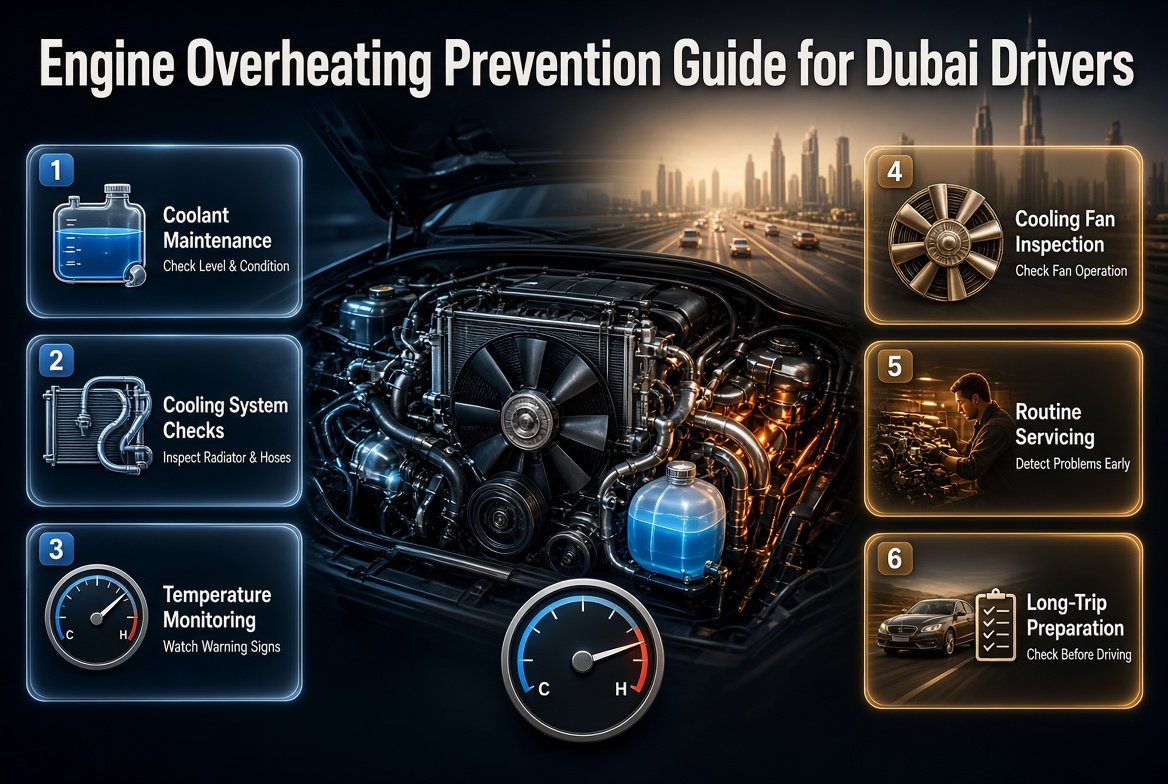
Engine Overheating Prevention | An engine temperature warning can turn a normal drive into a stressful roadside emergency. You may be travelling through busy Dubai traffic, waiting at a signal with the air conditioning running, or driving on a highway when the temperature gauge suddenly begins to rise. In that moment, knowing what to check, what to avoid, and when to stop can make a significant difference.
Engine overheating prevention is the process of keeping an engine within its intended operating temperature through correct coolant maintenance, cooling-system inspections, timely servicing, and sensible driving habits. It is not simply about adding coolant whenever the temperature rises. The real goal is to identify developing problems early and ensure that the engine can absorb, circulate, and release heat effectively.
In Dubai and other hot environments, a well-maintained cooling system is particularly important. High ambient temperatures, dusty conditions, slow-moving traffic, prolonged idling, and heavy engine loads can place additional demands on the system. However, a healthy vehicle should be designed to operate under its intended conditions without continually overheating.
This guide explains how engine overheating develops, how to prevent it, which warning signs deserve attention, how to prepare for long journeys, and what to do if the temperature starts rising. It also covers common maintenance mistakes, professional inspection methods, and practical routines that help protect your engine without replacing healthy components unnecessarily.
What Is Engine Overheating and Why Does Prevention Matter?
Engine overheating happens when the engine becomes hotter than its cooling system can safely manage. It may result from insufficient coolant, restricted airflow, poor coolant circulation, a faulty thermostat, or another mechanical problem.
An engine normally generates substantial heat while running. Its cooling system is designed to manage that heat and maintain a temperature range specified by the manufacturer. Prevention means keeping the system capable of doing its job under normal driving conditions and responding quickly when its performance changes.
Why can overheating damage an engine?
Excessive heat can affect engine oil, metal components, seals, gaskets, and other parts. If overheating continues, the cylinder head may distort, the head gasket may fail, and internal components may sustain serious damage.
The consequences depend on the engine design, the severity of the overheating, and how long the engine continues running under excessive temperatures.
Common risks include:
- Coolant loss: Excessive heat and pressure may cause coolant to escape through a damaged component or overflow.
- Reduced lubrication protection: High temperatures can accelerate oil degradation and make it harder for the oil to protect moving parts under demanding conditions.
- Cylinder-head damage: Severe overheating can distort the cylinder head and compromise the seal between engine components.
- Head-gasket failure: Excessive heat can damage the gasket, potentially allowing coolant, oil, or combustion gases to enter places where they should not.
- Engine breakdown: Continued operation under severe overheating conditions can cause extensive damage and may make the engine uneconomical to repair.
A temperature warning should never be ignored simply because the vehicle still starts, accelerates, or sounds normal.
Pro Tip: Become familiar with your car’s normal temperature readings. A sudden change from its usual operating behaviour may be more informative than waiting for steam or a major warning light to appear.
What Are the Main Causes of Engine Overheating?
Understanding the causes helps you choose the right preventive checks. Several faults can produce similar symptoms, so a temperature increase does not automatically mean that the radiator or thermostat needs replacing.
1. Low coolant level
Coolant absorbs heat from the engine and carries it through the cooling system to the radiator. The radiator then releases that heat into the surrounding air.
When the coolant level becomes too low, the system may not circulate enough fluid to transfer heat effectively. Low coolant can also allow air to enter the system, potentially creating circulation problems or localised hot spots.
Possible causes include:
- Leaking radiator or coolant reservoir.
- Cracked hoses or loose hose connections.
- A leaking water pump.
- A faulty pressure cap.
- Internal engine leakage.
- Coolant escaping through an overflow or boiling problem.
Check the reservoir when the engine is completely cold. If the level repeatedly falls, investigate the reason instead of continuing to top it up without addressing the fault.
2. Restricted radiator airflow
The radiator transfers heat from the coolant to the air passing through its fins. Dust, insects, leaves, and other debris can obstruct airflow, while bent fins can reduce the effective cooling area.
External contamination is particularly relevant for vehicles driven regularly in dusty environments. Internal restrictions are different: deposits or contamination inside the radiator may limit coolant flow even when the outside appears clean.
A visual inspection can reveal obvious debris or damage, but internal restrictions may require professional testing.
3. A faulty thermostat
The thermostat regulates coolant flow as the engine warms up. When the engine is cold, it restricts flow through the radiator as part of the warm-up process. As the engine reaches the required operating temperature, the thermostat opens to allow more coolant to circulate through the cooling system.
If the thermostat sticks closed or fails to open sufficiently, heat may not be transferred to the radiator effectively.
Possible symptoms include a rapidly rising temperature, overheating after the engine warms up, or unusual temperature behaviour. A thermostat stuck open can also prevent the engine from reaching its intended operating temperature efficiently.
Testing is preferable to replacing the thermostat based on symptoms alone.
4. Cooling-fan failure
The cooling fan helps move air through the radiator, especially when the vehicle is stationary or travelling slowly.
If the fan motor, relay, wiring, control system, or another related component fails, airflow may become insufficient under certain conditions.
A vehicle that runs at a normal temperature on an open road but gets hotter in traffic may have an airflow-related problem. However, this pattern is only a diagnostic clue, not proof of fan failure.
Some vehicles use variable-speed or electronically controlled fans, so their normal operation differs from that of older vehicles.
5. Water-pump problems
The water pump circulates coolant through the engine and cooling system. If it leaks, becomes damaged, or fails to circulate coolant properly, the engine may overheat.
Possible signs include coolant leakage near the pump, unusual mechanical noise, or rising engine temperature. Some pump problems do not produce obvious external leaks.
A technician may need to inspect the pump, its drive mechanism, and coolant circulation to determine whether it is working correctly.
6. Damaged hoses, belts, or pressure caps
Hoses carry coolant between the engine, radiator, and other components. Age, heat exposure, vibration, and deterioration can cause them to crack, swell, or leak.
On vehicles with belt-driven water pumps, a damaged or slipping drive belt may also affect coolant circulation. The exact arrangement depends on the engine design.
The pressure cap helps maintain the specified pressure in the cooling system. A defective cap can contribute to coolant loss or reduce the system’s ability to control boiling.
Inspect accessible components for visible damage, but never remove hot hoses or open a pressurised cooling system.
7. Internal engine problems
Not every overheating problem originates in an external cooling component. A damaged head gasket, internal coolant leak, combustion-gas intrusion, or another engine fault may affect cooling-system pressure and temperature.
Warning signs may include repeated coolant loss without an obvious external leak, persistent white exhaust smoke under conditions where it is abnormal, contaminated fluids, or recurring overheating.
These symptoms do not independently confirm a head-gasket failure. Proper diagnosis is necessary before approving major repairs.
For broader guidance on preventive engine care, read the Engine Maintenance Guide. It complements this article by covering engine maintenance beyond temperature control.
How Can You Prevent Engine Overheating Before It Starts?
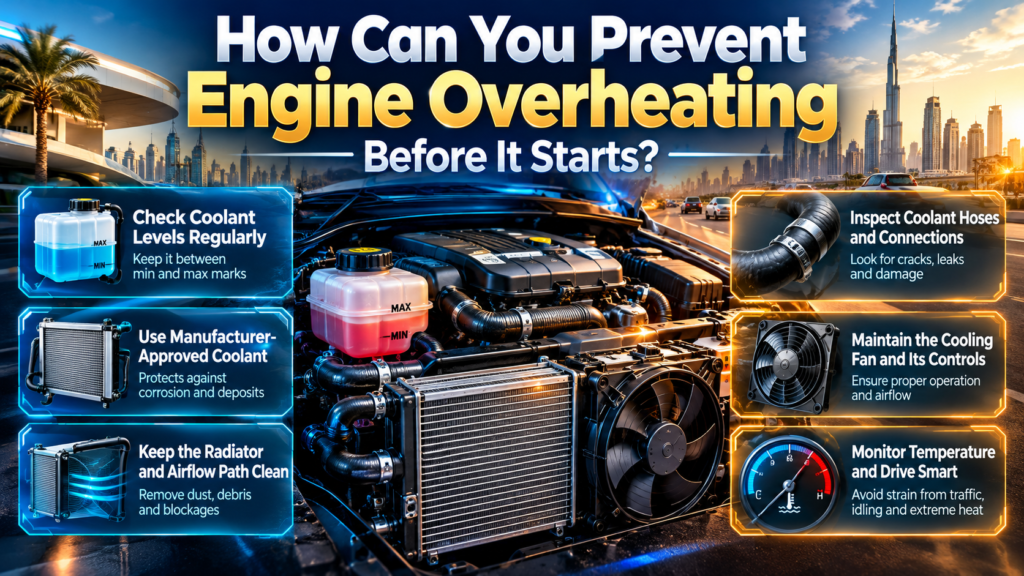
The most effective approach combines regular checks with condition-based maintenance. You do not need to dismantle the cooling system or replace components unnecessarily. Instead, establish a routine that identifies visible problems early and ensures that scheduled servicing is completed correctly.
1. Check coolant levels regularly
Coolant level checks are simple, but they must be performed safely. Most vehicles have a coolant reservoir with minimum and maximum marks.
Follow this process:
- Park on level ground and switch off the engine.
- Allow the engine to cool completely.
- Locate the coolant reservoir using the owner’s manual.
- Check that the coolant level falls within the specified marks.
- Look for visible leakage, dried residue, or damage around accessible connections.
- If the level is low, follow the manufacturer’s instructions for adding the correct coolant.
- Arrange an inspection if the level repeatedly falls or the system shows signs of leakage.
Never remove a radiator cap or coolant reservoir cap while the system is hot or pressurised. Hot coolant and steam can escape suddenly and cause serious burns.
A coolant check should also include observation. A reservoir that was at the correct level last week but is now significantly lower deserves attention, even if the temperature gauge has not yet changed.
Common Mistake: Treating repeated coolant top-ups as routine maintenance. A properly functioning cooling system should not continually lose significant amounts of coolant. Find out why the level is dropping.
2. Use the manufacturer-approved coolant
Coolant does more than transfer heat. Its formulation also helps protect against corrosion, deposits, and damage to compatible cooling-system materials.
Different engines may require different coolant specifications. Products that appear similar or share the same colour are not necessarily interchangeable.
Before adding coolant:
- Check the exact specification in the owner’s manual.
- Use the recommended premixed coolant or the specified concentrate-to-water mixture.
- Avoid mixing products unless their compatibility is confirmed.
- Follow the manufacturer’s replacement interval.
- Ask a technician to check coolant condition if contamination or unusual discolouration appears.
Water alone is not a suitable permanent replacement for the correct coolant mixture. In an emergency, the appropriate temporary measure depends on the vehicle and the circumstances. Follow the owner’s manual or obtain professional assistance rather than experimenting with the system.
Coolant condition matters as much as coolant quantity. Additives that protect against corrosion and deposits can deteriorate over time, even when the level appears correct.
3. Keep the radiator and airflow path clean
Radiator maintenance helps preserve the system’s ability to release heat. Inspect accessible areas for accumulated dust, insects, leaves, and other debris.
The air-conditioning condenser is often positioned in front of the radiator, so contamination around the front cooling assembly can affect airflow through more than one component.
For safe maintenance:
- Switch off the engine and allow hot components to cool.
- Inspect accessible areas without reaching into the fan assembly.
- Remove loose debris only when it can be done safely.
- Avoid bending the radiator fins.
- Do not use excessive water pressure on delicate fins.
- Arrange professional cleaning if contamination is heavy or difficult to access.
Cleaning the exterior cannot resolve internal blockages, a faulty thermostat, or poor coolant circulation. If overheating continues despite clean external surfaces, further diagnosis may be needed.
Read the Radiator Maintenance Guide in Dubai for more detail about radiator condition, airflow, and preventive care.
4. Inspect coolant hoses and connections
Hoses are exposed to heat, pressure, vibration, and ageing. A hose may deteriorate gradually before it begins leaking noticeably.
During a cold-engine visual inspection, look for:
- Cracks or visible splits.
- Swelling or unusual deformation.
- Dried coolant residue around connections.
- Wet areas near clamps or joints.
- Hoses rubbing against surrounding components.
- Signs of damage around accessible fittings.
Do not remove a hose simply to inspect its inside. Cooling-system repairs may require draining, refilling, and bleeding the system according to manufacturer procedures.
If a hose is damaged, have it replaced with the correct specification and check nearby components for related deterioration.
5. Maintain the cooling fan and its controls
A cooling fan is particularly important during slow driving and stationary operation. When the vehicle is moving slowly, there may not be enough natural airflow through the radiator to remove the required amount of heat.
If the engine repeatedly becomes hotter in traffic, ask a technician to assess fan operation, electrical connections, control signals, and related airflow components.
Do not assume that the fan must run continuously. Some vehicles switch it on and off according to temperature, air-conditioning demand, and operating conditions.
Safety Tip: Electric cooling fans can start automatically, even after the engine has been switched off. Keep hands, clothing, and tools away from the fan and moving belts.
6. Follow the correct coolant service interval
Coolant does not have one universal replacement interval. The correct schedule depends on the vehicle, coolant formulation, engine design, and manufacturer’s recommendations.
Some vehicles use long-life coolant, while others have different servicing requirements. The age of the fluid, its condition, contamination, and previous maintenance history also matter.
Do not flush a system simply because the car has reached an arbitrary mileage. Equally, do not ignore an overdue coolant service because the temperature gauge still appears normal.
Use the vehicle’s service schedule and ask for the specification, interval, and reason behind any recommended maintenance.
7. Check the pressure cap and reservoir
The coolant reservoir and pressure cap are important parts of the cooling system. Cracks, damaged seals, and pressure-control problems can contribute to coolant loss or reduced cooling performance.
Look for visible damage and residue around the cap and reservoir. Never attempt to test a hot pressure cap by removing it.
If a cap is suspected of failing, a technician can test it against the vehicle’s specified pressure requirements. Replacing it with an incorrect cap may create further problems, so the replacement must match the manufacturer’s specification.
8. Investigate warning signs early
Prevention is not only about scheduled checks. It also means responding when a vehicle behaves differently.
Investigate:
- A temperature gauge that begins rising more than usual.
- A coolant warning that appears repeatedly.
- An unexplained drop in coolant level.
- A sweet coolant odour after driving.
- Steam or visible leakage.
- Unusual temperature changes when the air conditioner is running.
- Repeated overheating during traffic or long journeys.
A warning may appear intermittently before a fault becomes constant. Do not wait for the problem to become severe before arranging an inspection.
How Often Should You Inspect Your Car’s Cooling System?
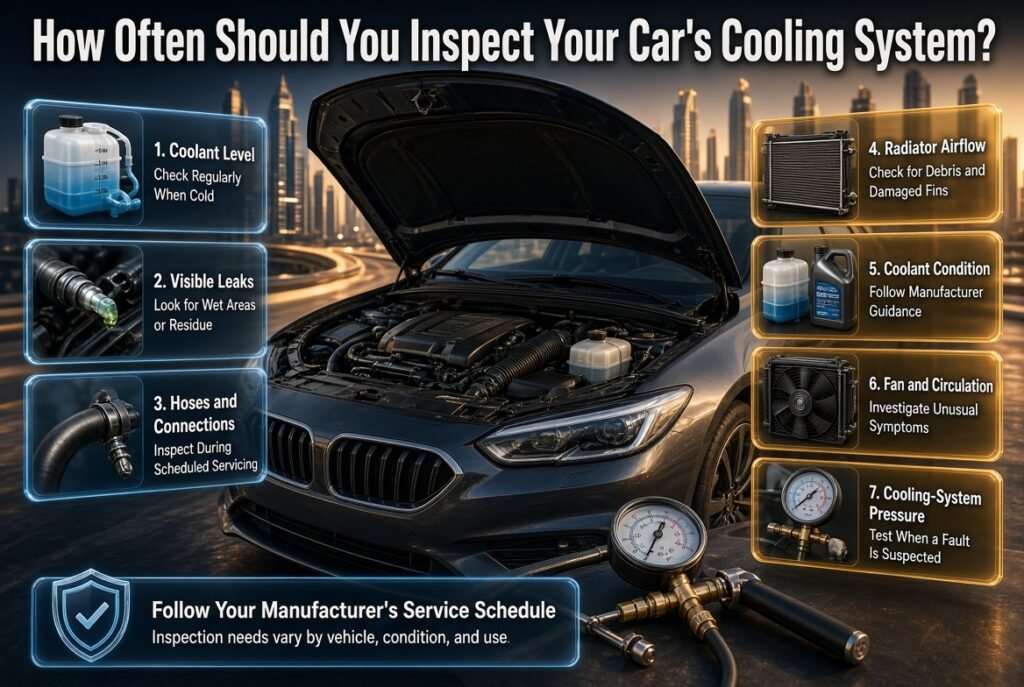
The appropriate inspection frequency depends on the manufacturer’s schedule, the vehicle’s condition, and how it is used. Regular visual checks help identify developing problems, while detailed servicing checks assess components that cannot be evaluated reliably from the outside.
A practical inspection routine can include the following:
| Inspection | Practical timing | Main purpose |
|---|---|---|
| Coolant level | Regularly, with the engine cold | Identify unexplained fluid loss |
| Visible leaks | During routine vehicle checks | Find wet areas or dried coolant residue |
| Hoses and connections | During scheduled servicing and when symptoms appear | Identify damage and deterioration |
| Radiator airflow | During routine inspection | Check for debris and damaged fins |
| Coolant condition | According to manufacturer guidance | Confirm fluid suitability and service needs |
| Fan and circulation performance | When symptoms occur or servicing indicates a need | Identify cooling-system faults |
| Cooling-system pressure | When leakage or pressure problems are suspected | Help locate leaks or cap-related issues |
This is a practical framework, not a replacement for the manufacturer’s service schedule. Some vehicles have sealed systems or components that require specialised equipment to inspect.
Does Dubai’s weather mean more frequent maintenance?
Hot weather makes cooling-system condition especially important, but it does not automatically justify replacing every component earlier than recommended.
High ambient temperatures, dusty conditions, traffic congestion, and extended idling may increase the demands placed on a vehicle. Drivers who frequently operate under these conditions should pay close attention to temperature behaviour, coolant levels, and scheduled maintenance.
The useful distinction is between monitoring more carefully and replacing parts unnecessarily. More attentive checks can identify developing problems without turning normal heat exposure into a reason for premature replacement.
For a broader preventive approach, consult the Vehicle Maintenance Guides. Use that resource for general vehicle care while keeping this article focused on preventing engine overheating.
How Do Driving Habits Affect Engine Temperature?
Driving habits affect engine load and the conditions under which heat must be removed. Sensible driving can help a healthy cooling system manage its workload, but no driving technique can compensate for a serious mechanical fault.
Avoid unnecessary prolonged idling
When a vehicle is stationary, natural airflow through the radiator is limited. The cooling fan must provide much of the airflow needed to remove heat.
Avoid leaving the engine running unnecessarily for extended periods. If the temperature rises while idling, do not continue waiting to see whether it eventually returns to normal.
A healthy cooling system should be capable of managing ordinary stationary operation under the conditions for which the vehicle was designed. Repeated overheating at idle deserves investigation.
Accelerate smoothly
Hard acceleration and sustained heavy engine loads can increase heat production. Smooth acceleration, suitable gear selection, and avoiding unnecessary heavy loads can reduce avoidable strain.
However, do not drive abnormally slowly, select unsuitable gears, or compromise traffic safety in an attempt to lower engine temperature.
If the engine temperature becomes abnormal, the correct response is to deal with the warning rather than attempting to control the temperature through driving style alone.
Prepare for long journeys and uphill driving
Extended highway journeys, steep climbs, towing, and carrying heavy loads may place greater demands on the engine and cooling system.
Before a demanding trip:
- Check coolant level when the engine is cold.
- Look for visible leaks.
- Confirm that no temperature warnings are present.
- Check whether previous overheating problems have been properly resolved.
- Follow the vehicle’s load and towing limits.
- Ensure scheduled servicing is up to date.
If the vehicle has a history of overheating, have the problem diagnosed before undertaking another demanding journey.
Use air conditioning sensibly
Air conditioning increases the load on many engines, and the condenser adds heat to the air passing through the front cooling assembly. However, a properly functioning vehicle should generally manage normal air-conditioning use within its designed operating conditions.
If the engine repeatedly overheats when the air conditioner is switched on, investigate the cause. Possible factors include restricted airflow, cooling-fan problems, radiator issues, or another existing fault.
Turning the air conditioner off may reduce the load temporarily, but it is not a repair for an underlying cooling-system problem.
Monitor the temperature on demanding drives
Pay attention to the temperature gauge during long journeys, heavy traffic, and hot-weather driving. Do not become distracted by continuously watching it; instead, recognise its normal range and respond to alerts.
If the temperature rises beyond its normal range, take the appropriate safety measures. A warning is a reason to assess the situation, not an invitation to push the vehicle harder to reach the destination.
How Can You Prepare Your Car for Hot Weather in Dubai?
Hot-weather preparation should focus on the condition of the vehicle rather than assumptions that every car needs additional parts or special modifications.
Before the hottest driving conditions
Inspect the coolant level when cold, look for leaks, check accessible hoses, and ensure that the radiator’s airflow path is not obstructed.
If the vehicle is due for coolant service, follow the manufacturer’s specification and interval. If it has already shown overheating symptoms, resolve the underlying issue before relying on it for long journeys.
During daily driving
Watch for unusual temperature changes and avoid unnecessary prolonged idling. Keep up with scheduled maintenance, especially if the vehicle regularly operates in heavy traffic.
Do not ignore small changes simply because the car usually performs well in hot weather. A new coolant smell or a recurring warning can indicate a developing fault.
Before a long highway journey
Check that the vehicle is mechanically ready for the trip. Confirm that the cooling system has no unresolved leaks or temperature issues, and carry appropriate emergency supplies.
If an overheating warning appears on the journey, stop safely and arrange assistance if required. Do not attempt to complete the trip by repeatedly stopping to cool the engine and then continuing without diagnosis.
What Should You Do If Your Engine Starts Overheating?
When the temperature warning appears, your priorities are safety, stopping further engine damage, and obtaining appropriate assistance.
Follow these steps:
- Assess the road situation. Keep control of the vehicle and look for a safe place to stop.
- Move out of traffic when safe. Avoid sudden manoeuvres or stopping in a dangerous location.
- Switch off the air conditioning if practical. Do not continue driving just to test whether this reduces the temperature.
- Stop the engine when necessary. If the gauge reaches the danger zone, a serious warning appears, or steam or coolant is escaping, stop safely and switch off the engine.
- Keep away from escaping steam. Do not approach the front of the vehicle if doing so would expose you to hot steam or escaping coolant.
- Never open the hot cooling system. Wait until the engine has cooled completely and follow the manufacturer’s instructions.
- Arrange professional assistance. If the vehicle has seriously overheated, do not assume it is safe to restart simply because the gauge has fallen.
Some vehicle manuals provide model-specific procedures for checking a suspected overheating event. Follow your own manual where it applies, but do not keep an engine running when there is a serious leak, steam, or another clear danger.
Should you keep driving after the temperature drops?
Not automatically. The temperature may fall because the engine has been switched off, the load has changed, or airflow has increased. That does not establish that the original fault has been repaired.
If the coolant level is low, a fan is failing, or the thermostat is malfunctioning, overheating may return as soon as the vehicle operates under similar conditions.
Arrange an inspection before resuming the journey whenever the warning was serious, the cause is unknown, or symptoms return.
What Do Professionals Check During an Overheating Inspection?
A professional inspection aims to identify the actual cause rather than replacing components based on assumptions. The tests selected depend on the vehicle, the symptoms, and the results of the initial checks.
1. Visual inspection
The technician checks accessible cooling-system components for leaks, corrosion, damaged hoses, loose connections, and visible contamination.
This first stage can reveal straightforward problems, but the absence of visible leakage does not rule out an internal leak or a fault that occurs only when the system is hot.
2. Coolant level and condition
The technician verifies the coolant specification, level, and condition. Contamination or incorrect fluid may indicate a maintenance issue that needs further investigation.
If the coolant has been mixed incorrectly or the system contains deposits, the appropriate corrective procedure depends on the vehicle and the nature of the problem.
3. Cooling-system pressure testing
A pressure test can help identify leaks in suitable systems. The pressure cap may also be tested to determine whether it maintains the required pressure.
Testing must follow the manufacturer’s specified limits. Applying the wrong pressure or using unsuitable equipment can cause damage.
4. Thermostat and temperature assessment
The technician checks whether the engine warms up and regulates its temperature as expected. Temperature readings and component behaviour help determine whether coolant circulation is being restricted.
A faulty temperature sensor may also produce misleading readings, so the displayed temperature should be evaluated alongside other evidence.
5. Cooling-fan and electrical checks
The inspection may include the fan motor, wiring, relays, control signals, and relevant sensors.
Modern vehicles may use computer-controlled fans with variable operating speeds. A fan that is not continuously running is not necessarily faulty; the technician must establish whether it operates when required.
6. Water pump and drive components
The technician checks the water pump, its drive mechanism, and other components that affect coolant circulation. Some faults are visible, while others require additional testing.
7. Internal engine diagnosis
If the evidence suggests an internal leak or combustion-gas intrusion, further testing may be required. The technician may use specialised procedures to assess the head gasket or other engine components.
These tests are not necessary for every overheating vehicle. They should be selected when the symptoms or earlier results justify them.
For an organised overview of broader engine checks, use the Engine Inspection Checklist.
Why is diagnosis better than replacing parts immediately?
Several faults can produce similar temperature symptoms. Replacing a radiator will not correct a failed water pump, and installing a new thermostat will not repair a leaking hose.
A sound maintenance process follows this sequence:
Inspect → Test → Identify the cause → Repair → Verify the result
This approach helps avoid unnecessary expenses and provides a clearer basis for deciding whether a component actually needs replacement.
Common Engine Overheating Prevention Mistakes
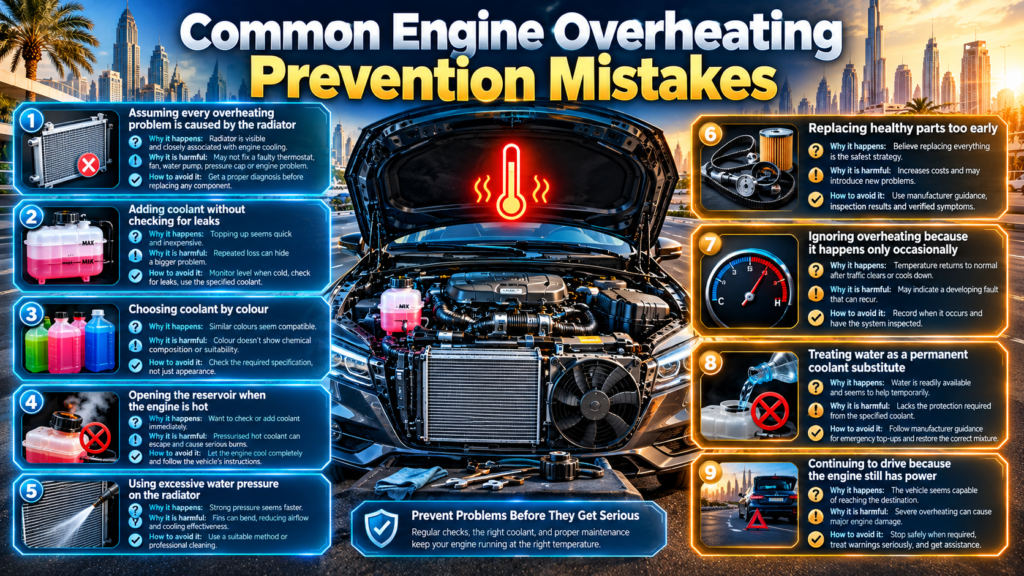
Preventive maintenance becomes less effective when drivers make assumptions, ignore warning signs, or use unsuitable products.
Mistake 1: Assuming every overheating problem is caused by the radiator
Why it happens: The radiator is visible and closely associated with engine cooling.
Why it is harmful: A radiator replacement may not correct a faulty thermostat, fan, water pump, pressure cap, or internal engine problem.
How to avoid it: Request a diagnosis that identifies the cause before authorising replacement.
Mistake 2: Adding coolant without checking for leaks
Why it happens: Topping up the reservoir seems like a quick and inexpensive solution.
Why it is harmful: Repeated fluid loss can conceal a problem that becomes more serious over time.
How to avoid it: Monitor the level when cold and investigate repeated drops. Use the specified coolant and follow the manufacturer’s instructions.
Mistake 3: Choosing coolant by colour
Why it happens: Drivers assume that similar colours indicate compatible formulations.
Why it is harmful: Coolant colour alone does not establish its chemical composition or suitability for a particular engine.
How to avoid it: Check the required specification rather than relying on appearance or a generic recommendation.
Mistake 4: Opening the reservoir when the engine is hot
Why it happens: A driver wants to check the level or add coolant immediately.
Why it is harmful: Pressurised hot coolant can escape forcefully and cause serious burns.
How to avoid it: Allow the engine to cool completely and follow the vehicle’s instructions.
Mistake 5: Using excessive water pressure on the radiator
Why it happens: Strong water pressure appears to offer a faster way to remove dust.
Why it is harmful: Delicate radiator fins can bend, reducing airflow and potentially making cooling less effective.
How to avoid it: Clean carefully using a suitable method or arrange professional cleaning when necessary.
Mistake 6: Replacing healthy parts too early
Why it happens: Drivers believe that replacing every ageing component is the safest strategy.
Why it is harmful: Unnecessary replacements increase costs and may introduce problems if parts or installation procedures are unsuitable.
How to avoid it: Use manufacturer guidance, inspection results, component condition, and verified symptoms to make maintenance decisions.
Mistake 7: Ignoring overheating because it happens only occasionally
Why it happens: The temperature returns to normal after traffic clears or the engine cools.
Why it is harmful: Intermittent symptoms may still indicate a developing fault that can recur under similar conditions.
How to avoid it: Record when the warning occurs and have the system inspected rather than waiting for a complete breakdown.
Mistake 8: Treating water as a permanent coolant substitute
Why it happens: Water is readily available and may appear to solve a low-fluid problem temporarily.
Why it is harmful: Water alone does not provide all the protection required from the specified coolant mixture.
How to avoid it: Follow the manufacturer’s guidance for emergency top-ups and restore the correct coolant mixture using the proper procedure.
Mistake 9: Continuing to drive because the engine still has power
Why it happens: The vehicle appears capable of reaching the destination.
Why it is harmful: Severe overheating can cause major engine damage even before obvious performance problems develop.
How to avoid it: Treat temperature warnings seriously, stop safely when required, and obtain assistance if the cause is uncertain.
Expert Advice: Build a Practical Engine Overheating Prevention Routine
A useful maintenance routine should be simple enough to follow consistently. It should also distinguish between checks a driver can perform safely and work that requires professional equipment.
The regular visual-check routine
When the engine is cold, inspect the coolant reservoir and look for obvious leaks or dried residue. During routine vehicle walk-arounds, pay attention to new fluid patches beneath the car.
Check for unusual temperature behaviour during normal driving. If a warning appears, do not wait until the next scheduled service to report it.
The scheduled-service routine
At the recommended service interval, ask the technician to assess coolant condition, hoses, connections, radiator airflow, and other relevant components.
The service should be based on the vehicle’s specification and condition. A car that has shown repeated overheating may need more detailed diagnostic work than a vehicle with no symptoms.
The pre-trip routine
Before a long journey, confirm that there are no unresolved cooling-system warnings or leaks. Review any recent repair work and make sure the vehicle is suitable for the intended load and route.
If the engine has recently overheated, obtain professional advice before travelling again.
The symptom-recording routine
When a temperature issue occurs, note the circumstances:
- Did it happen in slow traffic or at highway speed?
- Was the air conditioning running?
- Did the warning appear shortly after starting or after a long drive?
- Was the coolant level lower than usual?
- Did you notice steam, an unusual smell, or visible leakage?
These observations can help a technician reproduce the conditions and narrow down possible causes. They are clues, not a substitute for testing.
Expert Tip: Ask the technician to explain what the inspection found, why the recommended repair is necessary, and how the result will be verified. This makes it easier to distinguish a confirmed fault from a possible cause.
How Can I Prevent My Car Engine from Overheating in Dubai’s Hot Weather?
Preventing engine overheating in Dubai requires regular cooling-system checks, correct coolant maintenance, and attention to temperature changes during heavy traffic and long journeys. High outdoor temperatures, prolonged idling, and restricted radiator airflow can increase the demands on the cooling system. However, a properly maintained vehicle should normally operate within its designed temperature range under suitable driving conditions.
To reduce the risk of overheating, focus on these preventive measures:
Check coolant levels regularly: Inspect the reservoir when the engine is completely cold and investigate repeated coolant loss.
Maintain radiator airflow: Keep accessible radiator surfaces free from excessive dust and debris without damaging the fins.
Inspect hoses and connections: Look for cracks, swelling, leaks, or dried coolant residue.
Follow the service schedule: Use the recommended coolant specification and replace it at the manufacturer’s specified interval.
Monitor engine temperature: Take unusual temperature increases seriously, particularly during traffic congestion or long drives.
Professional advice: Don’t replace cooling-system components simply because you drive in a hot climate. Regular inspections and evidence-based repairs are more effective than unnecessary part replacements.
Why Does My Car Engine Overheat in Traffic but Not on the Highway?
An engine that overheats in traffic but operates normally at highway speeds may have an airflow or cooling-system problem. At higher speeds, air naturally passes through the radiator, helping it release heat. When the vehicle slows down or stops, the cooling fan becomes more important for maintaining sufficient airflow.
Several faults can produce this pattern, so the temperature behaviour should be treated as a diagnostic clue rather than a confirmed diagnosis.
Common areas to investigate include:
Cooling fan: A faulty fan motor, relay, wiring connection, or control system may reduce airflow at low speeds.
Radiator condition: External debris or internal restrictions may limit heat transfer.
Coolant level: Insufficient coolant can reduce the system’s ability to manage engine heat.
Coolant circulation: A thermostat or water pump problem may prevent proper heat transfer.
Professional advice: If the temperature rises into the danger zone, stop safely rather than continuing to drive. Arrange an inspection to identify the actual cause before the problem leads to engine damage.
How Often Should I Check Engine Coolant to Prevent Overheating?
Coolant should be checked regularly according to your vehicle’s maintenance guidance, with additional checks when you notice warning signs or prepare for a demanding journey. The appropriate frequency depends on the vehicle, its cooling-system design, service history, and operating conditions.
A practical routine includes checking the coolant reservoir when the engine is cold, inspecting for visible leaks, and confirming that scheduled coolant servicing is up to date.
Pay particular attention to these signs:
The coolant level repeatedly falls below the recommended mark.
Dried coolant residue appears around hoses or connections.
A sweet or unusual coolant smell develops after driving.
The temperature gauge behaves differently from normal.
The vehicle shows a coolant or temperature warning.
Professional advice: Never open a hot or pressurised cooling system. If coolant keeps disappearing, investigate the cause instead of repeatedly topping up the reservoir. A leak, faulty pressure cap, water pump problem, or internal engine issue may require professional diagnosis.
Can Low Coolant Cause Serious Engine Damage, Even If My Car Still Runs Normally?
Low coolant can cause serious engine damage because the cooling system may no longer be able to transfer heat away from the engine effectively. In some situations, the temperature may rise quickly, while other problems may develop before the driver notices an obvious change in performance.
Continuing to drive with insufficient coolant can increase the risk of overheating, cylinder-head distortion, head-gasket damage, and other expensive mechanical problems.
If you discover a low coolant level, take these steps:
Park safely and switch off the engine if overheating is suspected.
Allow the engine to cool completely before checking the reservoir.
Look for visible leakage without touching hot components.
Use the manufacturer-approved coolant and follow the correct filling procedure.
Arrange professional inspection if the level drops repeatedly or the engine has overheated.
Professional advice: A low coolant level is a warning that deserves attention, not simply a reason to add more fluid. If the vehicle has experienced severe overheating, don’t assume it is safe to drive again just because the engine has cooled down.
What Should I Do Immediately If My Engine Starts Overheating While Driving?
If your engine begins overheating, your priorities are to protect yourself, stop safely, and prevent further engine damage. Continuing to drive with a serious temperature warning can turn a manageable cooling-system fault into a major engine repair.
Follow these steps:
Find a safe place to stop: Watch the road and traffic, and move away from active traffic lanes when safe.
Reduce the engine load: If practical while moving toward a safe stopping place, switch off the air conditioning. Do not continue driving if a serious warning requires you to stop.
Switch off the engine: Stop the engine when safely positioned, particularly if the gauge reaches the danger zone or steam appears.
Keep away from hot coolant: Never open the radiator cap or coolant reservoir while the system is hot or pressurised.
Arrange assistance: If there is steam, a significant leak, or a severe temperature warning, obtain professional help rather than attempting to continue the journey.
Professional advice: A falling temperature reading after stopping does not prove that the underlying problem has disappeared. Have the cause investigated before driving again if the overheating was severe, the coolant is leaking, or the fault remains uncertain.
Conclusion
Preventing engine overheating starts with understanding your vehicle’s condition and addressing small warning signs before they develop into serious mechanical problems. In Dubai, high temperatures, heavy traffic, extended idling, and frequent air-conditioning use can increase the demands on a vehicle’s cooling system. However, overheating should never be treated as an unavoidable result of hot weather. A properly maintained cooling system, suitable coolant, adequate airflow, and timely inspections can help keep engine temperature within the manufacturer’s recommended range.
Make coolant level and condition checks part of your regular maintenance routine, and pay attention to warning lights, rising temperature readings, coolant leaks, unusual smells, and repeated temperature fluctuations. If your engine begins to overheat, switch off the air conditioning, stop in a safe location as soon as possible, and turn off the engine. Never remove the radiator cap while the system is hot, as pressurised coolant can cause severe burns. Allow the engine to cool and arrange a professional inspection if the temperature warning persists or coolant loss is suspected.
For a more complete maintenance routine, explore our Vehicle Maintenance Guides and Engine Maintenance Guide to understand how regular checks support long-term vehicle reliability. You can also review the Engine Inspection Checklist, Cooling System Maintenance in Dubai, and Radiator Maintenance Guide in Dubai for more specific guidance on inspecting and maintaining the components that help control engine temperature.
The most effective approach is simple: inspect regularly, diagnose warning signs correctly, and follow your vehicle manufacturer’s maintenance recommendations. If you need roadside assistance or fuel delivery in Dubai, visit Fuel Delivery Dubai to learn more about the available service. Consistent maintenance and prompt action when problems appear can help reduce the risk of overheating, avoid unnecessary repairs, and keep your vehicle ready for everyday driving.
Leave a Reply