Introduction
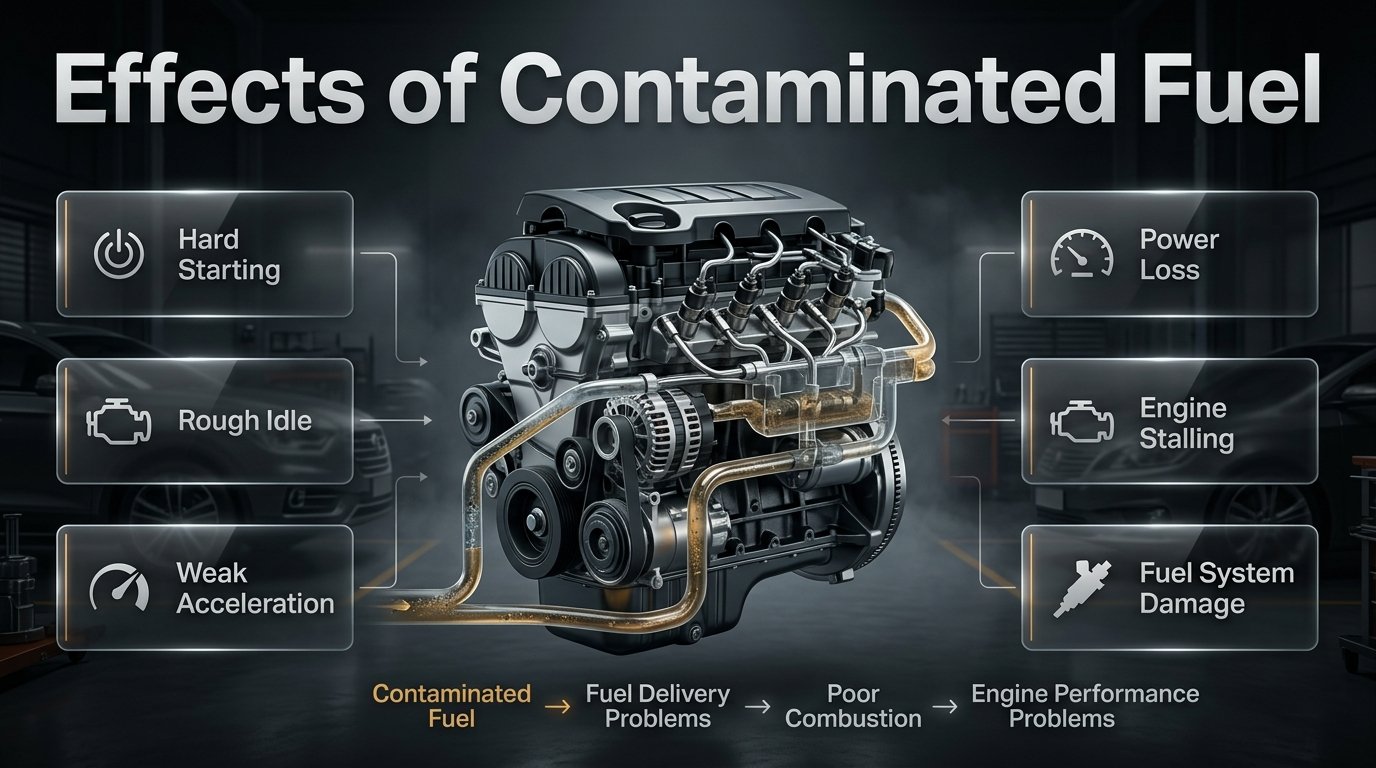
Effects of Contaminated Fuel | Imagine filling your car with fuel and driving away expecting a normal journey. A few minutes later, the engine begins to hesitate. Acceleration feels weak, the idle becomes rough, and the vehicle struggles when you press the accelerator. In more serious cases, the engine may even stall.
Many drivers immediately suspect the fuel pump, injectors, spark plugs, turbocharger, battery, or another expensive component. However, the real problem may have started much earlier—with contaminated fuel entering the fuel system.
The effects of contaminated fuel can range from temporary performance problems to serious fuel-system damage. Water, dirt, rust, sediment, microbial growth, incorrect fuel, and degraded fuel can all interfere with fuel delivery and proper combustion. Depending on the type and amount of contamination, the problem may affect starting, idling, acceleration, fuel economy, engine performance, and the condition of critical fuel-system components.
Understanding these effects is important because contaminated fuel symptoms can sometimes look very similar to mechanical or electrical problems. Replacing expensive components without confirming the cause can lead to unnecessary repairs and wasted money.
This guide explains how contaminated fuel affects petrol and diesel engines, the most common symptoms to look for, how to distinguish fuel contamination from a mechanical fault, what can happen if you continue driving, how professionals diagnose fuel-related problems, and what practical steps can help prevent contamination in the first place.
Need Fuel Delivery Dubai 👉 Fuel Delivery Dubai.
What Are the Effects of Contaminated Fuel?
Contaminated fuel can interfere with normal fuel delivery and combustion, causing hard starting, rough idling, hesitation, poor acceleration, stalling, misfires, reduced fuel economy, unusual exhaust smoke, fuel-filter blockage, injector problems, and potentially fuel-pump or engine damage.
The severity depends on the type of contaminant, the quantity that entered the fuel system, the vehicle’s design, and how long the vehicle continues running on contaminated fuel.
A simple way to understand the process is:
Contaminated fuel → restricted or abnormal fuel delivery → poor combustion → engine performance problems → possible component damage
Not every contaminated-fuel incident causes permanent damage. In many cases, identifying the problem early and removing the contaminated fuel can prevent a much larger repair.
Why Does Contaminated Fuel Cause So Many Problems?
An engine depends on fuel with predictable properties. The fuel must be delivered at the correct pressure and quantity and must mix and burn properly under the engine’s operating conditions.
When unwanted material enters the fuel, that balance can be disrupted.
For example, water doesn’t provide the same combustion characteristics as petrol or diesel. Dirt and sediment can restrict filters and damage precision components. Rust particles can travel through the fuel system, while microbial contamination can create sludge and deposits.
This means contamination can affect several parts simultaneously.
The fuel tank may become contaminated first. Then the fuel filter becomes loaded with debris. If contaminants pass through the filtration system, they can reach the pump or injectors.
That is why simply replacing one component may not always solve the problem.
What Causes Fuel Contamination?
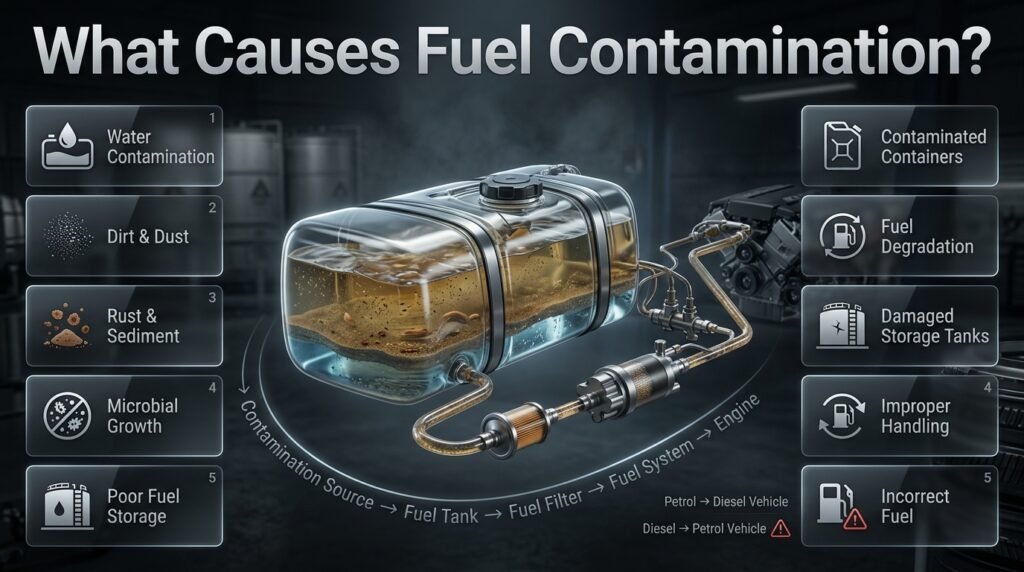
Understanding the causes is important because the best solution depends on the type of contamination involved.
The most common causes include:
- Water entering the fuel
- Dirt and dust
- Rust particles
- Sediment
- Microbial growth
- Poor fuel storage
- Contaminated fuel containers
- Incorrect fuel
- Fuel degradation
- Damaged or poorly maintained storage tanks
- Improper fuel handling
- Environmental contamination
For a deeper explanation of the sources of contamination, see causes of fuel contamination.
Water Contamination
Water is one of the most important contaminants to consider.
It can enter fuel through condensation, damaged storage tanks, poor handling, contaminated containers, or problems in fuel-storage infrastructure.
Water is particularly concerning because it doesn’t behave like petrol or diesel during combustion.
In diesel systems, water can also contribute to corrosion and reduce the protection that clean fuel provides to sensitive fuel-system components.
Dirt and Dust
Fuel can become contaminated with dirt when it is handled or stored improperly.
Even small particles can become a problem for modern fuel systems because injectors and pumps operate with tight tolerances.
A fuel filter is designed to capture many of these particles, but a heavily contaminated fuel supply can overload the filter.
Rust and Sediment
Rust can come from deteriorating storage tanks, fuel containers, or components within the fuel-storage system.
Sediment can settle at the bottom of tanks and become mixed into fuel during movement, refueling, or changes in storage conditions.
This material can eventually reach the vehicle’s fuel system.
Microbial Contamination
Microbial growth is more commonly discussed with diesel fuel, particularly where water is present.
Certain microorganisms can grow at the fuel-water interface and produce biomass or sludge-like material.
This can contribute to filter blockage and fuel-system problems.
Wrong Fuel
Incorrect fuel isn’t technically the same thing as ordinary contamination, but it creates a similar practical problem: the fuel inside the tank isn’t suitable for the engine.
For example, petrol in a diesel vehicle or diesel in a petrol vehicle can cause serious operating problems.
If the wrong fuel has been added, starting the engine can circulate it through the fuel system and make the situation more complicated.
What Are the Most Common Symptoms of Contaminated Fuel?
The most common symptoms include:
- Hard starting
- Engine hesitation
- Rough idle
- Loss of power
- Poor acceleration
- Engine misfires
- Stalling
- Reduced fuel economy
- Unusual exhaust smoke
- Engine warning lights
- Fuel-filter restriction
- Injector-related symptoms
However, these symptoms aren’t exclusive to contaminated fuel.
The strongest clue is often when the symptoms appeared.
If the vehicle was operating normally and suddenly developed several problems shortly after refueling, fuel contamination deserves serious consideration.
1. Hard Starting After Refueling
One of the first signs of a fuel problem can be difficult starting.
The engine may crank longer than normal before starting, or it may start and then immediately stall.
In more serious cases, the engine may crank normally but fail to start.
This can happen when contaminated fuel interferes with combustion or when contamination restricts the amount of usable fuel reaching the engine.
What Should You Check?
Ask yourself:
- Did the vehicle start normally before refueling?
- Did the problem begin shortly afterward?
- Was the fuel obtained from a reliable source?
- Has the vehicle recently been serviced?
- Is the battery operating normally?
Hard starting can also result from battery problems, ignition faults, fuel-pressure issues, glow-plug problems in diesel engines, or sensor faults.
So the symptom alone doesn’t prove contamination.
2. Rough Engine Idle
A healthy engine should generally maintain a stable idle.
If contaminated fuel reaches the engine, combustion can become inconsistent.
The driver may notice:
- Engine shaking
- Fluctuating RPM
- Vibrations
- Uneven running
- Occasional stumbling
- An engine that feels like it’s about to stall
Rough idle can also result from vacuum leaks, dirty injectors, ignition faults, sensor problems, or air-intake issues.
That is why fuel quality should be considered as part of a complete diagnosis rather than treated as the automatic answer.
3. Hesitation During Acceleration
Hesitation is one of the most noticeable effects of contaminated fuel.
You press the accelerator expecting immediate response, but the vehicle pauses, stumbles, or feels unusually weak before accelerating.
This can occur when:
- Fuel flow is restricted
- The filter is blocked
- Water is present in the fuel
- Fuel injection becomes inconsistent
- Combustion quality is reduced
The problem may be particularly noticeable when accelerating uphill or carrying a heavy load.
Practical Example
A driver fills the tank in the morning.
The vehicle initially feels normal.
After several kilometers, acceleration becomes inconsistent.
By the time the driver reaches a highway, the vehicle struggles to gain speed.
That sequence makes fuel contamination worth investigating, especially if the vehicle had no previous performance problems.
4. Loss of Engine Power
Contaminated fuel can cause noticeable power loss.
The vehicle may feel as though it has suddenly become heavier.
You might notice that:
- It struggles uphill
- Acceleration is slower
- Overtaking becomes difficult
- The engine feels weak at higher RPM
- The vehicle doesn’t respond normally to throttle input
A restricted fuel filter can be one reason for this.
If the engine isn’t receiving enough fuel, it may not be able to produce the expected power.
However, turbocharger problems, clogged air filters, exhaust restrictions, fuel-pump faults, and sensor issues can produce similar symptoms.
5. Engine Stalling
Severe contamination can cause the engine to stall.
This can happen because fuel delivery becomes unreliable or combustion becomes unstable.
Stalling can occur:
- Immediately after starting
- At idle
- During acceleration
- When climbing a hill
- After the engine warms up
Repeated stalling is more serious than occasional hesitation because it can create a safety problem.
If the vehicle stalls in traffic or repeatedly loses power, unnecessary driving should be avoided until the cause is identified.
6. Engine Misfires
A misfire occurs when combustion doesn’t happen correctly in one or more cylinders.
Contaminated fuel can contribute to misfires by interfering with proper combustion or fuel injection.
Drivers may experience:
- Jerking
- Shaking
- Uneven acceleration
- Poor engine response
- Reduced power
- An illuminated check-engine light
However, misfires can also be caused by spark plugs, ignition coils, injectors, sensors, compression problems, and other faults.
This is why replacing ignition components without investigating the fuel system may waste money.
7. Reduced Fuel Economy
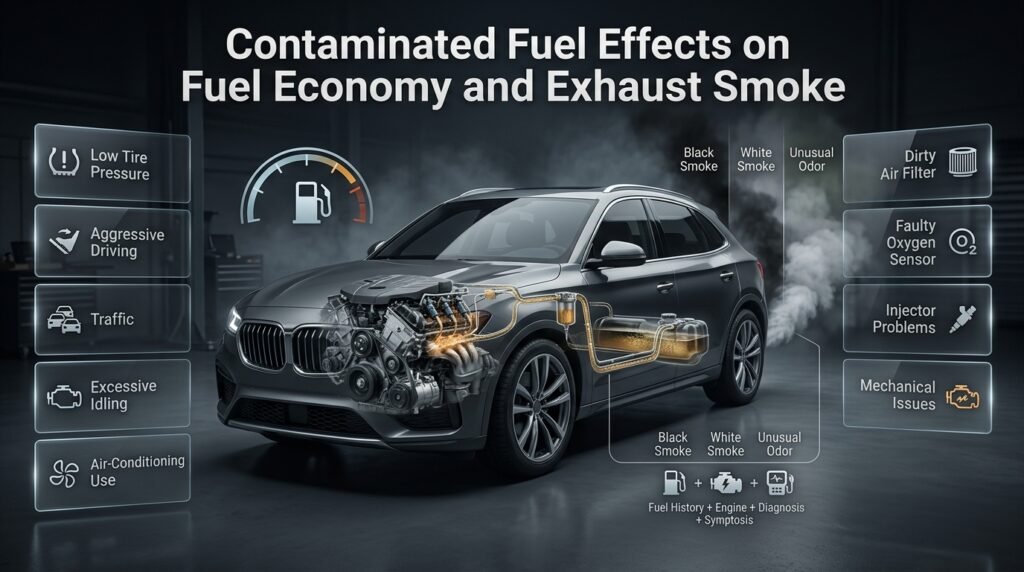
Fuel contamination may contribute to poor fuel economy because the engine isn’t operating under normal conditions.
But this symptom requires caution.
Poor fuel economy can also result from:
- Low tire pressure
- Aggressive driving
- Traffic
- Excessive idling
- Air-conditioning use
- Dirty air filters
- Faulty oxygen sensors
- Injector problems
- Mechanical issues
A sudden decrease immediately following refueling is more relevant to fuel quality than a gradual decrease over a long period.
8. Unusual Exhaust Smoke
Contaminated or incorrect fuel can sometimes change combustion behavior and produce unusual exhaust.
Depending on the engine and specific problem, drivers may notice excessive:
- Black smoke
- White smoke
- Unusual odor
Smoke color should never be used as the only diagnostic method.
For example, white smoke can have causes unrelated to fuel contamination, while black smoke may indicate an overly rich combustion condition.
The fuel history and other symptoms must be considered together.
9. Engine Warning Light
Contaminated fuel can contribute to conditions that trigger an engine warning light.
Possible related conditions include:
- Misfires
- Fuel-pressure abnormalities
- Combustion problems
- Sensor readings outside expected ranges
But an engine warning light doesn’t mean contaminated fuel is definitely responsible.
A diagnostic scan should be used to identify stored trouble codes, followed by proper testing.
How Does Water in Fuel Affect the Engine?
Water contamination can interfere with normal combustion and fuel delivery. It can also contribute to corrosion in fuel-system components.
The effects depend heavily on the amount of water present.
A small amount may cause intermittent symptoms, while significant contamination can cause hard starting, rough running, stalling, and other serious problems.
Water may enter fuel through:
- Condensation
- Damaged fuel-storage tanks
- Poor storage
- Contaminated containers
- Improper handling
- Environmental exposure
Why Is Water More Concerning in Diesel Engines?
Modern diesel fuel systems can operate at extremely high pressures.
Their pumps and injectors depend on clean fuel and appropriate lubrication.
Water can contribute to corrosion and wear in sensitive components.
This is one reason diesel vehicles often have fuel filtration and water-separation systems designed to protect the fuel system.
For additional information, read about fuel quality and engine performance.
How Does Dirt Affect the Fuel System?
Dirt may seem harmless because the vehicle’s fuel filter is designed to capture contaminants.
But the filter has limits.
If large amounts of dirt enter the tank, the filter may become restricted.
The result can be:
Dirty fuel → loaded filter → reduced fuel flow → poor acceleration → possible stalling
If particles pass through the filtration system, they may reach sensitive fuel-system components.
This can be particularly concerning for modern fuel injectors and high-pressure pumps.
Can Contaminated Fuel Damage Fuel Injectors?
Yes, contaminated fuel can contribute to injector problems.
Injectors are precision components responsible for delivering fuel in a controlled pattern.
Contamination may cause:
- Deposits
- Restricted fuel flow
- Abnormal spray patterns
- Sticking
- Uneven fuel delivery
- Premature wear
The exact effect depends on the type of contamination and the injector design.
This is particularly important for modern diesel engines, where fuel-system components operate under very demanding conditions.
A useful diagnostic principle is:
Don’t replace the injector simply because the engine has injector-like symptoms. Check the fuel supply first.
Can Contaminated Fuel Damage the Fuel Pump?
It can.
Fuel pumps are designed to work with fuel that meets the required cleanliness and lubrication characteristics.
Water, abrasive particles, rust, or other contaminants can increase wear or interfere with pump operation.
A restricted fuel filter can also force the pump to work under unfavorable conditions.
Possible symptoms include:
- Low fuel pressure
- Poor acceleration
- Hard starting
- Engine stalling
- Pump noise
- Reduced performance
But a weak pump can produce similar symptoms without any contamination.
Testing fuel pressure and inspecting the fuel supply can help separate the possibilities.
What Are the Effects of Contaminated Diesel?
The effects of contaminated diesel can include hard starting, rough idle, hesitation, reduced power, fuel-filter blockage, injector problems, stalling, and fuel-system wear.
Diesel systems can be especially sensitive to water and particulate contamination.
Common diesel contaminants include:
- Water
- Dirt
- Rust
- Sediment
- Microbial contamination
- Incorrect fuel
- Degraded fuel
You can explore the causes in more detail in contaminated diesel causes.
What Are the Effects of Contaminated Petrol?
Contaminated petrol can cause:
- Hard starting
- Rough idle
- Hesitation
- Poor acceleration
- Misfires
- Stalling
- Reduced fuel economy
- Unusual combustion behavior
Petrol engines depend on controlled ignition and correct fuel delivery.
When contaminated petrol reaches the combustion chamber, the engine may not burn the fuel normally.
For more specific symptoms, see contaminated petrol symptoms.
Contaminated Fuel vs Mechanical Problems
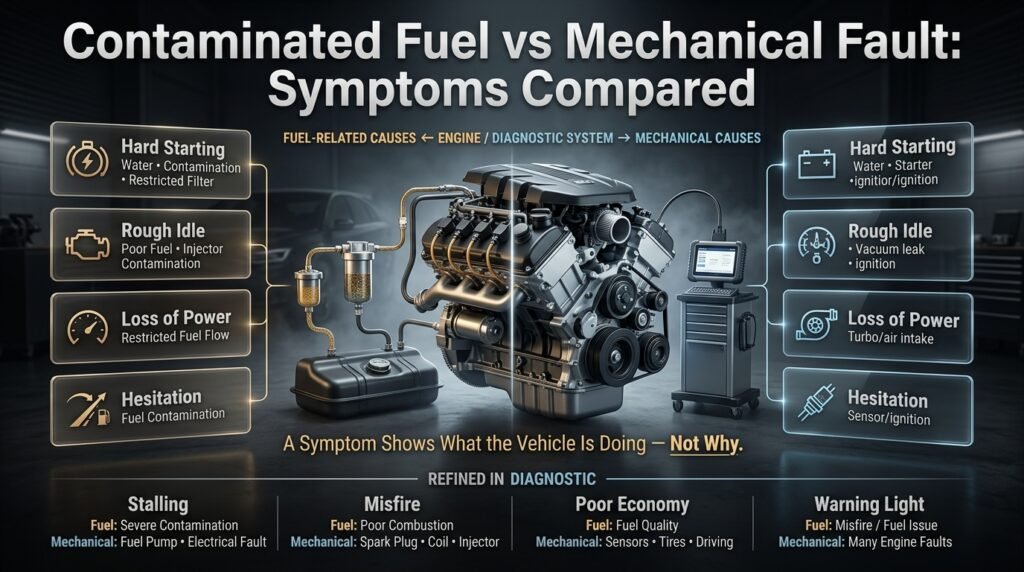
This is one of the most important parts of diagnosing the problem.
Contaminated fuel and mechanical faults can produce nearly identical symptoms.
| Symptom | Possible Fuel Cause | Other Possible Cause |
|---|---|---|
| Hard starting | Water, contamination, restricted filter | Battery, starter, ignition |
| Rough idle | Poor fuel, injector contamination | Vacuum leak, ignition |
| Loss of power | Restricted fuel flow | Turbo, air intake |
| Hesitation | Fuel contamination | Sensor, ignition |
| Stalling | Severe contamination | Fuel pump, electrical fault |
| Misfire | Poor combustion | Spark plug, coil, injector |
| Poor economy | Fuel quality | Sensors, tires, driving |
| Warning light | Misfire/fuel issue | Many engine faults |
The lesson is simple:
A symptom tells you what the vehicle is doing. It doesn’t automatically tell you why it’s doing it.
How Can You Tell if Contaminated Fuel Is the Real Problem?
The best approach is to combine several pieces of evidence.
Check When the Problem Started
Timing is one of the most useful clues.
If the vehicle was running normally and developed multiple symptoms immediately after refueling, contamination becomes a stronger possibility.
If the problem has gradually developed over many months, other causes deserve equal attention.
Check the Fuel Filter
A technician can inspect the filter for:
- Dirt
- Rust
- Water
- Sludge
- Excessive sediment
- Abnormal deposits
A heavily contaminated filter provides useful evidence.
However, replacing it without investigating the rest of the fuel system may only provide a temporary solution.
Check a Fuel Sample
Fuel sampling can reveal problems that aren’t obvious from driving symptoms.
Depending on the situation, a technician may look for:
- Water separation
- Sediment
- Particles
- Unusual appearance
- Abnormal odor
- Other evidence of contamination
More detailed testing may be necessary for suspected chemical or quality-related issues.
You can learn more about the basics in fuel quality testing basics.
How Is Contaminated Fuel Diagnosed Professionally?
A professional diagnosis should avoid guessing.
Step 1: Review the Vehicle History
Find out:
- When the symptoms started
- When the vehicle was last refueled
- Where it was refueled
- Whether the vehicle had previous symptoms
- Whether recent maintenance was performed
Step 2: Inspect the Fuel System
The technician may examine the fuel filter, tank, lines, and other accessible components.
Step 3: Test Fuel Quality
If contamination is suspected, a sample may be collected for inspection or laboratory testing.
Step 4: Scan the Vehicle
Diagnostic equipment can identify stored fault codes.
Step 5: Test Fuel Pressure
Fuel pressure testing helps determine whether fuel delivery is functioning normally.
Step 6: Check Injectors and Pump
Only after basic fuel-system checks should expensive components be targeted.
Step 7: Check Other Systems
If the fuel supply appears normal, attention should shift to:
- Ignition
- Sensors
- Air intake
- Exhaust
- Compression
- Turbocharger
- Electrical systems
This approach reduces the risk of replacing expensive components unnecessarily.
What Should You Do If You Suspect Contaminated Fuel?
If you strongly suspect contaminated fuel, especially after a sudden change following refueling, take the problem seriously.
Step 1: Stop Driving if the Vehicle Is Severely Affected
If the car is repeatedly stalling, losing major power, or running extremely rough, don’t continue driving unnecessarily.
Step 2: Keep Your Fuel Receipt
A receipt can help establish when and where the vehicle was refueled.
Keep it if you believe the fuel may have caused the problem.
Step 3: Don’t Immediately Add Random Additives
Fuel additives aren’t a universal cure.
They won’t reliably remove significant amounts of water, dirt, sediment, or incorrect fuel.
Using the wrong product can also introduce another variable into the diagnosis.
Step 4: Have the Fuel System Inspected
A technician can determine whether the fuel needs to be drained, filtered, replaced, or otherwise handled.
Step 5: Avoid Unnecessary Component Replacement
Don’t automatically replace the fuel pump or injectors simply because the vehicle is losing power.
Diagnosis should come first.
What Happens If You Keep Driving With Contaminated Fuel?
Continuing to drive may increase the amount of contaminated fuel circulating through the system.
Potential consequences include:
- More fuel-filter restriction
- Increased injector contamination
- Fuel-pump wear
- Repeated misfires
- Stalling
- Poor combustion
- Increased emissions
- Reduced engine performance
- More expensive repairs
However, not every contamination event causes permanent damage.
The outcome depends on:
- Type of contaminant
- Quantity
- Vehicle design
- Engine type
- Duration of exposure
- Condition of the fuel system
Early detection generally gives you more options.
How Serious Is Water Contamination?
Water contamination can range from a minor inconvenience to a serious fuel-system problem.
The key factor is quantity.
A small amount may cause intermittent symptoms.
A significant quantity can lead to:
- Hard starting
- Stalling
- Poor combustion
- Corrosion
- Fuel-system problems
Diesel systems can be particularly sensitive.
If water contamination is suspected, it is better to investigate the problem rather than assuming the vehicle will simply burn the water away.
Can Old Fuel Cause Similar Effects?
Yes.
Fuel that has been stored for too long or under unsuitable conditions may degrade and develop properties that affect engine performance.
Old fuel may contribute to:
- Difficult starting
- Rough running
- Poor acceleration
- Deposits
- Reduced combustion quality
However, old fuel and contaminated fuel aren’t exactly the same thing.
Fuel may be old without containing water or dirt, while relatively fresh fuel can be contaminated.
A proper diagnosis should determine what is actually wrong with the fuel.
How Does Fuel Quality Affect Engine Performance?
Fuel quality influences how consistently the engine can perform its combustion process.
Good-quality fuel should meet the appropriate specifications for the vehicle.
Poor fuel quality can contribute to:
- Inconsistent combustion
- Deposits
- Fuel-system restriction
- Reduced performance
- Increased emissions
- Poor economy
For more background, see fuel quality standards and good quality petrol characteristics.
Does Octane Have Anything to Do With Contaminated Petrol?
Octane and contamination are different concepts.
Octane measures petrol’s resistance to abnormal combustion or knocking.
Contamination refers to unwanted substances or unsuitable material in the fuel.
A higher octane rating doesn’t automatically make contaminated petrol safe.
For example, if petrol contains significant water or dirt, using premium petrol doesn’t remove those contaminants.
For more information, see regular vs premium petrol octane.
Common Mistakes When Dealing With Contaminated Fuel
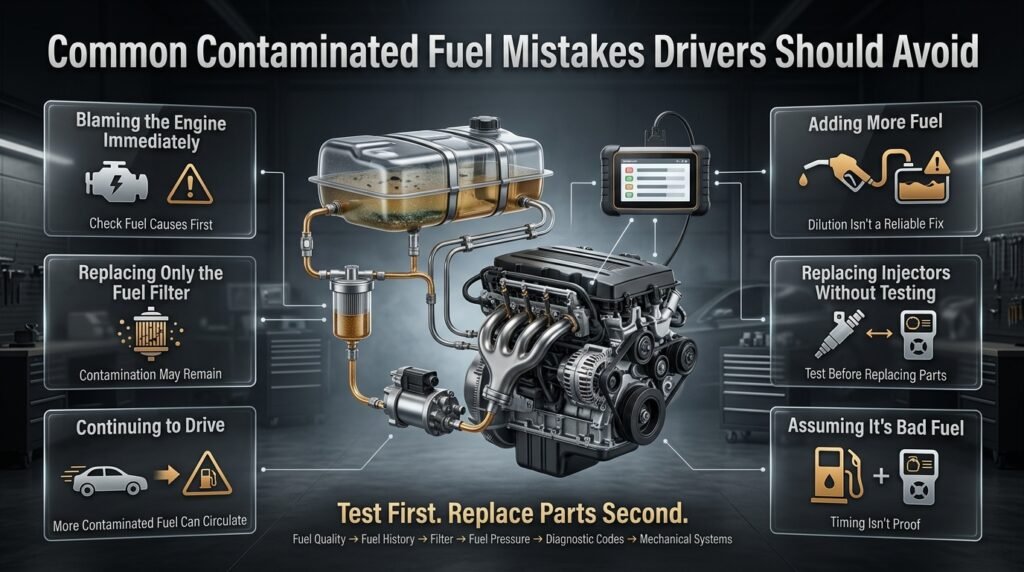
Mistake 1: Blaming the Engine Immediately
A vehicle that runs badly doesn’t automatically have internal engine damage.
Why it happens
Drivers often associate severe symptoms with expensive mechanical failures.
Why it’s harmful
Fuel-related problems may be overlooked.
Better approach
Check fuel quality, fuel history, filters, fuel pressure, and diagnostic codes alongside mechanical systems.
Mistake 2: Replacing Only the Fuel Filter
A new filter can help restore fuel flow, but it may not solve the entire problem.
Why it happens
The filter is visibly dirty.
Why it’s harmful
Contaminated fuel may still be inside the tank.
Better approach
Find the source and extent of contamination.
Mistake 3: Continuing to Drive
The vehicle may still move, so the driver assumes it is safe.
Why it’s harmful
More contaminated fuel can circulate through sensitive components.
Better approach
If symptoms are severe, stop unnecessary driving and arrange proper diagnosis.
Mistake 4: Adding More Fuel and Hoping for the Best
Dilution may sound logical, but it isn’t a reliable solution for significant contamination.
Better approach
Determine what’s actually in the tank first.
Mistake 5: Replacing Injectors Without Testing
Injector symptoms don’t necessarily mean the injectors are defective.
Better approach
Check fuel quality, filtration, pressure, wiring, and diagnostic codes before replacing expensive parts.
Mistake 6: Assuming Every Post-Refueling Problem Is Bad Fuel
Timing matters, but it isn’t proof.
A component can fail coincidentally after refueling.
Better approach
Use evidence rather than assumptions.
Expert Advice: Diagnose the Fuel Before Replacing Expensive Parts
One of the most useful professional habits is to begin with simple, inexpensive checks.
A sensible diagnostic sequence is:
Recent refueling → fuel condition → fuel filter → fuel pressure → diagnostic codes → injectors/pump → other mechanical systems
This doesn’t mean fuel contamination is always the answer.
It means it should be investigated when the symptoms and timing make it plausible.
This approach can prevent unnecessary spending on parts that were never defective.
How Can Fuel Contamination Be Prevented?
Prevention starts with fuel handling.
Use Reliable Fuel Sources
Buying fuel from reputable sources reduces the risk of poor handling and questionable storage conditions.
Avoid Dirty Containers
If fuel is transferred using a container, that container should be clean and appropriate for fuel.
Dust, water, rust, and residues can enter the fuel during handling.
Maintain Fuel Filters
Fuel filters are critical protective components.
Follow the vehicle manufacturer’s replacement recommendations and consider the vehicle’s operating conditions.
Pay Attention to Warning Signs
Don’t ignore:
- Water-in-fuel warnings
- Sudden power loss
- Repeated stalling
- Unusual fuel-filter blockage
- Symptoms appearing immediately after refueling
Maintain Storage Equipment
For businesses, fleets, generators, and other fuel-storage systems, tank maintenance is especially important.
Water and sediment can accumulate over time.
Why Proper Fuel Storage Matters
Fuel can become contaminated before it ever reaches your vehicle.
Poorly maintained storage tanks can accumulate:
- Water
- Rust
- Sediment
- Microbial contamination
When fuel is moved or disturbed, these contaminants may become suspended and enter the fuel supply.
This is why fuel quality isn’t determined only by the chemical composition of the fuel.
Storage, transportation, handling, and environmental conditions also matter.
For more information, see factors affecting fuel quality.
Petrol vs Diesel: Which Is More Sensitive to Contamination?
Both petrol and diesel systems can suffer from contaminated fuel, but the type of risk differs.
| Factor | Petrol | Diesel |
|---|---|---|
| Water contamination | Can cause poor combustion | Particularly concerning |
| Dirt | Can restrict filters/injectors | Can be highly damaging |
| Wrong fuel | Serious | Serious |
| Injector sensitivity | High | Very high in modern systems |
| Microbial contamination | Less commonly emphasized | More relevant |
| High-pressure systems | Vehicle-dependent | Common in modern diesels |
The important point is not that one fuel is completely safe.
Both require proper handling and cleanliness.
For broader information, read petrol and diesel fuel types.
When Should You Stop Driving?
Not every rough-running engine requires immediate towing, but certain symptoms should be treated seriously.
Consider stopping unnecessary driving when:
- The engine repeatedly stalls
- Power loss is severe
- The vehicle jerks heavily
- A warning light is flashing
- The engine runs extremely rough
- You suspect significant water contamination
- You know the wrong fuel was added
- The vehicle becomes unsafe in traffic
A vehicle that is difficult to control or repeatedly loses power shouldn’t be driven simply to “see if it gets better.”
Practical Example: A Petrol Car After Refueling
Consider a petrol car that had been operating normally.
The driver fills the tank.
Within 15–30 minutes:
- The engine begins hesitating.
- Idle becomes rough.
- Acceleration becomes weak.
- The check-engine light appears.
- The vehicle eventually stalls.
There are several possibilities.
It could be contaminated petrol.
It could also be an unrelated ignition or fuel-system problem that happened at roughly the same time.
A professional shouldn’t immediately declare either answer.
The correct approach is to examine the fuel history, scan the vehicle, check fuel pressure, inspect the fuel filter where appropriate, and test the fuel if contamination is suspected.
That is evidence-based diagnosis.
Practical Example: A Diesel Vehicle With Water Contamination
A diesel vehicle runs normally for weeks.
After refueling, it begins losing power and becomes difficult to start.
A fuel filter inspection reveals water and contamination.
In this case, the fuel system deserves immediate attention.
Continuing to drive may circulate contaminated fuel through sensitive components.
The appropriate response depends on the vehicle and contamination level, but it may involve draining contaminated fuel, replacing filtration components, inspecting the fuel system, and checking affected components.
Practical Example: The Problem Isn’t Fuel
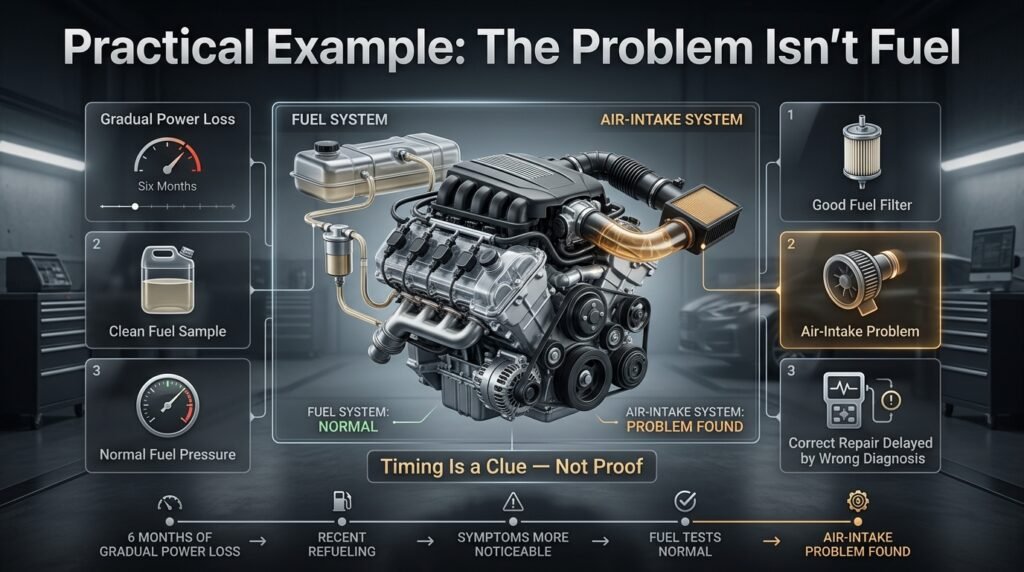
Imagine another vehicle that has been gradually losing power for six months.
The driver recently refueled, and the problem became slightly more noticeable.
A fuel sample is clean.
Fuel pressure is normal.
The filter is in good condition.
Diagnostic testing reveals a problem with the air-intake system.
In this situation, blaming fuel contamination would delay the correct repair.
This example demonstrates why timing is useful but not conclusive.
What Is the Best Way to Test Fuel Quality?
The appropriate test depends on what contamination is suspected.
Basic inspection may identify:
- Water
- Sediment
- Particles
- Unusual appearance
- Separation
More advanced testing may be necessary for fuel properties or contaminants that aren’t visible.
Testing is especially useful when:
- Expensive repairs are being considered
- A fuel-related dispute exists
- Fleet vehicles experience repeated contamination
- Storage tanks are suspected
- Fuel quality is uncertain
The goal isn’t simply to prove that the fuel looks bad.
The goal is to determine whether the fuel could reasonably explain the vehicle’s symptoms.
Why Replacing the Filter Alone May Not Be Enough
A fuel filter is designed to trap contaminants.
If it becomes blocked, replacing it may restore fuel flow.
But imagine the tank still contains contaminated fuel.
The new filter may simply become contaminated again.
That’s why professionals need to consider the complete fuel supply.
Depending on the situation, inspection may extend to:
- Tank
- Fuel lines
- Filter
- Fuel pump
- Injectors
- Water separator
- Fuel-pressure system
The exact procedure varies by vehicle.
How Much Damage Can Contaminated Fuel Cause?
There is no universal answer.
A mild contamination event may cause temporary drivability problems.
A severe event can contribute to expensive fuel-system repairs.
Potentially affected components include:
- Fuel filter
- Fuel pump
- Fuel injectors
- Fuel lines
- High-pressure fuel components
- Combustion-related components
The amount of damage depends on contamination type, concentration, exposure time, and vehicle design.
The best strategy is therefore early identification rather than waiting for damage to become obvious.
What Are the Most Common Symptoms of Contaminated Fuel?
Contaminated fuel usually reveals itself through a noticeable change in engine behavior. The most common signs include hard starting, rough idling, hesitation during acceleration, loss of power, misfires, poor throttle response, stalling, unusual exhaust smoke, and sometimes a check-engine light. The exact symptoms depend on whether the fuel contains water, dirt, sediment, microbial contamination, or another unwanted substance.
One of the strongest clues is timing. If the vehicle was running normally and several problems appeared shortly after refueling, fuel contamination becomes an important possibility. However, symptoms alone don’t prove that the fuel is contaminated because problems with injectors, fuel pumps, ignition components, sensors, air intake, or fuel pressure can look very similar.
What to look for:
Hard or extended engine cranking
Rough or unstable idle
Hesitation when pressing the accelerator
Sudden loss of power
Engine misfires or jerking
Unexpected stalling
Increased fuel consumption
Unusual exhaust smoke
Fuel-filter restriction
Engine or fuel-system warning lights
Professional tip: Don’t focus on one symptom in isolation. Look at the combination of symptoms + when they started + recent refueling history. That combination provides much stronger evidence than simply saying, “My car is losing power, so the fuel must be bad.”
Can Contaminated Fuel Damage the Engine or Fuel System?
Yes, contaminated fuel can cause anything from temporary drivability problems to serious fuel-system damage, particularly when contamination is severe or the vehicle continues operating on it. Water can contribute to corrosion and fuel-system problems, while dirt and other particles can restrict filters and contribute to wear in precision fuel components.
The important point is that contamination doesn’t necessarily damage the engine immediately. In many situations, the fuel system is affected first.
A typical damage path can look like this:
Contaminated fuel → fuel-filter restriction → reduced fuel flow → pump stress → injector problems → poor combustion → engine performance problems
Modern fuel-injection systems are particularly sensitive to contamination because pumps and injectors have very precise operating clearances. Perkins, for example, notes that fuel contamination can contribute to injector wear, blocked injector holes, incorrect spray patterns, poor starting, loss of power, poor idling, increased fuel consumption, and misfiring.
Components that may be affected include:
Fuel filter
Fuel pump
Fuel lines
Fuel injectors
High-pressure fuel pump
Fuel rail and related components
Sensors or fuel-control components
Combustion system
The important distinction: contaminated fuel doesn’t automatically mean your engine is ruined. Early identification can prevent a fuel-quality issue from developing into a much more expensive repair.
Expert advice: Before replacing an expensive injector or fuel pump, investigate the fuel itself. A contaminated fuel supply can sometimes make a healthy component appear to have failed.
What Happens If There Is Water in Petrol or Diesel Fuel?
Water is one of the most concerning forms of fuel contamination because it doesn’t provide the combustion characteristics the engine expects, and in fuel systems—especially diesel systems—it can also contribute to corrosion and wear. Water contamination may cause rough running, hesitation, hard starting, misfires, poor acceleration, and stalling.
Water contamination can enter fuel in several ways, including condensation, storage problems, leaks, contaminated fuel containers, or problems somewhere in the fuel-supply chain.
In diesel fuel, the concern can be even greater. Water can reduce protection for sensitive fuel-system components and create conditions that encourage microbial growth. The resulting contamination can contribute to filter blockage and corrosion.
Common signs of water contamination:
Rough or unstable engine operation
Difficult starting
Hesitation under acceleration
Loss of engine power
Misfires or uneven running
Unexpected stalling
Water detected in a fuel separator
Repeated fuel-filter blockage
Unusual exhaust appearance in some cases
Water contamination is also important because the symptoms can look like a mechanical failure.
For example, a driver may assume the fuel pump has failed because the vehicle loses power. But if water or another contaminant is restricting the fuel supply, replacing the pump without checking the fuel could completely miss the root cause.
Quick professional rule: If severe engine problems appear shortly after refueling, especially when the vehicle was previously running normally, check the fuel condition before assuming a major engine component has failed.
Is It Safe to Keep Driving With Contaminated Fuel?
Continuing to drive with suspected contaminated fuel isn’t a good idea when the vehicle is showing serious symptoms such as repeated stalling, major power loss, severe hesitation, heavy misfires, or a fuel-system warning. The longer contaminated fuel circulates, the greater the opportunity for contaminants to reach filters, pumps, injectors, and other sensitive components.
This doesn’t mean every questionable tank of fuel will destroy an engine.
The risk depends on:
Type of contaminant
Amount of contamination
Vehicle fuel-system design
Duration of exposure
Condition of the fuel filter
Whether contamination has reached injectors or pumps
A vehicle that has developed mild hesitation may still be driveable in some circumstances, but deliberately continuing to drive for days while ignoring worsening symptoms is a different situation.
Stop and investigate the problem when:
The engine repeatedly stalls
Power drops dramatically
The vehicle becomes difficult to control in traffic
The engine runs extremely rough
A warning light is flashing
You suspect significant water contamination
You have accidentally used the wrong fuel
The vehicle suddenly developed serious symptoms after refueling
Common mistake: Many drivers continue driving because the vehicle “still runs.”
That’s not always a good test.
If contaminated fuel is already moving through the system, additional driving may simply expose more components to the contaminated fuel.
Better approach: If the symptoms are serious, stop unnecessary driving and have the fuel system properly assessed. The goal isn’t just to get the vehicle moving again; it’s to identify and remove the underlying problem.
How Do You Know if Bad Fuel Is Actually Causing the Problem?
The most reliable way to identify contaminated fuel is to combine fuel history, symptoms, inspection, fuel testing, and vehicle diagnostics rather than relying on one symptom.
This is where professional diagnosis makes a major difference.
Suppose your vehicle starts running badly after refueling. That is an important clue, but it isn’t proof. A fuel pump, injector, ignition coil, sensor, or another component could have failed at roughly the same time.
A proper diagnosis should therefore investigate both possibilities.
A practical diagnostic process:
1. Check the timing
Was the vehicle running normally before refueling?
Did the symptoms begin minutes or hours afterward?
2. Check the fuel filter
Look for unusual dirt, sediment, water, rust, or other contamination.
3. Inspect a fuel sample
A sample may reveal visible water, particles, sediment, separation, or abnormal fuel appearance.
4. Scan the vehicle
Diagnostic trouble codes can provide information about misfires, fuel pressure, and other operating problems.
5. Check fuel pressure
This can help determine whether the engine is receiving fuel correctly.
6. Investigate injectors and pump if necessary
Only after the basic fuel supply has been assessed should expensive components become the primary focus.
7. Compare the evidence
If the fuel is contaminated, the filter shows contamination, symptoms appeared immediately after refueling, and fuel-system readings support the diagnosis, the case for contaminated fuel becomes much stronger.
The professional approach is simple:
Don’t diagnose the expensive part first. Diagnose the system first.
That principle can save money and prevent unnecessary component replacement.
A fuel-quality test can also be useful when the contamination isn’t obvious visually. Fuel quality testing basics can help readers understand why proper testing is more useful than simply judging fuel by appearance.
Conclusion
The effects of contaminated fuel can range from minor engine hesitation to serious fuel-system problems, depending on the type and amount of contamination. Water, dirt, rust, sediment, microbial growth, and incorrect fuel can interfere with normal fuel delivery and combustion, leading to symptoms such as hard starting, rough idling, poor acceleration, power loss, misfires, and unexpected stalling.
The important thing is not to assume that every fuel-related symptom means a major mechanical failure. If a vehicle starts running poorly shortly after refueling, the fuel supply should be considered alongside the fuel filter, pump, injectors, ignition system, sensors, and other possible causes.
Early diagnosis is especially important. Continuing to drive with heavily contaminated fuel can allow the problem to spread through the fuel system and potentially increase repair costs.
For the best protection, use reliable fuel sources, maintain the vehicle’s filtration system, follow the manufacturer’s fuel requirements, and investigate unusual symptoms promptly. When contamination is suspected, testing the fuel and diagnosing the complete fuel system is far better than replacing expensive components based on symptoms alone.
For more fuel-related guidance and emergency refueling information, visit Fuel Delivery Dubai.
Leave a Reply