
ntroduction
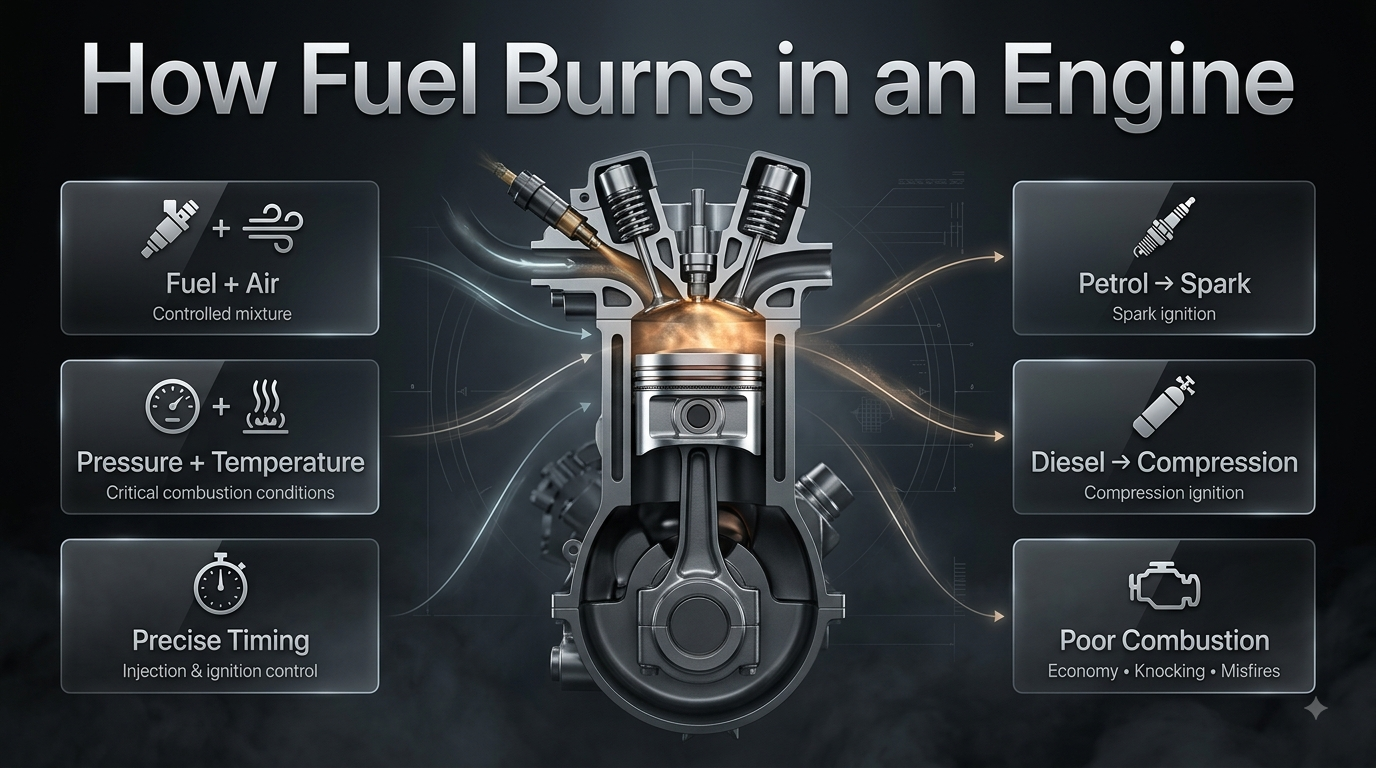
How Fuel Burns in an Engine | When you start your car, you don’t see the process that actually makes it move. Inside the engine, fuel is being delivered, air is being drawn in, pressure is building, and combustion is releasing energy—all within a tiny fraction of a second.
But how fuel burns in an engine isn’t as simple as fuel entering a cylinder and catching fire. Modern engines carefully control the amount of fuel, the amount of air, the injection or ignition timing, and the pressure and temperature inside the combustion chamber.
That controlled process is what turns the chemical energy stored in fuel into mechanical power.
Whether you’re trying to understand why a petrol engine needs a spark plug, how a diesel engine ignites fuel without a conventional spark, why poor combustion reduces fuel economy, or what causes engine knocking and misfires, it all comes back to the same basic process: fuel must mix with oxygen and release its energy under the right conditions and at the right time.
For a useful introduction to the different characteristics and uses of vehicle fuels, you can also explore Out of Petrol Dubai 👉 FuelDeliveryDubai, where the broader fuel topic can be understood before getting deeper into engine combustion.
How Does Fuel Burn in an Engine?
Fuel burns in an engine when fuel and oxygen are brought together under suitable pressure and temperature conditions and combustion is initiated in a controlled way. The chemical energy in the fuel is released as heat, producing high-pressure gases that push the piston downward. The piston then transfers that force to the crankshaft, creating rotational power.
The basic process can be simplified as:
Fuel + Oxygen + Ignition Conditions → Combustion → Heat → Pressure → Piston Movement → Crankshaft Rotation
The important word here is controlled.
An engine isn’t designed simply to make fuel burn as quickly as possible. It needs combustion to happen at a specific point in the engine cycle and at a controlled rate.
If combustion starts too early, happens too quickly, or occurs too late, the engine may lose efficiency, produce abnormal noise, increase emissions, or experience mechanical stress.
This is why modern combustion systems are engineered around several connected factors:
- Fuel quantity
- Air supply
- Fuel atomization
- Compression
- Temperature
- Cylinder pressure
- Ignition or injection timing
- Combustion-chamber design
- Engine speed
- Engine load
A change in one of these factors can influence the entire combustion event.
What Does an Engine Need to Burn Fuel?
At the most basic level, combustion needs fuel and oxygen, along with suitable conditions to start and sustain the chemical reaction.
The fuel comes from the vehicle’s fuel system, while oxygen comes from the air entering the engine.
The third part depends on the engine type.
A conventional petrol engine normally uses a spark plug to initiate combustion.
A conventional diesel engine uses the heat generated by high compression to create the conditions needed for fuel to ignite after injection.
This creates the two major combustion categories used in conventional automotive engines:
Petrol → Spark Ignition
Diesel → Compression Ignition
The distinction is important because it affects almost everything else about the engine, including fuel delivery, compression ratio, combustion-chamber design, injection strategy, and engine controls.
Before getting into combustion itself, it’s also useful to understand that not every vehicle uses exactly the same fuel. Petrol, diesel, and other automotive fuels have different characteristics and applications, which are covered in Types of Automotive Fuel.
What Happens to Fuel Before It Burns?

Fuel doesn’t travel directly from the tank into the cylinder and immediately burn.
It passes through a carefully controlled fuel-delivery system.
A typical sequence looks like this:
Fuel Tank → Fuel Pump → Fuel Filter → Fuel Rail/System → Injector → Combustion Chamber
The exact design depends on the vehicle.
The fuel pump moves fuel through the system, while the fuel filter helps remove contaminants. The fuel system then maintains the pressure required for the injectors to deliver fuel accurately.
The injector is particularly important because it determines when fuel enters the engine and how much is delivered.
In modern engines, fuel delivery can be adjusted according to:
- Engine speed
- Engine load
- Coolant temperature
- Intake-air temperature
- Airflow
- Accelerator position
- Crankshaft position
- Camshaft position
- Exhaust conditions
- Boost pressure
This allows the engine to change its combustion strategy depending on what the driver is asking it to do.
For example, the fuel requirements during a cold start aren’t the same as those during steady highway cruising.
Likewise, the amount of fuel needed during hard acceleration is very different from the amount needed while the vehicle is idling.
Why Fuel Injection Is So Important
Modern fuel injection systems are designed to deliver a very precise quantity of fuel at a very precise time.
The injector isn’t simply a small valve that opens and closes.
Its spray pattern, pressure, opening duration, and timing all influence combustion.
In diesel engines, this becomes particularly important because fuel is injected directly into hot compressed air. The fuel needs to atomize and mix with the surrounding air before and during combustion.
In petrol direct-injection engines, fuel spray behavior also affects mixture preparation and combustion.
A poorly performing injector can therefore cause much more than a simple fuel-delivery problem.
Depending on the fault, it may contribute to:
- Rough idle
- Poor acceleration
- Hard starting
- Increased fuel consumption
- Smoke
- Misfires
- Uneven engine operation
- Increased emissions
Pro Tip: When diagnosing poor engine performance, don’t assume the fuel itself is always the problem. The fuel system, injectors, air intake, ignition system, compression, sensors, and engine-control system can all affect how effectively fuel burns.
How Does Air Enter the Engine?
Fuel needs oxygen, so the engine must bring enough air into the cylinder for combustion.
During the intake stroke, the piston moves downward and creates conditions that allow air to enter through the intake system.
The amount of air entering the engine depends on the engine design and operating conditions.
A naturally aspirated engine relies primarily on atmospheric pressure and the pressure difference created by piston movement.
A turbocharged engine uses exhaust energy to drive a turbine, which powers a compressor that forces additional air into the engine.
A supercharged engine uses a mechanically driven compressor to increase intake-air pressure.
The basic reason for adding more air is simple:
More suitable air available → More oxygen available → More fuel can potentially be burned → More power can potentially be produced
However, this doesn’t mean that adding unlimited fuel and air automatically creates unlimited power.
The engine has physical and thermal limits.
Fuel delivery, combustion temperature, cylinder pressure, cooling, lubrication, exhaust flow, and mechanical strength all have to remain within appropriate limits.
Why Oxygen Is Essential for Combustion
Fuel contains chemical energy, but that energy cannot be released effectively without oxygen.
During combustion, fuel molecules react with oxygen. Under ideal conditions, hydrocarbons in the fuel are converted primarily into carbon dioxide and water, with energy released in the process.
Real engine combustion is more complicated.
The conditions inside the cylinder aren’t perfectly uniform. Some areas may contain more fuel than others, and temperature and pressure vary throughout the combustion chamber.
This is particularly important in diesel engines, where fuel is injected into air rather than being completely mixed beforehand.
Good engine design attempts to control this mixing as effectively as possible.
That means the combustion chamber, injector, piston shape, intake airflow, injection pressure, and timing all matter.
The Four-Stroke Engine Cycle
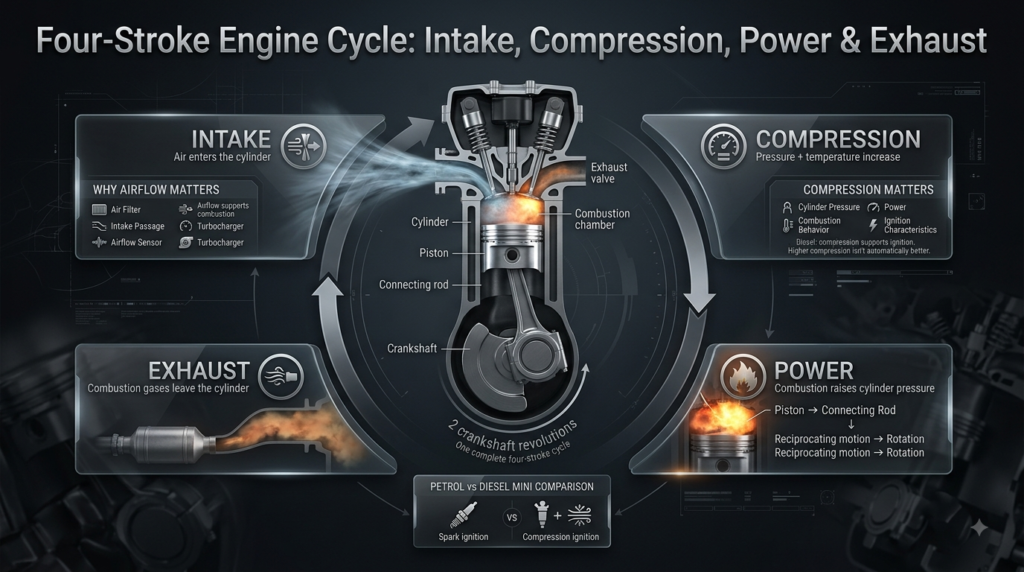
Most conventional petrol and diesel engines used in cars operate using the four-stroke cycle.
The four strokes are:
- Intake
- Compression
- Power
- Exhaust
Together, these four stages form the basic operating cycle of the engine.
The crankshaft completes two revolutions during one complete four-stroke cycle.
Let’s look at what happens during each stage.
1. Intake Stroke
The intake stroke is where the engine brings air into the cylinder.
The piston moves downward while the intake valve is open.
In many petrol engines, fuel is introduced into the intake air before it reaches the cylinder, while some petrol engines inject fuel directly into the combustion chamber.
Diesel engines generally draw in air during the intake stroke and inject diesel fuel later during the compression stage.
The purpose of the intake stroke is to prepare the cylinder with the air needed for the next stages.
Why Intake Airflow Matters
The engine needs sufficient airflow to support combustion.
A restricted air filter, blocked intake passage, malfunctioning airflow sensor, turbocharger problem, or other airflow issue can affect engine performance.
That’s why fuel and air should always be considered together.
A combustion problem isn’t necessarily caused by a lack of fuel.
Sometimes the engine is simply unable to obtain or properly manage the air it needs.
2. Compression Stroke
Once the cylinder has received its charge of air or air-fuel mixture, the intake valve closes.
The piston begins moving upward.
As the piston reduces the volume inside the cylinder, pressure and temperature increase.
This is the compression stroke.
Compression is particularly important in diesel engines because the temperature produced by compression is central to the ignition process.
Petrol engines also use compression, but their ignition normally comes from a spark plug.
Why Compression Matters
Compression influences:
- Cylinder pressure
- Temperature
- Combustion behavior
- Engine efficiency
- Power
- Ignition characteristics
However, higher compression isn’t automatically better.
The compression ratio has to be matched to the engine’s fuel, combustion system, operating conditions, emissions requirements, and mechanical design.
Petrol engines also need to avoid conditions that encourage abnormal combustion such as knock.
Diesel engines, meanwhile, are specifically designed around high compression and compression ignition.
3. Power Stroke
The power stroke is where combustion releases energy and creates the pressure that produces useful engine work.
In a petrol engine, the spark plug produces a spark at the appropriate point in the cycle.
That spark starts the combustion process.
In a diesel engine, fuel is injected into the hot compressed air and begins to ignite when the local conditions become suitable.
In both cases, combustion increases cylinder pressure.
The high-pressure gases act on the top of the piston and force it downward.
The piston is connected to the crankshaft through a connecting rod.
As the piston moves down, the connecting rod transfers that force to the crankshaft.
The crankshaft converts the piston’s reciprocating motion into rotation.
That rotational movement is eventually used to drive the vehicle.
4. Exhaust Stroke
After the power stroke, the exhaust valve opens.
The piston moves upward and pushes the combustion gases out of the cylinder.
These gases then travel through the exhaust system.
Modern vehicles use various emissions-control technologies to reduce pollutants before exhaust gases are released into the atmosphere.
Once the exhaust stroke is complete, the cylinder can begin another intake stroke.
The cycle then repeats.
At normal engine speed, these events happen so rapidly that the engine appears to operate continuously.
How Does a Petrol Engine Burn Fuel?
A conventional petrol engine uses spark ignition.
The engine takes in air and fuel, compresses the charge, and then uses an electrical spark to initiate combustion.
The simplified process is:
Air + Petrol → Compression → Spark → Flame Development → Combustion → Expansion
The spark doesn’t instantly burn every fuel molecule in the cylinder.
Instead, the spark creates a small ignition point.
From there, combustion develops through the combustible mixture.
The rate at which the flame travels depends on many factors, including mixture composition, pressure, temperature, turbulence, fuel properties, and combustion-chamber design.
The timing of the spark is also critical.
The engine needs the pressure created by combustion to occur at a useful point in the piston’s movement.
If ignition occurs too early, pressure may rise before the piston has reached the ideal position.
If ignition occurs too late, some of the potential energy may be released when the piston is already too far into the expansion stroke.
This is why modern petrol engines continuously adjust ignition timing.
For a more detailed explanation of the process inside a petrol cylinder, see the petrol engine combustion process.
Why Do Petrol Engines Need Spark Plugs?
A conventional petrol engine normally relies on a spark plug because the compressed petrol-air mixture is designed to be ignited by an external ignition source.
The spark plug receives high voltage from the ignition system.
That voltage creates an electrical arc across the plug’s electrodes.
The spark provides the energy required to start the combustion process.
But the spark must occur at the correct time.
Modern engine computers calculate ignition timing based on information from multiple sensors.
Timing can change according to:
- Engine RPM
- Engine load
- Coolant temperature
- Intake-air conditions
- Fuel characteristics
- Knock detection
- Boost pressure
- Other operating parameters
This electronic control allows the engine to maintain suitable combustion under different conditions.
How Does a Diesel Engine Burn Fuel?
Diesel engines use a different approach.
Instead of preparing a combustible air-fuel mixture and then igniting it with a spark, a diesel engine generally takes in air and compresses it to a very high pressure.
The compression significantly raises the air temperature.
Near the appropriate point in the cycle, the fuel injector sprays diesel into the hot compressed air.
The fuel breaks into small droplets, begins evaporating, mixes with oxygen, and can auto-ignite under suitable conditions.
The simplified process is:
Air → High Compression → High Temperature → Diesel Injection → Atomization → Mixing → Auto-Ignition → Combustion
This is called compression ignition.
The diesel engine therefore doesn’t normally need a spark plug for its main combustion event.
For a deeper explanation of this process, see the diesel engine combustion process.
Why Diesel Engines Use High Compression
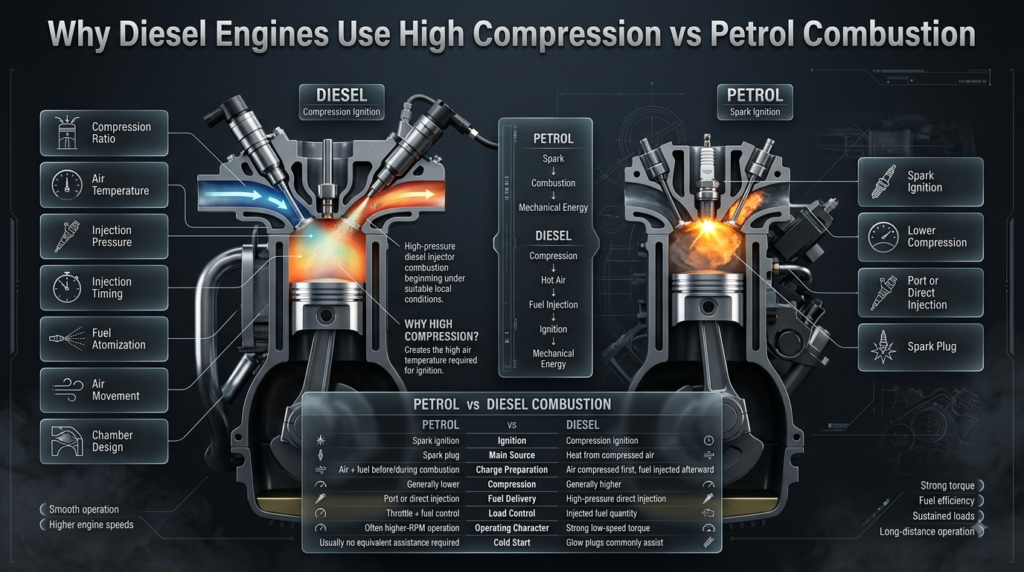
The high compression ratio in a diesel engine isn’t simply designed to make the engine stronger or more powerful.
Its most important role in combustion is helping create the high air temperature required for ignition.
When air is compressed rapidly, its pressure and temperature increase.
The diesel injector then introduces fuel into this hot environment.
This is why diesel combustion is closely connected to:
- Compression ratio
- Air temperature
- Injection pressure
- Injection timing
- Fuel atomization
- Air movement
- Combustion-chamber design
Petrol vs Diesel Combustion
Both petrol and diesel engines convert chemical energy into mechanical energy, but the way they initiate and control combustion is significantly different.
| Feature | Petrol Engine | Diesel Engine |
|---|---|---|
| Ignition type | Spark ignition | Compression ignition |
| Main ignition source | Spark plug | Heat from compressed air |
| Typical charge preparation | Air and fuel prepared before or during combustion | Air compressed first, fuel injected afterward |
| Compression ratio | Generally lower | Generally higher |
| Fuel delivery | Port or direct injection | High-pressure direct injection |
| Load control | Commonly uses throttle and fuel control | Primarily controlled by injected fuel quantity |
| Typical operating character | Often higher-RPM operation | Strong low-speed torque |
| Cold-start assistance | Usually not required in the same manner | Glow plugs commonly assist cold starting |
The two systems aren’t simply competing versions of the same technology.
They were developed around different combustion principles.
Petrol engines generally offer smooth operation and strong performance across higher engine speeds.
Diesel engines are commonly designed to deliver strong torque and good fuel efficiency, especially in applications involving sustained loads or long-distance operation.
For a broader comparison of the fuels themselves, petrol and diesel fuel types explains how these two major automotive fuels differ.
What Actually Pushes the Piston?
The piston isn’t pushed down by the liquid fuel.
It’s pushed by high-pressure gases produced by combustion.
This distinction is important.
When combustion occurs, chemical energy in the fuel is released as heat.
The gases inside the cylinder become extremely hot and create high pressure.
That pressure acts against the piston crown.
Because the piston can move inside the cylinder, the pressure forces it downward.
The connecting rod transfers this force to the crankshaft.
The crankshaft then converts the piston’s up-and-down motion into rotational motion.
The complete energy conversion looks like this:
Chemical Energy
↓
Heat From Combustion
↓
High-Pressure Gas
↓
Piston Movement
↓
Connecting Rod
↓
Crankshaft Rotation
↓
Transmission and Drivetrain
↓
Wheel Movement
This is the basic reason an internal combustion engine can turn fuel into vehicle movement.
Is Fuel Exploding Inside the Engine?
People often say that fuel “explodes” inside an engine, but normal engine combustion is better understood as a controlled burning process rather than an uncontrolled explosion.
The engine is designed to produce a useful pressure rise.
In a petrol engine, the spark initiates a controlled flame development.
In a diesel engine, injection and auto-ignition occur in a carefully managed environment.
The rate of pressure rise is particularly important.
If pressure rises too quickly, combustion can become harsh and noisy.
If combustion occurs too late, efficiency can suffer.
The engine therefore needs to release the fuel’s energy in a controlled manner.
This is one of the central principles behind modern combustion engineering.
What Is the Air-Fuel Ratio?
The air-fuel ratio describes the relative amount of air and fuel involved in combustion.
For gasoline, the commonly referenced stoichiometric air-fuel ratio is approximately 14.7 parts air to 1 part fuel by mass.
This doesn’t mean every petrol engine operates at exactly 14.7:1 under every condition.
The engine can intentionally operate with different mixtures depending on what it is trying to achieve.
For example, the mixture strategy may change during:
- Cold starting
- Acceleration
- High-load operation
- Cruising
- Idling
- Catalyst warm-up
- Emissions-control operation
Diesel engines work differently.
They generally operate with excess air, and engine output is largely controlled by changing the quantity of fuel injected into the available air.
That’s one of the key differences between petrol and diesel combustion control.
Why Fuel and Air Must Mix Correctly
Having the correct total amount of fuel and air isn’t enough.
They also need to be distributed correctly within the combustion chamber.
This is especially important in diesel engines.
Diesel fuel enters the cylinder as a high-pressure spray.
The droplets must atomize, evaporate, and mix with surrounding oxygen.
The quality of this process depends on:
- Injector design
- Injection pressure
- Spray pattern
- Fuel properties
- Air movement
- Piston design
- Combustion-chamber geometry
- Injection timing
- Temperature
If mixing isn’t effective, some areas can become too rich while others contain too little fuel.
This can influence combustion efficiency, emissions, noise, and particulate formation.
Why Fuel Atomization Matters
Liquid fuel must be prepared before it can burn effectively.
Fuel injectors therefore break the liquid into small droplets.
This process is known as atomization.
Smaller droplets provide more surface area relative to their volume, which helps fuel evaporate and mix with surrounding air.
In modern diesel engines, extremely high injection pressures help produce carefully controlled spray patterns.
The objective isn’t simply to make the fuel droplets small.
The spray needs to reach the right areas of the combustion chamber with the correct penetration, timing, and distribution.
That is why injector design is such an important part of combustion engineering.
What Makes Combustion Efficient?

Efficient combustion depends on several factors working together.
Adequate Air
The engine needs enough oxygen to support the required fuel burn.
Correct Fuel Quantity
Too much or too little fuel can move combustion away from the desired conditions.
Good Atomization
Fuel must be prepared so it can mix effectively with air.
Correct Timing
Ignition or injection must happen at the right point in the engine cycle.
Suitable Temperature
The combustion chamber must provide conditions that allow reliable ignition and combustion.
Appropriate Pressure
Cylinder pressure affects combustion and the amount of useful force produced.
Good Combustion-Chamber Design
Piston shape, airflow, injector placement, and chamber geometry influence how fuel and air interact.
Accurate Electronic Control
Modern engine computers coordinate many of these factors in real time.
This is why engine combustion is best understood as a system, not as one isolated event.
Why Combustion Timing Matters
Imagine combustion happening at exactly the wrong point.
If the fuel burns too early, cylinder pressure can rise while the piston is still moving upward.
That can oppose piston movement and create abnormal combustion conditions.
If combustion happens too late, pressure may rise after the piston has already moved too far down.
The engine may still produce power, but the energy conversion won’t be as effective.
The ideal timing depends on engine speed, load, fuel characteristics, compression, temperature, and many other factors.
Modern engines therefore adjust combustion timing continuously.
In petrol engines, this includes ignition timing.
In diesel engines, injection timing is particularly important.
What Is Engine Knock?
Engine knock is an abnormal combustion phenomenon that can occur when combustion doesn’t proceed as intended.
In petrol engines, part of the unburned mixture can auto-ignite unexpectedly after the spark has initiated the intended flame development.
This can create pressure waves inside the cylinder.
Knock can be influenced by factors such as:
- Fuel octane
- Engine temperature
- Compression ratio
- Ignition timing
- Engine load
- Intake conditions
- Carbon deposits
Modern engines often use knock sensors to detect abnormal combustion and adjust ignition strategy.
Fuel octane is therefore an important part of petrol-engine combustion.
However, octane shouldn’t be confused with energy content.
Higher-octane fuel primarily provides greater resistance to knock.
For a more detailed explanation of octane and the difference between regular and premium petrol, see regular vs premium petrol octane.
Why Doesn’t More Fuel Always Mean More Power?
It might seem logical that adding more fuel should automatically produce more power.
That’s not how an engine works.
Fuel needs sufficient oxygen and suitable combustion conditions.
If additional fuel is supplied without enough air or without proper combustion control, the engine may produce more incomplete combustion, smoke, deposits, and emissions rather than useful power.
An engine produces more useful power when it can effectively convert additional fuel energy into mechanical work.
That requires the correct relationship between:
Fuel + Air + Pressure + Temperature + Timing
This is why turbocharged engines can produce substantially more power.
A turbocharger increases the amount of air entering the engine, allowing the fuel system to supply additional fuel while maintaining appropriate combustion conditions.
What Happens When Fuel Doesn’t Burn Properly?
Poor combustion can produce several noticeable symptoms.
A vehicle may experience:
- Rough idling
- Hesitation
- Poor acceleration
- Reduced engine power
- Higher fuel consumption
- Difficult starting
- Misfires
- Excessive smoke
- Unusual engine noise
- Increased emissions
The cause isn’t always obvious.
For example, a petrol misfire could be caused by a spark plug, ignition coil, injector, air leak, compression problem, or electronic control issue.
A diesel engine may develop poor combustion because of injector problems, inadequate fuel pressure, poor compression, restricted airflow, or injection timing issues.
This is why proper diagnosis matters.
Common Mistakes People Make About Engine Combustion
Mistake 1: “Fuel Just Explodes Inside the Cylinder”
Normal combustion is a controlled process, not simply an uncontrolled explosion.
Better understanding: The engine manages the rate and timing of combustion to create useful cylinder pressure.
Mistake 2: “Diesel Engines Don’t Use Ignition”
Diesel engines absolutely require ignition.
The difference is the method.
Petrol: ignition is normally initiated by a spark.
Diesel: ignition occurs when injected fuel encounters sufficiently hot compressed air.
Mistake 3: “Glow Plugs Are Diesel Spark Plugs”
They’re not.
Glow plugs assist cold starting in many diesel engines by helping establish suitable thermal conditions.
They don’t perform the same function as petrol spark plugs during normal combustion.
Mistake 4: “Premium Fuel Always Gives More Power”
Higher octane primarily means greater resistance to knock.
An engine must be designed or calibrated to take advantage of higher octane before a meaningful performance benefit can be expected.
Mistake 5: “More Fuel Means More Power”
Fuel must be matched with appropriate air and combustion conditions.
Excess fuel can actually reduce efficiency and increase emissions.
Mistake 6: “All Engines Burn Fuel the Same Way”
Petrol and diesel engines use fundamentally different combustion strategies.
Understanding this difference makes it much easier to understand their different fuel systems and operating characteristics.
How Engine Computers Control Combustion
Modern engines rely heavily on electronic control units.
The engine computer receives information from sensors and uses that information to determine how the engine should operate.
Depending on the engine, the system can monitor:
- Crankshaft position
- Camshaft position
- Engine speed
- Engine load
- Intake pressure
- Airflow
- Intake temperature
- Coolant temperature
- Oxygen levels
- Knock activity
- Exhaust conditions
The computer can then adjust fuel delivery and combustion timing.
In petrol engines, this can involve fuel injection and ignition timing.
In diesel engines, the system can control injection pressure, quantity, timing, and multiple injection events.
This continuous adjustment is one reason modern engines can maintain relatively stable combustion across a wide range of operating conditions.
What Happens to the Energy Released by Fuel?
Fuel contains chemical energy.
When combustion occurs, that chemical energy is released primarily as thermal energy.
The heat creates high-pressure gases.
The gases push the piston.
The piston moves the connecting rod.
The connecting rod turns the crankshaft.
But the engine can’t convert all the fuel’s energy into useful vehicle movement.
Some energy is lost through:
- Exhaust gases
- Cooling
- Friction
- Pumping losses
- Heat transfer
- Mechanical accessories
- Other system losses
The goal of engine engineering is therefore not just to make fuel burn.
It’s to extract as much useful mechanical work as reasonably possible from the energy released by combustion.
Why Fuel Combustion Affects Fuel Economy

Fuel economy depends partly on how efficiently the engine converts fuel energy into useful work.
Good combustion can help reduce wasted fuel energy, but overall efficiency depends on the entire engine and vehicle.
Fuel economy is influenced by:
- Engine design
- Combustion efficiency
- Driving style
- Vehicle weight
- Aerodynamics
- Tire pressure
- Transmission
- Engine temperature
- Road conditions
- Vehicle load
- Accessory use
For example, repeated hard acceleration and braking can consume considerably more fuel than maintaining a steady speed.
This is why fuel economy can’t be explained by combustion alone.
The entire energy chain matters.
Why the Combustion Process Is So Important
The combustion process determines much of what an engine feels like in real-world driving.
It influences:
- Power
- Torque
- Fuel economy
- Engine smoothness
- Noise
- Exhaust emissions
- Starting performance
- Thermal loads
- Component durability
A small change in combustion timing or fuel-air preparation can affect several of these areas simultaneously.
This is why modern engine manufacturers spend enormous amounts of time developing combustion systems.
The objective is to achieve the right balance between performance, efficiency, emissions, durability, and drivability.
How does fuel actually burn inside an engine?
Fuel burns inside the engine when it is brought together with oxygen under the right temperature, pressure, and ignition conditions. The combustion releases the chemical energy stored in the fuel as heat. That heat creates rapidly expanding, high-pressure gases inside the cylinder, and those gases push the piston downward. The connecting rod transfers this movement to the crankshaft, which converts it into rotation that can ultimately drive the vehicle’s wheels.
The process is carefully timed rather than being a simple explosion. The engine has to control the amount of fuel, available air, ignition or injection timing, compression, and combustion rate. If these conditions are properly coordinated, the pressure produced by combustion acts on the piston at a useful point in its movement. That’s how a relatively small amount of fuel can produce continuous mechanical power while the engine is running.
What matters most:
Fuel provides the chemical energy.
Air provides the oxygen required for combustion.
Combustion releases heat and creates cylinder pressure.
Cylinder pressure pushes the piston.
The crankshaft converts piston movement into rotation.
Timing determines how effectively that pressure becomes useful work.
How does a petrol engine burn fuel without wasting it?
A petrol engine normally mixes petrol with air and compresses the mixture before a spark plug initiates combustion. The spark doesn’t simply ignite the entire cylinder at once. It creates an initial flame kernel, which develops through the combustible mixture. As combustion progresses, pressure increases inside the cylinder and pushes the piston downward during the power stroke.
The key to efficient petrol combustion is control. The engine needs the right amount of fuel and air, but it also needs the spark to occur at an appropriate time. Modern engine management systems continuously adjust fueling and ignition according to engine speed, load, temperature, airflow, and other operating conditions.
This is also why poor ignition timing, incorrect fueling, weak ignition components, or abnormal combustion can affect both performance and fuel economy.
For better petrol combustion:
Keep spark plugs in good condition.
Use the fuel grade recommended by the manufacturer.
Don’t ignore recurring misfires.
Maintain the air and fuel systems properly.
Understand that higher-octane fuel isn’t automatically more efficient in every engine.
Keep in mind that combustion timing is just as important as the amount of fuel being burned.
How does diesel fuel burn without a spark plug?
A diesel engine burns fuel through compression ignition. Instead of using a spark plug to ignite a premixed fuel-air charge, the engine first draws air into the cylinder and compresses it heavily. This compression raises the air’s temperature. Near the appropriate point in the cycle, the injector sprays diesel fuel into the hot compressed air. The fuel atomizes, mixes with oxygen, and ignites under suitable conditions.
This is why saying that “diesel engines don’t use ignition” is misleading. They absolutely require ignition; they simply achieve it differently. The heat needed for ignition comes primarily from compression rather than an electrical spark.
The injection process also has a major influence on diesel combustion. Injection pressure, spray pattern, injection timing, fuel quantity, air movement, and combustion-chamber design all affect how effectively the diesel burns.
Important diesel-combustion factors:
High compression creates the required air temperature.
The injector must deliver fuel accurately.
Fuel atomization helps the fuel mix with air.
Injection timing affects pressure development and efficiency.
Adequate oxygen is essential for effective combustion.
Glow plugs can assist cold starting but aren’t equivalent to petrol spark plugs.
What happens if fuel and air don’t mix properly in an engine?
If fuel and air aren’t distributed correctly, combustion can become uneven or incomplete. The engine may then produce less useful power while consuming fuel less efficiently. Depending on the engine and the specific problem, poor mixture preparation can contribute to rough running, hesitation, increased emissions, smoke, misfires, or deposits.
This is particularly important in diesel engines because diesel fuel is injected directly into compressed air. The injector has to break the fuel into an appropriate spray and distribute it through the combustion chamber so the fuel can interact with available oxygen. In petrol engines, mixture preparation is also important, whether the engine uses port injection or direct injection.
A common mistake is to think that simply supplying the correct total amount of fuel and air guarantees good combustion. It doesn’t. Their distribution, temperature, pressure, and timing also matter.
Signs that combustion may not be working properly:
Rough or unstable idle
Poor acceleration
Higher-than-normal fuel consumption
Misfires
Hard starting
Excessive smoke
Unusual combustion noise
Increased exhaust emissions
A professional diagnosis should look at the complete system rather than automatically replacing the fuel injector or blaming the fuel.
Why is combustion timing so important for engine power and fuel economy?
Combustion timing determines when the pressure created by burning fuel acts on the piston. Even if the engine has the correct amount of fuel and air, releasing that energy at the wrong point can reduce useful power and efficiency. The goal is to create cylinder pressure at a point where it can push the piston downward effectively rather than fighting its upward movement or releasing too much energy after the useful expansion period.
In petrol engines, ignition timing controls when the spark starts the combustion process. In diesel engines, injection timing strongly influences when fuel enters the hot compressed air and how combustion develops. Modern engines use electronic controls to adjust these parameters according to operating conditions.
Incorrect timing can contribute to poor performance, excessive heat, abnormal combustion, increased emissions, or mechanical stress.
Why correct timing matters:
It helps maximize useful cylinder pressure.
It improves the conversion of fuel energy into mechanical work.
It helps control combustion noise.
It can reduce the risk of abnormal combustion.
It supports better fuel economy.
It helps the engine maintain performance across different RPM and load conditions.
The professional takeaway: efficient combustion isn’t about making fuel burn as fast as possible. It’s about making the right amount of fuel burn in the right way, at the right time, with enough oxygen available. That’s the principle behind modern petrol and diesel engine combustion.
Conclusion
Understanding how fuel burns in an engine makes it much easier to understand how a vehicle produces power, uses fuel, and controls emissions. Fuel doesn’t simply enter the engine and explode. It goes through a carefully controlled process in which fuel, air, pressure, temperature, and ignition timing work together to release chemical energy.
In a petrol engine, the air-fuel mixture is normally ignited by a spark plug. In a diesel engine, fuel is injected into highly compressed, hot air, allowing it to ignite through compression. Although the ignition methods are different, both engines follow the same basic principle: combustion creates high-pressure gases, those gases push the piston, and the piston transfers that force to the crankshaft.
The quality of combustion depends on much more than the fuel itself. Proper fuel delivery, sufficient airflow, accurate injection or ignition timing, good compression, effective fuel atomization, and suitable operating temperatures all play important roles. When these factors are properly balanced, the engine can produce useful power while controlling fuel consumption and emissions.
For drivers and vehicle owners, the most important lesson is that efficient combustion is controlled combustion. Using the correct fuel, keeping the engine properly maintained, addressing misfires or unusual smoke early, and following the manufacturer’s service recommendations can all help maintain reliable engine performance.
Once you understand what happens inside the cylinder, topics such as petrol versus diesel combustion, fuel economy, octane, engine knocking, injectors, turbocharging, and emissions become much easier to understand. For more practical information about automotive fuels and fuel-related topics, visit Out of Petrol Dubai 👉 FuelDeliveryDubai.
Ultimately, the entire process comes down to one fundamental idea: the engine’s job is to release the energy stored in fuel at the right time and convert as much of that energy as possible into useful mechanical power.
Leave a Reply