Introduction
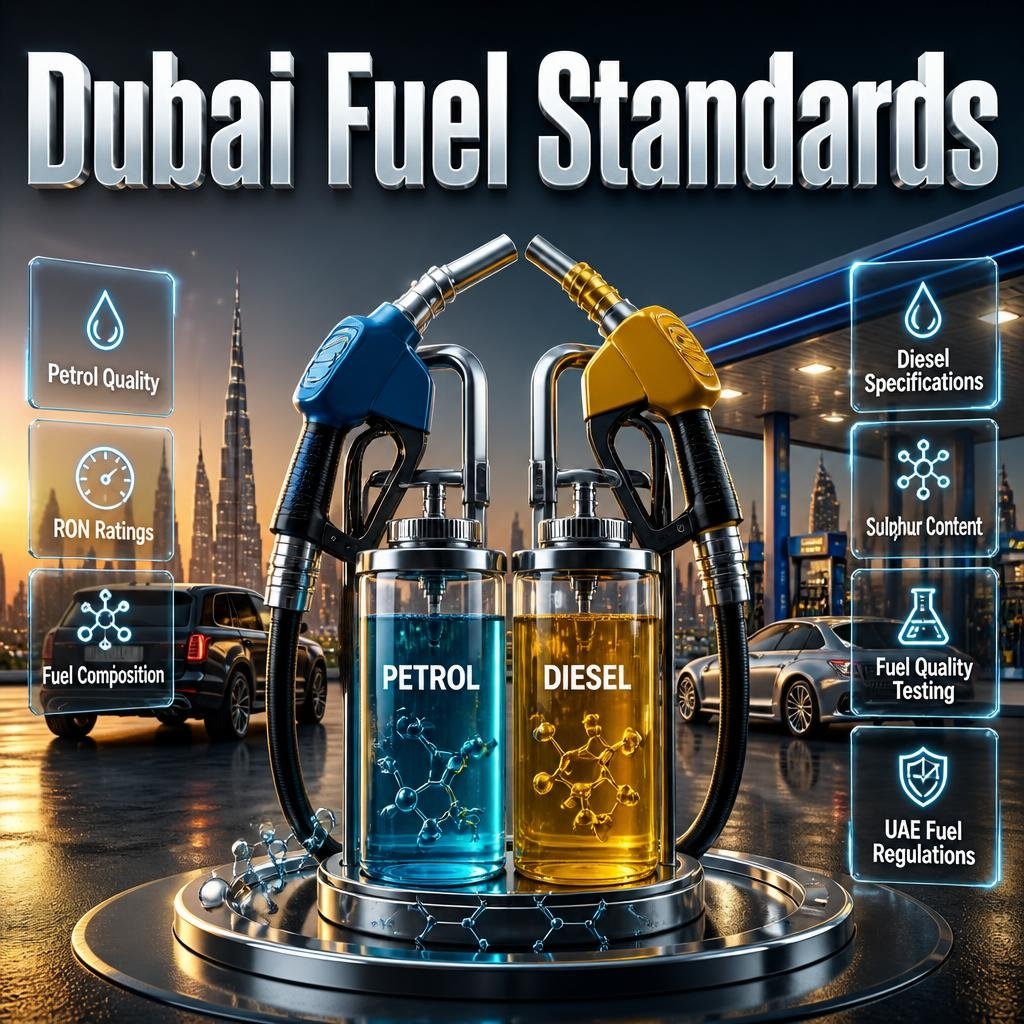
Dubai Fuel Standards | Choosing the right fuel is one of the most important decisions a vehicle owner makes. However, many motorists focus only on petrol prices or the number displayed on a fuel pump without understanding what those numbers actually mean. Fuel composition, octane rating, sulphur content, cleanliness and technical specifications all influence how a vehicle operates.
For drivers in Dubai, understanding Dubai fuel standards is particularly important. Vehicles operate in demanding conditions, including high summer temperatures, heavy traffic, frequent stop-and-go journeys and long highway drives. Using suitable fuel and maintaining the vehicle properly can help support reliable engine operation under these conditions.
The United Arab Emirates has established technical standards and regulatory requirements for petroleum products. These provide a framework for fuel quality, product conformity, safe handling and responsible distribution. Dubai also has specific regulatory arrangements governing petroleum-related activities, including storage, transportation, supply and retail operations.
At Fuel Delivery Dubai, understanding the importance of appropriate fuel selection and responsible refuelling is central to helping motorists make informed decisions.
Whether you own a petrol-powered sedan, a diesel SUV, a luxury vehicle or a commercial fleet, knowing how fuel standards work can help you avoid common mistakes and understand what your vehicle actually needs.
In this guide, you’ll learn about petrol and diesel specifications, RON ratings, diesel sulphur levels, fuel-quality testing, regulatory responsibilities, storage practices and the practical steps drivers should follow when choosing fuel in Dubai.
1. What Are Dubai Fuel Standards?
Dubai fuel standards refer to the technical specifications and regulatory requirements governing petroleum products supplied and handled within the emirate. They establish expectations for fuel characteristics, product conformity, safe distribution and appropriate use.
These requirements help ensure that petrol and diesel are suitable for their intended applications rather than allowing uncontrolled differences in essential fuel properties.
Fuel specifications can cover several important characteristics:
- Octane rating for petrol.
- Cetane rating for diesel.
- Sulphur concentration.
- Fuel density and viscosity.
- Chemical composition.
- Water and sediment content.
- Volatility and distillation characteristics.
- Lubricity and stability.
- Applicable testing and conformity requirements.
Not every parameter applies equally to petrol and diesel. Each product has its own technical requirements based on its intended engine application.
Why Are Fuel Standards Necessary?
Imagine purchasing fuel from different suppliers without any consistent quality requirements. Differences in chemical composition, contamination levels or combustion characteristics could create uncertainty for motorists and vehicle operators.
Fuel standards provide a framework for reducing this uncertainty.
Their main purposes include:
Engine compatibility: Fuel should have characteristics appropriate for the engines designed to use it.
Product consistency: Technical specifications establish measurable requirements for petroleum products.
Consumer protection: Regulatory oversight helps prevent the supply and sale of non-compliant or improperly sourced products.
Environmental responsibility: Controlling certain fuel components can support emissions-control technologies and reduce harmful emissions.
Public safety: Proper handling, storage, transportation and dispensing reduce risks associated with flammable petroleum products.
An important distinction is that fuel standards do not guarantee that every vehicle will perform perfectly. Engine condition, maintenance, driving behaviour and correct fuel selection also matter.
2. Who Is Responsible for Regulating Fuel Standards in Dubai?

Fuel regulation in Dubai operates through the UAE’s wider petroleum and technical standards framework, alongside emirate-level rules governing petroleum-related activities.
Different authorities have different responsibilities. Understanding this distinction is important because regulating fuel specifications and regulating petroleum trading are related but separate functions.
UAE Ministry of Industry and Advanced Technology
The Ministry of Industry and Advanced Technology (MoIAT) is responsible for important aspects of the UAE’s national standards and technical regulations framework.
Its responsibilities include:
- Developing and adopting national technical standards.
- Establishing applicable conformity requirements.
- Supporting product quality and consumer protection.
- Promoting technical consistency.
- Supporting the implementation of relevant regulatory requirements.
Petroleum products must be considered within the applicable national standards and technical regulations relevant to their product categories.
Dubai Supreme Council of Energy
The Dubai Supreme Council of Energy (DSCE) has an important role in regulating petroleum products trading activities within Dubai.
Executive Council Resolution No. 85 of 2025 establishes a regulatory framework for dealing in petroleum products in the emirate.
The framework addresses activities including:
- Importing petroleum products.
- Manufacturing and processing.
- Storage.
- Transportation.
- Distribution.
- Marketing.
- Wholesale and retail sales.
- Supply to other parties.
It also provides for relevant permits, inspections, technical requirements and compliance responsibilities.
Fuel Retailers and Distributors
Fuel suppliers and retailers must operate according to the applicable regulatory requirements.
Their responsibilities can involve maintaining suitable facilities, managing approved supply sources, following safe handling procedures and ensuring that products meet the relevant technical specifications.
For motorists, this means that fuel quality is not simply a matter of choosing a familiar pump. Responsible management throughout the supply chain is also important.
3. What Are the Main Petrol Grades Available in Dubai?
The main petrol grades commonly encountered by Dubai motorists are E-Plus 91, Special 95 and Super 98.
Their numbers refer to Research Octane Number (RON), which measures petrol’s resistance to engine knocking.
Each grade serves vehicles with different fuel requirements. Choosing between them should depend on the manufacturer’s recommendation rather than personal assumptions about which petrol is best.
E-Plus 91
E-Plus 91 is a regular unleaded petrol grade with an octane rating of 91 RON.
It is intended for vehicles designed to operate on 91 RON petrol or an appropriate equivalent.
Common considerations include:
- Compatibility with engines requiring regular unleaded petrol.
- Suitability for many everyday passenger vehicles.
- A potentially lower refuelling cost compared with higher-octane alternatives.
- Compliance with the vehicle manufacturer’s minimum octane recommendation.
However, not every petrol-powered vehicle can use E-Plus 91.
Some modern engines, particularly certain turbocharged and high-compression models, require higher octane fuel.
Special 95
Special 95 is a widely used petrol grade with an octane rating of 95 RON.
It is suitable for vehicles whose manufacturers specify 95 RON or an appropriate equivalent.
It is commonly relevant to:
- Family sedans.
- Petrol-powered SUVs.
- Many modern passenger vehicles.
- Certain turbocharged engines.
- Vehicles designed around 95 RON fuel.
For a driver whose vehicle requires 95 RON, choosing Special 95 is generally more appropriate than paying extra for a higher grade without a specific technical reason.
Super 98
Super 98 has an octane rating of 98 RON.
It provides greater resistance to knocking and is intended for engines that require or recommend this level of octane performance.
It may be appropriate for:
- High-performance vehicles.
- Certain luxury cars.
- High-compression petrol engines.
- Selected turbocharged engines.
- Vehicles with manufacturer-approved 98 RON requirements.
Higher octane does not automatically mean better mileage, greater power or cleaner combustion in every vehicle.
The manufacturer’s specification remains the most important consideration.
Petrol Grade Comparison
| Petrol grade | RON rating | General application |
|---|---|---|
| E-Plus | 91 | Vehicles designed for 91 RON |
| Special | 95 | Vehicles designed for 95 RON |
| Super | 98 | Vehicles requiring or recommending 98 RON |
Drivers wanting a more detailed explanation of these products can explore Dubai Petrol Grades.
4. What Does RON Mean and Why Does It Matter?
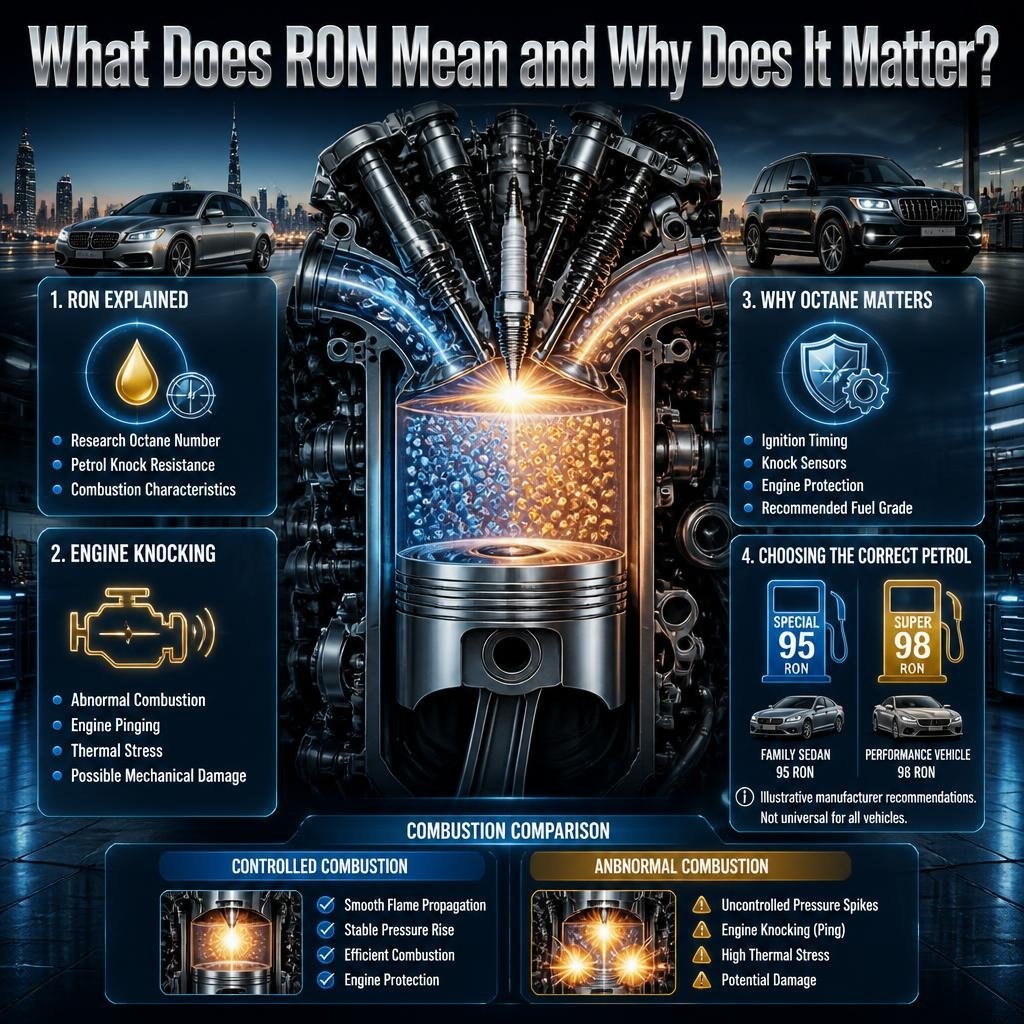
RON stands for Research Octane Number. It is a standardised measurement of petrol’s resistance to knocking during combustion.
Engine knocking can occur when the air-and-fuel mixture ignites in an uncontrolled manner instead of burning as intended after spark-plug ignition.
This abnormal combustion can create unwanted pressure and temperature conditions inside the engine.
How Does Octane Rating Affect Engine Operation?
Petrol engines compress an air-and-fuel mixture before ignition. The engine is designed around particular combustion characteristics.
When petrol has insufficient knock resistance for the engine’s requirements, abnormal combustion may occur under certain operating conditions.
Possible consequences include:
- Engine knocking or pinging.
- Reduced performance.
- Ignition-timing adjustments by engine management systems.
- Increased thermal stress.
- Potential mechanical damage in severe cases.
Modern engines may use knock sensors to detect abnormal combustion and adjust ignition timing. However, these systems should not be treated as permission to ignore the recommended fuel grade.
Does Higher RON Mean More Power?
Not automatically.
A vehicle designed for 95 RON may show little or no measurable improvement when filled with 98 RON.
However, an engine specifically designed or calibrated for 98 RON may depend on that grade to achieve its intended performance.
Practical example:
Consider two motorists:
- The first drives a family sedan requiring 95 RON.
- The second owns a performance vehicle requiring 98 RON.
The first should normally use Special 95, while the second should follow the manufacturer’s 98 RON recommendation.
Both drivers are making the correct decision even though they are purchasing different petrol grades.
5. What Are the Main Diesel Fuel Standards in Dubai?
Diesel fuel has different technical requirements from petrol because diesel engines use compression ignition rather than spark-plug ignition.
Its quality is evaluated through several characteristics that influence combustion, fuel injection, cleanliness, safety and emissions.
Important diesel properties include:
- Cetane number.
- Sulphur concentration.
- Density.
- Viscosity.
- Flash point.
- Lubricity.
- Water content.
- Sediment and contamination.
- Oxidation stability.
Cetane Number
The cetane number measures the ignition quality of diesel fuel.
It indicates how readily the fuel ignites after being injected into the compressed air inside a diesel engine.
Suitable ignition characteristics support dependable engine operation.
Inappropriate cetane characteristics can contribute to:
- Difficult starting.
- Rough combustion.
- Increased engine noise.
- Poor combustion behaviour.
- Unwanted emissions.
However, cetane number is only one part of overall diesel quality.
Sulphur Content
Sulphur concentration is an important consideration in modern diesel specifications.
Higher sulphur content can contribute to sulphur oxide emissions and create difficulties for certain exhaust after-treatment technologies.
Modern diesel vehicles may use:
- Diesel particulate filters.
- Diesel oxidation catalysts.
- Selective catalytic reduction systems.
These technologies require appropriate operating conditions and compatible fuel.
Diesel Density
Density measures the mass of a particular volume of fuel.
It influences the amount of fuel delivered by volume-based injection systems and is therefore an important quality parameter.
A value outside the applicable specification may indicate a product-quality issue, although density alone cannot identify the exact cause.
Diesel Viscosity
Viscosity describes how easily diesel flows.
It matters because modern injection systems require suitable fuel-flow characteristics to deliver fuel accurately.
Fuel outside the relevant viscosity limits can affect injection behaviour and system operation.
What Is Low-Sulphur Diesel?
Low-sulphur diesel contains a reduced concentration of sulphur compared with higher-sulphur alternatives.
For example, diesel products marketed with a 10ppm sulphur specification indicate a very low sulphur concentration.
However, motorists should always check the actual product specification rather than assume every diesel product has identical characteristics.
6. What Technical Parameters Determine Fuel Quality?
Fuel quality cannot be established through one measurement alone.
Professional fuel assessment uses multiple testing methods to evaluate whether a product meets its applicable specification.
Octane Number
RON and Motor Octane Number (MON) are used to evaluate the anti-knock characteristics of petrol.
They provide information about how petrol behaves under standardised testing conditions.
Cetane Number
Cetane number evaluates diesel ignition quality.
It is relevant to starting behaviour, ignition delay and combustion characteristics.
Sulphur Concentration
Sulphur testing measures the amount of sulphur present in fuel.
This is particularly important for emissions and compatibility with exhaust after-treatment systems.
Density and Viscosity
These parameters help determine whether the fuel has suitable physical properties for its intended application.
They are especially relevant to diesel injection and fuel-handling performance.
Water and Sediment
Water and unwanted particles can compromise fuel cleanliness.
Potential consequences include:
- Fuel-filter blockage.
- Corrosion.
- Injector problems.
- Fuel-pump damage.
- Microbial growth in certain diesel storage conditions.
Distillation Characteristics
Distillation testing examines how different portions of a fuel evaporate at different temperatures.
For petrol, these characteristics help assess starting behaviour, volatility and combustion-related performance.
Flash Point
Flash point is particularly important for diesel safety.
It identifies the temperature at which fuel vapours can ignite under specified test conditions.
Why Are Multiple Tests Necessary?
A petrol sample might have an acceptable RON rating but still fail another important specification.
Similarly, diesel with an acceptable cetane number could contain excessive water or sediment.
That is why professional fuel-quality testing evaluates the complete set of relevant parameters rather than relying on a single result.
7. How Is Fuel Quality Checked Before It Reaches a Petrol Station?
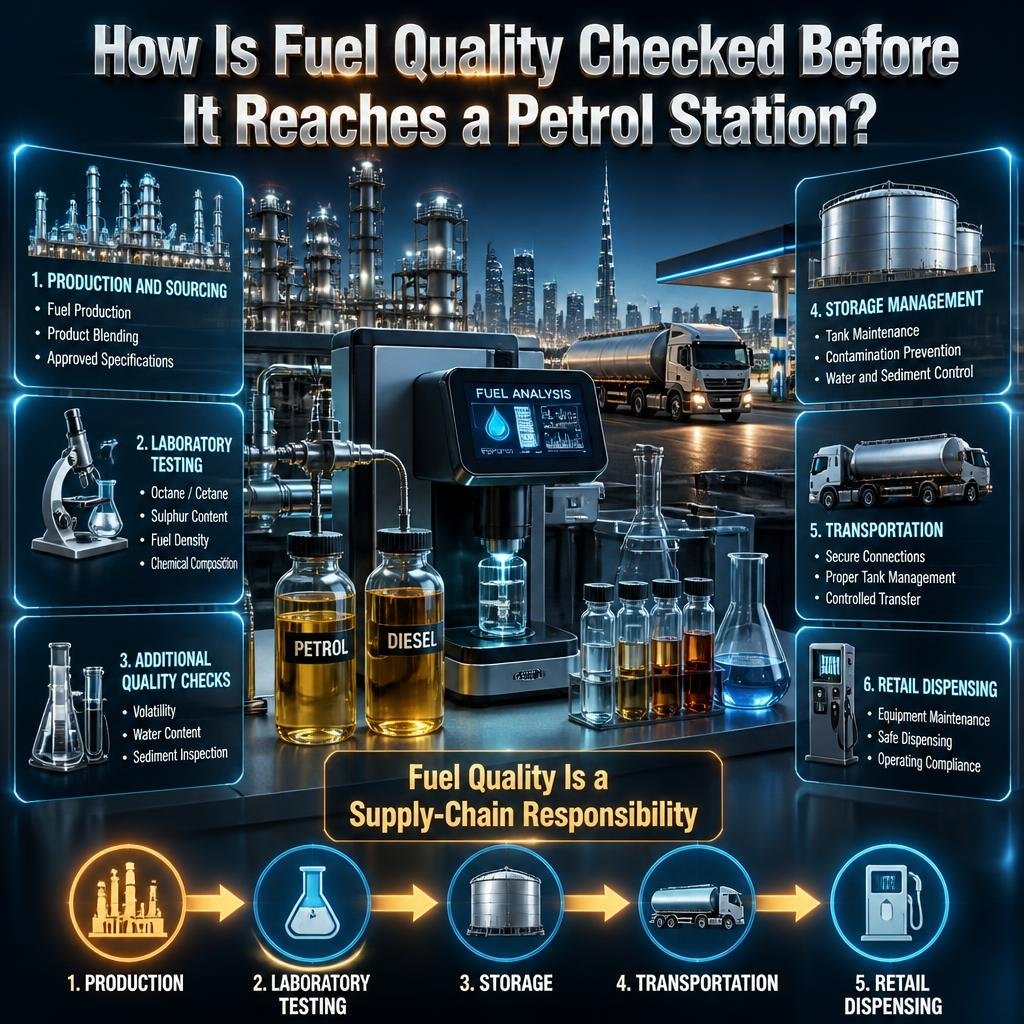
Fuel quality management begins long before motorists arrive at a dispensing pump.
It involves production, sourcing, testing, transportation, storage and retail distribution.
Each stage has a role in maintaining product integrity.
Stage 1: Fuel Production and Sourcing
Petroleum products are produced, processed or sourced according to their intended applications.
Suppliers must manage product composition and blending so that the resulting fuel meets the applicable specifications.
Stage 2: Laboratory Testing
Testing helps determine whether fuel meets relevant technical requirements.
Depending on the product, laboratories may examine:
- Octane or cetane characteristics.
- Sulphur concentration.
- Density.
- Chemical composition.
- Volatility.
- Water and sediment.
- Other required properties.
Stage 3: Storage Management
Fuel must be stored in suitable facilities.
Poorly maintained tanks can allow water, sediment and other contaminants to enter the product.
Stage 4: Transportation
Petroleum products must be transported using appropriate equipment and procedures.
Proper tank management, secure connections and controlled transfer operations help reduce contamination and leakage risks.
Stage 5: Retail Dispensing
At the retail stage, suitable storage and dispensing arrangements help maintain fuel integrity.
Equipment maintenance and compliance with applicable operating requirements are important parts of this process.
Professional advice: Fuel quality is a supply-chain responsibility. Fuel that meets its original specification can still become contaminated if it is stored or handled incorrectly.
8. Why Is Fuel Storage Important in Dubai?
Fuel storage is particularly important in a hot climate because temperature conditions, moisture, unsuitable equipment and poor maintenance can influence stored petroleum products.
Storage management is therefore an important part of maintaining fuel quality.
Water Contamination
Water may enter a storage system through condensation, damaged seals, leaks or other contamination routes.
In diesel storage, accumulated water can contribute to corrosion and microbial growth.
Sediment Accumulation
Dust, rust and other particles may accumulate at the bottom of storage tanks.
If disturbed, these materials can enter the fuel supply and affect filters and injection components.
Fuel Oxidation
Fuel can deteriorate over time depending on its composition, storage conditions and exposure to air.
Oxidation may contribute to deposit formation and changes in fuel properties.
Unsuitable Storage Materials
Incorrect tanks, seals or transfer equipment can affect product integrity.
Storage equipment must be appropriate for the petroleum product being handled.
Recommended Storage Practices
Responsible storage management involves:
- Using suitable and approved storage facilities.
- Keeping tanks properly sealed.
- Inspecting fittings and connections.
- Monitoring for water accumulation.
- Maintaining suitable filtration arrangements.
- Following appropriate tank-cleaning procedures.
- Avoiding unnecessary long-term storage.
- Keeping inspection and maintenance records.
For individual motorists, the safest approach is to purchase fuel through recognised supply channels rather than relying on fuel stored in unsuitable containers.
9. How Do Fuel Standards Support Environmental Protection?
Fuel specifications influence vehicle emissions because the chemical composition of petrol and diesel affects combustion and exhaust-system performance.
Controlling certain fuel properties can help support cleaner vehicle operation.
Sulphur and Exhaust Emissions
Sulphur in petroleum products contributes to sulphur oxide emissions.
It can also affect the performance of some emissions-control technologies.
Suitable low-sulphur fuel supports modern exhaust after-treatment systems when used in compatible vehicles.
Petrol Composition
Petrol specifications may also control characteristics such as:
- Benzene content.
- Aromatic compounds.
- Oxygenates.
- Volatility.
- Other regulated chemical components.
These properties can influence combustion, evaporative emissions and air quality.
Modern Emissions-Control Systems
Petrol vehicles commonly use catalytic converters to manage exhaust emissions.
Modern diesel vehicles may use particulate filters and selective catalytic reduction systems.
Appropriate fuel specifications help these systems operate under their intended conditions.
Fuel Standards Are Only One Part of the Solution
Vehicle emissions also depend on factors such as:
- Engine condition.
- Vehicle age.
- Maintenance quality.
- Driving behaviour.
- Traffic conditions.
- Exhaust-system condition.
Using compliant fuel is important, but regular maintenance and responsible driving remain necessary.
10. How Do Dubai Fuel Standards Affect Everyday Motorists?

Fuel standards may seem like an industry-level subject, but they have practical implications for ordinary vehicle owners.
Understanding them helps motorists make better decisions about fuel selection, maintenance and refuelling.
Better Engine Compatibility
Using the recommended fuel grade helps the engine operate according to its intended combustion requirements.
Consistent Product Requirements
Technical specifications provide measurable requirements for fuel products.
This supports greater consistency across the supply chain.
Protection of Modern Vehicle Technology
Modern vehicles use sophisticated injection systems, sensors and emissions-control equipment.
Appropriate fuel characteristics help these components operate as intended.
Consumer Protection
Regulatory oversight establishes requirements for authorised petroleum activities and product conformity.
This helps reduce risks associated with unverified sources and non-compliant products.
More Informed Refuelling Decisions
Motorists who understand fuel specifications are less likely to choose petrol based only on price or misunderstand the purpose of premium grades.
For a broader explanation of vehicle fuel requirements and practical selection, explore Dubai Fuel Requirements.
11. How Can Dubai Drivers Choose the Correct Fuel?
Choosing the correct fuel should begin with the vehicle manufacturer’s instructions.
The following process helps prevent avoidable mistakes.
Step 1: Check the Owner’s Manual
Look for the recommended fuel type and minimum octane requirement.
The information may also appear on the fuel-filler flap or in official vehicle documentation.
Step 2: Identify Your Engine Type
Confirm whether your vehicle uses petrol or diesel.
These fuels have different combustion characteristics and are not interchangeable.
Step 3: Match the Fuel Grade
Select the petrol grade or diesel product that meets the manufacturer’s requirements.
Do not automatically choose the highest-priced option.
Step 4: Use Recognised Fuel Retailers
Choose established retailers operating under the applicable regulatory framework.
Familiar fuel retailers in Dubai include ENOC, EPPCO, ADNOC Distribution and Emarat.
Step 5: Monitor Vehicle Behaviour
Pay attention to unusual symptoms after refuelling.
These may include:
- Engine knocking.
- Difficult starting.
- Unusual smoke.
- Unexpected hesitation.
- Warning lights.
- Sudden changes in fuel consumption.
Remember that these symptoms can also result from mechanical faults.
Step 6: Keep Refuelling Records
Maintain basic records of:
- Refuelling date.
- Fuel grade.
- Amount purchased.
- Odometer reading.
- Station location.
- Unusual vehicle symptoms.
This information can help a technician investigate problems more effectively.
12. What Common Fuel-Related Problems Should Drivers Avoid?
Fuel-related problems can develop because of incorrect selection, contamination, poor storage or unsuitable handling.
Recognising these issues can help motorists respond appropriately.
Incorrect Petrol Grade
Using petrol with a lower octane rating than the manufacturer’s minimum recommendation can increase the risk of knocking in engines that require higher-octane fuel.
How to avoid it: Check the recommended RON before refuelling.
Water Contamination
Water in diesel can affect filtration, injection equipment and fuel-system reliability.
How to avoid it: Maintain the vehicle’s fuel filter and water separator according to the manufacturer’s schedule.
Fuel Contamination
Dust, sediment, rust and other unwanted materials can enter fuel during poor storage or handling.
How to avoid it: Use recognised supply channels and arrange professional inspection if contamination is suspected.
Incorrect Fuel Type
Petrol and diesel must never be treated as interchangeable products.
Filling a vehicle with the wrong fuel can cause serious mechanical damage.
How to avoid it: Check the pump label and nozzle before refuelling.
If you notice the mistake before starting the engine, do not start it. Contact a qualified recovery or vehicle technician.
Poor Storage Practices
Unsuitable containers and poorly maintained tanks can compromise fuel quality.
How to avoid it: Use suitable storage equipment and approved handling procedures.
13. What Should You Do If You Suspect Poor-Quality Fuel?
If a vehicle develops unusual symptoms shortly after refuelling, avoid immediately blaming the fuel supplier.
A structured response helps protect the vehicle and makes it easier to identify the actual problem.
Step 1: Stop Safely
If the vehicle develops severe knocking, loses power or displays a serious warning, move to a safe location where possible.
Step 2: Avoid Unnecessary Engine Operation
If incorrect or contaminated fuel is suspected, avoid continuing the journey.
If the wrong fuel has been added and the engine has not been started, leave it switched off.
Step 3: Keep the Refuelling Receipt
The receipt can help establish when and where the vehicle was refuelled.
Record the product grade, approximate quantity and vehicle mileage.
Step 4: Arrange Professional Inspection
A qualified technician can inspect the fuel system and determine whether the problem involves contamination, fuel selection, filters, injectors or another mechanical fault.
Step 5: Report a Suspected Fuel Issue
If there is reasonable evidence of a product-quality problem, contact the retailer and follow the appropriate complaint procedure.
Do not attempt to drain the tank yourself. Petrol and diesel require suitable equipment, safe handling procedures and appropriate disposal.
14. Common Mistakes Drivers Make About Dubai Fuel Standards

Many fuel-related misunderstandings arise because motorists confuse technical specifications with fuel prices or engine performance.
The following mistakes are worth avoiding.
Mistake 1: Believing Super 98 Is Always Better
A higher octane rating does not automatically improve performance in every vehicle.
Why it happens: Drivers often associate a higher number with a superior product.
Better approach: Use the octane rating recommended by the manufacturer.
Mistake 2: Assuming All Petrol Grades Are Identical
E-Plus 91, Special 95 and Super 98 have different knock-resistance characteristics.
Why it matters: Some engines require a higher minimum octane rating.
Better approach: Check the fuel specification before selecting a grade.
Mistake 3: Confusing Fuel Quality With Fuel Price
A higher price does not automatically prove that a product is more suitable for a particular engine.
Why it happens: Many motorists associate premium pricing with better performance.
Better approach: Consider technical compatibility first and price second.
Mistake 4: Ignoring Diesel Quality Parameters
Diesel quality involves more than the label displayed at a pump.
Why it matters: Cetane, sulphur, viscosity, water and sediment can influence engine operation.
Better approach: Follow the manufacturer’s diesel requirements and service schedule.
Mistake 5: Blaming Every Engine Problem on Fuel
Poor acceleration, rough idling and increased consumption can result from many mechanical issues.
Why it happens: Symptoms sometimes appear shortly after refuelling.
Better approach: Keep records and arrange a proper diagnosis.
Mistake 6: Ignoring Fuel Storage and Handling
Fuel can become contaminated after production if storage and transportation are poorly managed.
Better approach: Use recognised suppliers and appropriate storage facilities.
15. Expert Recommendations for Better Fuel Management
Good fuel management requires more than choosing the correct petrol grade.
It involves responsible refuelling, regular maintenance and attention to the vehicle’s operating condition.
Follow Manufacturer Specifications
Make the manufacturer’s fuel recommendation your starting point.
Avoid changing grades based on unverified advice or assumptions about premium petrol.
Maintain Fuel Filters
Fuel filters help capture unwanted particles before they reach sensitive engine components.
Replace them according to the recommended maintenance schedule.
Diesel owners should also pay attention to water-separator maintenance where fitted.
Maintain a Practical Fuel Reserve
Avoid repeatedly allowing the tank to reach an extremely low level.
A practical reserve is especially useful before long journeys, during busy traffic periods and when travelling through less familiar areas.
Monitor Fuel Consumption
Track average fuel economy over several refuelling cycles.
If consumption changes unexpectedly, consider checking:
- Tyre pressure.
- Air filters.
- Fuel filters.
- Engine sensors.
- Injectors.
- Driving behaviour.
- Air-conditioning operation.
Plan Refuelling Around Regular Routes
Identify suitable stations near your home, workplace and frequently used roads.
Planning helps reduce unnecessary detours and last-minute refuelling decisions.
Maintain the Entire Vehicle
Fuel quality cannot compensate for poor vehicle maintenance.
Suitable engine oil, properly inflated tyres, a healthy cooling system and clean filters all contribute to dependable operation.
16. How Do Dubai’s Driving Conditions Influence Fuel Consumption?
Dubai’s driving environment creates several practical challenges for motorists.
Although technical fuel specifications do not automatically change because of weather or traffic, operating conditions influence how much fuel a vehicle consumes.
High Summer Temperatures
Hot weather increases the importance of maintaining the cooling system, engine oil and general vehicle condition.
Drivers should pay attention to:
- Coolant level and condition.
- Radiator and cooling-system performance.
- Engine oil specifications.
- Air-conditioning maintenance.
- Fuel-system condition.
Stop-and-Go Traffic
Frequent acceleration and braking can increase fuel consumption, particularly during busy commuting periods.
Smooth acceleration, sensible following distances and avoiding unnecessary idling can help improve efficiency.
Highway Driving
Long journeys create different operating demands compared with short urban trips.
Before travelling, check the fuel level, tyre pressure and general vehicle condition.
Air-Conditioning Use
Air-conditioning is essential for comfortable driving in Dubai, but operating the system can increase engine load and fuel consumption depending on the vehicle and conditions.
Regular maintenance helps the system operate efficiently.
For additional guidance, read Dubai Driving and Fuel Insights and Dubai City Driving.
17. How Should Drivers Plan Fuel Costs Under Dubai Fuel Standards?
Fuel standards determine product characteristics, while retail prices determine the amount motorists pay.
These are separate considerations, but both affect everyday driving decisions.
For example, a vehicle requiring 95 RON should have its fuel budget calculated using a compatible 95 RON product rather than automatically choosing a cheaper grade.
Important budgeting factors include:
- Vehicle fuel requirements.
- Average monthly mileage.
- Fuel consumption.
- Current price per litre.
- Traffic conditions.
- Frequency of refuelling.
A Simple Monthly Fuel Cost Calculation
The basic formula is:
Monthly fuel cost = Monthly litres consumed × Price per litre
For example:
A vehicle uses 120 litres per month, and the selected fuel costs AED 4.00 per litre.
120 × AED 4.00 = AED 480.
This is an illustrative example, not a statement of current petrol prices.
Why Should Fuel Compatibility Come Before Savings?
Choosing an unsuitable fuel grade simply to reduce the immediate bill can create unnecessary risks.
The correct approach is to identify the required product and then manage consumption through better driving habits, vehicle maintenance and route planning.
For more detailed budgeting guidance, explore:
18. How Can Drivers Find Suitable Fuel Stations in Dubai?

Choosing a suitable refuelling location is another important part of everyday fuel management.
Motorists should consider convenience, recognised operations and the availability of the required fuel grade.
Consider Your Regular Routes
Identify stations near:
- Your home.
- Your workplace.
- Regular shopping destinations.
- Frequently used roads.
- Business and delivery locations.
This makes refuelling easier to plan.
Check the Available Fuel Grade
Not every motorist needs the same petrol grade.
Confirm that the station offers the product required by your vehicle before making a special journey.
Consider Operating Convenience
Opening hours, accessibility, traffic conditions and payment facilities can influence the convenience of a station.
Avoid Unverified Fuel Sources
Do not purchase petroleum products from unknown or unauthorised sources.
Reliable supply channels and proper handling are important for maintaining product integrity.
For more information about refuelling locations, read our Dubai Fuel Stations guide.
19. What Should You Know About Fuel Delivery and Responsible Refuelling?
Fuel delivery can be a practical option when motorists cannot conveniently reach a traditional petrol station.
However, mobile fuel supply is also a regulated petroleum activity and should not be treated as an informal fuel-transfer service.
Dubai’s regulatory framework addresses mobile fuel delivery and retail sale, alongside other petroleum-related activities.
Why Is Proper Authorisation Important?
Petroleum products are flammable and require appropriate storage, transportation and handling.
Responsible operations involve:
- Appropriate regulatory permissions.
- Approved petroleum supply sources.
- Suitable fuel transportation equipment.
- Proper handling procedures.
- Applicable safety requirements.
- Compliance with relevant technical specifications.
When Can Fuel Delivery Be Useful?
A properly authorised fuel delivery service can help in situations such as:
- Running low on fuel away from a convenient station.
- Refuelling at an approved business location.
- Managing fuel requirements for eligible vehicle operations.
- Reducing unnecessary journeys to a petrol station.
What Should Customers Check?
Before arranging a service, motorists should consider:
- Whether the provider is appropriately authorised.
- Whether the requested fuel type is available.
- Whether the service can reach the intended location.
- Whether the vehicle requires a specific petrol grade or diesel product.
- Whether the provider follows appropriate safety procedures.
For a more complete explanation of the refuelling process, read Dubai Fuel Quality and Refuelling and our Dubai Refuelling Guide.
What Are the Official Fuel Standards in Dubai for Petrol and Diesel?
Dubai follows the UAE’s applicable technical standards and regulatory requirements to maintain the quality, safety and suitability of petroleum products. These standards cover important fuel characteristics, including octane rating, cetane number, sulphur concentration, density, viscosity and contamination limits.
For petrol, the commonly available grades are E-Plus 91, Special 95 and Super 98. Diesel has separate technical requirements because diesel engines operate through compression ignition rather than spark ignition.
Important points motorists should understand:
Petrol specifications include octane rating and relevant chemical properties.
Diesel specifications include cetane quality, sulphur content and cleanliness.
Fuel products must meet their applicable technical requirements.
Storage, transportation and distribution also influence fuel quality.
What Is the Difference Between E-Plus 91, Special 95 and Super 98 in Dubai?
The main difference between these petrol grades is their Research Octane Number (RON), which measures resistance to engine knocking. E-Plus 91 provides 91 RON, Special 95 provides 95 RON, and Super 98 provides 98 RON.
A higher octane rating is particularly important for engines designed to operate with greater knock resistance. However, choosing the highest grade does not automatically improve performance or fuel economy in every vehicle.
Before selecting a petrol grade, consider:
Check the minimum octane requirement in your owner’s manual.
Use Special 95 if your manufacturer specifies 95 RON.
Choose Super 98 when your vehicle requires or recommends 98 RON.
Avoid using a lower grade than the manufacturer’s specified minimum.
Why Is Low-Sulphur Diesel Important for Vehicles in Dubai?
Low-sulphur diesel is important because sulphur content influences exhaust emissions and the operation of modern diesel emission-control systems. Excessive sulphur can contribute to sulphur oxide emissions and negatively affect certain exhaust after-treatment technologies.
Modern diesel vehicles may use diesel particulate filters (DPF), diesel oxidation catalysts and selective catalytic reduction systems. Using diesel that meets the vehicle’s applicable fuel requirements helps these technologies operate as intended.
Key considerations for diesel vehicle owners:
Check the diesel specification recommended by your manufacturer.
Understand the sulphur concentration stated in the product specification.
Maintain diesel filters and water separators where fitted.
Investigate unusual smoke, rough operation or starting difficulties.
Avoid purchasing diesel from unverified sources.
How Can Drivers Identify Poor-Quality or Contaminated Fuel in Dubai?
Poor-quality or contaminated fuel can sometimes cause unusual engine behaviour after refuelling. However, symptoms alone cannot confirm that the fuel is responsible because mechanical problems, faulty injectors, blocked filters and ignition-system issues can produce similar signs.
Drivers should pay attention to unusual engine knocking, difficult starting, unexpected hesitation, warning lights or sudden performance changes.
Recommended steps if you suspect a fuel problem:
Stop safely if the engine develops serious symptoms.
Avoid unnecessary engine operation if contamination is suspected.
Keep the fuel receipt and record the refuelling location.
Note the fuel grade, quantity and vehicle mileage.
Arrange a professional fuel-system inspection.
Contact the retailer if there is reasonable evidence of a product-quality issue.
How Do Dubai Fuel Standards Affect Fuel Delivery and Refuelling Services?
Dubai fuel standards are relevant to fuel delivery as well as traditional petrol stations because petroleum products must be handled, stored, transported and supplied according to applicable regulatory and technical requirements.
Fuel delivery operations require particular attention to product suitability, approved supply arrangements, appropriate transportation equipment and safe handling procedures. Customers should also ensure that the supplied fuel matches their vehicle’s requirements.
Before arranging a fuel delivery service, motorists should:
Confirm that the provider has the applicable authorisation.
Specify whether the vehicle requires petrol or diesel.
Confirm the correct petrol octane grade.
Check that suitable transportation and handling procedures are followed.
Provide an accurate vehicle location.
Retain the service and refuelling details for future reference.
Understanding these requirements helps motorists make informed decisions and choose responsible refuelling services rather than relying solely on convenience or price.
Conclusion: Understanding Dubai Fuel Standards for Safer and More Efficient Driving
Understanding Dubai fuel standards helps motorists make informed decisions about fuel selection, vehicle performance and responsible refuelling. Petrol grades such as E-Plus 91, Special 95 and Super 98 serve different engine requirements, while diesel quality depends on important technical characteristics that support reliable combustion and engine operation. Choosing the correct fuel is not simply about selecting a higher grade; it is about following the vehicle manufacturer’s recommendations and using fuel that meets the required specifications.
For everyday driving, motorists should pay attention to their vehicle’s fuel requirements, refuel through reputable stations, avoid unnecessary delays when the fuel level is low and respond promptly to unusual engine behaviour after refuelling. Understanding fuel quality also makes it easier to recognise possible contamination, maintain consistent vehicle performance and plan refuelling around Dubai’s traffic and driving conditions.
Fuel standards are only one part of responsible vehicle ownership. Regular maintenance, sensible driving habits and proper fuel planning all contribute to a more dependable driving experience. When unexpected fuel shortages occur, having access to a reliable Fuel Delivery Dubai service can also help motorists manage roadside situations more conveniently.
Ultimately, the best approach is to understand your vehicle, follow its recommended fuel specifications and make informed refuelling decisions. These simple practices help Dubai drivers protect their vehicles, manage fuel consumption and travel with greater confidence.
Leave a Reply