Introduction
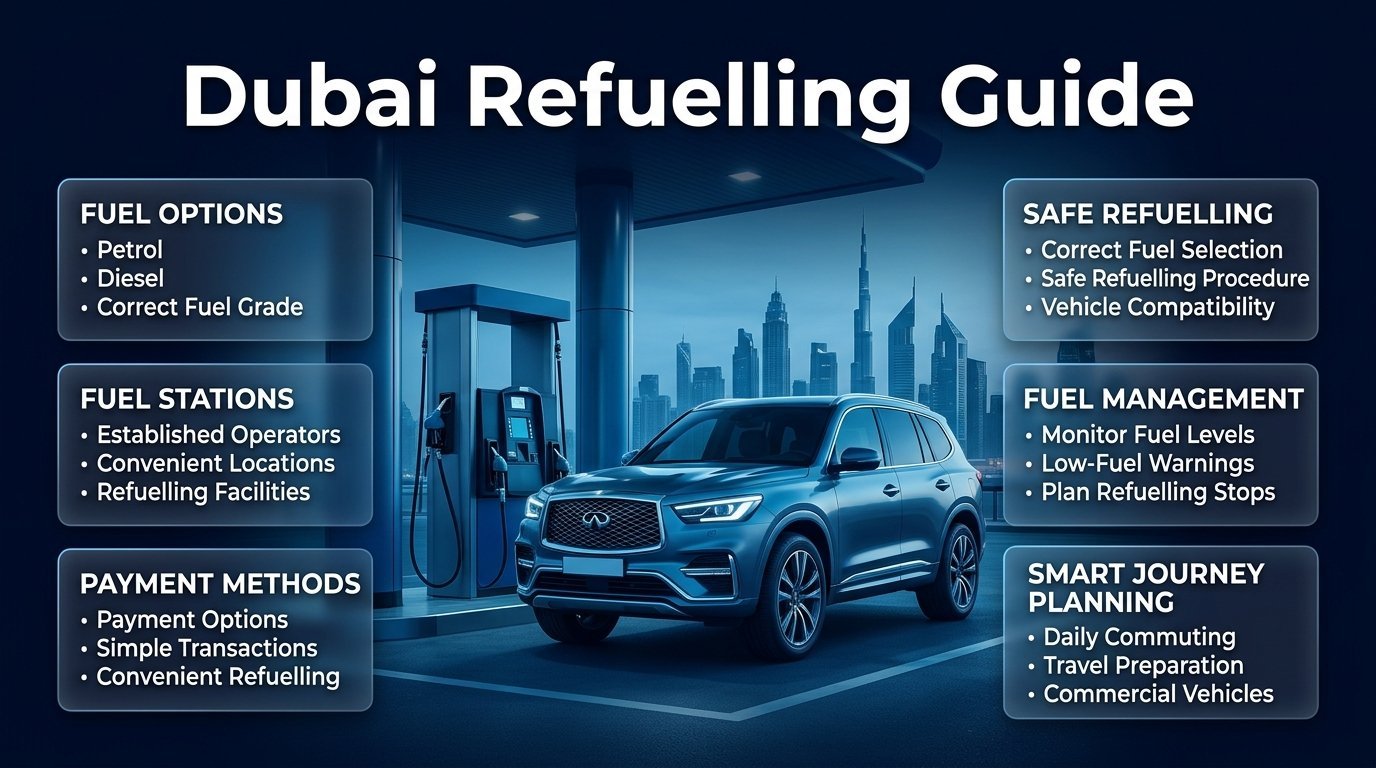
Dubai Refuelling Guide | Refuelling your vehicle in Dubai should be a simple part of everyday driving. However, choosing the correct petrol grade, finding a convenient fuel station, understanding payment options and managing fuel consumption can become challenging, particularly when you’re new to the city or travelling through unfamiliar areas. Even regular motorists can face unexpected situations, such as crowded petrol stations, low-fuel warnings or difficulty finding suitable refuelling facilities.
Dubai has a well-developed fuel retail network, with established operators serving private motorists, commercial vehicles, residents and visitors. However, knowing where to refuel is only one part of the process. Understanding which fuel your vehicle requires, how much to purchase and when to plan your next stop can make your journeys considerably easier.
This Dubai Refuelling Guide provides a practical explanation of how refuelling works across the city. It covers petrol and diesel options, fuel station operators, payment methods, refuelling procedures, vehicle compatibility, safety precautions and fuel management strategies.
Whether you’re a daily commuter, tourist, new resident, rental car driver or commercial vehicle operator, this guide will help you make informed refuelling decisions. For additional information about local fuel services and assistance, visit Fuel Delivery Dubai.
1. Understanding the Refuelling System in Dubai
Refuelling in Dubai involves purchasing the correct automotive fuel from an authorised retail station or arranging an appropriate fuel assistance service when necessary. Motorists can access established fuel retailers across different parts of the emirate, making routine vehicle refuelling relatively convenient.
The system serves different types of vehicles, including private cars, SUVs, taxis, delivery vehicles, pickups and commercial fleets. However, the fuel type, grade and available facilities can differ between stations.
How Does Refuelling Work?
The standard refuelling process is straightforward.
When you arrive at a petrol station, you follow the designated entrance and position your vehicle beside an appropriate dispenser. You then communicate the required fuel type, grade and quantity to the attendant or follow the station’s designated procedure.
After refuelling, payment is completed through an accepted payment method.
A normal refuelling visit generally involves:
- Identifying a suitable petrol station.
- Checking your vehicle’s fuel requirements.
- Entering the refuelling area safely.
- Selecting the correct fuel type and grade.
- Confirming the requested quantity or amount.
- Completing the payment.
- Checking that the fuel cap is properly secured.
- Leaving the station by following its traffic directions.
Why Should Drivers Understand Local Refuelling Practices?
Understanding the process helps prevent avoidable mistakes, especially when driving a rental vehicle or using a station for the first time.
For example, a visitor who has previously driven a diesel vehicle may be unfamiliar with the petrol grades available in Dubai. Similarly, someone purchasing a vehicle for the first time may not understand why different petrol octane ratings exist.
A little preparation prevents confusion and makes the experience more efficient.
Expert Tip: Before your first refuelling visit, check your vehicle’s fuel-filler label. It provides important information about the correct fuel type and, where specified, the minimum petrol octane requirement.
2. Which Types of Fuel Are Available in Dubai?
Understanding fuel categories is essential because petrol and diesel engines have different operating requirements.
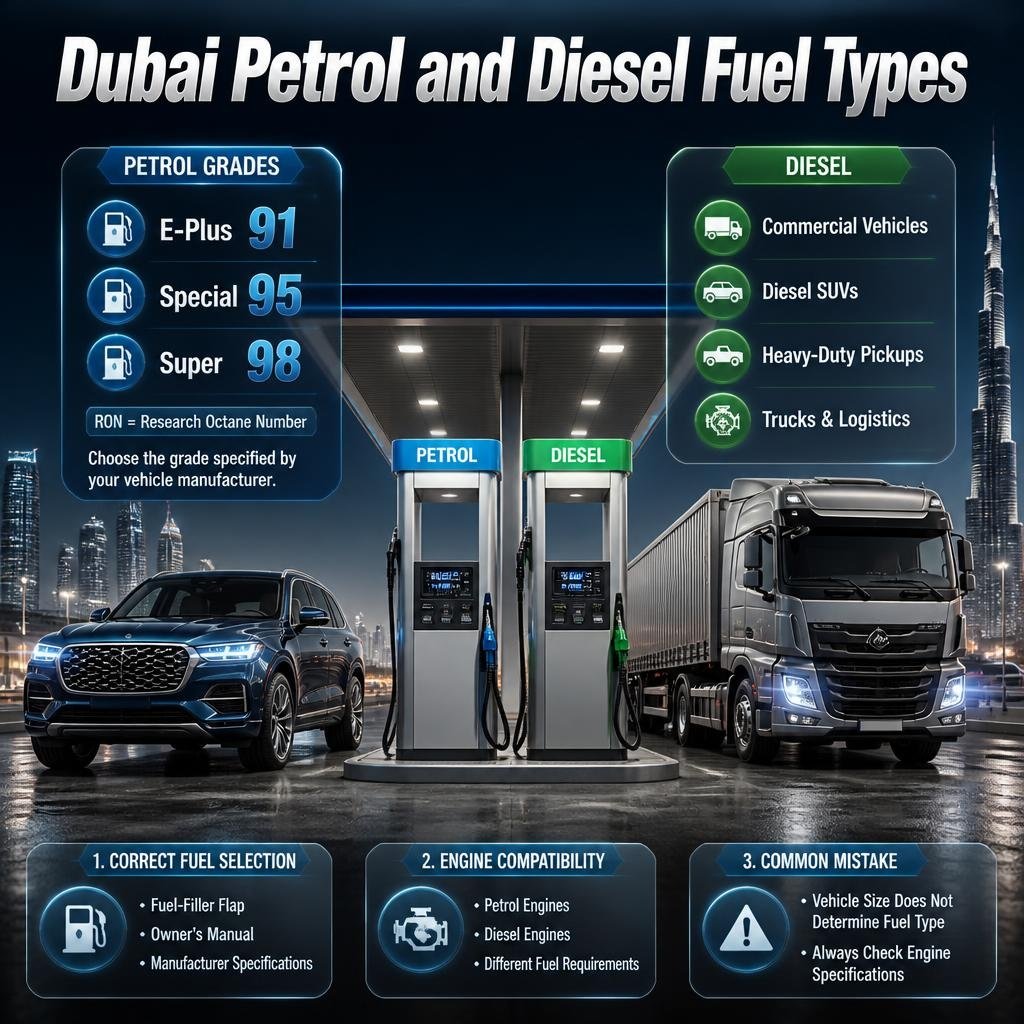
Dubai motorists generally encounter two main automotive fuel categories: petrol and diesel. Each is intended for compatible engine designs and should never be selected simply because it is available or cheaper.
Petrol for Petrol-Engine Vehicles
Petrol is commonly used in passenger cars, SUVs, sports cars and many light commercial vehicles.
Dubai’s recognised retail petrol grades include:
- E-Plus 91
- Special 95
- Super 98
The numbers represent the Research Octane Number (RON), which indicates petrol’s resistance to engine knocking.
Different engines have different compression characteristics and fuel requirements. Some vehicles are designed to operate on 91 RON, while others require 95 RON or higher.
Choosing the correct grade is important for maintaining the engine’s intended operation.
Diesel for Diesel-Engine Vehicles
Diesel is used in vehicles designed with compression-ignition engines.
These include certain:
- Commercial transport vehicles.
- Heavy-duty pickups.
- Diesel SUVs.
- Delivery and logistics vehicles.
- Trucks and specialised vehicles.
Diesel fuel is not a substitute for petrol. The two fuels have different properties and are designed for different engine systems.
Common Mistake: Some drivers assume that larger vehicles automatically require diesel. This is incorrect. Many large SUVs and pickups operate on petrol, so always check the manufacturer’s specifications.
How Should You Identify Your Required Fuel?
Check these sources before visiting a station:
- Fuel-filler flap instructions.
- Vehicle owner’s manual.
- Manufacturer’s technical specifications.
- Authorised dealership recommendations.
For a more detailed explanation of the fuel types suitable for different vehicles, read our Dubai Fuel Requirements guide.
3. Which Companies Operate Fuel Stations in Dubai?
Dubai has several established fuel retailers that provide refuelling facilities to motorists. Recognising these operators makes it easier to understand the local fuel station network and identify suitable locations.
The main names motorists should recognise include ENOC, EPPCO, ADNOC Distribution and Emarat.
ENOC Fuel Stations
Emirates National Oil Company (ENOC) is one of the recognised fuel retailers in the UAE.
Its retail network serves motorists across Dubai and offers different fuel grades for compatible vehicles. Depending on the location, customers may also find convenience stores and additional vehicle-related services.
ENOC is a familiar name for residents and visitors who regularly travel around the city.
EPPCO Fuel Stations
EPPCO is associated with the ENOC retail network and is another familiar name in Dubai’s fuel retail sector.
Its stations serve motorists in different locations, providing access to fuel and selected customer facilities.
Drivers should check the particular station’s available services rather than assuming every location offers identical facilities.
ADNOC Distribution
ADNOC Distribution operates a substantial fuel retail network across the UAE, including locations serving motorists in Dubai.
Its stations provide petrol and diesel facilities, while selected locations may offer additional services.
Motorists can consider ADNOC stations when planning journeys between different parts of the city.
Emarat Fuel Stations
Emarat is another established fuel retailer in the UAE.
Its network provides refuelling facilities and selected customer services. As with other operators, the available facilities depend on the individual station.
What Should You Compare Before Choosing a Fuel Retailer?
A suitable station should match your actual requirements.
Consider the following:
| Selection factor | Why it matters |
|---|---|
| Location | Reduces unnecessary travelling |
| Road access | Makes entering and leaving easier |
| Fuel availability | Helps you find the required fuel |
| Payment facilities | Supports convenient transactions |
| Operating arrangements | Helps you plan your visit |
| Additional services | Useful when you need more than fuel |
You don’t necessarily need to visit the same retailer every time. Choosing a convenient, suitable station along your existing route can save unnecessary driving.
For more information about different station options, see our Dubai Fuel Stations guide.
4. Understanding Dubai Petrol Grades Before Refuelling
Petrol selection is one of the most important decisions motorists make at a fuel dispenser.
The three recognised petrol grades have different octane ratings, but a higher number doesn’t automatically mean that a fuel is better for every vehicle.
E-Plus 91
E-Plus 91 has an octane rating of 91 RON.
It is suitable for vehicles whose manufacturers specify or permit this grade. Certain standard petrol engines are designed to operate on 91 RON without requiring a higher rating.
However, it shouldn’t be used in an engine that requires a higher minimum octane level.
Special 95
Special 95 has an octane rating of 95 RON.
It is commonly selected for vehicles designed to operate on 95 RON. Many modern passenger vehicles have specific requirements that make this grade appropriate.
If your owner’s manual recommends 95 RON, this should be your normal choice unless the manufacturer provides additional guidance.
Super 98
Super 98 has an octane rating of 98 RON.
Certain high-performance vehicles and specialised engines require or recommend higher-octane petrol.
However, using Super 98 in a vehicle designed for a lower grade doesn’t automatically increase horsepower, improve mileage or reduce operating expenses.
Petrol Grade Comparison
| Grade | RON | General application |
|---|---|---|
| E-Plus 91 | 91 | Compatible standard petrol engines |
| Special 95 | 95 | Vehicles requiring or accepting 95 RON |
| Super 98 | 98 | Engines requiring or benefiting from 98 RON |
How Do You Make the Right Selection?
Follow these steps:
- Check the minimum octane requirement.
- Confirm whether the manufacturer specifies a particular grade.
- Compare the recommended grade with the dispenser label.
- Select the appropriate option.
- Avoid changing grades simply because another option appears more premium.
Pro Tip: If you’re unsure about your vehicle’s fuel requirement, don’t guess. Consult the owner’s manual or an authorised service centre.
For more information about octane ratings and fuel selection, read our Dubai Petrol Grades article.
5. How to Find a Convenient Fuel Station in Dubai
Finding a nearby fuel station is relatively easy, but selecting the most convenient one requires more consideration.
A station may appear close on a map while being difficult to access because of road direction, traffic restrictions or the position of its entrance.
Consider Your Regular Driving Routes
Start by identifying stations close to places you visit regularly.
These may include:
- Your residential area.
- Your workplace.
- Shopping destinations.
- Frequently used highways.
- Business and commercial locations.
- Regular school or university routes.
Keeping a few alternative locations in mind can prevent unnecessary detours.
Check Road Accessibility
A station’s physical distance isn’t the only important factor.
For example, a station may be less than two kilometres away but require a lengthy detour because of road dividers or traffic direction.
Before travelling, consider:
- The direction you’re driving.
- Available entry and exit points.
- Current traffic conditions.
- Road closures or diversions.
- Whether your vehicle can access the station comfortably.
Use Navigation Carefully
Navigation applications can help identify potential fuel stations and plan routes.
However, don’t assume every result provides accurate information about current fuel availability or additional services.
Check the relevant station details before relying on them.
Quick Tip: Save two or three convenient fuel stations along your normal routes. This gives you alternatives when one location becomes crowded.
6. How to Refuel a Car in Dubai: Step-by-Step Instructions
For experienced motorists, refuelling is a routine activity. However, new residents, tourists and first-time drivers may appreciate understanding each stage.
Following a consistent process reduces confusion and helps prevent incorrect fuel selection.
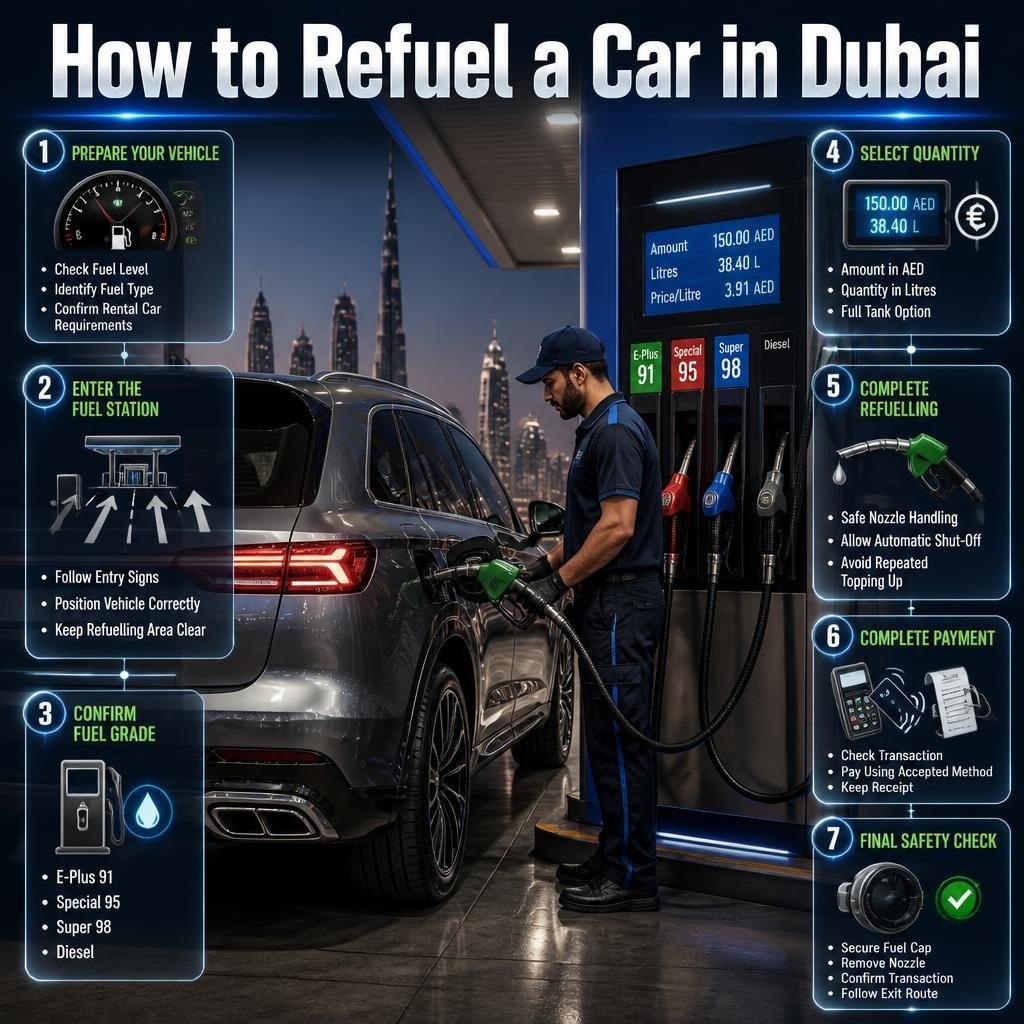
Step 1: Prepare Your Vehicle
Before entering the station, check your approximate fuel level and identify the correct fuel type.
If you’re driving a rental vehicle, confirm whether it uses petrol or diesel.
Why it matters: Rental vehicles may have different engine specifications, even when their exterior models look similar.
Step 2: Enter the Designated Refuelling Area
Follow the station’s entry signs and traffic directions.
Move slowly and position the vehicle beside the appropriate dispenser.
Avoid blocking other vehicles or stopping in an area not intended for refuelling.
Step 3: Confirm the Fuel Grade
Communicate your required petrol grade or diesel type before refuelling begins.
If you have any doubt, check the fuel-filler information again.
Professional advice: Make fuel selection the first priority, not the payment amount. Purchasing the wrong fuel can create much greater problems than purchasing the wrong quantity.
Step 4: Specify the Required Quantity
You can generally request an amount in dirhams or a quantity in litres, depending on the station’s process.
For example, if you’re managing a particular fuel budget, requesting a fixed monetary amount can help control the transaction.
If you want to fill the tank, communicate this clearly.
Step 5: Complete the Refuelling Process
Allow the attendant or authorised dispenser process to complete the transaction.
Don’t attempt to interfere with the nozzle or dispenser equipment.
When refuelling is complete, avoid repeatedly topping up after the automatic shut-off.
Step 6: Make Your Payment
Use an accepted payment method and check the transaction amount.
If you’re maintaining a monthly fuel record, keep the receipt or record the transaction details.
Step 7: Check Before Leaving
Before driving away:
- Confirm the fuel cap is secured.
- Check that the dispenser nozzle has been removed.
- Make sure your transaction is complete.
- Follow the designated exit route.
A consistent routine makes refuelling faster and reduces the likelihood of small but avoidable mistakes.
Check Fuel Specifications Before Making Refuelling Decisions
Understanding fuel specifications helps motorists make better decisions about the type and quality of fuel they use in their vehicles. Petrol and diesel are subject to specific technical requirements that influence important characteristics such as composition, performance properties and suitability for different engine systems. For drivers in Dubai, knowing these specifications is useful when comparing fuel options, understanding product quality and avoiding assumptions based solely on price or fuel grade. It is equally important to distinguish between general fuel quality requirements and the specific fuel recommendations provided by vehicle manufacturers. Selecting fuel that meets the applicable standards and matches the engine’s requirements supports more responsible vehicle care. For further information about technical specifications, quality requirements and regulatory considerations, explore this comprehensive guide to Dubai fuel standards.
7. How Much Fuel Should You Purchase?
The correct amount depends on your vehicle’s tank capacity, driving requirements, available budget and expected journey distance.
Some motorists prefer full-tank refuelling, while others purchase smaller quantities according to their daily travel needs.
Neither approach is automatically better for everyone.
When Is Full-Tank Refuelling Useful?
Filling your tank can be convenient when:
- You’re planning a long journey.
- You travel frequently for work.
- You regularly use highways.
- You want fewer refuelling stops.
- You expect an unusually busy driving schedule.
However, always follow the dispenser’s automatic shut-off and avoid overfilling.
When Is Partial Refuelling Suitable?
Partial refuelling may make sense when:
- You have a limited short-term budget.
- You only need enough fuel for a particular journey.
- You’re approaching your preferred station.
- You want to purchase a specific quantity.
However, repeatedly purchasing very small quantities can become inconvenient and may increase the likelihood of forgetting your next refuelling stop.
Understand Your Fuel Tank Capacity
Your vehicle’s owner’s manual provides information about the fuel tank capacity.
Avoid assuming that all vehicles have similar tank sizes.
A compact passenger car, large SUV and commercial pickup can have significantly different fuel capacities.
Calculate the Required Amount
Use the following formula:
Fuel cost = Quantity in litres × Price per litre
For example:
Suppose you purchase 35 litres of petrol at an illustrative rate of AED 2.80 per litre.
35 × 2.80 = AED 98.
This example explains the calculation method and isn’t a current fuel-price quotation.
Understanding the relationship between litres and total expenditure helps you estimate refuelling costs before visiting a station.
For a more detailed approach to managing fuel purchases, see our Dubai Fuel Planning guide.
8. What Payment Methods Are Available at Dubai Fuel Stations?
Payment convenience is another important part of the refuelling experience.
Different fuel retailers and individual locations may support different payment arrangements. Drivers should confirm available methods instead of assuming every station offers identical facilities.
Cash Payments
Cash remains a straightforward payment option where accepted.
It can be useful for motorists who prefer paying directly without using a bank card or mobile application.
However, carrying a reasonable alternative payment method is sensible when travelling.
Debit and Credit Cards
Card payments provide a convenient way to complete fuel transactions.
They can also make it easier to track purchases through bank statements.
Before paying, check the amount and confirm that the transaction has been completed successfully.
Contactless Payments
Some locations support contactless transactions through compatible cards and payment devices.
This can make the payment process quicker, depending on the station’s available facilities.
Mobile and Retailer Payment Services
Certain fuel retailers may provide applications or supported digital payment services.
Availability and features depend on the retailer and its current payment arrangements.
Which Payment Method Should You Choose?
The best method depends on convenience, availability and personal preference.
For private motorists, a bank card or supported digital payment option can simplify everyday transactions.
For commercial drivers, maintaining clear transaction records is particularly useful when calculating operating expenses.
Expert Tip: Keep your payment receipt or digital transaction record. Comparing monthly fuel purchases can help identify changes in driving costs and vehicle consumption.
9. When Should You Refuel in Dubai?
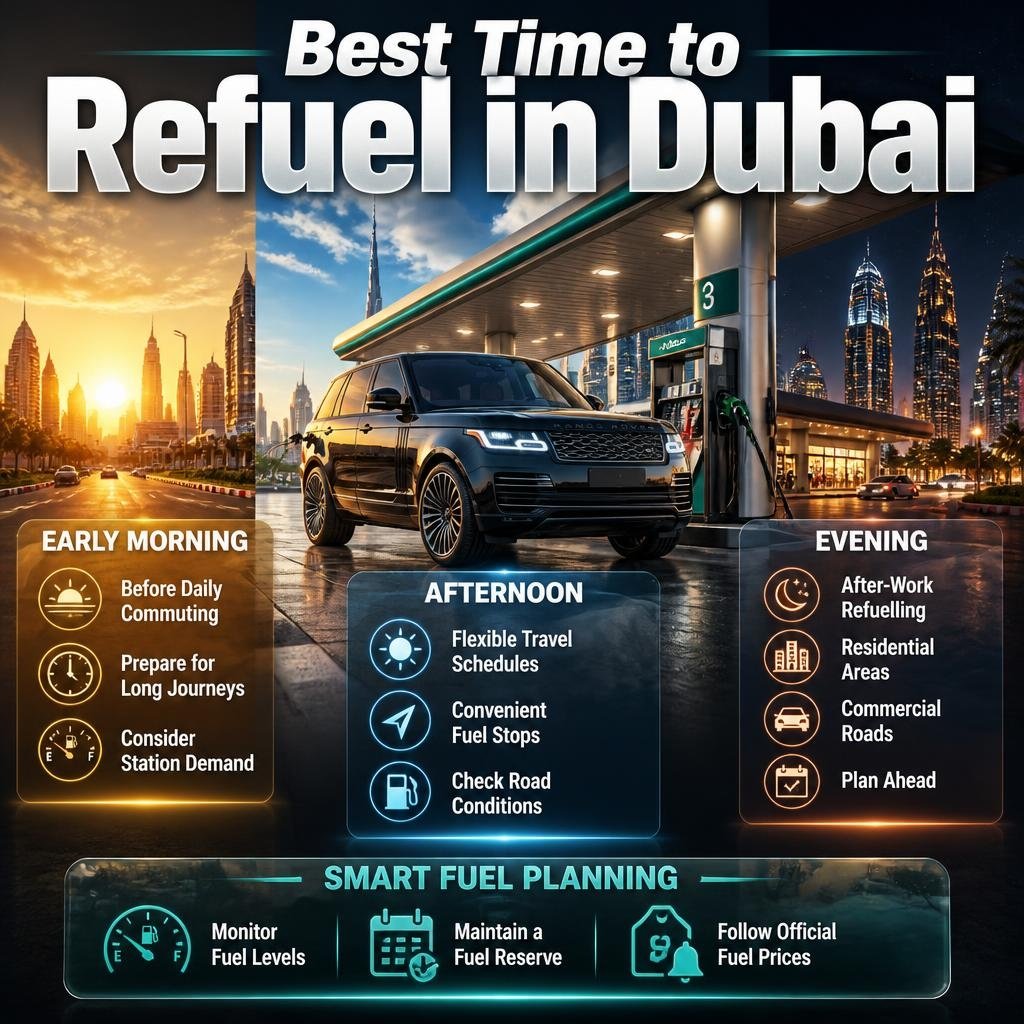
The best refuelling time depends on your daily routine, traffic conditions and station accessibility.
There isn’t one universally ideal hour for every motorist.
Dubai’s roads experience different traffic patterns throughout the day, and stations close to business districts or busy residential areas may experience increased demand during certain periods.
Early Morning Refuelling
Early morning refuelling can be convenient for drivers preparing for work or longer journeys.
However, stations near major employment areas may experience increased activity during commuting hours.
If you have a flexible schedule, consider completing your refuelling before your regular journey begins.
Afternoon Refuelling
Afternoon refuelling can be practical for motorists who have flexible working arrangements or are already travelling near a suitable station.
However, consider road conditions and the station’s location before making a detour.
Evening Refuelling
Many motorists refuel after completing their working day.
Stations near shopping destinations, residential communities and commercial roads may experience increased demand during evening periods.
Planning ahead can help avoid unnecessary waiting.
Should You Refuel Only When Fuel Prices Change?
Your refuelling routine should primarily be based on your vehicle’s needs.
Waiting for a particular price movement while allowing the fuel level to become dangerously low is not a sensible strategy.
Instead, monitor official fuel-price announcements when planning your budget and maintain a practical reserve.
For further information about how driving conditions affect everyday fuel use, read our Dubai City Driving guide.
10. Fuel Quality and Responsible Refuelling Practices
Fuel quality matters because engines are designed to operate with fuel that meets their required specifications.
Selecting the correct grade is important, but responsible refuelling also involves choosing established fuel retailers and avoiding careless practices.
Why Does Fuel Quality Matter?
The fuel used by an engine affects combustion and overall engine operation.
Petrol and diesel must meet appropriate specifications to perform as intended.
Using unsuitable fuel or contaminated fuel can contribute to operating problems and, in some cases, expensive repairs.
Does Higher-Octane Petrol Mean Higher Fuel Quality?
Not necessarily.
Octane rating and overall fuel quality are different concepts.
RON measures resistance to knocking. It doesn’t independently establish every aspect of fuel quality or prove that a higher-octane option is superior for all engines.
Drivers should avoid treating the highest octane rating as a universal quality ranking.
How Can You Make Better Fuel Choices?
Follow these recommendations:
- Purchase the fuel type specified for your vehicle.
- Follow the manufacturer’s minimum octane requirement.
- Use established and authorised retail channels.
- Avoid mixing petrol and diesel.
- Pay attention to unusual engine behaviour after refuelling.
- Arrange a professional inspection if you suspect a fuel-related problem.
Common Mistake: Changing fuel grades repeatedly because of unverified recommendations can create confusion. Follow your manufacturer’s specifications instead of relying on assumptions.
For more detailed information about this subject, explore our Dubai Fuel Quality guide.
11. Essential Safety Rules at Dubai Petrol Stations
Fuel is a flammable substance, so refuelling areas require careful behaviour from motorists and station employees.
Although stations have operational safety procedures, customers must also follow the instructions displayed at the location.
Switch Off the Engine
Always turn off the engine before refuelling.
An operating vehicle should not be left running beside an active fuel dispenser.
Never Smoke Near Fuel Dispensers
Smoking and open flames are inappropriate around petrol and diesel refuelling equipment.
Fuel vapours can create serious fire hazards.
Follow Station Instructions
Observe the signs and instructions displayed around the refuelling area.
If employees request a particular action, follow their directions.
Avoid Spilling Fuel
Don’t attempt to overfill the tank or interfere with the dispenser.
If a spill occurs, inform station personnel immediately rather than trying to manage the situation yourself.
Secure the Fuel Cap
After refuelling, make sure the cap is correctly closed.
An improperly secured fuel cap can trigger a warning indicator on some vehicles.
Be Careful Around Children and Passengers
Keep passengers away from active refuelling equipment and supervise children.
Avoid unnecessary movement around dispensers.
What If You Notice an Unusual Smell?
If you notice a strong fuel smell or suspect leakage, stop the refuelling process if safe to do so and inform station staff.
Don’t start the vehicle until the situation has been checked and considered safe.
Professional Advice: Never compromise on safety to save a few minutes. Correct refuelling procedures protect everyone using the station.
12. How to Manage Fuel Consumption on Dubai Roads
Your refuelling expenses are influenced by more than the price per litre.
Driving behaviour, traffic congestion, vehicle condition, tyre pressure, road selection and air-conditioning use all contribute to fuel consumption.
Understanding these factors helps motorists make better decisions between refuelling visits.
Maintain Smooth Acceleration
Rapid acceleration demands more energy from the engine.
Repeatedly accelerating aggressively and then braking increases unnecessary fuel use, particularly in congested urban traffic.
Gradual acceleration helps maintain smoother vehicle movement.
Avoid Unnecessary Idling
An engine consumes fuel while running, even when the vehicle is stationary.
Long periods of unnecessary idling can therefore increase fuel consumption.
Switch off the engine when appropriate and safe, following the vehicle manufacturer’s recommendations.
Maintain Correct Tyre Pressure
Underinflated tyres increase rolling resistance.
This means the engine may need to work harder to maintain vehicle movement.
Check tyre pressure regularly according to the manufacturer’s recommendations.
Use Air Conditioning Sensibly
Air conditioning is particularly important for comfort during Dubai’s hot weather.
However, cooling demand can increase engine load and fuel consumption.
Maintain comfortable temperature settings and keep the air-conditioning system properly serviced.
Avoid Unnecessary Detours
Poor route planning can increase the distance travelled and time spent in traffic.
Before starting a journey, consider:
- Your destination.
- Traffic conditions.
- Available road connections.
- Expected journey duration.
- Convenient refuelling locations.
For additional guidance about controlling fuel expenditure, explore our Dubai Fuel Costs guide.
13. What Should You Do When Your Vehicle Runs Low on Fuel?
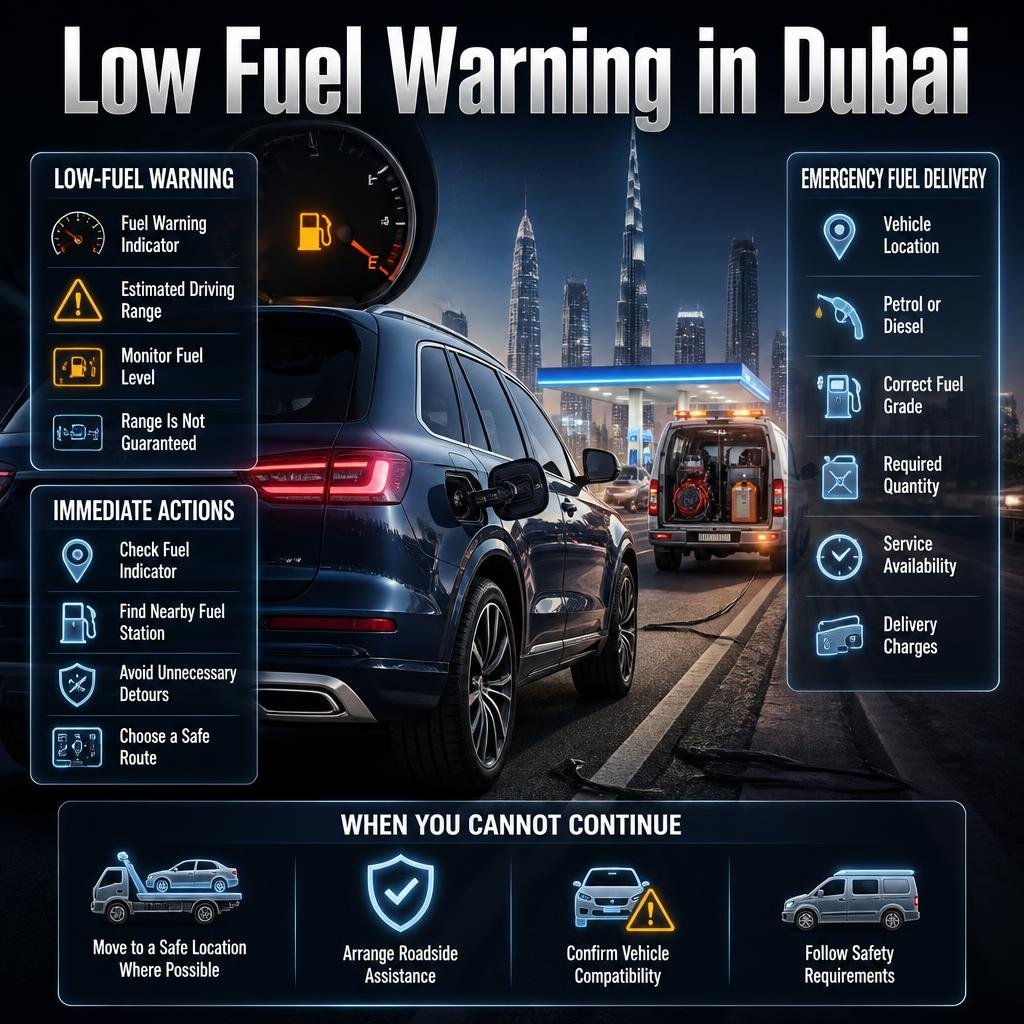
A low-fuel situation can happen unexpectedly, even when drivers normally follow a regular refuelling routine.
You may experience heavy traffic, an unexpected route change, an extended journey or an inaccurate estimate of the remaining driving range.
The important thing is to respond calmly and avoid making the situation more dangerous.
Understand the Low-Fuel Warning
Most modern vehicles provide a warning indicator when the fuel level reaches a predetermined threshold.
Some vehicles also display an estimated remaining driving range.
However, this estimate is not a guarantee.
Actual range can change depending on traffic, speed, road gradients, temperature, vehicle load and air-conditioning use.
What Should You Do First?
Follow these steps:
- Check the fuel warning indicator.
- Identify your vehicle’s approximate remaining range.
- Look for a suitable nearby fuel station.
- Avoid unnecessary acceleration and detours.
- Choose a safe route rather than making sudden manoeuvres.
- If you cannot continue safely, move to a safe location where possible.
- Arrange appropriate roadside assistance if required.
Should You Continue Driving After the Warning Appears?
You shouldn’t treat the low-fuel warning as permission to continue driving for an extended distance.
The remaining fuel quantity varies between vehicles, and the displayed range can change quickly.
Repeatedly driving with a critically low fuel level is an unnecessary risk.
Can Emergency Fuel Delivery Help?
Emergency fuel delivery can provide a practical alternative when a vehicle cannot conveniently reach a petrol station.
Depending on the service provider’s coverage and operating arrangements, suitable fuel may be delivered to an accessible vehicle location.
Before requesting assistance, confirm the following information:
- Exact vehicle location.
- Vehicle make and model.
- Petrol or diesel requirement.
- Required petrol grade, if applicable.
- Estimated fuel quantity.
- Service availability.
- Delivery charges and expected arrangements.
The fuel must be compatible with the vehicle, and delivery must comply with applicable safety and operational requirements.
For additional information about fuel assistance and available services, visit Fuel Delivery Dubai.
14. Refuelling Considerations for Tourists and Rental Car Drivers
Dubai welcomes visitors who often rely on rental vehicles to explore the city.
Although refuelling a rental car is generally straightforward, tourists should pay attention to a few additional details.
Check the Fuel Type Before Leaving the Rental Office
Never assume a rental vehicle uses petrol simply because it is a passenger car.
Some vehicles operate on diesel.
Check the fuel-filler label and rental documentation before your first refuelling visit.
Understand the Fuel Grade
If the rental car requires Special 95, don’t automatically select Super 98.
Likewise, don’t choose E-Plus 91 unless the manufacturer permits that grade.
The correct requirement depends on the specific engine.
Understand the Rental Company’s Fuel Policy
Rental agreements can contain different fuel-return requirements.
Some companies provide vehicles with a full tank and expect them to be returned full. Others may have different arrangements.
Check the agreement before returning the vehicle to avoid unexpected charges.
Keep Fuel Receipts
Receipts can help demonstrate that you purchased fuel before returning the car.
They are also useful if there is a question about the final fuel level or transaction.
Plan Refuelling Before Returning the Vehicle
Don’t wait until the final few minutes to find a petrol station near the rental return location.
Allow enough time to refuel, follow the return route and complete the vehicle handover.
This simple preparation makes the process less stressful.
15. Refuelling for Commercial Vehicles and Business Fleets
Commercial drivers have different refuelling requirements from ordinary private motorists.
Delivery vehicles, business pickups, transport fleets and other work-related vehicles may cover substantial distances each day.
For these operators, fuel management is an important part of controlling operating expenses.
Establish a Refuelling Schedule
A consistent schedule helps businesses monitor fuel availability and avoid unexpected interruptions.
The schedule should consider:
- Average daily distance.
- Vehicle tank capacity.
- Expected fuel consumption.
- Typical operating routes.
- Available refuelling locations.
- Work schedules.
A schedule should remain flexible enough to accommodate unexpected journeys.
Monitor Individual Vehicle Consumption
Different vehicles can have different consumption rates, even when they operate within the same fleet.
Keep separate records for each vehicle rather than using one average figure for the entire business.
Maintain Fuel Purchase Records
A useful fleet fuel record includes:
| Record | Purpose |
|---|---|
| Vehicle identification | Identifies the vehicle |
| Refuelling date | Tracks purchase frequency |
| Fuel type | Confirms compatibility |
| Litres purchased | Measures fuel quantity |
| Total expense | Tracks operating costs |
| Odometer reading | Helps calculate consumption |
Investigate Unusual Consumption
If a vehicle suddenly starts consuming more fuel, investigate the reason.
Possible contributing factors include:
- Changes in operating routes.
- Increased vehicle load.
- Excessive idling.
- Incorrect tyre pressure.
- Maintenance problems.
- Changes in driving behaviour.
A professional inspection may be necessary when consumption changes cannot be explained by normal operating conditions.
16. Common Refuelling Mistakes Dubai Drivers Should Avoid
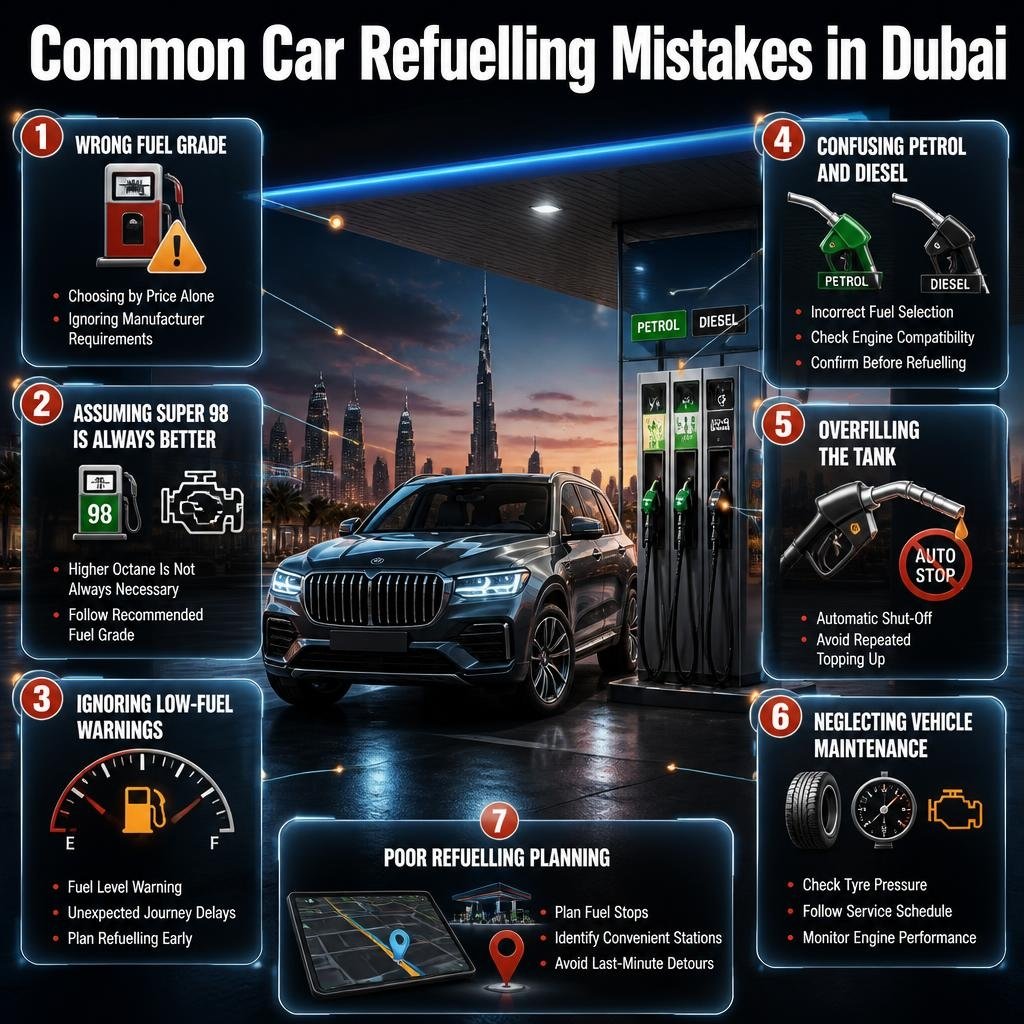
Many fuel-related problems happen because drivers rush their decisions or rely on assumptions.
Avoiding the following mistakes can make refuelling safer and more convenient.
Mistake 1: Choosing Fuel Based on Price Alone
The cheapest fuel option isn’t necessarily appropriate for your vehicle.
An engine requiring a higher octane rating shouldn’t be filled with a lower grade simply to reduce the immediate purchase cost.
Better approach: Check the manufacturer’s requirements first.
Mistake 2: Assuming Super 98 Is Always Superior
Higher octane doesn’t automatically produce additional performance or fuel economy in an engine that doesn’t need it.
Better approach: Purchase the grade specified by your manufacturer.
Mistake 3: Ignoring the Low-Fuel Warning
Some drivers continue travelling because they believe the remaining range will be sufficient.
This can leave them stranded when traffic conditions change.
Better approach: Identify a convenient refuelling stop before the fuel level becomes critically low.
Mistake 4: Confusing Petrol and Diesel
This is one of the most serious mistakes because the wrong fuel can cause expensive mechanical problems.
Better approach: Confirm the fuel type before every unfamiliar refuelling visit.
Mistake 5: Overfilling the Fuel Tank
Some motorists continue adding fuel after the dispenser automatically stops.
This can create unnecessary risks and potentially affect vehicle emissions equipment.
Better approach: Stop when the automatic shut-off activates.
Mistake 6: Neglecting Vehicle Maintenance
Drivers sometimes blame fuel quality for increased consumption when the actual issue may involve vehicle condition.
Better approach: Monitor tyre pressure, servicing requirements and engine performance.
Mistake 7: Failing to Plan Refuelling Stops
Waiting until the last moment can create unnecessary detours and pressure.
Better approach: Include convenient refuelling locations in your regular journey planning.
17. Expert Recommendations for a More Efficient Refuelling Routine
A good refuelling routine is based on preparation, accurate information and consistent vehicle monitoring.
You don’t need complicated calculations or constant visits to petrol stations. A few practical habits can make the entire process easier.
Keep a Personal List of Suitable Stations
Identify stations near your home, workplace and regular travel routes.
Save alternatives so you aren’t dependent on one particular location.
Understand Your Vehicle’s Average Consumption
Learn how many litres your vehicle typically uses over 100 kilometres.
For example, if a vehicle averages 9 litres per 100 kilometres, a 300-kilometre journey would theoretically require approximately 27 litres under comparable driving conditions.
Actual consumption may differ because of traffic, road conditions, vehicle load and driving habits.
Monitor Your Monthly Fuel Expenses
Record your refuelling transactions and compare monthly spending.
If expenses increase, investigate whether the cause is higher fuel prices, additional mileage, increased consumption or a mechanical issue.
Choose the Correct Fuel Before Considering the Cost
Compatibility must always come first.
Comparing fuel expenses is useful only when you’re comparing options suitable for your vehicle.
Avoid Making Refuelling an Emergency Activity
The best time to plan refuelling is before you urgently need it.
A regular routine helps prevent unnecessary interruptions and reduces dependence on last-minute assistance.
Keep Emergency Assistance Information Available
If you travel frequently across Dubai, understand how to arrange appropriate roadside assistance.
This is especially useful for drivers who regularly visit unfamiliar locations.
Review Your Fuel Strategy Regularly
Your driving requirements may change over time.
A new workplace, different daily route or additional business responsibilities can affect your fuel needs.
Review your refuelling routine whenever your normal driving pattern changes.
Which Petrol Grade Should I Choose for My Car in Dubai: E-Plus 91, Special 95 or Super 98?
Choosing the correct petrol grade depends on your vehicle’s engine design and the manufacturer’s recommended octane requirement. Dubai offers E-Plus 91, Special 95 and Super 98, but the highest octane option isn’t necessarily the best choice for every vehicle. For example, if your manufacturer recommends Special 95, using Super 98 may not provide any noticeable improvement in performance or fuel economy. Similarly, using E-Plus 91 in an engine that requires 95 RON can increase the risk of engine knocking.
Before selecting a petrol grade, consider these important points:
Check the recommended RON rating in your owner’s manual.
Read the fuel information displayed inside the fuel-filler flap.
Never select petrol based only on its price.
Avoid assuming that premium petrol automatically improves mileage.
Consult an authorised service centre if your vehicle’s fuel requirements are unclear.
Professional recommendation: Always follow the manufacturer’s minimum octane requirement. Correct fuel selection helps maintain appropriate engine operation and prevents unnecessary fuel expenses.
How Can I Find the Right Fuel Station in Dubai for My Daily Driving Needs?
Finding a suitable fuel station involves more than choosing the nearest location. Dubai has several established fuel retailers, including ENOC, EPPCO, ADNOC Distribution and Emarat. However, station accessibility, traffic conditions, available fuel types and additional facilities can differ between locations. A station close to your destination may still require an unnecessary detour because of road direction or restricted entry points.
When choosing a convenient refuelling location, consider:
Distance: Identify stations close to your home, workplace and regular destinations.
Road accessibility: Check entrance and exit arrangements before travelling.
Fuel availability: Make sure the station provides the fuel type your vehicle requires.
Traffic conditions: Consider busy commuting periods when planning your stop.
Additional facilities: Check whether the location provides services you may need.
Professional recommendation: Save two or three suitable fuel stations along your regular driving routes. Having alternative locations makes refuelling easier when your preferred station is crowded or inconvenient.
How Can I Reduce My Monthly Refuelling Expenses While Driving in Dubai?
Managing fuel expenses requires more than choosing a petrol station or comparing prices. Your driving habits, vehicle condition, journey distance and traffic exposure all influence how much fuel your vehicle consumes. Frequent acceleration, unnecessary idling, incorrect tyre pressure and poorly planned journeys can increase fuel consumption over time.
To manage your monthly refuelling expenses more effectively:
Maintain smooth acceleration and avoid unnecessary hard braking.
Check tyre pressure according to manufacturer recommendations.
Reduce unnecessary engine idling.
Plan journeys to avoid avoidable detours.
Use the petrol grade recommended for your vehicle.
Monitor litres purchased and kilometres travelled.
Maintain your engine and vehicle according to the service schedule.
Practical example: If your vehicle consumes 10 litres per 100 kilometres, driving 1,500 kilometres would require approximately 150 litres under similar driving conditions. Tracking actual consumption helps you estimate your monthly fuel requirements and identify unexpected changes.
Professional recommendation: Maintain a simple monthly fuel record. Comparing fuel purchases, mileage and expenditure gives you a clearer understanding of your actual driving costs.
What Should I Do If My Car Runs Out of Fuel on a Dubai Road?
Running out of fuel can be stressful, particularly when you’re travelling through an unfamiliar area or dealing with heavy traffic. The priority should be protecting yourself, your passengers and other road users rather than attempting to drive further with an almost empty tank.
If your vehicle runs out of fuel, take the following steps:
Move to a safe location if the vehicle can still be moved safely.
Avoid stopping in an active traffic lane whenever possible.
Switch on your hazard warning lights when appropriate.
Follow road-safety procedures and seek assistance if the vehicle is stranded.
Identify your exact location using your navigation application.
Arrange suitable roadside assistance or emergency fuel delivery.
Confirm the correct petrol or diesel requirement before requesting fuel.
Emergency fuel delivery may be a practical solution when your vehicle cannot conveniently reach a petrol station. Availability depends on the provider’s coverage, location accessibility and applicable operating arrangements.
Professional recommendation: Don’t wait until your fuel tank is nearly empty before planning your next stop. Maintain a reasonable fuel reserve, particularly before longer journeys or trips through unfamiliar parts of Dubai.
Is It Safe to Refuel a Car in Dubai During Hot Weather, and What Precautions Should Drivers Follow?
Refuelling during Dubai’s hot weather is a normal part of vehicle operation, but motorists must follow proper petrol station safety procedures regardless of temperature. Petrol is flammable, and its vapours can create serious hazards if drivers ignore safety instructions. High outdoor temperatures make responsible fuel handling and attention to station procedures particularly important.
Follow these precautions during every refuelling visit:
Switch off the vehicle’s engine before refuelling.
Never smoke or use open flames near fuel dispensers.
Follow the station’s instructions regarding mobile phone use.
Avoid overfilling the tank after the automatic shut-off activates.
Report fuel spills or unusual leakage to station employees.
Ensure the fuel cap is properly secured after refuelling.
Keep children and passengers away from active dispensing equipment.
Professional recommendation: Never rush the refuelling process, even when you’re in a hurry or dealing with uncomfortable weather. Following the station’s safety procedures helps protect motorists, passengers and employees while reducing avoidable fuel-related risks.
Conclusion
Refuelling in Dubai becomes easier, safer and more cost-effective when drivers understand their vehicle’s fuel requirements, available petrol grades and the services offered by local fuel stations. Choosing the correct petrol or diesel, planning refuelling stops and monitoring fuel consumption can help motorists avoid unnecessary expenses and maintain a smoother driving routine.
A reliable refuelling strategy is not simply about finding the nearest petrol station. It also involves checking fuel levels before long journeys, understanding payment options, following station safety procedures and recognising when professional roadside assistance may be needed.
Whether you are a resident, tourist, rental-car driver or commercial vehicle operator, these practical steps can help you manage everyday driving with greater confidence. For additional support with fuel-related needs, explore the services available through Fuel Delivery Dubai.
The best approach is to refuel before your tank becomes critically low, use the fuel grade recommended by your vehicle manufacturer and plan your journeys with Dubai’s driving conditions in mind.
Leave a Reply