
Introduction
Brake Maintenance Basics | A car can feel completely normal until the moment you need to stop quickly. You may not think much about the brakes during an ordinary drive, but every trip depends on them working consistently. A squealing sound, a soft brake pedal, steering-wheel vibration, or a vehicle pulling to one side can sometimes be an early indication that something needs attention.
That is why understanding brake maintenance basics is an important part of responsible vehicle ownership.
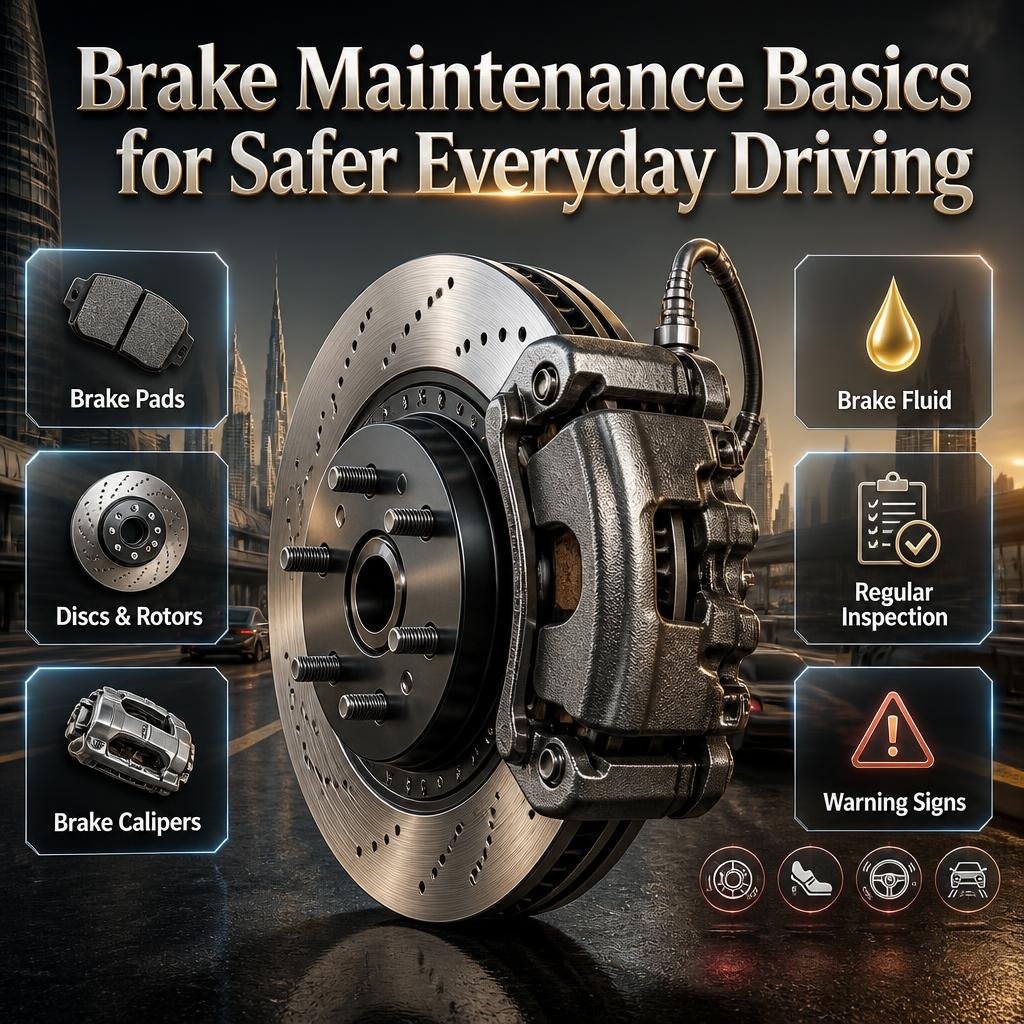
Brake maintenance isn’t simply about replacing brake pads when they become worn. The braking system includes several components that have to work together, including brake pads, discs or rotors, calipers, brake fluid, hydraulic lines, hoses, the master cylinder, parking brake components, and electronic systems such as ABS on equipped vehicles.
For drivers in Dubai, regular brake care can be particularly important because daily driving may involve heavy traffic, repeated braking, high temperatures, highway speeds, frequent acceleration and deceleration, and long periods of air-conditioning use. These conditions don’t mean every vehicle needs brakes replaced at a fixed interval, but they do make sensible inspection and preventive maintenance important.
For broader vehicle-care information, Fuel Delivery Dubai provides practical guidance for drivers dealing with everyday vehicle and roadside situations.
In this guide, you’ll learn what brake maintenance includes, how the main brake components work, how to recognize brake problems, how often brakes should be inspected, how brake fluid fits into the system, what Dubai driving conditions can change, which maintenance mistakes to avoid, and when a brake problem is serious enough to stop driving.
What Is Brake Maintenance?
Brake maintenance is the process of inspecting, servicing, cleaning, adjusting, and replacing braking-system components when required to keep the vehicle’s braking performance safe and predictable.
It involves much more than simply changing brake pads.
A proper brake inspection may include:
- Brake-pad thickness and condition
- Brake-disc or rotor condition
- Caliper operation
- Brake-fluid level and condition
- Brake-fluid leaks
- Brake hoses and lines
- Brake pedal feel
- Parking-brake operation
- ABS-related warning lights
- Uneven brake wear
- Unusual braking noise
- Vibration during braking
- Signs of overheating
- Visible damage or contamination
The exact maintenance requirements vary by vehicle. The manufacturer’s service information should be the main reference for service intervals, fluid specifications, component limits, and replacement procedures.
Why Does Brake Maintenance Matter?
The braking system is one of the most important safety systems in a vehicle.
A vehicle can have a healthy engine, good air conditioning, a strong battery, and properly inflated tyres but still be unsafe to drive if the brakes aren’t working correctly.
Regular brake maintenance helps identify developing problems before they become more serious. It can also help prevent unnecessary damage to related components.
For example, a driver who notices persistent brake noise and has the system inspected early may discover normal wear or a relatively straightforward issue. Ignoring the symptom until severe grinding develops can potentially lead to additional component damage.
The goal isn’t to replace brake parts as early as possible.
The goal is to:
- Follow the manufacturer’s maintenance requirements.
- Monitor brake performance.
- Identify abnormal symptoms early.
- Inspect worn components properly.
- Repair genuine problems before they compromise safety.
What Are the Main Parts of a Car’s Brake System?
Understanding the main brake components makes brake maintenance much easier.
When you press the brake pedal, several systems work together to convert your pedal input into controlled deceleration.
Brake Pads
Brake pads are friction components used with disc brakes.
When the brake system applies hydraulic pressure, the caliper moves the pads against the rotating brake disc. Friction between these surfaces slows the wheel.
Brake pads gradually wear during normal use.
Their lifespan can vary widely because of:
- Driving style
- Traffic conditions
- Vehicle weight
- Brake-pad material
- Road conditions
- Driving speed
- Frequency of hard braking
- Stop-and-go driving
- Terrain
- Vehicle type
This is why a universal statement such as “brake pads always last X kilometres” isn’t reliable.
Two vehicles with the same mileage can have completely different brake-pad wear.
What Happens When Brake Pads Wear?
As the friction material becomes thinner, the brake system eventually reaches the point where the pads need replacement.
Depending on the vehicle, you may notice:
- Squealing
- Grinding
- Reduced braking performance
- A brake-pad warning
- Uneven braking
- A different pedal feel
- Visible reduction in pad thickness
Some vehicles have electronic wear sensors, while others use mechanical wear indicators or require visual inspection.
The correct wear limit depends on the component and vehicle.
Brake Discs or Rotors
Brake discs, also called rotors, provide the rotating friction surface for disc brakes.
They operate under significant heat and mechanical stress.
A brake disc can develop:
- Uneven wear
- Deep scoring
- Cracks
- Corrosion
- Excessive thickness variation
- Heat-related damage
- Surface irregularities
A disc shouldn’t automatically be replaced every time brake pads are replaced.
Its condition needs to be assessed against the manufacturer’s specifications.
If the disc is within the required limits and otherwise suitable, the appropriate service may be different from a situation where the disc is cracked, excessively worn, or below its minimum specification.
Why Should You Inspect Brake Discs?
Because replacing pads without considering the condition of the disc can result in poor braking performance or premature wear.
For example, if a disc has serious surface damage, simply installing new pads doesn’t necessarily solve the underlying problem.
A professional inspection should determine whether the disc can remain in service, requires machining where permitted, or needs replacement.
Brake Calipers
Brake calipers are responsible for applying the brake pads against the disc on many disc-brake systems.
A properly functioning caliper allows the brake pads to apply and release correctly.
A caliper problem can cause:
- Uneven pad wear
- Pulling during braking
- Excessive heat
- Brake drag
- Noise
- Reduced braking performance
One important clue is uneven wear.
If one brake pad is significantly more worn than another, don’t automatically assume the solution is simply replacing that pad. The caliper, slider mechanism, hydraulic system, or related components may need inspection.
Brake Fluid
Brake fluid transfers hydraulic pressure through the braking system.
It is not interchangeable with engine oil, coolant, transmission fluid, or other automotive fluids.
Brake-fluid maintenance involves more than looking at the level.
Depending on the vehicle, proper maintenance may involve:
- Checking fluid level
- Checking for leaks
- Confirming the correct specification
- Monitoring service history
- Replacing fluid according to manufacturer requirements
- Avoiding contamination
- Proper bleeding after certain repairs
For a more detailed explanation, see the Brake Fluid Maintenance guide.
Using the wrong fluid can create serious problems, so the vehicle manufacturer’s specification should always be followed.
How Does Brake Fluid Work?
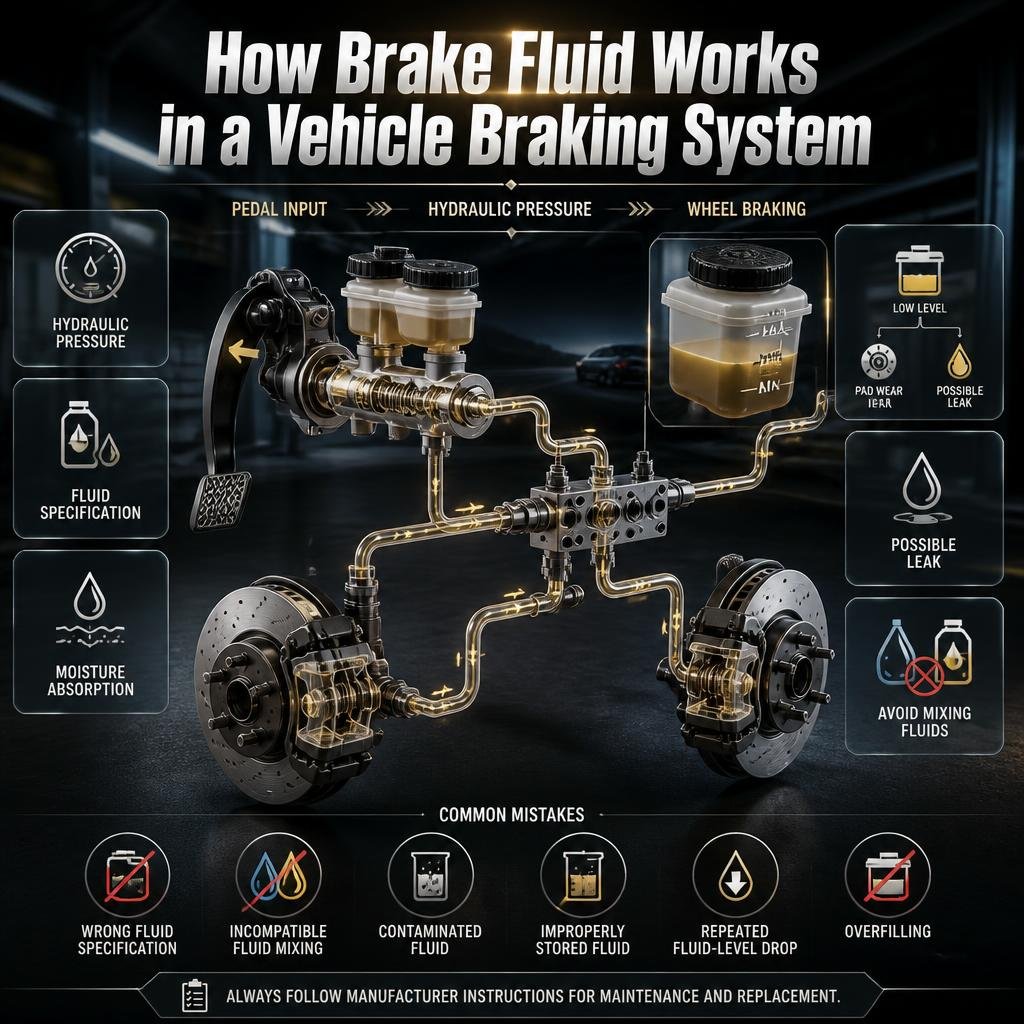
Brake fluid is part of the hydraulic side of the braking system.
When you press the brake pedal, mechanical input is converted into hydraulic pressure. That pressure is transmitted through the brake fluid to components at the wheels.
The system relies on the fluid being suitable for its operating environment.
Brake fluid can also absorb moisture over time in systems that use hygroscopic fluids. That is one reason some manufacturers specify periodic brake-fluid replacement.
A low brake-fluid level can have different causes.
It may relate to normal pad wear, but it can also indicate a leak or another braking-system problem.
That means simply adding fluid without finding out why the level is low isn’t always the right approach.
Common Brake-Fluid Mistakes
Avoid:
- Guessing the fluid specification
- Mixing incompatible fluids
- Using contaminated fluid
- Using fluid from an improperly stored container
- Ignoring a repeated drop in fluid level
- Treating brake fluid like engine oil
- Overfilling the reservoir
The safest approach is to follow the vehicle manufacturer’s instructions.
How Often Should You Check Your Brakes?
There isn’t one brake inspection interval that applies to every vehicle.
Brake inspection frequency depends on:
- Manufacturer recommendations
- Vehicle type
- Mileage
- Vehicle age
- Driving conditions
- Traffic
- Driving style
- Brake-component design
- Previous brake work
- Warning signs
Your owner’s manual and service schedule should be the starting point.
However, drivers shouldn’t wait for the next scheduled service if braking behaviour changes.
For example, if your brakes suddenly start grinding two months after a routine inspection, that doesn’t mean you should wait two more months.
Tires and brakes work together during every stop, so brake maintenance should not be considered separately from tire condition. Proper tire pressure, tread condition, sidewall inspection, and uneven-wear checks can all contribute to better road contact and predictable braking behavior. For a practical step-by-step approach to checking these areas, you can follow the Tire Maintenance Guide and include tire condition as part of your regular vehicle safety routine.
A Practical Brake Maintenance Schedule
A useful approach is:
During routine servicing
Have the braking system inspected according to the manufacturer’s schedule.
When tyres are being serviced
Ask whether the visible brake components can be checked as part of the service.
Before a long trip
Pay attention to brake performance, warning lights, pedal feel, and known maintenance requirements.
When symptoms appear
Arrange inspection promptly rather than waiting for the next scheduled service.
After brake repairs
Follow the technician’s instructions regarding bedding-in, operating limitations, and follow-up inspection where applicable.
What Are the Most Common Signs of Brake Problems?
Brake problems don’t always look the same.
Some symptoms are obvious, while others are subtle.
1. Squealing Brakes
Brake squeal can have several causes.
It may be related to:
- Brake-pad material
- Moisture
- Dust
- Temperature
- Surface condition
- Wear indicators
- Component movement
A brief noise under specific conditions isn’t automatically proof of a serious failure.
But persistent, worsening, or unusual brake noise deserves inspection.
2. Grinding Noise
Grinding is more concerning than an occasional squeak.
A harsh metallic grinding sound may indicate severe wear or contact between components that shouldn’t be contacting each other in that way.
Don’t keep driving simply because the vehicle still stops.
Continuing to drive with severe brake symptoms can increase component damage and potentially create a safety problem.
3. Soft or Spongy Brake Pedal
A brake pedal that suddenly feels softer than normal deserves attention.
Possible causes can include:
- Air in the hydraulic system
- Brake-fluid problems
- Hydraulic leakage
- Component faults
- Other braking-system issues
A significantly changed pedal feel should not be dismissed.
4. Brake Pedal Feels Too Low
If the brake pedal travels much farther than normal before braking occurs, the braking system should be checked.
This can be associated with several different problems, so don’t assume the cause without diagnosis.
5. Vehicle Pulls to One Side
If the vehicle noticeably pulls left or right when braking, possible causes can involve the brakes, tyres, suspension, steering, or wheel-related components.
This is a good example of why diagnosis matters.
Replacing one brake component without identifying the actual cause may not solve the problem.
6. Steering Wheel Vibrates While Braking
A steering-wheel vibration during braking may be associated with brake-disc condition, but it isn’t automatically proof that the discs are defective.
Tyres, wheels, suspension components, alignment, and other mechanical issues can also produce vibration.
A professional inspection can separate these possibilities.
7. Burning Smell From a Wheel
A strong burning smell, smoke, or unusually high heat from one wheel can indicate excessive brake heat or another mechanical problem.
Don’t ignore it.
If the vehicle is producing severe heat or smoke, stop somewhere safe and seek appropriate assistance.
8. Brake Warning Light
A brake-related warning light should never be treated as decoration on the dashboard.
Depending on the vehicle, warning indicators can relate to:
- Brake-fluid level
- Parking brake
- Brake-system faults
- ABS
- Electronic braking systems
Check the owner’s manual for the meaning of the specific warning.
How Do You Perform a Basic Brake Check?
A basic driver-level check can help identify warning signs, but it isn’t the same as a complete professional brake inspection.
Step 1: Check the Dashboard
Start the vehicle and look for:
- Brake warning light
- ABS warning light
- Other related warning messages
If a warning remains illuminated, identify its meaning before continuing normal driving.
Step 2: Pay Attention to Pedal Feel
During safe operation, notice whether the brake pedal feels normal for your vehicle.
Pay attention to:
- Excessive travel
- Softness
- Sponginess
- Pulsation
- Sudden changes
- Unusual resistance
You don’t need to diagnose the cause yourself.
You’re simply identifying a change.
Step 3: Listen for Unusual Sounds
Listen for changes during normal braking.
Take note of:
- Squealing
- Grinding
- Scraping
- Clicking
- Repeated rubbing noises
One brief noise doesn’t necessarily identify the problem, but a persistent pattern is worth investigating.
Step 4: Look for Visible Fluid Leakage
If you see fluid around the wheels or under the vehicle, don’t assume it’s harmless.
First identify what the fluid may be.
Brake-fluid leakage requires appropriate attention.
Never crawl underneath a vehicle that is supported only by a jack.
Step 5: Notice How the Vehicle Stops
Ask yourself:
- Does it stop as expected?
- Does it pull?
- Does the steering wheel shake?
- Does the pedal feel different?
- Does braking require noticeably more effort?
Changes are more important than comparing your car with another vehicle.
How Does Dubai Driving Affect Brake Maintenance?

Dubai driving can expose vehicles to a combination of conditions that influence maintenance requirements.
These can include:
- Heavy traffic
- Frequent stop-and-go driving
- High ambient temperatures
- Highway driving
- Short urban journeys
- Frequent acceleration
- Repeated braking
- Dust
- Heavy vehicle loads
- Long-distance journeys
Traffic is especially relevant.
In stop-and-go conditions, drivers may repeatedly accelerate and brake over relatively short distances.
That doesn’t mean every Dubai vehicle will experience unusually rapid brake wear. Actual wear still depends on the vehicle and driver.
However, frequent braking means brake components deserve proper attention.
The same principle applies to highway driving.
High-speed driving can make brake condition particularly important because stopping safely from higher speeds requires significant braking capability.
Heat and Brake Maintenance
Brake systems naturally generate heat when converting vehicle motion into heat through friction.
Repeated braking can increase brake temperatures.
Dubai’s hot ambient conditions are therefore one reason drivers should take vehicle maintenance seriously, although ambient temperature alone isn’t a reason to replace brake parts prematurely.
The correct approach is:
Inspect → Measure → Diagnose → Maintain → Monitor
Not:
Assume heat → Replace everything
Can Driving Habits Affect Brake Wear?
Yes, driving habits can influence how quickly brake components wear.
Hard Braking
Emergency braking is sometimes necessary.
You should never avoid braking hard when a genuine emergency requires it.
However, repeated unnecessary hard braking during normal traffic can increase brake-system heat and wear.
Following Too Closely
Following too closely reduces your reaction time.
It can also force you to brake more aggressively when traffic slows.
Maintaining an appropriate following distance gives you more opportunity to reduce speed smoothly.
Accelerating Aggressively
Rapid acceleration followed by hard braking creates unnecessary speed changes.
A smoother driving style can reduce unnecessary braking during ordinary traffic conditions.
Resting Your Foot on the Brake
Some drivers lightly keep their foot on the brake pedal without realizing it.
This can cause unnecessary brake application and heat.
Your foot should be removed from the brake pedal when braking isn’t required.
How Can You Make Brake Pads Last Longer?
Brake-pad life isn’t completely under the driver’s control, but driving habits can influence wear.
Look Ahead
Instead of reacting only when the vehicle directly in front begins braking, observe traffic farther ahead.
If traffic is slowing, you may have time to reduce speed smoothly.
Maintain Space
A sensible following distance reduces unnecessary emergency-style braking.
Use Appropriate Speed
Higher speeds generally require more braking effort when slowing down.
Drive at appropriate speeds for the road, traffic, and conditions.
Avoid Unnecessary Weight
Vehicle weight affects the energy required to accelerate and decelerate.
You shouldn’t remove necessary equipment, but carrying unnecessary heavy items every day isn’t ideal for overall vehicle efficiency.
Don’t Ignore Brake Problems
A small problem can become more expensive if ignored.
If a caliper starts dragging, for example, continued driving may create excessive heat and uneven wear.
Brake Pads vs Brake Discs: What’s the Difference?
Drivers sometimes use the terms interchangeably, but brake pads and discs perform different jobs.
| Component | Main job | Typical maintenance concern |
|---|---|---|
| Brake pads | Create friction against the disc | Wear |
| Brake discs/rotors | Provide rotating friction surface | Wear, scoring, cracks, thickness |
| Calipers | Apply and release pads | Sticking, leakage, uneven operation |
| Brake fluid | Transmit hydraulic pressure | Age, contamination, moisture, leaks |
| Brake hoses | Carry hydraulic pressure | Cracks, damage, deterioration |
| Brake lines | Carry hydraulic fluid | Corrosion, leaks, damage |
| Parking brake | Holds vehicle stationary | Adjustment, cable/electronic faults |
| ABS | Helps manage wheel slip during braking | Warning lights, sensor/system faults |
The important lesson is simple:
A brake problem isn’t always a brake-pad problem.
Proper diagnosis matters.
What Is Uneven Brake Pad Wear?
Uneven wear means the brake pads don’t wear at a similar rate when they should.
For example, one pad may be significantly thinner than another.
Possible causes can include:
- Caliper problems
- Slider issues
- Hydraulic problems
- Installation issues
- Component damage
- Normal differences depending on brake-system design
Uneven wear is useful information for a technician.
Replacing the thinnest pad without finding the reason for the uneven wear can allow the underlying issue to remain.
What Should You Know About Brake Disc Wear?
Brake discs are designed to operate within specific limits.
During inspection, a technician may consider:
- Disc thickness
- Minimum permitted thickness
- Surface condition
- Cracks
- Scoring
- Corrosion
- Uneven wear
- Heat damage
- Runout or related measurements where applicable
The correct limits depend on the specific vehicle.
That’s why generic internet measurements aren’t a substitute for the manufacturer’s specifications.
Common Mistake
A common mistake is assuming that every brake disc showing a visible line or slight surface change must immediately be replaced.
The opposite mistake is equally problematic: assuming that a badly scored or damaged disc is fine because the car still stops.
The correct answer comes from proper inspection.
Why Brake Fluid Level Can Change
Brake-fluid level isn’t necessarily static throughout the life of a vehicle.
As brake pads wear, caliper pistons may occupy a different position, which can influence reservoir level.
However, a low level can also indicate leakage or another problem.
That is why repeatedly adding brake fluid without investigating the cause isn’t good maintenance.
If the brake-fluid level has dropped noticeably, the system should be assessed appropriately.
How Should You Maintain Brake Fluid?
Follow the vehicle manufacturer’s brake-fluid specification and service instructions.
Important practices include:
- Check the correct fluid type.
- Keep the reservoir clean.
- Don’t introduce dirt or other fluids.
- Don’t use an unknown product.
- Follow the specified replacement interval.
- Check for leaks.
- Keep the container properly sealed.
- Have the system properly bled after relevant repairs.
Brake fluid is sensitive to contamination and moisture.
Some manufacturer guidance specifically warns against using fluid from containers that have been left open because brake fluid can absorb moisture.
This is another reason professional brake-fluid servicing is preferable to guessing or improvising.
How Does Brake Maintenance Fit Into Overall Vehicle Maintenance?
Brakes don’t operate in isolation.
Safe vehicle operation also depends on tyres, steering, suspension, fluids, battery condition, visibility, and other systems.
For a wider maintenance overview, the Vehicle Maintenance Guides section provides broader information on preventive vehicle care.
A useful maintenance approach is:
Tyres + Brakes + Fluids + Battery + Cooling + Steering + Suspension + Lights
Each area contributes differently to safety and reliability.
Don’t Forget Other Vehicle Fluids
Brake fluid is only one of the fluids that needs attention.
Depending on the vehicle, you may also have:
- Engine oil
- Coolant
- Transmission fluid
- Differential fluid
- Power-steering fluid
- Washer fluid
- Other manufacturer-specific fluids
Each fluid has a different purpose and specification.
The Essential Car Fluids guide can help you understand why different vehicle fluids shouldn’t be treated as interchangeable.
Brake Maintenance and Engine Oil Maintenance Are Different
Drivers sometimes think that completing an oil change means the vehicle has been fully serviced.
It doesn’t.
Engine oil protects and lubricates internal engine components, while brake fluid is part of the hydraulic braking system.
They require completely different maintenance procedures.
If you’re building a broader preventive maintenance routine, review Engine Oil Maintenance in Dubai separately from your brake maintenance schedule.
A vehicle can have perfectly maintained engine oil and still have worn brake pads or deteriorated brake fluid.
Brake Maintenance and Coolant Maintenance Are Also Different
Coolant is responsible for helping manage engine temperature.
Brake fluid is part of the braking hydraulic system.
Neither fluid should be substituted for the other.
If you’re checking your vehicle’s maintenance condition, the Coolant Fluid Maintenance in Dubai guide can help with the cooling side of vehicle care.
Keeping these systems separate in your maintenance records makes it easier to know what has actually been serviced.
What Should You Check Before a Long Journey?

A long-distance trip is a good opportunity to review the vehicle’s overall condition.
You don’t want to discover a brake problem after entering a busy highway.
Before a long journey, check:
Brakes
- Brake pedal feel
- Brake warning lights
- Unusual noises
- Brake-fluid condition and level
- Known brake issues
- Recent inspection history
Tyres
- Pressure
- Tread condition
- Sidewall damage
- Uneven wear
- Spare tyre or repair kit
Fluids
- Engine oil
- Coolant
- Brake fluid
- Washer fluid
Electrical and Visibility
- Headlights
- Brake lights
- Indicators
- Hazard lights
- Wipers
- Windscreen condition
Emergency Preparation
- Phone charged
- Emergency contacts available
- Basic roadside equipment
- Enough fuel for the planned journey
For a broader fluid review before travelling, use the Vehicle Fluid Inspection in Dubai guide.
What Are the Most Common Brake Maintenance Mistakes?
Mistake 1: Waiting for Grinding
Some drivers believe that brakes only need attention when they start making an extremely loud grinding noise.
That’s too late as a maintenance strategy.
Brake problems can show up through less dramatic symptoms first.
Better approach
Investigate unusual squealing, vibration, pulling, or changes in pedal feel before they become severe.
Mistake 2: Replacing Parts Without Diagnosis
A noise doesn’t automatically tell you which component has failed.
Likewise, vibration doesn’t automatically mean the brake discs are defective.
Better approach
Identify the actual cause before replacing expensive parts.
Mistake 3: Choosing Brake Parts Only by Price
The cheapest component isn’t necessarily the correct component.
Brake parts should be appropriate for:
- Vehicle model
- Brake-system design
- Manufacturer requirements
- Intended use
- Correct specifications
Better approach
Choose suitable components based on vehicle requirements and professional advice.
Mistake 4: Ignoring Brake Fluid
Some owners track engine oil carefully but never think about brake fluid.
Better approach
Keep brake-fluid inspection and service history with your normal vehicle maintenance records.
Mistake 5: Assuming New Brake Pads Solve Everything
New pads cannot automatically repair:
- Damaged discs
- Sticking calipers
- Hydraulic leaks
- Faulty hoses
- ABS faults
- Other mechanical issues
Better approach
Inspect the complete braking system.
Mistake 6: Ignoring Uneven Wear
Uneven pad wear is information.
It can indicate that something isn’t operating as it should.
Better approach
Ask why the wear is uneven instead of only replacing the thinnest pad.
Mistake 7: Driving With a Warning Light
A warning light is there to communicate that the vehicle has detected something requiring attention.
Better approach
Identify the warning before continuing normal driving.
When Should You Stop Driving Because of a Brake Problem?
Not every brake symptom means you must immediately stop the vehicle where you are.
But some conditions are serious enough that continuing to drive isn’t sensible.
Examples include:
- Major loss of braking power
- Brake pedal suddenly dropping unusually low
- Severe grinding
- Significant brake-fluid leakage
- Smoke from a wheel
- Strong burning smell accompanied by abnormal braking
- Severe pulling
- Serious brake warning combined with poor braking performance
- Sudden major change in brake behaviour
If the vehicle cannot be stopped or controlled normally, safety should take priority over reaching a workshop.
Move away from traffic when possible and arrange appropriate assistance.
Never put yourself or passengers at greater risk simply because you want to avoid calling for help.
Can Brake Problems Affect Fuel Economy?
Brake maintenance is mainly about safety, but a brake component that doesn’t release correctly can create additional resistance.
For example, a sticking brake may keep a brake pad in unwanted contact with the disc.
That can generate heat and resistance.
This is one reason brake condition can be relevant to overall vehicle efficiency.
However, don’t assume that poor fuel economy automatically means you have a brake problem.
Fuel consumption can be influenced by:
- Traffic
- Speed
- Acceleration
- Tyre pressure
- Vehicle weight
- Air conditioning
- Engine condition
- Driving style
- Road conditions
For a broader look at vehicle condition and fuel efficiency, you can also review Fuel-Saving Driving Tips.
How Do Braking Habits Affect Fuel Economy in Dubai?
Repeated acceleration and braking in traffic means energy is continually being added to and removed from the vehicle’s motion.
The brake pedal itself isn’t consuming fuel like the accelerator, but aggressive speed changes can contribute to higher overall fuel consumption.
This is especially relevant in busy urban traffic.
For a deeper explanation, see How Braking Habits Affect Fuel Economy in Dubai.
The practical lesson is not to avoid braking when braking is necessary.
Instead:
- Look ahead.
- Maintain sensible following distance.
- Avoid unnecessary acceleration.
- Anticipate traffic.
- Slow smoothly when conditions allow.
- Brake firmly when safety requires it.
Safety always comes before fuel economy.
How Can You Build a Simple Brake Maintenance Routine?
You don’t need a complicated system.
A simple routine is enough.
Every Few Weeks
Pay attention to:
- Brake noise
- Pedal feel
- Warning lights
- Pulling
- Vibration
- Any new symptoms
You don’t need to remove wheels or dismantle brake components for this basic monitoring.
During Routine Servicing
Ask for appropriate inspection of:
- Brake pads
- Brake discs
- Calipers
- Brake hoses
- Brake lines
- Brake fluid
- Parking brake
- ABS-related warnings
Before Long Trips
Review:
- Brake performance
- Brake warning lights
- Brake-fluid service history
- Known brake symptoms
- Tyres
- Other essential vehicle fluids
After Brake Repairs
Follow the technician’s instructions carefully.
Depending on the work performed, the vehicle may need a bedding-in procedure for new pads and/or discs.
Don’t assume that freshly installed brake components immediately behave exactly like fully bedded components.
What Does a Professional Brake Inspection Usually Look At?
A professional inspection can be more detailed than a driver’s visual check.
Depending on the vehicle and service procedure, a technician may inspect:
- Pad thickness
- Pad condition
- Disc thickness
- Disc surface
- Caliper movement
- Brake-fluid level
- Brake-fluid condition
- Hydraulic leaks
- Brake hoses
- Brake lines
- Parking brake
- Wheel-related components
- ABS system
- Warning codes
- Brake performance
The exact inspection procedure varies between vehicles.
This is why a qualified technician should use the correct service information rather than applying one universal procedure to every car.
Should You Replace Brake Pads in Pairs?
Brake-pad replacement is normally considered by axle rather than replacing only one individual pad.
The exact procedure depends on the vehicle and braking system.
The reason is balance.
If one side has significantly different friction material or condition from the other, braking performance can become uneven.
A professional should inspect both sides of the relevant axle and follow the vehicle manufacturer’s replacement procedure.
What Is Brake Bedding-In?
New brake pads and discs may require a bedding-in process.
Bedding-in allows the mating surfaces to establish an appropriate contact pattern.
The exact procedure varies by manufacturer and brake components.
Some service information provides specific procedures involving controlled braking followed by cooling periods.
Drivers should follow the instructions provided for their particular vehicle and components rather than copying a generic internet procedure.
Important
Don’t perform aggressive bedding procedures in unsafe traffic conditions.
The objective is to condition the components safely, not to create unnecessary risk.
How Does Vehicle Weight Affect Brake Wear?
A heavier vehicle generally requires more energy to be managed when slowing down.
Vehicle weight can therefore influence braking-system demands.
Factors can include:
- Number of passengers
- Cargo
- Vehicle design
- Towing
- Driving speed
- Road gradient
This doesn’t mean you should remove necessary equipment to protect the brakes.
Instead, avoid carrying unnecessary weight and follow the manufacturer’s load limits.
What About Brake Maintenance for Older Cars?

Older vehicles may need more attention because their service history can be less certain and components have had more time to age.
Potential areas include:
- Brake hoses
- Brake lines
- Caliper seals
- Master-cylinder components
- Brake-fluid history
- Disc condition
- Pad condition
- Parking-brake components
An older vehicle doesn’t automatically have bad brakes.
The key is knowing the condition and history of the actual vehicle.
If you’re buying a used car, don’t rely solely on the seller saying that “the brakes were recently serviced.”
Ask what was replaced, when it was replaced, and whether supporting records are available.
What About a Car That Is Rarely Driven?
A vehicle that sits unused isn’t necessarily maintenance-free.
Brake components can still be affected by:
- Corrosion
- Moisture
- Age
- Seals
- Fluid condition
- Parking-brake components
A vehicle that is driven only occasionally may therefore deserve a careful inspection before being used for a long trip.
Don’t assume low mileage automatically means excellent brake condition.
Brake Maintenance Checklist
Use this checklist as a practical reminder.
Brake Performance
- Brake pedal feels normal
- Vehicle stops predictably
- No major pulling
- No severe vibration
- No unusual grinding
- No persistent unexplained noise
Brake Components
- Brake pads inspected
- Brake discs inspected
- Calipers checked
- Brake hoses checked
- Brake lines checked
- Parking brake checked
Brake Fluid
- Correct fluid specification confirmed
- Fluid level checked
- No visible leakage
- Service history known
- Fluid service performed when required
Dashboard
- No unexplained brake warning light
- No ABS warning light
- No relevant warning messages
Before Long Journeys
- Brake inspection completed if due
- Tyres checked
- Tyre pressure checked
- Engine oil checked
- Coolant checked
- Lights checked
- Wipers checked
- Emergency equipment reviewed
- Fuel level planned
A Simple Brake Maintenance Decision Guide
| What you notice | What to do |
|---|---|
| Normal braking | Continue routine monitoring |
| Occasional minor squeak | Monitor and investigate if persistent |
| Persistent squealing | Arrange inspection |
| Grinding | Stop unnecessary driving and seek inspection |
| Soft brake pedal | Have the braking system checked promptly |
| Major loss of braking | Stop driving when safe and seek assistance |
| Brake warning light | Identify the warning and arrange appropriate inspection |
| Vehicle pulls during braking | Have brakes, tyres and related systems inspected |
| Steering vibration during braking | Arrange inspection |
| Visible brake-fluid leak | Do not ignore; seek professional attention |
| Smoke from wheel | Stop safely and seek appropriate assistance |
| Uneven pad wear | Investigate the underlying cause |
How often should I check my car brakes?
Your brakes should be inspected according to your vehicle manufacturer’s maintenance schedule, but you shouldn’t rely on a fixed mileage number alone. Brake wear depends on traffic conditions, driving habits, vehicle weight, brake-pad material, road conditions, and how frequently the vehicle is driven.
For drivers who regularly deal with heavy stop-and-go traffic, frequent braking, or long highway journeys, paying attention to brake condition between scheduled services is particularly important. A routine inspection can identify worn brake pads, damaged discs, leaking brake fluid, sticking calipers, or other problems before they become more serious.
A brake inspection is also worth arranging sooner if you notice a change in how the vehicle stops. New noises, vibration, pulling to one side, a soft pedal, longer pedal travel, or a brake warning light shouldn’t be treated as normal wear.
Important points to remember:
Follow the vehicle manufacturer’s recommended inspection schedule.
Have the brakes checked sooner when symptoms appear.
Inspect brakes before a long journey if service history is uncertain.
Don’t judge brake condition by mileage alone.
Keep a record of brake inspections and replacements.
How do I know when my brake pads need replacing?
Brake pads need replacing when their friction material reaches the applicable wear limit or when inspection identifies damage or another condition that makes replacement necessary. There isn’t one mileage figure that accurately predicts when every vehicle’s brake pads will need replacement.
Some vehicles have brake-pad wear indicators that alert the driver when the pads are approaching a specified wear level. Other vehicles require visual inspection during servicing. Persistent squealing can sometimes be an early warning, while grinding can indicate that the braking system has already reached a more serious stage of wear.
Uneven brake-pad wear is another important sign. If one pad is considerably thinner than another, the cause should be investigated rather than simply replacing the visibly worn pad. Caliper operation, slider mechanisms, hydraulic components, and other parts may need checking.
Watch for these signs:
Brake-pad warning indicator
Persistent unusual squealing
Grinding or scraping
Noticeably reduced braking performance
Uneven pad wear
Brake inspection showing insufficient friction material
Damage or contamination of the pad
The safest approach is to have brake-pad thickness measured or properly inspected instead of trying to estimate remaining life from sound or mileage alone.
What are the warning signs that my brakes need immediate attention?
The most important warning signs include a significant change in brake-pedal feel, major loss of braking performance, severe grinding, brake-fluid leakage, strong pulling during braking, smoke or excessive heat from a wheel, and brake warning lights accompanied by abnormal braking behaviour.
Not every brake noise means the vehicle is unsafe to drive, but serious or rapidly worsening symptoms should never be ignored. Braking problems can develop gradually, so drivers should take changes seriously even when the vehicle still appears to stop normally.
For example, a small amount of brake noise may have a relatively simple explanation, while grinding combined with reduced braking performance can indicate a much more serious condition. Similarly, a low brake-fluid level may have more than one possible cause, including normal pad wear or a hydraulic leak.
Seek professional attention when you notice:
Major reduction in braking performance
Brake pedal suddenly becoming very soft or unusually low
Severe grinding
Significant brake-fluid leakage
Smoke from a wheel
Strong burning smell with abnormal braking
Serious pulling during braking
Persistent brake or ABS warning lights
Rapidly worsening brake symptoms
If the vehicle cannot be safely controlled or stopped, don’t continue driving simply to reach a workshop. Move to a safe location when possible and arrange appropriate assistance.
How often should brake fluid be changed?
Brake-fluid replacement should follow the vehicle manufacturer’s recommended service schedule because the correct interval varies between vehicles and brake-fluid specifications. Brake fluid isn’t maintained in the same way as engine oil, and it shouldn’t simply be changed whenever an owner happens to service the vehicle.
Many brake fluids used in conventional hydraulic braking systems can absorb moisture over time. Moisture contamination can affect fluid performance, particularly when the braking system becomes hot. This is one reason manufacturers may specify periodic brake-fluid replacement even when the vehicle isn’t showing an obvious braking problem.
The fluid level also deserves attention. A noticeable or repeated drop in brake-fluid level shouldn’t automatically be solved by simply adding more fluid. The system should be checked for leakage or another underlying issue.
Good brake-fluid maintenance includes:
Following the manufacturer’s replacement interval.
Using only the specified brake-fluid type.
Checking the reservoir level.
Looking for signs of leakage.
Avoiding contamination.
Keeping the fluid container properly sealed.
Having the system properly bled after relevant repairs.
Never substitute engine oil, coolant, transmission fluid, or another automotive fluid for brake fluid. Using the wrong product can seriously affect the braking system.
Can driving in heavy traffic and hot weather wear brakes faster?
Heavy traffic can increase brake use because the vehicle repeatedly accelerates and slows down, particularly in stop-and-go conditions. Hot weather can also contribute to the thermal demands placed on a vehicle’s braking system. However, neither factor means that every vehicle in a hot climate automatically needs brake replacement at a specific mileage.
Actual brake wear depends on several factors, including vehicle weight, driving style, brake-component design, traffic conditions, road conditions, braking frequency, and the condition of the existing brake system.
For Dubai drivers, repeated urban braking and frequent highway driving make it sensible to monitor brake performance rather than relying only on a generic replacement interval. Smooth driving can help reduce unnecessary brake use, but safety should always come first. You should never avoid necessary braking simply to reduce component wear.
Practical habits that can help:
Maintain an appropriate following distance.
Look farther ahead in traffic.
Avoid unnecessary acceleration followed by hard braking.
Don’t rest your foot on the brake pedal.
Follow the manufacturer’s maintenance schedule.
Check brakes when symptoms appear.
Have the system inspected before long journeys when maintenance is due.
The important distinction is between monitoring brake wear and assuming premature replacement is necessary. Good maintenance is based on actual inspection and the vehicle’s requirements, not simply on climate or mileage.
Conclusion
Brake maintenance is not something to leave until you hear a strange noise or feel a problem through the brake pedal. Regular attention to brake pads, discs, calipers, brake fluid, hoses, warning lights, and overall braking performance helps identify developing problems before they become more expensive or potentially dangerous.
For drivers in Dubai, consistent brake care is particularly important because heavy traffic, frequent stop-and-go driving, high temperatures, highway journeys, and regular air-conditioning use can place additional demands on a vehicle. A practical maintenance routine should include regular visual checks, monitoring brake performance, following the manufacturer’s service recommendations, and arranging a professional inspection whenever unusual symptoms appear.
Brake maintenance should also be considered as part of the vehicle’s wider maintenance system. Engine oil, coolant, brake fluid, tyres, battery condition, lighting, and other essential components all contribute to safe and dependable driving. Keeping these areas maintained makes it easier to detect problems early and reduces the risk of unexpected roadside trouble.
The most important principle is simple: do not ignore changes in braking performance. Squealing, grinding, vibration, pulling to one side, a soft or sinking pedal, unusual fluid loss, warning lights, or a noticeable increase in stopping distance should be investigated rather than treated as normal wear.
A few minutes spent checking your vehicle and following its recommended maintenance schedule can help protect the braking system, improve driving confidence, and support safer journeys across Dubai. If a brake-related problem occurs alongside another roadside issue, getting the vehicle to a safe location and arranging appropriate roadside assistance should take priority over continuing to drive with a potentially unsafe vehicle.
Leave a Reply