Introduction
What is octane in petrol | Have you ever reached a petrol station and wondered whether you should choose regular petrol, 95 octane, or 98 octane? The numbers on fuel pumps can be confusing, especially when you’re not sure what they actually mean or whether paying extra for premium petrol will make your car perform better.
So, what is octane in petrol?
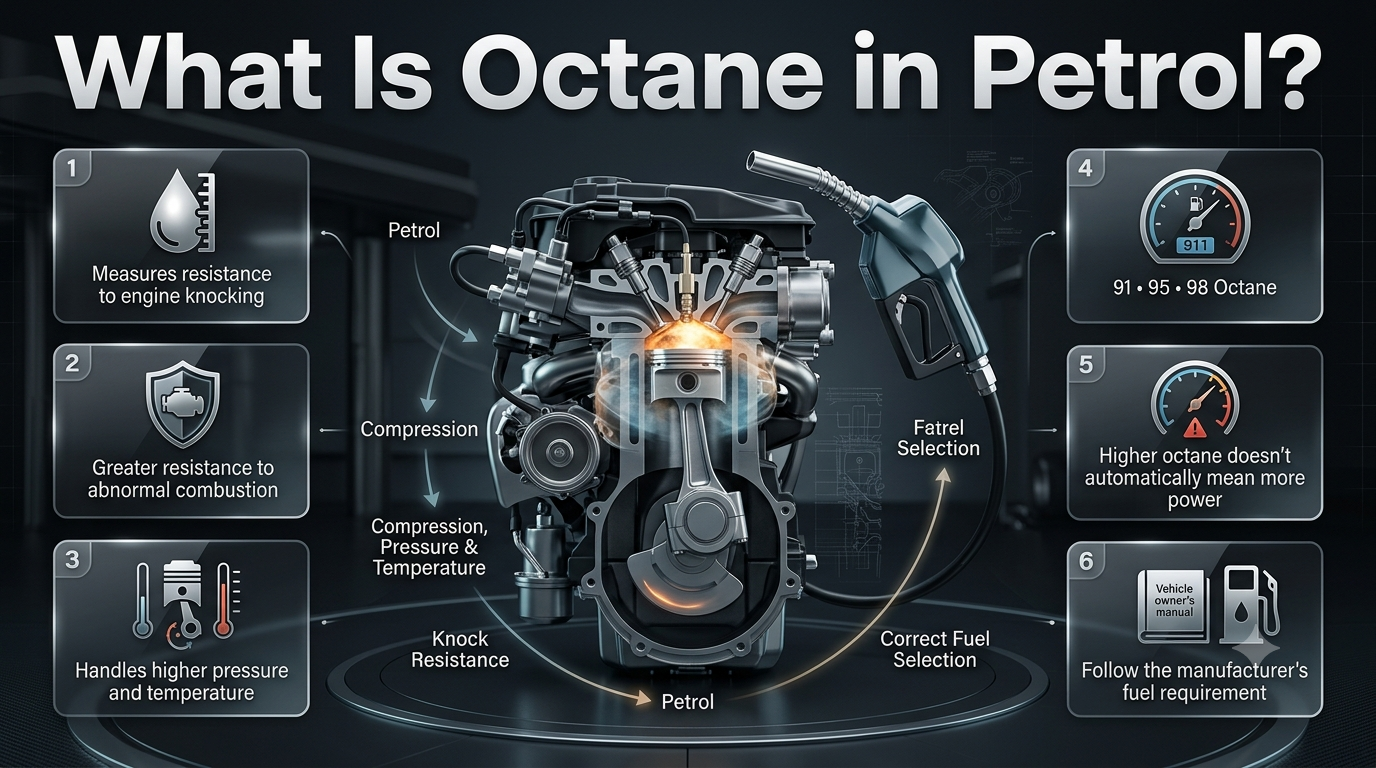
Octane is a measure of a petrol fuel’s resistance to engine knocking, also called abnormal combustion or detonation. A higher octane rating means the fuel can withstand greater pressure and temperature inside an engine before it begins to ignite uncontrollably.
However, higher octane doesn’t automatically mean more power, better fuel economy, or better fuel quality for every vehicle. The right fuel depends on the engine’s design and the manufacturer’s requirements.
In this guide, we’ll explain what octane means, how octane ratings work, what RON and MON mean, why engines knock, whether premium petrol is worth the extra cost, and how to choose the right petrol for your vehicle.
For drivers dealing with a car ran out of petrol Dubai 👉 Fuel Delivery Dubai, knowing your vehicle’s required petrol grade can also be useful when arranging emergency fuel delivery.
What Is Octane in Petrol?
Octane in petrol refers to the fuel’s ability to resist knocking during combustion. A higher octane rating indicates greater resistance to abnormal self-ignition when the air-fuel mixture is subjected to high pressure and temperature inside the engine.
When a petrol engine operates normally, the air-fuel mixture is compressed inside the cylinder and then ignited by the spark plug at the correct moment.
The resulting combustion should happen in a controlled and predictable way.
If part of the mixture ignites unexpectedly, pressure waves can develop inside the cylinder. This is known as engine knock.
Octane rating tells us how resistant the petrol is to this type of unwanted combustion.
What does octane actually measure?
Octane measures anti-knock performance, not the amount of energy contained in the fuel.
This distinction is important.
A petrol rated at 98 octane doesn’t necessarily contain more energy than a 95-octane petrol in a way that automatically produces more power. Its main advantage is its greater resistance to knock.
In simple terms:
Higher octane = greater resistance to knocking
Lower octane = lower resistance to knocking
The correct octane level is the one that matches your engine’s requirements.
Pro Tip: Don’t choose the highest octane fuel simply because the number is higher. Check your vehicle manufacturer’s minimum and recommended fuel grade first.
Why Does Octane Matter in a Petrol Engine?
Octane matters because petrol engines compress an air-fuel mixture before ignition.
Compression increases the pressure and temperature of the mixture. This helps the engine produce useful power, but it also creates conditions where uncontrolled combustion can occur.
An engine with a high compression ratio or high cylinder pressure may therefore require fuel with greater resistance to knock.
A simplified combustion process looks like this:
Air + Petrol → Compression → Spark → Controlled Combustion → Power
During normal combustion, the spark plug starts the combustion process at the intended time.
With abnormal combustion, the process can look more like:
Air + Petrol → Compression → Spark → Uncontrolled Ignition → Pressure Waves
Those pressure waves are associated with knocking.
Repeated or severe knocking can increase stress on engine components and may affect performance.
What Is Engine Knocking?
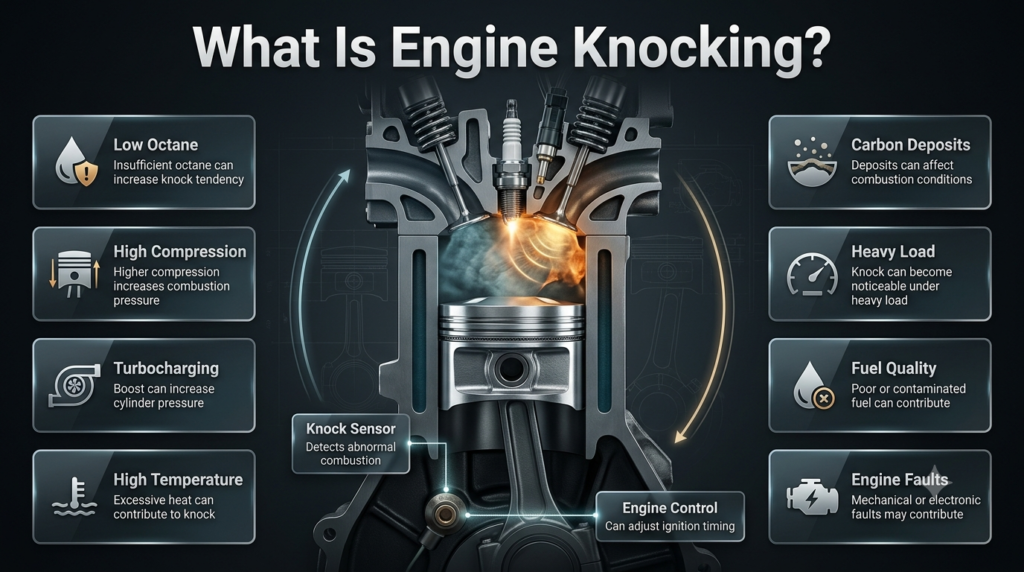
Engine knocking is abnormal combustion that occurs when part of the compressed air-fuel mixture ignites unexpectedly instead of burning in the intended controlled manner. It can produce a metallic pinging or rattling sound, particularly under heavy acceleration or high engine load.
Knocking can happen when combustion conditions inside the cylinder become too severe for the fuel’s anti-knock capability.
Common contributing factors include:
- Fuel with insufficient octane for the engine
- High compression
- Turbocharging or supercharging
- Excessive ignition timing
- High engine temperature
- Carbon deposits
- Heavy engine load
- Poor-quality or contaminated fuel
- Engine modifications
- Certain mechanical or electronic faults
Modern petrol engines often use knock sensors to detect abnormal combustion and allow the engine-control system to adjust ignition timing.
That technology can help protect the engine, but it doesn’t mean the manufacturer’s fuel requirement should be ignored.
What Does the Octane Number Mean?
The number displayed on a petrol pump represents the fuel’s octane rating under a specific standardized testing method.
Depending on the country and fuel standard, you may see numbers such as:
- 91
- 95
- 97
- 98
- 100
A higher number generally means greater resistance to knocking under the relevant test conditions.
Does 95 octane mean 95% octane?
No.
This is one of the most common misconceptions about petrol.
A fuel labelled 95 octane does not mean that 95% of the fuel consists of octane molecules.
Petrol is a complex mixture of hydrocarbons and additives.
The octane number describes how the fuel behaves in standardized anti-knock testing compared with reference fuels.
Think of octane as a performance rating for knock resistance, not a percentage of chemical composition.
How Is Octane Rating Determined?
Octane ratings are historically based on the knocking behavior of reference compounds.
Two important reference compounds are:
- Iso-octane, which has high knock resistance
- n-heptane, which has comparatively low knock resistance
Laboratory testing compares the behavior of a fuel against reference mixtures.
This produces an octane rating that indicates the fuel’s anti-knock characteristics.
The actual chemistry of commercial petrol is considerably more complicated than this simple reference scale.
What Is RON in Petrol?
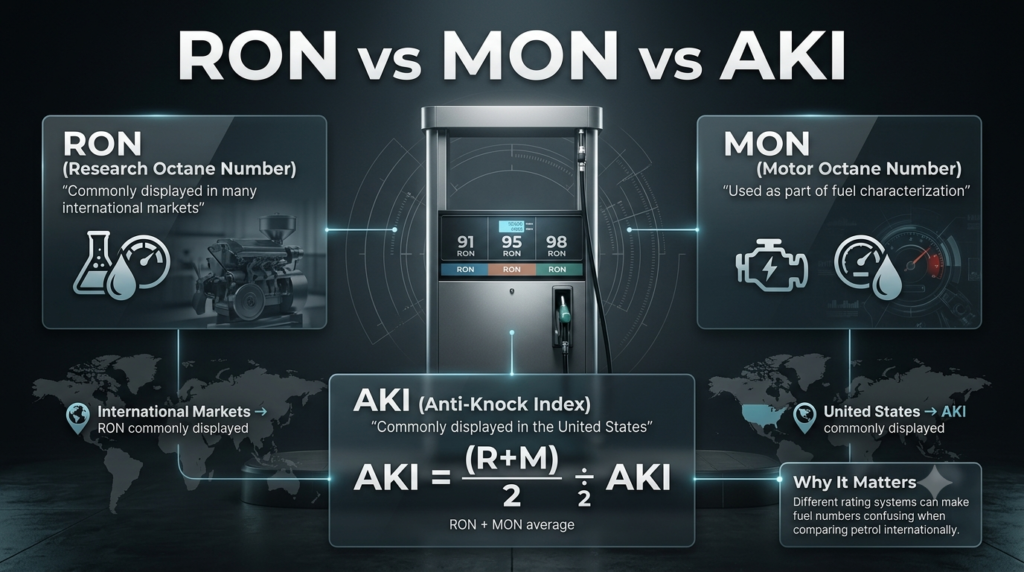
RON stands for Research Octane Number. It is a standardized measurement of a petrol’s resistance to knocking under specified laboratory test conditions.
RON is widely used in many countries and is commonly displayed on petrol pumps.
You may see fuel labelled:
- 91 RON
- 95 RON
- 97 RON
- 98 RON
A higher RON generally indicates greater resistance to knocking.
For example, 98 RON petrol has greater anti-knock resistance than 95 RON petrol when measured using the RON method.
However, that doesn’t automatically mean every engine needs 98 RON.
What Is MON?
MON stands for Motor Octane Number.
It is another standardized measurement of a petrol’s resistance to knocking.
The MON test uses more demanding operating conditions than the RON test, including different engine speed and intake conditions.
Because the test conditions are more severe, a fuel’s MON value is generally lower than its RON value.
Both measurements help describe a fuel’s anti-knock behavior.
What Is AKI or (R+M)/2?
In some markets, especially the United States, fuel pumps commonly display Anti-Knock Index, or AKI.
AKI is calculated using:
AKI = (RON + MON) ÷ 2
This is also known as the (R+M)/2 method.
This creates an important point for international drivers.
A fuel labelled 95 in an RON market is not directly equivalent to a fuel labelled 95 in an AKI market.
The testing and rating systems are different.
Quick Tip: Before comparing octane numbers between countries, check whether you’re looking at RON, MON, or AKI.
RON vs MON vs AKI
| Rating | Full Name | Where It Matters |
|---|---|---|
| RON | Research Octane Number | Commonly displayed in many international markets |
| MON | Motor Octane Number | Used as part of fuel characterization |
| AKI | Anti-Knock Index | Commonly displayed in the United States |
| (R+M)/2 | RON + MON average | Another name for AKI |
Understanding the rating system prevents confusion when comparing petrol grades internationally.
What Is the Difference Between Regular and Premium Petrol?
The primary difference between regular and premium petrol is usually octane rating.
Regular petrol has a lower resistance to knocking than premium petrol.
Premium petrol has a higher resistance to knocking.
However, premium fuel isn’t automatically better for every engine.
Regular petrol
Regular petrol may be perfectly suitable for engines designed around a lower octane requirement.
Benefits can include:
- Lower cost
- Appropriate performance
- No unnecessary premium-fuel expense
Premium petrol
Premium petrol is generally more useful for engines that require or can take advantage of greater knock resistance.
These may include:
- High-compression petrol engines
- Certain turbocharged engines
- Performance engines
- Some luxury vehicles
- Specially tuned engines
The important distinction is whether premium petrol is required, recommended, or simply available as an option.
Does Higher Octane Mean More Power?
No. Higher octane does not automatically create more horsepower.
This is one of the biggest misunderstandings about premium petrol.
Octane measures resistance to knock.
A high-performance engine may be designed to use that additional knock resistance to operate with more aggressive ignition timing, higher boost, or other combustion parameters.
In that situation, higher octane can support higher performance.
But if a normal engine is designed to run on regular petrol, putting premium fuel into the tank doesn’t automatically transform it into a higher-performance engine.
A simple example
Imagine two vehicles.
Vehicle A: Designed for 91 RON.
Vehicle B: A high-compression turbocharged engine designed for 98 RON.
Putting 98 RON into Vehicle A may provide little noticeable benefit.
For Vehicle B, using the specified high-octane fuel may be important for achieving the engine’s intended performance.
The benefit comes from engine design and calibration, not simply from the number printed on the pump.
Does Higher Octane Improve Fuel Economy?
Higher octane can sometimes improve fuel economy in an engine designed to take advantage of it, but it isn’t guaranteed.
Fuel consumption depends on many factors, including:
- Engine design
- Driving style
- Traffic
- Vehicle weight
- Tyre pressure
- Road conditions
- Temperature
- Air conditioning use
- Engine condition
- Fuel formulation
- Engine calibration
If your car is designed for regular petrol, switching to premium doesn’t necessarily produce enough efficiency improvement to justify the additional cost.
If the manufacturer specifically recommends premium, however, the higher-octane fuel may help the engine operate closer to its intended calibration.
Is Premium Petrol Worth the Extra Cost?
Premium petrol can make sense when:
- Your vehicle requires premium fuel.
- Your manufacturer recommends premium for optimal performance.
- Your engine is specifically calibrated to benefit from higher octane.
- You’re operating a performance engine under demanding conditions where premium is specified.
- Your manufacturer provides different performance specifications depending on fuel grade.
For an ordinary vehicle that only requires regular petrol, paying extra for premium may not provide enough practical benefit.
Premium fuel decision table
| Manufacturer Recommendation | What You Should Do |
| Premium required | Use premium |
| Premium recommended | Premium is generally preferable |
| Regular specified | Regular is normally sufficient |
| Multiple grades approved | Follow the stated minimum |
| Requirement unclear | Check the owner’s manual |
Expert Tip: Your owner’s manual is more reliable than general advice about whether premium fuel is “better.”
What Happens If You Use Lower-Octane Petrol?

Using fuel below the manufacturer’s recommended minimum can increase the risk of knock.
Modern engines often have knock sensors and electronic control systems that can respond by changing ignition timing.
This can help protect the engine.
However, the vehicle may experience:
- Reduced performance
- Slower acceleration
- Lower efficiency
- Increased combustion stress under certain conditions
The exact effect depends on the engine and how far the fuel is below the required specification.
If your vehicle requires premium petrol, consistently using a lower grade isn’t recommended.
What Happens If You Use Higher-Octane Petrol?
If your vehicle is designed for a lower octane rating and the manufacturer approves that fuel, using a higher-octane grade generally won’t cause a dramatic improvement.
The engine may simply operate within the same calibration.
Some modern engines can adjust their operation according to fuel quality, but the amount of benefit varies significantly.
Therefore:
Higher octane is not automatically more beneficial.
It is beneficial when the engine can actually use the additional knock resistance.
Can You Mix Different Octane Fuels?
If the different petrol grades are approved for your vehicle, they can generally be mixed.
For example, if a tank contains some 91 RON and you add 95 RON, the resulting fuel will have an intermediate overall anti-knock characteristic.
However, mixing fuels doesn’t turn the entire tank into the highest available octane grade.
If your vehicle requires a specific minimum octane rating, make sure the final fuel mixture meets that requirement.
What if you accidentally use lower octane?
If you accidentally use a lower grade than recommended, don’t immediately panic.
For vehicles that permit multiple fuel grades, a single tank may not cause a serious issue.
However, if the vehicle specifically requires high-octane fuel, avoid hard acceleration and heavy loads until you’ve confirmed the manufacturer’s recommended procedure.
What Causes Engine Knock Besides Low Octane?
Low octane is only one possible cause of knocking.
Other causes can include:
High engine temperature
Excessive heat can increase the likelihood of abnormal combustion.
Excessive ignition timing
If ignition occurs too early, combustion pressure can become problematic.
High compression
Higher compression increases pressure and temperature inside the cylinder.
Turbocharging
Boost pressure increases the amount of air entering the engine and can increase cylinder pressure.
Carbon deposits
Deposits inside the combustion chamber can affect combustion conditions.
Poor-quality fuel
Contamination or fuel that doesn’t meet the appropriate specification can cause performance problems.
Mechanical or electronic faults
Problems with sensors, fuel delivery, ignition, cooling, or engine controls can contribute to abnormal combustion.
Common Mistake: Assuming every knocking sound is caused by low-octane petrol. Persistent knocking can be a sign of an engine problem and shouldn’t be ignored.
Why Do Turbocharged Engines Often Need Higher Octane?
Turbochargers force more air into the engine.
More air allows the engine to burn more fuel and potentially produce more power from a relatively small engine.
But greater airflow and boost can also increase cylinder pressure.
Higher cylinder pressure can increase knock sensitivity.
This is one reason many turbocharged petrol engines specify premium fuel.
However, not every turbocharged vehicle requires premium petrol.
Some engines are designed to operate safely on different fuel grades, while others are specifically calibrated for higher octane.
Always follow the manufacturer’s specifications.
What Is the Relationship Between Compression Ratio and Octane?
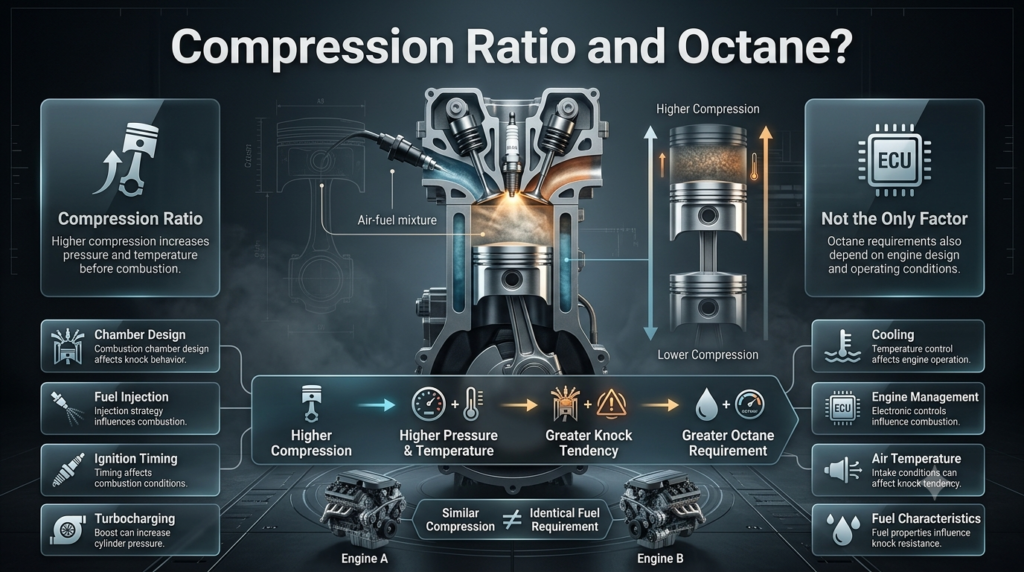
Compression ratio is an important factor in determining an engine’s octane requirement.
A higher compression ratio compresses the air-fuel mixture more strongly.
That increases pressure and temperature before combustion.
Higher compression can improve thermal efficiency, but it can also increase the possibility of knock.
A simplified relationship is:
Higher compression → Higher pressure and temperature → Greater knock tendency → Greater octane requirement
However, compression ratio isn’t the only factor.
Engine designers also consider:
- Combustion chamber design
- Fuel injection
- Ignition timing
- Turbocharging
- Cooling
- Engine management
- Air temperature
- Fuel characteristics
That’s why two engines with similar compression ratios can have different fuel requirements.
Octane vs Cetane: What’s the Difference?
Octane and cetane are often confused because both are fuel-rating terms.
They describe very different properties.
| Feature | Octane | Cetane |
| Mainly associated with | Petrol engines | Diesel engines |
| Measures | Resistance to knock | Ignition quality |
| Higher number generally means | Greater knock resistance | Shorter ignition delay |
| Main concern | Abnormal combustion | Ignition behavior |
A simple way to remember it:
Petrol → Octane → Knock resistance
Diesel → Cetane → Ignition quality
If you’re learning about the broader world of automotive fuels, our guide to automotive fuel types can help you understand how different vehicle fuels are classified and used.
Is Octane the Same as Fuel Quality?
No.
Octane is only one characteristic of petrol.
Overall fuel quality can involve:
- Octane rating
- Detergent additives
- Contamination
- Storage condition
- Fuel stability
- Compliance with applicable specifications
- Additive package
- Cleanliness
Therefore:
High octane does not automatically mean superior fuel in every respect.
A 98-octane fuel may have greater knock resistance than a 95-octane fuel, but that doesn’t mean the octane number alone tells you everything about the fuel.
For a wider overview, you can explore petrol and diesel fuel types.
Does Premium Petrol Clean the Engine?
Not because of its octane rating.
Octane and detergent performance are separate characteristics.
Some premium fuels may contain additive packages designed to help control deposits or maintain fuel-system cleanliness, but this depends on the specific fuel formulation.
Therefore, you shouldn’t assume:
Higher octane = cleaner engine
The octane number itself tells you about knock resistance.
It doesn’t measure injector-cleaning ability or engine-cleaning performance.
How to Choose the Right Octane for Your Car
Choosing the correct petrol is easier than it may seem.
Step 1: Check your owner’s manual
Look for the minimum required octane rating.
Pay attention to whether the specification uses:
- RON
- AKI
- Another fuel standard
Step 2: Check the fuel-filler door
Some vehicles display the minimum fuel requirement near the fuel cap or fuel-filler door.
Step 3: Understand “required” vs “recommended”
If premium is required, use it.
If premium is recommended, it may help the engine deliver its intended performance.
If regular fuel is approved, there may be little reason to pay extra for premium.
Step 4: Consider the vehicle’s engine
Turbocharged and high-compression engines can have higher octane requirements.
But don’t make assumptions solely based on engine type.
Step 5: Buy from a reputable fuel source
Correct octane is important, but so is using fuel that meets applicable quality specifications.
For businesses and drivers who need dependable fuel-related services, you can also explore FuelDeliveryDubai.
Common Mistakes Drivers Make About Octane
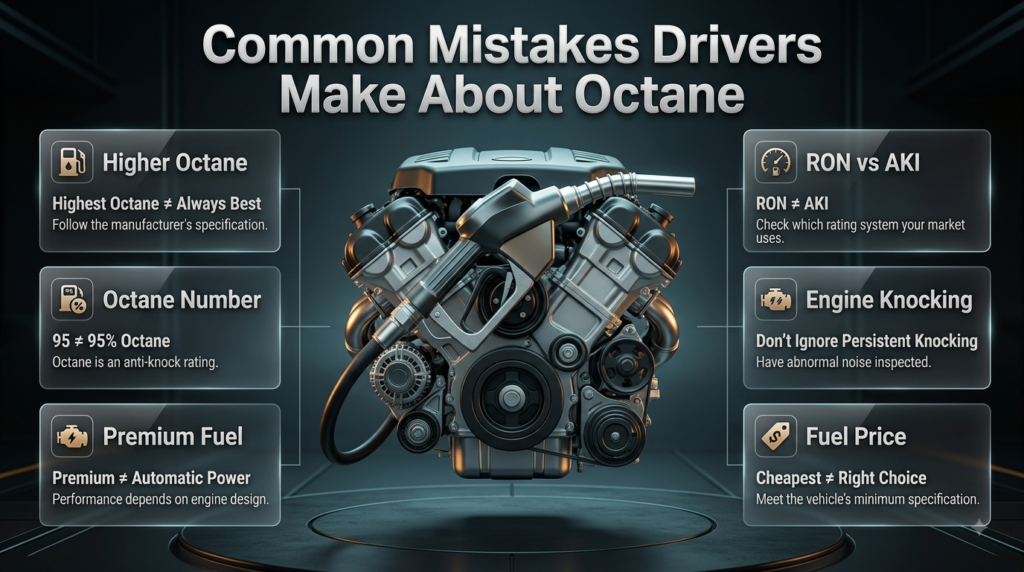
Mistake 1: Thinking the highest octane is always best
Higher octane provides greater knock resistance, but your engine may not need it.
Avoid it: Follow the manufacturer’s specification.
Mistake 2: Thinking 95 means 95% octane
The number is not a percentage of octane molecules.
Avoid it: Think of octane as an anti-knock rating.
Mistake 3: Believing premium always produces more power
Premium fuel only supports additional performance when the engine is designed to use it.
Avoid it: Check whether premium is required or recommended.
Mistake 4: Comparing RON and AKI directly
These rating systems aren’t identical.
Avoid it: Check which measurement your market uses.
Mistake 5: Ignoring engine knocking
Persistent knocking shouldn’t automatically be blamed on fuel.
Avoid it: Have the vehicle inspected if abnormal noise continues.
Mistake 6: Choosing fuel based only on price
The cheapest fuel isn’t necessarily the right choice if it doesn’t meet the vehicle’s requirements.
Avoid it: Start with the manufacturer’s minimum fuel specification.
How to Tell If Your Car Needs Premium Petrol
The easiest methods are:
- Read the owner’s manual.
- Check the fuel-filler label.
- Check the manufacturer’s official specifications.
- Look for the minimum octane requirement.
- Determine whether premium is listed as required or recommended.
Don’t rely solely on what another driver says.
A vehicle with a similar engine size may have completely different fuel requirements.
What Should You Do If Your Engine Starts Knocking?
If you notice repeated pinging or knocking, first consider whether you’re using the correct fuel.
Then consider other possibilities, such as:
- Engine overheating
- Heavy load
- Poor-quality fuel
- Carbon deposits
- Ignition problems
- Sensor faults
- Fuel-system problems
- Engine modifications
If the noise continues after using the correct fuel, professional inspection is advisable.
A fuel change may solve a fuel-related knock problem, but it won’t repair a mechanical or electronic fault.
Expert Tip: Persistent knocking should be treated as a symptom that needs investigation rather than simply as a reason to buy higher-octane petrol.
Does Octane Affect Acceleration?
It can, but only under certain conditions.
If an engine is designed to take advantage of higher octane, premium petrol can allow the engine-control system to maintain more favorable combustion conditions under demanding operation.
This can support better acceleration and performance.
However, in an engine that doesn’t need or benefit from premium fuel, the difference may be negligible.
That’s why you shouldn’t judge fuel purely by octane number.
Does Octane Affect Fuel Consumption?
Yes, potentially—but the effect varies by engine.
A high-compression or performance engine may operate more efficiently with the fuel grade specified by its manufacturer.
For a regular-fuel engine, premium petrol may not provide enough improvement in fuel economy to offset its higher price.
Your driving habits can also have a much greater effect on fuel consumption.
For example:
- Aggressive acceleration increases fuel use.
- High-speed driving increases aerodynamic drag.
- Underinflated tyres increase rolling resistance.
- Heavy traffic reduces efficiency.
- Excessive idling wastes fuel.
Therefore, don’t expect a higher octane number alone to dramatically reduce fuel consumption.
Practical Example: Choosing Between 95 and 98 Octane
Imagine you’re driving a modern petrol vehicle that specifies 95 RON minimum and recommends 95 RON for normal operation.
You have two choices at the station:
95 RON: Meets the manufacturer’s requirement.
98 RON: Provides greater knock resistance but may cost more.
If the engine isn’t calibrated to benefit significantly from 98 RON, the more expensive fuel may provide little practical advantage.
Now imagine a performance vehicle that specifies 98 RON.
In that situation, choosing 98 RON is the appropriate decision because the engine was designed around that fuel requirement.
The key lesson is:
Choose fuel according to the engine—not simply according to the highest number on the pump.
What Is Octane in Petrol and Why Does It Matter?
Octane is a measure of how well petrol can resist engine knocking or abnormal combustion when the fuel-air mixture is exposed to high pressure and temperature inside the engine. A higher octane rating means the fuel has greater resistance to unwanted auto-ignition. This becomes particularly important in engines with higher compression, turbocharging, or performance-focused combustion systems.
Octane matters because an engine is designed to burn its fuel mixture at a controlled point in the combustion cycle. If the mixture starts burning uncontrollably, pressure inside the cylinder can rise in an undesirable way. Modern engines can detect knock and adjust ignition timing to protect themselves, but that adjustment can reduce performance or efficiency.
Important points:
Octane measures knock resistance, not overall fuel quality.
A higher octane number doesn’t mean the petrol contains a higher percentage of octane.
High-compression and some turbocharged engines can have higher octane requirements.
Using the correct octane helps the engine operate closer to its intended calibration.
Persistent knocking shouldn’t automatically be blamed on fuel; it can also indicate an engine problem.
Professional takeaway: The right octane isn’t necessarily the highest number available at the petrol station. It’s the fuel grade that meets your vehicle manufacturer’s specification.
Is Higher Octane Petrol Better for Your Car?
Higher-octane petrol is not automatically better for every car. Its main advantage is greater resistance to knock, which is useful when an engine’s design creates higher pressure and temperature inside the combustion chamber. If your vehicle is specifically designed or calibrated to benefit from premium fuel, using the recommended higher octane can help it maintain its intended performance.
For a vehicle designed to run properly on regular petrol, however, moving to a much higher octane doesn’t automatically produce more horsepower or dramatically improve fuel economy. The engine has to be capable of taking advantage of that additional knock resistance. This is why professional fuel advice should always start with the manufacturer’s minimum and recommended octane requirement rather than simply choosing the most expensive grade.
What to consider before paying for premium:
Check the minimum octane requirement in the owner’s manual.
Find out whether premium fuel is required or recommended.
Consider whether the engine is turbocharged or high-compression.
Don’t assume a higher number means more energy or more power.
Compare the additional fuel cost with any actual benefit your vehicle receives.
Professional takeaway: Premium petrol makes the most sense when the engine was designed to use it—not simply because premium has a higher number on the pump.
What Happens If You Use Lower-Octane Petrol Than Recommended?
Using petrol below the manufacturer’s required octane can increase the engine’s tendency to knock, particularly when the engine is under heavy load, operating at high temperature, or working with high cylinder pressure. Modern petrol engines commonly use knock sensors and engine-control systems that can respond by reducing ignition advance, helping protect the engine from abnormal combustion.
The important point is that electronic engine management is not a replacement for using the correct fuel. When the system has to continually compensate for insufficient octane, the engine may not operate at its intended performance or efficiency. In severe conditions, persistent knock can place significant stress on internal engine components.
Possible effects include:
Reduced acceleration and engine response
Lower fuel efficiency
Reduced power under demanding conditions
Increased likelihood of audible pinging or knocking
Greater combustion stress if severe knock continues
Engine-management adjustments designed to protect the engine
If you’ve accidentally used a slightly lower grade once, don’t automatically assume you’ve damaged the engine. The situation depends on the vehicle, the specified minimum, the amount of lower-octane fuel used, and driving conditions.
Professional takeaway: If your vehicle requires premium petrol, don’t make a habit of replacing it with a lower grade simply to save money. The manufacturer’s minimum octane requirement should be treated as a real operating requirement.
Does Premium Petrol Keep Your Engine Cleaner?
Not necessarily. A higher octane rating does not automatically mean that petrol has better cleaning or deposit-control properties. Octane and detergent performance are two different characteristics of fuel.
Premium petrol is primarily distinguished by its higher resistance to knocking. However, individual fuel suppliers may use different additive packages, and some fuels may contain detergents or deposit-control additives designed to help maintain fuel-system cleanliness.
This means you shouldn’t assume that moving from regular to premium petrol will automatically clean carbon deposits, fuel injectors, valves, or the combustion chamber. If a fuel has cleaning benefits, those benefits come from its specific additive formulation rather than simply from its octane number.
Keep these factors separate:
Octane rating: Resistance to engine knocking.
Detergent additives: Help control certain deposits.
Fuel quality: Includes compliance with applicable specifications and freedom from contamination.
Engine cleanliness: Also depends on maintenance, operating conditions, fuel system design, and driving patterns.
If you’re choosing premium petrol specifically because you believe the higher octane will clean your engine, that expectation may be misleading.
Professional advice: Choose premium because your engine requires or benefits from its octane level—not because you assume the number itself represents a cleaning treatment. If you’re concerned about deposits or fuel-system cleanliness, consider the fuel’s additive specifications and follow the vehicle manufacturer’s maintenance recommendations.
How Do I Know Which Octane Fuel My Car Needs?
The most reliable way to determine your car’s required octane is to check the owner’s manual and the manufacturer’s fuel specification. The required rating may also be printed near the fuel-filler door or fuel cap.
Don’t base your decision only on engine size, vehicle price, or what another driver recommends. Two petrol vehicles with similar engine sizes can have very different fuel requirements because their compression ratios, turbocharging systems, ignition strategies, and engine calibrations may differ.
It’s also important to understand whether the manufacturer’s specification uses RON or AKI. A number from one rating system shouldn’t be compared directly with the same number from another system.
Use this professional checklist:
Check the owner’s manual for the minimum octane requirement.
Check the fuel-filler label for any specified grade.
Determine whether premium is required or recommended.
Confirm whether the rating is RON or AKI.
Use at least the manufacturer’s stated minimum.
Don’t upgrade to premium solely because you expect more power.
If the engine knocks despite using the correct fuel, investigate the underlying cause.
For example, if your vehicle specifies 95 RON minimum, 95 RON is the appropriate starting point. If the manufacturer specifically requires 98 RON, using 98 RON is the safer and more appropriate choice.
Professional advice: Your vehicle’s manufacturer has already established the fuel requirement through engine design and testing. That specification should take priority over generic advice such as “premium is always better” or “all petrol engines can use regular fuel.”
Quick Expert Takeaway
When choosing petrol, don’t focus only on the biggest octane number at the station. Understand what the rating actually means, check your vehicle’s minimum requirement, and consider whether premium fuel is required, recommended, or simply optional.
The most important rule is straightforward:
Use the octane grade your engine was designed to operate with. Higher isn’t automatically better, and lower isn’t always safe.
Conclusion
Understanding what octane is in petrol makes it much easier to choose the right fuel for your vehicle. Octane isn’t a measure of how powerful or premium the petrol is; it tells you how effectively the fuel can resist engine knocking and abnormal combustion under pressure and heat.
The most important thing is to match the fuel to your engine. A higher-octane petrol can be valuable for high-compression, turbocharged, and performance engines that are designed to take advantage of greater knock resistance. For a vehicle designed to run on regular petrol, however, paying extra for premium fuel doesn’t automatically mean better performance, cleaner engine operation, or improved fuel economy.
Before filling your tank, check your owner’s manual or the manufacturer’s fuel specification, and make sure you’re comparing the correct rating system such as RON or AKI. Using the correct octane helps your engine operate as intended while avoiding unnecessary fuel costs.
In short, don’t choose petrol simply because it has the highest number on the pump. Choose the octane grade your engine actually requires—and you’ll be making a smarter decision for performance, efficiency, and long-term vehicle operation.
Leave a Reply