

Introduction
Spark Ignition vs Compression Ignition Engines in Dubai | Choosing between petrol and diesel vehicles is not just about the price displayed at the fuel station. A driver commuting through Dubai’s busy roads, travelling regularly between emirates, or operating a vehicle for work needs to understand how the engine produces power, how efficiently it uses fuel, and what maintenance it requires.
The difference between spark ignition vs compression ignition engines in Dubai is particularly relevant when comparing daily driving conditions, fuel economy, engine performance, and long-term ownership expenses. Although both engine types convert fuel energy into mechanical power, they use different combustion methods and have different operating characteristics.
A spark ignition engine, commonly found in petrol cars, uses an electrical spark to start combustion. A compression ignition engine, commonly found in diesel vehicles, compresses air until its temperature becomes high enough to ignite injected fuel.
Neither system is automatically the best choice for every driver. A petrol vehicle may suit someone making short city journeys, while a diesel vehicle may be attractive to someone covering long distances or carrying heavy loads. Modern engine technology also means that individual models can differ considerably.
This guide explains how both engines work, compares their advantages and disadvantages, examines Dubai’s driving conditions, and explains how to choose the right engine without overlooking maintenance costs or emissions requirements.
For additional vehicle information and fuel-related assistance, visit FuelDeliveryDubai.
2. What Is a Spark Ignition Engine?
A spark ignition engine, usually abbreviated as SI, is an internal combustion engine that uses an electrical spark to initiate combustion. Petrol engines are the most familiar example, although spark ignition technology can also operate with other suitable fuels.
In a conventional petrol engine, air enters the cylinder and fuel is mixed with it or injected directly into the cylinder, depending on the engine design. The piston compresses the charge, and the spark plug creates a precisely timed electrical discharge that starts combustion.
The expanding combustion gases push the piston downward, producing mechanical work that eventually turns the vehicle’s wheels.
How does a spark ignition engine operate?
Most conventional petrol car engines use a four-stroke cycle.
1. Intake stroke: The piston moves downward while the intake valve opens. Air enters the cylinder, with fuel supplied through the intake system or direct injection.
2. Compression stroke: The piston moves upward, compressing the charge. The compression ratio is selected to balance efficiency, performance, fuel characteristics, and protection against abnormal combustion.
3. Power stroke: The spark plug initiates combustion at the appropriate time. Expanding gases force the piston downward and transfer energy to the crankshaft.
4. Exhaust stroke: The piston moves upward and pushes the burned gases through the exhaust valve.
The cycle then repeats while the engine operates.
Why are spark plugs important?
Spark plugs must produce a reliable spark under demanding conditions. Their condition, the ignition coils’ performance, and the engine control system’s timing all affect combustion quality.
Worn plugs or faulty coils can cause misfires, uneven idling, sluggish acceleration, and increased fuel consumption. However, similar symptoms can result from fuel-delivery faults, air leaks, or sensor problems.
A professional diagnosis should therefore establish the cause before components are replaced.
Where are spark ignition engines commonly used?
Spark ignition engines are widely used in:
- Passenger cars and family sedans.
- Many crossovers and SUVs.
- Light commercial vehicles.
- Performance cars.
- Petrol hybrid vehicles, where an electric motor works alongside the engine.
Their suitability depends on the complete vehicle design rather than ignition type alone.
For many Dubai drivers, a petrol engine offers familiar driving characteristics, smooth operation, and a practical option for everyday journeys. Actual fuel economy and maintenance costs still depend on the vehicle and how it is used.
3. What Is a Compression Ignition Engine?
A compression ignition engine, abbreviated as CI, initiates combustion using the heat generated by compressing air inside the cylinder. Conventional diesel engines are the best-known example of this design.
Unlike a conventional petrol engine, a diesel engine generally draws air into the cylinder and compresses it without first mixing the full fuel charge into that air. Near the end of compression, the fuel injection system sprays diesel into the hot, compressed air.
Under suitable operating conditions, the fuel ignites without requiring a spark plug to initiate the main combustion event.
How does a compression ignition engine operate?
A conventional four-stroke diesel engine follows four main stages.
1. Intake stroke: The intake valve opens, and the cylinder draws in air.
2. Compression stroke: The piston compresses the air, raising its pressure and temperature. The engine’s design must withstand the high pressures involved.
3. Power stroke: The injector delivers diesel fuel into the hot air. Combustion releases energy, and expanding gases push the piston downward.
4. Exhaust stroke: The piston moves upward and expels the burned gases through the exhaust valve.
Although the overall four-stroke sequence resembles that of a petrol engine, the fuel introduction and ignition processes differ significantly.
Why does a diesel engine use high-pressure fuel injection?
Modern diesel engines depend on precise injection control. The fuel must be delivered at the correct time, in the correct quantity, and with a suitable spray pattern.
The injection system can influence starting, combustion noise, fuel consumption, power delivery, and emissions. Faults involving injectors, fuel pressure, or fuel quality can therefore affect engine performance.
Diesel fuel systems operate at very high pressures. Repairs involving the common rail and injectors require suitable training and equipment; high-pressure lines should never be loosened while the engine is running.
Do diesel engines have spark plugs?
Conventional diesel engines do not use spark plugs to initiate normal combustion. However, many use glow plugs to help with starting under conditions that require additional heating.
Glow plugs and spark plugs perform different functions. A glow plug supports starting by heating the combustion chamber or a related area; it does not replace the diesel engine’s compression-ignition process.
Diesel engines are widely used in commercial vehicles, pickups, trucks, buses, and some passenger cars and SUVs. Their fuel efficiency and torque characteristics can be advantageous when the vehicle’s purpose and operating conditions suit the design.
4. Spark Ignition vs Compression Ignition: Main Differences
The fundamental difference is the way combustion begins. Spark ignition engines use an electrical spark, while compression ignition engines rely on the temperature created by compressing air and then introducing fuel.
This distinction affects several other design decisions, including compression ratio, fuel delivery, emissions equipment, and maintenance procedures.
| Comparison factor | Spark ignition engine | Compression ignition engine |
|---|---|---|
| Common vehicle fuel | Petrol | Diesel |
| Combustion initiation | Electrical spark | Heat from compressed air |
| Main ignition components | Spark plugs and ignition coils | High-pressure injection equipment; glow plugs where fitted |
| Compression ratio | Generally lower | Generally higher |
| Fuel delivery | Port injection or direct injection | Usually high-pressure direct injection in modern vehicles |
| Fuel economy | Varies by model; conventional designs often use more fuel than comparable diesels | Often advantageous on longer journeys and under suitable loads |
| Low-speed torque | Depends on design, displacement, and turbocharging | Often strong, particularly in turbocharged applications |
| Engine noise | Often quieter and smoother | Combustion noise may be more noticeable |
| Common maintenance concerns | Ignition system, fuel delivery, lubrication, and cooling | Fuel filtration, injection equipment, lubrication, cooling, and emissions systems |
| Typical applications | Passenger cars, crossovers, many SUVs | Commercial vehicles, pickups, trucks, and selected passenger vehicles |
These are general engineering tendencies, not universal rules. Turbocharging, hybridisation, transmission design, engine calibration, and vehicle weight can change the real-world comparison.
Does a higher compression ratio automatically mean better performance?
No. A higher compression ratio can improve thermal efficiency under appropriate conditions, but engine performance also depends on combustion control, airflow, fuel delivery, engine speed, turbocharging, and mechanical design.
Petrol engines must manage the risk of abnormal combustion, commonly called knock. Diesel engines are designed around compression ignition and must manage high cylinder pressures, injection timing, combustion noise, and emissions.
The correct comparison is therefore between complete vehicle models, not compression ratios alone.
For a broader comparison of how these engine types affect vehicle ownership, see Petrol vs. Diesel Comparisons Dubai.
5. How Do Petrol and Diesel Combustion Processes Differ?
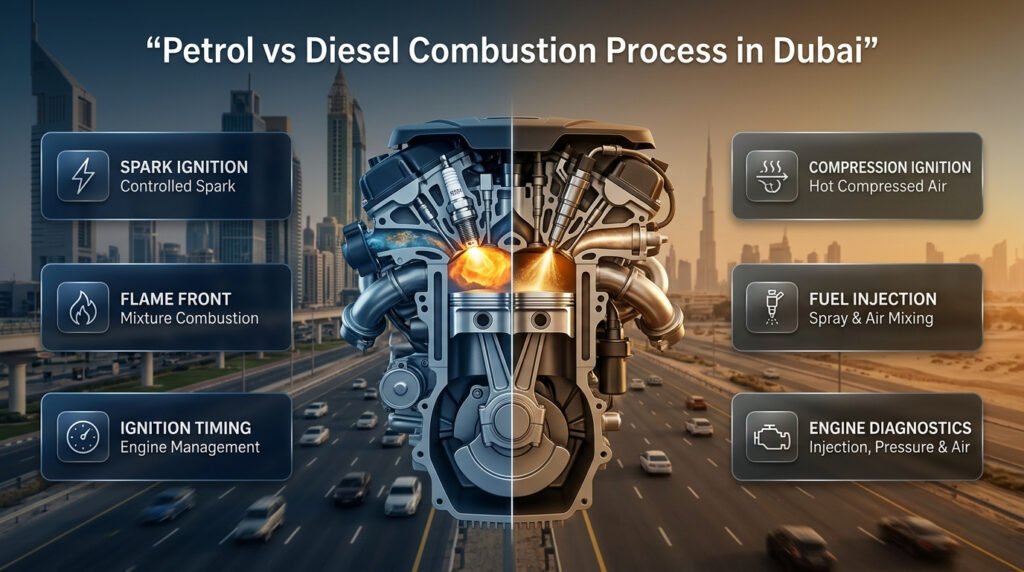
Combustion is the process that releases chemical energy from fuel. Both petrol and diesel engines use controlled combustion to create pressure inside the cylinder, but the fuel and air are prepared differently, and combustion starts through different mechanisms.
Petrol combustion
In a conventional spark ignition engine, the charge is prepared before ignition. Depending on the design, fuel may be mixed with incoming air in the intake system or injected directly into the cylinder.
The spark plug initiates combustion at a controlled point. The flame then spreads through the combustible mixture, creating pressure that drives the piston downward.
Ignition timing is important because combustion takes time. The engine control unit adjusts timing according to factors such as engine speed, load, temperature, and knock risk.
If combustion starts too early or becomes uncontrolled, the engine may experience abnormal pressure and temperature conditions. Modern engine management systems use sensors and control strategies to reduce this risk.
Diesel combustion
In a conventional compression ignition engine, air is compressed before fuel is introduced. The injector sprays diesel into the hot air, and combustion begins when local conditions allow the fuel to ignite.
The fuel spray must mix with air rapidly and burn in a controlled manner. Injection timing, pressure, quantity, and spray characteristics all affect the process.
Modern diesel systems may use multiple injection events during one cycle to help manage combustion noise, performance, and emissions.
Why does this difference matter to drivers?
The combustion method helps explain why petrol and diesel engines have different maintenance needs and driving characteristics.
For example, a petrol engine misfire may be associated with a spark plug or ignition coil, but a diesel engine’s rough running may involve injection quality, fuel pressure, compression, or air supply.
The correct diagnostic process depends on the engine design. Replacing components without confirming the cause can increase costs without solving the problem.
For a deeper explanation of the combustion stages, read Petrol vs Diesel Combustion Process in Dubai.
6. How Do Petrol and Diesel Engines Differ in Everyday Driving?
The technical differences become more useful when considered in real driving situations. A driver navigating crowded urban roads may value smooth response and comfortable operation, while a driver covering long highway distances may place greater emphasis on fuel consumption and sustained performance.
Acceleration and responsiveness
Petrol engines often deliver smooth acceleration and can operate comfortably across a broad range of engine speeds. Many modern petrol engines use turbocharging to produce strong torque at lower speeds as well.
Diesel engines often provide substantial torque at relatively low engine speeds. This can make them well suited to carrying loads, climbing gradients, and maintaining momentum under demanding conditions.
However, torque alone does not determine acceleration. Transmission ratios, engine power, turbocharger response, vehicle weight, and control software all influence how a vehicle feels.
Noise and refinement
Petrol engines are often quieter, particularly at idle and during gentle acceleration. Diesel engines can produce more noticeable combustion noise because of their operating pressures and combustion characteristics.
Modern diesel engines have become considerably more refined through improved injection control, engine mounts, sound insulation, and other design features. A well-maintained diesel vehicle can still provide a comfortable driving experience.
Driving in congested traffic
Repeated stopping and accelerating increases fuel use in both engine types. Air-conditioning demand, vehicle load, journey length, and the amount of time spent idling can also influence consumption.
A petrol car may be a practical choice for short urban journeys. A diesel can also perform well in city driving, but the driver should understand any emissions-system requirements that apply to that particular model.
For example, if a diesel vehicle has a particulate filter, frequent short journeys may prevent the exhaust system from reaching the conditions needed for successful regeneration. This depends on the vehicle’s design and operating strategy.
Long-distance driving
Diesel engines often offer a fuel-economy advantage during sustained highway driving. Their efficiency and torque characteristics can be particularly useful for vehicles covering high annual mileage.
Nevertheless, modern petrol engines can also be efficient on highways. A hybrid petrol vehicle may have a different advantage in urban conditions, so the exact vehicle and journey pattern remain important.
The best way to compare driving performance is to test the vehicles on roads similar to those you regularly use.
7. Which Engine Is More Fuel-Efficient in Dubai?
Diesel engines often achieve better fuel economy than comparable conventional petrol engines. Their higher compression ratios, operating characteristics, and the energy contained in each litre of diesel can contribute to this advantage.
However, fuel consumption varies with vehicle design, driving conditions, speed, load, engine technology, and maintenance. It is not accurate to promise that every diesel vehicle will be more economical than every petrol alternative.
Why diesel engines often use less fuel
Diesel engines generally operate with higher compression ratios and can maintain efficient operation under a wide range of loads. Their combustion and air-management strategies contribute to their typical efficiency advantage.
Petrol engines have also improved significantly. Direct injection, turbocharging, variable valve timing, cylinder deactivation, and hybrid systems can reduce fuel consumption.
As a result, comparing fuel economy requires more than checking whether the engine uses petrol or diesel.
Calculate the potential annual saving
Suppose a petrol vehicle consumes 8 litres per 100 kilometres, while a comparable diesel vehicle consumes 6 litres per 100 kilometres.
For an annual distance of 20,000 kilometres:
- Petrol consumption: 1,600 litres.
- Diesel consumption: 1,200 litres.
- Difference: 400 litres per year.
To estimate the fuel-cost difference, multiply each vehicle’s consumption by the actual price per litre of its fuel.
The result is only part of the ownership comparison. You must also consider purchase price, scheduled servicing, repairs, insurance, and resale value.
Which fuel-economy figures should you trust?
Start with the manufacturer’s figures for the exact vehicle version. Then investigate real-world results from comparable models and consider whether the figures reflect city driving, highway driving, or a mixed cycle.
Do not compare a small petrol sedan with a heavy diesel SUV and assume the difference comes entirely from the ignition system.
Pro tip: Keep track of actual fuel purchases and distance travelled over several fill-ups. A consistent record under similar driving conditions can be more useful than judging fuel consumption from a dashboard reading over one short trip.
8. How Does Dubai’s Hot Climate Affect Both Engine Types?
Dubai’s high ambient temperatures make cooling-system condition and correct maintenance especially important. However, neither spark ignition nor compression ignition is inherently unsuitable for hot weather. Both engine types are designed to operate within specified temperature ranges.
Cooling-system performance
The cooling system transfers excess engine heat away from critical components. It generally includes a radiator, coolant, hoses, a water pump, a thermostat, and cooling fans, although the precise arrangement varies by vehicle.
High ambient temperatures reduce the temperature difference available for heat transfer. Heavy traffic and extended idling may also limit airflow through the radiator, depending on fan performance and vehicle design.
Drivers should monitor warning indicators and investigate recurring coolant loss, unusual temperature changes, or visible leaks.
Never remove a radiator cap or open a pressurised cooling system while it is hot.
Air conditioning and engine load
Air conditioning places an additional load on the vehicle’s energy system. The effect on fuel consumption varies with the compressor design, cabin temperature, traffic, vehicle speed, and engine calibration.
A poorly maintained cooling system can struggle under demanding conditions regardless of fuel type. A vehicle that repeatedly overheats should be inspected rather than driven until the warning disappears.
Dust and air filtration
Dusty conditions can make air-filter maintenance particularly relevant. Restricted airflow can affect engine performance, while contamination entering the engine can contribute to wear.
Follow the manufacturer’s inspection and replacement schedule, adjusting maintenance only where the manufacturer permits it for the actual operating environment.
Engine oil and coolant specifications
Use the engine oil viscosity and specification required by the manufacturer. Do not choose oil based only on the belief that hotter weather always requires a thicker grade.
Likewise, coolant colour alone does not identify the correct product. Different coolant formulations may look similar but have different chemical specifications.
The safest approach is to use approved fluids and follow the vehicle’s maintenance instructions.
9. What Are the Maintenance Differences Between Spark and Compression Ignition Engines?
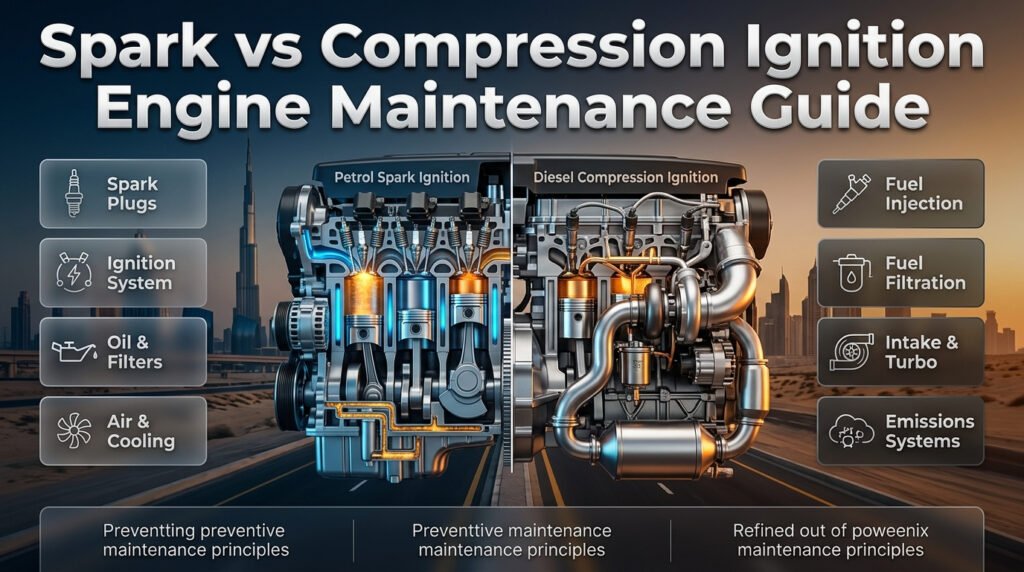
Both engine types need regular oil and filter changes, air filtration, cooling-system maintenance, and inspections. Their specialised maintenance needs differ because petrol engines use spark ignition, while diesel engines rely on compression ignition and high-pressure fuel delivery.
Petrol engine maintenance
Common maintenance tasks include:
- Changing engine oil and the oil filter at the specified interval.
- Inspecting spark plugs and replacing them when due.
- Investigating ignition misfires and ignition-coil faults.
- Maintaining the air filter and fuel system.
- Checking coolant, hoses, belts, and other scheduled service items.
Spark plug replacement intervals vary by engine and plug type. Always follow the maintenance schedule for the specific vehicle.
Diesel engine maintenance
Common maintenance tasks include:
- Replacing engine oil and filters as specified.
- Maintaining the diesel fuel filter and water separator, where fitted.
- Investigating injector or fuel-pressure problems.
- Checking turbocharger and intake-system condition where applicable.
- Monitoring the DPF, EGR, and NOx-control systems where fitted.
- Investigating abnormal smoke, difficult starting, or persistent warning lights.
Not every diesel vehicle uses the same emissions equipment. Check the specifications for the exact model rather than assuming that all diesel cars have identical systems.
Which engine is cheaper to maintain?
There is no universal answer. A petrol engine may have lower repair costs in some situations, while a diesel engine may save enough fuel to offset higher maintenance expenses for a high-mileage driver.
The ownership comparison should include routine servicing, likely repairs, fuel consumption, insurance, vehicle purchase price, and expected resale value.
Why is preventative maintenance important?
Preventative maintenance helps identify problems before they cause secondary damage. For example, a cooling-system leak may be inexpensive to repair when discovered early, but continued driving while overheating can lead to serious engine damage.
Similarly, investigating a petrol misfire promptly can help prevent further problems, while addressing diesel fuel-system or emissions warnings early may reduce the risk of more extensive repairs.
Maintenance should be based on symptoms, inspection results, and the manufacturer’s requirements—not a blanket assumption that one engine type always needs more attention.
10. Petrol vs Diesel: Which Engine Is Better for Different Drivers?
The right engine depends on what the vehicle needs to do. Instead of selecting an engine based on a general reputation, compare the driving conditions and ownership costs relevant to your situation.
Drivers who mainly travel short distances
A petrol vehicle may suit drivers who make frequent short trips, particularly when choosing a conventional passenger car. A suitable petrol hybrid may also offer an advantage in stop-and-go traffic.
Some modern diesel vehicles require particular operating conditions for emissions-system regeneration. If your journeys are consistently short, investigate those requirements before buying.
Drivers who travel long distances
Diesel vehicles may be attractive for regular highway travel because of their potential fuel-economy advantage. This can matter when annual mileage is high.
However, compare the exact petrol and diesel versions, including fuel consumption, service costs, purchase price, and vehicle specifications.
Commercial and heavy-load users
Diesel engines often suit commercial vehicles because of their torque characteristics and efficiency under sustained loads.
Even so, the vehicle’s payload rating, towing capacity, cooling system, transmission, and maintenance requirements must match the intended work. Never exceed the manufacturer’s limits.
Drivers who prioritise comfort
A petrol vehicle may be preferable for someone who values quiet operation, smooth response, and ordinary passenger-car use.
Modern diesel vehicles can also provide excellent comfort. A test drive is the best way to assess cabin noise, vibration, transmission response, and performance in the conditions that matter to you.
A practical decision table
| Driving requirement | What to consider |
|---|---|
| Short city journeys | Petrol or a suitable petrol hybrid |
| Frequent highway travel | Compare diesel and efficient petrol models |
| Heavy commercial use | Diesel may be advantageous |
| Quiet everyday operation | Evaluate petrol models and refined diesel alternatives |
| High annual mileage | Calculate fuel savings against ownership costs |
| Lowest total cost | Compare the full cost of ownership rather than fuel alone |
The most suitable engine is the one that meets your requirements without creating unnecessary fuel or maintenance expenses.
11. How Do Engine Design and Technology Affect the Comparison?
The labels petrol and diesel do not tell the whole story. Modern engine design includes fuel injection, turbocharging, electronic controls, variable valve timing, exhaust treatment, and, in some vehicles, hybrid assistance.
These technologies can change how efficiently an engine operates and how it responds to different driving conditions.
Fuel injection technology
Petrol engines may use port fuel injection, direct injection, or a combination of both. Each design has different characteristics related to fuel delivery, combustion control, and maintenance.
Modern diesel engines typically use electronically controlled high-pressure injection. This enables accurate control over the amount and timing of fuel delivered to the cylinder.
An injection problem can affect both engine types, but the appropriate diagnostic tests differ.
Turbocharging
A turbocharger uses energy from exhaust gases to compress incoming air. This can help an engine produce more power from a given displacement.
Both petrol and diesel engines can be turbocharged. Therefore, it is inaccurate to assume that every petrol engine has weak low-speed torque or that every diesel engine accelerates slowly.
The result depends on turbocharger sizing, engine calibration, transmission design, and the vehicle’s weight.
Hybrid assistance
A petrol hybrid combines a petrol engine with an electric motor and battery system. Depending on its design, it can use electric power during some low-speed conditions, recover energy during braking, and reduce the petrol engine’s workload.
This can make a petrol hybrid particularly attractive for some urban driving patterns.
Hybrid systems introduce their own components and maintenance considerations, so compare the complete vehicle rather than evaluating the combustion engine in isolation.
Electronic engine management
Modern engines rely on control modules and sensors to manage fuel delivery, ignition or injection timing, temperature, emissions, and other operating conditions.
A warning light may indicate a fault in one component or an issue affecting several systems. Diagnostic codes are useful, but a code alone does not always prove which part has failed.
A proper diagnosis combines fault codes, live data, physical inspection, and appropriate testing.
12. Common Mistakes When Choosing or Maintaining an Engine
A few common misunderstandings can lead to unnecessary expenses or a vehicle that does not suit the driver’s routine.
Mistake 1: Buying diesel only because it uses less fuel
Diesel may offer better fuel economy, but savings depend on annual distance, fuel prices, purchase price, and maintenance costs.
Better approach: Estimate annual consumption and compare the total cost of ownership for the specific vehicles.
Mistake 2: Assuming petrol engines cannot handle Dubai’s heat
Both petrol and diesel engines can operate in hot climates when designed and maintained correctly.
Better approach: Inspect the cooling system, use approved fluids, and respond promptly to temperature warnings.
Mistake 3: Ignoring emissions equipment on diesel vehicles
Some diesel vehicles have DPF, EGR, and other emissions-control systems that require proper operation.
Better approach: Understand the exact vehicle’s equipment and driving requirements, especially if most journeys are short.
Mistake 4: Replacing parts without proper diagnosis
A misfire does not always mean a spark plug has failed, and diesel smoke does not automatically mean the injectors need replacement.
Better approach: Confirm the cause with appropriate testing before approving repairs.
Mistake 5: Comparing vehicles with different specifications
Engine size, vehicle weight, transmission, turbocharging, and equipment affect performance and fuel consumption.
Better approach: Compare equivalent models and configurations whenever possible.
Mistake 6: Neglecting the service history of a used vehicle
A vehicle can appear clean while having unresolved mechanical problems or overdue maintenance.
Better approach: Arrange a pre-purchase inspection, review service records, and investigate warning lights or unusual engine behaviour.
13. A Step-by-Step Guide to Choosing the Right Engine

Use this process to compare vehicles in a practical and consistent way.
Step 1: Calculate your annual mileage.
Estimate the kilometres you drive each year. A driver covering a few thousand kilometres has different fuel-saving opportunities from someone travelling long distances for work.
Step 2: Categorise your journeys.
Identify whether your driving is mainly short urban trips, mixed commuting, or sustained highway travel. Include how frequently you carry passengers or cargo.
Step 3: Compare real-world fuel consumption.
Use figures for the exact vehicle versions and consider the conditions under which those figures were recorded.
Step 4: Review servicing requirements.
Check the manufacturer’s maintenance schedule, required fluids, ignition-system service items, fuel-filter requirements, and emissions equipment.
Step 5: Estimate ownership costs.
Include purchase price, fuel, routine servicing, likely repairs, insurance, and resale value over the period you expect to own the vehicle.
Step 6: Arrange a test drive and inspection.
Assess starting, idling, acceleration, cabin noise, transmission behaviour, and cooling-system performance. For used vehicles, obtain a professional inspection.
Step 7: Make the decision based on evidence.
Choose the vehicle that best fits your driving pattern and budget. Do not assume that the engine with the lowest fuel consumption will necessarily be the cheapest to own.
14. Professional Recommendations for Dubai Drivers
A sensible engine choice is supported by accurate information and consistent maintenance. These practical recommendations can help you avoid common problems.
Follow the correct service schedule
Use the maintenance schedule for your exact model and engine. Service intervals, fluid specifications, and replacement requirements can vary substantially between vehicles.
If the vehicle operates under conditions the manufacturer classifies as severe service, check whether a different maintenance schedule applies.
Investigate unusual symptoms early
Pay attention to persistent rough idling, difficult starting, unusual smoke, loss of power, unexpected fuel consumption, and temperature warnings.
These symptoms can have several causes. Early diagnosis is generally more useful than continuing to drive while hoping the problem will disappear.
Check fluids safely
Inspect engine oil and coolant according to the manufacturer’s instructions. Check coolant only when the engine is sufficiently cool, and never open a hot pressurised cooling system.
Use the specified fluids instead of selecting products based on colour or assumptions about the climate.
Understand your diesel vehicle’s emissions requirements
If a diesel vehicle has a DPF or other emissions-control equipment, learn the manufacturer’s instructions for warning lights and regeneration. Do not ignore repeated warnings or attempt unsuitable workarounds.
Keep records of fuel consumption
Recording distance travelled and fuel purchased can help identify changes over time. Compare similar routes and conditions before deciding that consumption has become abnormal.
Choose repairs based on diagnostic evidence
A technician should explain the identified fault, the tests performed, and the reason for the recommended repair. This is particularly important when a repair involves expensive fuel-injection or emissions-system components.
For additional vehicle information, practical guidance, and fuel-related assistance, visit FuelDeliveryDubai.
What Is the Main Difference Between Spark Ignition and Compression Ignition Engines?
The main difference is how combustion starts inside the engine. A conventional spark ignition (SI) engine, commonly found in petrol cars, uses a spark plug to ignite the air-fuel mixture. A compression ignition (CI) engine, commonly found in diesel vehicles, compresses air until it becomes sufficiently hot, then injects diesel fuel into the cylinder so that it ignites.
Both engine types convert fuel energy into mechanical power, but their combustion systems affect fuel efficiency, performance, maintenance requirements, and driving characteristics.
Department of Energy
+1
In Dubai, understanding this distinction helps drivers compare petrol and diesel vehicles based on real driving needs rather than fuel type alone.
Key differences to understand:
Ignition method: Petrol engines use spark plugs; conventional diesel engines rely on heat generated by compressing air.
Fuel delivery: Petrol engines may use port injection or direct injection, while modern diesel engines typically inject fuel directly into the combustion chamber at high pressure.
Driving characteristics: Diesel engines commonly deliver strong low-speed torque, while petrol engines often provide smoother acceleration across higher engine speeds.
Efficiency: Diesel engines often consume less fuel per kilometre under comparable conditions, although actual results depend on vehicle design and driving patterns.
Maintenance: Petrol engines require spark-plug and ignition-system maintenance. Diesel engines have different requirements, including high-pressure fuel-system care and, on many modern vehicles, exhaust after-treatment maintenance.
For a deeper explanation of how these systems operate, readers can explore the petrol and diesel combustion process in Dubai.
Which Engine Is More Fuel-Efficient for Driving in Dubai: Spark Ignition or Compression Ignition?
Compression ignition diesel engines generally offer better fuel efficiency than comparable conventional petrol engines, partly because they use higher compression ratios and operate efficiently with excess air. Diesel fuel also contains more energy per litre than petrol. However, the most economical option for a Dubai driver depends on annual mileage, traffic conditions, vehicle weight, maintenance costs, and the purchase price.
European Automobile Manufacturers’ Association
+1
For drivers who regularly travel long distances on Sheikh Zayed Road or commute between Dubai and other emirates, a suitable diesel vehicle may provide an advantage through lower fuel consumption. On the other hand, a petrol car may be more practical for drivers who make short trips, drive occasionally, or prioritise a lower initial vehicle cost.
Dubai’s stop-start traffic, extended idling, air-conditioning use, and frequent short journeys can affect fuel economy in either engine type. Therefore, comparing official fuel-consumption figures is useful, but real-world driving patterns should also influence the decision.
What should Dubai drivers compare?
Annual mileage: Higher mileage can make fuel savings more valuable over time.
Journey length: Regular longer journeys may suit some diesel vehicles, while short urban trips can reduce the practical benefit.
Total ownership cost: Include servicing, insurance, purchase price, fuel, and potential repairs—not just the cost per litre.
Vehicle specifications: Compare similar vehicle sizes and power outputs for a fair assessment.
Actual fuel consumption: Review manufacturer data and, where possible, reliable real-world figures for the specific model.
The best comparison is between the exact vehicles you are considering, not simply between petrol and diesel as fuel categories.
Does Dubai’s Hot Climate Affect Spark Ignition and Compression Ignition Engines Differently?
Dubai’s hot climate can place additional demands on both spark ignition and compression ignition engines. High ambient temperatures, heavy traffic, prolonged air-conditioning use, dust, and extended idling can increase the workload on the cooling system and affect overall vehicle efficiency. However, it is not accurate to assume that every diesel engine performs better—or that every petrol engine overheats—in hot weather.
The condition and design of the vehicle matter more than the ignition category alone. Both engine types depend on effective cooling, suitable engine oil, clean air filtration, and a properly maintained fuel system. A vehicle with restricted airflow through its radiator or a failing cooling fan may struggle in traffic regardless of whether it uses petrol or diesel.
Modern diesel engines may also have turbochargers and emissions-control components that require appropriate maintenance. Petrol engines have their own heat-management demands, including ignition timing, cooling-system performance, and protection against abnormal combustion.
Practical maintenance priorities in Dubai include:
Check the cooling system: Monitor coolant levels and investigate repeated coolant loss rather than simply topping up indefinitely.
Use the correct fluids: Follow the vehicle manufacturer’s specifications for coolant and engine oil.
Inspect air filters: Dusty operating conditions can make air-filter inspections particularly important.
Watch temperature warnings: Stop safely and follow the owner’s manual if the engine overheats; continuing to drive may cause serious damage.
Maintain the air-conditioning system: Excessive load or a cooling-system fault should be investigated instead of assuming the weather is the only cause.
Consistent maintenance and early diagnosis help both engine types operate reliably in Dubai’s demanding conditions.
Which Engine Is Cheaper to Maintain in Dubai: Petrol or Diesel?
Neither petrol nor diesel is automatically cheaper to maintain in every situation. Petrol engines often have simpler maintenance needs in some vehicle classes, while diesel engines may offer better fuel economy for drivers who cover substantial distances. The overall cost depends on the specific model, its age, service history, component design, and the type of driving it experiences.
A petrol vehicle generally needs scheduled oil and filter changes, air-filter maintenance, and spark-plug replacement at the specified intervals. Its ignition coils and related components may also require attention if misfires develop.
A modern diesel vehicle requires its own scheduled servicing, including appropriate oil and filter changes, fuel-filter maintenance, and inspection of the injection system. Depending on the model, diesel particulate filters, exhaust-gas recirculation systems, turbochargers, and selective catalytic reduction systems may add maintenance considerations.
For a used diesel vehicle, a thorough inspection is especially important. A low purchase price may not represent good value if the vehicle has neglected servicing or faults in expensive fuel-injection or emissions-control components.
Before choosing a vehicle, check these factors:
Service history: Look for documented maintenance rather than relying solely on mileage or appearance.
Model-specific costs: Request servicing and common-repair estimates for the exact vehicle.
Driving suitability: Consider whether your usual journeys suit the engine and its emissions system.
Fuel-system condition: Investigate starting problems, rough running, smoke, warning lights, or unusual fuel consumption.
Long-term budget: Compare expected fuel savings against purchase price, servicing, and possible repair expenses.
The more useful question is not simply which engine is cheaper, but which vehicle offers the best balance of reliability, running costs, and suitability for your driving routine.
Should Dubai Drivers Choose a Spark Ignition Petrol Engine or a Compression Ignition Diesel Engine?
The right choice depends on how you use your vehicle, how many kilometres you travel, and what you expect from its performance. A petrol engine may suit drivers who mainly travel around the city, make shorter journeys, and prefer responsive acceleration. A diesel engine may suit drivers who regularly cover longer distances, carry heavier loads, or value strong low-speed pulling power and fuel economy.
However, neither engine type is the universal best choice for Dubai. A modern petrol vehicle can be highly efficient, while a diesel vehicle can become an expensive option if its maintenance needs do not match the owner’s budget or driving pattern.
Consider the full ownership picture before making a decision. Compare the exact models, check their manufacturer-recommended servicing schedules, and assess how they perform under the conditions in which you normally drive.
Use these decision points as a practical guide:
Mostly short city journeys: Consider a petrol vehicle, especially if your trips are brief and annual mileage is relatively low.
Frequent long-distance commuting: Compare suitable diesel models for real-world fuel economy and comfort.
Heavy loads or towing: Check the manufacturer’s rated capabilities and the engine’s torque characteristics.
Lower repair-risk priority: Choose based on model-specific reliability records and a strong service history, rather than fuel type alone.
Long-term ownership: Calculate estimated fuel costs alongside servicing, insurance, depreciation, and likely repairs.
Before finalising your decision, compare the specific vehicle’s engine technology, service requirements, and real-world operating costs. This provides a more reliable basis for choosing between spark ignition and compression ignition than relying on general petrol-versus-diesel assumptions.
For broader guidance on choosing between the two fuel types, see petrol vs. diesel comparisons in Dubai.
Conclusion
Understanding the difference between spark ignition and compression ignition engines helps Dubai drivers make better decisions about vehicle performance, fuel efficiency, maintenance, and long-term ownership costs. Spark ignition engines, commonly used in petrol vehicles, rely on spark plugs to ignite the air-fuel mixture, while compression ignition engines, commonly used in diesel vehicles, generate the heat needed for combustion by compressing air before injecting fuel.
Both engine types offer practical advantages, but the right choice depends on driving habits, annual mileage, vehicle requirements, and maintenance budget. Petrol engines can be a suitable option for everyday city driving and shorter journeys, while diesel engines may offer advantages in fuel economy and low-speed torque for drivers who regularly cover longer distances or carry heavier loads.
Dubai’s hot weather, traffic congestion, air-conditioning use, and dusty conditions also make regular maintenance essential. Keeping the cooling system, air filters, engine oil, and fuel system in good condition helps support reliable performance, regardless of ignition type. Following the manufacturer’s service schedule and investigating warning signs early can also help prevent avoidable repair costs.
Ultimately, the best engine is not simply the one that uses less fuel; it is the one that matches your driving needs and delivers dependable performance at a reasonable total cost of ownership. By comparing specific vehicle models, real-world fuel consumption, maintenance requirements, and long-term expenses, drivers can make a more informed choice for everyday travel in Dubai. For additional guidance on vehicle fuel options and practical driving needs, visit Fuel Delivery Dubai and explore the relevant petrol and diesel comparison guides.
Leave a Reply