Introduction
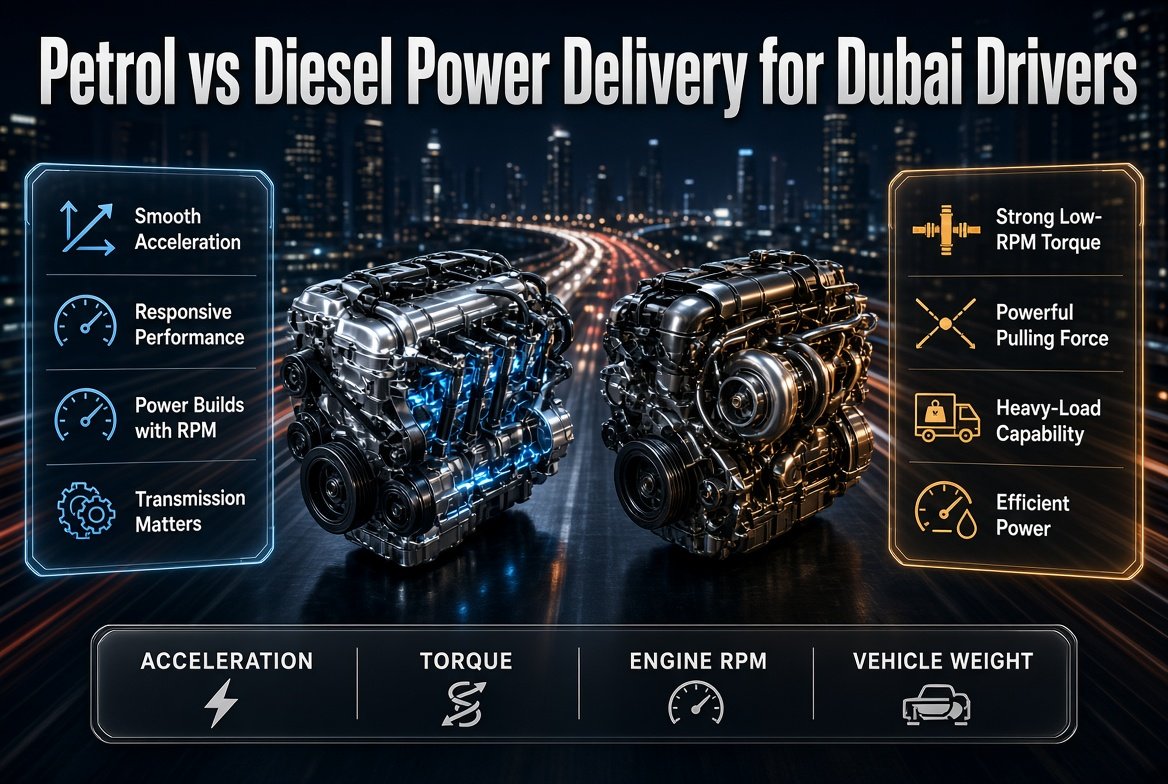
Petrol vs Diesel Power Delivery for Dubai Drivers | Imagine driving along Sheikh Zayed Road during busy hours. You need to merge into traffic, accelerate after a signal, or overtake another vehicle safely. Your car responds when you press the accelerator, but the way it builds speed depends on its engine, transmission, weight, and overall design. This is where understanding petrol vs diesel power delivery for Dubai drivers becomes important.
Petrol and diesel engines can both provide excellent performance, but they usually deliver power differently. Petrol engines often offer smooth acceleration and strong performance as engine speed increases. Diesel engines commonly produce substantial torque at lower engine speeds, which can help vehicles move heavy loads and accelerate without requiring frequent high-RPM operation.
However, choosing between petrol and diesel is not simply a matter of deciding which engine feels stronger. Dubai drivers must also consider daily traffic, long-distance journeys, air-conditioning demand, fuel consumption, vehicle maintenance, and the type of car they intend to drive.
For drivers who need practical vehicle guidance and roadside fuel assistance, Fuel Delivery Dubai provides a starting point for exploring fuel-related services and useful automotive information.
In this guide, we will explain how petrol and diesel power delivery work, compare their real-world performance, examine their behaviour in Dubai’s driving conditions, and identify the factors that matter most when choosing a vehicle. You will also learn how to evaluate engine specifications, recognize common performance problems, and maintain your vehicle for consistent power delivery.
1. What Does Power Delivery Mean in a Petrol or Diesel Car?
Power delivery describes how an engine produces useful mechanical power and how that power reaches the vehicle’s wheels. It influences how a car moves away from a standstill, responds to accelerator input, gains speed, and maintains momentum when carrying passengers or travelling uphill.
Drivers often describe power delivery using words such as responsive, smooth, strong, quick, or effortless. These descriptions refer to different aspects of performance. A vehicle may feel strong when pulling away from a traffic light but take longer to accelerate at highway speeds. Another vehicle may feel less forceful initially but build speed rapidly as the engine revs increase.
Understanding this difference helps you compare petrol and diesel vehicles more accurately.
What is torque?
Torque is the rotational force produced by an engine. It helps turn the crankshaft and contributes to the force available to move the vehicle.
Many diesel engines produce substantial torque at relatively low engine speeds. This characteristic can make them feel strong when accelerating from low speeds or carrying heavy loads.
Petrol engines can also produce excellent torque, particularly when equipped with turbocharging. Their torque delivery depends on engine displacement, intake design, tuning, and the RPM range in which the engine operates.
What is horsepower?
Horsepower measures the rate at which an engine performs work. It is closely related to torque and engine speed.
A vehicle with higher horsepower may have an advantage when accelerating at higher speeds, provided its weight, gearing, traction, and other characteristics are comparable.
For example, a petrol SUV with a powerful engine may accelerate faster than a heavier diesel SUV even if the diesel produces more peak torque. The diesel might still feel stronger at low RPM because of how its torque is delivered.
Why does the difference matter in Dubai?
Dubai drivers experience several different driving situations throughout the week. A commuter may spend time in stop-start traffic, travel along Sheikh Zayed Road, park in crowded areas, and occasionally make longer journeys to Abu Dhabi or other emirates.
Each situation places different demands on a vehicle.
- City driving requires smooth, predictable response at low speeds.
- Highway merging requires sufficient acceleration to match traffic speed safely.
- Long-distance journeys benefit from consistent performance and efficient cruising.
- Carrying passengers or equipment increases the load the engine must move.
- Hot weather increases the importance of maintaining the cooling system and air-conditioning performance.
The best power delivery is therefore not necessarily the most aggressive. It is the powertrain behaviour that suits your regular driving conditions.
2. How Does a Petrol Engine Deliver Power?
A petrol engine generally uses spark ignition. Air enters the engine, petrol is mixed with the air or introduced through direct injection, and a spark plug ignites the combustible mixture. The resulting pressure pushes the pistons and produces mechanical power.
Petrol engines are available in naturally aspirated and turbocharged designs. Naturally aspirated engines draw air into the cylinders without a turbocharger, while turbocharged engines use compressed air to increase the amount of oxygen available for combustion.
These designs can produce noticeably different driving experiences.
Smooth acceleration and higher-RPM performance
Many petrol engines operate comfortably across a relatively broad RPM range and can continue building power as engine speed increases.
This can make petrol vehicles enjoyable for drivers who prefer smooth acceleration and responsive performance when the transmission selects a lower gear.
For example, a petrol sedan travelling through Downtown Dubai may need to accelerate gently after a traffic light and then increase speed to join moving traffic. A well-calibrated engine and automatic transmission can provide smooth, predictable response throughout the process.
Petrol engines can offer several practical advantages:
- Smooth operation in many passenger vehicles.
- Responsive acceleration when the engine is operating in its effective RPM range.
- Strong high-RPM performance in suitable designs.
- Broad availability across sedans, hatchbacks, SUVs, and sports cars.
- Compatibility with conventional automatic and hybrid powertrains.
These advantages are not universal. A small petrol engine in a heavy SUV may struggle when the vehicle is fully loaded, while a powerful turbocharged diesel may feel considerably stronger in the same situation.
How does accelerator response work?
Pressing the accelerator requests more power from the engine. In modern vehicles, an electronic control system interprets the driver’s input and adjusts factors such as throttle opening, fuel delivery, ignition timing, and boost pressure where applicable.
The engine does not always respond instantly to the driver’s request. Turbocharger response, transmission downshifts, traction control, and engine-management programming can introduce a short delay.
This explains why two petrol cars with similar horsepower figures can feel different during everyday driving.
A naturally aspirated petrol engine may respond progressively as the accelerator is pressed. A turbocharged petrol engine may deliver stronger torque once sufficient boost pressure is available. Some turbo engines respond almost immediately, while others require more time to build boost.
When choosing a petrol vehicle, evaluate how naturally it responds during ordinary acceleration rather than judging it only by its maximum power rating.
Is petrol power delivery suitable for city driving?
Petrol engines are often a practical choice for drivers who make frequent short journeys, commute through residential areas, and use their vehicles mainly for everyday errands.
Their suitability depends on the complete vehicle, particularly the engine’s low-speed behaviour and transmission calibration.
A petrol sedan with a smooth automatic gearbox may be comfortable in congested traffic. A petrol SUV with a small engine may require more accelerator input when carrying several passengers or accelerating onto a fast road.
Expert tip: During a test drive, pay attention to the transition between gentle acceleration and moderate acceleration. The vehicle should respond predictably without excessive hesitation, harsh gear changes, or unnecessary engine noise.
3. How Does a Diesel Engine Deliver Power?
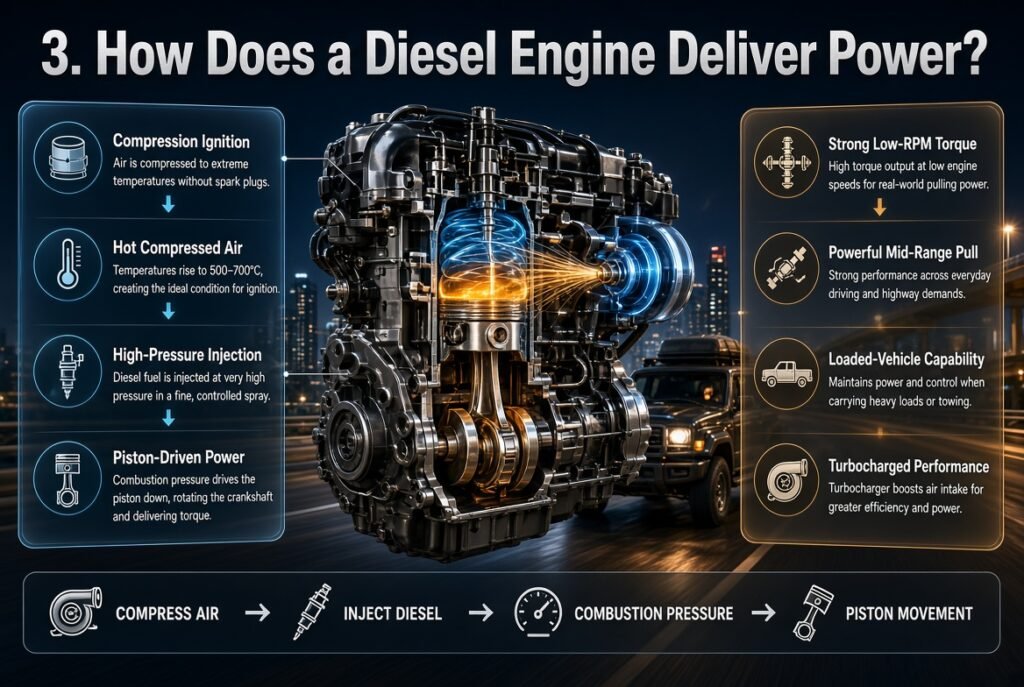
Diesel engines use compression ignition. Instead of relying on spark plugs to ignite the air-fuel mixture, they compress air to a high temperature and inject diesel fuel into that hot air. Combustion produces the pressure needed to move the pistons.
Modern diesel engines commonly use high-pressure fuel injection, electronic engine management, and turbocharging. These technologies help manufacturers improve power output, fuel economy, and emissions control.
Why diesel engines often feel strong at low RPM
Many diesel engines are designed to produce substantial torque at low or medium engine speeds. This can help a vehicle accelerate without needing to rev as high as some petrol engines.
For drivers, the result may feel like strong pulling power. A diesel SUV can move away from a junction confidently, while a diesel pickup can provide useful force when carrying tools, materials, or other equipment.
This characteristic is particularly valuable when the vehicle’s intended use involves sustained loads or frequent highway travel.
Typical advantages include:
- Strong low- and mid-range torque in many models.
- Useful pulling power for heavier vehicles.
- Efficient operation in many long-distance applications.
- Reduced need for frequent high-RPM acceleration in suitable conditions.
- Strong performance potential in pickups, vans, and commercial vehicles.
Nevertheless, diesel engines are not automatically stronger in every situation. Engine size, turbocharger design, gearing, and maximum horsepower can change the result significantly.
How diesel power delivery feels in everyday driving
Consider a diesel SUV travelling from Al Quoz towards Jebel Ali with passengers and luggage. When the driver accelerates from a moderate speed, the engine may provide strong mid-range pulling force without needing a large increase in RPM.
This can make the vehicle feel relaxed during normal driving.
However, low-speed torque does not eliminate the need for appropriate gearing. If the vehicle is in the wrong gear or its engine is operating outside its most effective range, acceleration may still feel slow.
Some diesel engines also produce noticeable vibration or noise at idle, although modern designs have reduced these characteristics considerably.
Are diesel engines suitable for frequent short trips?
A diesel vehicle can be used in urban environments, but the maintenance requirements of some modern diesel engines deserve careful attention.
Many newer models have diesel particulate filters, or DPFs, that collect soot from exhaust gases. These filters periodically need suitable operating conditions to regenerate and burn off accumulated soot.
Repeated short journeys, frequent interruptions to regeneration, and certain patterns of low-load operation can make regeneration more difficult for some vehicles.
This does not mean every diesel car is unsuitable for city driving. It means drivers should understand the manufacturer’s guidance for their specific model.
Common mistake: Choosing a diesel vehicle only because it produces high torque, without considering whether the driver’s usual journeys suit its emissions system and maintenance requirements.
4. Petrol vs Diesel Power Delivery: The Main Differences
Petrol and diesel engines can both provide strong performance, but their power characteristics often differ across the engine’s operating range.
Petrol engines frequently offer a higher-revving character, while diesel engines commonly provide substantial torque at lower RPM. These are general tendencies rather than strict rules.
| Performance factor | Petrol engine | Diesel engine |
|---|---|---|
| Ignition method | Spark ignition | Compression ignition |
| Typical driving character | Smooth and flexible, often higher-revving | Strong low- and mid-range pulling force |
| Low-speed acceleration | Depends on engine and gearing | Often strong in suitable models |
| Higher-RPM performance | Many engines continue building power effectively | Many engines operate over a narrower RPM range |
| Highway overtaking | Can be excellent with sufficient horsepower | Can be excellent with strong mid-range output |
| Heavy-load driving | Suitable in many vehicles | Often attractive for sustained load |
| Short urban journeys | Often a practical option | Requires consideration of model-specific emissions systems |
| Fuel economy | Varies considerably by design | Often favourable in comparable long-distance applications |
| Maintenance priorities | Ignition, fuel, cooling, and engine-management systems | Fuel injection, turbocharging where fitted, emissions equipment, and cooling |
Which engine feels more powerful?
The answer depends on the type of performance you notice most.
If you value a strong response at low engine speeds, a suitable diesel may feel more powerful. If you prefer acceleration that builds as engine speed rises, a petrol engine may provide the driving experience you want.
Neither sensation guarantees a faster vehicle.
A diesel engine with strong torque but modest horsepower may feel forceful at low speeds without achieving the shortest acceleration time. A petrol engine with greater horsepower may accelerate faster, particularly when its transmission keeps the engine in the correct operating range.
For a broader explanation of the differences in engine design, performance, and everyday ownership, read Petrol vs. Diesel Comparisons in Dubai.
5. How Does Petrol vs Diesel Power Delivery Affect Dubai City Driving?
Dubai’s urban roads require drivers to change speed frequently. Traffic signals, junctions, parking entrances, congestion, and merging traffic all influence how an engine feels during normal use.
In these conditions, predictable response and smooth transmission behaviour can matter more than maximum horsepower.
Pulling away from traffic lights
When a traffic light turns green, the engine must provide enough force to move the vehicle smoothly.
A diesel engine with strong low-RPM torque may move away confidently without requiring high engine speed. A petrol engine can achieve the same result when its power output, gearing, and vehicle weight are appropriately matched.
The transmission plays an important role. A well-calibrated automatic gearbox can make either engine type feel smooth and responsive.
Drivers should avoid judging power delivery solely by how quickly a vehicle launches from a standstill. Aggressive acceleration can increase fuel consumption, reduce comfort, and create unnecessary risks in traffic.
Driving through congested areas
During stop-start driving in Deira, Business Bay, or Downtown Dubai, the engine repeatedly transitions between idling, gentle acceleration, and slowing down.
A vehicle that responds smoothly to small accelerator inputs can be easier to control in these situations.
The characteristics worth evaluating include:
- Smooth movement at very low speeds.
- Predictable response to light accelerator pressure.
- Minimal hesitation when moving into a gap.
- Comfortable transmission shifts.
- Stable engine operation with the air conditioner running.
A diesel may offer strong low-speed torque, but its exact behaviour depends on engine calibration and gearbox design. A petrol car may be equally comfortable, particularly when it has a responsive automatic transmission or hybrid assistance.
Is engine torque more important than horsepower in city traffic?
Torque can be particularly noticeable at low speeds, but the torque delivered to the wheels matters more than the engine’s peak torque figure alone.
Transmission ratios multiply engine torque, while vehicle weight and tyre grip affect the resulting acceleration.
For this reason, a petrol car with carefully chosen gearing may feel more responsive than a diesel with a higher peak torque figure.
The practical approach is to test the vehicle in conditions resembling your regular commute and compare the exact models you are considering.
6. Petrol vs Diesel Power Delivery on Sheikh Zayed Road
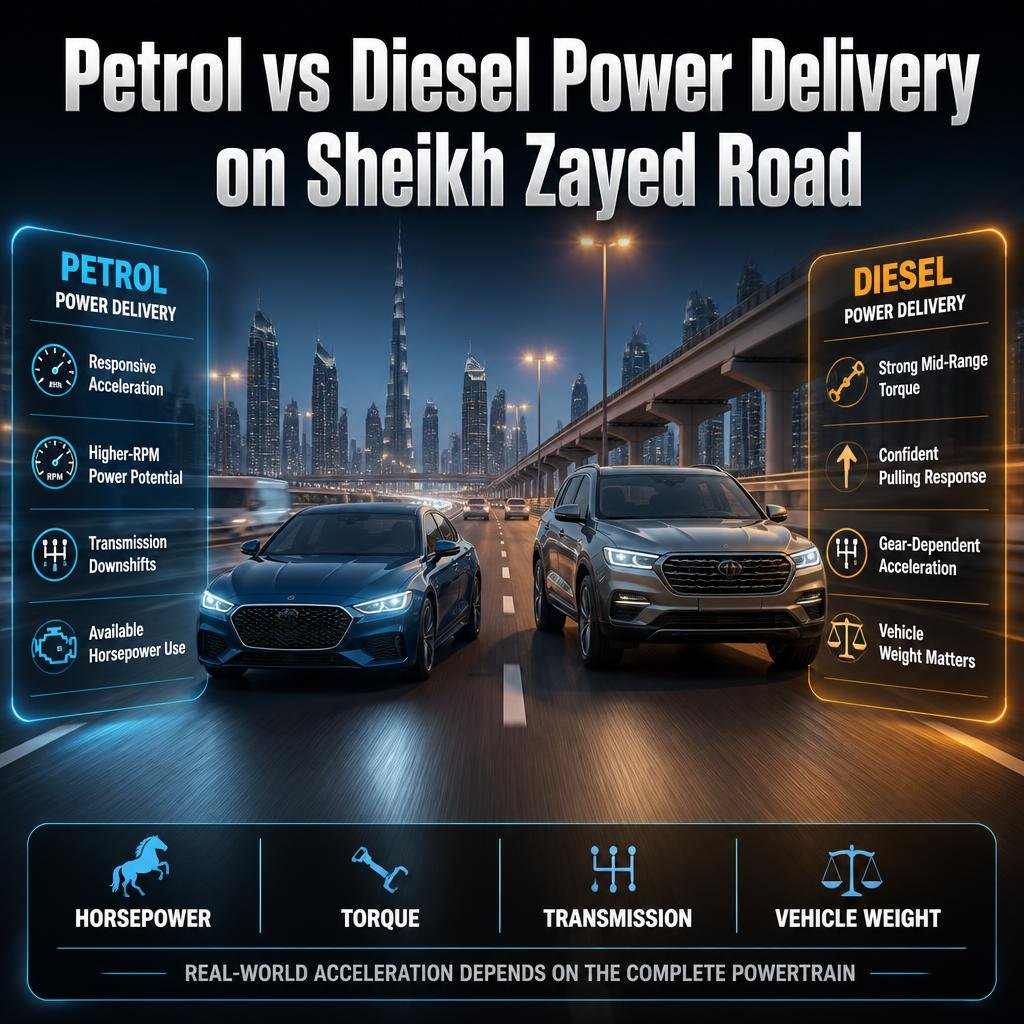
Highway driving places different demands on an engine. Once a vehicle reaches a moderate or high road speed, acceleration depends increasingly on available power, gearing, aerodynamic resistance, and vehicle weight.
For Dubai drivers using Sheikh Zayed Road, the ability to merge smoothly and accelerate when needed is often more important than the sensation of strong pulling force at very low speeds.
Which engine is better for merging?
A vehicle merging onto a highway needs to reach a suitable speed within the available distance while maintaining control.
A petrol engine with sufficient horsepower can provide strong acceleration, particularly when the transmission downshifts to a more suitable gear. A diesel engine with a broad torque curve may also provide effective acceleration without requiring high RPM.
The result depends on the specific powertrain.
For example, a turbocharged petrol sedan may accelerate quickly when its transmission selects the correct gear. A diesel SUV may deliver strong mid-range acceleration but take longer to gain speed because of its additional weight.
The correct comparison includes the vehicle’s measured acceleration, transmission response, and performance at the road speeds relevant to your journey.
Which engine is better for overtaking?
Safe overtaking requires enough available acceleration to complete the manoeuvre within an appropriate distance and without exceeding speed limits.
Neither petrol nor diesel automatically provides safer overtaking performance.
Important factors include:
- The power available at your current road speed.
- How quickly the transmission selects the appropriate gear.
- The vehicle’s weight and load.
- Road conditions, visibility, and available space.
- The driver’s judgement and compliance with traffic rules.
A diesel engine’s mid-range torque may make acceleration feel effortless. A petrol engine’s higher-RPM power may provide stronger acceleration once it reaches its effective operating range.
For a more focused discussion of response and acceleration, read Petrol vs Diesel Acceleration in Dubai.
Why maximum speed is not the best measure
A vehicle’s maximum speed does not tell you how comfortably it accelerates during everyday driving.
Most drivers rarely approach maximum speed, while merging and moderate-speed acceleration occur much more frequently.
When comparing two cars, focus on useful performance, predictable response, and the ability to maintain speed without unnecessary strain.
A vehicle that delivers smooth, sufficient power at normal road speeds may be more practical than one that has a higher top-speed figure but less suitable everyday response.
7. How Do Torque and Horsepower Work Together?
Torque and horsepower are closely related, but they describe different aspects of engine performance. Understanding both helps explain why a diesel can feel strong at low speeds while a petrol car may accelerate faster overall.
Why torque affects pulling force
Torque describes rotational force at the engine’s crankshaft. The transmission and final-drive gearing can multiply this force before it reaches the wheels.
This means engine torque alone does not reveal the full amount of force available at the road surface.
A diesel engine producing substantial torque may be particularly useful when a vehicle is heavily loaded. However, a petrol engine with lower peak torque may deliver comparable wheel force through suitable gearing.
Tyre traction also matters. If the tyres cannot maintain grip, additional engine torque will not necessarily improve acceleration.
Why horsepower matters for acceleration
Horsepower measures how quickly the engine can perform work. At higher road speeds, available power becomes increasingly important because aerodynamic drag rises substantially with speed.
A vehicle with greater horsepower may continue accelerating strongly where a lower-powered vehicle begins to gain speed more slowly.
This is one reason that peak torque should not be treated as a complete measure of performance.
Compare the full engine specifications
When reviewing a petrol or diesel vehicle, examine the following:
- Maximum horsepower and the engine speed at which it is produced.
- Maximum torque and the RPM range where it is available.
- Vehicle weight and permitted payload.
- Transmission type and gear ratios.
- Manufacturer-quoted acceleration figures.
- Independent performance tests where available.
A car’s power curve often tells you more than a single maximum figure. A broad torque plateau may provide consistent acceleration, while a strong horsepower figure can indicate good high-speed performance.
For a detailed discussion of engine pulling force and how it influences vehicle behaviour, explore Petrol vs Diesel Torque Comparison in Dubai.
8. How Do Dubai’s Hot Conditions Affect Power Delivery?
Dubai’s hot climate makes engine cooling, lubrication, and air-conditioning performance important parts of vehicle ownership.
Modern petrol and diesel engines are designed to operate within specified temperature ranges, but excessive heat or poor maintenance can affect performance in either type.
Does hot weather reduce engine power?
Hot air is less dense than cooler air at the same pressure, which means it contains less oxygen per unit of volume. This can affect engine output, particularly in naturally aspirated engines.
Turbocharged engines can compensate to some extent by compressing intake air, but their actual output still depends on intake temperature, boost control, intercooling, and engine-management limits.
When temperatures are high, some vehicles may reduce power to protect the engine or other components. The effect varies by model and operating conditions.
This is why a vehicle’s performance in mild weather may not fully represent its behaviour during a very hot Dubai afternoon.
How does air conditioning affect acceleration?
The air-conditioning system requires energy to operate. Depending on the system, this can add mechanical or electrical load to the powertrain.
The effect is often more noticeable during low-speed driving, particularly in a vehicle with limited power.
A modern petrol engine may adjust its operation to compensate for air-conditioning demand. A diesel engine may also manage the additional load effectively, although the exact result depends on the design.
Hybrid vehicles can use electric assistance to manage some driving demands differently.
When comparing vehicles, evaluate comfort and acceleration with the air conditioning operating normally.
Why engine cooling maintenance matters
An engine that overheats may lose performance as its control system attempts to protect critical components.
Potential cooling-system problems include:
- Low coolant caused by a leak.
- A cooling fan that does not operate correctly.
- A restricted radiator.
- A faulty thermostat.
- A defective pressure cap or another cooling-system component.
If the temperature gauge rises abnormally or a temperature warning appears, stop in a safe place and follow the manufacturer’s instructions. Never open a hot, pressurized cooling system.
Professional advice: Use the coolant specification recommended for your vehicle, maintain the cooling system according to the service schedule, and investigate unexplained coolant loss. Replacing components without diagnosis can waste money and leave the actual fault unresolved.
9. Does Stronger Power Delivery Mean Better Fuel Economy?

No. Power delivery and fuel economy are related, but they measure different things.
Power delivery describes how an engine responds and transfers power. Fuel economy describes how effectively the vehicle uses fuel to cover a given distance.
A vehicle can feel powerful while consuming considerable fuel. Another vehicle may deliver sufficient performance while using less fuel because of its engine design, transmission, weight, and operating conditions.
When diesel may offer a fuel-economy advantage
Diesel engines often achieve favourable fuel economy in comparable applications, particularly during long-distance driving and sustained-load operation.
Their efficiency can make them attractive to drivers who cover substantial annual distances or use vehicles for commercial work.
However, actual savings depend on fuel prices, driving patterns, maintenance, and the purchase price of the vehicle.
A diesel that saves fuel may not necessarily cost less to own if it has a higher purchase price or more expensive repairs.
When petrol may be the better overall choice
Petrol may suit drivers who travel relatively short distances, use their cars mainly in urban areas, or prefer the performance and comfort of a particular petrol model.
Petrol hybrids may also be worth considering because electric assistance can reduce fuel consumption in suitable stop-start driving conditions.
A realistic comparison should include:
- Actual fuel consumption in your normal driving conditions.
- Annual kilometres driven.
- Current fuel prices applicable to your vehicle.
- Routine maintenance and repair costs.
- Purchase price and expected resale value.
- Any model-specific emissions-system requirements.
Do not rely exclusively on a manufacturer’s best-case fuel-consumption figure. Your own driving pattern can produce different results.
For a detailed explanation of how petrol and diesel economy compare, see Petrol vs Diesel Fuel Economy in Dubai.
10. Which Engine Suits Sedans, SUVs, and Pickups?
The most suitable engine depends on the vehicle’s size, intended workload, and typical journey.
Petrol engines for sedans
Petrol sedans are often well suited to commuting, family travel, and everyday urban driving.
They can offer smooth acceleration, comfortable operation, and sufficient power for highway journeys. Models with suitable gearing may also provide excellent responsiveness during merging and overtaking.
However, not all petrol sedans deliver the same experience. Engine size, turbocharging, transmission calibration, and vehicle weight all influence performance.
Choose a vehicle that provides sufficient power without requiring constant aggressive acceleration during normal use.
Petrol and diesel engines for SUVs
Large SUVs often weigh more than sedans and may regularly carry passengers and luggage.
A diesel SUV with strong low-speed torque can feel relaxed when accelerating under load. It may also be attractive for long-distance travel, depending on the vehicle’s fuel economy and maintenance requirements.
A petrol SUV can provide strong acceleration and may suit drivers who mainly use their vehicles for city travel.
Before deciding, compare the actual engine variants, towing requirements, passenger capacity, and annual mileage.
Diesel engines for pickups and commercial vehicles
Diesel engines are frequently used in pickups, vans, and commercial vehicles because many are designed to deliver useful pulling force under sustained loads.
For a pickup travelling between warehouses in Al Quoz and work sites elsewhere in Dubai, low- and mid-range torque may be particularly useful.
Nevertheless, the engine’s torque rating does not determine the permitted payload. Chassis design, suspension, tyres, brakes, and manufacturer specifications establish the vehicle’s safe operating limits.
A petrol pickup may still be suitable for lighter duties or less frequent use. The correct choice depends on the actual workload and operating costs.
11. Common Mistakes When Comparing Petrol and Diesel Power Delivery
Drivers sometimes make decisions based on engine reputation rather than the complete vehicle. These mistakes can lead to higher ownership costs or disappointing performance.
Mistake 1: Assuming every diesel is more powerful
Diesel engines commonly produce strong low-RPM torque, but this does not guarantee greater horsepower or faster acceleration.
Why it happens: Buyers often compare peak torque figures without considering the rest of the powertrain.
How to avoid it: Compare horsepower, torque curves, vehicle weight, gearing, and measured acceleration.
Mistake 2: Assuming every petrol car is faster
Petrol engines can perform strongly at higher RPM, but a diesel vehicle with greater power or better gearing may accelerate faster.
Why it happens: Drivers associate high engine speed with performance and overlook differences in engine output.
How to avoid it: Compare the exact vehicle versions, not just their fuel types.
Mistake 3: Ignoring transmission behaviour
A capable engine may feel slow if its transmission delays downshifts or uses unsuitable gear ratios.
Why it happens: Buyers concentrate on engine specifications and overlook the gearbox.
How to avoid it: During a test drive, assess low-speed movement, normal acceleration, and how smoothly the transmission responds when additional power is requested.
Mistake 4: Choosing diesel only for low-RPM torque
Strong pulling force may be attractive, but some modern diesel engines have emissions-system requirements that are less convenient for repeated short trips.
Why it happens: Buyers focus on performance and fuel economy without considering journey length.
How to avoid it: Review the manufacturer’s guidance for the specific diesel engine and assess whether your regular driving pattern suits it.
Mistake 5: Ignoring vehicle weight
A heavier vehicle requires more force to accelerate under otherwise comparable conditions.
Why it happens: Buyers compare engine output but fail to consider how much weight the engine must move.
How to avoid it: Compare power-to-weight characteristics, actual acceleration figures, and expected passenger or cargo loads.
Mistake 6: Treating one test drive as a complete assessment
A brief drive may not reveal how the vehicle performs under different conditions.
Why it happens: Drivers often focus on the first impression of acceleration.
How to avoid it: Evaluate low-speed response, moderate acceleration, transmission behaviour, cabin comfort, and highway performance where safe and legal.
Mistake 7: Overlooking maintenance-related power loss
A poorly maintained engine may perform worse than its specifications suggest.
Why it happens: Drivers sometimes assume that reduced acceleration is a normal characteristic of the fuel type.
How to avoid it: Investigate changes in performance, warning lights, rough running, or unusual smoke instead of assuming the engine is naturally weak.
12. Expert Advice for Maintaining Consistent Engine Performance

A well-maintained engine is more likely to deliver the performance intended by its manufacturer. Maintenance cannot change an engine’s basic design, but it can help prevent avoidable power loss and improve reliability.
Follow the correct servicing schedule
Use the manufacturer’s recommended intervals for engine oil, filters, spark plugs where fitted, and other service items.
If the manufacturer specifies different requirements for severe operating conditions, follow the guidance applicable to your driving pattern.
Dubai’s heat, traffic, dust, and air-conditioning demand make regular inspections particularly important, but service intervals should still be based on the vehicle’s specifications rather than guesswork.
Keep the air and fuel systems in good condition
Restricted airflow, fuel-delivery problems, and faulty sensors can affect acceleration.
Petrol vehicles may develop ignition-system faults that cause misfiring or rough running. Diesel vehicles may experience issues involving fuel injection, turbocharging, or emissions equipment.
These symptoms can overlap, so diagnosis is more reliable than replacing parts based on assumptions.
Use the correct engine oil and coolant
Engine oil protects moving components, while coolant helps maintain the required operating temperature.
Use products that meet the manufacturer’s specifications. Oil viscosity and coolant requirements vary between vehicles, so a fluid that is appropriate for one engine may not be suitable for another.
Check for unexplained fluid loss and investigate leaks promptly.
Maintain tyre pressure and condition
Tyres influence rolling resistance, grip, braking, and handling. Incorrect pressure can affect fuel consumption and the way a vehicle responds to acceleration.
Check pressures when the tyres are cold and follow the vehicle manufacturer’s recommendations.
Inspect the tyres for damage and uneven wear, and replace them when required.
Investigate sudden power loss
If your vehicle suddenly becomes less responsive, possible causes include intake restrictions, fuel-system faults, overheating, engine-management problems, or transmission issues.
A warning light, unusual vibration, abnormal smoke, or overheating should not be ignored.
Arrange a professional inspection when necessary, particularly if the vehicle loses power suddenly or cannot maintain normal performance safely.
13. A Practical Checklist for Choosing Between Petrol and Diesel
Before purchasing a vehicle, use this checklist to make the comparison more objective.
Step 1: Identify your main driving pattern
Consider whether most of your journeys involve short city trips, regular highway commuting, long-distance travel, or commercial work.
Your regular driving pattern helps determine which powertrain characteristics are most useful.
Step 2: Define the performance you need
Ask yourself whether you mainly want smooth city response, confident highway acceleration, strong pulling force, or sufficient power while carrying loads.
Avoid paying for performance you rarely use, but don’t choose an engine that feels inadequate for your normal requirements.
Step 3: Compare actual specifications
Review horsepower, torque, RPM ranges, vehicle weight, transmission type, and acceleration data.
If you are comparing used vehicles, also consider their age, mileage, service history, and mechanical condition.
Step 4: Evaluate total ownership costs
Calculate fuel costs using realistic consumption figures and your expected annual mileage.
Include routine servicing, insurance, purchase price, likely repairs, and any model-specific maintenance requirements.
Step 5: Test-drive the exact model
A petrol engine in one vehicle may feel very different from a petrol engine in another. The same is true of diesel models.
Test the vehicle under safe, legal conditions and pay attention to smoothness, hesitation, noise, vibration, and transmission response.
Step 6: Make the decision based on evidence
Choose the vehicle that best balances performance, efficiency, comfort, reliability, and ownership costs.
A well-maintained vehicle with suitable power delivery is often a better purchase than a more powerful vehicle that does not suit your needs.
Is petrol or diesel better for power delivery in Dubai’s daily driving conditions?
Petrol and diesel engines deliver power differently, so the better choice depends on your driving habits and the type of performance you expect. Petrol engines often provide smooth acceleration and responsive performance as engine speed increases. Diesel engines commonly produce strong torque at lower RPM, which can make them feel powerful when moving away from traffic lights or accelerating with passengers and luggage.
For drivers travelling through Downtown Dubai, Business Bay, or other congested areas, smooth low-speed response and transmission behaviour are particularly important. For drivers who regularly use highways or carry heavy loads, a diesel engine may offer useful pulling power.
Important factors to consider:
Choose a petrol engine if you prioritise smooth everyday driving and responsive acceleration.
Consider diesel if you regularly travel long distances or need strong pulling force.
Compare the exact engine specifications, vehicle weight, and transmission performance before deciding.
Evaluate maintenance requirements alongside performance, especially if most of your journeys are short.
Why do diesel engines often feel more powerful than petrol engines at low speeds?
Diesel engines often feel stronger at low speeds because many are designed to produce substantial torque at relatively low engine RPM. Torque is the rotational force that helps the engine move the vehicle, while horsepower measures how quickly the engine performs work. This strong low-RPM torque can make a diesel vehicle feel capable when pulling away from a stop, climbing a gradient, or carrying a heavy load.
However, a stronger pulling sensation does not automatically mean the vehicle accelerates faster. Transmission gearing, vehicle weight, available horsepower, turbocharger response, and tyre traction all affect real-world performance. A turbocharged petrol engine can also deliver substantial low-speed torque.
What drivers should understand:
Low-RPM torque can make acceleration feel effortless without high engine speeds.
Gear ratios influence how effectively engine torque reaches the wheels.
Horsepower becomes increasingly important when evaluating acceleration at higher speeds.
The complete power curve is more informative than comparing peak torque figures alone.
Which engine provides better acceleration on Sheikh Zayed Road?
The engine that provides better acceleration on Sheikh Zayed Road depends on the particular vehicles being compared. A petrol engine with strong horsepower may accelerate rapidly when the transmission selects the appropriate gear. A diesel engine with a broad mid-range torque curve can also provide confident acceleration, especially when the vehicle is carrying passengers or luggage.
For highway driving, drivers should focus on how quickly a car responds at normal road speeds, rather than judging performance only by its initial acceleration from a traffic light. Transmission response is particularly important because a delayed downshift can make a vehicle feel less responsive when additional power is needed.
Before choosing a vehicle, compare:
Manufacturer-quoted acceleration figures and independent performance tests.
Available horsepower and torque across the engine’s operating range.
Vehicle weight, transmission type, and gear ratios.
Smoothness and predictability during safe, legal test-drive conditions.
A suitable engine should provide enough acceleration for normal merging and overtaking without requiring risky manoeuvres or excessive speed.
Does petrol or diesel provide better power and fuel economy in Dubai’s hot weather?
Fuel economy and power delivery depend on engine design, vehicle condition, driving style, and operating conditions. Diesel engines often offer good fuel economy in comparable vehicles, particularly during long-distance driving. Petrol engines can provide an attractive balance of performance and efficiency, while petrol-hybrid vehicles may be especially efficient in certain stop-start conditions.
Dubai’s hot weather adds further considerations. Air conditioning places an additional load on the powertrain, while high intake temperatures can affect engine output. A properly maintained cooling system helps the engine operate within its intended temperature range. Neither petrol nor diesel engines are automatically immune to performance changes in extreme heat.
Practical recommendations:
Compare real-world fuel consumption for the exact vehicle models.
Maintain the cooling system and use manufacturer-specified fluids.
Keep tyres inflated to the recommended pressure.
Drive smoothly and avoid unnecessary rapid acceleration.
Consider annual mileage and maintenance costs when calculating overall savings.
The most economical choice is the vehicle that meets your performance needs while delivering suitable fuel consumption and manageable ownership costs.
How can Dubai drivers maintain strong petrol or diesel engine performance?
Maintaining strong engine performance starts with following the manufacturer’s servicing schedule and identifying problems before they become more serious. Restricted air filters, fuel-delivery faults, incorrect fluid specifications, overheating, and transmission problems can all affect acceleration. Petrol engines may also experience ignition-system issues, while diesel engines can develop problems involving fuel injection, turbocharging, or emissions-control equipment.
Drivers should pay attention to changes in normal performance. Slow acceleration, rough idling, unusual smoke, warning lights, or abnormal engine temperatures should not automatically be treated as ordinary characteristics of a petrol or diesel engine.
Essential maintenance practices:
Service the engine using the manufacturer’s recommended intervals and specifications.
Inspect the cooling system and investigate unexplained coolant loss.
Check tyre pressure and condition regularly.
Address warning lights, unusual noises, and sudden power loss promptly.
Follow the manufacturer’s guidance for diesel particulate filter regeneration where applicable.
Obtain a professional diagnosis before replacing expensive components.
Consistent maintenance helps preserve the engine’s intended performance, supports reliability in Dubai’s demanding driving conditions, and can prevent avoidable repair expenses.
Conclusion
Choosing between petrol and diesel power delivery in Dubai depends on how you drive, the type of vehicle you own, and the performance you expect from your engine. Petrol engines are often a suitable choice for drivers who value smooth acceleration, responsive throttle control, and comfortable performance during everyday city journeys. Diesel engines, on the other hand, are well suited to drivers who need strong low-speed pulling power, confident performance under heavy loads, or consistent torque for long-distance highway driving.
Dubai’s driving conditions also influence how each engine performs. Heavy traffic, frequent stops, air-conditioning use, high temperatures, and long highway journeys can affect engine efficiency and responsiveness. For this reason, comparing petrol and diesel engines requires more than looking at horsepower or torque figures alone. Transmission behaviour, vehicle weight, maintenance requirements, fuel consumption, and driving habits all contribute to real-world performance.
Before making a decision, consider your regular routes, annual mileage, vehicle type, and long-term ownership costs. A petrol engine may provide the responsiveness you need for daily commuting, while a diesel engine may offer practical advantages for towing, carrying heavy loads, or covering substantial highway distances. Neither option is automatically better for every driver.
For more guidance on choosing the right fuel type and understanding engine performance, explore the resources available at Fuel Delivery Dubai. By understanding how petrol and diesel engines deliver power, you can make a more informed vehicle decision, maintain reliable performance, and enjoy a driving experience suited to Dubai’s roads and conditions.
Leave a Reply