
Introduction
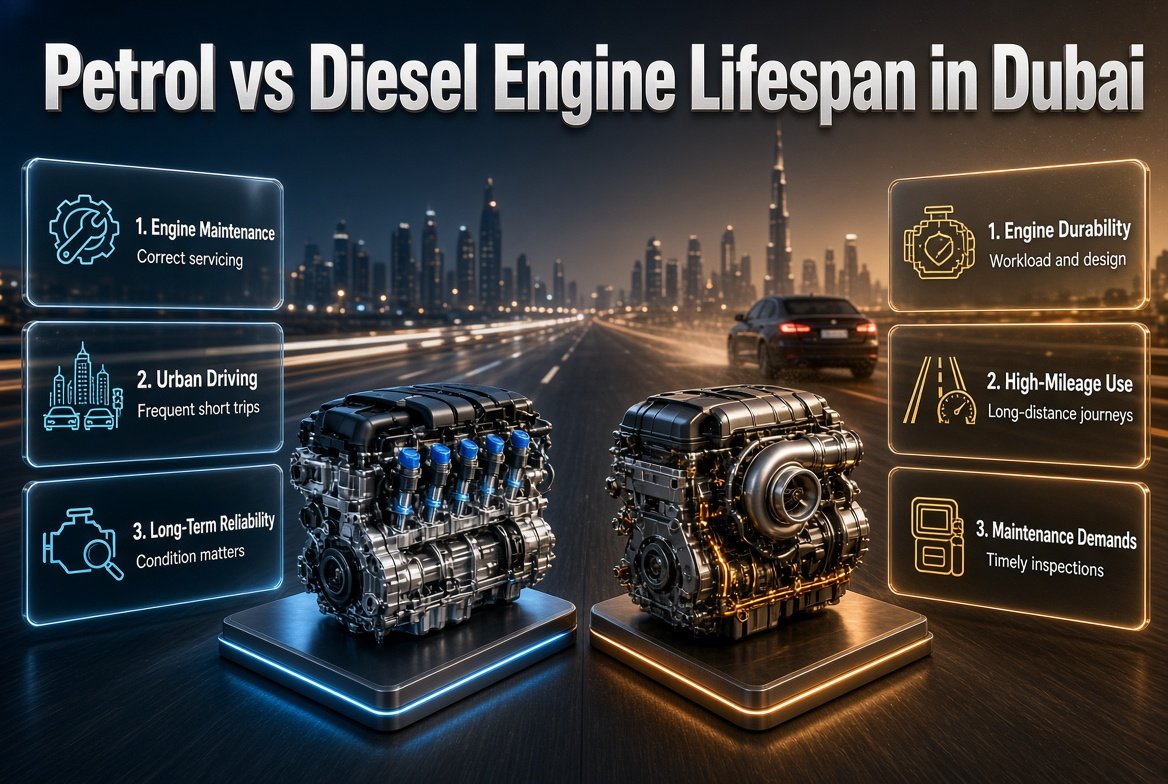
Petrol vs Diesel Engine Lifespan in Dubai | Buying a car in Dubai is not just about choosing a vehicle that looks good, delivers strong performance, or consumes less fuel. If you want to keep your car for many years, engine lifespan should be one of your most important considerations. The real question is whether a petrol or diesel engine can survive longer under Dubai’s demanding driving conditions without requiring expensive repairs.
The answer depends on several factors, including engine design, maintenance quality, driving habits, mileage, and the type of journeys you make. Diesel engines are often designed to handle high compression and sustained workloads, which can help them achieve high mileage. Petrol engines can also last for many years and may be more practical for drivers who mainly travel short distances in urban areas.
Dubai introduces additional challenges. High temperatures, heavy traffic, frequent air-conditioning use, dusty roads, and long highway journeys can influence how an engine ages. A poorly maintained diesel engine may require major repairs before a well-maintained petrol engine, even when both vehicles have similar mileage.
Understanding these differences can help you make a more informed decision before buying a new or used vehicle.
For drivers researching vehicle ownership, Fuel Delivery Dubai provides a starting point for exploring fuel-related services and information relevant to local driving needs.
This guide explains petrol vs diesel engine lifespan in Dubai, realistic mileage expectations, the effects of climate and traffic, maintenance requirements, warning signs of engine wear, and the factors that matter most when choosing a vehicle for long-term ownership.
1. How Long Do Petrol and Diesel Engines Last in Dubai?
A petrol engine can commonly reach approximately 200,000–300,000 km or more, while some diesel engines can reach 300,000–500,000 km or more with suitable maintenance and operating conditions. These are broad estimates rather than guaranteed lifespans or Dubai-specific statistical averages. Actual results depend on the exact engine, vehicle design, servicing history, and driving conditions.
The important distinction is between the engine’s potential lifespan and the lifespan of the entire vehicle. An engine may remain mechanically sound while the transmission, turbocharger, fuel system, cooling system, or emissions equipment requires expensive repairs.
Typical petrol engine lifespan
Petrol engines are widely used in sedans, hatchbacks, SUVs, and many family vehicles. Their lifespan varies considerably according to engine design, maintenance requirements, and the conditions in which they operate.
A properly maintained petrol engine can cover substantial mileage without requiring a complete rebuild. Regular oil changes, effective cooling, suitable fuel, and timely repairs help protect internal components.
For example, a petrol sedan used for a moderate daily commute may accumulate mileage gradually over several years. If it receives consistent servicing and avoids overheating, it may remain dependable well beyond 200,000 km.
However, frequent short trips, neglected oil changes, repeated overheating, and aggressive driving can shorten its service life.
Typical diesel engine lifespan
Diesel engines are often engineered to withstand high cylinder pressures and deliver strong torque at relatively low engine speeds. These characteristics make many diesel engines suitable for commercial vehicles, pickups, large SUVs, and long-distance driving.
A well-maintained diesel engine may achieve 300,000 km or more, and some engines designed for demanding applications can exceed 500,000 km.
Nevertheless, these figures should not be treated as promises. Modern diesel vehicles can have sophisticated injection systems, turbochargers, particulate filters, and exhaust-treatment components. The engine itself may remain in good condition while one of these systems needs costly attention.
Petrol vs diesel lifespan comparison
| Factor | Petrol engine | Diesel engine |
|---|---|---|
| Broad potential mileage | 200,000–300,000+ km | 300,000–500,000+ km |
| Compression characteristics | Generally lower compression | Generally higher compression |
| Typical strength | Often well suited to everyday mixed driving | Often well suited to sustained workloads |
| Short urban journeys | Generally practical | May be less suitable for some modern diesel systems |
| Heavy-load operation | Depends on engine design | Many models are designed for this use |
| Maintenance concerns | Ignition, oil, cooling and fuel systems | Fuel injection, turbocharging and emissions systems where fitted |
| Long-term reliability | Strong when properly maintained | Strong when properly maintained |
| Repair costs | Depend on the specific model | Some diesel-specific repairs can be expensive |
The key lesson is that diesel engines may have a higher potential mileage in suitable applications, but petrol engines can be equally sensible long-term choices for particular drivers.
2. How Does Dubai’s Climate Affect Engine Lifespan?
Dubai’s hot climate places additional demands on engine cooling, lubrication, air filtration, and other vehicle systems. High ambient temperatures reduce the difference between the engine’s operating temperature and the surrounding air, making effective heat management especially important.
Both petrol and diesel engines can operate reliably in Dubai, provided they are designed for the conditions and maintained correctly.
High temperatures and internal engine wear
Engine oil forms a protective film between moving components, reduces friction, and helps carry heat away from critical surfaces. Oil also collects contaminants that must eventually be removed through servicing.
When oil is degraded, unsuitable for the engine, or used beyond the recommended interval, its ability to protect internal components may be reduced.
The cooling system is equally important. A radiator, thermostat, water pump, cooling fan, hoses, and pressure cap must work together to control engine temperature.
If one component fails, the engine may overheat, especially in slow traffic or during heavy operation.
Repeated overheating can damage cylinder-head surfaces, head gaskets, pistons, and other internal components. In severe cases, an engine that was previously repairable may require a complete rebuild or replacement.
Dust and air filtration
Dust is another important consideration for vehicles operating in Dubai and surrounding desert areas.
An engine air filter prevents airborne particles from entering the combustion chambers. A damaged filter or poorly sealed air-intake system may allow contaminants to reach internal surfaces, increasing wear.
Diesel fuel systems also require appropriate filtration because modern injectors operate under very high pressures and close tolerances.
Drivers should follow the manufacturer’s inspection schedule and consider operating conditions when deciding whether filters need earlier attention.
Air-conditioning and additional engine load
Air-conditioning is essential for comfortable driving in Dubai, but it adds load to the engine when operating.
That does not mean using the air conditioner automatically shortens engine life. The concern is the combination of high ambient temperatures, heavy traffic, repeated acceleration, and a cooling system that is not working correctly.
A vehicle that maintains normal operating temperature with the air conditioner running is generally better positioned to cope with everyday driving than one that repeatedly overheats.
Practical advice: If the temperature gauge rises unusually when the vehicle is stationary or the air conditioner is running, arrange an inspection. Do not assume the problem is simply caused by hot weather.
3. Why Can Diesel Engines Last Longer Than Petrol Engines?
Diesel engines often achieve high mileage because their design supports high compression and substantial torque. However, the durability advantage varies between engine families, and some modern petrol engines are also designed for long service lives.
Understanding how the engines work helps explain why mileage expectations differ.
Higher compression and engine construction
In a typical petrol engine, a spark plug ignites the compressed air-fuel mixture. In a diesel engine, fuel is injected into highly compressed air, causing the fuel to ignite because of the high temperature.
Diesel engines commonly use stronger components to withstand their operating pressures. Their pistons, connecting rods, crankshafts, and cylinder blocks may be designed around demanding workloads.
This construction can contribute to durability when the engine is operated and maintained as intended.
However, higher compression also creates substantial demands on components. Poor lubrication, overheating, incorrect repairs, or fuel-system faults can still cause serious damage.
Low-speed torque and workload
Many diesel engines produce substantial torque at relatively low engine speeds. This is useful for moving heavier vehicles, carrying loads, and maintaining progress on longer journeys.
A diesel engine designed for regular highway operation or commercial work may be well suited to that environment.
A small petrol engine, by contrast, may be designed primarily for everyday passenger-car use. Comparing the two only by fuel type ignores their different intended applications.
Why petrol engines can still be durable
Petrol engines generally operate with different combustion and compression characteristics. Many are lighter and may have fewer diesel-specific emissions components.
This can make ownership more straightforward in some vehicles, particularly when they are used mainly for city driving.
However, modern petrol engines can also feature turbochargers, direct fuel injection, variable valve systems, and complex engine management. These technologies introduce their own maintenance requirements.
The important distinction: Engine construction influences durability, but maintenance history and suitability for the workload determine whether that potential is realised.
4. Which Engine Is Better for Dubai’s City Traffic?
For drivers who mainly travel through Dubai’s urban areas, petrol engines are often a practical choice. Short commutes, school runs, shopping trips, and frequent stops can suit many petrol-powered vehicles.
Diesel engines can also work in cities, but certain modern diesel models are more sensitive to repeated short journeys because of their emissions-control systems.
Petrol engines for everyday urban driving
Petrol cars are often suitable for:
- Short journeys between home and work.
- Frequent stop-start traffic.
- School runs and shopping trips.
- Daily commuting with occasional highway travel.
- Drivers who cover relatively low annual mileage.
Short journeys are not completely harmless to petrol engines. Repeated cold starts may allow moisture and fuel contamination to accumulate in engine oil, particularly if the engine rarely reaches its normal operating temperature.
Nevertheless, many petrol vehicles are practical for this driving pattern.
Diesel engines in stop-start conditions
Modern diesel vehicles may have a diesel particulate filter (DPF) that captures soot from the exhaust. The filter periodically requires regeneration, a process that burns accumulated soot under suitable conditions.
Repeated short trips, low-speed operation, and interrupted regeneration can contribute to DPF problems in some vehicles.
Not every diesel model uses identical technology, and city driving does not automatically damage every diesel engine. Owners should follow the manufacturer’s operating guidance and respond to warning lights appropriately.
Choosing according to your actual routine
Consider two Dubai drivers.
The first drives approximately 15 km each day, mostly through congested roads, and rarely takes long journeys. A petrol vehicle may be a sensible choice because it fits the routine without adding unnecessary diesel-system complexity.
The second drives long distances several times a week and regularly travels between Dubai and Abu Dhabi. A suitable diesel vehicle may provide useful fuel economy and strong torque, depending on the model.
The correct choice is based on the actual driving pattern, not simply which engine type has the higher theoretical lifespan.
5. Which Engine Lasts Longer on Dubai–Abu Dhabi Highway Journeys?
Both petrol and diesel engines can perform well on highways. Diesel engines are often attractive for regular long-distance driving because of their torque characteristics and potential fuel economy, while petrol engines can also provide excellent reliability when maintained properly.
Long highway journeys generally allow an engine to operate at a more stable temperature than repeated short trips. They can also reduce the frequency of cold starts relative to the total distance travelled.
Benefits of highway driving for engine health
Once an engine reaches its normal operating temperature, the oil and other systems can operate within their intended ranges.
Long journeys may also be beneficial for some diesel emissions systems because they can provide suitable conditions for DPF regeneration.
However, highway driving is not automatically protective. Excessive speeds, heavy loads, insufficient oil, coolant problems, and prolonged operation under abnormal temperatures can still accelerate wear.
Diesel engines and long-distance efficiency
Many diesel vehicles are designed to deliver strong pulling power without requiring high engine speeds under normal cruising conditions.
This can be advantageous for larger SUVs and vehicles carrying passengers or equipment.
Diesel fuel economy may also reduce fuel costs for drivers covering substantial annual distances, although the actual saving depends on vehicle efficiency, fuel prices, servicing costs, and purchase price.
Petrol engines on long journeys
A petrol car can also be an excellent long-distance vehicle. Engine durability depends on the model, maintenance, cooling performance, and operating conditions.
Drivers should avoid choosing a diesel solely because they expect to make occasional highway trips. If most journeys are short, the advantages may not justify the additional ownership considerations.
For a closer look at how engine characteristics influence overtaking, acceleration, and everyday driving, read Petrol vs Diesel Driving Performance in Dubai.
6. How Does Maintenance Affect Petrol and Diesel Engine Lifespan?
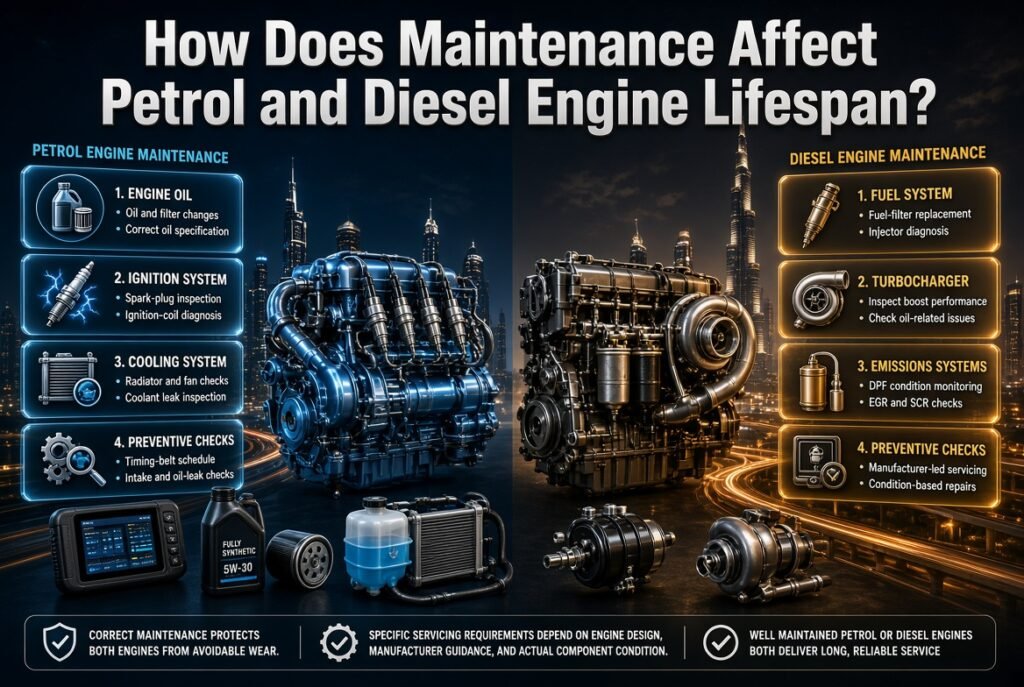
Maintenance is one of the most important factors influencing how long an engine remains dependable. Correct servicing reduces avoidable wear and helps identify faults before they cause serious damage.
Neither petrol nor diesel engines can compensate indefinitely for neglected maintenance.
Engine oil and filter replacement
Oil should meet the manufacturer’s required specification, including the relevant viscosity and performance approvals.
Replacement intervals vary by engine and vehicle. Some manufacturers also specify different schedules for severe operating conditions, which may include frequent short trips, heavy traffic, or other demanding use.
Do not apply one universal oil-change interval to every vehicle. Check the owner’s manual or manufacturer-approved service information.
Cooling-system inspections
Both petrol and diesel engines need an effective cooling system.
Important checks include:
- Coolant level and condition.
- Radiator and cooling-fan operation.
- Thermostat function.
- Water-pump condition.
- Hose connections and leak points.
- Pressure cap and expansion tank.
- Correct coolant specification.
Coolant colour alone does not establish whether it is suitable. The chemical specification and compatibility with the vehicle are what matter.
Repeated coolant loss should be investigated rather than managed through endless top-ups.
Petrol engine maintenance
Depending on the engine, maintenance may include:
- Spark-plug replacement.
- Ignition-coil inspection.
- Fuel-injector diagnosis.
- Intake-system inspection.
- Timing-belt replacement where applicable.
- Oil-leak and cooling-system checks.
These requirements differ significantly between engine models.
Diesel engine maintenance
Diesel-specific maintenance may include:
- Fuel-filter replacement.
- Water-in-fuel checks where applicable.
- Injector diagnosis.
- Turbocharger inspection.
- EGR-system assessment.
- DPF monitoring and servicing where fitted.
- SCR and AdBlue-system maintenance where applicable.
These systems should not be replaced automatically at every service. Their condition should be assessed according to manufacturer guidance, diagnostic results, and symptoms.
For a more detailed comparison of servicing requirements, consult Petrol vs Diesel Engine Maintenance in Dubai.
7. Can a High-Mileage Engine Still Be a Good Purchase?
Yes. A vehicle with high mileage can still be a sensible purchase if it has been maintained correctly and passes a thorough inspection.
Mileage measures distance travelled, not the complete history of engine wear.
A vehicle that has covered 220,000 km on regular highway journeys with documented servicing may be in better condition than one with 100,000 km of neglected urban driving.
What matters more than mileage alone?
Service history: Look for records of oil changes, filter replacement, coolant maintenance, and scheduled repairs.
Operating history: Establish whether the vehicle was used for private commuting, commercial work, towing, or heavy-load operation.
Cold-start behaviour: Observe whether the engine starts normally and whether unusual noises, persistent smoke, or excessive vibration occur.
Oil and coolant condition: Investigate unexplained oil consumption, coolant loss, or signs of contamination.
Diagnostic results: Check stored and pending fault codes rather than relying only on the dashboard.
Repair history: Determine whether major repairs have already been completed and whether the work was documented.
What tests can reveal engine condition?
A qualified technician may recommend a compression test or leak-down test if internal engine wear is suspected. Diagnostic scanning can identify electronic faults, while a road test may reveal overheating, hesitation, unusual noise, or power loss.
No single test can predict precisely how many kilometres remain before an engine needs major work.
A proper inspection reduces uncertainty, but it cannot guarantee that a used vehicle will remain trouble-free.
Common Petrol and Diesel Engine Problems in Dubai: Warning Signs and Prevention
Engine problems can affect both petrol and diesel vehicles, but the causes, warning signs, and repair requirements often differ. In Dubai, high temperatures, heavy traffic, frequent idling, and dusty driving conditions make regular maintenance especially important. Petrol engines may develop faults involving spark plugs, ignition coils, fuel injectors, or cooling systems, while diesel engines may experience injector problems, turbocharger faults, clogged diesel particulate filters (DPF), or emission-control issues in vehicles equipped with these systems. Understanding these differences helps drivers recognise potential faults and seek professional diagnosis before the problem becomes more serious.
Drivers should pay attention to symptoms such as difficult starting, unusual engine noises, excessive smoke, reduced power, overheating, and sudden changes in fuel consumption. Rather than replacing components without proper testing, arrange an inspection to identify the actual cause and follow the manufacturer’s maintenance recommendations. Our detailed guide to Common Petrol vs Diesel Engine Problems in Dubai explains the most common faults affecting both engine types, the warning signs drivers should recognise, and the preventive measures that can help reduce avoidable repair costs and maintain dependable vehicle performance in Dubai.
8. What Warning Signs Suggest That an Engine Is Wearing Out?
Engine wear does not always produce obvious symptoms at an early stage. However, changes in sound, fluid consumption, starting behaviour, and performance can indicate developing problems.
Recognising these changes early can help prevent additional damage.
Persistent blue exhaust smoke
Blue smoke may indicate that engine oil is entering the combustion chamber. Possible causes include worn piston rings, valve-seal problems, or turbocharger faults on vehicles equipped with a turbocharger.
The correct diagnosis depends on when the smoke appears and the engine’s design.
Repeated overheating
An engine that repeatedly overheats needs investigation. Potential causes include coolant leaks, radiator restrictions, fan problems, thermostat faults, or water-pump failure.
Continuing to drive an overheating vehicle can cause severe internal damage.
Increasing oil consumption
Some engines consume a small amount of oil during normal operation, but a sudden or increasing need for top-ups deserves attention.
Possible causes include external leaks, internal wear, or faults involving the turbocharger where fitted.
Unusual knocking or vibration
New mechanical noises should not be dismissed as normal ageing. Deep knocking, persistent rattling, or unusual vibration may indicate a problem that requires professional diagnosis.
Loss of power or starting difficulties
Slow starting, misfires, hesitation, or reduced power can result from fuel-system, ignition, compression, sensor, or air-intake problems.
Diesel engines may also develop injector or emissions-system faults, depending on the model.
Professional advice: If an oil-pressure warning appears while the engine is running, or the engine overheats, stop safely and follow the manufacturer’s instructions. Continuing to drive can turn a repairable fault into extensive damage.
9. Common Mistakes That Shorten Engine Lifespan in Dubai
Many expensive engine problems begin with maintenance decisions that appear harmless at first. Avoiding these mistakes can improve the chances of achieving a long service life with either fuel type.
Mistake 1: Delaying oil changes
Engine oil degrades over time and collects contaminants. Delaying replacement beyond the appropriate interval can increase deposits and reduce protection.
How to avoid it: Follow the manufacturer’s schedule and use the specified oil grade and approval.
Mistake 2: Ignoring coolant loss
Some drivers repeatedly add coolant without investigating why the level keeps dropping.
This can conceal a leaking hose, radiator fault, water-pump problem, or more serious internal issue.
How to avoid it: Arrange a cooling-system inspection when coolant loss is unexplained or recurring.
Mistake 3: Driving aggressively when the engine is cold
Hard acceleration and heavy loads immediately after starting can increase stress before the engine reaches normal operating conditions.
How to avoid it: Drive gently during warm-up and avoid unnecessary high engine speeds until the engine is operating normally.
Mistake 4: Choosing diesel for mileage alone
A diesel engine’s potential for high mileage does not automatically make it suitable for every driver.
A vehicle used almost exclusively for very short trips may experience avoidable emissions-system problems.
How to avoid it: Match the vehicle to your actual journey lengths, annual mileage, and workload.
Mistake 5: Ignoring small changes in performance
A slight increase in oil consumption, an unfamiliar noise, or a new warning light may indicate an early fault.
How to avoid it: Record when the symptom occurs and arrange diagnosis before it becomes more serious.
Mistake 6: Using generic maintenance intervals
Different engines have different oil requirements, filter schedules, coolant specifications, and timing-system maintenance needs.
How to avoid it: Follow the correct service information for the exact model and engine.
Mistake 7: Buying without checking the maintenance history
A clean exterior and low odometer reading do not prove that an engine has been cared for.
How to avoid it: Review invoices, verify available records, and arrange an independent pre-purchase inspection.
10. How to Estimate the Remaining Life of a Used Engine
Estimating remaining engine life requires several pieces of evidence. An odometer reading alone cannot provide a reliable answer.
A useful assessment combines maintenance records, mechanical inspection, diagnostic results, and the vehicle’s intended future use.
Step 1: Review documented servicing
Look for regular oil and filter changes, coolant maintenance, and repairs completed according to the manufacturer’s schedule.
Missing records do not prove neglect, but they increase uncertainty.
Step 2: Inspect the engine before starting it
A cold inspection may reveal leaks, damaged hoses, loose connections, or other visible concerns.
Check fluid levels and condition according to the manufacturer’s guidance. Never open a hot pressurised cooling system.
Step 3: Observe the cold start
Pay attention to starting time, unusual noises, excessive vibration, and persistent smoke.
Some brief sounds or variations may be normal for a particular engine, so symptoms should be assessed against the manufacturer’s specifications.
Step 4: Complete a diagnostic scan
A professional scan can reveal stored or pending faults that may not trigger an obvious dashboard warning.
For diesel vehicles, the inspection may also need to consider relevant fuel-injection and emissions-system data.
Step 5: Conduct a road test
Observe acceleration, engine temperature, smoothness, and unusual noises under normal driving conditions.
The vehicle should be assessed safely and within legal speed limits.
Step 6: Obtain specialist testing when necessary
If the inspection raises concerns about internal wear, a compression test, leak-down test, or other targeted assessment may help clarify the engine’s condition.
Quick Tip: A thorough inspection cannot promise a particular remaining lifespan. Its value is in identifying known problems, estimating repair needs, and helping you avoid an unsuitable purchase.
11. Expert Recommendations for Extending Engine Life in Dubai
Long engine life usually comes from consistent habits rather than one special product or maintenance trick.
Use the correct fluids
Engine oil and coolant should meet the exact specifications required for the vehicle. Substituting products based on colour, price, or general claims can create compatibility problems.
Monitor temperature and fluid levels
Check oil and coolant according to the owner’s manual. Investigate unexplained changes rather than waiting for a dashboard warning.
Keep the air-intake system in good condition
Inspect the air filter and intake connections according to the service schedule, taking dusty operating conditions into account.
A correctly fitted filter helps prevent contaminants from entering the engine.
Avoid unnecessary idling
Extended idling consumes fuel and keeps the engine operating without covering useful distance. It is not a substitute for driving the vehicle appropriately.
For diesel vehicles, follow the manufacturer’s guidance for DPF regeneration rather than relying on arbitrary idling or improvised procedures.
Use fuel appropriate for the vehicle
Follow the manufacturer’s required fuel grade and specification. Diesel vehicles with sensitive injection systems require particular attention to fuel quality and filtration.
Address warning signs promptly
Do not ignore repeated overheating, abnormal oil consumption, leaks, or persistent warning lights.
Early diagnosis can help limit damage and clarify whether a repair is minor or more substantial.
Keep a maintenance record
Maintain invoices, inspection reports, and service dates. Records help identify recurring faults and make future resale easier.
Review severe-service requirements
If you regularly drive in heavy traffic, make frequent short trips, or operate under substantial loads, check whether the manufacturer recommends different service intervals.
Dubai’s climate is relevant, but maintenance should be based on the vehicle’s actual requirements rather than assumptions about every car in the region.
12. Petrol vs Diesel Engine Lifespan: Which Is More Reliable?
Engine lifespan and engine reliability are related, but they are not identical.
Lifespan concerns how long an engine can remain usable. Reliability concerns how consistently it operates without unexpected faults or interruptions.
A diesel engine may have the potential to achieve very high mileage but still require an expensive injector, turbocharger, or emissions-system repair. A petrol engine may have a lower expected mileage range yet provide dependable everyday service with fewer major problems for a particular owner.
Compare the exact engine, not just the fuel type
When evaluating reliability, consider:
- The engine’s known maintenance requirements.
- The availability and cost of replacement parts.
- The quality of the vehicle’s service history.
- The condition of its cooling and lubrication systems.
- The suitability of the engine for your driving routine.
- The potential cost of major repairs.
A proven engine design with documented maintenance may be a better investment than a vehicle chosen solely because diesel engines are often associated with longevity.
For a more detailed discussion of durability and dependability, read Petrol vs Diesel Engine Reliability in Dubai.
13. Does a Longer Engine Lifespan Mean Lower Ownership Costs?
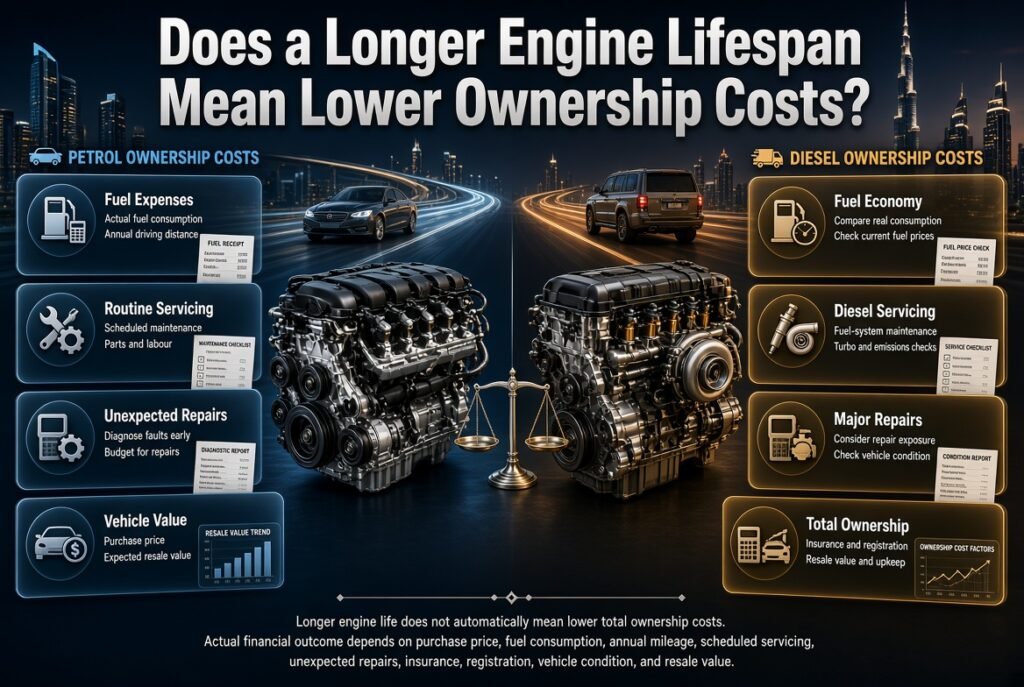
Not necessarily. A vehicle that lasts longer in kilometres may still cost more to own if its purchase price, servicing, repairs, and fuel expenses are higher.
Long-term ownership should be evaluated as a complete financial decision.
Scheduled maintenance expenses
Both petrol and diesel vehicles require regular servicing. The exact cost depends on the vehicle, parts, labour, service intervals, and manufacturer requirements.
Some petrol engines have relatively straightforward maintenance needs. Certain diesel vehicles require additional attention to fuel filtration, turbocharging, and emissions-control systems.
These differences vary by model, so broad assumptions should not replace actual service quotations.
Unexpected repairs
Unexpected expenses can have a significant effect on long-term ownership.
For example, a diesel vehicle may provide good fuel economy during years of highway driving, but a major fuel-system or emissions repair could reduce those savings.
A petrol vehicle can also develop expensive faults, particularly if it uses complex turbocharging, direct injection, or other advanced systems.
Fuel consumption and annual distance
Diesel fuel economy may be advantageous for drivers who cover high annual mileage. However, the financial benefit depends on actual consumption, fuel prices, and the vehicle’s condition.
For low-mileage drivers, the purchase price and maintenance differences may matter more than small fuel savings.
Calculate total ownership cost
Before choosing a vehicle, estimate:
- Purchase price.
- Annual fuel expenses.
- Scheduled servicing.
- Tyres and other routine wear items.
- A reasonable allowance for unexpected repairs.
- Insurance and registration expenses.
- Expected resale value.
Use estimates for the exact vehicles you are comparing rather than assuming every diesel or petrol model has the same costs.
For a closer comparison of routine and potential repair expenses, read Petrol vs Diesel Servicing Costs in Dubai.
14. Which Engine Should You Choose for Long-Term Ownership in Dubai?
The right choice depends on your daily driving pattern, annual mileage, load requirements, and preferred maintenance budget.
There is no single engine type that is best for every driver.
Choose petrol when your driving is mainly urban
A petrol vehicle is often practical if you:
- Make frequent short journeys.
- Spend much of your time in city traffic.
- Drive relatively low annual mileage.
- Prefer to avoid some diesel-specific emissions-system considerations.
- Want a vehicle suited to everyday commuting.
The exact petrol engine still needs to be evaluated for reliability, service requirements, and known weaknesses.
Consider diesel for regular long-distance use
A diesel vehicle may be suitable if you:
- Cover substantial highway mileage.
- Regularly travel between cities.
- Carry heavier loads where the vehicle is designed for them.
- Need strong low-speed torque.
- Have access to suitable servicing and parts.
Before buying a modern diesel, confirm that its emissions systems are appropriate for your driving pattern.
Compare the vehicles before making a decision
| Your priority | What to evaluate |
|---|---|
| Maximum potential engine mileage | Engine design and proven durability |
| Daily urban driving | Short-trip suitability and maintenance needs |
| Long-distance travel | Highway efficiency and service history |
| Lower repair risk | Model-specific reliability and inspection results |
| Used-car purchase | Documented servicing and mechanical condition |
| Long-term affordability | Total ownership cost, not fuel price alone |
For additional background on the main differences between both engine types, see Petrol vs. Diesel Comparisons Dubai.
Which Engine Lasts Longer in Dubai: Petrol or Diesel?
Diesel engines often have the potential to last longer than petrol engines, particularly in vehicles designed for heavy workloads and regular highway driving. A well-maintained diesel engine may reach 300,000–500,000 km or more, while many petrol engines can achieve 200,000–300,000 km or beyond. However, these are general estimates, not guaranteed lifespans. The actual result depends on engine design, driving conditions, service history, and the quality of maintenance.
In Dubai, high temperatures, traffic congestion, and dusty conditions make regular servicing essential for both engine types. A neglected diesel engine can develop expensive mechanical or emissions-system problems long before a properly maintained petrol engine reaches the end of its useful life.
Key factors that influence engine lifespan:
Maintenance history: Regular oil changes, filter replacements, and cooling-system inspections help prevent premature wear.
Driving conditions: Frequent short journeys and stop-start traffic affect engines differently from consistent highway driving.
Engine design: Some engines are built for high mileage, while others prioritise performance, economy, or compact construction.
Repair history: Previous overheating, poor-quality repairs, or neglected mechanical faults can significantly affect remaining engine life.
Is a Petrol or Diesel Engine Better for Dubai’s Hot Climate?
Neither petrol nor diesel engines are automatically better suited to Dubai’s hot climate. Both can provide reliable performance when the cooling system, lubrication, air filtration, and other essential components are maintained according to the manufacturer’s requirements. The condition of the vehicle matters more than the fuel type alone.
High ambient temperatures can make heat management more demanding, particularly when driving through congested areas with the air conditioner running. A faulty radiator fan, leaking coolant hose, weak water pump, or unsuitable engine oil can increase the risk of overheating. If overheating continues, it can damage the cylinder head, head gasket, and other internal components.
Important considerations for Dubai drivers:
Use engine oil and coolant that meet the manufacturer’s specifications.
Check coolant levels and investigate recurring fluid loss instead of repeatedly topping up.
Maintain the air filter to help prevent dust from entering the engine.
Address unusual temperature changes before they develop into serious mechanical problems.
Follow the correct service schedule for your specific vehicle and driving conditions.
Can a Petrol or Diesel Engine Last More Than 300,000 km in Dubai?
Yes, both petrol and diesel engines can exceed 300,000 km when their design, maintenance, and operating conditions support long-term durability. Some diesel engines designed for sustained commercial use can achieve substantially higher mileage, while certain petrol engines also remain serviceable well beyond 300,000 km.
However, reaching this distance depends on more than regular servicing alone. Engine oil consumption, cooling-system performance, fuel quality, driving habits, and previous repairs all influence how long an engine remains dependable. Modern diesel vehicles may also require expensive repairs to fuel-injection or emissions-control components, even when the engine’s internal components remain in reasonable condition.
Before purchasing a high-mileage vehicle, check:
Documented oil changes and scheduled maintenance.
Signs of overheating, coolant leaks, or excessive oil consumption.
Cold-start behaviour, unusual engine noises, and persistent exhaust smoke.
Diagnostic fault codes and the condition of relevant fuel or emissions systems.
The results of an independent mechanical inspection.
A vehicle with 250,000 km and a consistent maintenance history may be a better purchase than one with 120,000 km and evidence of neglect. Mileage should always be assessed alongside the engine’s actual condition.
Does Dubai Traffic Reduce Petrol and Diesel Engine Lifespan?
Dubai’s stop-start traffic can contribute to engine wear, particularly when journeys are short, the engine repeatedly starts from cold, or maintenance is neglected. Frequent acceleration, idling, and operating in high temperatures can increase the demands placed on the engine and cooling system. However, traffic does not automatically mean that an engine will fail prematurely.
Petrol engines are often practical for urban driving because many models handle frequent short journeys without diesel-specific particulate-filter requirements. Modern diesel engines can also operate successfully in cities, but repeated short trips may interfere with DPF regeneration in vehicles equipped with this system.
Ways to reduce unnecessary engine stress:
Avoid aggressive acceleration while the engine is warming up.
Follow the manufacturer’s maintenance schedule, including any severe-service recommendations.
Avoid unnecessary prolonged idling.
Investigate overheating, abnormal vibration, and changes in oil consumption.
For diesel vehicles, follow the manufacturer’s guidance on DPF regeneration and warning lights.
Drivers who mainly make short urban journeys should consider whether a petrol vehicle better matches their routine. Those who regularly cover long highway distances may find a suitable diesel engine more practical.
How Can I Choose a Petrol or Diesel Car That Will Last Longer in Dubai?
Choosing a long-lasting vehicle requires comparing the specific engine, its reliability history, maintenance requirements, and intended use. Selecting diesel solely because it is associated with higher mileage can be a costly mistake if the vehicle is unsuitable for your driving pattern or has an incomplete service history.
For example, a driver who spends most of the week in city traffic and covers relatively few kilometres annually may find a petrol vehicle easier to maintain. Someone who regularly travels between Dubai and Abu Dhabi or operates a vehicle under sustained loads may benefit from a diesel model designed for that purpose.
Use these checks before making your decision:
Review service records: Look for consistent maintenance and evidence that scheduled repairs were completed.
Arrange a pre-purchase inspection: Have a qualified technician assess the engine, cooling system, and diagnostic data.
Compare repair costs: Consider fuel-system, turbocharger, ignition, and emissions-system requirements where applicable.
Match the engine to your routine: Evaluate annual mileage, journey length, traffic exposure, and load requirements.
Estimate total ownership costs: Include fuel, scheduled servicing, potential repairs, and expected resale value.
The best long-term choice is the vehicle that combines proven engine durability with suitable operating conditions and manageable maintenance costs. A properly maintained petrol or diesel engine can provide many years of dependable service when selected for the right purpose.
Conclusion: Petrol vs Diesel Engine Lifespan in Dubai
Choosing between a petrol and diesel engine in Dubai depends on more than the number of kilometres a vehicle can cover. Both engine types can deliver long-term reliability when they receive the correct maintenance, suitable engine oil, quality fuel, and timely repairs. Diesel engines are often designed for heavy-duty use and can achieve high mileage under suitable driving conditions, while petrol engines may be a practical choice for drivers who mainly travel short distances, commute through busy urban areas, and want a simpler ownership experience. However, neither engine type automatically lasts longer in every situation.
Dubai’s hot climate, heavy traffic, frequent air-conditioning use, dusty conditions, and repeated stop-and-go journeys can influence engine wear. Regular servicing and adapting maintenance to the vehicle manufacturer’s recommendations are therefore essential. Diesel owners should pay particular attention to the fuel-injection system, turbocharger, exhaust emissions components, and the suitability of their driving pattern for diesel technology. Petrol owners should monitor engine oil, coolant condition, ignition components, and signs of overheating.
Before choosing a vehicle, consider your annual mileage, daily routes, maintenance budget, service history, and long-term ownership plans. If you are comparing the wider differences between both fuel types, explore our guide to petrol vs diesel comparisons. You can also review our guides to petrol and diesel engine maintenance in Dubai, engine reliability, and servicing costs to make a more informed decision.
Ultimately, the longest-lasting engine is the one that suits your driving habits and receives consistent, correct maintenance. Rather than choosing petrol or diesel based on reputation alone, evaluate the specific vehicle, its maintenance history, and its intended use. For information about fuel-related services in the UAE, visit Fuel Delivery Dubai.
Leave a Reply