Introduction
Fuel Quality Standards for Vehicles | A car can have a healthy engine, a good battery, and regular maintenance, but poor-quality fuel can still create unexpected problems. Hard starting, rough running, reduced performance, poor fuel economy, and fuel-system issues can sometimes begin with what’s going into the fuel tank.
This is why fuel quality standards for vehicles are important. These standards help ensure that petrol and diesel have the properties required for safe, reliable, and efficient vehicle operation.
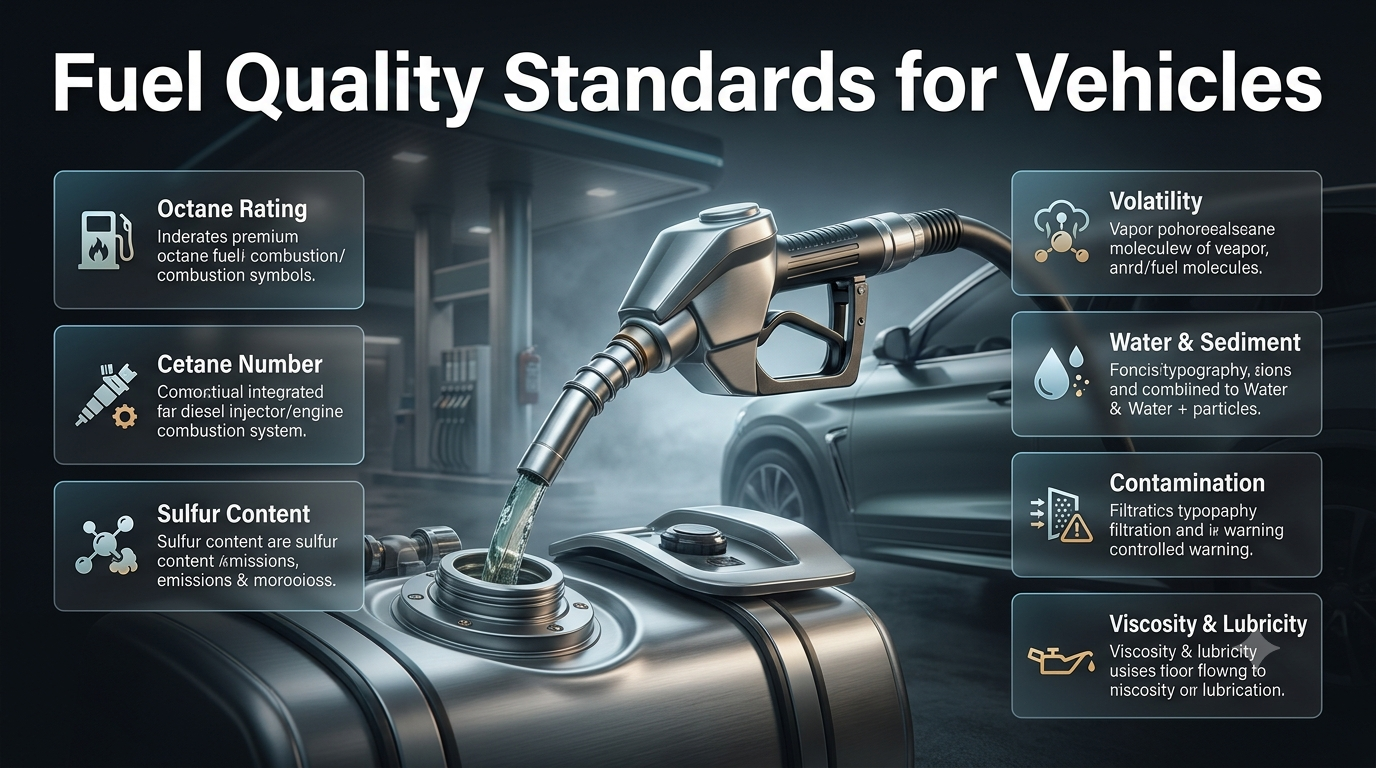
But fuel quality isn’t just about choosing a higher-octane petrol or buying from an expensive fuel station. There are several factors involved, including octane rating, cetane number, sulfur content, volatility, water, sediment, contamination, viscosity, and lubricity. For drivers who ran out of fuel in Dubai 👉 Fuel Delivery Dubai, understanding fuel quality can also help them make better decisions when refuelling.
In this guide, we’ll explain what fuel quality standards actually mean, why they matter, and what vehicle owners should know before choosing or using automotive fuel.
What Are Fuel Quality Standards for Vehicles?
Fuel quality standards are technical requirements that define the characteristics automotive fuel should meet before it is considered suitable for its intended use.
These requirements can cover several properties, including:
- Octane rating
- Cetane number
- Sulfur content
- Fuel volatility
- Water and sediment
- Density
- Viscosity
- Lubricity
- Distillation characteristics
- Corrosion tendency
- Fuel stability
- Contamination limits
The exact requirements depend on the type of fuel, vehicle, engine technology, and country or region.
For example, petrol used in spark-ignition engines has different requirements from diesel fuel used in compression-ignition engines.
Quick answer: Fuel quality standards exist to make sure automotive fuel has predictable properties and is suitable for the engine, fuel system, emissions equipment, and operating conditions.
Why Do Fuel Quality Standards Matter?
Modern engines are highly dependent on precise fuel delivery and combustion.
A modern vehicle may use direct fuel injection, turbocharging, high-pressure fuel pumps, oxygen sensors, catalytic converters, particulate filters, and sophisticated engine-management systems.
These components are designed to operate with fuel meeting specific requirements.
Poor-quality or contaminated fuel can potentially contribute to:
- Poor combustion
- Difficult starting
- Rough engine operation
- Fuel injector problems
- Increased emissions
- Fuel-filter blockage
- Fuel-system corrosion
- Reduced engine performance
- Unusual exhaust smoke
- Increased maintenance requirements
This doesn’t mean every engine problem is caused by fuel. Battery faults, ignition problems, sensors, injectors, air-intake problems, and mechanical issues can create similar symptoms.
The important point is that fuel quality is one part of overall vehicle reliability.
What Makes Automotive Fuel “Good Quality”?
There isn’t one single number that determines whether fuel is good or bad.
A fuel can have an appropriate octane rating but still have problems with contamination or storage. Similarly, diesel can have an acceptable cetane number but still have issues involving water, sediment, lubricity, or other properties.
Here are some of the most important fuel-quality characteristics:
| Fuel Property | Mainly Relevant To | Why It Matters |
|---|---|---|
| Octane rating | Petrol | Helps resist engine knocking |
| Cetane number | Diesel | Indicates ignition quality |
| Sulfur content | Petrol & diesel | Important for emissions systems |
| Volatility | Mainly petrol | Affects evaporation and combustion |
| Water content | Petrol & diesel | Can contribute to corrosion and running problems |
| Sediment | Petrol & diesel | Can affect filters and fuel-system components |
| Viscosity | Diesel | Important for fuel injection |
| Lubricity | Diesel | Helps protect fuel-system components |
| Stability | Petrol & diesel | Important during storage |
This is why simply asking, “Is this high-octane fuel?” doesn’t tell you everything about its quality.
If you’re learning the basics of fuel properties, you can also explore our Fuel Fundamentals guide for a broader understanding of how automotive fuels work.
Petrol Fuel Quality Standards
Petrol, commonly called gasoline, is used primarily in spark-ignition engines.
One of the best-known petrol characteristics is its octane rating. However, octane is only one part of the overall fuel specification.
ASTM D4814, for example, covers automotive spark-ignition engine fuel and includes requirements related to characteristics such as volatility and other properties affecting vehicle operation.
What Does Octane Rating Mean?
Octane rating describes a petrol fuel’s resistance to knocking or abnormal combustion.
When fuel has insufficient knock resistance for an engine’s operating conditions, combustion can occur in a way that isn’t intended by the engine design.
Modern engines use electronic controls to manage ignition and combustion, but the manufacturer’s recommended fuel grade should still be followed.
Does Higher Octane Mean Better Fuel?

Not automatically.
This is one of the most common misunderstandings among drivers.
A higher-octane fuel is not necessarily “better” for every vehicle. If an engine is designed to operate correctly on a particular minimum octane rating, using a much higher grade may provide little or no practical benefit.
The correct approach is to check the vehicle manufacturer’s recommendation.
Pro Tip: Don’t choose petrol solely because the number on the pump is higher. Choose a fuel grade that meets or exceeds the manufacturer’s required specification.
Why Is Petrol Volatility Important?
Volatility refers to how easily fuel evaporates.
This characteristic is important because petrol needs to form an appropriate fuel-air mixture for efficient combustion.
If volatility isn’t appropriate for the environmental conditions, it can affect fuel behavior during starting and operation.
This becomes particularly relevant in areas with significant temperature differences or very hot climates.
Fuel specifications can therefore take seasonal and geographical conditions into account.
Why Does Hot Weather Matter?
High temperatures can affect how petrol evaporates and behaves within the fuel system.
In very hot environments, fuel formulation and handling become particularly important because excessive evaporation can create operational and emissions-related challenges.
This is one reason fuel standards aren’t simply based on a single universal formula for every climate.
Why Sulfur Content Matters in Vehicle Fuel
Sulfur content is another important fuel-quality characteristic.
Modern vehicles increasingly rely on sophisticated emissions-control systems. These systems work best when the fuel meets the sulfur requirements for which the vehicle was designed.
Lower-sulfur fuels have become increasingly important as vehicle emissions technology has advanced.
Sulfur can affect exhaust after-treatment systems and is therefore an important part of modern fuel specifications.
For drivers, the practical lesson is simple: use fuel that meets the specification required for your vehicle and market.
You don’t need to memorize sulfur limits yourself. The manufacturer’s documentation and applicable fuel regulations provide the relevant requirements.
Can You Tell Fuel Quality by Looking at It?
Not reliably.
This is another common mistake.
Fuel that looks clear doesn’t automatically mean that it meets every required quality specification.
Some characteristics require proper laboratory testing.
For example, you can’t accurately determine:
- Octane rating by appearance
- Cetane number by appearance
- Sulfur content by appearance
- Lubricity by appearance
- Exact volatility by appearance
Visible contamination may sometimes provide an obvious warning, but normal-looking fuel can still fail a technical requirement.
Common Mistake: Assuming that clear fuel is automatically high-quality fuel.
Better approach: Fuel quality should be judged against the applicable technical specification, not simply by appearance.
How Does Fuel Reach Your Vehicle?
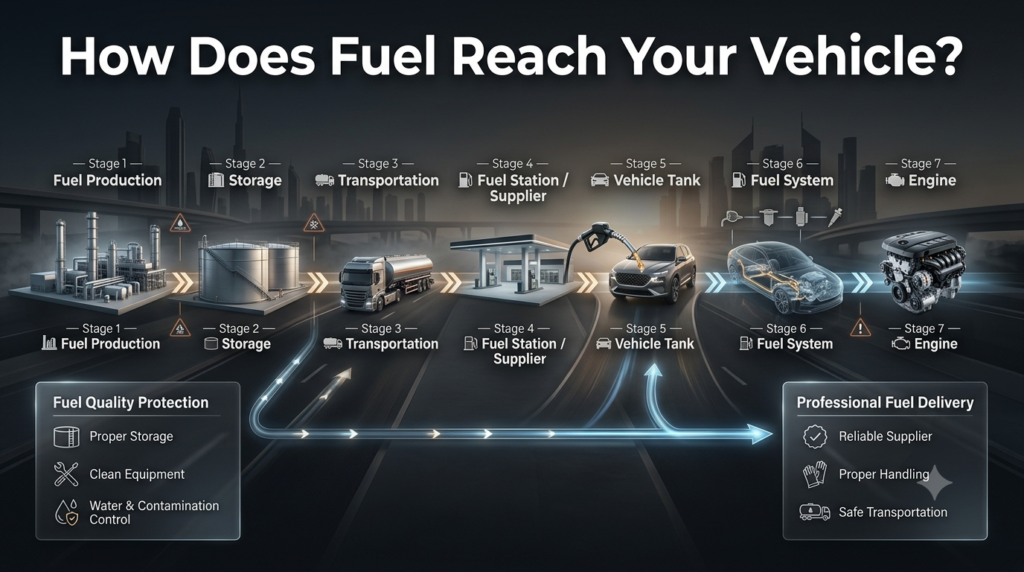
Fuel quality also depends on what happens between production and the vehicle’s tank.
A simplified fuel supply chain looks like this:
Fuel Production → Storage → Transportation → Fuel Station/Supplier → Vehicle Tank → Fuel System → Engine
Every stage matters.
Poor storage conditions, contamination, water intrusion, unsuitable handling, or dirty equipment can potentially affect fuel quality after production.
For businesses involved in fuel transportation or delivery, proper handling and storage are therefore just as important as obtaining fuel from a reliable source.
For vehicle owners who use fuel delivery services, choosing a professional and established supplier is also an important part of reducing uncertainty about fuel handling.
If you’re researching fuel delivery options in Dubai, you can learn more about Fuel Delivery Dubai and the role of proper fuel supply and delivery.
Fuel Quality vs Fuel Grade: What’s the Difference?
These terms are often used as though they mean the same thing, but they don’t.
Fuel grade usually refers to a particular category of fuel, such as a petrol grade identified by its octane rating.
Fuel quality is much broader.
It can include the fuel’s:
- Chemical characteristics
- Cleanliness
- Sulfur level
- Volatility
- Stability
- Water content
- Sediment
- Other technical properties
For example, two petrol products may have similar octane ratings while differing in other characteristics.
| Fuel Grade | Overall Fuel Quality |
|---|---|
| Usually identified by a number or category | Covers many technical characteristics |
| Commonly visible to consumers | Often requires testing |
| Octane is important for petrol | Includes octane plus other properties |
| Doesn’t describe every fuel characteristic | Provides a broader picture |
So, higher fuel grade does not automatically mean every aspect of fuel quality is better.
Diesel fuel has different quality requirements from petrol because diesel engines use compression ignition rather than a spark to begin combustion.
That difference makes properties such as cetane number, lubricity, viscosity, water content, sulfur level, and cleanliness especially important.
A diesel engine may continue running on fuel that isn’t ideal, but that doesn’t mean the fuel is suitable for long-term use. Modern diesel injection systems operate under demanding conditions, so fuel quality becomes increasingly important as engine technology becomes more advanced.
What Makes Diesel Fuel High Quality?
High-quality diesel isn’t defined by one characteristic. It needs to meet a range of technical requirements suitable for the engine and applicable fuel standard.
Important diesel fuel properties include:
- Cetane number
- Sulfur content
- Water and sediment
- Viscosity
- Lubricity
- Density
- Flash point
- Distillation characteristics
- Oxidation stability
- Contamination levels
ASTM D975, for example, specifies requirements for several diesel fuel grades and includes properties such as cetane number, sulfur, water and sediment, lubricity, viscosity, flash point, and distillation characteristics.
The practical lesson for vehicle owners is simple: diesel quality should be judged by the complete fuel specification rather than one advertised feature.
What Is Cetane Number in Diesel Fuel?
Cetane number is a measure of diesel fuel’s ignition quality.
Unlike petrol engines, diesel engines don’t normally rely on a spark plug to ignite the fuel. Air is compressed to a high temperature, and diesel fuel is injected into that hot compressed air.
The fuel’s ignition characteristics therefore matter.
A suitable cetane level can contribute to:
- Easier starting
- More consistent combustion
- Smoother engine operation
- Reduced ignition delay
- Better combustion behavior
However, cetane number isn’t a complete measure of diesel quality.
A diesel fuel can have an acceptable cetane number while still having other problems, such as excessive water, contamination, unsuitable viscosity, or inadequate lubricity.
Cetane vs Octane
These two terms are often confused because both are associated with fuel quality.
| Characteristic | Octane | Cetane |
|---|---|---|
| Mainly associated with | Petrol | Diesel |
| Engine type | Spark ignition | Compression ignition |
| Main purpose | Resistance to knocking | Ignition quality |
| Higher value generally indicates | Greater knock resistance | Better ignition characteristics |
Quick Tip: Don’t compare petrol and diesel using the same fuel-quality measurement. Octane and cetane describe different combustion characteristics.
Why Diesel Fuel Lubricity Matters

Lubricity describes the ability of diesel fuel to provide lubrication to components that come into contact with the fuel.
This is particularly important in fuel systems containing high-pressure pumps and precision injectors.
Modern diesel injection systems are engineered with extremely tight tolerances. The fuel itself can play a role in protecting certain moving fuel-system components.
If fuel doesn’t provide the required lubricating characteristics, components may experience increased wear.
This is one reason modern diesel fuel specifications include lubricity requirements.
Expert Tip: Don’t assume that adding a random lubricant or additive is a safe solution for poor-quality diesel. Use fuel that already meets the required specification unless the vehicle manufacturer specifically recommends an appropriate product.
Why Water Is a Serious Diesel Fuel Problem
Water is one of the contaminants that deserves particular attention in diesel fuel.
It can enter fuel through:
- Poor storage conditions
- Condensation
- Contaminated storage tanks
- Damaged equipment
- Improper transportation
- Poor handling
Water isn’t a substitute for diesel during combustion, and its presence can contribute to fuel-system problems.
It can also create conditions that promote corrosion and other issues.
Modern diesel fuel systems can be especially sensitive because high-pressure injection equipment requires clean and properly conditioned fuel.
What Can Happen When Diesel Contains Water?
Potential problems include:
- Difficult starting
- Rough engine operation
- Fuel-filter issues
- Corrosion
- Injector problems
- Fuel-pump wear
- Reduced engine performance
Not every one of these symptoms proves water contamination exists. Proper diagnosis is still necessary.
What Are Water Separators and Fuel Filters?
Many diesel vehicles use fuel filters designed to remove particles and, depending on the system, separate water from the fuel.
These components provide an important protective function.
A fuel filter can help prevent contaminants from reaching sensitive fuel-system components.
But a filter isn’t an excuse to ignore fuel quality.
If contamination is severe, the filter may become restricted or overwhelmed.
Signs of a Possible Fuel-Filter Problem
A restricted fuel filter may contribute to:
- Loss of power
- Poor acceleration
- Difficult starting
- Engine hesitation
- Reduced fuel flow
- Engine stalling
These symptoms can have several other causes, so a technician should diagnose the vehicle rather than replacing parts based only on symptoms.
What Is Sediment in Fuel?

Sediment refers to unwanted solid material that can be present in fuel.
It may come from:
- Dirty storage tanks
- Rust or corrosion
- Transportation equipment
- Contaminated containers
- Poor fuel-handling practices
Solid particles can become trapped by fuel filters, but smaller contaminants may create problems for precision fuel-system components.
This is particularly important for modern diesel engines because fuel injectors and pumps operate under demanding conditions.
Common Mistake: Replacing a blocked fuel filter without investigating why it became blocked.
If the same problem happens repeatedly, the source of contamination should be investigated.
How Fuel Contamination Affects Modern Engines
Older engines and modern engines don’t necessarily respond to fuel problems in the same way.
Modern engines often use:
- High-pressure injection
- Electronic fuel control
- Turbochargers
- Precise injector timing
- Emissions sensors
- Exhaust after-treatment systems
These systems provide excellent control and efficiency, but they also depend on the correct operating conditions.
Contaminated fuel can interfere with fuel delivery or combustion and may create symptoms that trigger warning systems.
For this reason, maintaining clean fuel is particularly important for newer vehicles.
What Happens When Fuel Quality Is Poor?
Fuel-related problems don’t always appear immediately.
In some cases, a driver may notice symptoms shortly after refueling. In other cases, a problem can develop gradually.
Possible symptoms include:
Starting Problems
The vehicle may take longer than usual to start or require repeated attempts.
Rough Running
The engine may feel uneven at idle or during acceleration.
Hesitation
The vehicle may hesitate when the driver presses the accelerator.
Reduced Performance
The engine may feel weaker, particularly under load.
Increased Fuel Consumption
Poor combustion or another fuel-system issue may contribute to increased fuel consumption.
Warning Lights
A fuel-related problem can sometimes cause the vehicle’s engine-management system to detect abnormal operating conditions.
But remember: these symptoms don’t automatically mean the fuel is bad.
A professional diagnosis is important because similar symptoms can come from mechanical, electrical, ignition, sensor, or air-intake problems.
How Is Fuel Quality Tested?
Fuel quality isn’t established through one universal test.
Different characteristics require different testing methods.
Depending on the applicable specification, testing may evaluate:
- Octane
- Cetane
- Sulfur
- Water and sediment
- Density
- Viscosity
- Flash point
- Distillation
- Lubricity
- Corrosion
- Stability
For example, ASTM D975 includes multiple requirements and test methods for diesel fuel properties rather than relying on cetane number alone.
This is why professional fuel-quality testing is much more useful than trying to judge fuel simply by smell, color, or appearance.
Automotive Fuel Classification: Types, Grades, Blends & More
Automotive Fuel Classification is the process of grouping vehicle fuels according to their type, physical form, fuel grade, chemical composition, blend percentage, and intended use. It covers common fuels such as petrol and diesel, ethanol and biodiesel blends, gaseous fuels like CNG and LPG, and alternative energy sources such as hydrogen and electricity. Understanding these classifications helps drivers and fleet operators select the right fuel, avoid costly fueling mistakes, and manage fuel storage, delivery, and vehicle compatibility more effectively.
👉 For More Details: Explore our complete guide to automotive fuel types, classifications, blends, and applications.
Can Drivers Test Fuel Quality at Home?
Basic visual checks may sometimes reveal obvious contamination, but they cannot confirm complete compliance with a fuel specification.
A driver cannot reliably determine the following simply by looking at fuel:
- Exact octane rating
- Exact cetane number
- Sulfur concentration
- Lubricity
- Precise volatility
- Full chemical composition
Laboratory testing is required for reliable measurement of these characteristics.
If you strongly suspect contaminated fuel, the best approach is to document the circumstances, keep your fuel receipt, avoid making assumptions, and have the vehicle and fuel properly inspected.
What Should You Do If Your Car Runs Poorly After Refueling?
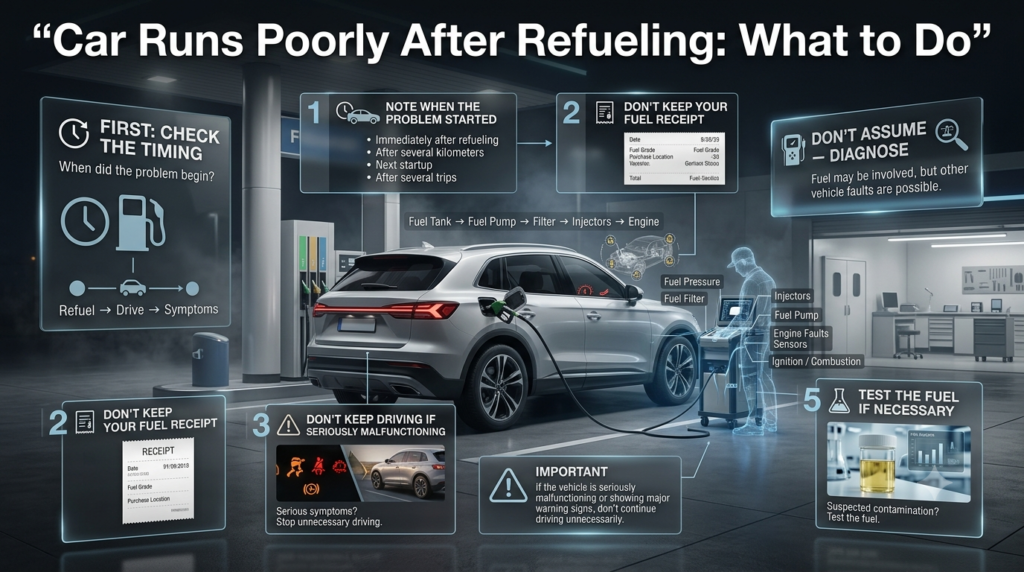
If your vehicle was operating normally and suddenly develops serious symptoms after refueling, don’t immediately assume the worst.
Follow a logical process.
Step 1: Note When the Problem Started
Record whether the problem appeared:
- Immediately after refueling
- After driving several kilometers
- The next time you started the vehicle
- After several trips
Timing can provide useful diagnostic information.
Step 2: Keep Your Fuel Receipt
The receipt can help establish:
- Where you purchased fuel
- When you purchased it
- Which fuel grade was used
Step 3: Don’t Keep Driving If the Vehicle Is Seriously Malfunctioning
If the vehicle is experiencing major performance problems, warning lights, or abnormal operation, continuing to drive can potentially make the situation worse.
Step 4: Have the Vehicle Diagnosed
A technician can investigate:
- Fuel pressure
- Fuel filter condition
- Injectors
- Fuel pump
- Engine-management faults
- Sensors
- Ignition or combustion problems
- Other possible causes
Step 5: Test the Fuel If Necessary
If contamination is suspected, fuel sampling and laboratory testing can help determine whether the fuel actually meets the applicable requirements.
Fuel Quality and Modern Emissions Systems
Fuel quality has become increasingly important because modern vehicles are designed to produce lower emissions.
Depending on the vehicle, the exhaust system may contain technologies such as:
- Catalytic converters
- Diesel particulate filters
- Selective catalytic reduction systems
- Oxygen sensors
- NOx sensors
- Exhaust temperature sensors
These components work together with the engine-management system.
Fuel that doesn’t meet the vehicle’s required specification can interfere with the conditions these systems are designed to operate under.
This is one reason modern fuel standards increasingly focus on properties that support emissions-control technology.
Why Low-Sulfur Fuel Matters
Sulfur is naturally associated with crude oil and can remain in fuels unless it is removed during refining.
Modern fuel standards have progressively reduced sulfur levels because sulfur can interfere with emissions-control technology.
For example, ASTM diesel specifications identify different sulfur categories, including ultra-low sulfur diesel with a 15 ppm sulfur limit.
European fuel requirements have also established very low sulfur levels for road fuels.
The exact requirement depends on the applicable market and fuel specification, so vehicle owners should follow the requirements relevant to their vehicle and location.
Does Better Fuel Improve Engine Performance?
This question needs a little clarification.
Using fuel that meets the correct specification helps the engine operate as designed. But switching to a more expensive fuel doesn’t automatically produce a noticeable performance increase.
For example, if your vehicle is designed for a particular petrol grade, moving to a significantly higher octane fuel doesn’t guarantee more horsepower.
Likewise, diesel fuel with an appropriate cetane number doesn’t automatically turn an ordinary diesel engine into a higher-performance engine.
The main goal of compliant fuel is reliable operation and compatibility with the engine, not simply maximum performance.
Fuel Quality vs Fuel Additives
Fuel additives are often marketed as solutions for cleaning injectors, improving combustion, increasing mileage, or protecting fuel systems.
Some additives have legitimate applications, but they shouldn’t be treated as a universal solution.
When Additives May Be Relevant
They may be appropriate when:
- The vehicle manufacturer recommends one
- A qualified technician identifies a specific need
- A particular fuel-system treatment is designed for the vehicle
- The product is compatible with the fuel and engine
When Additives Are Not the Answer
Don’t rely on additives to fix:
- Severely contaminated fuel
- Water contamination
- A damaged injector
- A failing fuel pump
- A blocked filter
- Incorrect fuel
- A mechanical engine problem
Pro Tip: Start with correct fuel and proper diagnosis. Additives should solve a specific problem, not replace good fuel-quality practices.
Fuel Storage and Quality
Fuel quality can change depending on how fuel is stored and handled.
Storage conditions matter because fuel can be exposed to:
- Water
- Air
- Temperature changes
- Contaminants
- Dirty equipment
- Poorly maintained tanks
For businesses handling fuel, regular inspection and appropriate storage procedures are important.
For vehicle owners, the practical takeaway is to purchase fuel from established sources with proper fuel-handling infrastructure.
This becomes especially important when fuel is being stored or transported rather than immediately consumed.
Common Diesel Fuel Quality Mistakes
Ignoring Water Contamination
Water can create serious problems in diesel fuel systems.
Why it happens: Drivers often assume the fuel filter will solve every contamination problem.
Why it’s a problem: Excessive contamination can overwhelm protective systems.
How to avoid it: Use reputable fuel sources and investigate repeated filter or fuel-system problems.
Focusing Only on Cetane
Cetane is important, but it isn’t the complete diesel specification.
Why it happens: Cetane is easy to understand and often used in fuel marketing.
Why it’s a problem: Other properties such as sulfur, lubricity, water, sediment, and viscosity also matter.
How to avoid it: Consider the complete fuel specification rather than one number.
Assuming a Fuel Problem Without Diagnosis
An engine that loses power isn’t automatically suffering from bad fuel.
Why it happens: The symptoms may appear after refueling.
Why it’s a problem: The actual fault could be an injector, sensor, filter, pump, turbocharger, or another component.
How to avoid it: Use timing as a diagnostic clue, not as proof.
What Should Dubai Drivers Know About Fuel Quality?
Dubai’s climate, high vehicle usage, and widespread dependence on private vehicles make fuel quality an important part of vehicle maintenance. However, drivers shouldn’t judge fuel quality simply by price, station appearance, or whether a vehicle feels powerful after filling up.
The better approach is to use the fuel type and grade recommended by the vehicle manufacturer and purchase from established suppliers operating within the applicable regulatory framework.
For businesses involved in fuel supply or delivery, proper storage, transportation, handling, and documentation are equally important. If you’re researching fuel supply services, you can also learn more about Fuel Delivery Dubai.
Does Dubai’s Hot Climate Affect Fuel Quality?
Temperature can influence fuel behavior, especially characteristics such as volatility and evaporation.
This doesn’t mean fuel automatically becomes poor quality because it’s hot outside. Compliant fuel is formulated and handled according to the requirements of the relevant market.
The bigger concern for vehicle owners is proper storage and handling.
Fuel should be stored and transported using appropriate equipment and procedures so that contamination, water entry, and other avoidable problems are minimized.
Expert Tip: In a hot climate, don’t focus only on the fuel itself. Consider the entire chain from storage and transportation to dispensing and the vehicle’s fuel system.
Is Higher-Octane or Premium Fuel Always Better for Your Car?
Higher-octane fuel isn’t automatically better for every vehicle. Octane indicates a petrol fuel’s resistance to knocking, so the correct grade depends primarily on the engine’s design and the manufacturer’s requirements.
If your vehicle requires a particular minimum octane rating, consistently using fuel below that requirement can create combustion-related problems. On the other hand, moving to a much higher octane fuel than the engine requires doesn’t necessarily produce more power, better fuel economy, or longer engine life.
The best approach is to follow the manufacturer’s specification rather than choosing fuel based only on price or the word “premium.”
Before choosing a fuel grade:
Check the owner’s manual.
Follow the minimum octane recommendation.
Don’t assume the most expensive fuel is automatically best.
Don’t confuse octane with overall fuel cleanliness.
Consider the engine manufacturer’s requirements rather than general advice.
Quick professional tip: Think of octane as a specific fuel property, not a universal score for fuel quality. A higher number doesn’t automatically mean every other fuel characteristic is better.
What Happens If Fuel Contains Water or Other Contaminants?
Water, sediment, and other contaminants can interfere with the fuel system and combustion process. The potential consequences depend on the type and amount of contamination, but problems can include fuel-filter restriction, corrosion, injector issues, poor engine operation, and difficulty starting.
Diesel systems can be particularly sensitive because modern diesel engines use high-pressure fuel pumps and precision injectors. A fuel filter can remove certain contaminants, but severe contamination can overwhelm the system or create problems before the issue is identified.
A fuel-quality problem shouldn’t be diagnosed simply because an engine starts running badly. Similar symptoms can come from a faulty fuel pump, injector, sensor, ignition component, air-intake problem, or another mechanical issue.
If contamination is suspected:
Keep the fuel receipt.
Note when the symptoms began.
Avoid adding random additives.
Have the fuel system inspected.
Check the fuel filter where appropriate.
Consider professional fuel testing if contamination is strongly suspected.
Common mistake: Replacing the fuel filter repeatedly without investigating why it keeps becoming contaminated. Recurring contamination usually deserves a closer look at the fuel source, storage, or fuel system.
How Can I Make Sure I’m Using Good-Quality Fuel for My Vehicle?
The safest approach is to combine the correct fuel specification, reputable supply, and proper vehicle maintenance. Start by checking the manufacturer’s recommended fuel type and grade, then purchase from established fuel stations or reliable suppliers that follow appropriate storage and handling practices.
Don’t judge fuel quality only by its color, price, smell, or the performance you feel immediately after filling the tank. Many important fuel characteristics require proper testing, and visual inspection cannot confirm properties such as octane, cetane, sulfur content, lubricity, or precise volatility.
For drivers in Dubai and other hot climates, proper fuel storage and handling are particularly relevant because fuel passes through several stages before reaching the vehicle.
A practical fuel-quality checklist:
Use the fuel type specified by the manufacturer.
Follow the recommended octane or diesel grade.
Buy from reputable suppliers.
Keep receipts for significant fuel purchases.
Pay attention to sudden changes after refueling.
Maintain the fuel filter and fuel system properly.
Don’t rely on random fuel additives.
Investigate repeated fuel-related symptoms professionally.
If you’re researching fuel handling and supply, you can also read Fuel Fundamentals and learn more about Fuel Delivery Dubai.
Conclusion
Understanding fuel quality standards for vehicles is essential for maintaining reliable engine performance, protecting sensitive fuel-system components, and avoiding unnecessary repairs. Good fuel isn’t simply about choosing a premium label or a higher octane number. It needs to meet the correct technical requirements for the vehicle and be properly stored, transported, and handled before it reaches the fuel tank.
For petrol vehicles, properties such as octane, volatility, sulfur content, and cleanliness matter. Diesel vehicles have additional considerations, including cetane, lubricity, viscosity, water, and sediment. These factors work together to support proper combustion and reliable fuel-system operation.
For everyday drivers, the best approach is straightforward: follow the manufacturer’s recommended fuel specification, use reputable fuel sources, maintain the vehicle’s fuel system, and investigate unusual symptoms rather than immediately assuming the fuel is responsible.
If you’re interested in understanding how fuel is supplied and handled, explore Fuel Fundamentals for more background information. For fuel supply and delivery requirements in Dubai, you can also visit Fuel Delivery Dubai.
Leave a Reply