
Introduction
Dubai Road Trips | Planning a road trip from Dubai sounds simple until you start considering the actual journey. You need to choose a destination, understand the driving distance, check road conditions, estimate fuel expenses and make sure your vehicle is ready for several hours on the road. Without proper planning, even an exciting weekend trip can turn into an uncomfortable experience.
Dubai is an excellent starting point for exploring the UAE by car. Within a few hours, motorists can travel towards mountain destinations, coastal areas, desert landscapes, cultural attractions and neighbouring emirates. Whether you’re planning a relaxing family outing, a weekend adventure or a longer journey, Dubai Road Trips offer plenty of opportunities to explore beyond the city.
However, a memorable journey isn’t simply about reaching your destination. It also depends on selecting the right route, managing driving time, maintaining your vehicle, planning fuel stops and understanding the conditions you may encounter along the way.
For motorists who need information about fuel assistance and roadside support, Fuel Delivery Dubai provides a relevant starting point for understanding available fuel-related services.
This complete guide explains how to plan road trips from Dubai, which destinations deserve consideration, how to prepare your vehicle, how to calculate fuel expenses and what to do when unexpected situations affect your journey. It also covers practical driving recommendations to help make your travel safer, more comfortable and better organised.
2. Why Dubai Is an Excellent Starting Point for Road Trips
Dubai’s location makes it convenient for motorists who want to explore different parts of the UAE. Its highway connections provide access to neighbouring emirates, coastal destinations, mountain roads and desert regions.
One of the biggest advantages is flexibility. You don’t always need to book accommodation or plan an extended holiday. Some destinations are suitable for a single-day visit, while others are better experienced over a weekend.
Access to Different Types of Destinations
Travelling from Dubai gives you several choices depending on your interests.
For example:
- Mountain lovers can explore Hatta and Jebel Jais.
- Beach visitors can consider Fujairah and Khor Fakkan.
- Families can plan visits to Abu Dhabi and Al Ain.
- Nature enthusiasts can explore desert surroundings and mountain landscapes.
- Travellers interested in longer adventures can consider Liwa.
This variety makes Dubai suitable for both occasional travellers and motorists who regularly explore the country.
A Connected Highway Network
Several major roads connect Dubai with other parts of the UAE.
| Highway | General direction or connection |
|---|---|
| E11 | Sheikh Zayed Road and coastal connections |
| E311 | Sheikh Mohammed bin Zayed Road |
| E611 | Emirates Road |
| E66 | Dubai–Al Ain Road |
| E44 | Dubai–Hatta Road |
The best highway depends on your destination, starting location and current traffic conditions. Two routes may reach the same destination while offering different journey times, toll requirements and driving experiences.
Professional advice: Always compare your complete journey rather than selecting a route based only on kilometres. A slightly longer route may provide a more convenient drive with fewer urban interruptions.
3. Best Road Trip Destinations from Dubai
Choosing the right destination is the first major decision when planning a road trip. Consider your available time, passenger preferences, driving experience and the activities you want to enjoy.
The following destinations offer different experiences and can help you plan a suitable journey.
3.1 Hatta – A Relaxing Mountain Escape

Hatta is one of the most attractive choices for motorists looking for a change from Dubai’s urban environment. Its mountain surroundings, outdoor activities and natural scenery make it suitable for couples, families and adventure enthusiasts.
The journey usually takes approximately 1.5–2 hours, depending on your starting point, route and traffic.
Popular attractions include:
- Hatta Dam.
- Hatta Heritage Village.
- Hatta Wadi Hub.
- Mountain viewpoints.
- Hiking and cycling areas.
Hatta Dam is particularly popular with visitors interested in kayaking and enjoying the surrounding landscape.
A full-day visit is often a practical choice because you can enjoy the journey without rushing between activities.
Driving considerations: Main visitor attractions can generally be reached through paved roads. However, some outdoor activities involve rougher terrain. Check access requirements before entering any off-road area, and never assume that a standard vehicle or rental insurance covers off-road driving.
3.2 Abu Dhabi – Culture, Architecture and Entertainment
Abu Dhabi is an excellent destination for motorists who enjoy cultural attractions, impressive architecture and family entertainment.
The journey from Dubai generally takes around 1.5–2 hours, depending on the starting point and traffic.
Popular attractions include:
- Sheikh Zayed Grand Mosque.
- Louvre Abu Dhabi.
- Qasr Al Watan.
- Yas Island.
- Abu Dhabi Corniche.
A useful way to organise an Abu Dhabi road trip is to group attractions according to their locations. This prevents unnecessary driving across the city.
For example, you could dedicate one part of the day to cultural attractions and another to waterfront sightseeing or entertainment.
Quick Tip: Check attraction entry arrangements, visiting hours and parking availability before departure. This is particularly important during weekends, holidays and major events.
3.3 Fujairah – Coastal Scenery and Beach Experiences
Fujairah is a suitable destination for people who prefer beaches, coastal views and outdoor activities.
Its location on the eastern side of the UAE provides a different coastal experience from Dubai. Visitors can enjoy beaches, historical sites and opportunities for water-based activities.
Popular places include:
- Al Aqah Beach.
- Fujairah Fort.
- Al Bidya Mosque.
- Coastal viewpoints.
- Diving and snorkelling locations.
The journey usually takes approximately 1.5–2 hours, depending on the selected destination and road conditions.
If you’re travelling with family, prepare swimming equipment, drinking water, sun protection and suitable clothing. Check beach access and available facilities before setting out.
Organise Your Journey with a Professional Dubai Travel Fuel Planning Guide
Proper fuel planning helps drivers avoid unnecessary stops, manage travel expenses, and maintain better control over their journeys across Dubai and the UAE. Before departure, motorists should assess their vehicle’s fuel efficiency, planned travel distance, expected traffic conditions, driving requirements, and potential route changes. Our Dubai Travel Fuel Planning Guide offers practical advice on estimating fuel needs, preparing for different journey types, managing fuel consumption, and avoiding common planning mistakes. Whether you are preparing for daily commuting, intercity travel, or a long-distance road trip, this guide helps you make informed decisions, maintain suitable fuel readiness, and reduce the possibility of unexpected fuel-related interruptions during your journey.
3.4 Ras Al Khaimah – Mountain Views and Outdoor Adventures
Ras Al Khaimah offers a combination of mountains, coastal attractions, heritage locations and outdoor activities.
One of its major attractions is Jebel Jais, which is known for its elevated mountain landscape and scenic viewpoints.
Other places worth considering include:
- Jebel Jais.
- Jais Viewing Deck Park.
- Dhayah Fort.
- Al Marjan Island.
- Local beaches.
The journey to Ras Al Khaimah city is generally around 1.5–2 hours. Reaching Jebel Jais requires additional driving time.
Mountain journeys need a different approach from ordinary highway travel. Drivers should maintain controlled speeds, observe warning signs and avoid sudden braking around bends.
If you intend to visit elevated viewpoints, check the weather and road conditions before leaving.
3.5 Al Ain – Heritage, Green Spaces and Family Activities
Al Ain offers a combination of cultural attractions, greenery and natural surroundings.
It is a good option for people who want to explore a quieter environment and learn more about the UAE’s heritage.
Popular destinations include:
- Al Ain Oasis.
- Jebel Hafeet.
- Al Ain Zoo.
- Al Jahili Fort.
- Green Mubazzarah.
The drive from Dubai generally takes approximately 1.5–2 hours, depending on your starting point.
Jebel Hafeet is particularly interesting for motorists who enjoy scenic mountain roads. However, the route requires careful speed management, especially during the descent.
Expert advice: Before travelling to mountainous areas, pay attention to brake condition, tyre condition and engine temperature. If your vehicle already has a mechanical warning or braking issue, resolve it before departure.
3.6 Khor Fakkan – A Combination of Mountains and Coastline
Khor Fakkan is a popular choice for motorists who want to combine coastal scenery with mountain surroundings.
The destination provides opportunities for beach visits, sightseeing and outdoor activities.
Popular attractions include:
- Khor Fakkan Beach.
- Khor Fakkan Waterfall.
- Al Rafisah Dam.
- Al Rabi Tower.
- Coastal viewpoints.
You can plan a full-day journey by selecting a few attractions instead of trying to visit everything in one trip.
This makes the journey more comfortable and gives you sufficient time for parking, refreshments and sightseeing.
3.7 Liwa Oasis – A Longer Desert Adventure
Liwa is more suitable for motorists planning an extended journey or an overnight trip.
Its desert landscape offers a different experience from the mountains and coastal destinations closer to Dubai.
Visitors can enjoy:
- Large desert dunes.
- Desert resorts.
- Photography opportunities.
- Traditional desert surroundings.
- Longer scenic drives.
Because Liwa involves substantially more driving than nearby destinations, fuel planning becomes particularly important.
Identify suitable fuel stations before departure and avoid relying on a single planned refuelling opportunity.
If your itinerary includes dune driving, understand that it requires suitable equipment, experience and recovery preparation. Reaching a desert resort by paved road and driving across sand dunes are two very different activities.
4. Comparing the Best Road Trips from Dubai

A comparison makes it easier to select a destination that matches your available time and travel preferences.
| Destination | Approximate one-way driving time | Main attraction | Recommended trip |
|---|---|---|---|
| Hatta | 1.5–2 hours | Mountains and outdoor activities | Full day |
| Abu Dhabi | 1.5–2 hours | Culture and entertainment | Full day |
| Fujairah | 1.5–2 hours | Beaches and coastal scenery | Full day |
| Ras Al Khaimah | 1.5–2 hours | Mountains and viewpoints | Full day |
| Al Ain | 1.5–2 hours | Heritage and nature | Full day |
| Khor Fakkan | Around 1.5–2.5 hours | Coastal and mountain scenery | Full day |
| Liwa | Around 3.5–4.5 hours | Desert landscapes | Overnight or longer |
These are approximate planning estimates, not guaranteed journey times. Actual travel time depends on your starting point, final destination, route selection, traffic and road conditions.
Before choosing a destination, consider the return journey as well. A two-hour drive in each direction already requires approximately four hours behind the wheel, before sightseeing or meal breaks.
Prepare for Extended Journeys with a Dubai Long-Distance Travel Guide
Long-distance journeys require careful preparation to ensure that your vehicle, travel route, and fuel arrangements are suitable for the entire trip. Drivers should consider total journey distance, fuel consumption, highway conditions, traffic delays, rest breaks, and return travel requirements before departure. Our Dubai Long-Distance Travel Guide provides practical recommendations for vehicle preparation, fuel management, route planning, highway safety, and handling unexpected travel challenges. Whether you are travelling from Dubai to another Emirate, planning a family road journey, or driving for business, this guide helps you prepare more effectively, manage potential difficulties, and maintain better control throughout your journey.
5. How to Choose the Right Destination for Your Road Trip
The best destination isn’t necessarily the most popular one. It is the destination that suits your schedule, passengers and travel expectations.
Consider Your Available Time
Start by deciding how much time you can realistically spend travelling.
- A short outing may be suitable for a nearby scenic location.
- A half-day trip should involve a manageable return journey.
- A full-day trip provides more opportunities for inter-emirate travel.
- A weekend journey allows additional sightseeing and overnight accommodation.
Avoid choosing a distant destination when you only have a few hours available.
Think About Your Passengers
Passenger comfort should influence your destination and route.
For families with children, consider:
- Availability of toilets and rest facilities.
- Convenient parking.
- Suitable restaurants.
- Comfortable journey duration.
- Attractions appropriate for different ages.
If elderly passengers are travelling, avoid unnecessarily long stretches without breaks.
Match the Journey to Your Driving Experience
Some routes involve ordinary highway driving, while others include mountain bends, steep gradients or unfamiliar roads.
If you have limited experience driving in mountainous conditions, choose a destination with straightforward access and allow additional time.
Never attempt challenging off-road routes simply because they appear attractive on a navigation application.
Consider the Type of Experience You Want
Your interests should help determine the destination.
For example:
- Choose Hatta for mountain scenery and outdoor activities.
- Choose Fujairah for a coastal experience.
- Choose Abu Dhabi for museums and major attractions.
- Choose Al Ain for heritage and greenery.
- Choose Liwa for a longer desert journey.
This simple approach prevents unnecessary driving and makes your trip more enjoyable.
6. Preparing Your Vehicle Before Leaving Dubai
A road trip places additional demands on your vehicle compared with a short daily commute.
Even if your destination is relatively close, a mechanical problem can cause delays and compromise safety.
Vehicle preparation should therefore be completed before departure rather than after a warning appears.
Inspect Tyres and Tyre Pressure
Tyres influence braking, steering, road grip and overall vehicle stability.
Before leaving:
- Check tyre pressure when the tyres are cold.
- Follow the manufacturer’s recommended pressure.
- Inspect tread depth and overall tyre condition.
- Look for cuts, cracks and bulges.
- Check for unusual wear patterns.
- Inspect the spare tyre if your vehicle has one.
Incorrect tyre pressure can increase rolling resistance, affect handling and contribute to unnecessary fuel consumption.
Do not reduce or increase tyre pressure based on guesswork. Use the manufacturer’s recommendations for your vehicle and load.
Check Engine Oil
Engine oil lubricates moving engine components and helps reduce friction.
Check the oil level using the procedure recommended in your owner’s manual.
Look for:
- Oil levels below the recommended range.
- Visible leaks.
- Unusual engine noises.
- Oil warning lights.
If the oil level is low, use the correct specification recommended by the vehicle manufacturer.
Inspect the Cooling System
The cooling system helps maintain a suitable engine operating temperature.
Before a longer drive, check the coolant level when the engine is completely cool.
Look for visible leaks, damaged hoses and unusual temperature warnings.
Never open a hot pressurised coolant reservoir or radiator cap. If your vehicle overheats during a journey, stop safely and arrange professional assistance rather than continuing to drive.
Check the Braking System
Brake performance is particularly important when travelling through mountain areas or carrying additional passengers and luggage.
Pay attention to:
- Grinding or squealing sounds.
- Steering wheel vibration during braking.
- A soft or sinking brake pedal.
- Vehicle pulling to one side.
- Brake warning lights.
If you notice these symptoms, arrange a professional inspection before the trip.
Test the Battery and Charging System
Battery problems can create unexpected starting difficulties.
Check the battery terminals, visible corrosion, starting performance and dashboard warning lights.
If the vehicle has experienced repeated slow starts or electrical problems, have the battery and charging system tested.
Check Air Conditioning and Electrical Equipment
Air conditioning is important for passenger comfort, especially during hot weather.
Before departure, confirm that the system cools effectively and that the airflow is consistent.
Also test:
- Headlights.
- Brake lights.
- Indicators.
- Windscreen wipers.
- Horn.
- Dashboard warning indicators.
A working electrical system is important for both visibility and communication with other road users.
Make Intercity Journeys Easier with a Dubai Intercity Travel Guide
Travelling between Dubai and other Emirates requires thoughtful preparation to manage distance, fuel requirements, road conditions, and changing traffic patterns. Before starting your journey, check your vehicle’s condition, ensure sufficient petrol for the planned route, consider possible delays, and account for your return journey. Our Dubai Intercity Travel Guide provides practical guidance on intercity travel preparation, route planning, fuel management, driving conditions, and avoiding common mistakes that can disrupt your trip. Whether you are travelling for business, visiting family, or planning a journey to another Emirate, this guide helps you make informed decisions, prepare more effectively, and enjoy a smoother and better-organised driving experience.
7. Fuel Planning and Fuel Expenses for Dubai Road Trips
Fuel planning is one of the most important parts of preparing a road trip.
A vehicle that has sufficient fuel for daily commuting may require a different approach when travelling longer distances, particularly if the route includes mountain roads, traffic delays or additional sightseeing.
Calculate Your Estimated Fuel Requirement
Use this formula:
Required fuel = Total journey distance ÷ Average fuel economy
Consider a vehicle travelling 300 kilometres in total, including the return journey.
Assume its average fuel economy is 12 kilometres per litre.
The calculation is:
300 ÷ 12 = 25 litres.
The estimated journey consumption is therefore 25 litres.
This figure is a planning estimate. Actual consumption may differ because of vehicle condition, air-conditioning use, traffic, speed, road gradients and passenger load.
Calculate the Expected Fuel Cost
Once you estimate the required litres, calculate the expected expense.
Fuel cost = Required litres × Current fuel price per litre
For example, if the journey requires 25 litres and the applicable fuel price is AED 2.80 per litre:
25 × 2.80 = AED 70.
The AED 2.80 price is an illustrative figure, not a current-price quotation. Use the applicable petrol or diesel price for your travel month.
Understand What Increases Fuel Consumption
A vehicle may consume more fuel during a road trip for several reasons.
Frequent acceleration: Repeatedly accelerating aggressively requires additional engine power.
Heavy traffic: Stop-and-go conditions can increase fuel consumption and journey time.
Incorrect tyre pressure: Underinflated tyres increase rolling resistance.
Excessive luggage: Additional weight makes the engine work harder.
Mountain gradients: Climbing steep roads requires additional power.
Unnecessary idling: Keeping the engine running while parked or waiting wastes fuel.
Poor maintenance: Mechanical issues, incorrect servicing and certain engine problems can affect efficiency.
Plan Refuelling Before Departure
Don’t wait until the fuel warning light appears before considering your next refuelling stop.
Instead:
- Check your current fuel level.
- Estimate the total journey distance.
- Calculate expected consumption.
- Identify suitable refuelling opportunities.
- Maintain an additional fuel reserve.
This approach is particularly useful for unfamiliar routes and longer journeys.
What If Your Vehicle Runs Out of Fuel?
Running out of fuel can happen because of an incorrect range estimate, an unexpected detour or an unplanned traffic delay.
If it happens:
- Move your vehicle to a safe location if possible.
- Activate hazard lights when appropriate.
- Follow road safety procedures.
- Avoid walking along a busy highway to find fuel.
- Arrange suitable roadside assistance.
Motorists can also explore Fuel Delivery Dubai for information about fuel delivery and related roadside fuel assistance.
8. Understanding Road Tolls and Other Travel Expenses

Fuel is only one part of your total road trip budget.
Depending on the selected destination, you may also need to consider toll charges, parking, meals, refreshments and attraction tickets.
Consider Salik Charges
Dubai uses an electronic toll system called Salik.
The applicable charge depends on the crossing time and current toll rules. Variable pricing arrangements and special schedules can affect the amount charged.
Before leaving:
- Review the route for Salik gates.
- Check your account balance.
- Consider alternative routes where practical.
- Include expected toll expenses in your budget.
Avoid making unnecessary detours simply to avoid a small toll charge. The additional fuel and driving time may cost more than the toll itself.
Consider Other Road and Destination Expenses
If your route enters another emirate, check whether separate toll arrangements apply.
For example, Abu Dhabi has its own Darb toll system with applicable registration and charging requirements.
Other expenses may include:
| Expense | Planning consideration |
|---|---|
| Fuel | Estimated consumption and fuel type |
| Salik | Applicable Dubai toll crossings |
| Darb | Applicable Abu Dhabi toll arrangements |
| Parking | Attraction and public parking |
| Food | Meals and refreshments |
| Activities | Entry fees and experiences |
| Accommodation | Required for overnight journeys |
| Emergency reserve | Unexpected expenses |
Prepare a Flexible Budget
A realistic travel budget should cover the entire journey rather than only the outward drive.
For example, a family visiting Abu Dhabi should consider return fuel, tolls, parking, food and attraction expenses.
Keep a reserve for unexpected changes such as an additional stop or route diversion.
This makes it easier to enjoy the trip without worrying about every small expense.
9. Best Time of Year and Day for Road Trips from Dubai
Weather and departure time can significantly affect the quality of your journey.
A route that feels comfortable during winter may require additional preparation during summer.
October to April: Comfortable Outdoor Travel
The cooler months are generally more suitable for mountain visits, beach activities, outdoor sightseeing and desert exploration.
Popular activities include:
- Hiking.
- Mountain sightseeing.
- Coastal visits.
- Outdoor family activities.
- Desert photography.
These months can also attract more visitors, particularly during weekends, school holidays and public holidays.
Plan your departure and parking arrangements accordingly.
May to September: Plan Around High Temperatures
Summer road trips require more attention to vehicle condition and passenger comfort.
Consider the following precautions:
- Start earlier when appropriate.
- Check the cooling system.
- Confirm air-conditioning performance.
- Carry sufficient drinking water.
- Prioritise indoor attractions during the hottest hours.
- Avoid unnecessary outdoor exposure.
- Never leave children or pets inside a parked vehicle.
Don’t assume that a vehicle is ready for summer travel simply because its air conditioning works. Tyres, coolant, battery and other components also need attention.
Choose a Suitable Departure Time
An early departure often provides more sightseeing time and may help avoid certain periods of heavy traffic.
However, the best departure time depends on your route, destination and personal schedule.
Before leaving, check current traffic, weather alerts and any road restrictions.
Most importantly, never sacrifice proper sleep to start a journey unusually early. Driver alertness is essential throughout the trip.
10. How to Plan a Dubai Road Trip Step by Step
A structured approach makes travel planning easier and reduces the chance of overlooking important details.
Step 1: Select Your Destination
Choose a destination according to your interests and available time.
Don’t select a location only because it is popular on social media. Consider the complete journey, including return travel and sightseeing.
Step 2: Decide How Long You Will Stay
Decide whether the journey will be a short outing, full-day trip or overnight adventure.
This decision affects your departure time, fuel requirements, meal planning and accommodation arrangements.
Step 3: Compare Available Routes
Use a navigation application to review possible routes.
Consider:
- Distance.
- Expected journey time.
- Traffic conditions.
- Road restrictions.
- Toll crossings.
- Available refuelling locations.
- Rest facilities.
Check your route before driving and avoid entering destinations or changing navigation settings while moving.
Step 4: Inspect Your Vehicle
Complete a basic inspection before departure.
Check tyres, oil, coolant, brakes, battery, lights and air conditioning.
If the vehicle requires maintenance, arrange it before travelling.
Step 5: Calculate Fuel Requirements
Estimate the complete round-trip distance and use your vehicle’s average fuel economy to calculate consumption.
Add a reserve for unexpected delays, detours and additional sightseeing.
Step 6: Organise Travel Essentials
Prepare everything you may need during the journey.
Keep important documents accessible and carry suitable supplies for your passengers.
Step 7: Inform Someone About Your Plan
For longer journeys, share your destination and approximate return time with a family member or trusted contact.
This is especially useful when travelling through unfamiliar areas.
Step 8: Review Conditions Before Departure
Check the latest traffic and weather information.
If there are warnings, road closures or unsuitable conditions, consider changing your departure time or destination.
Step 9: Drive Responsibly
Maintain a safe following distance, obey speed limits and avoid sudden manoeuvres.
Take breaks whenever concentration decreases or fatigue develops.
Step 10: Plan Your Return Journey
Don’t treat reaching the destination as the end of your planning.
Consider the time required to return, traffic conditions, available fuel and your physical condition.
A successful road trip includes a safe and comfortable journey home.
11. Essential Items to Carry During a Road Trip
Packing correctly helps prevent unnecessary stops and makes longer journeys more comfortable.
Vehicle and Emergency Essentials
Consider carrying:
- A suitable spare tyre, if provided.
- Tyre-changing equipment where appropriate.
- A tyre pressure gauge.
- A vehicle-compatible phone charging solution.
- A first-aid kit.
- A warning triangle where required.
- A torch.
- Emergency contact details.
- Basic roadside safety supplies.
Don’t attempt tyre replacement or roadside repairs in an unsafe position beside moving traffic.
Personal and Passenger Essentials
Carry:
- Drinking water.
- Snacks.
- Sunglasses.
- Suitable clothing.
- Sunscreen.
- Necessary medication.
- Tissues and hygiene supplies.
- Child travel essentials, where needed.
For longer journeys, organise your luggage so that frequently needed items remain accessible without creating a driving distraction.
Important Vehicle Documents
Ensure that the required documents are valid and accessible.
These generally include:
- Valid driving licence.
- Vehicle registration.
- Vehicle insurance.
- Rental agreement, if applicable.
If you’re travelling in a rental vehicle, check the permitted travel areas and insurance conditions.
12. Safe Driving Techniques for Different Road Conditions
Road trips can involve highways, urban roads, mountain routes and unfamiliar junctions.
Each environment requires appropriate driving behaviour.
Highway Driving
Highway driving requires consistent attention, safe spacing and predictable movements.
Follow these practices:
- Maintain the posted speed limit.
- Keep a safe distance from the vehicle ahead.
- Check mirrors before changing lanes.
- Signal your intentions early.
- Avoid sudden braking.
- Use appropriate lanes.
- Watch for vehicles entering from access roads.
Don’t remain in a lane simply because it appears convenient. Follow lane signs and road rules.
Mountain Road Driving
Mountain roads require more careful speed control because of bends, gradients and changing visibility.
When climbing, maintain a controlled driving style and avoid unnecessary acceleration.
When descending:
- Reduce speed before entering bends.
- Use an appropriate gear.
- Avoid continuously riding the brakes.
- Maintain additional following distance.
- Observe warning signs.
If your vehicle begins showing unusual brake or engine temperature warnings, stop at a safe place and arrange an inspection.
Desert and Remote Area Driving
Remote desert locations require additional preparation.
Before travelling:
- Confirm access conditions.
- Check whether the road is paved.
- Understand your vehicle’s limitations.
- Carry sufficient water.
- Keep your fuel reserve.
- Inform someone about your travel plan.
Don’t enter soft sand or restricted areas in an ordinary road car simply because a navigation route appears to lead there.
Driving During Rain or Poor Visibility
Rain can reduce tyre grip and increase stopping distances.
During wet conditions:
- Reduce speed.
- Increase following distance.
- Avoid sudden braking.
- Use appropriate lights.
- Avoid flooded roads.
- Follow official warnings.
If visibility becomes poor, find a safe place to stop when conditions permit.
13. How to Make Road Trips More Comfortable and Fuel-Efficient
A comfortable road trip doesn’t require complicated driving techniques. Consistent habits can make a noticeable difference.
Maintain Smooth Acceleration
Avoid pressing the accelerator aggressively after every traffic interruption.
Gradual acceleration reduces unnecessary engine demand and creates a smoother experience for passengers.
Maintain a Sensible Speed
Higher speeds generally increase aerodynamic resistance, which can increase fuel consumption.
Drive within posted limits and choose a consistent speed suitable for traffic and road conditions.
Avoid Unnecessary Braking
Look ahead and anticipate changes in traffic.
Gradually reducing speed is generally more comfortable than repeatedly accelerating and braking.
Never compromise safety to save fuel. Brake when necessary and maintain appropriate stopping distances.
Reduce Unnecessary Vehicle Weight
Remove equipment and luggage that you don’t need.
Extra weight can increase fuel consumption, particularly during repeated acceleration and mountain climbs.
Use Air Conditioning Sensibly
Air conditioning improves comfort but also requires energy.
Maintain a comfortable cabin temperature and ensure the system is working correctly.
Never compromise passenger safety or comfort simply to reduce fuel use.
Avoid Extended Idling
If you’re waiting for an extended period and it is safe and appropriate, avoid leaving the engine running unnecessarily.
Follow the vehicle manufacturer’s guidance, particularly where special operating conditions apply.
For more detailed guidance about efficient driving habits and vehicle use, Dubai Driving and Fuel Insights provides related information.
14. Common Road Trip Mistakes and How to Avoid Them
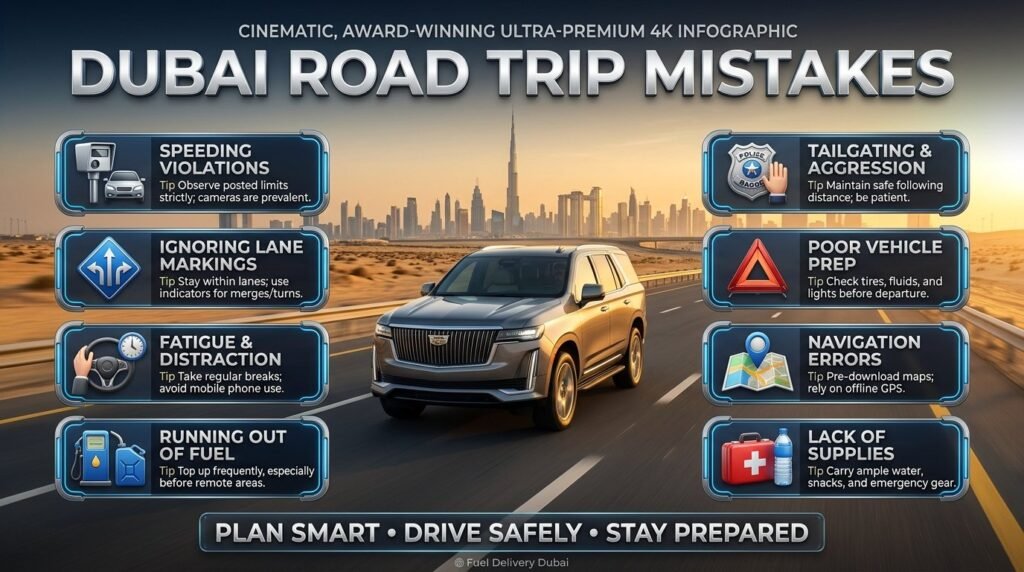
Some travel problems occur because motorists focus too much on the destination and overlook the practical requirements of the journey.
Mistake 1: Planning Only the Outward Journey
Why it happens: Drivers concentrate on reaching the destination and forget that they must also return.
Why it creates problems: They may underestimate driving time, fuel requirements and fatigue.
How to avoid it: Calculate the complete round-trip distance and reserve enough time for the return journey.
Mistake 2: Depending Entirely on Navigation Estimates
Why it happens: Navigation applications provide a convenient journey time.
Why it creates problems: Traffic, accidents, roadworks and unexpected stops can change the actual journey.
How to avoid it: Allow additional time and review traffic conditions before departure.
Mistake 3: Ignoring Small Mechanical Warning Signs
Why it happens: Drivers assume that a minor noise or warning light can wait until after the trip.
Why it creates problems: A small mechanical issue can become more serious during extended driving.
How to avoid it: Arrange an inspection before departure if the vehicle shows unusual symptoms.
Mistake 4: Starting With an Almost Empty Fuel Tank
Why it happens: Some motorists believe that a fuel station will always be available nearby.
Why it creates problems: Unfamiliar routes, delays or detours may make the next refuelling opportunity inconvenient.
How to avoid it: Start with sufficient fuel and identify suitable refuelling options.
Mistake 5: Carrying Too Much Luggage
Why it happens: Travellers pack items they may not actually use.
Why it creates problems: Excessive weight can affect handling and fuel consumption.
How to avoid it: Prepare a practical packing list and remove unnecessary equipment.
Mistake 6: Ignoring Driver Fatigue
Why it happens: Drivers want to complete the journey without stopping.
Why it creates problems: Tiredness reduces concentration, judgement and reaction time.
How to avoid it: Take breaks, share driving where legally permitted and stop when you feel sleepy.
Mistake 7: Visiting Too Many Attractions
Why it happens: Travellers try to fit every popular attraction into one day.
Why it creates problems: The trip becomes rushed and involves unnecessary driving.
How to avoid it: Select a manageable number of attractions and group them by location.
Mistake 8: Forgetting Weather and Access Conditions
Why it happens: Travellers assume that the destination will always be accessible.
Why it creates problems: Weather alerts, temporary restrictions or unsuitable road conditions may affect plans.
How to avoid it: Review current conditions before departure and keep an alternative plan.
15. Professional Recommendations for Better Dubai Road Trips
Experienced motorists understand that good journeys depend on preparation, flexibility and responsible driving.
Complete Your Vehicle Inspection Before Travel Day
Don’t leave every inspection until the morning of departure.
Check tyres, brakes, fluids, battery and lights in advance. This gives you time to arrange maintenance without disrupting your travel schedule.
Use Realistic Fuel Calculations
Don’t depend entirely on the fuel economy advertised by a vehicle manufacturer.
Use your vehicle’s actual consumption figures from regular driving and allow for different road conditions.
A vehicle that normally performs efficiently in city traffic may behave differently on steep mountain roads or during extended highway travel.
Keep Your Travel Schedule Flexible
A road trip should not become stressful because you are trying to follow an unrealistic timetable.
Allow time for meals, parking, sightseeing and unexpected delays.
If traffic becomes heavy, adjust your plans rather than taking unsafe shortcuts.
Prioritise Tyre and Brake Condition
Tyres and brakes are particularly important when carrying passengers or travelling through mountain areas.
If either system shows signs of damage or poor performance, resolve the issue before continuing.
Avoid Last-Minute Route Changes
Review the route before departure and make any necessary navigation changes while safely parked.
Unplanned lane changes and sudden turns can create risks for you and other motorists.
Prepare a Backup Plan
For longer trips, identify alternative refuelling opportunities, suitable rest stops and possible accommodation.
You don’t need to plan every minute, but knowing your options can make unexpected situations easier to manage.
Choose the Right Trip for Your Vehicle
Not every vehicle is suitable for every type of terrain.
A standard passenger car is appropriate for many paved-road destinations, but challenging off-road routes may require a suitable 4×4 and experienced drivers.
Understand your vehicle’s capabilities before selecting an adventure.
16. Short Road Trips Versus Long-Distance Road Trips
Short and long journeys require different levels of preparation.
Understanding the difference helps you avoid treating every trip as though it involves the same risks and requirements.
| Planning factor | Short road trip | Long-distance road trip |
|---|---|---|
| Journey duration | Usually a few hours | Several hours or longer |
| Vehicle inspection | Basic pre-trip inspection | More detailed preparation |
| Fuel planning | Simple consumption estimate | Detailed fuel and reserve plan |
| Rest breaks | Based on comfort and fatigue | Essential throughout the journey |
| Luggage | Usually limited | More careful packing |
| Accommodation | Usually unnecessary | May be required |
| Route planning | One main destination | Multiple stops may be involved |
| Emergency preparation | Basic supplies | More comprehensive preparation |
If your journey involves extended driving between emirates, review the Dubai Long-Distance Driving Guide.
For journeys involving extended highway travel, the Dubai Highway Driving Guide provides additional information about highway conditions, vehicle preparation and safe driving practices.
17. What to Do When Unexpected Problems Occur During a Road Trip
Even a carefully planned journey can involve unexpected situations.
Knowing how to respond calmly can prevent a minor problem from becoming more serious.
If Your Vehicle Develops a Mechanical Problem
If you notice unusual noises, warning lights, overheating or reduced performance, prioritise safety.
Move to a safe location where possible, activate hazard lights when appropriate and arrange professional assistance.
Don’t continue driving if doing so could cause further damage or put passengers at risk.
If You Experience a Flat Tyre
Avoid stopping in an active traffic lane unless there is no safer alternative.
Move away from traffic when possible and follow the vehicle manufacturer’s roadside tyre-changing instructions.
If the location is unsafe, arrange professional roadside assistance.
If You Run Out of Fuel
A fuel shortage can be especially inconvenient during an unfamiliar journey.
Move to a safe location if possible and follow roadside safety procedures.
Arrange suitable fuel assistance rather than walking along a highway or attempting an unsafe refuelling solution.
If You Encounter Heavy Traffic
Remain patient and maintain a safe distance.
Don’t use emergency lanes or make sudden movements to avoid congestion.
If your delay becomes substantial, reassess your planned stops and inform anyone expecting you at the destination.
If Weather Conditions Become Unsafe
Strong winds, heavy rain, poor visibility and other severe conditions can affect driving.
Follow official instructions, avoid risky routes and delay travel when necessary.
Safety should always take priority over completing a planned itinerary.
18. Complete Pre-Departure Checklist for Dubai Road Trips
Use this checklist before starting your next journey.
Vehicle inspection
- Check tyre pressure and condition.
- Inspect tyre tread and visible damage.
- Check engine oil.
- Inspect coolant when the engine is cold.
- Check brake performance.
- Test the battery and charging system.
- Confirm air-conditioning performance.
- Test headlights, indicators and brake lights.
- Check windscreen wipers.
- Confirm spare tyre and emergency equipment availability.
Journey planning
- Confirm your destination.
- Review the complete return route.
- Check live traffic conditions.
- Review the weather forecast.
- Estimate total driving time.
- Calculate fuel requirements.
- Check applicable toll arrangements.
- Identify suitable rest and refuelling stops.
- Confirm attraction access and visiting arrangements.
- Arrange accommodation if necessary.
Personal preparation
- Carry a valid driving licence.
- Confirm vehicle registration and insurance.
- Carry drinking water.
- Pack necessary medication.
- Prepare a phone charger.
- Carry a first-aid kit.
- Pack suitable clothing.
- Share your travel plan for longer journeys.
Completing these checks helps you start your journey with greater confidence and fewer avoidable surprises.
What are the best road trip destinations from Dubai for a weekend getaway?
Dubai offers several excellent destinations for weekend road trips, depending on whether you prefer mountain scenery, beaches, cultural attractions or desert landscapes. Hatta, Fujairah, Ras Al Khaimah, Abu Dhabi and Khor Fakkan are popular choices because they offer different experiences without requiring an extended holiday.
For a relaxing weekend, choose a destination that gives you enough time for sightseeing without spending most of your trip behind the wheel.
Recommended destinations:
Hatta: Suitable for mountain views, kayaking and outdoor activities.
Fujairah: A good choice for beaches, coastal scenery and water activities.
Ras Al Khaimah: Ideal for mountain viewpoints and outdoor adventures.
Abu Dhabi: Excellent for cultural attractions, architecture and family entertainment.
Khor Fakkan: Offers an attractive combination of beaches and mountain surroundings.
Before selecting your destination, consider your available time, accommodation requirements and return journey. Booking accommodation in advance is particularly useful during weekends and popular travel periods.
How much fuel should I prepare for a road trip from Dubai?
The amount of fuel required depends on your total driving distance, vehicle fuel economy, engine type, road conditions and driving habits. A vehicle travelling on an open highway may consume less fuel than one experiencing heavy traffic or climbing mountain roads.
The most practical approach is to calculate fuel consumption using your vehicle’s actual average mileage rather than relying entirely on manufacturer estimates.
Use this calculation:
Required fuel = Total journey distance ÷ Average fuel economy.
For example, if your complete return journey is 360 km and your vehicle averages 12 km per litre, the estimated fuel requirement is 30 litres.
Important fuel-planning recommendations:
Calculate the complete return distance, not just the outward journey.
Check your current fuel level before departure.
Allow additional fuel for unexpected detours and traffic.
Identify suitable refuelling opportunities along the route.
Consider air-conditioning use, passenger load and mountain gradients.
Keeping sufficient fuel in your vehicle helps prevent unnecessary interruptions and makes longer journeys easier to manage.
What should I check in my car before travelling from Dubai to another emirate?
A complete vehicle inspection is important before an inter-emirate road trip because extended driving can expose existing mechanical problems. A vehicle that performs normally during short city journeys may behave differently during prolonged highway driving or on steep mountain roads.
Pay particular attention to tyres, brakes, engine oil, coolant, battery and air-conditioning performance.
Essential pre-trip checks:
Tyres: Inspect pressure, tread depth and visible damage.
Brakes: Check for unusual sounds, vibration or reduced braking performance.
Engine oil: Confirm the level and use the manufacturer’s recommended specification.
Coolant: Check the level when the engine is completely cool.
Battery: Look for corrosion, weak starting and electrical warnings.
Air conditioning: Confirm that the system provides consistent cooling.
Lights: Test headlights, indicators and brake lights.
If you notice overheating, brake problems, fluid leaks or warning lights, arrange a professional inspection before starting your journey. Preventive maintenance is considerably better than dealing with an avoidable breakdown during travel.
What is the best time to start a road trip from Dubai?
Early morning is often a practical departure time for road trips from Dubai because it can provide more sightseeing time and help motorists avoid some busy traffic periods. However, the ideal departure time depends on the destination, weather, road conditions and attraction opening hours.
During cooler months, morning departures are particularly suitable for mountain visits, outdoor activities and coastal journeys. During summer, leaving earlier can help reduce exposure to high daytime temperatures.
Consider these planning tips:
Check live traffic before leaving.
Review the weather forecast and road conditions.
Confirm the destination’s visiting hours.
Avoid travelling when you are tired or sleep-deprived.
Allow enough time for refreshments and rest stops.
Consider weekend and public holiday traffic.
A well-rested driver and realistic departure schedule are more important than reaching a destination a few minutes earlier.
What should I do if my car runs out of fuel or breaks down during a Dubai road trip?
A vehicle breakdown or fuel shortage can interrupt even a carefully planned journey. The priority should always be passenger safety rather than trying to resolve the problem immediately.
If your vehicle develops a problem, move to a safe location where possible, activate your hazard lights when appropriate and follow the relevant roadside safety procedures. Avoid standing near moving traffic or attempting repairs in an unsafe location.
Recommended actions:
Move away from active traffic lanes if it is safe to do so.
Activate hazard lights when appropriate.
Contact emergency services if there is immediate danger.
Arrange suitable roadside assistance for mechanical problems.
For a fuel shortage, request appropriate fuel assistance.
Avoid walking along busy highways to search for a petrol station.
Keep your vehicle details and location available when requesting assistance.
For longer journeys, it is sensible to understand available roadside and fuel assistance options before departure. Keeping sufficient fuel, maintaining your vehicle and preparing for unexpected delays can significantly reduce the inconvenience of travel.
Conclusion
Dubai road trips offer an excellent opportunity to explore the UAE beyond the city’s familiar streets, whether you are planning a short weekend escape to Hatta, a coastal drive towards Fujairah, or a longer journey to Abu Dhabi, Al Ain or Ras Al Khaimah. However, an enjoyable journey depends on more than choosing an attractive destination. Proper preparation, sensible route planning, vehicle condition and responsible driving all contribute to a safer and more comfortable experience.
Before setting off, check your tyres, brakes, engine oil, coolant, battery and lights. Calculate your expected fuel requirements, allow an additional reserve for unexpected delays, and consider toll charges, parking and possible route changes when preparing your travel budget. During the journey, maintain a safe following distance, avoid sudden acceleration and braking, take breaks when necessary, and adjust your driving to traffic and weather conditions.
Most importantly, never wait until a warning light or roadside problem interrupts your plans. Keep your vehicle prepared, monitor your fuel level and know what assistance is available if an unexpected situation occurs. With a practical travel plan and careful driving habits, you can make Dubai road trips more efficient, predictable and enjoyable while exploring more of the UAE with confidence.
Leave a Reply