
Introduction
Dubai Highway Driving | Driving on a Dubai highway can be straightforward when traffic is moving smoothly, but the situation can change within seconds. A vehicle may suddenly enter your lane, traffic may slow near an interchange, or you may realise that your exit is approaching while several vehicles are travelling beside you. These situations require quick decisions, proper observation and a good understanding of highway driving.
Dubai Highway Driving is not simply about travelling at higher speeds. It involves understanding road rules, selecting the correct lane, maintaining safe distances, recognising traffic patterns and preparing your vehicle for longer journeys. Drivers who develop these habits are better equipped to deal with busy roads, unexpected situations and changing weather conditions.
Dubai’s highway network connects major commercial districts, residential communities, industrial locations and neighbouring emirates. Routes such as Sheikh Zayed Road, Al Khail Road, Sheikh Mohammed Bin Zayed Road and Emirates Road are important for daily commuters, tourists and long-distance motorists.
Whether you are a new UAE resident, a visitor renting a car or an experienced driver, knowing how to use these roads correctly can make a significant difference to your journey. Fuel Delivery Dubai is also a useful starting point for understanding fuel assistance when unexpected vehicle or fuel-related problems affect your travel plans.
This comprehensive guide covers the important aspects of Dubai highway driving, including traffic regulations, speed management, lane discipline, merging, overtaking, fuel efficiency, vehicle preparation and emergency situations. It also explains common mistakes and practical techniques that help drivers become more confident without taking unnecessary risks.
2. Understanding Dubai’s Major Highway Network
Before driving on Dubai’s highways, it is useful to understand how the main routes connect different parts of the emirate. Choosing an appropriate highway can reduce unnecessary travelling, help you avoid complicated junctions and make journey planning easier.
Each route has different traffic characteristics. Some are heavily used by office commuters, while others accommodate more long-distance and commercial traffic.
Sheikh Zayed Road (E11)
Sheikh Zayed Road is one of Dubai’s most important highways. It connects several major business, residential and commercial districts and carries significant daily traffic.
Drivers using this route should expect changing traffic conditions, particularly around major interchanges and busy entry and exit points.
Important driving considerations include:
- Identify your exit before reaching a major interchange.
- Avoid unnecessary lane changes.
- Watch for vehicles entering from connecting roads.
- Maintain additional space around buses and heavy vehicles.
- Follow electronic speed-limit displays and road signs.
- Allow extra journey time during busy commuting periods.
Practical example: If you are travelling towards a destination in central Dubai, check the exit number and lane guidance before approaching the interchange. Waiting until the final moment can make a simple journey unnecessarily stressful.
Sheikh Mohammed Bin Zayed Road (E311)
Sheikh Mohammed Bin Zayed Road is an important transport corridor connecting Dubai with surrounding residential communities and other emirates.
It is frequently used by commuters, commercial vehicles and motorists travelling longer distances.
Drivers should pay attention to heavy vehicles, connecting roads, changing speed restrictions and traffic entering from other directions.
Professional advice: Avoid remaining beside a large truck for an extended period. Maintain a safe distance and ensure you can see the road ahead before deciding to overtake.
Emirates Road (E611)
Emirates Road is commonly used for longer journeys and connections between different parts of the UAE.
Motorists travelling outside central Dubai may find this route useful, depending on their starting point and destination.
Before departure, consider:
- Your intended exit.
- Available fuel range.
- Vehicle condition.
- Expected travel time.
- Weather and visibility.
- Possible traffic restrictions.
A longer route is not necessarily a slower route. Compare the complete journey rather than choosing a road simply because it appears shorter on a map.
Al Khail Road (E44)
Al Khail Road connects several important residential and commercial locations in Dubai.
It is frequently used by daily commuters and drivers travelling between different districts.
Some sections experience significant congestion, especially around connecting roads and interchanges.
Quick tip: Keep your navigation instructions ready before moving. If you miss a turn, continue to the next suitable exit rather than attempting a sudden correction.
3. Essential Highway Driving Rules in Dubai

Safe highway driving starts with understanding and following the applicable UAE traffic regulations. Drivers must obey posted speed limits, respect road markings, maintain safe distances, use indicators correctly and avoid dangerous behaviour.
These requirements are important because highway vehicles travel at higher speeds, leaving less time to respond to mistakes.
Follow the Posted Speed Limits
There is no single speed limit that applies to every section of every Dubai highway.
Limits can vary according to road design, traffic conditions, location and temporary restrictions. Always follow the signs displayed on the road you are using.
Remember:
- Check speed-limit signs when entering a highway.
- Watch for electronic speed displays.
- Follow temporary restrictions around roadworks.
- Reduce speed when visibility or traction becomes poor.
- Never assume that the previous road’s speed limit still applies.
A posted speed limit is a maximum legal restriction, not a recommendation to drive at that speed in every situation.
Maintain Proper Lane Discipline
Lane discipline helps traffic move more predictably.
Drivers should use the appropriate lane for their speed and intended direction. The leftmost lane is generally used for overtaking rather than continuous slow driving.
Poor lane discipline can force other motorists to brake suddenly or make unnecessary movements.
Use these habits:
- Select your lane early.
- Avoid unnecessary weaving.
- Do not block overtaking traffic.
- Follow lane arrows and road markings.
- Return to an appropriate lane after overtaking when safe.
Use Indicators Correctly
Indicators communicate your intention to other road users.
Activate the indicator before changing lanes or turning, allowing nearby drivers sufficient time to understand your movement.
However, an indicator does not automatically give you priority. You must still check that the intended lane is clear.
Maintain a Safe Following Distance
A safe following distance gives you time to recognise a hazard and respond without sudden braking.
A practical guideline is to maintain at least a three-second gap in normal conditions. Increase the distance during rain, fog, dust, heavy traffic or when following a large vehicle.
For example, select a fixed roadside object. When the vehicle ahead passes it, count the seconds until your own vehicle reaches the same point. If you reach it too quickly, increase the gap.
Wear Seat Belts
Seat belts must be worn by drivers and passengers.
Before starting your journey:
- Check the driver’s seat belt.
- Ensure front passengers are secured.
- Confirm rear passengers are wearing seat belts.
- Use suitable child restraints.
- Never assume that a short journey makes seat belts unnecessary.
Avoid Driving Distractions
Highway driving requires continuous concentration.
Using a mobile phone, adjusting navigation repeatedly, eating or looking away from the road can reduce your ability to respond to changing traffic.
Set your destination before departure and stop at a suitable safe location if you need to make adjustments.
Make Smarter Travel Decisions with a Dubai Fuel Planning Guide
Effective fuel planning is an essential part of preparing for any journey, whether you are driving within Dubai, travelling between Emirates, or planning an extended road trip. Instead of relying only on the fuel gauge, motorists should consider their complete travel distance, vehicle fuel efficiency, expected traffic conditions, driving habits, and possible route changes before departure. Our Dubai Travel Fuel Planning Guide offers practical recommendations for estimating fuel requirements, preparing for different journey types, managing travel-related fuel expenses, and avoiding common fuel planning mistakes. By following these guidelines, drivers can make better travel decisions, maintain adequate fuel readiness, and reduce the likelihood of unexpected interruptions during their journeys.
4. How to Manage Speed on Dubai Highways
Speed management is one of the most important skills for highway motorists. The faster a vehicle travels, the more distance it generally needs to stop, and the consequences of a delayed reaction can become more serious.
Why Driving at a Consistent Speed Matters
Frequent acceleration and braking can make driving uncomfortable and increase the risk of rear-end collisions.
When traffic allows, maintain a steady speed that remains within the posted limit and is suitable for the road conditions.
Benefits include:
- Better control over vehicle movement.
- More predictable interaction with surrounding traffic.
- Less unnecessary acceleration.
- Improved passenger comfort.
- Potentially better fuel efficiency.
Should You Always Drive at the Maximum Speed?
No. The maximum permitted speed does not mean that driving at that speed is always appropriate.
Consider a situation where the road is legally suitable for a relatively high speed, but rain has reduced visibility and traffic is becoming congested. Maintaining the maximum speed in these conditions may be unsafe.
A responsible driver adjusts speed according to:
- Traffic density.
- Visibility.
- Road surface.
- Vehicle condition.
- Weather.
- Available stopping distance.
Understand Speed Cameras and Enforcement
Dubai uses traffic-monitoring systems to enforce road safety regulations.
Drivers should obey displayed speed limits rather than relying on assumptions about camera locations or possible speed tolerances.
Common mistake: Following another vehicle simply because it is travelling faster. Other motorists cannot determine the legal limit for you, and their driving decisions do not remove your responsibility.
5. Safe Lane Changing on Dubai Highways
Changing lanes is a normal part of highway driving, but it requires careful observation.
The biggest mistake is moving into another lane without properly checking the speed and position of approaching vehicles.
Follow the Correct Lane-Changing Process
Step 1: Plan your movement
Identify the lane you need and avoid waiting until an exit is immediately ahead.
Step 2: Check your mirrors
Look at the rear-view and relevant side mirror to understand the surrounding traffic.
Step 3: Check your blind spot
A vehicle may be beside your car without appearing clearly in your mirrors. Perform a brief shoulder check.
Step 4: Activate your indicator
Give other drivers sufficient warning of your intended movement.
Step 5: Assess the available gap
Consider the distance and speed of nearby vehicles. Do not force your way into a small space.
Step 6: Move smoothly
Make a controlled steering movement without sudden acceleration or braking.
Step 7: Cancel your indicator
Once you have completed the manoeuvre, ensure the indicator is switched off.
What Happens If You Miss Your Exit?
Missing an exit is inconvenient, but it does not justify a dangerous lane change.
Continue along the highway and follow your navigation system to another suitable exit.
Never:
- Reverse on a highway.
- Stop suddenly in a traffic lane.
- Cross several lanes at the last moment.
- Drive over prohibited road markings.
- Use the hard shoulder to reach an exit.
A few additional minutes are always preferable to an unnecessary collision risk.
Prepare Confidently with a Dubai Long-Distance Travel Guide
Planning a long-distance journey requires careful attention to fuel availability, vehicle readiness, route conditions, and overall travel requirements. Drivers should prepare for the complete journey, including return distances, potential traffic delays, rest breaks, and unexpected changes along the route. Our Dubai Long-Distance Travel Guide provides practical insights into long-distance journey preparation, fuel management, vehicle checks, highway driving considerations, and common travel mistakes. Whether you are travelling from Dubai to another Emirate, visiting family, or organising an extended road journey, this guide helps you understand the essential preparation steps, manage your travel more effectively, and minimise avoidable interruptions throughout the journey.
6. How to Merge Safely Into Highway Traffic

Merging means joining an existing traffic lane from an entrance ramp or connecting road.
It can be challenging for beginners because vehicles already on the highway may be travelling faster than the vehicle entering from the ramp.
Step-by-Step Highway Merging
- Observe the main carriageway while approaching the entrance.
- Identify a suitable gap between vehicles.
- Build an appropriate speed where safe and permitted.
- Activate your indicator.
- Check mirrors and blind spots.
- Give way to vehicles already occupying the main road.
- Enter smoothly when a safe opportunity is available.
Do not assume that other drivers must automatically move aside.
Merging During Heavy Traffic
Congestion makes merging more difficult because available gaps become smaller.
Remain patient and avoid aggressive acceleration or forcing your vehicle into another lane.
If traffic is moving slowly, wait for a reasonable opening and communicate your intention clearly.
Expert tip: Start observing traffic early on the entrance ramp. This gives you more time to identify a suitable gap rather than making a rushed decision near the end.
Understanding the Difference Between Merging and Lane Changing
These two movements are related but not identical.
- Merging: Joining an existing traffic stream from an entrance or connecting road.
- Lane changing: Moving from one established traffic lane into another.
Both require signalling, observation and adequate space, but merging also involves understanding the traffic already occupying the main carriageway.
7. Safe Overtaking on Dubai Highways
Overtaking allows motorists to pass slower vehicles when the road, traffic and applicable regulations permit it.
However, overtaking requires more than finding an empty space beside another vehicle.
When Is Overtaking Appropriate?
Before overtaking, check that:
- The intended lane is clear.
- Visibility is sufficient.
- Road markings and signs permit the movement.
- No vehicle is approaching in the intended lane.
- You have enough room to complete the manoeuvre.
- You can return to an appropriate lane safely.
Avoid overtaking when approaching an area with restricted visibility or when surrounding traffic makes the movement unsafe.
How to Overtake Correctly
First, observe the vehicle ahead and the road beyond it. Check your mirrors and blind spot before signalling.
Move into the overtaking lane only when there is sufficient space. Pass smoothly without aggressive acceleration, then return to an appropriate lane when safe.
Do not cut in sharply or leave insufficient space between vehicles.
Dangerous Overtaking Habits
Avoid the following behaviours:
- Using the hard shoulder to pass traffic.
- Weaving between multiple lanes.
- Overtaking without checking blind spots.
- Cutting in front of another vehicle.
- Competing with another driver for road space.
- Overtaking when visibility is restricted.
Professional recommendation: Overtaking should solve a genuine traffic situation, not satisfy impatience. If there is no clear safety benefit, remaining in your lane is often the better decision.
Plan Better Journeys with a Dubai Intercity Travel Guide
Travelling between Dubai and other Emirates requires proper planning to ensure a smooth, comfortable, and well-organised journey. Before departure, motorists should consider the total travel distance, available fuel, expected traffic conditions, road restrictions, vehicle condition, and possible return journey requirements. Our Dubai Intercity Travel Guide offers practical guidance on intercity journey preparation, fuel management, route selection, driving conditions, and avoiding common travel-related problems. Whether you are commuting for business, visiting another Emirate, or planning a family journey, this guide helps you prepare your vehicle, make informed travel decisions, and reduce the risk of unexpected interruptions during your trip.
8. Understanding Dubai Highway Traffic Patterns
Traffic conditions vary throughout the day, and the same route may offer very different journey times depending on when you travel.
Understanding common traffic patterns helps drivers plan more realistic journeys.
Morning Commuting Period
Morning traffic often increases as residents travel towards offices, schools and commercial districts.
During these periods, drivers may encounter congestion around major interchanges and roads connecting residential communities with business locations.
Allow additional time and avoid rushing to reach your destination.
Evening Commuting Period
Evening traffic can become heavy as motorists return home or travel towards shopping and leisure destinations.
Sudden braking, vehicles entering from connecting roads and changing traffic speeds require additional attention.
Maintain a suitable following distance and avoid unnecessary overtaking.
Weekend and Holiday Traffic
Weekend and holiday traffic can differ from weekday commuting patterns.
Popular shopping destinations, entertainment areas and tourist locations may experience increased vehicle movements.
Long-distance routes may also become busier as residents travel between emirates.
How to Choose a Better Departure Time
Before leaving:
- Check current traffic conditions.
- Review your estimated journey time.
- Identify alternative routes.
- Consider major interchanges.
- Allow additional time for unexpected delays.
Do not depend entirely on a navigation application’s estimated arrival time. Traffic incidents, road restrictions and weather can change the journey.
9. Driving on Dubai Highways During Rain, Fog and Dust
Weather conditions can affect visibility, tyre grip and braking performance.
Even experienced drivers must adjust their habits when road conditions become difficult.
Rainy Weather
Rain can make road surfaces slippery and increase the distance required to stop.
When driving in rain:
- Reduce your speed appropriately.
- Increase your following distance.
- Avoid sudden braking.
- Use suitable headlights.
- Keep your windscreen clean.
- Avoid flooded roads and standing water.
Do not assume that a road is safe to cross simply because another vehicle has passed through it.
Foggy Conditions
Fog can reduce visibility and make it difficult to judge the position and speed of other vehicles.
Use low-beam headlights, reduce speed and avoid unnecessary overtaking.
Do not use high beams in dense fog because reflected light can make visibility worse.
If conditions become too difficult, find an appropriate safe stopping location rather than stopping unexpectedly in an active traffic lane.
Dust and Sand
Dusty conditions can reduce visibility and make it harder to identify road markings and hazards.
Keep your windscreen clean, maintain additional space and avoid following another vehicle too closely.
If you cannot clearly see the road ahead, reduce speed and make safety your priority.
What Should You Do When Visibility Suddenly Drops?
Do not panic or make sudden steering movements.
Ease off the accelerator, maintain control and increase your following distance. Follow official traffic instructions and avoid unnecessary lane changes.
The safest response is to give yourself more time and space to recognise what is happening.
10. Preparing Your Vehicle Before a Highway Journey
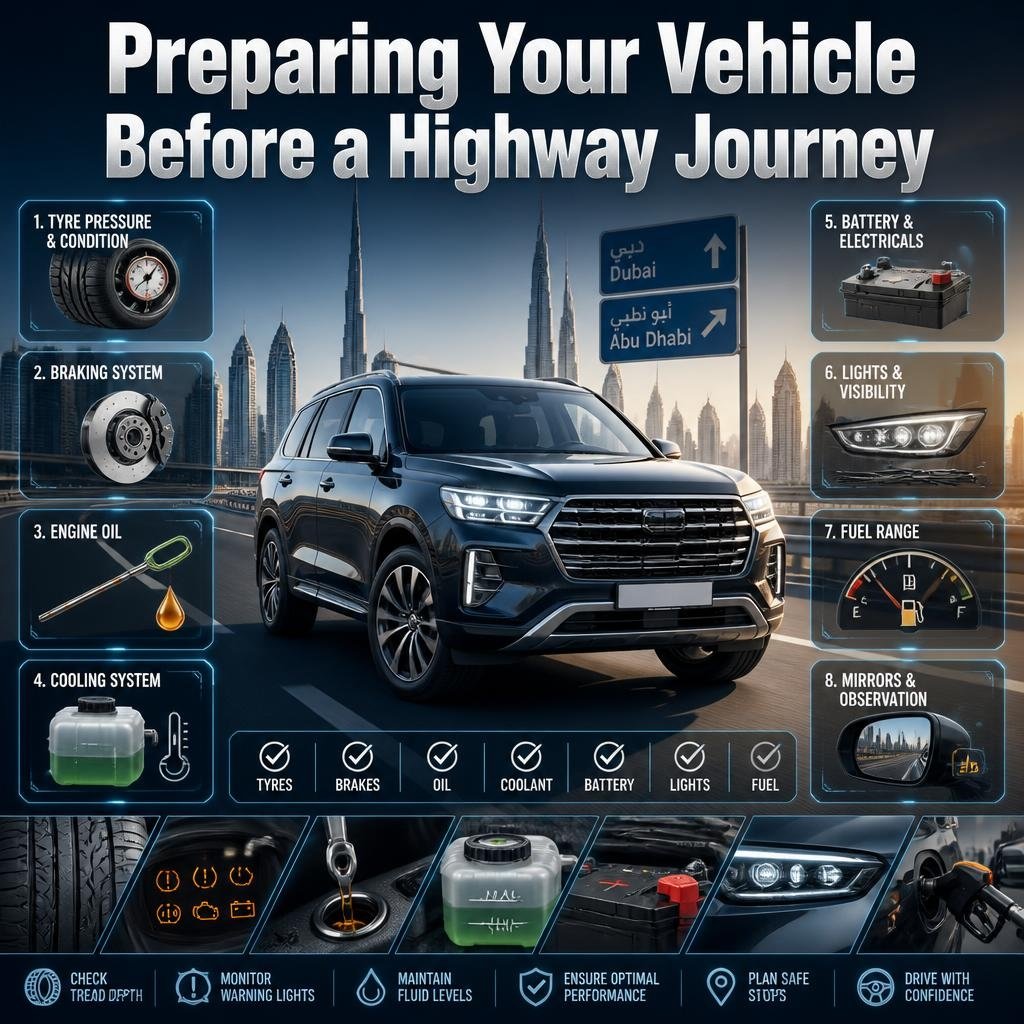
A highway journey places continuous demands on your vehicle’s engine, tyres, brakes, cooling system and electrical components.
A basic inspection before departure can help identify problems that might otherwise interrupt your journey.
Tyre Pressure and Condition
Tyres are the only parts of your vehicle that directly contact the road.
Incorrect pressure or damaged tread can affect braking, steering and stability.
Before departure:
- Check pressure when tyres are cold.
- Follow the manufacturer’s recommended figures.
- Inspect tread depth and general condition.
- Look for cuts, cracks and bulges.
- Check for uneven wear.
- Confirm that your spare tyre or repair equipment is suitable.
Do not use the maximum pressure printed on the tyre sidewall as your normal operating pressure.
Braking System
Reliable brakes are essential for highway safety.
Pay attention to unusual sounds, vibration, changes in pedal response and warning lights.
If your vehicle pulls to one side while braking or the pedal feels abnormal, arrange an inspection before starting a longer journey.
Engine Oil
Engine oil lubricates moving components and helps control friction.
Check the level according to your vehicle manufacturer’s instructions and look for signs of leakage.
Never ignore an oil-pressure warning.
Cooling System
Dubai’s hot climate makes cooling-system maintenance especially important.
Check the coolant level when the engine is completely cool and use the specification recommended by the vehicle manufacturer.
Never open a hot radiator or pressurised coolant reservoir cap.
Battery and Electrical Components
A weak battery may cause starting difficulties and electrical problems.
Check for visible corrosion, loose connections and warning signs.
If the battery has been showing repeated starting problems, have it tested before depending on the vehicle for a long journey.
Lights, Wipers and Visibility
Check headlights, brake lights, indicators and hazard warning lights.
Inspect wiper blades and ensure the windscreen washer system works properly.
Good visibility helps you recognise hazards and communicate with other drivers.
Complete Pre-Highway Inspection
| Vehicle component | Inspection | Main purpose |
|---|---|---|
| Tyres | Pressure and tread | Grip and stability |
| Brakes | Pedal and braking response | Controlled stopping |
| Engine oil | Correct level | Engine protection |
| Coolant | Level and condition | Temperature control |
| Battery | Condition and connections | Reliable starting |
| Lights | Headlights and brake lights | Visibility |
| Wipers | Blade condition | Clear windscreen |
| Fuel | Available range | Journey preparation |
| Mirrors | Position and visibility | Better observation |
11. How to Improve Fuel Efficiency During Highway Driving
Fuel consumption is affected by speed, acceleration, vehicle condition, tyre pressure, passenger load and traffic conditions.
Highway driving can provide better fuel efficiency than stop-and-go city driving when traffic moves steadily. However, excessive speed and aggressive acceleration can reduce that advantage.
Maintain a Smooth Driving Style
Frequent acceleration followed by heavy braking wastes energy.
When traffic conditions allow, accelerate gradually and maintain a suitable consistent speed.
This reduces unnecessary changes in engine demand and makes your driving more comfortable.
Avoid Excessive Speed
Air resistance increases as vehicle speed rises.
At higher speeds, the engine must work harder to overcome aerodynamic drag. This can increase fuel consumption, depending on the vehicle’s design and operating conditions.
Choose a sensible speed within the posted limit instead of accelerating simply to save a few minutes.
Maintain Correct Tyre Pressure
Underinflated tyres increase rolling resistance, which can raise fuel consumption.
Check tyre pressure regularly, particularly before longer journeys.
Avoid Unnecessary Vehicle Weight
Carrying unnecessary heavy equipment increases the energy required to move the vehicle.
Remove items that you do not need, while keeping essential safety equipment available.
Use Air Conditioning Sensibly
Air conditioning is important for comfort in Dubai’s climate, but it places an additional load on the vehicle.
Maintain the system properly and choose a comfortable temperature setting.
Do not compromise driver concentration or passenger safety simply to reduce air-conditioning use.
Avoid Unnecessary Idling
Long periods of unnecessary idling consume fuel without moving the vehicle.
When waiting in a suitable safe location for an extended period, follow the vehicle manufacturer’s recommendations and applicable local requirements.
Plan Your Refuelling
Do not wait until the fuel warning becomes urgent, particularly when travelling outside familiar areas.
Consider the total distance, expected traffic, vehicle fuel economy and possible detours.
For additional practical advice, continue with Dubai Driving and Fuel Insights, which covers fuel-related driving decisions and vehicle efficiency.
12. What to Do During a Highway Breakdown or Fuel Emergency
A mechanical problem on a highway requires a different response from a breakdown in a quiet residential street.
Other vehicles may be travelling at high speeds, so your first priority should be protecting yourself and your passengers.
Step 1: Recognise the Problem
Watch for warning lights, unusual sounds, engine temperature changes, smoke, loss of power or abnormal steering and braking.
Do not ignore a serious warning simply because the vehicle is still moving.
Step 2: Move Towards a Safe Location
If the vehicle remains controllable, move towards an appropriate emergency stopping area or hard shoulder when safe and permitted.
Avoid sudden movements across traffic lanes.
Step 3: Activate Hazard Warning Lights
Switch on hazard warning lights once stopped to make other motorists aware of your vehicle.
Step 4: Protect Passengers
Do not allow passengers to stand near moving traffic.
If leaving the vehicle is safe, move to a protected location away from the carriageway. Follow official instructions and avoid attempting roadside repairs beside active traffic.
Step 5: Arrange Appropriate Assistance
Contact the relevant roadside assistance provider or emergency service according to the nature of the problem.
Provide accurate information about your location, direction of travel and vehicle condition.
What If Your Vehicle Runs Out of Fuel?
Running out of fuel on a highway can create a dangerous situation.
If you notice that the engine is losing power:
- Avoid sudden steering movements.
- Move towards a safe stopping area if possible.
- Activate hazard lights after stopping.
- Keep passengers away from traffic.
- Do not walk across highway lanes to reach a petrol station.
- Arrange appropriate roadside fuel assistance.
A fuel delivery service may help motorists whose vehicles cannot safely reach a petrol station. However, service availability, location access and delivery arrangements should always be confirmed.
Professional advice: Do not treat roadside fuel delivery as a substitute for planning. Refuelling before a long journey is safer and more convenient than waiting until your vehicle is stranded.
13. Planning Long-Distance Highway Journeys From Dubai

Travelling from Dubai to another emirate requires additional preparation compared with a short daily commute.
Longer journeys involve more time on the road, greater exposure to changing traffic conditions and additional demands on the vehicle.
Calculate Your Fuel Requirements
Estimate your journey distance and consider your vehicle’s typical fuel consumption.
Do not depend entirely on the manufacturer’s advertised fuel economy because real-world results can differ.
Actual consumption may increase because of:
- Air-conditioning use.
- Passenger and luggage weight.
- Traffic congestion.
- Driving speed.
- Road gradients.
- Tyre pressure.
- Vehicle maintenance.
Always allow a reasonable fuel reserve.
Inspect the Vehicle Before Departure
Check the tyres, brakes, coolant, engine oil, lights and battery.
If your vehicle has an existing mechanical issue, arrange an inspection rather than hoping it will remain manageable during the journey.
Plan Rest Stops
Fatigue reduces concentration and reaction time.
If you experience repeated yawning, difficulty focusing or trouble maintaining your lane, stop at a suitable safe location and rest.
Do not continue driving simply because your destination is close.
Prepare for Unexpected Delays
A planned journey may become longer because of congestion, roadworks, weather or an unexpected incident.
Allow additional time and avoid scheduling your arrival so tightly that you feel pressured to speed.
For a more detailed preparation guide, read Dubai Long-Distance Driving.
14. How to Drive Safely Around Trucks, Buses and Heavy Vehicles
Dubai highways are used by passenger cars, delivery vehicles, buses and heavy commercial transport.
These vehicles have different dimensions, braking characteristics and visibility limitations.
Understand Heavy-Vehicle Blind Spots
Large vehicles have areas around them where their drivers may not have a clear view.
Avoid remaining beside a truck for an extended period.
If you cannot see the truck driver’s mirrors, there is a possibility that the driver cannot see your vehicle clearly.
Give Trucks Additional Space
Heavy vehicles need more room to manoeuvre and may take longer to stop.
Do not cut closely in front of a truck after overtaking.
Maintain additional space and avoid sudden braking.
Be Careful Around Large Vehicles During Turns
Long vehicles may require additional space when turning or changing direction.
Do not attempt to squeeze into small gaps beside them, particularly near junctions and connecting roads.
Watch for Vehicles Entering and Leaving the Highway
Commercial vehicles may enter or exit through connecting roads.
Observe their movements early and avoid positioning your vehicle in areas where they may need additional space.
15. Common Dubai Highway Driving Mistakes and How to Avoid Them
Many highway problems begin with small mistakes that become serious because of speed, limited space or delayed reactions.
Understanding these habits can help drivers make better decisions.
1. Following Too Closely
Why it happens: Some drivers become impatient or do not realise how quickly a highway vehicle can approach another car.
Why it is dangerous: There may not be enough distance to respond when the vehicle ahead brakes suddenly.
How to avoid it: Maintain an appropriate following gap and increase it during poor weather or heavy traffic.
2. Making Last-Minute Lane Changes
Why it happens: Drivers notice their exit too late or fail to plan their route.
Why it is dangerous: Nearby vehicles may not have enough time to react.
How to avoid it: Identify your exit early and move into the required lane gradually.
3. Driving Slowly in the Overtaking Lane
Why it happens: Some motorists assume that the leftmost lane is always the best place to drive.
Why it is dangerous: It can obstruct faster traffic and encourage unnecessary overtaking.
How to avoid it: Use the appropriate lane and keep the overtaking lane available for its intended purpose.
4. Ignoring Blind Spots
Why it happens: Drivers depend entirely on their mirrors.
Why it is dangerous: Motorcycles and other vehicles may be outside the visible mirror area.
How to avoid it: Check mirrors and perform a brief blind-spot check before moving.
5. Sudden Braking
Why it happens: Drivers react late to congestion or approaching exits.
Why it is dangerous: Vehicles behind may not have enough room to stop safely.
How to avoid it: Observe traffic further ahead and slow down progressively when possible.
6. Aggressive Overtaking
Why it happens: Impatience or competition with other motorists.
Why it is dangerous: Sudden movements can force other drivers to brake or change lanes.
How to avoid it: Overtake only when the movement is legal and safe. Never compete for road space.
7. Ignoring Weather Conditions
Why it happens: Drivers continue using their normal driving habits even when visibility or traction changes.
Why it is dangerous: Wet or dusty roads can affect control and stopping distances.
How to avoid it: Reduce speed and increase your following distance.
8. Starting a Journey Without Checking the Vehicle
Why it happens: Drivers assume that a vehicle suitable for city journeys is automatically ready for highway travel.
Why it is dangerous: A damaged tyre, weak battery or cooling-system problem can interrupt a longer journey.
How to avoid it: Complete a basic inspection before departure.
9. Depending Entirely on Navigation
Why it happens: Drivers follow voice instructions without checking road signs.
Why it is dangerous: Navigation may not reflect every temporary restriction or last-minute road change.
How to avoid it: Use navigation as a planning aid while continuing to follow actual roadside signs and instructions.
10. Driving While Tired
Why it happens: Drivers underestimate fatigue or try to reach their destination without stopping.
Why it is dangerous: Tiredness affects concentration, judgement and reaction time.
How to avoid it: Get sufficient rest before travelling and stop safely when signs of fatigue appear.
16. Professional Recommendations for Better Dubai Highway Driving
Good highway driving is not about reacting quickly to every situation. It is about recognising potential problems early and making decisions that prevent unnecessary risks.
The following recommendations can help occasional motorists and regular commuters improve their driving habits.
Look Further Ahead Instead of Focusing Only on the Next Car
Experienced drivers observe traffic several vehicles ahead.
This helps them recognise braking lights, congestion, merging vehicles and changing traffic conditions earlier.
For example, if you notice several vehicles slowing down in the distance, you can gradually reduce your speed rather than braking suddenly when you reach the congestion.
Keep Your Driving Predictable
Other motorists need to understand your intentions.
Use indicators, maintain a suitable lane position and avoid unnecessary acceleration or braking.
Predictable driving makes it easier for surrounding vehicles to maintain safe distances.
Allow Extra Space Around Large Vehicles
Trucks and buses have larger blind spots and different braking characteristics.
Avoid following them closely or remaining beside them unnecessarily.
When overtaking, complete the manoeuvre safely and leave sufficient space before returning to your lane.
Never Respond Emotionally to Aggressive Drivers
Some motorists may tailgate, flash their headlights or change lanes aggressively.
Do not compete with them or attempt to teach them a lesson.
Maintain a safe position, avoid confrontation and allow them to move away when possible.
Prepare Your Vehicle Before Important Journeys
A few minutes of inspection can help identify problems before departure.
Pay particular attention to tyre condition, brakes, coolant, engine oil, battery performance and fuel availability.
If something feels abnormal, investigate it rather than ignoring the warning.
Keep Your Journey Flexible
Traffic conditions are not always predictable.
Allow additional time, consider alternative routes and avoid planning a journey around an unrealistically tight arrival time.
Use Navigation Without Depending on It Completely
Navigation applications are useful for route planning, but they cannot replace road awareness.
Pay attention to actual signs, lane markings, electronic displays and traffic instructions.
If the navigation system suggests a movement that appears unsafe or prohibited, follow the road rules.
Keep Essential Emergency Equipment Available
Your vehicle should have appropriate emergency equipment for its use and journey requirements.
Consider keeping:
- A suitable warning triangle.
- A properly maintained spare tyre or repair kit.
- A compatible tyre-pressure gauge.
- A basic first-aid kit.
- A phone charger.
- Necessary roadside assistance details.
Store equipment securely so it does not become a hazard during sudden braking.
17. Dubai Highway Driving: Practical Pre-Departure and Road Safety Checklist
A checklist is useful because drivers often forget small but important details when preparing for a journey.
Use the following guide before travelling.
Before Starting Your Journey
- Check your destination and route.
- Review traffic conditions.
- Confirm sufficient fuel.
- Inspect tyre pressure and condition.
- Check engine oil and coolant.
- Ensure the brakes are functioning normally.
- Test headlights, indicators and brake lights.
- Adjust mirrors and seating position.
- Secure luggage properly.
- Make sure every passenger wears a seat belt.
- Set your navigation before moving.
While Driving on the Highway
- Follow the displayed speed limit.
- Maintain a suitable following distance.
- Check mirrors regularly.
- Check blind spots before changing lanes.
- Signal before making manoeuvres.
- Avoid unnecessary overtaking.
- Watch for vehicles entering the highway.
- Keep sufficient space around heavy vehicles.
- Adjust your speed to weather conditions.
- Avoid mobile phone distractions.
- Stay alert for changing traffic patterns.
When Approaching an Exit
- Check directional signs early.
- Identify the correct lane.
- Reduce speed appropriately.
- Avoid sudden lane changes.
- Follow road markings.
- Continue safely if you miss the exit.
If an Emergency Occurs
- Remain calm.
- Move to a safe stopping area if possible.
- Activate hazard warning lights.
- Protect passengers from moving traffic.
- Contact the appropriate assistance service.
- Avoid attempting dangerous roadside repairs.
What Are the Most Important Highway Driving Rules Every Driver Should Know in Dubai?
Driving safely on Dubai highways requires more than following speed limits. Motorists must understand lane discipline, safe overtaking, proper merging, road signs and the importance of maintaining sufficient distance from other vehicles. Following these rules helps prevent sudden traffic movements and reduces the risk of accidents, particularly on busy routes such as Sheikh Zayed Road and Al Khail Road.
Drivers should pay particular attention to these requirements:
Follow posted speed limits: Speed restrictions can change between highway sections, so always observe roadside signs and electronic displays.
Maintain lane discipline: Use the appropriate lane and avoid unnecessary lane changes or obstructing overtaking traffic.
Use indicators correctly: Signal before changing lanes or turning, and check mirrors and blind spots.
Keep a safe distance: Maintain at least a three-second gap in normal conditions and increase it during poor weather.
Avoid distractions: Never allow mobile phones or other activities to take your attention away from driving.
Understanding these basic rules makes highway journeys more predictable and helps protect everyone sharing the road.
How Can I Safely Change Lanes and Overtake Vehicles on Dubai Highways?
Lane changing and overtaking require careful timing because vehicles on Dubai highways may approach from behind at significantly different speeds. A driver who changes lanes without checking surrounding traffic can force another motorist to brake suddenly, creating a dangerous situation.
The safest approach is to plan your movement early rather than waiting until you need to make an immediate correction.
Follow these important practices:
Check your rear-view and side mirrors before moving.
Briefly check your blind spot to identify vehicles that may not appear in your mirrors.
Activate your indicator before changing lanes.
Make sure there is sufficient space to complete the manoeuvre.
Overtake only when permitted and when visibility and traffic conditions are suitable.
Return to an appropriate lane smoothly without cutting off another vehicle.
Never use the hard shoulder to overtake traffic.
Professional advice: If you approach your highway exit too quickly, do not attempt to cross several lanes at the last moment. Continue to the next suitable exit and follow an alternative route. A slightly longer journey is always preferable to an unsafe manoeuvre.
What Should I Check Before Driving on a Dubai Highway, Especially During Hot Weather?
Vehicle preparation is particularly important in Dubai because high temperatures can place additional demands on tyres, batteries, engine cooling systems and other components. A vehicle that performs normally during short city journeys may develop problems during extended highway driving if maintenance has been neglected.
Before departure, complete a basic vehicle inspection to identify potential problems.
Important checks include:
Tyre pressure: Check when tyres are cold and follow the manufacturer’s recommended pressure.
Tyre condition: Look for cracks, cuts, bulges and uneven tread wear.
Engine coolant: Check the coolant level when the engine is completely cool.
Engine oil: Confirm that the oil level is within the recommended range.
Battery condition: Look for signs of corrosion, loose connections or starting difficulties.
Brakes: Pay attention to unusual sounds, vibration or changes in braking response.
Air conditioning: Make sure the system provides adequate cooling.
Fuel level: Ensure that you have enough fuel for the planned journey and possible delays.
Expert recommendation: Do not wait for a dashboard warning before checking your vehicle. Regular inspections and scheduled servicing can help identify developing problems before they interrupt a highway journey.
How Can I Reduce Fuel Consumption While Driving on Dubai Highways?
Fuel efficiency during highway driving depends on speed, acceleration, tyre pressure, vehicle condition, air-conditioning use and traffic conditions. Although steady highway travel can be more fuel-efficient than frequent stop-and-go city driving, excessive speeds and aggressive acceleration can increase fuel consumption.
A smooth and consistent driving style is one of the most practical ways to improve fuel efficiency.
Consider these techniques:
Maintain a suitable speed within the posted speed limit.
Accelerate gradually instead of pressing the accelerator aggressively.
Avoid unnecessary braking and repeated acceleration.
Keep tyres inflated to the manufacturer’s recommended pressure.
Remove unnecessary weight from your vehicle.
Maintain the engine and other important mechanical components.
Plan your route to avoid unnecessary detours.
Avoid prolonged unnecessary idling.
For drivers who regularly travel longer distances, checking fuel requirements before departure is equally important. Allow additional fuel for congestion, unexpected route changes and air-conditioning demand.
What Should I Do If My Car Breaks Down or Runs Out of Fuel on a Dubai Highway?
A vehicle breakdown or fuel shortage on a highway can become dangerous because surrounding traffic may be travelling at high speeds. The priority is to move away from moving traffic safely, protect passengers and arrange suitable assistance.
If your vehicle develops a problem, follow these steps:
Stay calm: Avoid sudden steering or braking unless necessary to prevent immediate danger.
Move to safety: If possible, move towards a suitable emergency stopping area or hard shoulder when safe and permitted.
Activate hazard lights: Make approaching motorists aware that your vehicle has stopped.
Protect passengers: Keep everyone away from moving traffic and move to a protected location if it is safe to leave the vehicle.
Request assistance: Contact an appropriate roadside assistance provider or emergency service.
Avoid roadside repairs: Never attempt dangerous repairs beside active highway traffic.
If your vehicle runs out of fuel, do not walk across highway lanes to reach a petrol station. Arrange suitable fuel assistance instead.
Professional recommendation: Keep your fuel level under observation, particularly before travelling between Dubai and other emirates. If an unexpected shortage occurs, Fuel Delivery Dubai can be a starting point for checking available fuel assistance services.
Conclusion
Dubai highway driving becomes safer, smoother and more efficient when motorists combine proper preparation with responsible driving habits. Understanding major highways, following posted speed limits, maintaining safe distances, changing lanes carefully and staying alert to traffic conditions can help prevent avoidable risks. Whether travelling through the city or driving between emirates, every journey requires attention, patience and a well-maintained vehicle.
Preparation is equally important. Checking tyre pressure, brakes, engine oil, coolant, lights and fuel levels before departure can reduce the chances of unexpected problems. Drivers should also remain prepared for changing weather, heavy traffic, road diversions and unexpected delays. A few minutes of planning before starting a journey can make a significant difference, especially during long-distance travel.
For a more confident driving experience, motorists should make safe driving a consistent habit rather than something they consider only when conditions become difficult. Avoid unnecessary lane changes, aggressive acceleration, tailgating and distracted driving. Keep enough fuel for the planned journey and understand what steps to take if your vehicle develops a problem on the road.
Ultimately, safe Dubai highway driving is about preparation, awareness and responsible decision-making. By applying these practices, drivers can protect themselves and other road users while making everyday journeys and longer trips more comfortable and dependable.
Leave a Reply