Introduction
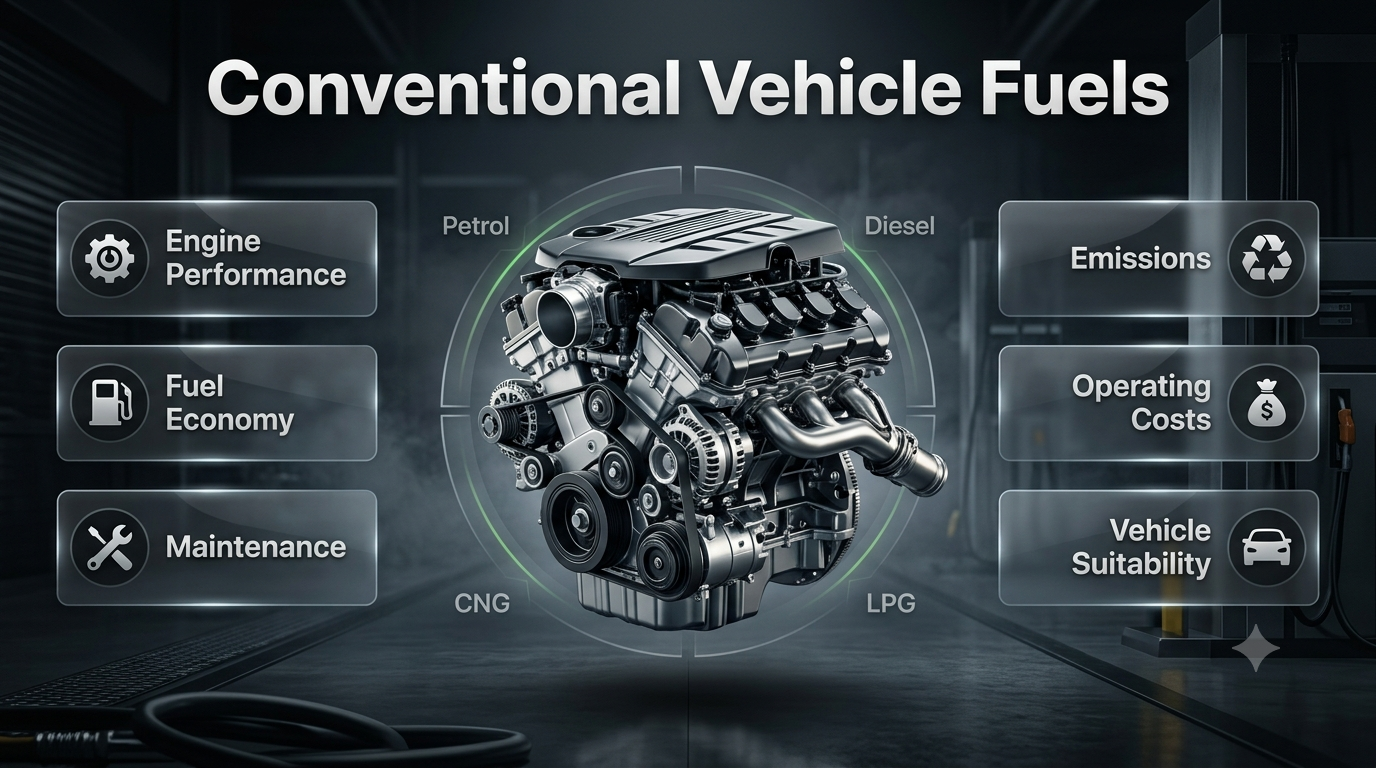
Conventional Vehicle Fuels | Choosing the right fuel for a vehicle can seem straightforward until you start comparing petrol, diesel, CNG, and LPG. Each fuel has different characteristics that affect engine performance, fuel economy, maintenance, emissions, and overall operating costs.
For private drivers, the choice can influence everyday running expenses. For businesses and commercial fleets, it can have an even bigger impact because fuel is often one of the largest recurring operating costs. Understanding fuel availability is also important in situations where drivers ran out of fuel in Dubai 👉 Fuel Delivery Dubai and need to understand their available refuelling options.
That’s why understanding conventional vehicle fuels is important before choosing a vehicle, managing a fleet, or comparing different fuel options.
In this guide, we’ll explain the major types of conventional vehicle fuels, how they work, where they’re commonly used, their advantages and disadvantages, and the factors that should be considered before selecting one.
What Are Conventional Vehicle Fuels?
Conventional vehicle fuels are established fuels that have traditionally been used to power vehicles equipped with internal combustion engines. The most common examples are gasoline, also called petrol, and diesel. Depending on the market and classification, CNG and LPG may also be included among established vehicle fuel options.
These fuels contain chemical energy. An internal combustion engine converts that energy into mechanical power, which is then transferred through the vehicle’s drivetrain to move the wheels.
In simple terms, conventional vehicle fuels are established energy sources that have been widely used to power cars, trucks, buses, vans, and other road vehicles.
Their biggest practical advantage is the infrastructure surrounding them. Fuel stations, storage facilities, distribution networks, mechanics, spare parts, and vehicle technologies have developed around these fuels over many decades.
For drivers, this means conventional fuels are generally easy to understand, widely available, and supported by mature transportation systems.
If you’re new to automotive fuel terminology, our Fuel Fundamentals guide provides a useful starting point for understanding basic fuel concepts.
What Are the Main Types of Conventional Vehicle Fuels?
Several fuels are used in road transportation, but gasoline and diesel remain the most familiar conventional options. CNG and LPG are also established fuels in certain markets and applications.
The most important types include:
- Gasoline or petrol
- Diesel
- Compressed natural gas (CNG)
- Liquefied petroleum gas (LPG)
Each one has different properties, and they aren’t simply interchangeable.
The correct fuel depends on the engine design, vehicle type, driving conditions, fuel availability, and manufacturer’s specifications.
1. Gasoline or Petrol
Gasoline, commonly called petrol in many countries, is one of the most widely used vehicle fuels in the world.
It’s primarily used in spark-ignition engines. In a typical gasoline engine, air and fuel are mixed and compressed before a spark plug initiates combustion.
The resulting combustion produces pressure that moves the engine’s pistons and ultimately generates mechanical power.
Gasoline engines are particularly common in passenger cars, compact SUVs, small vans, and other light-duty vehicles.
Why Is Gasoline So Popular?
One major reason is convenience.
Petrol stations are widely available in many countries, making gasoline vehicles practical for everyday driving and long-distance journeys.
Gasoline engines are also generally known for smooth operation and responsive acceleration. For drivers who mainly use a vehicle for commuting, errands, family travel, and normal road driving, gasoline can be a practical choice.
Advantages of Gasoline
Some common advantages include:
- Widely available refueling infrastructure
- Smooth engine operation
- Responsive acceleration
- Suitable for many passenger vehicles
- Generally straightforward fuel-system technology
- Good choice for many light-duty applications
Disadvantages of Gasoline
Gasoline isn’t ideal for every application.
Depending on the vehicle and operating conditions, gasoline engines may use more fuel than comparable diesel vehicles, particularly during high-mileage or heavy-load operation.
Other considerations include fuel economy, fuel price, vehicle design, and long-term operating costs.
Pro Tip: Don’t judge a gasoline vehicle only by its fuel price. Look at its actual fuel consumption and estimate the cost per kilometer or mile.
2. Diesel
Diesel is another major conventional vehicle fuel and plays an especially important role in commercial transportation.
It’s commonly used in:
- Trucks
- Buses
- Delivery vans
- Commercial fleets
- SUVs
- Heavy-duty vehicles
- Long-distance transport vehicles
Unlike most gasoline engines, diesel engines normally use compression ignition.
Instead of relying on a spark plug to initiate combustion, the engine compresses air to a high temperature and then injects diesel fuel into the compressed air. The fuel ignites under the resulting conditions.
Why Is Diesel Used in Commercial Vehicles?
The main reason is torque.
Diesel engines are well known for producing strong low-speed pulling power. This makes them useful for vehicles that carry heavy loads, tow equipment, or operate for long periods.
For a delivery truck, for example, the ability to move a heavy load efficiently is often more important than having extremely quick acceleration.
Diesel engines can also provide strong fuel economy in many high-mileage applications.
Advantages of Diesel
Key benefits can include:
- Strong low-speed torque
- Good suitability for heavy loads
- Strong fuel economy in many applications
- Useful for long-distance transportation
- Widely used in commercial vehicles
- Suitable for high-mileage operations
Disadvantages of Diesel
Modern diesel engines are technically sophisticated.
They may use high-pressure fuel injection, turbocharging, particulate filters, exhaust-gas treatment, and other emissions-control technologies.
These systems help modern vehicles meet emissions requirements, but they can also make maintenance more complex.
Diesel vehicles may therefore require more specialized servicing than simpler gasoline vehicles.
Common Mistake: Assuming diesel is automatically the better choice because it can offer good fuel economy. A fuel-efficient diesel vehicle isn’t necessarily the best option if your driving pattern doesn’t match the vehicle’s intended use.
3. Compressed Natural Gas (CNG)
Compressed natural gas, commonly known as CNG, is natural gas stored at high pressure for use as a vehicle fuel.
CNG has been used in transportation for many years and is particularly relevant in some commercial and fleet applications.
It’s commonly found in:
- Buses
- Taxis
- Fleet vehicles
- Certain passenger vehicles
- Commercial transportation
CNG can be attractive where the required refueling infrastructure is readily available and the operating economics are favorable.
What Are the Benefits of CNG?
CNG vehicles can offer several practical advantages.
Depending on the vehicle and fuel system, CNG combustion can result in lower levels of certain tailpipe pollutants compared with some conventional petroleum-fuel systems.
CNG can also be attractive for fleets that have predictable routes and access to dedicated refueling facilities.
What Are the Limitations of CNG?
Infrastructure is one of the biggest considerations.
A driver needs reliable access to suitable CNG refueling stations. If those stations aren’t available along regular routes, the convenience advantage can disappear quickly.
Storage is another consideration because CNG must be stored under high pressure using appropriate equipment.
For that reason, CNG should only be used in vehicles and fuel systems specifically designed or professionally approved for it.
4. Liquefied Petroleum Gas (LPG)
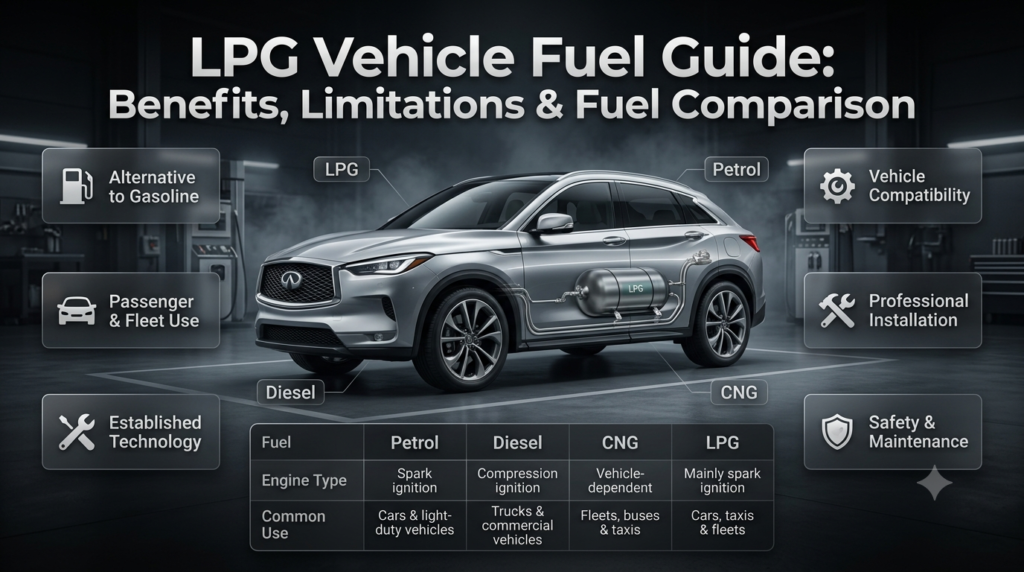
Liquefied petroleum gas, or LPG, is another established fuel used in certain vehicles.
It’s stored as a liquid under pressure and is commonly used in appropriately designed or converted spark-ignition vehicles.
LPG can be attractive in markets where it’s affordable and readily available.
It’s sometimes used in passenger vehicles, taxis, and fleet applications.
Advantages of LPG
Potential benefits include:
- Alternative to gasoline
- Established fuel technology
- Useful in markets with good LPG availability
- Can be suitable for certain fleet applications
Limitations of LPG
LPG requires compatible equipment and proper installation.
A vehicle shouldn’t be converted using low-quality or unsuitable components simply to reduce fuel costs.
The fuel system must be professionally installed and maintained, with appropriate attention to storage, pressure, safety, and local regulations.
Expert Tip: When considering LPG conversion, evaluate the complete system—not just the price of the conversion. Installation quality, vehicle compatibility, maintenance, and local regulations all matter.
Conventional Vehicle Fuels Comparison
| Fuel | Typical Engine Type | Common Applications | Main Advantage |
|---|---|---|---|
| Gasoline/Petrol | Spark ignition | Cars, SUVs, light-duty vehicles | Smooth and responsive operation |
| Diesel | Compression ignition | Trucks, buses, commercial vehicles | Strong torque and high-mileage capability |
| CNG | Depends on vehicle design | Fleets, buses, taxis | Established gaseous-fuel option |
| LPG | Mainly spark ignition | Cars, taxis, fleets | Alternative fuel option where infrastructure exists |
The table provides a quick overview, but fuel selection shouldn’t be based on one characteristic alone.
A fuel that works extremely well for a heavy-duty truck may be completely unnecessary for a small city car.
How Do Conventional Vehicle Fuels Work?
Although the fuel systems are different, the basic principle is similar.
The vehicle stores fuel, delivers it to the engine, combines it with air as required, and uses combustion to release energy.
The simplified process looks like this:
Fuel → Fuel System → Engine → Combustion → Mechanical Energy → Vehicle Movement
The major difference is how combustion is initiated and controlled.
Gasoline engines generally rely on spark ignition, while diesel engines generally use compression ignition.
CNG and LPG require fuel systems designed around their specific physical and combustion characteristics.
This is why putting the wrong fuel into a vehicle can create serious problems. The engine and fuel-delivery system are designed around particular fuel properties.
Why Does Fuel Type Matter?
Fuel type affects much more than the amount you pay when filling the tank.
It can influence:
- Fuel economy
- Engine performance
- Torque
- Acceleration
- Maintenance
- Driving range
- Refueling convenience
- Vehicle purchase cost
- Emissions
- Commercial operating expenses
- Long-term ownership costs
For example, a heavy-duty truck that regularly carries construction materials has very different fuel requirements from a small car used for short daily commutes.
Likewise, a fleet operating hundreds of kilometers every day needs to think carefully about fuel availability, refueling time, fuel consumption, and vehicle downtime.
Quick Tip: Always match the fuel to the vehicle’s actual job. The right fuel is the one that makes sense for the complete operating situation, not simply the one with the lowest advertised price.
Gasoline vs Diesel: Which Is Better?
There isn’t a universal answer.
Gasoline can be a practical option for passenger vehicles, light-duty use, and drivers who value smooth operation and responsive performance.
Diesel can be more suitable for vehicles that regularly carry heavy loads, travel long distances, or accumulate high annual mileage.
| Factor | Gasoline | Diesel |
|---|---|---|
| Typical use | Passenger vehicles | Commercial/heavy-duty vehicles |
| Engine operation | Spark ignition | Compression ignition |
| Low-speed torque | Generally lower | Generally stronger |
| Heavy loads | Vehicle-dependent | Often well suited |
| High-mileage use | Suitable depending on vehicle | Often highly suitable |
| Maintenance complexity | Generally simpler | Can be more complex |
| Urban passenger use | Common | Vehicle/use dependent |
When Does Gasoline Make More Sense?
Gasoline may be a sensible choice when:
- You drive a passenger car
- Your annual mileage is moderate
- You mainly drive in urban areas
- You don’t regularly carry heavy loads
- You want smooth and responsive operation
- Petrol stations are readily accessible
When Does Diesel Make More Sense?
Diesel may be worth considering when:
- The vehicle travels long distances
- The vehicle carries heavy loads
- Annual mileage is high
- Strong low-speed torque is important
- The vehicle is designed for commercial use
- Fuel economy is a major operating consideration
The important point is that application comes before preference.
A fuel should be selected according to how the vehicle is actually used.
Are Conventional Vehicle Fuels Still Important?
Yes. Conventional vehicle fuels remain an important part of global transportation because a huge number of existing cars, vans, trucks, buses, and commercial fleets still rely on internal combustion engines.
The biggest advantage isn’t simply the fuel itself. It’s the infrastructure built around it.
Fuel stations, storage facilities, transportation networks, mechanics, spare parts, service centers, and vehicle technologies have been developed around conventional fuels for decades. This makes refueling relatively quick and convenient in many locations.
For commercial operators, that convenience can be especially important. A delivery vehicle that spends too much time waiting to refuel isn’t generating revenue during that downtime.
Why Do Businesses Still Use Conventional Fuels?

Businesses usually look at fuel from an operational perspective rather than simply asking which fuel is cheapest.
A commercial fleet may need to consider:
- Daily mileage
- Vehicle load
- Fuel consumption
- Refueling time
- Fuel availability
- Maintenance requirements
- Vehicle downtime
- Driver behavior
- Route conditions
- Total operating cost
For example, a company operating delivery vans throughout the day may prioritize a fuel that offers dependable range and quick refueling.
A vehicle that travels long distances every day has different requirements from one that makes only a few short trips.
This is why fleet managers should evaluate fuel based on the complete operating cycle rather than the price displayed at the fuel station.
If you’re researching different automotive fuel categories, you can also explore our guide to automotive fuel types.
What Is the Difference Between Fuel Price and Fuel Cost?
Fuel price is the amount you pay for a specific quantity of fuel.
Fuel cost, however, is better understood as the amount you spend to move a vehicle over a certain distance.
For example, imagine one vehicle uses less fuel per 100 kilometers while another consumes significantly more.
Even if both vehicles use fuels with similar prices, their actual operating costs can be very different.
A simple way to think about it is:
Fuel Cost per Distance = Fuel Consumption × Fuel Price
For businesses, the calculation can go further:
Total Vehicle Cost = Fuel + Maintenance + Tires + Downtime + Depreciation + Other Operating Costs
This broader calculation gives fleet operators a much more realistic understanding of what a vehicle actually costs to operate.
Why Fuel Economy Matters
Fuel economy tells you how effectively a vehicle converts fuel into useful movement.
A vehicle that travels farther using the same amount of fuel generally costs less to operate, assuming other costs are similar.
However, fuel economy figures should always be interpreted in context.
Real-world consumption can change because of:
- Traffic
- Driving speed
- Vehicle load
- Tire pressure
- Weather
- Road conditions
- Air-conditioning use
- Idling
- Driving style
- Vehicle maintenance
Expert Tip: Use real-world fuel consumption when estimating operating costs whenever possible. Manufacturer figures are useful for comparison, but actual results can vary considerably.
How Should You Choose a Conventional Vehicle Fuel?
Choosing a fuel becomes much easier when you break the decision into practical steps.
Step 1: Identify the Vehicle
Start with the vehicle itself.
Check the manufacturer’s specifications to determine which fuel type and fuel grade the engine is designed to use.
Never assume that one fuel can safely replace another simply because both are used in vehicles.
Gasoline and diesel engines, for example, operate differently and use different fuel systems.
Professional Advice: The manufacturer’s recommended fuel specification should always be your first reference point.
Step 2: Understand Your Driving Pattern
Think about how you actually use the vehicle.
Ask yourself:
- How many kilometers do I drive each month?
- Are most trips short or long?
- Do I spend most of the time in traffic?
- Do I regularly travel on highways?
- Does the vehicle carry passengers or heavy loads?
- Is the vehicle used every day?
This information can reveal which fuel characteristics matter most.
A person who drives a small car a few times a week has very different requirements from a delivery company operating vehicles throughout the day.
Step 3: Consider Vehicle Load
Load has a direct effect on fuel consumption.
A heavily loaded truck requires considerably more energy to move than an empty vehicle.
For commercial applications, it’s therefore important to consider the typical operating weight rather than the vehicle’s empty condition.
If the vehicle regularly carries heavy cargo, torque and durability may become more important than maximum acceleration.
Step 4: Check Fuel Availability
A fuel may look attractive on paper but become inconvenient if refueling infrastructure is limited.
Before selecting a fuel, consider where you can refuel during normal operations.
This is particularly important for CNG and LPG because availability can vary significantly by location.
For fleet operators, it may be possible to plan around dedicated refueling facilities. Individual drivers usually need more flexibility.
Step 5: Compare Total Operating Costs
Don’t compare fuels based only on price.
Consider:
- Purchase price
- Fuel consumption
- Fuel price
- Maintenance
- Expected vehicle lifespan
- Refueling convenience
- Insurance considerations
- Resale value
- Downtime
A vehicle with a higher initial price can potentially become more economical over time if it provides better efficiency and lower operating costs.
Step 6: Follow the Manufacturer’s Requirements
Always use the correct fuel type and specification.
For gasoline vehicles, the required octane rating matters.
For diesel vehicles, the appropriate diesel specification and fuel quality are important.
Using an unsuitable fuel can affect combustion, performance, emissions systems, and engine components.
What Are the Most Common Fuel Mistakes?
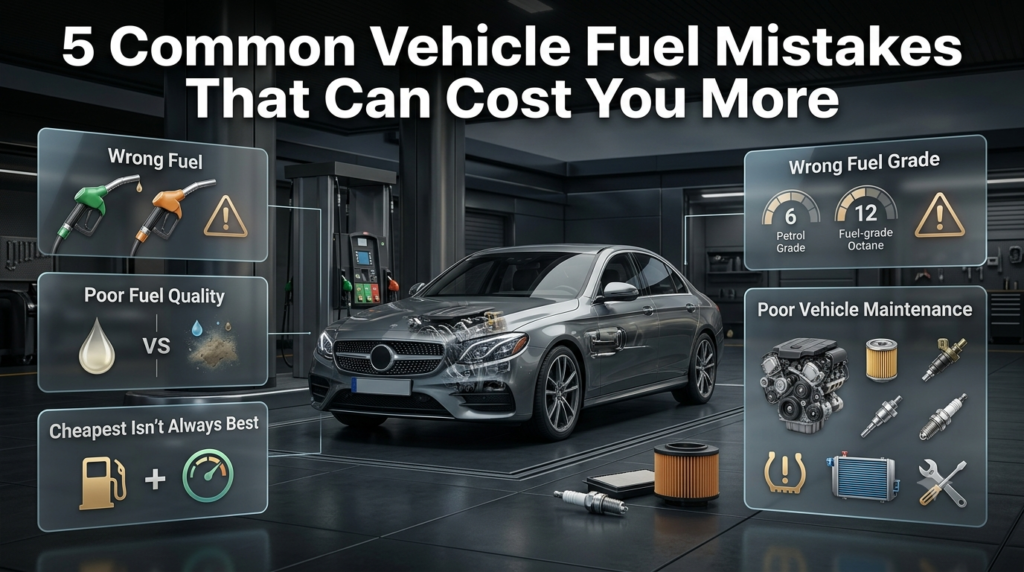
Many fuel-related problems aren’t caused by complicated mechanical failures. They come from basic mistakes that could have been avoided.
1. Putting the Wrong Fuel in the Vehicle
This is one of the most serious and common mistakes.
Gasoline and diesel engines are designed around different combustion principles. Accidentally filling a vehicle with the wrong fuel can result in poor operation, failure to start, or potentially expensive repairs.
If you realize you’ve used the wrong fuel, don’t assume that driving the vehicle will solve the problem.
Quick Tip: If you suspect you’ve filled the vehicle with the wrong fuel, stop and seek appropriate professional assistance before continuing to operate it.
2. Ignoring Fuel Quality
Fuel quality matters.
Contaminated fuel can introduce water, dirt, or other unwanted material into the fuel system.
Over time, this can affect components such as:
- Fuel filters
- Injectors
- Fuel pumps
- Combustion systems
This is particularly important for businesses that store fuel or operate their own refueling systems.
3. Choosing Fuel Only Because It’s Cheaper
A lower price doesn’t necessarily mean lower operating costs.
If a vehicle consumes more fuel, requires additional maintenance, or isn’t suited to the selected fuel, the apparent savings can disappear.
The better question is:
“What will this fuel cost me per kilometer over the life of the vehicle?”
4. Ignoring the Recommended Fuel Grade
Different gasoline engines may require different octane levels, while diesel vehicles may have specific fuel requirements.
Using the wrong grade or specification can affect engine performance and may cause problems over time.
Always check the vehicle manufacturer’s recommendations.
5. Neglecting Vehicle Maintenance
Fuel efficiency depends on the condition of the entire vehicle.
A poorly maintained engine may consume more fuel even when the fuel itself is perfectly suitable.
Common maintenance areas include:
- Engine oil
- Air filters
- Fuel filters
- Spark plugs
- Injectors
- Tire pressure
- Cooling systems
- Emissions equipment
A small maintenance problem can become a major operating expense if it’s ignored for too long.
How Can You Improve Fuel Efficiency?
You don’t necessarily need to change fuel types to reduce fuel expenses.
Better driving habits and proper maintenance can also make a noticeable difference.
Maintain Correct Tire Pressure
Tires that aren’t properly inflated can increase rolling resistance.
When rolling resistance increases, the engine has to work harder to move the vehicle.
Check tire pressure regularly and follow the manufacturer’s recommended pressure.
Avoid Unnecessary Idling
An idling engine consumes fuel even though the vehicle isn’t moving.
Repeated unnecessary idling can add up over time, particularly for commercial vehicles that spend many hours on the road.
Where appropriate and safe, reducing unnecessary idle time can help lower fuel consumption.
Accelerate Smoothly
Aggressive acceleration followed by heavy braking wastes energy.
Smooth acceleration and predictable driving can help the vehicle operate more efficiently.
This becomes particularly important in fleet operations, where small differences in driver behavior can become significant when multiplied across many vehicles.
Reduce Unnecessary Weight
Extra weight requires additional energy to move.
Drivers should avoid carrying equipment, tools, or cargo that isn’t needed.
For commercial vehicles, however, safety and operational requirements should always come first. Never remove essential equipment simply to reduce weight.
Keep the Vehicle Properly Maintained
Regular maintenance helps the engine and fuel system operate as intended.
A proper maintenance schedule may include:
- Engine oil changes
- Air-filter replacement
- Fuel-filter replacement
- Spark-plug inspection
- Injector checks
- Tire inspections
- Cooling-system checks
Pro Tip: Preventive maintenance is usually easier and cheaper than waiting for a small mechanical issue to become a major failure.
Conventional Vehicle Fuels and Environmental Considerations
Conventional fuels also need to be considered from an environmental perspective.
Combustion of petroleum-based fuels produces carbon dioxide, while vehicle engines can also produce other pollutants depending on fuel type, engine technology, operating conditions, and emissions-control systems.
Modern vehicles use increasingly advanced technology to reduce harmful emissions.
Examples include:
- Catalytic converters
- Diesel particulate filters
- Exhaust-gas treatment systems
- Electronic engine management
- Improved fuel injection
These technologies have significantly changed the emissions performance of modern vehicles compared with older engine designs.
However, the environmental impact of a vehicle isn’t determined by fuel alone.
It can also depend on:
- How the fuel is produced
- How it’s transported
- Engine efficiency
- Vehicle weight
- Driving habits
- Maintenance
- Emissions-control technology
- Total distance traveled
That’s why a meaningful comparison should consider the entire fuel-and-vehicle system.
Conventional Fuels vs Alternative Vehicle Fuels
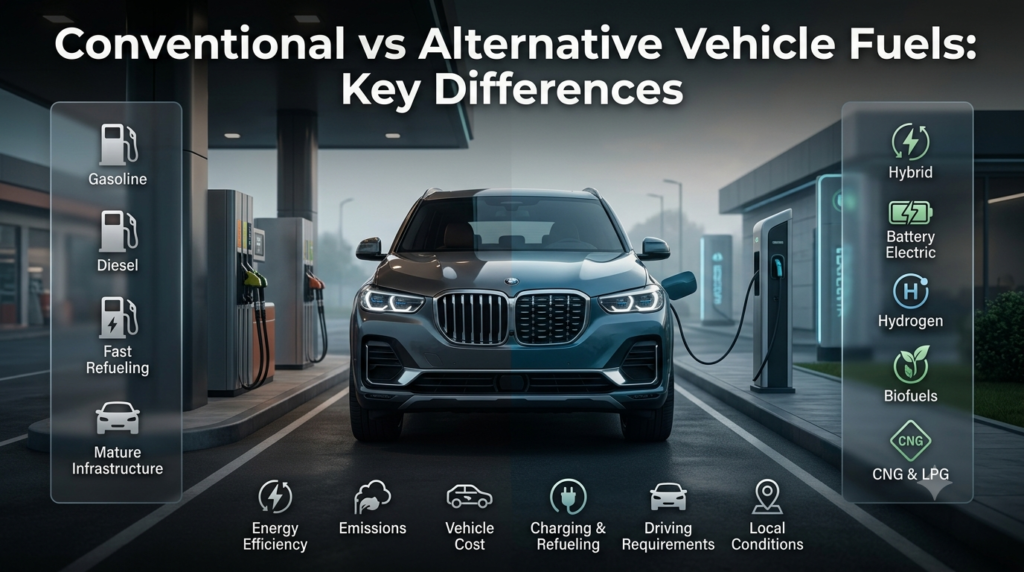
The automotive industry is no longer limited to traditional gasoline and diesel.
Drivers and businesses now have access to technologies such as:
- Hybrid vehicles
- Battery-electric vehicles
- Hydrogen-powered vehicles
- Biofuels
- CNG
- LPG
Each option has different strengths and limitations.
Conventional fuels continue to benefit from mature infrastructure, fast refueling, established repair networks, and a huge existing vehicle fleet.
Alternative technologies may provide advantages in areas such as energy efficiency or emissions, but their practicality depends heavily on charging or refueling infrastructure, vehicle cost, driving requirements, and local conditions.
For a closer comparison of traditional fuel options, our guide to petrol and diesel fuel types can help you understand the differences between these two major fuel categories.
Are Conventional Fuels Suitable for Every Vehicle?
No.
Every vehicle has a specific fuel requirement determined by its engine and fuel system.
A gasoline vehicle shouldn’t be filled with diesel, and a diesel vehicle shouldn’t be filled with gasoline.
Likewise, CNG or LPG should only be used in a vehicle with a properly designed and approved system.
Fuel compatibility involves more than simply getting the engine to run.
The fuel system, storage components, injectors, engine management, combustion characteristics, emissions equipment, and safety systems all need to work together.
Expert Tip: Never rely on an online comment or informal recommendation when deciding whether a particular fuel is suitable for your vehicle. Start with the manufacturer’s specifications.
Conventional Vehicle Fuels for Commercial Fleets
For commercial fleets, fuel selection can become a strategic business decision.
A private driver might save a relatively small amount by improving fuel efficiency. A company operating 50 or 100 vehicles can potentially save a significant amount through small improvements across the entire fleet.
Fleet managers should monitor:
- Fuel consumption per vehicle
- Fuel cost per kilometer
- Total monthly fuel usage
- Driver behavior
- Idling time
- Maintenance costs
- Vehicle utilization
- Fuel theft or unexplained losses
- Route efficiency
Example: Two Delivery Vans
Imagine two delivery vans operating the same route.
Van A has a lower purchase price but consumes more fuel.
Van B costs more initially but uses less fuel and requires fewer refueling stops.
If both vehicles are operated for several years, Van B could potentially produce a lower total operating cost despite its higher purchase price.
This is why professional fleet management focuses on total cost of ownership, not just the initial vehicle price or fuel price.
Why Fuel Monitoring Matters
Fuel monitoring can reveal problems that aren’t immediately visible.
If one vehicle suddenly starts consuming more fuel than similar vehicles, the cause could be:
- Tire pressure
- Mechanical problems
- Aggressive driving
- Excessive idling
- Overloading
- Fuel-system issues
- Incorrect fuel records
Identifying the problem early can prevent unnecessary expenses.
How Does Driving Style Affect Conventional Fuel Consumption?
The way a vehicle is driven can have a major effect on how much fuel it uses. Two drivers operating identical vehicles on the same route can achieve noticeably different fuel economy because of differences in acceleration, braking, speed, and idling.
Aggressive acceleration forces the engine to use more fuel, while repeated hard braking wastes some of the energy that was just produced. Constantly changing speed in heavy traffic can also reduce efficiency.
For better fuel economy, drivers should focus on smooth acceleration, maintain a steady speed when traffic allows, avoid unnecessary idling, and anticipate traffic conditions rather than constantly accelerating and braking.
Quick Tip: Smooth driving isn’t only more comfortable. It can also reduce fuel consumption, tire wear, and unnecessary mechanical stress.
Does Vehicle Weight Affect Fuel Consumption?
Yes. A heavier vehicle generally requires more energy to accelerate and maintain movement, especially in stop-and-go traffic.
This is particularly important for commercial vehicles. A delivery van carrying unnecessary equipment every day may consume more fuel than the same vehicle operating with only the required load.
However, reducing weight should never compromise safety or business requirements.
Before removing equipment, fleet operators should determine whether it is genuinely unnecessary.
Factors That Can Increase Fuel Consumption
Several factors can increase the amount of fuel a vehicle needs:
- Excessive cargo
- Underinflated tires
- Frequent hard acceleration
- High speeds
- Long periods of idling
- Poor engine maintenance
- Heavy traffic
- Frequent short trips
- Strong headwinds
- Poor wheel alignment
Understanding these factors can help drivers identify why real-world fuel consumption differs from the vehicle’s advertised figures.
What Role Does Vehicle Maintenance Play?
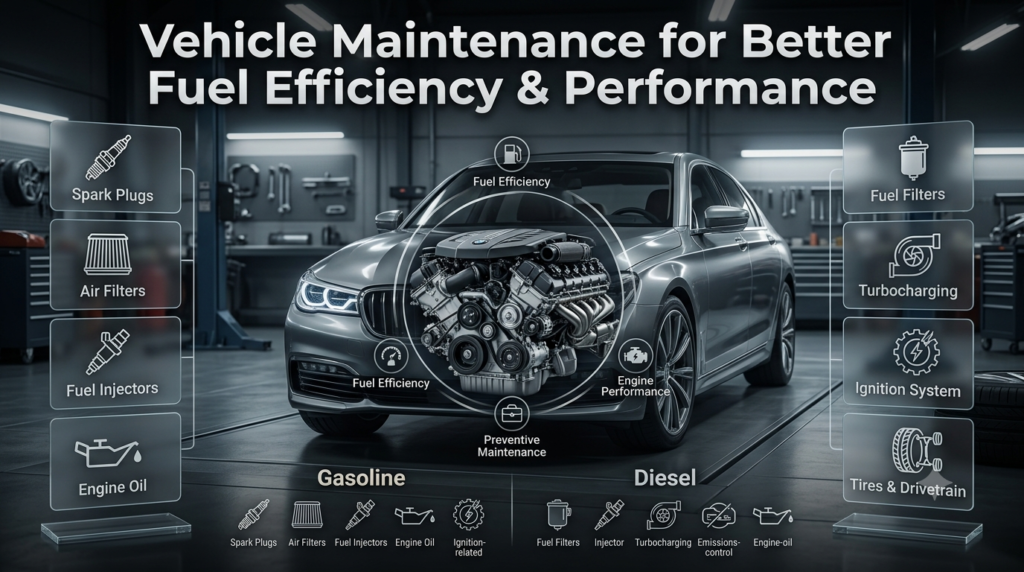
Fuel efficiency depends heavily on vehicle condition.
A vehicle with a poorly maintained engine may require more fuel to produce the same amount of useful power. Problems with the air intake, ignition system, fuel system, tires, or drivetrain can all affect efficiency.
Regular maintenance helps identify these issues before they become expensive failures.
For gasoline vehicles, attention may include spark plugs, air filters, fuel injectors, engine oil, and ignition components.
For diesel vehicles, fuel filters, injectors, turbocharging systems, emissions-control equipment, and engine oil can be particularly important.
The exact maintenance schedule should always follow the vehicle manufacturer’s recommendations.
Expert Tip: Don’t wait for a noticeable drop in performance before checking the vehicle. Preventive maintenance can identify efficiency problems while they’re still relatively small.
How Does Fuel Storage Affect Fuel Quality?
Fuel storage is especially important for businesses, fleet operators, construction companies, and organizations that keep fuel on-site.
Fuel should be stored in appropriate equipment and under conditions that minimize contamination, water intrusion, deterioration, and safety risks.
Poor storage practices can lead to problems with fuel quality and vehicle performance.
Common issues include:
- Water contamination
- Dirt and sediment
- Damaged storage equipment
- Improper handling
- Inadequate inspection
- Poor tank maintenance
For businesses, proper fuel management should include appropriate storage procedures, inspections, documentation, and compliance with applicable safety requirements.
Why Is Water Contamination a Problem?
Water doesn’t belong in a vehicle’s fuel system.
It can contribute to corrosion and fuel-system problems and may affect engine operation.
Diesel fuel systems can be particularly sensitive to contamination because modern diesel injection systems operate at very high pressures and use precision components.
This is one reason professional fuel management matters in commercial operations.
What Is the Best Conventional Fuel for City Driving?
There isn’t one answer for every vehicle.
For many passenger cars, gasoline is a practical choice for urban driving because gasoline-powered vehicles are widely available and often well suited to everyday stop-and-go use.
However, the vehicle’s specific engine technology matters more than the fuel label alone.
Modern diesel vehicles can also be used in cities, but some diesel emissions-control systems may not be ideally suited to vehicles that are driven almost exclusively on very short trips.
The best approach is to follow the manufacturer’s recommended operating conditions.
What Is the Best Conventional Fuel for Long-Distance Driving?
Long-distance driving places different demands on a vehicle.
Fuel economy, driving range, engine durability, refueling availability, and comfort become particularly important.
Diesel has traditionally been popular for long-distance transportation because diesel-powered vehicles can offer strong fuel economy and torque in many applications.
Gasoline vehicles can also perform very well on highways, especially when they use efficient modern engines.
The right choice depends on the vehicle rather than the fuel name alone.
What Is the Best Fuel for Heavy-Duty Vehicles?
Diesel is commonly associated with heavy-duty transportation because of its strong torque characteristics and established commercial-vehicle technology.
Trucks, buses, construction vehicles, agricultural equipment, and other heavy-duty applications often require an engine capable of handling substantial loads for extended periods.
However, modern fleet operators should consider the entire operating environment.
The decision should include:
- Average load
- Daily distance
- Route conditions
- Fuel availability
- Maintenance support
- Vehicle purchase price
- Fuel economy
- Regulatory requirements
- Expected service life
- Total cost of ownership
A heavy-duty application should never be evaluated using passenger-car fuel requirements.
What Should Fleet Managers Consider Before Choosing a Fuel?
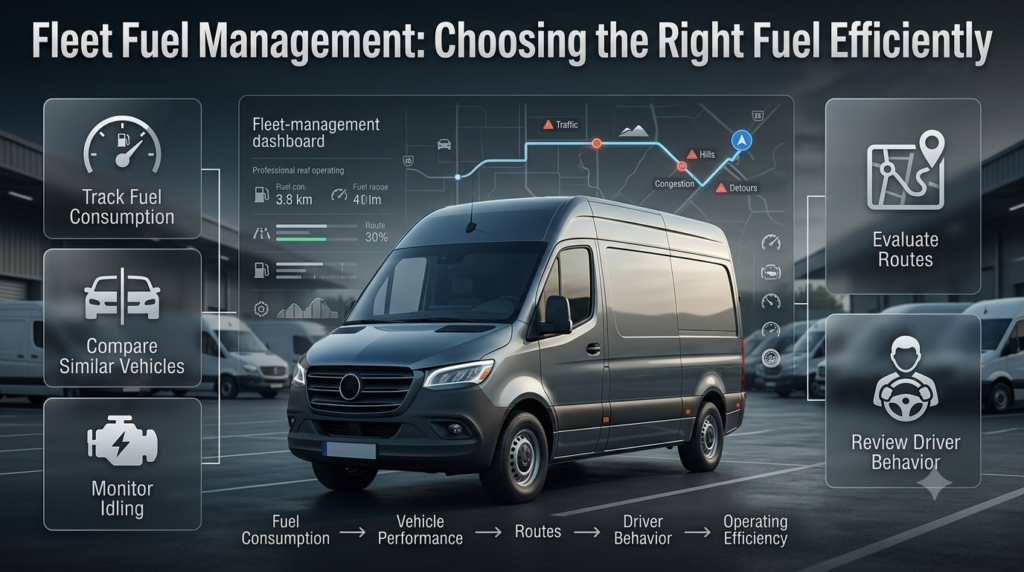
Fleet fuel selection should be based on data rather than assumptions.
A good fleet analysis begins with actual operating information.
Track Fuel Consumption
Record how much fuel each vehicle uses and compare it with the distance traveled.
This helps identify vehicles that are performing differently from the rest of the fleet.
Compare Similar Vehicles
If several vehicles of the same model operate under similar conditions, their fuel consumption should generally be within a reasonable range.
A significant difference may indicate a maintenance issue, driving-style problem, loading difference, or data problem.
Monitor Idling
Unnecessary idling can waste fuel without adding useful mileage.
This is especially important for delivery vehicles, buses, service vans, and vehicles that spend significant time waiting.
Evaluate Routes
A route with frequent traffic, hills, congestion, or unnecessary detours can increase fuel consumption.
Better route planning can therefore reduce fuel costs without changing the fuel itself.
Review Driver Behavior
Driver training can make a meaningful difference.
Drivers should understand how acceleration, braking, idling, tire pressure, and speed affect fuel consumption.
Pro Tip: Small improvements multiplied across an entire fleet can become much more valuable than trying to save money on a few individual fuel purchases.
How Do Fuel Grades Affect Vehicle Performance?
Fuel type and fuel grade aren’t exactly the same thing.
A vehicle may require a specific grade of gasoline or a particular diesel specification.
For gasoline engines, octane rating is an important consideration. Higher octane isn’t automatically better for every vehicle. The appropriate grade is the one specified by the manufacturer.
For diesel vehicles, fuel quality and specification are also important because modern diesel fuel systems operate with highly precise components.
Using the manufacturer’s recommended fuel specification helps ensure the engine operates as intended.
What Happens If You Use the Wrong Fuel?
Using the wrong fuel can cause anything from poor engine operation to serious mechanical problems.
The exact consequences depend on the vehicle, the amount of incorrect fuel used, whether the engine was started, and how far the vehicle was driven.
For example, putting gasoline into a diesel vehicle can affect lubrication and fuel-system operation. Putting diesel into a gasoline vehicle can interfere with combustion.
If incorrect fueling occurs, the safest approach is generally to avoid continuing to operate the vehicle and obtain appropriate professional assistance.
Common Mistake: Starting the engine after realizing that the wrong fuel was added can potentially circulate the incorrect fuel through more of the system.
Are Conventional Fuels Cost-Effective for Businesses?
They can be, especially when the business operates vehicles that are well matched to conventional fuel systems and has reliable access to refueling infrastructure.
The key is efficient management.
Businesses can improve fuel economics by:
- Selecting appropriate vehicles
- Monitoring consumption
- Training drivers
- Reducing unnecessary idling
- Maintaining vehicles
- Planning efficient routes
- Preventing fuel contamination
- Monitoring fuel purchases
- Reviewing vehicle utilization
Fuel management should be treated as an operational process rather than simply an accounting expense.
Conventional Vehicle Fuels: A Practical Decision Guide
| If your priority is… | Consider focusing on… |
|---|---|
| Everyday passenger driving | Vehicle efficiency and gasoline suitability |
| Heavy loads | Torque and appropriate diesel applications |
| Long-distance operation | Fuel economy, range, and refueling availability |
| Fleet cost reduction | Total cost per kilometer |
| Urban operation | Vehicle suitability for stop-and-go conditions |
| CNG operation | Availability of reliable CNG infrastructure |
| LPG operation | Vehicle compatibility and professional installation |
| Lower fuel consumption | Maintenance and driving behavior |
This table shouldn’t replace manufacturer specifications, but it provides a useful starting point when comparing options.
Are Conventional Fuels Reliable?
Conventional fuel systems are supported by decades of engineering experience and widespread infrastructure.
That doesn’t mean every vehicle or fuel system is maintenance-free.
Reliability depends on several factors:
- Vehicle design
- Fuel quality
- Maintenance
- Driving conditions
- Component quality
- Fuel-system condition
- Storage practices
- Driver behavior
A well-maintained vehicle using the correct fuel is generally in a much better position to deliver dependable performance than a poorly maintained vehicle, regardless of fuel type.
What Are the Most Common Conventional Vehicle Fuels?
Conventional vehicle fuels are established energy sources that have been widely used to power internal combustion vehicles. Gasoline (petrol) and diesel are the two primary fuels associated with conventional road transportation, while CNG and LPG are also established options in certain markets and applications. Each fuel has different combustion characteristics, operating requirements, performance benefits, and limitations.
The right fuel depends largely on the vehicle’s engine, driving conditions, expected mileage, load, fuel availability, and maintenance requirements. A fuel that works well for a passenger car may not be the most practical choice for a heavy-duty truck or commercial fleet.
Key points:
Gasoline is widely used in passenger and light-duty vehicles.
Diesel is particularly common in trucks, buses, and commercial vehicles.
CNG is used in selected fleet, taxi, and bus applications.
LPG can be used in compatible vehicles and professionally installed systems.
Fuel compatibility should always follow the vehicle manufacturer’s specifications
Is Diesel Better Than Petrol for Conventional Vehicles?
Diesel isn’t automatically better than petrol; it is generally better suited to certain types of driving and vehicle applications. Diesel engines are well known for producing strong low-speed torque, which makes them particularly useful for heavy loads, commercial transportation, and high-mileage driving.
Petrol engines, on the other hand, are widely used in passenger vehicles and can provide smooth, responsive performance for everyday driving. For someone who mainly drives short urban trips in a passenger car, petrol may be a more practical choice than diesel.
The best option should therefore be based on how the vehicle will actually be used rather than simply comparing fuel prices.
Key points:
Diesel can be advantageous for heavy loads and long-distance operation.
Petrol is commonly suitable for passenger and light-duty vehicles.
Diesel may offer strong fuel economy in high-mileage applications.
Modern diesel systems can require more specialized maintenance.
Annual mileage and driving pattern are important when comparing the two.
How Can You Reduce Fuel Consumption in a Conventional Vehicle?
Reducing fuel consumption isn’t always about switching to another fuel. Vehicle condition, driving habits, load, tire pressure, and route conditions can have a significant effect on how efficiently a vehicle uses fuel.
Smooth acceleration, avoiding unnecessary idling, maintaining correct tire pressure, and keeping the engine properly serviced can all help reduce wasted fuel. For commercial fleets, the savings can become substantial because even a small improvement in fuel efficiency is multiplied across many vehicles and thousands of kilometers.
The most effective approach is to identify where fuel is being wasted and then address the underlying cause.
Key points:
Keep tires inflated to the manufacturer’s recommended pressure.
Avoid unnecessary engine idling.
Accelerate and brake smoothly.
Remove unnecessary weight where appropriate.
Follow the vehicle’s maintenance schedule.
Monitor fuel consumption to identify unusual increases.
Plan routes efficiently, especially for commercial vehicles.
What Factors Should You Consider When Choosing a Conventional Vehicle Fuel?
The best conventional fuel depends on much more than its price at the fuel station. Before choosing between petrol, diesel, CNG, LPG, or another compatible option, consider vehicle type, engine requirements, annual mileage, load, driving conditions, fuel availability, maintenance, and total operating cost.
For example, a delivery company may prioritize fuel economy, range, quick refueling, and reliability, while a private driver may place greater importance on smooth performance and convenience. The same fuel can therefore be economical for one driver and unsuitable for another.
A professional fuel decision starts with the vehicle’s requirements and then considers the owner’s operating needs.
Key points:
Check the manufacturer’s approved fuel type and specification.
Calculate expected annual mileage.
Consider whether the vehicle carries heavy loads.
Compare real-world fuel consumption.
Check fuel availability along regular routes.
Include maintenance and downtime in the cost calculation.
Evaluate total cost of ownership rather than fuel price alone.
Why Is Fuel Quality Important for Conventional Vehicles?
Fuel quality plays an important role in engine performance, reliability, and fuel-system health. Modern engines use increasingly precise fuel-delivery components, including injectors, pumps, filters, and electronic control systems. Contaminated or unsuitable fuel can interfere with these components and may contribute to poor performance or expensive repairs.
This is especially important for commercial operators that purchase, transport, or store fuel in larger quantities. Water, dirt, sediment, or improper storage conditions can compromise fuel quality before it even reaches the vehicle.
Using the correct fuel from a reliable source and maintaining the vehicle’s fuel system are therefore essential parts of good fuel management.
Key points:
Use fuel that meets the vehicle manufacturer’s specification.
Avoid questionable or poorly stored fuel.
Keep fuel-storage equipment clean and properly maintained.
Replace fuel filters according to the recommended service schedule.
Pay attention to unusual changes in engine performance or fuel economy.
For commercial fleets, monitor fuel quality and consumption regularly.
Conclusion
Conventional vehicle fuels continue to play a major role in modern transportation because they offer established technology, widespread refueling infrastructure, and practical solutions for everything from everyday passenger cars to heavy-duty commercial fleets. Gasoline, diesel, CNG, and LPG each have their own strengths, and the right choice depends on how a vehicle is actually used.
The most important factor isn’t simply choosing the cheapest fuel. Vehicle type, engine requirements, driving distance, load, fuel availability, maintenance, fuel economy, and total operating cost all need to be considered together.
For drivers and fleet operators, using the correct fuel and maintaining the vehicle properly can make a significant difference in performance, reliability, and long-term running costs. By understanding how conventional vehicle fuels work and choosing an option that matches the vehicle’s real operating needs, you can make a more informed and cost-effective fuel decision.
Leave a Reply