
Introduction
Contaminated Diesel Causes | Imagine filling your diesel vehicle with fuel and driving away normally. A few minutes later, the engine starts hesitating. Acceleration feels weak, the vehicle struggles uphill, and eventually the engine may stall. Your first thought might be a bad injector, fuel pump, turbocharger, or some serious engine failure.
But what if the problem started with the fuel?
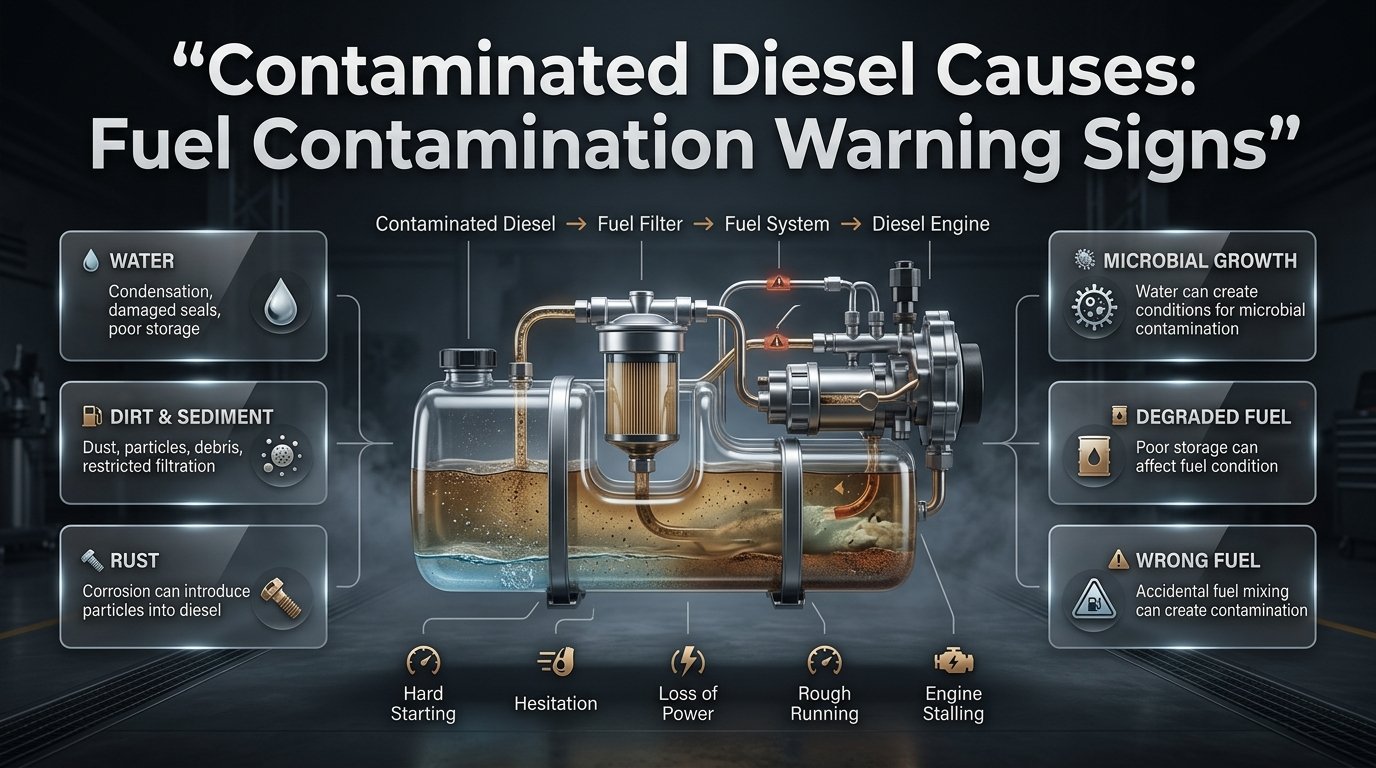
Contaminated diesel causes can range from water and dirt to rust, sediment, microbial growth, degraded fuel, or accidental mixing with another fuel. These contaminants can interfere with fuel flow, combustion, filtration, and the operation of sensitive diesel fuel-system components.
The challenge is that contaminated diesel often produces symptoms that look like mechanical or electrical faults. That makes correct diagnosis especially important.
In this guide, you’ll learn what causes diesel contamination, how contaminants enter the fuel system, which symptoms they can produce, how to identify the problem, what mistakes to avoid, and how to prevent contamination from damaging your vehicle.
If you’re dealing with an unexpected fuel-related problem in Dubai, Need Diesel Emergency Dubai 👉 Fuel Delivery Dubai can also be a useful resource when your vehicle cannot continue safely.
What Are the Most Common Contaminated Diesel Causes?
The most common causes of contaminated diesel are water, dirt, dust, sediment, rust, microbial growth, degraded fuel, incorrect fuel, poor storage, and careless fuel handling.
Contamination can occur before diesel reaches your vehicle or after it has already been stored in the vehicle’s tank.
The major causes include:
- Water entering the fuel.
- Condensation inside tanks.
- Dirty storage tanks.
- Rust and corrosion.
- Dirt, dust, and sediment.
- Microbial contamination.
- Old or degraded diesel.
- Incorrect fuel or cross-contamination.
- Contaminated containers.
- Poor fuel-handling practices.
- Contamination during transportation or dispensing.
- Long-term storage without proper fuel management.
The important thing to understand is that contaminated diesel isn’t always caused by visibly dirty fuel. Water and microorganisms, for example, may create serious problems without immediately making contamination obvious to the driver.
Why Does Diesel Fuel Become Contaminated?
Diesel passes through several stages before it reaches an engine.
A simplified fuel journey looks like this:
Production → transportation → storage → dispensing → vehicle tank → fuel filter → fuel pump → injectors → combustion
At every stage, there is an opportunity for unwanted material to enter the fuel.
A storage tank may collect water at the bottom. A damaged container may allow dirt inside. A poorly maintained fuel system may develop corrosion. A vehicle that sits for months may accumulate condensation.
This means fuel quality isn’t determined only by the original quality of the diesel.
Fuel handling, storage, transportation, and vehicle maintenance all influence the condition of the fuel by the time it reaches the engine.
This broader view is important because drivers sometimes assume that if diesel looked clean when purchased, contamination couldn’t possibly be responsible for a later problem.
What Causes Water Contamination in Diesel?
Water is one of the most significant diesel fuel contaminants because it can affect both fuel quality and fuel-system components.
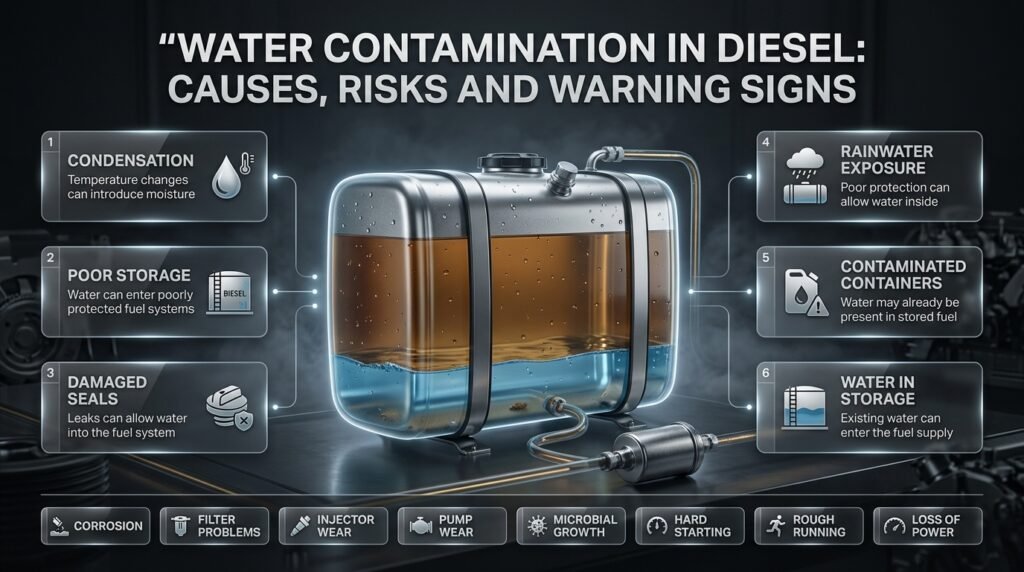
Water can enter diesel through condensation, damaged seals, poorly maintained storage tanks, contaminated fuel containers, rainwater exposure, or existing water inside a fuel-storage system.
Unlike diesel fuel, water doesn’t provide the properties required for proper combustion and fuel-system lubrication.
How Does Water Enter a Diesel Tank?
Several situations can introduce water:
- Condensation caused by temperature changes
- Poorly sealed storage tanks
- Damaged fuel caps
- Rainwater entering storage equipment
- Flooding
- Contaminated fuel containers
- Water already present in a service-station or storage tank
- Poor fuel-handling procedures
Water tends to settle differently from diesel because the two liquids have different densities. This means free water can accumulate in areas of the fuel system where it can eventually be drawn into the engine’s fuel supply.
Why Is Water Bad for Diesel Fuel?
Water contamination may contribute to:
- Corrosion
- Poor combustion
- Fuel-filter problems
- Injector wear
- Fuel-pump wear
- Microbial growth
- Hard starting
- Rough running
- Loss of power
Modern diesel fuel systems can be particularly sensitive because fuel is delivered at very high pressures through precision components.
For a broader explanation of how fuel quality affects vehicle operation, see Fuel Quality and Engine Performance.
Can Condensation Cause Contaminated Diesel?
Yes. Condensation is an important but often overlooked source of water contamination.
When the air space inside a partially filled fuel tank experiences temperature changes, moisture can condense and accumulate inside the tank.
This can become more relevant when:
- The tank remains partially empty for long periods.
- The vehicle is stored for extended periods.
- Temperature changes are significant.
- The fuel tank isn’t properly maintained.
- Water isn’t periodically identified and removed from storage systems.
Why Does a Partially Empty Tank Matter?
A partially filled tank contains more air space than a full tank. That air can contain moisture.
Repeated temperature changes may allow moisture to condense and eventually collect inside the tank.
This doesn’t mean every partially filled diesel tank will develop a serious contamination problem. It means long-term storage conditions deserve attention, especially where temperature and humidity fluctuate.
Expert Tip: If a diesel vehicle has been sitting unused for an extended period and develops fuel-related symptoms after being returned to service, don’t ignore the possibility of water accumulation or degraded fuel.
Can Dirt and Dust Contaminate Diesel?
Absolutely.
Diesel can become contaminated with physical particles such as:
- Dust
- Sand
- Dirt
- Sediment
- Metal particles
- Rust
- Debris from containers or storage equipment
These contaminants may enter through dirty fuel equipment, damaged storage systems, open containers, poor transfer procedures, or accumulated deposits inside a tank.
The fuel filter is designed to capture particles before they reach sensitive components.
However, the filter has a limited capacity.
If large quantities of dirt enter the fuel system, the filter can become restricted.
How Does a Dirty Fuel Filter Affect a Diesel Engine?
When the fuel filter becomes heavily contaminated, fuel flow may become restricted.
The sequence can look like this:
Contaminated diesel → filter captures particles → filter becomes restricted → fuel flow decreases → engine receives inadequate fuel → power drops
The vehicle may still start and idle normally but struggle when the driver demands more power.
For example, a diesel car might:
- Idle reasonably well.
- Accelerate slowly.
- Lose power on hills.
- Hesitate when overtaking.
- Struggle under heavy load.
- Eventually stall if fuel flow becomes severely restricted.
This is one reason contaminated diesel can sometimes be mistaken for a turbocharger or electronic problem.
Can Rust Cause Diesel Fuel Contamination?
Yes.
Rust can develop when metal fuel tanks or storage equipment are exposed to moisture over time.
Once corrosion occurs, loose rust particles can enter the fuel.
Rust contamination is particularly problematic because it can create a cycle:
Water → corrosion → rust particles → fuel contamination → filter restriction
If the source of rust isn’t addressed, replacing the fuel filter alone may not solve the problem.
Where Can Rust Come From?
Potential sources include:
- Old storage tanks
- Metal fuel containers
- Corroded transfer equipment
- Damaged fuel-system components
- Poorly maintained storage infrastructure
A filter containing significant rust particles can therefore be a useful clue during diagnosis.
What Is Microbial Contamination in Diesel?
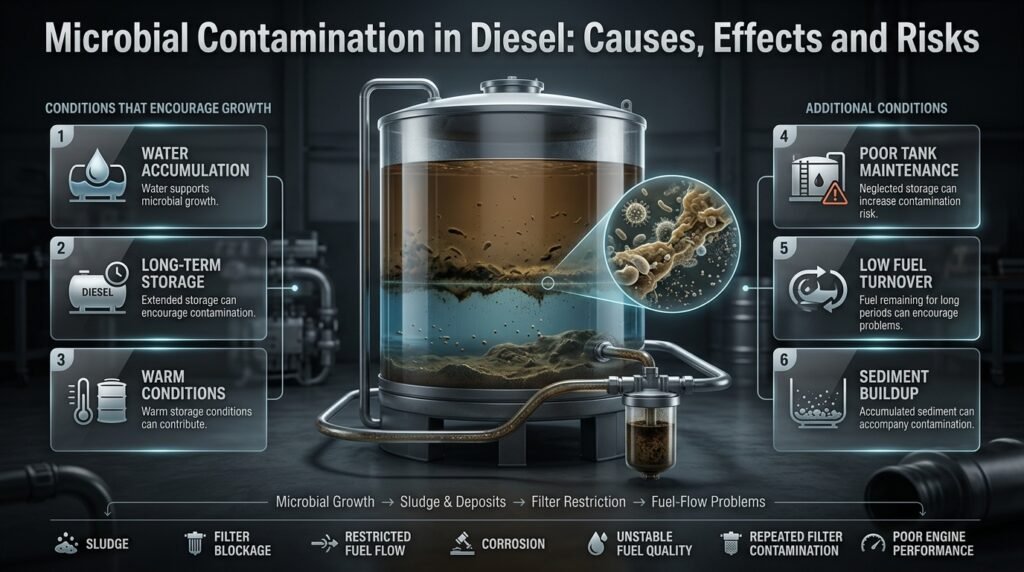
Microbial contamination is commonly associated with microorganisms that grow where fuel and water meet.
It’s sometimes called “diesel bug,” but the term doesn’t mean an insect is living in the fuel.
The microorganisms can produce material that contributes to sludge, deposits, corrosion, and fuel-filter blockage.
What Encourages Microbial Growth?
The biggest factor is usually the presence of water.
Other conditions that can contribute include:
- Long-term fuel storage
- Warm conditions
- Poor tank maintenance
- Water accumulation
- Low fuel turnover
- Sediment buildup
What Problems Can Microbial Contamination Cause?
Potential problems include:
- Sludge
- Filter blockage
- Fuel-flow restrictions
- Corrosion
- Unstable fuel quality
- Repeated filter contamination
- Poor engine performance
If a fuel filter repeatedly becomes clogged with unusual dark or slimy material, simply installing another filter may not be enough.
The storage tank and fuel source should also be investigated.
Can Old Diesel Become Contaminated?
Old diesel can deteriorate, particularly when stored under poor conditions for an extended period.
Fuel quality can change through oxidation and other degradation processes. Depending on storage conditions, deposits or sediment may develop.
However, it’s important not to assume that old diesel automatically means contaminated diesel.
The condition of the fuel depends on:
- Storage time
- Temperature
- Exposure to air
- Water presence
- Tank cleanliness
- Fuel quality
- Storage practices
Fuel stored for a long period should therefore be evaluated based on its actual condition rather than age alone.
Can Incorrect Fuel Cause Diesel Contamination?
Yes.
Accidentally putting petrol into a diesel vehicle is a form of fuel contamination and can create serious problems.
The consequences depend on:
- The amount of incorrect fuel
- The type of vehicle
- The fuel-system design
- Whether the engine was started
- Whether the vehicle was driven
- How much incorrect fuel circulated through the system
What Should You Do If the Wrong Fuel Was Added?
If you realize the mistake before starting the vehicle, don’t start the engine.
Starting the engine can circulate the incorrect fuel through the fuel system.
The appropriate response is to obtain professional assistance and determine what fuel needs to be removed and which parts of the system require inspection.
For readers comparing different automotive fuels, Petrol and Diesel Fuel Types provides useful background on the differences between these fuel categories.
Can Petrol Contamination Damage a Diesel Engine?
Potentially, yes.
Diesel fuel systems are designed around specific fuel properties. Petrol has different characteristics and does not behave the same way in a diesel fuel system.
The most important concern isn’t simply whether the wrong liquid will burn. The fuel also interacts with:
- Fuel pumps
- Injectors
- Seals
- Fuel-pressure systems
- Lubricated components
- Combustion processes
That’s why accidental misfuelling should be treated seriously rather than assuming that adding more diesel will automatically solve the problem.
What Are the Symptoms of Contaminated Diesel?
The symptoms depend on the type and severity of contamination.
Common symptoms include:
- Difficult starting
- Engine hesitation
- Rough idle
- Reduced acceleration
- Loss of power
- Engine stalling
- Unusual exhaust smoke
- Poor fuel economy
- Fuel-filter blockage
- Engine warning lights
- Unusual engine behavior after refueling
- Poor performance under load
A particularly important clue is timing.
If a vehicle was operating normally and suddenly developed symptoms shortly after refueling, fuel contamination should be considered.
That doesn’t prove contaminated diesel is the cause, but it makes fuel quality an important part of the investigation.
Can Contaminated Diesel Cause Hard Starting?
Yes.
Water, restricted fuel flow, severe contamination, incorrect fuel, or fuel-system problems caused by contamination can all contribute to difficult starting.
A restricted fuel filter can prevent enough fuel from reaching the injection system.
Similarly, water or other contaminants may interfere with normal fuel delivery.
However, hard starting has many possible causes, including battery problems, glow-plug faults, fuel-pressure issues, air entering the fuel system, injector problems, and mechanical faults.
The correct diagnosis therefore requires more than one symptom.
Can Contaminated Diesel Cause Loss of Power?
Yes.
Loss of power is one of the symptoms that can occur when contamination restricts fuel delivery.
The effect may be more noticeable when the engine is under load.
For example:
A vehicle may drive reasonably well on a flat road at moderate speed but lose power when climbing a hill or accelerating onto a highway.
Why?
Because the engine requires greater fuel flow when power demand increases.
If the filter or fuel system can’t provide that flow, performance can drop.
Can Contaminated Diesel Cause Smoke?
It can contribute to abnormal combustion and unusual exhaust smoke, depending on the type of contamination and the engine’s condition.
However, smoke should never be treated as proof of contaminated fuel.
Different smoke colors and patterns can have different causes, including:
- Poor combustion
- Injector problems
- Turbocharger problems
- Coolant-related issues
- Oil consumption
- Air-fuel problems
- Engine wear
Fuel contamination is one possibility among several.
Can Contaminated Diesel Damage Fuel Injectors?
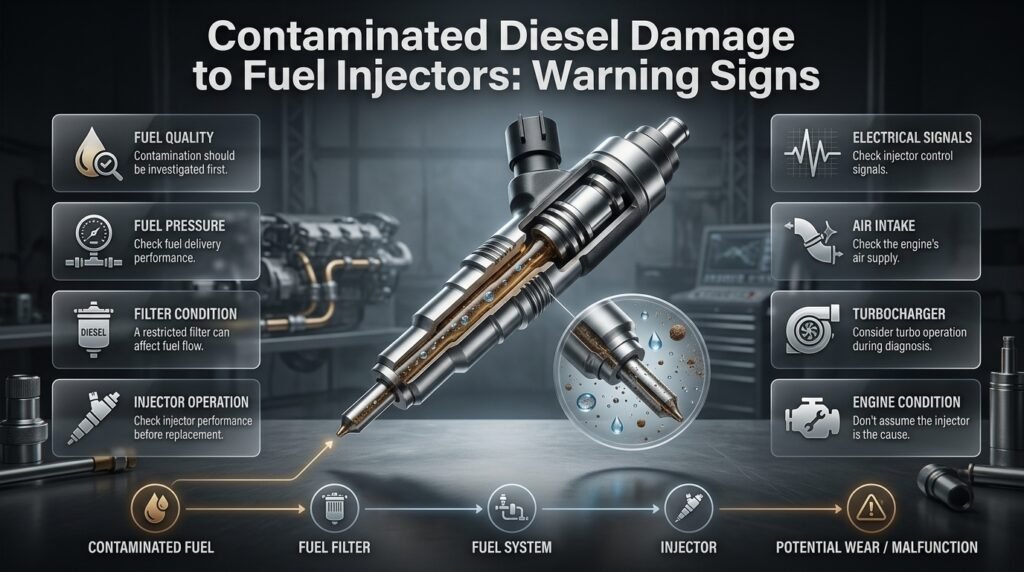
Yes, contamination can contribute to injector problems.
Modern diesel injectors contain precision components that operate under demanding conditions.
Water, abrasive particles, rust, or unsuitable fuel can contribute to wear or malfunction.
However, it is important not to jump directly from “poor engine performance” to “the injectors are damaged.”
A proper diagnosis should examine:
- Fuel quality
- Fuel pressure
- Filter condition
- Injector operation
- Electrical signals
- Air intake
- Turbocharger operation
- Engine condition
For readers who want to understand how diesel combustion works, see Diesel Engine Combustion Process.
What Happens When Contaminated Diesel Reaches the Fuel System?
The fuel system acts as a pathway between the tank and the engine.
Contamination can affect different parts at different stages.
Stage 1: Fuel Tank
Water, sediment, rust, or other contaminants may collect here.
Stage 2: Fuel Filter
The filter captures particles and can become restricted.
Stage 3: Fuel Pump
If contaminated fuel reaches the pump, abrasive or corrosive contaminants may contribute to wear.
Stage 4: Injectors
Fine contamination can potentially affect precision injection components.
Stage 5: Combustion
Poor-quality or incorrect fuel can affect combustion behavior and engine performance.
This explains why a contamination problem shouldn’t always be treated as a single-component failure.
How Do You Diagnose Contaminated Diesel?
There isn’t one universal test that answers every fuel-contamination question.
A sensible diagnostic process combines fuel history, symptoms, inspection, filtration evidence, and appropriate testing.
Step 1: Check When the Symptoms Started
Ask yourself:
- Did the problem start after refueling?
- Did you use a different fuel station?
- Was the vehicle recently stored?
- Was fuel transferred from a container?
- Did the problem appear suddenly?
Timing is valuable evidence.
Step 2: Inspect the Fuel Filter
A professional may inspect the filter for:
- Water
- Rust
- Dirt
- Sediment
- Sludge
- Unusual deposits
The condition of the filter can reveal clues about what’s happening upstream.
Step 3: Examine a Fuel Sample
A fuel sample can sometimes reveal:
- Free water
- Sediment
- Separation
- Unusual appearance
- Visible particles
But visual inspection has limitations.
Not every form of contamination can be identified simply by looking at fuel.
Step 4: Test the Fuel When Necessary
Laboratory or appropriate professional fuel testing may be useful when contamination isn’t obvious or when a dispute exists over fuel quality.
Testing can provide information that visual inspection cannot.
For a practical introduction, see Fuel Quality Testing Basics.
Step 5: Investigate the Source
If contamination is confirmed, ask:
Where did it come from?
Possible sources include:
- Vehicle tank
- Storage tank
- Fuel container
- Fuel station equipment
- Transportation
- Water intrusion
- Previous fuel
- Incorrect fuel
Finding the source is critical.
Otherwise, contaminated fuel may simply be introduced again after the system has been cleaned.
Contaminated Diesel vs Clean Diesel
| Factor | Normal Diesel | Potentially Contaminated Diesel |
|---|---|---|
| Appearance | Consistent fuel appearance | May show water, particles, haze, or sediment |
| Water | No free water expected | Water may separate or accumulate |
| Sediment | Minimal | Dirt, rust, or deposits may be present |
| Engine operation | Smooth and consistent | Hesitation, roughness, or stalling |
| Acceleration | Normal | May be weak or inconsistent |
| Fuel filter | Normal service condition | May be heavily restricted |
| Fuel history | No unusual event | Problem may follow recent refueling |
| Storage | Properly maintained | Poorly stored or exposed to water |
Remember that appearance alone doesn’t establish fuel quality.
What Should You Do If You Suspect Contaminated Diesel?
If the vehicle is running poorly and contaminated diesel is a realistic possibility, don’t keep driving unnecessarily.
A sensible approach is:
1. Stop if the Vehicle Is Unsafe
If the engine is repeatedly stalling, losing significant power, or behaving unpredictably, move to a safe location.
2. Record Your Refueling Information
Keep details such as:
- Time of refueling
- Location
- Amount purchased
- Fuel type
- Receipt, if available
This information can become useful if the fuel quality needs to be investigated.
3. Don’t Keep Restarting the Engine
If you strongly suspect incorrect or severely contaminated fuel, repeatedly running the engine may circulate the fuel further through the system.
4. Have the Fuel System Checked
A professional assessment can determine whether the issue is actually fuel-related.
5. Identify the Contamination
Water, dirt, rust, microbes, and incorrect fuel require different responses.
6. Address the Source
Don’t clean the vehicle’s fuel system while leaving a contaminated storage source untouched.
Can Changing the Fuel Filter Fix Contaminated Diesel?
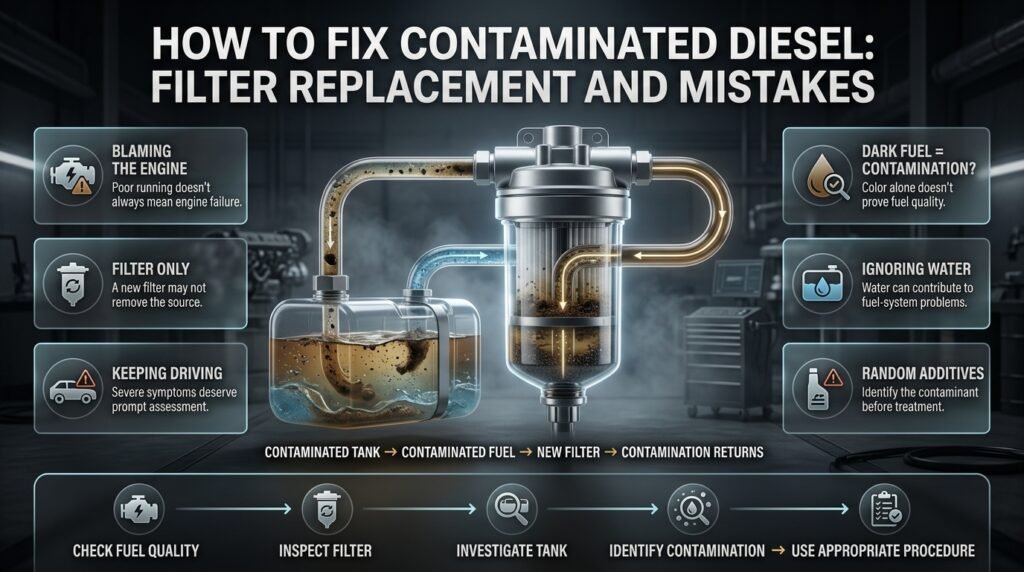
Sometimes it helps, but it isn’t always enough.
A fuel filter can capture certain contaminants. If the problem is simply a restricted filter and the fuel source is clean, replacing the filter may restore normal fuel flow.
But consider this situation:
Contaminated tank → contaminated fuel → new filter → contaminated fuel reaches new filter
The new filter may become restricted again.
This is why repeated filter replacement without investigating the fuel source can become an expensive cycle.
Common Mistake: Treating the fuel filter as the cause rather than as evidence that contamination may be present upstream.
Common Mistakes When Dealing With Contaminated Diesel
Mistake 1: Blaming the Engine Immediately
A vehicle running badly doesn’t automatically have an internal engine problem.
Why it happens: Drivers often associate severe symptoms with engine failure.
Why it’s harmful: Fuel-related problems may be overlooked.
Better approach: Investigate fuel quality alongside mechanical, electrical, air-intake, and fuel-pressure causes.
Mistake 2: Replacing Only the Fuel Filter
A filter can become dirty because it is doing its job.
Why it happens: The filter looks contaminated, so replacing it seems like the obvious solution.
Why it’s harmful: The original contamination may remain in the tank.
Better approach: Find out what contaminated the filter.
Mistake 3: Continuing to Drive
Some drivers keep driving because the engine still starts.
Why it’s harmful: Contaminated fuel can continue circulating through the system.
Better approach: If symptoms are severe or fuel contamination is strongly suspected, have the vehicle assessed promptly.
Mistake 4: Assuming Dark Fuel Is Automatically Contaminated
Fuel appearance is only one clue.
Why it happens: People expect clean fuel to have a particular color.
Why it’s harmful: Color alone doesn’t establish fuel quality.
Better approach: Use fuel history, inspection, filter evidence, and testing when necessary.
Mistake 5: Ignoring Water
Drivers often look for dirt while overlooking water.
Why it’s harmful: Water can contribute to corrosion, microbial growth, and fuel-system problems.
Better approach: Include water contamination in the diagnostic process.
Mistake 6: Adding Random Additives
Drivers sometimes try to solve a fuel problem by adding an unverified additive.
Why it’s risky: An additive may not address the actual contamination and may complicate diagnosis.
Better approach: Identify the contaminant first and use only appropriate products and procedures.
Expert Advice for Preventing Diesel Contamination
Professional fuel management generally starts with controlling the environment around the fuel.
Keep Storage Tanks Clean
Sediment and water can accumulate at the bottom of tanks.
Regular inspection helps identify problems before contaminated fuel reaches vehicles.
Control Water
Water is one of the most important factors behind several types of diesel contamination.
Use Suitable Containers
Don’t transfer diesel using containers that previously held unknown liquids.
Protect Fuel From Dirt
Keep caps, funnels, transfer equipment, and storage areas clean.
Monitor Fuel Filters
A filter that becomes dirty unusually quickly deserves investigation.
Watch for Repeated Problems
If multiple vehicles develop similar fuel-related symptoms after using the same fuel source, investigate the shared source.
Expert Tip: Repeated contamination is more informative than a single dirty filter. If the same problem keeps returning, look upstream.
How Fuel Quality Standards Help Prevent Contamination
Fuel specifications exist to establish important quality characteristics and limits.
Good fuel quality management helps reduce problems associated with:
- Water
- Sediment
- Improper fuel properties
- Contaminants
- Poor storage
- Fuel degradation
Understanding standards can be particularly useful for fleet operators, workshops, and businesses that store diesel.
You can learn more about this subject through Fuel Quality Standards.
How Diesel Fuel Quality Affects Engine Performance
Fuel quality influences much more than whether an engine starts.
The quality and condition of fuel can affect:
- Fuel delivery
- Combustion
- Injector performance
- Fuel pressure
- Engine response
- Fuel economy
- Emissions
- Long-term component reliability
A diesel engine is a system where fuel, air, compression, injection timing, and combustion all work together.
When the fuel is contaminated, that balance can be disturbed.
For a broader comparison of fuel characteristics and engine behavior, Fuel Fundamentals can provide useful background.
How Can You Prevent Contaminated Diesel?
Prevention starts before the fuel reaches the engine.
Keep Fuel Storage Protected
Storage areas should be protected from unnecessary exposure to rain, dust, and other contaminants.
Minimize Water Accumulation
Water should not be allowed to build up in fuel storage systems.
Use Clean Transfer Equipment
Funnels, pumps, hoses, and containers should be suitable and clean.
Avoid Questionable Fuel Sources
If fuel quality is uncertain, the cheapest option at the pump may not be the cheapest option after a fuel-system problem.
Monitor Fuel Filters
Unexpectedly rapid filter blockage can be an early warning sign.
Keep Refueling Records
Recording where and when fuel was purchased can help identify patterns.
Don’t Ignore Storage Conditions
Long-term storage requires more attention than fuel that is purchased and consumed quickly.
What Is the Difference Between Contaminated Diesel and a Mechanical Problem?
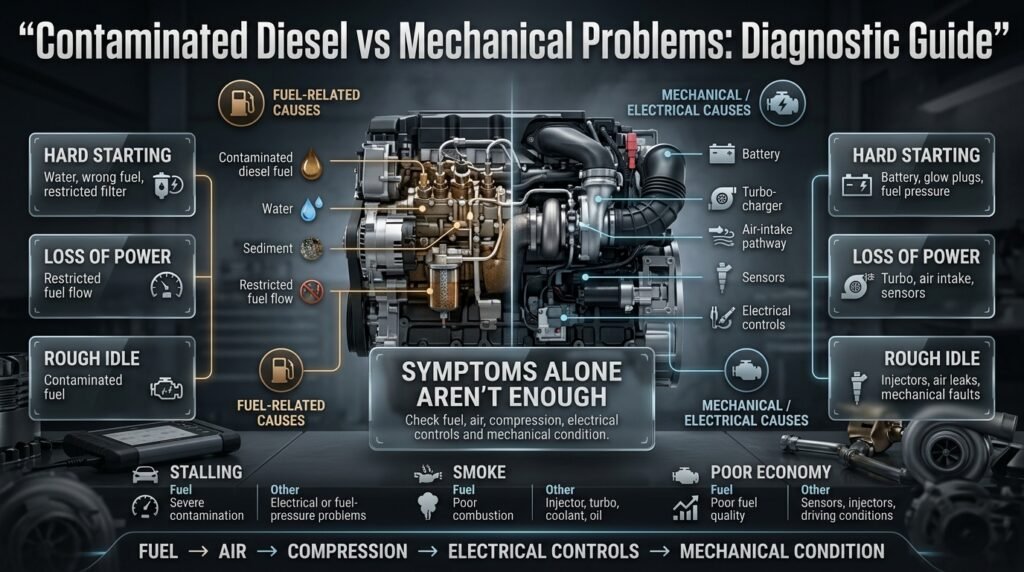
This is one of the most important diagnostic questions.
Both problems can produce similar symptoms.
| Symptom | Possible Fuel Cause | Other Possible Causes |
|---|---|---|
| Hard starting | Water, wrong fuel, restricted filter | Battery, glow plugs, fuel pressure |
| Loss of power | Restricted fuel flow | Turbo, air intake, sensors |
| Rough idle | Contaminated fuel | Injectors, air leaks, mechanical faults |
| Stalling | Severe contamination | Electrical or fuel-pressure problems |
| Smoke | Poor combustion | Injector, turbo, coolant, oil |
| Poor economy | Poor fuel quality | Sensors, injectors, driving conditions |
This table illustrates why symptoms alone aren’t enough.
A good diagnosis considers fuel, air, compression, electrical controls, and mechanical condition together.
Why Modern Diesel Engines Need Clean Fuel
Modern diesel systems operate with highly precise fuel delivery.
Fuel injection pressures are extremely high, and components such as injectors and pumps are manufactured with tight tolerances.
That makes contamination particularly undesirable.
Small particles may cause wear.
Water may contribute to corrosion.
Incorrect fuel can alter lubrication and combustion characteristics.
Microbial material can block filters.
The more advanced the fuel system becomes, the more important fuel cleanliness becomes.
Can Contaminated Diesel Affect Fuel Economy?
It can.
If fuel contamination affects combustion or fuel delivery, the engine may operate less efficiently.
For example, a restricted fuel system can change how the engine responds under load, while poor combustion may reduce useful energy extracted from the fuel.
However, poor fuel economy has many possible causes.
Other possibilities include:
- Underinflated tires
- Injector problems
- Air-intake restrictions
- Sensor faults
- Turbocharger problems
- Excessive idling
- Driving habits
- Vehicle load
Therefore, fuel contamination should be investigated when there is supporting evidence rather than assumed automatically.
When Should You Seek Professional Help?
Professional diagnosis is strongly advisable when:
- The engine won’t start.
- The vehicle repeatedly stalls.
- Significant water is found in fuel.
- Wrong fuel was added.
- The fuel filter repeatedly becomes blocked.
- The vehicle suddenly loses major power.
- Severe smoke develops.
- Fuel contamination is confirmed.
- Multiple fuel-system components may be affected.
- The vehicle is equipped with a high-pressure modern diesel system.
Fuel-system repairs can become expensive if contamination spreads.
Early diagnosis can therefore save both time and money.
What are the most common causes of contaminated diesel?
The most common causes are water, dirt, sediment, rust, microbial growth, fuel degradation, and cross-contamination with another fuel or substance. Contamination can happen during storage, transportation, transfer, dispensing, or inside the vehicle’s own fuel tank. Water is particularly important because it can contribute to corrosion and create conditions that support microbial growth. Cummins also identifies water, microorganisms, wax, hard particles, debris, and sediment among common diesel-fuel contaminants.
A useful way to understand the problem is to look at where the fuel has been rather than blaming the engine immediately. A diesel tank can collect water and sediment over time, while damaged caps, seals, hoses, pumps, or transfer equipment can provide additional opportunities for contamination.
Key points:
Water can enter through condensation, rain, damaged seals, or poorly maintained storage.
Dirt, dust, rust, and sediment can restrict fuel flow.
Microbial growth is strongly associated with water being present in the fuel system.
Old or poorly stored diesel can deteriorate.
Incorrect fuel can change the fuel’s properties and create serious fuel-system problems.
Contamination can occur before the fuel even reaches your vehicle.
Professional advice: If the vehicle was running normally and developed problems shortly after refueling, don’t automatically start replacing expensive engine components. The fuel source and fuel filter should be considered as part of the initial diagnosis
Can water in diesel fuel cause engine problems?
Water contamination can cause much more than a little rough running. It can contribute to fuel-filter restriction, corrosion, microbial growth, poor fuel-system performance, and damage to sensitive fuel-system components. In modern diesel systems, this matters because injectors and other internal components operate with very small clearances and can be affected by particles and other contaminants.
Water can enter a diesel tank through condensation, damaged fuel caps or seals, rainwater exposure, contaminated storage tanks, or poor fuel-handling practices. Condensation becomes particularly relevant when fuel is stored for long periods and the tank repeatedly experiences temperature and humidity changes.
Once water accumulates, it can also create an environment where microorganisms grow. The resulting biological material can contribute to sludge and filter blockage.
Signs worth paying attention to:
Difficult or delayed starting
Rough engine operation
Hesitation during acceleration
Loss of power
Repeated fuel-filter blockage
Corrosion or rust in the fuel system
Unusual deposits or sludge
Problems that appear after long-term fuel storage
Professional advice: Don’t assume that draining a small amount of visible water automatically means the entire problem is solved. If contamination has been present for some time, the filter, tank, fuel lines, and other affected components may also need inspection.
What are the signs that diesel fuel is contaminated?
The most useful clue is often a combination of symptoms and timing, rather than one symptom by itself. Contaminated diesel can cause hard starting, rough running, hesitation, loss of power, fuel-filter plugging, increased smoke, and poor engine performance. Fuel analysis is also used professionally to investigate problems such as filter plugging, smoking, loss of power, and poor injector performance.
For example, suppose a vehicle has been running normally for weeks and suddenly becomes sluggish immediately after refueling. That doesn’t prove the fuel is contaminated, but it gives you a strong reason to investigate the fuel before assuming that the turbocharger, injectors, or engine has suddenly failed.
Another useful clue is what happens to the fuel filter. If a relatively new filter becomes heavily restricted or contaminated unusually quickly, the filter may be showing evidence of a problem upstream.
Watch for these warning signs:
Engine struggles to start
Vehicle loses power under load
Acceleration becomes inconsistent
Engine stalls unexpectedly
Fuel filter becomes blocked prematurely
Excessive or unusual exhaust smoke
Symptoms begin soon after refueling
Multiple vehicles using the same fuel source develop similar problems
Professional advice: Don’t diagnose contaminated diesel from smoke or fuel color alone. These symptoms can also come from injectors, fuel-pressure faults, air-intake problems, sensors, turbocharger issues, or other mechanical faults. The strongest diagnosis combines the vehicle’s history with fuel inspection and, when necessary, fuel testing.
Can contaminated diesel damage fuel injectors and the fuel pump?
Yes, serious or prolonged contamination can contribute to injector and fuel-pump problems, particularly when water or abrasive particles are involved. Modern diesel injectors contain precision internal components that can be susceptible to wear or sticking when contamination is present. Cummins notes that contamination can reduce fuel-system component life and may lead to malfunctions or damage.
The important point is that damage isn’t necessarily caused by one dramatic event. Contaminated fuel may first restrict the filter, then affect fuel delivery, and eventually expose pumps and injectors to water or abrasive material.
A simplified chain can look like this:
Contaminated fuel → filter restriction → reduced fuel flow → fuel-system stress → injector/pump performance problems
With severe contamination, manufacturers identify consequences such as premature filter plugging, loss of power, injector failures, and fuel-pump failures.
Potential warning signs include:
Repeated fuel-filter blockage
Loss of engine power
Poor acceleration
Rough operation
Difficult starting
Unusual injector behavior
Fuel-pressure-related faults
Persistent symptoms after a filter replacement
Professional advice: Don’t replace injectors simply because the vehicle is losing power. First establish whether the fuel is clean and whether fuel pressure and filtration are operating correctly. A fuel analysis can sometimes identify contamination that would otherwise lead to unnecessary parts replacement.
What should you do if you suspect contaminated diesel?
The best response is to stop treating the problem as a normal engine fault and investigate the fuel systematically. If the vehicle is severely losing power, repeatedly stalling, or you suspect incorrect fuel or significant contamination, avoid unnecessary driving and have the fuel system assessed.
Start by recording when the problem appeared and whether it followed a recent refueling event. Keep the fuel receipt if you have one and note where the fuel was purchased. Then have the fuel filter and fuel itself inspected where appropriate.
A professional fuel analysis can check factors such as water content, particle contamination, microbial growth, and other fuel-quality characteristics. Cummins specifically describes fuel analysis as a method for investigating fuel-related problems including filter plugging, smoking, loss of power, and component damage.
A practical response is:
Stop driving if the vehicle is operating dangerously or repeatedly stalling.
Record the time and location of the last refueling.
Don’t repeatedly restart the engine if severe contamination or misfuelling is suspected.
Inspect the fuel filter.
Check for water, sediment, rust, or unusual material.
Test the fuel when visual inspection isn’t enough.
Identify where the contamination originated.
Clean or correct the affected system according to the appropriate procedure.
Don’t simply replace the filter and ignore the fuel tank.
Professional advice: The biggest mistake is treating contaminated diesel as a “filter problem” only. A filter may be the first component showing the effects, but the real source could be water in the tank, dirty storage equipment, microbial contamination, rust, or incorrect fuel. Cummins specifically recommends maintaining storage and transfer equipment because hoses, pumps, filters, connections, caps, seals, and gaskets can all contribute to fuel contamination.
Conclusion
Contaminated diesel isn’t always an obvious problem. It can start with something as simple as water entering a fuel tank, dirt from poor handling, rust inside a storage system, microbial growth, old fuel, or accidental cross-contamination. What makes the issue difficult is that the resulting symptoms can look very similar to injector, fuel-pump, turbocharger, or engine problems.
The most important step is to pay attention to when the symptoms started and what happened before them. If a vehicle was running normally and suddenly develops hard starting, hesitation, rough running, power loss, smoke, or repeated fuel-filter blockage after refueling, fuel quality deserves proper investigation.
Don’t rely on a filter replacement alone. Check the fuel, investigate the tank and storage source, and use appropriate fuel testing when the contamination isn’t obvious. Early identification can help prevent a relatively simple fuel-quality problem from developing into expensive fuel-system damage.
For drivers dealing with a fuel-related emergency in Dubai, Fuel Delivery Dubai – emergency fuel delivery and roadside refueling support can provide a practical first step when the vehicle cannot safely continue its journey.
Leave a Reply