
Introduction
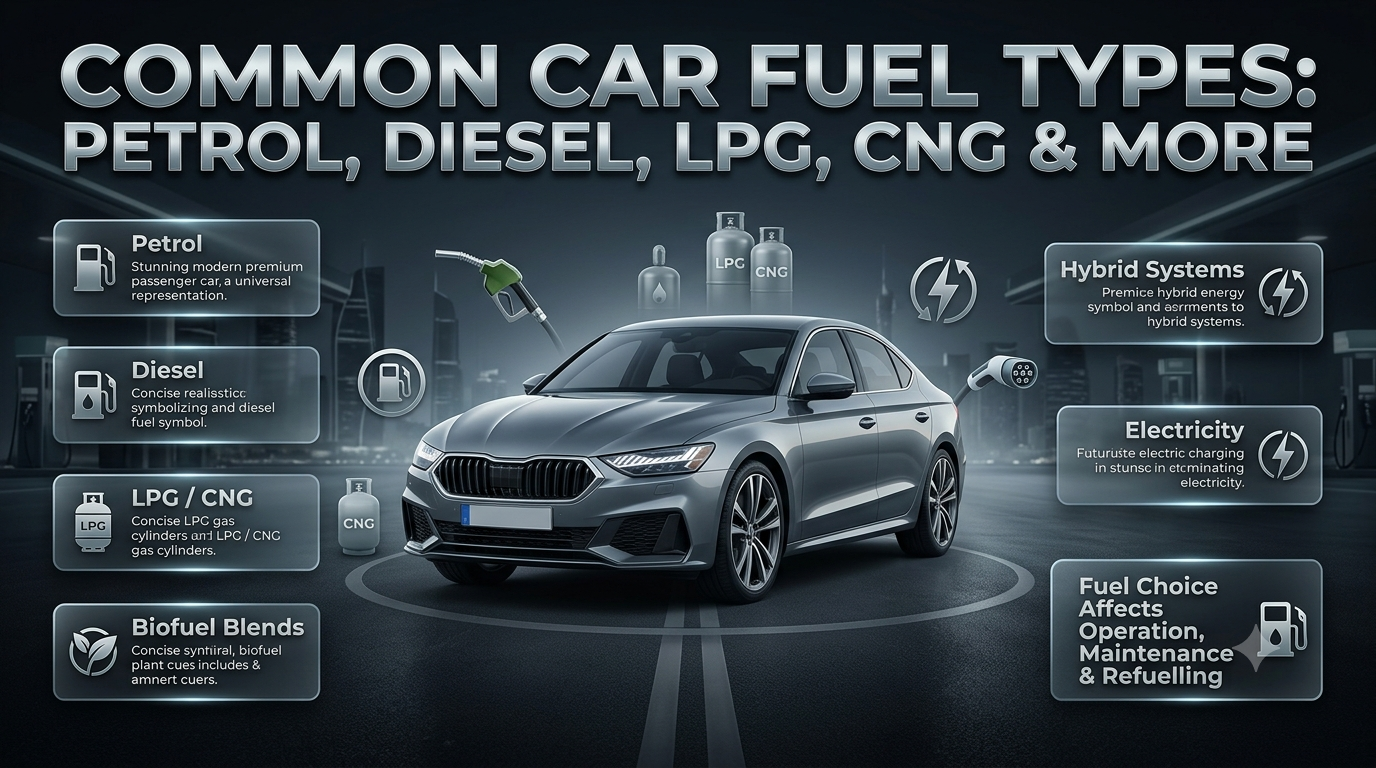
Common Car Fuel Types | Choosing the right fuel for a car may seem simple at first. Most drivers know the basic difference between petrol and diesel, but modern vehicles can also use LPG, CNG, biofuel blends, hybrid systems, and electricity.
Understanding the common car fuel types is useful because the fuel a vehicle uses affects how its engine operates, how it should be maintained, and what type of refuelling infrastructure it needs.
For drivers who want to understand the bigger picture of automotive fuel, Fuel Delivery Dubai provides a broader starting point for fuel-related information and services.
In this guide, we’ll explain the main car fuel types in simple terms, compare their characteristics, and explain what drivers should know before choosing or using a particular fuel.
What Are the Common Car Fuel Types?
The most common automotive fuel types include petrol, diesel, LPG, CNG, ethanol-based fuels, biodiesel, and other renewable fuel options.
Petrol and diesel are still the most familiar fuels for conventional internal-combustion vehicles. LPG and CNG are gaseous fuel alternatives, while biofuels are produced from biological or renewable sources.
A useful way to understand automotive fuel is to separate it into three broad groups:
- Conventional liquid fuels
- Gaseous fuels
- Renewable and alternative fuels
There are also hybrid and electric powertrains, which we’ll cover in the next part because they use electrical energy alongside or instead of conventional combustion.
Before comparing individual fuels, it’s helpful to understand basic concepts such as combustion, fuel quality, efficiency, and fuel properties. Our Fuel Fundamentals guide covers those underlying principles in greater detail.
For a broader overview of the different fuel categories used in transportation, see Types of Automotive Fuel.
1. Petrol or Gasoline
Petrol, also called gasoline, is one of the most widely used fuels for passenger cars.
Petrol engines normally use spark ignition. The engine brings air and fuel together, compresses the mixture, and uses a spark plug to initiate combustion.
The combustion process releases energy that pushes the pistons and ultimately turns the vehicle’s wheels.
Petrol is available in different grades, and octane rating is one of the most important characteristics used to distinguish those grades.
Why Is Petrol So Common?
Petrol engines are popular because they offer a practical combination of performance, availability, smooth operation, and vehicle choice.
Petrol vehicles are commonly found in:
- Small city cars
- Sedans
- SUVs
- Sports cars
- Family vehicles
- Many hybrid vehicles
For everyday passenger-car use, petrol remains a widely available and practical option.
How Does a Petrol Engine Work?
The basic process happens through several stages:
- Air enters the engine.
- Fuel is introduced into the combustion chamber.
- The air-fuel mixture is compressed.
- A spark plug creates a spark.
- Combustion takes place.
- Expanding gases push the piston.
- The engine converts that movement into mechanical power.
Modern petrol engines use electronic controls and precise fuel-injection systems to manage this process.
Advantages of Petrol
Petrol offers several benefits for everyday driving:
- Widely available
- Large choice of vehicles
- Smooth engine operation
- Good throttle response
- Suitable for city and highway driving
- Available in different grades
Disadvantages of Petrol
Petrol also has limitations.
Depending on the vehicle, engine design, and driving conditions, petrol engines may consume more fuel than some comparable diesel or hybrid systems.
Other considerations include:
- Fuel consumption varies with driving conditions
- Combustion produces exhaust emissions
- Incorrect fuel grade may affect engine operation
- Some high-performance engines require higher-octane petrol
Pro Tip: Don’t automatically choose the most expensive petrol available. The correct fuel grade is the one specified or recommended by the vehicle manufacturer.
What Is Octane Rating?
Octane rating describes the resistance of petrol to unwanted autoignition in a spark-ignition engine.
A common misunderstanding is that a higher octane number automatically means the fuel contains more energy or will make every car more powerful.
That’s not how octane works.
The correct octane requirement depends on the engine’s design, compression characteristics, and manufacturer calibration.
This is one reason why understanding fuel fundamentals is important when comparing different petrol grades.
For a more detailed look at petrol grades alongside diesel fuel, read our Petrol and Diesel Fuel Types guide.
2. Diesel

Diesel is another major automotive fuel and is commonly associated with vehicles designed for high mileage, long-distance travel, heavy loads, and commercial applications.
Diesel engines generally use compression ignition, which is different from the spark-ignition system used by conventional petrol engines.
Instead of using a spark plug to ignite the fuel-air mixture, a diesel engine compresses air until its temperature becomes high enough for injected diesel fuel to ignite.
How Does Diesel Combustion Work?
A simplified diesel combustion process looks like this:
- Air enters the cylinder.
- The engine compresses the air.
- Compression increases the air temperature.
- Diesel fuel is injected into the compressed air.
- The fuel ignites.
- Expanding gases push the piston.
- Mechanical power is transferred through the drivetrain.
This different combustion process gives diesel engines characteristics that differ from petrol engines.
Why Are Diesel Engines Used in Cars?
One of the best-known characteristics of diesel engines is strong low-speed torque.
This can be useful when a vehicle needs to:
- Carry heavy loads
- Travel long distances
- Tow equipment
- Operate commercially
- Maintain efficiency during high-mileage driving
Diesel engines are therefore common in:
- SUVs
- Pickup trucks
- Vans
- Commercial vehicles
- Trucks
- Some passenger cars
Advantages of Diesel
Depending on the application, diesel can provide:
- Strong low-speed torque
- Good fuel efficiency
- Suitability for long-distance travel
- Good performance under heavy loads
- Practicality for high-mileage drivers
- Extensive use in commercial transportation
Disadvantages of Diesel
Modern diesel engines can be technically complex.
They may use sophisticated fuel-injection equipment and emissions-control systems that require specialized maintenance.
Potential disadvantages include:
- More complex fuel and emissions systems
- Higher repair costs for some components
- Specialized maintenance requirements
- Short-trip use may not suit every diesel application
- Sensitivity to fuel contamination or incorrect fuel specification
Expert Tip: Diesel isn’t automatically the best choice simply because it can provide good fuel economy. Consider how you actually use the vehicle. Long-distance and heavy-load driving can produce a very different result from frequent short city trips.
Petrol vs Diesel: What’s the Difference?
Petrol and diesel are both conventional liquid fuels, but their engines use fundamentally different combustion methods.
| Feature | Petrol | Diesel |
|---|---|---|
| Ignition | Spark ignition | Compression ignition |
| Main fuel characteristic | Octane | Cetane |
| Typical strength | Smooth and responsive operation | Strong low-speed torque |
| Common use | Passenger vehicles | High-mileage and heavy-duty applications |
| Spark plugs | Used for ignition | Not used to initiate normal combustion |
| Fuel injection | Common | Essential to modern diesel operation |
Neither fuel is universally better.
The better choice depends on the vehicle, driving pattern, annual mileage, fuel availability, maintenance requirements, and manufacturer’s specifications.
Our Petrol and Diesel Fuel Types article goes deeper into how these two major fuel categories differ.
3. LPG
LPG stands for liquefied petroleum gas.
It is primarily made from propane and butane and can be stored as a liquid under pressure.
LPG can be used as an automotive fuel in vehicles designed for LPG or vehicles that have been properly converted using an appropriate LPG fuel system.
Some vehicles can operate using both petrol and LPG.
How Does LPG Work in a Car?
An LPG vehicle requires dedicated components to store, regulate, and deliver the fuel.
Depending on the system, these can include:
- LPG storage tank
- Fuel lines
- Pressure regulator
- Injectors
- Control electronics
- Safety equipment
The engine system also needs appropriate calibration for LPG operation.
This means LPG isn’t simply another type of petrol.
Advantages of LPG
Potential benefits include:
- Alternative to conventional petrol
- Can reduce dependence on petrol
- Can be used in dual-fuel vehicles
- Established technology in some markets
Limitations of LPG
LPG also has practical limitations.
- Refuelling stations may be limited
- Requires specialized fuel-system components
- Vehicle compatibility is important
- Conversion quality matters
- Additional maintenance may be required
Is LPG Suitable for Every Car?
No.
A vehicle shouldn’t be converted to LPG simply because the fuel appears cheaper.
The engine, fuel system, conversion equipment, calibration, and applicable requirements all need to be considered.
Common Mistake: Assuming that any petrol car can safely use LPG without checking whether the engine and fuel system are suitable.
4. CNG
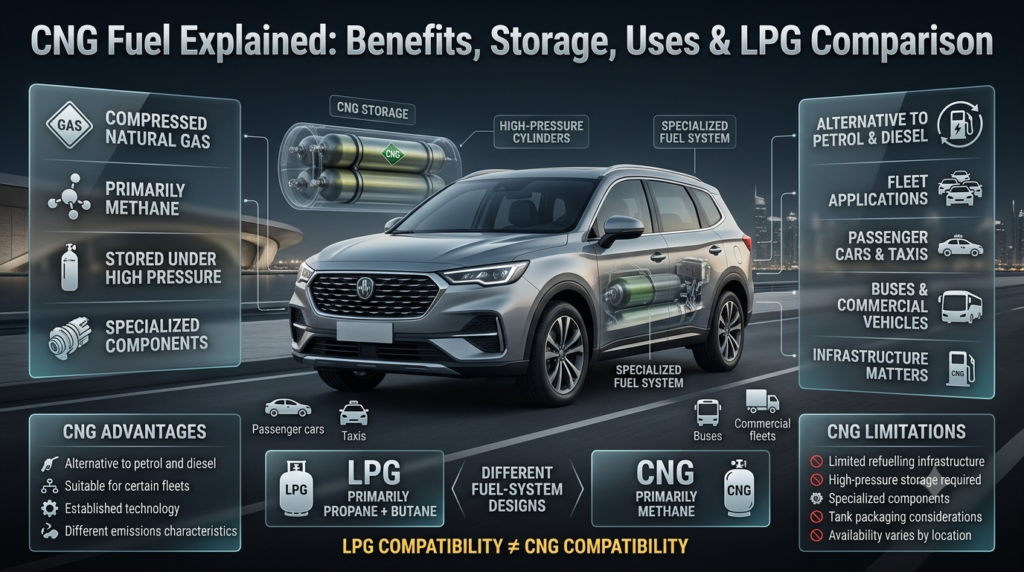
CNG stands for compressed natural gas.
It is primarily methane stored at high pressure and used as a gaseous automotive fuel.
CNG vehicles require specialized storage cylinders and fuel-system components because the fuel must be stored under significant pressure.
CNG has been used in passenger cars, taxis, buses, and commercial fleets in regions where suitable refuelling infrastructure exists.
Why Do Vehicles Use CNG?
CNG can provide an alternative to conventional petrol and diesel.
It may be attractive for certain fleet operators where:
- CNG stations are easily accessible
- Vehicle compatibility is available
- Operating costs make sense
- Vehicles cover substantial distances
Advantages of CNG
Potential advantages include:
- Alternative to petrol and diesel
- Suitable for certain fleet applications
- Established technology
- Different emissions characteristics from conventional fuels
Limitations of CNG
CNG also has important limitations.
- Refuelling infrastructure may be limited
- High-pressure storage is required
- Specialized components are needed
- Tank packaging can affect vehicle design
- Availability varies by location
LPG vs CNG
LPG and CNG are both gaseous automotive fuels, but they aren’t the same fuel.
LPG is primarily propane and butane.
CNG is primarily methane.
They also have different storage requirements and fuel-system designs.
Therefore, a vehicle designed for LPG shouldn’t automatically be considered suitable for CNG.
5. Biofuels
Biofuels are fuels produced from biological or renewable sources.
Two familiar examples are:
- Ethanol
- Biodiesel
Some biofuels are blended with conventional petrol or diesel.
However, compatibility is extremely important.
A fuel blend that is suitable for one vehicle may not necessarily be approved for another.
Ethanol
Ethanol is an alcohol that can be blended with petrol.
Different markets use different ethanol concentrations, and vehicles are designed for specific fuel specifications.
Drivers should therefore check the manufacturer’s requirements before using a particular ethanol blend.
Biodiesel
Biodiesel is produced from biological sources and can be blended with conventional diesel.
Its suitability depends on:
- Vehicle design
- Fuel specification
- Approved blend
- Manufacturer requirements
- Applicable fuel standards
Modern diesel vehicles can have sophisticated fuel-injection and emissions systems, so using an unsuitable fuel blend can potentially create problems.
Why Are Biofuels Important?
Biofuels are part of the broader move toward diversified and renewable transportation energy.
They can reduce dependence on conventional petroleum-derived fuels in suitable applications, although the environmental impact of a biofuel depends on how it is produced and processed.
For a broader explanation of fuel categories, properties, and alternative fuel systems, you can refer back to our Types of Automotive Fuel guide.
How Does Fuel Quality Affect a Car?
Choosing the correct fuel type is only part of maintaining a healthy fuel system.
Fuel quality also matters.
Modern vehicles use precise fuel-injection systems, electronic engine controls, and emissions equipment. Contaminated or unsuitable fuel can interfere with normal engine operation.
Potential symptoms of a fuel-related problem include:
- Difficult starting
- Rough engine operation
- Reduced acceleration
- Poor fuel economy
- Engine warning lights
- Abnormal engine behavior
However, these symptoms don’t automatically mean that the fuel is responsible.
Problems with injectors, ignition, sensors, air intake, electronics, or other engine components can produce similar symptoms.
Expert Tip: If your vehicle starts behaving differently immediately after refuelling, note when the symptoms started and have the vehicle properly diagnosed instead of immediately replacing parts.
What Should You Check Before Using a Different Fuel?
Before using a different fuel or fuel blend, check:
- The vehicle manufacturer’s specification
- Engine compatibility
- Fuel-system compatibility
- Approved fuel grade or blend
- Local availability
- Applicable regulations
- Professional conversion requirements, if applicable
Never assume that a fuel suitable for one vehicle is automatically suitable for another
6. Hybrid Vehicles
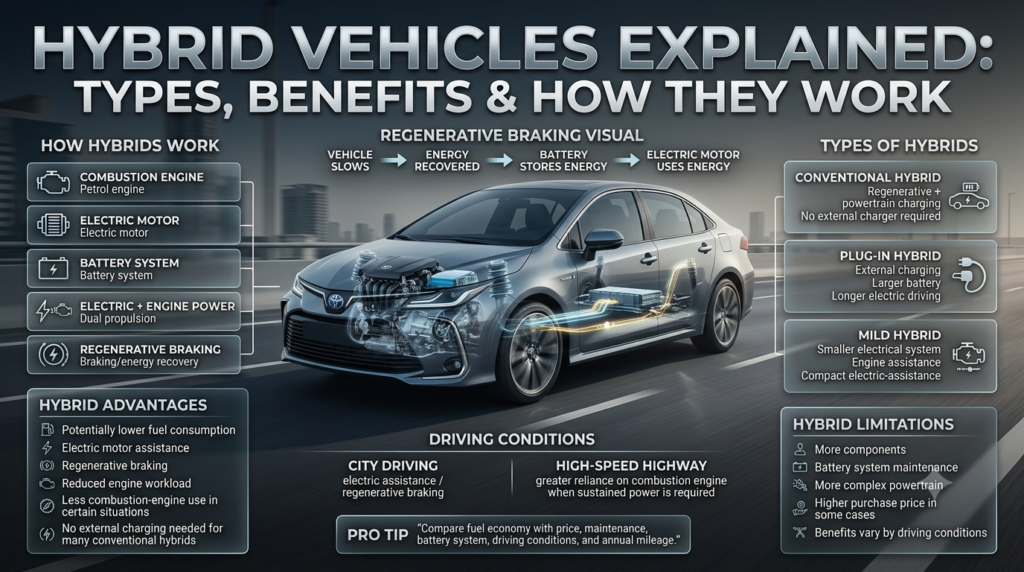
A hybrid vehicle combines an internal-combustion engine with an electric motor and battery system.
Most passenger-car hybrids use a petrol engine, although the exact design varies between manufacturers.
The main idea is simple: the vehicle can use the combustion engine, electric motor, or both depending on driving conditions.
This can improve efficiency in situations where the electric system can assist the engine effectively.
How Does a Hybrid Car Work?
A hybrid system can automatically manage different sources of propulsion.
For example, the vehicle may use electric assistance during certain low-speed or acceleration conditions and rely more heavily on the combustion engine when sustained power is required.
One important technology is regenerative braking.
When the vehicle slows down, some of the energy that would normally be lost as heat through braking can be recovered and stored in the battery.
That stored energy can later be used by the electric motor.
What Are the Main Types of Hybrid Cars?
There are several types of hybrid systems.
Conventional Hybrid
A conventional hybrid can recharge its battery through regenerative braking and the vehicle’s own powertrain.
It normally doesn’t need to be connected to an external charger.
Plug-In Hybrid
A plug-in hybrid can be connected to an external electricity supply.
Its larger battery allows it to travel farther using electric power before the combustion engine becomes necessary.
This can be useful for drivers who have access to charging but still want the flexibility of a conventional engine for longer journeys.
Mild Hybrid
A mild hybrid uses a smaller electrical system to assist the combustion engine.
The electric system can help with certain functions, but it generally doesn’t provide the same level of independent electric driving as a full hybrid.
Advantages of Hybrid Vehicles
Hybrid vehicles can offer several practical advantages:
- Potentially lower fuel consumption
- Electric motor assistance
- Regenerative braking
- Reduced engine workload in suitable conditions
- Less dependence on the combustion engine during certain driving situations
- No need for charging in many conventional hybrid systems
Limitations of Hybrid Vehicles
Hybrid technology also introduces additional complexity.
Potential considerations include:
- More components
- Battery system maintenance
- More complex powertrain
- Higher purchase price in some cases
- Benefits vary according to driving conditions
A hybrid that performs extremely well in city traffic may not provide exactly the same advantage during continuous high-speed highway driving.
Pro Tip: Don’t compare a hybrid with a conventional petrol car using fuel economy figures alone. Consider the vehicle price, maintenance, battery system, driving conditions, and annual mileage as well.
7. Battery-Electric Vehicles
Battery-electric vehicles, commonly called EVs, don’t use petrol or diesel to power their motors.
Instead, electrical energy is stored in a high-voltage battery.
The battery supplies electricity to one or more electric motors, which convert electrical energy into mechanical movement.
This makes an EV fundamentally different from a conventional internal-combustion vehicle.
Is Electricity a Car Fuel?
In everyday conversation, people often call electricity the fuel of an electric car.
Technically, electricity is better described as an energy source.
A petrol vehicle stores chemical energy in liquid fuel and releases it through combustion.
An EV stores electrical energy in a battery and converts that energy through an electric motor.
How Does an EV Work?
The basic process is:
- Electricity is supplied through a charging system.
- The battery stores electrical energy.
- Power electronics control the electricity supplied to the motor.
- The electric motor converts electrical energy into mechanical movement.
- The motor drives the wheels.
When the vehicle slows down, regenerative braking can recover some energy and return it to the battery.
Advantages of Electric Vehicles
EVs offer several characteristics that distinguish them from conventional cars.
- No tailpipe emissions while driving
- Immediate electric-motor torque
- Fewer conventional engine components
- No conventional engine oil changes
- Efficient conversion of stored electrical energy into movement
- Home charging may be convenient
- Public charging can extend driving range
Limitations of Electric Vehicles
EV ownership also requires different planning.
Important considerations include:
- Charging time
- Availability of charging stations
- Battery capacity
- Driving range
- Temperature effects
- Electricity costs
- Long-distance route planning
For someone with convenient home charging, an EV can be very practical.
For someone without reliable access to charging, a petrol, diesel, or hybrid vehicle may be easier to use.
EV vs Hybrid: What’s the Difference?
Although both use electric motors, their powertrains are different.
| Feature | Hybrid | Battery EV |
|---|---|---|
| Combustion engine | Yes | No |
| Electric motor | Yes | Yes |
| Petrol/diesel required | Usually petrol | No |
| External charging | Depends on hybrid type | Required |
| Tailpipe emissions | Yes | None while driving |
| Refuelling | Conventional fuel | Electricity |
| Long-distance flexibility | Usually high | Depends on charging infrastructure |
| Battery size | Generally smaller | Generally larger |
A plug-in hybrid sits somewhere between the two because it can operate electrically for part of a journey while retaining a combustion engine.
8. Hydrogen Fuel-Cell Vehicles
Hydrogen fuel-cell vehicles are another type of alternative powertrain.
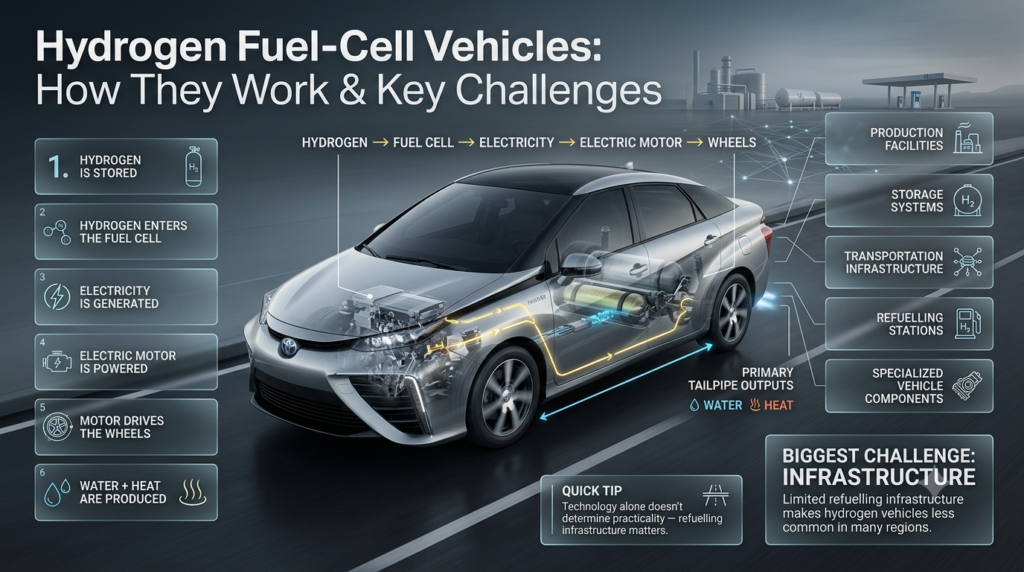
Instead of burning hydrogen in a conventional engine, a fuel-cell vehicle uses hydrogen to generate electricity.
That electricity powers an electric motor.
This means a hydrogen fuel-cell car is electrically propelled even though it carries hydrogen as its energy source.
How Does a Hydrogen Fuel-Cell Car Work?
A simplified process looks like this:
- Hydrogen is stored in high-pressure tanks.
- Hydrogen enters the fuel-cell system.
- The fuel cell generates electrical energy.
- The electricity powers the electric motor.
- The motor drives the wheels.
- Water and heat are produced as primary tailpipe outputs.
Why Aren’t Hydrogen Cars Common Everywhere?
The biggest challenge is infrastructure.
Hydrogen vehicles require specialized:
- Production facilities
- Storage systems
- Transportation infrastructure
- Refuelling stations
- Vehicle components
Because hydrogen refuelling infrastructure isn’t widely available in many regions, fuel-cell passenger cars remain much less common than petrol, diesel, hybrid, and battery-electric vehicles.
Quick Tip: An alternative fuel isn’t automatically practical simply because the technology works. Refuelling infrastructure is one of the most important factors when considering an alternative-fuel vehicle.
Conventional Fuel vs Alternative Powertrains
The major options can now be compared more easily.
| Fuel or Powertrain | Energy Source | Main Advantage | Main Limitation |
|---|---|---|---|
| Petrol | Petrol | Wide availability | Combustion emissions |
| Diesel | Diesel | Torque and efficiency in suitable applications | Complex modern emissions systems |
| LPG | LPG | Alternative to petrol | Infrastructure and compatibility |
| CNG | Natural gas | Alternative gaseous fuel | Refuelling infrastructure |
| Biofuels | Biological/renewable sources | Renewable-content option | Vehicle/blend compatibility |
| Hybrid | Fuel + electricity | Combines two propulsion systems | Greater complexity |
| EV | Electricity | Electric propulsion | Charging requirements |
| Hydrogen fuel cell | Hydrogen | Electric propulsion with hydrogen | Limited infrastructure |
There is no universal winner.
The most suitable choice depends on the vehicle, driving pattern, infrastructure, operating cost, and personal requirements.
Which Fuel Type Is Best for City Driving?
City driving can involve:
- Frequent stops
- Traffic congestion
- Repeated acceleration
- Low average speeds
- Extended idling
- Frequent braking
These conditions can influence fuel and energy efficiency.
A hybrid can be attractive in some urban conditions because it can use electric assistance and regenerative braking frequently.
An EV can also be well suited to city driving because an electric motor is efficient at low speeds and doesn’t need to idle like a conventional combustion engine.
However, that doesn’t mean every city driver should choose a hybrid or EV.
Purchase price, charging access, vehicle size, annual mileage, and personal requirements still matter.
Which Fuel Type Is Best for Long-Distance Driving?

Long-distance driving creates different priorities.
Drivers may care more about:
- Driving range
- Refuelling time
- Fuel availability
- Highway efficiency
- Comfort
- Luggage capacity
- Charging infrastructure
Diesel can be practical for certain high-mileage applications.
Petrol vehicles can also be excellent for long-distance travel.
Hybrid vehicles provide another option, while EVs can work very well when reliable fast-charging infrastructure is available along the route.
The important point is that driving range and infrastructure matter as much as the fuel itself.
Which Fuel Is Best for Heavy Loads?
Vehicles that regularly carry heavy loads need to produce sufficient torque and have a powertrain designed for the application.
Diesel engines have traditionally been popular in heavy-duty applications because of their torque characteristics.
However, electric powertrains can also produce substantial torque and are increasingly being used in commercial applications.
The correct choice depends on the vehicle’s engineering, payload rating, operating environment, and intended use.
Expert Tip: Never choose a fuel type based only on engine power. Always check the vehicle’s actual payload, towing capacity, drivetrain design, and manufacturer specifications.
What Factors Should You Consider Before Choosing a Fuel Type?
Choosing between petrol, diesel, hybrid, EV, or another powertrain requires more than comparing fuel prices.
1. Driving Pattern
Think about how you actually use the vehicle.
Do you mostly:
- Drive around the city?
- Travel on highways?
- Make short trips?
- Drive long distances?
- Carry passengers?
- Carry heavy loads?
Your answers can significantly influence the most practical option.
2. Annual Mileage
Someone who drives a few thousand kilometres per year may have different priorities from someone who drives tens of thousands of kilometres.
High annual mileage can make fuel or energy efficiency more important.
3. Refuelling or Charging Access
This is especially important for alternative powertrains.
Before choosing an EV, check whether you have convenient charging access.
Before choosing CNG, LPG, or hydrogen, check whether suitable refuelling stations are available along your normal routes.
4. Vehicle Purchase Cost
Don’t look only at fuel costs.
A more efficient vehicle can have higher upfront costs, while a cheaper vehicle may cost more to operate over many years.
5. Maintenance
Different powertrains require different maintenance.
Conventional engines have oil, filters, belts, cooling systems, fuel systems, and exhaust components.
EVs eliminate many conventional engine components but introduce high-voltage battery and electrical systems.
Hybrids combine aspects of both technologies.
How Does Dubai’s Climate Affect Fuel and Vehicle Choice?
Dubai’s hot climate creates operating conditions that drivers should consider regardless of the fuel type.
High temperatures can increase the workload on several vehicle systems.
Important areas include:
- Engine cooling
- Air-conditioning
- Battery performance
- Tyre pressure
- Engine oil
- Fuel-system condition
- Cooling-system maintenance
Heavy air-conditioning use can also increase the energy demand on a vehicle.
However, Dubai’s climate doesn’t automatically make petrol, diesel, hybrid, or EV the “best” option.
The vehicle’s design and maintenance condition matter more than making a simple fuel-type assumption.
For drivers looking at the wider fuel ecosystem in Dubai, Fuel Delivery Dubai provides a useful starting point for understanding fuel-related services and information.
Does Fuel Type Affect Vehicle Performance?
Yes, but fuel type isn’t the only factor.
Performance depends on the complete powertrain.
Important factors include:
- Engine design
- Motor output
- Torque
- Transmission
- Vehicle weight
- Aerodynamics
- Fuel quality
- Engine calibration
- Battery capacity
- Driving conditions
For conventional engines, petrol and diesel combustion characteristics are different.
For EVs, electric motors can deliver torque very quickly.
For hybrids, performance depends on how the combustion engine and electric motor are integrated.
What Is the Difference Between Fuel Economy and Fuel Efficiency?
These terms are related but aren’t exactly the same.
Fuel economy usually describes how far a vehicle can travel using a certain amount of fuel, such as kilometres per litre.
Fuel efficiency is a broader concept describing how effectively the vehicle converts energy into useful movement.
An EV, for example, doesn’t normally use litres of fuel, so its energy consumption is measured differently.
Understanding these terms is useful when comparing conventional cars with hybrids and EVs.
For more fundamental information about fuel efficiency and how fuel behaves, see Fuel Fundamentals.
Can a Car Use More Than One Fuel Type?
Some vehicles can.
Dual-fuel and bi-fuel systems are designed to operate using more than one fuel.
Examples can include:
- Petrol + LPG
- Petrol + CNG
- Petrol + electricity in hybrid systems
However, the vehicle must be specifically designed or properly converted to support those fuels.
A normal petrol vehicle doesn’t automatically become a dual-fuel vehicle simply because another fuel is available.
Is Premium Fuel Always Better?
No.
This is one of the most common misconceptions about automotive fuel.
Premium petrol may have a higher octane rating, but that doesn’t mean every engine will gain additional power or efficiency from using it.
The correct fuel is the grade recommended by the manufacturer.
If an engine is designed for a particular octane requirement, using a much higher grade may provide little or no practical benefit.
What Happens If You Use the Wrong Fuel?
Using the wrong fuel can cause serious problems because petrol and diesel engines are designed around different fuel properties and combustion processes.
For example, putting diesel into a petrol vehicle or petrol into a diesel vehicle can interfere with the fuel system and engine operation.
If you’ve accidentally added the wrong fuel, don’t assume that adding the correct fuel afterward will solve the problem.
Avoid continuing to operate the vehicle and seek appropriate professional assistance.
Common Mistake: Starting or driving the vehicle after realizing that the wrong fuel has been added can potentially make the situation worse.
What are the most common types of fuel used in cars?
The most common car fuel types include petrol, diesel, LPG, CNG, and biofuel blends. Petrol and diesel remain the dominant conventional fuels for internal-combustion vehicles, while LPG and CNG are used in vehicles equipped with compatible fuel systems. Biofuels such as ethanol and biodiesel are also used in approved blends. Hybrid and electric vehicles add another category because they combine conventional fuel with electrical energy or use electricity instead of liquid fuel.
The right fuel isn’t determined simply by availability or price. A vehicle’s engine is designed around a specific fuel type, combustion process, and fuel specification. That’s why petrol, diesel, LPG, and CNG aren’t interchangeable even though they all provide energy for transportation.
Key points:
Petrol is widely used in passenger cars and uses spark ignition.
Diesel is common in high-mileage, commercial, and heavy-load applications.
LPG and CNG require compatible fuel systems.
Biofuel compatibility depends on the approved blend and vehicle.
Hybrid and EV systems use electrical energy differently from conventional cars.
Always follow the vehicle manufacturer’s fuel specification.
For a broader overview, readers can explore Types of Automotive Fuel.
Which is better for a car: petrol or diesel?
Petrol isn’t automatically better than diesel, and diesel isn’t automatically the better choice either. The right option depends on how the car is driven, how many kilometres it covers, the type of vehicle, fuel availability, and maintenance requirements. Petrol can be a practical choice for many passenger cars and mixed everyday driving, while diesel can make more sense for certain high-mileage, long-distance, or heavy-load applications.
The biggest mistake is choosing based only on the fuel price or a general belief that diesel always gives better economy. A vehicle that spends most of its time making short urban trips may have different requirements from one that regularly travels long highway distances.
Key points:
Petrol is commonly suitable for everyday passenger-car use.
Diesel can be advantageous for long-distance and high-mileage applications.
Diesel engines generally provide strong low-speed torque.
Petrol engines are often valued for smooth operation and responsiveness.
Maintenance requirements can differ significantly.
Your actual driving pattern should guide the decision.
For a more detailed comparison, see Petrol and Diesel Fuel Types.
Can I use a different fuel type in my car if it is cheaper?
You shouldn’t switch to a different fuel simply because it costs less. Fuel compatibility is determined by the vehicle’s engine and fuel system, not by the price or apparent similarity of the fuel. Petrol and diesel engines use fundamentally different combustion systems, while LPG and CNG require specialized components and calibration.
Some vehicles can legitimately operate on more than one fuel, such as petrol-LPG systems or hybrid vehicles using petrol and electricity. In those cases, the vehicle is specifically designed or professionally converted to handle those energy sources. A standard petrol or diesel vehicle shouldn’t be treated as automatically compatible with another fuel.
Before changing fuel type, check:
Vehicle manufacturer’s specifications
Engine compatibility
Fuel-system requirements
Approved fuel grade or blend
Local regulations
Professional conversion requirements
Availability of suitable refuelling infrastructure
Using the wrong fuel can lead to poor engine operation and potentially expensive fuel-system or engine problems. If you’re unsure about a fuel, check the owner’s manual before putting it into the tank.
For the fundamentals behind fuel specifications and fuel properties, see Fuel Fundamentals.
Which car fuel type is best for city driving and short trips?
There isn’t one fuel type that is automatically best for every city driver, but driving conditions can make some powertrains more suitable than others. City driving typically involves frequent stops, low average speeds, repeated acceleration, traffic congestion, and regular braking. These conditions can influence fuel consumption and powertrain efficiency.
Hybrid vehicles can perform well in some urban environments because the electric motor can assist during acceleration and regenerative braking can recover some energy during deceleration. Battery-electric vehicles can also be well suited to city use, particularly when the driver has convenient charging access. Petrol vehicles remain a practical choice for many drivers because refuelling is widely available.
Diesel shouldn’t be selected purely because of its fuel economy reputation. If a vehicle is repeatedly used for very short journeys, the overall suitability of the diesel powertrain and its emissions-control systems should be considered.
For city driving, consider:
Average trip length
Traffic congestion
Annual mileage
Fuel economy
Charging availability
Maintenance requirements
Vehicle size and weight
Local fuel infrastructure
The best choice is therefore the powertrain that fits your actual daily routine rather than whichever fuel is currently popular.
Does fuel quality affect car performance and fuel economy?
Yes, fuel quality can have a noticeable effect on engine operation, fuel-system performance, combustion, and in some situations fuel economy. Modern vehicles use precise fuel-injection systems and electronic engine controls, so the fuel needs to meet the specification for which the vehicle was designed.
Poor-quality, contaminated, or unsuitable fuel can contribute to symptoms such as difficult starting, rough running, reduced acceleration, abnormal engine behavior, or warning lights. However, these symptoms don’t automatically prove that fuel is the problem. Faulty injectors, sensors, ignition components, air-intake problems, and other mechanical issues can produce similar symptoms.
Important things to consider:
Use the correct fuel type.
Follow the manufacturer’s recommended fuel grade.
Avoid fuel that may be contaminated.
Don’t assume premium fuel is automatically better.
Pay attention to unusual symptoms after refuelling.
Have suspected fuel problems properly diagnosed before replacing parts.
Fuel quality is therefore not just about getting the cheapest fuel available. It is about using fuel that meets the requirements of the engine and fuel system.
For a deeper explanation of fuel characteristics, efficiency, and quality, readers can refer to Fuel Fundamentals.
Conclusion
Understanding the common car fuel types is about more than knowing the difference between petrol and diesel. Petrol, diesel, LPG, CNG, biofuels, hybrids, electric vehicles, and hydrogen systems all have different operating principles, advantages, limitations, and infrastructure requirements.
There isn’t one fuel that is automatically the best for every driver. The right choice depends on how you use your car, how far you normally travel, the type of engine or powertrain, fuel availability, maintenance requirements, and the manufacturer’s specifications.
Before choosing or changing a fuel type, always check what your vehicle is designed to use. Using the wrong fuel or an unsuitable fuel blend can create unnecessary mechanical and fuel-system problems, while choosing the right option can make everyday driving more practical and predictable.
For anyone who wants to understand automotive fuel more deeply, the next step is to look beyond fuel names and understand fuel quality, combustion, efficiency, octane and cetane ratings, contamination, and modern alternative-fuel technologies. These fundamentals make it much easier to make informed decisions about your vehicle and its fuel requirements.
The key takeaway is simple: don’t choose a car fuel only because it is cheaper, more popular, or advertised as more efficient. Choose the fuel or powertrain that matches your vehicle and your real driving needs.
Leave a Reply