
Introduction
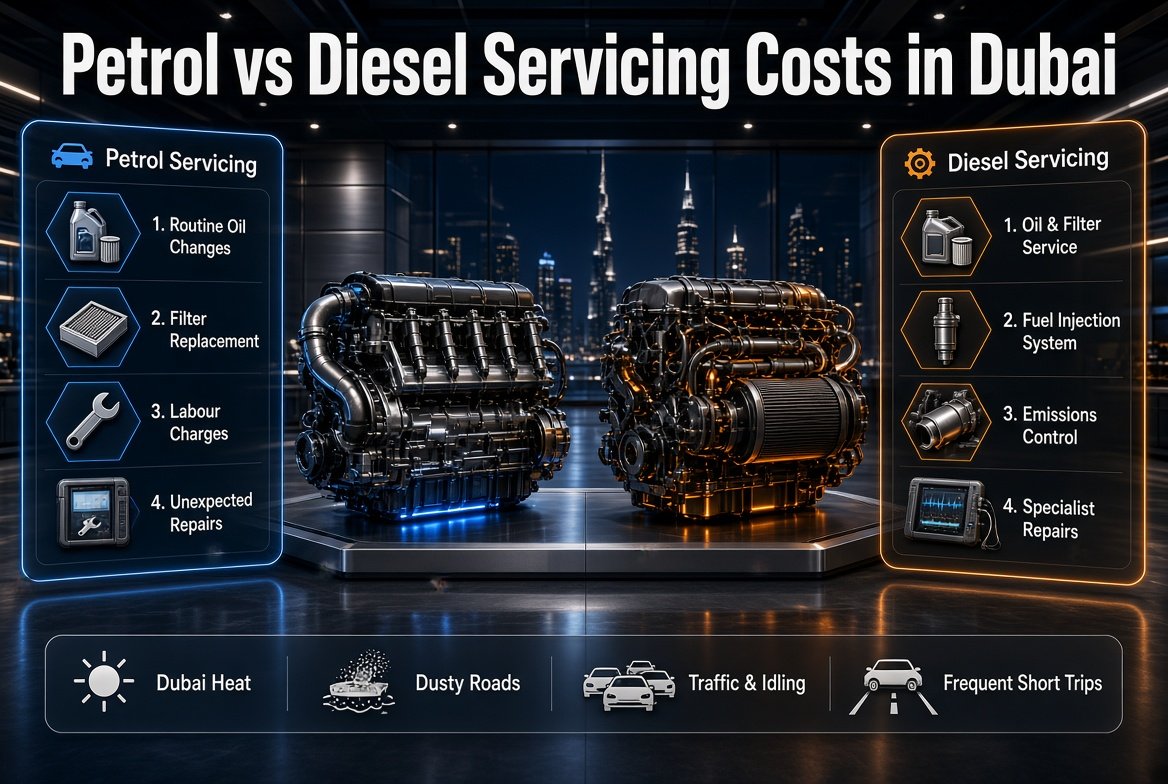
Petrol vs Diesel Servicing Costs in Dubai | Owning a car in Dubai involves more than paying for fuel and insurance. Regular servicing, engine oil, filters, replacement parts, labour charges, and unexpected mechanical repairs can significantly affect your annual budget. The difference becomes particularly important when deciding between petrol and diesel vehicles, because both engine types have different maintenance requirements and long-term ownership considerations.
Understanding petrol vs diesel servicing costs in Dubai helps you make a better decision before buying a car or planning your next service. Petrol vehicles often have relatively straightforward routine maintenance, while modern diesel engines may require additional attention to fuel-injection equipment and emissions-control systems. However, a well-maintained diesel vehicle can still be economical for drivers who cover substantial distances throughout the year.
Dubai’s driving environment adds another consideration. High temperatures, dusty roads, air-conditioning use, traffic congestion, and frequent short journeys can influence maintenance requirements for both engine types.
This guide explains routine servicing expenses, replacement parts, common repair risks, workshop quotations, and practical ways to control maintenance costs. It also shows how to compare petrol and diesel vehicles fairly without relying on assumptions about fuel efficiency or engine reliability.
For additional guidance on vehicle-related services and fuel support, visit Fuel Delivery Dubai.
1. What Is the Difference Between Petrol and Diesel Servicing Costs?
Petrol and diesel servicing costs differ because the engines use different combustion systems, fuel components, and, in many modern vehicles, different emissions-control technologies. Petrol vehicles often have lower routine servicing costs in comparable passenger-car categories, while some diesel repairs require specialised equipment and more expensive components.
However, there is no universal price difference that applies to every vehicle. A premium petrol SUV may cost considerably more to maintain than a basic diesel pickup, depending on the manufacturer, engine design, parts availability, and vehicle condition.
What determines the actual servicing bill?
The most important cost factors include:
Engine oil and filters: Both engine types need suitable engine oil and regular filter maintenance. The required specification, oil capacity, and filter design influence the cost.
Fuel-system components: Petrol engines use spark ignition and can have conventional or direct-injection systems. Diesel engines use compression ignition and commonly rely on high-pressure fuel injection. Repairs to modern diesel injectors and pumps can be particularly expensive.
Emissions equipment: Many modern diesel vehicles have diesel particulate filters, exhaust gas recirculation systems, and other emissions-control components. These systems can add diagnostic and repair costs.
Vehicle age and mileage: Older vehicles may need more attention to seals, hoses, cooling components, suspension parts, and electrical systems.
Workshop expertise: Routine oil changes are widely available, but certain diesel fuel-system or emissions-related faults require specialist knowledge.
Routine servicing versus unexpected repairs
It is important to separate scheduled maintenance from unexpected repairs.
Scheduled maintenance includes work such as oil changes, filter replacement, inspections, and manufacturer-recommended fluid servicing. These expenses can generally be planned in advance.
Unexpected repairs include injector failures, cooling-system faults, turbocharger problems, and electrical issues. Their costs depend on the fault and the work required.
A vehicle with slightly higher routine servicing costs may still be cheaper to own if it avoids major repairs. Equally, a vehicle with excellent fuel economy may become expensive if it has neglected maintenance or unresolved mechanical problems.
Professional advice: Compare the complete maintenance requirements of specific vehicles rather than choosing petrol or diesel based on fuel type alone.
2. Petrol vs Diesel Servicing Costs in Dubai: A Detailed Comparison
A useful comparison considers routine maintenance, common replacement parts, specialist labour, and potential repair exposure. Petrol vehicles often have an advantage in routine servicing simplicity, while diesel vehicles can have additional maintenance requirements depending on their age and emissions equipment.
| Maintenance category | Petrol vehicles | Diesel vehicles |
|---|---|---|
| Engine oil and filter | Depends on oil specification and capacity | Depends on oil specification and capacity |
| Air filter | Inspection and replacement as required | Inspection and replacement as required |
| Fuel filter | Design-dependent maintenance | Often an important service item |
| Spark plugs | Required in conventional petrol ignition systems | Not used for normal diesel combustion |
| Glow plugs | Not normally required | Used for starting in many diesel engines |
| Fuel injectors | Can be expensive on advanced systems | High-pressure systems can be expensive to repair |
| Turbocharger | Fitted to some models | Fitted to many modern diesel models |
| DPF maintenance | Not normally applicable | Applicable to diesel vehicles equipped with a DPF |
| EGR system | Design-dependent | Common on modern diesel vehicles |
| Cooling system | Requires scheduled inspections | Requires scheduled inspections |
| Diagnostic equipment | Required for modern electronic systems | Specialist equipment may be needed for some faults |
| Routine labour | Depends on vehicle accessibility | May be higher for specialist procedures |
The table describes general tendencies rather than fixed prices. Some petrol vehicles use complex turbocharging and direct-injection technology, while some diesel vehicles have straightforward maintenance schedules.
Why should you compare individual models?
Consider two vehicles in the same price range. One has an affordable service package, widely available replacement parts, and a reliable maintenance history. The other requires specialised components and has a record of unresolved mechanical faults.
The second vehicle could cost substantially more to maintain regardless of whether it uses petrol or diesel.
Before purchasing, request the manufacturer’s service schedule and obtain a written estimate from a workshop familiar with the exact model. Include scheduled servicing, expected wear items, and any maintenance that is already overdue.
For a broader overview of engine-related differences, see Petrol vs. Diesel Comparisons Dubai.
3. What Does Routine Petrol Car Servicing Include?
Routine petrol servicing focuses on keeping the engine properly lubricated, maintaining clean air and fuel systems, and checking the components that affect performance and safety.
For many petrol passenger cars, the basic service process is relatively straightforward. However, the exact work depends on the engine design and the manufacturer’s maintenance schedule.
Engine oil and oil filter replacement
Engine oil reduces friction, helps control temperature, and carries contaminants away from important engine components. Over time, oil deteriorates and collects particles that must be removed through scheduled maintenance.
The correct oil specification matters as much as the replacement interval. Some petrol engines require specific synthetic oils, while turbocharged and direct-injection engines may have additional requirements.
A workshop should identify the correct specification and quantity before completing the service.
Spark plugs and ignition components
Petrol engines use spark plugs to ignite the air-fuel mixture. Worn plugs can contribute to misfires, rough idling, poor acceleration, and increased fuel consumption.
Ignition coils may also require attention if the vehicle develops a misfire. However, replacing plugs or coils without proper diagnosis can waste money.
Spark plug replacement intervals vary by vehicle and plug type. Some modern plugs are designed to last substantially longer than conventional alternatives.
Air filters and fuel filters
The engine air filter prevents dust and debris from entering the intake system. In Dubai, frequent exposure to dusty conditions makes regular inspection worthwhile.
Fuel-filter arrangements differ between petrol vehicles. Some have serviceable filters, while others incorporate components into larger fuel-system assemblies.
Do not assume that every filter requires replacement at every oil change. Follow the maintenance schedule and assess the filter’s condition where appropriate.
Cooling-system inspections
Petrol engines need an effective cooling system to operate within the intended temperature range. During servicing, a workshop may inspect coolant levels, hoses, the radiator, the cooling fan, and visible signs of leakage.
Overheating should never be ignored. A small cooling-system fault can develop into a major engine repair if the vehicle continues to operate at excessive temperatures.
Common mistake: Treating a basic oil change as a complete vehicle service. Oil replacement is important, but it does not replace inspections of brakes, tyres, coolant, battery condition, and other scheduled maintenance items.
4. What Does Routine Diesel Car Servicing Include?
Diesel servicing includes the usual maintenance tasks required by petrol vehicles, but some diesel engines have additional requirements involving fuel filtration, high-pressure injection equipment, turbocharging, and exhaust after-treatment systems.
These differences can affect both the service quotation and the level of expertise required to diagnose certain faults.
Engine oil and fuel-filter maintenance
Diesel engines operate under different combustion conditions from petrol engines. They need oil that meets the manufacturer’s performance requirements and is compatible with the engine’s design and emissions equipment.
The fuel filter is particularly important because contaminants and water can damage sensitive injection components. The replacement interval varies by vehicle, fuel-system design, and operating conditions.
If the fuel filter is neglected, restricted fuel flow or contamination may affect engine operation and increase the risk of expensive component damage.
High-pressure fuel injection
Modern diesel engines commonly use high-pressure common-rail systems to deliver fuel accurately. These systems support efficient combustion and help control emissions.
However, injectors and high-pressure pumps operate under demanding conditions. Diagnosing problems may require specialist tools, fuel-pressure testing, and electronic analysis.
A hard-starting engine, rough idle, excessive smoke, or loss of power does not automatically mean the injectors need replacement. Several faults can produce similar symptoms.
Glow plugs and starting systems
Many diesel engines use glow plugs to assist starting when the engine is cold. A failed glow plug or control circuit may contribute to starting difficulties or warning messages.
Glow plugs are not the same as petrol spark plugs. They assist the diesel starting process rather than providing the spark used for normal petrol combustion.
Replacement requirements depend on the vehicle and the actual fault.
Emissions-control maintenance
Modern diesel vehicles may use several systems to reduce exhaust emissions.
- Diesel particulate filter (DPF): Captures soot from exhaust gases.
- Exhaust gas recirculation (EGR): Helps reduce nitrogen oxide emissions.
- Selective catalytic reduction (SCR): Uses a suitable reductant, commonly AdBlue, on equipped vehicles.
Not every diesel model uses identical equipment. Maintenance and repair requirements depend on the vehicle’s specification.
When warning lights appear, proper diagnosis is more useful than immediately paying for cleaning or replacement services.
For a more detailed maintenance comparison, read Petrol vs Diesel Engine Maintenance in Dubai.
5. Why Can Diesel Repairs Cost More Than Petrol Repairs?
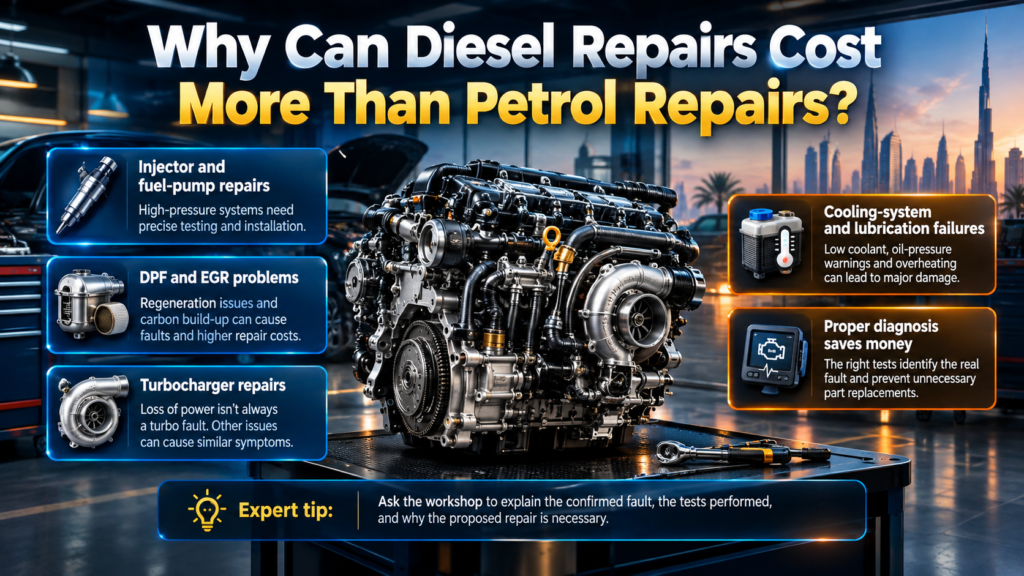
Diesel repairs can be expensive when high-pressure injection systems, turbochargers, or emissions-control components develop faults. These components may require specialised testing and precise installation.
However, diesel engines are not automatically unreliable or destined to need expensive repairs. Maintenance history, operating conditions, design quality, and timely diagnosis have a major influence on long-term costs.
Injector and fuel-pump repairs
Diesel injectors must deliver fuel accurately at very high pressure. Contaminated fuel, internal wear, electrical faults, or other problems can affect their operation.
A workshop should confirm whether the fault involves an injector, pump, electrical connection, fuel-pressure control, or another part of the system.
Replacing an entire set of injectors without adequate evidence can create an unnecessary expense.
DPF and EGR problems
On vehicles equipped with a DPF, the filter must manage accumulated soot through its intended regeneration process. Certain driving patterns, particularly repeated short journeys, may prevent some vehicles from completing regeneration successfully.
EGR components can also develop faults or become restricted by deposits, depending on engine design and operating conditions.
When a warning appears, follow the manufacturer’s instructions and obtain professional diagnosis if the issue persists.
Removing emissions equipment or disabling required systems is not an appropriate substitute for diagnosis and compliant repairs.
Turbocharger repairs
Turbochargers are fitted to many diesel engines and to some petrol engines. They increase the amount of air available for combustion, supporting the engine’s performance and efficiency.
A turbocharger fault can be expensive, but loss of power does not necessarily mean the turbo itself has failed. Intake leaks, control-system faults, lubrication problems, and sensor issues may produce similar symptoms.
The correct diagnosis can prevent unnecessary replacement.
Cooling-system and lubrication failures
Both engine types can suffer expensive damage when cooling or lubrication problems are ignored.
Low coolant, oil-pressure warnings, overheating, and serious leaks require prompt attention. Continuing to drive under unsafe conditions may turn a manageable repair into extensive engine damage.
Expert tip: Ask the workshop to explain the confirmed fault, the tests performed, and why the proposed repair is necessary. This is particularly important when the quotation involves expensive diesel fuel-system or emissions components.
6. How Do Dubai’s Heat, Dust, and Traffic Affect Servicing Costs?
Dubai’s driving conditions influence maintenance requirements for both petrol and diesel vehicles. High ambient temperatures, dust, stop-start traffic, and frequent short journeys can place additional demands on particular systems.
The effect depends on the vehicle’s design, maintenance history, and how it is driven.
High temperatures and engine cooling
During hot weather, the cooling system must manage engine heat effectively. A weak radiator fan, restricted radiator, leaking hose, faulty thermostat, or low coolant level can cause overheating.
Both petrol and diesel engines require the correct coolant specification and a properly functioning cooling system.
If the engine temperature rises abnormally, stop safely and follow the manufacturer’s instructions. Never open a hot pressurised cooling system.
A professional inspection can identify whether the problem involves a leak, fan, thermostat, radiator, water pump, or another component.
Dust and air-filter condition
Dust can accumulate in engine air filters, particularly when vehicles regularly travel through dusty areas or near construction sites.
A restricted air filter can affect airflow and may contribute to performance problems, depending on the vehicle and the degree of restriction.
Regular inspection is sensible, but replacing filters unnecessarily increases maintenance spending. Use the manufacturer’s recommendations and the filter’s actual condition to guide replacement.
Stop-start traffic and idling
Heavy traffic increases operating time without necessarily adding much distance to the odometer. Repeated short trips can also prevent some engines and emissions systems from reaching their intended operating conditions.
For certain diesel vehicles, this may interfere with DPF regeneration. Petrol vehicles can experience their own operating-condition-related maintenance concerns.
If your daily routine consists mainly of short journeys, consider how well the specific vehicle is suited to that pattern rather than assuming that diesel efficiency will always compensate for additional maintenance.
Air-conditioning use
Air conditioning places an additional load on the vehicle, although the effect varies by engine, climate-control design, and driving conditions.
A properly maintained cooling system, clean cabin filter, and functional air-conditioning system help support comfortable driving. However, a cabin filter and an engine air filter serve different purposes and should not be confused.
If the air conditioner stops cooling effectively, arrange diagnosis rather than automatically assuming that the engine requires servicing.
Short trips versus long-distance driving
A vehicle that regularly travels longer distances may operate under different conditions from one used for brief journeys around residential areas.
Long-distance use can be suitable for many diesel engines, including some DPF-equipped models, when the vehicle is operated according to its instructions. It does not eliminate the need for servicing.
The best maintenance approach is to consider actual usage, the manufacturer’s guidance, and early signs of developing faults.
7. How Can You Estimate Annual Petrol and Diesel Servicing Costs?
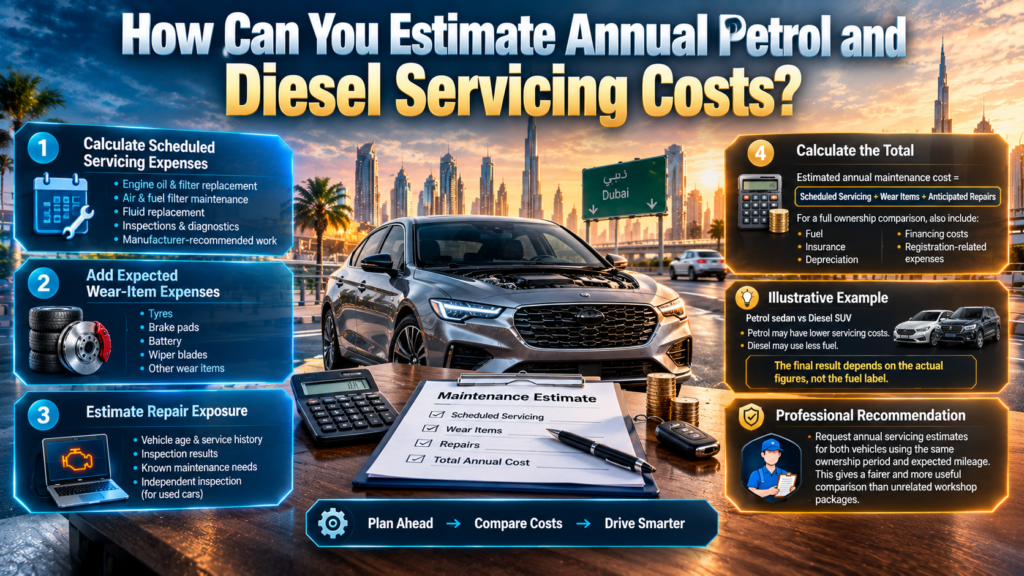
The most reliable estimate combines scheduled servicing, expected wear items, and a separate allowance for unexpected repairs.
A single oil-change price cannot show the complete annual cost of owning a vehicle. Some expenses occur regularly, while others arise only after a component reaches the end of its service life.
Step 1: Calculate scheduled servicing expenses
Check how many scheduled services your vehicle requires during a typical year. Some manufacturers specify intervals based on distance, time, or a combination of both.
For each service, record the estimated cost of:
- Engine oil and filter replacement.
- Air-filter and fuel-filter maintenance when due.
- Scheduled fluid replacement.
- Inspections and diagnostic work included in the service.
- Manufacturer-recommended maintenance procedures.
Do not count a service item twice if it is already included in a package.
Step 2: Add expected wear-item expenses
Tyres, brake pads, batteries, wiper blades, and other wear items may need replacement during ownership.
Their replacement frequency depends on the vehicle, mileage, driving style, product quality, and operating conditions.
For example, a driver who regularly travels long distances may use tyres more quickly in terms of mileage. A driver who spends considerable time in congested traffic may experience different brake-wear patterns.
Step 3: Estimate repair exposure
Use the vehicle’s age, service history, inspection results, and known maintenance requirements to estimate potential repair costs.
A newer vehicle with a valid maintenance plan may offer more predictable expenses than an older vehicle with incomplete records.
For used cars, obtain an independent inspection before finalising your budget.
Step 4: Calculate the total
Use this formula:
Estimated annual maintenance cost = scheduled servicing + expected wear items + anticipated repairs
For a more complete ownership comparison, calculate fuel, insurance, depreciation, financing costs, and registration-related expenses separately.
Illustrative example
Suppose you are comparing a petrol sedan and a diesel SUV. The petrol sedan may have lower scheduled servicing costs, while the diesel SUV may use less fuel over the same annual distance.
The sedan could still be cheaper overall if its fuel consumption is reasonable and the SUV’s additional maintenance costs exceed its fuel savings. Alternatively, the diesel SUV could be more economical for a high-mileage driver.
The result depends on the actual figures, not the fuel label.
Professional recommendation: Request annual servicing estimates for both vehicles using the same ownership period and expected mileage. This produces a more useful comparison than comparing unrelated workshop packages.
Common Petrol vs Diesel Engine Problems in Dubai: A Practical Troubleshooting Guide
Petrol and diesel engines can develop different mechanical problems depending on vehicle condition, maintenance history, driving habits, and operating conditions in Dubai. High temperatures, traffic congestion, frequent idling, and dusty roads can increase the importance of regular inspections and timely servicing. Petrol engines may experience ignition coil failures, worn spark plugs, fuel injector issues, or cooling-system faults, while diesel engines can develop problems involving fuel injectors, turbochargers, diesel particulate filters (DPF), and exhaust emission-control systems. Recognising these differences helps drivers understand potential faults and avoid unnecessary repairs.
When a vehicle develops difficult starting, unusual engine noises, excessive exhaust smoke, reduced acceleration, overheating, or higher-than-normal fuel consumption, the symptoms should be investigated rather than ignored. A proper diagnosis can identify the underlying cause before it leads to further damage. Read our detailed guide on Common Petrol vs Diesel Engine Problems in Dubai to learn how common petrol and diesel engine faults differ, recognise early warning signs, and understand the preventive maintenance steps that help Dubai drivers maintain reliable performance and manage repair costs more effectively.
8. Does Diesel Fuel Economy Make Up for Higher Servicing Costs?
Diesel fuel economy can offset higher servicing expenses when the fuel savings are large enough. The result depends on real-world fuel consumption, annual distance, fuel prices, maintenance costs, and the likelihood of significant repairs.
Drivers who regularly cover long distances may benefit more than those whose journeys are short and infrequent.
Calculate your annual fuel expenditure
Use the following formula:
Annual fuel cost = (annual kilometres × consumption in L/100 km ÷ 100) × fuel price per litre
For illustration, assume a driver covers 20,000 kilometres per year.
- Petrol consumption: 9 litres per 100 kilometres.
- Diesel consumption: 7 litres per 100 kilometres.
- Assumed petrol price: AED 3 per litre.
- Assumed diesel price: AED 3 per litre.
These are illustrative figures for explaining the calculation, not current UAE fuel prices or a claim about specific vehicles.
| Item | Petrol example | Diesel example |
|---|---|---|
| Annual distance | 20,000 km | 20,000 km |
| Consumption | 9 L/100 km | 7 L/100 km |
| Annual fuel use | 1,800 litres | 1,400 litres |
| Annual fuel expenditure | AED 5,400 | AED 4,200 |
The diesel example saves AED 1,200 annually on fuel under these assumptions.
Now suppose the diesel vehicle costs AED 600 more each year to service. The remaining annual saving is AED 600 before accounting for repairs, insurance, depreciation, and purchase-price differences.
If the diesel vehicle later needs an expensive injection-system repair, the financial advantage could be reduced further.
When is diesel more likely to make financial sense?
Diesel may be worth considering when:
- You cover substantial annual mileage.
- The specific vehicle offers a meaningful real-world efficiency advantage.
- Your driving pattern suits the engine and its emissions systems.
- Scheduled servicing and replacement parts are reasonably priced.
- The vehicle has a strong maintenance history.
Petrol may be more suitable when journeys are predominantly short, annual mileage is moderate, or the petrol model offers a better overall balance of purchase price, maintenance, and reliability.
For a more detailed discussion of engine efficiency under Dubai driving conditions, see Diesel vs Petrol Efficiency for Dubai Driving.
Petrol vs Diesel Engine Lifespan in Dubai: A Practical Guide to Engine Longevity
The lifespan of a petrol or diesel engine depends on several factors, including engine design, maintenance quality, driving habits, and operating conditions. In Dubai, high temperatures, traffic congestion, frequent idling, and long-distance highway journeys can influence engine wear over time. Diesel engines are often engineered for sustained workloads and strong low-speed torque, while petrol engines can also provide long-term reliability when properly maintained. However, neither engine type guarantees a longer lifespan in every situation; the vehicle’s build quality, service history, mileage, and intended use all play important roles.
Drivers can help extend engine life by following the manufacturer’s service schedule, using the correct engine oil and coolant, inspecting the cooling system, replacing filters on time, and addressing warning lights or unusual noises promptly. Diesel owners should also follow the recommended maintenance procedures for turbochargers and emission-control systems where fitted. For more detailed information, read our guide to Petrol vs Diesel Engine Lifespan in Dubai. It explains the factors that affect engine longevity, compares long-term ownership considerations, and offers practical maintenance guidance to help drivers reduce premature engine wear in Dubai’s demanding driving conditions.
9. Which Is Better for City Driving and Highway Use in Dubai?
The better engine depends on how frequently you drive, how long your journeys are, and what you expect from the vehicle.
Petrol cars are often a practical choice for everyday urban travel. Diesel vehicles may be attractive for regular long-distance journeys, heavy loads, and some larger SUVs or commercial applications.
Petrol engines for city driving
Petrol engines can suit drivers who make frequent trips between residential areas, workplaces, shopping centres, and schools.
Their maintenance requirements may be relatively straightforward, depending on the model. However, repeated short journeys still require proper servicing and should not be used as a reason to neglect oil, filters, or inspections.
When choosing a petrol vehicle, consider:
- Real-world fuel consumption in traffic.
- Engine size and vehicle weight.
- Oil and spark-plug replacement requirements.
- Cooling-system condition.
- Availability of parts and qualified workshops.
Diesel engines for highway driving
Diesel engines often provide strong low-speed torque and can deliver good fuel economy on suitable vehicles.
These characteristics can be useful for regular Dubai–Abu Dhabi travel, commercial use, or carrying substantial loads. However, highway driving does not automatically make every diesel vehicle cheaper to own.
Purchase price, maintenance schedules, emissions equipment, and actual fuel consumption still matter.
What about mixed driving?
Many Dubai drivers combine urban traffic with regular highway travel. In this situation, compare the actual models rather than applying a simple city-versus-highway rule.
A modern petrol vehicle may offer excellent efficiency, while a diesel model may deliver a worthwhile advantage for higher mileage. Vehicle technology, weight, transmission, and driving conditions all influence the outcome.
For further information about engine response, torque, and overtaking behaviour, read Petrol vs Diesel Driving Performance in Dubai.
10. How Does Vehicle Reliability Affect Long-Term Servicing Costs?
Reliability affects how frequently a vehicle needs repairs, how disruptive those repairs become, and how much you spend beyond scheduled maintenance.
A vehicle with slightly higher routine servicing costs may be cheaper to own over several years if it experiences fewer unexpected failures.
Service history matters more than assumptions
Two vehicles of the same model can have very different maintenance costs because their previous owners may have treated them differently.
A vehicle with complete records provides evidence of oil changes, filter replacement, scheduled inspections, and previous repairs.
An incomplete history does not prove that a vehicle is unreliable, but it creates uncertainty. That uncertainty should be addressed through a professional inspection and a realistic repair allowance.
What should be inspected before buying?
Ask a qualified technician to examine:
- Engine starting and idle quality.
- Oil and coolant leaks.
- Cooling-system condition.
- Diagnostic trouble codes.
- Transmission behaviour.
- Suspension and braking components.
- Battery and charging-system performance.
- Evidence of neglected maintenance or previous repairs.
For diesel vehicles, include the fuel-injection system and emissions-control equipment where fitted. For petrol vehicles, pay attention to ignition performance and the condition of any turbocharging or direct-injection systems.
Why preventative maintenance is valuable
Preventative maintenance helps identify developing problems before they become more expensive or cause a breakdown.
However, it should be based on evidence and manufacturer recommendations. Replacing healthy components unnecessarily can increase ownership costs without providing meaningful benefits.
For a closer look at how maintenance history and engine condition influence ownership, read Petrol vs Diesel Engine Reliability in Dubai.
11. Common Mistakes That Increase Petrol and Diesel Servicing Costs
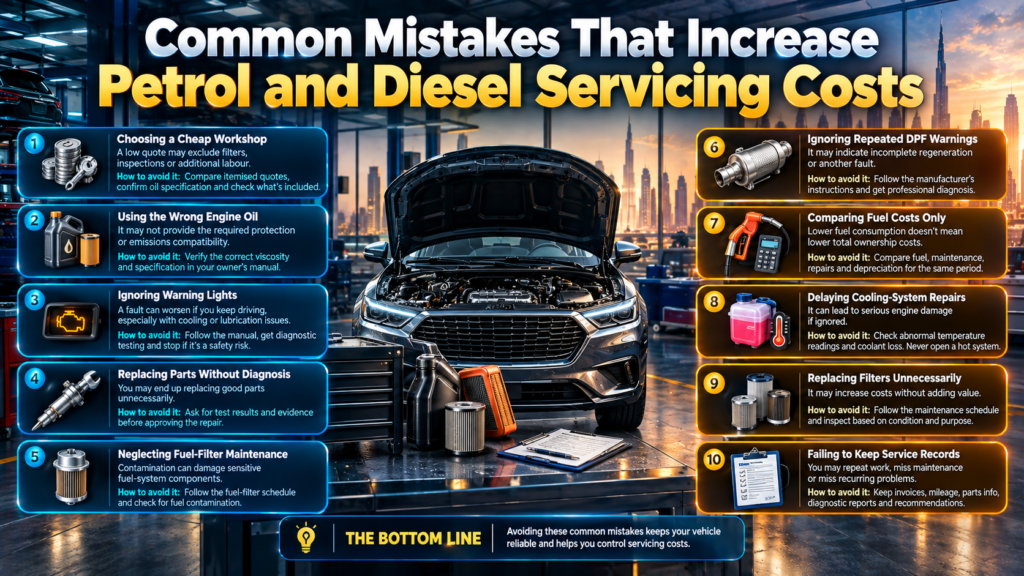
Several avoidable mistakes can increase maintenance expenses regardless of fuel type. Most involve incorrect servicing decisions, delayed diagnosis, or poor record-keeping.
Mistake 1: Choosing a workshop only because it is cheap
A low quotation may exclude filters, inspections, or additional labour. It may also make it difficult to understand which products and parts are being used.
How to avoid it: Compare itemised quotations, confirm the oil specification, and check what is included before approving the work.
Mistake 2: Using the wrong engine oil
Oil that does not meet the manufacturer’s requirements may fail to provide the intended protection or compatibility with emissions equipment.
How to avoid it: Verify the required viscosity and performance specification in the owner’s manual or approved maintenance documentation.
Mistake 3: Ignoring warning lights
A warning light may indicate a developing fault that requires attention. Continuing to drive can worsen some problems, particularly those involving lubrication, cooling, or emissions systems.
How to avoid it: Follow the owner’s manual, obtain diagnostic testing, and stop driving if the warning indicates an immediate safety risk.
Mistake 4: Replacing parts without confirming the fault
Replacing injectors, sensors, pumps, or turbochargers without proper diagnosis can result in unnecessary expenditure.
How to avoid it: Ask the workshop to explain the test results and the evidence supporting the recommended repair.
Mistake 5: Neglecting fuel-filter maintenance
Fuel contamination can damage sensitive fuel-system components. This is especially important for diesel engines with high-pressure injection systems.
How to avoid it: Follow the manufacturer’s fuel-filter schedule and investigate any suspected fuel contamination.
Mistake 6: Ignoring repeated DPF warnings
On equipped diesel vehicles, repeated warnings can indicate that the system is not completing its intended regeneration process or that another fault is present.
How to avoid it: Follow the manufacturer’s instructions and seek professional diagnosis if the warning persists. Do not rely on an assumed driving routine to solve every DPF problem.
Mistake 7: Comparing fuel costs without comparing servicing
Lower fuel consumption does not guarantee lower total ownership costs.
How to avoid it: Compare fuel, scheduled maintenance, likely repairs, and depreciation over the same ownership period.
Mistake 8: Delaying cooling-system repairs
Low coolant, a faulty fan, or a leaking hose can cause serious engine damage if ignored.
How to avoid it: Investigate abnormal temperature readings and coolant loss promptly. Never open a hot pressurised cooling system.
Mistake 9: Replacing filters unnecessarily
Replacing every filter at every service may increase costs without providing additional value.
How to avoid it: Follow the maintenance schedule and inspect components according to their purpose and condition.
Mistake 10: Failing to keep service records
Without records, you may repeat work, miss scheduled maintenance, or struggle to identify recurring problems.
How to avoid it: Keep invoices, mileage readings, parts information, diagnostic reports, and details of outstanding recommendations.
12. Expert Advice for Reducing Servicing Costs in Dubai
The best maintenance strategy focuses on the manufacturer’s requirements, reliable diagnosis, appropriate parts, and consistent record-keeping.
Build a vehicle-specific maintenance plan
Start by identifying the exact model, engine variant, mileage, age, and service history.
Then record the required oil specification, scheduled servicing intervals, filter requirements, fluid replacement intervals, and any special procedures for the vehicle.
This is more effective than using a generic checklist that may not match your car.
Prioritise safety and high-impact maintenance
Some maintenance items deserve immediate attention because their failure can affect safety or cause significant damage.
These include:
- Braking-system faults.
- Tyres with unsafe wear or damage.
- Cooling-system leaks or overheating.
- Engine oil-pressure warnings.
- Serious fuel leaks.
- Battery or charging faults that affect vehicle operation.
- Persistent engine-management warnings.
Not every issue has the same urgency. Ask the technician to distinguish immediate safety concerns from maintenance that can be scheduled later.
Ask for diagnostic evidence
When a workshop recommends an expensive repair, ask what tests confirmed the fault.
Depending on the issue, useful evidence may include fault codes, pressure measurements, leak tests, component inspection results, or documented symptoms.
A diagnostic code is a starting point, not always proof that the named component has failed.
Use suitable replacement parts
Genuine parts, original-equipment suppliers, and aftermarket products can differ in cost and quality.
The right choice depends on the component, the manufacturer’s requirements, warranty conditions, and the reliability of the supplier.
Safety-critical components and specialised engine parts deserve particular care. The cheapest option is not always the least expensive over the component’s service life.
Review your maintenance costs annually
At the end of each year, calculate how much you spent on scheduled servicing, wear items, repairs, and fuel.
This helps you identify whether your costs are rising because of higher mileage, vehicle age, recurring faults, or unnecessary work.
If your vehicle repeatedly requires expensive repairs, compare the expected future costs with the vehicle’s market value and replacement options.
Is petrol or diesel cheaper to service in Dubai over the long term?
Petrol vehicles often have lower routine servicing costs than comparable diesel vehicles, but the overall difference depends on the model, mileage, maintenance history, and type of repairs required. Diesel engines may need specialised attention to high-pressure fuel injectors, fuel pumps, and emissions-control systems. However, drivers who regularly cover long distances may recover some additional maintenance expenses through better fuel economy.
When comparing long-term costs, consider more than the price of an oil change. A vehicle with predictable maintenance requirements and a good service history can be more economical than one with cheaper routine servicing but frequent mechanical problems.
Important factors to compare:
Annual scheduled servicing and replacement-filter costs.
Potential repairs to injectors, turbochargers, and emissions systems.
Fuel consumption based on your actual driving conditions.
Vehicle age, mileage, spare-parts availability, and service history.
Why can diesel car repairs be more expensive than petrol car repairs in Dubai?
Modern diesel engines often use high-pressure fuel-injection systems and advanced emissions-control equipment. Components such as diesel injectors, high-pressure fuel pumps, diesel particulate filters (DPFs), and exhaust gas recirculation (EGR) systems can require specialist diagnostics and repairs. If a fault is ignored, the resulting damage may increase the final repair bill.
Dubai’s driving conditions can also influence maintenance needs. Repeated short journeys may prevent some DPF-equipped vehicles from completing their intended regeneration cycles, depending on the vehicle and operating conditions. This makes it important to follow the manufacturer’s guidance and investigate persistent warning lights promptly.
How to control repair expenses:
Choose a workshop experienced with your vehicle’s diesel system.
Request diagnostic evidence before approving expensive replacements.
Follow the recommended fuel-filter and engine-oil service intervals.
Address persistent warning lights, unusual smoke, or loss of power early.
How does Dubai’s hot weather affect petrol and diesel servicing costs?
Dubai’s high temperatures can make cooling-system maintenance, battery condition, tyre inspections, and correct fluid specifications particularly important. Both petrol and diesel engines depend on effective cooling and lubrication. If a radiator, cooling fan, hose, thermostat, or water pump develops a fault, continued driving with an overheating engine can result in substantial repair costs.
Dusty conditions can also affect air-filter maintenance, while heavy traffic and frequent short journeys influence how a vehicle operates. These conditions do not automatically make diesel servicing more expensive, but they make vehicle-specific inspections and timely maintenance especially valuable.
Practical maintenance priorities:
Inspect coolant levels and investigate unexplained coolant loss.
Check engine air filters according to the manufacturer’s guidance and actual condition.
Monitor battery performance, tyre condition, and fluid leaks.
Stop safely if the engine overheats; never open a hot, pressurised cooling system.
Can diesel fuel savings offset higher servicing costs in Dubai?
Diesel fuel savings can offset higher servicing expenses when the vehicle’s improved fuel economy produces enough savings over the distance you drive. The financial benefit is usually more significant for drivers who regularly travel long distances than for those who mainly make short trips around Dubai.
For example, if a diesel vehicle saves AED 1,000 annually in fuel but costs AED 600 more per year to maintain, the net annual saving is AED 400 before accounting for unexpected repairs, insurance, depreciation, and purchase-price differences. A major repair could reduce or eliminate that advantage.
Before choosing a diesel vehicle, compare:
Your expected annual mileage.
Real-world fuel consumption for both vehicles.
Annual scheduled servicing and expected wear-item costs.
Potential repair expenses and the vehicle’s maintenance history.
The best decision comes from comparing total ownership costs over three to five years rather than focusing exclusively on fuel economy.
How can I reduce petrol and diesel servicing costs without compromising vehicle reliability?
The most effective way to reduce servicing costs is to follow the manufacturer’s maintenance schedule, use the correct fluids and replacement parts, and identify developing problems before they cause further damage. Skipping maintenance may appear to save money initially, but it can increase the risk of expensive repairs involving the engine, cooling system, fuel system, or emissions equipment.
It is also important to distinguish necessary repairs from optional recommendations. A professional workshop should explain the fault, provide relevant diagnostic findings, and clarify why a component needs replacement.
Smart ways to manage your maintenance budget:
Compare itemised quotations from reputable workshops.
Confirm that the engine oil meets your vehicle’s required specification.
Keep invoices and records of servicing, repairs, and replacement parts.
Prioritise safety-critical faults and investigate warning lights promptly.
Set aside a separate allowance for tyres, brakes, batteries, and unexpected repairs.
Expert recommendation: Choose a petrol or diesel vehicle based on your driving habits, realistic maintenance budget, and the condition of the specific model. Consistent, evidence-based maintenance is more valuable than simply choosing the engine type with the lowest advertised servicing price.
Conclusion: Petrol vs Diesel Servicing Costs in Dubai
Choosing between petrol and diesel is not just a question of which engine requires cheaper servicing. The real cost depends on your vehicle model, annual mileage, driving conditions, maintenance history, parts availability, and the type of journeys you make in Dubai. Petrol engines can be more economical to maintain for drivers who mainly travel short distances, commute through city traffic, or use their vehicles occasionally. Diesel engines may offer better fuel economy and strong performance for drivers who regularly cover long highway distances or need greater pulling power, but certain diesel components can increase repair expenses when problems develop.
Dubai’s hot climate, heavy traffic, frequent air-conditioning use, and dusty conditions make preventive maintenance important for both engine types. Following the manufacturer’s service schedule, using the correct engine oil and approved fluids, monitoring the cooling system, and addressing warning signs early can help reduce avoidable repair costs. Before purchasing a vehicle, compare its expected servicing expenses, fuel consumption, common repair requirements, and long-term reliability rather than relying on fuel type alone.
For a more informed decision, review our guides to petrol vs diesel engine maintenance in Dubai and petrol vs diesel engine reliability in Dubai. Understanding these differences will help you select an engine that suits your driving habits and budget.
Ultimately, the most cost-effective engine is the one that matches your daily driving needs and receives consistent, appropriate maintenance. By considering servicing costs alongside fuel efficiency, reliability, and expected repair expenses, you can make a practical long-term decision for driving in Dubai.
Leave a Reply