

Introduction
Diesel vs Petrol Efficiency for Dubai Driving | Choosing between a petrol and diesel vehicle can be confusing when you drive regularly in Dubai. One car may promise better mileage, while another may have a lower purchase price and cheaper routine servicing. The real question is not simply which engine uses less fuel, but which vehicle offers better value for your daily driving conditions.
Diesel vs petrol efficiency for Dubai driving depends on several factors, including engine design, traffic congestion, average journey length, air-conditioning use, fuel prices and vehicle maintenance. Diesel engines often provide better fuel economy on longer journeys, while petrol vehicles can be suitable for short commutes, frequent city trips and mixed everyday use.
Dubai’s driving environment makes this comparison especially important. A driver travelling regularly between residential communities and business districts may experience very different fuel consumption from someone covering long distances on Sheikh Zayed Road or driving between emirates.
The difference becomes even more significant when you calculate monthly fuel expenses rather than relying entirely on advertised mileage figures.
This guide explains how petrol and diesel vehicles perform in Dubai, how to compare their real-world efficiency, what hot weather and traffic mean for consumption, and how to estimate the total cost of ownership. You will also learn how to choose an engine according to your driving habits without paying for efficiency advantages you may never use.
For readers looking for practical information about fuel availability and vehicle fuel needs, the Fuel Delivery Dubai homepage provides a relevant starting point.
2. What Does Fuel Efficiency Mean for Petrol and Diesel Cars?
Fuel efficiency describes how effectively a vehicle uses fuel to travel a particular distance. In Dubai, drivers commonly compare petrol and diesel vehicles using kilometres per litre (km/L) or litres per 100 kilometres (L/100 km).
A vehicle that travels more kilometres using one litre of fuel generally has better fuel economy. When consumption is measured in litres per 100 kilometres, a lower figure indicates better efficiency.
For example, a car that averages 15 km/L uses less fuel per kilometre than a comparable car averaging 10 km/L. However, this does not automatically mean that the first vehicle is cheaper to run, because the price per litre may differ.
Fuel efficiency versus fuel cost efficiency
These terms are related, but they are not identical.
Fuel efficiency measures how much distance a vehicle covers using a given quantity of fuel. Fuel cost efficiency measures how much money is required to cover that distance.
A diesel vehicle may consume fewer litres but use more expensive fuel. A petrol vehicle may consume more litres but cost less to purchase or maintain. Both factors need to be considered before making a decision.
The most useful comparisons include:
- Kilometres travelled per litre.
- Fuel cost per 100 kilometres.
- Monthly and annual fuel expenditure.
- Routine servicing and potential repair costs.
- Vehicle purchase price and expected resale value.
Why engine efficiency matters in Dubai
Many Dubai drivers spend time in slow-moving traffic, use air-conditioning throughout much of the year and travel between residential, commercial and industrial areas. These conditions influence how much fuel a vehicle consumes.
A car that performs efficiently during a standardised test may deliver different results on a congested daily route. Similarly, a vehicle that performs well on a highway may not achieve the same economy during repeated short trips.
The practical rule: compare vehicles under conditions that resemble your actual driving routine rather than relying exclusively on manufacturer figures.
3. Diesel vs Petrol Efficiency: Main Differences at a Glance
Diesel engines generally offer an efficiency advantage over comparable conventional petrol engines, particularly during sustained driving. Petrol engines, however, can be more suitable for certain urban driving patterns and may offer lower ownership costs depending on the vehicle.
| Comparison factor | Petrol vehicle | Diesel vehicle |
|---|---|---|
| Typical fuel economy | Often lower than comparable diesel models | Often higher than comparable petrol models |
| Highway driving | Can be economical | Often well suited to long-distance travel |
| Short city journeys | Frequently a practical choice | Suitability depends partly on emissions-system requirements |
| Low-speed torque | Varies by engine | Generally strong |
| Noise and vibration | Usually quieter | Can be more noticeable |
| Purchase cost | May be lower for comparable models | Can be higher for some models |
| Routine maintenance | Depends on engine and vehicle | Depends on engine and emissions equipment |
| Short-trip suitability | Often suitable | Some modern diesels need suitable driving conditions for filter regeneration |
| Commercial use | Suitable for many applications | Often useful for heavy-duty and high-mileage applications |
| Overall ownership value | Depends on the complete cost | Depends on fuel savings and additional expenses |
These are general characteristics, not universal rules. Engine technology has advanced considerably, and a modern petrol hybrid can be more economical in urban traffic than a conventional diesel vehicle.
Why diesel often achieves better mileage
Diesel engines typically operate with higher compression ratios and convert a greater proportion of fuel energy into useful work. Their combustion characteristics also help produce strong torque at relatively low engine speeds.
This can be beneficial when a vehicle carries passengers, travels long distances or maintains a steady cruising speed.
Why petrol remains competitive
Petrol engines are widely used in passenger cars because they can offer smooth operation, broad model availability and practical everyday performance. Modern petrol engines use technologies such as turbocharging, variable valve timing and efficient transmissions to reduce consumption.
Petrol hybrid vehicles add electric assistance and can recover energy during braking, making them particularly effective in suitable stop-and-go conditions.
The best comparison is therefore between specific vehicles, not simply between two fuel labels.
4. How Does Dubai Traffic Affect Petrol and Diesel Fuel Consumption?
Traffic conditions can make a noticeable difference to fuel economy. Frequent acceleration, braking, idling and low-speed movement increase the amount of fuel required to complete a journey.
A route that takes 25 minutes during quieter periods may take much longer during peak traffic. Even if the distance remains unchanged, the vehicle may use more fuel because the engine spends more time operating without making meaningful progress.
Petrol cars in stop-and-go traffic
Petrol vehicles can be practical for regular city driving, including short commutes, shopping trips and journeys between residential communities and workplaces.
However, repeated acceleration consumes energy. When drivers accelerate sharply and then brake heavily a short distance later, some of that energy is wasted.
Petrol consumption can also increase when the engine remains running while the vehicle is stationary. This is particularly relevant when waiting in queues, collecting passengers or spending extended periods in congested traffic.
Drivers can improve efficiency by:
- Accelerating progressively when traffic conditions allow.
- Looking ahead to anticipate changes in traffic flow.
- Avoiding unnecessary idling where switching off the engine is safe and appropriate.
- Maintaining the manufacturer’s recommended tyre pressure.
- Keeping the engine and transmission properly maintained.
Diesel cars in stop-and-go traffic
Diesel engines can also perform efficiently in urban conditions, but their suitability depends on the specific vehicle and how it is driven.
Some modern diesel vehicles use a diesel particulate filter, commonly called a DPF, to capture soot from the exhaust. The filter periodically needs suitable exhaust temperatures to burn off accumulated particles through a process called regeneration.
Frequent short journeys, repeated interruptions and prolonged low-speed operation can prevent some systems from completing regeneration as intended. The consequences may include warning lights, reduced performance or additional maintenance requirements.
This does not mean that every diesel car is unsuitable for city driving. It means that drivers should understand the requirements of the particular engine before buying it.
Which engine is better for daily Dubai commutes?
For a driver who mainly travels short distances in congested urban areas, a suitable petrol vehicle is often a straightforward option. A petrol hybrid may also deserve consideration.
For someone who regularly covers longer distances, diesel may offer meaningful fuel savings if the vehicle is appropriate for the route and its maintenance requirements are met.
Expert tip: Do not choose a diesel vehicle solely because its highway mileage figure is attractive. First consider the length of your usual journeys, annual kilometres and the manufacturer’s guidance for emissions-system operation.
5. Does Dubai’s Hot Weather Affect Petrol and Diesel Efficiency?

Dubai’s climate creates additional operating demands for vehicles, particularly during the summer months. Air-conditioning use, cooling-system performance, tyre pressure, engine condition and traffic congestion can all affect fuel consumption.
Both petrol and diesel vehicles are affected, although the size of the impact varies with engine design, vehicle condition and driving conditions.
How heat affects petrol engines
Petrol engines need to remain within their designed operating-temperature range. During hot weather, air-conditioning adds an energy demand, while slow-moving traffic may reduce airflow through the radiator compared with sustained highway driving.
Modern engine-management systems adjust operating parameters to protect performance and emissions. Depending on the conditions, these adjustments can affect fuel consumption.
A properly maintained petrol car should be capable of operating in its intended climate, but neglected cooling components, restricted airflow or mechanical faults can undermine efficiency.
How heat affects diesel engines
Diesel engines also need effective cooling and appropriate maintenance. Their efficiency advantage does not make them immune to the effects of heavy loads, congestion, air-conditioning demand or poor mechanical condition.
An engine with restricted airflow, incorrect servicing, faulty sensors or fuel-system problems may consume more fuel than expected.
Diesel emissions systems also need to operate according to their design. Drivers should not ignore warning lights or assume that a long highway journey will automatically resolve every emissions-related problem.
Summer maintenance that supports efficiency
A practical summer checklist includes:
- Checking coolant levels when the engine is cold.
- Inspecting the cooling system for leaks.
- Maintaining tyres at the vehicle manufacturer’s recommended pressure.
- Replacing air filters according to the specified schedule and actual condition.
- Checking that the air-conditioning system operates correctly.
- Investigating unexplained changes in fuel consumption.
- Following the recommended service schedule for the engine and transmission.
Does air-conditioning make diesel more efficient than petrol?
Not automatically. Air-conditioning increases energy demand, but its effect depends on the vehicle and operating conditions.
A diesel vehicle may retain an overall efficiency advantage over a comparable petrol vehicle, yet a particular petrol hybrid could still consume less fuel in urban traffic.
The fairest approach is to compare actual consumption with air-conditioning operating under similar conditions.
6. Petrol vs Diesel Fuel Economy in Dubai: Understanding the Cost Per Kilometre
Mileage figures become more useful when converted into money. Instead of asking only which car travels farther per litre, calculate how much each vehicle costs to drive over a fixed distance.
The basic formula is:
Fuel cost per 100 km = (100 ÷ km/L) × price per litre
Suppose a petrol car averages 12 km/L and the petrol it requires costs AED 2.70 per litre. Its fuel cost per 100 km would be approximately AED 22.50.
Now suppose a diesel car averages 16 km/L and diesel costs AED 3.00 per litre. Its cost per 100 km would be approximately AED 18.75.
In this illustrative example, diesel costs AED 3.75 less per 100 km in fuel.
These fuel prices and mileage figures are hypothetical examples, not current UAE pump prices or guaranteed vehicle averages. Use the actual price and consumption figures relevant to your vehicle when budgeting.
Why comparing litres alone can be misleading
Consider two drivers who each travel 2,000 km per month.
The petrol driver uses a vehicle averaging 12 km/L. The diesel driver uses a vehicle averaging 16 km/L.
The petrol vehicle consumes approximately 166.67 litres, while the diesel vehicle consumes 125 litres.
The diesel vehicle uses around 41.67 fewer litres each month. However, the monetary saving depends on the price of each fuel.
If diesel costs considerably more per litre, the financial advantage becomes smaller. If the petrol vehicle is significantly cheaper to maintain, the overall ownership comparison may change again.
Calculate your monthly fuel consumption
Use these steps to estimate your costs:
- Record the number of kilometres you drive in a typical month.
- Determine your actual average fuel economy.
- Check the current price of the correct fuel grade.
- Divide the monthly distance by kilometres per litre.
- Multiply the litres required by the price per litre.
- Repeat the calculation for the alternative vehicle.
This approach helps drivers avoid making decisions based on a single advertised mileage figure.
For a more focused comparison of consumption and running costs, explore the Petrol vs Diesel Fuel Economy in Dubai guide.
7. Real-World Example: Comparing Monthly and Annual Fuel Costs
A practical example can show why diesel may appeal to high-mileage drivers without assuming that it is always the cheapest option.
Imagine two comparable vehicles used for 2,500 km each month.
The petrol vehicle averages 12.5 km/L, while the diesel vehicle averages 16 km/L. For this example, assume petrol costs AED 2.70 per litre and diesel costs AED 3.00 per litre.
Petrol vehicle calculation
Monthly fuel consumption:
2,500 ÷ 12.5 = 200 litres.
Monthly fuel cost:
200 × AED 2.70 = AED 540.
Annual fuel cost:
AED 540 × 12 = AED 6,480.
Diesel vehicle calculation
Monthly fuel consumption:
2,500 ÷ 16 = 156.25 litres.
Monthly fuel cost:
156.25 × AED 3.00 = AED 468.75.
Annual fuel cost:
AED 468.75 × 12 = AED 5,625.
What does the comparison show?
| Measure | Petrol | Diesel |
|---|---|---|
| Monthly distance | 2,500 km | 2,500 km |
| Average economy | 12.5 km/L | 16 km/L |
| Monthly consumption | 200 L | 156.25 L |
| Monthly fuel cost | AED 540 | AED 468.75 |
| Annual fuel cost | AED 6,480 | AED 5,625 |
The diesel vehicle saves AED 71.25 per month, or AED 855 per year, in this hypothetical comparison.
The result would change if the fuel prices or vehicle consumption figures changed.
Does the saving justify buying diesel?
That depends on the purchase-price difference and additional running costs.
If the diesel model costs AED 3,000 more to purchase, the illustrative fuel saving would take about 3.5 years to recover that difference, assuming consumption and prices remain constant and all other costs are equal.
If the diesel vehicle also has higher servicing or repair costs, the payback period becomes longer. If it has a lower total ownership cost or is used for considerably more kilometres, the decision could favour diesel.
The purpose of the calculation is not to declare a winner. It is to show how drivers can make a decision using their own numbers rather than general assumptions.
8. Is Diesel Better for Sheikh Zayed Road and Long-Distance Driving?
Diesel engines often perform well on sustained highway journeys because of their thermal efficiency and strong low-speed torque. This can make them attractive to drivers who regularly travel long distances for work, business or family commitments.
Petrol vehicles can also be economical on highways. Modern engines, efficient transmissions, appropriate gearing and aerodynamic design can all contribute to competitive fuel consumption.
Why steady driving improves efficiency
A vehicle generally uses more fuel when the driver repeatedly accelerates sharply, brakes heavily and changes speed unnecessarily.
On a clear road, maintaining a sensible and legal cruising speed can help reduce unnecessary fuel use. At higher speeds, aerodynamic drag increases, requiring more energy to keep the vehicle moving.
The most effective approach is to maintain a speed appropriate for traffic and road conditions rather than attempting to drive as slowly as possible.
Practical highway efficiency tips
- Accelerate progressively when entering faster-moving traffic.
- Maintain a safe following distance.
- Anticipate traffic changes to reduce unnecessary braking.
- Remove unnecessary cargo.
- Keep tyres at the recommended pressure.
- Avoid carrying roof equipment when it is not needed.
- Maintain the engine, transmission and cooling system correctly.
A realistic comparison
Suppose a driver regularly travels between Dubai and another emirate for work. A diesel vehicle with good real-world economy may provide worthwhile savings because the annual distance is high.
Another driver may cover a similar distance but drive a petrol hybrid. The hybrid may recover energy during deceleration and deliver excellent efficiency under suitable conditions.
The outcome depends on the specific vehicles and their usage, not simply the fuel type.
For a distance-focused comparison, read the Petrol vs Diesel Mileage Comparison in Dubai.
9. Which Is Better for Short Trips, School Runs and Everyday City Use?

Short journeys place different demands on a vehicle from long-distance driving. An engine may spend more time warming up, the vehicle may stop frequently, and the driver may cover relatively few kilometres during each trip.
For these situations, a petrol vehicle is often a practical choice, particularly if it is a small or medium-sized passenger car.
Why petrol may suit short journeys
Petrol vehicles are available in a wide range of sizes and configurations. Many are well suited to everyday commuting, short errands and mixed driving.
For drivers who cover relatively few kilometres annually, the difference in fuel consumption may not be large enough to justify paying more for a diesel model.
When a diesel can still make sense
Some diesel vehicles are designed for mixed or urban use, and their suitability depends on the emissions technology and manufacturer recommendations.
A driver who makes short trips during the week but regularly covers longer distances may still find diesel practical. The important question is whether the overall pattern supports the engine and emissions system.
What about petrol hybrids?
Petrol hybrids deserve consideration for city driving because they can use electric assistance and recover energy during braking. Depending on the model, they may reduce fuel consumption in traffic compared with a conventional petrol vehicle.
Their purchase price, battery warranty, servicing requirements and real-world economy should still be compared.
Quick tip: If your driving mostly involves journeys of only a few kilometres, compare a suitable petrol car and a petrol hybrid before deciding that diesel is the most economical option.
10. How Vehicle Size, Engine Capacity and Driving Style Change Efficiency
Fuel type is only one part of the equation. Two petrol vehicles can have very different fuel consumption, and the same is true of two diesel vehicles.
A small, lightweight vehicle generally requires less energy to move than a heavier vehicle with greater frontal area, all else being equal. However, engine design, gearing, aerodynamics and driving conditions also influence the result.
Engine capacity and power
A larger engine may consume more fuel when producing greater power, but engine capacity alone does not determine economy.
A modern turbocharged engine may provide useful performance from a relatively small displacement, while a larger engine may be designed for smoothness, towing or sustained loads.
Compare actual consumption figures and the vehicle’s intended use rather than assuming that a smaller engine is always more efficient.
Vehicle weight and cargo
Passengers, luggage, tools and other cargo increase the weight the vehicle must move. The effect varies with the journey, but unnecessary load can reduce efficiency, particularly in repeated acceleration.
Drivers should carry what they need without using the vehicle as unnecessary storage.
Driving style
Driving habits can influence fuel consumption in either a petrol or diesel vehicle.
Repeated hard acceleration, late braking, unnecessary idling and excessive speed can all increase fuel use. A smoother driving style can reduce waste while preserving safe progress.
However, smooth driving does not mean driving too slowly, obstructing other road users or compromising safety.
Tyres and rolling resistance
Tyre pressure, tyre design, wheel alignment and tyre condition influence rolling resistance. Underinflated tyres can increase the effort required to move the vehicle and may cause uneven wear.
Use the pressure specified by the manufacturer and check it when the tyres are cold. Avoid changing tyre size or specification without understanding its effect on safety, handling and consumption.
11. Maintenance Costs: Does Diesel Efficiency Mean Lower Ownership Costs?
Better fuel economy does not automatically mean lower ownership costs. Routine servicing, repairs, vehicle depreciation, insurance and purchase price can make a significant difference.
Typical petrol maintenance considerations
Depending on the model, petrol vehicles may require:
- Engine oil and filter changes.
- Spark-plug replacement.
- Air-filter servicing.
- Ignition-system inspections.
- Cooling-system maintenance.
- Fuel-system and sensor checks.
Typical diesel maintenance considerations
Diesel vehicles also need routine servicing. Depending on the model and emissions specification, additional components may include a diesel particulate filter, exhaust-gas recirculation system, selective catalytic reduction equipment, high-pressure fuel injection components and turbocharger systems.
Not every diesel vehicle has all these systems, and maintenance requirements vary by model.
These components can operate reliably when maintained correctly. However, repairs may be expensive if a system develops a fault, especially when the vehicle has been used in conditions that do not suit its design.
Why diesel emissions systems matter
Some modern diesel engines require suitable exhaust temperatures and driving conditions to complete particulate-filter regeneration.
If the vehicle mainly makes short trips, regeneration may be interrupted repeatedly. Depending on the vehicle, this can result in warnings or a need for professional intervention.
Drivers should follow the owner’s manual and investigate warning lights rather than repeatedly attempting to resolve an underlying fault through unplanned highway driving.
How to calculate the total cost of ownership
Use the following framework:
Total ownership cost = Purchase price + Fuel + Maintenance + Repairs + Insurance + Other costs − Resale value
A diesel vehicle may save money on fuel but cost more to buy. A petrol vehicle may consume more fuel but have lower overall expenses.
To compare fairly, estimate costs over the same period, such as three or five years, and use the same annual mileage for both vehicles.
Used-car buying advice
Before purchasing a used petrol or diesel vehicle, review its service history and arrange an independent inspection.
Pay attention to:
- Unexplained warning lights.
- Unusual engine noise or vibration.
- Visible fluid leaks.
- Uneven tyre wear.
- Poor acceleration or irregular running.
- Relevant emissions-system faults on diesel vehicles.
- Evidence of overdue maintenance.
A vehicle with excellent advertised mileage may still be a poor purchase if its condition is neglected.
12. Common Mistakes When Comparing Petrol and Diesel Efficiency
Drivers can make expensive decisions when they compare only one specification or rely on assumptions about fuel type.
Mistake 1: Comparing different vehicle categories
A compact petrol sedan and a heavy diesel SUV are not equivalent comparisons. Their weight, engine power, aerodynamics and intended use differ.
Better approach: Compare similar vehicle classes and realistic specifications.
Mistake 2: Assuming diesel is always cheaper
Diesel may use fewer litres, but its price per litre can be higher. The saving depends on the relationship between consumption and fuel prices.
Better approach: Calculate the fuel cost per 100 km using current prices.
Mistake 3: Ignoring annual mileage
A driver travelling 8,000 km annually may save relatively little through a modest improvement in fuel economy. A driver travelling 40,000 km may benefit much more from the same improvement.
Better approach: Estimate annual kilometres before choosing an engine.
Mistake 4: Overlooking short-trip requirements
Some diesel emissions systems are less suited to repeated short journeys. Drivers may focus on advertised mileage without considering whether their routine meets the vehicle’s operating requirements.
Better approach: Read the manufacturer’s guidance before buying.
Mistake 5: Trusting one fuel-economy reading
A single journey may be affected by traffic, weather, load and driving style. It does not necessarily represent normal consumption.
Better approach: Track fuel use over several refills.
Mistake 6: Ignoring vehicle condition
Incorrect tyre pressure, engine faults, restricted airflow and overdue servicing can increase consumption.
Better approach: Maintain the vehicle and investigate unexplained changes.
Mistake 7: Choosing a vehicle solely for fuel savings
A vehicle may save fuel but cost considerably more to purchase, insure or repair.
Better approach: Compare total ownership costs over the period you intend to keep it.
Mistake 8: Using unsafe fuel-saving techniques
Driving too slowly, following other vehicles too closely or switching off the engine in an unsafe situation can create serious risks.
Better approach: Use smooth acceleration, anticipate traffic and follow local road rules.
13. Professional Tips to Improve Petrol and Diesel Efficiency in Dubai
Improving fuel economy does not require expensive modifications or aggressive driving. Consistent maintenance and sensible habits can reduce unnecessary consumption.
Measure actual fuel economy
Fill the tank, record the odometer reading and note the litres added. At the next refill, record the distance travelled and fuel used.
Calculate:
Fuel economy (km/L) = Kilometres travelled ÷ Litres consumed
For example, if you travel 600 km and use 50 litres, your average consumption is 12 km/L.
Repeat the calculation across several refills to obtain a more reliable picture of everyday driving.
Maintain smooth acceleration
Accelerate progressively and anticipate traffic changes. Avoid repeated bursts of acceleration followed by heavy braking when a smoother approach is possible.
This can help reduce wasted energy without compromising safe driving.
Maintain an appropriate cruising speed
Higher speeds generally increase aerodynamic drag. Travel at a legal, sensible speed and avoid unnecessary changes in pace.
Do not assume that the slowest possible speed will always produce the best result; the vehicle must also operate safely and appropriately for the road.
Use air-conditioning sensibly
Air-conditioning is essential for comfortable driving in Dubai’s climate. Keep the system serviced, maintain the cabin filter as required and investigate poor cooling rather than simply running the system harder.
Fuel efficiency should not come at the expense of driver concentration or passenger comfort.
Keep tyres correctly inflated
Check tyre pressure when the tyres are cold and use the manufacturer’s recommended figures. Inspect tyres for damage and uneven wear.
If wear patterns suggest an alignment or suspension issue, have the vehicle inspected instead of assuming that tyre pressure is the only cause.
Follow the correct maintenance schedule
Use the engine oil specification and service intervals recommended for the vehicle. Keep filters, cooling components and other maintenance items in suitable condition.
For diesel vehicles, pay particular attention to any model-specific emissions-system instructions.
Investigate sudden changes in consumption
If your vehicle starts using more fuel than usual, consider changes in traffic, journey length, tyre pressure and driving style. If the increase persists, arrange a proper inspection.
A technician may need to examine fault codes, sensors, brakes, air intake, fuel delivery or emissions equipment. Replacing parts without diagnosis can waste money without solving the problem.
14. How to Choose Between Diesel and Petrol: A Step-by-Step Decision Guide
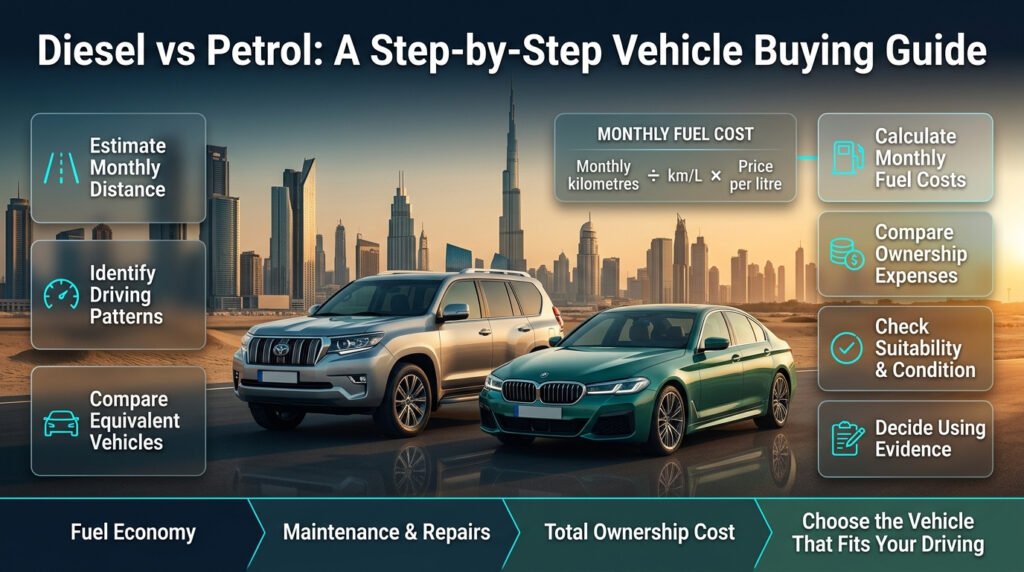
The most effective way to select a fuel type is to match the vehicle to your routine and budget.
Step 1: Estimate your monthly distance
Work out how many kilometres you normally travel in a month. Include commuting, errands, family trips and regular journeys between emirates.
Higher annual mileage generally makes small differences in fuel economy more financially important.
Step 2: Identify your driving pattern
Determine whether most journeys involve short city trips, mixed driving or longer highway travel.
This matters because a vehicle’s real-world economy and maintenance needs can differ substantially between these patterns.
Step 3: Compare equivalent vehicles
Choose petrol and diesel models of similar size, capability and age. Compare their real-world consumption rather than relying exclusively on the best advertised figure.
If urban driving dominates, include a suitable petrol hybrid in your comparison.
Step 4: Calculate fuel costs
Use the formula:
Monthly fuel cost = Monthly kilometres ÷ km/L × Price per litre
Repeat the calculation for each vehicle using realistic figures and the correct fuel grade.
Step 5: Include ownership expenses
Compare purchase price, routine servicing, expected repairs, insurance and resale value.
If one vehicle costs more initially, calculate how long its expected fuel savings would take to recover that difference.
Step 6: Check suitability and condition
Read the manufacturer’s guidance for the intended driving pattern. If buying used, review the maintenance history and arrange an inspection.
For diesel vehicles, make sure you understand any emissions-system requirements.
Step 7: Make the decision using evidence
Choose the vehicle that meets your transport needs and provides the best balance of fuel consumption, reliability, maintenance and total cost.
Do not choose diesel merely because it usually delivers higher km/L, and do not choose petrol simply because it may cost less to purchase.
15. Which Drivers Should Prefer Petrol, and Which Should Consider Diesel?
The most suitable option depends on how the vehicle will be used.
Petrol may be the better fit when:
- You mainly make short journeys.
- Your annual mileage is relatively low.
- You need a practical everyday passenger car.
- You prefer a quieter engine.
- The petrol model has a substantially lower total ownership cost.
- You are considering a petrol hybrid for regular city driving.
Diesel may be worth considering when:
- You cover high annual mileage.
- A significant proportion of your driving involves longer journeys.
- You need a suitable vehicle for regular loads or commercial work.
- The model provides a meaningful real-world fuel-economy advantage.
- You can follow the manufacturer’s maintenance and emissions-system requirements.
- Fuel savings are sufficient to offset any purchase or maintenance premium.
What if your driving is mixed?
Many Dubai drivers combine congested commuting with highway journeys. In this case, compare the actual petrol and diesel models available to you rather than relying on a general rule.
A well-designed petrol vehicle may perform efficiently in mixed driving. A diesel model may still be suitable if it is compatible with your journey pattern. A hybrid could also provide strong results where traffic is frequent.
The right choice is the one that suits the complete pattern of use.
16. How Fuel Availability Fits into Everyday Dubai Driving
Fuel efficiency is primarily determined by vehicle design, driving conditions and maintenance, but fuel planning is also part of reliable everyday motoring.
Drivers should monitor their fuel level, understand their vehicle’s normal consumption and avoid relying on the warning light as their regular refuelling reminder. Actual remaining range can vary with traffic, speed, load, air-conditioning demand and vehicle condition.
For drivers who want information about fuel services and fuel-related assistance in Dubai, the Fuel Delivery Dubai homepage is relevant to everyday fuel needs.
Regardless of whether you drive petrol or diesel, plan refuelling around your journey, particularly before long trips or travel through unfamiliar areas. Always confirm the correct fuel type for your vehicle before refuelling.
Is Diesel More Fuel-Efficient Than Petrol for Driving in Dubai?
Diesel engines generally deliver better fuel economy than comparable conventional petrol engines because they typically convert a greater proportion of fuel energy into useful work. This advantage is often noticeable during long-distance driving, regular highway commutes and journeys where the engine operates at a relatively steady speed. However, actual fuel efficiency depends on the vehicle’s weight, engine design, transmission, maintenance condition and driving habits.
In Dubai, traffic congestion, frequent stops and continuous air-conditioning use can affect both petrol and diesel consumption. A diesel vehicle may still achieve better mileage, but drivers who mainly make short journeys should consider whether the vehicle’s emissions system is suitable for their routine. A modern petrol hybrid may also provide excellent efficiency in urban traffic.
Key points to consider:
Compare vehicles of similar size, age and performance.
Check real-world fuel consumption rather than relying only on advertised mileage.
Consider journey length and traffic conditions before choosing diesel.
Which Is Cheaper to Run in Dubai: A Petrol or Diesel Car?
The cheaper option depends on the amount of fuel consumed per kilometre, the price per litre and the vehicle’s overall ownership expenses. Diesel cars often use fewer litres over the same distance, but diesel fuel may cost more per litre than the petrol grade required by a particular vehicle. Purchase price, insurance, maintenance and depreciation can also change the financial outcome.
For example, if a petrol car averages 12 km/L and a diesel car averages 16 km/L, the diesel vehicle requires fewer litres to cover 100 km. However, the actual saving must be calculated using the current UAE fuel prices. Drivers should also consider how many kilometres they travel each month because a small efficiency advantage becomes more valuable as annual mileage increases.
Key points to consider:
Calculate fuel cost per 100 km for both vehicles.
Estimate monthly and annual driving distances.
Compare purchase price and expected servicing costs.
Consider potential emissions-system repairs on applicable diesel models.
Calculate the total ownership cost over three to five years.
Is Petrol or Diesel Better for Dubai’s Stop-and-Go Traffic?
For drivers who regularly make short journeys through busy urban areas, a suitable petrol car is often a practical choice. Petrol engines are widely available in everyday passenger vehicles, and many models offer smooth operation and reasonable running costs. Petrol hybrids can be particularly efficient in suitable stop-and-go conditions because they can use electric assistance and recover energy during braking.
Diesel vehicles can also perform well in city traffic, but some modern diesel engines require appropriate exhaust temperatures and driving conditions to regenerate their diesel particulate filters. Frequent short journeys may interrupt this process and eventually contribute to warning lights or maintenance problems. This does not make every diesel car unsuitable for city driving; the vehicle’s specific requirements and the driver’s routine matter.
Key points to consider:
Petrol can be suitable for short commutes, shopping trips and frequent stops.
Petrol hybrids are worth comparing if most driving occurs in congestion.
Check the manufacturer’s guidance before using a diesel vehicle mainly for short journeys.
Avoid unnecessary idling and repeated hard acceleration.
Compare actual urban fuel economy instead of highway mileage figures alone.
Does Dubai’s Hot Weather Affect Petrol and Diesel Fuel Efficiency?
Dubai’s high summer temperatures can influence fuel consumption in both petrol and diesel vehicles. Air-conditioning increases the vehicle’s energy demand, while congestion and prolonged idling can add to fuel use. Cooling-system condition, tyre pressure, engine maintenance and driving habits also affect efficiency. The extent of the impact varies by vehicle, so it is not accurate to assume that one fuel type automatically performs better in extreme heat.
Proper maintenance is particularly important during hot weather. A restricted air filter, incorrect tyre pressure, cooling-system fault or malfunctioning sensor can reduce efficiency regardless of whether the vehicle uses petrol or diesel. Drivers should follow the manufacturer’s service schedule and investigate persistent changes in fuel consumption rather than replacing components without diagnosis.
Key points to consider:
Maintain tyre pressure according to the manufacturer’s recommendations.
Check coolant levels only when the engine is cold.
Keep the air-conditioning system properly maintained.
Follow the correct engine oil and filter service intervals.
Investigate unexplained fuel consumption increases promptly.
Which Is Better for High-Mileage Drivers in Dubai: Petrol or Diesel?
Diesel is often worth considering for drivers who cover long distances regularly because its fuel-economy advantage can produce greater savings as annual mileage increases. It may be particularly suitable for regular highway commuters, business drivers and commercial applications where the vehicle is designed for sustained use or heavier loads. However, higher mileage alone does not guarantee that diesel will be the cheapest option.
The decision depends on the difference in fuel consumption, current fuel prices, purchase cost and maintenance requirements. A diesel vehicle that saves money on fuel may still be more expensive overall if its initial price or repair costs are substantially higher. An efficient petrol vehicle or petrol hybrid may also be competitive, depending on the route and vehicle specifications.
Key points to consider:
Estimate your annual distance before comparing vehicles.
Calculate expected fuel expenses using realistic consumption figures.
Compare purchase price, servicing, repairs and resale value.
Check whether the diesel model suits your daily journey pattern.
Choose the vehicle with the best overall ownership value, not simply the highest km/L figure.
Conclusion: Diesel vs Petrol Efficiency for Dubai Driving
Choosing between a petrol and diesel vehicle for driving in Dubai depends on more than fuel economy alone. Both engine types can deliver reliable performance, but their overall efficiency varies according to driving conditions, annual mileage, vehicle size, maintenance requirements, and ownership costs. Understanding these factors helps drivers make a practical decision based on their everyday needs rather than relying on general assumptions about petrol or diesel.
Diesel engines often provide better fuel economy over long distances because they typically use less fuel per kilometre and deliver strong low-speed torque. This can make them attractive to drivers who regularly travel on Sheikh Zayed Road, commute between Dubai and other emirates, or operate vehicles for business purposes. Petrol engines, however, can be a practical choice for drivers who mainly travel short distances, navigate busy urban streets, and prioritise smooth performance and potentially lower purchase and maintenance costs.
Dubai’s driving environment also plays an important role in real-world efficiency. Traffic congestion, frequent stops, extended idling, air-conditioning use, driving speed, tyre pressure, and vehicle maintenance can all influence fuel consumption. A well-maintained petrol vehicle may be more economical to own than a diesel vehicle in certain circumstances, while a diesel vehicle may deliver greater long-term savings for drivers who cover substantial distances. The actual result depends on the specific vehicles being compared and their real-world fuel consumption.
Before making a decision, compare the fuel economy of similar vehicles, current fuel prices, annual driving distance, servicing expenses, insurance, and expected resale value. Calculate the estimated annual fuel cost rather than judging efficiency by kilometres per litre alone. Reviewing the differences between petrol and diesel fuel economy in Dubai and understanding the petrol versus diesel engine technology can also help you evaluate the advantages and limitations of each option.
Ultimately, diesel may be the better choice for frequent long-distance driving and high annual mileage, while petrol may suit many everyday urban drivers in Dubai. Neither option is automatically more economical for every driver. The smartest choice is the vehicle that matches your driving habits, fits your budget, and delivers dependable performance with reasonable running costs.
For drivers who need dependable fuel assistance on Dubai’s roads, Fuel Delivery Dubai offers a convenient way to explore mobile fuel delivery support when a vehicle runs low on fuel. By combining sensible vehicle selection, efficient driving habits, and regular maintenance, you can manage fuel expenses more effectively and make informed decisions about your vehicle’s long-term running costs.
Leave a Reply