
Introduction
Petrol vs Diesel Torque Comparison in Dubai | Choosing between a petrol and diesel car in Dubai can be confusing, especially when two vehicles look similar on paper but feel completely different when you drive them. One may accelerate smoothly from a traffic light, while the other may feel stronger when carrying passengers, climbing a parking ramp, or joining a busy highway.
The difference often comes down to engine torque, horsepower, transmission gearing, and vehicle weight. Understanding these factors makes it easier to decide which engine suits your driving needs.
A petrol vs diesel torque comparison in Dubai helps drivers understand why diesel engines often deliver strong pulling power at lower engine speeds, while petrol engines can provide smooth acceleration and responsive performance across a wide range of driving conditions. However, modern turbocharged petrol engines have changed the traditional comparison, and diesel engines are not automatically better in every situation.
Dubai’s driving environment also matters. Daily commuting, stop-and-go traffic, long-distance highway journeys, air-conditioning use, and hot weather all influence how an engine performs and how much it costs to maintain.
In this guide, we’ll explain how torque works, compare petrol and diesel engines, examine their performance in Dubai’s driving conditions, and identify the factors that matter most when purchasing or maintaining a vehicle.
For additional guidance on choosing the right fuel type and understanding vehicle performance, visit Fuel Delivery Dubai.
1. What Is Engine Torque, and Why Is It Important?
Engine torque is the rotational force produced by an engine’s crankshaft. It is generally measured in newton-metres (Nm). In simple terms, torque helps an engine turn the drivetrain and move the vehicle against resistance.
When you accelerate from a standstill, carry passengers, climb an incline, or pull a trailer, torque contributes to the force available to move the vehicle. However, the torque produced by the engine is not identical to the force delivered to the road because the transmission and final-drive gearing multiply torque while mechanical losses reduce the amount reaching the wheels.
How does torque affect everyday driving?
Imagine driving a family SUV through busy Dubai traffic. You stop at a junction, wait for the signal, and then move forward when the traffic starts moving.
An engine that delivers useful torque at low RPM may move the vehicle confidently without requiring high engine speeds. Another engine might need a downshift or more acceleration to produce the same response.
This difference can affect how relaxed a vehicle feels during everyday driving.
Torque is particularly relevant when:
- Moving a heavy vehicle away from a standstill.
- Accelerating with passengers and luggage.
- Climbing parking ramps or other inclines.
- Maintaining speed when the vehicle is carrying a load.
- Accelerating from a lower speed without repeated gear changes.
- Towing a load within the manufacturer’s approved limits.
However, torque is only one part of vehicle performance. Horsepower, transmission calibration, traction, vehicle weight, and the engine’s operating range also influence acceleration.
What is the difference between torque and horsepower?
Torque measures rotational force, whereas horsepower measures how quickly the engine performs work.
A vehicle with strong torque may feel powerful at low speeds, but a vehicle with more horsepower may accelerate faster as speed increases. The outcome depends on how effectively the engine delivers its torque across the operating range.
This is why a diesel SUV can feel stronger when moving away from a junction while a petrol performance car can accelerate more quickly at higher speeds.
Expert tip: Never compare two vehicles using torque figures alone. Check horsepower, vehicle weight, transmission type, and published acceleration figures to understand their complete performance.
2. Why Do Diesel Engines Often Produce More Torque Than Petrol Engines?
Diesel engines frequently produce higher torque than similarly sized naturally aspirated petrol engines. Their combustion characteristics, operating speeds, engine construction, and turbocharging systems contribute to this difference.
Nevertheless, engine design matters more than fuel type alone. A large turbocharged petrol engine can produce more torque than a smaller diesel engine.
Higher compression and combustion characteristics
Diesel engines typically operate with higher compression ratios than petrol engines. They compress air to a high temperature and inject fuel into the compressed air, where combustion occurs under suitable operating conditions.
The engine’s construction and combustion system are designed to handle the resulting cylinder pressures. Combined with suitable displacement, airflow, and fuel delivery, this design can support substantial torque production.
However, higher compression does not automatically guarantee higher torque. Bore and stroke dimensions, turbocharger performance, engine speed, combustion efficiency, and electronic calibration all contribute to the final output.
Strong pulling power at lower RPM
Many turbo-diesel engines produce substantial torque at relatively low engine speeds. This characteristic is useful when driving a heavy SUV or pickup that needs to move away from a standstill or accelerate while carrying passengers and equipment.
For example, consider a diesel SUV that produces its strongest torque within a relatively low RPM range. When the transmission selects an appropriate gear, the vehicle may accelerate confidently without the engine needing to rev aggressively.
A comparable naturally aspirated petrol engine may need higher RPM to produce its strongest pulling response.
This is a general comparison rather than a universal rule. Modern turbocharged petrol engines can also deliver strong torque at low RPM.
Why turbocharging changes the comparison
A turbocharger forces more air into the engine, allowing it to burn more fuel efficiently under suitable conditions and produce greater power and torque than an otherwise comparable naturally aspirated design.
Both petrol and diesel engines use turbocharging.
A turbocharged petrol engine may therefore deliver strong low-speed acceleration while retaining the ability to produce substantial power at higher RPM. A turbo-diesel may provide excellent pulling power across its intended operating range, particularly in larger vehicles.
When comparing two cars, examine the complete torque curve rather than only the maximum torque figure. The range of engine speeds over which useful torque is available often matters more than a single peak number.
3. Petrol vs Diesel Torque Comparison in Dubai
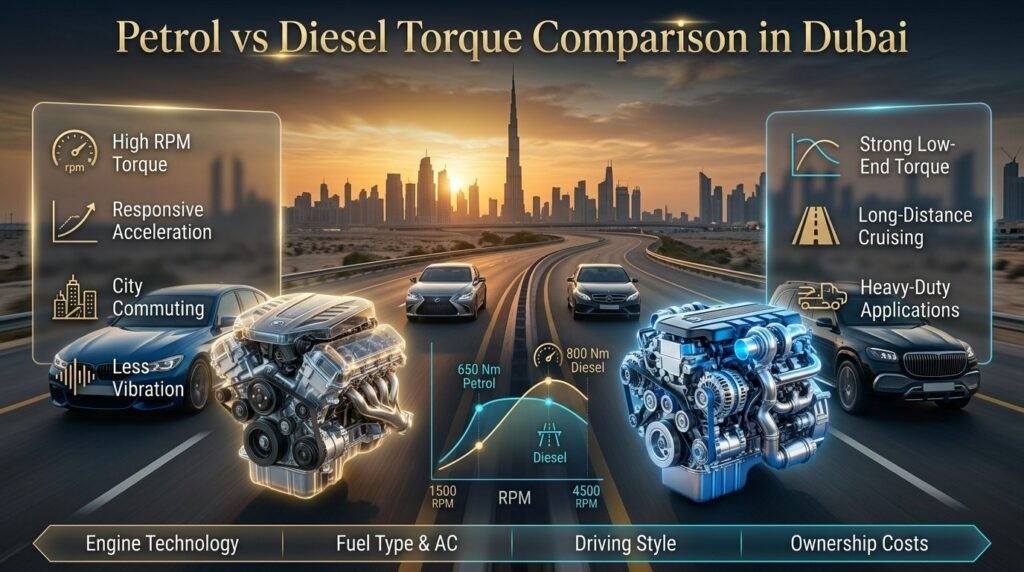
Petrol and diesel engines have different performance characteristics, but neither fuel type automatically wins every comparison. The most useful approach is to compare vehicles of similar size, weight, power output, and intended purpose.
The following table summarises their general characteristics.
| Performance factor | Petrol engine | Diesel engine |
|---|---|---|
| Low-RPM torque | Varies; often moderate in naturally aspirated engines | Often strong in turbocharged models |
| Maximum torque | Depends on displacement, design, and turbocharging | Frequently high in comparable mainstream engines |
| Low-speed response | Often smooth and progressive | Often strong under load, depending on turbo response |
| High-RPM operation | Many models operate effectively at higher RPM | Many models are designed around a lower operating range |
| Acceleration | Can be excellent, especially in turbocharged models | Often confident at low speeds, depending on gearing |
| Heavy-load performance | Depends on the engine and vehicle rating | Often suitable for heavy SUVs and pickups |
| Engine noise | Often quieter and smoother | Can produce more noticeable combustion noise |
| Maintenance | Ignition, cooling, oil, and fuel systems require attention | Fuel injection, turbocharging, emissions equipment, and oil require attention |
| Best application | Everyday driving, varied use, and performance-focused vehicles | Frequent load carrying and towing when the vehicle is properly rated |
These are general tendencies. A turbocharged petrol engine may outperform a diesel in torque, acceleration, or power, depending on the models being compared.
Which engine provides stronger pulling power?
For many comparable SUVs and pickups, a turbo-diesel provides a strong combination of low-speed torque and relaxed load-carrying performance.
This can be useful when travelling with a full cabin, carrying luggage, or operating a work vehicle. However, a well-designed petrol engine can also provide sufficient pulling power for these situations.
The important question is whether the engine produces enough torque at the speeds you actually use.
A vehicle with a lower maximum torque figure may still feel more responsive because it weighs less or has a transmission that keeps the engine in an effective operating range.
Why engine size matters
Engine displacement is the total volume swept by the pistons during their movement. It is commonly expressed in litres.
Larger engines often have the potential to produce more torque, but displacement alone does not determine performance. Turbocharging, engine design, and electronic controls can allow a smaller engine to produce substantial torque.
For example, a small turbocharged petrol engine may outperform a larger naturally aspirated petrol engine in low-speed torque. A modern diesel may also use turbocharging to generate strong pulling power from a relatively compact displacement.
When buying a car, compare the exact engine variant rather than assuming that a larger engine or a diesel badge guarantees better performance.
4. How Does Torque Affect Driving in Dubai?
Dubai presents several different driving conditions. Drivers may spend one journey in slow urban traffic and another travelling at highway speeds. The best engine for one situation may not be the best choice for another.
Driving in stop-and-go traffic
During congested periods, vehicles repeatedly move away from a standstill, accelerate briefly, and stop again.
Low-speed torque can help a heavy vehicle move without requiring excessive engine speed. Many diesel SUVs perform well in this situation because they deliver strong pulling force at relatively low RPM.
However, the transmission is equally important. A petrol vehicle with responsive throttle control and smooth automatic gear changes may feel more comfortable than a diesel vehicle with noticeable turbo lag or hesitant shifting.
When evaluating a car for daily commuting, consider:
- How smoothly it moves away from a stop.
- Whether acceleration feels predictable.
- How frequently the transmission changes gears.
- Whether the engine responds quickly to moderate throttle input.
- How comfortably the vehicle moves with passengers aboard.
A car that delivers power smoothly is often more pleasant in traffic than one that produces an impressive peak torque figure but responds abruptly.
Pro tip: Test-drive vehicles in normal driving mode. Sport mode may change throttle response and gear selection, making the engine feel more responsive than it would during everyday commuting.
Accelerating on Sheikh Zayed Road
Highway driving places different demands on an engine. Joining a moving traffic stream requires sufficient acceleration, while overtaking requires the vehicle to respond predictably when the driver requests additional power.
Diesel torque can make a vehicle feel strong during mid-range acceleration. A turbocharged petrol engine can provide similar performance, and some petrol vehicles offer stronger acceleration at higher speeds.
The transmission may downshift to increase engine RPM and access more power. This is normal behaviour and does not necessarily indicate that an engine lacks torque.
When choosing a vehicle for frequent highway travel, assess:
- Acceleration from moderate road speeds.
- The smoothness of downshifts.
- Engine noise during acceleration.
- Stability and comfort at cruising speeds.
- Fuel consumption during your usual journeys.
Do not evaluate highway performance solely by how quickly a vehicle moves away from a traffic light. Mid-range acceleration is often more relevant to highway driving.
Climbing parking ramps and inclines
Parking structures and steep access ramps can make low-speed control noticeable.
A vehicle with sufficient torque and suitable gearing should climb an ordinary ramp without requiring excessive throttle input. Diesel SUVs often perform confidently, but petrol vehicles can handle the same task comfortably when their powertrain is appropriately matched to the vehicle’s weight.
During a safe test drive, pay attention to whether the vehicle climbs smoothly or repeatedly changes gears in a way that feels uncomfortable.
Avoid aggressive acceleration tests on ramps or public roads. The goal is to evaluate predictable control rather than maximum performance.
Carrying passengers and luggage
A fully loaded vehicle requires more force to accelerate than the same vehicle travelling with only the driver.
This is particularly noticeable when climbing an incline, merging into traffic, or accelerating from a low speed.
A diesel SUV with strong low-RPM torque may feel relaxed when carrying a family and luggage. A petrol SUV with sufficient power and well-calibrated gearing may provide similarly comfortable performance.
Check the manufacturer’s payload limits and avoid exceeding the permitted load. High torque does not make an overloaded vehicle safe.
5. Does More Torque Mean Faster Acceleration?
No. Higher engine torque does not automatically mean a vehicle accelerates faster.
Acceleration depends on the torque available at the wheels, the gear ratio, the vehicle’s weight, tyre grip, horsepower, and the transmission’s ability to keep the engine in its effective operating range.
Understanding wheel torque
The engine produces torque at the crankshaft. The transmission and final drive then multiply this torque according to their gear ratios.
A lower gear generally multiplies engine torque more than a higher gear. This helps a vehicle move away from a standstill or accelerate strongly at lower speeds.
However, the same vehicle may change gears as it accelerates. Its performance therefore depends on how much usable power it can deliver throughout the speed range.
A practical comparison
Imagine two hypothetical SUVs:
- Vehicle A is a diesel SUV producing 450 Nm of maximum engine torque.
- Vehicle B is a turbocharged petrol SUV producing 350 Nm of maximum engine torque.
Vehicle A may feel stronger when moving away from a stop or carrying a heavy load. Vehicle B could still accelerate faster in some conditions if it weighs less, produces more horsepower, or has more effective gearing.
These figures are illustrative and do not represent a direct comparison between specific production vehicles.
How torque relates to horsepower
Engine power can be calculated from torque and engine speed:
Power (kW) = Torque (Nm) × RPM ÷ 9,550
This relationship explains why torque and horsepower must be considered together. An engine that maintains useful torque at higher RPM can produce substantial power.
For buyers, the practical lesson is to compare maximum torque, the torque delivery range, horsepower, transmission gearing, and vehicle weight rather than relying on a single number.
For a more detailed discussion of acceleration, power delivery, and other driving characteristics, read Petrol vs Diesel Engine Performance in Dubai.
6. Which Engine Is Better for SUVs, Sedans, and Pickups?
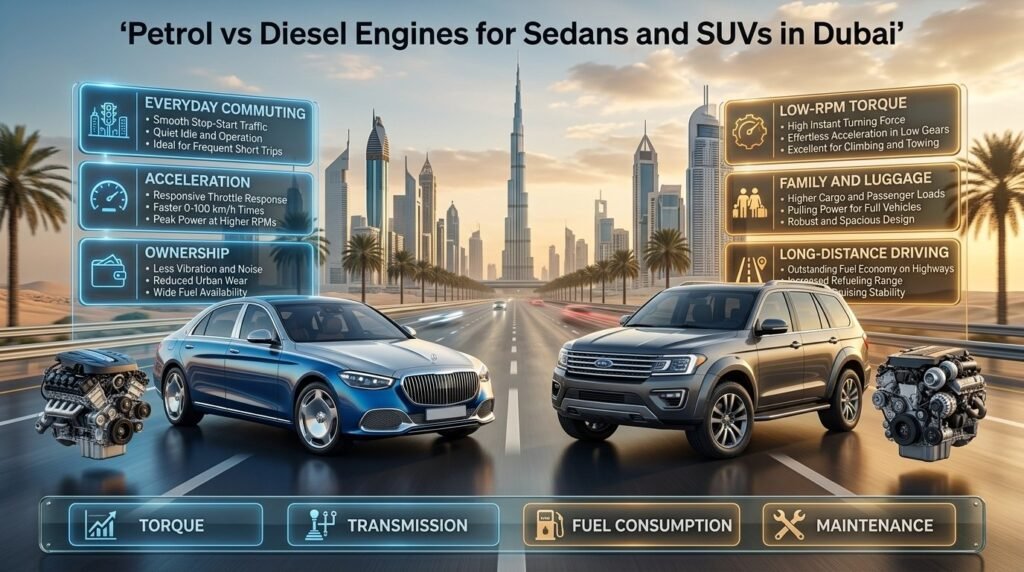
The right engine depends on the vehicle category, expected load, annual mileage, and driving style. A diesel engine may be attractive for regular heavy-load use, while a petrol engine may provide everything needed for normal commuting and family travel.
Petrol sedans for everyday commuting
Petrol sedans are often practical for urban driving, errands, and mixed city and highway use.
Their power delivery can be smooth, and many models offer sufficient torque for comfortable acceleration without needing a large engine.
When comparing petrol sedans, consider:
- Low-speed response in traffic.
- Acceleration when the cabin is occupied.
- Fuel consumption on your usual route.
- Transmission smoothness.
- Servicing requirements and parts availability.
- Comfort during longer journeys.
A naturally aspirated petrol engine may require higher RPM for strong acceleration, while a turbocharged petrol engine can provide greater low-speed torque.
For most sedan buyers, the objective should be a balanced powertrain rather than the highest possible torque.
Diesel SUVs for family and long-distance driving
Diesel SUVs often suit drivers who regularly carry passengers and luggage or cover substantial highway distances.
Their strong low-RPM torque can make a heavy vehicle feel relaxed when accelerating under load. However, engine weight, transmission calibration, and overall vehicle design still influence how the SUV behaves.
Petrol SUVs remain an excellent alternative for family commuting, occasional long trips, and drivers who prefer their particular balance of refinement, acceleration, and ownership costs.
Before buying, evaluate the exact engine variant, expected fuel consumption, service history, and total cost of ownership.
Pickups and commercial vehicles
Pickups and commercial vehicles frequently operate under heavier loads than passenger cars.
A suitable diesel engine can provide useful torque for moving cargo or towing, but buyers should also assess the vehicle’s rated payload, towing capacity, cooling system, transmission limits, and braking capability.
The engine’s torque figure does not establish how much weight the vehicle can legally or safely carry.
For commercial use, consider how frequently the vehicle will operate under load, how long it will run each day, and what maintenance support is available.
Sports cars and performance vehicles
Sports cars require a different comparison because high-speed acceleration, handling, weight distribution, and power delivery may be more important than low-speed pulling force.
Many petrol performance engines deliver strong power at higher RPM. Turbocharged petrol engines can also produce substantial torque at low and medium engine speeds.
The best choice depends on the driving experience you want, not simply whether the engine uses petrol or diesel.
7. How Does Dubai’s Hot Weather Affect Engine Torque?
Hot weather can influence engine performance, but it does not automatically make diesel engines more powerful than petrol engines.
High intake-air temperatures reduce air density. Depending on the engine and its control system, this can affect combustion, boost management, and available power. Modern vehicles may adjust engine operation to protect components when temperatures become excessive.
Both petrol and diesel engines require a properly maintained cooling system and adequate airflow.
Cooling system condition
A cooling system that cannot control engine temperature may cause reduced performance, warning messages, or serious mechanical damage.
Before a long journey, pay attention to:
- Coolant levels when the engine is completely cold.
- Visible coolant leaks.
- Unusual changes in the temperature gauge.
- Cooling fans that appear to be malfunctioning.
- Repeated overheating or unexplained coolant loss.
Never remove a radiator or pressurised coolant cap while the engine is hot.
If the engine repeatedly overheats, arrange a professional diagnosis instead of repeatedly adding coolant without identifying the cause.
Air filters and turbocharger performance
A severely restricted air filter can affect airflow. Turbocharger faults, boost leaks, sensor problems, and fuel-delivery issues can also reduce engine performance.
A diesel engine may lose its characteristic pulling power if it cannot produce the expected boost or deliver fuel correctly. Turbocharged petrol engines can experience similar problems.
Pay attention to sudden changes in acceleration, unusual smoke, warning lights, or new engine noises. These symptoms require diagnosis rather than an assumption that the vehicle is simply affected by hot weather.
For additional preventive maintenance advice, see the Engine Maintenance Guide.
8. Does Higher Torque Mean Better Fuel Economy?
No. Torque and fuel economy describe different aspects of a vehicle’s operation.
Torque measures rotational force, while fuel economy indicates how efficiently a vehicle uses fuel to travel a distance. Diesel engines often combine strong torque with good fuel efficiency, especially in larger vehicles and during sustained highway journeys.
However, actual consumption depends on engine design, vehicle weight, gearing, traffic, driving habits, air-conditioning use, and maintenance.
Why diesel engines can be efficient
Diesel engines generally operate with a high compression ratio and have combustion characteristics that can support good thermal efficiency.
In many applications, these characteristics help diesel vehicles travel farther per litre than comparable petrol vehicles.
Nevertheless, not every diesel car consumes less fuel than every petrol car. A small petrol vehicle may use less fuel than a heavy diesel SUV because the vehicles serve different purposes and have different power requirements.
Calculate your real running costs
To compare vehicles fairly, consider:
- Annual distance travelled.
- Real-world kilometres per litre.
- The price of the required fuel grade.
- Scheduled maintenance costs.
- Expected repairs and replacement parts.
- Purchase price and resale value.
Use the following calculation:
Annual fuel cost = Annual kilometres ÷ Kilometres per litre × Fuel price per litre
For example, a car travelling 20,000 kilometres annually at 10 km/L consumes approximately 2,000 litres of fuel each year.
A vehicle achieving 12 km/L over the same distance consumes approximately 1,667 litres. The difference is about 333 litres annually, before accounting for changes in driving conditions or fuel prices.
This comparison demonstrates why actual consumption figures are more useful than assuming that an engine with higher torque must be more economical.
For a dedicated breakdown of efficiency, consumption, and practical running costs, explore Petrol vs Diesel Fuel Economy in Dubai.
9. How to Compare Petrol and Diesel Torque Before Buying
Manufacturer specifications provide a useful starting point, but a realistic test drive helps you understand how the engine and transmission behave together.
Step 1: Compare the exact engine variants
Two versions of the same vehicle may have different torque outputs, horsepower, transmission types, and gear ratios.
Record the following details for each vehicle:
- Engine displacement.
- Naturally aspirated or turbocharged design.
- Maximum torque in Nm.
- RPM range where peak torque is available.
- Maximum horsepower or kilowatts.
- Transmission type.
- Kerb weight.
- Approved payload and towing capacity, where relevant.
Use official specifications for the exact model year and engine variant. Do not assume that every trim level has the same powertrain.
Step 2: Evaluate low-speed response
During a normal test drive, observe how the car moves away from a standstill.
Does it accelerate smoothly with moderate throttle input? Does it hesitate before moving? Does the transmission select gears predictably?
These observations are often more useful for everyday driving than a maximum torque figure taken from a specification sheet.
Step 3: Assess mid-range acceleration
Test how the vehicle responds when accelerating from a moderate speed in a safe and legal setting.
Notice whether the transmission downshifts smoothly and whether the engine provides predictable acceleration.
Avoid aggressive testing on public roads. The objective is to assess ordinary driving behaviour, not establish a maximum-speed result.
Step 4: Evaluate the complete ownership cost
A vehicle with impressive torque may still be an expensive choice if it has higher purchase, servicing, insurance, or repair costs.
For a used vehicle, inspect the service history and have any unexplained performance issues investigated before buying.
Step 5: Match the engine to your driving pattern
If you mostly commute and occasionally take longer trips, a petrol engine may provide sufficient performance without the need for additional pulling power.
If you regularly carry heavy loads or tow within approved limits, a suitable diesel engine may offer practical advantages.
Make the decision based on your actual routine rather than occasional situations that rarely occur.
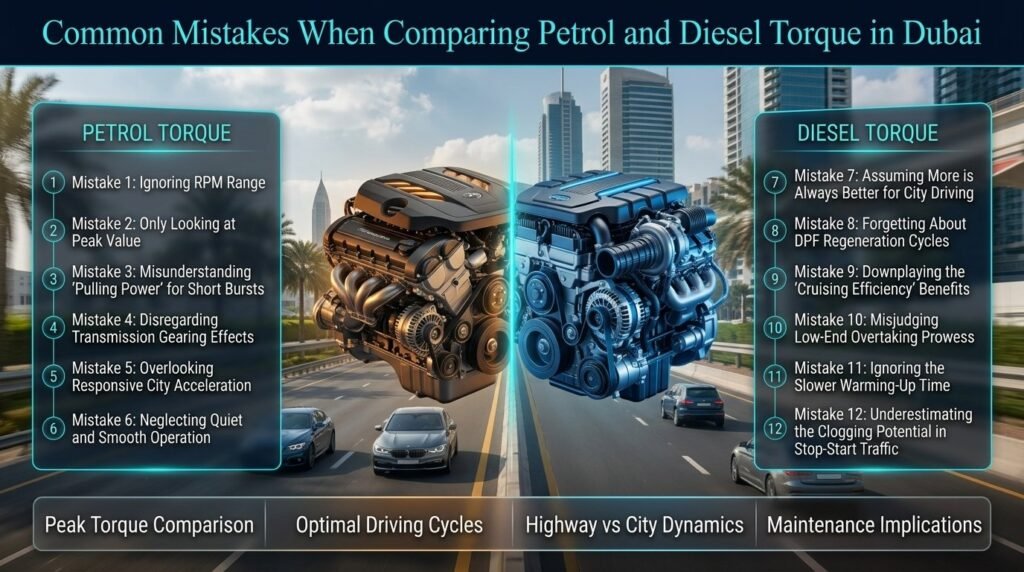
10. Common Mistakes When Comparing Petrol and Diesel Torque
Mistake 1: Assuming the highest torque always wins
A higher torque figure does not guarantee faster acceleration or a better driving experience.
Why it happens: Buyers often compare the largest number on two specification sheets without considering vehicle weight or gearing.
How to avoid it: Compare horsepower, torque delivery, transmission behaviour, and acceleration figures together.
Mistake 2: Ignoring the torque delivery range
An engine’s peak torque may be available only within a specific RPM range. If the engine spends much of its time outside that range, the maximum figure may not reflect its everyday response.
How to avoid it: Check the published RPM range and assess how the transmission keeps the engine operating effectively.
Mistake 3: Believing every diesel is stronger than every petrol
Engine design and displacement can create substantial differences within each fuel category.
How to avoid it: Compare the exact engines rather than generalising from the fuel type.
Mistake 4: Choosing diesel based only on fuel economy
Lower fuel consumption per kilometre does not automatically mean lower overall ownership costs.
How to avoid it: Include fuel, servicing, repairs, purchase price, and expected annual mileage in your calculation.
Mistake 5: Overlooking transmission problems
A hesitant gearbox or delayed throttle response can make an engine feel weak even when its specifications are competitive.
How to avoid it: Evaluate the transmission during a test drive and have persistent hesitation or unusual shifting professionally inspected.
Mistake 6: Ignoring maintenance history
A vehicle that has lost pulling power may have a mechanical fault rather than an inherently weak engine.
Petrol engines can experience ignition problems, while diesel engines can suffer from injector, boost, airflow, or emissions-system issues.
How to avoid it: Review service records and investigate unexplained changes in performance before purchasing a used vehicle.
Mistake 7: Assuming torque alone determines towing ability
An engine may produce substantial torque without the vehicle being approved for a particular towing load.
How to avoid it: Verify the manufacturer’s towing rating, payload, transmission limitations, cooling requirements, and braking specifications.
11. Expert Advice for Better Engine Performance in Dubai
The best approach to maintaining engine performance is to follow the manufacturer’s service schedule and investigate changes in vehicle behaviour early.
Replacing components unnecessarily is rarely as effective as identifying the underlying problem.
Follow a practical maintenance routine
Use the manufacturer’s recommended service intervals, taking account of any specified severe-use conditions.
Check fluid levels according to the owner’s manual, inspect for visible leaks, and pay attention to changes in engine sound, starting, idle quality, temperature, and acceleration.
For turbocharged vehicles, correct oil specification and timely servicing are particularly important. Never assume that a more expensive oil or an unapproved additive will automatically improve torque.
Diagnose a loss of pulling power correctly
If the vehicle becomes noticeably weaker, record the circumstances in which the problem occurs.
For example:
- Does acceleration feel weak only at low RPM?
- Does the vehicle hesitate during highway acceleration?
- Does the problem appear after the engine becomes hot?
- Are there warning lights or unusual noises?
- Has fuel consumption increased at the same time?
These details help a technician determine which systems need inspection.
Petrol engines may require checks of ignition components, fuel delivery, sensors, and airflow. Diesel engines may require checks of injectors, boost pressure, fuel delivery, and emissions equipment.
Both engine types may experience cooling-system, transmission, or sensor faults that affect performance.
Avoid unnecessary repairs
Do not replace a turbocharger, fuel pump, injector, or other expensive component based solely on a general symptom.
A proper diagnosis may involve fault-code checks, live data, pressure testing, electrical testing, and mechanical inspection, depending on the problem.
The aim is to identify the cause, verify the repair, and confirm that normal performance has returned.
Consider the whole vehicle
Engine torque is only one part of safe and efficient driving. Tyres, brakes, suspension, cooling, transmission, and the vehicle’s overall condition also influence how well it performs.
A vehicle that accelerates strongly but has worn tyres or poorly maintained brakes is not in good overall condition.
For everyday driving in Dubai, prioritise a balanced vehicle that offers suitable performance, predictable handling, effective cooling, and manageable running costs.
Is petrol or diesel better for torque and pulling power in Dubai?
Diesel engines generally offer stronger low-RPM torque than similarly sized naturally aspirated petrol engines, making them suitable for heavier SUVs, pickups, and vehicles that regularly carry passengers or cargo. This pulling power can help a vehicle accelerate confidently from low speeds without requiring the engine to rev excessively. However, modern turbocharged petrol engines can also deliver substantial torque, so the better option depends on the exact engine and vehicle.
In Dubai, where drivers encounter urban congestion, highway journeys, and hot-weather driving, it’s important to consider how the engine performs under your usual conditions rather than choosing based on fuel type alone.
Key points to consider:
For heavy loads: A suitable diesel engine can provide strong low-speed pulling power.
For daily commuting: A petrol engine may offer smooth, responsive performance.
For highway driving: Compare mid-range acceleration, horsepower, and transmission response.
For the final decision: Evaluate torque, vehicle weight, fuel economy, and maintenance costs together.
Why do diesel engines usually produce more torque than petrol engines?
Diesel engines commonly produce strong torque because of their combustion characteristics, engine design, and turbocharging systems. Many diesel engines generate substantial pulling force at relatively low revolutions per minute (RPM), which helps them move heavier vehicles without requiring high engine speeds. Their performance is particularly useful when carrying loads or accelerating from a slower speed.
However, diesel engines don’t always produce more torque than petrol engines. A large or turbocharged petrol engine can outperform a smaller diesel engine, depending on displacement, boost pressure, and engine calibration.
Important factors affecting engine torque:
Engine displacement: Larger displacement can increase torque potential, but it doesn’t guarantee higher output.
Turbocharging: Both petrol and diesel turbochargers can substantially increase torque.
RPM range: The engine speed at which torque becomes available influences everyday responsiveness.
Transmission gearing: Appropriate gear ratios help convert engine torque into usable wheel torque.
Does higher torque mean a car accelerates faster or consumes less fuel?
Higher torque does not automatically mean faster acceleration or better fuel economy. Torque measures rotational force, while horsepower measures how quickly work is performed. A vehicle’s acceleration also depends on its weight, gearing, traction, and transmission response.
Similarly, fuel economy depends on engine efficiency, driving conditions, vehicle design, traffic, and driving habits. Although many diesel vehicles combine strong torque with good fuel efficiency, a high-torque diesel SUV may consume more fuel than a smaller petrol car because it is heavier and requires more energy to move.
Before comparing vehicles, check:
Acceleration: Review published 0–100 km/h times and mid-range performance.
Fuel consumption: Compare realistic kilometres per litre for your driving routine.
Vehicle weight: A lighter car may accelerate efficiently with less torque.
Ownership costs: Include fuel, servicing, repairs, and purchase price.
Which engine is better for Dubai traffic, highways, and long-distance driving?
The best engine depends on where and how frequently you drive. Diesel engines can provide relaxed low-speed pulling power, which is useful for heavy SUVs and vehicles carrying passengers or luggage. Petrol engines can offer smooth acceleration and comfortable everyday performance, particularly in sedans and family SUVs designed primarily for commuting.
For highway journeys, both engine types can perform well. Diesel may appeal to drivers who regularly cover long distances and benefit from its fuel efficiency, while a suitable petrol engine can provide excellent cruising comfort and acceleration. Dubai’s hot climate also makes cooling-system condition and routine maintenance important for both.
Choose according to your driving pattern:
City commuting: Prioritise smooth acceleration, transmission behaviour, and realistic fuel consumption.
Frequent highway journeys: Compare mid-range acceleration, cruising comfort, and running costs.
Family SUVs: Consider vehicle weight, passenger load, torque delivery, and maintenance history.
Commercial use: Check approved payload, towing capacity, and the manufacturer’s service requirements.
How can you maintain petrol or diesel engine torque in Dubai’s hot weather?
Maintaining normal engine performance requires following the manufacturer’s service schedule and investigating unusual changes in acceleration promptly. Dubai’s high temperatures place additional demands on the cooling system, while dust and demanding driving conditions can make air filtration and regular inspections especially important.
A loss of pulling power doesn’t necessarily mean the engine is too small or that the vehicle needs an expensive replacement part. Restricted airflow, ignition faults, fuel-delivery problems, turbocharger issues, and transmission faults can all affect performance. Correct diagnosis helps identify the actual cause.
Practical maintenance recommendations:
Check the cooling system: Investigate overheating, coolant leaks, or repeated coolant loss.
Maintain the air filter: Replace it according to the manufacturer’s recommendations and operating conditions.
Use the correct engine oil: Follow the specified grade and service interval.
Investigate performance changes: Seek professional diagnosis for hesitation, unusual smoke, warning lights, or reduced acceleration.
Avoid unnecessary replacements: Use appropriate diagnostic tests before replacing expensive components.
Professional recommendation: When comparing petrol and diesel engines in Dubai, choose the vehicle that delivers sufficient torque for your normal driving needs while providing acceptable fuel economy, reliable performance, and manageable maintenance costs. The highest torque figure isn’t necessarily the best choice for every driver.
Conclusion: Petrol vs Diesel Torque Comparison in Dubai
Choosing between petrol and diesel engines in Dubai depends on your driving habits, vehicle type, performance expectations, and long-term running costs. Diesel engines generally produce more torque at lower engine speeds, making them suitable for SUVs, pickups, towing, heavy loads, and long-distance highway driving. Petrol engines, on the other hand, often deliver smoother acceleration, quieter operation, and responsive performance for daily commuting and urban driving.
However, torque alone should not determine which engine is best. Transmission design, vehicle weight, engine tuning, turbocharging, fuel economy, maintenance requirements, and driving conditions all influence real-world performance. Dubai’s hot weather, frequent traffic, air-conditioning use, and long highway journeys also make regular maintenance essential for keeping either engine operating efficiently.
Before making a decision, compare the vehicle’s torque specifications with its actual performance, fuel consumption, and maintenance needs. For a broader understanding of the differences, explore our guide to petrol vs diesel comparisons, along with our detailed comparison of petrol vs diesel engine performance in Dubai.
Ultimately, the best engine is the one that matches your everyday driving requirements without creating unnecessary running costs. Whether you choose petrol for smooth urban performance or diesel for stronger low-speed pulling power, consistent servicing and responsible driving can help maintain engine efficiency and reliability. For convenient fuel-related assistance in the UAE, visit Fuel Delivery Dubai to learn more about the available service.
Leave a Reply