
Introduction
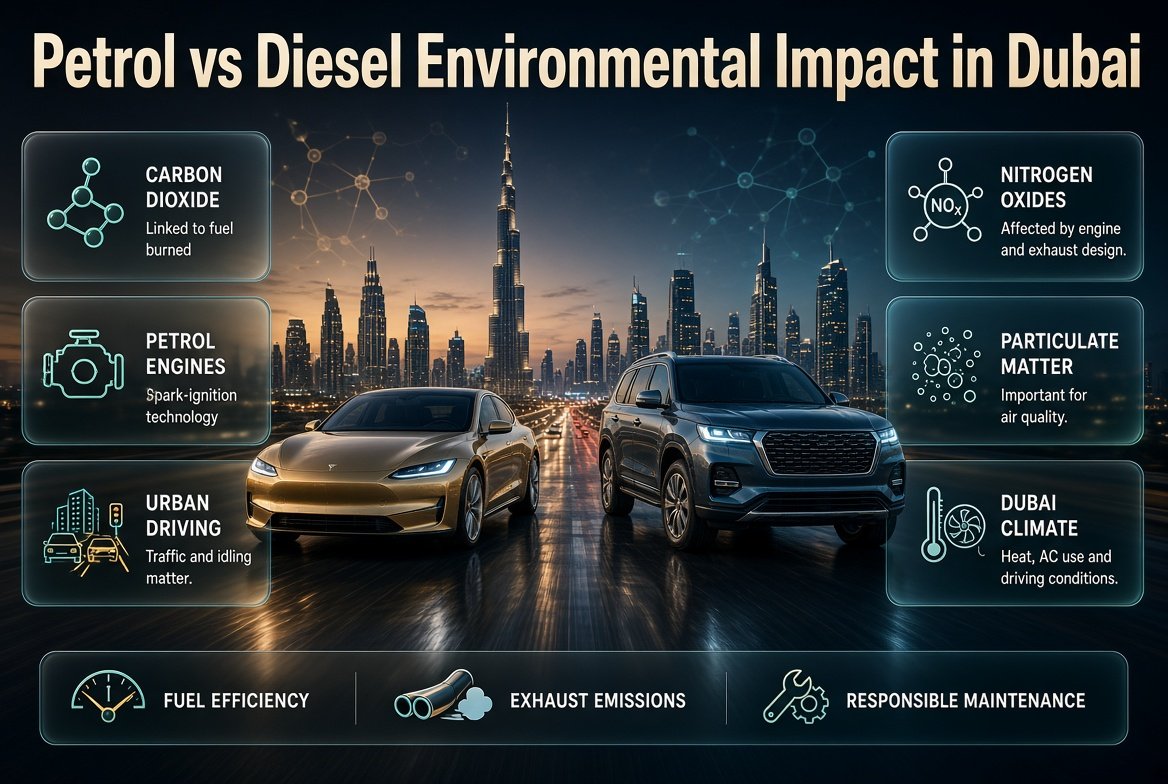
Petrol vs Diesel Environmental Impact in Dubai | Choosing between a petrol and diesel vehicle in Dubai involves more than fuel prices, mileage, and engine performance. A car that consumes less fuel may produce less carbon dioxide, but it may also release different levels of nitrogen oxides and particulate matter. Understanding these differences helps drivers make a better decision for their daily journeys, long-distance travel, and environmental responsibilities.
The petrol vs diesel environmental impact in Dubai is particularly relevant because local driving conditions include high temperatures, heavy traffic, frequent air-conditioning use, short urban journeys, and long highway trips. Each factor can influence fuel consumption and vehicle emissions.
If you need practical information about fuel-related services, Fuel Delivery Dubai provides a starting point for understanding the fuel needs of motorists in the city. However, choosing an environmentally responsible vehicle requires a separate assessment of fuel efficiency, exhaust emissions, engine technology, and maintenance.
In this guide, you’ll learn how petrol and diesel engines affect air quality, which produces more carbon dioxide, how Dubai’s climate influences emissions, and what to consider before buying or maintaining a vehicle. You’ll also discover practical ways to reduce unnecessary fuel consumption without compromising road safety or everyday convenience.
1. What Is the Environmental Impact of Petrol and Diesel Vehicles?
The environmental impact of a vehicle includes the greenhouse gases and air pollutants it releases, the fuel it consumes, and the resources required to manufacture, operate, and eventually dispose of it. Petrol and diesel vehicles both create environmental impacts, but the type and quantity of emissions can differ significantly.
For Dubai drivers, three areas deserve particular attention: climate change, local air quality, and the vehicle’s overall environmental footprint.
Carbon emissions and climate change
When petrol or diesel burns inside an engine, it releases carbon dioxide (CO₂). This greenhouse gas contributes to global warming by trapping heat in the atmosphere.
The amount of CO₂ a vehicle produces depends largely on how much fuel it consumes. Diesel engines generally achieve better fuel economy than comparable petrol engines, so they can release less tailpipe CO₂ over the same distance.
However, diesel releases more CO₂ per litre burned than petrol. The diesel vehicle’s efficiency advantage is what can make its emissions per kilometre lower.
Air pollution and human health
Vehicle exhaust can contain nitrogen oxides (NOx), particulate matter, carbon monoxide, and unburned hydrocarbons. These pollutants contribute to different environmental and health concerns.
Nitrogen oxides can contribute to ground-level ozone and secondary particulate pollution. Fine particles can penetrate deep into the respiratory system, while carbon monoxide interferes with the body’s ability to transport oxygen.
Diesel engines have historically been associated with higher NOx and soot emissions than comparable conventional petrol engines. Modern emissions-control technology has reduced many of these emissions, but the vehicle’s condition remains important.
The broader environmental footprint
A vehicle’s environmental impact does not begin when the driver starts the engine. It also includes fuel extraction, refining, transportation, manufacturing, maintenance, and end-of-life treatment.
An assessment that considers these stages is called a lifecycle assessment. It provides a broader comparison than tailpipe emissions alone.
For example, a fuel-efficient vehicle may have relatively low operating emissions, but its total environmental footprint also depends on how it was manufactured and how long it remains in service.
The main point: Petrol and diesel should not be judged by one environmental measurement. Fuel consumption, exhaust pollutants, vehicle technology, and lifecycle emissions all matter.
2. How Do Petrol and Diesel Engines Produce Different Emissions?
Petrol and diesel engines use different combustion processes. These differences influence fuel efficiency, engine performance, and the pollutants that can form during combustion.
How a petrol engine works
Most conventional petrol engines use spark ignition. The engine mixes petrol with air, compresses the mixture, and uses a spark plug to ignite it.
The resulting combustion pushes the piston and produces mechanical power. The engine’s fuel-injection system, ignition timing, air supply, and electronic controls all influence how efficiently fuel burns.
Petrol engines typically use a three-way catalytic converter to control carbon monoxide, hydrocarbons, and nitrogen oxides.
Modern direct-injection petrol engines can sometimes produce significant particulate emissions, particularly under certain operating conditions. Some models use gasoline particulate filters to control these emissions.
How a diesel engine works
A diesel engine uses compression ignition. It compresses air to a high temperature and injects diesel fuel into the hot air, causing the fuel to ignite without a spark plug.
Diesel engines generally operate at higher compression ratios and can extract more useful work from each litre of fuel. This is one reason they often achieve better fuel economy.
However, combustion conditions can encourage nitrogen oxide formation and the production of soot. Modern diesel vehicles therefore rely on carefully engineered exhaust-treatment systems.
These may include:
- Diesel oxidation catalysts to reduce certain exhaust pollutants.
- Diesel particulate filters (DPFs) to capture soot.
- Exhaust gas recirculation (EGR) to help control nitrogen oxide formation.
- Selective catalytic reduction (SCR) systems to reduce nitrogen oxides.
The equipment varies by model and emissions standard.
Why combustion technology matters in Dubai
A vehicle driven through congested urban streets experiences different conditions from one travelling steadily on a highway. Engine temperature, load, acceleration, and exhaust-treatment operation can all influence emissions.
A diesel engine’s theoretical fuel-efficiency advantage does not guarantee lower emissions for every pollutant under every driving condition. Likewise, a petrol engine’s potentially lower NOx emissions do not automatically make it the cleaner choice overall.
For a more detailed explanation of these mechanical differences, read Petrol Engine vs Diesel Engine Technology in Dubai.
3. Petrol vs Diesel Environmental Impact in Dubai: Complete Comparison
The following comparison describes general tendencies for conventional passenger vehicles. Actual emissions depend on the engine, model year, emissions standard, vehicle weight, driving conditions, and maintenance history.
| Environmental factor | Petrol vehicles | Diesel vehicles |
|---|---|---|
| Tailpipe CO₂ | Can be higher when fuel consumption is greater | Often lower per kilometre because of better fuel economy |
| CO₂ per litre | Generally lower than diesel | Generally higher than petrol |
| Nitrogen oxides | Often lower in conventional comparisons | Historically a greater concern |
| Soot and particulate matter | Usually low in port-injected engines; direct injection can produce particles | Historically higher without effective filtration |
| Fuel efficiency | Varies; many petrol engines use more fuel for comparable work | Often more efficient, particularly under sustained load |
| Carbon monoxide | Can be significant if combustion or emissions controls are faulty | Generally differs by engine and operating conditions |
| Hydrocarbons | Controlled mainly by catalytic systems and engine management | Controlled through combustion and exhaust-treatment systems |
| Short urban trips | Can suit frequent short journeys | Some models may struggle with repeated short trips and DPF regeneration |
| Long-distance driving | Can be efficient depending on the vehicle | Often suitable for sustained highway use |
| Maintenance requirements | Ignition, fuel, sensor, and catalytic systems need attention | May require additional attention to DPF, EGR, and SCR equipment |
| Overall environmental performance | Depends on efficiency and emissions controls | Depends on efficiency and emissions controls |
The table shows why the environmental comparison is more complicated than deciding which fuel is cleaner.
A modern diesel vehicle with functioning exhaust treatment may produce substantially fewer pollutants than an older diesel vehicle. A well-maintained petrol car may perform better in certain air-quality measurements than a diesel vehicle with faulty emissions equipment.
Which measurements should you compare?
When choosing between two vehicles, look at:
- Official fuel consumption in litres per 100 kilometres.
- Tailpipe CO₂ emissions in grams per kilometre.
- The applicable vehicle emissions standard.
- Available NOx and particulate emissions data.
- The vehicle’s age and maintenance history.
- Its suitability for your usual driving pattern.
These measurements help you compare actual vehicles rather than relying on broad assumptions about fuel types.
4. Does Petrol or Diesel Produce More Carbon Dioxide?
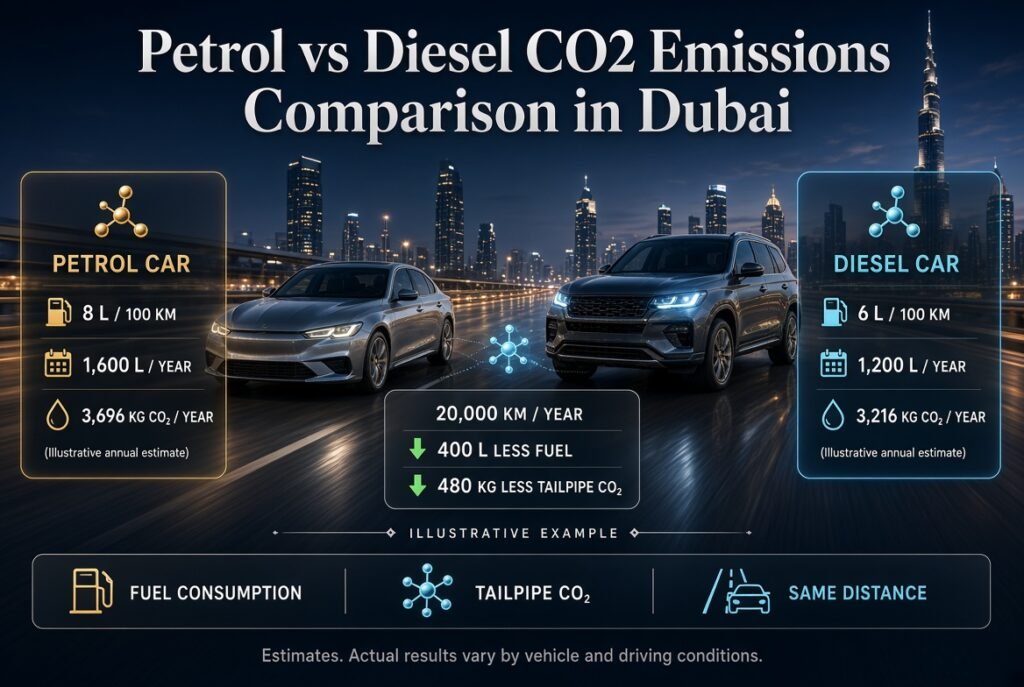
Diesel generally releases more CO₂ per litre of fuel burned, but diesel vehicles often use fewer litres per kilometre. As a result, an efficient diesel vehicle can produce less tailpipe CO₂ over the same distance than a comparable petrol vehicle.
This distinction matters because drivers sometimes assume that the fuel releasing more CO₂ per litre must always create more emissions during a journey. Fuel consumption changes the result.
A practical annual emissions example
Imagine two comparable vehicles travelling 20,000 kilometres per year.
The petrol car averages 8 litres per 100 km, while the diesel car averages 6 litres per 100 km. These are illustrative figures, not measured values for a particular model.
| Calculation | Petrol car | Diesel car |
|---|---|---|
| Annual distance | 20,000 km | 20,000 km |
| Fuel consumption | 8 L/100 km | 6 L/100 km |
| Annual fuel use | 1,600 litres | 1,200 litres |
| Approximate CO₂ factor | 2.31 kg/litre | 2.68 kg/litre |
| Estimated annual tailpipe CO₂ | 3,696 kg | 3,216 kg |
In this example, the diesel vehicle uses 400 fewer litres of fuel annually and produces approximately 480 kg less tailpipe CO₂.
The calculation uses approximate standard combustion factors. It excludes fuel production, refining, transport, vehicle manufacturing, and other lifecycle emissions. Real-world results will vary.
What does this mean for Dubai drivers?
If your main environmental priority is reducing greenhouse gas emissions, compare the amount of fuel each vehicle consumes over your expected annual mileage.
A larger diesel SUV may still use more fuel overall than a smaller petrol sedan. A petrol hybrid may also consume substantially less fuel than a conventional petrol car during suitable urban driving.
Expert Tip: Compare CO₂ emissions per kilometre for the exact vehicle versions you are considering. Engine size, transmission, vehicle weight, and driving conditions can change the result.
5. Why Are Diesel Nitrogen Oxides and Soot Important?
Carbon dioxide contributes to climate change, while nitrogen oxides and particulate matter create additional air-quality concerns. These pollutants should be evaluated separately because a vehicle that performs well in one category may not perform as well in another.
Nitrogen oxides and ground-level ozone
Nitrogen oxides form during high-temperature combustion. They include nitric oxide and nitrogen dioxide, which can contribute to air pollution.
Nitrogen dioxide can irritate the respiratory system. Nitrogen oxides also participate in atmospheric reactions that produce ground-level ozone and secondary particles.
Diesel engines have traditionally faced greater challenges controlling NOx emissions. Modern systems such as EGR and SCR reduce these emissions, but their performance depends on the vehicle’s design, operating conditions, and maintenance.
Petrol vehicles also produce NOx. Their actual emissions depend on combustion conditions and the effectiveness of the catalytic converter.
Particulate matter and soot
Particulate matter includes tiny solid particles and liquid droplets suspended in the air. Fine particles can penetrate deep into the lungs.
Diesel soot has historically been a major concern because diesel combustion can produce carbon-rich particles. A properly functioning DPF captures a large proportion of exhaust soot.
However, particulate emissions are not exclusive to diesel engines. Some petrol direct-injection engines can produce fine particles, particularly under certain operating conditions. Their emission-control systems may include gasoline particulate filters.
Why these pollutants matter in urban areas
Road traffic concentrates emissions near roads, junctions, parking areas, and busy commercial districts. Exposure depends on pollutant levels, weather, road design, and how emissions disperse.
Dubai’s air pollution also comes from sources such as windblown desert dust, construction, industrial activity, and road dust. Not every airborne particle can be attributed to a vehicle’s exhaust.
This distinction is important: reducing vehicle emissions is useful, but it is only one part of improving the city’s overall air quality.
6. How Does Dubai’s Hot Climate Affect Vehicle Emissions?
Dubai’s climate influences how vehicles are used and how much energy they need during everyday operation. High temperatures, air-conditioning demand, traffic congestion, and dusty conditions can all affect vehicle efficiency. Their impact varies by vehicle and journey.
Air-conditioning and fuel consumption
During summer, drivers often run air-conditioning for most of the journey. In conventional petrol and diesel vehicles, the air-conditioning compressor typically adds mechanical load to the engine.
This additional load can increase fuel consumption, particularly during slow traffic, idling, and short journeys where the vehicle repeatedly cools a hot cabin.
Consider a driver making several short trips between home, work, and a shopping centre. The engine may repeatedly operate under changing loads while the air-conditioning system works to maintain a comfortable cabin temperature.
The combined effect can make actual fuel economy worse than the vehicle’s advertised figure.
Practical advice: Use the air-conditioning system sensibly, park in shade where practical, and avoid unnecessary idling. Never compromise safe cabin cooling or road safety to save fuel.
Traffic congestion and repeated acceleration
Frequent acceleration and braking waste energy. When drivers accelerate sharply and then brake heavily at the next signal, some of the energy used to move the vehicle is lost.
This affects petrol and diesel vehicles, although the precise fuel penalty depends on the engine, transmission, vehicle weight, and traffic conditions.
Repeated short journeys may also prevent some diesel engines from completing DPF regeneration under suitable conditions. Soot can accumulate if regeneration repeatedly fails or is interrupted.
Dust and engine maintenance
Dubai’s dusty environment makes air-filter inspection and routine servicing important. A heavily restricted air filter, faulty sensor, or other engine problem can affect performance and fuel consumption.
However, it is important to distinguish airborne desert dust from exhaust particulate emissions. They are different sources of pollution, and maintaining an engine does not eliminate environmental dust.
Highway driving and longer journeys
Steady highway driving can allow an engine to operate more efficiently than repeated stop-start journeys. This may favour a diesel vehicle designed for long-distance use.
For example, a driver regularly travelling between Dubai and Abu Dhabi may benefit from a diesel vehicle’s fuel efficiency if the model suits the journey and its emissions systems are properly maintained.
A petrol vehicle can also achieve good highway economy. The result depends on engine design, vehicle weight, speed, gearing, and load.
7. Which Is Better for Dubai City Driving: Petrol or Diesel?
For many private drivers who mainly make short urban journeys, an efficient petrol vehicle or hybrid can be a practical option. Diesel may be more suitable for frequent long-distance travel or heavy-duty applications, where its fuel efficiency and torque can be beneficial.
Neither choice is automatically the cleanest. The vehicle’s specific emissions performance remains the most important factor.
When a petrol vehicle may be suitable
Petrol may be worth considering if you:
- Drive short distances around residential and commercial areas.
- Frequently encounter stop-start traffic.
- Cover relatively low annual mileage.
- Want to avoid some of the additional maintenance considerations associated with diesel particulate filters.
- Are comparing similarly sized vehicles with appropriate emissions controls.
Many petrol engines suit this pattern well, but repeated short journeys can still increase fuel consumption and emissions.
When a diesel vehicle may be suitable
Diesel may be appropriate if you:
- Travel long distances regularly.
- Carry heavy loads or tow within the vehicle’s approved limits.
- Cover high annual mileage.
- Need strong low-speed pulling power.
- Can follow the required maintenance schedule for the exhaust-treatment system.
A diesel engine’s efficiency advantage may be valuable when the vehicle spends much of its time operating under steady loads.
What about frequent school runs and shopping trips?
Short journeys can be demanding for both engine types. Petrol engines may not reach their most efficient operating conditions immediately, while some diesel emissions systems need suitable exhaust temperatures to regenerate the DPF.
If most of your journeys are short, compare efficient petrol models and hybrids as well as conventional diesel vehicles. The best choice depends on the actual model and how it performs in your driving pattern.
For a more detailed comparison of real-world fuel efficiency, read Fuel-Efficient Petrol vs Diesel Engines in Dubai.
8. How Does Driving Style Influence Petrol and Diesel Emissions?
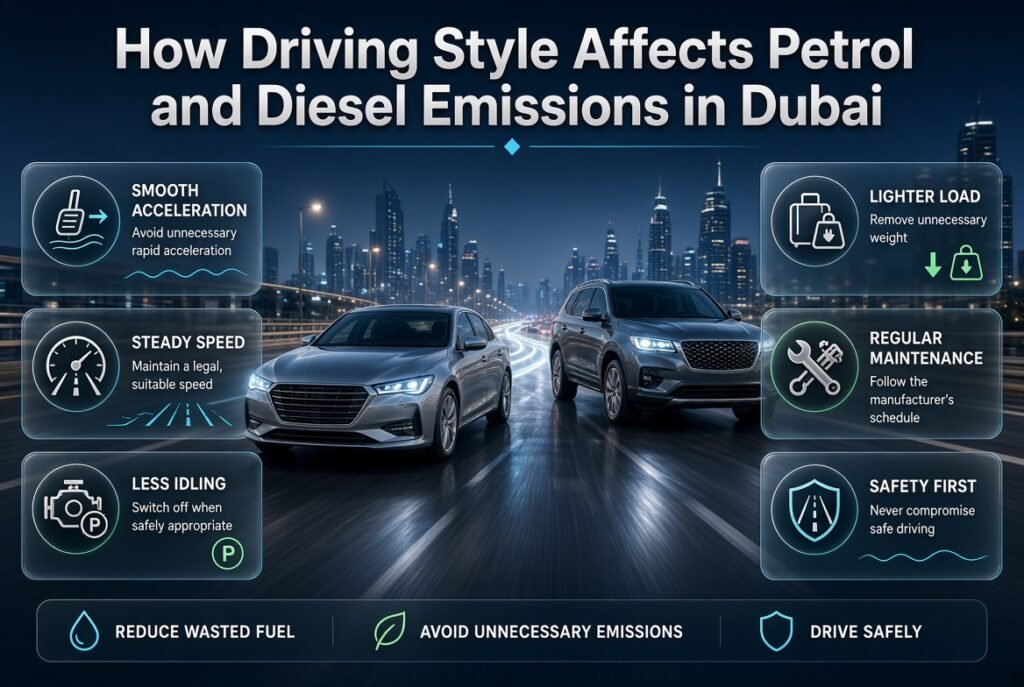
Driving behaviour can influence fuel consumption and emissions regardless of the fuel type. Efficient driving does not require travelling unusually slowly; it means using energy sensibly while following traffic conditions and road rules.
Avoid unnecessary acceleration
Rapid acceleration demands more power from the engine and can increase fuel consumption. Anticipating traffic signals and leaving sufficient space to respond smoothly can reduce unnecessary changes in speed.
This is particularly useful on congested urban roads, where aggressive acceleration often produces little practical time savings.
Maintain a steady speed when conditions allow
Frequent speed changes can waste fuel. On open roads, a consistent legal speed can help improve efficiency.
However, the best speed for fuel economy varies by vehicle. Higher speeds generally increase aerodynamic resistance, so driving faster than necessary can increase fuel use.
Reduce unnecessary idling
An idling engine consumes fuel without moving the vehicle. If you are safely parked and do not need the engine running, switching it off may reduce unnecessary emissions.
Follow the manufacturer’s guidance and avoid switching off the engine where doing so could compromise safety, essential cooling, or vehicle operation.
Keep the vehicle properly loaded
Carrying unnecessary weight increases the energy needed to accelerate. Remove items that do not need to remain in the vehicle, particularly if you regularly carry heavy equipment or luggage.
Use the correct maintenance schedule
An engine that is operating outside its intended specifications may consume more fuel or produce excessive emissions.
Routine servicing should include the checks required by the manufacturer, rather than relying on generic advice that may not suit every vehicle.
Common Mistake: Trying to improve fuel economy by driving too slowly in fast-moving traffic or coasting in an unsafe manner. Fuel-saving techniques should never compromise road safety.
9. Can Vehicle Maintenance Reduce Environmental Pollution?
Yes. Proper maintenance helps preserve fuel efficiency and keeps emissions-control equipment working as designed. It cannot eliminate exhaust emissions, but it can prevent additional pollution caused by faults and neglect.
Maintain the fuel and engine systems
Incorrect fuel delivery, faulty sensors, poor combustion, and other engine problems can affect fuel consumption and emissions.
If fuel economy suddenly deteriorates, investigate the cause rather than assuming that normal weather or traffic is responsible.
Check the catalytic converter
Petrol vehicles commonly use three-way catalytic converters to control carbon monoxide, hydrocarbons, and nitrogen oxides.
A damaged or ineffective converter may allow higher emissions. An engine fault that damages the converter should also be diagnosed, rather than replacing the converter without identifying the underlying cause.
Maintain diesel particulate filters
A DPF traps soot from diesel exhaust. It must periodically remove accumulated soot through regeneration under the conditions specified by the manufacturer.
Repeated regeneration warnings, reduced engine performance, or a persistent DPF warning light require appropriate diagnosis.
Drivers should not attempt to solve a recurring problem by removing the filter or disabling emissions controls. Such modifications can increase pollution and may breach applicable requirements.
Inspect EGR and SCR systems
EGR helps control nitrogen oxide formation by recirculating a portion of the exhaust gas. SCR systems reduce NOx through exhaust after-treatment, generally using an approved urea-based reducing agent.
Faults, incorrect fluids, or neglected maintenance can prevent these systems from performing as intended.
Keep tyres at the correct pressure
Underinflated tyres increase rolling resistance and may increase fuel consumption. Check the recommended pressure and inspect tyres for damage and uneven wear.
Correct pressure also supports handling, braking, and tyre longevity.
Investigate unusual smoke and warning lights
Persistent exhaust smoke, a strong unusual exhaust smell, repeated emissions warnings, or sudden fuel-consumption changes should not be ignored.
The correct repair depends on the underlying fault. Professional diagnosis is more reliable than replacing parts based on guesswork.
For a deeper discussion of common faults and their implications, see Common Petrol vs Diesel Engine Problems in Dubai.
10. What Mistakes Should Drivers Avoid When Comparing Environmental Impact?
Choosing a vehicle based on a single specification can lead to a misleading environmental comparison. These are the most common mistakes and how to avoid them.
Mistake 1: Assuming diesel is always environmentally friendly
Diesel engines often use less fuel, but their NOx and particulate emissions can be higher than those of comparable petrol vehicles.
Why it happens: Drivers often focus on kilometres per litre without considering air pollutants.
How to avoid it: Compare CO₂, NOx, particulate emissions, and fuel consumption separately.
Mistake 2: Assuming petrol is always cleaner
An older petrol vehicle with a faulty catalytic converter may emit substantial pollutants. A modern diesel with effective emissions controls may perform better in certain categories.
Why it happens: Generalisations about traditional engine technology are applied to every modern vehicle.
How to avoid it: Compare the exact model year, engine, emissions standard, and maintenance condition.
Mistake 3: Comparing vehicles of very different sizes
A large diesel SUV may consume more fuel overall than a smaller petrol sedan, despite the diesel engine’s efficiency advantage.
Why it happens: Drivers compare fuel type instead of comparing vehicles designed for similar purposes.
How to avoid it: Start with vehicles of comparable size, weight, passenger capacity, and intended use.
Mistake 4: Ignoring the effect of short journeys
Repeated short trips can increase fuel consumption and may create DPF regeneration difficulties in some diesel vehicles.
Why it happens: Drivers assume that a vehicle’s official fuel economy will remain the same on every journey.
How to avoid it: Evaluate your usual trip length and consider the engine’s operating requirements before purchasing.
Mistake 5: Delaying emissions-system repairs
A faulty catalytic converter, DPF, EGR valve, or SCR system can compromise emissions control.
Why it happens: Some drivers focus only on whether the vehicle can still be driven.
How to avoid it: Investigate recurring warning lights and follow the manufacturer’s repair recommendations.
Mistake 6: Confusing fuel economy with complete environmental performance
Lower fuel use generally helps reduce tailpipe CO₂, but it does not automatically mean lower NOx or particulate emissions.
Why it happens: Fuel consumption is easier to compare than the full range of pollutants.
How to avoid it: Assess climate emissions, local air pollution, and lifecycle impacts separately.
Mistake 7: Overlooking vehicle lifespan
Replacing a vehicle solely because a newer model has better fuel economy may not always deliver the environmental benefit a driver expects. Manufacturing a replacement also requires resources and energy.
Why it happens: Drivers focus on operating efficiency without considering manufacturing impacts.
How to avoid it: Compare the condition and expected useful life of your current vehicle with the likely benefits of a replacement. The best decision depends on the age, emissions, reliability, and expected mileage of both vehicles.
11. Are Hybrid and Electric Vehicles Better Alternatives?
Drivers concerned about environmental impact may also consider hybrid, plug-in hybrid, and battery-electric vehicles. These technologies offer different advantages, and the best choice depends on how the vehicle will be used.
Conventional hybrid vehicles
A hybrid combines a combustion engine with an electric motor and battery. The system can recover some energy during braking and use electric assistance to reduce fuel consumption.
Hybrids can be particularly efficient in stop-start driving, although their benefits vary by model and driving conditions.
They still produce tailpipe emissions when the combustion engine operates.
Plug-in hybrid vehicles
Plug-in hybrids have a larger battery that can be charged externally. They can complete some journeys using electric power before the combustion engine becomes necessary.
Their environmental performance depends heavily on charging habits, journey length, electricity use, and how frequently the petrol engine operates.
A plug-in hybrid that is rarely charged may deliver much less fuel-saving benefit than a driver expects.
Battery-electric vehicles
Battery-electric vehicles have no tailpipe exhaust emissions while driving. They therefore avoid direct exhaust emissions of CO₂, NOx, and combustion-related particles during operation.
However, they are not completely impact-free. Electricity generation, battery manufacturing, vehicle production, tyre wear, and eventual disposal all have environmental implications.
The overall climate benefit depends partly on the electricity supply and the vehicle’s lifecycle.
Which alternative suits Dubai?
Consider your daily distance, charging access, parking arrangements, vehicle budget, and expected ownership period.
For drivers who mainly travel short urban distances, an efficient hybrid may be worth comparing with conventional petrol and diesel cars. Drivers with convenient charging and suitable travel patterns may also find a battery-electric vehicle practical.
The important principle is to compare real-world usage rather than assuming that one technology is the best choice for every driver.
12. How Can You Estimate the Environmental Impact of Your Own Vehicle?
The most useful comparison is based on how much you drive, how much fuel your vehicle consumes, and which pollutants it releases. You do not need specialist equipment to estimate fuel-related CO₂ emissions, although detailed air-pollution measurements require reliable emissions data.
Step 1: Calculate your annual distance
Estimate the number of kilometres you drive in a typical year. Include commuting, shopping, family journeys, and longer trips between Dubai and other emirates.
For example, if you drive approximately 60 km per working day for 250 days, your commuting distance alone is 15,000 km. Weekend and holiday journeys would increase the total.
Step 2: Calculate annual fuel consumption
Multiply your annual distance by your average fuel consumption, then divide by 100.
For a vehicle averaging 7 litres per 100 km and travelling 15,000 km annually:
15,000 × 7 ÷ 100 = 1,050 litres per year.
Use your actual fuel records if available. Dashboard estimates can be useful, but they may not match the result calculated from refuelling records.
Step 3: Estimate tailpipe CO₂
Multiply annual fuel consumption by an appropriate emissions factor for the fuel.
For an illustrative petrol vehicle using 1,050 litres annually, an approximate factor of 2.31 kg CO₂ per litre gives:
1,050 × 2.31 = 2,425.5 kg CO₂ per year.
This estimate represents tailpipe CO₂ from fuel combustion. It does not include the emissions associated with producing and delivering the fuel.
Step 4: Compare other emissions separately
Fuel consumption alone cannot establish whether a vehicle produces less NOx or particulate matter. Look for credible vehicle-specific data or information from recognised emissions-testing programmes.
When comparing used vehicles, also consider whether the emissions-control equipment is present and functioning correctly.
Step 5: Review your result annually
Fuel economy can change with traffic patterns, mileage, maintenance, tyre condition, and vehicle age. Reviewing your fuel records helps you identify unusual increases and evaluate whether your driving habits are becoming more efficient.
Professional recommendation: Use your own driving data for fuel and CO₂ estimates, but do not treat those calculations as direct measurements of local air pollution. The two questions require different information.
13. What Is the Difference Between Tailpipe Emissions and Lifecycle Emissions?
Tailpipe emissions are pollutants released directly by a vehicle while it operates. Lifecycle emissions include the environmental impact of producing fuel, manufacturing the vehicle, operating it, and handling it at the end of its useful life.
Both measurements are useful, but they answer different questions.
Tailpipe emissions
For petrol and diesel vehicles, tailpipe emissions include CO₂, NOx, and other combustion-related pollutants.
Tailpipe measurements are useful when comparing how conventional vehicles affect local air quality and how much CO₂ they release during driving.
A vehicle with lower fuel consumption will generally produce less tailpipe CO₂ over the same distance, assuming comparable fuel and operating conditions.
Fuel production and supply
Petrol and diesel must be extracted or sourced from raw materials, refined, and transported before they reach a vehicle’s fuel tank.
These processes require energy and can generate greenhouse gas emissions. Their contribution varies according to the production pathway, refinery operations, transport, and other factors.
Consequently, a tailpipe-only comparison does not represent the entire climate impact of using a fuel.
Vehicle manufacturing
Manufacturing a vehicle requires materials, energy, components, and industrial processes. Battery-electric vehicles can have higher manufacturing emissions than some conventional vehicles, partly because of battery production, although the difference varies considerably by model and production method.
Over the vehicle’s lifetime, operating emissions may offset some or all of that initial difference. The result depends on the electricity supply, annual mileage, vehicle efficiency, and useful life.
Why this distinction matters in Dubai
A driver comparing a petrol sedan, a diesel SUV, and an electric vehicle should consider both immediate and long-term environmental effects.
For example, a battery-electric vehicle produces no tailpipe exhaust while driving, but its lifecycle emissions depend on electricity generation and manufacturing. A diesel vehicle may offer good fuel economy but still produce exhaust pollutants.
The most responsible comparison uses consistent assumptions about vehicle size, lifetime distance, energy use, and the emissions included in the assessment.
For a closer look at how different exhaust pollutants compare, see Petrol vs Diesel Emissions Comparison in Dubai.
14. Expert Recommendations for Environmentally Responsible Driving in Dubai

Choosing an efficient vehicle is important, but the way you maintain and use it also affects its environmental performance. The following recommendations help translate the technical comparison into everyday decisions.
Choose the right vehicle for the job
Do not purchase a large diesel SUV if a smaller vehicle meets your passenger and luggage needs. Similarly, do not choose a petrol vehicle solely because you assume it is cleaner without comparing its fuel consumption and emissions.
Vehicle size, weight, engine efficiency, and intended use should all influence the decision.
Check emissions equipment before buying used
Ask for maintenance records and inspect the vehicle for warning lights, engine faults, and signs of exhaust-system modification.
A used diesel with a missing DPF or a petrol car with an ineffective catalytic converter may not deliver the emissions performance expected from its original specifications.
Match the engine to your regular journeys
Frequent long-distance driving can favour a suitable diesel vehicle. Short urban journeys may make a petrol car or hybrid more practical, particularly if the diesel model’s exhaust system requires operating conditions your usual journeys rarely provide.
Do not base the decision on occasional holiday trips if nearly all your regular driving happens in congested urban traffic.
Investigate sudden fuel-consumption changes
If a vehicle begins using noticeably more fuel, check the tyre pressure, maintenance history, and engine warning indicators. Mechanical faults, driving changes, and traffic conditions can all contribute.
Diagnose the underlying cause before assuming that the engine type itself is inefficient.
Measure progress instead of guessing
Keep a simple record of kilometres travelled and fuel purchased. This can help you identify changes in fuel economy and evaluate whether smoother driving or improved maintenance is making a difference.
Remember that better fuel economy is a useful indicator of reduced fuel-related CO₂ emissions, but it is not a complete measure of local air pollution.
Consider reducing vehicle kilometres
When practical, combine errands, share journeys, use public transport, or choose a suitable alternative to driving alone. Reducing unnecessary journeys can lower total fuel use regardless of whether the vehicle runs on petrol or diesel.
For further information about the differences between the two fuel types, visit Petrol vs. Diesel Comparisons Dubai.
15. How Should Dubai Drivers Make the Final Decision?
The right choice depends on your driving habits, vehicle requirements, and environmental priorities. A driver who covers long distances every week may reach a different conclusion from someone who mostly drives a few kilometres around a residential neighbourhood.
Before deciding, compare the following factors.
| Decision factor | What to consider |
|---|---|
| Annual mileage | Higher mileage makes fuel efficiency increasingly important |
| Journey type | Frequent short trips and sustained highway driving create different operating conditions |
| Vehicle size | Larger vehicles often require more energy to move |
| CO₂ emissions | Compare the actual figures for each model |
| NOx and particulate emissions | Check the emissions standard and available test data |
| Maintenance | Consider the condition and servicing requirements of emissions equipment |
| Ownership period | Include expected mileage, useful life, and manufacturing impacts where data is available |
| Alternative technologies | Compare petrol, diesel, hybrid, and electric options where practical |
Example: A private commuter
A driver who travels short distances through Dubai traffic, makes frequent stops, and rarely drives on the highway may find a petrol hybrid worth considering. The vehicle’s ability to use electric assistance during suitable conditions may reduce fuel consumption.
However, a conventional petrol car with good efficiency could also be a sensible option. The decision should be based on actual vehicle performance rather than assumptions about fuel type.
Example: A high-mileage highway driver
A driver regularly travelling between Dubai and Abu Dhabi may benefit from a fuel-efficient diesel designed for long-distance operation. Its lower fuel consumption could reduce operational CO₂ emissions compared with a less efficient petrol alternative.
The diesel vehicle must still have functioning emissions controls. Lower fuel consumption does not eliminate NOx or particulate pollution.
Example: A business operating several vehicles
A business managing delivery vehicles or commercial transport should evaluate fuel use across its fleet, not just the efficiency of one vehicle.
Useful measures include:
- Fuel consumption per 100 km.
- Annual kilometres travelled by each vehicle.
- Maintenance and emissions-system records.
- Vehicle load and journey type.
- Unnecessary idling and avoidable mileage.
- The suitability of alternative vehicle technologies.
Fleet managers can use these records to identify inefficient vehicles, improve maintenance planning, and make better replacement decisions.
For drivers interested in how these fuel types differ under actual driving conditions, Petrol vs Diesel Driving Performance in Dubai provides additional context on acceleration, torque, and everyday vehicle behaviour.
The most reliable decision is the one based on your own requirements, supported by vehicle-specific evidence and realistic expectations.
Is petrol or diesel better for the environment in Dubai?
Choosing between petrol and diesel depends on your vehicle, driving habits, fuel consumption, and the type of emissions you want to reduce. Diesel engines generally offer better fuel efficiency and can produce less carbon dioxide (CO₂) per kilometre than comparable petrol vehicles. However, diesel engines can produce higher nitrogen oxides (NOx) and particulate emissions, which contribute to air pollution. Modern emissions-control technology can reduce these pollutants, but its effectiveness depends on proper maintenance and operating conditions.
For Dubai drivers, the best option depends on whether most journeys involve congested city roads, short trips, or longer highway travel.
Important factors to consider:
Compare CO₂ emissions per kilometre rather than only fuel consumption per litre.
Check the vehicle’s NOx and particulate emissions where reliable data is available.
Consider an efficient petrol car or hybrid for frequent urban journeys.
Ensure that catalytic converters, diesel particulate filters, and other emissions systems function correctly.
Does a diesel car produce less carbon dioxide than a petrol car in Dubai?
A diesel car can produce less CO₂ per kilometre because diesel engines typically use less fuel for the same distance. Although burning a litre of diesel releases more CO₂ than burning a litre of petrol, the diesel engine’s fuel-efficiency advantage can offset this difference. The actual result depends on the vehicles being compared, their weight, engine design, driving conditions, and fuel consumption.
For example, a diesel vehicle averaging 6 litres per 100 km may produce less tailpipe CO₂ than a comparable petrol vehicle averaging 8 litres per 100 km. However, this comparison does not establish which vehicle produces less NOx or particulate pollution.
How to compare vehicles accurately:
Check the official CO₂ emissions figure in grams per kilometre.
Calculate annual fuel use using your expected driving distance.
Consider Dubai traffic, air-conditioning use, and highway mileage.
Remember that tailpipe calculations do not include fuel production or vehicle manufacturing.
How does Dubai’s hot weather affect petrol and diesel emissions?
Dubai’s hot climate can increase vehicle energy demand, particularly when air-conditioning is used extensively. In conventional petrol and diesel vehicles, the air-conditioning compressor typically adds a load to the engine, potentially increasing fuel consumption. Heavy traffic, prolonged idling, and repeated acceleration can add to this effect.
Diesel vehicles also have specific emissions-control requirements. Repeated short journeys may prevent some diesel particulate filters (DPFs) from reaching suitable conditions for regeneration, potentially allowing soot to accumulate. Petrol vehicles can also consume more fuel during inefficient operating conditions, so neither engine type is unaffected by urban driving.
Practical steps for Dubai motorists:
Combine short errands when practical to avoid unnecessary journeys.
Avoid excessive idling when it is safe to switch off the engine.
Maintain the recommended tyre pressure and service schedule.
Investigate repeated DPF warnings or sudden changes in fuel consumption.
Use air-conditioning sensibly without compromising safe cabin cooling.
Why can diesel vehicles cause more air pollution despite better fuel efficiency?
Fuel efficiency measures how effectively an engine converts fuel into useful movement, while air pollution involves the harmful substances released during combustion. Diesel engines often use less fuel per kilometre, potentially reducing CO₂ emissions, but their combustion characteristics can encourage nitrogen oxide and soot formation.
Modern diesel vehicles use systems such as diesel particulate filters (DPFs), exhaust gas recirculation (EGR), and selective catalytic reduction (SCR) to control these pollutants. When these systems operate correctly, they can substantially reduce emissions. If they are damaged, neglected, or removed, the vehicle may release significantly more pollution than intended.
What drivers should understand:
Lower fuel consumption does not automatically mean lower emissions of every pollutant.
A functioning DPF helps capture exhaust particles.
SCR systems help reduce nitrogen oxides.
Warning lights and persistent exhaust smoke should be investigated.
Vehicle condition and emissions technology matter as much as fuel type.
How can Dubai drivers reduce the environmental impact of petrol and diesel vehicles?
Drivers can reduce avoidable emissions by using fuel efficiently, maintaining their vehicles, and limiting unnecessary journeys. Although neither petrol nor diesel vehicles can eliminate tailpipe pollution, sensible driving and proper maintenance can help prevent excess fuel consumption and keep emissions-control systems working as intended.
The first step is to understand your usual driving pattern. Frequent short trips, long periods in traffic, and unnecessary acceleration can increase fuel use. A vehicle that suits your daily requirements and is maintained according to the manufacturer’s specifications is generally a better choice than one selected solely because of its fuel type.
Recommended actions:
Drive smoothly and anticipate traffic conditions to reduce unnecessary acceleration and braking.
Maintain correct tyre pressure to reduce rolling resistance.
Service the engine and emissions-control equipment according to manufacturer recommendations.
Avoid unnecessary idling and combine errands where practical.
Compare efficient petrol, diesel, hybrid, and electric vehicles when considering a replacement.
Use public transport or shared journeys when suitable to reduce total vehicle kilometres.
The most effective long-term approach is to combine an appropriate vehicle choice with efficient driving and consistent maintenance. These measures help reduce fuel use and avoidable pollution while supporting practical everyday driving in Dubai.
Conclusion: Petrol vs Diesel Environmental Impact in Dubai
The environmental impact of petrol and diesel vehicles in Dubai depends on more than the type of fuel they use. Both fuels produce emissions that contribute to climate change, while their effects on local air quality differ according to engine design, driving conditions, vehicle age, maintenance, and emissions-control technology. Petrol engines generally produce less nitrogen oxide and particulate pollution than older diesel engines, while diesel engines can offer better fuel efficiency and lower carbon dioxide emissions per kilometre in comparable vehicles. However, modern diesel vehicles with effective emissions-control systems can perform much better than older models.
Dubai’s driving conditions also influence vehicle emissions. High temperatures, heavy traffic, frequent idling, air-conditioning use, short journeys, and demanding highway driving can increase fuel consumption and affect emissions performance. Regular servicing, correct tyre pressure, smooth acceleration, timely repairs, and proper maintenance of emissions-control components can help reduce unnecessary fuel use and pollution.
When choosing between petrol and diesel, Dubai drivers should consider their daily mileage, driving routes, vehicle type, maintenance budget, and the vehicle’s verified emissions performance. A fuel-efficient vehicle that suits your actual driving needs may be a better environmental choice than selecting an engine type based on fuel economy alone. Hybrid and electric vehicles may also be worth considering where they fit your budget and charging or driving requirements.
For a broader understanding of the differences, explore our guide to petrol vs diesel comparisons and our detailed analysis of petrol and diesel emissions in Dubai.
Ultimately, reducing environmental impact requires a combination of informed vehicle selection, responsible driving, and consistent maintenance. By understanding how petrol and diesel engines affect emissions under Dubai’s real-world conditions, drivers can make more practical decisions that support fuel efficiency, cleaner air, and more responsible vehicle ownership.
Leave a Reply